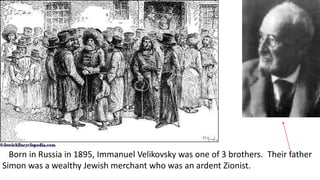

Born in Russia in 1895, Immanuel Velikovsky was one of 3 brothers. Their father
Simon was a wealthy Jewish merchant who was an ardent Zionist.
Wilhelm Stekel, one of Freud’s first pupils, trained
Velikovsky to be a psychoanalyst. Velikovsky had
gotten his MD degree in 1921 from the University of
Moscow. He lived in Palestine practicing medicine
and analysis until 1939 when he came to America.
He came to think that Pharaoh Akhnaton and his life
were the origin of the Greek Oedipus story and he
wrote a fascinating book “Oedipus and Akhnaton”.
Velikovsky also found an Egyptian papyrus that
seemed to describe the 10 plagues of the Jewish
Exodus story. This and his amazing biblical
scholarship, added to a brilliantly inventive mind, led
him to conclude that much of the chronology of
ancient history was wrong. A radical rewriting of
most ancient dates was needed, which he did.
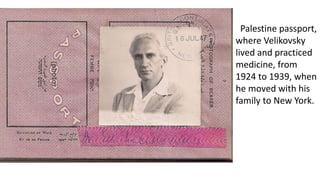
Palestine passport,
where Velikovsky
lived and practiced
medicine, from
1924 to 1939, when
he moved with his
family to New York.
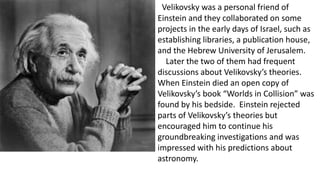
Velikovsky was a personal friend of
Einstein and they collaborated on some
projects in the early days of Israel, such as
establishing libraries, a publication house,
and the Hebrew University of Jerusalem.
Later the two of them had frequent
discussions about Velikovsky’s theories.
When Einstein died an open copy of
Velikovsky’s book “Worlds in Collision” was
found by his bedside. Einstein rejected
parts of Velikovsky’s theories but
encouraged him to continue his
groundbreaking investigations and was
impressed with his predictions about
astronomy.
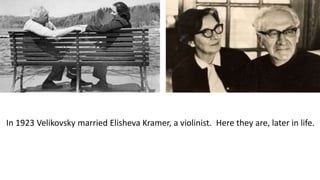
In 1923 Velikovsky married Elisheva Kramer, a violinist. Here they are, later in life.
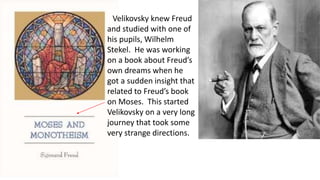
Velikovsky knew Freud
and studied with one of
his pupils, Wilhelm
Stekel. He was working
on a book about Freud’s
own dreams when he
got a sudden insight that
related to Freud’s book
on Moses. This started
Velikovsky on a very long
journey that took some
very strange directions.
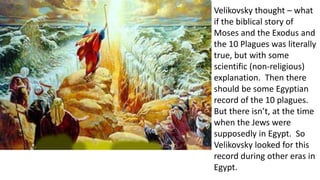
Velikovsky thought – what
if the biblical story of
Moses and the Exodus and
the 10 Plagues was literally
true, but with some
scientific (non-religious)
explanation. Then there
should be some Egyptian
record of the 10 plagues.
But there isn’t, at the time
when the Jews were
supposedly in Egypt. So
Velikovsky looked for this
record during other eras in
Egypt.
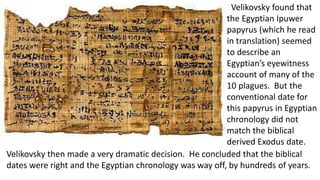
Velikovsky found that
the Egyptian Ipuwer
papyrus (which he read
in translation) seemed
to describe an
Egyptian’s eyewitness
account of many of the
10 plagues. But the
conventional date for
this papyrus in Egyptian
chronology did not
match the biblical
derived Exodus date.
Velikovsky then made a very dramatic decision. He concluded that the biblical
dates were right and the Egyptian chronology was way off, by hundreds of years.
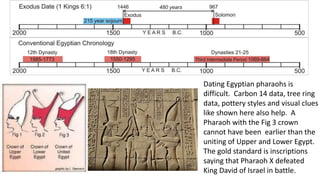
Dating Egyptian pharaohs is
difficult. Carbon 14 data, tree ring
data, pottery styles and visual clues
like shown here also help. A
Pharaoh with the Fig 3 crown
cannot have been earlier than the
uniting of Upper and Lower Egypt.
The gold standard is inscriptions
saying that Pharaoh X defeated
King David of Israel in battle.
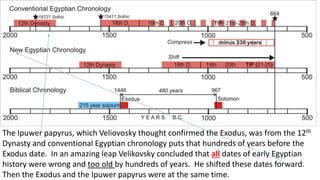
The Ipuwer papyrus, which Veliovosky thought confirmed the Exodus, was from the 12th
Dynasty and conventional Egyptian chronology puts that hundreds of years before the
Exodus date. In an amazing leap Velikovsky concluded that all dates of early Egyptian
history were wrong and too old by hundreds of years. He shifted these dates forward.
Then the Exodus and the Ipuwer papyrus were at the same time.
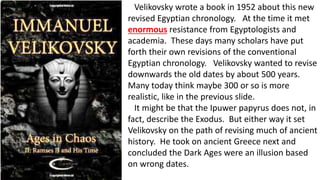
Velikovsky wrote a book in 1952 about this new
revised Egyptian chronology. At the time it met
enormous resistance from Egyptologists and
academia. These days many scholars have put
forth their own revisions of the conventional
Egyptian chronology. Velikovsky wanted to revise
downwards the old dates by about 500 years.
Many today think maybe 300 or so is more
realistic, like in the previous slide.
It might be that the Ipuwer papyrus does not, in
fact, describe the Exodus. But either way it set
Velikovsky on the path of revising much of ancient
history. He took on ancient Greece next and
concluded the Dark Ages were an illusion based
on wrong dates.
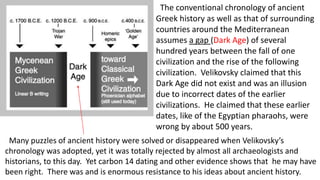
The conventional chronology of ancient
Greek history as well as that of surrounding
countries around the Mediterranean
assumes a gap (Dark Age) of several
hundred years between the fall of one
civilization and the rise of the following
civilization. Velikovsky claimed that this
Dark Age did not exist and was an illusion
due to incorrect dates of the earlier
civilizations. He claimed that these earlier
dates, like of the Egyptian pharaohs, were
wrong by about 500 years.
Many puzzles of ancient history were solved or disappeared when Velikovsky’s
chronology was adopted, yet it was totally rejected by almost all archaeologists and
historians, to this day. Yet carbon 14 dating and other evidence shows that he may have
been right. There was and is enormous resistance to his ideas about ancient history.
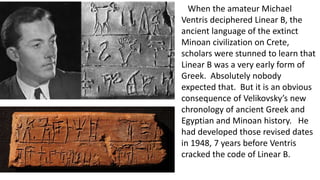
When the amateur Michael
Ventris deciphered Linear B, the
ancient language of the extinct
Minoan civilization on Crete,
scholars were stunned to learn that
Linear B was a very early form of
Greek. Absolutely nobody
expected that. But it is an obvious
consequence of Velikovsky’s new
chronology of ancient Greek and
Egyptian and Minoan history. He
had developed those revised dates
in 1948, 7 years before Ventris
cracked the code of Linear B.
Although Velikovsky continued his
research into ancient history and
solved many historical puzzles,
documented in several books, he
started to look for a possible scientific
explanation for the 10 plagues of the
Exodus and other odd biblical
“miracles”. In one, Joshua tells the sun
to stand still and it does for several
hours, giving an extra long day. Many
cultures in Europe and Asia have folk
legends of the sun standing still, giving
an extra long day on one or two
occasions. In happens twice in the
bible.
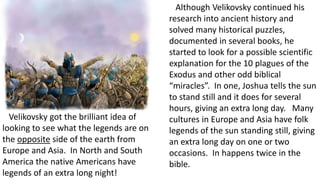
Velikovsky got the brilliant idea of
looking to see what the legends are on
the opposite side of the earth from
Europe and Asia. In North and South
America the native Americans have
legends of an extra long night!
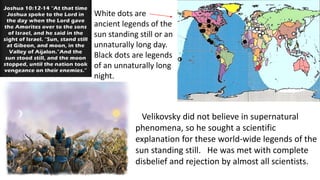
Velikovsky did not believe in supernatural
phenomena, so he sought a scientific
explanation for these world-wide legends of the
sun standing still. He was met with complete
disbelief and rejection by almost all scientists.
White dots are
ancient legends of the
sun standing still or an
unnaturally long day.
Black dots are legends
of an unnaturally long
night.
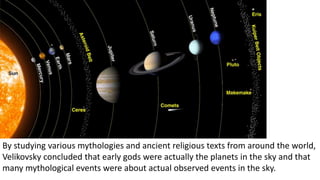
By studying various mythologies and ancient religious texts from around the world,
Velikovsky concluded that early gods were actually the planets in the sky and that
many mythological events were about actual observed events in the sky.
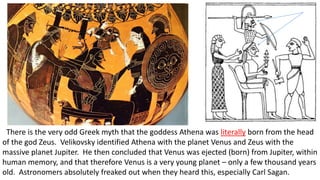
There is the very odd Greek myth that the goddess Athena was literally born from the head
of the god Zeus. Velikovsky identified Athena with the planet Venus and Zeus with the
massive planet Jupiter. He then concluded that Venus was ejected (born) from Jupiter, within
human memory, and that therefore Venus is a very young planet – only a few thousand years
old. Astronomers absolutely freaked out when they heard this, especially Carl Sagan.
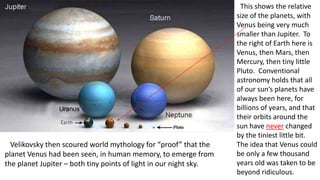
This shows the relative
size of the planets, with
Venus being very much
smaller than Jupiter. To
the right of Earth here is
Venus, then Mars, then
Mercury, then tiny little
Pluto. Conventional
astronomy holds that all
of our sun’s planets have
always been here, for
billions of years, and that
their orbits around the
sun have never changed
by the tiniest little bit.
The idea that Venus could
be only a few thousand
years old was taken to be
beyond ridiculous.
Velikovsky then scoured world mythology for “proof” that the
planet Venus had been seen, in human memory, to emerge from
the planet Jupiter – both tiny points of light in our night sky.
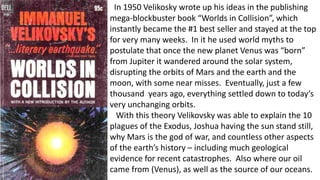
In 1950 Velikosky wrote up his ideas in the publishing
mega-blockbuster book “Worlds in Collision”, which
instantly became the #1 best seller and stayed at the top
for very many weeks. In it he used world myths to
postulate that once the new planet Venus was “born”
from Jupiter it wandered around the solar system,
disrupting the orbits of Mars and the earth and the
moon, with some near misses. Eventually, just a few
thousand years ago, everything settled down to today’s
very unchanging orbits.
With this theory Velikovsky was able to explain the 10
plagues of the Exodus, Joshua having the sun stand still,
why Mars is the god of war, and countless other aspects
of the earth’s history – including much geological
evidence for recent catastrophes. Also where our oil
came from (Venus), as well as the source of our oceans.
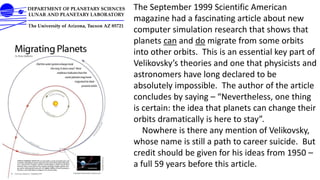
The September 1999 Scientific American
magazine had a fascinating article about new
computer simulation research that shows that
planets can and do migrate from some orbits
into other orbits. This is an essential key part of
Velikovsky’s theories and one that physicists and
astronomers have long declared to be
absolutely impossible. The author of the article
concludes by saying – “Nevertheless, one thing
is certain: the idea that planets can change their
orbits dramatically is here to stay”.
Nowhere is there any mention of Velikovsky,
whose name is still a path to career suicide. But
credit should be given for his ideas from 1950 –
a full 59 years before this article.
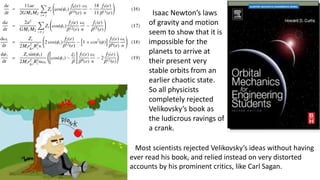
Isaac Newton’s laws
of gravity and motion
seem to show that it is
impossible for the
planets to arrive at
their present very
stable orbits from an
earlier chaotic state.
So all physicists
completely rejected
Velikovsky’s book as
the ludicrous ravings of
a crank.
Most scientists rejected Velikovsky’s ideas without having
ever read his book, and relied instead on very distorted
accounts by his prominent critics, like Carl Sagan.
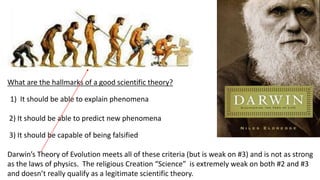
What are the hallmarks of a good scientific theory?
1) It should be able to explain phenomena
2) It should be able to predict new phenomena
3) It should be capable of being falsified
Darwin’s Theory of Evolution meets all of these criteria (but is weak on #3) and is not as strong
as the laws of physics. The religious Creation “Science” is extremely weak on both #2 and #3
and doesn’t really qualify as a legitimate scientific theory.
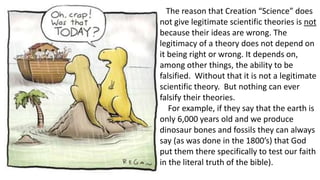
The reason that Creation “Science” does
not give legitimate scientific theories is not
because their ideas are wrong. The
legitimacy of a theory does not depend on
it being right or wrong. It depends on,
among other things, the ability to be
falsified. Without that it is not a legitimate
scientific theory. But nothing can ever
falsify their theories.
For example, if they say that the earth is
only 6,000 years old and we produce
dinosaur bones and fossils they can always
say (as was done in the 1800’s) that God
put them there specifically to test our faith
in the literal truth of the bible).
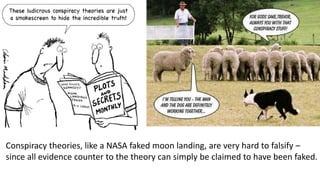
Conspiracy theories, like a NASA faked moon landing, are very hard to falsify –
since all evidence counter to the theory can simply be claimed to have been faked.
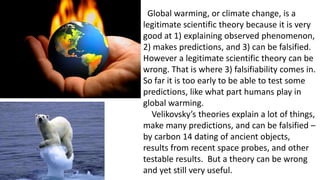
Global warming, or climate change, is a
legitimate scientific theory because it is very
good at 1) explaining observed phenomenon,
2) makes predictions, and 3) can be falsified.
However a legitimate scientific theory can be
wrong. That is where 3) falsifiability comes in.
So far it is too early to be able to test some
predictions, like what part humans play in
global warming.
Velikovsky’s theories explain a lot of things,
make many predictions, and can be falsified –
by carbon 14 dating of ancient objects,
results from recent space probes, and other
testable results. But a theory can be wrong
and yet still very useful.
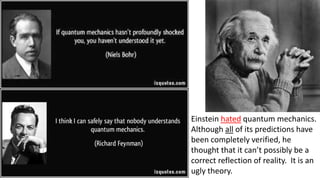
Einstein hated quantum mechanics.
Although all of its predictions have
been completely verified, he
thought that it can’t possibly be a
correct reflection of reality. It is an
ugly theory.
It may be that, just like quantum mechanics, Velikovsky’s
theories are very successful at explaining things, making accurate
predictions, and have yet to be falsified and yet
1) there may be some “better” theories, yet to be discovered,
with just as good a track record and which do not so
completely offend the established scientific, geological, and
archeological communities. Especially astronomers.
2) His highly unorthodox methods of research – looking to
ancient myths and the bible as a source of factual knowledge,
could maybe be dispensed with – with these as yet to be
discovered alternate theories.
3) False premises may sometimes lead to correct conclusions.
Maybe he has simply made many extremely lucky guesses.
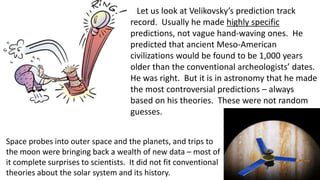
Let us look at Velikovsky’s prediction track
record. Usually he made highly specific
predictions, not vague hand-waving ones. He
predicted that ancient Meso-American
civilizations would be found to be 1,000 years
older than the conventional archeologists’ dates.
He was right. But it is in astronomy that he made
the most controversial predictions – always
based on his theories. These were not random
guesses.
Space probes into outer space and the planets, and trips to
the moon were bringing back a wealth of new data – most of
it complete surprises to scientists. It did not fit conventional
theories about the solar system and its history.
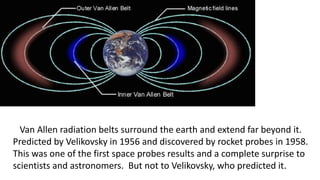
Van Allen radiation belts surround the earth and extend far beyond it.
Predicted by Velikovsky in 1956 and discovered by rocket probes in 1958.
This was one of the first space probes results and a complete surprise to
scientists and astronomers. But not to Velikovsky, who predicted it.
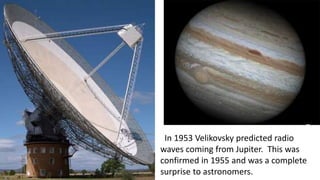
In 1953 Velikovsky predicted radio
waves coming from Jupiter. This was
confirmed in 1955 and was a complete
surprise to astronomers.
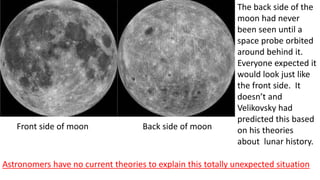
The back side of the
moon had never
been seen until a
space probe orbited
around behind it.
Everyone expected it
would look just like
the front side. It
doesn’t and
Velikovsky had
predicted this based
on his theories
about lunar history.
Front side of moon Back side of moon
Astronomers have no current theories to explain this totally unexpected situation
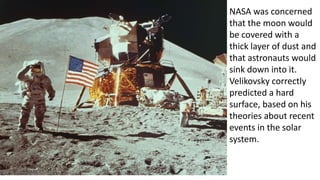
NASA was concerned
that the moon would
be covered with a
thick layer of dust and
that astronauts would
sink down into it.
Velikovsky correctly
predicted a hard
surface, based on his
theories about recent
events in the solar
system.
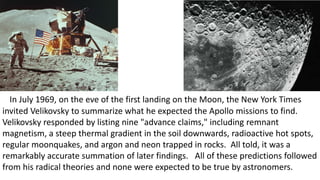
In July 1969, on the eve of the first landing on the Moon, the New York Times
invited Velikovsky to summarize what he expected the Apollo missions to find.
Velikovsky responded by listing nine "advance claims," including remnant
magnetism, a steep thermal gradient in the soil downwards, radioactive hot spots,
regular moonquakes, and argon and neon trapped in rocks. All told, it was a
remarkably accurate summation of later findings. All of these predictions followed
from his radical theories and none were expected to be true by astronomers.
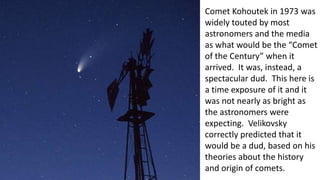
Comet Kohoutek in 1973 was
widely touted by most
astronomers and the media
as what would be the “Comet
of the Century” when it
arrived. It was, instead, a
spectacular dud. This here is
a time exposure of it and it
was not nearly as bright as
the astronomers were
expecting. Velikovsky
correctly predicted that it
would be a dud, based on his
theories about the history
and origin of comets.
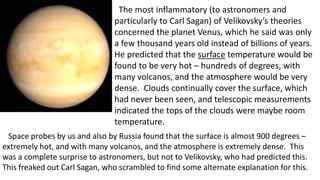
The most inflammatory (to astronomers and
particularly to Carl Sagan) of Velikovsky’s theories
concerned the planet Venus, which he said was only
a few thousand years old instead of billions of years.
He predicted that the surface temperature would be
found to be very hot – hundreds of degrees, with
many volcanos, and the atmosphere would be very
dense. Clouds continually cover the surface, which
had never been seen, and telescopic measurements
indicated the tops of the clouds were maybe room
temperature.
Space probes by us and also by Russia found that the surface is almost 900 degrees –
extremely hot, and with many volcanos, and the atmosphere is extremely dense. This
was a complete surprise to astronomers, but not to Velikovsky, who had predicted this.
This freaked out Carl Sagan, who scrambled to find some alternate explanation for this.
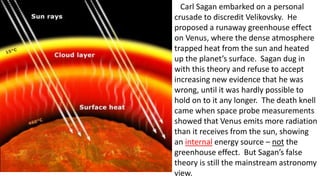
Carl Sagan embarked on a personal
crusade to discredit Velikovsky. He
proposed a runaway greenhouse effect
on Venus, where the dense atmosphere
trapped heat from the sun and heated
up the planet’s surface. Sagan dug in
with this theory and refuse to accept
increasing new evidence that he was
wrong, until it was hardly possible to
hold on to it any longer. The death knell
came when space probe measurements
showed that Venus emits more radiation
than it receives from the sun, showing
an internal energy source – not the
greenhouse effect. But Sagan’s false
theory is still the mainstream astronomy
view.
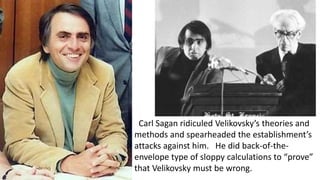
Carl Sagan ridiculed Velikovsky’s theories and
methods and spearheaded the establishment’s
attacks against him. He did back-of-the-
envelope type of sloppy calculations to “prove”
that Velikovsky must be wrong.
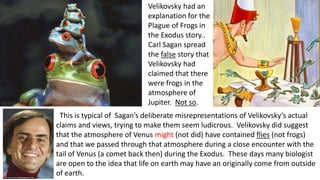
Velikovsky had an
explanation for the
Plague of Frogs in
the Exodus story..
Carl Sagan spread
the false story that
Velikovsky had
claimed that there
were frogs in the
atmosphere of
Jupiter. Not so.
This is typical of Sagan’s deliberate misrepresentations of Velikovsky’s actual
claims and views, trying to make them seem ludicrous. Velikovsky did suggest
that the atmosphere of Venus might (not did) have contained flies (not frogs)
and that we passed through that atmosphere during a close encounter with the
tail of Venus (a comet back then) during the Exodus. These days many biologist
are open to the idea that life on earth may have an originally come from outside
of earth.
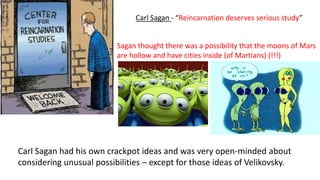
Carl Sagan had his own crackpot ideas and was very open-minded about
considering unusual possibilities – except for those ideas of Velikovsky.
Sagan thought there was a possibility that the moons of Mars
are hollow and have cities inside (of Martians) (!!!)
Carl Sagan - “Reincarnation deserves serious study”
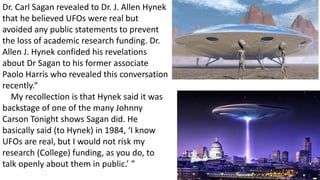
Dr. Carl Sagan revealed to Dr. J. Allen Hynek
that he believed UFOs were real but
avoided any public statements to prevent
the loss of academic research funding. Dr.
Allen J. Hynek confided his revelations
about Dr Sagan to his former associate
Paolo Harris who revealed this conversation
recently.“
My recollection is that Hynek said it was
backstage of one of the many Johnny
Carson Tonight shows Sagan did. He
basically said (to Hynek) in 1984, ‘I know
UFOs are real, but I would not risk my
research (College) funding, as you do, to
talk openly about them in public.’ ”
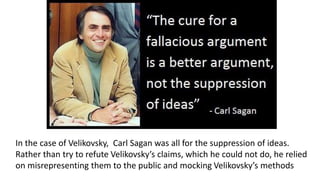
In the case of Velikovsky, Carl Sagan was all for the suppression of ideas.
Rather than try to refute Velikovsky’s claims, which he could not do, he relied
on misrepresenting them to the public and mocking Velikovsky’s methods
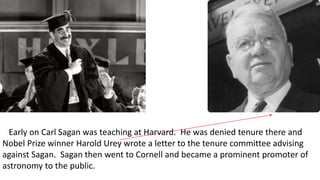
Early on Carl Sagan was teaching at Harvard. He was denied tenure there and
Nobel Prize winner Harold Urey wrote a letter to the tenure committee advising
against Sagan. Sagan then went to Cornell and became a prominent promoter of
astronomy to the public.
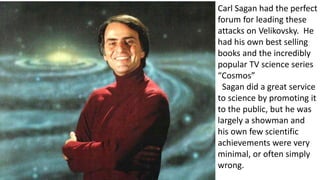
Carl Sagan had the perfect
forum for leading these
attacks on Velikovsky. He
had his own best selling
books and the incredibly
popular TV science series
“Cosmos”
Sagan did a great service
to science by promoting it
to the public, but he was
largely a showman and
his own few scientific
achievements were very
minimal, or often simply
wrong.
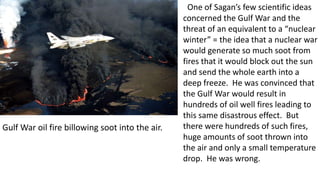
One of Sagan’s few scientific ideas
concerned the Gulf War and the
threat of an equivalent to a “nuclear
winter” = the idea that a nuclear war
would generate so much soot from
fires that it would block out the sun
and send the whole earth into a
deep freeze. He was convinced that
the Gulf War would result in
hundreds of oil well fires leading to
this same disastrous effect. But
there were hundreds of such fires,
huge amounts of soot thrown into
the air and only a small temperature
drop. He was wrong.
Gulf War oil fire billowing soot into the air.
Velikovsky represented a serious threat to the
astronomy community. They could not accept
his theories or his methods, yet he kept making
accurate predictions of space probe results that
were totally unexpected. In addition, they had
no theories of their own that could explain
these space probe results, like frequent moon
quakes, a very different back side of the moon
from what was expected, new found aspects of
Venus, etc., etc.
He and his work had to somehow be
suppressed, especially his book “Worlds in
Collision”. And so began what became known
as the very shameful “Velikovsky Affair”.
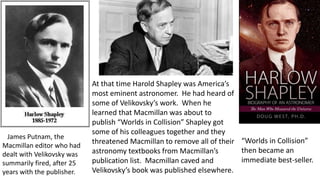
At that time Harold Shapley was America’s
most eminent astronomer. He had heard of
some of Velikovsky’s work. When he
learned that Macmillan was about to
publish “Worlds in Collision” Shapley got
some of his colleagues together and they
threatened Macmillan to remove all of their
astronomy textbooks from Macmillan’s
publication list. Macmillan caved and
Velikovsky’s book was published elsewhere.
“Worlds in Collision”
then became an
immediate best-seller.
James Putnam, the
Macmillan editor who had
dealt with Velikovsky was
summarily fired, after 25
years with the publisher.
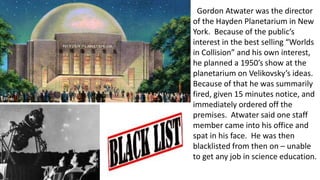
Gordon Atwater was the director
of the Hayden Planetarium in New
York. Because of the public’s
interest in the best selling “Worlds
in Collision” and his own interest,
he planned a 1950’s show at the
planetarium on Velikovsky’s ideas.
Because of that he was summarily
fired, given 15 minutes notice, and
immediately ordered off the
premises. Atwater said one staff
member came into his office and
spat in his face. He was then
blacklisted from then on – unable
to get any job in science education.
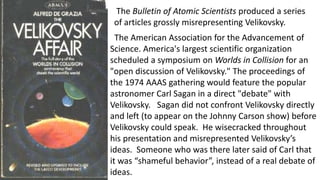
The Bulletin of Atomic Scientists produced a series
of articles grossly misrepresenting Velikovsky.
The American Association for the Advancement of
Science. America's largest scientific organization
scheduled a symposium on Worlds in Collision for an
"open discussion of Velikovsky." The proceedings of
the 1974 AAAS gathering would feature the popular
astronomer Carl Sagan in a direct "debate" with
Velikovsky. Sagan did not confront Velikovsky directly
and left (to appear on the Johnny Carson show) before
Velikovsky could speak. He wisecracked throughout
his presentation and misrepresented Velikovsky’s
ideas. Someone who was there later said of Carl that
it was “shameful behavior”, instead of a real debate of
ideas.
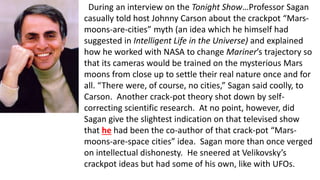
During an interview on the Tonight Show…Professor Sagan
casually told host Johnny Carson about the crackpot “Mars-
moons-are-cities” myth (an idea which he himself had
suggested in Intelligent Life in the Universe) and explained
how he worked with NASA to change Mariner’s trajectory so
that its cameras would be trained on the mysterious Mars
moons from close up to settle their real nature once and for
all. “There were, of course, no cities,” Sagan said coolly, to
Carson. Another crack-pot theory shot down by self-
correcting scientific research. At no point, however, did
Sagan give the slightest indication on that televised show
that he had been the co-author of that crack-pot “Mars-
moons-are-space cities” idea. Sagan more than once verged
on intellectual dishonesty. He sneered at Velikovsky’s
crackpot ideas but had some of his own, like with UFOs.
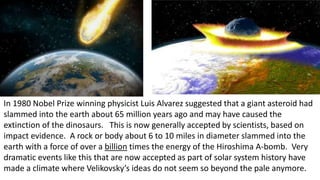
In 1980 Nobel Prize winning physicist Luis Alvarez suggested that a giant asteroid had
slammed into the earth about 65 million years ago and may have caused the
extinction of the dinosaurs. This is now generally accepted by scientists, based on
impact evidence. A rock or body about 6 to 10 miles in diameter slammed into the
earth with a force of over a billion times the energy of the Hiroshima A-bomb. Very
dramatic events like this that are now accepted as part of solar system history have
made a climate where Velikovsky’s ideas do not seem so beyond the pale anymore.
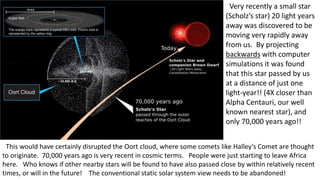
Very recently a small star
(Scholz’s star) 20 light years
away was discovered to be
moving very rapidly away
from us. By projecting
backwards with computer
simulations it was found
that this star passed by us
at a distance of just one
light-year!! (4X closer than
Alpha Centauri, our well
known nearest star), and
only 70,000 years ago!!
This would have certainly disrupted the Oort cloud, where some comets like Halley’s Comet are thought
to originate. 70,000 years ago is very recent in cosmic terms. People were just starting to leave Africa
here. Who knows if other nearby stars will be found to have also passed close by within relatively recent
times, or will in the future! The conventional static solar system view needs to be abandoned!
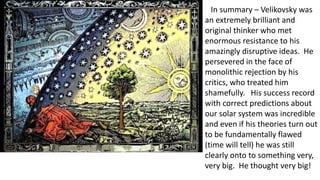
In summary – Velikovsky was
an extremely brilliant and
original thinker who met
enormous resistance to his
amazingly disruptive ideas. He
persevered in the face of
monolithic rejection by his
critics, who treated him
shamefully. His success record
with correct predictions about
our solar system was incredible
and even if his theories turn out
to be fundamentally flawed
(time will tell) he was still
clearly onto to something very,
very big. He thought very big!
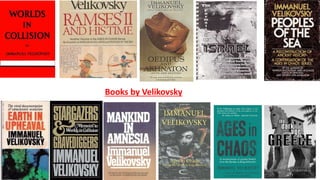
Books by Velikovsky
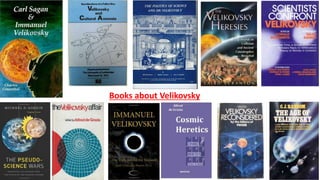
Books about Velikovsky
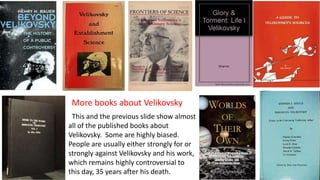
This and the previous slide show almost
all of the published books about
Velikovsky. Some are highly biased.
People are usually either strongly for or
strongly against Velikovsky and his work,
which remains highly controversial to
this day, 35 years after his death.
More books about Velikovsky

Revised Velikovsky slideshow

  • 2.
    Born in Russiain 1895, Immanuel Velikovsky was one of 3 brothers. Their father Simon was a wealthy Jewish merchant who was an ardent Zionist.
  • 4.
    Wilhelm Stekel, oneof Freud’s first pupils, trained Velikovsky to be a psychoanalyst. Velikovsky had gotten his MD degree in 1921 from the University of Moscow. He lived in Palestine practicing medicine and analysis until 1939 when he came to America. He came to think that Pharaoh Akhnaton and his life were the origin of the Greek Oedipus story and he wrote a fascinating book “Oedipus and Akhnaton”. Velikovsky also found an Egyptian papyrus that seemed to describe the 10 plagues of the Jewish Exodus story. This and his amazing biblical scholarship, added to a brilliantly inventive mind, led him to conclude that much of the chronology of ancient history was wrong. A radical rewriting of most ancient dates was needed, which he did.
  • 5.
    Palestine passport, where Velikovsky livedand practiced medicine, from 1924 to 1939, when he moved with his family to New York.
  • 6.
    Velikovsky was apersonal friend of Einstein and they collaborated on some projects in the early days of Israel, such as establishing libraries, a publication house, and the Hebrew University of Jerusalem. Later the two of them had frequent discussions about Velikovsky’s theories. When Einstein died an open copy of Velikovsky’s book “Worlds in Collision” was found by his bedside. Einstein rejected parts of Velikovsky’s theories but encouraged him to continue his groundbreaking investigations and was impressed with his predictions about astronomy.
  • 7.
    In 1923 Velikovskymarried Elisheva Kramer, a violinist. Here they are, later in life.
  • 8.
    Velikovsky knew Freud andstudied with one of his pupils, Wilhelm Stekel. He was working on a book about Freud’s own dreams when he got a sudden insight that related to Freud’s book on Moses. This started Velikovsky on a very long journey that took some very strange directions.
  • 9.
    Velikovsky thought –what if the biblical story of Moses and the Exodus and the 10 Plagues was literally true, but with some scientific (non-religious) explanation. Then there should be some Egyptian record of the 10 plagues. But there isn’t, at the time when the Jews were supposedly in Egypt. So Velikovsky looked for this record during other eras in Egypt.
  • 10.
    Velikovsky found that theEgyptian Ipuwer papyrus (which he read in translation) seemed to describe an Egyptian’s eyewitness account of many of the 10 plagues. But the conventional date for this papyrus in Egyptian chronology did not match the biblical derived Exodus date. Velikovsky then made a very dramatic decision. He concluded that the biblical dates were right and the Egyptian chronology was way off, by hundreds of years.
  • 11.
    Dating Egyptian pharaohsis difficult. Carbon 14 data, tree ring data, pottery styles and visual clues like shown here also help. A Pharaoh with the Fig 3 crown cannot have been earlier than the uniting of Upper and Lower Egypt. The gold standard is inscriptions saying that Pharaoh X defeated King David of Israel in battle.
  • 12.
    The Ipuwer papyrus,which Veliovosky thought confirmed the Exodus, was from the 12th Dynasty and conventional Egyptian chronology puts that hundreds of years before the Exodus date. In an amazing leap Velikovsky concluded that all dates of early Egyptian history were wrong and too old by hundreds of years. He shifted these dates forward. Then the Exodus and the Ipuwer papyrus were at the same time.
  • 14.
    Velikovsky wrote abook in 1952 about this new revised Egyptian chronology. At the time it met enormous resistance from Egyptologists and academia. These days many scholars have put forth their own revisions of the conventional Egyptian chronology. Velikovsky wanted to revise downwards the old dates by about 500 years. Many today think maybe 300 or so is more realistic, like in the previous slide. It might be that the Ipuwer papyrus does not, in fact, describe the Exodus. But either way it set Velikovsky on the path of revising much of ancient history. He took on ancient Greece next and concluded the Dark Ages were an illusion based on wrong dates.
  • 15.
    The conventional chronologyof ancient Greek history as well as that of surrounding countries around the Mediterranean assumes a gap (Dark Age) of several hundred years between the fall of one civilization and the rise of the following civilization. Velikovsky claimed that this Dark Age did not exist and was an illusion due to incorrect dates of the earlier civilizations. He claimed that these earlier dates, like of the Egyptian pharaohs, were wrong by about 500 years. Many puzzles of ancient history were solved or disappeared when Velikovsky’s chronology was adopted, yet it was totally rejected by almost all archaeologists and historians, to this day. Yet carbon 14 dating and other evidence shows that he may have been right. There was and is enormous resistance to his ideas about ancient history.
  • 16.
    When the amateurMichael Ventris deciphered Linear B, the ancient language of the extinct Minoan civilization on Crete, scholars were stunned to learn that Linear B was a very early form of Greek. Absolutely nobody expected that. But it is an obvious consequence of Velikovsky’s new chronology of ancient Greek and Egyptian and Minoan history. He had developed those revised dates in 1948, 7 years before Ventris cracked the code of Linear B.
  • 17.
    Although Velikovsky continuedhis research into ancient history and solved many historical puzzles, documented in several books, he started to look for a possible scientific explanation for the 10 plagues of the Exodus and other odd biblical “miracles”. In one, Joshua tells the sun to stand still and it does for several hours, giving an extra long day. Many cultures in Europe and Asia have folk legends of the sun standing still, giving an extra long day on one or two occasions. In happens twice in the bible. Velikovsky got the brilliant idea of looking to see what the legends are on the opposite side of the earth from Europe and Asia. In North and South America the native Americans have legends of an extra long night!
  • 18.
    Velikovsky did notbelieve in supernatural phenomena, so he sought a scientific explanation for these world-wide legends of the sun standing still. He was met with complete disbelief and rejection by almost all scientists. White dots are ancient legends of the sun standing still or an unnaturally long day. Black dots are legends of an unnaturally long night.
  • 19.
    By studying variousmythologies and ancient religious texts from around the world, Velikovsky concluded that early gods were actually the planets in the sky and that many mythological events were about actual observed events in the sky.
  • 20.
    There is thevery odd Greek myth that the goddess Athena was literally born from the head of the god Zeus. Velikovsky identified Athena with the planet Venus and Zeus with the massive planet Jupiter. He then concluded that Venus was ejected (born) from Jupiter, within human memory, and that therefore Venus is a very young planet – only a few thousand years old. Astronomers absolutely freaked out when they heard this, especially Carl Sagan.
  • 21.
    This shows therelative size of the planets, with Venus being very much smaller than Jupiter. To the right of Earth here is Venus, then Mars, then Mercury, then tiny little Pluto. Conventional astronomy holds that all of our sun’s planets have always been here, for billions of years, and that their orbits around the sun have never changed by the tiniest little bit. The idea that Venus could be only a few thousand years old was taken to be beyond ridiculous. Velikovsky then scoured world mythology for “proof” that the planet Venus had been seen, in human memory, to emerge from the planet Jupiter – both tiny points of light in our night sky.
  • 22.
    In 1950 Velikoskywrote up his ideas in the publishing mega-blockbuster book “Worlds in Collision”, which instantly became the #1 best seller and stayed at the top for very many weeks. In it he used world myths to postulate that once the new planet Venus was “born” from Jupiter it wandered around the solar system, disrupting the orbits of Mars and the earth and the moon, with some near misses. Eventually, just a few thousand years ago, everything settled down to today’s very unchanging orbits. With this theory Velikovsky was able to explain the 10 plagues of the Exodus, Joshua having the sun stand still, why Mars is the god of war, and countless other aspects of the earth’s history – including much geological evidence for recent catastrophes. Also where our oil came from (Venus), as well as the source of our oceans.
  • 23.
    The September 1999Scientific American magazine had a fascinating article about new computer simulation research that shows that planets can and do migrate from some orbits into other orbits. This is an essential key part of Velikovsky’s theories and one that physicists and astronomers have long declared to be absolutely impossible. The author of the article concludes by saying – “Nevertheless, one thing is certain: the idea that planets can change their orbits dramatically is here to stay”. Nowhere is there any mention of Velikovsky, whose name is still a path to career suicide. But credit should be given for his ideas from 1950 – a full 59 years before this article.
  • 24.
    Isaac Newton’s laws ofgravity and motion seem to show that it is impossible for the planets to arrive at their present very stable orbits from an earlier chaotic state. So all physicists completely rejected Velikovsky’s book as the ludicrous ravings of a crank. Most scientists rejected Velikovsky’s ideas without having ever read his book, and relied instead on very distorted accounts by his prominent critics, like Carl Sagan.
  • 25.
    What are thehallmarks of a good scientific theory? 1) It should be able to explain phenomena 2) It should be able to predict new phenomena 3) It should be capable of being falsified Darwin’s Theory of Evolution meets all of these criteria (but is weak on #3) and is not as strong as the laws of physics. The religious Creation “Science” is extremely weak on both #2 and #3 and doesn’t really qualify as a legitimate scientific theory.
  • 26.
    The reason thatCreation “Science” does not give legitimate scientific theories is not because their ideas are wrong. The legitimacy of a theory does not depend on it being right or wrong. It depends on, among other things, the ability to be falsified. Without that it is not a legitimate scientific theory. But nothing can ever falsify their theories. For example, if they say that the earth is only 6,000 years old and we produce dinosaur bones and fossils they can always say (as was done in the 1800’s) that God put them there specifically to test our faith in the literal truth of the bible).
  • 27.
    Conspiracy theories, likea NASA faked moon landing, are very hard to falsify – since all evidence counter to the theory can simply be claimed to have been faked.
  • 28.
    Global warming, orclimate change, is a legitimate scientific theory because it is very good at 1) explaining observed phenomenon, 2) makes predictions, and 3) can be falsified. However a legitimate scientific theory can be wrong. That is where 3) falsifiability comes in. So far it is too early to be able to test some predictions, like what part humans play in global warming. Velikovsky’s theories explain a lot of things, make many predictions, and can be falsified – by carbon 14 dating of ancient objects, results from recent space probes, and other testable results. But a theory can be wrong and yet still very useful.
  • 29.
    Einstein hated quantummechanics. Although all of its predictions have been completely verified, he thought that it can’t possibly be a correct reflection of reality. It is an ugly theory.
  • 30.
    It may bethat, just like quantum mechanics, Velikovsky’s theories are very successful at explaining things, making accurate predictions, and have yet to be falsified and yet 1) there may be some “better” theories, yet to be discovered, with just as good a track record and which do not so completely offend the established scientific, geological, and archeological communities. Especially astronomers. 2) His highly unorthodox methods of research – looking to ancient myths and the bible as a source of factual knowledge, could maybe be dispensed with – with these as yet to be discovered alternate theories. 3) False premises may sometimes lead to correct conclusions. Maybe he has simply made many extremely lucky guesses.
  • 31.
    Let us lookat Velikovsky’s prediction track record. Usually he made highly specific predictions, not vague hand-waving ones. He predicted that ancient Meso-American civilizations would be found to be 1,000 years older than the conventional archeologists’ dates. He was right. But it is in astronomy that he made the most controversial predictions – always based on his theories. These were not random guesses. Space probes into outer space and the planets, and trips to the moon were bringing back a wealth of new data – most of it complete surprises to scientists. It did not fit conventional theories about the solar system and its history.
  • 32.
    Van Allen radiationbelts surround the earth and extend far beyond it. Predicted by Velikovsky in 1956 and discovered by rocket probes in 1958. This was one of the first space probes results and a complete surprise to scientists and astronomers. But not to Velikovsky, who predicted it.
  • 33.
    In 1953 Velikovskypredicted radio waves coming from Jupiter. This was confirmed in 1955 and was a complete surprise to astronomers.
  • 34.
    The back sideof the moon had never been seen until a space probe orbited around behind it. Everyone expected it would look just like the front side. It doesn’t and Velikovsky had predicted this based on his theories about lunar history. Front side of moon Back side of moon Astronomers have no current theories to explain this totally unexpected situation
  • 35.
    NASA was concerned thatthe moon would be covered with a thick layer of dust and that astronauts would sink down into it. Velikovsky correctly predicted a hard surface, based on his theories about recent events in the solar system.
  • 36.
    In July 1969,on the eve of the first landing on the Moon, the New York Times invited Velikovsky to summarize what he expected the Apollo missions to find. Velikovsky responded by listing nine "advance claims," including remnant magnetism, a steep thermal gradient in the soil downwards, radioactive hot spots, regular moonquakes, and argon and neon trapped in rocks. All told, it was a remarkably accurate summation of later findings. All of these predictions followed from his radical theories and none were expected to be true by astronomers.
  • 37.
    Comet Kohoutek in1973 was widely touted by most astronomers and the media as what would be the “Comet of the Century” when it arrived. It was, instead, a spectacular dud. This here is a time exposure of it and it was not nearly as bright as the astronomers were expecting. Velikovsky correctly predicted that it would be a dud, based on his theories about the history and origin of comets.
  • 38.
    The most inflammatory(to astronomers and particularly to Carl Sagan) of Velikovsky’s theories concerned the planet Venus, which he said was only a few thousand years old instead of billions of years. He predicted that the surface temperature would be found to be very hot – hundreds of degrees, with many volcanos, and the atmosphere would be very dense. Clouds continually cover the surface, which had never been seen, and telescopic measurements indicated the tops of the clouds were maybe room temperature. Space probes by us and also by Russia found that the surface is almost 900 degrees – extremely hot, and with many volcanos, and the atmosphere is extremely dense. This was a complete surprise to astronomers, but not to Velikovsky, who had predicted this. This freaked out Carl Sagan, who scrambled to find some alternate explanation for this.
  • 39.
    Carl Sagan embarkedon a personal crusade to discredit Velikovsky. He proposed a runaway greenhouse effect on Venus, where the dense atmosphere trapped heat from the sun and heated up the planet’s surface. Sagan dug in with this theory and refuse to accept increasing new evidence that he was wrong, until it was hardly possible to hold on to it any longer. The death knell came when space probe measurements showed that Venus emits more radiation than it receives from the sun, showing an internal energy source – not the greenhouse effect. But Sagan’s false theory is still the mainstream astronomy view.
  • 40.
    Carl Sagan ridiculedVelikovsky’s theories and methods and spearheaded the establishment’s attacks against him. He did back-of-the- envelope type of sloppy calculations to “prove” that Velikovsky must be wrong.
  • 41.
    Velikovsky had an explanationfor the Plague of Frogs in the Exodus story.. Carl Sagan spread the false story that Velikovsky had claimed that there were frogs in the atmosphere of Jupiter. Not so. This is typical of Sagan’s deliberate misrepresentations of Velikovsky’s actual claims and views, trying to make them seem ludicrous. Velikovsky did suggest that the atmosphere of Venus might (not did) have contained flies (not frogs) and that we passed through that atmosphere during a close encounter with the tail of Venus (a comet back then) during the Exodus. These days many biologist are open to the idea that life on earth may have an originally come from outside of earth.
  • 42.
    Carl Sagan hadhis own crackpot ideas and was very open-minded about considering unusual possibilities – except for those ideas of Velikovsky. Sagan thought there was a possibility that the moons of Mars are hollow and have cities inside (of Martians) (!!!) Carl Sagan - “Reincarnation deserves serious study”
  • 43.
    Dr. Carl Saganrevealed to Dr. J. Allen Hynek that he believed UFOs were real but avoided any public statements to prevent the loss of academic research funding. Dr. Allen J. Hynek confided his revelations about Dr Sagan to his former associate Paolo Harris who revealed this conversation recently.“ My recollection is that Hynek said it was backstage of one of the many Johnny Carson Tonight shows Sagan did. He basically said (to Hynek) in 1984, ‘I know UFOs are real, but I would not risk my research (College) funding, as you do, to talk openly about them in public.’ ”
  • 44.
    In the caseof Velikovsky, Carl Sagan was all for the suppression of ideas. Rather than try to refute Velikovsky’s claims, which he could not do, he relied on misrepresenting them to the public and mocking Velikovsky’s methods
  • 45.
    Early on CarlSagan was teaching at Harvard. He was denied tenure there and Nobel Prize winner Harold Urey wrote a letter to the tenure committee advising against Sagan. Sagan then went to Cornell and became a prominent promoter of astronomy to the public.
  • 46.
    Carl Sagan hadthe perfect forum for leading these attacks on Velikovsky. He had his own best selling books and the incredibly popular TV science series “Cosmos” Sagan did a great service to science by promoting it to the public, but he was largely a showman and his own few scientific achievements were very minimal, or often simply wrong.
  • 47.
    One of Sagan’sfew scientific ideas concerned the Gulf War and the threat of an equivalent to a “nuclear winter” = the idea that a nuclear war would generate so much soot from fires that it would block out the sun and send the whole earth into a deep freeze. He was convinced that the Gulf War would result in hundreds of oil well fires leading to this same disastrous effect. But there were hundreds of such fires, huge amounts of soot thrown into the air and only a small temperature drop. He was wrong. Gulf War oil fire billowing soot into the air.
  • 48.
    Velikovsky represented aserious threat to the astronomy community. They could not accept his theories or his methods, yet he kept making accurate predictions of space probe results that were totally unexpected. In addition, they had no theories of their own that could explain these space probe results, like frequent moon quakes, a very different back side of the moon from what was expected, new found aspects of Venus, etc., etc. He and his work had to somehow be suppressed, especially his book “Worlds in Collision”. And so began what became known as the very shameful “Velikovsky Affair”.
  • 49.
    At that timeHarold Shapley was America’s most eminent astronomer. He had heard of some of Velikovsky’s work. When he learned that Macmillan was about to publish “Worlds in Collision” Shapley got some of his colleagues together and they threatened Macmillan to remove all of their astronomy textbooks from Macmillan’s publication list. Macmillan caved and Velikovsky’s book was published elsewhere. “Worlds in Collision” then became an immediate best-seller. James Putnam, the Macmillan editor who had dealt with Velikovsky was summarily fired, after 25 years with the publisher.
  • 50.
    Gordon Atwater wasthe director of the Hayden Planetarium in New York. Because of the public’s interest in the best selling “Worlds in Collision” and his own interest, he planned a 1950’s show at the planetarium on Velikovsky’s ideas. Because of that he was summarily fired, given 15 minutes notice, and immediately ordered off the premises. Atwater said one staff member came into his office and spat in his face. He was then blacklisted from then on – unable to get any job in science education.
  • 51.
    The Bulletin ofAtomic Scientists produced a series of articles grossly misrepresenting Velikovsky. The American Association for the Advancement of Science. America's largest scientific organization scheduled a symposium on Worlds in Collision for an "open discussion of Velikovsky." The proceedings of the 1974 AAAS gathering would feature the popular astronomer Carl Sagan in a direct "debate" with Velikovsky. Sagan did not confront Velikovsky directly and left (to appear on the Johnny Carson show) before Velikovsky could speak. He wisecracked throughout his presentation and misrepresented Velikovsky’s ideas. Someone who was there later said of Carl that it was “shameful behavior”, instead of a real debate of ideas.
  • 52.
    During an interviewon the Tonight Show…Professor Sagan casually told host Johnny Carson about the crackpot “Mars- moons-are-cities” myth (an idea which he himself had suggested in Intelligent Life in the Universe) and explained how he worked with NASA to change Mariner’s trajectory so that its cameras would be trained on the mysterious Mars moons from close up to settle their real nature once and for all. “There were, of course, no cities,” Sagan said coolly, to Carson. Another crack-pot theory shot down by self- correcting scientific research. At no point, however, did Sagan give the slightest indication on that televised show that he had been the co-author of that crack-pot “Mars- moons-are-space cities” idea. Sagan more than once verged on intellectual dishonesty. He sneered at Velikovsky’s crackpot ideas but had some of his own, like with UFOs.
  • 53.
    In 1980 NobelPrize winning physicist Luis Alvarez suggested that a giant asteroid had slammed into the earth about 65 million years ago and may have caused the extinction of the dinosaurs. This is now generally accepted by scientists, based on impact evidence. A rock or body about 6 to 10 miles in diameter slammed into the earth with a force of over a billion times the energy of the Hiroshima A-bomb. Very dramatic events like this that are now accepted as part of solar system history have made a climate where Velikovsky’s ideas do not seem so beyond the pale anymore.
  • 54.
    Very recently asmall star (Scholz’s star) 20 light years away was discovered to be moving very rapidly away from us. By projecting backwards with computer simulations it was found that this star passed by us at a distance of just one light-year!! (4X closer than Alpha Centauri, our well known nearest star), and only 70,000 years ago!! This would have certainly disrupted the Oort cloud, where some comets like Halley’s Comet are thought to originate. 70,000 years ago is very recent in cosmic terms. People were just starting to leave Africa here. Who knows if other nearby stars will be found to have also passed close by within relatively recent times, or will in the future! The conventional static solar system view needs to be abandoned!
  • 55.
    In summary –Velikovsky was an extremely brilliant and original thinker who met enormous resistance to his amazingly disruptive ideas. He persevered in the face of monolithic rejection by his critics, who treated him shamefully. His success record with correct predictions about our solar system was incredible and even if his theories turn out to be fundamentally flawed (time will tell) he was still clearly onto to something very, very big. He thought very big!
  • 56.
  • 57.
  • 58.
    This and theprevious slide show almost all of the published books about Velikovsky. Some are highly biased. People are usually either strongly for or strongly against Velikovsky and his work, which remains highly controversial to this day, 35 years after his death. More books about Velikovsky