Department
of
Civil Engineering
Southern University Bangladesh
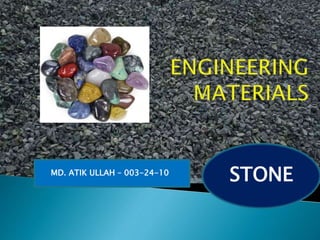
STONEMD. ATIK ULLAH – 003-24-10
The stones are derived from rocks which form
the earth’s crust & have no definite shape or
chemical composition but are mixtures of two
or more minerals.
The rocks from which stones are obtained may
be in the following three groups.
STONE
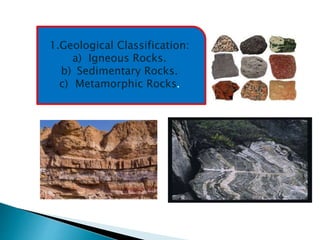
1.Geological Classification:
a) Igneous Rocks.
b) Sedimentary Rocks.
c) Metamorphic Rocks.
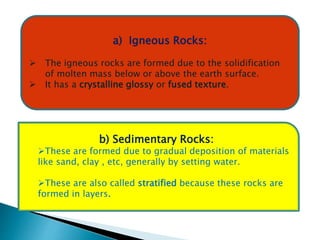
a) Igneous Rocks:
 The igneous rocks are formed due to the solidification
of molten mass below or above the earth surface.
 It has a crystalline glossy or fused texture.
b) Sedimentary Rocks:
These are formed due to gradual deposition of materials
like sand, clay , etc, generally by setting water.
These are also called stratified because these rocks are
formed in layers.
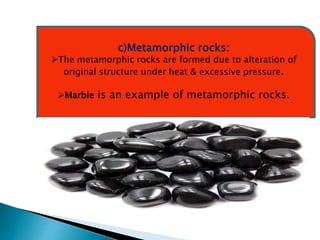
c)Metamorphic rocks:
The metamorphic rocks are formed due to alteration of
original structure under heat & excessive pressure.
Marble is an example of metamorphic rocks.
 1.Physical Classification:
a) Stratified Rocks.
b) Un-stratified Rocks.
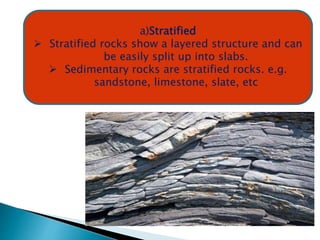
a)Stratified
 Stratified rocks show a layered structure and can
be easily split up into slabs.
 Sedimentary rocks are stratified rocks. e.g.
sandstone, limestone, slate, etc
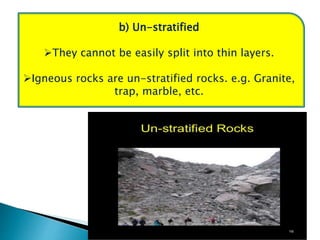
b) Un-stratified
They cannot be easily split into thin layers.
Igneous rocks are un-stratified rocks. e.g. Granite,
trap, marble, etc.
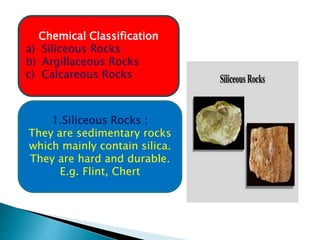
Chemical Classification
a) Siliceous Rocks
b) Argillaceous Rocks
c) Calcareous Rocks
1.Siliceous Rocks :
They are sedimentary rocks
which mainly contain silica.
They are hard and durable.
E.g. Flint, Chert
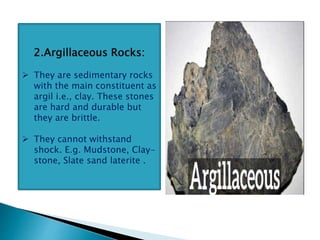
2.Argillaceous Rocks:
 They are sedimentary rocks
with the main constituent as
argil i.e., clay. These stones
are hard and durable but
they are brittle.
 They cannot withstand
shock. E.g. Mudstone, Clay-
stone, Slate sand laterite .
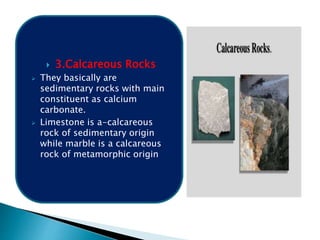
 3.Calcareous Rocks
 They basically are
sedimentary rocks with main
constituent as calcium
carbonate.
 Limestone is a-calcareous
rock of sedimentary origin
while marble is a calcareous
rock of metamorphic origin
Various Types of Stones Used for Building
Constructions
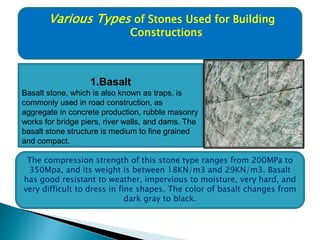
1.Basalt
Basalt stone, which is also known as traps, is
commonly used in road construction, as
aggregate in concrete production, rubble masonry
works for bridge piers, river walls, and dams. The
basalt stone structure is medium to fine grained
and compact.
The compression strength of this stone type ranges from 200MPa to
350Mpa, and its weight is between 18KN/m3 and 29KN/m3. Basalt
has good resistant to weather, impervious to moisture, very hard, and
very difficult to dress in fine shapes. The color of basalt changes from
dark gray to black.
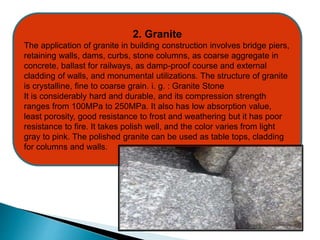
2. Granite
The application of granite in building construction involves bridge piers,
retaining walls, dams, curbs, stone columns, as coarse aggregate in
concrete, ballast for railways, as damp-proof course and external
cladding of walls, and monumental utilizations. The structure of granite
is crystalline, fine to coarse grain. i. g. : Granite Stone
It is considerably hard and durable, and its compression strength
ranges from 100MPa to 250MPa. It also has low absorption value,
least porosity, good resistance to frost and weathering but it has poor
resistance to fire. It takes polish well, and the color varies from light
gray to pink. The polished granite can be used as table tops, cladding
for columns and walls.
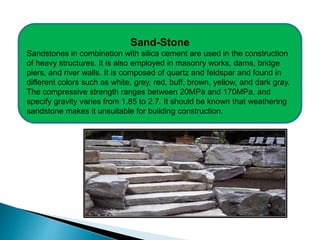
Sand-Stone
Sandstones in combination with silica cement are used in the construction
of heavy structures. It is also employed in masonry works, dams, bridge
piers, and river walls. It is composed of quartz and feldspar and found in
different colors such as white, grey, red, buff, brown, yellow, and dark gray.
The compressive strength ranges between 20MPa and 170MPa, and
specify gravity varies from 1.85 to 2.7. It should be known that weathering
sandstone makes it unsuitable for building construction.
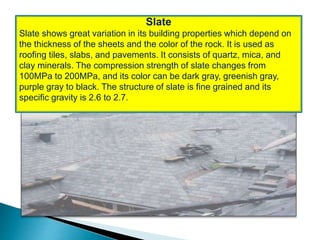
Slate
Slate shows great variation in its building properties which depend on
the thickness of the sheets and the color of the rock. It is used as
roofing tiles, slabs, and pavements. It consists of quartz, mica, and
clay minerals. The compression strength of slate changes from
100MPa to 200MPa, and its color can be dark gray, greenish gray,
purple gray to black. The structure of slate is fine grained and its
specific gravity is 2.6 to 2.7.
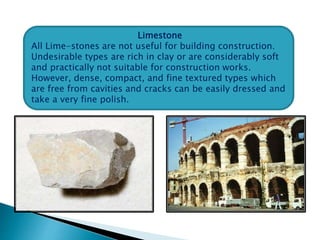
Limestone
All Lime-stones are not useful for building construction.
Undesirable types are rich in clay or are considerably soft
and practically not suitable for construction works.
However, dense, compact, and fine textured types which
are free from cavities and cracks can be easily dressed and
take a very fine polish.
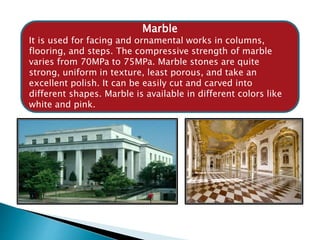
Marble
It is used for facing and ornamental works in columns,
flooring, and steps. The compressive strength of marble
varies from 70MPa to 75MPa. Marble stones are quite
strong, uniform in texture, least porous, and take an
excellent polish. It can be easily cut and carved into
different shapes. Marble is available in different colors like
white and pink.
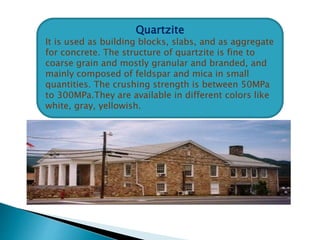
Quartzite
It is used as building blocks, slabs, and as aggregate
for concrete. The structure of quartzite is fine to
coarse grain and mostly granular and branded, and
mainly composed of feldspar and mica in small
quantities. The crushing strength is between 50MPa
to 300MPa.They are available in different colors like
white, gray, yellowish.
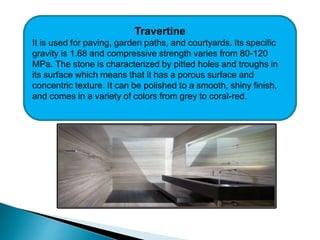
Travertine
It is used for paving, garden paths, and courtyards. Its specific
gravity is 1.68 and compressive strength varies from 80-120
MPa. The stone is characterized by pitted holes and troughs in
its surface which means that it has a porous surface and
concentric texture. It can be polished to a smooth, shiny finish,
and comes in a variety of colors from grey to coral-red.
Basically we get better quality’s stone from Sylhet and
Dinajpur ( MaddhaPara). Every year we need more then
8 Millions M.Ton stone chips. But in our limited
resources it’s not sufficient at all. That’s why we have to
import large number of stone chips from Oman, UAE,
Vietnam, Malaysia and India. Now, stone chips are 2nd
number of imported elements in our total number of
imports items.
STONE
RESOURSES
Requirements of Good Building Stones
Strength
Generally most of the building stones have high strength to
resist the load coming on it. Therefore it is not of prime
concern when it comes to check the quality of stones. But when
the stones are to be used in large structures, it becomes
necessary to check the compressive strength of stones.
Compressive strength of building stones generally fall within
the range of 60 to 200N/mm2.
Durability
Building stones should be capable to resist the adverse effects
of natural forces like wind, rain and heat. It must be durable
and should not deteriorate due to the adverse effects of the
above natural forces.
Hardness
When stones are used in floors, pavements or aprons of
bridges, they become subjected to wearing and abrasive forces
caused by movement of men or machine over them. So it is
required to test hardness of stone.
Hardness of stone is determined by Mohs scale.
Toughness
Toughness of stones means it ability to resist impact forces.
Building stones should be tough enough to sustain stresses
developed due to vibrations. The vibrations may be due to
the machinery mounted over them or due to the loads
moving over them. The stone aggregates used in the road
constructions should be tough.
Specific Gravity
The more the specific gravity of stone, the more heavier and
stronger the stone is.
Therefore stones having higher specific gravity values
should be used for the construction of dams, retaining
walls, docks and harbors. The specific gravity of good
building stone is between 2.4 and 2.8.
Porosity and Absorption
Porosity of building stones depend upon the mineral
constituent and structural formation of the parent rock. If
stones used in building construction are porous then rain
water can easily enter into the pore spaces and cause
damage to the stones. Therefore building stone should not
be porous.
Water absorption of stone is directly proportional to the
porosity of rock. If a stone is more porous then it will
absorb more water and cause more damage to stone.
Workability
Stone should be workable. Stone is said to be workable when
the work involved in stone working (such as cutting, dressing &
shaping) is economical and easy to conduct.
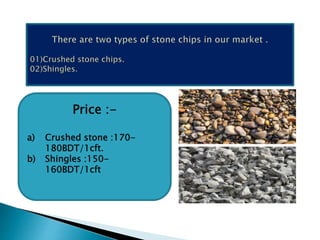
Price :-
a) Crushed stone :170-
180BDT/1cft.
b) Shingles :150-
160BDT/1cft
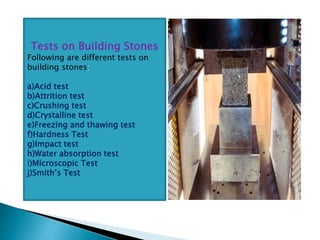
Tests on Building Stones
Following are different tests on
building stones:
a)Acid test
b)Attrition test
c)Crushing test
d)Crystalline test
e)Freezing and thawing test
f)Hardness Test
g)Impact test
h)Water absorption test
i)Microscopic Test
j)Smith’s Test
If you have any query ,you can ask
me.
Thanks to watching this
presentation
and staying with me.
THE END

Stone

  • 1.
  • 2.
    STONEMD. ATIK ULLAH– 003-24-10
  • 3.
    The stones arederived from rocks which form the earth’s crust & have no definite shape or chemical composition but are mixtures of two or more minerals. The rocks from which stones are obtained may be in the following three groups. STONE
  • 4.
    1.Geological Classification: a) IgneousRocks. b) Sedimentary Rocks. c) Metamorphic Rocks.
  • 5.
    a) Igneous Rocks: The igneous rocks are formed due to the solidification of molten mass below or above the earth surface.  It has a crystalline glossy or fused texture. b) Sedimentary Rocks: These are formed due to gradual deposition of materials like sand, clay , etc, generally by setting water. These are also called stratified because these rocks are formed in layers.
  • 6.
    c)Metamorphic rocks: The metamorphicrocks are formed due to alteration of original structure under heat & excessive pressure. Marble is an example of metamorphic rocks.
  • 7.
     1.Physical Classification: a)Stratified Rocks. b) Un-stratified Rocks.
  • 8.
    a)Stratified  Stratified rocksshow a layered structure and can be easily split up into slabs.  Sedimentary rocks are stratified rocks. e.g. sandstone, limestone, slate, etc
  • 9.
    b) Un-stratified They cannotbe easily split into thin layers. Igneous rocks are un-stratified rocks. e.g. Granite, trap, marble, etc.
  • 10.
    Chemical Classification a) SiliceousRocks b) Argillaceous Rocks c) Calcareous Rocks 1.Siliceous Rocks : They are sedimentary rocks which mainly contain silica. They are hard and durable. E.g. Flint, Chert
  • 11.
    2.Argillaceous Rocks:  Theyare sedimentary rocks with the main constituent as argil i.e., clay. These stones are hard and durable but they are brittle.  They cannot withstand shock. E.g. Mudstone, Clay- stone, Slate sand laterite .
  • 12.
     3.Calcareous Rocks They basically are sedimentary rocks with main constituent as calcium carbonate.  Limestone is a-calcareous rock of sedimentary origin while marble is a calcareous rock of metamorphic origin
  • 13.
    Various Types ofStones Used for Building Constructions 1.Basalt Basalt stone, which is also known as traps, is commonly used in road construction, as aggregate in concrete production, rubble masonry works for bridge piers, river walls, and dams. The basalt stone structure is medium to fine grained and compact. The compression strength of this stone type ranges from 200MPa to 350Mpa, and its weight is between 18KN/m3 and 29KN/m3. Basalt has good resistant to weather, impervious to moisture, very hard, and very difficult to dress in fine shapes. The color of basalt changes from dark gray to black.
  • 14.
    2. Granite The applicationof granite in building construction involves bridge piers, retaining walls, dams, curbs, stone columns, as coarse aggregate in concrete, ballast for railways, as damp-proof course and external cladding of walls, and monumental utilizations. The structure of granite is crystalline, fine to coarse grain. i. g. : Granite Stone It is considerably hard and durable, and its compression strength ranges from 100MPa to 250MPa. It also has low absorption value, least porosity, good resistance to frost and weathering but it has poor resistance to fire. It takes polish well, and the color varies from light gray to pink. The polished granite can be used as table tops, cladding for columns and walls.
  • 15.
    Sand-Stone Sandstones in combinationwith silica cement are used in the construction of heavy structures. It is also employed in masonry works, dams, bridge piers, and river walls. It is composed of quartz and feldspar and found in different colors such as white, grey, red, buff, brown, yellow, and dark gray. The compressive strength ranges between 20MPa and 170MPa, and specify gravity varies from 1.85 to 2.7. It should be known that weathering sandstone makes it unsuitable for building construction.
  • 16.
    Slate Slate shows greatvariation in its building properties which depend on the thickness of the sheets and the color of the rock. It is used as roofing tiles, slabs, and pavements. It consists of quartz, mica, and clay minerals. The compression strength of slate changes from 100MPa to 200MPa, and its color can be dark gray, greenish gray, purple gray to black. The structure of slate is fine grained and its specific gravity is 2.6 to 2.7.
  • 17.
    Limestone All Lime-stones arenot useful for building construction. Undesirable types are rich in clay or are considerably soft and practically not suitable for construction works. However, dense, compact, and fine textured types which are free from cavities and cracks can be easily dressed and take a very fine polish.
  • 18.
    Marble It is usedfor facing and ornamental works in columns, flooring, and steps. The compressive strength of marble varies from 70MPa to 75MPa. Marble stones are quite strong, uniform in texture, least porous, and take an excellent polish. It can be easily cut and carved into different shapes. Marble is available in different colors like white and pink.
  • 19.
    Quartzite It is usedas building blocks, slabs, and as aggregate for concrete. The structure of quartzite is fine to coarse grain and mostly granular and branded, and mainly composed of feldspar and mica in small quantities. The crushing strength is between 50MPa to 300MPa.They are available in different colors like white, gray, yellowish.
  • 20.
    Travertine It is usedfor paving, garden paths, and courtyards. Its specific gravity is 1.68 and compressive strength varies from 80-120 MPa. The stone is characterized by pitted holes and troughs in its surface which means that it has a porous surface and concentric texture. It can be polished to a smooth, shiny finish, and comes in a variety of colors from grey to coral-red.
  • 21.
    Basically we getbetter quality’s stone from Sylhet and Dinajpur ( MaddhaPara). Every year we need more then 8 Millions M.Ton stone chips. But in our limited resources it’s not sufficient at all. That’s why we have to import large number of stone chips from Oman, UAE, Vietnam, Malaysia and India. Now, stone chips are 2nd number of imported elements in our total number of imports items. STONE RESOURSES
  • 23.
    Requirements of GoodBuilding Stones Strength Generally most of the building stones have high strength to resist the load coming on it. Therefore it is not of prime concern when it comes to check the quality of stones. But when the stones are to be used in large structures, it becomes necessary to check the compressive strength of stones. Compressive strength of building stones generally fall within the range of 60 to 200N/mm2.
  • 24.
    Durability Building stones shouldbe capable to resist the adverse effects of natural forces like wind, rain and heat. It must be durable and should not deteriorate due to the adverse effects of the above natural forces. Hardness When stones are used in floors, pavements or aprons of bridges, they become subjected to wearing and abrasive forces caused by movement of men or machine over them. So it is required to test hardness of stone. Hardness of stone is determined by Mohs scale.
  • 25.
    Toughness Toughness of stonesmeans it ability to resist impact forces. Building stones should be tough enough to sustain stresses developed due to vibrations. The vibrations may be due to the machinery mounted over them or due to the loads moving over them. The stone aggregates used in the road constructions should be tough. Specific Gravity The more the specific gravity of stone, the more heavier and stronger the stone is. Therefore stones having higher specific gravity values should be used for the construction of dams, retaining walls, docks and harbors. The specific gravity of good building stone is between 2.4 and 2.8.
  • 26.
    Porosity and Absorption Porosityof building stones depend upon the mineral constituent and structural formation of the parent rock. If stones used in building construction are porous then rain water can easily enter into the pore spaces and cause damage to the stones. Therefore building stone should not be porous. Water absorption of stone is directly proportional to the porosity of rock. If a stone is more porous then it will absorb more water and cause more damage to stone. Workability Stone should be workable. Stone is said to be workable when the work involved in stone working (such as cutting, dressing & shaping) is economical and easy to conduct.
  • 27.
    Price :- a) Crushedstone :170- 180BDT/1cft. b) Shingles :150- 160BDT/1cft
  • 28.
    Tests on BuildingStones Following are different tests on building stones: a)Acid test b)Attrition test c)Crushing test d)Crystalline test e)Freezing and thawing test f)Hardness Test g)Impact test h)Water absorption test i)Microscopic Test j)Smith’s Test
  • 30.
    If you haveany query ,you can ask me. Thanks to watching this presentation and staying with me.
  • 31.