STONE CONSTRUCTION
• Stone masonry is a traditional form of construction that has been
practiced for centuries in regions where stone is locally available.
• . Buildings of this type range from cultural and historical landmarks,
• stone is an affordable and cost-effective building material for housing
construction.
STONE CONSTRUCTION
WHAT IS STONE?
The hard, solid, non metallic mineral matter of which
rock is made, a building material.
STONE -As A Building Material
Stones have been considered as one of the popular
building material from the olden days due totheir
availability in abundance from the natural
rocks.Building stones should possess enough strength
and durability.The stones which are suitable for the
construction of the structures such as retaining
walls,abutments, dams, barrages, roads etc are known
as building stones.
Common Uses Of Building Stones:
1.Millions of tones of crushed rock are needed
annually for road base, paving
2.Ready-mixed concrete and asphalt.
3.Sandstone which is not so hard-wearing or
beautifully patterned is used for
4.Garden walls and paths in landscaping.
5.Basalt: It is quarried and crushed as "Blue
Metal" which is used as a road-base, and inreinforced
concrete as aggregate.
6.Although wood, straw and mud is used for houses in
some parts of the world, most buildingsare preferred
to be built of stones.
7.Building wells
8.Aggregate
9.Stone walls11.Roof tile in the form of
10.Shale is a component of bricks and may also be
used in manufacturing of cement
11.Nite, another stone type is used for architectural
construction, ornamental stones andmonuments
12.Marble is widely used in construction industry, for
aesthetic purposes,
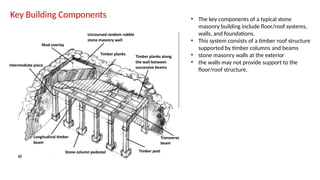
Key Building Components • The key components of a typical stone
masonry building include floor/roof systems,
walls, and foundations.
• This system consists of a timber roof structure
supported by timber columns and beams
• stone masonry walls at the exterior
• the walls may not provide support to the
floor/roof structure.
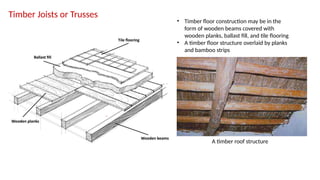
Timber Joists or Trusses
• Timber floor construction may be in the
form of wooden beams covered with
wooden planks, ballast fill, and tile flooring
• A timber floor structure overlaid by planks
and bamboo strips
A timber roof structure
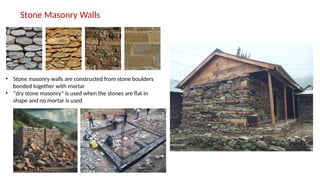
Stone Masonry Walls
• Stone masonry walls are constructed from stone boulders
bonded together with mortar
• “dry stone masonry” is used when the stones are flat in
shape and no mortar is used
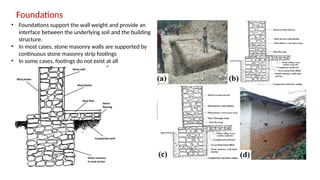
Foundations
• Foundations support the wall weight and provide an
interface between the underlying soil and the building
structure.
• In most cases, stone masonry walls are supported by
continuous stone masonry strip footings
• In some cases, footings do not exist at all
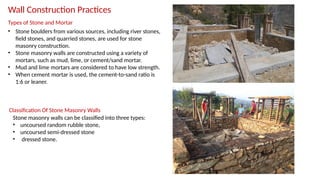
Wall Construction Practices
Types of Stone and Mortar
• Stone boulders from various sources, including river stones,
field stones, and quarried stones, are used for stone
masonry construction.
• Stone masonry walls are constructed using a variety of
mortars, such as mud, lime, or cement/sand mortar.
• Mud and lime mortars are considered to have low strength.
• When cement mortar is used, the cement-to-sand ratio is
1:6 or leaner.
Stone masonry walls can be classified into three types:
• uncoursed random rubble stone,
• uncoursed semi-dressed stone
• dressed stone.
Classification Of Stone Masonry Walls
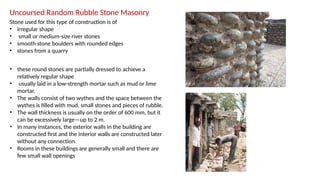
Uncoursed Random Rubble Stone Masonry
Stone used for this type of construction is of
• irregular shape
• small or medium-size river stones
• smooth stone boulders with rounded edges
• stones from a quarry
• these round stones are partially dressed to achieve a
relatively regular shape
• usually laid in a low-strength mortar such as mud or lime
mortar.
• The walls consist of two wythes and the space between the
wythes is filled with mud, small stones and pieces of rubble.
• The wall thickness is usually on the order of 600 mm, but it
can be excessively large—up to 2 m.
• In many instances, the exterior walls in the building are
constructed first and the interior walls are constructed later
without any connection.
• Rooms in these buildings are generally small and there are
few small wall openings
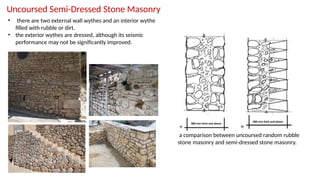
Uncoursed Semi-Dressed Stone Masonry
• there are two external wall wythes and an interior wythe
filled with rubble or dirt.
• the exterior wythes are dressed, although its seismic
performance may not be significantly improved.
a comparison between uncoursed random rubble
stone masonry and semi-dressed stone masonry.
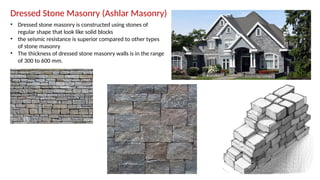
Dressed Stone Masonry (Ashlar Masonry)
• Dressed stone masonry is constructed using stones of
regular shape that look like solid blocks
• the seismic resistance is superior compared to other types
of stone masonry
• The thickness of dressed stone masonry walls is in the range
of 300 to 600 mm.
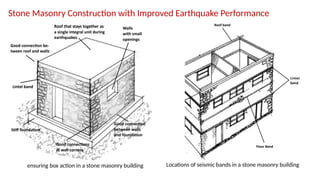
Stone Masonry Construction with Improved Earthquake Performance
ensuring box action in a stone masonry building Locations of seismic bands in a stone masonry building
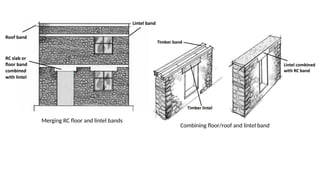
Merging RC floor and lintel bands
Combining floor/roof and lintel band
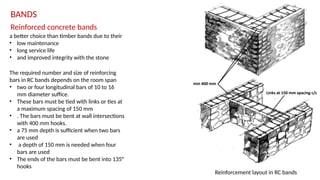
Reinforced concrete bands
BANDS
a better choice than timber bands due to their
• low maintenance
• long service life
• and improved integrity with the stone
The required number and size of reinforcing
bars in RC bands depends on the room span
• two or four longitudinal bars of 10 to 16
mm diameter suffice.
• These bars must be tied with links or ties at
a maximum spacing of 150 mm
• . The bars must be bent at wall intersections
with 400 mm hooks.
• a 75 mm depth is sufficient when two bars
are used
• a depth of 150 mm is needed when four
bars are used
• The ends of the bars must be bent into 135°
hooks
Reinforcement layout in RC bands
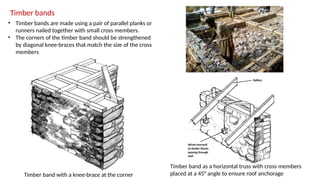
Timber bands
• Timber bands are made using a pair of parallel planks or
runners nailed together with small cross members.
• The corners of the timber band should be strengthened
by diagonal knee-braces that match the size of the cross
members
Timber band with a knee-brace at the corner
Timber band as a horizontal truss with cross members
placed at a 45° angle to ensure roof anchorage
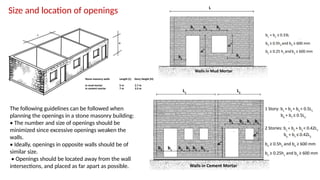
Size and location of openings
The following guidelines can be followed when
planning the openings in a stone masonry building:
• The number and size of openings should be
minimized since excessive openings weaken the
walls.
• Ideally, openings in opposite walls should be of
similar size.
• Openings should be located away from the wall
intersections, and placed as far apart as possible.
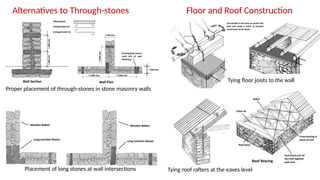
Proper placement of through-stones in stone masonry walls
Placement of long stones at wall intersections
Floor and Roof Construction
Alternatives to Through-stones
Tying roof rafters at the eaves level
Tying floor joists to the wall
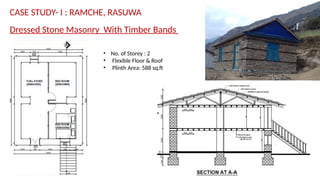
CASE STUDY- I : RAMCHE, RASUWA
Dressed Stone Masonry With Timber Bands
• No. of Storey : 2
• Flexible Floor & Roof
• Plinth Area: 588 sq.ft
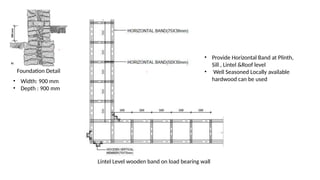
Foundation Detail
• Width: 900 mm
• Depth : 900 mm
• Provide Horizontal Band at Plinth,
Sill , Lintel &Roof level
• Well Seasoned Locally available
hardwood can be used
Lintel Level wooden band on load bearing wall
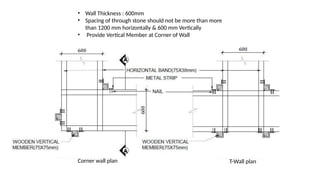
• Wall Thickness : 600mm
• Spacing of through stone should not be more than more
than 1200 mm horizontally & 600 mm Vertically
• Provide Vertical Member at Corner of Wall
Corner wall plan T-Wall plan
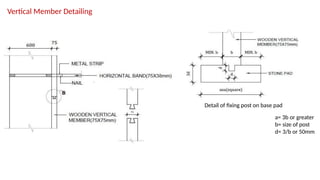
Vertical Member Detailing
Detail of fixing post on base pad
a= 3b or greater
b= size of post
d= 3/b or 50mm
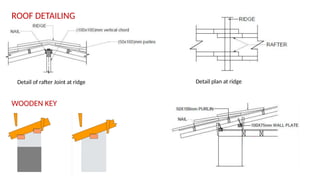
ROOF DETAILING
Detail of rafter Joint at ridge Detail plan at ridge
WOODEN KEY
STONE CONSTRUCTION AND TECHNOLOGY AS MOUNTAIN ARCHITECTURE.pptx

STONE CONSTRUCTION AND TECHNOLOGY AS MOUNTAIN ARCHITECTURE.pptx

  • 1.
  • 2.
    • Stone masonryis a traditional form of construction that has been practiced for centuries in regions where stone is locally available. • . Buildings of this type range from cultural and historical landmarks, • stone is an affordable and cost-effective building material for housing construction. STONE CONSTRUCTION WHAT IS STONE? The hard, solid, non metallic mineral matter of which rock is made, a building material. STONE -As A Building Material Stones have been considered as one of the popular building material from the olden days due totheir availability in abundance from the natural rocks.Building stones should possess enough strength and durability.The stones which are suitable for the construction of the structures such as retaining walls,abutments, dams, barrages, roads etc are known as building stones.
  • 3.
    Common Uses OfBuilding Stones: 1.Millions of tones of crushed rock are needed annually for road base, paving 2.Ready-mixed concrete and asphalt. 3.Sandstone which is not so hard-wearing or beautifully patterned is used for 4.Garden walls and paths in landscaping. 5.Basalt: It is quarried and crushed as "Blue Metal" which is used as a road-base, and inreinforced concrete as aggregate. 6.Although wood, straw and mud is used for houses in some parts of the world, most buildingsare preferred to be built of stones. 7.Building wells 8.Aggregate 9.Stone walls11.Roof tile in the form of 10.Shale is a component of bricks and may also be used in manufacturing of cement 11.Nite, another stone type is used for architectural construction, ornamental stones andmonuments 12.Marble is widely used in construction industry, for aesthetic purposes,
  • 4.
    Key Building Components• The key components of a typical stone masonry building include floor/roof systems, walls, and foundations. • This system consists of a timber roof structure supported by timber columns and beams • stone masonry walls at the exterior • the walls may not provide support to the floor/roof structure.
  • 5.
    Timber Joists orTrusses • Timber floor construction may be in the form of wooden beams covered with wooden planks, ballast fill, and tile flooring • A timber floor structure overlaid by planks and bamboo strips A timber roof structure
  • 6.
    Stone Masonry Walls •Stone masonry walls are constructed from stone boulders bonded together with mortar • “dry stone masonry” is used when the stones are flat in shape and no mortar is used
  • 7.
    Foundations • Foundations supportthe wall weight and provide an interface between the underlying soil and the building structure. • In most cases, stone masonry walls are supported by continuous stone masonry strip footings • In some cases, footings do not exist at all
  • 8.
    Wall Construction Practices Typesof Stone and Mortar • Stone boulders from various sources, including river stones, field stones, and quarried stones, are used for stone masonry construction. • Stone masonry walls are constructed using a variety of mortars, such as mud, lime, or cement/sand mortar. • Mud and lime mortars are considered to have low strength. • When cement mortar is used, the cement-to-sand ratio is 1:6 or leaner. Stone masonry walls can be classified into three types: • uncoursed random rubble stone, • uncoursed semi-dressed stone • dressed stone. Classification Of Stone Masonry Walls
  • 9.
    Uncoursed Random RubbleStone Masonry Stone used for this type of construction is of • irregular shape • small or medium-size river stones • smooth stone boulders with rounded edges • stones from a quarry • these round stones are partially dressed to achieve a relatively regular shape • usually laid in a low-strength mortar such as mud or lime mortar. • The walls consist of two wythes and the space between the wythes is filled with mud, small stones and pieces of rubble. • The wall thickness is usually on the order of 600 mm, but it can be excessively large—up to 2 m. • In many instances, the exterior walls in the building are constructed first and the interior walls are constructed later without any connection. • Rooms in these buildings are generally small and there are few small wall openings
  • 10.
    Uncoursed Semi-Dressed StoneMasonry • there are two external wall wythes and an interior wythe filled with rubble or dirt. • the exterior wythes are dressed, although its seismic performance may not be significantly improved. a comparison between uncoursed random rubble stone masonry and semi-dressed stone masonry.
  • 11.
    Dressed Stone Masonry(Ashlar Masonry) • Dressed stone masonry is constructed using stones of regular shape that look like solid blocks • the seismic resistance is superior compared to other types of stone masonry • The thickness of dressed stone masonry walls is in the range of 300 to 600 mm.
  • 12.
    Stone Masonry Constructionwith Improved Earthquake Performance ensuring box action in a stone masonry building Locations of seismic bands in a stone masonry building
  • 13.
    Merging RC floorand lintel bands Combining floor/roof and lintel band
  • 14.
    Reinforced concrete bands BANDS abetter choice than timber bands due to their • low maintenance • long service life • and improved integrity with the stone The required number and size of reinforcing bars in RC bands depends on the room span • two or four longitudinal bars of 10 to 16 mm diameter suffice. • These bars must be tied with links or ties at a maximum spacing of 150 mm • . The bars must be bent at wall intersections with 400 mm hooks. • a 75 mm depth is sufficient when two bars are used • a depth of 150 mm is needed when four bars are used • The ends of the bars must be bent into 135° hooks Reinforcement layout in RC bands
  • 16.
    Timber bands • Timberbands are made using a pair of parallel planks or runners nailed together with small cross members. • The corners of the timber band should be strengthened by diagonal knee-braces that match the size of the cross members Timber band with a knee-brace at the corner Timber band as a horizontal truss with cross members placed at a 45° angle to ensure roof anchorage
  • 17.
    Size and locationof openings The following guidelines can be followed when planning the openings in a stone masonry building: • The number and size of openings should be minimized since excessive openings weaken the walls. • Ideally, openings in opposite walls should be of similar size. • Openings should be located away from the wall intersections, and placed as far apart as possible.
  • 18.
    Proper placement ofthrough-stones in stone masonry walls Placement of long stones at wall intersections Floor and Roof Construction Alternatives to Through-stones Tying roof rafters at the eaves level Tying floor joists to the wall
  • 19.
    CASE STUDY- I: RAMCHE, RASUWA Dressed Stone Masonry With Timber Bands • No. of Storey : 2 • Flexible Floor & Roof • Plinth Area: 588 sq.ft
  • 20.
    Foundation Detail • Width:900 mm • Depth : 900 mm • Provide Horizontal Band at Plinth, Sill , Lintel &Roof level • Well Seasoned Locally available hardwood can be used Lintel Level wooden band on load bearing wall
  • 21.
    • Wall Thickness: 600mm • Spacing of through stone should not be more than more than 1200 mm horizontally & 600 mm Vertically • Provide Vertical Member at Corner of Wall Corner wall plan T-Wall plan
  • 22.
    Vertical Member Detailing Detailof fixing post on base pad a= 3b or greater b= size of post d= 3/b or 50mm
  • 23.
    ROOF DETAILING Detail ofrafter Joint at ridge Detail plan at ridge WOODEN KEY