Masonry
structure
(stone mud wall
structure)
B I S H A L M A N D A L ( 2 0 0 5 3 5 )
D E E P A K K U M A R Y A D A V ( 2 0 0 5 3 8 )
B I P I N S A H ( 2 0 0 5 3 4 )
B I N O D M A N D A L ( 2 0 0 5 3 3 )
D A M B A R N A R A Y A N M A N D A L ( 2 0 0 5 3 7 )
Introduction
Masonry can be defined as construction of building units bonded
together with mortar.
The building unit may be stone, brick, block of cement e.t.c
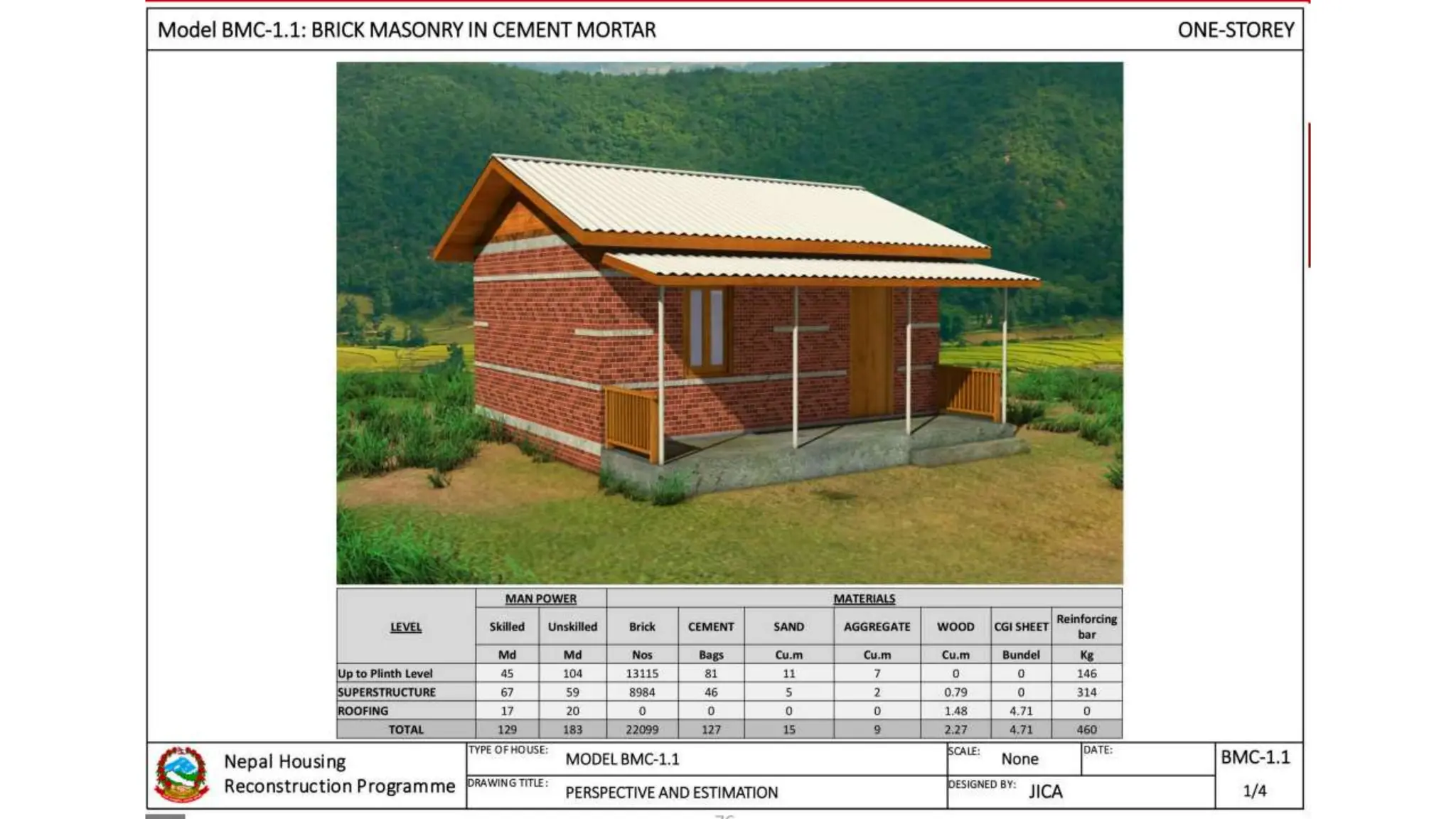
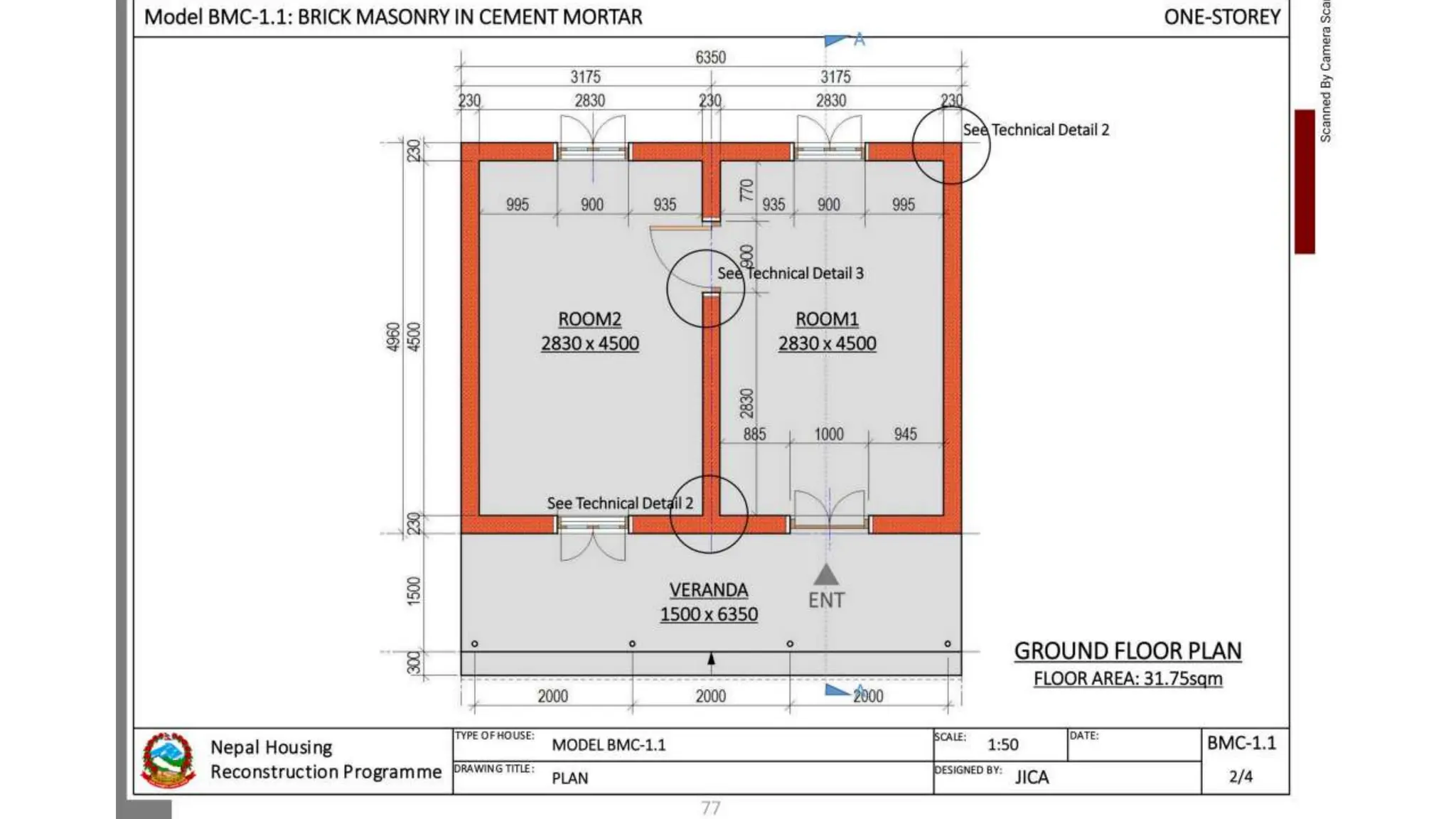
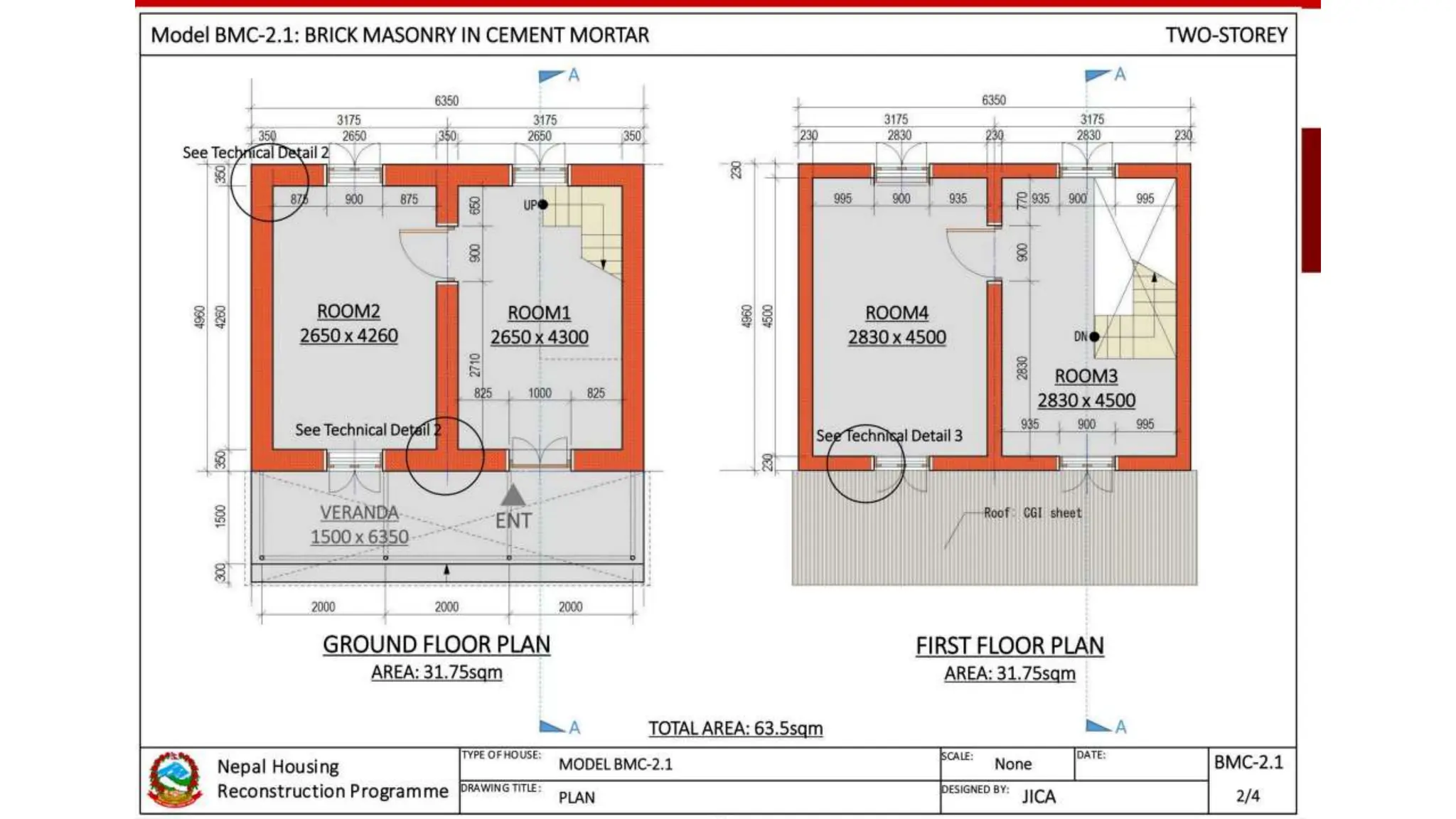
Of brick is used →Brick masonry
Of stone is used →stone masonry
Stone Masonry
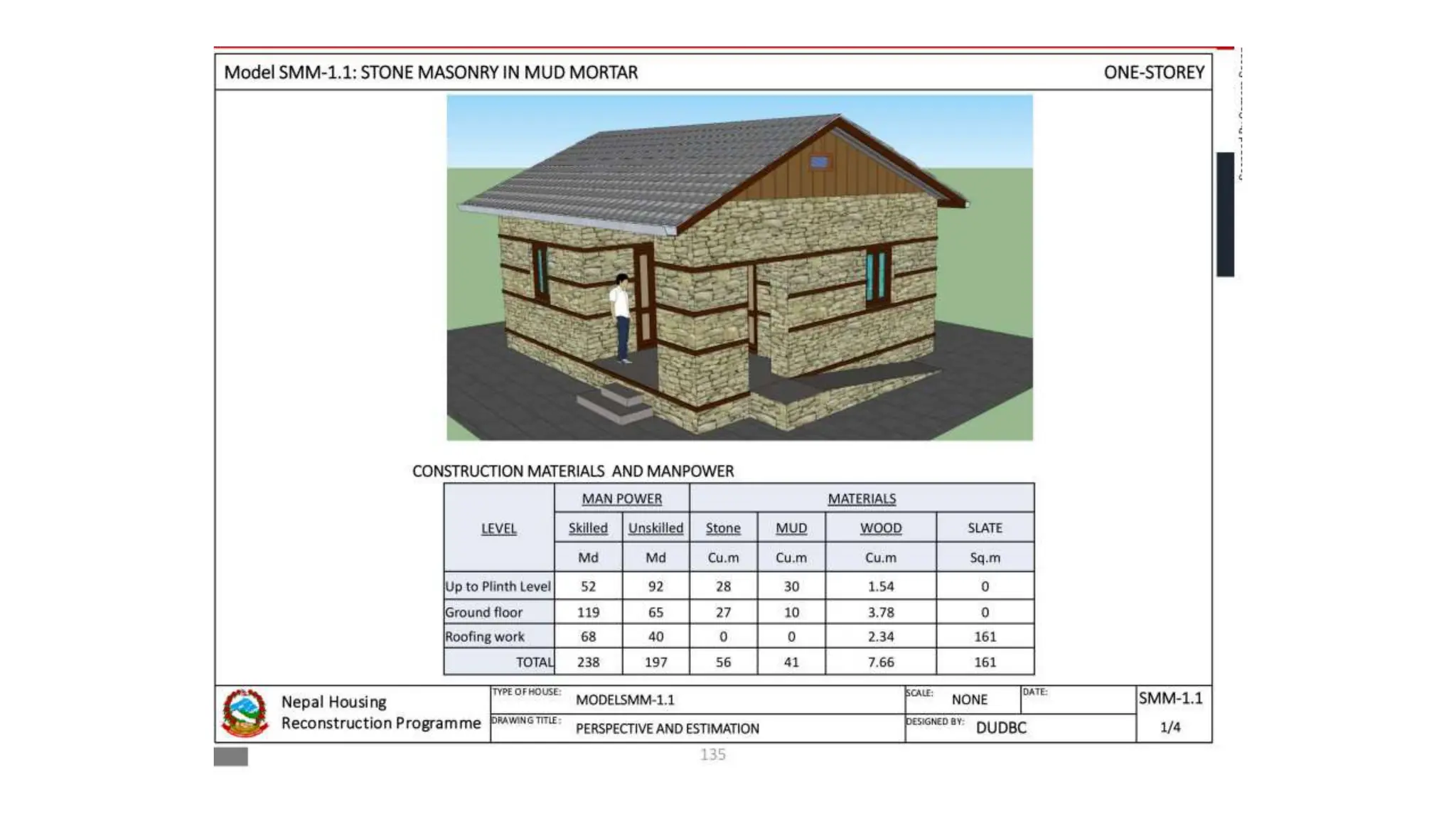
The masonry made up stone units bounded together with mud
mortar.
Mud mortar act as cementing material and unites the individual stone
units together to act as homogenous mass .
Stone msonry with mud mortar are the most prevalent construction
Typology for housing in rural Nepal
4
Types of Stone Masonry
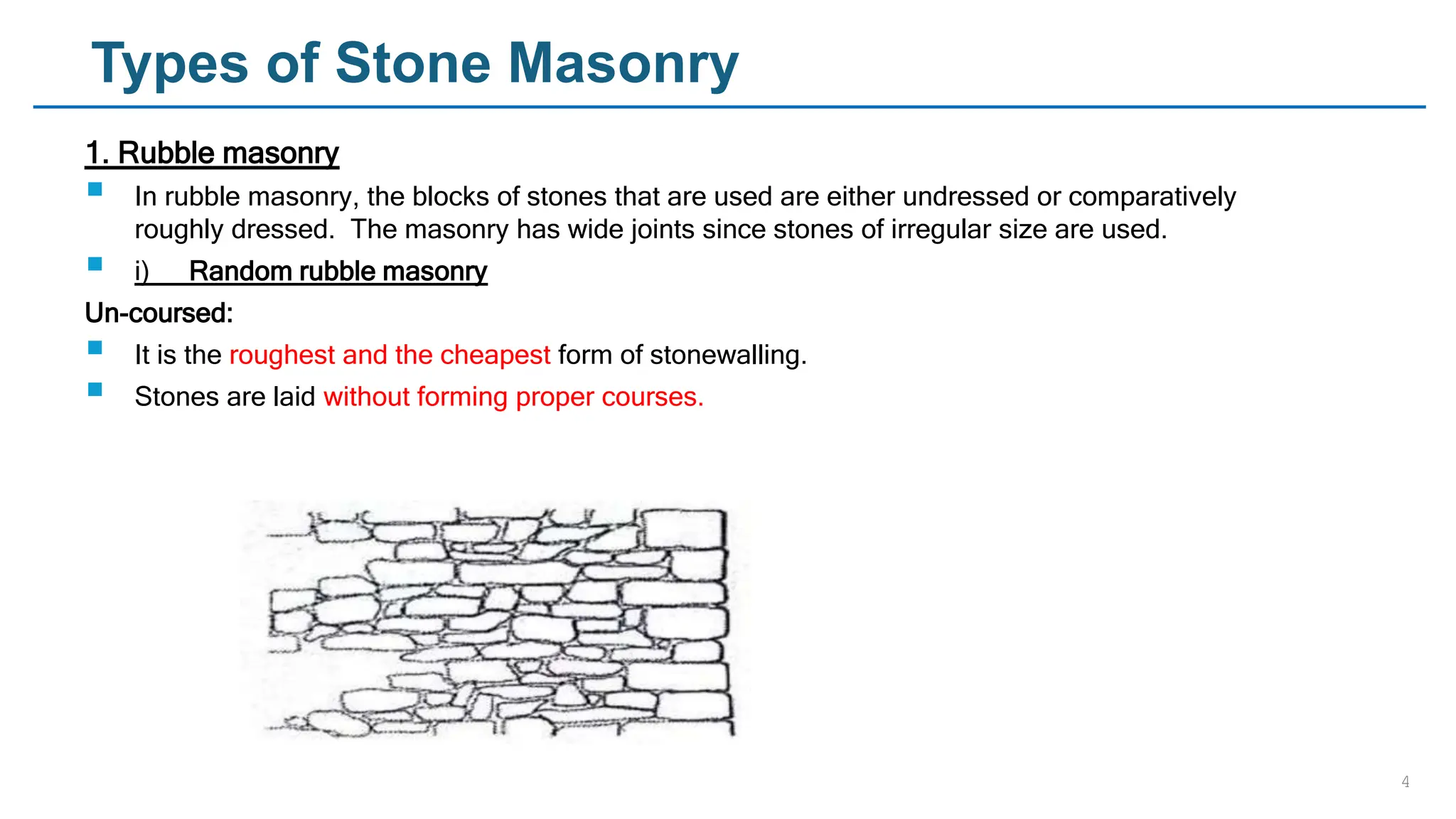
1. Rubble masonry
 In rubble masonry, the blocks of stones that are used are either undressed or comparatively
roughly dressed. The masonry has wide joints since stones of irregular size are used.
 i) Random rubble masonry
Un-coursed:
 It is the roughest and the cheapest form of stonewalling.
 Stones are laid without forming proper courses.
5
Types of Stone Masonry
 i) Random rubble masonry
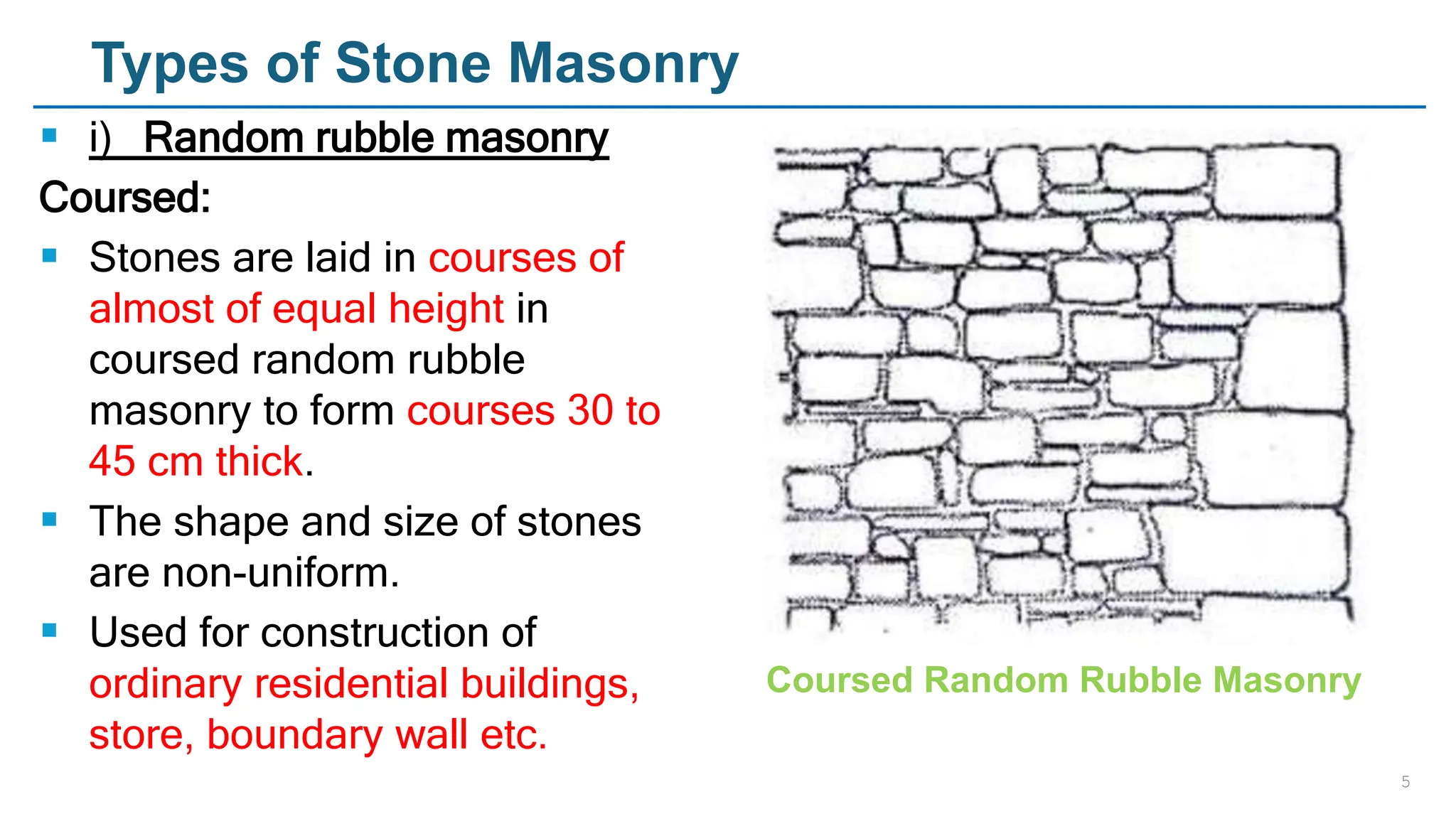
Coursed:
 Stones are laid in courses of
almost of equal height in
coursed random rubble
masonry to form courses 30 to
45 cm thick.
 The shape and size of stones
are non-uniform.
 Used for construction of
ordinary residential buildings,
store, boundary wall etc.
Coursed Random Rubble Masonry
6
Types of Stone Masonry
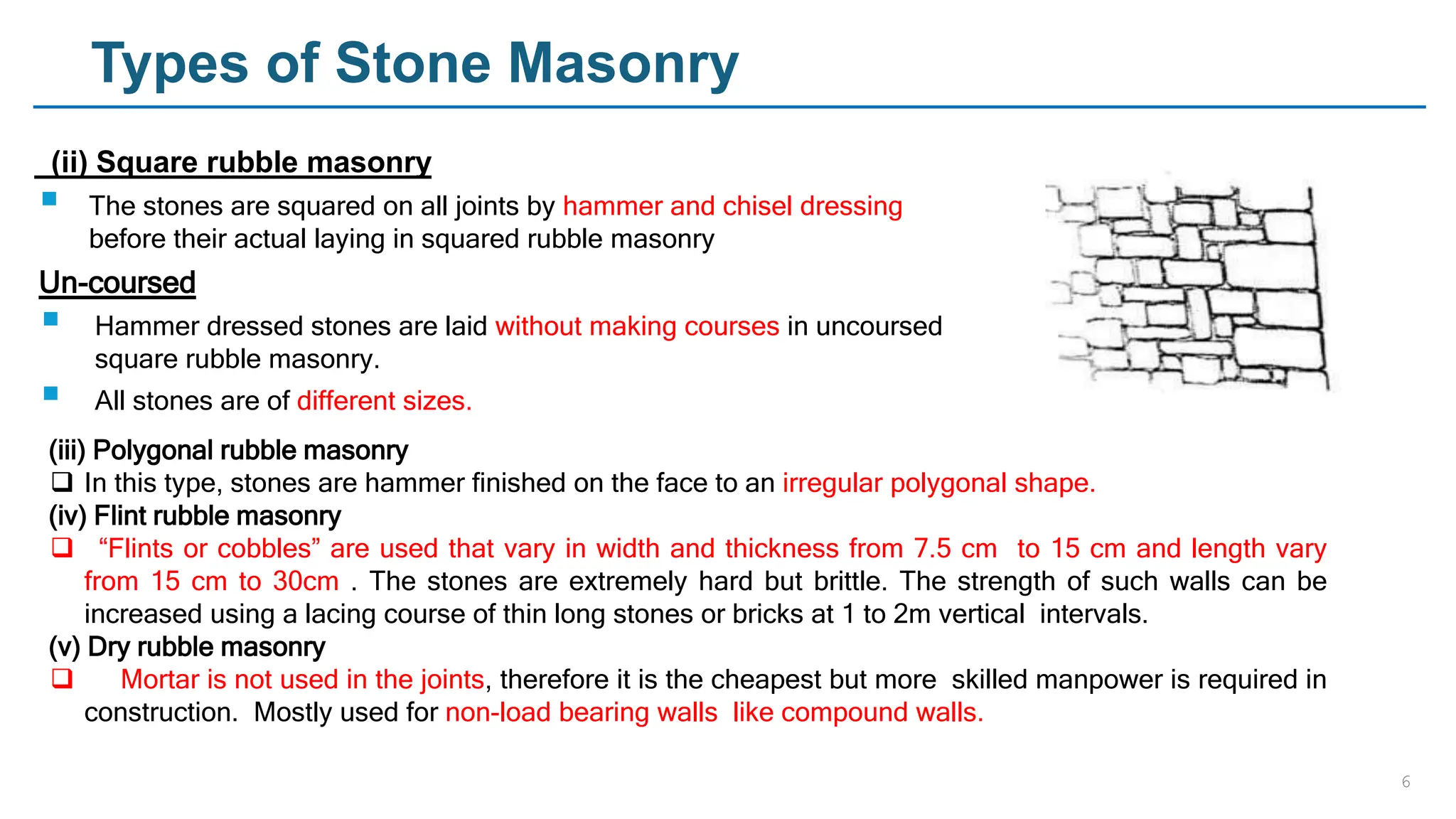
(ii) Square rubble masonry
 The stones are squared on all joints by hammer and chisel dressing
before their actual laying in squared rubble masonry
Un-coursed
 Hammer dressed stones are laid without making courses in uncoursed
square rubble masonry.
 All stones are of different sizes.
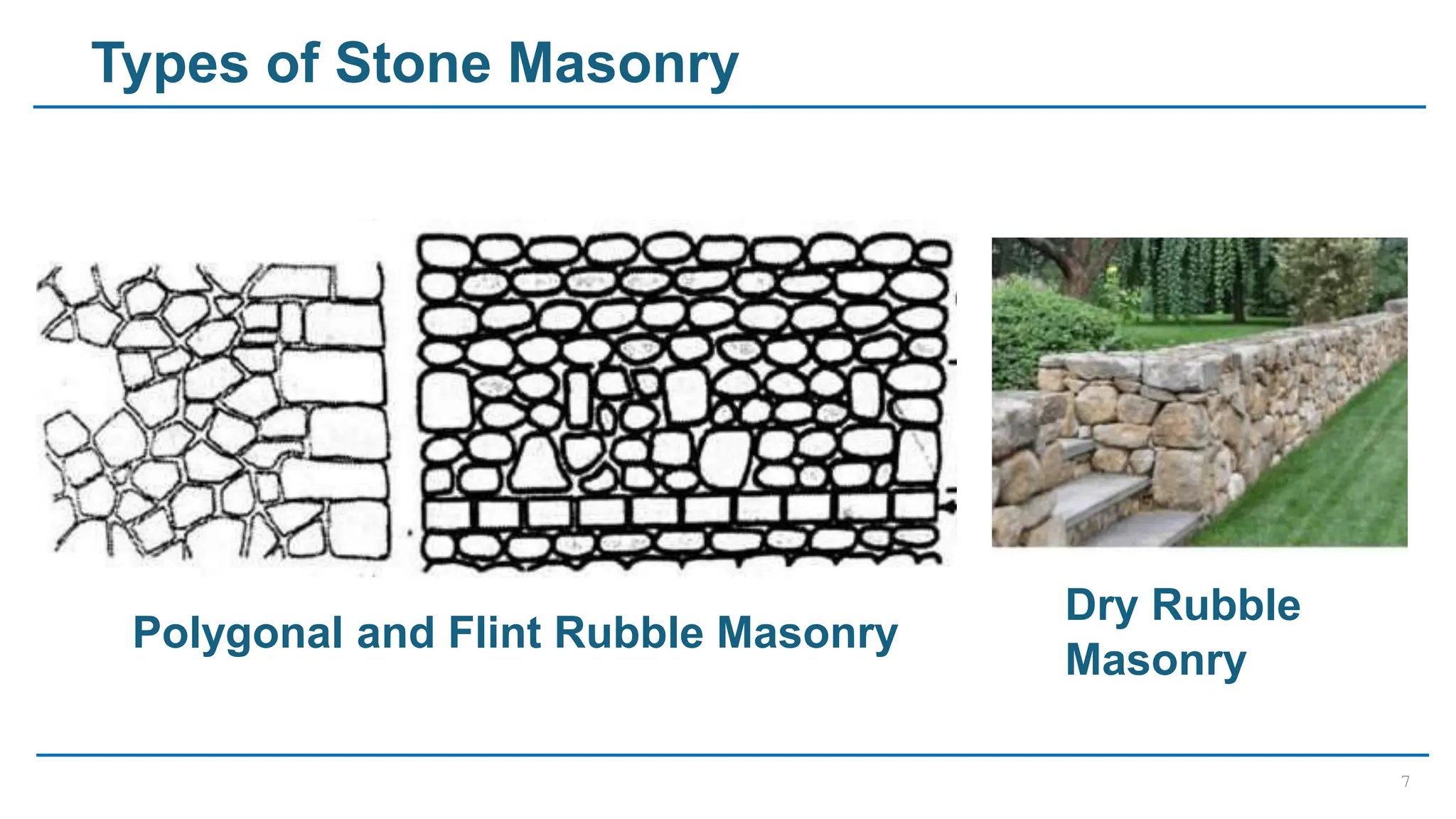
(iii) Polygonal rubble masonry
 In this type, stones are hammer finished on the face to an irregular polygonal shape.
(iv) Flint rubble masonry
 “Flints or cobbles” are used that vary in width and thickness from 7.5 cm to 15 cm and length vary
from 15 cm to 30cm . The stones are extremely hard but brittle. The strength of such walls can be
increased using a lacing course of thin long stones or bricks at 1 to 2m vertical intervals.
(v) Dry rubble masonry
 Mortar is not used in the joints, therefore it is the cheapest but more skilled manpower is required in
construction. Mostly used for non-load bearing walls like compound walls.
7
Types of Stone Masonry
Polygonal and Flint Rubble Masonry
Dry Rubble
Masonry
8
Types of Stone Masonry
2. Ashlar masonry
 The stone masonry in which finely dressed stones are laid
in cement or lime mortar is known as ashlar masonry.
 The courses are of uniform height.
 All joints are regular, thin and have uniform thickness.
 It is more costly type of masonry as it requires finely
dressed stones.
 It is used in residential buildings, hotels and restaurants,
architectural buildings of high importance, heavy
structures, high piers and abutment of bridges etc.
9
Types of Stone Masonry
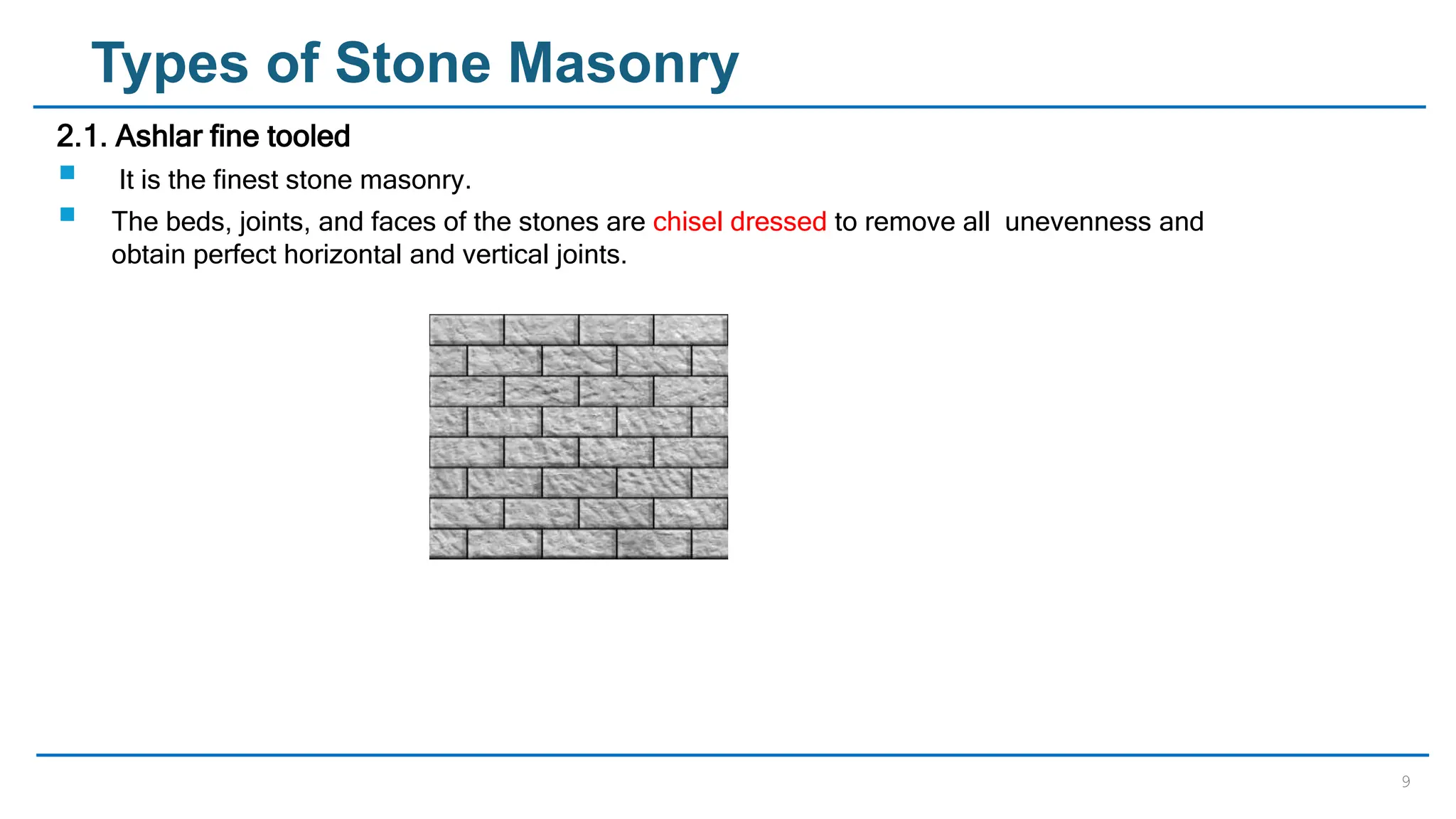
2.1. Ashlar fine tooled
 It is the finest stone masonry.
 The beds, joints, and faces of the stones are chisel dressed to remove all unevenness and
obtain perfect horizontal and vertical joints.
10
Types of Stone Masonry
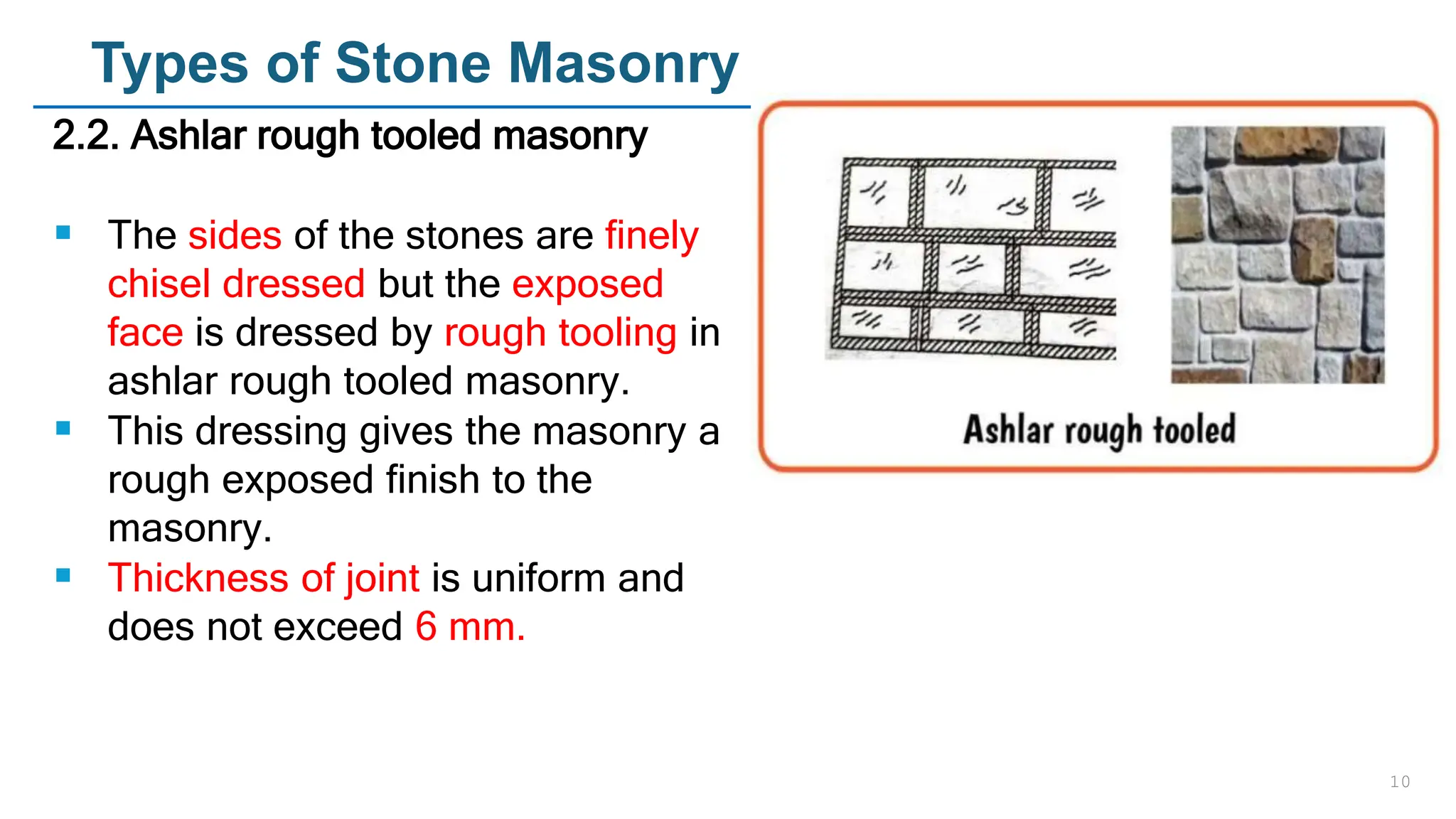
2.2. Ashlar rough tooled masonry
 The sides of the stones are finely
chisel dressed but the exposed
face is dressed by rough tooling in
ashlar rough tooled masonry.
 This dressing gives the masonry a
rough exposed finish to the
masonry.
 Thickness of joint is uniform and
does not exceed 6 mm.
11
Types of Stone Masonry
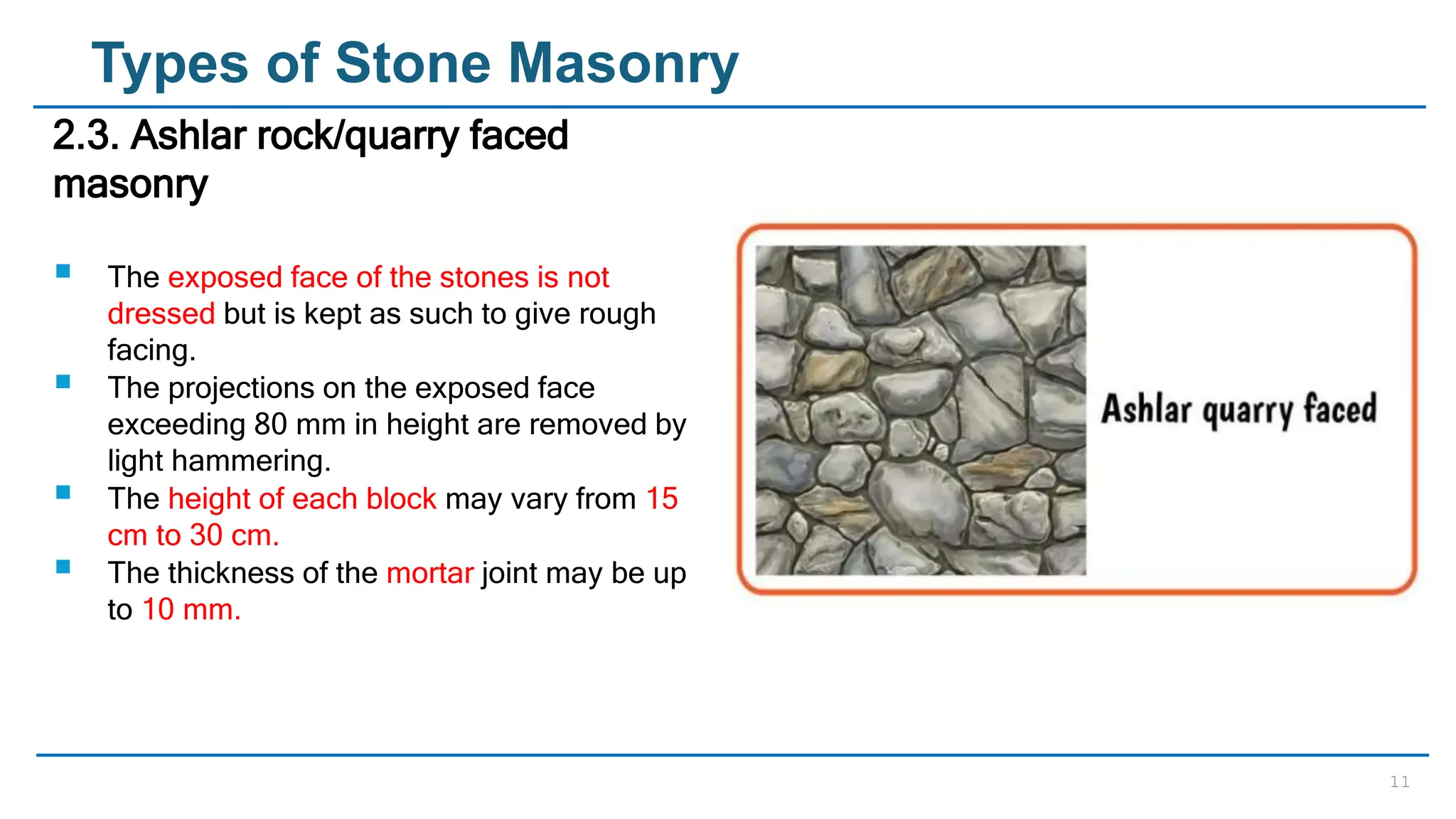
2.3. Ashlar rock/quarry faced
masonry
 The exposed face of the stones is not
dressed but is kept as such to give rough
facing.
 The projections on the exposed face
exceeding 80 mm in height are removed by
light hammering.
 The height of each block may vary from 15
cm to 30 cm.
 The thickness of the mortar joint may be up
to 10 mm.
12
Types of Stone Masonry
2.4. Ashlar chamfered
 It is a special type of ashlar rock-faced
in which the strip provided around the
perimeter of the exposed face is
chamfered at an angle of 45° to a
depth of 25 mm.
 Large projections over 80 mm are
removed by a hammer.
Minimum Requirements for
Stone Masonry in Mud
Mortar (NBC203)
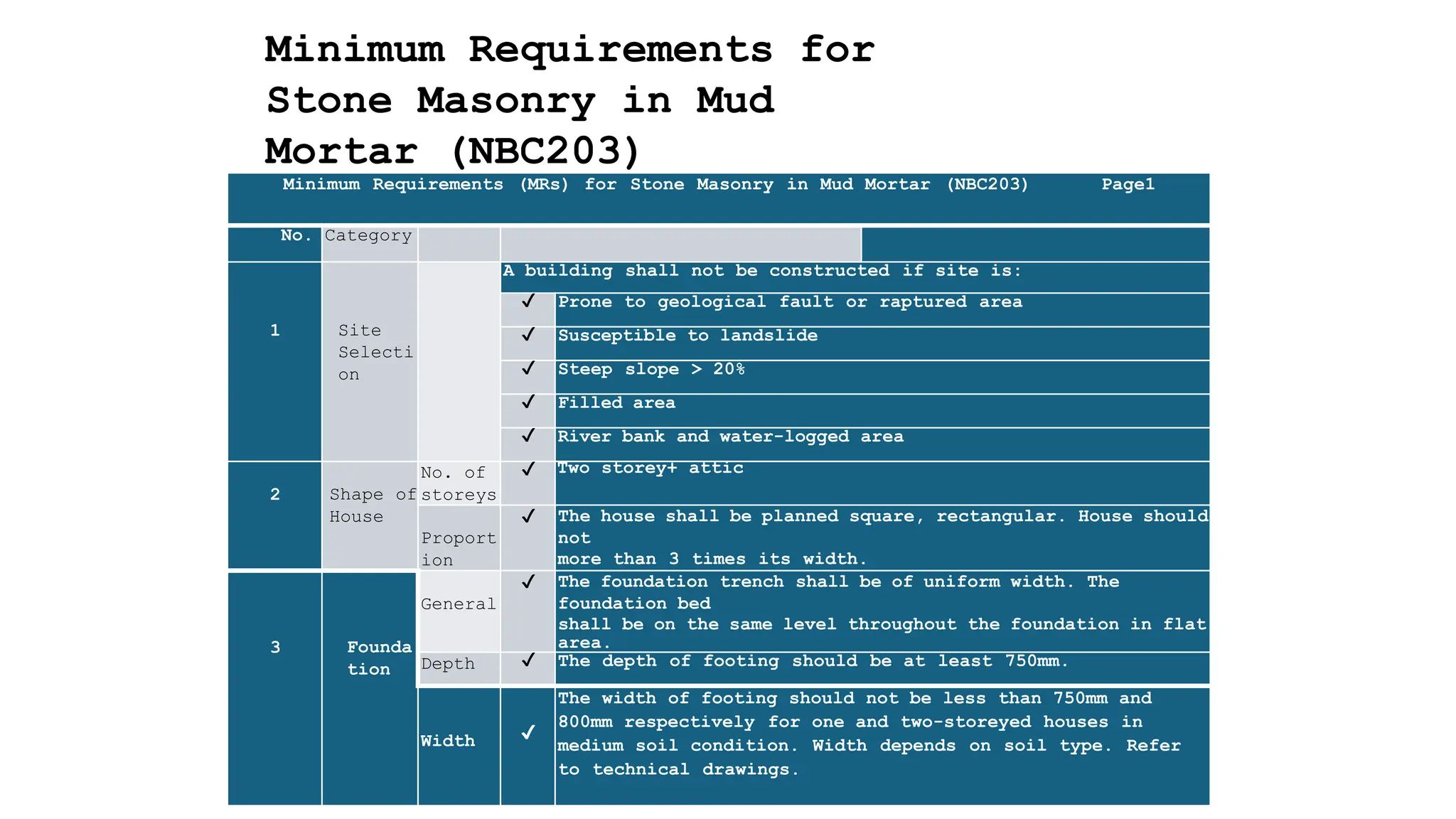
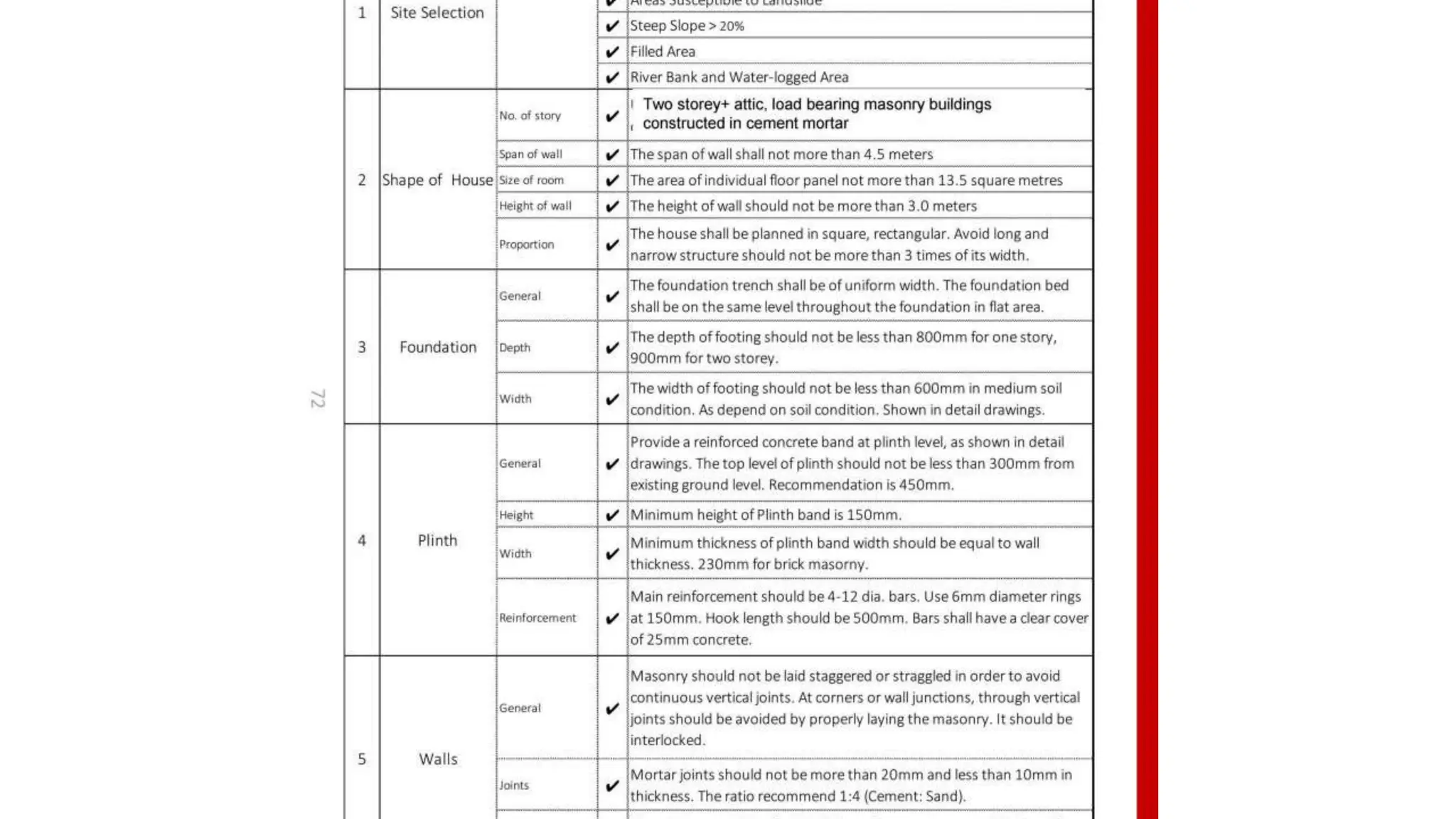
Minimum Requirements (MRs) for Stone Masonry in Mud Mortar (NBC203) Page1
No. Category
1 Site
Selecti
on
A building shall not be constructed if site is:
✔ Prone to geological fault or raptured area
✔ Susceptible to landslide
✔ Steep slope > 20%
✔ Filled area
✔ River bank and water-logged area
2 Shape of
House
No. of
storeys
✔ Two storey+ attic
Proport
ion
✔ The house shall be planned square, rectangular. House should
not
more than 3 times its width.
3 Founda
tion
General
✔ The foundation trench shall be of uniform width. The
foundation bed
shall be on the same level throughout the foundation in flat
area.
Depth ✔ The depth of footing should be at least 750mm.
Width ✔
The width of footing should not be less than 750mm and
800mm respectively for one and two-storeyed houses in
medium soil condition. Width depends on soil type. Refer
to technical drawings.
4 Plin
th
General
✔
The top level of plinth should be at least 300mm
above existing ground level. Recommended plinth
height from the ground is 450mm.
5 Wall
s
General ✔
Masonry should be laid staggered to avoid formation
of continuous vertical joint. At corners or wall
junctions, continuous vertical joints should be
avoided by properly laying large stones. The walls
should be
interlocked.
Joints
✔ Mortar joints should not be more than 20mm and less
than 10mm in
thickness.
Though
Stone
✔
Spacing of through stone shall not be more than
1200mm in the horizontal direction and 600mm in the
vertical direction. Seasoned timber, precast or cast
insitu concrete can be used instead of through
stone.
Length
of wall
✔
Maximum length of unsupported wall shall not exceed
12 times its thickness. If unsupported length of
wall is more than this, buttress shall be provided
at an interval not exceeding 12 times wall
thickness.
Wall
thicknes
s
✔ The wall thickness should not be less than 350-
450mm, 450mm
respectively for one and two-storey houses.
Height
of wall
✔ The height of wall between floors should not be more
than 8 times
wall thickness.
Minimum Requirements (MRs) for Stone Masonry in Mud Mortar (NBC203) Page2
Category
6.Opening
s
Location
✔ Openings are to be located away from inside corners
by 1/4 of the
height of the adjoining opening, but not less than
600 mm.
Total
length
of
openings
✔
Total length of opening should be less than 0.3 and
0.25 of individual wall length respectively for one
and two-storey house.
Distance
between
opening
✔ Distance between two openings shall be larger of
half the height of
shorter opening or 600mm.
Lintel level ✔ Keep lintel level same for doors and windows
7.Vertica
l
Reinforceme
nt
Location
✔
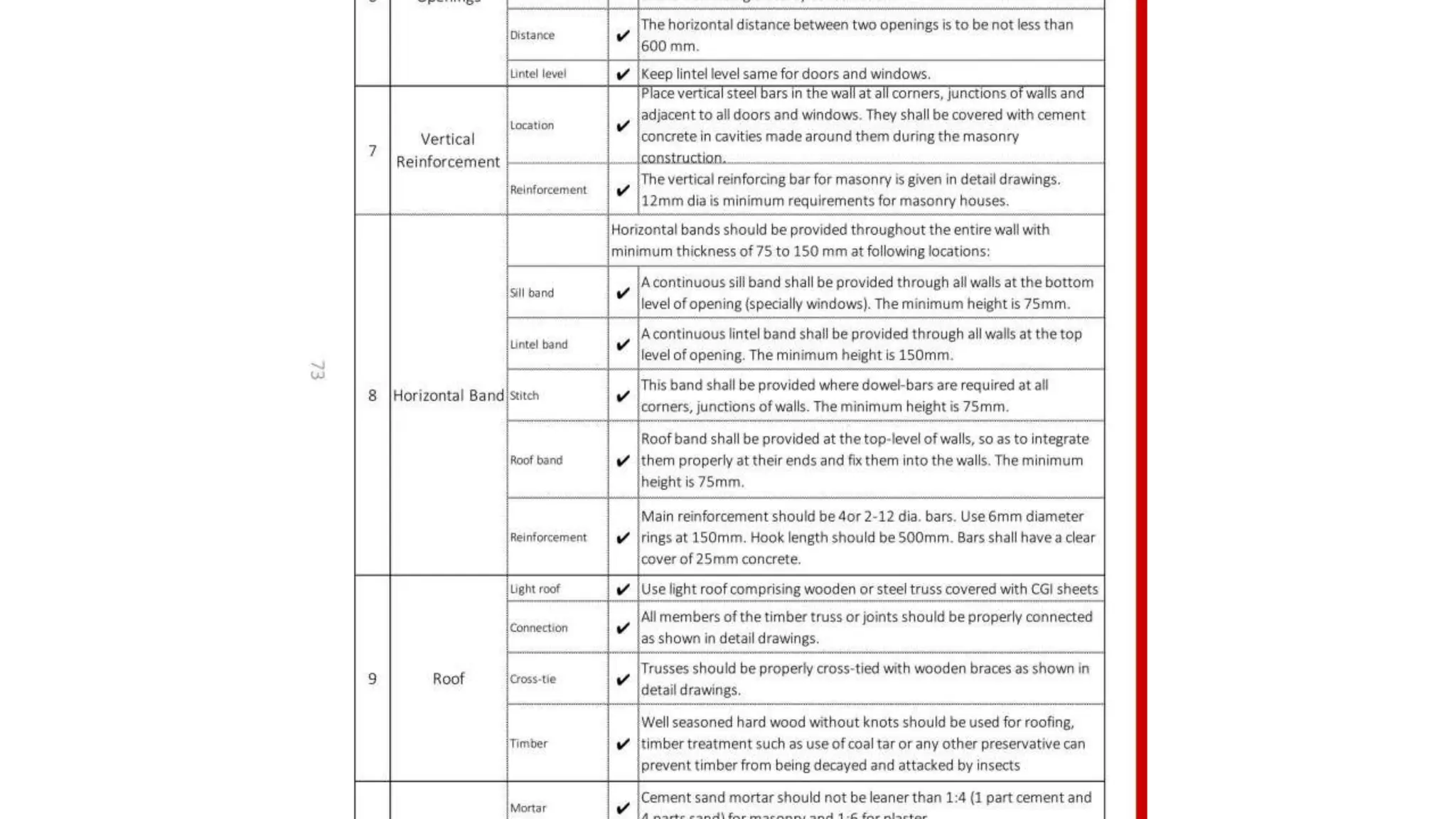
Place vertical steel bars in the wall at all
corners, wall junctions and adjacent to all doors
and windows. They shall be covered with cement
concrete in cavities made around them.
Reinforcemen
t
✔
At corners and junctions vertical reinforcing bar
should be 12mm for one storey, and 16 mm in the
ground floor and 12mm in the upper storey in case
of two storey house. At jambs, the reinforcing bars
should be 12mm.
8Horizon
tal
Band
General
✔
Horizontal reinforced concrete bands should be
provided throughout the entire wall with minimum
thickness of 75 to 150 mm at following locations.
Minimum width of bands should be equal to the wall
thickness. Where reinforcing bars have been used,
these shall have a clear cover of 25mm. Where
reinforced concrete is not available, timber bands
and stitches could be used.
Plinth
band
✔
A continuous plinth band shall be provided through
all walls at the plinth level. The minimum height
is 75mm with 2-12 reinforcing bars for hard soil.
In case of soft soil, band should be 150mm high
with 4- 12 reinforcement. Use 6mm dia. stirrups at
150mm centres.
Sill band ✔
A continuous sill band shall be provided through
all walls at the bottom level of opening
(specially windows). The minimum height is 75mm
with 2-10 reinforcing bars. Use 6mm diameter
stirrups at
150mm centres.
Lintel
band
✔
A continuous lintel band shall be provided through
all walls at the top level of opening. The minimum
height is 75mm with 2-12mm bars.
Use 6mm stirrups at 150mm centres. Extra thickening
should be provided where openings are more than 1m
wide.
Roof band ✔
Roof band shall be provided at the top of walls, so
as to tie the walls at their top and tie the roof to
the walls. The minimum height is 75mm with 2-12mm
diameter bars. Use 6mm dia. Stirrups at 150mm
centres.
Masonry gable wall must have the triangular portion
of masonry enclosed in a reinforced concrete band.
No. Category
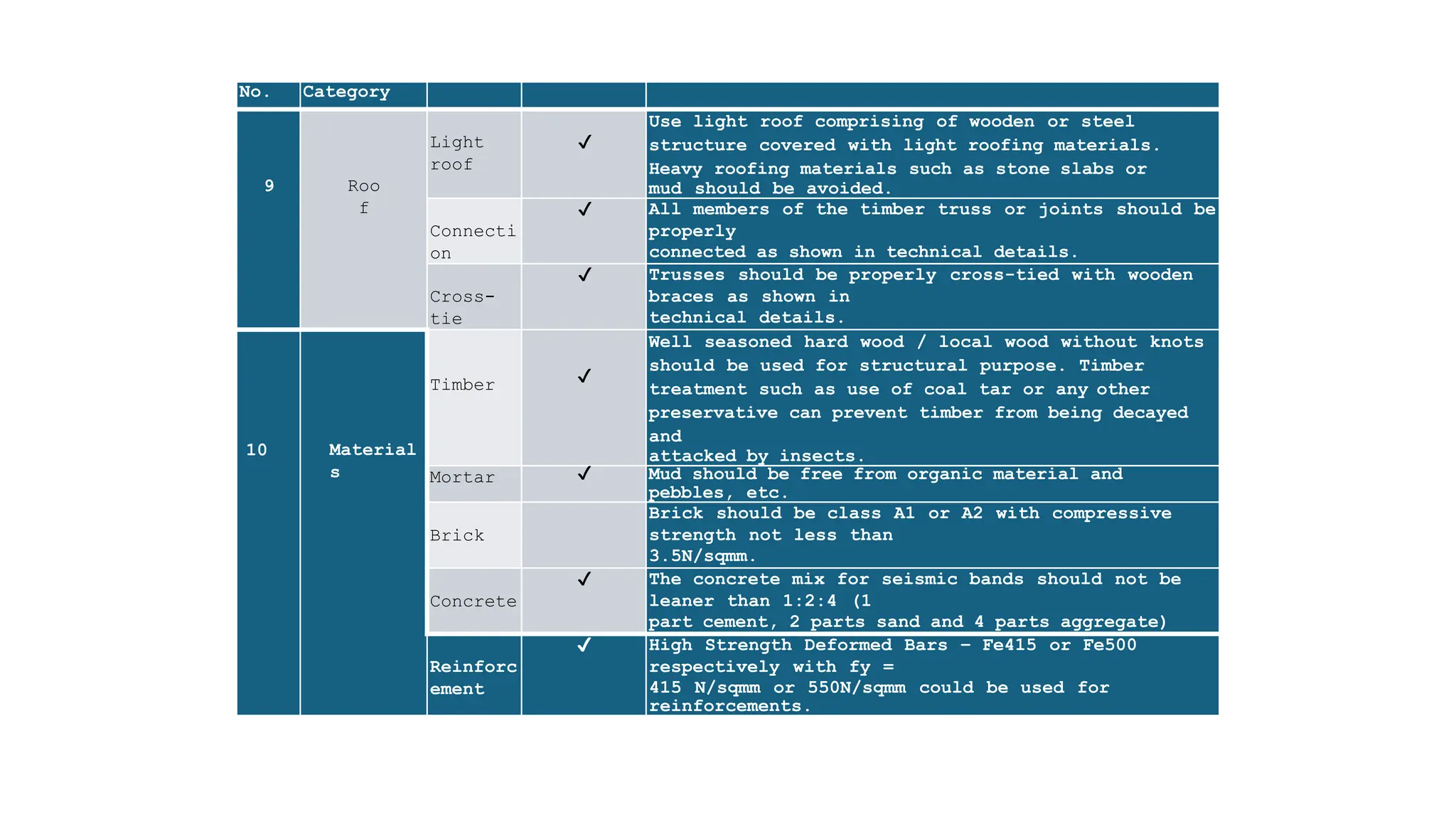
9 Roo
f
Light
roof
✔
Use light roof comprising of wooden or steel
structure covered with light roofing materials.
Heavy roofing materials such as stone slabs or
mud should be avoided.
Connecti
on
✔ All members of the timber truss or joints should be
properly
connected as shown in technical details.
Cross-
tie
✔ Trusses should be properly cross-tied with wooden
braces as shown in
technical details.
10 Material
s
Timber ✔
Well seasoned hard wood / local wood without knots
should be used for structural purpose. Timber
treatment such as use of coal tar or any other
preservative can prevent timber from being decayed
and
attacked by insects.
Mortar ✔ Mud should be free from organic material and
pebbles, etc.
Brick
Brick should be class A1 or A2 with compressive
strength not less than
3.5N/sqmm.
Concrete
✔ The concrete mix for seismic bands should not be
leaner than 1:2:4 (1
part cement, 2 parts sand and 4 parts aggregate)
Reinforc
ement
✔ High Strength Deformed Bars – Fe415 or Fe500
respectively with fy =
415 N/sqmm or 550N/sqmm could be used for
reinforcements.
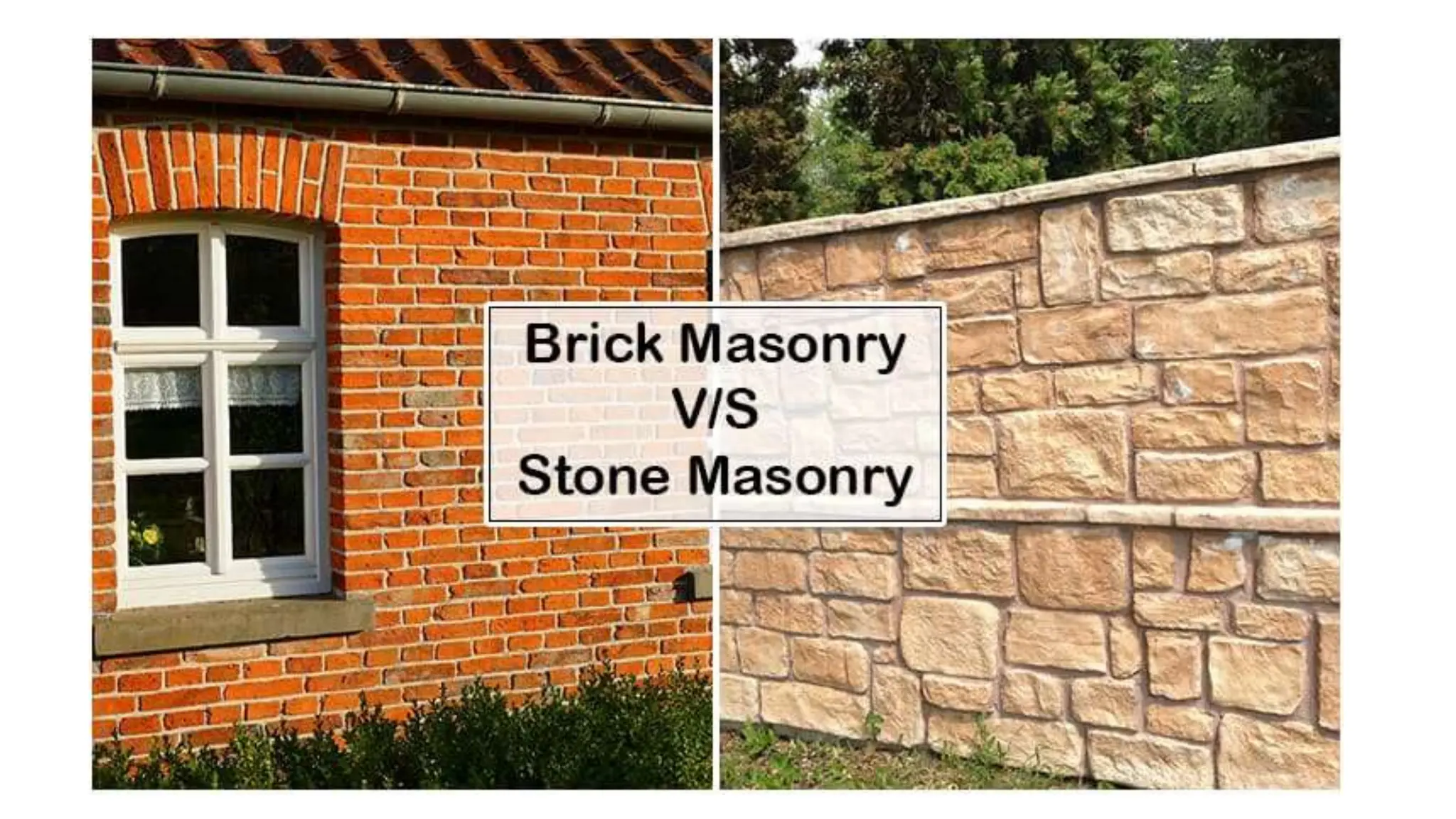
Comparison between
brick and stone masonry:
Sure, either of the two masonry can give your structure a
beautiful look but which fits your project better? If you
can’t decide yet which, you may continue reading below
for the comparison of the two.
Lifespan
Brick masonry durability is excellent but not excellent
enough than stone. You can expect too much from the
longevity of stone masonry than brick because it has
properties that provide strength, durability, and water-
resistance.
Strength
Brick masonry strength is more questionable than the
stone construction, although it can be used for other
places it is not suitable for all places. There are also more
options for size provided with stones than bricks.
However, regular size and uniform shape bricks are easier
to bond together resulting in better strength, while stones,
since they are in irregular shapes, are more difficult to
Beauty:
Good quality stones are undeniably beautiful that you
don’t have to improve or enhance their appearances,
which is why it is perfect for monumental nature buildings.
On the other hand, bricks perfectly match light ornamental
work, however, bricks are easier to mold into the desired
shape that will not eat all your budget. For the design
options, both have great options, like a variety of shapes,
and options for size but there are more choices available
for stone variations. Since bricks have lesser design
variations, they don’t give off more aesthetic looks like
stones.
Impact of Environment:
Stones are more damp-proof than bricks because they are
absorbent in nature. Other components of the building
may decay or break down due to dampness. However,
brick masonry construction is more resistant to fire than
stone masonry. For the exposure to an open atmosphere,
brick walls should be painted, while stone masonry walls
do not require stuff like that. Furthermore, if you are
looking for good insulation to air-transmitted noise, you
may have to go for stone masonry.
Cost of construction:
If you are currently on a tight budget, you may opt for brick
masonry since they are almost everywhere. Brick walls
are built in small thickness from 13cm, 23cm, and so on,
which means lesser mortar. On the other hand, stone
walls require a minimum thickness of 35cm, thus more
mortar is needed for the stonework mortar joints.
Workmanship:
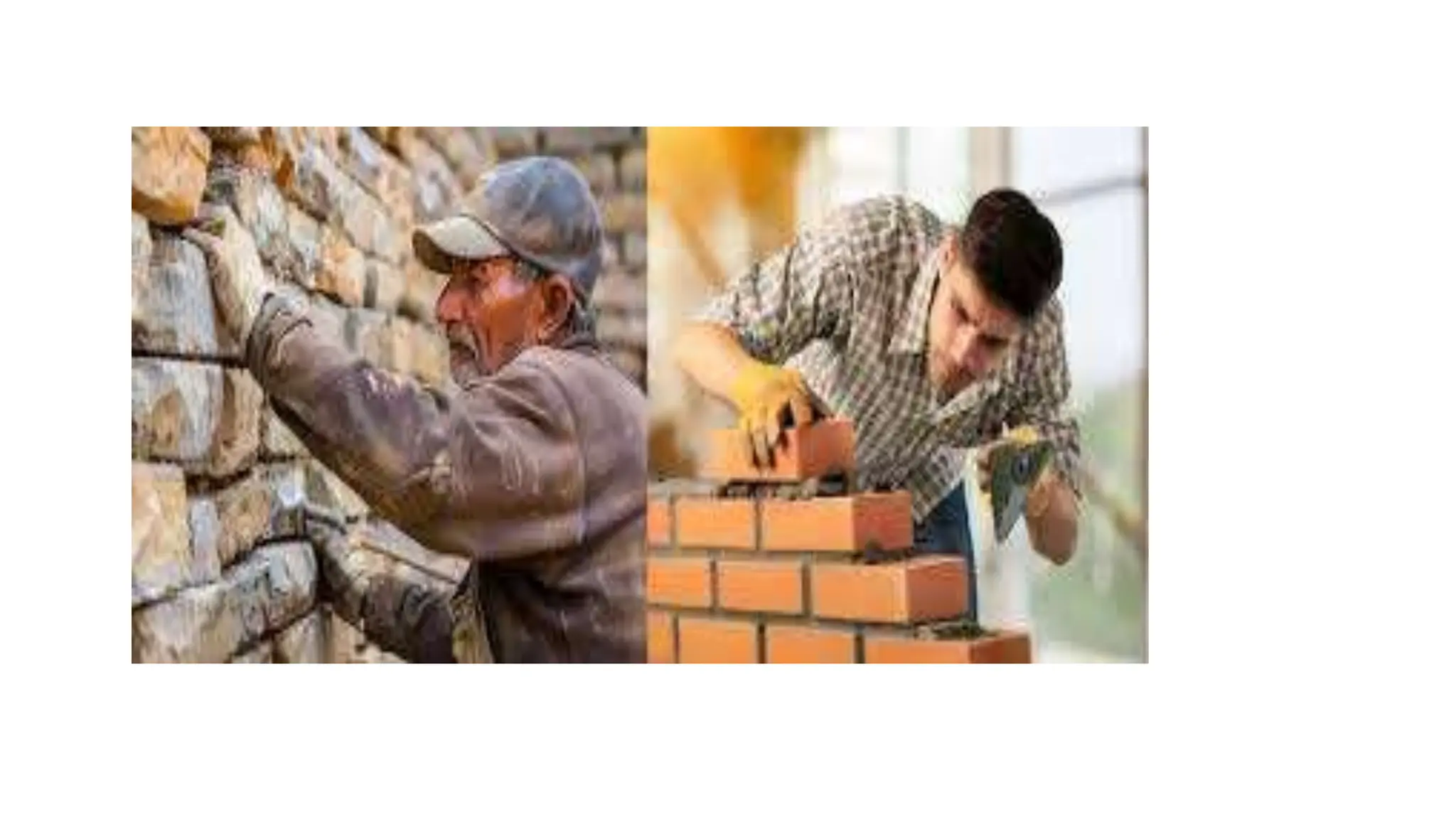
Stone masonry construction proceeds slowly because it is
not easy and the process requires dressing and placing
stones. Stones are also heavy to install, sometimes
resulting in some major incidents where deterioration of
joints inside the interior wall happens. On the other hand,
since bricks are handy, the masonry proceeds very
quickly. Bricks are also light in weight which means there
is a lesser to no risk of a major incident.
You should pick a skilled contractor who is good at stone
masonry because defects can’t be rectified.
Uses:
Brick masonry is commonly used in residential buildings,
while stone masonry is used in piers, monumental
buildings, marine structures, dams, and docks.
Flexibility:
Bricks can be easily altered, while stone masonry is hard
to relocate or repair resulting in a hard alteration. Also,
stone masonry when building openings for doors, or
windows requires more work than brick masonry because
stones need to be cut in different sizes.
Conclusion:
Both are good and durable, however, stone masonry
demands more skilled labor, thicker walls, large size, and
heavyweight which is expensive. On the other hand, brick
masonry also has good qualities that may provide a solid
and excellent construction. Hence, brick masonry is
preferred due to its affordable price.
Key Differences Between Brick And
Stone Masonry:
1. Brick masonry is more economical than stone
masonry.
2. Stone is more durable, strong, and weather-
resistant than Brick.
3. Bricks are available in regular shape and size. We
can use them with a certain pattern known as brick
bonds. But, in stone masonry, no definite patterns
are possible due to their dissimilar shape and size.
4. A brick wall may be made as thin as 10 cm. But in
the case of a stone wall, the thickness of the wall is
generally not less than 38 cm.
5. Because of more durability, strength, and weather
resisting characteristics, the stone masonry is
useful in construction programs
6. Due to the enormous size of the stone, it is difficult
to manage. But you can handle the Brick easily as
they are small in size.
7. Less skilled labor is needed in brick masonry than
in stone masonry.
THANK YOU

Presentation on the stone masonry and brick masonry

  • 1.
    Masonry structure (stone mud wall structure) BI S H A L M A N D A L ( 2 0 0 5 3 5 ) D E E P A K K U M A R Y A D A V ( 2 0 0 5 3 8 ) B I P I N S A H ( 2 0 0 5 3 4 ) B I N O D M A N D A L ( 2 0 0 5 3 3 ) D A M B A R N A R A Y A N M A N D A L ( 2 0 0 5 3 7 )
  • 2.
    Introduction Masonry can bedefined as construction of building units bonded together with mortar. The building unit may be stone, brick, block of cement e.t.c Of brick is used →Brick masonry Of stone is used →stone masonry
  • 3.
    Stone Masonry The masonrymade up stone units bounded together with mud mortar. Mud mortar act as cementing material and unites the individual stone units together to act as homogenous mass . Stone msonry with mud mortar are the most prevalent construction Typology for housing in rural Nepal
  • 4.
    4 Types of StoneMasonry 1. Rubble masonry  In rubble masonry, the blocks of stones that are used are either undressed or comparatively roughly dressed. The masonry has wide joints since stones of irregular size are used.  i) Random rubble masonry Un-coursed:  It is the roughest and the cheapest form of stonewalling.  Stones are laid without forming proper courses.
  • 5.
    5 Types of StoneMasonry  i) Random rubble masonry Coursed:  Stones are laid in courses of almost of equal height in coursed random rubble masonry to form courses 30 to 45 cm thick.  The shape and size of stones are non-uniform.  Used for construction of ordinary residential buildings, store, boundary wall etc. Coursed Random Rubble Masonry
  • 6.
    6 Types of StoneMasonry (ii) Square rubble masonry  The stones are squared on all joints by hammer and chisel dressing before their actual laying in squared rubble masonry Un-coursed  Hammer dressed stones are laid without making courses in uncoursed square rubble masonry.  All stones are of different sizes. (iii) Polygonal rubble masonry  In this type, stones are hammer finished on the face to an irregular polygonal shape. (iv) Flint rubble masonry  “Flints or cobbles” are used that vary in width and thickness from 7.5 cm to 15 cm and length vary from 15 cm to 30cm . The stones are extremely hard but brittle. The strength of such walls can be increased using a lacing course of thin long stones or bricks at 1 to 2m vertical intervals. (v) Dry rubble masonry  Mortar is not used in the joints, therefore it is the cheapest but more skilled manpower is required in construction. Mostly used for non-load bearing walls like compound walls.
  • 7.
    7 Types of StoneMasonry Polygonal and Flint Rubble Masonry Dry Rubble Masonry
  • 8.
    8 Types of StoneMasonry 2. Ashlar masonry  The stone masonry in which finely dressed stones are laid in cement or lime mortar is known as ashlar masonry.  The courses are of uniform height.  All joints are regular, thin and have uniform thickness.  It is more costly type of masonry as it requires finely dressed stones.  It is used in residential buildings, hotels and restaurants, architectural buildings of high importance, heavy structures, high piers and abutment of bridges etc.
  • 9.
    9 Types of StoneMasonry 2.1. Ashlar fine tooled  It is the finest stone masonry.  The beds, joints, and faces of the stones are chisel dressed to remove all unevenness and obtain perfect horizontal and vertical joints.
  • 10.
    10 Types of StoneMasonry 2.2. Ashlar rough tooled masonry  The sides of the stones are finely chisel dressed but the exposed face is dressed by rough tooling in ashlar rough tooled masonry.  This dressing gives the masonry a rough exposed finish to the masonry.  Thickness of joint is uniform and does not exceed 6 mm.
  • 11.
    11 Types of StoneMasonry 2.3. Ashlar rock/quarry faced masonry  The exposed face of the stones is not dressed but is kept as such to give rough facing.  The projections on the exposed face exceeding 80 mm in height are removed by light hammering.  The height of each block may vary from 15 cm to 30 cm.  The thickness of the mortar joint may be up to 10 mm.
  • 12.
    12 Types of StoneMasonry 2.4. Ashlar chamfered  It is a special type of ashlar rock-faced in which the strip provided around the perimeter of the exposed face is chamfered at an angle of 45° to a depth of 25 mm.  Large projections over 80 mm are removed by a hammer.
  • 13.
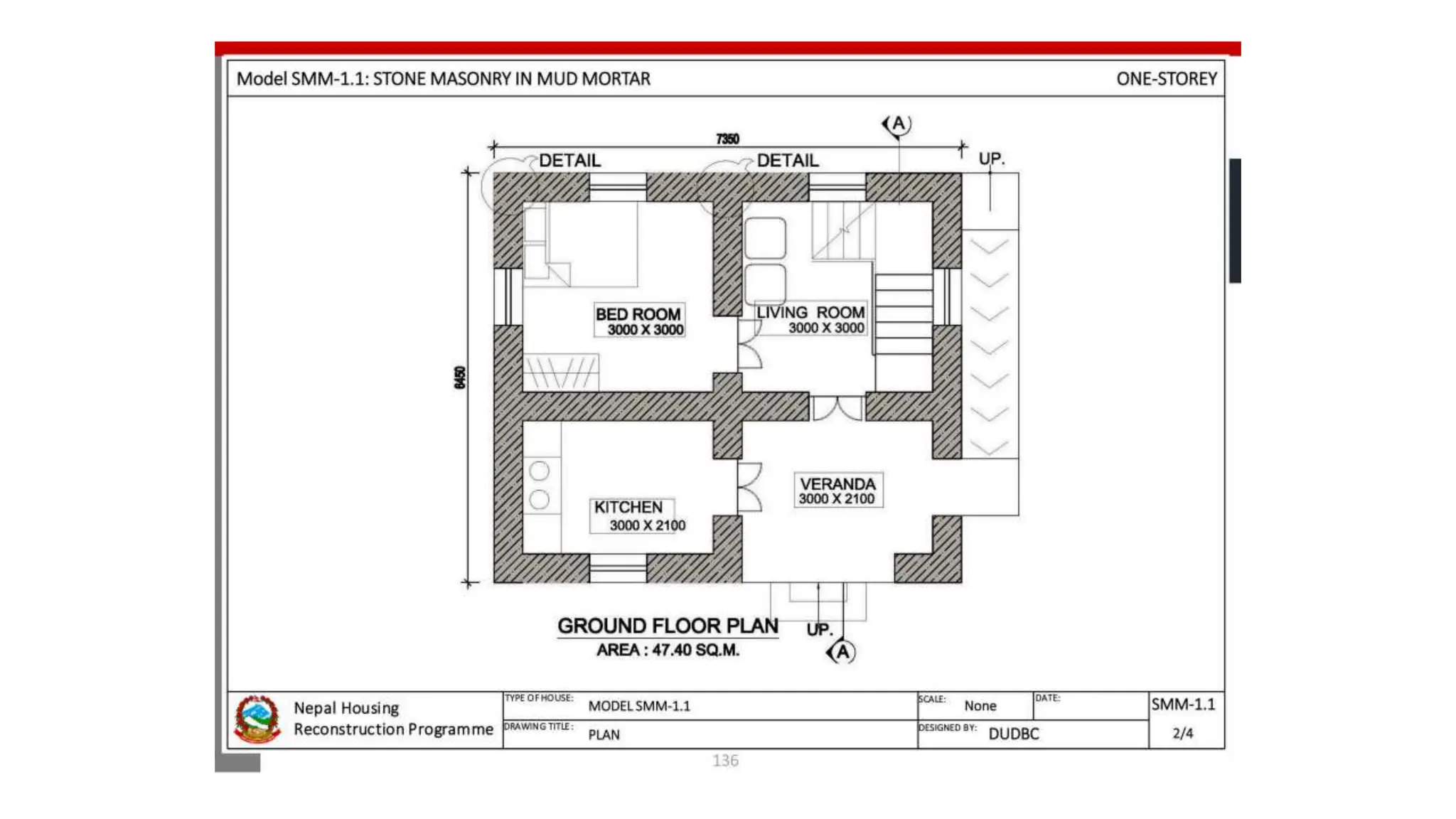
    Minimum Requirements for StoneMasonry in Mud Mortar (NBC203) Minimum Requirements (MRs) for Stone Masonry in Mud Mortar (NBC203) Page1 No. Category 1 Site Selecti on A building shall not be constructed if site is: ✔ Prone to geological fault or raptured area ✔ Susceptible to landslide ✔ Steep slope > 20% ✔ Filled area ✔ River bank and water-logged area 2 Shape of House No. of storeys ✔ Two storey+ attic Proport ion ✔ The house shall be planned square, rectangular. House should not more than 3 times its width. 3 Founda tion General ✔ The foundation trench shall be of uniform width. The foundation bed shall be on the same level throughout the foundation in flat area. Depth ✔ The depth of footing should be at least 750mm. Width ✔ The width of footing should not be less than 750mm and 800mm respectively for one and two-storeyed houses in medium soil condition. Width depends on soil type. Refer to technical drawings.
  • 14.
    4 Plin th General ✔ The toplevel of plinth should be at least 300mm above existing ground level. Recommended plinth height from the ground is 450mm. 5 Wall s General ✔ Masonry should be laid staggered to avoid formation of continuous vertical joint. At corners or wall junctions, continuous vertical joints should be avoided by properly laying large stones. The walls should be interlocked. Joints ✔ Mortar joints should not be more than 20mm and less than 10mm in thickness. Though Stone ✔ Spacing of through stone shall not be more than 1200mm in the horizontal direction and 600mm in the vertical direction. Seasoned timber, precast or cast insitu concrete can be used instead of through stone. Length of wall ✔ Maximum length of unsupported wall shall not exceed 12 times its thickness. If unsupported length of wall is more than this, buttress shall be provided at an interval not exceeding 12 times wall thickness. Wall thicknes s ✔ The wall thickness should not be less than 350- 450mm, 450mm respectively for one and two-storey houses. Height of wall ✔ The height of wall between floors should not be more than 8 times wall thickness.
  • 15.
    Minimum Requirements (MRs)for Stone Masonry in Mud Mortar (NBC203) Page2 Category 6.Opening s Location ✔ Openings are to be located away from inside corners by 1/4 of the height of the adjoining opening, but not less than 600 mm. Total length of openings ✔ Total length of opening should be less than 0.3 and 0.25 of individual wall length respectively for one and two-storey house. Distance between opening ✔ Distance between two openings shall be larger of half the height of shorter opening or 600mm. Lintel level ✔ Keep lintel level same for doors and windows 7.Vertica l Reinforceme nt Location ✔ Place vertical steel bars in the wall at all corners, wall junctions and adjacent to all doors and windows. They shall be covered with cement concrete in cavities made around them. Reinforcemen t ✔ At corners and junctions vertical reinforcing bar should be 12mm for one storey, and 16 mm in the ground floor and 12mm in the upper storey in case of two storey house. At jambs, the reinforcing bars should be 12mm.
  • 16.
    8Horizon tal Band General ✔ Horizontal reinforced concretebands should be provided throughout the entire wall with minimum thickness of 75 to 150 mm at following locations. Minimum width of bands should be equal to the wall thickness. Where reinforcing bars have been used, these shall have a clear cover of 25mm. Where reinforced concrete is not available, timber bands and stitches could be used. Plinth band ✔ A continuous plinth band shall be provided through all walls at the plinth level. The minimum height is 75mm with 2-12 reinforcing bars for hard soil. In case of soft soil, band should be 150mm high with 4- 12 reinforcement. Use 6mm dia. stirrups at 150mm centres. Sill band ✔ A continuous sill band shall be provided through all walls at the bottom level of opening (specially windows). The minimum height is 75mm with 2-10 reinforcing bars. Use 6mm diameter stirrups at 150mm centres. Lintel band ✔ A continuous lintel band shall be provided through all walls at the top level of opening. The minimum height is 75mm with 2-12mm bars. Use 6mm stirrups at 150mm centres. Extra thickening should be provided where openings are more than 1m wide. Roof band ✔ Roof band shall be provided at the top of walls, so as to tie the walls at their top and tie the roof to the walls. The minimum height is 75mm with 2-12mm diameter bars. Use 6mm dia. Stirrups at 150mm centres. Masonry gable wall must have the triangular portion of masonry enclosed in a reinforced concrete band.
  • 17.
    No. Category 9 Roo f Light roof ✔ Uselight roof comprising of wooden or steel structure covered with light roofing materials. Heavy roofing materials such as stone slabs or mud should be avoided. Connecti on ✔ All members of the timber truss or joints should be properly connected as shown in technical details. Cross- tie ✔ Trusses should be properly cross-tied with wooden braces as shown in technical details. 10 Material s Timber ✔ Well seasoned hard wood / local wood without knots should be used for structural purpose. Timber treatment such as use of coal tar or any other preservative can prevent timber from being decayed and attacked by insects. Mortar ✔ Mud should be free from organic material and pebbles, etc. Brick Brick should be class A1 or A2 with compressive strength not less than 3.5N/sqmm. Concrete ✔ The concrete mix for seismic bands should not be leaner than 1:2:4 (1 part cement, 2 parts sand and 4 parts aggregate) Reinforc ement ✔ High Strength Deformed Bars – Fe415 or Fe500 respectively with fy = 415 N/sqmm or 550N/sqmm could be used for reinforcements.
  • 46.
    Comparison between brick andstone masonry: Sure, either of the two masonry can give your structure a beautiful look but which fits your project better? If you can’t decide yet which, you may continue reading below for the comparison of the two. Lifespan Brick masonry durability is excellent but not excellent enough than stone. You can expect too much from the longevity of stone masonry than brick because it has properties that provide strength, durability, and water- resistance. Strength Brick masonry strength is more questionable than the stone construction, although it can be used for other places it is not suitable for all places. There are also more options for size provided with stones than bricks. However, regular size and uniform shape bricks are easier to bond together resulting in better strength, while stones, since they are in irregular shapes, are more difficult to
  • 47.
    Beauty: Good quality stonesare undeniably beautiful that you don’t have to improve or enhance their appearances, which is why it is perfect for monumental nature buildings. On the other hand, bricks perfectly match light ornamental work, however, bricks are easier to mold into the desired shape that will not eat all your budget. For the design options, both have great options, like a variety of shapes, and options for size but there are more choices available for stone variations. Since bricks have lesser design variations, they don’t give off more aesthetic looks like stones. Impact of Environment: Stones are more damp-proof than bricks because they are absorbent in nature. Other components of the building may decay or break down due to dampness. However, brick masonry construction is more resistant to fire than stone masonry. For the exposure to an open atmosphere, brick walls should be painted, while stone masonry walls do not require stuff like that. Furthermore, if you are looking for good insulation to air-transmitted noise, you may have to go for stone masonry.
  • 48.
    Cost of construction: Ifyou are currently on a tight budget, you may opt for brick masonry since they are almost everywhere. Brick walls are built in small thickness from 13cm, 23cm, and so on, which means lesser mortar. On the other hand, stone walls require a minimum thickness of 35cm, thus more mortar is needed for the stonework mortar joints. Workmanship: Stone masonry construction proceeds slowly because it is not easy and the process requires dressing and placing stones. Stones are also heavy to install, sometimes resulting in some major incidents where deterioration of joints inside the interior wall happens. On the other hand, since bricks are handy, the masonry proceeds very quickly. Bricks are also light in weight which means there is a lesser to no risk of a major incident. You should pick a skilled contractor who is good at stone masonry because defects can’t be rectified.
  • 49.
    Uses: Brick masonry iscommonly used in residential buildings, while stone masonry is used in piers, monumental buildings, marine structures, dams, and docks. Flexibility: Bricks can be easily altered, while stone masonry is hard to relocate or repair resulting in a hard alteration. Also, stone masonry when building openings for doors, or windows requires more work than brick masonry because stones need to be cut in different sizes. Conclusion: Both are good and durable, however, stone masonry demands more skilled labor, thicker walls, large size, and heavyweight which is expensive. On the other hand, brick masonry also has good qualities that may provide a solid and excellent construction. Hence, brick masonry is preferred due to its affordable price.
  • 52.
    Key Differences BetweenBrick And Stone Masonry: 1. Brick masonry is more economical than stone masonry. 2. Stone is more durable, strong, and weather- resistant than Brick. 3. Bricks are available in regular shape and size. We can use them with a certain pattern known as brick bonds. But, in stone masonry, no definite patterns are possible due to their dissimilar shape and size. 4. A brick wall may be made as thin as 10 cm. But in the case of a stone wall, the thickness of the wall is generally not less than 38 cm. 5. Because of more durability, strength, and weather resisting characteristics, the stone masonry is useful in construction programs 6. Due to the enormous size of the stone, it is difficult to manage. But you can handle the Brick easily as they are small in size. 7. Less skilled labor is needed in brick masonry than in stone masonry.
  • 55.