For any help regarding Stochastic Processes Homework Help
visit :- https://www.statisticshomeworkhelper.com/,
Email :- info@statisticshomeworkhelper.com or
call us at :- +1 678 648 4277
Statistics Homework Help
Reading Assignment: Review Chapter 3, Sections 3.1 to 3.6.1. Read Chapter 4, Sections
4.1 to 4.3
1)Exercise 3.13 in text.
2)Exercise 3.14 in text.
3)Exercise 3.15 in text.
4)Exercise 3.22 in text.
5)Exercise 3.26 in text.
6)Exercise 4.1 in text.
Problems
Statistics Homework Help
Solutions
Suppose that the states are numbered so that state 1 to J1 are in the recurrent class 1, J1 + 1
to J1 + J2 in recurrent class 2, etc. Thus, [P] has the following form:
Statistics Homework Help
Exercise 3.14:
Answer the following questions for the following stochastic matrix [P]
a) Find [P n] in closed form for arbitrary n > 1.
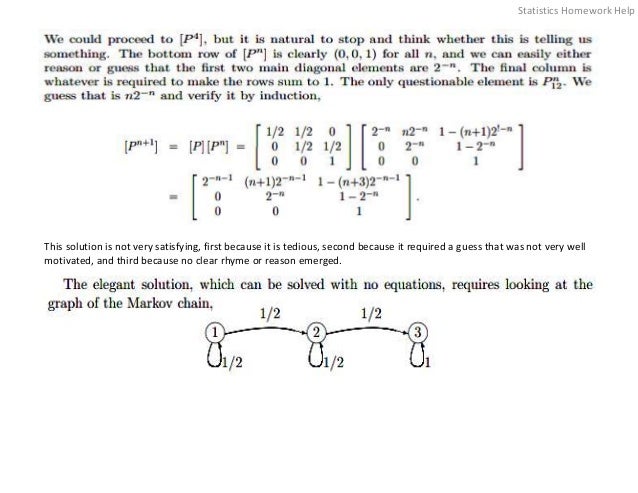
Solution: There are several approaches here. We first give the brute-force solution of simply multiplying [P]
by itself multiple times (which is reasonable for a first look), and then give the elegant solution.
Statistics Homework Help
This solution is not very satisfying, first because it is tedious, second because it required a guess that was not very well
motivated, and third because no clear rhyme or reason emerged.
Statistics Homework Help
It is now clear that P11! n = 2−n is the probability of taking the lower loop for ! n successive steps starting in state 1.
Similarly P n 22 = 2−n is the probability of taking the lower loop at state 2 for n successive steps.
Finally, P n 12 is the probability of taking the transition from state 1 to 2 exactly once out of the n transitions
starting in state 1 and of staying in the same state for the other n − 1 transitions. There are n such paths, corresponding to
the n possible steps at which the 1 → 2 transition can occur, and each path has probability 2−n. Thus P n 12 = n2−n, and
we ‘see’ why this factor of n appears. The transitions P n i3 are then chosen to make the rows sum to 1, yielding the same
solution as above..
b) Find all distinct eigenvalues and the multiplicity of each distinct eigenvalue for [P].
Solution: Use the following equation to find the determinant of [P − λI] and note that the only permutation of the
columns that gives a non-zero value is the main diagonal.
Thus det[P − ΛI] = ( − λ 2 2 ) (1 − λ). It follows that λ = 1 is an eigenvalue of multiplicity 1 and λ = 1/2 is an eigenvalue
of multiplicity 2.
c) Find a right eigenvector for each distinct eigenvalue, and show that the eigenvalue of multiplicity 2 does not
have 2 linearly independent eigenvectors.
Statistics Homework Help
From the first equation, ν2 = 0 and from the third ν3 = 0, so ν2 = 1 is the right eigenvector, unique within a scale factor.
d) Use (c) to show that there is no diagonal matrix [Λ] and no invertible matrix [U] for which [P][U] = [U][Λ].
Solution: Letting ν 1,ν 2,ν 3 be the columns of an hypothesized matrix [U], we see that [P][U] = [U][Λ] can be written out
as [P]νi = λ1νi for i = 1, 2, 3. For [U] to be invertible, ν 1,ν 2,ν 3 must be linearly independent eigenvectors of [P]. Part (c)
however showed that 3 such eigenvectors do not exist.
e) Rederive the result of part d) using the result of a) rather than c).
Note that the argument here is quite general. If [P n] has any terms containing a polynomial in n times λn i , then
the eigenvectors can’t span the space and a Jordan form decomposition is required.
Exercise 3.15:
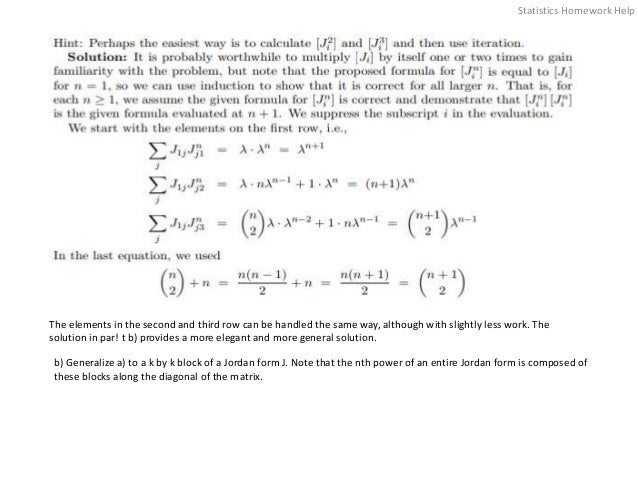
a) Let [Ji] be a 3 by 3 block of a Jordan form, i.e.,
Show that the nth power of [Ji] is given by
Statistics Homework Help
The elements in the second and third row can be handled the same way, although with slightly less work. The
solution in par! t b) provides a more elegant and more general solution.
b) Generalize a) to a k by k block of a Jordan form J. Note that the nth power of an entire Jordan form is composed of
these blocks along the diagonal of the matrix.
Statistics Homework Help
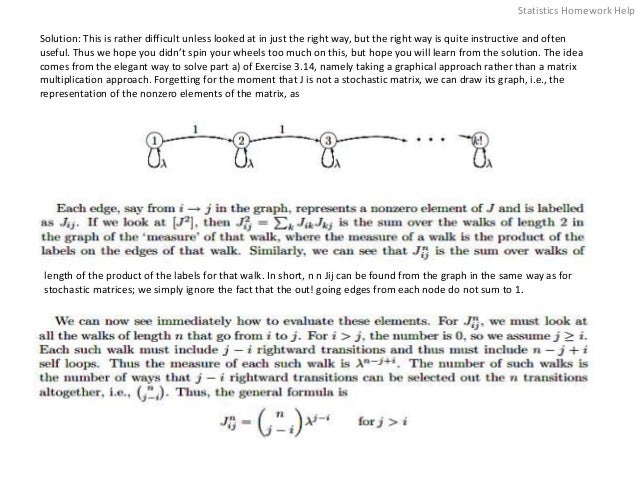
Solution: This is rather difficult unless looked at in just the right way, but the right way is quite instructive and often
useful. Thus we hope you didn’t spin your wheels too much on this, but hope you will learn from the solution. The idea
comes from the elegant way to solve part a) of Exercise 3.14, namely taking a graphical approach rather than a matrix
multiplication approach. Forgetting for the moment that J is not a stochastic matrix, we can draw its graph, i.e., the
representation of the nonzero elements of the matrix, as
length of the product of the labels for that walk. In short, n n Jij can be found from the graph in the same way as for
stochastic matrices; we simply ignore the fact that the out! going edges from each node do not sum to 1.
Statistics Homework Help
c) Let [P] be a stochastic matrix represented by a Jordan form [J] as [P] = U[J][U −1] and consider [U −1][P][U] = [J].
Show that any repeated eigenvalue of [P] that is represented by a Jordan block of 2 by 2 or more must be strictly
less than 1. Hint: Upper bound the elements of [U −1][P n][U]! by taking the magnitude of the elements of [U] and
[U −!1] an d upper bounding each element of a stochastic matrix by 1.
Solution: Each element of the matrix [U −1][P n][U] is a sum of products of terms and the magnitude of that sum
is upper bounded by the sum of products of the magnitudes of the terms. Representing the matrix whose
elements are the magnitudes of a matrix [U] as [|U|], and recognizing that [P n] = [|P n|] since its elements are
nonnegative, we have
where [M] is a matrix whose elements are all equal to 1.
The matrix on the right is independent of n, so each of its elements is simply a finite number. If [P] has an
eigenvalue λ of magnitude 1 whose multiplicity exceeds its number of linearly independent eigenvectors, then
[Jn] contains an element nλn−1 of magnitude n, and for large enough n, this is larger than the finite number
above, yielding a contradiction. Thus, for any stochastic ! matrix, any repeated eigenvalue with a defective
number of linearly independent eigenvectors has a magnitude strictly less than 1.
d) Let λs be the eigenvalue of largest magnitude less than 1. Assume that the Jordan blocks for λs are at
most of size k. Show that each ergodic class of [P] converges at least as fast as nkλk s .
Statistics Homework Help
The states of an ergodic class have no transitions out, and for questions of convergence within the class we can ignore
transitions in. Thus we will get rid of some excess notation by simply assuming an ergodic Markov chain. Thus there is a
single eigenvalue equal to 1 and all other eigenvalues are strictly less than 1. The largest such in magnitude is denoted as
λs. Assume that the eigenvalues are arranged in [J] in decreasing magnitude, so that J11 = 1.
Exercise 3.22
Statistics Homework Help
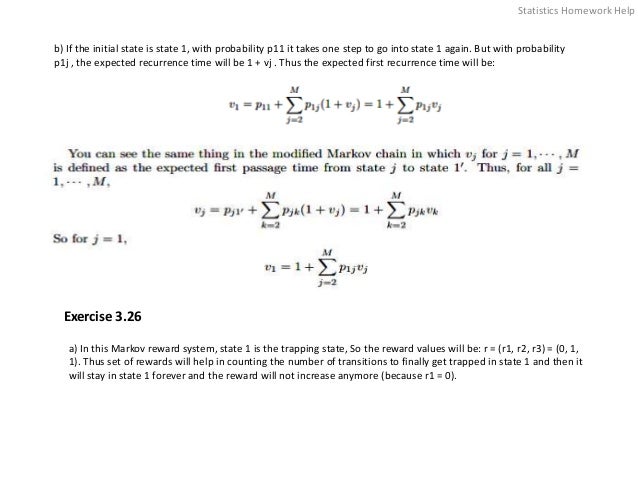
b) If the initial state is state 1, with probability p11 it takes one step to go into state 1 again. But with probability
p1j , the expected recurrence time will be 1 + vj . Thus the expected first recurrence time will be:
Exercise 3.26
a) In this Markov reward system, state 1 is the trapping state, So the reward values will be: r = (r1, r2, r3) = (0, 1,
1). Thus set of rewards will help in counting the number of transitions to finally get trapped in state 1 and then it
will stay in state 1 forever and the reward will not increase anymore (because r1 = 0).
Statistics Homework Help
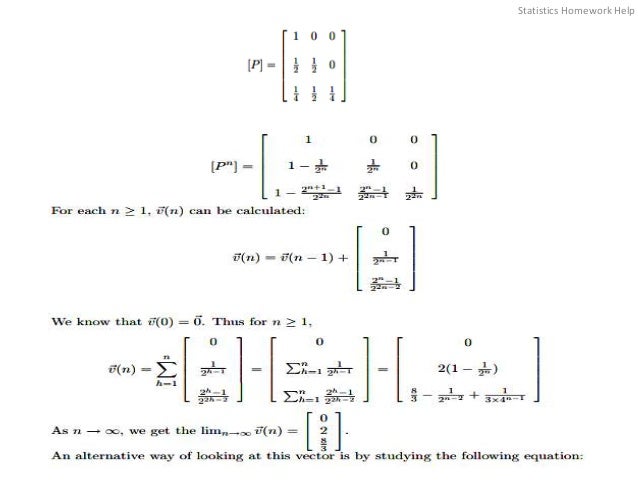
Note that each increase in n adds one additional term to this expression, and thus the expression can be written
as:
b) We start by following the first approach in part a), which requires us to calculate [P n]. Noting that state 2 can
never lead to state 3, we note that P n = (1/2)n 12 . Using this in finding the rest of [P n], some calculation leads
to :
Statistics Homework Help
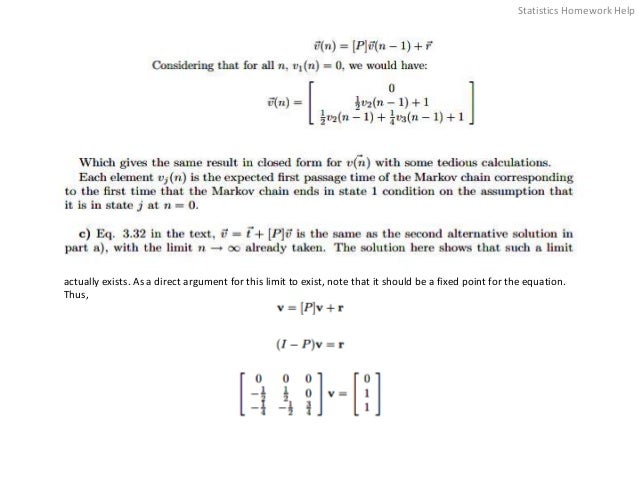
actually exists. As a direct argument for this limit to exist, note that it should be a fixed point for the equation.
Thus,
Statistics Homework Help
Letting v1(n) = 0, we would easily get v2 = 2 and v 8 3 = 3 . You observe that the fixed point of the equation v =
[P]v + r is the limit of the expected aggregate reward of the Markov chain.
Statistics Homework Help
c) First, we can get some bound on the value of E[X˘i] = E[min(Xi, b)]:
Statistics Homework Help

Stochastic Processes Homework Help

  • 1.
    For any helpregarding Stochastic Processes Homework Help visit :- https://www.statisticshomeworkhelper.com/, Email :- info@statisticshomeworkhelper.com or call us at :- +1 678 648 4277 Statistics Homework Help
  • 2.
    Reading Assignment: ReviewChapter 3, Sections 3.1 to 3.6.1. Read Chapter 4, Sections 4.1 to 4.3 1)Exercise 3.13 in text. 2)Exercise 3.14 in text. 3)Exercise 3.15 in text. 4)Exercise 3.22 in text. 5)Exercise 3.26 in text. 6)Exercise 4.1 in text. Problems Statistics Homework Help
  • 3.
    Solutions Suppose that thestates are numbered so that state 1 to J1 are in the recurrent class 1, J1 + 1 to J1 + J2 in recurrent class 2, etc. Thus, [P] has the following form: Statistics Homework Help
  • 4.
    Exercise 3.14: Answer thefollowing questions for the following stochastic matrix [P] a) Find [P n] in closed form for arbitrary n > 1. Solution: There are several approaches here. We first give the brute-force solution of simply multiplying [P] by itself multiple times (which is reasonable for a first look), and then give the elegant solution. Statistics Homework Help
  • 5.
    This solution isnot very satisfying, first because it is tedious, second because it required a guess that was not very well motivated, and third because no clear rhyme or reason emerged. Statistics Homework Help
  • 6.
    It is nowclear that P11! n = 2−n is the probability of taking the lower loop for ! n successive steps starting in state 1. Similarly P n 22 = 2−n is the probability of taking the lower loop at state 2 for n successive steps. Finally, P n 12 is the probability of taking the transition from state 1 to 2 exactly once out of the n transitions starting in state 1 and of staying in the same state for the other n − 1 transitions. There are n such paths, corresponding to the n possible steps at which the 1 → 2 transition can occur, and each path has probability 2−n. Thus P n 12 = n2−n, and we ‘see’ why this factor of n appears. The transitions P n i3 are then chosen to make the rows sum to 1, yielding the same solution as above.. b) Find all distinct eigenvalues and the multiplicity of each distinct eigenvalue for [P]. Solution: Use the following equation to find the determinant of [P − λI] and note that the only permutation of the columns that gives a non-zero value is the main diagonal. Thus det[P − ΛI] = ( − λ 2 2 ) (1 − λ). It follows that λ = 1 is an eigenvalue of multiplicity 1 and λ = 1/2 is an eigenvalue of multiplicity 2. c) Find a right eigenvector for each distinct eigenvalue, and show that the eigenvalue of multiplicity 2 does not have 2 linearly independent eigenvectors. Statistics Homework Help
  • 7.
    From the firstequation, ν2 = 0 and from the third ν3 = 0, so ν2 = 1 is the right eigenvector, unique within a scale factor. d) Use (c) to show that there is no diagonal matrix [Λ] and no invertible matrix [U] for which [P][U] = [U][Λ]. Solution: Letting ν 1,ν 2,ν 3 be the columns of an hypothesized matrix [U], we see that [P][U] = [U][Λ] can be written out as [P]νi = λ1νi for i = 1, 2, 3. For [U] to be invertible, ν 1,ν 2,ν 3 must be linearly independent eigenvectors of [P]. Part (c) however showed that 3 such eigenvectors do not exist. e) Rederive the result of part d) using the result of a) rather than c). Note that the argument here is quite general. If [P n] has any terms containing a polynomial in n times λn i , then the eigenvectors can’t span the space and a Jordan form decomposition is required. Exercise 3.15: a) Let [Ji] be a 3 by 3 block of a Jordan form, i.e., Show that the nth power of [Ji] is given by Statistics Homework Help
  • 8.
    The elements inthe second and third row can be handled the same way, although with slightly less work. The solution in par! t b) provides a more elegant and more general solution. b) Generalize a) to a k by k block of a Jordan form J. Note that the nth power of an entire Jordan form is composed of these blocks along the diagonal of the matrix. Statistics Homework Help
  • 9.
    Solution: This israther difficult unless looked at in just the right way, but the right way is quite instructive and often useful. Thus we hope you didn’t spin your wheels too much on this, but hope you will learn from the solution. The idea comes from the elegant way to solve part a) of Exercise 3.14, namely taking a graphical approach rather than a matrix multiplication approach. Forgetting for the moment that J is not a stochastic matrix, we can draw its graph, i.e., the representation of the nonzero elements of the matrix, as length of the product of the labels for that walk. In short, n n Jij can be found from the graph in the same way as for stochastic matrices; we simply ignore the fact that the out! going edges from each node do not sum to 1. Statistics Homework Help
  • 10.
    c) Let [P]be a stochastic matrix represented by a Jordan form [J] as [P] = U[J][U −1] and consider [U −1][P][U] = [J]. Show that any repeated eigenvalue of [P] that is represented by a Jordan block of 2 by 2 or more must be strictly less than 1. Hint: Upper bound the elements of [U −1][P n][U]! by taking the magnitude of the elements of [U] and [U −!1] an d upper bounding each element of a stochastic matrix by 1. Solution: Each element of the matrix [U −1][P n][U] is a sum of products of terms and the magnitude of that sum is upper bounded by the sum of products of the magnitudes of the terms. Representing the matrix whose elements are the magnitudes of a matrix [U] as [|U|], and recognizing that [P n] = [|P n|] since its elements are nonnegative, we have where [M] is a matrix whose elements are all equal to 1. The matrix on the right is independent of n, so each of its elements is simply a finite number. If [P] has an eigenvalue λ of magnitude 1 whose multiplicity exceeds its number of linearly independent eigenvectors, then [Jn] contains an element nλn−1 of magnitude n, and for large enough n, this is larger than the finite number above, yielding a contradiction. Thus, for any stochastic ! matrix, any repeated eigenvalue with a defective number of linearly independent eigenvectors has a magnitude strictly less than 1. d) Let λs be the eigenvalue of largest magnitude less than 1. Assume that the Jordan blocks for λs are at most of size k. Show that each ergodic class of [P] converges at least as fast as nkλk s . Statistics Homework Help
  • 11.
    The states ofan ergodic class have no transitions out, and for questions of convergence within the class we can ignore transitions in. Thus we will get rid of some excess notation by simply assuming an ergodic Markov chain. Thus there is a single eigenvalue equal to 1 and all other eigenvalues are strictly less than 1. The largest such in magnitude is denoted as λs. Assume that the eigenvalues are arranged in [J] in decreasing magnitude, so that J11 = 1. Exercise 3.22 Statistics Homework Help
  • 12.
    b) If theinitial state is state 1, with probability p11 it takes one step to go into state 1 again. But with probability p1j , the expected recurrence time will be 1 + vj . Thus the expected first recurrence time will be: Exercise 3.26 a) In this Markov reward system, state 1 is the trapping state, So the reward values will be: r = (r1, r2, r3) = (0, 1, 1). Thus set of rewards will help in counting the number of transitions to finally get trapped in state 1 and then it will stay in state 1 forever and the reward will not increase anymore (because r1 = 0). Statistics Homework Help
  • 13.
    Note that eachincrease in n adds one additional term to this expression, and thus the expression can be written as: b) We start by following the first approach in part a), which requires us to calculate [P n]. Noting that state 2 can never lead to state 3, we note that P n = (1/2)n 12 . Using this in finding the rest of [P n], some calculation leads to : Statistics Homework Help
  • 14.
  • 15.
    actually exists. Asa direct argument for this limit to exist, note that it should be a fixed point for the equation. Thus, Statistics Homework Help
  • 16.
    Letting v1(n) =0, we would easily get v2 = 2 and v 8 3 = 3 . You observe that the fixed point of the equation v = [P]v + r is the limit of the expected aggregate reward of the Markov chain. Statistics Homework Help
  • 17.
    c) First, wecan get some bound on the value of E[X˘i] = E[min(Xi, b)]: Statistics Homework Help