Fundamentals
of
Antennas
Antenna ?
The word, ‘ANTENNA’ came from a word, ‘ANTENNAE’ - A
Sensory Appendage found on the Head of Insects.
Antennae in insects help them sense their surroundings — they
detect smell, touch, and sometimes sound. They act as sensitive
receivers of environmental information.
Italian inventor Guglielmo Marconi used the term "antenna" to
describe the long wire he used to "receive" wireless signals from
the environment
Antenna ?
Antenna can be a metallic device, or a rod, or
a wire, or a slot, capable of radiating and
receiving radio/EM waves.
Antenna can be Sensor.
Antenna ?
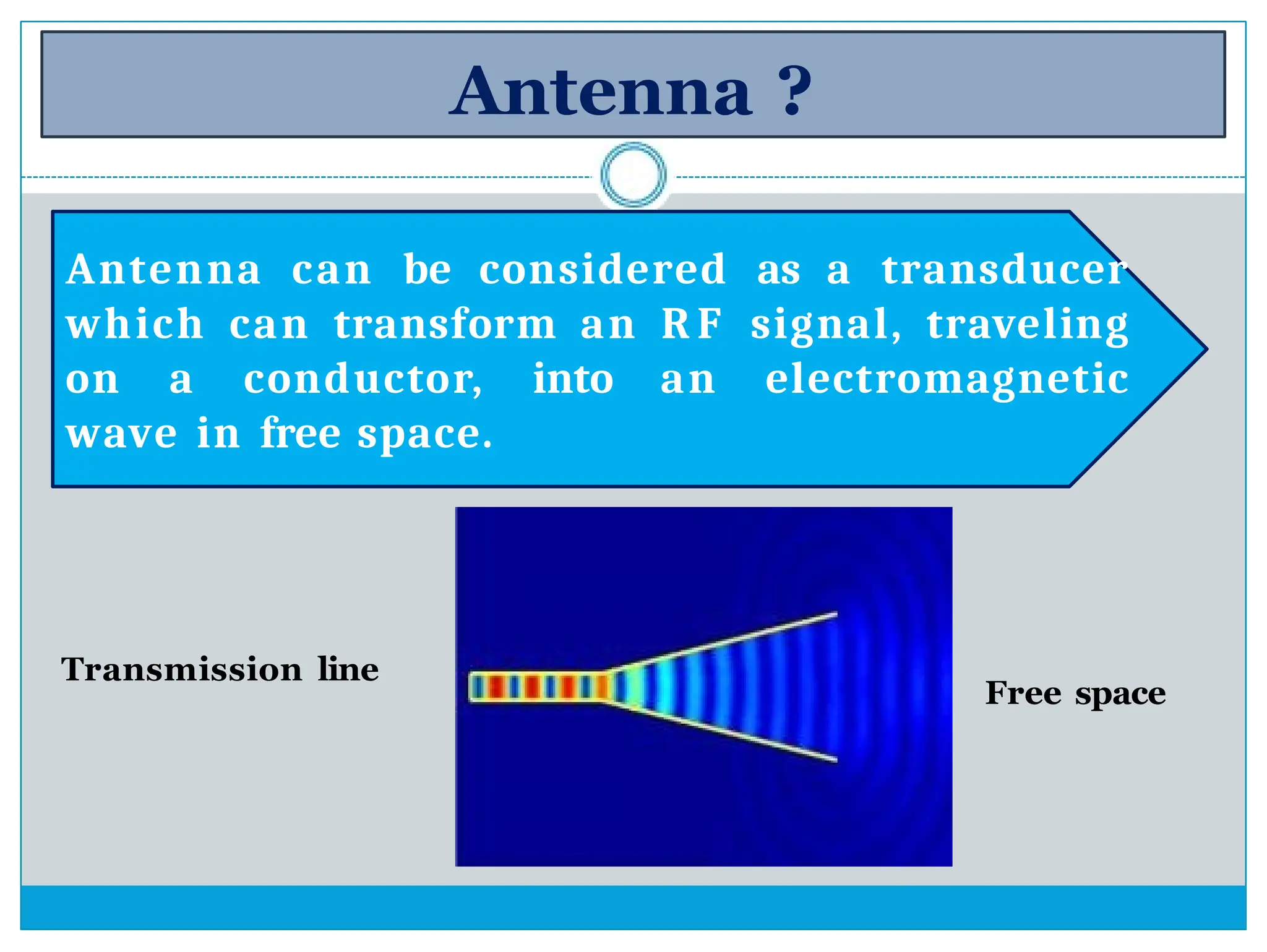
Antenna can be considered as a transducer
which can transform an R F signal, traveling
on a conductor, into an electromagnetic
wave in free space.
Transmission line
Free space
Attempt the Following Questions
1. Describe in one line, the importance of
antennas in modern world.
2. Write ten applications of antennas.
3. Write the names of ten different antennas.
4. Write ten different terms / parameters
associated with any antenna.
5. Write requirements of an antenna design.
Importance of Antennas
Wireless Communication
is Impossible without Antennas
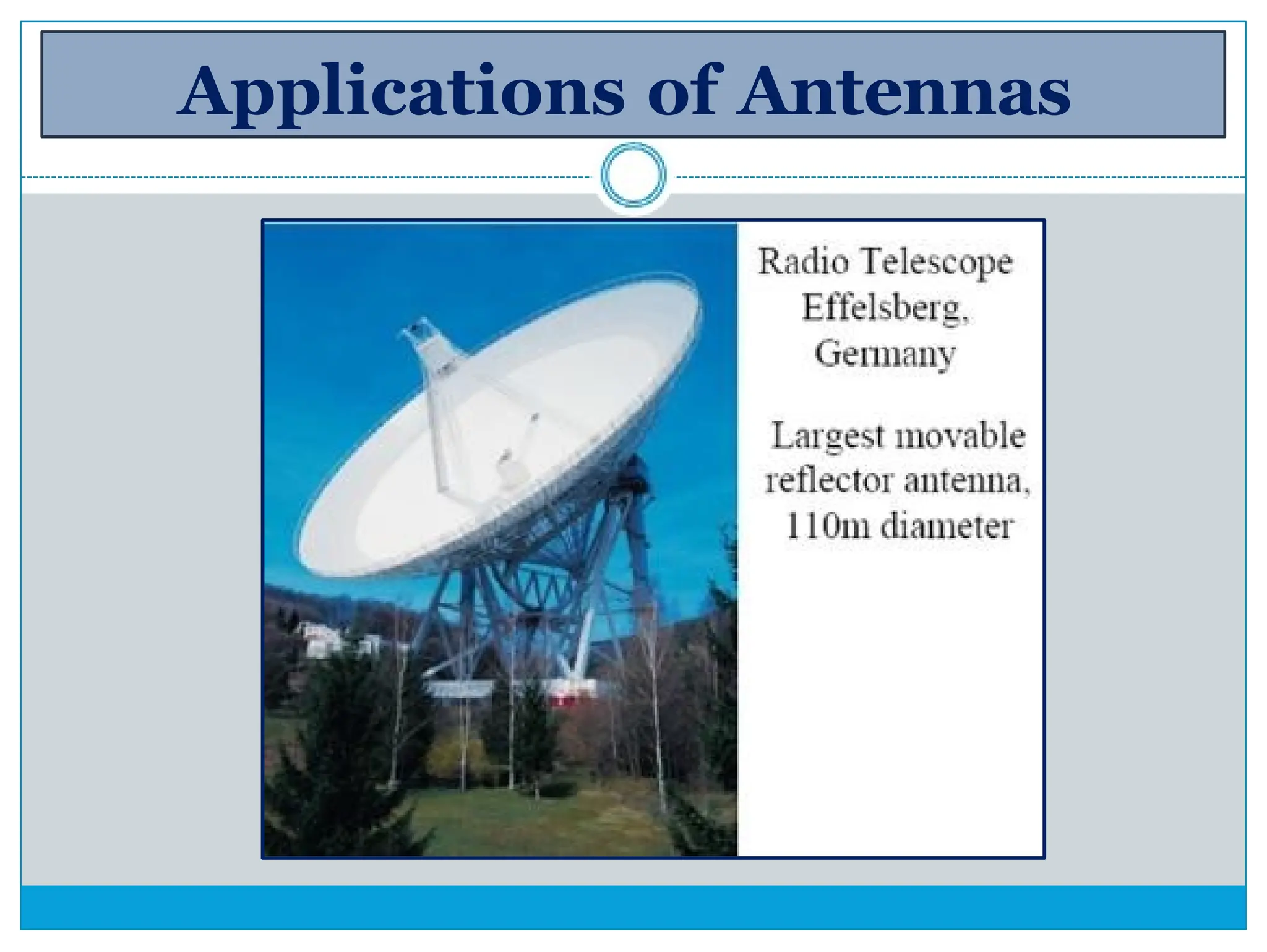
Applications of Antennas
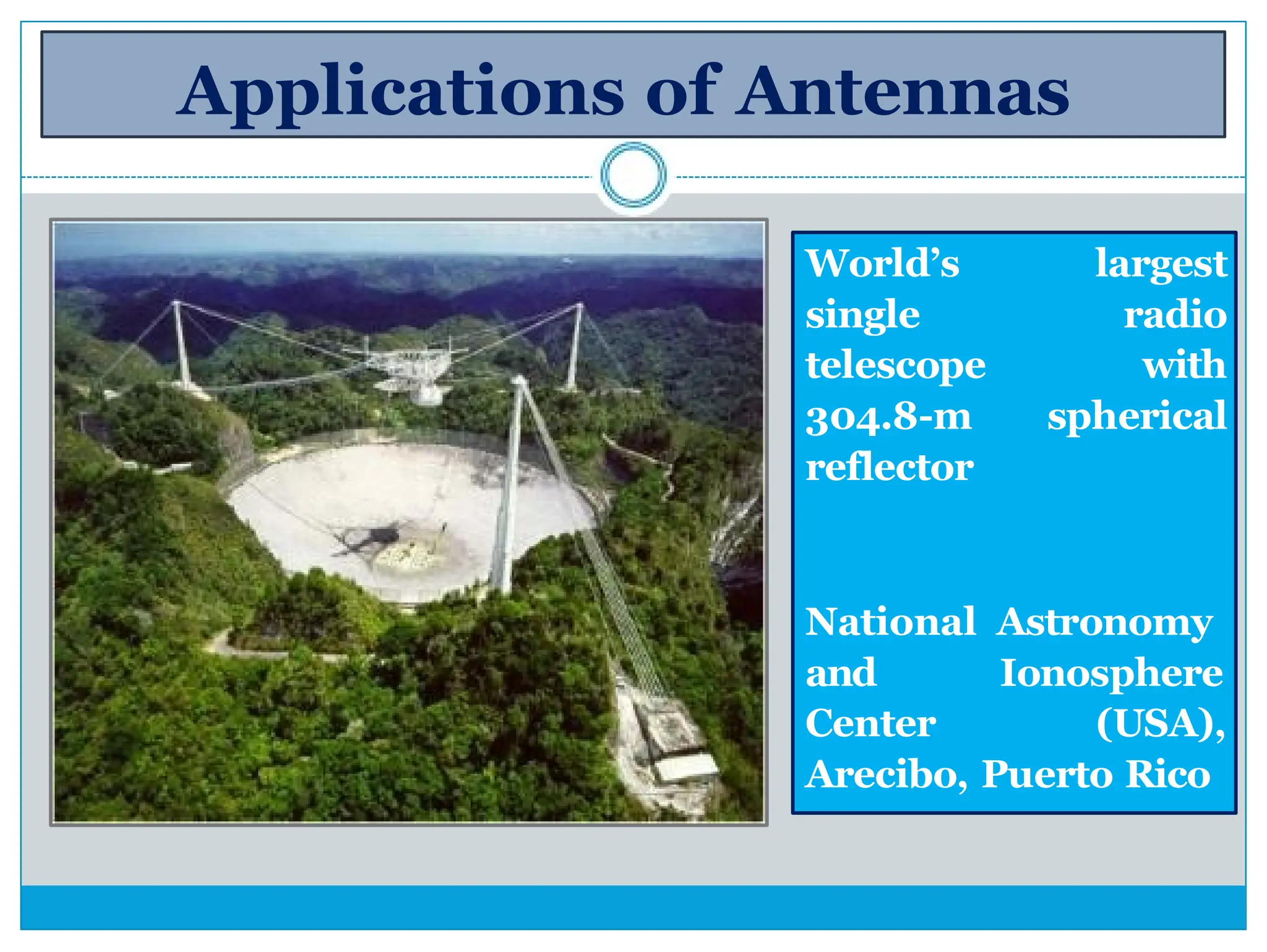
largest
radio
with
spherical
World’s
single
telescope
304.8-m
reflector
National Astronomy
and Ionosphere
Center (USA),
Arecibo, Puerto Rico
Applications of Antennas
1. Mobile Phone
2. Radio Communication
3. Television
4. Military
5. Satellite
6. Bio-medical
7. Ship – to – Ship Communication
8. Radar
9. Remote Sensing
10. Laptop
Types of Antennas
1. Wire Antennas
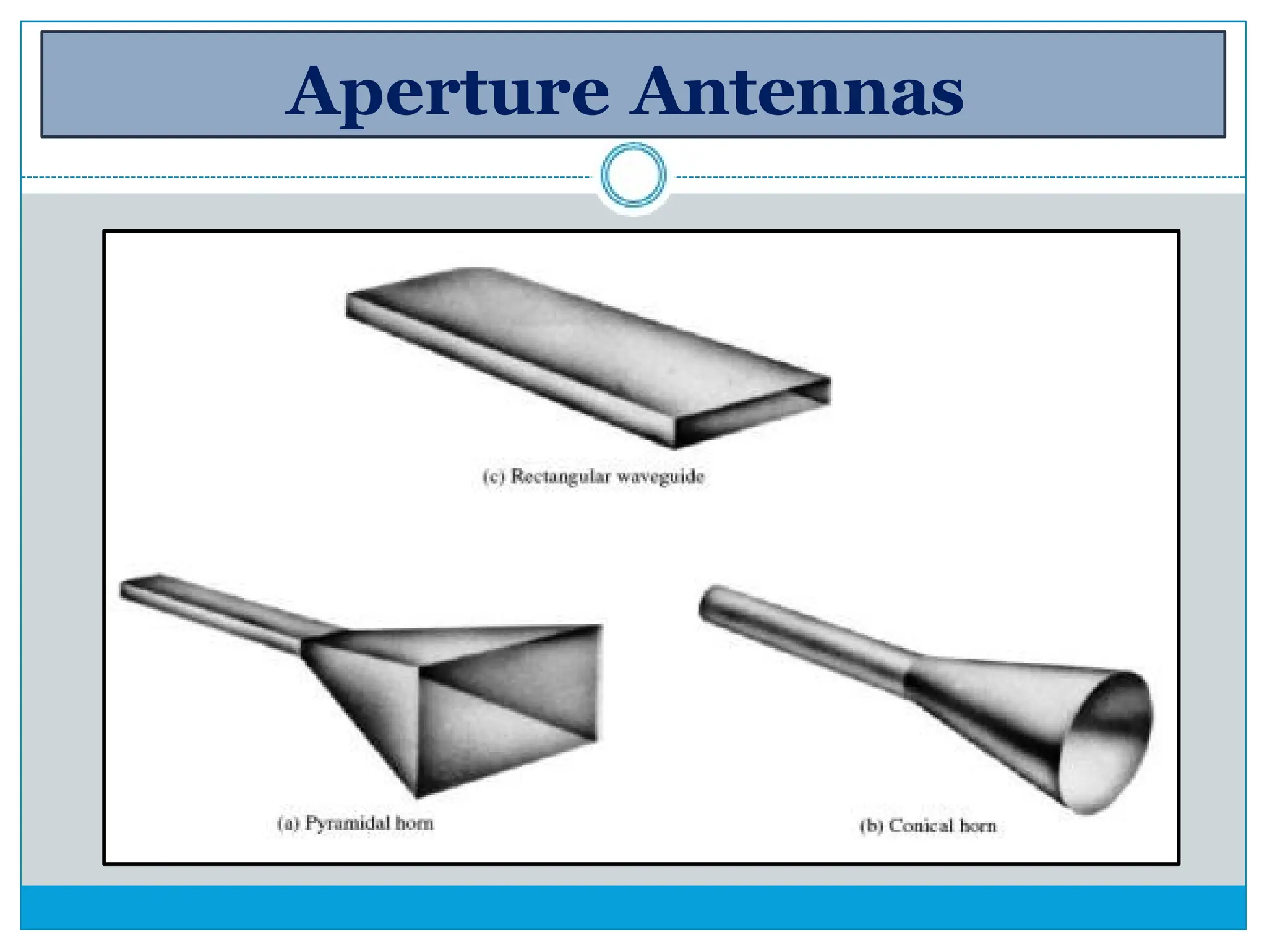
2. Aperture Antennas
3. Microstrip Antennas
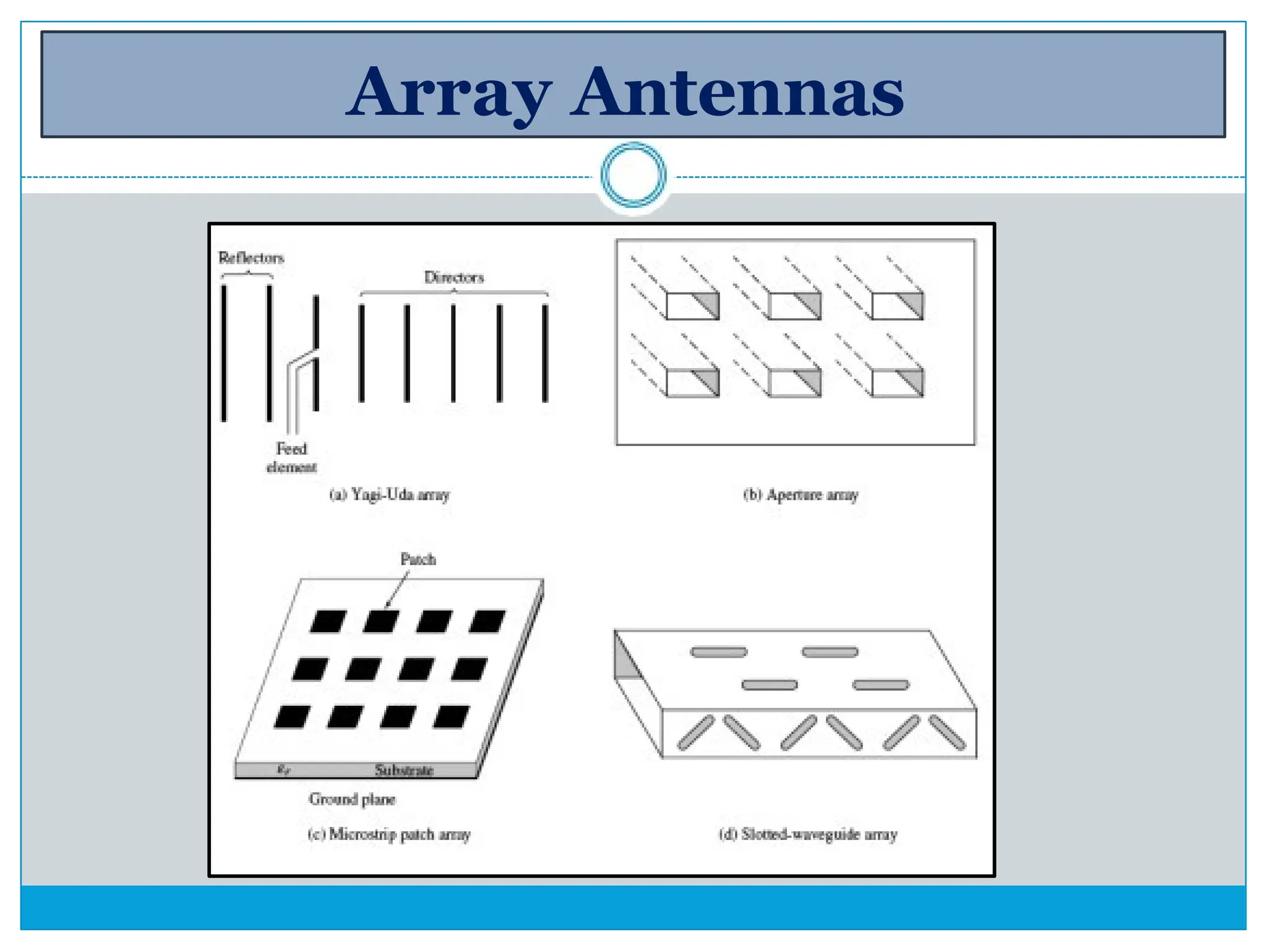
4. Array Antennas
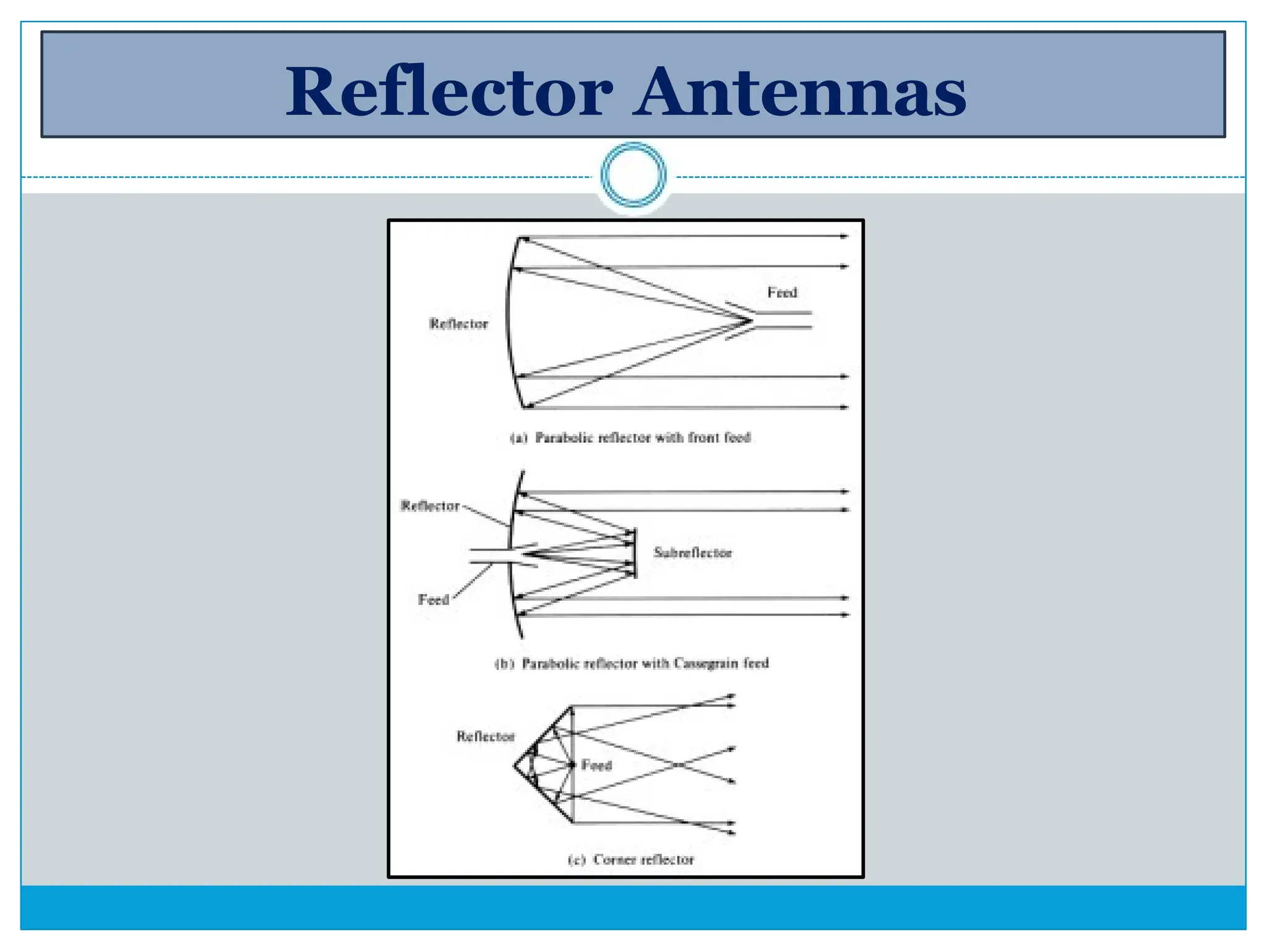
5. Reflector Antennas
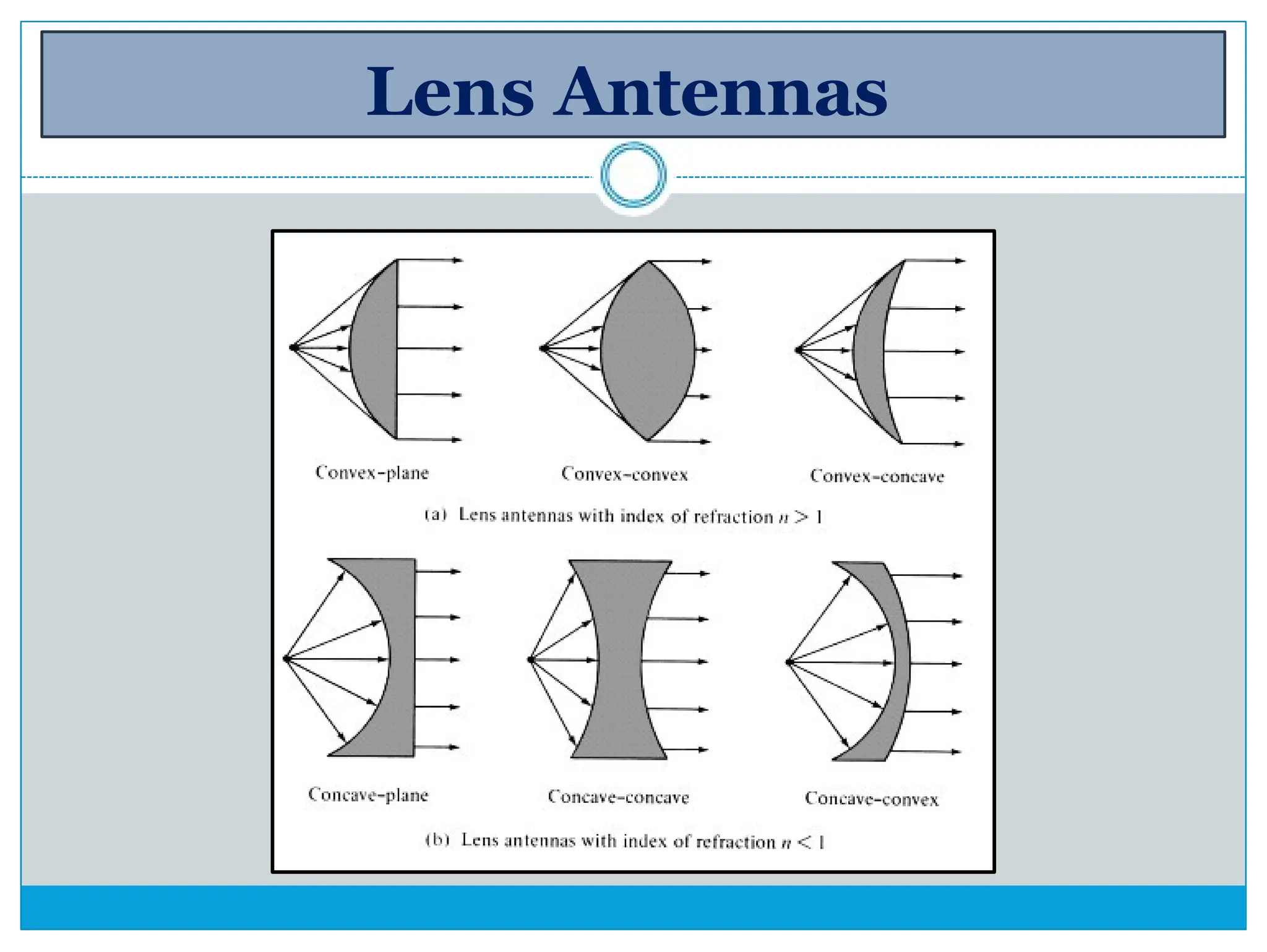
6. Lens Antennas
Wire Antennas
Aperture Antennas
Reflector Antennas
Microstrip Antennas
Array Antennas
Lens Antennas
Key Antenna Parameters
1. Radiation Patterns
2. Directivity
3. Gain
4. Antenna Efficiency
5. Half-Power Beam Width
6. Beam Efficiency
7. Band width
8. Polarization
9. Input Impedance
10. Front to Back Ratio
Antenna Radiation Pattern is a Mathematical Function
or a Graphical Representation of the radiation
properties of an antenna as a function of space
coordinates.
1 Antenna Radiation Patterns
Antenna Radiation Patterns
1
Antenna Radiation Patterns
1
Antenna Directivity
Directivity describes,
how well an antenna directs the energy in a
certain direction.
Directivity describes
how much an antenna concentrates energy
in one direction in preference to radiation
in other directions.
2
Antenna Gain
3
The gain of an antenna in a given direction is…
- the amount of energy radiated in that direction,
compared to the energy an isotropic antenna would
radiate in the same direction when driven with the
same input power.
Gain = (Efficiency) . (Directivity)
If antenna efficiency is 100%, then the directivity
would be equal to the antenna gain.
Antenna Efficiency
4
The antenna efficiency takes into account
the amount of losses at the terminals of
the antenna and within the structure of
the antenna.
These losses include,
- Reflections because of mismatch between
the transmitter and the antenna,
- Conduction and dielectric losses (i. e. I2R
losses)
Antenna Bandwidth
5
The range of frequency over which antenna
can operate correctly can be consider as the
Antenna BW.
Generally, the BW is represented in terms of
percentage of the center frequency of the
band
BW = 100 . (Highest Freq. – Lowest Freq.)
Centre Freq.
Antenna Polarization
6
Antenna Polarization is decided by the
Polarization of the Wave transmitted or
radiated by the antenna.
Polarization of the Wave is the property of
the EM wave describing the direction and the
magnitude of the electric field vector.
1. Linear Polarization: H & V
2. Circular Polarization: RHCP & LHCP
3. Elliptical Polarization : RHEP & LHEP
Antenna Polarization
6
Antenna Polarization
6
Co-polarization:
Polarization with which
the antenna is intended
to radiate or receive the
EM energy.
Cross-polarization:
Polarization orthogonal
to the
desired polarization.
If the E-field is y-directed and if is termed as
co-polar component,
then the x-directed component of the E-field,
is a cross polar component.
Co & Cross Polarization
6
-8 -6 -4 -2 0 2 4 6 8
Theta (Degree)
-50
-40
-30
-20
-10
0
Relative
Level
(dB)
Co Pol. (Phi=0)
Co Pol. (Phi=90)
Cx Pol. (Phi=90)
Effects of High Cross-Polarization
⚫ Undesired Interference in Communication
Applications
⚫ Measurement Errors in
Radiometric Applications
⚫ Affects Tracking Accuracies in
Radar Applications
⚫ Restriction on Frequency Re-use Applications
⚫ Unacceptable Performance Degradation
It is the ratio of the power in the main
beam to the total power received by the
antenna.
What should be the value of Beam
Efficiency ?
7 Antenna Beam Efficiency
Half-Power Beamwidth
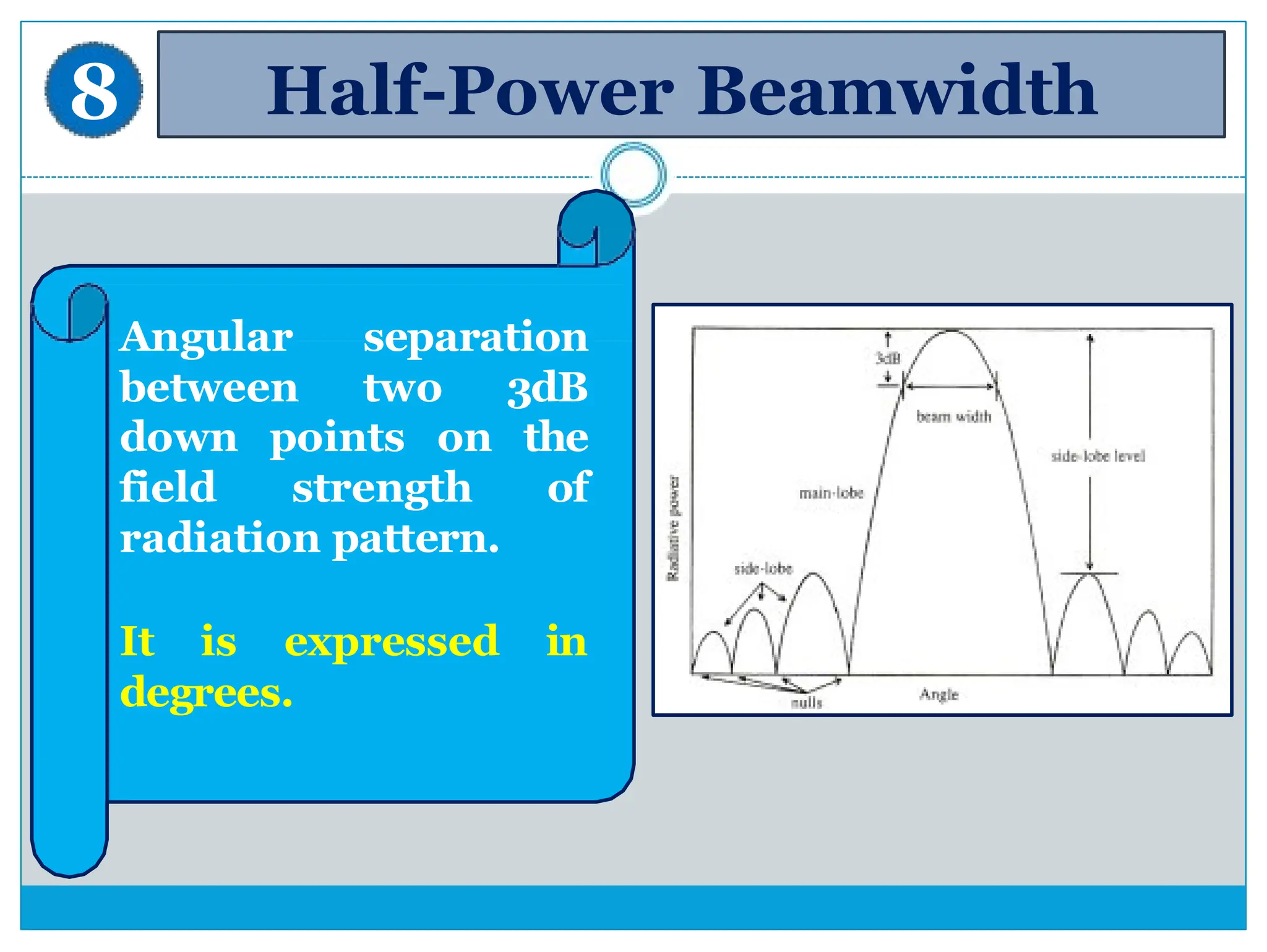
Angular separation
between two 3dB
down points on the
field strength of
radiation pattern.
It is expressed in
degrees.
8
Front-to-Back Ratio
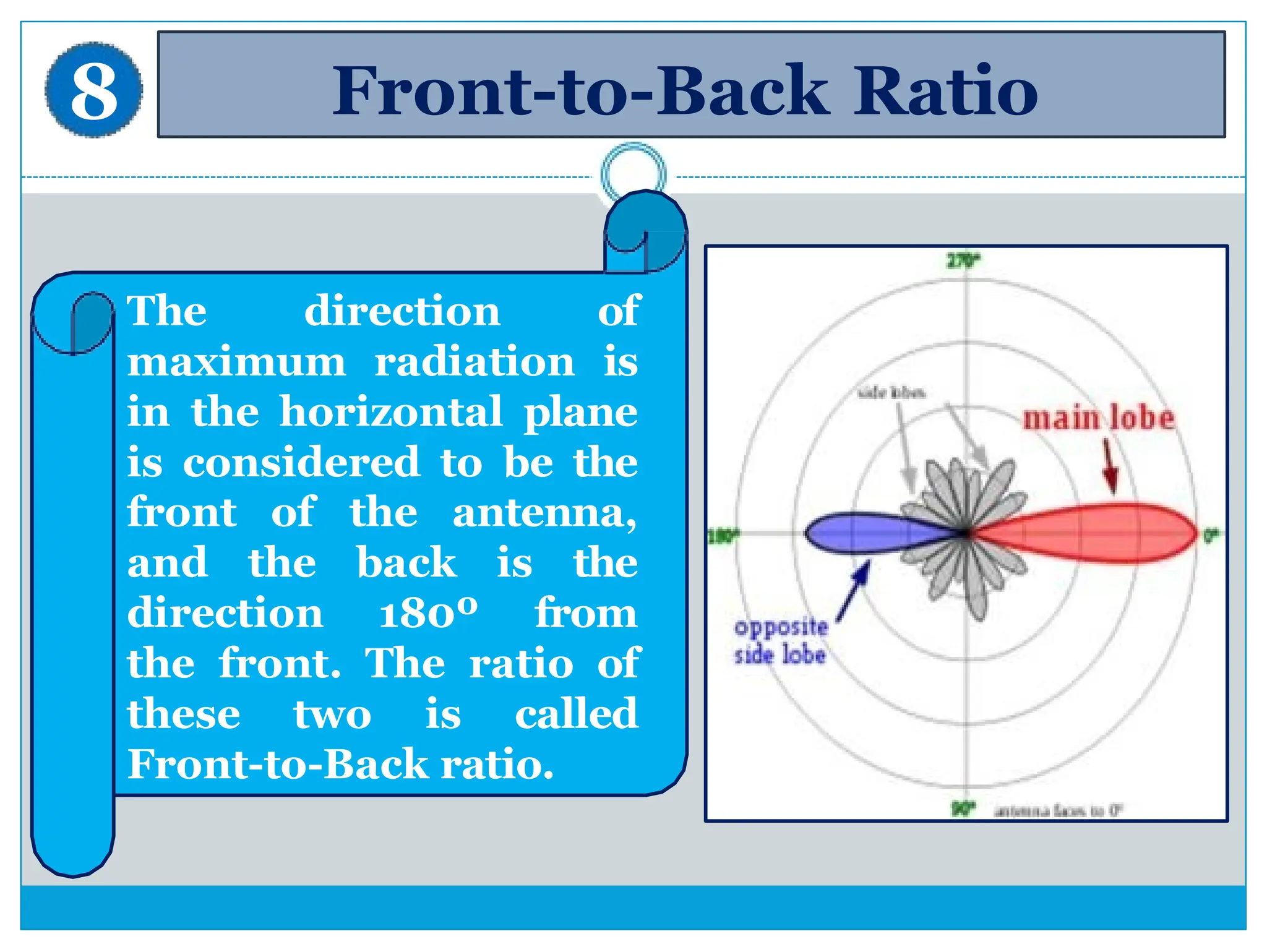
The direction of
maximum radiation is
in the horizontal plane
is considered to be the
front of the antenna,
and the back is the
direction 180º from
the front. The ratio of
these two is called
Front-to-Back ratio.
8
Isotropic Antenna
Isotropic Antenna is a
in all
- Hypothetical-lossless antenna,
- having equal radiation
direction,
- physically not realizable,
- used as reference antenna
Directional Antenna
Directional Antenna is
- Capable of radiating or receiving EM
waves in a specific direction
Omni-Directional Antenna
Omni-Directional
Antenna is having
- Directional
property
in
a specific plane
but non
directional in the
orthogonal plane
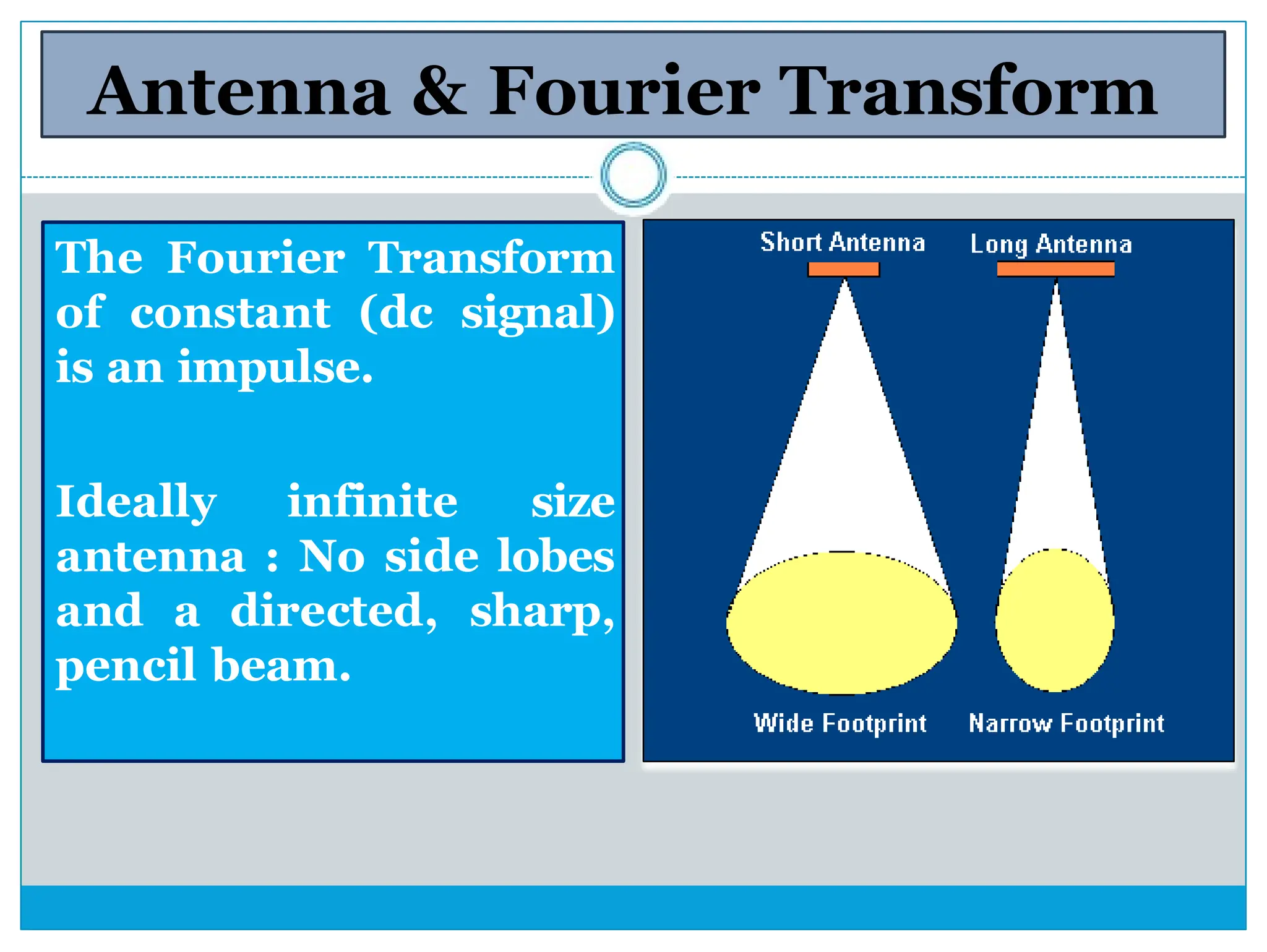
Antenna & Fourier Transform
The Fourier Transform
of constant (dc signal)
is an impulse.
Ideally infinite size
antenna : No side lobes
and a directed, sharp,
pencil beam.
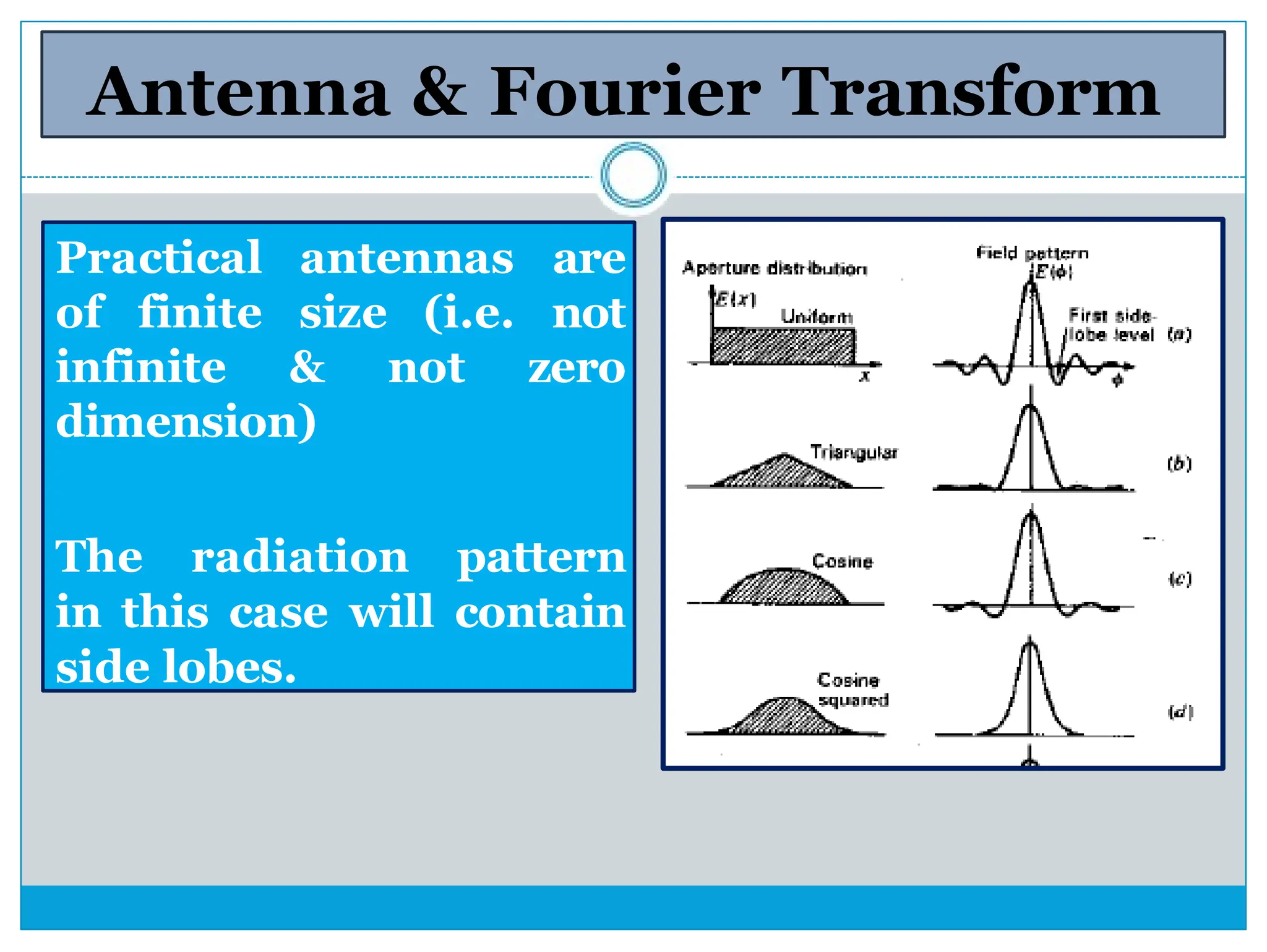
Antenna & Fourier Transform
Practical antennas are
of finite size (i.e. not
infinite & not zero
dimension)
The radiation pattern
in this case will contain
side lobes.
Antenna Design Specifications
⚫ Gain and/or Directivity
⚫ Bandwidth
⚫ Field Patterns / Radiation Patterns
⚫ Beam-width (HPBW / FNBW)
⚫ Impedance Matching / Return Loss
⚫ Front to Back Ratio
⚫ Polarization
⚫ Environmental Specifications
⚫ Structural Specifications
⚫ Mounting Specifications
Antenna Design - Complete Engineering
Electrical
Engg.
Civil
Engg.
Computer
Engg.
Mathematics
Mechanical
Engg.

Fundamentals_of_Antennas,unit1 as per JNTUGV

  • 1.
  • 2.
    Antenna ? The word,‘ANTENNA’ came from a word, ‘ANTENNAE’ - A Sensory Appendage found on the Head of Insects. Antennae in insects help them sense their surroundings — they detect smell, touch, and sometimes sound. They act as sensitive receivers of environmental information. Italian inventor Guglielmo Marconi used the term "antenna" to describe the long wire he used to "receive" wireless signals from the environment
  • 3.
    Antenna ? Antenna canbe a metallic device, or a rod, or a wire, or a slot, capable of radiating and receiving radio/EM waves. Antenna can be Sensor.
  • 4.
    Antenna ? Antenna canbe considered as a transducer which can transform an R F signal, traveling on a conductor, into an electromagnetic wave in free space. Transmission line Free space
  • 5.
    Attempt the FollowingQuestions 1. Describe in one line, the importance of antennas in modern world. 2. Write ten applications of antennas. 3. Write the names of ten different antennas. 4. Write ten different terms / parameters associated with any antenna. 5. Write requirements of an antenna design.
  • 6.
    Importance of Antennas WirelessCommunication is Impossible without Antennas
  • 7.
  • 8.
  • 9.
  • 10.
  • 11.
    Applications of Antennas 1.Mobile Phone 2. Radio Communication 3. Television 4. Military 5. Satellite 6. Bio-medical 7. Ship – to – Ship Communication 8. Radar 9. Remote Sensing 10. Laptop
  • 12.
    Types of Antennas 1.Wire Antennas 2. Aperture Antennas 3. Microstrip Antennas 4. Array Antennas 5. Reflector Antennas 6. Lens Antennas
  • 13.
  • 14.
  • 15.
  • 16.
  • 17.
  • 18.
  • 19.
    Key Antenna Parameters 1.Radiation Patterns 2. Directivity 3. Gain 4. Antenna Efficiency 5. Half-Power Beam Width 6. Beam Efficiency 7. Band width 8. Polarization 9. Input Impedance 10. Front to Back Ratio
  • 20.
    Antenna Radiation Patternis a Mathematical Function or a Graphical Representation of the radiation properties of an antenna as a function of space coordinates. 1 Antenna Radiation Patterns
  • 21.
  • 22.
  • 23.
    Antenna Directivity Directivity describes, howwell an antenna directs the energy in a certain direction. Directivity describes how much an antenna concentrates energy in one direction in preference to radiation in other directions. 2
  • 24.
    Antenna Gain 3 The gainof an antenna in a given direction is… - the amount of energy radiated in that direction, compared to the energy an isotropic antenna would radiate in the same direction when driven with the same input power. Gain = (Efficiency) . (Directivity) If antenna efficiency is 100%, then the directivity would be equal to the antenna gain.
  • 25.
    Antenna Efficiency 4 The antennaefficiency takes into account the amount of losses at the terminals of the antenna and within the structure of the antenna. These losses include, - Reflections because of mismatch between the transmitter and the antenna, - Conduction and dielectric losses (i. e. I2R losses)
  • 26.
    Antenna Bandwidth 5 The rangeof frequency over which antenna can operate correctly can be consider as the Antenna BW. Generally, the BW is represented in terms of percentage of the center frequency of the band BW = 100 . (Highest Freq. – Lowest Freq.) Centre Freq.
  • 27.
    Antenna Polarization 6 Antenna Polarizationis decided by the Polarization of the Wave transmitted or radiated by the antenna. Polarization of the Wave is the property of the EM wave describing the direction and the magnitude of the electric field vector. 1. Linear Polarization: H & V 2. Circular Polarization: RHCP & LHCP 3. Elliptical Polarization : RHEP & LHEP
  • 28.
  • 29.
    Antenna Polarization 6 Co-polarization: Polarization withwhich the antenna is intended to radiate or receive the EM energy. Cross-polarization: Polarization orthogonal to the desired polarization. If the E-field is y-directed and if is termed as co-polar component, then the x-directed component of the E-field, is a cross polar component.
  • 30.
    Co & CrossPolarization 6 -8 -6 -4 -2 0 2 4 6 8 Theta (Degree) -50 -40 -30 -20 -10 0 Relative Level (dB) Co Pol. (Phi=0) Co Pol. (Phi=90) Cx Pol. (Phi=90)
  • 31.
    Effects of HighCross-Polarization ⚫ Undesired Interference in Communication Applications ⚫ Measurement Errors in Radiometric Applications ⚫ Affects Tracking Accuracies in Radar Applications ⚫ Restriction on Frequency Re-use Applications ⚫ Unacceptable Performance Degradation
  • 32.
    It is theratio of the power in the main beam to the total power received by the antenna. What should be the value of Beam Efficiency ? 7 Antenna Beam Efficiency
  • 33.
    Half-Power Beamwidth Angular separation betweentwo 3dB down points on the field strength of radiation pattern. It is expressed in degrees. 8
  • 34.
    Front-to-Back Ratio The directionof maximum radiation is in the horizontal plane is considered to be the front of the antenna, and the back is the direction 180º from the front. The ratio of these two is called Front-to-Back ratio. 8
  • 35.
    Isotropic Antenna Isotropic Antennais a in all - Hypothetical-lossless antenna, - having equal radiation direction, - physically not realizable, - used as reference antenna
  • 36.
    Directional Antenna Directional Antennais - Capable of radiating or receiving EM waves in a specific direction
  • 37.
    Omni-Directional Antenna Omni-Directional Antenna ishaving - Directional property in a specific plane but non directional in the orthogonal plane
  • 38.
    Antenna & FourierTransform The Fourier Transform of constant (dc signal) is an impulse. Ideally infinite size antenna : No side lobes and a directed, sharp, pencil beam.
  • 39.
    Antenna & FourierTransform Practical antennas are of finite size (i.e. not infinite & not zero dimension) The radiation pattern in this case will contain side lobes.
  • 40.
    Antenna Design Specifications ⚫Gain and/or Directivity ⚫ Bandwidth ⚫ Field Patterns / Radiation Patterns ⚫ Beam-width (HPBW / FNBW) ⚫ Impedance Matching / Return Loss ⚫ Front to Back Ratio ⚫ Polarization ⚫ Environmental Specifications ⚫ Structural Specifications ⚫ Mounting Specifications
  • 41.
    Antenna Design -Complete Engineering Electrical Engg. Civil Engg. Computer Engg. Mathematics Mechanical Engg.