
Stream Processing
and Apache Flink®'s
approach to it
@StephanEwen
Apache Flink PMC
CTO @ data Artisans
About me
Database systems, TU Berlin, IBM, Microsoft
Co-bootstrapped Stratosphere project's runtime
Apache Flink created from a (partial) Stratosphere fork
Apache Flink community founded data Artisans
Now Flink PMC and CTO at data Artisans
Streaming technology is enabling the obvious:
continuous processing on data that is
continuously produced
Hint: you already have streaming data
3
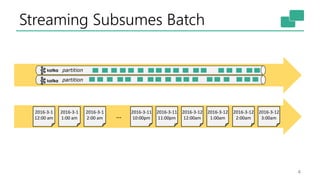
Streaming Subsumes Batch
4
2016-3-1
12:00 am
2016-3-1
1:00 am
2016-3-1
2:00 am
2016-3-11
11:00pm
2016-3-12
12:00am
2016-3-12
1:00am
2016-3-11
10:00pm
2016-3-12
2:00am
2016-3-12
3:00am…
partition
partition
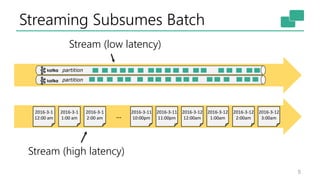
Streaming Subsumes Batch
5
2016-3-1
12:00 am
2016-3-1
1:00 am
2016-3-1
2:00 am
2016-3-11
11:00pm
2016-3-12
12:00am
2016-3-12
1:00am
2016-3-11
10:00pm
2016-3-12
2:00am
2016-3-12
3:00am…
partition
partition
Stream (low latency)
Stream (high latency)
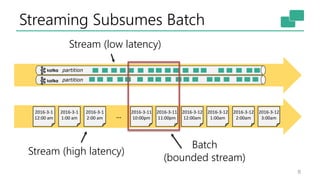
Streaming Subsumes Batch
6
2016-3-1
12:00 am
2016-3-1
1:00 am
2016-3-1
2:00 am
2016-3-11
11:00pm
2016-3-12
12:00am
2016-3-12
1:00am
2016-3-11
10:00pm
2016-3-12
2:00am
2016-3-12
3:00am…
partition
partition
Stream (low latency)
Batch
(bounded stream)
Stream (high latency)
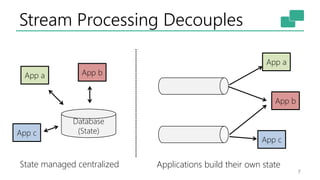
Stream Processing Decouples
7
Database
(State)
App a App b
App c
App a
App b
App c
Applications build their own stateState managed centralized
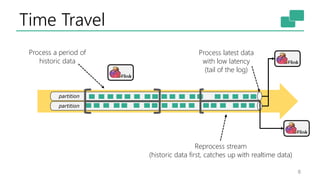
Time Travel
8
Process a period of
historic data
partition
partition
Process latest data
with low latency
(tail of the log)
Reprocess stream
(historic data first, catches up with realtime data)
9
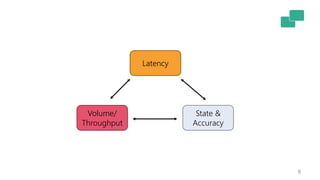
Latency
Volume/
Throughput
State &
Accuracy
10
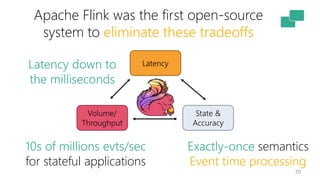
Latency
Volume/
Throughput
State &
Accuracy
Exactly-once semantics
Event time processing
10s of millions evts/sec
for stateful applications
Latency down to
the milliseconds
Apache Flink was the first open-source
system to eliminate these tradeoffs
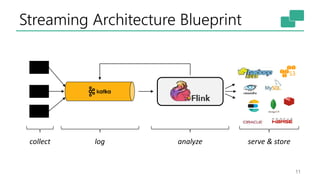
Streaming Architecture Blueprint
11
collect log analyze serve & store
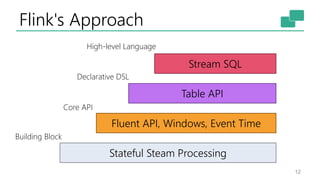
Flink's Approach
12
Stateful Steam Processing
Fluent API, Windows, Event Time
Table API
Stream SQL
Core API
Declarative DSL
High-level Language
Building Block
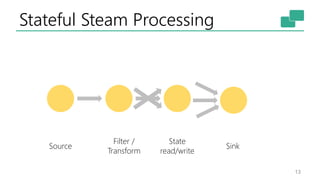
Stateful Steam Processing
13
Source
Filter /
Transform
State
read/write
Sink
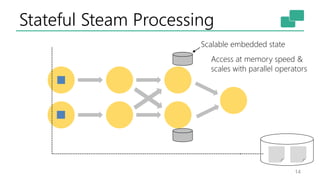
Stateful Steam Processing
14
Scalable embedded state
Access at memory speed &
scales with parallel operators
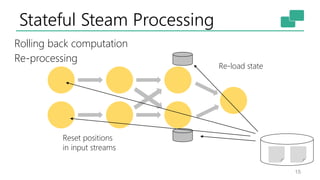
Stateful Steam Processing
15
Re-load state
Reset positions
in input streams
Rolling back computation
Re-processing
Stateful Steam Processing
16
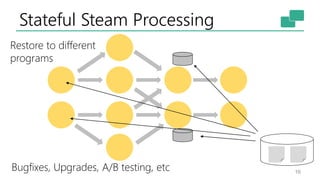
Restore to different
programs
Bugfixes, Upgrades, A/B testing, etc
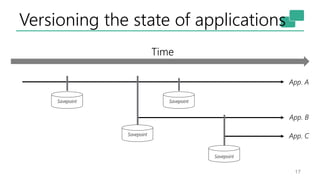
Versioning the state of applications
17
Savepoint
Savepoint
Savepoint
App. A
App. B
App. C
Time
Savepoint
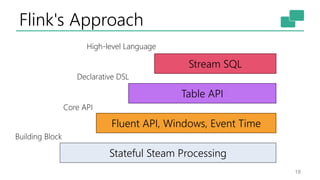
Flink's Approach
18
Stateful Steam Processing
Fluent API, Windows, Event Time
Table API
Stream SQL
Core API
Declarative DSL
High-level Language
Building Block
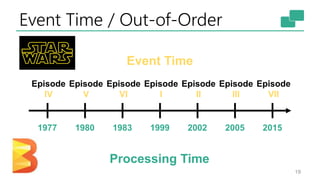
Event Time / Out-of-Order
19
1977 1980 1983 1999 2002 2005 2015
Processing Time
Episode
IV
Episode
V
Episode
VI
Episode
I
Episode
II
Episode
III
Episode
VII
Event Time
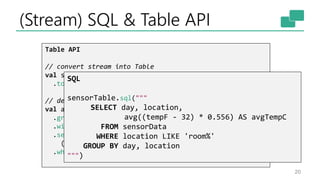
(Stream) SQL & Table API
20
Table API
// convert stream into Table
val sensorTable: Table = sensorData
.toTable(tableEnv, 'location, 'time, 'tempF)
// define query on Table
val avgTempCTable: Table = sensorTable
.groupBy('location)
.window(Tumble over 1.days on 'rowtime as 'w)
.select('w.start as 'day, 'location,
(('tempF.avg - 32) * 0.556) as 'avgTempC)
.where('location like "room%")
SQL
sensorTable.sql("""
SELECT day, location,
avg((tempF - 32) * 0.556) AS avgTempC
FROM sensorData
WHERE location LIKE 'room%'
GROUP BY day, location
""")
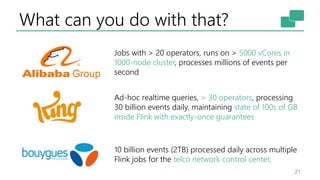
What can you do with that?
21
10 billion events (2TB) processed daily across multiple
Flink jobs for the telco network control center.
Ad-hoc realtime queries, > 30 operators, processing
30 billion events daily, maintaining state of 100s of GB
inside Flink with exactly-once guarantees
Jobs with > 20 operators, runs on > 5000 vCores in
1000-node cluster, processes millions of events per
second
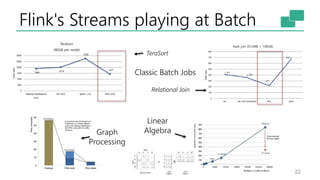
Flink's Streams playing at Batch
22
TeraSort
Relational Join
Classic Batch Jobs
Graph
Processing
Linear
Algebra
23
What can we expect next ?
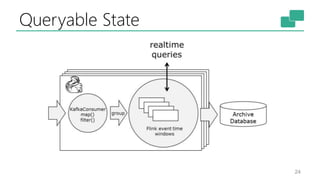
Queryable State
24
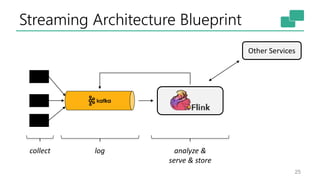
Streaming Architecture Blueprint
25
collect log analyze &
serve & store
Other Services
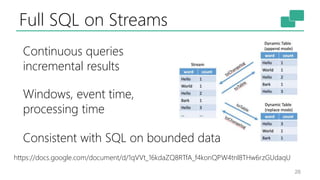
Full SQL on Streams
26
Continuous queries
incremental results
Windows, event time,
processing time
Consistent with SQL on bounded data
https://docs.google.com/document/d/1qVVt_16kdaZQ8RTfA_f4konQPW4tnl8THw6rzGUdaqU
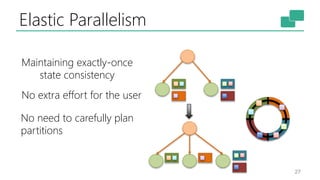
Elastic Parallelism
27
Maintaining exactly-once
state consistency
No extra effort for the user
No need to carefully plan
partitions
Very large state
28
Terabytes of state inside the stream processor
Maintaining fast checkpoints and recovery
E.g., long histories of windows, large join tables
State at local memory speed
29
We are hiring!
data-artisans.com/careers

Stephan Ewen - Stream Processing as a Foundational Paradigm and Apache Flink's Approach to It

  • 1.
    Stream Processing and ApacheFlink®'s approach to it @StephanEwen Apache Flink PMC CTO @ data Artisans
  • 2.
    About me Database systems,TU Berlin, IBM, Microsoft Co-bootstrapped Stratosphere project's runtime Apache Flink created from a (partial) Stratosphere fork Apache Flink community founded data Artisans Now Flink PMC and CTO at data Artisans
  • 3.
    Streaming technology isenabling the obvious: continuous processing on data that is continuously produced Hint: you already have streaming data 3
  • 4.
    Streaming Subsumes Batch 4 2016-3-1 12:00am 2016-3-1 1:00 am 2016-3-1 2:00 am 2016-3-11 11:00pm 2016-3-12 12:00am 2016-3-12 1:00am 2016-3-11 10:00pm 2016-3-12 2:00am 2016-3-12 3:00am… partition partition
  • 5.
    Streaming Subsumes Batch 5 2016-3-1 12:00am 2016-3-1 1:00 am 2016-3-1 2:00 am 2016-3-11 11:00pm 2016-3-12 12:00am 2016-3-12 1:00am 2016-3-11 10:00pm 2016-3-12 2:00am 2016-3-12 3:00am… partition partition Stream (low latency) Stream (high latency)
  • 6.
    Streaming Subsumes Batch 6 2016-3-1 12:00am 2016-3-1 1:00 am 2016-3-1 2:00 am 2016-3-11 11:00pm 2016-3-12 12:00am 2016-3-12 1:00am 2016-3-11 10:00pm 2016-3-12 2:00am 2016-3-12 3:00am… partition partition Stream (low latency) Batch (bounded stream) Stream (high latency)
  • 7.
    Stream Processing Decouples 7 Database (State) Appa App b App c App a App b App c Applications build their own stateState managed centralized
  • 8.
    Time Travel 8 Process aperiod of historic data partition partition Process latest data with low latency (tail of the log) Reprocess stream (historic data first, catches up with realtime data)
  • 9.
  • 10.
    10 Latency Volume/ Throughput State & Accuracy Exactly-once semantics Eventtime processing 10s of millions evts/sec for stateful applications Latency down to the milliseconds Apache Flink was the first open-source system to eliminate these tradeoffs
  • 11.
  • 12.
    Flink's Approach 12 Stateful SteamProcessing Fluent API, Windows, Event Time Table API Stream SQL Core API Declarative DSL High-level Language Building Block
  • 13.
    Stateful Steam Processing 13 Source Filter/ Transform State read/write Sink
  • 14.
    Stateful Steam Processing 14 Scalableembedded state Access at memory speed & scales with parallel operators
  • 15.
    Stateful Steam Processing 15 Re-loadstate Reset positions in input streams Rolling back computation Re-processing
  • 16.
    Stateful Steam Processing 16 Restoreto different programs Bugfixes, Upgrades, A/B testing, etc
  • 17.
    Versioning the stateof applications 17 Savepoint Savepoint Savepoint App. A App. B App. C Time Savepoint
  • 18.
    Flink's Approach 18 Stateful SteamProcessing Fluent API, Windows, Event Time Table API Stream SQL Core API Declarative DSL High-level Language Building Block
  • 19.
    Event Time /Out-of-Order 19 1977 1980 1983 1999 2002 2005 2015 Processing Time Episode IV Episode V Episode VI Episode I Episode II Episode III Episode VII Event Time
  • 20.
    (Stream) SQL &Table API 20 Table API // convert stream into Table val sensorTable: Table = sensorData .toTable(tableEnv, 'location, 'time, 'tempF) // define query on Table val avgTempCTable: Table = sensorTable .groupBy('location) .window(Tumble over 1.days on 'rowtime as 'w) .select('w.start as 'day, 'location, (('tempF.avg - 32) * 0.556) as 'avgTempC) .where('location like "room%") SQL sensorTable.sql(""" SELECT day, location, avg((tempF - 32) * 0.556) AS avgTempC FROM sensorData WHERE location LIKE 'room%' GROUP BY day, location """)
  • 21.
    What can youdo with that? 21 10 billion events (2TB) processed daily across multiple Flink jobs for the telco network control center. Ad-hoc realtime queries, > 30 operators, processing 30 billion events daily, maintaining state of 100s of GB inside Flink with exactly-once guarantees Jobs with > 20 operators, runs on > 5000 vCores in 1000-node cluster, processes millions of events per second
  • 22.
    Flink's Streams playingat Batch 22 TeraSort Relational Join Classic Batch Jobs Graph Processing Linear Algebra
  • 23.
    23 What can weexpect next ?
  • 24.
  • 25.
    Streaming Architecture Blueprint 25 collectlog analyze & serve & store Other Services
  • 26.
    Full SQL onStreams 26 Continuous queries incremental results Windows, event time, processing time Consistent with SQL on bounded data https://docs.google.com/document/d/1qVVt_16kdaZQ8RTfA_f4konQPW4tnl8THw6rzGUdaqU
  • 27.
    Elastic Parallelism 27 Maintaining exactly-once stateconsistency No extra effort for the user No need to carefully plan partitions
  • 28.
    Very large state 28 Terabytesof state inside the stream processor Maintaining fast checkpoints and recovery E.g., long histories of windows, large join tables State at local memory speed
  • 29.
  • 30.