DR.AYUSH GARG
P.G. JR-I
RADIOTHERAPY
Definition
Any procedure where hematopoietic stem
cells of any donor and any source are
given to a recipient with intention of
repopulating/replacing the hematopoietic
system in total or in part.
Types of Transplant
 Autologous (your own cells)
 Allogeneic
 cells from another person

Sibling

Unrelated Donor

Parent or relative
 or source: Umbilical cord
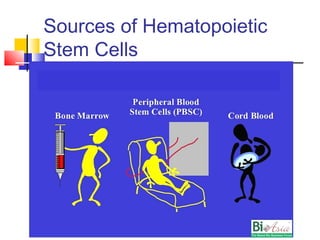
Sources of Hematopoietic
Stem Cells
 Bone Marrow
 PBSC (peripheral blood stem cells)
 Umbilical Cord
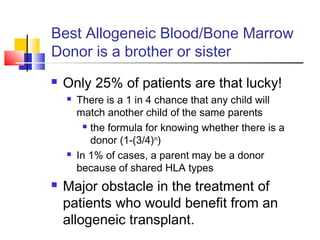
Best Allogeneic Blood/Bone Marrow
Donor is a brother or sister
 Only 25% of patients are that lucky!
 There is a 1 in 4 chance that any child will
match another child of the same parents
 the formula for knowing whether there is a
donor (1-(3/4)n
)
 In 1% of cases, a parent may be a donor
because of shared HLA types
 Major obstacle in the treatment of
patients who would benefit from an
allogeneic transplant.
Bone Marrow
 Standard source of hematopoietic cells
for more than 30 years.
 Transplant physicians may select
marrow because:
 Extensive clinical data are available about
marrow transplant outcomes
 Extensive information is available about
the marrow donation experience
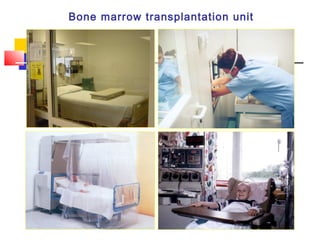
Bone marrow transplantation unit
Peripheral Blood Stem Cells
 Autologous transplants rely almost
exclusively on PBSC rather than marrow due
to:
 Easier collection of cells
 More rapid hematopoietic recovery
 Decreased costs
 We also use this method in certain instances
for allogeneic transplants in pediatrics.
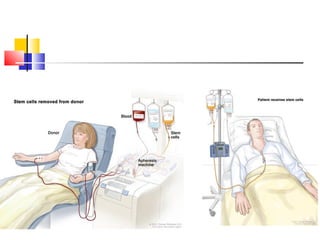
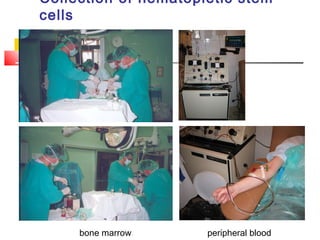
Collection of hematopietic stem
cells
bone marrow peripheral blood
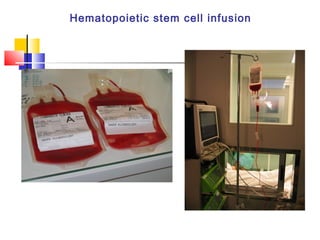
Hematopoietic stem cell infusion
Umbilical Cord Blood
 Physicians may consider umbilical cord blood
a good choice particularly for patients who
need an unrelated donor and have an
uncommon HLA type or are in urgent need of
a transplant.
 HLA mismatch is better tolerated – even with
haploidentical donors
 Available more quickly than marrow or PBSC
unrelated donors
 Reduced incidence and severity of GVHD
Diseases that we transplant in
children
 Autologous
 Relapsed Hodgkins Disease
 Relapsed Non Hodgkins Lymphoma (NHL)
 Stage IV Neuroblastoma
 Relapsed Ewings Sarcoma
 Investigational

Metastatic Ewings Sarcoma

Medulloblastoma, other brain tumors

Autoimmune Diseases (SLE)
Allogeneic Transplant
Indications in Children
Malignant Diseases
 AML CR1 – Matched Sibling
 High Risk ALL CR1 (Ph+ ALL)
 Relapsed or Refractory AML or ALL
 Chronic myelogenous leukemia
 Juvenile myelomonocytic leukemia
 Myelodysplastic syndromes
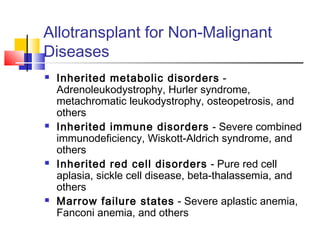
Allotransplant for Non-Malignant
Diseases
 Inherited metabolic disorders -
Adrenoleukodystrophy, Hurler syndrome,
metachromatic leukodystrophy, osteopetrosis, and
others
 Inherited immune disorders - Severe combined
immunodeficiency, Wiskott-Aldrich syndrome, and
others
 Inherited red cell disorders - Pure red cell
aplasia, sickle cell disease, beta-thalassemia, and
others
 Marrow failure states - Severe aplastic anemia,
Fanconi anemia, and others
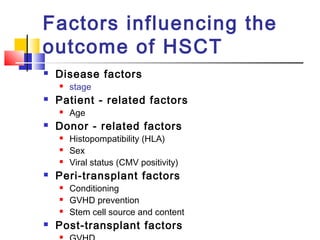
Factors influencing the
outcome of HSCT
 Disease factors
 stage
 Patient - related factors
 Age
 Donor - related factors
 Histopompatibility (HLA)
 Sex
 Viral status (CMV positivity)
 Peri-transplant factors
 Conditioning
 GVHD prevention
 Stem cell source and content
 Post-transplant factors

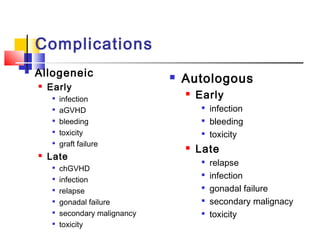
Complications
 Allogeneic
 Early

infection

aGVHD

bleeding

toxicity

graft failure
 Late

chGVHD

infection

relapse

gonadal failure

secondary malignancy

toxicity
 Autologous
 Early

infection

bleeding

toxicity
 Late

relapse

infection

gonadal failure

secondary malignacy

toxicity
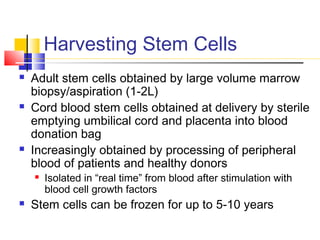
Harvesting Stem Cells
 Adult stem cells obtained by large volume marrow
biopsy/aspiration (1-2L)
 Cord blood stem cells obtained at delivery by sterile
emptying umbilical cord and placenta into blood
donation bag
 Increasingly obtained by processing of peripheral
blood of patients and healthy donors
 Isolated in “real time” from blood after stimulation with
blood cell growth factors
 Stem cells can be frozen for up to 5-10 years
Conclusion
 Stem cells can be derived from adult, cord blood and
eventually embryonic stem cells
 Stem cell transplantation can both support highly intensive
chemotherapy and promote highly effective immunotherapy
 Recent advances in stem cell transplantation allow therapy
more tailored to disease and patient
 Improved supportive care measures expand transplant to
more patients
 Expanded applications capitalizing on stem cell plasticity
are feasible
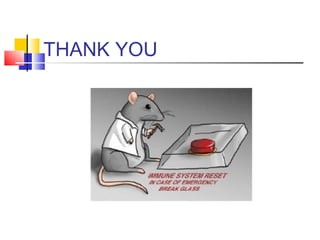
THANK YOU
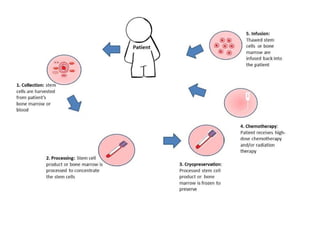
Transplant Process (5 steps)
(1) Conditioning,
(2) Stem cell infusion,
(3) Neutropenic phase,
(4) Engraftment phase
(5) Post-engraftment period.
Conditioning Phase
 The conditioning period typically lasts 7-10
days.
 The purposes are (by delivery of
chemotherapy and/or radiation)
 to eliminate malignancy
 to provide immune suppression to prevent
rejection of new stem cells
 create space for the new cells
 Radiation and chemotherapy agents differ in
their abilities to achieve these goals.
Stem cell processing and
infusion
 Infusion - 20 minutes to an hour, varies
depending on the volume infused. The stem
cells may be processed before infusion, if
indicated. Depletion of T cells can be
performed to decrease GVHD.
 Premedication with acetaminophen and
diphenhydramine to prevent reaction.
Stem cell processing and
infusion
 Infused through a CVL, much like a blood
transfusion.
 Anaphylaxis, volume overload, and a
(rare) transient GVHD are the major
potential complications involved.
 Stem cell products that have been
cryopreserved contain dimethyl sulfoxide
(DMSO) as a preservative and potentially can
cause renal failure, in addition to the
unpleasant smell and taste.
Neutropenic Phase
 During this period (2-4 wk), the patient
essentially has no effective immune system.
 Healing is poor, and the patient is very
susceptible to infection.
 Supportive care and empiric antibiotic therapy
are the mainstays of successful passage
through this phase.
Engraftment Phase
 During this period (several weeks), the
healing process begins with resolution
of mucositis and other lesions acquired.
In addition, fever begins to subside, and
infections often begin to clear. The
greatest challenges at this time are
management of GVHD and prevention
of viral infections (especially CMV).
Post-engraftment Phase
 This period lasts for months to years.
Hallmarks of this phase include the
gradual development of tolerance,
weaning off of immunosuppression,
management of chronic GVHD, and
documentation of immune
reconstitution.
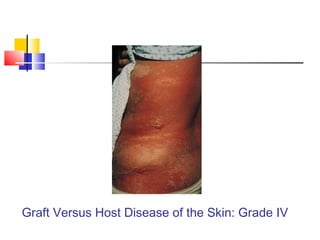
Graft versus Host Disease (GVHD)
• If donor cells see the host cells as foreign,
the donor cells will attack the host.
• Skin, gut, and liver most likely to be
affected.
• Acute < 100 days after the transplant
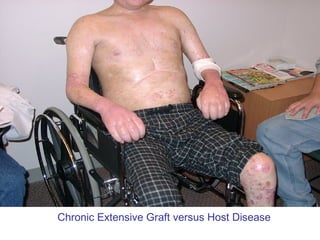
• Chronic > 100 days
 What are risk factors for GVHD?
 HLA match / mismatch
 Lymphocytes in graft
 Inadequate immune suppression
 Other???
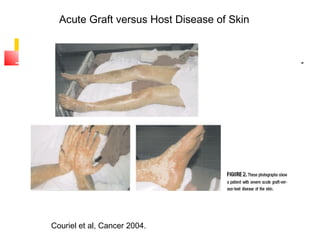
Couriel et al, Cancer 2004.
Acute Graft versus Host Disease of Skin
Graft Versus Host Disease of the Skin: Grade IV
Chronic Extensive Graft versus Host Disease
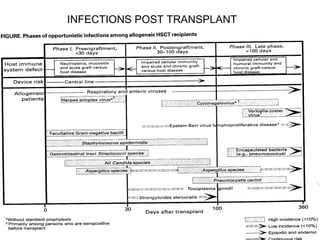
INFECTIONS POST TRANSPLANT
Other Problems Encountered
 Hemorrhagic Cystitis
 VOD (venoocclusive disease of the
liver) or SOS (solid organ syndrome)
 Organ Toxicity (lung, heart, kidney)
 Idiopathic Pneumonia Syndrome

Stem cell transplantation

  • 1.
  • 2.
    Definition Any procedure wherehematopoietic stem cells of any donor and any source are given to a recipient with intention of repopulating/replacing the hematopoietic system in total or in part.
  • 3.
    Types of Transplant Autologous (your own cells)  Allogeneic  cells from another person  Sibling  Unrelated Donor  Parent or relative  or source: Umbilical cord
  • 4.
    Sources of Hematopoietic StemCells  Bone Marrow  PBSC (peripheral blood stem cells)  Umbilical Cord
  • 5.
    Best Allogeneic Blood/BoneMarrow Donor is a brother or sister  Only 25% of patients are that lucky!  There is a 1 in 4 chance that any child will match another child of the same parents  the formula for knowing whether there is a donor (1-(3/4)n )  In 1% of cases, a parent may be a donor because of shared HLA types  Major obstacle in the treatment of patients who would benefit from an allogeneic transplant.
  • 8.
    Bone Marrow  Standardsource of hematopoietic cells for more than 30 years.  Transplant physicians may select marrow because:  Extensive clinical data are available about marrow transplant outcomes  Extensive information is available about the marrow donation experience
  • 9.
  • 10.
    Peripheral Blood StemCells  Autologous transplants rely almost exclusively on PBSC rather than marrow due to:  Easier collection of cells  More rapid hematopoietic recovery  Decreased costs  We also use this method in certain instances for allogeneic transplants in pediatrics.
  • 11.
    Collection of hematopieticstem cells bone marrow peripheral blood
  • 12.
  • 13.
    Umbilical Cord Blood Physicians may consider umbilical cord blood a good choice particularly for patients who need an unrelated donor and have an uncommon HLA type or are in urgent need of a transplant.  HLA mismatch is better tolerated – even with haploidentical donors  Available more quickly than marrow or PBSC unrelated donors  Reduced incidence and severity of GVHD
  • 14.
    Diseases that wetransplant in children  Autologous  Relapsed Hodgkins Disease  Relapsed Non Hodgkins Lymphoma (NHL)  Stage IV Neuroblastoma  Relapsed Ewings Sarcoma  Investigational  Metastatic Ewings Sarcoma  Medulloblastoma, other brain tumors  Autoimmune Diseases (SLE)
  • 15.
    Allogeneic Transplant Indications inChildren Malignant Diseases  AML CR1 – Matched Sibling  High Risk ALL CR1 (Ph+ ALL)  Relapsed or Refractory AML or ALL  Chronic myelogenous leukemia  Juvenile myelomonocytic leukemia  Myelodysplastic syndromes
  • 16.
    Allotransplant for Non-Malignant Diseases Inherited metabolic disorders - Adrenoleukodystrophy, Hurler syndrome, metachromatic leukodystrophy, osteopetrosis, and others  Inherited immune disorders - Severe combined immunodeficiency, Wiskott-Aldrich syndrome, and others  Inherited red cell disorders - Pure red cell aplasia, sickle cell disease, beta-thalassemia, and others  Marrow failure states - Severe aplastic anemia, Fanconi anemia, and others
  • 17.
    Factors influencing the outcomeof HSCT  Disease factors  stage  Patient - related factors  Age  Donor - related factors  Histopompatibility (HLA)  Sex  Viral status (CMV positivity)  Peri-transplant factors  Conditioning  GVHD prevention  Stem cell source and content  Post-transplant factors 
  • 18.
    Complications  Allogeneic  Early  infection  aGVHD  bleeding  toxicity  graftfailure  Late  chGVHD  infection  relapse  gonadal failure  secondary malignancy  toxicity  Autologous  Early  infection  bleeding  toxicity  Late  relapse  infection  gonadal failure  secondary malignacy  toxicity
  • 19.
    Harvesting Stem Cells Adult stem cells obtained by large volume marrow biopsy/aspiration (1-2L)  Cord blood stem cells obtained at delivery by sterile emptying umbilical cord and placenta into blood donation bag  Increasingly obtained by processing of peripheral blood of patients and healthy donors  Isolated in “real time” from blood after stimulation with blood cell growth factors  Stem cells can be frozen for up to 5-10 years
  • 20.
    Conclusion  Stem cellscan be derived from adult, cord blood and eventually embryonic stem cells  Stem cell transplantation can both support highly intensive chemotherapy and promote highly effective immunotherapy  Recent advances in stem cell transplantation allow therapy more tailored to disease and patient  Improved supportive care measures expand transplant to more patients  Expanded applications capitalizing on stem cell plasticity are feasible
  • 21.
  • 22.
    Transplant Process (5steps) (1) Conditioning, (2) Stem cell infusion, (3) Neutropenic phase, (4) Engraftment phase (5) Post-engraftment period.
  • 23.
    Conditioning Phase  Theconditioning period typically lasts 7-10 days.  The purposes are (by delivery of chemotherapy and/or radiation)  to eliminate malignancy  to provide immune suppression to prevent rejection of new stem cells  create space for the new cells  Radiation and chemotherapy agents differ in their abilities to achieve these goals.
  • 24.
    Stem cell processingand infusion  Infusion - 20 minutes to an hour, varies depending on the volume infused. The stem cells may be processed before infusion, if indicated. Depletion of T cells can be performed to decrease GVHD.  Premedication with acetaminophen and diphenhydramine to prevent reaction.
  • 25.
    Stem cell processingand infusion  Infused through a CVL, much like a blood transfusion.  Anaphylaxis, volume overload, and a (rare) transient GVHD are the major potential complications involved.  Stem cell products that have been cryopreserved contain dimethyl sulfoxide (DMSO) as a preservative and potentially can cause renal failure, in addition to the unpleasant smell and taste.
  • 26.
    Neutropenic Phase  Duringthis period (2-4 wk), the patient essentially has no effective immune system.  Healing is poor, and the patient is very susceptible to infection.  Supportive care and empiric antibiotic therapy are the mainstays of successful passage through this phase.
  • 27.
    Engraftment Phase  Duringthis period (several weeks), the healing process begins with resolution of mucositis and other lesions acquired. In addition, fever begins to subside, and infections often begin to clear. The greatest challenges at this time are management of GVHD and prevention of viral infections (especially CMV).
  • 28.
    Post-engraftment Phase  Thisperiod lasts for months to years. Hallmarks of this phase include the gradual development of tolerance, weaning off of immunosuppression, management of chronic GVHD, and documentation of immune reconstitution.
  • 29.
    Graft versus HostDisease (GVHD) • If donor cells see the host cells as foreign, the donor cells will attack the host. • Skin, gut, and liver most likely to be affected. • Acute < 100 days after the transplant • Chronic > 100 days
  • 30.
     What arerisk factors for GVHD?  HLA match / mismatch  Lymphocytes in graft  Inadequate immune suppression  Other???
  • 31.
    Couriel et al,Cancer 2004. Acute Graft versus Host Disease of Skin
  • 32.
    Graft Versus HostDisease of the Skin: Grade IV
  • 33.
    Chronic Extensive Graftversus Host Disease
  • 34.
  • 35.
    Other Problems Encountered Hemorrhagic Cystitis  VOD (venoocclusive disease of the liver) or SOS (solid organ syndrome)  Organ Toxicity (lung, heart, kidney)  Idiopathic Pneumonia Syndrome

Editor's Notes

  • #36 (do you want a slide per problem?) Do you want a separate slide per problem, or is this sufficient?