- A boiler is a closed vessel in which
water or other fluid is heated.
- The heated or vaporized fluid exist the
boiler for use in various Process or
Heating applications or for Power
generation.
- In Steam Power Plant, typically called
Thermal Power Plant, water is heated to
get steam for Power generation.
What is Boiler?
- A boiler is called a high-pressure boiler
when it operates with a steam pressure
above 80 bars.
- The modern high pressure boiler:
Steam capacities – 30 to 650 tons/hour
and above
Pressure – up to 160 bar
Maximum steam temperature – 540 °C
Types of High Pressure Boiler
(1) La-Mont boiler
(2) Loeffler boiler
(3) Benson boiler
(4) Schmidt-Hartman boiler
(5) Velox boiler
(6) Supercritical boiler
(7) Supercharged boiler
(8) Fluidized bed combustion boiler
Unique Feature of High
Pressure Boiler
- Method of water circulation: Forced
circulation, using pump
- Types of Turbine: Water Tube Boilers,
with flow through several sets of
parallel system of turbine – to reduce
pressure loss occurring in single tube
system and to have better control over
quality of steam.
Continue
- Improve method of heating:
 Saving of heat by evaporation of water
above critical pressure of steam.
 Heating of water by mixing with
superheated steam, to give high heat
transfer coefficients.
 Increase in overall heat transfer
coefficients by increasing water
velocity inside the tube and increasing
Continue
gas velocity above sonic velocity.
- Compactness: Large number of small
size tubes and number of pass are used
which increases the heat transfer area,
hence size and weight of boiler is
reduced.
Advantages of High Pressure
Boiler over Conventional
Boiler
 Due to forced circulation of water,
evaporative capacity of boiler is
increased and size of drum is reduced.
 Smaller diameter tube are used, which
increases heat transfer rate and reduce
fuel consumption.
 Pressurised combustion is used which
Continue
increases the rate of firing of fuel thus
increasing the rate of heat release.
 These boiler is compact and hence less
floor space is required.
 Due to high velocity of water through
tubes, the scale formation tendency is
eliminated.
 Due to uniform heating of all parts,
there is less chances of overheating.
Continue
 High pressure and temperature of
steam lead to increase the plant
efficiency.
 The steam can be raised quickly to
meet the variable load.
 A very rapid start from cold is possible.
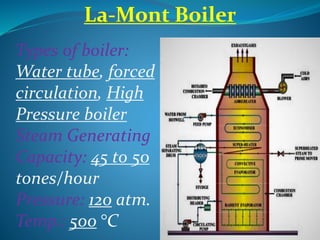
La-Mont Boiler
Types of boiler:
Water tube, forced
circulation, High
Pressure boiler
Steam Generating
Capacity: 45 to 50
tones/hour
Pressure: 120 atm.
Temp.: 500 °C
Principle: This boiler works on basic
principle of forced convection.
- If the water is circulate by a pump
inside the tube, the heat transfer rate
from gas to the water is increase.
- Various part of boiler:
 Economizer
 Centrifugal pump
 Evaporator tube
Continue
Continue
 Grate
 Furnace
 Super heater
 Water steam separator drum
 Air preheater
- Working:
 A feed pump forces the water into the
economizer where the temperature of
water is increases. This water forced
Continue
into the evaporator tube by using
centrifugal pump driven by steam
turbine. Water passes 10-15 times into
the evaporator tube. The mixture of
saturated steam and water is formed
inside the tube.
 This mixture sends to the steam
separator drum which is outside the
boiler. Steam from the separator sends
Continue
to the economizer, where the saturated
steam converts into superheated
steam. The water again sends to the
economizer where it again passes by
the evaporator tubes.
 The air from the air preheater enter
into the furnace where fuel burn. The
fuel gases first heat the evaporator
tube then passes by the super heater.
Continue
These gases from the super heater
again use to preheat the air into air
preheater before exhaust into
atmosphere.
- Difficulties:
 The deposition of salt and sediments
on the inner surfaces of the water
tubes, which reduces the heat transfer
rate.
Continue
 There also formation of bubbling at the
inner surfaces of water tube. It leads to
increase the heat flow resistance.
- Advantages:
 High Pressure Boiler
 Flexible in design
 Easily start
 Higher heat transfer rate
 Reassemble in natural circulation
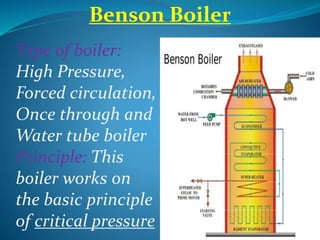
Benson Boiler
Type of boiler:
High Pressure,
Forced circulation,
Once through and
Water tube boiler
Principle: This
boiler works on
the basic principle
of critical pressure
of water.
- Advantages:
 The benson boiler does not use water-
steam separator, which reduce the total
cost of boiler.
 This boiler can transport easily from
one station to another.
 It is economical and have higher
efficiency.
Continue
Continue
 This boiler can use over the pressure
above 350 bar without changing
evaporator.
 This can be start easily and can reach
its maximum load capacity within 10
minutes.
- Disadvantages:
 Danger of overheating
 Salt deposition and sediment on the
Continue
inner surface of water tube.
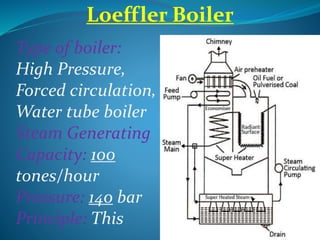
Loeffler Boiler
Type of boiler:
High Pressure,
Forced circulation,
Water tube boiler
Steam Generating
Capacity: 100
tones/hour
Pressure: 140 bar
Principle: This
boiler working principle is to evaporate
the feed water by the use of
superheated steam from the
superheater.
- Advantages:
 The evaporator tubes in this boiler
carries superheated steam, therefore
there is no salt deposition on the
surface of tubes.
Continue
Continue
 Compact in design.
 High steam generating capacity.
 Suitable for marine application.
- Disadvantages:
 Bubbles are formed at inner surface of
tube, which reduce the heat transfer
rate.
 Evaporating drum is use, which
increase the cost of boiler.
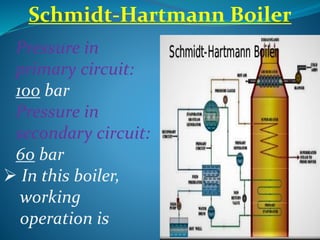
Schmidt-Hartmann Boiler
Pressure in
primary circuit:
100 bar
Pressure in
secondary circuit:
60 bar
 In this boiler,
working
operation is
Continue
similar to an electric transformer.
 Two pressures are used to effect an
interchange of energy.
- Advantages:
 Any deposits in evaporator drum due
to impure water can simply brushed off
by remove the submerged tube as of the
drum or by blowing off water.
 As it can use impure water there is no
Continue
necessity of water softening plant
eventually reduces cost.
 It can utilize impure water for creation
of steam.
- Disadvantages:
 Evaporating drum is use which
increase size of plant by cost.
 Due to deposits in evaporator drum
because of impure water plant has to
stop often for cleaning.
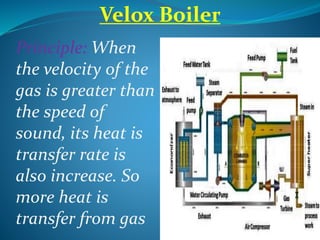
Velox Boiler
Principle: When
the velocity of the
gas is greater than
the speed of
sound, its heat is
transfer rate is
also increase. So
more heat is
transfer from gas
Continue
to water as compare when the heat
transfer at the subsonic speed.
- Advantages:
 This boiler has high heat transfer rate.
 It has great flexibility.
 It is compact in design.
 It is easy to control. It is fully
automatic.
 It has thermal efficiency about 90-95
% .
Continue
- Disadvantages:
 Need extra ground as of horizontal
construction.
 Fuel oil burning power station lies in
the high cost of fuel.
 It can only operate on liquid or
gaseous fuels.
High pressure boiler

High pressure boiler

  • 2.
    - A boileris a closed vessel in which water or other fluid is heated. - The heated or vaporized fluid exist the boiler for use in various Process or Heating applications or for Power generation. - In Steam Power Plant, typically called Thermal Power Plant, water is heated to get steam for Power generation. What is Boiler?
  • 3.
    - A boileris called a high-pressure boiler when it operates with a steam pressure above 80 bars. - The modern high pressure boiler: Steam capacities – 30 to 650 tons/hour and above Pressure – up to 160 bar Maximum steam temperature – 540 °C
  • 4.
    Types of HighPressure Boiler (1) La-Mont boiler (2) Loeffler boiler (3) Benson boiler (4) Schmidt-Hartman boiler (5) Velox boiler (6) Supercritical boiler (7) Supercharged boiler (8) Fluidized bed combustion boiler
  • 5.
    Unique Feature ofHigh Pressure Boiler - Method of water circulation: Forced circulation, using pump - Types of Turbine: Water Tube Boilers, with flow through several sets of parallel system of turbine – to reduce pressure loss occurring in single tube system and to have better control over quality of steam.
  • 6.
    Continue - Improve methodof heating:  Saving of heat by evaporation of water above critical pressure of steam.  Heating of water by mixing with superheated steam, to give high heat transfer coefficients.  Increase in overall heat transfer coefficients by increasing water velocity inside the tube and increasing
  • 7.
    Continue gas velocity abovesonic velocity. - Compactness: Large number of small size tubes and number of pass are used which increases the heat transfer area, hence size and weight of boiler is reduced.
  • 8.
    Advantages of HighPressure Boiler over Conventional Boiler  Due to forced circulation of water, evaporative capacity of boiler is increased and size of drum is reduced.  Smaller diameter tube are used, which increases heat transfer rate and reduce fuel consumption.  Pressurised combustion is used which
  • 9.
    Continue increases the rateof firing of fuel thus increasing the rate of heat release.  These boiler is compact and hence less floor space is required.  Due to high velocity of water through tubes, the scale formation tendency is eliminated.  Due to uniform heating of all parts, there is less chances of overheating.
  • 10.
    Continue  High pressureand temperature of steam lead to increase the plant efficiency.  The steam can be raised quickly to meet the variable load.  A very rapid start from cold is possible.
  • 11.
    La-Mont Boiler Types ofboiler: Water tube, forced circulation, High Pressure boiler Steam Generating Capacity: 45 to 50 tones/hour Pressure: 120 atm. Temp.: 500 °C
  • 12.
    Principle: This boilerworks on basic principle of forced convection. - If the water is circulate by a pump inside the tube, the heat transfer rate from gas to the water is increase. - Various part of boiler:  Economizer  Centrifugal pump  Evaporator tube Continue
  • 13.
    Continue  Grate  Furnace Super heater  Water steam separator drum  Air preheater - Working:  A feed pump forces the water into the economizer where the temperature of water is increases. This water forced
  • 14.
    Continue into the evaporatortube by using centrifugal pump driven by steam turbine. Water passes 10-15 times into the evaporator tube. The mixture of saturated steam and water is formed inside the tube.  This mixture sends to the steam separator drum which is outside the boiler. Steam from the separator sends
  • 15.
    Continue to the economizer,where the saturated steam converts into superheated steam. The water again sends to the economizer where it again passes by the evaporator tubes.  The air from the air preheater enter into the furnace where fuel burn. The fuel gases first heat the evaporator tube then passes by the super heater.
  • 16.
    Continue These gases fromthe super heater again use to preheat the air into air preheater before exhaust into atmosphere. - Difficulties:  The deposition of salt and sediments on the inner surfaces of the water tubes, which reduces the heat transfer rate.
  • 17.
    Continue  There alsoformation of bubbling at the inner surfaces of water tube. It leads to increase the heat flow resistance. - Advantages:  High Pressure Boiler  Flexible in design  Easily start  Higher heat transfer rate  Reassemble in natural circulation
  • 18.
    Benson Boiler Type ofboiler: High Pressure, Forced circulation, Once through and Water tube boiler Principle: This boiler works on the basic principle of critical pressure
  • 19.
    of water. - Advantages: The benson boiler does not use water- steam separator, which reduce the total cost of boiler.  This boiler can transport easily from one station to another.  It is economical and have higher efficiency. Continue
  • 20.
    Continue  This boilercan use over the pressure above 350 bar without changing evaporator.  This can be start easily and can reach its maximum load capacity within 10 minutes. - Disadvantages:  Danger of overheating  Salt deposition and sediment on the
  • 21.
  • 22.
    Loeffler Boiler Type ofboiler: High Pressure, Forced circulation, Water tube boiler Steam Generating Capacity: 100 tones/hour Pressure: 140 bar Principle: This
  • 23.
    boiler working principleis to evaporate the feed water by the use of superheated steam from the superheater. - Advantages:  The evaporator tubes in this boiler carries superheated steam, therefore there is no salt deposition on the surface of tubes. Continue
  • 24.
    Continue  Compact indesign.  High steam generating capacity.  Suitable for marine application. - Disadvantages:  Bubbles are formed at inner surface of tube, which reduce the heat transfer rate.  Evaporating drum is use, which increase the cost of boiler.
  • 25.
    Schmidt-Hartmann Boiler Pressure in primarycircuit: 100 bar Pressure in secondary circuit: 60 bar  In this boiler, working operation is
  • 26.
    Continue similar to anelectric transformer.  Two pressures are used to effect an interchange of energy. - Advantages:  Any deposits in evaporator drum due to impure water can simply brushed off by remove the submerged tube as of the drum or by blowing off water.  As it can use impure water there is no
  • 27.
    Continue necessity of watersoftening plant eventually reduces cost.  It can utilize impure water for creation of steam. - Disadvantages:  Evaporating drum is use which increase size of plant by cost.  Due to deposits in evaporator drum because of impure water plant has to stop often for cleaning.
  • 28.
    Velox Boiler Principle: When thevelocity of the gas is greater than the speed of sound, its heat is transfer rate is also increase. So more heat is transfer from gas
  • 29.
    Continue to water ascompare when the heat transfer at the subsonic speed. - Advantages:  This boiler has high heat transfer rate.  It has great flexibility.  It is compact in design.  It is easy to control. It is fully automatic.  It has thermal efficiency about 90-95 % .
  • 30.
    Continue - Disadvantages:  Needextra ground as of horizontal construction.  Fuel oil burning power station lies in the high cost of fuel.  It can only operate on liquid or gaseous fuels.