STDCS: A Spatio-Temporal Data-Centric Storage Scheme For Real-Time Sensornet Applications  Mohamed Aly (University of Pittsburgh & Yahoo, Inc.) In collaboration with   Anandha Gopalan  (University of Pittsburgh, Imperial College) and   Jerry Zhao, Adel Youssef (Google, Inc.)
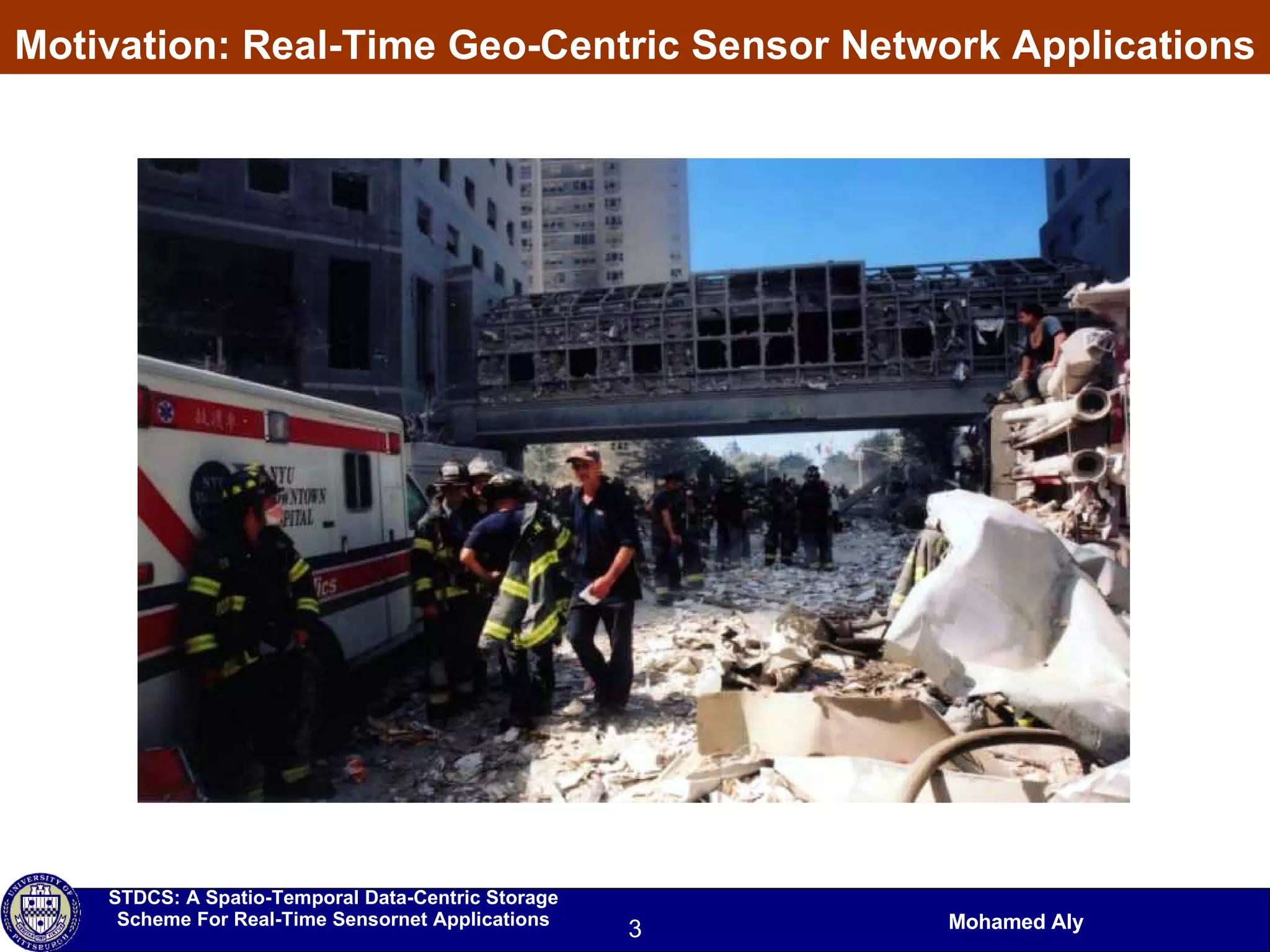
Motivation: Real-Time Geo-Centric Sensor Network Applications Globally deployed sensor around the globe. Clusters of sensors forming networks. Mobile users roaming across the networks. Real-time   geo-centric   ad-hoc  queries issued from within or nearby the queried area. The sensor network is responsible of answering these queries directly from the sensors rather than from base stations. Examples:  Bronx Zoo cluster. Disaster management cluster.
Motivation: Real-Time Geo-Centric Sensor Network Applications
Data Storage Options in Sensor Networks Base Station Storage: Events are sent to base stations where queries are issued and evaluated. Best suited for continuous queries. In-Network Storage (INS): Events are stored in the sensor nodes. Best suited for ad-hoc queries. All previous INS schemes were Data-Centric Storage (DCS) schemes.
In-Network Data-Centric Storage (DCS) Mainly to answer range queries. Quality of Data (QoD) of ad-hoc queries. Assign a value-range of readings for each sensor. Examples: Distributed Hash Tables (DHT) [Shenker et. al., HotNets’02] Geographic Hash Tables (GHT) [Ratnasamy et. al., WSNA’02] Distributed Index for Multi-dimensional data (DIM) [Li et. al., SenSys’03, Aly et. al., DMSN’05, MOBIQUITOUS’06] K-D Tree based Data-Centric Storage (KDDCS) [Aly et. al., CIKM’06]
STDCS Overview Motivation: No previous INS schemes adopting geo-centric storage. Expected techniques may be:  Local storage. Spatial storage Design Goal: Load-Balancing of storage load among sensors Differences from previous schemes: Temporally evolving spatial indexing scheme to balance query load among sensors. Dynamic query hotspot detection and decomposition.
Roadmap Motivation: Real-Time Geo-Centric applications. Background: Data-Centric Storage (DCS). Problem Statement: Real-Time Geo-Centric Storage. Scheme Overview: STDCS. STDCS Components Local Virtual address assignment Spatio-Temporal data indexing. Point-to-point data delivery. Query processing. Adaptive hotspot decomposition. Experimental Results Conclusions
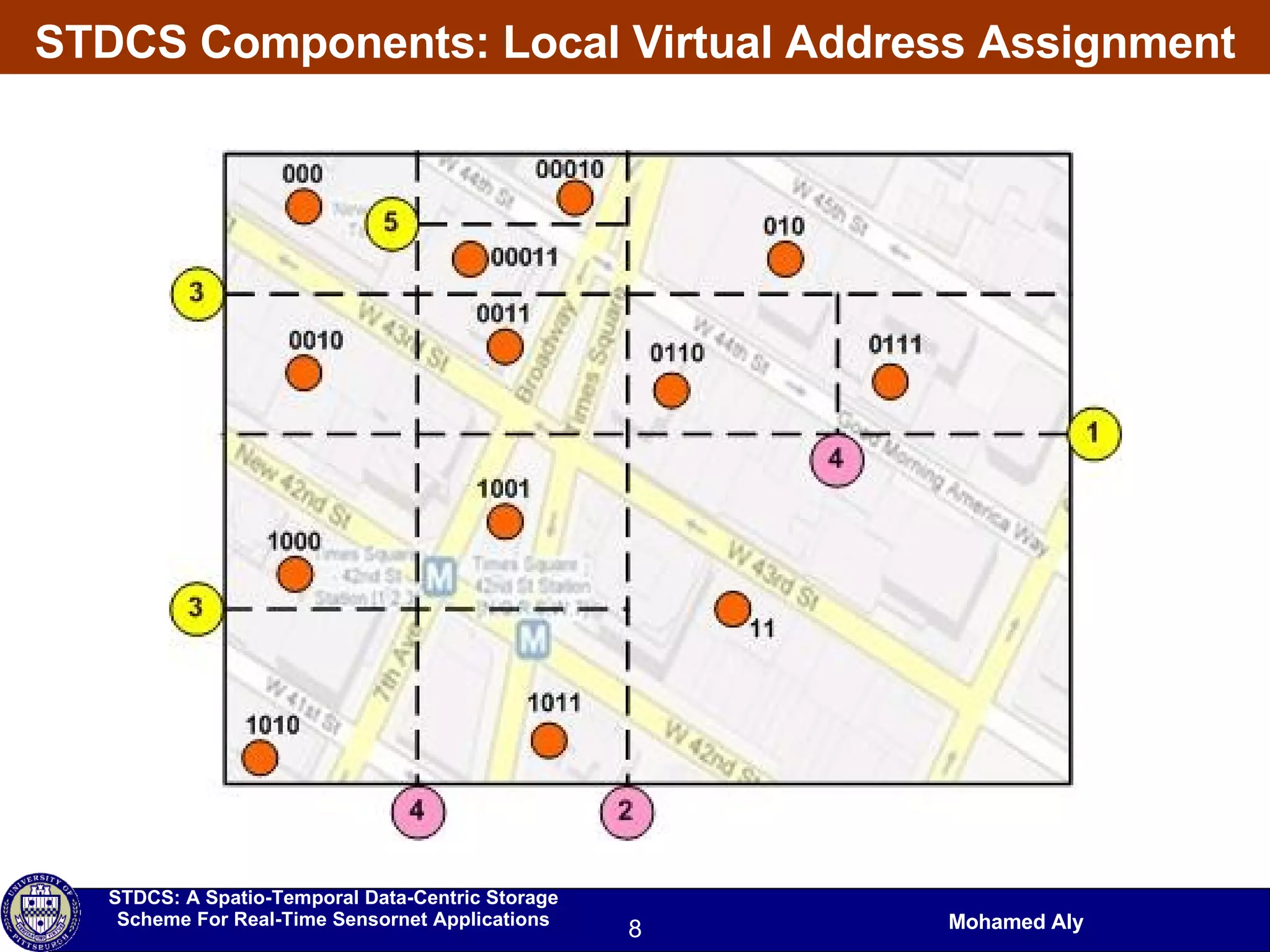
STDCS Components: Local Virtual Address Assignment
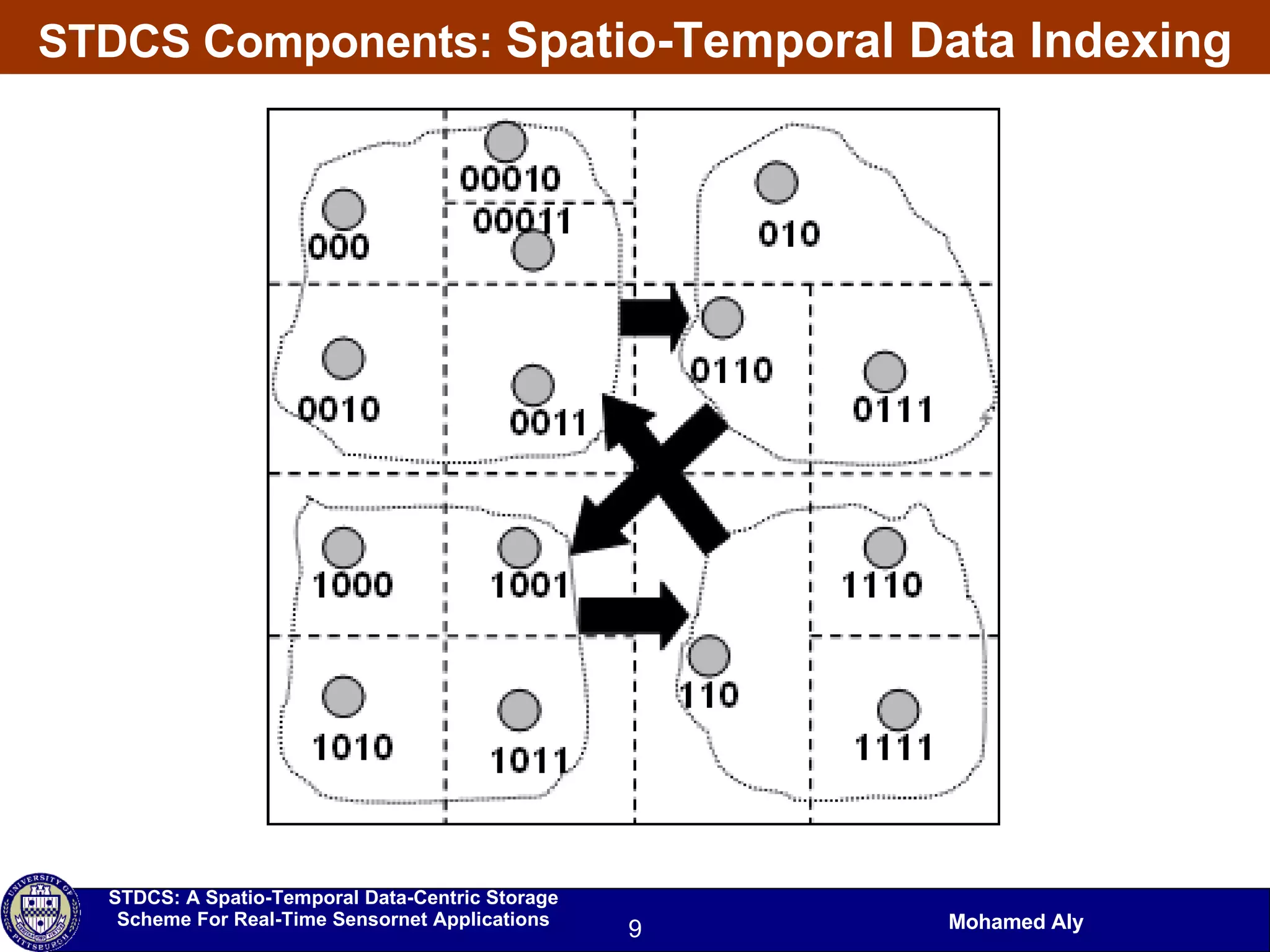
STDCS Components:  Spatio-Temporal Data Indexing
STDCS Components:  Reading Delivery and Querying
STDCS Components: Adaptive Hotspot Decomposition Motivation: Dynamic query hotspots as time progresses. Observation: Recurrent querying scenarios across the day, the week, etc. Technique: Continuously keeping track of hotspots using the Average Querying Frequency (AQF) metric. Dynamically chaning the switching time to decompose hotspots.
Roadmap Motivation: Real-Time Geo-Centric applications. Background: Data-Centric Storage (DCS). Problem Statement: Real-Time Geo-Centric Storage. Scheme Overview: STDCS. STDCS Components Local Virtual address assignment Spatio-Temporal data indexing. Point-to-point data delivery. Query processing. Adaptive hotspot decomposition. Experimental Results Conclusions
Simulation Description Compare:   STDCS, local storage, spatial indexing. A cluster of stationary sensors (with random locations). Each sensor senses a reading each 10 min. Sensor reading = 1 packet. Sensor capacity = 20 readings (packets)  Multiple mobile users. A query: random sensor, radius, and type.  Two phases:  initialization (3 hours of readings) & running (1 day of readings and queries). Metrics:  throughput, energy level, node deaths.
Experimental Results: STDCS vs. Query Hotspots
Experimental Results: Switching Time Effect
Experimental Results: Switching Time vs. Node Deaths
Experimental Results: Adaptive Hotspot Decomposition
Conclusions STDCS:  A real-time geo-centric data storage scheme. A new concept of spatio-temporal data indexing. Ability to dynamically cope with dynamic loads and query hotspots.
Acknowledgment This work has been partly supported by: Google, Inc. The “Secure CITI: A Secure Critical Information Technology Infrastructure for Disaster Management (S-CITI)” project funded through the ITR Medium Award ANI-0325353 from the National Science Foundation (NSF). For more information, please visit:  http://www.cs.pitt.edu/s-citi/
Thank You Questions ?

STDCS

  • 1.
    STDCS: A Spatio-TemporalData-Centric Storage Scheme For Real-Time Sensornet Applications Mohamed Aly (University of Pittsburgh & Yahoo, Inc.) In collaboration with Anandha Gopalan (University of Pittsburgh, Imperial College) and Jerry Zhao, Adel Youssef (Google, Inc.)
  • 2.
    Motivation: Real-Time Geo-CentricSensor Network Applications Globally deployed sensor around the globe. Clusters of sensors forming networks. Mobile users roaming across the networks. Real-time geo-centric ad-hoc queries issued from within or nearby the queried area. The sensor network is responsible of answering these queries directly from the sensors rather than from base stations. Examples: Bronx Zoo cluster. Disaster management cluster.
  • 3.
    Motivation: Real-Time Geo-CentricSensor Network Applications
  • 4.
    Data Storage Optionsin Sensor Networks Base Station Storage: Events are sent to base stations where queries are issued and evaluated. Best suited for continuous queries. In-Network Storage (INS): Events are stored in the sensor nodes. Best suited for ad-hoc queries. All previous INS schemes were Data-Centric Storage (DCS) schemes.
  • 5.
    In-Network Data-Centric Storage(DCS) Mainly to answer range queries. Quality of Data (QoD) of ad-hoc queries. Assign a value-range of readings for each sensor. Examples: Distributed Hash Tables (DHT) [Shenker et. al., HotNets’02] Geographic Hash Tables (GHT) [Ratnasamy et. al., WSNA’02] Distributed Index for Multi-dimensional data (DIM) [Li et. al., SenSys’03, Aly et. al., DMSN’05, MOBIQUITOUS’06] K-D Tree based Data-Centric Storage (KDDCS) [Aly et. al., CIKM’06]
  • 6.
    STDCS Overview Motivation:No previous INS schemes adopting geo-centric storage. Expected techniques may be: Local storage. Spatial storage Design Goal: Load-Balancing of storage load among sensors Differences from previous schemes: Temporally evolving spatial indexing scheme to balance query load among sensors. Dynamic query hotspot detection and decomposition.
  • 7.
    Roadmap Motivation: Real-TimeGeo-Centric applications. Background: Data-Centric Storage (DCS). Problem Statement: Real-Time Geo-Centric Storage. Scheme Overview: STDCS. STDCS Components Local Virtual address assignment Spatio-Temporal data indexing. Point-to-point data delivery. Query processing. Adaptive hotspot decomposition. Experimental Results Conclusions
  • 8.
    STDCS Components: LocalVirtual Address Assignment
  • 9.
    STDCS Components: Spatio-Temporal Data Indexing
  • 10.
    STDCS Components: Reading Delivery and Querying
  • 11.
    STDCS Components: AdaptiveHotspot Decomposition Motivation: Dynamic query hotspots as time progresses. Observation: Recurrent querying scenarios across the day, the week, etc. Technique: Continuously keeping track of hotspots using the Average Querying Frequency (AQF) metric. Dynamically chaning the switching time to decompose hotspots.
  • 12.
    Roadmap Motivation: Real-TimeGeo-Centric applications. Background: Data-Centric Storage (DCS). Problem Statement: Real-Time Geo-Centric Storage. Scheme Overview: STDCS. STDCS Components Local Virtual address assignment Spatio-Temporal data indexing. Point-to-point data delivery. Query processing. Adaptive hotspot decomposition. Experimental Results Conclusions
  • 13.
    Simulation Description Compare: STDCS, local storage, spatial indexing. A cluster of stationary sensors (with random locations). Each sensor senses a reading each 10 min. Sensor reading = 1 packet. Sensor capacity = 20 readings (packets) Multiple mobile users. A query: random sensor, radius, and type. Two phases: initialization (3 hours of readings) & running (1 day of readings and queries). Metrics: throughput, energy level, node deaths.
  • 14.
    Experimental Results: STDCSvs. Query Hotspots
  • 15.
    Experimental Results: STDCSvs. Query Hotspots
  • 16.
  • 17.
    Experimental Results: SwitchingTime vs. Node Deaths
  • 18.
    Experimental Results: AdaptiveHotspot Decomposition
  • 19.
    Conclusions STDCS: A real-time geo-centric data storage scheme. A new concept of spatio-temporal data indexing. Ability to dynamically cope with dynamic loads and query hotspots.
  • 20.
    Acknowledgment This workhas been partly supported by: Google, Inc. The “Secure CITI: A Secure Critical Information Technology Infrastructure for Disaster Management (S-CITI)” project funded through the ITR Medium Award ANI-0325353 from the National Science Foundation (NSF). For more information, please visit: http://www.cs.pitt.edu/s-citi/
  • 21.