
Real-time data management on wireless sensor networks: survey

    Ousmane Diallo (a,b), Joel J.P.C.Rodrigues( b), Mbaye Sene (a )

    (a) Department of Mathematics and Informatics, UCAD,Senegal
(b) Instituto de Telecomunicac- ~oes, University of BeiraInterior,Portugal


       Journal of Network and Computer Applications 35 (2012) 1013–1021


              Article history: Received 22 July2011, Accepted 5 December2011, Available online 14December 2011
                                                and finally Published in May-2012

                    Keywords: Wireless sensor networks, Real-time database management, Data collection


                                                   NILAMADHAB MISHRA
                                                        D0121008


                                                                                                    & 2011 Elsevier Ltd. All rights reserved.
Contents

• Aim
• Concept
• Background
• Current solutions of real-time database
  techniques for WSN
• Open issues
• Conclusion

                                            2
Aim
• The wireless sensor network faces a lot of constraints like
  h/w constraint, limited energy resources, limited
  computational capability, limited band width, limited storage
  capability and many more limitations/constraints. So it’s a
  challenge to manage large real-time data on WSN.
• So to face the challenges ,two approaches are suggested in
  this paper:-warehousing approach and distributed approach.
• Warehousing approach- stores data in a central data base,
  then queries may be performed on it to retrieve data.
• Distributed approach-sensor devices are considered as local
  data bases and data are managed locally.
• Aim- To identify the main specifications of real-time data
  management and suggest some solutions for effective real-
  time data management on WSN.
                                                              3
Contents
• Aim
• Concept
• Background
• Current solutions of real-time database
  techniques for WSN
• Open issues
• Conclusion


                                            4
Concept
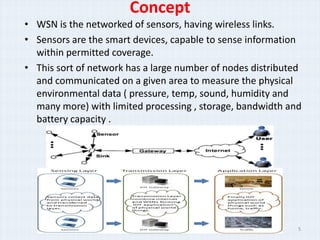
• WSN is the networked of sensors, having wireless links.
• Sensors are the smart devices, capable to sense information
  within permitted coverage.
• This sort of network has a large number of nodes distributed
  and communicated on a given area to measure the physical
  environmental data ( pressure, temp, sound, humidity and
  many more) with limited processing , storage, bandwidth and
  battery capacity .


                                                             5
Concept
• There are two main approaches to data storage and querying
  in WSN: distributed approach and warehousing approach.
• In distributed approach, researches recommend a distributed
  evaluation of requests on sensor networks, and aim at
  exploiting the capacities of calculation of sensors. The
  objective is to locally calculate in order to limit sending of
  messages, reducing thus the energy consumption.
• In warehousing approach, warehouse has a centralized
  system that Collects data from sensors (in stream) and send to
  a central database server, in which user requests are
  processed.
• Note that this warehousing approach generates large data
  flows.


                                                               6
Contents

• Aim
• Concept
• Background
• Current solutions of real-time database
  techniques for WSN
• Open issues
• Conclusions and future work

                                            7
Background
• With the evolution of the traditional databases management
  systems, the sensor databases try to create an abstraction
  between the end-users and the sensor nodes.
• It allow the users to only concentrate on the data that they
  need to be collected rather how to extract data from a
  network.

• This evolution of sensor databases has seen born various data
  storage and query management techniques designed
  specifically for WSNs. There are two main approaches to data
  storage and query in WSNs : warehousing and distributed.


                                                                 8
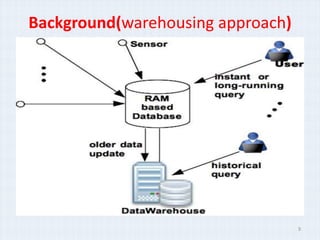
Background(warehousing approach)


                                   9
Background(warehousing approach)
• The warehousing approach is a centralized system. The data
  gathered by the sensors are sent to a central database where
  user queries are processed. In this case, the sensors act as
  simply collectors. The warehousing approach is the most used
  one in query processing.
                     Drawbacks
• The huge number of generated data can easily create a
  bottleneck on the central server.
• The huge amount of information transferring waste the
  resources. The instructions processing is much less expensive
  than the wireless data transmission.


                                                                  10
Background(distributed approach)
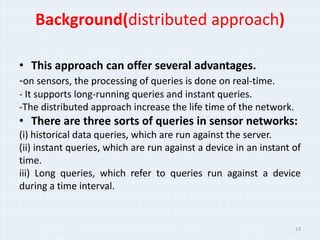
 Distributed approach where sensor devices are part of the data base.


                                                                        11
Background(distributed approach)

• The distributed approach exploits the capabilities of
  sensors calculation and the sensors act as local
  databases.
•    It aims to locally calculate the limit of sending messages in
    order to save the energy consumption. In this approach, the
    data are stored in a central database server and in the devices
    themselves, enabling one to query both. Here, the devices act
    as part of the database.


                                                                 12
Background(distributed approach)

• This approach can offer several advantages.
-on sensors, the processing of queries is done on real-time.
- It supports long-running queries and instant queries.
-The distributed approach increase the life time of the network.
• There are three sorts of queries in sensor networks:
(i) historical data queries, which are run against the server.
(ii) instant queries, which are run against a device in an instant of
time.
iii) Long queries, which refer to queries run against a device
during a time interval.


                                                                   13
Contents

• Aim
• Concept
• Background
• Current solutions of real-time database
  techniques for WSN
• Open issues
• Conclusion

                                            14
Current solutions of real-time
    database techniques for WSN( )                     review


• Noel et al.(2004a, 2004b), Noel et al.(2005a) have proposed a
  new sensor database spatiotemporal access method, named
  as Po-tree. Po-Tree is an indexing system for centralized
  spatiotemporal data bases, working on data from a fixed
  sensor network with real-time constraints.
• Noel et al. (2005b), Noel and Sevigne (2005) have proposed a
  real-time spatiotemporal indexing scheme for agile sensors,
  named the PasTree. The PasTree is an improved version of the
  PoTree. The structure is based to a multi version spatial sub-
  tree; which keep tracks of the sensor location changes. Thus,
  each node keeps information about the past positions sensors
  and the actual ones.


                        Warehousing approach(review)            15
Current solutions of real-time
    database techniques for WSN( )                     review


• Noel and Sevigne(2006) have also proposed a third indexing
  method, named as StH, for real-time management of main
  memory. The StH, spatiotemporal/Heat, is an indexing system
  for centralized spatiotemporal databases in RAM memory,
  working on data from a agile sensor network and taking into
  account the memory saturation of the database.
• Sevigne and Noel (2008) have shown the complete structure
  PoTree, PasTree and StH but this time it is increasing the StH
  linking the database (into memory hand) to a data
  warehouse.


                        Warehousing approach(review)
                                                                16
Current solutions of real-time
    database techniques for WSN( )                     review


• The data acquired by the sensors must represent the current
  status of the targeted phenomenon. However, this status is
  subject to constant changes.
• Thus, in (Bouju et al., 2009) and Noel et al. (2005b), the
  authors attempt to consider the location of the sensors; which
  can be fixed, agile and mobile.
• Based on the UML formalism, they define a spatiotemporal
  sensor data model for real-time storing according to the
  sensor position (fixed, agile, mobile).


                        Warehousing approach(review)
                                                                17
Current solutions of real-time
   database techniques for WSN( )                      review


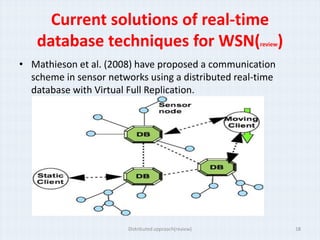
• Mathieson et al. (2008) have proposed a communication
  scheme in sensor networks using a distributed real-time
  database with Virtual Full Replication.


                        Distributed approach(review)            18
Current solutions of real-time
   database techniques for WSN( )                     review


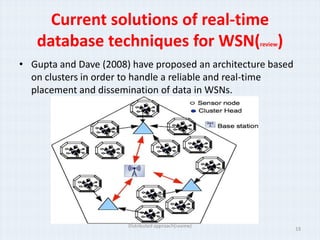
• Gupta and Dave (2008) have proposed an architecture based
  on clusters in order to handle a reliable and real-time
  placement and dissemination of data in WSNs.


                       Distributed approach(review)
                                                               19
Current solutions of real-time
    database techniques for WSN( )                     review


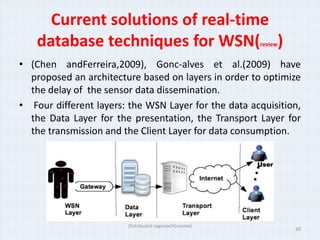
• (Chen andFerreira,2009), Gonc-alves et al.(2009) have
  proposed an architecture based on layers in order to optimize
  the delay of the sensor data dissemination.
• Four different layers: the WSN Layer for the data acquisition,
  the Data Layer for the presentation, the Transport Layer for
  the transmission and the Client Layer for data consumption.


                        Distributed approach(review)
                                                                20
Current solutions of real-time
   database techniques for WSN( )                     review


• Like a conventional database management systems, a real-
  time database management system must process transactions
  while ensuring that the database consistency is not violated.


• Chagas et al. (2010) present some real-time database
  management techniques to deal with this challenge.


• It uses a distributed approach where the network devices act
  as database and periodically send the acquired data to the
  database server.

                        Distributed approach(review            21
Contents

• Aim
• Concept
• Background
• Current solutions of real-time database
  techniques for WSN
• Open issues
• Conclusion

                                            22
Open issues

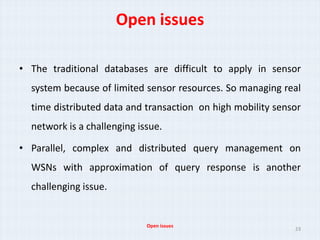
• The traditional databases are difficult to apply in sensor
  system because of limited sensor resources. So managing real
  time distributed data and transaction on high mobility sensor
  network is a challenging issue.

• Parallel, complex and distributed query management on
  WSNs with approximation of query response is another
  challenging issue.


                             Open issues
                                                             23
Contents

• Aim
• Concept
• Background
• Current solutions of real-time database
  techniques for WSN
• Open issues
• Conclusion

                                            24
Conclusion

• This work has reviewed the various solutions for managing
  sensor’s real time data management by implementing
  warehousing and distributed approaches.


                 QUERY PLEASE ?

                                                              25

Real time data management on wsn

  • 1.
    Real-time data managementon wireless sensor networks: survey Ousmane Diallo (a,b), Joel J.P.C.Rodrigues( b), Mbaye Sene (a ) (a) Department of Mathematics and Informatics, UCAD,Senegal (b) Instituto de Telecomunicac- ~oes, University of BeiraInterior,Portugal Journal of Network and Computer Applications 35 (2012) 1013–1021 Article history: Received 22 July2011, Accepted 5 December2011, Available online 14December 2011 and finally Published in May-2012 Keywords: Wireless sensor networks, Real-time database management, Data collection NILAMADHAB MISHRA D0121008 & 2011 Elsevier Ltd. All rights reserved.
  • 2.
    Contents • Aim • Concept •Background • Current solutions of real-time database techniques for WSN • Open issues • Conclusion 2
  • 3.
    Aim • The wirelesssensor network faces a lot of constraints like h/w constraint, limited energy resources, limited computational capability, limited band width, limited storage capability and many more limitations/constraints. So it’s a challenge to manage large real-time data on WSN. • So to face the challenges ,two approaches are suggested in this paper:-warehousing approach and distributed approach. • Warehousing approach- stores data in a central data base, then queries may be performed on it to retrieve data. • Distributed approach-sensor devices are considered as local data bases and data are managed locally. • Aim- To identify the main specifications of real-time data management and suggest some solutions for effective real- time data management on WSN. 3
  • 4.
    Contents • Aim • Concept •Background • Current solutions of real-time database techniques for WSN • Open issues • Conclusion 4
  • 5.
    Concept • WSN isthe networked of sensors, having wireless links. • Sensors are the smart devices, capable to sense information within permitted coverage. • This sort of network has a large number of nodes distributed and communicated on a given area to measure the physical environmental data ( pressure, temp, sound, humidity and many more) with limited processing , storage, bandwidth and battery capacity . 5
  • 6.
    Concept • There aretwo main approaches to data storage and querying in WSN: distributed approach and warehousing approach. • In distributed approach, researches recommend a distributed evaluation of requests on sensor networks, and aim at exploiting the capacities of calculation of sensors. The objective is to locally calculate in order to limit sending of messages, reducing thus the energy consumption. • In warehousing approach, warehouse has a centralized system that Collects data from sensors (in stream) and send to a central database server, in which user requests are processed. • Note that this warehousing approach generates large data flows. 6
  • 7.
    Contents • Aim • Concept •Background • Current solutions of real-time database techniques for WSN • Open issues • Conclusions and future work 7
  • 8.
    Background • With theevolution of the traditional databases management systems, the sensor databases try to create an abstraction between the end-users and the sensor nodes. • It allow the users to only concentrate on the data that they need to be collected rather how to extract data from a network. • This evolution of sensor databases has seen born various data storage and query management techniques designed specifically for WSNs. There are two main approaches to data storage and query in WSNs : warehousing and distributed. 8
  • 9.
  • 10.
    Background(warehousing approach) • Thewarehousing approach is a centralized system. The data gathered by the sensors are sent to a central database where user queries are processed. In this case, the sensors act as simply collectors. The warehousing approach is the most used one in query processing. Drawbacks • The huge number of generated data can easily create a bottleneck on the central server. • The huge amount of information transferring waste the resources. The instructions processing is much less expensive than the wireless data transmission. 10
  • 11.
    Background(distributed approach) Distributedapproach where sensor devices are part of the data base. 11
  • 12.
    Background(distributed approach) • Thedistributed approach exploits the capabilities of sensors calculation and the sensors act as local databases. • It aims to locally calculate the limit of sending messages in order to save the energy consumption. In this approach, the data are stored in a central database server and in the devices themselves, enabling one to query both. Here, the devices act as part of the database. 12
  • 13.
    Background(distributed approach) • Thisapproach can offer several advantages. -on sensors, the processing of queries is done on real-time. - It supports long-running queries and instant queries. -The distributed approach increase the life time of the network. • There are three sorts of queries in sensor networks: (i) historical data queries, which are run against the server. (ii) instant queries, which are run against a device in an instant of time. iii) Long queries, which refer to queries run against a device during a time interval. 13
  • 14.
    Contents • Aim • Concept •Background • Current solutions of real-time database techniques for WSN • Open issues • Conclusion 14
  • 15.
    Current solutions ofreal-time database techniques for WSN( ) review • Noel et al.(2004a, 2004b), Noel et al.(2005a) have proposed a new sensor database spatiotemporal access method, named as Po-tree. Po-Tree is an indexing system for centralized spatiotemporal data bases, working on data from a fixed sensor network with real-time constraints. • Noel et al. (2005b), Noel and Sevigne (2005) have proposed a real-time spatiotemporal indexing scheme for agile sensors, named the PasTree. The PasTree is an improved version of the PoTree. The structure is based to a multi version spatial sub- tree; which keep tracks of the sensor location changes. Thus, each node keeps information about the past positions sensors and the actual ones. Warehousing approach(review) 15
  • 16.
    Current solutions ofreal-time database techniques for WSN( ) review • Noel and Sevigne(2006) have also proposed a third indexing method, named as StH, for real-time management of main memory. The StH, spatiotemporal/Heat, is an indexing system for centralized spatiotemporal databases in RAM memory, working on data from a agile sensor network and taking into account the memory saturation of the database. • Sevigne and Noel (2008) have shown the complete structure PoTree, PasTree and StH but this time it is increasing the StH linking the database (into memory hand) to a data warehouse. Warehousing approach(review) 16
  • 17.
    Current solutions ofreal-time database techniques for WSN( ) review • The data acquired by the sensors must represent the current status of the targeted phenomenon. However, this status is subject to constant changes. • Thus, in (Bouju et al., 2009) and Noel et al. (2005b), the authors attempt to consider the location of the sensors; which can be fixed, agile and mobile. • Based on the UML formalism, they define a spatiotemporal sensor data model for real-time storing according to the sensor position (fixed, agile, mobile). Warehousing approach(review) 17
  • 18.
    Current solutions ofreal-time database techniques for WSN( ) review • Mathieson et al. (2008) have proposed a communication scheme in sensor networks using a distributed real-time database with Virtual Full Replication. Distributed approach(review) 18
  • 19.
    Current solutions ofreal-time database techniques for WSN( ) review • Gupta and Dave (2008) have proposed an architecture based on clusters in order to handle a reliable and real-time placement and dissemination of data in WSNs. Distributed approach(review) 19
  • 20.
    Current solutions ofreal-time database techniques for WSN( ) review • (Chen andFerreira,2009), Gonc-alves et al.(2009) have proposed an architecture based on layers in order to optimize the delay of the sensor data dissemination. • Four different layers: the WSN Layer for the data acquisition, the Data Layer for the presentation, the Transport Layer for the transmission and the Client Layer for data consumption. Distributed approach(review) 20
  • 21.
    Current solutions ofreal-time database techniques for WSN( ) review • Like a conventional database management systems, a real- time database management system must process transactions while ensuring that the database consistency is not violated. • Chagas et al. (2010) present some real-time database management techniques to deal with this challenge. • It uses a distributed approach where the network devices act as database and periodically send the acquired data to the database server. Distributed approach(review 21
  • 22.
    Contents • Aim • Concept •Background • Current solutions of real-time database techniques for WSN • Open issues • Conclusion 22
  • 23.
    Open issues • Thetraditional databases are difficult to apply in sensor system because of limited sensor resources. So managing real time distributed data and transaction on high mobility sensor network is a challenging issue. • Parallel, complex and distributed query management on WSNs with approximation of query response is another challenging issue. Open issues 23
  • 24.
    Contents • Aim • Concept •Background • Current solutions of real-time database techniques for WSN • Open issues • Conclusion 24
  • 25.
    Conclusion • This workhas reviewed the various solutions for managing sensor’s real time data management by implementing warehousing and distributed approaches. QUERY PLEASE ? 25