'
&
$
%
Modeling and Querying Metadata in the
Semantic Sensor Web: stRDF and stSPARQL
Manolis Koubarakis
Kostis Kyzirakos
Manos Karpathiotakis
Dept. of Informatics and Telecommunications
National and Kapodistrian University of Athens
Dagstuhl SSN 26/01/2010
'
&
$
%
Talk Outline
• Motivation
• The Data Model stRDF
• The Query Language stSPARQL
• Implementation
• Future Work
Dagstuhl SSN 26/01/2010
'
&
$
%
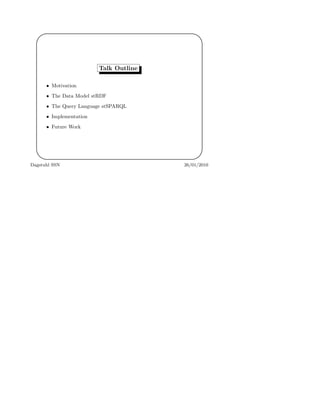
Motivation
• The vision of the Semantic Sensor Web: annotate sensor
data and services to enable discovery, integration,
interoperability etc. (Sheth et al. 2008, SemsorGrid4Env)
• Sensor annotations involve thematic, spatial and temporal
metadata. Examples:
– The sensor measures temperature. (thematic)
– The sensor is located in the location represented by point
(A, B). (spatial)
– The sensor measured −30
Celsius on 26/01/2010 at
03:00pm. (temporal)
• RDF can represent thematic metadata. How about spatial and
temporal metadata?
Dagstuhl SSN 26/01/2010
'
&
$
%
Previous Work
• Time in RDF (Gutierrez and colleagues, 2005).
• SPARQL-ST (Perry, 2008).
• SPAUK (Kollas, 2007)
Dagstuhl SSN 26/01/2010
'
&
$
%
Our Approach
• Use ideas from constraint databases (Kanellakis, Kuper and
Revesz, 1991). Slogan: What’s in a tuple? Constraints.
• Extend RDF to a constraint database model. Slogan: What’s
in a triple? Constraints.
• Extend SPARQL to a constraint query language.
• Follow exactly the approach of CSQL (Kuper et al., 1998).
• Use linear constraints to represent spatial and temporal
metadata.
Dagstuhl SSN 26/01/2010
'
&
$
%
Spatial Metadata
• We start with a FO language L = {≤, +} ∪ Q over the structure
Q = Q, ≤, +, (q)q∈Q .
• Atomic formulae: linear equations and inequalities of the form
(
p
i=1
aixi)Θa0
where Θ is one of =, ≤ or <.
• Semi-linear point sets: sets that can be defined by quantifier-free
formulas of L.
Dagstuhl SSN 26/01/2010
'
&
$
%
Example
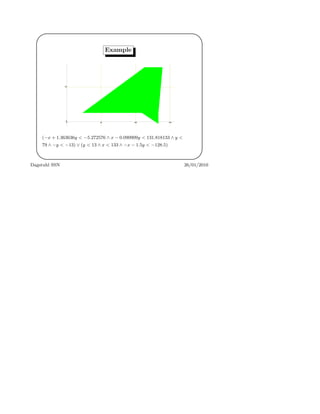
(−x + 1.363636y < −5.272576 ∧ x − 0.090909y < 131.818133 ∧ y <
79 ∧ −y < −13) ∨ (y < 13 ∧ x < 133 ∧ −x − 1.5y < −128.5)
Dagstuhl SSN 26/01/2010
'
&
$
%
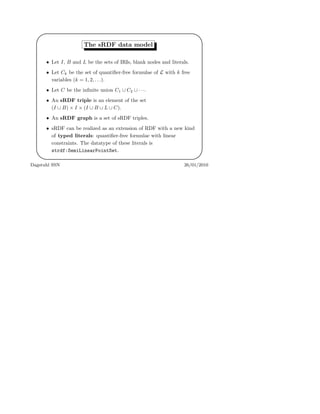
The sRDF data model
• Let I, B and L be the sets of IRIs, blank nodes and literals.
• Let Ck be the set of quantifier-free formulae of L with k free
variables (k = 1, 2, . . .).
• Let C be the infinite union C1 ∪ C2 ∪ · · ·.
• An sRDF triple is an element of the set
(I ∪ B) × I × (I ∪ B ∪ L ∪ C).
• An sRDF graph is a set of sRDF triples.
• sRDF can be realized as an extension of RDF with a new kind
of typed literals: quantifier-free formulae with linear
constraints. The datatype of these literals is
strdf:SemiLinearPointSet.
Dagstuhl SSN 26/01/2010
'
&
$
%
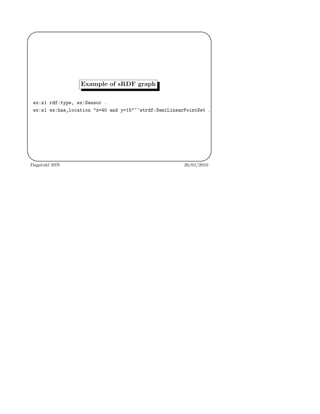
Example of sRDF graph
ex:s1 rdf:type, ex:Sensor .
ex:s1 ex:has_location "x=40 and y=15"^^strdf:SemiLinearPointSet .
Dagstuhl SSN 26/01/2010
'
&
$
%
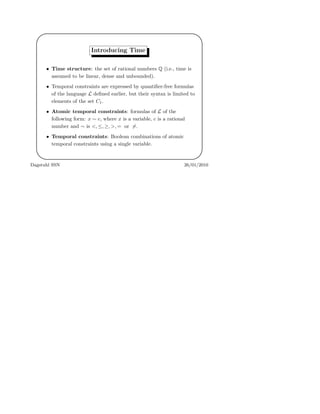
Introducing Time
• Time structure: the set of rational numbers Q (i.e., time is
assumed to be linear, dense and unbounded).
• Temporal constraints are expressed by quantifier-free formulas
of the language L defined earlier, but their syntax is limited to
elements of the set C1.
• Atomic temporal constraints: formulas of L of the
following form: x ∼ c, where x is a variable, c is a rational
number and ∼ is <, ≤, ≥, >, = or =.
• Temporal constraints: Boolean combinations of atomic
temporal constraints using a single variable.
Dagstuhl SSN 26/01/2010
'
&
$
%
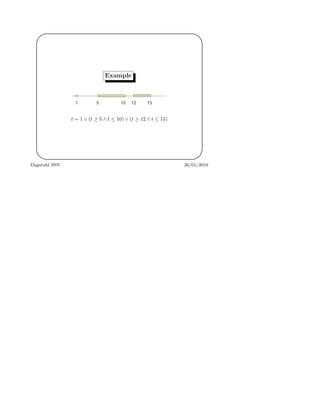
Example
1 5 10 12 15
t = 1 ∨ (t ≥ 5 ∧ t ≤ 10) ∨ (t ≥ 12 ∧ t ≤ 15)
Dagstuhl SSN 26/01/2010
'
&
$
%
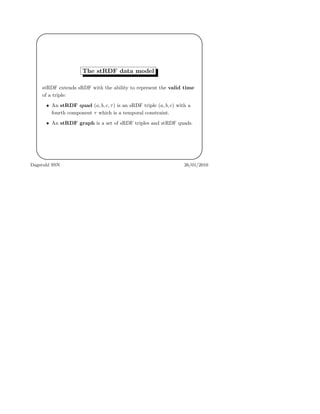
The stRDF data model
stRDF extends sRDF with the ability to represent the valid time
of a triple:
• An stRDF quad (a, b, c, τ) is an sRDF triple (a, b, c) with a
fourth component τ which is a temporal constraint.
• An stRDF graph is a set of sRDF triples and stRDF quads.
Dagstuhl SSN 26/01/2010
'
&
$
%
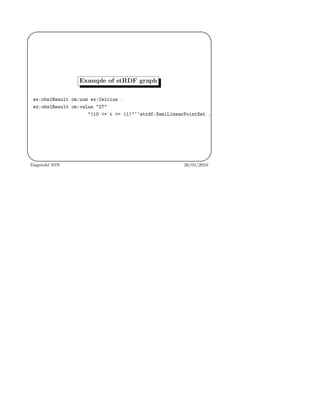
Example of stRDF graph
ex:obs1Result om:uom ex:Celcius .
ex:obs1Result om:value "27"
"(10 <= t <= 11)"^^strdf:SemiLinearPointSet .
Dagstuhl SSN 26/01/2010
'
&
$
%
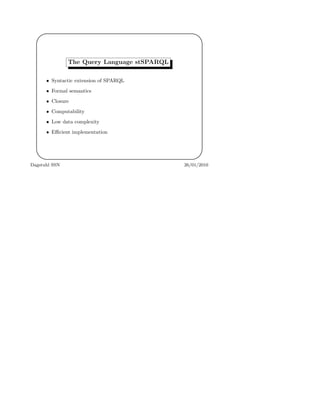
The Query Language stSPARQL
• Syntactic extension of SPARQL
• Formal semantics
• Closure
• Computability
• Low data complexity
• Efficient implementation
Dagstuhl SSN 26/01/2010
'
&
$
%
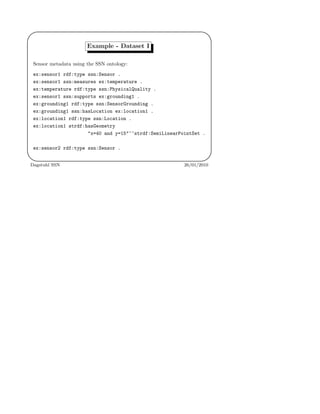
Example - Dataset I
Sensor metadata using the SSN ontology:
ex:sensor1 rdf:type ssn:Sensor .
ex:sensor1 ssn:measures ex:temperature .
ex:temperature rdf:type ssn:PhysicalQuality .
ex:sensor1 ssn:supports ex:grounding1 .
ex:grounding1 rdf:type ssn:SensorGrounding .
ex:grounding1 ssn:hasLocation ex:location1 .
ex:location1 rdf:type ssn:Location .
ex:location1 strdf:hasGeometry
"x=40 and y=15"^^strdf:SemiLinearPointSet .
ex:sensor2 rdf:type ssn:Sensor .
Dagstuhl SSN 26/01/2010
'
&
$
%
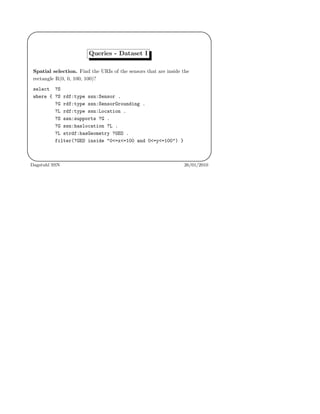
Queries - Dataset I
Spatial selection. Find the URIs of the sensors that are inside the
rectangle R(0, 0, 100, 100)?
select ?S
where { ?S rdf:type ssn:Sensor .
?G rdf:type ssn:SensorGrounding .
?L rdf:type ssn:Location .
?S ssn:supports ?G .
?G ssn:haslocation ?L .
?L strdf:hasGeometry ?GEO .
filter(?GEO inside "0<=x<=100 and 0<=y<=100") }
Dagstuhl SSN 26/01/2010
'
&
$
%
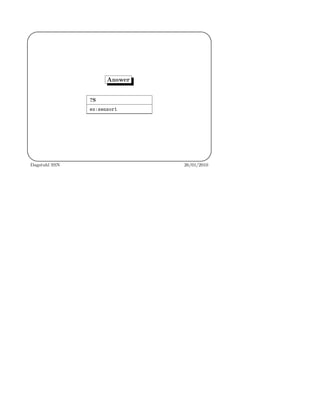
Answer
?S
ex:sensor1
Dagstuhl SSN 26/01/2010
'
&
$
%
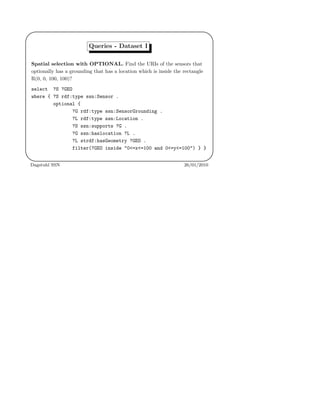
Queries - Dataset I
Spatial selection with OPTIONAL. Find the URIs of the sensors that
optionally has a grounding that has a location which is inside the rectangle
R(0, 0, 100, 100)?
select ?S ?GEO
where { ?S rdf:type ssn:Sensor .
optional {
?G rdf:type ssn:SensorGrounding .
?L rdf:type ssn:Location .
?S ssn:supports ?G .
?G ssn:haslocation ?L .
?L strdf:hasGeometry ?GEO .
filter(?GEO inside "0<=x<=100 and 0<=y<=100") } }
Dagstuhl SSN 26/01/2010
'
&
$
%
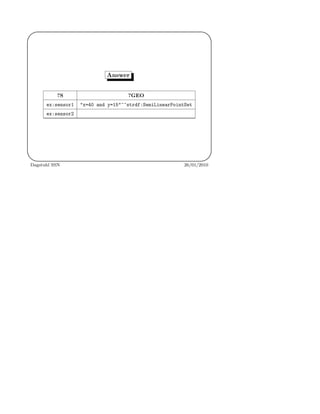
Answer
?S ?GEO
ex:sensor1 "x=40 and y=15"^^strdf:SemiLinearPointSet
ex:sensor2
Dagstuhl SSN 26/01/2010
'
&
$
%
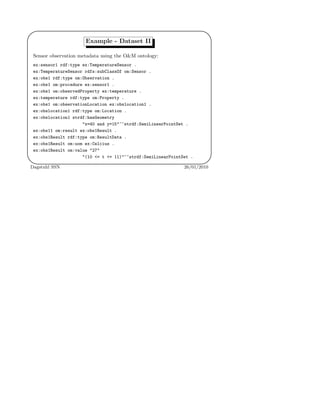
Example - Dataset II
Sensor observation metadata using the O&M ontology:
ex:sensor1 rdf:type ex:TemperatureSensor .
ex:TemperatureSensor rdfs:subClassOf om:Sensor .
ex:obs1 rdf:type om:Observation .
ex:obs1 om:procedure ex:sensor1 .
ex:obs1 om:observedProperty ex:temperature .
ex:temperature rdf:type om:Property .
ex:obs1 om:observationLocation ex:obslocation1 .
ex:obslocation1 rdf:type om:Location .
ex:obslocation1 strdf:hasGeometry
"x=40 and y=15"^^strdf:SemiLinearPointSet .
ex:obs11 om:result ex:obs1Result .
ex:obs1Result rdf:type om:ResultData .
ex:obs1Result om:uom ex:Celcius .
ex:obs1Result om:value "27"
"(10 <= t <= 11)"^^strdf:SemiLinearPointSet .
Dagstuhl SSN 26/01/2010
'
&
$
%
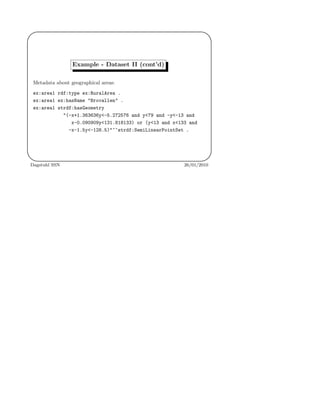
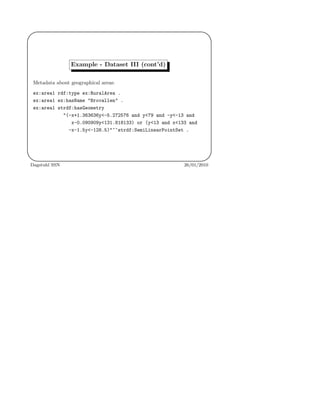
Example - Dataset II (cont’d)
Metadata about geographical areas:
ex:area1 rdf:type ex:RuralArea .
ex:area1 ex:hasName "Brovallen" .
ex:area1 strdf:hasGeometry
"(-x+1.363636y<-5.272576 and y<79 and -y<-13 and
x-0.090909y<131.818133) or (y<13 and x<133 and
-x-1.5y<-128.5)"^^strdf:SemiLinearPointSet .
Dagstuhl SSN 26/01/2010
'
&
$
%
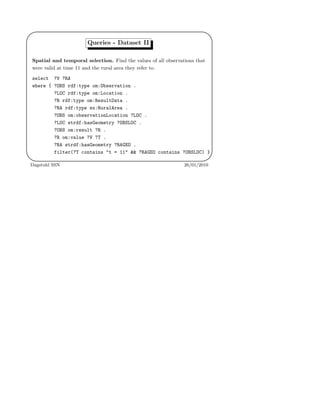
Queries - Dataset II
Spatial and temporal selection. Find the values of all observations that
were valid at time 11 and the rural area they refer to.
select ?V ?RA
where { ?OBS rdf:type om:Observation .
?LOC rdf:type om:Location .
?R rdf:type om:ResultData .
?RA rdf:type ex:RuralArea .
?OBS om:observationLocation ?LOC .
?LOC strdf:hasGeometry ?OBSLOC .
?OBS om:result ?R .
?R om:value ?V ?T .
?RA strdf:hasGeometry ?RAGEO .
filter(?T contains "t = 11" && ?RAGEO contains ?OBSLOC) }
Dagstuhl SSN 26/01/2010
'
&
$
%
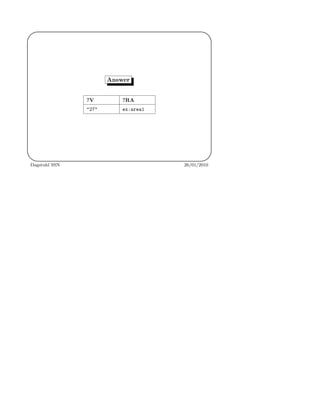
Answer
?V ?RA
"27" ex:area1
Dagstuhl SSN 26/01/2010
'
&
$
%
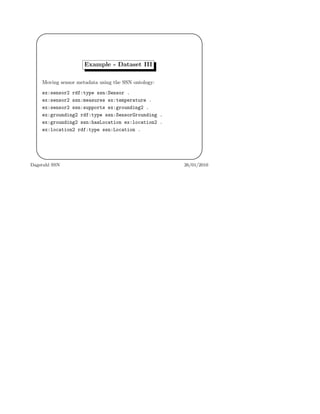
Example - Dataset III
Moving sensor metadata using the SSN ontology:
ex:sensor2 rdf:type ssn:Sensor .
ex:sensor2 ssn:measures ex:temperature .
ex:sensor2 ssn:supports ex:grounding2 .
ex:grounding2 rdf:type ssn:SensorGrounding .
ex:grounding2 ssn:hasLocation ex:location2 .
ex:location2 rdf:type ssn:Location .
Dagstuhl SSN 26/01/2010
'
&
$
%
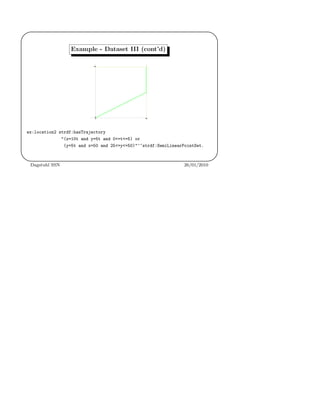
Example - Dataset III (cont’d)
ex:location2 strdf:hasTrajectory
"(x=10t and y=5t and 0<=t<=5) or
(y=5t and x=50 and 25<=y<=50)"^^strdf:SemiLinearPointSet.
Dagstuhl SSN 26/01/2010
'
&
$
%
Example - Dataset III (cont’d)
Metadata about geographical areas:
ex:area1 rdf:type ex:RuralArea .
ex:area1 ex:hasName "Brovallen" .
ex:area1 strdf:hasGeometry
"(-x+1.363636y<-5.272576 and y<79 and -y<-13 and
x-0.090909y<131.818133) or (y<13 and x<133 and
-x-1.5y<-128.5)"^^strdf:SemiLinearPointSet .
Dagstuhl SSN 26/01/2010
'
&
$
%
Queries - Dataset III
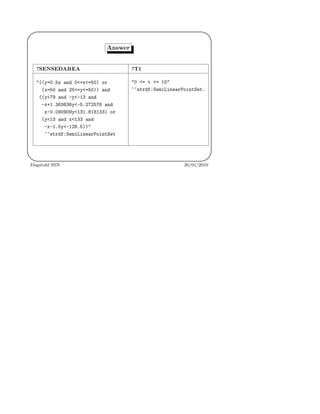
Intersection of an area with a trajectory. Which areas of Brovallen
were sensed by a moving sensor and when?
select (?TR[1,2] INTER ?GEO) as ?SENSEDAREA ?GEO[3]
where { ?SN rdf:type ssn:Sensor .
?Y rdf:type ssn:Location .
?X rdf:type ssn:SensorGrounding .
?RA rdf:type ex:RuralArea .
?SN ssn:supports ?X .
?X ssn:hasLocation ?Y .
?Y strdf:hasTrajectory ?TR .
?RA ex:hasName "Brovallen" .
?RA strdf:hasGeometry ?GEO .
filter(?TR[1,2] overlap ?GEO) }
Dagstuhl SSN 26/01/2010
'
&
$
%
Answer
?SENSEDAREA ?T1
"((y=0.5x and 0<=x<=50) or
(x=50 and 25<=y<=50)) and
((y<79 and -y<-13 and
-x+1.363636y<-5.272576 and
x-0.090909y<131.818133) or
(y<13 and x<133 and
-x-1.5y<-128.5))"
^^strdf:SemiLinearPointSet
"0 <= t <= 10"
^^strdf:SemiLinearPointSet.
Dagstuhl SSN 26/01/2010
'
&
$
%
One More Query
Projection and spatial function application. Find the URIs of the
sensors that are north of Brovallen.
select ?SN
where { ?SN rdf:type ssn:Sensor .
?X rdf:type ssn:SensorGrounding .
?RA rdf:type ex:RuralArea .
?SN ssn:supports ?X .
?X ssn:hasLocation ?Y .
?Y strdf:hasGeometry ?SN_LOC .
?RA ex:hasName "Brovallen".
?RA strdf:hasGeometry ?GEO .
filter(MAX(?GEO[2])<MIN(?SN_LOC[2])) }
Dagstuhl SSN 26/01/2010
'
&
$
%
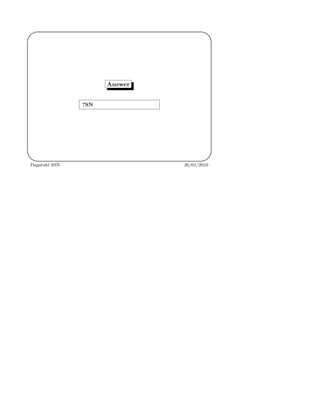
Answer
?SN
Dagstuhl SSN 26/01/2010
'
&
$
%
What Else is There in stSPARQL Syntax?
• k-ary spatial terms
“(x ≥ 1 ∧ x = y) ∨ y = 7”
?GEO ∩ “(x ≥ 1 ∧ x = y) ∨ y = 7”
BD(?GEO ∩ “(x ≥ 1 ∧ x = y) ∨ y = 7”)
“(x ≥ 1 ∧ x ≤ 10 ∧ y ≥ 0 ∧ x = z)”[1, 2] ∩ “(z ≥ 0 ∧ z ≤ 10)”
• Metric spatial terms
AREA(“(x ≥ 1 ∧ x ≤ 10 ∧ y ≥ 0 ∧ x = y)”)
MIN(“(x ≥ 1 ∧ x ≤ 10 ∧ y ≥ 0 ∧ x = y)”[1])
• Spatial and temporal selection predicates
Dagstuhl SSN 26/01/2010
'
&
$
%
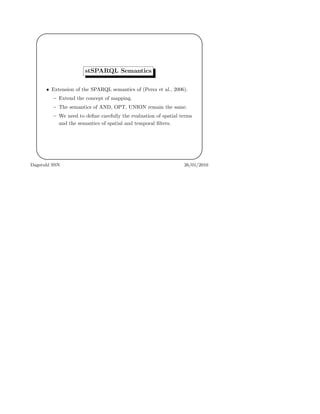
stSPARQL Semantics
• Extension of the SPARQL semantics of (Perez et al., 2006).
– Extend the concept of mapping.
– The semantics of AND, OPT, UNION remain the same.
– We need to define carefully the evaluation of spatial terms
and the semantics of spatial and temporal filters.
Dagstuhl SSN 26/01/2010
'
&
$
%
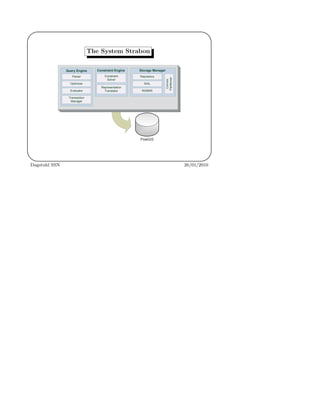
The System Strabon
PostGIS
Query Engine
Parser
Optimizer
Evaluator
Transaction
Manager
Storage Manager
Repository
SAIL
RDBMS
Convex
Partitioner
Constraint Engine
Constraint
Solver
Representation
Translator
Dagstuhl SSN 26/01/2010
'
&
$
%
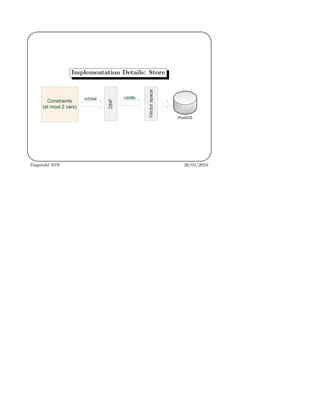
Implementation Details: Store
DNF
Constraints
(at most 2 vars)
PostGIS
Vectorspace
cddliborbital
Dagstuhl SSN 26/01/2010
'
&
$
%
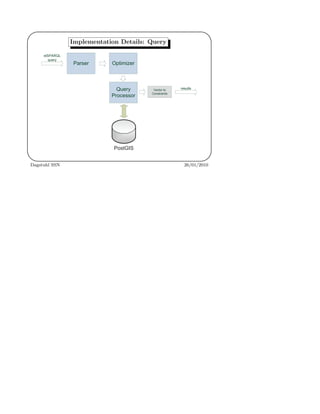
Implementation Details: Query
Parser Optimizer
Query
Processor
stSPARQL
query
results
PostGIS
Vector to
Constraints
Dagstuhl SSN 26/01/2010
'
&
$
%
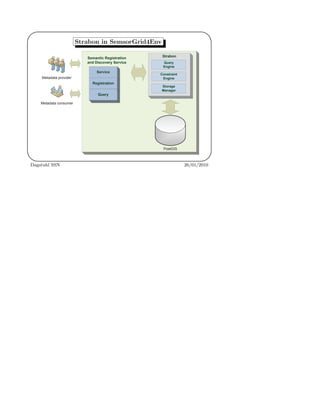
Strabon in SemsorGrid4Env
PostGIS
Query
Engine
Storage
Manager
Constraint
EngineMetadata provider
Metadata consumer
Strabon
Service
Registration
Query
Semantic Registration
and Discovery Service
Dagstuhl SSN 26/01/2010
'
&
$
%
Future Work
• Complete the theory (complexity results).
• Complete the implementation (see demo for what works now).
• Integrate with the rest of SemsorGrid4Env architecture
components.
• Incomplete information (use the blank nodes for a bit more
than what they are currently used).
• OWL 2 and constraints?
Dagstuhl SSN 26/01/2010

Modeling and Querying Metadata in the Semantic Sensor Web: stRDF and stSPARQL

  • 1.
    ' & $ % Modeling and QueryingMetadata in the Semantic Sensor Web: stRDF and stSPARQL Manolis Koubarakis Kostis Kyzirakos Manos Karpathiotakis Dept. of Informatics and Telecommunications National and Kapodistrian University of Athens Dagstuhl SSN 26/01/2010
  • 2.
    ' & $ % Talk Outline • Motivation •The Data Model stRDF • The Query Language stSPARQL • Implementation • Future Work Dagstuhl SSN 26/01/2010
  • 3.
    ' & $ % Motivation • The visionof the Semantic Sensor Web: annotate sensor data and services to enable discovery, integration, interoperability etc. (Sheth et al. 2008, SemsorGrid4Env) • Sensor annotations involve thematic, spatial and temporal metadata. Examples: – The sensor measures temperature. (thematic) – The sensor is located in the location represented by point (A, B). (spatial) – The sensor measured −30 Celsius on 26/01/2010 at 03:00pm. (temporal) • RDF can represent thematic metadata. How about spatial and temporal metadata? Dagstuhl SSN 26/01/2010
  • 4.
    ' & $ % Previous Work • Timein RDF (Gutierrez and colleagues, 2005). • SPARQL-ST (Perry, 2008). • SPAUK (Kollas, 2007) Dagstuhl SSN 26/01/2010
  • 5.
    ' & $ % Our Approach • Useideas from constraint databases (Kanellakis, Kuper and Revesz, 1991). Slogan: What’s in a tuple? Constraints. • Extend RDF to a constraint database model. Slogan: What’s in a triple? Constraints. • Extend SPARQL to a constraint query language. • Follow exactly the approach of CSQL (Kuper et al., 1998). • Use linear constraints to represent spatial and temporal metadata. Dagstuhl SSN 26/01/2010
  • 6.
    ' & $ % Spatial Metadata • Westart with a FO language L = {≤, +} ∪ Q over the structure Q = Q, ≤, +, (q)q∈Q . • Atomic formulae: linear equations and inequalities of the form ( p i=1 aixi)Θa0 where Θ is one of =, ≤ or <. • Semi-linear point sets: sets that can be defined by quantifier-free formulas of L. Dagstuhl SSN 26/01/2010
  • 7.
    ' & $ % Example (−x + 1.363636y< −5.272576 ∧ x − 0.090909y < 131.818133 ∧ y < 79 ∧ −y < −13) ∨ (y < 13 ∧ x < 133 ∧ −x − 1.5y < −128.5) Dagstuhl SSN 26/01/2010
  • 8.
    ' & $ % The sRDF datamodel • Let I, B and L be the sets of IRIs, blank nodes and literals. • Let Ck be the set of quantifier-free formulae of L with k free variables (k = 1, 2, . . .). • Let C be the infinite union C1 ∪ C2 ∪ · · ·. • An sRDF triple is an element of the set (I ∪ B) × I × (I ∪ B ∪ L ∪ C). • An sRDF graph is a set of sRDF triples. • sRDF can be realized as an extension of RDF with a new kind of typed literals: quantifier-free formulae with linear constraints. The datatype of these literals is strdf:SemiLinearPointSet. Dagstuhl SSN 26/01/2010
  • 9.
    ' & $ % Example of sRDFgraph ex:s1 rdf:type, ex:Sensor . ex:s1 ex:has_location "x=40 and y=15"^^strdf:SemiLinearPointSet . Dagstuhl SSN 26/01/2010
  • 10.
    ' & $ % Introducing Time • Timestructure: the set of rational numbers Q (i.e., time is assumed to be linear, dense and unbounded). • Temporal constraints are expressed by quantifier-free formulas of the language L defined earlier, but their syntax is limited to elements of the set C1. • Atomic temporal constraints: formulas of L of the following form: x ∼ c, where x is a variable, c is a rational number and ∼ is <, ≤, ≥, >, = or =. • Temporal constraints: Boolean combinations of atomic temporal constraints using a single variable. Dagstuhl SSN 26/01/2010
  • 11.
    ' & $ % Example 1 5 1012 15 t = 1 ∨ (t ≥ 5 ∧ t ≤ 10) ∨ (t ≥ 12 ∧ t ≤ 15) Dagstuhl SSN 26/01/2010
  • 12.
    ' & $ % The stRDF datamodel stRDF extends sRDF with the ability to represent the valid time of a triple: • An stRDF quad (a, b, c, τ) is an sRDF triple (a, b, c) with a fourth component τ which is a temporal constraint. • An stRDF graph is a set of sRDF triples and stRDF quads. Dagstuhl SSN 26/01/2010
  • 13.
    ' & $ % Example of stRDFgraph ex:obs1Result om:uom ex:Celcius . ex:obs1Result om:value "27" "(10 <= t <= 11)"^^strdf:SemiLinearPointSet . Dagstuhl SSN 26/01/2010
  • 14.
    ' & $ % The Query LanguagestSPARQL • Syntactic extension of SPARQL • Formal semantics • Closure • Computability • Low data complexity • Efficient implementation Dagstuhl SSN 26/01/2010
  • 15.
    ' & $ % Example - DatasetI Sensor metadata using the SSN ontology: ex:sensor1 rdf:type ssn:Sensor . ex:sensor1 ssn:measures ex:temperature . ex:temperature rdf:type ssn:PhysicalQuality . ex:sensor1 ssn:supports ex:grounding1 . ex:grounding1 rdf:type ssn:SensorGrounding . ex:grounding1 ssn:hasLocation ex:location1 . ex:location1 rdf:type ssn:Location . ex:location1 strdf:hasGeometry "x=40 and y=15"^^strdf:SemiLinearPointSet . ex:sensor2 rdf:type ssn:Sensor . Dagstuhl SSN 26/01/2010
  • 16.
    ' & $ % Queries - DatasetI Spatial selection. Find the URIs of the sensors that are inside the rectangle R(0, 0, 100, 100)? select ?S where { ?S rdf:type ssn:Sensor . ?G rdf:type ssn:SensorGrounding . ?L rdf:type ssn:Location . ?S ssn:supports ?G . ?G ssn:haslocation ?L . ?L strdf:hasGeometry ?GEO . filter(?GEO inside "0<=x<=100 and 0<=y<=100") } Dagstuhl SSN 26/01/2010
  • 17.
  • 18.
    ' & $ % Queries - DatasetI Spatial selection with OPTIONAL. Find the URIs of the sensors that optionally has a grounding that has a location which is inside the rectangle R(0, 0, 100, 100)? select ?S ?GEO where { ?S rdf:type ssn:Sensor . optional { ?G rdf:type ssn:SensorGrounding . ?L rdf:type ssn:Location . ?S ssn:supports ?G . ?G ssn:haslocation ?L . ?L strdf:hasGeometry ?GEO . filter(?GEO inside "0<=x<=100 and 0<=y<=100") } } Dagstuhl SSN 26/01/2010
  • 19.
    ' & $ % Answer ?S ?GEO ex:sensor1 "x=40and y=15"^^strdf:SemiLinearPointSet ex:sensor2 Dagstuhl SSN 26/01/2010
  • 20.
    ' & $ % Example - DatasetII Sensor observation metadata using the O&M ontology: ex:sensor1 rdf:type ex:TemperatureSensor . ex:TemperatureSensor rdfs:subClassOf om:Sensor . ex:obs1 rdf:type om:Observation . ex:obs1 om:procedure ex:sensor1 . ex:obs1 om:observedProperty ex:temperature . ex:temperature rdf:type om:Property . ex:obs1 om:observationLocation ex:obslocation1 . ex:obslocation1 rdf:type om:Location . ex:obslocation1 strdf:hasGeometry "x=40 and y=15"^^strdf:SemiLinearPointSet . ex:obs11 om:result ex:obs1Result . ex:obs1Result rdf:type om:ResultData . ex:obs1Result om:uom ex:Celcius . ex:obs1Result om:value "27" "(10 <= t <= 11)"^^strdf:SemiLinearPointSet . Dagstuhl SSN 26/01/2010
  • 21.
    ' & $ % Example - DatasetII (cont’d) Metadata about geographical areas: ex:area1 rdf:type ex:RuralArea . ex:area1 ex:hasName "Brovallen" . ex:area1 strdf:hasGeometry "(-x+1.363636y<-5.272576 and y<79 and -y<-13 and x-0.090909y<131.818133) or (y<13 and x<133 and -x-1.5y<-128.5)"^^strdf:SemiLinearPointSet . Dagstuhl SSN 26/01/2010
  • 22.
    ' & $ % Queries - DatasetII Spatial and temporal selection. Find the values of all observations that were valid at time 11 and the rural area they refer to. select ?V ?RA where { ?OBS rdf:type om:Observation . ?LOC rdf:type om:Location . ?R rdf:type om:ResultData . ?RA rdf:type ex:RuralArea . ?OBS om:observationLocation ?LOC . ?LOC strdf:hasGeometry ?OBSLOC . ?OBS om:result ?R . ?R om:value ?V ?T . ?RA strdf:hasGeometry ?RAGEO . filter(?T contains "t = 11" && ?RAGEO contains ?OBSLOC) } Dagstuhl SSN 26/01/2010
  • 23.
  • 24.
    ' & $ % Example - DatasetIII Moving sensor metadata using the SSN ontology: ex:sensor2 rdf:type ssn:Sensor . ex:sensor2 ssn:measures ex:temperature . ex:sensor2 ssn:supports ex:grounding2 . ex:grounding2 rdf:type ssn:SensorGrounding . ex:grounding2 ssn:hasLocation ex:location2 . ex:location2 rdf:type ssn:Location . Dagstuhl SSN 26/01/2010
  • 25.
    ' & $ % Example - DatasetIII (cont’d) ex:location2 strdf:hasTrajectory "(x=10t and y=5t and 0<=t<=5) or (y=5t and x=50 and 25<=y<=50)"^^strdf:SemiLinearPointSet. Dagstuhl SSN 26/01/2010
  • 26.
    ' & $ % Example - DatasetIII (cont’d) Metadata about geographical areas: ex:area1 rdf:type ex:RuralArea . ex:area1 ex:hasName "Brovallen" . ex:area1 strdf:hasGeometry "(-x+1.363636y<-5.272576 and y<79 and -y<-13 and x-0.090909y<131.818133) or (y<13 and x<133 and -x-1.5y<-128.5)"^^strdf:SemiLinearPointSet . Dagstuhl SSN 26/01/2010
  • 27.
    ' & $ % Queries - DatasetIII Intersection of an area with a trajectory. Which areas of Brovallen were sensed by a moving sensor and when? select (?TR[1,2] INTER ?GEO) as ?SENSEDAREA ?GEO[3] where { ?SN rdf:type ssn:Sensor . ?Y rdf:type ssn:Location . ?X rdf:type ssn:SensorGrounding . ?RA rdf:type ex:RuralArea . ?SN ssn:supports ?X . ?X ssn:hasLocation ?Y . ?Y strdf:hasTrajectory ?TR . ?RA ex:hasName "Brovallen" . ?RA strdf:hasGeometry ?GEO . filter(?TR[1,2] overlap ?GEO) } Dagstuhl SSN 26/01/2010
  • 28.
    ' & $ % Answer ?SENSEDAREA ?T1 "((y=0.5x and0<=x<=50) or (x=50 and 25<=y<=50)) and ((y<79 and -y<-13 and -x+1.363636y<-5.272576 and x-0.090909y<131.818133) or (y<13 and x<133 and -x-1.5y<-128.5))" ^^strdf:SemiLinearPointSet "0 <= t <= 10" ^^strdf:SemiLinearPointSet. Dagstuhl SSN 26/01/2010
  • 29.
    ' & $ % One More Query Projectionand spatial function application. Find the URIs of the sensors that are north of Brovallen. select ?SN where { ?SN rdf:type ssn:Sensor . ?X rdf:type ssn:SensorGrounding . ?RA rdf:type ex:RuralArea . ?SN ssn:supports ?X . ?X ssn:hasLocation ?Y . ?Y strdf:hasGeometry ?SN_LOC . ?RA ex:hasName "Brovallen". ?RA strdf:hasGeometry ?GEO . filter(MAX(?GEO[2])<MIN(?SN_LOC[2])) } Dagstuhl SSN 26/01/2010
  • 30.
  • 31.
    ' & $ % What Else isThere in stSPARQL Syntax? • k-ary spatial terms “(x ≥ 1 ∧ x = y) ∨ y = 7” ?GEO ∩ “(x ≥ 1 ∧ x = y) ∨ y = 7” BD(?GEO ∩ “(x ≥ 1 ∧ x = y) ∨ y = 7”) “(x ≥ 1 ∧ x ≤ 10 ∧ y ≥ 0 ∧ x = z)”[1, 2] ∩ “(z ≥ 0 ∧ z ≤ 10)” • Metric spatial terms AREA(“(x ≥ 1 ∧ x ≤ 10 ∧ y ≥ 0 ∧ x = y)”) MIN(“(x ≥ 1 ∧ x ≤ 10 ∧ y ≥ 0 ∧ x = y)”[1]) • Spatial and temporal selection predicates Dagstuhl SSN 26/01/2010
  • 32.
    ' & $ % stSPARQL Semantics • Extensionof the SPARQL semantics of (Perez et al., 2006). – Extend the concept of mapping. – The semantics of AND, OPT, UNION remain the same. – We need to define carefully the evaluation of spatial terms and the semantics of spatial and temporal filters. Dagstuhl SSN 26/01/2010
  • 33.
    ' & $ % The System Strabon PostGIS QueryEngine Parser Optimizer Evaluator Transaction Manager Storage Manager Repository SAIL RDBMS Convex Partitioner Constraint Engine Constraint Solver Representation Translator Dagstuhl SSN 26/01/2010
  • 34.
    ' & $ % Implementation Details: Store DNF Constraints (atmost 2 vars) PostGIS Vectorspace cddliborbital Dagstuhl SSN 26/01/2010
  • 35.
    ' & $ % Implementation Details: Query ParserOptimizer Query Processor stSPARQL query results PostGIS Vector to Constraints Dagstuhl SSN 26/01/2010
  • 36.
    ' & $ % Strabon in SemsorGrid4Env PostGIS Query Engine Storage Manager Constraint EngineMetadataprovider Metadata consumer Strabon Service Registration Query Semantic Registration and Discovery Service Dagstuhl SSN 26/01/2010
  • 37.
    ' & $ % Future Work • Completethe theory (complexity results). • Complete the implementation (see demo for what works now). • Integrate with the rest of SemsorGrid4Env architecture components. • Incomplete information (use the blank nodes for a bit more than what they are currently used). • OWL 2 and constraints? Dagstuhl SSN 26/01/2010