Management is the process of planning, organizing, leading, and controlling resources—especially people—to achieve specific goals efficiently and effectively.
1. Basic Training(STCW Regulation VI/1)
The STCW mandates that all seafarers who are assigned safety or emergency duties aboard
a ship complete Basic Training (BT) before their employment. The training focuses on
enhancing safety awareness, survival techniques, fire prevention, and emergency response.
1.1 Personal Survival Techniques (PST)
Objective:
To equip seafarers with the knowledge and practical skills required to survive if they must
abandon ship.
Theoretical Training Components:
Types and functions of life-saving appliances (LSAs), including life rafts and lifejackets
Importance of muster stations and lifeboat management
Physiological effects of cold water and how to mitigate hypothermia
Role of emergency position-indicating radio beacons (EPIRBs) and Search and Rescue
Transponders (SARTs)
International regulations for emergency situations, such as SOLAS requirements
3.
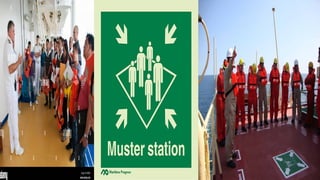
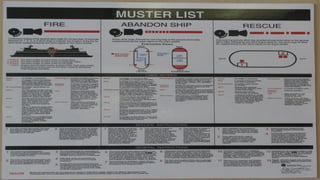
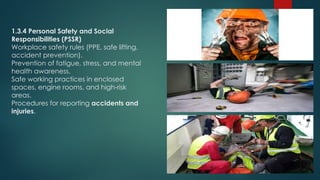
A Muster Stationis a designated area on a ship where passengers and
crew must gather in the event of an emergency, such as a fire,
collision, or abandonment. It is a crucial part of a ship's emergency
evacuation procedures, ensuring that everyone on board knows
where to go and can quickly assemble for further instructions or
evacuation.
A Muster List is a document or record that details the duties and
responsibilities of each crew member during an emergency on board
a vessel. It is an essential part of a ship's emergency preparedness
plan, outlining how the crew should respond in various emergency
situations, such as fire, collision, or abandonment.
6.
Practical Training Components:
Donningand using lifejackets and immersion suits
Jumping from heights safely while wearing survival gear
Boarding and righting a capsized life raft
Organizing and maintaining life raft stations
Proper use of survival equipment (pyrotechnics, signaling mirrors, and radios)
Demonstration of survival techniques, including group huddling to conserve body heat
1.2 Fire Prevention and Fire Fighting (FPFF)
Objective:
To ensure that seafarers can effectively respond to fire incidents onboard through preventive
measures and coordinated firefighting actions.
Theoretical Training Components:
Principles of combustion and fire spread
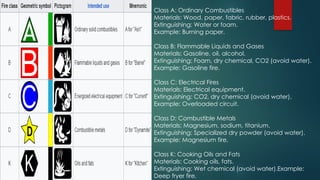
Classification of fires (A, B, C, D, and electrical fires)
Types of firefighting agents and extinguishers
Fixed firefighting systems (water sprinklers, CO2, and foam systems)
Fire detection and alarm systems
Personal protective equipment (PPE) and self-contained breathing apparatus (SCBA)
7.
Class A: OrdinaryCombustibles
Materials: Wood, paper, fabric, rubber, plastics.
Extinguishing: Water or foam.
Example: Burning paper.
Class B: Flammable Liquids and Gases
Materials: Gasoline, oil, alcohol.
Extinguishing: Foam, dry chemical, CO2 (avoid water).
Example: Gasoline fire.
Class C: Electrical Fires
Materials: Electrical equipment.
Extinguishing: CO2, dry chemical (avoid water).
Example: Overloaded circuit.
Class D: Combustible Metals
Materials: Magnesium, sodium, titanium.
Extinguishing: Specialized dry powder (avoid water).
Example: Magnesium fire.
Class K: Cooking Oils and Fats
Materials: Cooking oils, fats.
Extinguishing: Wet chemical (avoid water).Example:
Deep fryer fire.
8.
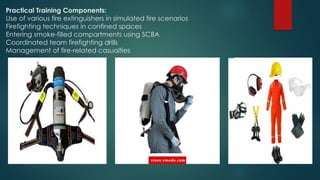
Practical Training Components:
Useof various fire extinguishers in simulated fire scenarios
Firefighting techniques in confined spaces
Entering smoke-filled compartments using SCBA
Coordinated team firefighting drills
Management of fire-related casualties
9.
1.3 Elementary FirstAid (EFA)
Objective:
To equip seafarers with the ability to provide initial medical assistance in emergencies.
Theoretical Training Components:
Anatomy and basic physiology of the human body
Recognizing life-threatening conditions (shock, cardiac arrest, severe bleeding)
Prioritizing casualties and triage principles
Basic pharmacology for pain relief and wound treatment
Importance of hygiene and infection control
Practical Training Components:
Performing CPR and using an Automated External Defibrillator (AED)
Treatment of burns, wounds, and fractures
Immobilization techniques for head and spinal injuries
Bandaging and hemorrhage control
Simulated casualty response scenarios
10.
1.4 Personal Safetyand Social Responsibilities (PSSR)
Objective:
To instill a safety-conscious attitude and promote effective teamwork onboard.
Theoretical Training Components:
Overview of maritime regulations and codes (STCW, SOLAS, MARPOL)
Understanding onboard hierarchical structures and communication protocols
Shipboard emergency procedures and drills
Cultural awareness and conflict resolution onboard
Fatigue management and mental health awareness
Practical Training Components:
Role-playing scenarios for emergency coordination
Evacuation drills and mustering procedures
Use of personal protective equipment (PPE)
Fire and abandon ship drill simulations
11.
2. Familiarization Training(Regulation VI/1)
Familiarization training ensures that seafarers are familiar with the safety,
operational, and emergency procedures specific to the ship they are assigned to.
Key Objectives:
Familiarize crew members with ship-specific systems, including communication,
alarms, and escape routes.
Ensure knowledge of assigned roles during emergencies.
Understand operational risks and safety procedures.
Training Components:
Location of firefighting, life-saving, and first-aid equipment
Usage instructions for emergency escape breathing devices (EEBDs)
Introduction to ship-specific hazard zones (engine room, cargo holds)
Demonstrations of proper donning and operation of PPE
Participation in shipboard drills (fire, collision, grounding, and abandon ship)
12.
3. Security-Related FamiliarizationTraining (Regulation VI/6)
The modern maritime industry faces numerous security challenges, including piracy and
terrorism. STCW mandates security-related training to ensure a proactive approach to
maritime security.
3.1 Security Awareness Training
Objective: To provide seafarers with the knowledge to recognize and respond to potential
security threats.
Key Topics:
Overview of the International Ship and Port Facility Security (ISPS) Code
Ship Security Plan (SSP) requirements
Recognizing and reporting suspicious activities
Security levels and corresponding response measures
Use of security alert systems
Practical Training:
Identification of unauthorized personnel
Responding to suspicious packages
Lockdown procedures and emergency communication drills
13.
Familiarization Training andSecurity-
related Familiarization Training
(As per STCW 1978, as amended,
Chapter VI)
The Standards of Training, Certification,
and Watchkeeping for Seafarers
(STCW) 1978, as amended, require all
crew members to undergo
Familiarization Training and Security-
related Familiarization Training before
assuming shipboard duties. These
trainings are essential for ensuring
safety, security, and emergency
preparedness onboard vessels.
14.
1.2 Objectives
Ensure seafarerscan safely operate
onboard equipment.
Familiarize crew members with
emergency duties and responsibilities.
Introduce ship-specific safety and
operational procedures.
Ensure personnel know how to respond to
emergencies (fire, abandon ship, man
overboard, etc.).
Ensure crew can effectively
communicate using Standard Marine
Communication Phrases (SMCP).
15.
1.3.2 Ship Layoutand Emergency Exits
Crew must be familiar with:
Locations of muster stations, fire stations, lifeboat embarkation
points.
Emergency exits, stairwells, escape hatches, and passageways.
Ship's accommodation, engine room, bridge, and cargo areas.
Example Drill: Emergency Escape Route Navigation
Objective: Ensure crew members can evacuate to muster stations
safely.
Procedure:
Alarm is sounded for a simulated emergency.
Crew members navigate to designated muster stations using
different escape routes.
Timed evacuation under normal and low-visibility conditions.
Assessment:
Time taken to reach muster stations.
Ability to navigate escape routes under simulated smoke or
darkness.
16.
1.3.3 Emergency Signalsand Alarm Systems
All crew must be able to:
Recognize different emergency alarm signals:
Fire alarm, general alarm, abandon ship, man overboard.
Respond appropriately to each alarm.
Use onboard communication systems (intercom, PA system,
emergency radios).
Example Drill: Alarm Recognition and Response
Objective: Train crew to respond correctly to different alarm
signals.
Procedure:
Crew members hear various alarm signals.
Identify the type of alarm and take appropriate action.
Mustering and role assignment verification.
Assessment:
Correct identification of alarm types.
Response time to assigned duties.
17.
1.3.4 Personal Safetyand Social
Responsibilities (PSSR)
Workplace safety rules (PPE, safe lifting,
accident prevention).
Prevention of fatigue, stress, and mental
health awareness.
Safe working practices in enclosed
spaces, engine rooms, and high-risk
areas.
Procedures for reporting accidents and
injuries.
18.
2. Security-related FamiliarizationTraining (STCW Chapter VI, Regulation VI/6, Section A-VI/6-
1)
2.1 Purpose of Security-related Familiarization Training
This training ensures that all seafarers can contribute to ship security and respond to security
threats as per the International Ship and Port Facility Security (ISPS) Code.
2.2 Objectives
Ensure crew understands security levels and the Ship Security Plan (SSP).
Train seafarers to recognize security threats (piracy, stowaways, terrorism).
Familiarize crew with access control and restricted area protocols.
Develop a security-conscious attitude among crew members.
2.3 Key Topics Covered in Security-related Familiarization Training
2.3.1 Ship Security Awareness
All crew must be familiar with:
The Ship Security Officer (SSO) and their role.
Security threat levels (ISPS Code: Level 1, Level 2, Level 3).
The importance of vigilance and reporting suspicious activity.
19.
Example Drill: SuspiciousActivity Recognition
Objective: Train crew to identify and report suspicious behavior.
Procedure:
A designated "suspicious person" moves around restricted areas.
Crew members identify, challenge, and report the individual.
The security officer is notified, and the event is logged.
Assessment:
Correct identification of suspicious behavior.
Proper use of reporting procedures.
2.3.2 Access Control and Restricted Areas
Crew members must:
Prevent unauthorized persons from entering restricted areas.
Conduct proper identity and baggage checks.
Monitor ship entry and exit points.
20.
Example Drill: UnauthorizedAccess Prevention
Objective: Test crew’s ability to control access to restricted areas.
Procedure:
A crew member attempts to enter a restricted area without authorization.
The security team challenges the intruder.
Proper documentation and reporting are conducted.
Assessment:
Timely recognition and response to unauthorized access.
Adherence to security procedures.
2.3.3 Response to Security Threats
Crew members must know how to:
Respond to piracy attacks (evasive maneuvers, lockdown procedures).
Handle bomb threats (searching, evacuation, notifying authorities).
Follow emergency lockdown and muster station protocols.
21.
Example Drill: Anti-PiracySecurity Exercise
Objective: Train crew to implement anti-piracy measures.
Procedure:
Simulated suspicious vessel approaching the ship.
Crew executes anti-piracy actions (locking doors, activating water cannons,
increasing speed).
Maintain communication with authorities.
Assessment:
Proper implementation of anti-piracy protocols.
Effective use of defensive measures.
22.
3. Conclusion
Familiarization Trainingensures that all seafarers are prepared for their roles,
understand emergency procedures, and can operate shipboard safety
equipment.
Security-related Familiarization Training ensures crew members contribute to ship
security and respond appropriately to threats.
Regular drills and assessments reinforce training, improve response times, and
ensure compliance with STCW and ISPS Code requirements.