Statistics and Probability Questions
Prepared by: Ross Christian Manuel
1. The word “statistics” actually comes from the word
_______ because governments have been involved in the
statistical activities, especially the conduct of censuses
either for military or taxation purposes.
a. state c. compute
b. logic d. research
Your Footer Here 202 – 09 – 19
2. In statistical activities, facts are collected from
respondents for purposes of getting aggregate information,
but confidentiality should be ________.
a. in public, where others can see it
b. protected
c. abused
d. all of the above
Your Footer Here 302 – 09 – 19
Your Footer Here 4
3. In data collection, is it required for the respondents to fill
out their specific identities/name?
a. Yes, because the researcher needs it
b. No, because people have a right to confidentiality
c. Yes, because it is a responsibility of the respondents
d. none of these
02 – 09 – 19
Your Footer Here 5
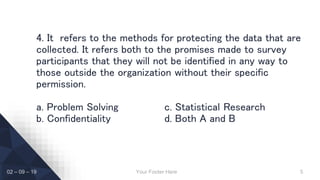
4. It refers to the methods for protecting the data that are
collected. It refers both to the promises made to survey
participants that they will not be identified in any way to
those outside the organization without their specific
permission.
a. Problem Solving c. Statistical Research
b. Confidentiality d. Both A and B
02 – 09 – 19
Your Footer Here 6
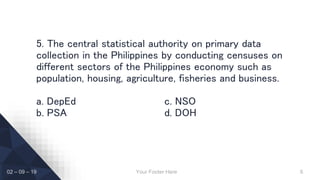
5. The central statistical authority on primary data
collection in the Philippines by conducting censuses on
different sectors of the Philippines economy such as
population, housing, agriculture, fisheries and business.
a. DepEd c. NSO
b. PSA d. DOH
02 – 09 – 19
Your Footer Here 7Your Date
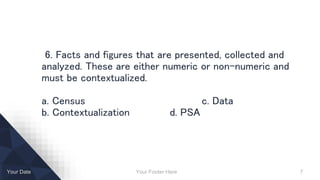
6. Facts and figures that are presented, collected and
analyzed. These are either numeric or non-numeric and
must be contextualized.
a. Census c. Data
b. Contextualization d. PSA
Your Footer Here 8Your Date
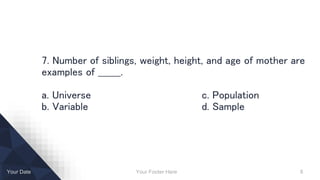
7. Number of siblings, weight, height, and age of mother are
examples of _______.
a. Universe c. Population
b. Variable d. Sample
Your Footer Here 9Your Date
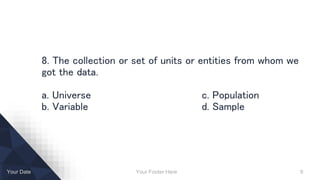
8. The collection or set of units or entities from whom we
got the data.
a. Universe c. Population
b. Variable d. Sample
Your Footer Here 10Your Date
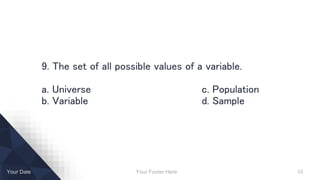
9. The set of all possible values of a variable.
a. Universe c. Population
b. Variable d. Sample
Your Footer Here 11Your Date
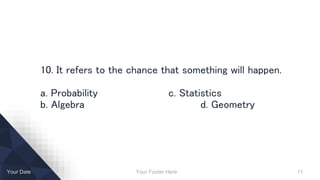
10. It refers to the chance that something will happen.
a. Probability c. Statistics
b. Algebra d. Geometry
Your Footer Here 12Your Date
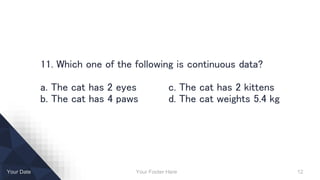
11. Which one of the following is continuous data?
a. The cat has 2 eyes c. The cat has 2 kittens
b. The cat has 4 paws d. The cat weights 5.4 kg
Your Footer Here 13Your Date
12. Which one of the following is discrete data?
a. Sam is 160 cm tall
b. Sam ran 100 meters in 10.2 seconds sister
c. Sam weighs 60 kg
d. Sam has two brothers and one
Your Footer Here 14Your Date
13. Which of these is NOT continuous data?
a. A person's height each year
b. The volume of water in a swimming pool each day
c. Cars finished in a factory each day
d. A person's weight on each birthday
Your Footer Here 15Your Date
14. A coin is tossed 50 times, and it lands on heads 28
times. Find the experimental probability of the coin landing
on heads.
a. 11/25 c. 28
b. 28/100 d. 14/25
Your Footer Here 16Your Date
15. Find the theoretical probability of a coin landing on head.
a. 1 c. 1/4
b. 1/2 d. 0
Your Footer Here 17Your Date
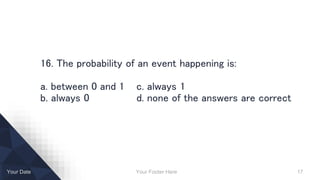
16. The probability of an event happening is:
a. between 0 and 1 c. always 1
b. always 0 d. none of the answers are correct
Your Footer Here 18Your Date
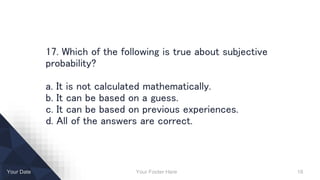
17. Which of the following is true about subjective
probability?
a. It is not calculated mathematically.
b. It can be based on a guess.
c. It can be based on previous experiences.
d. All of the answers are correct.
Your Footer Here 19Your Date
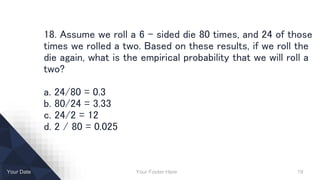
18. Assume we roll a 6 – sided die 80 times, and 24 of those
times we rolled a two. Based on these results, if we roll the
die again, what is the empirical probability that we will roll a
two?
a. 24/80 = 0.3
b. 80/24 = 3.33
c. 24/2 = 12
d. 2 / 80 = 0.025
Your Footer Here 20Your Date
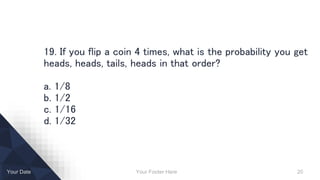
19. If you flip a coin 4 times, what is the probability you get
heads, heads, tails, heads in that order?
a. 1/8
b. 1/2
c. 1/16
d. 1/32
Your Footer Here 21Your Date
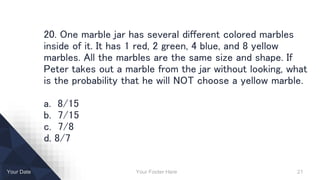
20. One marble jar has several different colored marbles
inside of it. It has 1 red, 2 green, 4 blue, and 8 yellow
marbles. All the marbles are the same size and shape. If
Peter takes out a marble from the jar without looking, what
is the probability that he will NOT choose a yellow marble.
a. 8/15
b. 7/15
c. 7/8
d. 8/7
Your Footer Here 22Your Date
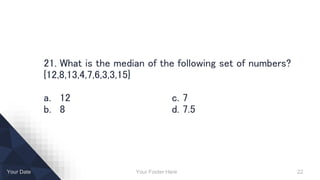
21. What is the median of the following set of numbers?
{12,8,13,4,7,6,3,3,15}
a. 12 c. 7
b. 8 d. 7.5
Your Footer Here 23Your Date
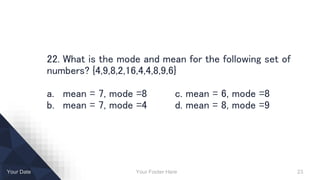
22. What is the mode and mean for the following set of
numbers? {4,9,8,2,16,4,4,8,9,6}
a. mean = 7, mode =8 c. mean = 6, mode =8
b. mean = 7, mode =4 d. mean = 8, mode =9
Your Footer Here 24Your Date
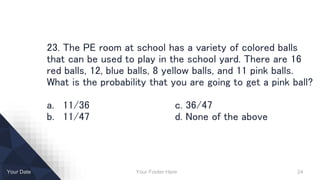
23. The PE room at school has a variety of colored balls
that can be used to play in the school yard. There are 16
red balls, 12, blue balls, 8 yellow balls, and 11 pink balls.
What is the probability that you are going to get a pink ball?
a. 11/36 c. 36/47
b. 11/47 d. None of the above
Your Footer Here 25Your Date
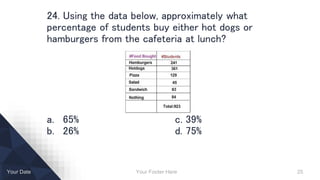
24. Using the data below, approximately what
percentage of students buy either hot dogs or
hamburgers from the cafeteria at lunch?
a. 65% c. 39%
b. 26% d. 75%
Your Footer Here 26Your Date
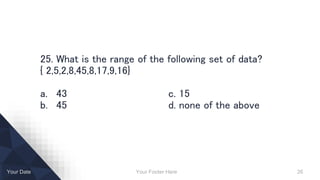
25. What is the range of the following set of data?
{ 2,5,2,8,45,8,17,9,16}
a. 43 c. 15
b. 45 d. none of the above
Your Footer Here 27Your Date
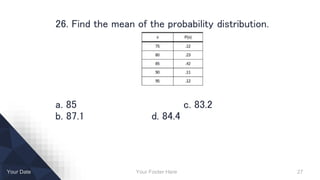
26. Find the mean of the probability distribution.
a. 85 c. 83.2
b. 87.1 d. 84.4
Your Footer Here 28Your Date
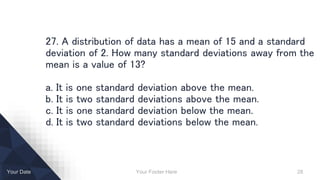
27. A distribution of data has a mean of 15 and a standard
deviation of 2. How many standard deviations away from the
mean is a value of 13?
a. It is one standard deviation above the mean.
b. It is two standard deviations above the mean.
c. It is one standard deviation below the mean.
d. It is two standard deviations below the mean.
Your Footer Here 29Your Date
27. A distribution of data has a mean of 15 and a standard
deviation of 2. How many standard deviations away from the
mean is a value of 13?
a. It is one standard deviation above the mean.
b. It is two standard deviations above the mean.
c. It is one standard deviation below the mean.
d. It is two standard deviations below the mean.
Your Footer Here 30Your Date
28. What is the value of mode in standard normal
distribution?
a. 1 c. Not Fixed
b. 0 d. None
Your Footer Here 31Your Date
29. About which of the following is a normal distribution
symmetric?
a. Covariance c. Mean
b. Standard deviation d. Variance
Your Footer Here 32Your Date
30. What shape is a normal distribution curve?
a. Half curve c. Round curve
b. Bell curve d. Square curve
Your Footer Here 33Your Date
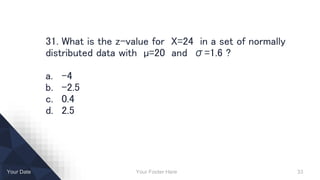
31. What is the z-value for X=24 in a set of normally
distributed data with µ=20 and σ=1.6 ?
a. -4
b. -2.5
c. 0.4
d. 2.5
Your Footer Here 34Your Date
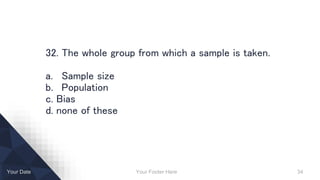
32. The whole group from which a sample is taken.
a. Sample size
b. Population
c. Bias
d. none of these
Your Footer Here 35Your Date
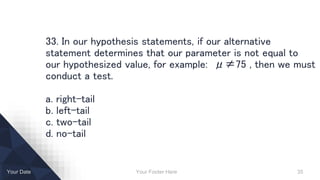
33. In our hypothesis statements, if our alternative
statement determines that our parameter is not equal to
our hypothesized value, for example: μ≠75 , then we must
conduct a test.
a. right-tail
b. left-tail
c. two-tail
d. no-tail
Your Footer Here 36Your Date
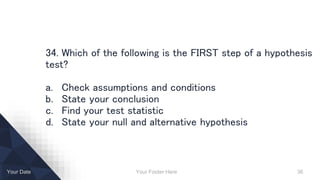
34. Which of the following is the FIRST step of a hypothesis
test?
a. Check assumptions and conditions
b. State your conclusion
c. Find your test statistic
d. State your null and alternative hypothesis
Your Footer Here 37Your Date
35. Which of the following is not an option for an alternate
hypothesis?
a. 𝐻 𝑎: 𝜇 = 𝑘 c. 𝐻 𝑎: 𝜇 > 𝑘
b. 𝐻 𝑎: 𝜇 < 𝑘 d. 𝐻 𝑎: 𝜇 ≠ 𝑘
Your Footer Here 38Your Date
36. Which of the following is not an option for an alternate
hypothesis?
a. 𝐻 𝑎: 𝜇 = 𝑘 c. 𝐻 𝑎: 𝜇 > 𝑘
b. 𝐻 𝑎: 𝜇 < 𝑘 d. 𝐻 𝑎: 𝜇 ≠ 𝑘
Your Footer Here 39Your Date
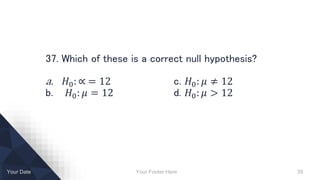
37. Which of these is a correct null hypothesis?
a. 𝐻0: ∝ = 12 c. 𝐻0: 𝜇 ≠ 12
b. 𝐻0: 𝜇 = 12 d. 𝐻0: 𝜇 > 12
Your Footer Here 40Your Date
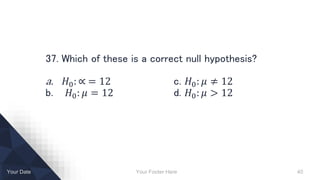
37. Which of these is a correct null hypothesis?
a. 𝐻0: ∝ = 12 c. 𝐻0: 𝜇 ≠ 12
b. 𝐻0: 𝜇 = 12 d. 𝐻0: 𝜇 > 12
Your Footer Here 41Your Date
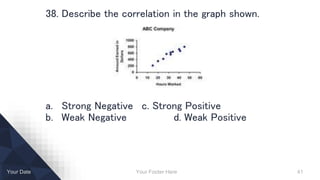
38. Describe the correlation in the graph shown.
a. Strong Negative c. Strong Positive
b. Weak Negative d. Weak Positive
Your Footer Here 42Your Date
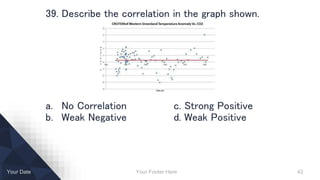
39. Describe the correlation in the graph shown.
a. No Correlation c. Strong Positive
b. Weak Negative d. Weak Positive
Your Footer Here 43Your Date
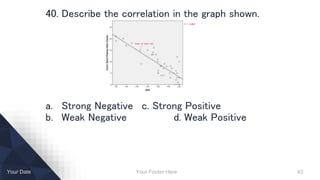
40. Describe the correlation in the graph shown.
a. Strong Negative c. Strong Positive
b. Weak Negative d. Weak Positive
Your Footer Here 44Your Date
41. What would be the correlation be between study time
and test grades?
a. Positive Correlation
b. No Correlation
c. Negative Correlation
d. Cannot Be Determined
Your Footer Here 45Your Date
42. What would the correlation be between math grades and
the time it takes to run a mile ?
a. Positive Correlation
b. No Correlation
c. Negative Correlation
d. Cannot Be Determined
Your Footer Here 46Your Date
43. What would the correlation be between math grades and
the time it takes to run a mile ?
a. Positive Correlation
b. No Correlation
c. Negative Correlation
d. Cannot Be Determined
Your Footer Here 47Your Date
44. What hypothesis states equality or no difference, or no
relationship/effect?
a. Statistical hypothesis c. Null hypothesis
b. Alternative hypothesis d. none of these
Your Footer Here 48Your Date
45. What hypothesis states no equality or existence of
differences, relationship, or effect?
a. Statistical hypothesis c. Null hypothesis
b. Alternative hypothesis d. none of these

Statistics and probability test questions

  • 1.
    Statistics and ProbabilityQuestions Prepared by: Ross Christian Manuel
  • 2.
    1. The word“statistics” actually comes from the word _______ because governments have been involved in the statistical activities, especially the conduct of censuses either for military or taxation purposes. a. state c. compute b. logic d. research Your Footer Here 202 – 09 – 19
  • 3.
    2. In statisticalactivities, facts are collected from respondents for purposes of getting aggregate information, but confidentiality should be ________. a. in public, where others can see it b. protected c. abused d. all of the above Your Footer Here 302 – 09 – 19
  • 4.
    Your Footer Here4 3. In data collection, is it required for the respondents to fill out their specific identities/name? a. Yes, because the researcher needs it b. No, because people have a right to confidentiality c. Yes, because it is a responsibility of the respondents d. none of these 02 – 09 – 19
  • 5.
    Your Footer Here5 4. It refers to the methods for protecting the data that are collected. It refers both to the promises made to survey participants that they will not be identified in any way to those outside the organization without their specific permission. a. Problem Solving c. Statistical Research b. Confidentiality d. Both A and B 02 – 09 – 19
  • 6.
    Your Footer Here6 5. The central statistical authority on primary data collection in the Philippines by conducting censuses on different sectors of the Philippines economy such as population, housing, agriculture, fisheries and business. a. DepEd c. NSO b. PSA d. DOH 02 – 09 – 19
  • 7.
    Your Footer Here7Your Date 6. Facts and figures that are presented, collected and analyzed. These are either numeric or non-numeric and must be contextualized. a. Census c. Data b. Contextualization d. PSA
  • 8.
    Your Footer Here8Your Date 7. Number of siblings, weight, height, and age of mother are examples of _______. a. Universe c. Population b. Variable d. Sample
  • 9.
    Your Footer Here9Your Date 8. The collection or set of units or entities from whom we got the data. a. Universe c. Population b. Variable d. Sample
  • 10.
    Your Footer Here10Your Date 9. The set of all possible values of a variable. a. Universe c. Population b. Variable d. Sample
  • 11.
    Your Footer Here11Your Date 10. It refers to the chance that something will happen. a. Probability c. Statistics b. Algebra d. Geometry
  • 12.
    Your Footer Here12Your Date 11. Which one of the following is continuous data? a. The cat has 2 eyes c. The cat has 2 kittens b. The cat has 4 paws d. The cat weights 5.4 kg
  • 13.
    Your Footer Here13Your Date 12. Which one of the following is discrete data? a. Sam is 160 cm tall b. Sam ran 100 meters in 10.2 seconds sister c. Sam weighs 60 kg d. Sam has two brothers and one
  • 14.
    Your Footer Here14Your Date 13. Which of these is NOT continuous data? a. A person's height each year b. The volume of water in a swimming pool each day c. Cars finished in a factory each day d. A person's weight on each birthday
  • 15.
    Your Footer Here15Your Date 14. A coin is tossed 50 times, and it lands on heads 28 times. Find the experimental probability of the coin landing on heads. a. 11/25 c. 28 b. 28/100 d. 14/25
  • 16.
    Your Footer Here16Your Date 15. Find the theoretical probability of a coin landing on head. a. 1 c. 1/4 b. 1/2 d. 0
  • 17.
    Your Footer Here17Your Date 16. The probability of an event happening is: a. between 0 and 1 c. always 1 b. always 0 d. none of the answers are correct
  • 18.
    Your Footer Here18Your Date 17. Which of the following is true about subjective probability? a. It is not calculated mathematically. b. It can be based on a guess. c. It can be based on previous experiences. d. All of the answers are correct.
  • 19.
    Your Footer Here19Your Date 18. Assume we roll a 6 – sided die 80 times, and 24 of those times we rolled a two. Based on these results, if we roll the die again, what is the empirical probability that we will roll a two? a. 24/80 = 0.3 b. 80/24 = 3.33 c. 24/2 = 12 d. 2 / 80 = 0.025
  • 20.
    Your Footer Here20Your Date 19. If you flip a coin 4 times, what is the probability you get heads, heads, tails, heads in that order? a. 1/8 b. 1/2 c. 1/16 d. 1/32
  • 21.
    Your Footer Here21Your Date 20. One marble jar has several different colored marbles inside of it. It has 1 red, 2 green, 4 blue, and 8 yellow marbles. All the marbles are the same size and shape. If Peter takes out a marble from the jar without looking, what is the probability that he will NOT choose a yellow marble. a. 8/15 b. 7/15 c. 7/8 d. 8/7
  • 22.
    Your Footer Here22Your Date 21. What is the median of the following set of numbers? {12,8,13,4,7,6,3,3,15} a. 12 c. 7 b. 8 d. 7.5
  • 23.
    Your Footer Here23Your Date 22. What is the mode and mean for the following set of numbers? {4,9,8,2,16,4,4,8,9,6} a. mean = 7, mode =8 c. mean = 6, mode =8 b. mean = 7, mode =4 d. mean = 8, mode =9
  • 24.
    Your Footer Here24Your Date 23. The PE room at school has a variety of colored balls that can be used to play in the school yard. There are 16 red balls, 12, blue balls, 8 yellow balls, and 11 pink balls. What is the probability that you are going to get a pink ball? a. 11/36 c. 36/47 b. 11/47 d. None of the above
  • 25.
    Your Footer Here25Your Date 24. Using the data below, approximately what percentage of students buy either hot dogs or hamburgers from the cafeteria at lunch? a. 65% c. 39% b. 26% d. 75%
  • 26.
    Your Footer Here26Your Date 25. What is the range of the following set of data? { 2,5,2,8,45,8,17,9,16} a. 43 c. 15 b. 45 d. none of the above
  • 27.
    Your Footer Here27Your Date 26. Find the mean of the probability distribution. a. 85 c. 83.2 b. 87.1 d. 84.4
  • 28.
    Your Footer Here28Your Date 27. A distribution of data has a mean of 15 and a standard deviation of 2. How many standard deviations away from the mean is a value of 13? a. It is one standard deviation above the mean. b. It is two standard deviations above the mean. c. It is one standard deviation below the mean. d. It is two standard deviations below the mean.
  • 29.
    Your Footer Here29Your Date 27. A distribution of data has a mean of 15 and a standard deviation of 2. How many standard deviations away from the mean is a value of 13? a. It is one standard deviation above the mean. b. It is two standard deviations above the mean. c. It is one standard deviation below the mean. d. It is two standard deviations below the mean.
  • 30.
    Your Footer Here30Your Date 28. What is the value of mode in standard normal distribution? a. 1 c. Not Fixed b. 0 d. None
  • 31.
    Your Footer Here31Your Date 29. About which of the following is a normal distribution symmetric? a. Covariance c. Mean b. Standard deviation d. Variance
  • 32.
    Your Footer Here32Your Date 30. What shape is a normal distribution curve? a. Half curve c. Round curve b. Bell curve d. Square curve
  • 33.
    Your Footer Here33Your Date 31. What is the z-value for X=24 in a set of normally distributed data with µ=20 and σ=1.6 ? a. -4 b. -2.5 c. 0.4 d. 2.5
  • 34.
    Your Footer Here34Your Date 32. The whole group from which a sample is taken. a. Sample size b. Population c. Bias d. none of these
  • 35.
    Your Footer Here35Your Date 33. In our hypothesis statements, if our alternative statement determines that our parameter is not equal to our hypothesized value, for example: μ≠75 , then we must conduct a test. a. right-tail b. left-tail c. two-tail d. no-tail
  • 36.
    Your Footer Here36Your Date 34. Which of the following is the FIRST step of a hypothesis test? a. Check assumptions and conditions b. State your conclusion c. Find your test statistic d. State your null and alternative hypothesis
  • 37.
    Your Footer Here37Your Date 35. Which of the following is not an option for an alternate hypothesis? a. 𝐻 𝑎: 𝜇 = 𝑘 c. 𝐻 𝑎: 𝜇 > 𝑘 b. 𝐻 𝑎: 𝜇 < 𝑘 d. 𝐻 𝑎: 𝜇 ≠ 𝑘
  • 38.
    Your Footer Here38Your Date 36. Which of the following is not an option for an alternate hypothesis? a. 𝐻 𝑎: 𝜇 = 𝑘 c. 𝐻 𝑎: 𝜇 > 𝑘 b. 𝐻 𝑎: 𝜇 < 𝑘 d. 𝐻 𝑎: 𝜇 ≠ 𝑘
  • 39.
    Your Footer Here39Your Date 37. Which of these is a correct null hypothesis? a. 𝐻0: ∝ = 12 c. 𝐻0: 𝜇 ≠ 12 b. 𝐻0: 𝜇 = 12 d. 𝐻0: 𝜇 > 12
  • 40.
    Your Footer Here40Your Date 37. Which of these is a correct null hypothesis? a. 𝐻0: ∝ = 12 c. 𝐻0: 𝜇 ≠ 12 b. 𝐻0: 𝜇 = 12 d. 𝐻0: 𝜇 > 12
  • 41.
    Your Footer Here41Your Date 38. Describe the correlation in the graph shown. a. Strong Negative c. Strong Positive b. Weak Negative d. Weak Positive
  • 42.
    Your Footer Here42Your Date 39. Describe the correlation in the graph shown. a. No Correlation c. Strong Positive b. Weak Negative d. Weak Positive
  • 43.
    Your Footer Here43Your Date 40. Describe the correlation in the graph shown. a. Strong Negative c. Strong Positive b. Weak Negative d. Weak Positive
  • 44.
    Your Footer Here44Your Date 41. What would be the correlation be between study time and test grades? a. Positive Correlation b. No Correlation c. Negative Correlation d. Cannot Be Determined
  • 45.
    Your Footer Here45Your Date 42. What would the correlation be between math grades and the time it takes to run a mile ? a. Positive Correlation b. No Correlation c. Negative Correlation d. Cannot Be Determined
  • 46.
    Your Footer Here46Your Date 43. What would the correlation be between math grades and the time it takes to run a mile ? a. Positive Correlation b. No Correlation c. Negative Correlation d. Cannot Be Determined
  • 47.
    Your Footer Here47Your Date 44. What hypothesis states equality or no difference, or no relationship/effect? a. Statistical hypothesis c. Null hypothesis b. Alternative hypothesis d. none of these
  • 48.
    Your Footer Here48Your Date 45. What hypothesis states no equality or existence of differences, relationship, or effect? a. Statistical hypothesis c. Null hypothesis b. Alternative hypothesis d. none of these

Editor's Notes

  • #2 © Copyright PresentationGo.com – The free PowerPoint library
  • #3 © Copyright PresentationGo.com – The free PowerPoint library
  • #4 © Copyright PresentationGo.com – The free PowerPoint library