Statins & Diabetes
by Theodore Graphos


                      February 2, 2012
Article

 Culver AL, Ockene IS, Balasubramanian R, et al.

 Statin Use and Risk of Diabetes Mellitus in
 Postmenopausal Women in the Women's
 Health Initiative.

 Arch Intern Med. 2012;172(2):144-52.
Background

 Statins are used by a large proportion
 of our population
  The most recent and reliable data (gleaned from the 2003-
  2004 NHANES) estimates that 24 million Americans
  are on statins. That number has almost certainly risen
  since then.
Background

 With such a large number of people taking these
 medications, even minor adverse effects become a
 significant problem.

 Recent studies reveal a correlation between statin use
 and an increased risk of developing diabetes.

           Note that there is still no causal evidence
           linking statins to the development of diabetes.
Background

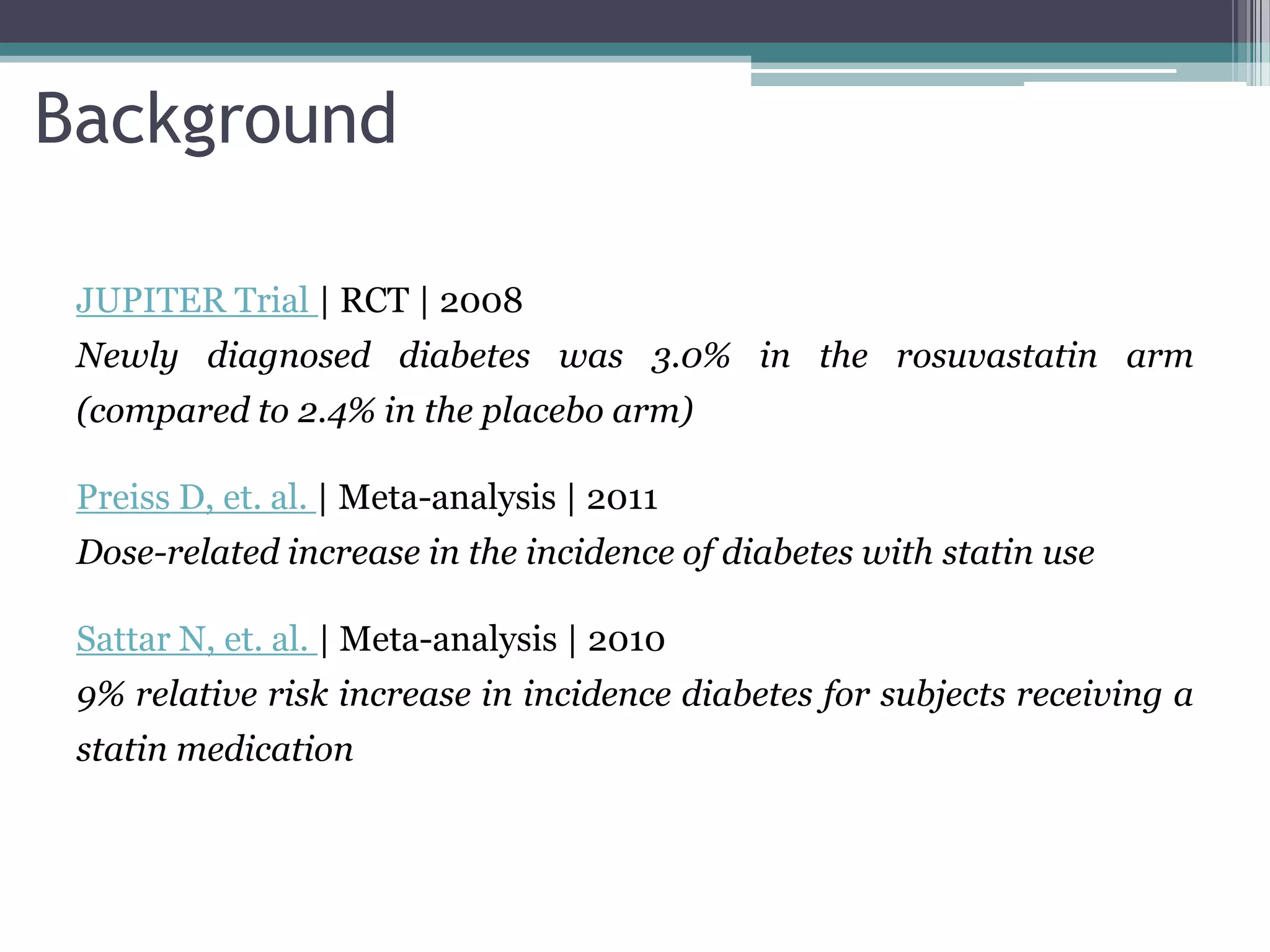
 JUPITER Trial | RCT | 2008
 Newly diagnosed diabetes was 3.0% in the rosuvastatin arm
 (compared to 2.4% in the placebo arm)

 Preiss D, et. al. | Meta-analysis | 2011
 Dose-related increase in the incidence of diabetes with statin use

 Sattar N, et. al. | Meta-analysis | 2010
 9% relative risk increase in incidence diabetes for subjects receiving a
 statin medication
Motivation

  Meta-analyses are weakened by heterogeneity and
   small study populations

  Single-drug studies may not be applicable to the
   entire class of medications
Objective

 To evaluate the overall effect of statin medication use on
 incident DM risk in a large dataset (in this case the
 Women’s Health Initiative (WHI) data).
Design
 Restrospective cohort using the Women’s Health Initiative
 (WHI) dataset

 The Women’s Health Initiative (WHI) was a large 15-year long
 clinical and observational study.
 There were three clinical trial groups (CT)…
  1) Hormone Therapy Trial (HT) (27,347)
  2) Dietary Modification Trial (DM) (48,835)
  3) Calcium/Vitamin D Supplementation Trial (CaD) (36,282)
 …and an additional (4) observational study group (OS)
SubjectsSelection
SubjectsInclusion & Exclusion
 Inclusion
   Post menopausal women aged 50-79

 Exclusion
   Self-reported DM at baseline
   Use of cerivastatin (removed from market)
Measurements
 Statin use
  “Inventoried” all current medications at baseline and year 3.

 New-onset diabetes
  Identified by questionnaire at each visit and defined as a
  self-report of a new physician diagnosis of diabetes
Results…
Demographics

 Large amount of
 heterogeniety

 Several character-
 istics put the statin
 group at increased
 risk of developing
 diabetes

  Worse diet
  Less exercise
  Family hx
Outcomes

 Statin use at base-
 line was associated
 with a statistically
 significant increase
 in incident DM


 …even after multi-
 variate adjustment


 …and regardless of
 duration or specific
 statin usage.
Outcomes

 The increased risk is
 found throughout all
 subgroups    tested,
 including:

  Age
  Race/ethnicity
  BMI

 This holds true even
 after multivariate
 adjustment†
 †Exceptfor African Americans,
 thought this maybe due to a lack
 of power for this subgroup.
Outcomes

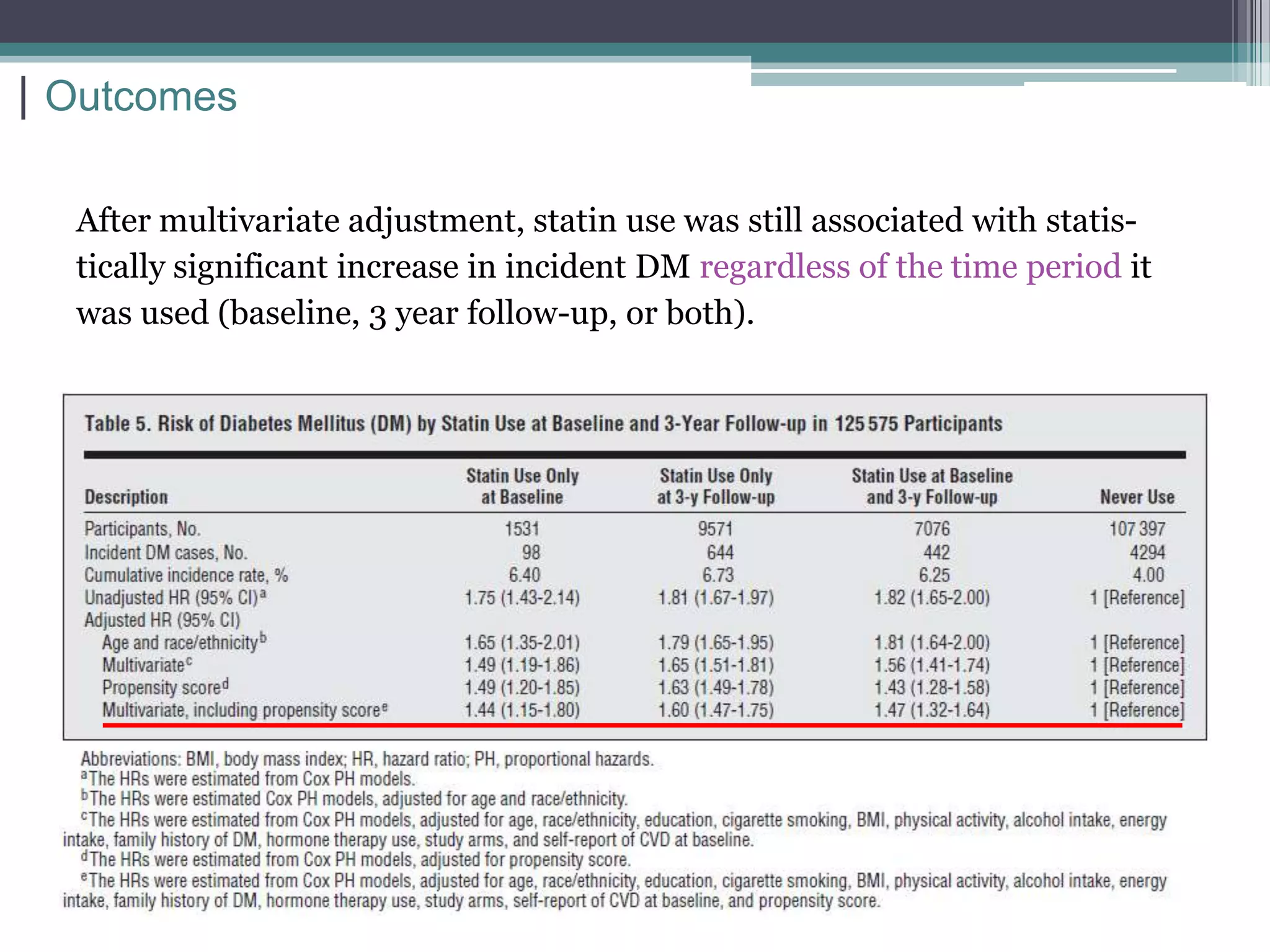
  After multivariate adjustment, statin use was still associated with statis-
  tically significant increase in incident DM regardless of the time period it
  was used (baseline, 3 year follow-up, or both).
Outcomes

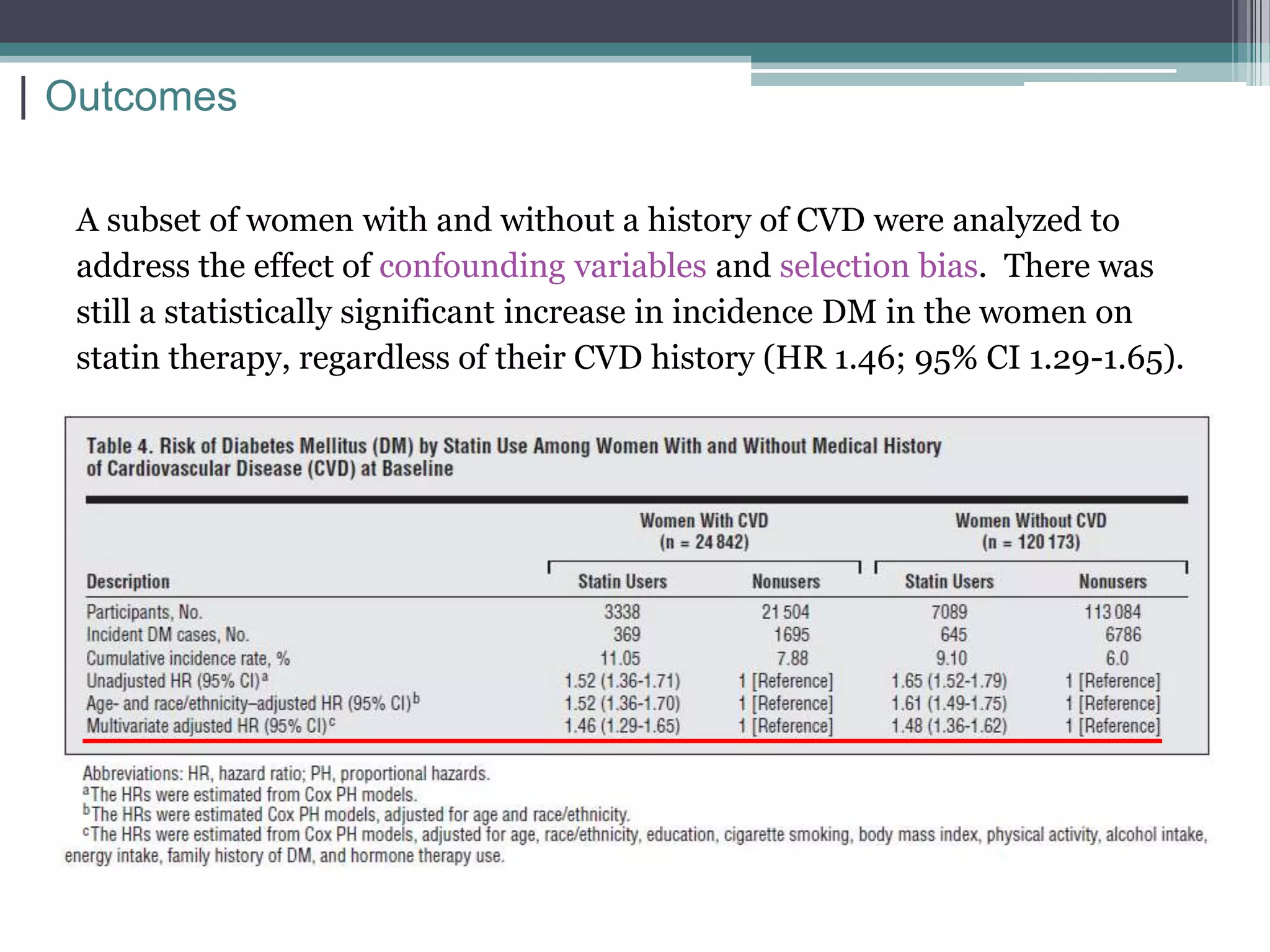
  A subset of women with and without a history of CVD were analyzed to
  address the effect of confounding variables and selection bias. There was
  still a statistically significant increase in incidence DM in the women on
  statin therapy, regardless of their CVD history (HR 1.46; 95% CI 1.29-1.65).
Outcomes


  A propensity score adjusted model added to the
  multivariate analysis continue to showed an increased risk
  of incident DM (HR 1.40; 95% CI 1.31-1.51)


  A unadjusted sensitivity analysis used fasting glucose in
  approximately 3700 women (instead of self-reported new
  physician diagnosed DM) did not show the increased risk
  (HR 1.06; 95% CI 0.61-1.86)
Conclusions
  There is clearly a relationship between statin use and the
   development of diabetes.

  A causal link has yet to be established.

  Statins have proven cardiovascular benefits through
   randomized, controlled trials.

  Patients with a legitimate indication for statin therapy
   should continue to take those medications.
Questions?

Statins and diabetes

  • 1.
    Statins & Diabetes byTheodore Graphos February 2, 2012
  • 2.
    Article Culver AL,Ockene IS, Balasubramanian R, et al. Statin Use and Risk of Diabetes Mellitus in Postmenopausal Women in the Women's Health Initiative. Arch Intern Med. 2012;172(2):144-52.
  • 3.
    Background Statins areused by a large proportion of our population The most recent and reliable data (gleaned from the 2003- 2004 NHANES) estimates that 24 million Americans are on statins. That number has almost certainly risen since then.
  • 4.
    Background With sucha large number of people taking these medications, even minor adverse effects become a significant problem. Recent studies reveal a correlation between statin use and an increased risk of developing diabetes. Note that there is still no causal evidence linking statins to the development of diabetes.
  • 5.
    Background JUPITER Trial| RCT | 2008 Newly diagnosed diabetes was 3.0% in the rosuvastatin arm (compared to 2.4% in the placebo arm) Preiss D, et. al. | Meta-analysis | 2011 Dose-related increase in the incidence of diabetes with statin use Sattar N, et. al. | Meta-analysis | 2010 9% relative risk increase in incidence diabetes for subjects receiving a statin medication
  • 6.
    Motivation  Meta-analysesare weakened by heterogeneity and small study populations  Single-drug studies may not be applicable to the entire class of medications
  • 7.
    Objective To evaluatethe overall effect of statin medication use on incident DM risk in a large dataset (in this case the Women’s Health Initiative (WHI) data).
  • 8.
    Design Restrospective cohortusing the Women’s Health Initiative (WHI) dataset The Women’s Health Initiative (WHI) was a large 15-year long clinical and observational study. There were three clinical trial groups (CT)… 1) Hormone Therapy Trial (HT) (27,347) 2) Dietary Modification Trial (DM) (48,835) 3) Calcium/Vitamin D Supplementation Trial (CaD) (36,282) …and an additional (4) observational study group (OS)
  • 9.
  • 10.
    SubjectsInclusion & Exclusion Inclusion  Post menopausal women aged 50-79 Exclusion  Self-reported DM at baseline  Use of cerivastatin (removed from market)
  • 11.
    Measurements Statin use “Inventoried” all current medications at baseline and year 3. New-onset diabetes Identified by questionnaire at each visit and defined as a self-report of a new physician diagnosis of diabetes
  • 12.
  • 13.
    Demographics Large amountof heterogeniety Several character- istics put the statin group at increased risk of developing diabetes  Worse diet  Less exercise  Family hx
  • 14.
    Outcomes Statin useat base- line was associated with a statistically significant increase in incident DM …even after multi- variate adjustment …and regardless of duration or specific statin usage.
  • 15.
    Outcomes The increasedrisk is found throughout all subgroups tested, including:  Age  Race/ethnicity  BMI This holds true even after multivariate adjustment† †Exceptfor African Americans, thought this maybe due to a lack of power for this subgroup.
  • 16.
    Outcomes Aftermultivariate adjustment, statin use was still associated with statis- tically significant increase in incident DM regardless of the time period it was used (baseline, 3 year follow-up, or both).
  • 17.
    Outcomes Asubset of women with and without a history of CVD were analyzed to address the effect of confounding variables and selection bias. There was still a statistically significant increase in incidence DM in the women on statin therapy, regardless of their CVD history (HR 1.46; 95% CI 1.29-1.65).
  • 18.
    Outcomes Apropensity score adjusted model added to the multivariate analysis continue to showed an increased risk of incident DM (HR 1.40; 95% CI 1.31-1.51) A unadjusted sensitivity analysis used fasting glucose in approximately 3700 women (instead of self-reported new physician diagnosed DM) did not show the increased risk (HR 1.06; 95% CI 0.61-1.86)
  • 19.
    Conclusions  Thereis clearly a relationship between statin use and the development of diabetes.  A causal link has yet to be established.  Statins have proven cardiovascular benefits through randomized, controlled trials.  Patients with a legitimate indication for statin therapy should continue to take those medications.
  • 20.