SPARKNaCl: a verified,
fast cryptographic library
or...
“What I did during lockdown...”
Roderick Chapman,
Director, Protean Code Limited (until 11th September 2022)...
Contents
• TweetNaCl? Why bother?
• Goals and not goals...
• Proof
• Performance
• Further work
Contents
• TweetNaCl? Why bother?
• Goals and not goals...
• Proof
• Performance
• Further work
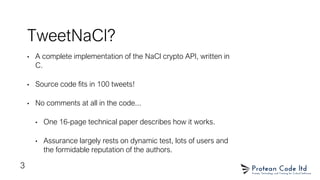
TweetNaCl?
• A complete implementation of the NaCl crypto API, written in
C.
• Source code fits in 100 tweets!
• No comments at all in the code...
• One 16-page technical paper describes how it works.
• Assurance largely rests on dynamic test, lots of users and
the formidable reputation of the authors.
3
TweetNaCl?
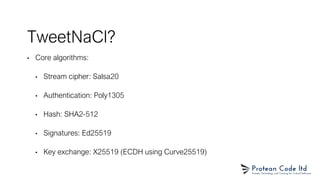
• Core algorithms:
• Stream cipher: Salsa20
• Authentication: Poly1305
• Hash: SHA2-512
• Signatures: Ed25519
• Key exchange: X25519 (ECDH using Curve25519)
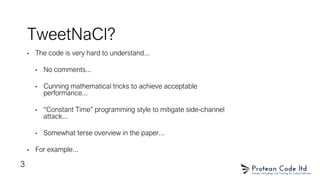
TweetNaCl?
• The code is very hard to understand...
• No comments...
• Cunning mathematical tricks to achieve acceptable
performance...
• “Constant Time” programming style to mitigate side-channel
attack...
• Somewhat terse overview in the paper...
• For example...
3
TweetNaCl?
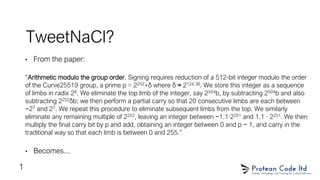
• From the paper:
“Arithmetic modulo the group order. Signing requires reduction of a 512-bit integer modulo the order
of the Curve25519 group, a prime p = 2252+δ where δ ≈ 2124.38. We store this integer as a sequence
of limbs in radix 28. We eliminate the top limb of the integer, say 2504b, by subtracting 2504b and also
subtracting 2252δb; we then perform a partial carry so that 20 consecutive limbs are each between
−27 and 27. We repeat this procedure to eliminate subsequent limbs from the top. We similarly
eliminate any remaining multiple of 2252, leaving an integer between −1.1·2251 and 1.1 · 2251. We then
multiply the final carry bit by p and add, obtaining an integer between 0 and p − 1, and carry in the
traditional way so that each limb is between 0 and 255.”
• Becomes...
1
sv modL(u8 *r,i64 x[64])
{
i64 carry,i,j;
for (i = 63;i >= 32;--i) {
carry = 0;
for (j = i - 32;j < i - 12;++j) {
x[j] += carry - 16 * x[i] * L[j - (i - 32)];
carry = (x[j] + 128) >> 8;
x[j] -= carry << 8;
}
x[j] += carry;
x[i] = 0;
}
carry = 0;
FOR(j,32) {
x[j] += carry - (x[31] >> 4) * L[j];
carry = x[j] >> 8;
x[j] &= 255;
}
FOR(j,32) x[j] -= carry * L[j];
FOR(i,32) {
x[i+1] += x[i] >> 8;
r[i] = x[i] & 255;
}
}
Why Bother?
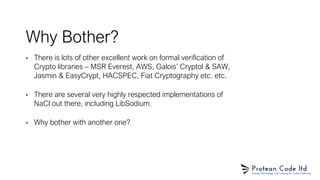
• There is lots of other excellent work on formal verification of
Crypto libraries – MSR Everest, AWS, Galois’ Cryptol & SAW,
Jasmin & EasyCrypt, HACSPEC, Fiat Cryptography etc. etc.
• There are several very highly respected implementations of
NaCl out there, including LibSodium.
• Why bother with another one?
Why Bother?
• Can a modern deductive verification system and
programming language cope with a library like NaCl?
1. What can be proven anyway?
2. What level of automation can be achieved?
Myth
“Formal is Slow...”
• So-called “Formal” languages have a reputation in industry for being “too slow”
for production use.
• Put another way: “Our code has to go really fast, so we can only write it on C, C,
C, or C... (or assembly language...)”
• Can a “formal” language like SPARK really compete?
3
Contents
• TweetNaCl? Why bother?
• Goals and not goals...
• Proof
• Performance
• Further work
Goals...
• A re-implementation of TweetNaCl in SPARK, covering the whole
library and NaCl API.
• It shall pass all NaCl regression tests.
• Retain “constant time” programming style.
• Fully “auto-active” proof of at least type- and memory safety for
the whole thing.
• It’s all about the types... (and contracts...)
• No “interactive” proof please...
3
Goals...
• Compatible with the “Zero Footprint” runtime library of
GCC/GNAT
• No COTS or libraries.
• “Heap free” programming style, so will run on ”bare-metal”
targets with no OS at all.
• Same code will compile and run on any target CPU/OS.
Goals...
• Performance and code size competitive with TweetNaCl.
• Will we find any bugs? En-passant, will we find bugs in
TweetNaCl too?
• We have form in this area: a subtle corner case bug was
found in the Skein hash algorithm by
re-implementing it in SPARK...
NOT Goals...
• Don’t try to compete with LibSodium’s performance...
• Don’t try to prove partial correctness (unless strictly
necessary).
• Don’t try to prove mathematical security-related properties of
Curve25519, Ed25519 and so on...
Contents
• TweetNaCl? Why bother?
• Goals and not goals...
• Proof
• Performance
• Further work
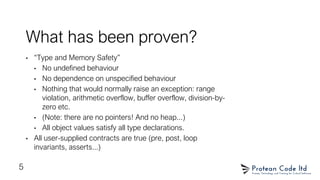
What has been proven?
• “Type and Memory Safety”
• No undefined behaviour
• No dependence on unspecified behaviour
• Nothing that would normally raise an exception: range
violation, arithmetic overflow, buffer overflow, division-by-
zero etc.
• (Note: there are no pointers! And no heap...)
• All object values satisfy all type declarations.
• All user-supplied contracts are true (pre, post, loop
invariants, asserts...)
5
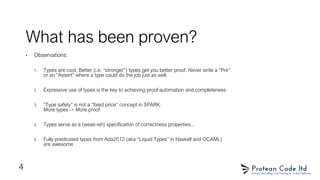
What has been proven?
• Observations:
1. Types are cool. Better (i.e. “stronger”) types get you better proof. Never write a “Pre”
or an “Assert” where a type could do the job just as well.
2. Expressive use of types is the key to achieving proof automation and completeness.
3. “Type safety” is not a “fixed price” concept in SPARK.
More types -> More proof.
4. Types serve as a (weak-ish) specification of correctness properties...
5. Fully predicated types from Ada2012 (aka “Liquid Types” in Haskell and OCAML)
are awesome.
4
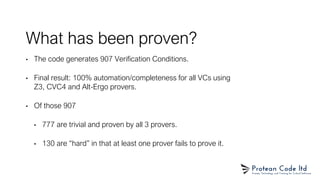
What has been proven?
• The code generates 907 Verification Conditions.
• Final result: 100% automation/completeness for all VCs using
Z3, CVC4 and Alt-Ergo provers.
• Of those 907
• 777 are trivial and proven by all 3 provers.
• 130 are “hard” in that at least one prover fails to prove it.
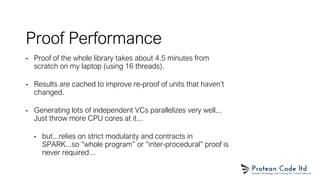
Proof Performance
• Proof of the whole library takes about 4.5 minutes from
scratch on my laptop (using 16 threads).
• Results are cached to improve re-proof of units that haven’t
changed.
• Generating lots of independent VCs parallelizes very well...
Just throw more CPU cores at it...
• but...relies on strict modularity and contracts in
SPARK...so “whole program” or “inter-procedural” proof is
never required...
Contents
• TweetNaCl? Why bother?
• Goals and not goals...
• Proof
• Performance
• Further work
Performance
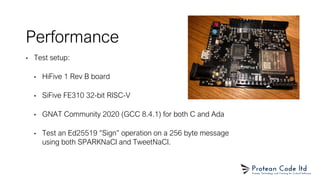
• Test setup:
• HiFive 1 Rev B board
• SiFive FE310 32-bit RISC-V
• GNAT Community 2020 (GCC 8.4.1) for both C and Ada
• Test an Ed25519 “Sign” operation on a 256 byte message
using both SPARKNaCl and TweetNaCl.
Expectations...
• Why SPARK might be slower than C...
• Functional programming style (and first-class array types)
implies return-by-copy for function return values, which
can be large blocks of data. Therefore: slow!
• TweetNaCl only does two normalization calls after “*” on
GF type, but this cannot be proven in SPARKNaCl which
does three normalization calls.
• SPARKNaCl sanitizes local variables before return from
subprograms. TweetNaCl does not.
Expectations...
• Why SPARK might be faster than C...
• SPARK is proven to be free of “runtime errors”, so can be
compiled with no dynamic type checking – just like C!
• SPARK has many intrinsic properties that make it
amenable to optimization: no aliasing, no undefined
behaviour, no side-effects in expressions etc.
• So... Let’s experiment with several of the standard
optimization levels...
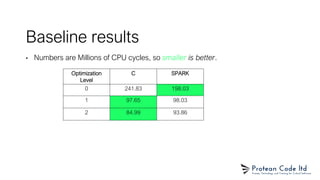
Baseline results
• Numbers are Millions of CPU cycles, so smaller is better.
Optimization
Level
C SPARK
0 241.83 198.03
1 97.65 98.03
2 84.99 93.86
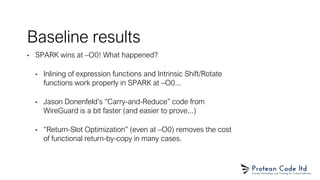
Baseline results
• SPARK wins at –O0! What happened?
• Inlining of expression functions and Intrinsic Shift/Rotate
functions work properly in SPARK at –O0...
• Jason Donenfeld’s “Carry-and-Reduce” code from
WireGuard is a bit faster (and easier to prove...)
• “Return-Slot Optimization” (even at –O0) removes the cost
of functional return-by-copy in many cases.
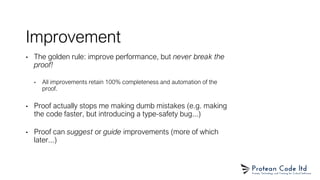
Improvement
• The golden rule: improve performance, but never break the
proof!
• All improvements retain 100% completeness and automation of the
proof.
• Proof actually stops me making dumb mistakes (e.g. making
the code faster, but introducing a type-safety bug...)
• Proof can suggest or guide improvements (more of which
later...)
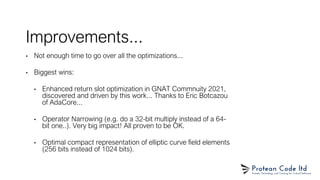
Improvements...
• Not enough time to go over all the optimizations...
• Biggest wins:
• Enhanced return slot optimization in GNAT Commnuity 2021,
discovered and driven by this work... Thanks to Eric Botcazou
of AdaCore...
• Operator Narrowing (e.g. do a 32-bit multiply instead of a 64-
bit one..). Very big impact! All proven to be OK.
• Optimal compact representation of elliptic curve field elements
(256 bits instead of 1024 bits).
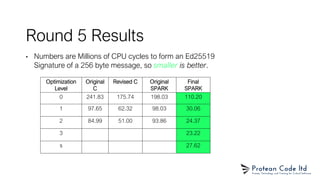
Round 5 Results
• Numbers are Millions of CPU cycles to form an Ed25519
Signature of a 256 byte message, so smaller is better.
Optimization
Level
Original
C
Revised C Original
SPARK
Final
SPARK
0 241.83 175.74 198.03 110.20
1 97.65 62.32 98.03 30.06
2 84.99 51.00 93.86 24.37
3 23.22
s 27.62
Observations
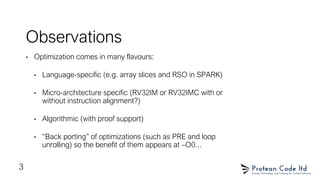
• Optimization comes in many flavours:
• Language-specific (e.g. array slices and RSO in SPARK)
• Micro-architecture specific (RV32IM or RV32IMC with or
without instruction alignment?)
• Algorithmic (with proof support)
• “Back porting” of optimizations (such as PRE and loop
unrolling) so the benefit of them appears at –O0...
3
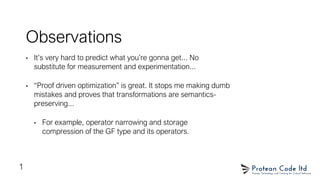
Observations
• It’s very hard to predict what you’re gonna get... No
substitute for measurement and experimentation...
• “Proof driven optimization” is great. It stops me making dumb
mistakes and proves that transformations are semantics-
preserving...
• For example, operator narrowing and storage
compression of the GF type and its operators.
1
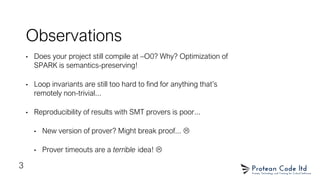
Observations
• Does your project still compile at –O0? Why? Optimization of
SPARK is semantics-preserving!
• Loop invariants are still too hard to find for anything that’s
remotely non-trivial...
• Reproducibility of results with SMT provers is poor...
• New version of prover? Might break proof... 
• Prover timeouts are a terrible idea! 
3
Contents
• TweetNaCl? Why bother?
• Goals and not goals...
• Proof
• Performance
• Further work
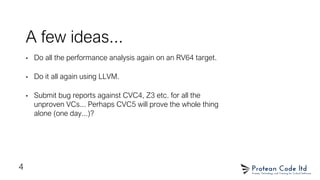
A few ideas...
• Do all the performance analysis again on an RV64 target.
• Do it all again using LLVM.
• Submit bug reports against CVC4, Z3 etc. for all the
unproven VCs... Perhaps CVC5 will prove the whole thing
alone (one day...)?
4
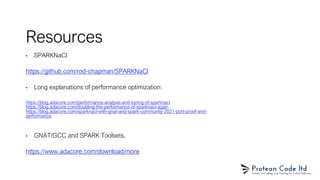
Resources
• SPARKNaCl
https://github.com/rod-chapman/SPARKNaCl
• Long explanations of performance optimization:
https://blog.adacore.com/performance-analysis-and-tuning-of-sparknacl
https://blog.adacore.com/doubling-the-performance-of-sparknacl-again
https://blog.adacore.com/sparknacl-with-gnat-and-spark-community-2021-port-proof-and-
performance
• GNAT/GCC and SPARK Toolsets,
https://www.adacore.com/download/more

SPARKNaCl: A verified, fast cryptographic library

  • 1.
    SPARKNaCl: a verified, fastcryptographic library or... “What I did during lockdown...” Roderick Chapman, Director, Protean Code Limited (until 11th September 2022)...
  • 2.
    Contents • TweetNaCl? Whybother? • Goals and not goals... • Proof • Performance • Further work
  • 3.
    Contents • TweetNaCl? Whybother? • Goals and not goals... • Proof • Performance • Further work
  • 4.
    TweetNaCl? • A completeimplementation of the NaCl crypto API, written in C. • Source code fits in 100 tweets! • No comments at all in the code... • One 16-page technical paper describes how it works. • Assurance largely rests on dynamic test, lots of users and the formidable reputation of the authors. 3
  • 5.
    TweetNaCl? • Core algorithms: •Stream cipher: Salsa20 • Authentication: Poly1305 • Hash: SHA2-512 • Signatures: Ed25519 • Key exchange: X25519 (ECDH using Curve25519)
  • 6.
    TweetNaCl? • The codeis very hard to understand... • No comments... • Cunning mathematical tricks to achieve acceptable performance... • “Constant Time” programming style to mitigate side-channel attack... • Somewhat terse overview in the paper... • For example... 3
  • 7.
    TweetNaCl? • From thepaper: “Arithmetic modulo the group order. Signing requires reduction of a 512-bit integer modulo the order of the Curve25519 group, a prime p = 2252+δ where δ ≈ 2124.38. We store this integer as a sequence of limbs in radix 28. We eliminate the top limb of the integer, say 2504b, by subtracting 2504b and also subtracting 2252δb; we then perform a partial carry so that 20 consecutive limbs are each between −27 and 27. We repeat this procedure to eliminate subsequent limbs from the top. We similarly eliminate any remaining multiple of 2252, leaving an integer between −1.1·2251 and 1.1 · 2251. We then multiply the final carry bit by p and add, obtaining an integer between 0 and p − 1, and carry in the traditional way so that each limb is between 0 and 255.” • Becomes... 1
  • 8.
    sv modL(u8 *r,i64x[64]) { i64 carry,i,j; for (i = 63;i >= 32;--i) { carry = 0; for (j = i - 32;j < i - 12;++j) { x[j] += carry - 16 * x[i] * L[j - (i - 32)]; carry = (x[j] + 128) >> 8; x[j] -= carry << 8; } x[j] += carry; x[i] = 0; } carry = 0; FOR(j,32) { x[j] += carry - (x[31] >> 4) * L[j]; carry = x[j] >> 8; x[j] &= 255; } FOR(j,32) x[j] -= carry * L[j]; FOR(i,32) { x[i+1] += x[i] >> 8; r[i] = x[i] & 255; } }
  • 9.
    Why Bother? • Thereis lots of other excellent work on formal verification of Crypto libraries – MSR Everest, AWS, Galois’ Cryptol & SAW, Jasmin & EasyCrypt, HACSPEC, Fiat Cryptography etc. etc. • There are several very highly respected implementations of NaCl out there, including LibSodium. • Why bother with another one?
  • 10.
    Why Bother? • Cana modern deductive verification system and programming language cope with a library like NaCl? 1. What can be proven anyway? 2. What level of automation can be achieved?
  • 11.
    Myth “Formal is Slow...” •So-called “Formal” languages have a reputation in industry for being “too slow” for production use. • Put another way: “Our code has to go really fast, so we can only write it on C, C, C, or C... (or assembly language...)” • Can a “formal” language like SPARK really compete? 3
  • 12.
    Contents • TweetNaCl? Whybother? • Goals and not goals... • Proof • Performance • Further work
  • 13.
    Goals... • A re-implementationof TweetNaCl in SPARK, covering the whole library and NaCl API. • It shall pass all NaCl regression tests. • Retain “constant time” programming style. • Fully “auto-active” proof of at least type- and memory safety for the whole thing. • It’s all about the types... (and contracts...) • No “interactive” proof please... 3
  • 14.
    Goals... • Compatible withthe “Zero Footprint” runtime library of GCC/GNAT • No COTS or libraries. • “Heap free” programming style, so will run on ”bare-metal” targets with no OS at all. • Same code will compile and run on any target CPU/OS.
  • 15.
    Goals... • Performance andcode size competitive with TweetNaCl. • Will we find any bugs? En-passant, will we find bugs in TweetNaCl too? • We have form in this area: a subtle corner case bug was found in the Skein hash algorithm by re-implementing it in SPARK...
  • 16.
    NOT Goals... • Don’ttry to compete with LibSodium’s performance... • Don’t try to prove partial correctness (unless strictly necessary). • Don’t try to prove mathematical security-related properties of Curve25519, Ed25519 and so on...
  • 17.
    Contents • TweetNaCl? Whybother? • Goals and not goals... • Proof • Performance • Further work
  • 18.
    What has beenproven? • “Type and Memory Safety” • No undefined behaviour • No dependence on unspecified behaviour • Nothing that would normally raise an exception: range violation, arithmetic overflow, buffer overflow, division-by- zero etc. • (Note: there are no pointers! And no heap...) • All object values satisfy all type declarations. • All user-supplied contracts are true (pre, post, loop invariants, asserts...) 5
  • 19.
    What has beenproven? • Observations: 1. Types are cool. Better (i.e. “stronger”) types get you better proof. Never write a “Pre” or an “Assert” where a type could do the job just as well. 2. Expressive use of types is the key to achieving proof automation and completeness. 3. “Type safety” is not a “fixed price” concept in SPARK. More types -> More proof. 4. Types serve as a (weak-ish) specification of correctness properties... 5. Fully predicated types from Ada2012 (aka “Liquid Types” in Haskell and OCAML) are awesome. 4
  • 20.
    What has beenproven? • The code generates 907 Verification Conditions. • Final result: 100% automation/completeness for all VCs using Z3, CVC4 and Alt-Ergo provers. • Of those 907 • 777 are trivial and proven by all 3 provers. • 130 are “hard” in that at least one prover fails to prove it.
  • 21.
    Proof Performance • Proofof the whole library takes about 4.5 minutes from scratch on my laptop (using 16 threads). • Results are cached to improve re-proof of units that haven’t changed. • Generating lots of independent VCs parallelizes very well... Just throw more CPU cores at it... • but...relies on strict modularity and contracts in SPARK...so “whole program” or “inter-procedural” proof is never required...
  • 22.
    Contents • TweetNaCl? Whybother? • Goals and not goals... • Proof • Performance • Further work
  • 23.
    Performance • Test setup: •HiFive 1 Rev B board • SiFive FE310 32-bit RISC-V • GNAT Community 2020 (GCC 8.4.1) for both C and Ada • Test an Ed25519 “Sign” operation on a 256 byte message using both SPARKNaCl and TweetNaCl.
  • 24.
    Expectations... • Why SPARKmight be slower than C... • Functional programming style (and first-class array types) implies return-by-copy for function return values, which can be large blocks of data. Therefore: slow! • TweetNaCl only does two normalization calls after “*” on GF type, but this cannot be proven in SPARKNaCl which does three normalization calls. • SPARKNaCl sanitizes local variables before return from subprograms. TweetNaCl does not.
  • 25.
    Expectations... • Why SPARKmight be faster than C... • SPARK is proven to be free of “runtime errors”, so can be compiled with no dynamic type checking – just like C! • SPARK has many intrinsic properties that make it amenable to optimization: no aliasing, no undefined behaviour, no side-effects in expressions etc. • So... Let’s experiment with several of the standard optimization levels...
  • 26.
    Baseline results • Numbersare Millions of CPU cycles, so smaller is better. Optimization Level C SPARK 0 241.83 198.03 1 97.65 98.03 2 84.99 93.86
  • 27.
    Baseline results • SPARKwins at –O0! What happened? • Inlining of expression functions and Intrinsic Shift/Rotate functions work properly in SPARK at –O0... • Jason Donenfeld’s “Carry-and-Reduce” code from WireGuard is a bit faster (and easier to prove...) • “Return-Slot Optimization” (even at –O0) removes the cost of functional return-by-copy in many cases.
  • 28.
    Improvement • The goldenrule: improve performance, but never break the proof! • All improvements retain 100% completeness and automation of the proof. • Proof actually stops me making dumb mistakes (e.g. making the code faster, but introducing a type-safety bug...) • Proof can suggest or guide improvements (more of which later...)
  • 29.
    Improvements... • Not enoughtime to go over all the optimizations... • Biggest wins: • Enhanced return slot optimization in GNAT Commnuity 2021, discovered and driven by this work... Thanks to Eric Botcazou of AdaCore... • Operator Narrowing (e.g. do a 32-bit multiply instead of a 64- bit one..). Very big impact! All proven to be OK. • Optimal compact representation of elliptic curve field elements (256 bits instead of 1024 bits).
  • 30.
    Round 5 Results •Numbers are Millions of CPU cycles to form an Ed25519 Signature of a 256 byte message, so smaller is better. Optimization Level Original C Revised C Original SPARK Final SPARK 0 241.83 175.74 198.03 110.20 1 97.65 62.32 98.03 30.06 2 84.99 51.00 93.86 24.37 3 23.22 s 27.62
  • 31.
    Observations • Optimization comesin many flavours: • Language-specific (e.g. array slices and RSO in SPARK) • Micro-architecture specific (RV32IM or RV32IMC with or without instruction alignment?) • Algorithmic (with proof support) • “Back porting” of optimizations (such as PRE and loop unrolling) so the benefit of them appears at –O0... 3
  • 32.
    Observations • It’s veryhard to predict what you’re gonna get... No substitute for measurement and experimentation... • “Proof driven optimization” is great. It stops me making dumb mistakes and proves that transformations are semantics- preserving... • For example, operator narrowing and storage compression of the GF type and its operators. 1
  • 33.
    Observations • Does yourproject still compile at –O0? Why? Optimization of SPARK is semantics-preserving! • Loop invariants are still too hard to find for anything that’s remotely non-trivial... • Reproducibility of results with SMT provers is poor... • New version of prover? Might break proof...  • Prover timeouts are a terrible idea!  3
  • 34.
    Contents • TweetNaCl? Whybother? • Goals and not goals... • Proof • Performance • Further work
  • 35.
    A few ideas... •Do all the performance analysis again on an RV64 target. • Do it all again using LLVM. • Submit bug reports against CVC4, Z3 etc. for all the unproven VCs... Perhaps CVC5 will prove the whole thing alone (one day...)? 4
  • 36.
    Resources • SPARKNaCl https://github.com/rod-chapman/SPARKNaCl • Longexplanations of performance optimization: https://blog.adacore.com/performance-analysis-and-tuning-of-sparknacl https://blog.adacore.com/doubling-the-performance-of-sparknacl-again https://blog.adacore.com/sparknacl-with-gnat-and-spark-community-2021-port-proof-and- performance • GNAT/GCC and SPARK Toolsets, https://www.adacore.com/download/more