Product Lines and Ecosystems
from customization to configuration
Jan Bosch
Director Software Center
www.software-center.se
Professor of Software Engineering
Chalmers University of Technology
Gothenburg, Sweden.
• Digitalization drives the adoption of Ops, i.e. DevOps, DataOps, MLOps,
putting unique, new challenges on software platforms
• Superset software platforms are the only cost effective solution for
DevOps
• Superset platforms affect the way we conduct systems engineering
Three Key Take-Aways
• Vem är jag? Wie ben ik? Who am I?
• Digitalization
• Superset platforms
• Three layer product model
• Systems engineering
• Conclusion
Overview
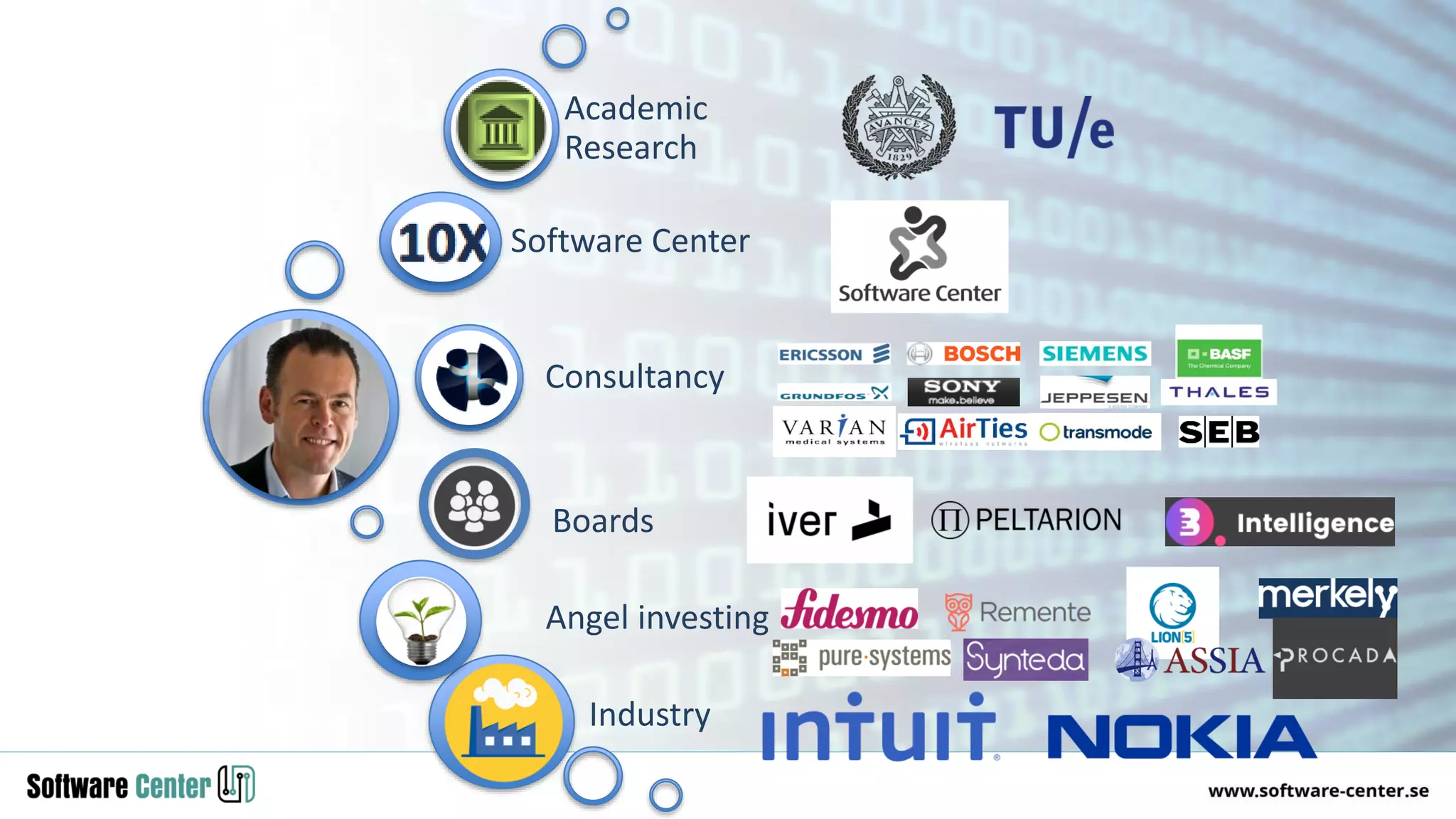
Boards
Consultancy
Software Center
Academic
Research
Angel investing
Industry
Software Center
Mission: To significantly improve the digitalization capability of the European Software-Intensive industry
Some Online Companies
• Vem är jag? Wie ben ik? Who am I?
• Digitalization
• Superset platforms
• Three layer product model
• Systems engineering
• Conclusion
Overview
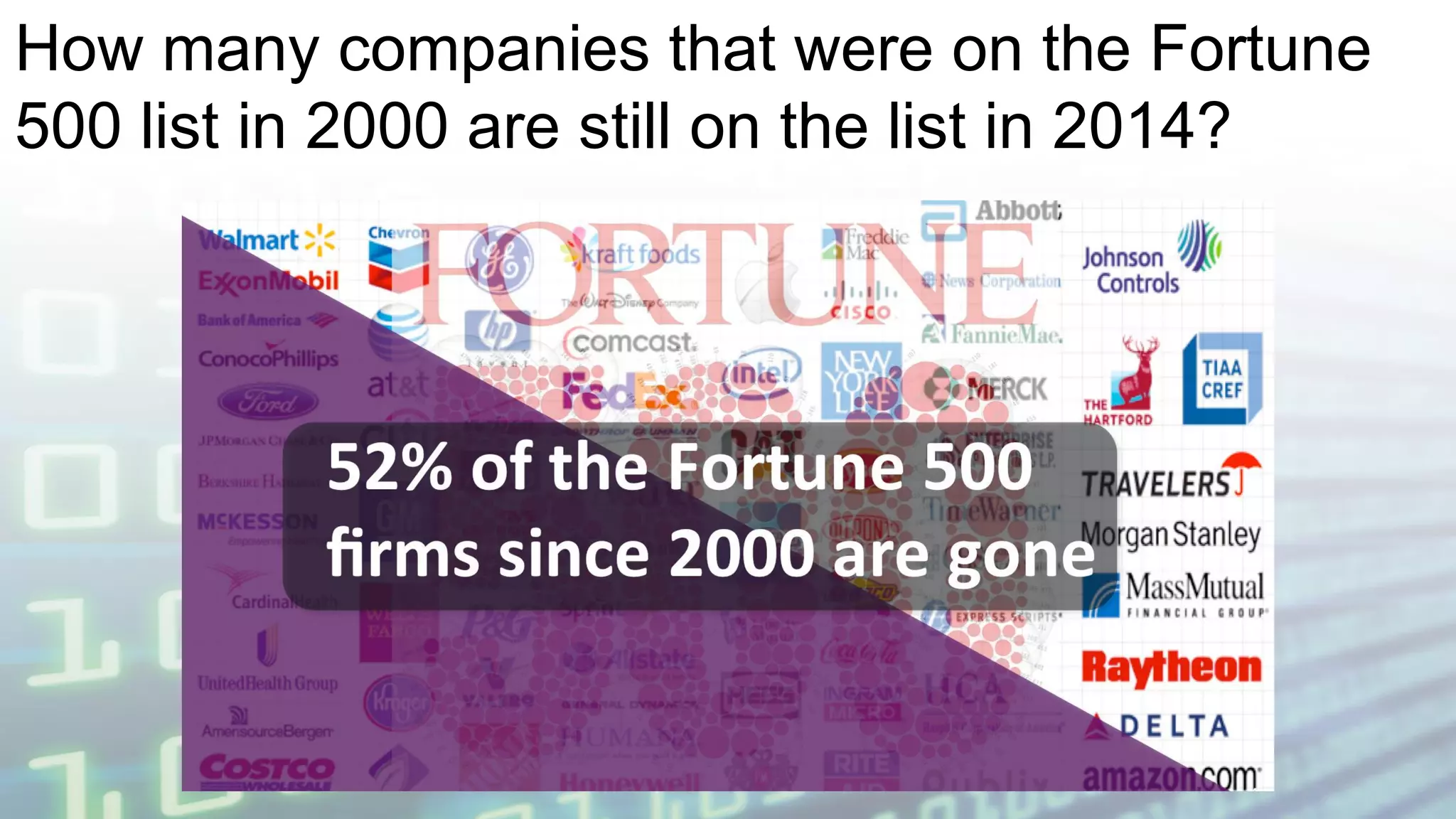
How many companies that were on the Fortune
500 list in 2000 are still on the list in 2014?
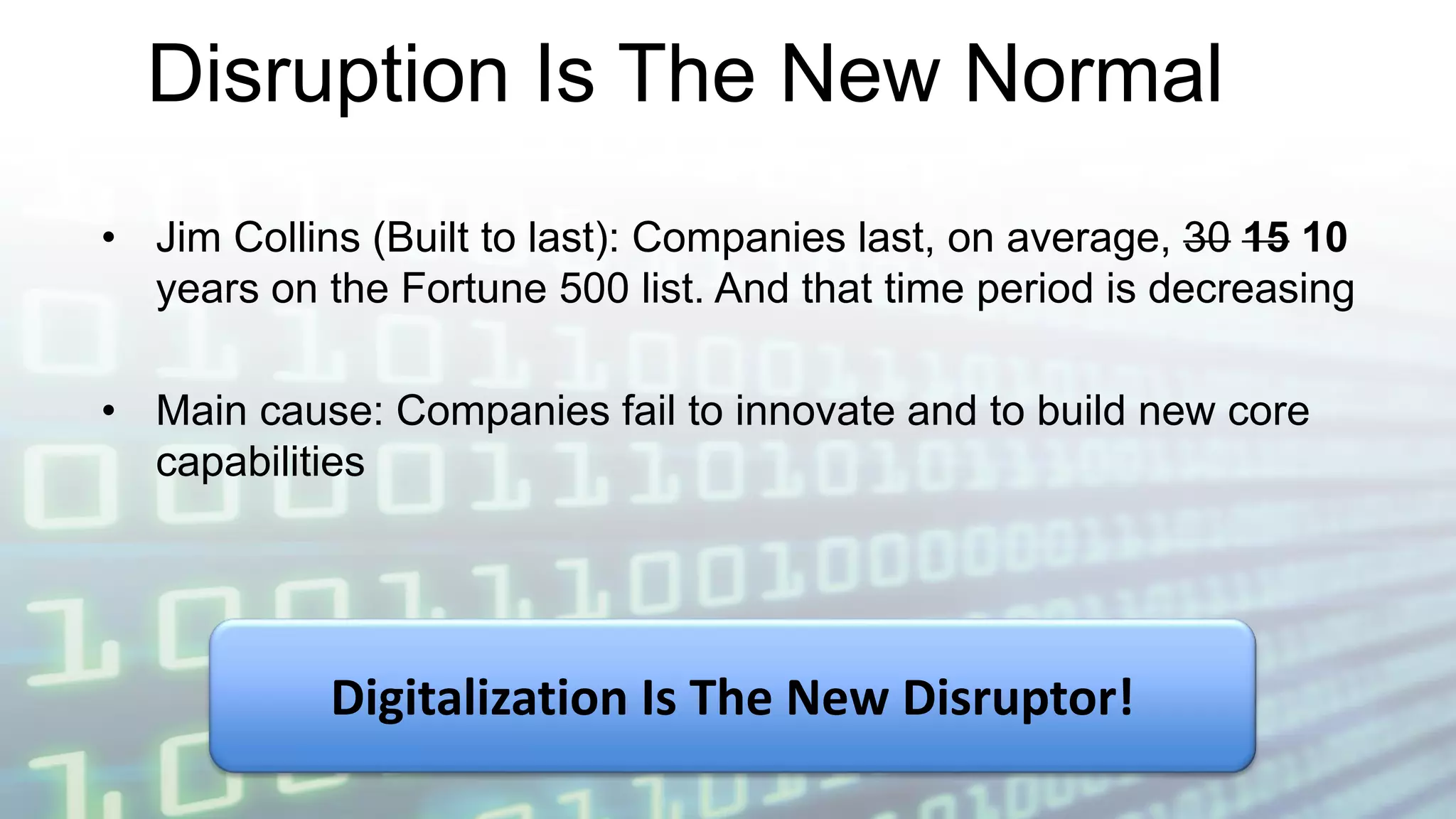
Disruption Is The New Normal
• Jim Collins (Built to last): Companies last, on average, 30 15 10
years on the Fortune 500 list. And that time period is decreasing
• Main cause: Companies fail to innovate and to build new core
capabilities
Digitalization Is The New Disruptor!
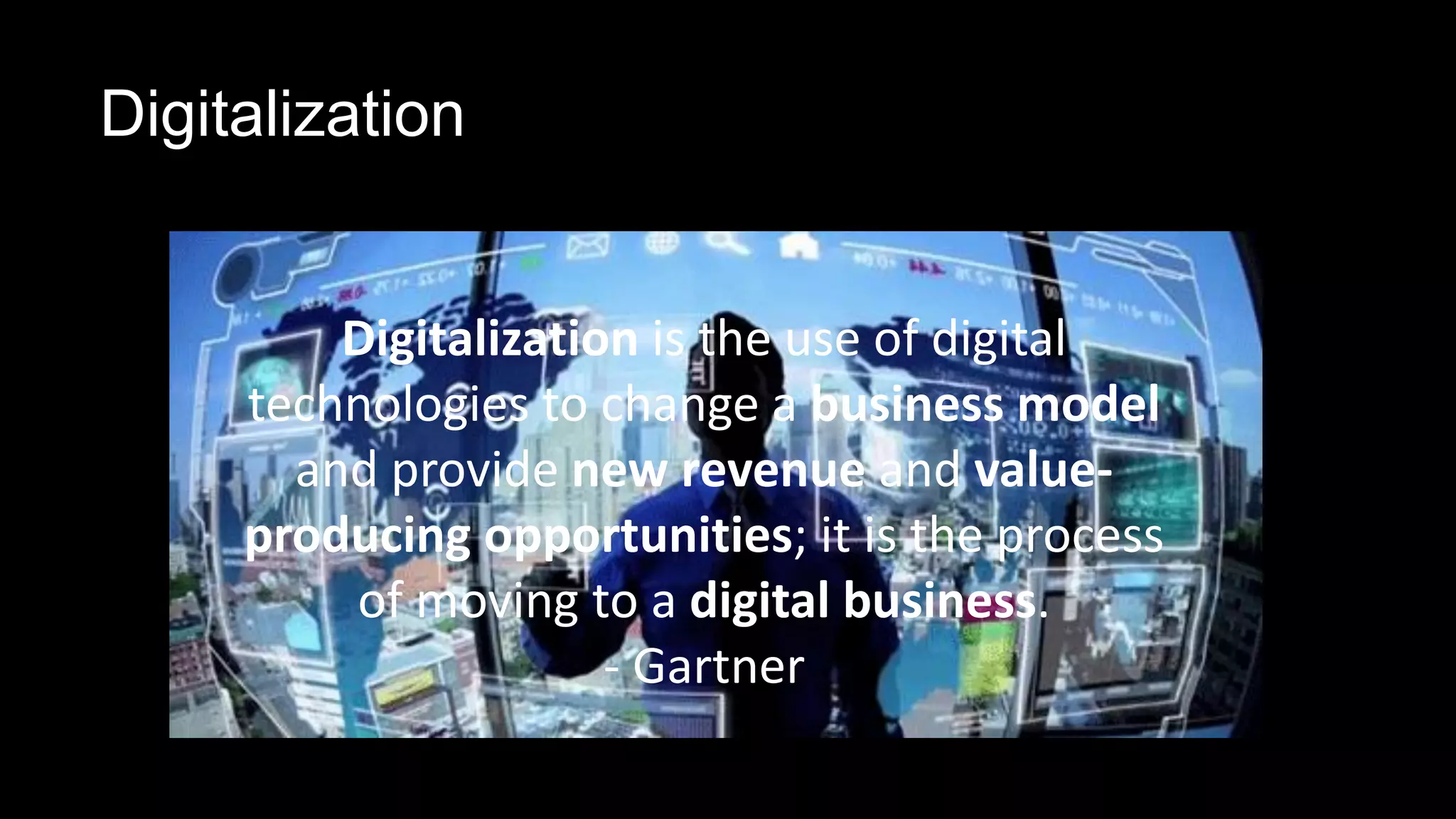
Digitalization
Digitalization is the use of digital
technologies to change a business model
and provide new revenue and value-
producing opportunities; it is the process
of moving to a digital business.
- Gartner
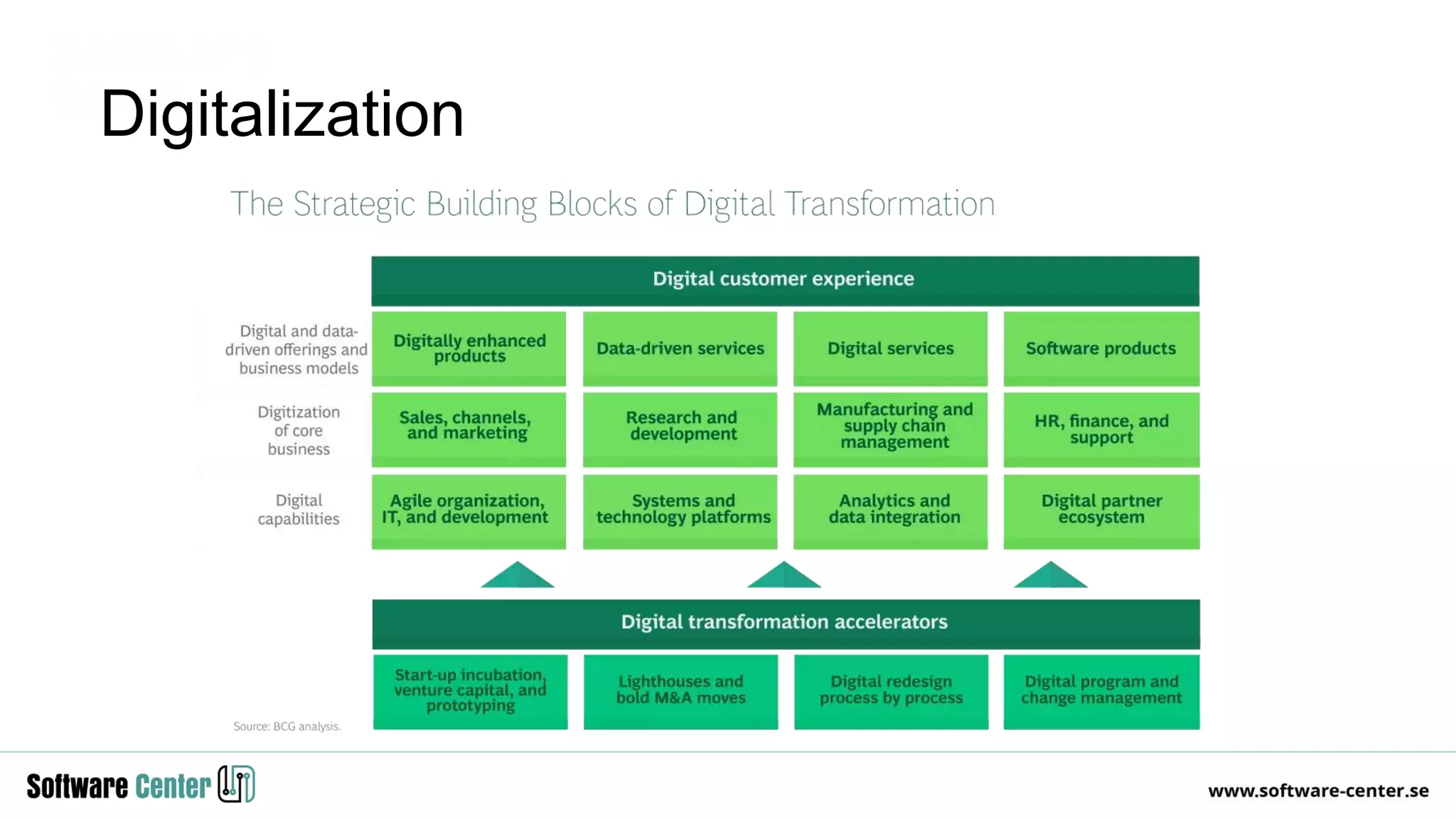
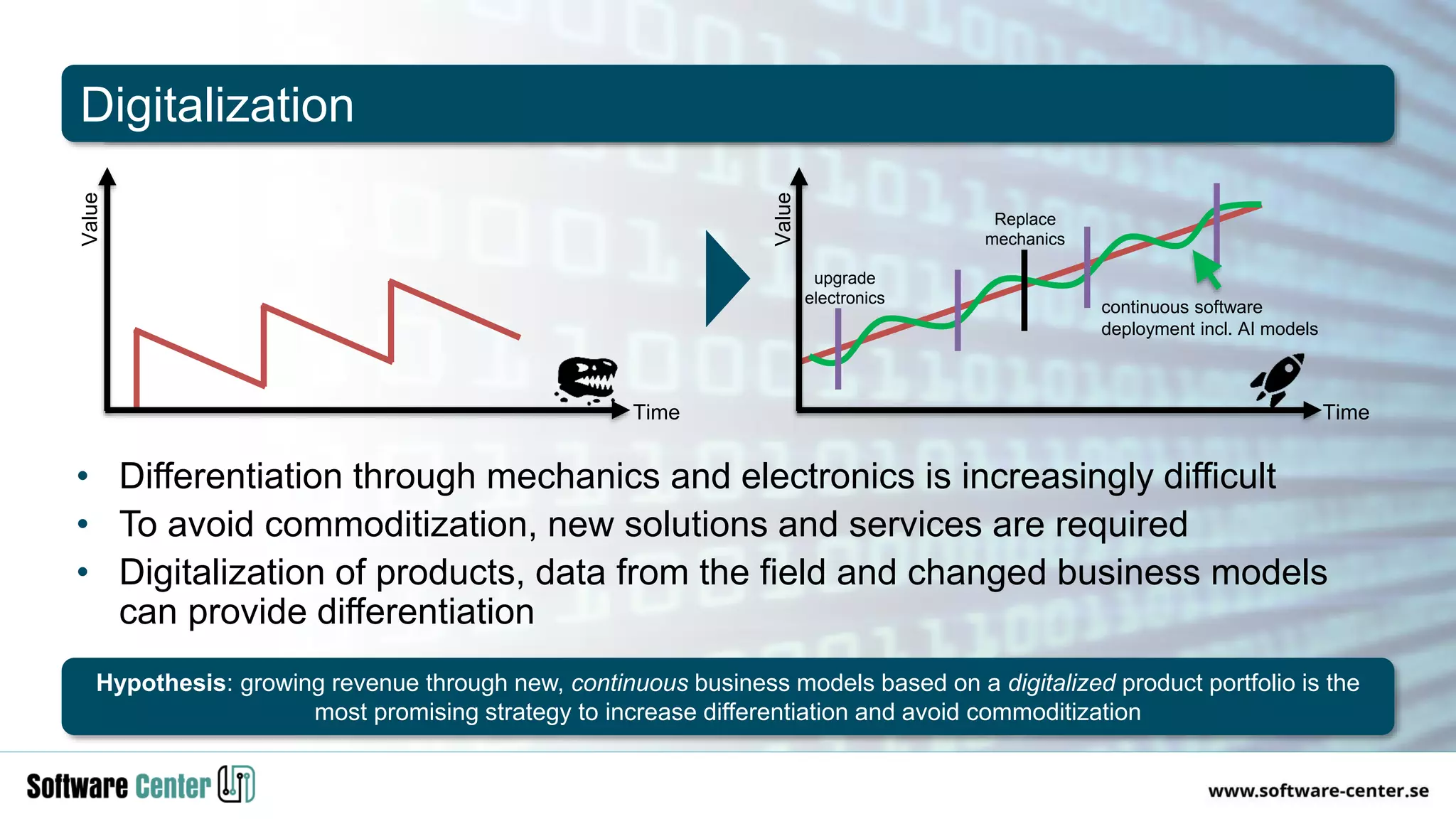
Digitalization
Digitalization
Value
Time
upgrade
electronics
Replace
mechanics
Value
Time
continuous software
deployment incl. AI models
• Differentiation through mechanics and electronics is increasingly difficult
• To avoid commoditization, new solutions and services are required
• Digitalization of products, data from the field and changed business models
can provide differentiation
Hypothesis: growing revenue through new, continuous business models based on a digitalized product portfolio is the
most promising strategy to increase differentiation and avoid commoditization
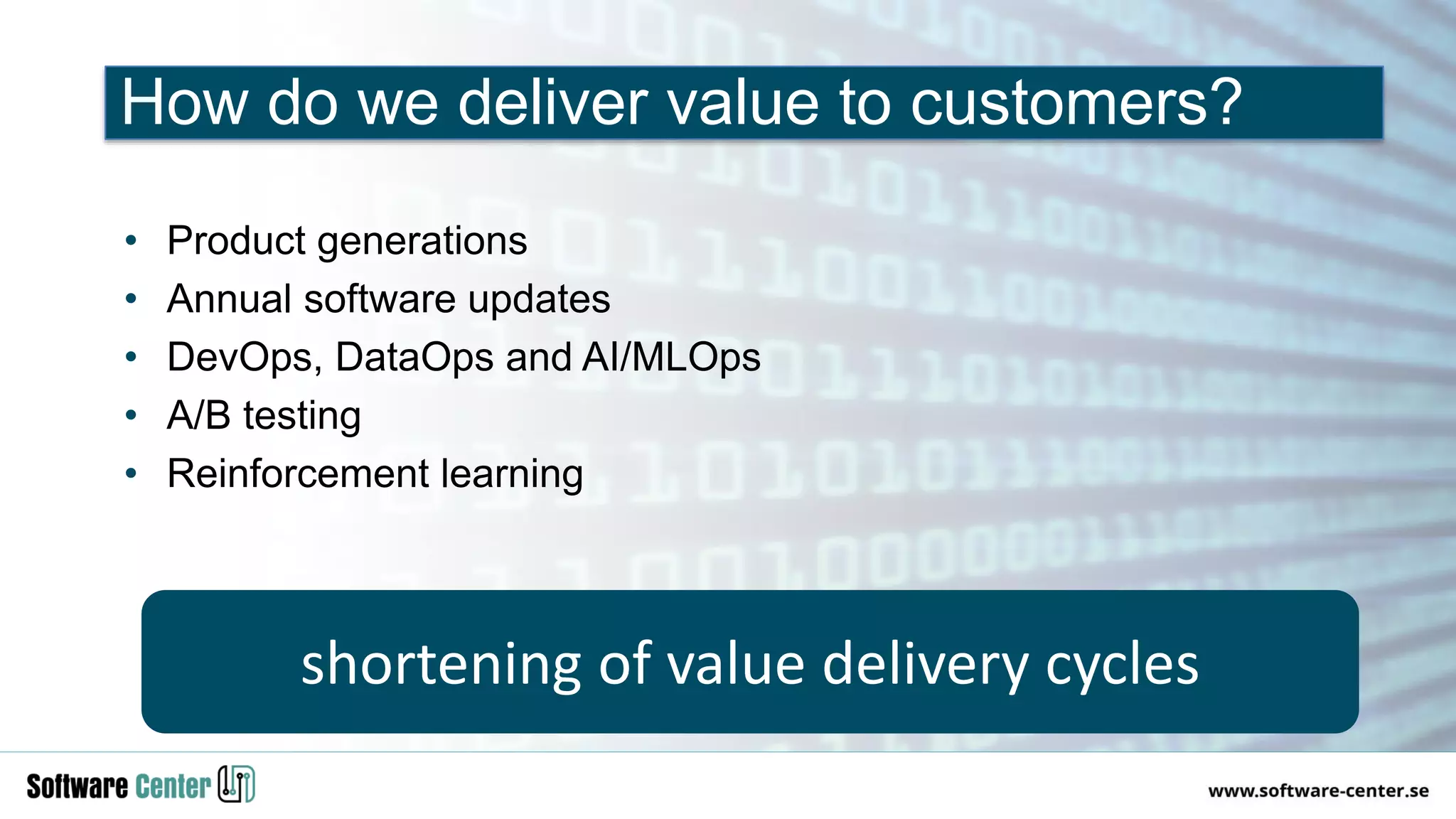
• Product generations
• Annual software updates
• DevOps, DataOps and AI/MLOps
• A/B testing
• Reinforcement learning
How do we deliver value to customers?
shortening of value delivery cycles
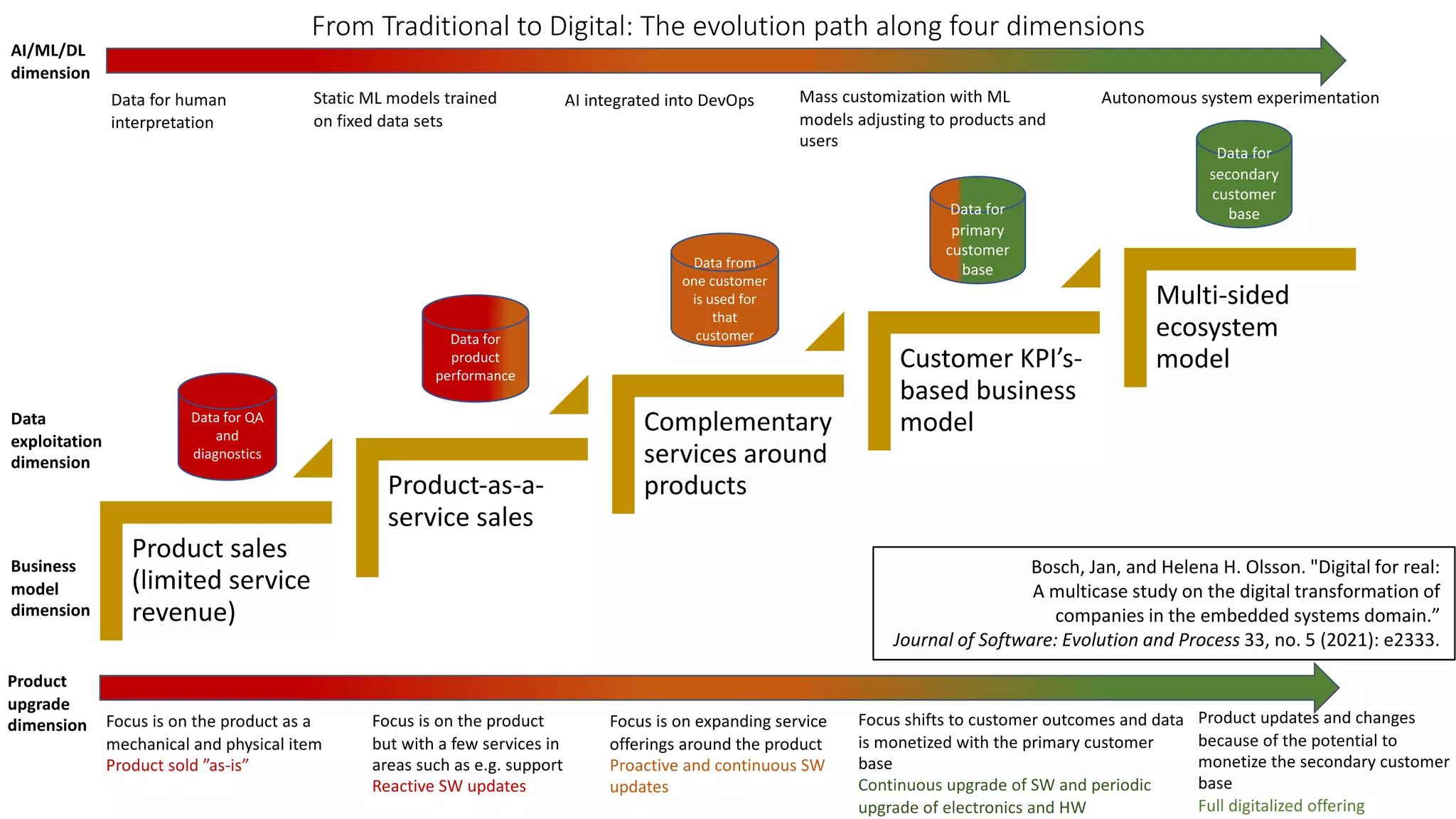
Bosch, Jan, and Helena H. Olsson. "Digital for real:
A multicase study on the digital transformation of
companies in the embedded systems domain.”
Journal of Software: Evolution and Process 33, no. 5 (2021): e2333.
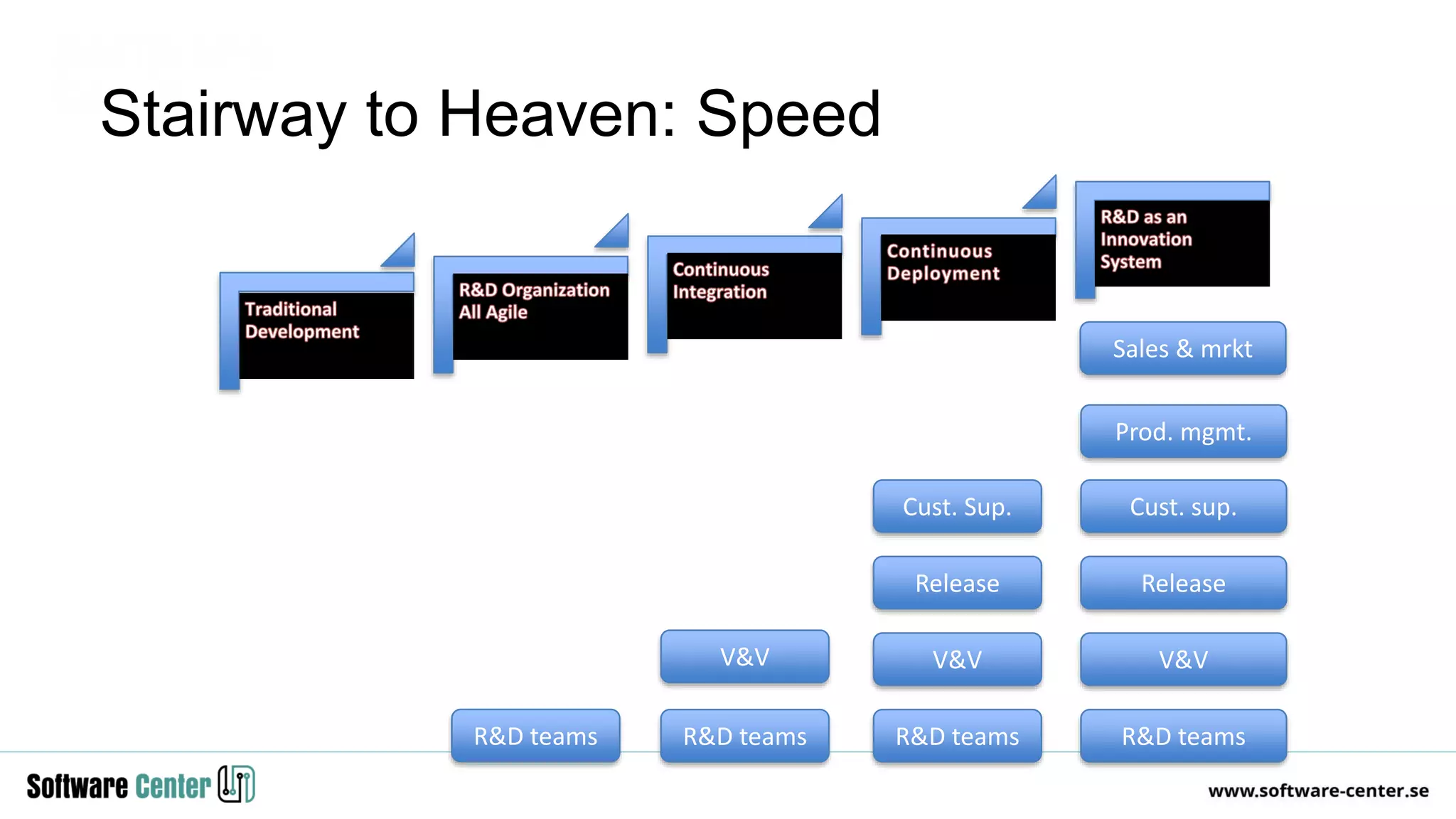
Stairway to Heaven: Speed
R&D teams R&D teams
V&V
R&D teams
V&V
Release
Cust. Sup.
R&D teams
V&V
Release
Cust. sup.
Prod. mgmt.
Sales & mrkt
• Vem är jag? Wie ben ik? Who am I?
• Digitalization
• Superset platforms
• Three layer product model
• Systems engineering
• Conclusion
Overview
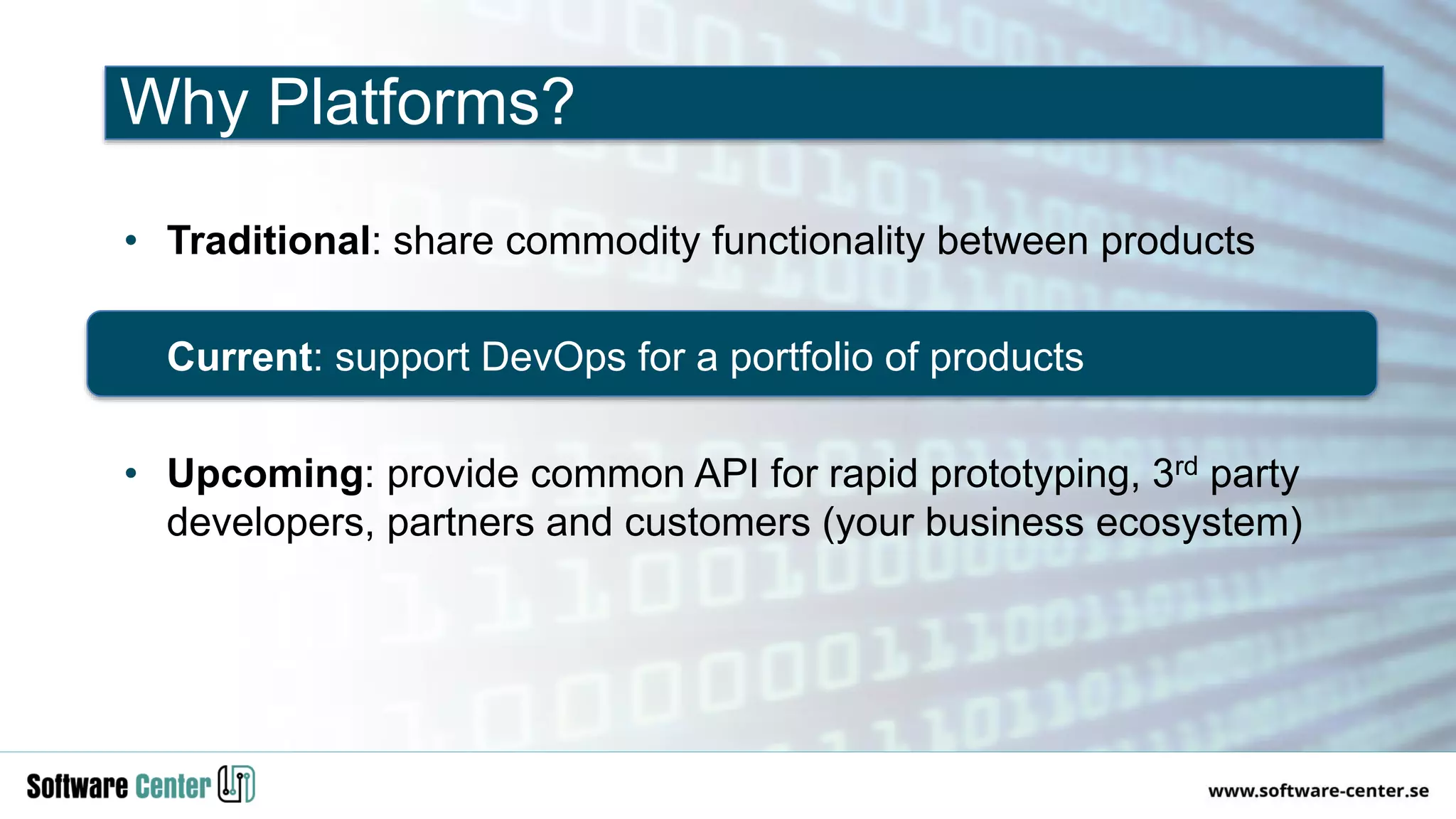
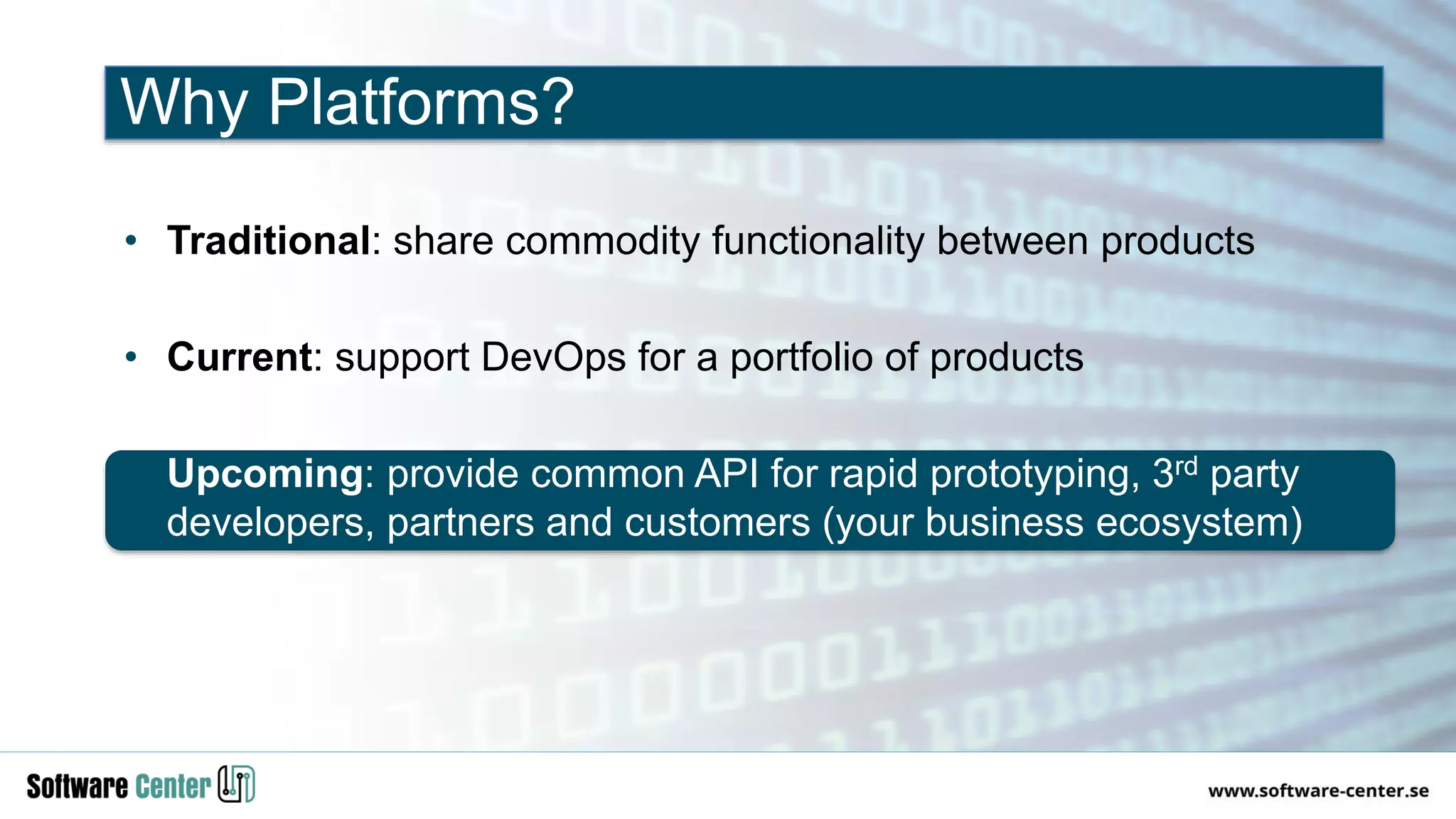
• Traditional: share commodity functionality between products
• Current: support DevOps for a portfolio of products
• Upcoming: provide common API for rapid prototyping, 3rd party
developers, partners and customers (your business ecosystem)
Why Platforms?
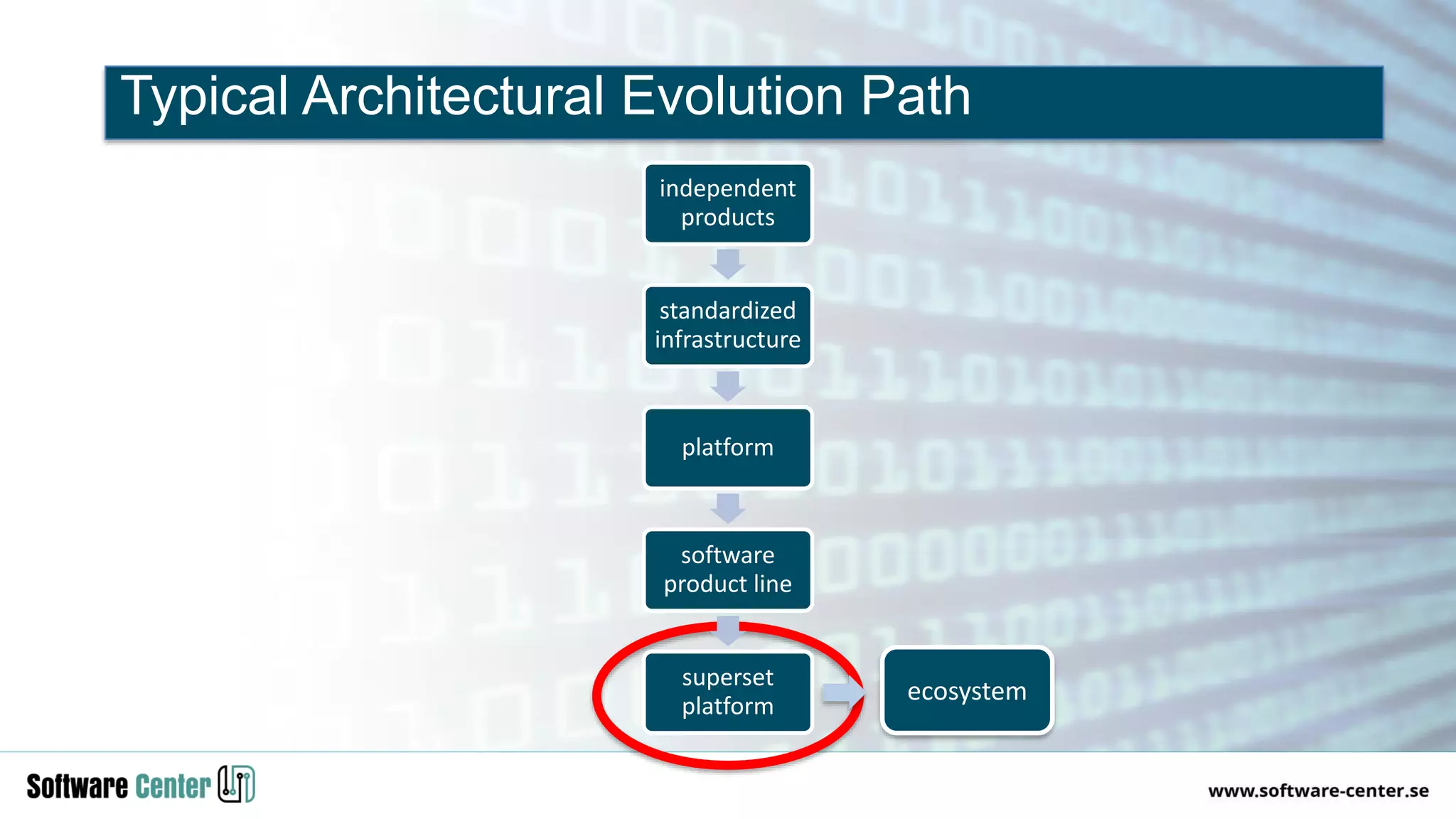
Typical Architectural Evolution Path
independent
products
standardized
infrastructure
platform
software
product line
superset
platform
ecosystem
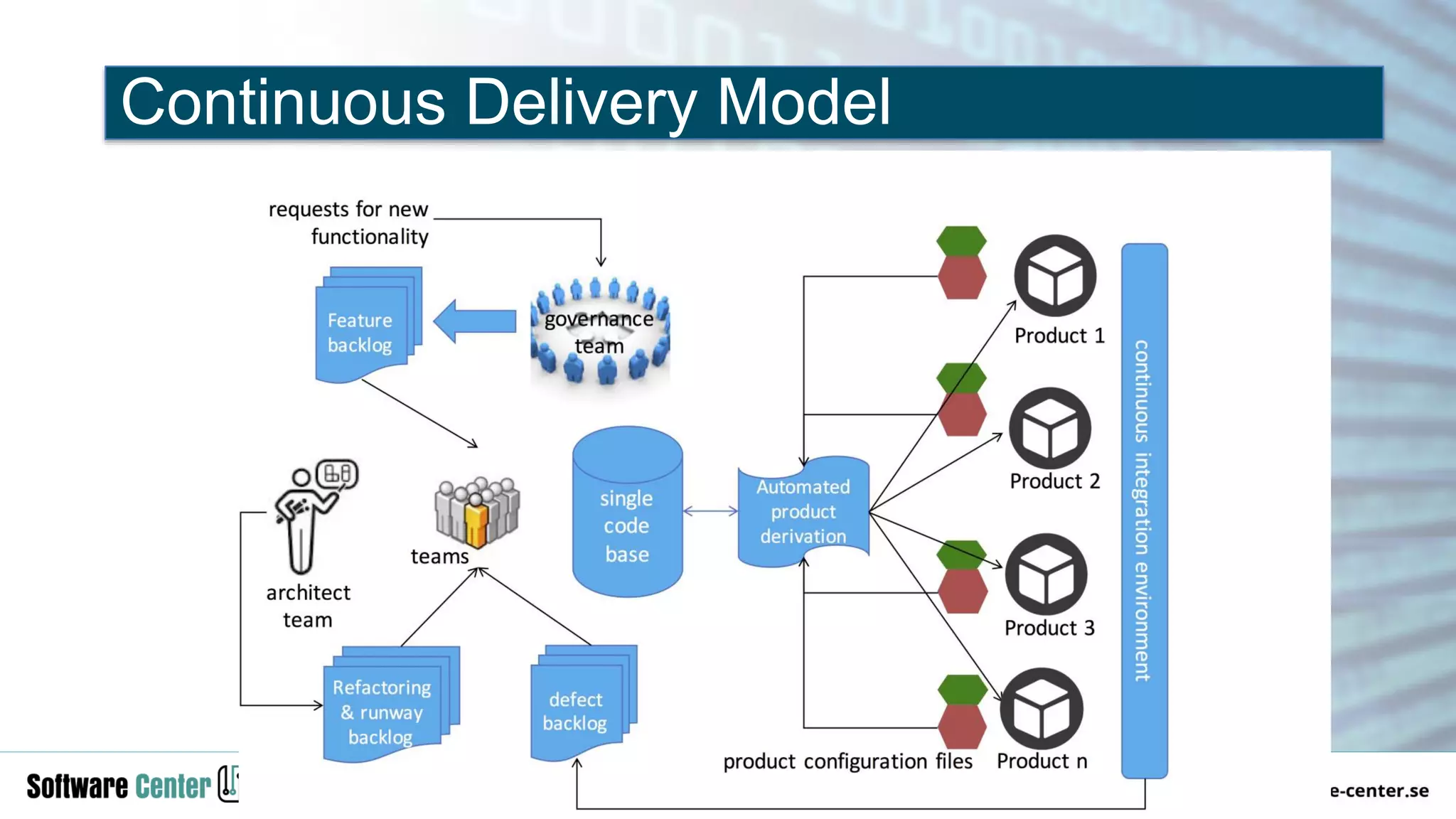
Continuous Delivery Model
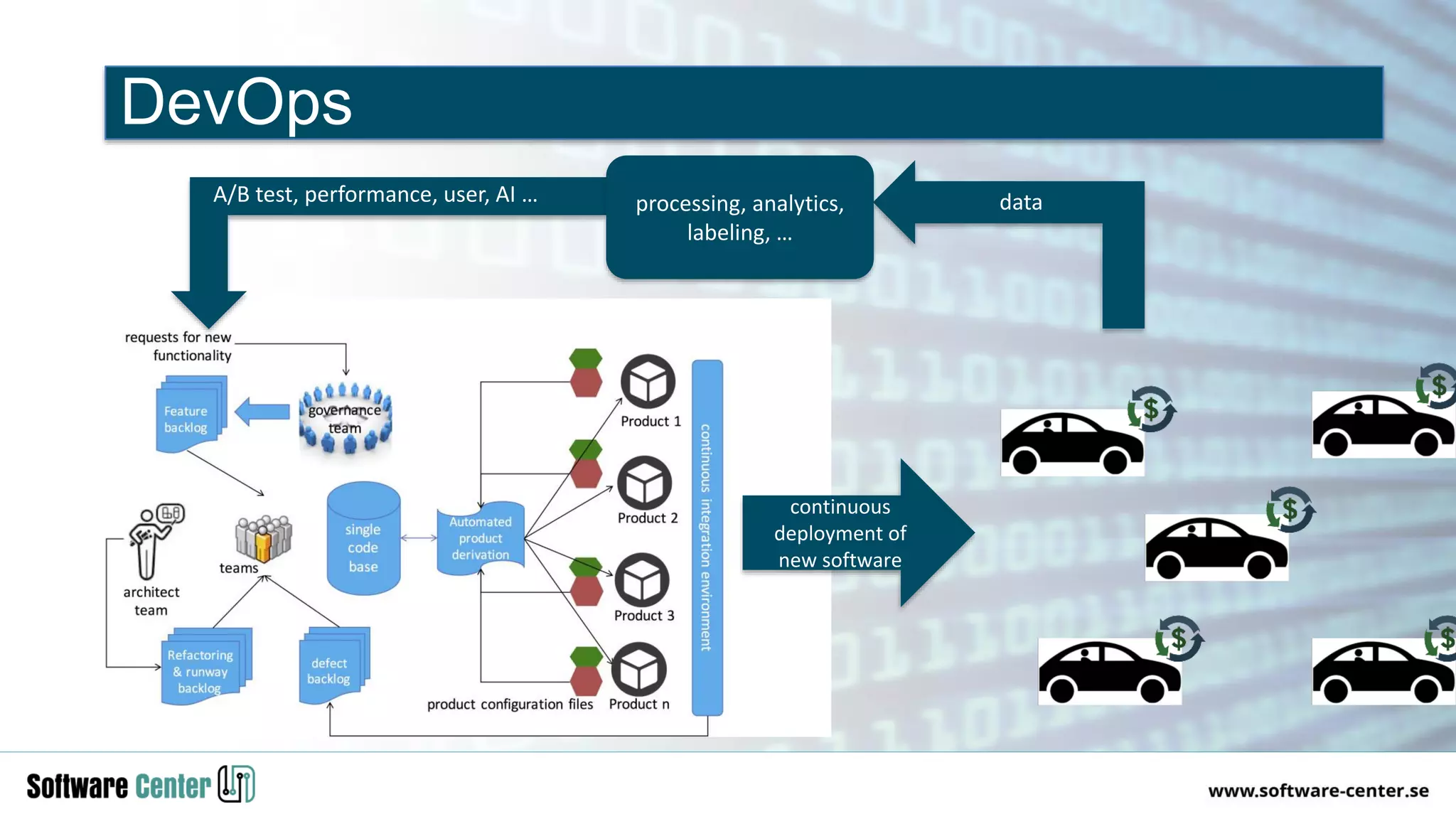
DevOps
continuous
deployment of
new software
data
A/B test, performance, user, AI … processing, analytics,
labeling, …
• Traditional: share commodity functionality between products
• Current: support DevOps for a portfolio of products
• Upcoming: provide common API for rapid prototyping, 3rd party
developers, partners and customers (your business ecosystem)
Why Platforms?
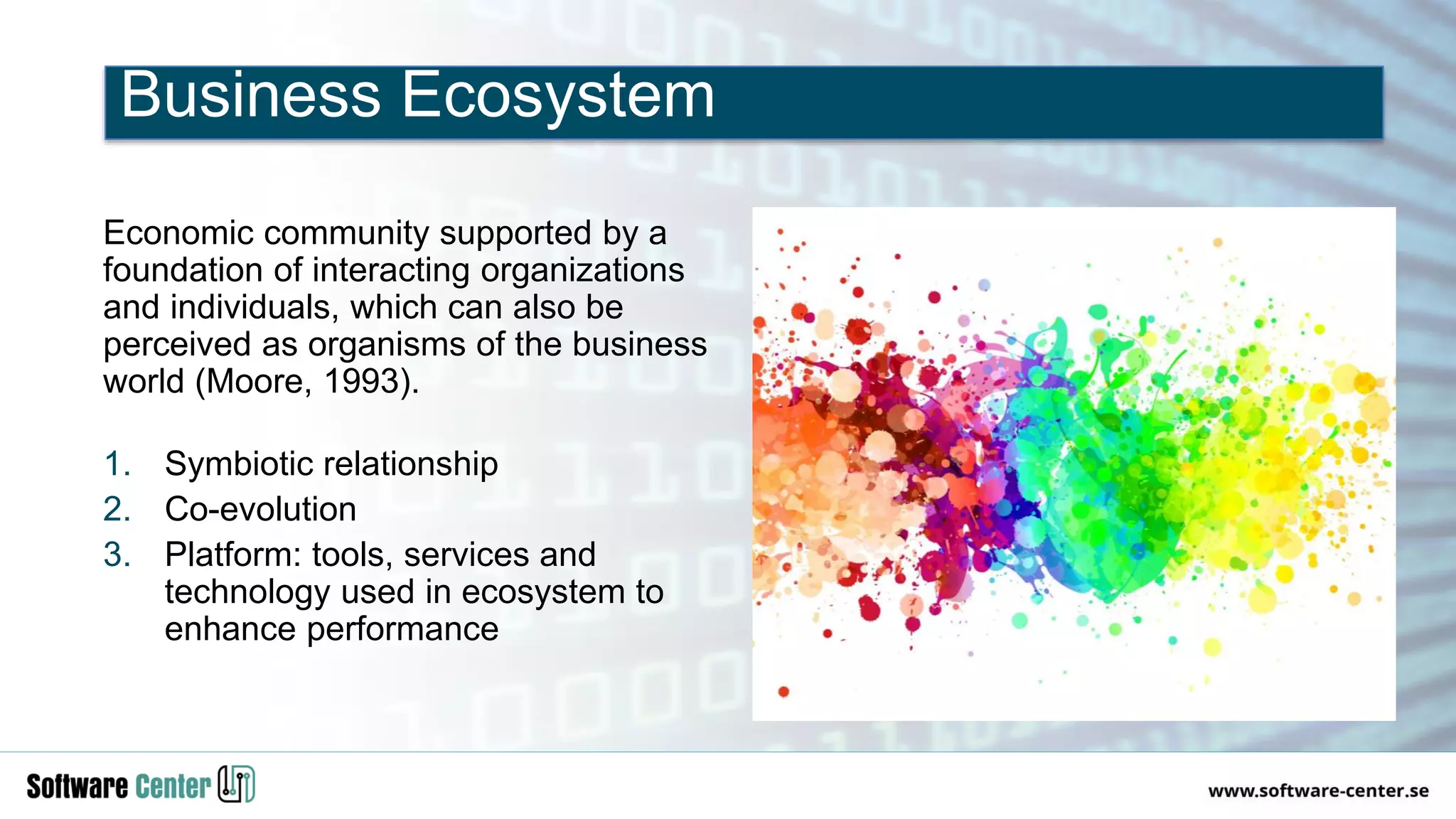
Economic community supported by a
foundation of interacting organizations
and individuals, which can also be
perceived as organisms of the business
world (Moore, 1993).
1. Symbiotic relationship
2. Co-evolution
3. Platform: tools, services and
technology used in ecosystem to
enhance performance
Business Ecosystem
• Keystone: central firm (e.g., Apple)
• Complementor: provide product/service complementing
ecosystem product/platform and enhances value (e.g., suppliers,
developers)
• Integrator: brings together parts provided by ecosystem players
into an integrated solution for end-user
• Customer or end-user
Roles in ecosystems
Two fundamental strategies
• Collaborative – cooperation
in communities e.g., android
platform (Google), Wikipedia
• Competitive – market driven
e.g., Apple app-store, Gore-
Tex
Ecosystem Strategies
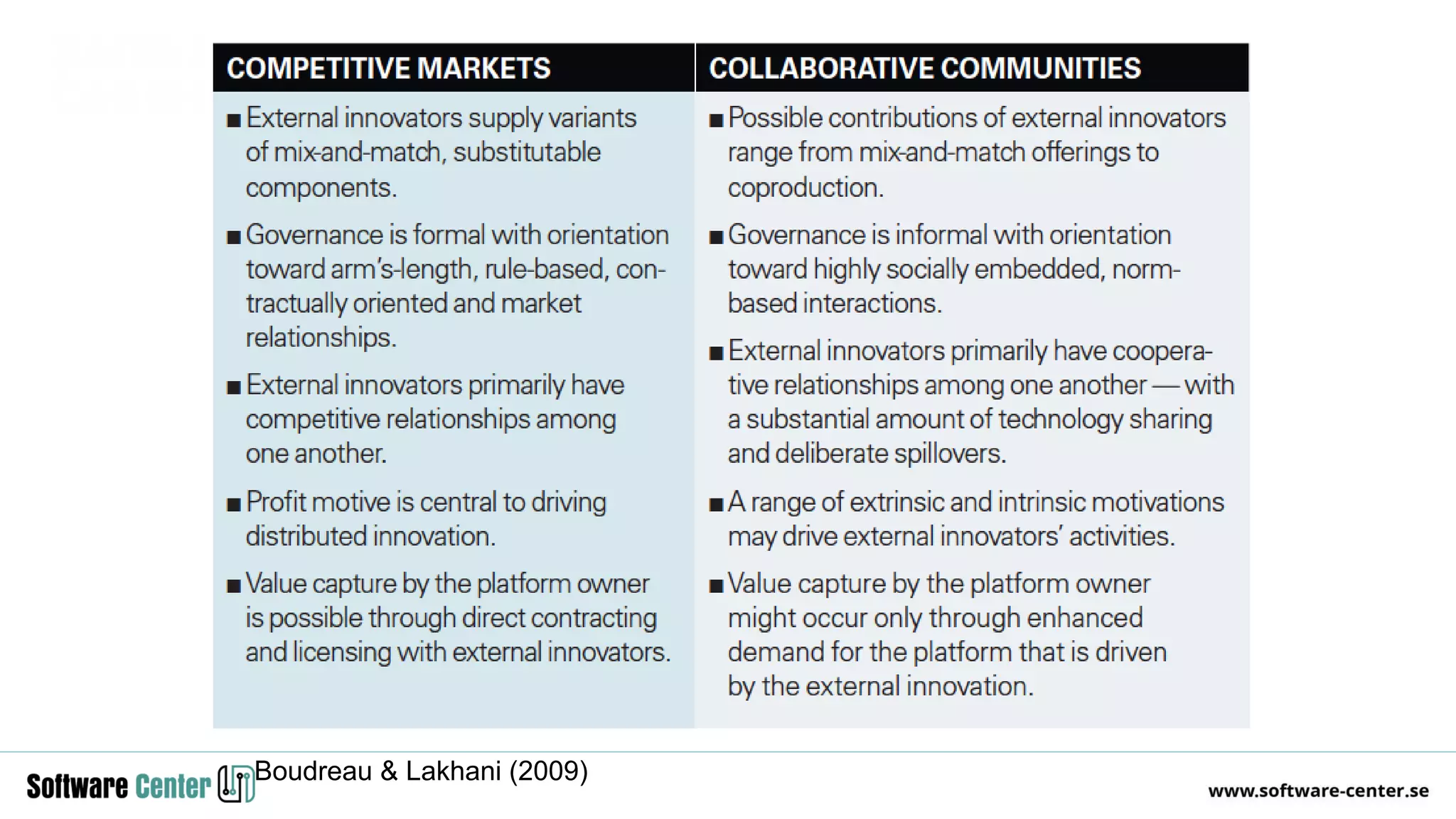
Boudreau & Lakhani (2009)
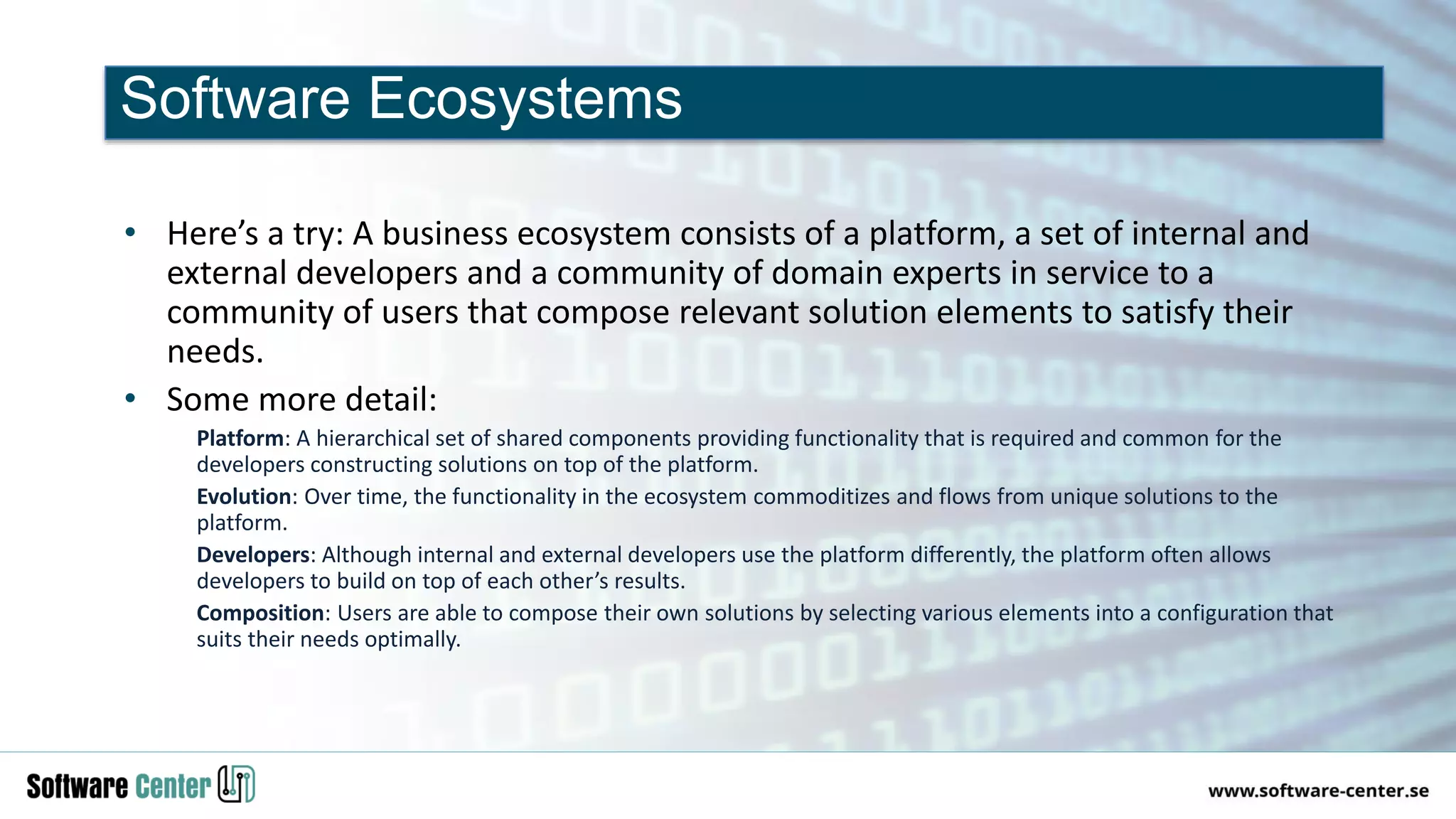
• Here’s a try: A business ecosystem consists of a platform, a set of internal and
external developers and a community of domain experts in service to a
community of users that compose relevant solution elements to satisfy their
needs.
• Some more detail:
Platform: A hierarchical set of shared components providing functionality that is required and common for the
developers constructing solutions on top of the platform.
Evolution: Over time, the functionality in the ecosystem commoditizes and flows from unique solutions to the
platform.
Developers: Although internal and external developers use the platform differently, the platform often allows
developers to build on top of each other’s results.
Composition: Users are able to compose their own solutions by selecting various elements into a configuration that
suits their needs optimally.
Software Ecosystems
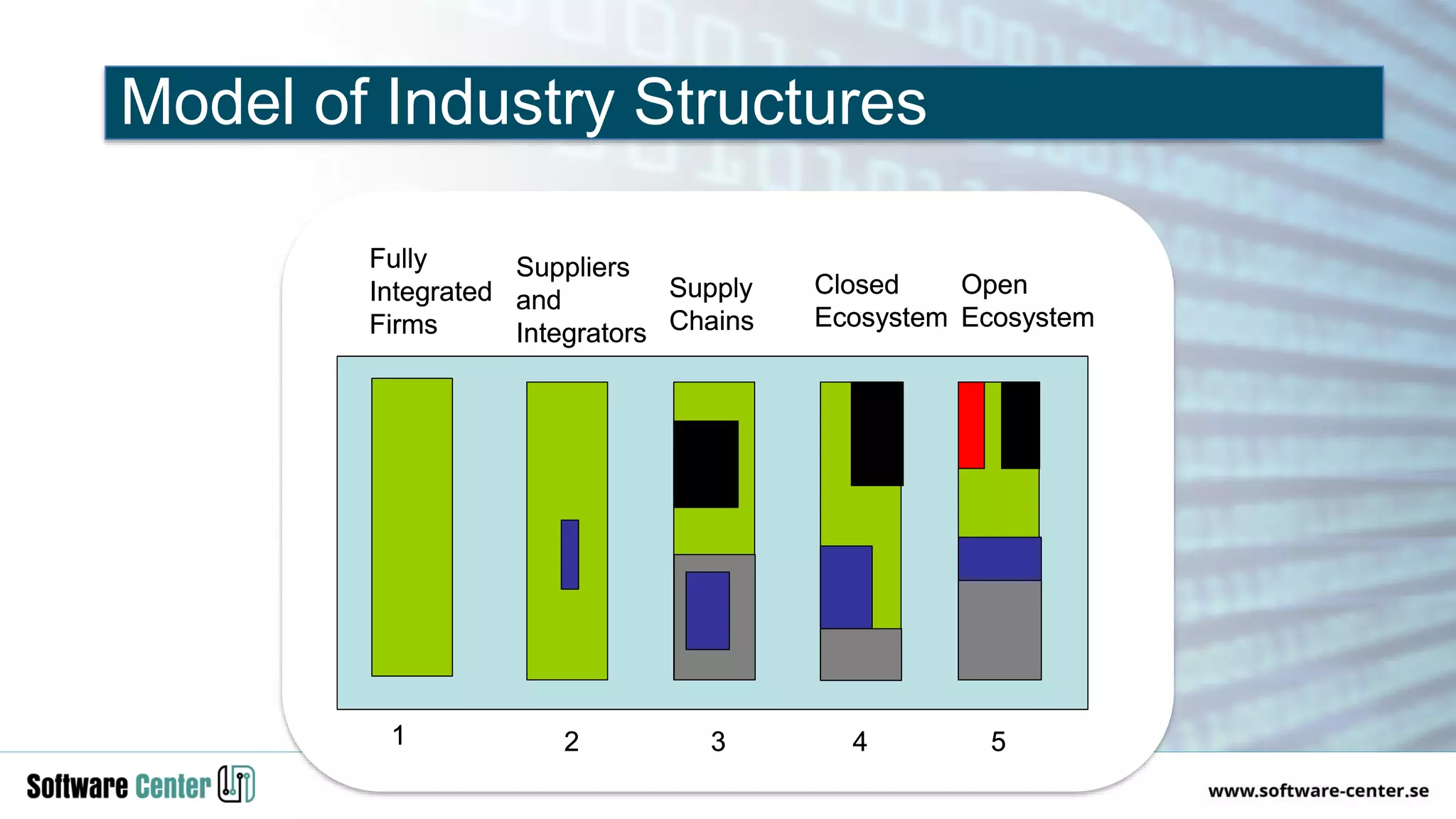
Model of Industry Structures
Open
Ecosystem
Fully
Integrated
Firms
1 2 3 4
Supply
Chains
Suppliers
and
Integrators
Closed
Ecosystem
5
Open
Ecosystem
Fully
Integrated
Firms
1 2 3 4
Supply
Chains
Suppliers
and
Integrators
Closed
Ecosystem
5
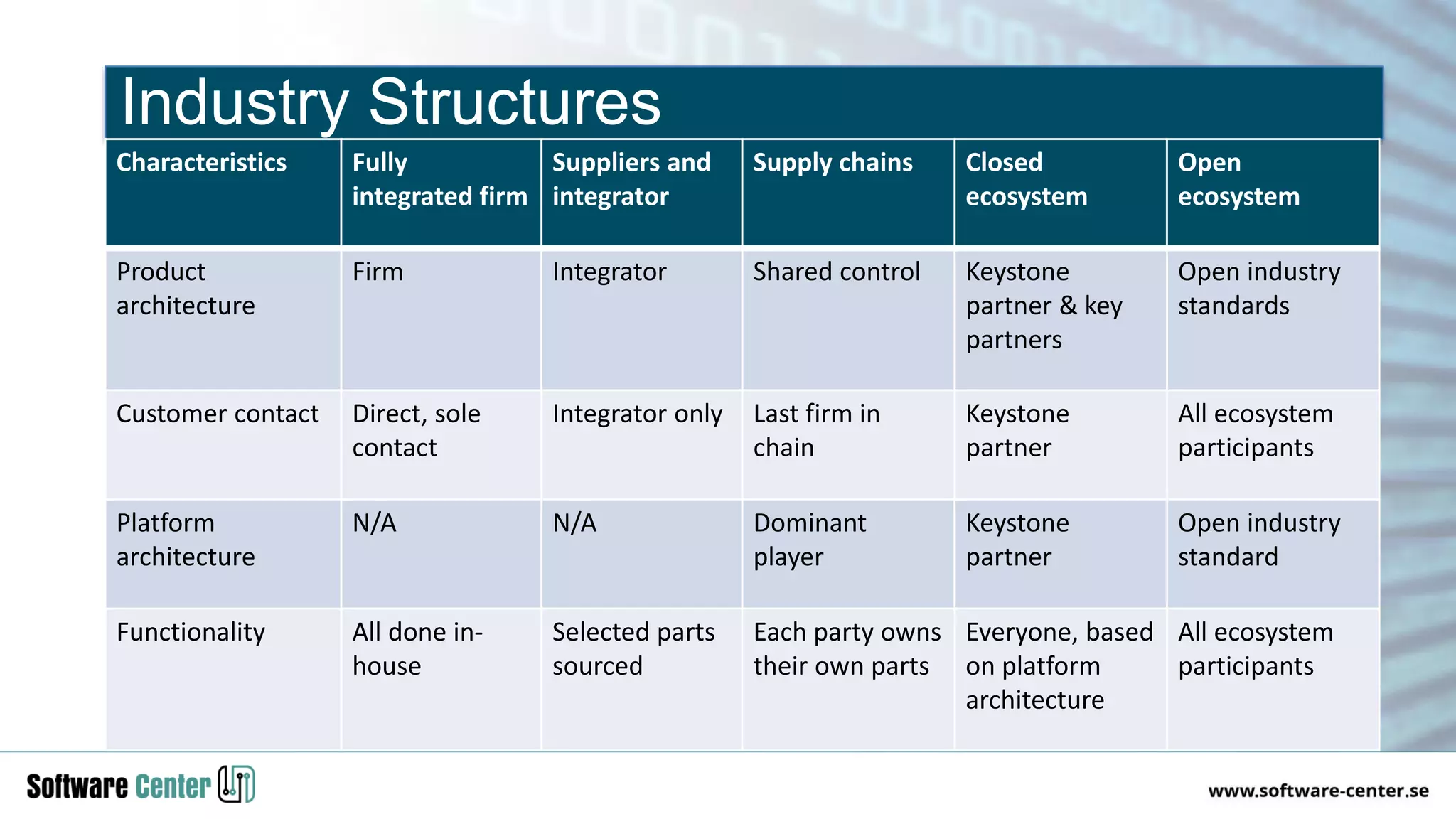
Characteristics Fully
integrated firm
Suppliers and
integrator
Supply chains Closed
ecosystem
Open
ecosystem
Product
architecture
Firm Integrator Shared control Keystone
partner & key
partners
Open industry
standards
Customer contact Direct, sole
contact
Integrator only Last firm in
chain
Keystone
partner
All ecosystem
participants
Platform
architecture
N/A N/A Dominant
player
Keystone
partner
Open industry
standard
Functionality All done in-
house
Selected parts
sourced
Each party owns
their own parts
Everyone, based
on platform
architecture
All ecosystem
participants
Industry Structures
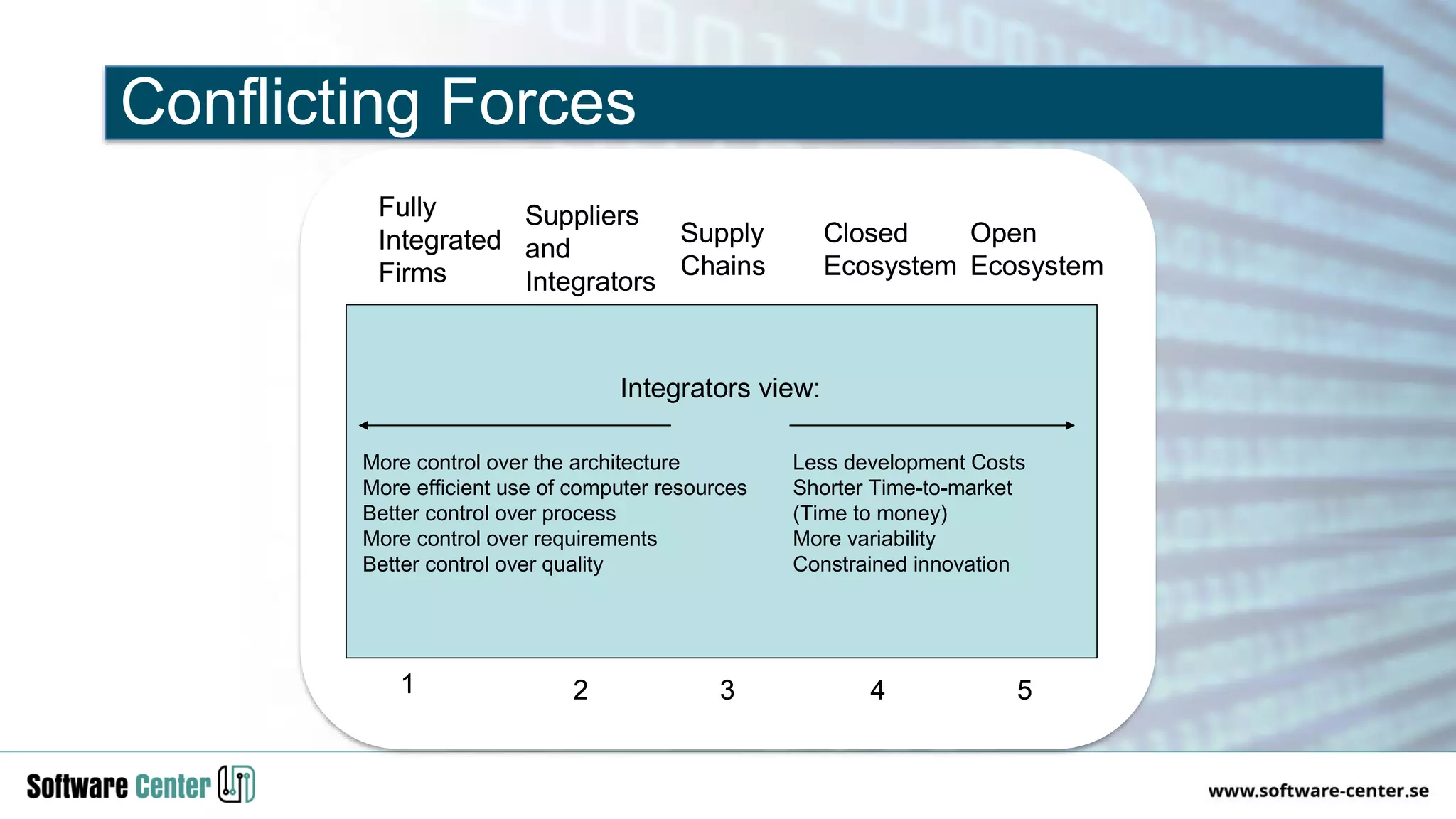
Conflicting Forces
Open
Ecosystem
Fully
Integrated
Firms
Less development Costs
Shorter Time-to-market
(Time to money)
More variability
Constrained innovation
1 2 3 4
More control over the architecture
More efficient use of computer resources
Better control over process
More control over requirements
Better control over quality
Supply
Chains
Suppliers
and
Integrators
Integrators view:
Closed
Ecosystem
5
Open
Ecosystem
Fully
Integrated
Firms
Less development Costs
Shorter Time-to-market
(Time to money)
More variability
Constrained innovation
1 2 3 4
More control over the architecture
More efficient use of computer resources
Better control over process
More control over requirements
Better control over quality
Supply
Chains
Suppliers
and
Integrators
Integrators view:
Closed
Ecosystem
5
• Vem är jag? Wie ben ik? Who am I?
• Digitalization
• Superset platforms
• Three layer product model
• Systems engineering
• Conclusion
Overview
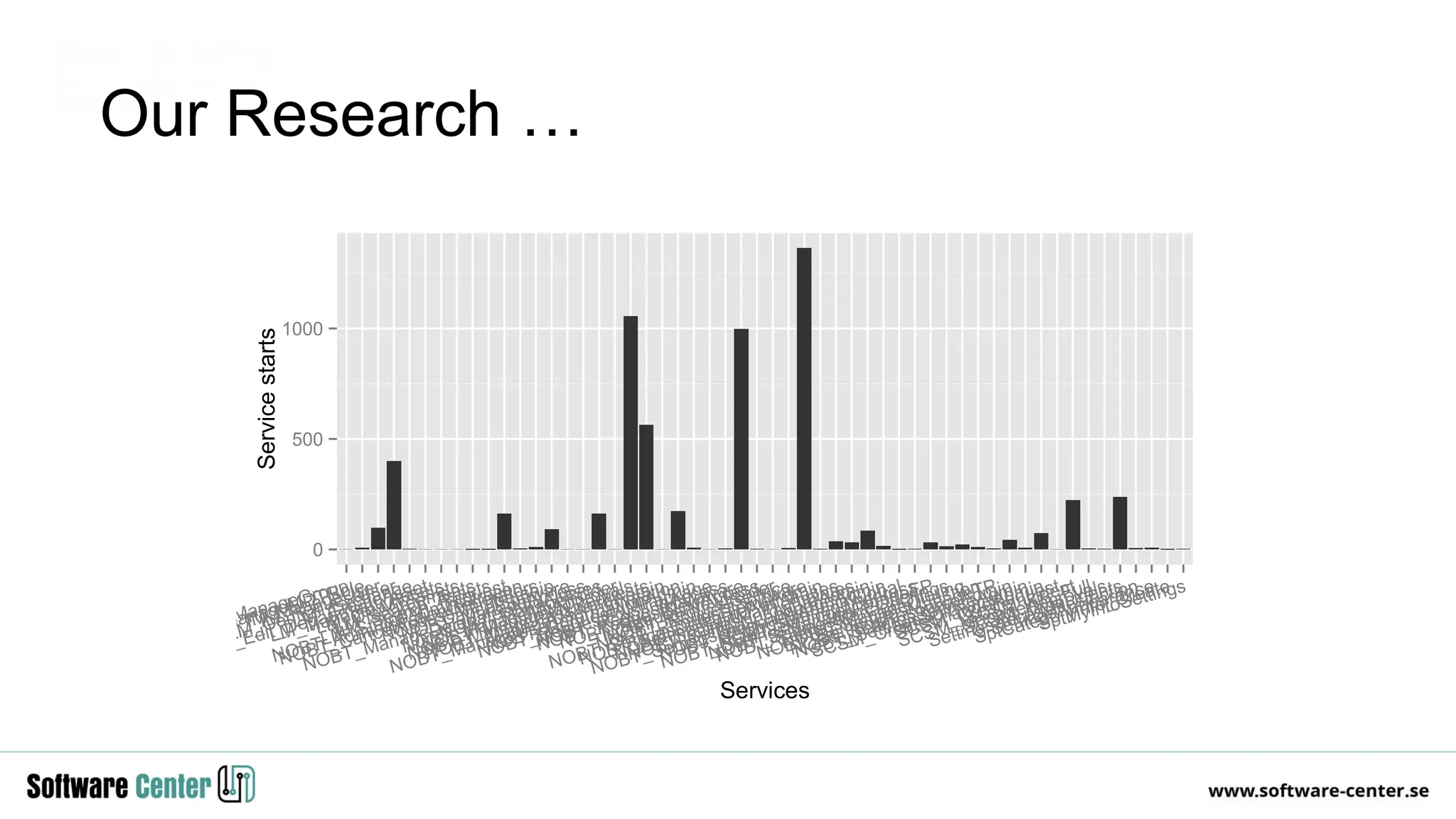
How do we
know that
we’re actually
delivering
value
customers
care about?
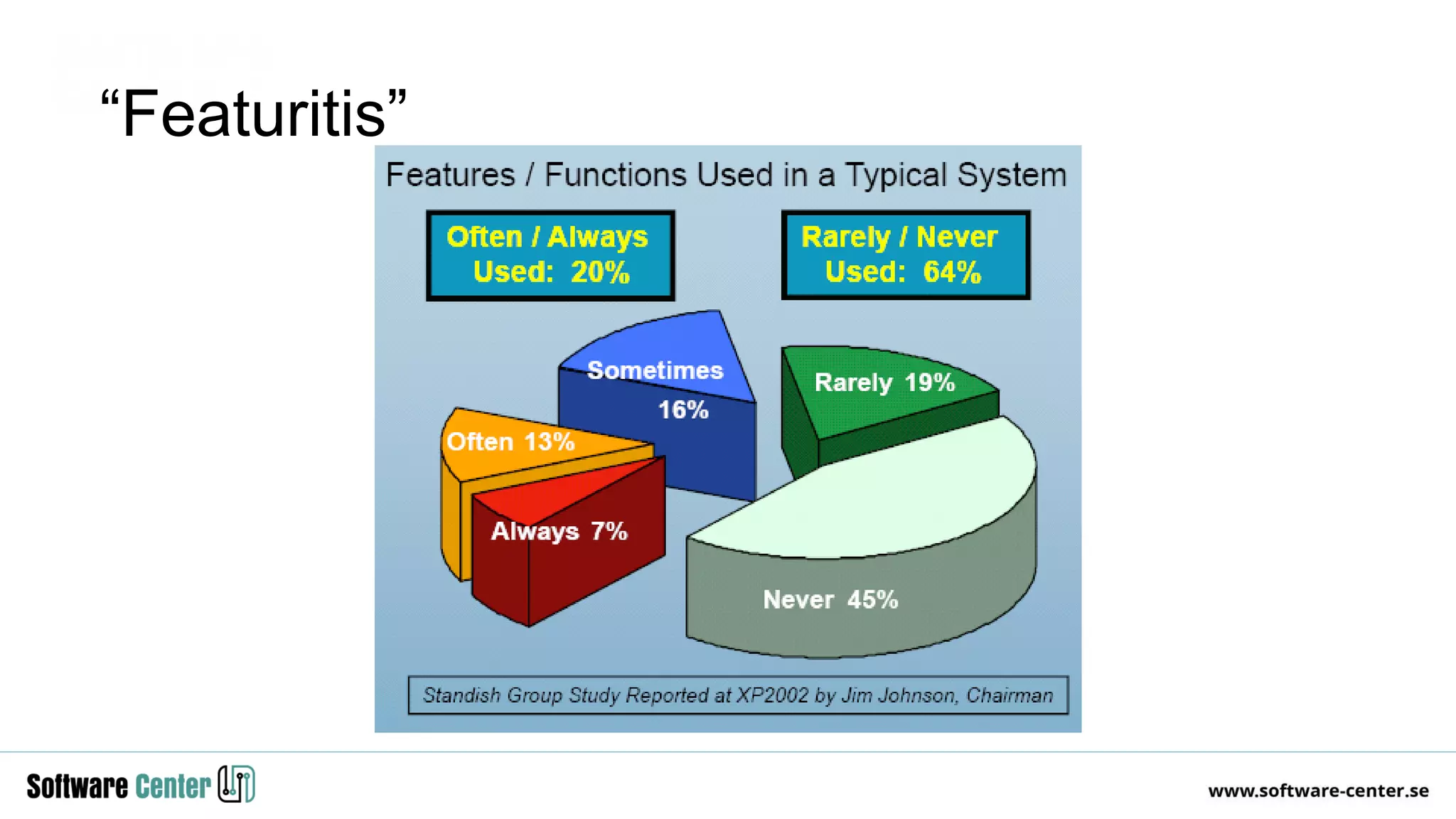
“Featuritis”
Our Research …
0
500
1000
IM_ManageGroup
IM_ManageMDTRole
IM_ManageUser
IM_RequestUser
LM_Central_Exchange
LM_CreateAsset
LM_Edit_Department_Assets
LM_Manage_MyAssets
LM_OPAgreements
LM_Search_Assets
LM_Search_Request
LM_StatusAdministration
NOBT_AdministrationGenerators
NOBT_CancelAccessMembership
NOBT_CancelSoftware
NOBT_ManageAccess
NOBT_ManageDelegatesAndAliases
NOBT_ManageFolder
NOBT_ManageMyApprovals
NOBT_ManageMyRequests
NOBT_ManagePasswordAdmin
NOBT_ManageUserInformation
NOBT_ManageUserInformationAdmin
NOBT_RequestAMPackage
NOBT_RequestExistingAccess
NOBT_RequestHardware
NOBT_RequestNewAccess
NOBT_RequestNewFolder
NOBT_RequestService
NOBT_RequestSoftware
NOBT_RequestTempAdmin
NOBT_SettingsDelegateAndAliases
NOBT_SettingsEditMailTemplates
NOBT_SettingsHardwareAdmin
NOBT_SettingsLanguageAdmin
NOBT_SettingsLanguageAdminGlobal
NOBT_SettingsManageAddress
NOBT_SettingsManageFP
NOBT_SettingsManageFPOfferings
NOBT_SettingsManageOffering
NOBT_SettingsManageQuestion
NOBT_SettingsManageTP
NOBT_SettingsResourceAdmin
NOBT_SettingsServiceAdmin
NOBT_SettingsSoftwareAdmin
SCSM_CreateChangeRequest
SCSM_CreateIncident
SCSM_KB_Full
SCSM_ManageApprovals
SCSM_MyIncidents
SettingsAccessRestriction
SettingsAppearance
SptCategoryInfo_Create
SptMyInfoSettings
Services
Service
starts
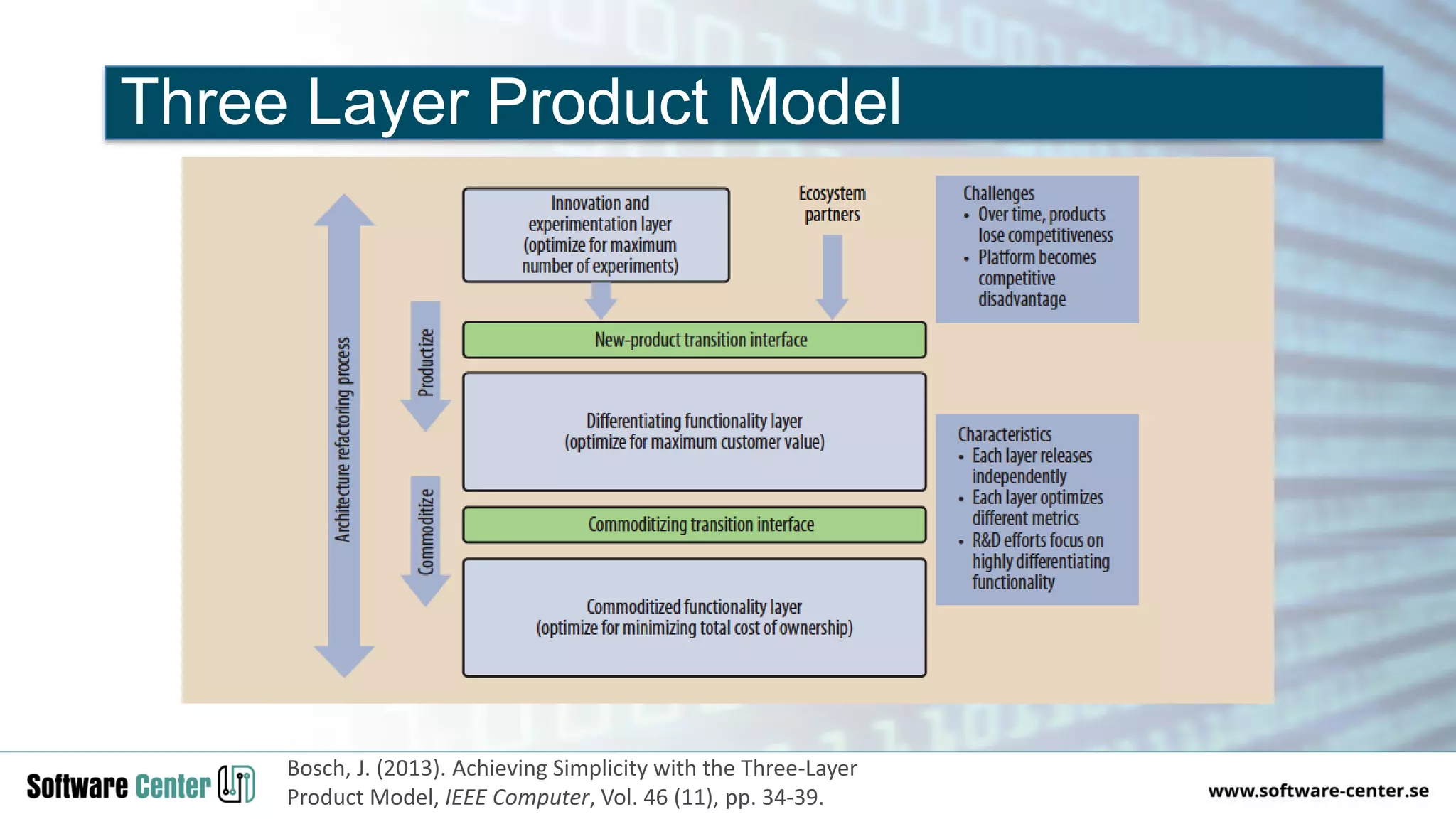
Bosch, J. (2013). Achieving Simplicity with the Three-Layer
Product Model, IEEE Computer, Vol. 46 (11), pp. 34-39.
Three Layer Product Model
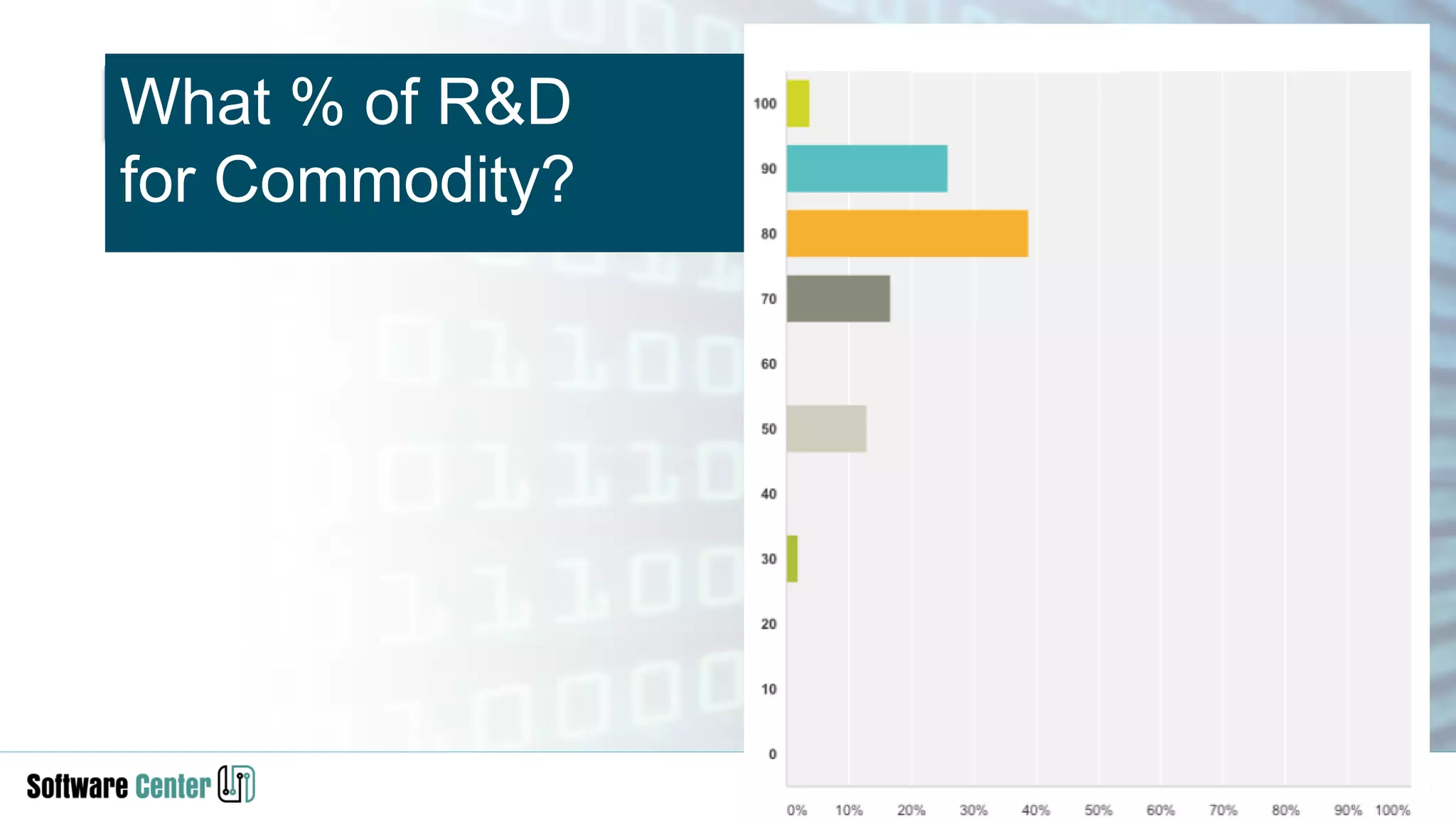
What % of R&D
for Commodity?
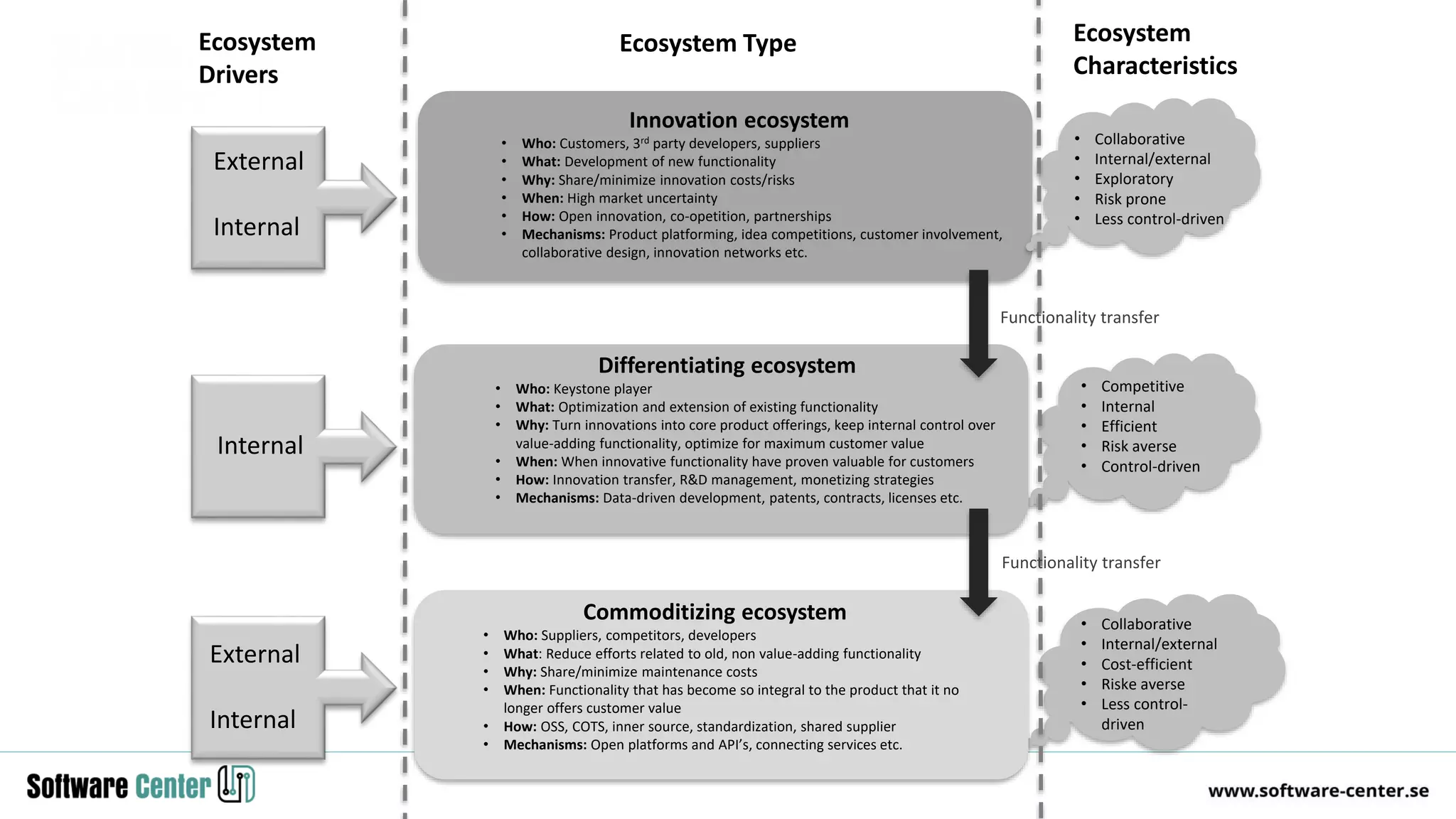
Innovation ecosystem
• Who: Customers, 3rd party developers, suppliers
• What: Development of new functionality
• Why: Share/minimize innovation costs/risks
• When: High market uncertainty
• How: Open innovation, co-opetition, partnerships
• Mechanisms: Product platforming, idea competitions, customer involvement,
collaborative design, innovation networks etc.
Differentiating ecosystem
• Who: Keystone player
• What: Optimization and extension of existing functionality
• Why: Turn innovations into core product offerings, keep internal control over
value-adding functionality, optimize for maximum customer value
• When: When innovative functionality have proven valuable for customers
• How: Innovation transfer, R&D management, monetizing strategies
• Mechanisms: Data-driven development, patents, contracts, licenses etc.
Commoditizing ecosystem
• Who: Suppliers, competitors, developers
• What: Reduce efforts related to old, non value-adding functionality
• Why: Share/minimize maintenance costs
• When: Functionality that has become so integral to the product that it no
longer offers customer value
• How: OSS, COTS, inner source, standardization, shared supplier
• Mechanisms: Open platforms and API’s, connecting services etc.
• Collaborative
• Internal/external
• Exploratory
• Risk prone
• Less control-driven
• Competitive
• Internal
• Efficient
• Risk averse
• Control-driven
• Collaborative
• Internal/external
• Cost-efficient
• Riske averse
• Less control-
driven
Ecosystem
Drivers
Ecosystem Type Ecosystem
Characteristics
External
Internal
External
Internal
Internal
Functionality transfer
Innovation ecosystem
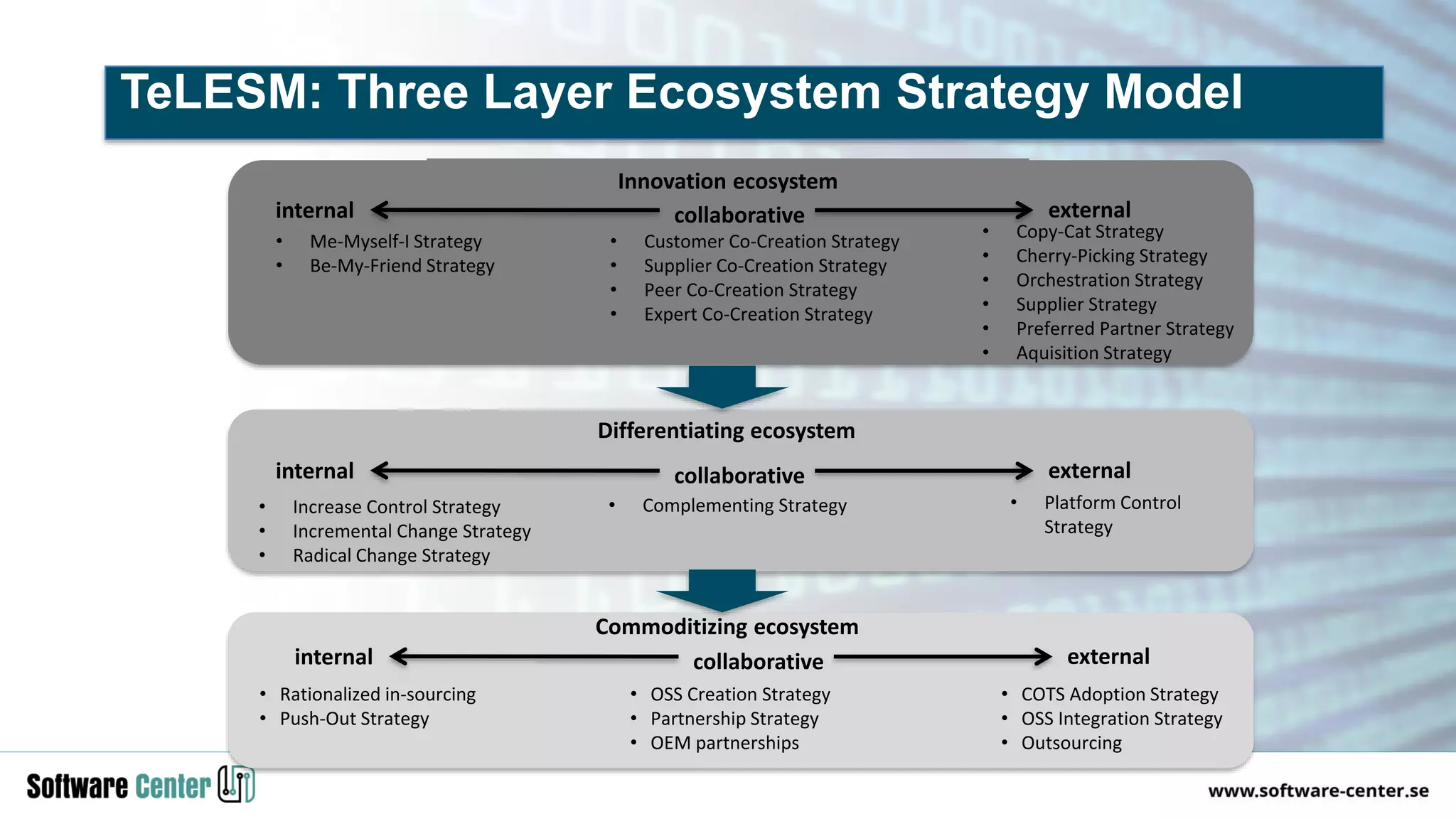
internal external
collaborative
• Me-Myself-I Strategy
• Be-My-Friend Strategy
• Copy-Cat Strategy
• Cherry-Picking Strategy
• Orchestration Strategy
• Supplier Strategy
• Preferred Partner Strategy
• Aquisition Strategy
• Customer Co-Creation Strategy
• Supplier Co-Creation Strategy
• Peer Co-Creation Strategy
• Expert Co-Creation Strategy
Differentiating ecosystem
internal external
collaborative
• Increase Control Strategy
• Incremental Change Strategy
• Radical Change Strategy
Commoditizing ecosystem
internal external
collaborative
• COTS Adoption Strategy
• OSS Integration Strategy
• Outsourcing
• OSS Creation Strategy
• Partnership Strategy
• OEM partnerships
• Rationalized in-sourcing
• Push-Out Strategy
• Complementing Strategy • Platform Control
Strategy
TeLESM: Three Layer Ecosystem Strategy Model
• Vem är jag? Wie ben ik? Who am I?
• Digitalization
• Superset platforms
• Three layer product model
• Systems engineering
• Conclusion
Overview
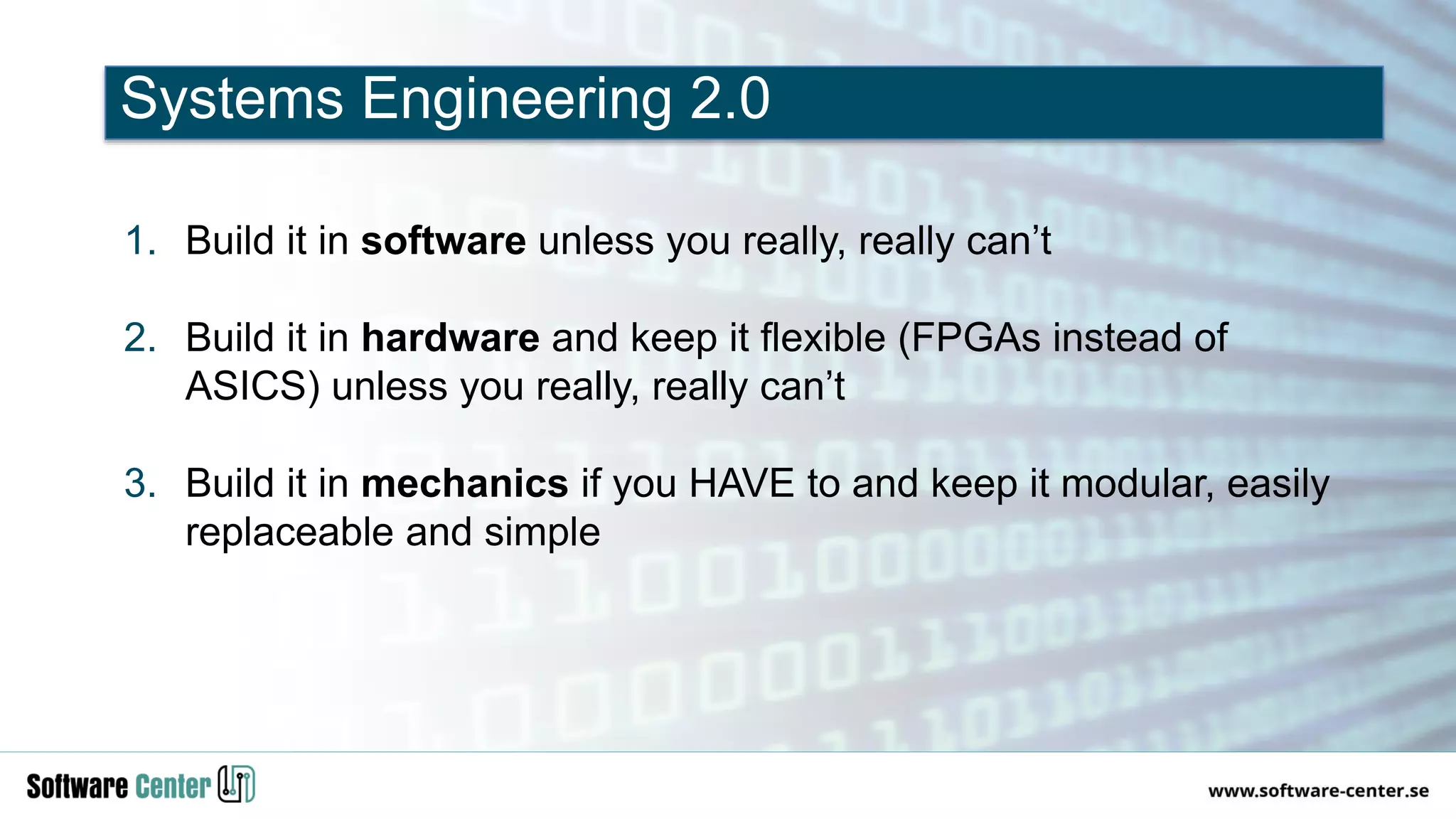
1. Build it in software unless you really, really can’t
2. Build it in hardware and keep it flexible (FPGAs instead of
ASICS) unless you really, really can’t
3. Build it in mechanics if you HAVE to and keep it modular, easily
replaceable and simple
Systems Engineering 2.0
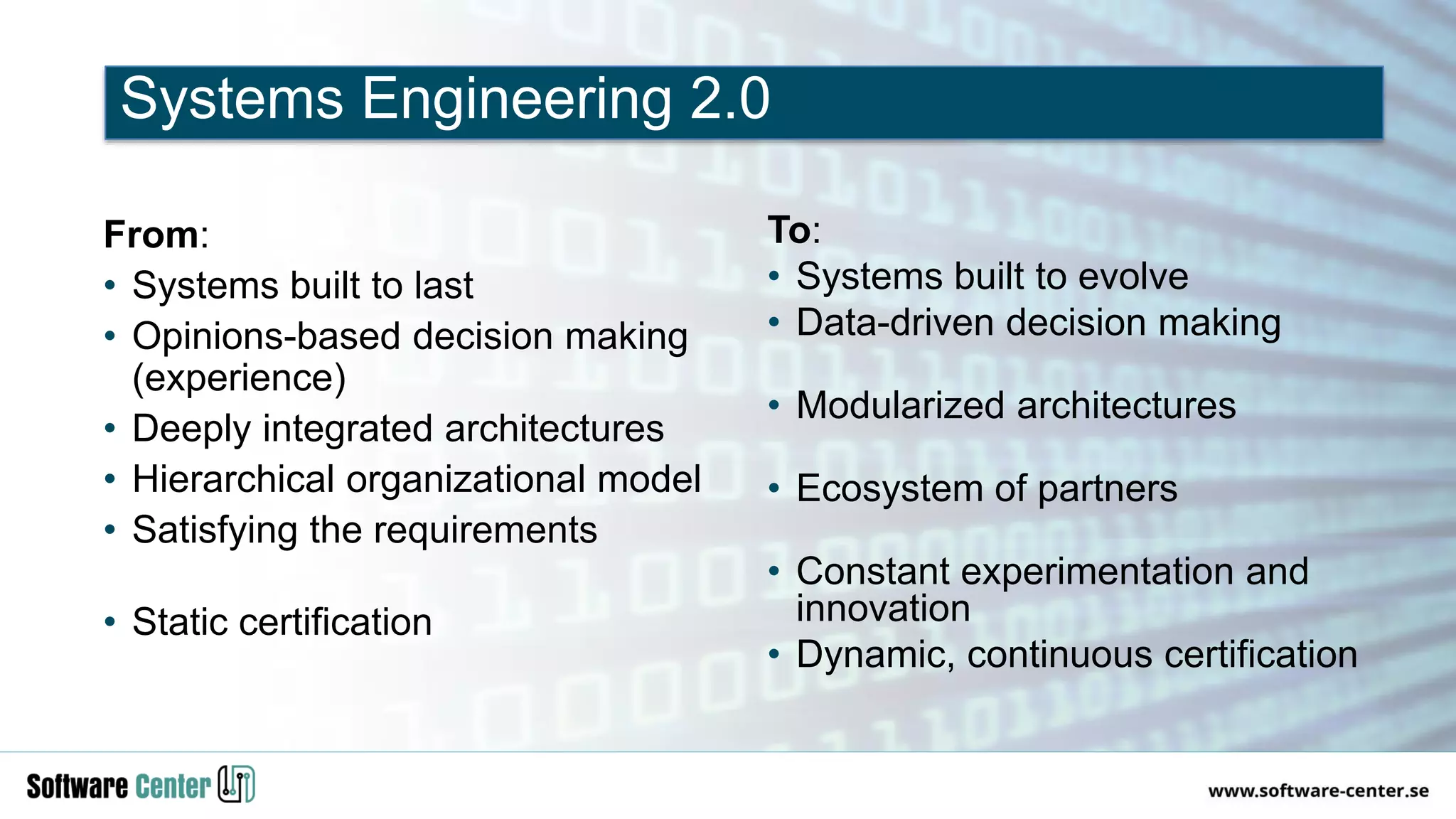
From:
• Systems built to last
• Opinions-based decision making
(experience)
• Deeply integrated architectures
• Hierarchical organizational model
• Satisfying the requirements
• Static certification
To:
• Systems built to evolve
• Data-driven decision making
• Modularized architectures
• Ecosystem of partners
• Constant experimentation and
innovation
• Dynamic, continuous certification
Systems Engineering 2.0
• Vem är jag? Wie ben ik? Who am I?
• Digitalization
• Superset platforms
• Three layer product model
• Systems engineering
• Conclusion
Overview
• Digitalization drives the adoption of Ops, i.e. DevOps, DataOps, MLOps,
putting unique, new challenges on software platforms
• Superset software platforms are the only cost effective solution for
DevOps
• Superset platforms affect the way we conduct systems engineering
Conclusion
Learn More?
www.janbosch.com
jan@janbosch.com
Follow me on LinkedIn, Twitter (@JanBosch) or
www.janbosch.com/blog

Product Lines and Ecosystems: from customization to configuration

  • 1.
    Product Lines andEcosystems from customization to configuration Jan Bosch Director Software Center www.software-center.se Professor of Software Engineering Chalmers University of Technology Gothenburg, Sweden.
  • 2.
    • Digitalization drivesthe adoption of Ops, i.e. DevOps, DataOps, MLOps, putting unique, new challenges on software platforms • Superset software platforms are the only cost effective solution for DevOps • Superset platforms affect the way we conduct systems engineering Three Key Take-Aways
  • 3.
    • Vem ärjag? Wie ben ik? Who am I? • Digitalization • Superset platforms • Three layer product model • Systems engineering • Conclusion Overview
  • 4.
  • 5.
    Software Center Mission: Tosignificantly improve the digitalization capability of the European Software-Intensive industry
  • 7.
  • 8.
    • Vem ärjag? Wie ben ik? Who am I? • Digitalization • Superset platforms • Three layer product model • Systems engineering • Conclusion Overview
  • 9.
    How many companiesthat were on the Fortune 500 list in 2000 are still on the list in 2014?
  • 10.
    Disruption Is TheNew Normal • Jim Collins (Built to last): Companies last, on average, 30 15 10 years on the Fortune 500 list. And that time period is decreasing • Main cause: Companies fail to innovate and to build new core capabilities Digitalization Is The New Disruptor!
  • 11.
    Digitalization Digitalization is theuse of digital technologies to change a business model and provide new revenue and value- producing opportunities; it is the process of moving to a digital business. - Gartner
  • 12.
  • 13.
    Digitalization Value Time upgrade electronics Replace mechanics Value Time continuous software deployment incl.AI models • Differentiation through mechanics and electronics is increasingly difficult • To avoid commoditization, new solutions and services are required • Digitalization of products, data from the field and changed business models can provide differentiation Hypothesis: growing revenue through new, continuous business models based on a digitalized product portfolio is the most promising strategy to increase differentiation and avoid commoditization
  • 14.
    • Product generations •Annual software updates • DevOps, DataOps and AI/MLOps • A/B testing • Reinforcement learning How do we deliver value to customers? shortening of value delivery cycles
  • 15.
    Bosch, Jan, andHelena H. Olsson. "Digital for real: A multicase study on the digital transformation of companies in the embedded systems domain.” Journal of Software: Evolution and Process 33, no. 5 (2021): e2333.
  • 16.
    Stairway to Heaven:Speed R&D teams R&D teams V&V R&D teams V&V Release Cust. Sup. R&D teams V&V Release Cust. sup. Prod. mgmt. Sales & mrkt
  • 17.
    • Vem ärjag? Wie ben ik? Who am I? • Digitalization • Superset platforms • Three layer product model • Systems engineering • Conclusion Overview
  • 18.
    • Traditional: sharecommodity functionality between products • Current: support DevOps for a portfolio of products • Upcoming: provide common API for rapid prototyping, 3rd party developers, partners and customers (your business ecosystem) Why Platforms?
  • 19.
    Typical Architectural EvolutionPath independent products standardized infrastructure platform software product line superset platform ecosystem
  • 20.
  • 21.
    DevOps continuous deployment of new software data A/Btest, performance, user, AI … processing, analytics, labeling, …
  • 22.
    • Traditional: sharecommodity functionality between products • Current: support DevOps for a portfolio of products • Upcoming: provide common API for rapid prototyping, 3rd party developers, partners and customers (your business ecosystem) Why Platforms?
  • 23.
    Economic community supportedby a foundation of interacting organizations and individuals, which can also be perceived as organisms of the business world (Moore, 1993). 1. Symbiotic relationship 2. Co-evolution 3. Platform: tools, services and technology used in ecosystem to enhance performance Business Ecosystem
  • 24.
    • Keystone: centralfirm (e.g., Apple) • Complementor: provide product/service complementing ecosystem product/platform and enhances value (e.g., suppliers, developers) • Integrator: brings together parts provided by ecosystem players into an integrated solution for end-user • Customer or end-user Roles in ecosystems
  • 25.
    Two fundamental strategies •Collaborative – cooperation in communities e.g., android platform (Google), Wikipedia • Competitive – market driven e.g., Apple app-store, Gore- Tex Ecosystem Strategies
  • 26.
  • 27.
    • Here’s atry: A business ecosystem consists of a platform, a set of internal and external developers and a community of domain experts in service to a community of users that compose relevant solution elements to satisfy their needs. • Some more detail: Platform: A hierarchical set of shared components providing functionality that is required and common for the developers constructing solutions on top of the platform. Evolution: Over time, the functionality in the ecosystem commoditizes and flows from unique solutions to the platform. Developers: Although internal and external developers use the platform differently, the platform often allows developers to build on top of each other’s results. Composition: Users are able to compose their own solutions by selecting various elements into a configuration that suits their needs optimally. Software Ecosystems
  • 28.
    Model of IndustryStructures Open Ecosystem Fully Integrated Firms 1 2 3 4 Supply Chains Suppliers and Integrators Closed Ecosystem 5 Open Ecosystem Fully Integrated Firms 1 2 3 4 Supply Chains Suppliers and Integrators Closed Ecosystem 5
  • 29.
    Characteristics Fully integrated firm Suppliersand integrator Supply chains Closed ecosystem Open ecosystem Product architecture Firm Integrator Shared control Keystone partner & key partners Open industry standards Customer contact Direct, sole contact Integrator only Last firm in chain Keystone partner All ecosystem participants Platform architecture N/A N/A Dominant player Keystone partner Open industry standard Functionality All done in- house Selected parts sourced Each party owns their own parts Everyone, based on platform architecture All ecosystem participants Industry Structures
  • 30.
    Conflicting Forces Open Ecosystem Fully Integrated Firms Less developmentCosts Shorter Time-to-market (Time to money) More variability Constrained innovation 1 2 3 4 More control over the architecture More efficient use of computer resources Better control over process More control over requirements Better control over quality Supply Chains Suppliers and Integrators Integrators view: Closed Ecosystem 5 Open Ecosystem Fully Integrated Firms Less development Costs Shorter Time-to-market (Time to money) More variability Constrained innovation 1 2 3 4 More control over the architecture More efficient use of computer resources Better control over process More control over requirements Better control over quality Supply Chains Suppliers and Integrators Integrators view: Closed Ecosystem 5
  • 31.
    • Vem ärjag? Wie ben ik? Who am I? • Digitalization • Superset platforms • Three layer product model • Systems engineering • Conclusion Overview
  • 32.
    How do we knowthat we’re actually delivering value customers care about?
  • 33.
  • 34.
    Our Research … 0 500 1000 IM_ManageGroup IM_ManageMDTRole IM_ManageUser IM_RequestUser LM_Central_Exchange LM_CreateAsset LM_Edit_Department_Assets LM_Manage_MyAssets LM_OPAgreements LM_Search_Assets LM_Search_Request LM_StatusAdministration NOBT_AdministrationGenerators NOBT_CancelAccessMembership NOBT_CancelSoftware NOBT_ManageAccess NOBT_ManageDelegatesAndAliases NOBT_ManageFolder NOBT_ManageMyApprovals NOBT_ManageMyRequests NOBT_ManagePasswordAdmin NOBT_ManageUserInformation NOBT_ManageUserInformationAdmin NOBT_RequestAMPackage NOBT_RequestExistingAccess NOBT_RequestHardware NOBT_RequestNewAccess NOBT_RequestNewFolder NOBT_RequestService NOBT_RequestSoftware NOBT_RequestTempAdmin NOBT_SettingsDelegateAndAliases NOBT_SettingsEditMailTemplates NOBT_SettingsHardwareAdmin NOBT_SettingsLanguageAdmin NOBT_SettingsLanguageAdminGlobal NOBT_SettingsManageAddress NOBT_SettingsManageFP NOBT_SettingsManageFPOfferings NOBT_SettingsManageOffering NOBT_SettingsManageQuestion NOBT_SettingsManageTP NOBT_SettingsResourceAdmin NOBT_SettingsServiceAdmin NOBT_SettingsSoftwareAdmin SCSM_CreateChangeRequest SCSM_CreateIncident SCSM_KB_Full SCSM_ManageApprovals SCSM_MyIncidents SettingsAccessRestriction SettingsAppearance SptCategoryInfo_Create SptMyInfoSettings Services Service starts
  • 35.
    Bosch, J. (2013).Achieving Simplicity with the Three-Layer Product Model, IEEE Computer, Vol. 46 (11), pp. 34-39. Three Layer Product Model
  • 36.
    What % ofR&D for Commodity?
  • 37.
    Innovation ecosystem • Who:Customers, 3rd party developers, suppliers • What: Development of new functionality • Why: Share/minimize innovation costs/risks • When: High market uncertainty • How: Open innovation, co-opetition, partnerships • Mechanisms: Product platforming, idea competitions, customer involvement, collaborative design, innovation networks etc. Differentiating ecosystem • Who: Keystone player • What: Optimization and extension of existing functionality • Why: Turn innovations into core product offerings, keep internal control over value-adding functionality, optimize for maximum customer value • When: When innovative functionality have proven valuable for customers • How: Innovation transfer, R&D management, monetizing strategies • Mechanisms: Data-driven development, patents, contracts, licenses etc. Commoditizing ecosystem • Who: Suppliers, competitors, developers • What: Reduce efforts related to old, non value-adding functionality • Why: Share/minimize maintenance costs • When: Functionality that has become so integral to the product that it no longer offers customer value • How: OSS, COTS, inner source, standardization, shared supplier • Mechanisms: Open platforms and API’s, connecting services etc. • Collaborative • Internal/external • Exploratory • Risk prone • Less control-driven • Competitive • Internal • Efficient • Risk averse • Control-driven • Collaborative • Internal/external • Cost-efficient • Riske averse • Less control- driven Ecosystem Drivers Ecosystem Type Ecosystem Characteristics External Internal External Internal Internal Functionality transfer Functionality transfer
  • 38.
    Innovation ecosystem internal external collaborative •Me-Myself-I Strategy • Be-My-Friend Strategy • Copy-Cat Strategy • Cherry-Picking Strategy • Orchestration Strategy • Supplier Strategy • Preferred Partner Strategy • Aquisition Strategy • Customer Co-Creation Strategy • Supplier Co-Creation Strategy • Peer Co-Creation Strategy • Expert Co-Creation Strategy Differentiating ecosystem internal external collaborative • Increase Control Strategy • Incremental Change Strategy • Radical Change Strategy Commoditizing ecosystem internal external collaborative • COTS Adoption Strategy • OSS Integration Strategy • Outsourcing • OSS Creation Strategy • Partnership Strategy • OEM partnerships • Rationalized in-sourcing • Push-Out Strategy • Complementing Strategy • Platform Control Strategy TeLESM: Three Layer Ecosystem Strategy Model
  • 39.
    • Vem ärjag? Wie ben ik? Who am I? • Digitalization • Superset platforms • Three layer product model • Systems engineering • Conclusion Overview
  • 40.
    1. Build itin software unless you really, really can’t 2. Build it in hardware and keep it flexible (FPGAs instead of ASICS) unless you really, really can’t 3. Build it in mechanics if you HAVE to and keep it modular, easily replaceable and simple Systems Engineering 2.0
  • 41.
    From: • Systems builtto last • Opinions-based decision making (experience) • Deeply integrated architectures • Hierarchical organizational model • Satisfying the requirements • Static certification To: • Systems built to evolve • Data-driven decision making • Modularized architectures • Ecosystem of partners • Constant experimentation and innovation • Dynamic, continuous certification Systems Engineering 2.0
  • 42.
    • Vem ärjag? Wie ben ik? Who am I? • Digitalization • Superset platforms • Three layer product model • Systems engineering • Conclusion Overview
  • 43.
    • Digitalization drivesthe adoption of Ops, i.e. DevOps, DataOps, MLOps, putting unique, new challenges on software platforms • Superset software platforms are the only cost effective solution for DevOps • Superset platforms affect the way we conduct systems engineering Conclusion
  • 44.
  • 45.
    www.janbosch.com jan@janbosch.com Follow me onLinkedIn, Twitter (@JanBosch) or www.janbosch.com/blog