Comparing the Multimodal
Interaction Technique Design of
MINT with NiMMiT
Sebastian Feuerstack and Ednaldo B. Pizzolato
Dr.-Ing. Sebastian Feuerstack
OFFIS – Institute for Information Technology
Oldenburg, Germany
21. Dezember 2013

Sebastian Feuerstack I Sebastian@Feuerstack.org
Outline
1.
2.
3.
4.

Introduction / Use Case
Related Work
NiMMiT vs. MINT
Results of Comparison

21. Dezember 2013

2
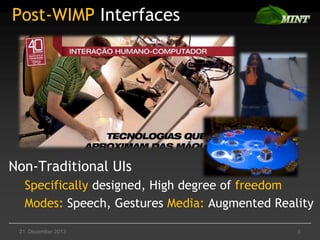
Post-WIMP Interfaces

Non-Traditional UIs
Specifically designed, High degree of freedom
Modes: Speech, Gestures Media: Augmented Reality
21. Dezember 2013

3
Basic Question

How to model
multimodal interaction
techniques?

21. Dezember 2013

4
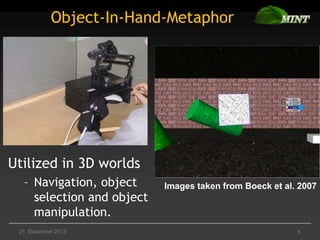
Object-In-Hand-Metaphor

Utilized in 3D worlds
– Navigation, object
selection and object
manipulation.
21. Dezember 2013

Images taken from Boeck et al. 2007

5
Why modeling?
Design, prototype, communicate and store
interaction techniques to be re-usable.
• High-level visual language
– Incorporated in a tool
– Abstracts source code
– Declarative and precise to be executed
21. Dezember 2013

6
What is State of the Art ?
State-driven
Object Graphs [Carr97]
ICOs [Navarre05]

Dataflow-driven:
InTml [Figueroa02]

Icon [Dragicevic04]

NiMMiT [Boeck06]
State + Data + Event +
Hierarchy
21. Dezember 2013

7
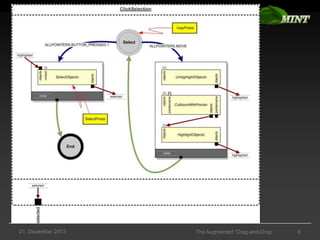
21. Dezember 2013

The Augmented “Drag-and-Drop

8
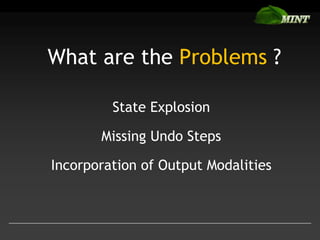
What are the Problems ?
State Explosion
Missing Undo Steps

Incorporation of Output Modalities
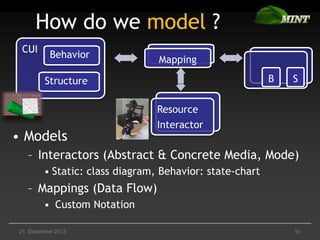
How do we model ?
CUI

Behavior

Mapping

B

Structure

• Models

S

Resource
Interactor

– Interactors (Abstract & Concrete Media, Mode)
• Static: class diagram, Behavior: state-chart

– Mappings (Data Flow)
• Custom Notation
21. Dezember 2013

10
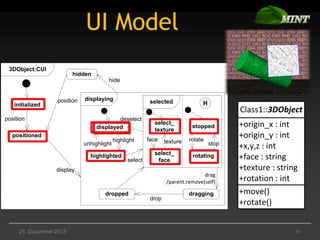
UI Model
3DObject:CUI

hidden
hide

initialized

position

position

displaying

selected

deselect
displayed

positioned
unhighlight

highlight

highlighted

select

select_
texture
face

select_
face

display

Class1::3DObject

stopped
rotate

stop

rotating

drag
/parent.remove(self)
dropped

21. Dezember 2013

texture

H

drop

dragging

+origin_x : int
+origin_y : int
+x,y,z : int
+face : string
+texture : string
+rotation : int
+move()
+rotate()

11
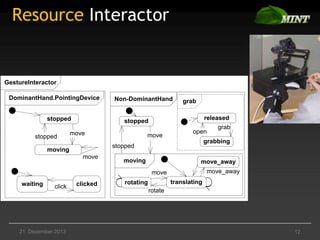
Resource Interactor

GestureInteractor
DominantHand.PointingDevice
stopped
stopped

Non-DominantHand

stopped

move

move

grab
released
grab
open
grabbing

stopped

moving
move

moving

move_away
move_away

move
waiting

click

21. Dezember 2013

clicked

translating

rotating
rotate

12
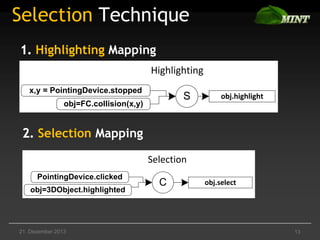
Selection Technique
Highlighting Mapping
Highlighting
x,y = PointingDevice.stopped

S

obj=FC.collision(x,y)

obj.highlight

Selection Mapping
Selection
PointingDevice.clicked
obj=3DObject.highlighted

21. Dezember 2013

C

obj.select

13
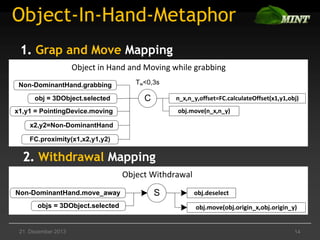
Object-In-Hand-Metaphor
Grap and Move Mapping
Object in Hand and Moving while grabbing
Non-DominantHand.grabbing
obj = 3DObject.selected

Tw<0,3s

C

n_x,n_y,offset=FC.calculateOffset(x1,y1,obj)
obj.move(n_x,n_y)

x1,y1 = PointingDevice.moving
x2,y2=Non-DominantHand
FC.proximity(x1,x2,y1,y2)

Withdrawal Mapping
Object Withdrawal
Non-DominantHand.move_away
objs = 3DObject.selected

21. Dezember 2013

S

obj.deselect
obj.move(obj.origin_x,obj.origin_y)

14
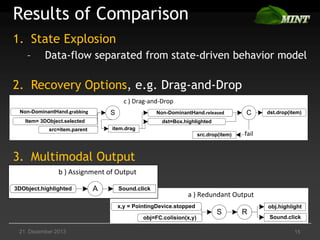
Results of Comparison
1. State Explosion
–

Data-flow separated from state-driven behavior model

2. Recovery Options, e.g. Drag-and-Drop
c ) Drag-and-Drop
Non-DominantHand.grabbing

S

Non-DominantHand.released

Item= 3DObject.selected

C

dst.drop(item)

dst=Box.highlighted
item.drag

src=item.parent

src.drop(item)

fail

3. Multimodal Output
b ) Assignment of Output
3DObject.highlighted

A

Sound.click

a ) Redundant Output

x,y = PointingDevice.stopped
obj=FC.colision(x,y)
21. Dezember 2013

S

R

obj.highlight
Sound.click
15
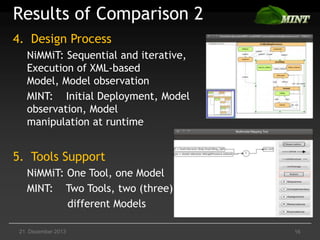
Results of Comparison 2
4. Design Process
NiMMiT: Sequential and iterative,
Execution of XML-based
Model, Model observation
MINT: Initial Deployment, Model
observation, Model
manipulation at runtime

5. Tools Support
NiMMiT: One Tool, one Model
MINT: Two Tools, two (three)
different Models
21. Dezember 2013

16
Questions or Comments?

21. Dezember 2013

17
Bio Sebastian Feuerstack
Master in Information Systems and Artificial
Intelligence, Technical University Berlin
PhD about Modal-based Design of Interactive
Systems, TU-Berlin & Researcher, DAI-Labor
Post-Doc about Design of Multimodal Interaction,
UFSCar & German Research Foundation
Project Manager & Senior Researcher of the
European Research Project: Holistic Human Factors
and System Design of Adaptive Cooperative HumanMachine Systems, OFFIS, Oldenburg, Germany

Research Interests: Engineering Interactive Systems,
Models, Methods and Tools Application: Assistance

Systems
Publications, Slides, Videos and Projects:
http://www.multi-access.de & http://www.feuerstack.org
21. Dezember 2013

18

Comparing the Multimodal Interaction Technique Design of MINT with NiMMiT

Editor's Notes

  • #4  The Post-WIMP term sums up the trend to design interaction techniques specifically to a certain combination of an application and one or more interaction devices and their control modes. Non-traditional interfaces that consider modes like speech or gestures and media such as augmented and hyper-reality offer a high degree of freedom in interaction design but make the design process cumbersome since extensive user testing is usually required to figure out an efficient and accessible way of interaction.
  • #7 is
  • #10 Transformationalapproach Not targetedtomultmodalinterfaces, Models areinspectable but transformationsarecomplexAssembly Approach: Black-boxedcomponents, extensibilityproblem