STATE
STD XI - POLITICAL SCIENCE
INTRODUCTION
STATE
ASPECTS OF STATE
▸ Different aspects of state are proposed such as:-
1. An organisation of different organisations.
2. An instrument of authority.
3. An instrument of authority to oppress people.
STATE
ORIGIN OF THE ENTITY OF THE STATE
▸ Difficult Task.
▸ Limited knowledge of human history.
▸ Social Contract Theories made by (for e.g.):-
John Locke Thomas Hobbes Jean-Jacques
Rousseau
STATE
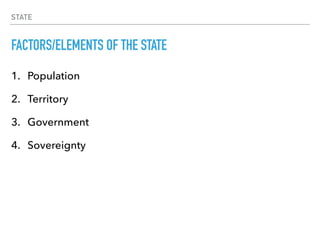
FACTORS/ELEMENTS OF THE STATE
1. Population
2. Territory
3. Government
4. Sovereignty
STATE
1. POPULATION
▸ State is a human institution.
▸ State should have only that size of the population which
can be conveniently be supported by its resources.
▸ Quality and quantity of the people.
▸ Optimum development of the state population.
STATE
2.TERRITORY
▸ The word ‘Territory’ covers the surface of the land within well defined
boundaries, the sub-soil, lakes and rivers and also air space above the land.
▸ Existence of the state depends not on the area of the territory but the
development of the state is dependent upon the situation and quality of the
territory.
▸ Examples:-
1. Compact Territory (Pakistan, Russia)
2. Area (USA & Monaco, Russia & Vatican City)
3. Naturally Secure Boundary Lines
STATE
3. GOVERNMENT
▸ Network through which the legislative, executive and
judicial work of the state is carried out.
▸ Types of government:-
Government
Legislature Executive Judiciary
Government
Monarchial Democratic Dictatorial
STATE
4. SOVEREIGNTY
▸ Highest power over all the people internally as well as
externally.
1.Internally the state has supreme power which makes rules
and laws, controls and coerce them and punish all the
individuals, groups etc. within its jurisdiction.
2.Externally the state should be free from foreign control
and determine its internal and foreign policy without any
outside interference and pressure.
STATE
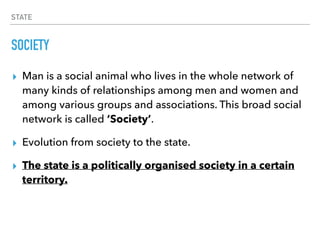
SOCIETY
▸ Man is a social animal who lives in the whole network of
many kinds of relationships among men and women and
among various groups and associations. This broad social
network is called ‘Society’.
▸ Evolution from society to the state.
▸ The state is a politically organised society in a certain
territory.
STATE
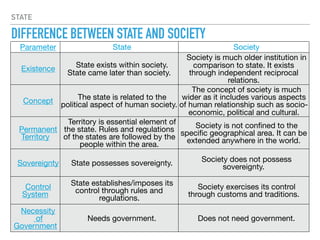
DIFFERENCE BETWEEN STATE AND SOCIETY
Parameter State Society
Existence State exists within society.
State came later than society.
Society is much older institution in
comparison to state. It exists
through independent reciprocal
relations.
Concept The state is related to the
political aspect of human society.
The concept of society is much
wider as it includes various aspects
of human relationship such as socio-
economic, political and cultural.
Permanent
Territory
Territory is essential element of
the state. Rules and regulations
of the states are followed by the
people within the area.
Society is not confined to the
specific geographical area. It can be
extended anywhere in the world.
Sovereignty State possesses sovereignty. Society does not possess
sovereignty.
Control
System
State establishes/imposes its
control through rules and
regulations.
Society exercises its control
through customs and traditions.
Necessity

of
Government
Needs government. Does not need government.
STATE
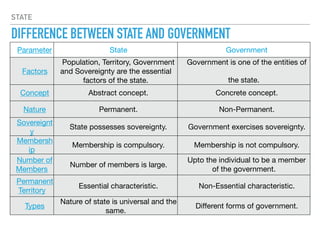
DIFFERENCE BETWEEN STATE AND GOVERNMENT
Parameter State Government
Factors
Population, Territory, Government
and Sovereignty are the essential
factors of the state.
Government is one of the entities of
the state.
Concept Abstract concept. Concrete concept.
Nature Permanent. Non-Permanent.
Sovereignt
y
State possesses sovereignty. Government exercises sovereignty.
Membersh
ip
Membership is compulsory. Membership is not compulsory.
Number of
Members
Number of members is large.
Upto the individual to be a member
of the government.
Permanent
Territory
Essential characteristic. Non-Essential characteristic.
Types
Nature of state is universal and the
same.
Different forms of government.
Like and Comment

State

  • 1.
    STATE STD XI -POLITICAL SCIENCE
  • 2.
  • 3.
    STATE ASPECTS OF STATE ▸Different aspects of state are proposed such as:- 1. An organisation of different organisations. 2. An instrument of authority. 3. An instrument of authority to oppress people.
  • 4.
    STATE ORIGIN OF THEENTITY OF THE STATE ▸ Difficult Task. ▸ Limited knowledge of human history. ▸ Social Contract Theories made by (for e.g.):- John Locke Thomas Hobbes Jean-Jacques Rousseau
  • 5.
    STATE FACTORS/ELEMENTS OF THESTATE 1. Population 2. Territory 3. Government 4. Sovereignty
  • 6.
    STATE 1. POPULATION ▸ Stateis a human institution. ▸ State should have only that size of the population which can be conveniently be supported by its resources. ▸ Quality and quantity of the people. ▸ Optimum development of the state population.
  • 7.
    STATE 2.TERRITORY ▸ The word‘Territory’ covers the surface of the land within well defined boundaries, the sub-soil, lakes and rivers and also air space above the land. ▸ Existence of the state depends not on the area of the territory but the development of the state is dependent upon the situation and quality of the territory. ▸ Examples:- 1. Compact Territory (Pakistan, Russia) 2. Area (USA & Monaco, Russia & Vatican City) 3. Naturally Secure Boundary Lines
  • 8.
    STATE 3. GOVERNMENT ▸ Networkthrough which the legislative, executive and judicial work of the state is carried out. ▸ Types of government:- Government Legislature Executive Judiciary Government Monarchial Democratic Dictatorial
  • 9.
    STATE 4. SOVEREIGNTY ▸ Highestpower over all the people internally as well as externally. 1.Internally the state has supreme power which makes rules and laws, controls and coerce them and punish all the individuals, groups etc. within its jurisdiction. 2.Externally the state should be free from foreign control and determine its internal and foreign policy without any outside interference and pressure.
  • 10.
    STATE SOCIETY ▸ Man isa social animal who lives in the whole network of many kinds of relationships among men and women and among various groups and associations. This broad social network is called ‘Society’. ▸ Evolution from society to the state. ▸ The state is a politically organised society in a certain territory.
  • 11.
    STATE DIFFERENCE BETWEEN STATEAND SOCIETY Parameter State Society Existence State exists within society. State came later than society. Society is much older institution in comparison to state. It exists through independent reciprocal relations. Concept The state is related to the political aspect of human society. The concept of society is much wider as it includes various aspects of human relationship such as socio- economic, political and cultural. Permanent Territory Territory is essential element of the state. Rules and regulations of the states are followed by the people within the area. Society is not confined to the specific geographical area. It can be extended anywhere in the world. Sovereignty State possesses sovereignty. Society does not possess sovereignty. Control System State establishes/imposes its control through rules and regulations. Society exercises its control through customs and traditions. Necessity of Government Needs government. Does not need government.
  • 12.
    STATE DIFFERENCE BETWEEN STATEAND GOVERNMENT Parameter State Government Factors Population, Territory, Government and Sovereignty are the essential factors of the state. Government is one of the entities of the state. Concept Abstract concept. Concrete concept. Nature Permanent. Non-Permanent. Sovereignt y State possesses sovereignty. Government exercises sovereignty. Membersh ip Membership is compulsory. Membership is not compulsory. Number of Members Number of members is large. Upto the individual to be a member of the government. Permanent Territory Essential characteristic. Non-Essential characteristic. Types Nature of state is universal and the same. Different forms of government.
  • 13.