


新創談判實戰
商務合作、客戶訂單、募資會議的架構與演練
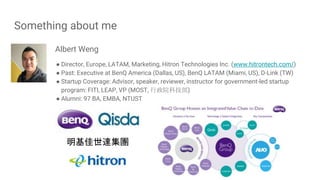
Albert Weng
2021/06/26
Something about me
Albert Weng
● Director, Europe, LATAM, Marketing, Hitron Technologies Inc. (www.hitrontech.com/)
● Past: Executive at BenQ America (Dallas, US), BenQ LATAM (Miami, US), D-Link (TW)
● Startup Coverage: Advisor, speaker, reviewer, instructor for government-led startup
program: FITI, LEAP, VP (MOST, 行政院科技部)
● Alumni: 97 BA, EMBA, NTUST
明基佳世達集團
課程資訊
日期:6/26_09:00-12:00
對象:竹科輔導的新創團隊(竹科竹青庭/蘭青庭/109及110竹科FITI)
大綱:
1. 新創談判的關鍵能力要件 (key elements)
2. 主要的新創談判類型剖析 (appointment analysis)
3. 常見的新創談判型式演練 (common scenarios)
4. 團隊的實際談判案例實戰 (real case exercise)
Rule of the course (setting boundaries)
You’re encouraged to ask questions that concern you.
I’ll answer at my best or simply tell you “I don’t know.”
Warm up hello!!!
What we’ll do:
1. Turn on the camera & microphone
2. Start from team 1 to say a few words to everyone
3. The speaker will handover to one of his/her team members to continue
10 sec intro:
1. Your team and your name
2. Full or part time in your startup
3. Why you take this course?
Why am I here?
1.Taiwan is a great place with great people but lack of the mind and skill for business.
2.If you have little confidence and competence in business, you’ll fight in TW only.
3.The international business arena is tough but not impossible if you find a good way in.
4.Business strategy, pitch, negotiation, marketing and leadership are all learned, not born.
Exploring the key driver(s)
“How critical is negotiation to you
and your business?”
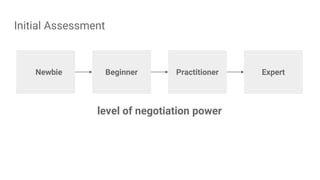
Initial Assessment
level of negotiation power
Newbie Beginner Practitioner Expert
大綱
1. 新創談判的關鍵能力要件 (key elements)
2. 主要的新創談判類型剖析 (appointment analysis)
3. 常見的新創談判型式演練 (common scenarios)
4. 團隊的實際談判案例實戰 (real case exercise)
Top untold secrets on negotiation
1. A good and smart negotiation is not tried, but prepared.
2. And it takes several rounds of scenario planning from each side.
3. Help them, help you. (Negotiation = exchange = business)
4. Prove that you’re the best for them now, and is only valid for now.
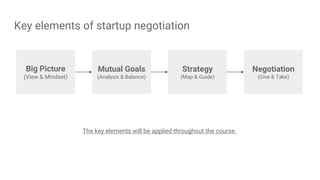
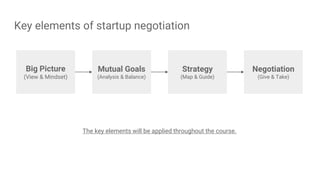
Key elements of startup negotiation
Big Picture
(View & Mindset)
Mutual Goals
(Analysis & Balance)
Strategy
(Map & Guide)
Negotiation
(Give & Take)
The key elements will be applied throughout the course.
Problem = Business
"Stop complaining about problems; problems are the
definition of business. The people who do best in
business aren’t the ones with the least problems, but
are the ones who solve their problems better and have
more fun doing it with better people.”
- Grand father of Daniel Meyer, Founder of Shake Shack
Heads-up
No standard answer in startup, nor in this workshop.
So, speak up to learn and grow TOGETHER.
“This is the best advice ever I wish you receive.”
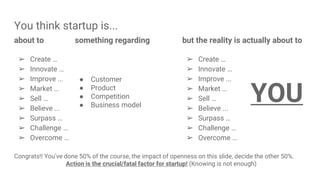
You think startup is...
➢ Create …
➢ Innovate …
➢ Improve ...
➢ Market …
➢ Sell …
➢ Believe ...
➢ Surpass …
➢ Challenge …
➢ Overcome …
● Customer
● Product
● Competition
● Business model
YOU
Congrats!! You’ve done 50% of the course, the impact of openness on this slide, decide the other 50%.
Action is the crucial/fatal factor for startup! (Knowing is not enough)
something regarding
about to but the reality is actually about to
➢ Create …
➢ Innovate …
➢ Improve ...
➢ Market …
➢ Sell …
➢ Believe ...
➢ Surpass …
➢ Challenge …
➢ Overcome …
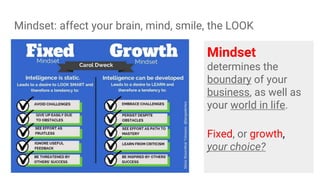
Mindset: affect your brain, mind, smile, the LOOK
Mindset
determines the
boundary of your
business, as well as
your world in life.
Fixed, or growth,
your choice?
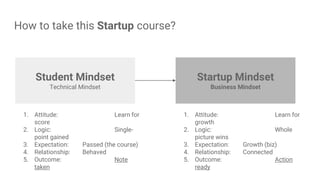
How to take this Startup course?
Student Mindset
Technical Mindset
Startup Mindset
Business Mindset
1. Attitude: Learn for
score
2. Logic: Single-
point gained
3. Expectation: Passed (the course)
4. Relationship: Behaved
5. Outcome: Note
taken
1. Attitude: Learn for
growth
2. Logic: Whole
picture wins
3. Expectation: Growth (biz)
4. Relationship: Connected
5. Outcome: Action
ready
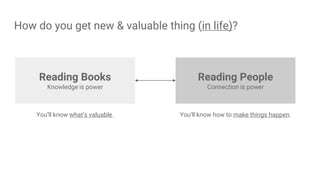
How do you get new & valuable thing (in life)?
Reading People
Connection is power
You’ll know what’s valuable. You’ll know how to make things happen.
Reading Books
Knowledge is power
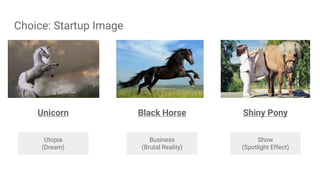
Choice: Startup Image
Unicorn Black Horse Shiny Pony
Utopia
(Dream)
Show
(Spotlight Effect)
Business
(Brutal Reality)
Before: Quick Live Pitch
Rule:
1. Team discussion: 60 sec.
2. Team pitch: 30 sec.
a. Intro: your team and your name, and your TA
b. Pitch:
1) Your business
2) Your call to action
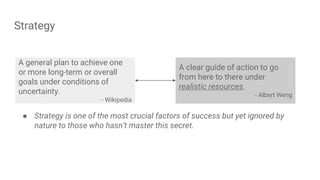
Strategy
A clear guide of action to go
from here to there under
realistic resources.
- Albert Weng
● Strategy is one of the most crucial factors of success but yet ignored by
nature to those who hasn’t master this secret.
A general plan to achieve one
or more long-term or overall
goals under conditions of
uncertainty.
- Wikipedia
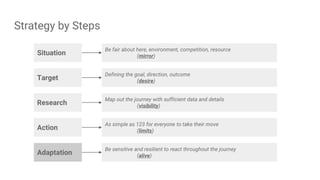
Strategy by Steps
Situation
Target
Research
Action
Adaptation
Be fair about here, environment, competition, resource
(mirror)
Defining the goal, direction, outcome
(desire)
Map out the journey with sufficient data and details
(visibility)
As simple as 123 for everyone to take their move
(limits)
Be sensitive and resilient to react throughout the journey
(alive)
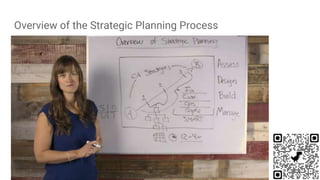
Overview of the Strategic Planning Process
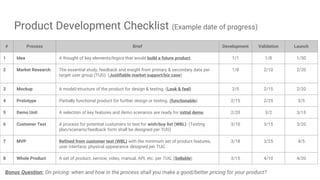
Product Development Checklist (Example date of progress)
# Process Brief Development Validation Launch
1 Idea A thought of key elements/logics that would build a future product. 1/1 1/8 1/30
2 Market Research The essential study, feedback and insight from primary & secondary data per
target user group (TUG). (Justifiable market support/biz case)
1/8 2/10 2/20
3 Mockup A model/structure of the product for design & testing. (Look & feel) 2/5 2/15 2/20
4 Prototype Partially functional product for further design or testing. (functionable) 2/15 2/25 3/5
5 Demo Unit A selection of key features and demo scenarios are ready for initial demo. 2/20 3/2 3/15
6 Customer Test A process for potential customers to test for wish/buy list (WBL). (Testing
plan/scenario/feedback form shall be designed per TUG)
3/10 3/15 3/20
7 MVP Refined from customer test (WBL) with the minimum set of product features,
user interface, physical appearance designed per TUG.
3/18 3/25 4/5
8 Whole Product A set of product, service, video, manual, API, etc. per TUG, (Sellable) 3/15 4/10 4/20
Bonus Question: On pricing: when and how in the process shall you make a good/better pricing for your product?
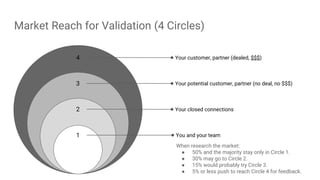
Market Reach for Validation (4 Circles)
You and your team
Your closed connections
Your potential customer, partner (no deal, no $$$)
Your customer, partner (dealed, $$$)
2
3
4
When research the market:
● 50% and the majority stay only in Circle 1.
● 30% may go to Circle 2.
● 15% would probably try Circle 3.
● 5% or less push to reach Circle 4 for feedback.
1
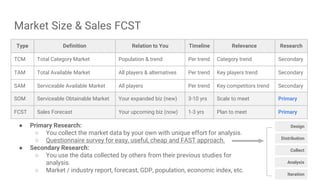
Market Size & Sales FCST
Type Definition Relation to You Timeline Relevance Research
TCM Total Category Market Population & trend Per trend Category trend Secondary
TAM Total Available Market All players & alternatives Per trend Key players trend Secondary
SAM Serviceable Available Market All players Per trend Key competitors trend Secondary
SOM Serviceable Obtainable Market Your expanded biz (new) 3-10 yrs Scale to meet Primary
FCST Sales Forecast Your upcoming biz (now) 1-3 yrs Plan to meet Primary
● Primary Research:
○ You collect the market data by your own with unique effort for analysis.
○ Questionnaire survey for easy, useful, cheap and FAST approach.
● Secondary Research:
○ You use the data collected by others from their previous studies for
analysis.
○ Market / industry report, forecast, GDP, population, economic index, etc.
Design
Distribution
Collect
Analysis
Iteration
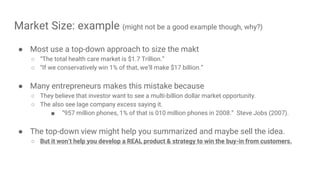
Market Size: example (might not be a good example though, why?)
● Most use a top-down approach to size the makt
○ “The total health care market is $1.7 Trillion.”
○ “If we conservatively win 1% of that, we’ll make $17 billion.”
● Many entrepreneurs makes this mistake because
○ They believe that investor want to see a multi-billion dollar market opportunity.
○ The also see lage company excess saying it.
■ “957 million phones, 1% of that is 010 million phones in 2008.” Steve Jobs (2007).
● The top-down view might help you summarized and maybe sell the idea.
○ But it won’t help you develop a REAL product & strategy to win the buy-in from customers.
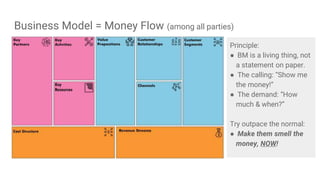
Business Model = Money Flow (among all parties)
Principle:
● BM is a living thing, not
a statement on paper.
● The calling: “Show me
the money!”
● The demand: “How
much & when?”
Try outpace the normal:
● Make them smell the
money, NOW!
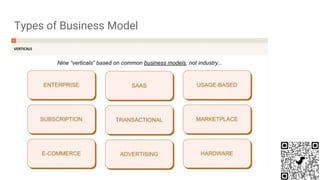
Types of Business Model
大綱
1. 新創談判的關鍵能力要件 (key elements)
2. 主要的新創談判類型剖析 (appointment analysis)
3. 常見的新創談判型式演練 (common scenarios)
4. 團隊的實際談判案例實戰 (real case exercise)
“Competition is for losers.”
- Peter Thiel
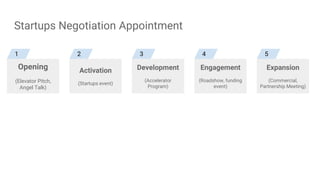
Startups Negotiation Appointment
Opening
(Elevator Pitch,
Angel Talk)
Activation
(Startups event)
Development
(Accelerator
Program)
Engagement
(Roadshow, funding
event)
Expansion
(Commercial,
Partnership Meeting)
1 2 3 4 5
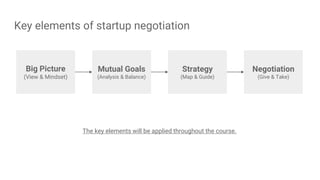
Key elements of startup negotiation
Big Picture
(View & Mindset)
Mutual Goals
(Analysis & Balance)
Strategy
(Map & Guide)
Negotiation
(Give & Take)
The key elements will be applied throughout the course.
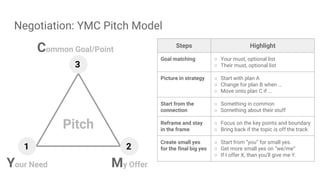
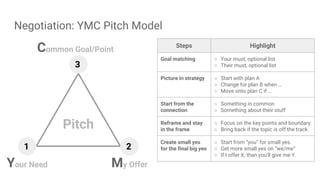
Negotiation: YMC Pitch Model
Your Need My Offer
1 2
3
Pitch
Common Goal/Point
Steps Highlight
Goal matching ○ Your must, optional list
○ Their must, optional list
Picture in strategy ○ Start with plan A
○ Change for plan B when …
○ Move onto plan C if ...
Start from the
connection
○ Something in common
○ Something about their stuff
Reframe and stay
in the frame
○ Focus on the key points and boundary
○ Bring back if the topic is off the track
Create small yes
for the final big yes
○ Start from “you” for small yes.
○ Get more small yes on “we/me”
○ If I offer X, than you’ll give me Y.
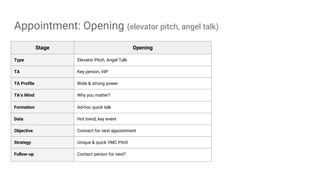
Appointment: Opening (elevator pitch, angel talk)
Stage Opening
Type Elevator Pitch, Angel Talk
TA Key person, VIP
TA Profile Wide & strong power
TA’s Mind Why you matter?
Formation Ad-hoc quick talk
Data Hot trend, key event
Objective Connect for next appointment
Strategy Unique & quick YMC Pitch
Follow-up Contact person for next?
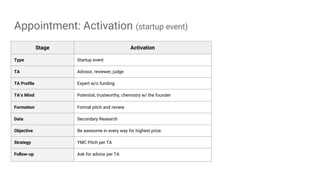
Appointment: Activation (startup event)
Stage Activation
Type Startup event
TA Advisor, reviewer, judge
TA Profile Expert w/o funding
TA’s Mind Potential, trustworthy, chemistry w/ the founder
Formation Formal pitch and review
Data Secondary Research
Objective Be awesome in every way for highest prize.
Strategy YMC Pitch per TA
Follow-up Ask for advice per TA
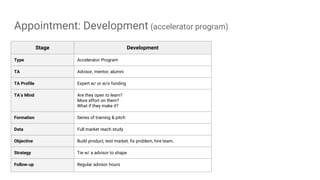
Appointment: Development (accelerator program)
Stage Development
Type Accelerator Program
TA Advisor, mentor, alumni
TA Profile Expert w/ or w/o funding
TA’s Mind Are they open to learn?
More effort on them?
What if they make it?
Formation Series of training & pitch
Data Full market reach study
Objective Build product, test market, fix problem, hire team..
Strategy Tie w/ a advisor to shape
Follow-up Regular advisor hours
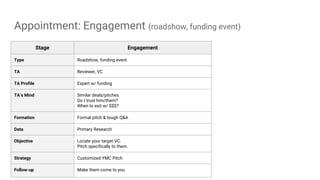
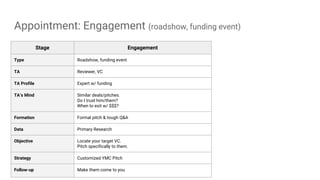
Appointment: Engagement (roadshow, funding event)
Stage Engagement
Type Roadshow, funding event
TA Reviewer, VC
TA Profile Expert w/ funding
TA’s Mind Similar deals/pitches.
Do I trust him/them?
When to exit w/ $$$?
Formation Formal pitch & tough Q&A
Data Primary Research
Objective Locate your target VC.
Pitch specifically to them.
Strategy Customized YMC Pitch
Follow-up Make them come to you
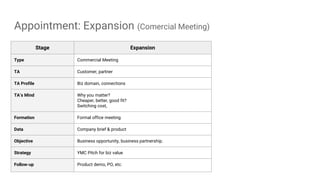
Appointment: Expansion (Comercial Meeting)
Stage Expansion
Type Commercial Meeting
TA Customer, partner
TA Profile Biz domain, connections
TA’s Mind Why you matter?
Cheaper, better, good fit?
Switching cost,
Formation Formal office meeting
Data Company brief & product
Objective Business opportunity, business partnership.
Strategy YMC Pitch for biz value
Follow-up Product demo, PO, etc.
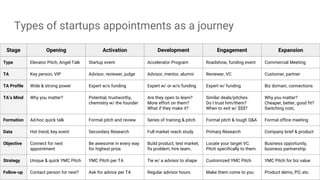
Types of startups appointments as a journey
Stage Opening Activation Development Engagement Expansion
Type Elevator Pitch, Angel Talk Startup event Accelerator Program Roadshow, funding event Commercial Meeting
TA Key person, VIP Advisor, reviewer, judge Advisor, mentor, alumni Reviewer, VC Customer, partner
TA Profile Wide & strong power Expert w/o funding Expert w/ or w/o funding Expert w/ funding Biz domain, connections
TA’s Mind Why you matter? Potential, trustworthy,
chemistry w/ the founder
Are they open to learn?
More effort on them?
What if they make it?
Similar deals/pitches.
Do I trust him/them?
When to exit w/ $$$?
Why you matter?
Cheaper, better, good fit?
Switching cost,
Formation Ad-hoc quick talk Formal pitch and review Series of training & pitch Formal pitch & tough Q&A Formal office meeting
Data Hot trend, key event Secondary Research Full market reach study Primary Research Company brief & product
Objective Connect for next
appointment
Be awesome in every way
for highest prize.
Build product, test market,
fix problem, hire team..
Locate your target VC.
Pitch specifically to them.
Business opportunity,
business partnership.
Strategy Unique & quick YMC Pitch YMC Pitch per TA Tie w/ a advisor to shape Customized YMC Pitch YMC Pitch for biz value
Follow-up Contact person for next? Ask for advice per TA Regular advisor hours Make them come to you Product demo, PO, etc.
大綱
1. 新創談判的關鍵能力要件 (key elements)
2. 主要的新創談判類型剖析 (appointment analysis)
3. 常見的新創談判型式演練 (common scenarios)
4. 團隊的實際談判案例實戰 (real case exercise)
After: Quick Live Pitch
Rule:
1. Team discussion: 60 sec.
2. Team pitch: 30 sec.
a. Intro: your team and your name, and your TA
b. Pitch:
1) Your business
2) Your call to action
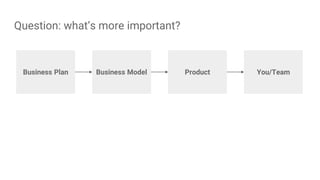
Question: what’s more important?
Business Plan Business Model Product You/Team
Key elements of startup negotiation
Big Picture
(View & Mindset)
Mutual Goals
(Analysis & Balance)
Strategy
(Map & Guide)
Negotiation
(Give & Take)
The key elements will be applied throughout the course.
Negotiation: YMC Pitch Model
Your Need My Offer
1 2
3
Pitch
Common Goal/Point
Steps Highlight
Goal matching ○ Your must, optional list
○ Their must, optional list
Picture in strategy ○ Start with plan A
○ Change for plan B when …
○ Move onto plan C if ...
Start from the
connection
○ Something in common
○ Something about their stuff
Reframe and stay
in the frame
○ Focus on the key points and boundary
○ Bring back if the topic is off the track
Create small yes
for the final big yes
○ Start from “you” for small yes.
○ Get more small yes on “we/me”
○ If I offer X, than you’ll give me Y.
Appointment: Engagement (roadshow, funding event)
Stage Engagement
Type Roadshow, funding event
TA Reviewer, VC
TA Profile Expert w/ funding
TA’s Mind Similar deals/pitches.
Do I trust him/them?
When to exit w/ $$$?
Formation Formal pitch & tough Q&A
Data Primary Research
Objective Locate your target VC.
Pitch specifically to them.
Strategy Customized YMC Pitch
Follow-up Make them come to you
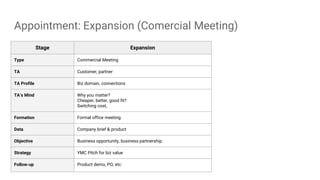
Appointment: Expansion (Comercial Meeting)
Stage Expansion
Type Commercial Meeting
TA Customer, partner
TA Profile Biz domain, connections
TA’s Mind Why you matter?
Cheaper, better, good fit?
Switching cost,
Formation Formal office meeting
Data Company brief & product
Objective Business opportunity, business partnership.
Strategy YMC Pitch for biz value
Follow-up Product demo, PO, etc.
大綱
1. 新創談判的關鍵能力要件 (key elements)
2. 主要的新創談判類型剖析 (appointment analysis)
3. 常見的新創談判型式演練 (common scenarios)
4. 團隊的實際談判案例實戰 (real case exercise)
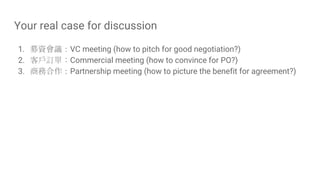
Your real case for discussion
1. 募資會議:VC meeting (how to pitch for good negotiation?)
2. 客戶訂單:Commercial meeting (how to convince for PO?)
3. 商務合作:Partnership meeting (how to picture the benefit for agreement?)
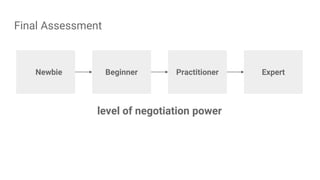
Final Assessment
level of negotiation power
Newbie Beginner Practitioner Expert
Feedback before wrap-up
“What have you learned from this course?”
“What’s your best insight to share?”
Wrap Up & Q&A

Startup Negotiation Workshop

  • 1.
  • 2.
    Something about me AlbertWeng ● Director, Europe, LATAM, Marketing, Hitron Technologies Inc. (www.hitrontech.com/) ● Past: Executive at BenQ America (Dallas, US), BenQ LATAM (Miami, US), D-Link (TW) ● Startup Coverage: Advisor, speaker, reviewer, instructor for government-led startup program: FITI, LEAP, VP (MOST, 行政院科技部) ● Alumni: 97 BA, EMBA, NTUST 明基佳世達集團
  • 3.
    課程資訊 日期:6/26_09:00-12:00 對象:竹科輔導的新創團隊(竹科竹青庭/蘭青庭/109及110竹科FITI) 大綱: 1. 新創談判的關鍵能力要件 (keyelements) 2. 主要的新創談判類型剖析 (appointment analysis) 3. 常見的新創談判型式演練 (common scenarios) 4. 團隊的實際談判案例實戰 (real case exercise)
  • 4.
    Rule of thecourse (setting boundaries) You’re encouraged to ask questions that concern you. I’ll answer at my best or simply tell you “I don’t know.”
  • 5.
    Warm up hello!!! Whatwe’ll do: 1. Turn on the camera & microphone 2. Start from team 1 to say a few words to everyone 3. The speaker will handover to one of his/her team members to continue 10 sec intro: 1. Your team and your name 2. Full or part time in your startup 3. Why you take this course?
  • 6.
    Why am Ihere? 1.Taiwan is a great place with great people but lack of the mind and skill for business. 2.If you have little confidence and competence in business, you’ll fight in TW only. 3.The international business arena is tough but not impossible if you find a good way in. 4.Business strategy, pitch, negotiation, marketing and leadership are all learned, not born.
  • 7.
    Exploring the keydriver(s) “How critical is negotiation to you and your business?”
  • 8.
    Initial Assessment level ofnegotiation power Newbie Beginner Practitioner Expert
  • 9.
    大綱 1. 新創談判的關鍵能力要件 (keyelements) 2. 主要的新創談判類型剖析 (appointment analysis) 3. 常見的新創談判型式演練 (common scenarios) 4. 團隊的實際談判案例實戰 (real case exercise)
  • 10.
    Top untold secretson negotiation 1. A good and smart negotiation is not tried, but prepared. 2. And it takes several rounds of scenario planning from each side. 3. Help them, help you. (Negotiation = exchange = business) 4. Prove that you’re the best for them now, and is only valid for now.
  • 11.
    Key elements ofstartup negotiation Big Picture (View & Mindset) Mutual Goals (Analysis & Balance) Strategy (Map & Guide) Negotiation (Give & Take) The key elements will be applied throughout the course.
  • 12.
    Problem = Business "Stopcomplaining about problems; problems are the definition of business. The people who do best in business aren’t the ones with the least problems, but are the ones who solve their problems better and have more fun doing it with better people.” - Grand father of Daniel Meyer, Founder of Shake Shack
  • 13.
    Heads-up No standard answerin startup, nor in this workshop. So, speak up to learn and grow TOGETHER. “This is the best advice ever I wish you receive.”
  • 14.
    You think startupis... ➢ Create … ➢ Innovate … ➢ Improve ... ➢ Market … ➢ Sell … ➢ Believe ... ➢ Surpass … ➢ Challenge … ➢ Overcome … ● Customer ● Product ● Competition ● Business model YOU Congrats!! You’ve done 50% of the course, the impact of openness on this slide, decide the other 50%. Action is the crucial/fatal factor for startup! (Knowing is not enough) something regarding about to but the reality is actually about to ➢ Create … ➢ Innovate … ➢ Improve ... ➢ Market … ➢ Sell … ➢ Believe ... ➢ Surpass … ➢ Challenge … ➢ Overcome …
  • 15.
    Mindset: affect yourbrain, mind, smile, the LOOK Mindset determines the boundary of your business, as well as your world in life. Fixed, or growth, your choice?
  • 16.
    How to takethis Startup course? Student Mindset Technical Mindset Startup Mindset Business Mindset 1. Attitude: Learn for score 2. Logic: Single- point gained 3. Expectation: Passed (the course) 4. Relationship: Behaved 5. Outcome: Note taken 1. Attitude: Learn for growth 2. Logic: Whole picture wins 3. Expectation: Growth (biz) 4. Relationship: Connected 5. Outcome: Action ready
  • 17.
    How do youget new & valuable thing (in life)? Reading People Connection is power You’ll know what’s valuable. You’ll know how to make things happen. Reading Books Knowledge is power
  • 18.
    Choice: Startup Image UnicornBlack Horse Shiny Pony Utopia (Dream) Show (Spotlight Effect) Business (Brutal Reality)
  • 19.
    Before: Quick LivePitch Rule: 1. Team discussion: 60 sec. 2. Team pitch: 30 sec. a. Intro: your team and your name, and your TA b. Pitch: 1) Your business 2) Your call to action
  • 20.
    Strategy A clear guideof action to go from here to there under realistic resources. - Albert Weng ● Strategy is one of the most crucial factors of success but yet ignored by nature to those who hasn’t master this secret. A general plan to achieve one or more long-term or overall goals under conditions of uncertainty. - Wikipedia
  • 21.
    Strategy by Steps Situation Target Research Action Adaptation Befair about here, environment, competition, resource (mirror) Defining the goal, direction, outcome (desire) Map out the journey with sufficient data and details (visibility) As simple as 123 for everyone to take their move (limits) Be sensitive and resilient to react throughout the journey (alive)
  • 22.
    Overview of theStrategic Planning Process
  • 23.
    Product Development Checklist(Example date of progress) # Process Brief Development Validation Launch 1 Idea A thought of key elements/logics that would build a future product. 1/1 1/8 1/30 2 Market Research The essential study, feedback and insight from primary & secondary data per target user group (TUG). (Justifiable market support/biz case) 1/8 2/10 2/20 3 Mockup A model/structure of the product for design & testing. (Look & feel) 2/5 2/15 2/20 4 Prototype Partially functional product for further design or testing. (functionable) 2/15 2/25 3/5 5 Demo Unit A selection of key features and demo scenarios are ready for initial demo. 2/20 3/2 3/15 6 Customer Test A process for potential customers to test for wish/buy list (WBL). (Testing plan/scenario/feedback form shall be designed per TUG) 3/10 3/15 3/20 7 MVP Refined from customer test (WBL) with the minimum set of product features, user interface, physical appearance designed per TUG. 3/18 3/25 4/5 8 Whole Product A set of product, service, video, manual, API, etc. per TUG, (Sellable) 3/15 4/10 4/20 Bonus Question: On pricing: when and how in the process shall you make a good/better pricing for your product?
  • 24.
    Market Reach forValidation (4 Circles) You and your team Your closed connections Your potential customer, partner (no deal, no $$$) Your customer, partner (dealed, $$$) 2 3 4 When research the market: ● 50% and the majority stay only in Circle 1. ● 30% may go to Circle 2. ● 15% would probably try Circle 3. ● 5% or less push to reach Circle 4 for feedback. 1
  • 25.
    Market Size &Sales FCST Type Definition Relation to You Timeline Relevance Research TCM Total Category Market Population & trend Per trend Category trend Secondary TAM Total Available Market All players & alternatives Per trend Key players trend Secondary SAM Serviceable Available Market All players Per trend Key competitors trend Secondary SOM Serviceable Obtainable Market Your expanded biz (new) 3-10 yrs Scale to meet Primary FCST Sales Forecast Your upcoming biz (now) 1-3 yrs Plan to meet Primary ● Primary Research: ○ You collect the market data by your own with unique effort for analysis. ○ Questionnaire survey for easy, useful, cheap and FAST approach. ● Secondary Research: ○ You use the data collected by others from their previous studies for analysis. ○ Market / industry report, forecast, GDP, population, economic index, etc. Design Distribution Collect Analysis Iteration
  • 26.
    Market Size: example(might not be a good example though, why?) ● Most use a top-down approach to size the makt ○ “The total health care market is $1.7 Trillion.” ○ “If we conservatively win 1% of that, we’ll make $17 billion.” ● Many entrepreneurs makes this mistake because ○ They believe that investor want to see a multi-billion dollar market opportunity. ○ The also see lage company excess saying it. ■ “957 million phones, 1% of that is 010 million phones in 2008.” Steve Jobs (2007). ● The top-down view might help you summarized and maybe sell the idea. ○ But it won’t help you develop a REAL product & strategy to win the buy-in from customers.
  • 27.
    Business Model =Money Flow (among all parties) Principle: ● BM is a living thing, not a statement on paper. ● The calling: “Show me the money!” ● The demand: “How much & when?” Try outpace the normal: ● Make them smell the money, NOW!
  • 28.
  • 29.
    大綱 1. 新創談判的關鍵能力要件 (keyelements) 2. 主要的新創談判類型剖析 (appointment analysis) 3. 常見的新創談判型式演練 (common scenarios) 4. 團隊的實際談判案例實戰 (real case exercise)
  • 30.
    “Competition is forlosers.” - Peter Thiel
  • 31.
    Startups Negotiation Appointment Opening (ElevatorPitch, Angel Talk) Activation (Startups event) Development (Accelerator Program) Engagement (Roadshow, funding event) Expansion (Commercial, Partnership Meeting) 1 2 3 4 5
  • 32.
    Key elements ofstartup negotiation Big Picture (View & Mindset) Mutual Goals (Analysis & Balance) Strategy (Map & Guide) Negotiation (Give & Take) The key elements will be applied throughout the course.
  • 33.
    Negotiation: YMC PitchModel Your Need My Offer 1 2 3 Pitch Common Goal/Point Steps Highlight Goal matching ○ Your must, optional list ○ Their must, optional list Picture in strategy ○ Start with plan A ○ Change for plan B when … ○ Move onto plan C if ... Start from the connection ○ Something in common ○ Something about their stuff Reframe and stay in the frame ○ Focus on the key points and boundary ○ Bring back if the topic is off the track Create small yes for the final big yes ○ Start from “you” for small yes. ○ Get more small yes on “we/me” ○ If I offer X, than you’ll give me Y.
  • 34.
    Appointment: Opening (elevatorpitch, angel talk) Stage Opening Type Elevator Pitch, Angel Talk TA Key person, VIP TA Profile Wide & strong power TA’s Mind Why you matter? Formation Ad-hoc quick talk Data Hot trend, key event Objective Connect for next appointment Strategy Unique & quick YMC Pitch Follow-up Contact person for next?
  • 35.
    Appointment: Activation (startupevent) Stage Activation Type Startup event TA Advisor, reviewer, judge TA Profile Expert w/o funding TA’s Mind Potential, trustworthy, chemistry w/ the founder Formation Formal pitch and review Data Secondary Research Objective Be awesome in every way for highest prize. Strategy YMC Pitch per TA Follow-up Ask for advice per TA
  • 36.
    Appointment: Development (acceleratorprogram) Stage Development Type Accelerator Program TA Advisor, mentor, alumni TA Profile Expert w/ or w/o funding TA’s Mind Are they open to learn? More effort on them? What if they make it? Formation Series of training & pitch Data Full market reach study Objective Build product, test market, fix problem, hire team.. Strategy Tie w/ a advisor to shape Follow-up Regular advisor hours
  • 37.
    Appointment: Engagement (roadshow,funding event) Stage Engagement Type Roadshow, funding event TA Reviewer, VC TA Profile Expert w/ funding TA’s Mind Similar deals/pitches. Do I trust him/them? When to exit w/ $$$? Formation Formal pitch & tough Q&A Data Primary Research Objective Locate your target VC. Pitch specifically to them. Strategy Customized YMC Pitch Follow-up Make them come to you
  • 38.
    Appointment: Expansion (ComercialMeeting) Stage Expansion Type Commercial Meeting TA Customer, partner TA Profile Biz domain, connections TA’s Mind Why you matter? Cheaper, better, good fit? Switching cost, Formation Formal office meeting Data Company brief & product Objective Business opportunity, business partnership. Strategy YMC Pitch for biz value Follow-up Product demo, PO, etc.
  • 39.
    Types of startupsappointments as a journey Stage Opening Activation Development Engagement Expansion Type Elevator Pitch, Angel Talk Startup event Accelerator Program Roadshow, funding event Commercial Meeting TA Key person, VIP Advisor, reviewer, judge Advisor, mentor, alumni Reviewer, VC Customer, partner TA Profile Wide & strong power Expert w/o funding Expert w/ or w/o funding Expert w/ funding Biz domain, connections TA’s Mind Why you matter? Potential, trustworthy, chemistry w/ the founder Are they open to learn? More effort on them? What if they make it? Similar deals/pitches. Do I trust him/them? When to exit w/ $$$? Why you matter? Cheaper, better, good fit? Switching cost, Formation Ad-hoc quick talk Formal pitch and review Series of training & pitch Formal pitch & tough Q&A Formal office meeting Data Hot trend, key event Secondary Research Full market reach study Primary Research Company brief & product Objective Connect for next appointment Be awesome in every way for highest prize. Build product, test market, fix problem, hire team.. Locate your target VC. Pitch specifically to them. Business opportunity, business partnership. Strategy Unique & quick YMC Pitch YMC Pitch per TA Tie w/ a advisor to shape Customized YMC Pitch YMC Pitch for biz value Follow-up Contact person for next? Ask for advice per TA Regular advisor hours Make them come to you Product demo, PO, etc.
  • 40.
    大綱 1. 新創談判的關鍵能力要件 (keyelements) 2. 主要的新創談判類型剖析 (appointment analysis) 3. 常見的新創談判型式演練 (common scenarios) 4. 團隊的實際談判案例實戰 (real case exercise)
  • 41.
    After: Quick LivePitch Rule: 1. Team discussion: 60 sec. 2. Team pitch: 30 sec. a. Intro: your team and your name, and your TA b. Pitch: 1) Your business 2) Your call to action
  • 42.
    Question: what’s moreimportant? Business Plan Business Model Product You/Team
  • 43.
    Key elements ofstartup negotiation Big Picture (View & Mindset) Mutual Goals (Analysis & Balance) Strategy (Map & Guide) Negotiation (Give & Take) The key elements will be applied throughout the course.
  • 44.
    Negotiation: YMC PitchModel Your Need My Offer 1 2 3 Pitch Common Goal/Point Steps Highlight Goal matching ○ Your must, optional list ○ Their must, optional list Picture in strategy ○ Start with plan A ○ Change for plan B when … ○ Move onto plan C if ... Start from the connection ○ Something in common ○ Something about their stuff Reframe and stay in the frame ○ Focus on the key points and boundary ○ Bring back if the topic is off the track Create small yes for the final big yes ○ Start from “you” for small yes. ○ Get more small yes on “we/me” ○ If I offer X, than you’ll give me Y.
  • 45.
    Appointment: Engagement (roadshow,funding event) Stage Engagement Type Roadshow, funding event TA Reviewer, VC TA Profile Expert w/ funding TA’s Mind Similar deals/pitches. Do I trust him/them? When to exit w/ $$$? Formation Formal pitch & tough Q&A Data Primary Research Objective Locate your target VC. Pitch specifically to them. Strategy Customized YMC Pitch Follow-up Make them come to you
  • 46.
    Appointment: Expansion (ComercialMeeting) Stage Expansion Type Commercial Meeting TA Customer, partner TA Profile Biz domain, connections TA’s Mind Why you matter? Cheaper, better, good fit? Switching cost, Formation Formal office meeting Data Company brief & product Objective Business opportunity, business partnership. Strategy YMC Pitch for biz value Follow-up Product demo, PO, etc.
  • 47.
    大綱 1. 新創談判的關鍵能力要件 (keyelements) 2. 主要的新創談判類型剖析 (appointment analysis) 3. 常見的新創談判型式演練 (common scenarios) 4. 團隊的實際談判案例實戰 (real case exercise)
  • 48.
    Your real casefor discussion 1. 募資會議:VC meeting (how to pitch for good negotiation?) 2. 客戶訂單:Commercial meeting (how to convince for PO?) 3. 商務合作:Partnership meeting (how to picture the benefit for agreement?)
  • 49.
    Final Assessment level ofnegotiation power Newbie Beginner Practitioner Expert
  • 50.
    Feedback before wrap-up “Whathave you learned from this course?” “What’s your best insight to share?”
  • 51.