


GROWTH
HACKING
A 2 hr. introduction to the
definition, concept,
mindset, and process
Christopher L. Sparks for the MC4E
INTRODUCTION
Intro: Who Am I?
• From the U.S.
• Small Business Owner 7 years
• Several Failed Startups
“There is no such thing as losing. You either win
or learn.”
- Multiple sources
• Corporate & SME Training
- Effectuation
- Growth Hacking
Intro: My Goals
Demystify Growth hacking
Clarify the definition
Introduce a mindset & process
Show you how professional growth hackers
prioritize important decisions
Problems with authority, centralized
power,
Out with the old, in with the new =
Constructive Progress
Intro: Why Growth Hacking Gets me excited?
Intro: Who are You?
Quickly! EVERYONE!
Cultural & Knowledge
Basis?
How many people
have a business?
(Identify yourselves, you are now team
leaders)
Your Expectations,
What are they?
• Startups stealing market share & innovation
potential
• Corporate interest & demand
• Standardizing methods, proving value
• One can now do the job of many, You can
“do more with less”.
Intro: Why should you care about Growth Hacking?
OVERVIEW
Overview: 2 Hours
• 30:00 – 45:00 of Information
• 1:15:00 - 1:30:00 Mini-Hackathon
• + :15 of ‘Optional’ Overtime
Be prepared to not relax, to take notes, & brainstorm
PLEASE ASK QUESTIONS, ESPECIALLY WITH
REGARD TO LANGUAGE!
DEFINE
Growth Hacking: Defining ‘Growth’
• “Growth of a business is the only thing
that matters in the startup world.”
• In the entrepreneurship world, this is not
always the case
– i.e. This does not mean that a Small Business
Owner cannot use this process, mindset, and
tools.
Growth Hacking: Defined
Lifehacking ≠ Growth Hacking
NOT A SET OF QUICK FIXES, MAGIC.
It is not
• Whitbies Fish & Chips “What a brilliant
hack!”
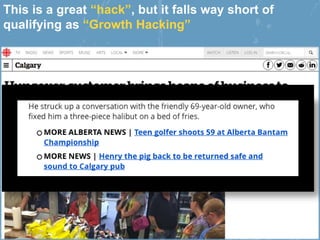
This is a great “hack”, but it falls way short of
qualifying as “Growth Hacking”
Growth Hacking: Defined
• What it is: Testable, trackable, scalable.
• It is an update:
• Rewriting the best-practices of marketing. The death
of business as usual.
• Lets re-define growth hacking:
Growth Hacking = 21st Century Marketing = Zero
Budget Marketing
“Entrepreneurial Marketing”
Growth Hacking: Defined
“Everything works with
everything else. In other words
it’s a system, and a system is
no big deal to use. Look, with
any new [system] you’ve gotta
learn a few new things.”
-Alan Alda
• Who is a growth hacker? T-Shaped
Individual
Broad Range Generalist W/ Deep Expertise
in one area
“… someone whose true north
is growth”
- Sean Ellis, 2010
Growth Hacking: Who?
Engineering & Testing mindset, not
necessarily an engineering degree.
A person who embodies the
Socratic method.
The person(s) within a company who
find(s) the customers and leads them through
a sales funnel, and hopefully creates a k-factor.
Growth Hacking: Who?
Growth Hacking: Defined
“The end goal of every growth
hacker is to build a self-
perpetuating machine that
reaches millions by itself.”
-Aaron Ginn
CONCEPTS
The Mindset – Growth Hacker Marketing by
Ryan Holiday
[GH Needs More Women]
Entrepreneurial Marketing: Concepts
“Look at what everyone else is doing, and walk the other way.”
Not every saturated channel is your best fit for growth.
Find out who & where your customers are, by any means necessary, and
go directly to them. Everything is testable & malleable.
Forget about gut feeling. Test all of your assumptions. The best validation is
a scalable sale.
Entrepreneurial Marketing: Concepts
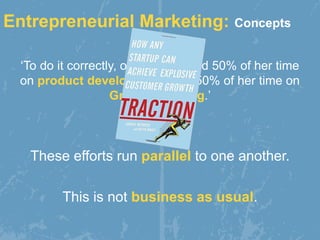
‘To do it correctly, one must spend 50% of her time
on product development, and 50% of her time on
Growth Hacking.’
These efforts run parallel to one another.
This is not business as usual.
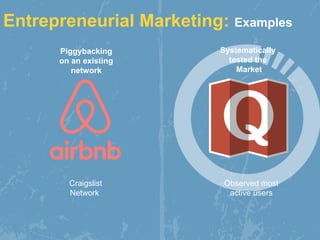
Entrepreneurial Marketing: Examples
Piggybacking
on an existing
network
Craigslist
Network
Systematically
tested the
Market
Observed most
active users
THE FULL
GROWTH
HACKING
SYSTEM
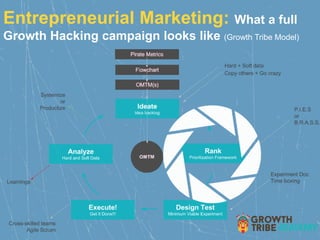
Entrepreneurial Marketing: What a full
Growth Hacking campaign looks like (Growth Tribe Model)
LET’S FOCUS!And get into workshop mode!
Entrepreneurial Marketing: Choosing
Channels with Traction
Today we are going to focus on prioritizing
growth channels using the Traction method
and the BRASS framework.
Why?
Well, time and money of course!
Entrepreneurial Marketing: Choosing
Channels with Traction
Also…
Traction is also a great place to
start for learning purposes!
Entrepreneurial Marketing: Traction &
where to begin
• This book is canon for the growth hacker
– buy it, seriously
[Or read my summary @ chrissparks.nl/blog]
• Book Structure:
– 1 Chapter summarizing growth channels
– 4 Chapters practical processes
– 19 Chapters in-depth describing growth
channels
Traction: Defined
Traction = Growth = Quantitative Demand
Indicators
• Rigorous , scientific testing process &
exploitation of multiple (3-4) channels
Replaces that ‘gut feeling’ with science!!!
• Testable, track-able, scalable testing.
Traction: Strategies & Tactics determined by
your bird in hand
Sometimes you have to do things that don’t
scale at first (Trade Shows),
Sometimes someone on your team has to
learn something new (Word Press),
BUT!
Always, your team is your Bird in Hand!
SO ALWAYS WORK FIRST WITH
WHAT YOU HAVE INFRONT OF YOU
OR
WITH WHATEVER IS WITHIN ARMS
REACH
WHEN YOU FIND THAT YOU
CANNOT
MOVE FORWARD WITH YOUR
AVAILABLE MEANS,
THEN YOU CAN LOOK OUTSIDE OF
YOUR TEAM FOR HELP (QUILTING)
EXERCISE TIME!
Traction Process Step 1: Set Analytics
Begin Google Analytics or Kissmetrics on your
landing page, website immediately.
- Passive: You will begin collecting data that will later
serve as a baseline for your actions.
- Active: begin learning how to use analytics, get
cozy with interpreting statistics, a/b tests.
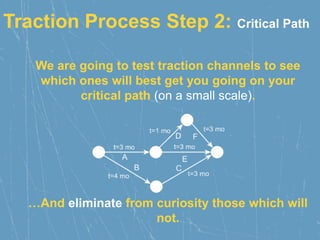
Traction Process Step 2: Critical Path
Begin By setting a quantifiable goal: ex. ‘X number
of subscribers’
This will be the focus of your critical path, OMTM, and all
efforts here forward to “move the needle”
Determine the steps necessary to reach your goal
in the fewest number of steps. All activities are
either on or off path.
Determine the steps necessary to reach your
goal in the fewest number of steps.
All activities are either on or off path,
Don’t waste money, time, or resources with off-
path or non-quantitative milestones.
Traction Process Step 2: Critical Path
We are going to test traction channels to see
which ones will best get you going on your
critical path (on a small scale).
…And eliminate from curiosity those which will
not.
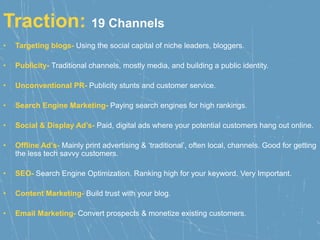
Traction: 19 Channels
• Targeting blogs- Using the social capital of niche leaders, bloggers.
• Publicity- Traditional channels, mostly media, and building a public identity.
• Unconventional PR- Publicity stunts and customer service.
• Search Engine Marketing- Paying search engines for high rankings.
• Social & Display Ad’s- Paid, digital ads where your potential customers hang out online.
• Offline Ad’s- Mainly print advertising & ‘traditional’, often local, channels. Good for getting
the less tech savvy customers.
• SEO- Search Engine Optimization. Ranking high for your keyword. Very Important.
• Content Marketing- Build trust with your blog.
• Email Marketing- Convert prospects & monetize existing customers.
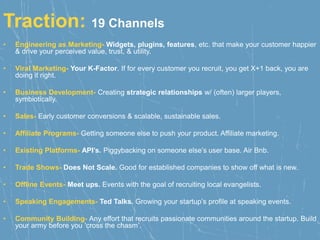
Traction: 19 Channels
• Engineering as Marketing- Widgets, plugins, features, etc. that make your customer happier
& drive your perceived value, trust, & utility.
• Viral Marketing- Your K-Factor. If for every customer you recruit, you get X+1 back, you are
doing it right.
• Business Development- Creating strategic relationships w/ (often) larger players,
symbiotically.
• Sales- Early customer conversions & scalable, sustainable sales.
• Affiliate Programs- Getting someone else to push your product. Affiliate marketing.
• Existing Platforms- API’s. Piggybacking on someone else’s user base. Air Bnb.
• Trade Shows- Does Not Scale. Good for established companies to show off what is new.
• Offline Events- Meet ups. Events with the goal of recruiting local evangelists.
• Speaking Engagements- Ted Talks. Growing your startup’s profile at speaking events.
• Community Building- Any effort that recruits passionate communities around the startup. Build
your army before you ‘cross the chasm’.
Exercise: Join your Glorious Team Leader
Now we are going to run a Traction exercise.
DOES EVERYONE HAVE THEIR
DOCUMENTS (Packets & Voting Sheets)?
Exercise: Step 1
Founders: Introduce your concept to your
team (10 minutes)
- Describe your Offering & Value
Proposition.
- Describe your intended customer/ market
- Declare your goal (1) or develop one.
Exercise: Step 1
Select a member of each team to Present their
case in 2:00. You have :30 to select.
- Offering
- Value Proposition
- Customer
- Market
- Goal (quantitative)
Exercise: Step 2
FIRST ELIMINATION ROUND – 15:00
IMPORTANT!
Don’t forget that some of the best growth
hacking channels are the ones that
everyone else ignores!
(offline events create evangelists!!!)
Exercise: Step 2
FIRST ELIMINATION ROUND – 15:00 – Open
Discussion
- Brainstorm: which channels are within the
reach of your team? Bird in Hand.
- Which serve as direct distribution channels
between your product and your market? Path of
least resistance.
- Choose a TOP SIX!!! Do not rank them.
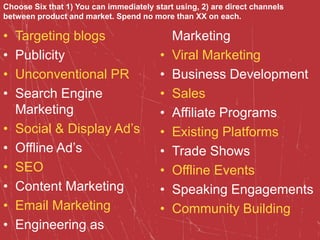
• Targeting blogs
• Publicity
• Unconventional PR
• Search Engine
Marketing
• Social & Display Ad’s
• Offline Ad’s
• SEO
• Content Marketing
• Email Marketing
• Engineering as
Marketing
• Viral Marketing
• Business Development
• Sales
• Affiliate Programs
• Existing Platforms
• Trade Shows
• Offline Events
• Speaking Engagements
• Community Building
Choose Six that 1) You can immediately start using, 2) are direct channels
between product and market. Spend no more than XX on each.
Exercise: Step 3
Isolate your top 6 on your score card in
no particular order
Now you are going to turn a brainstorm
session into a quantifiable ranking
system.
Have you selected six?
Traction Process Step 4: BRASS
Framework
Using the BRASS framework
When brainstorming a channel, team members
should ask themselves these three questions:
1) How much will it cost?
2) How many customers are available?
3) Are these the customers I need right now?
Traction Process Step 4: BRASS
Metrics by David Arnoux [Growth Tribe]
• B- BLINK
Gut feeling. Don’t think, just vote!
• R- RELEVANCE
Relevance to your customer base. Is this
channel directly delivering my message to
where my customers hang out?
• A- AVAILABILITY
Internal resources (team) & expertise vs. cost.
Exploitable with your bird in hand?
• S- SCALABILITY
Can you go big if this channel proves effective?
Exercise: Step 3
Each of the BRASS metrics gets a vote of
1-5 for each of your six channels.
Vote BLIND by writing your vote on your
provided voting card.
DON’T LET POLITICS SKEW YOUR
DECISION
Exercise: Step 3
You have 15 minutes.
Start the clock
Exercise: Step 4
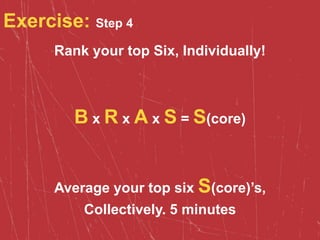
Rank your top Six, Individually!
B x R x A x S = S(core)
Average your top six S(core)’s,
Collectively. 5 minutes
CUTOFF POINT
Adina, are we good on time? If so, let’s
go!
Exercise: Step 4
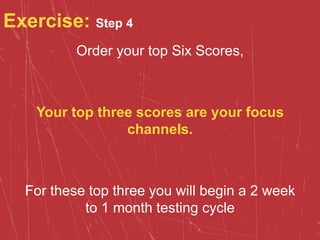
Order your top Six Scores,
Your top three scores are your focus
channels.
For these top three you will begin a 2 week
to 1 month testing cycle
Exercise: Step 5
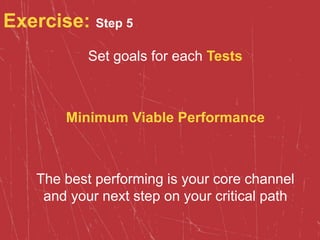
Set goals for each Tests
Minimum Viable Performance
The best performing is your core channel
and your next step on your critical path
Exercise: Step 5
After your testing you will know which of the
three is the one with the most promise.
Move forward with this one!
The rest are insurance.
DISCUSSION,
Q&A
DANK JE
WEL!!!
+31 616 10 85 77
LSparksV@gmail.com
ChrisSparks.nl
/in/christopherlsparks
Feedback is a gift. Please
send some.

Mc4 e growth_hacking_2hr_gsew_MVPDraft1

  • 1.
    GROWTH HACKING A 2 hr.introduction to the definition, concept, mindset, and process Christopher L. Sparks for the MC4E
  • 2.
  • 3.
    Intro: Who AmI? • From the U.S. • Small Business Owner 7 years • Several Failed Startups “There is no such thing as losing. You either win or learn.” - Multiple sources • Corporate & SME Training - Effectuation - Growth Hacking
  • 4.
    Intro: My Goals DemystifyGrowth hacking Clarify the definition Introduce a mindset & process Show you how professional growth hackers prioritize important decisions
  • 5.
    Problems with authority,centralized power, Out with the old, in with the new = Constructive Progress Intro: Why Growth Hacking Gets me excited?
  • 6.
    Intro: Who areYou? Quickly! EVERYONE! Cultural & Knowledge Basis? How many people have a business? (Identify yourselves, you are now team leaders) Your Expectations, What are they?
  • 7.
    • Startups stealingmarket share & innovation potential • Corporate interest & demand • Standardizing methods, proving value • One can now do the job of many, You can “do more with less”. Intro: Why should you care about Growth Hacking?
  • 8.
  • 9.
    Overview: 2 Hours •30:00 – 45:00 of Information • 1:15:00 - 1:30:00 Mini-Hackathon • + :15 of ‘Optional’ Overtime Be prepared to not relax, to take notes, & brainstorm PLEASE ASK QUESTIONS, ESPECIALLY WITH REGARD TO LANGUAGE!
  • 10.
  • 11.
    Growth Hacking: Defining‘Growth’ • “Growth of a business is the only thing that matters in the startup world.” • In the entrepreneurship world, this is not always the case – i.e. This does not mean that a Small Business Owner cannot use this process, mindset, and tools.
  • 12.
    Growth Hacking: Defined Lifehacking≠ Growth Hacking NOT A SET OF QUICK FIXES, MAGIC. It is not • Whitbies Fish & Chips “What a brilliant hack!”
  • 13.
    This is agreat “hack”, but it falls way short of qualifying as “Growth Hacking”
  • 14.
    Growth Hacking: Defined •What it is: Testable, trackable, scalable. • It is an update: • Rewriting the best-practices of marketing. The death of business as usual. • Lets re-define growth hacking: Growth Hacking = 21st Century Marketing = Zero Budget Marketing “Entrepreneurial Marketing”
  • 15.
    Growth Hacking: Defined “Everythingworks with everything else. In other words it’s a system, and a system is no big deal to use. Look, with any new [system] you’ve gotta learn a few new things.” -Alan Alda
  • 16.
    • Who isa growth hacker? T-Shaped Individual Broad Range Generalist W/ Deep Expertise in one area “… someone whose true north is growth” - Sean Ellis, 2010 Growth Hacking: Who?
  • 17.
    Engineering & Testingmindset, not necessarily an engineering degree. A person who embodies the Socratic method. The person(s) within a company who find(s) the customers and leads them through a sales funnel, and hopefully creates a k-factor. Growth Hacking: Who?
  • 18.
    Growth Hacking: Defined “Theend goal of every growth hacker is to build a self- perpetuating machine that reaches millions by itself.” -Aaron Ginn
  • 19.
  • 20.
    The Mindset –Growth Hacker Marketing by Ryan Holiday [GH Needs More Women] Entrepreneurial Marketing: Concepts “Look at what everyone else is doing, and walk the other way.” Not every saturated channel is your best fit for growth. Find out who & where your customers are, by any means necessary, and go directly to them. Everything is testable & malleable. Forget about gut feeling. Test all of your assumptions. The best validation is a scalable sale.
  • 21.
    Entrepreneurial Marketing: Concepts ‘Todo it correctly, one must spend 50% of her time on product development, and 50% of her time on Growth Hacking.’ These efforts run parallel to one another. This is not business as usual.
  • 22.
    Entrepreneurial Marketing: Examples Piggybacking onan existing network Craigslist Network Systematically tested the Market Observed most active users
  • 23.
  • 24.
    Entrepreneurial Marketing: Whata full Growth Hacking campaign looks like (Growth Tribe Model)
  • 25.
    LET’S FOCUS!And getinto workshop mode!
  • 26.
    Entrepreneurial Marketing: Choosing Channelswith Traction Today we are going to focus on prioritizing growth channels using the Traction method and the BRASS framework. Why? Well, time and money of course!
  • 27.
    Entrepreneurial Marketing: Choosing Channelswith Traction Also… Traction is also a great place to start for learning purposes!
  • 28.
    Entrepreneurial Marketing: Traction& where to begin • This book is canon for the growth hacker – buy it, seriously [Or read my summary @ chrissparks.nl/blog] • Book Structure: – 1 Chapter summarizing growth channels – 4 Chapters practical processes – 19 Chapters in-depth describing growth channels
  • 29.
    Traction: Defined Traction =Growth = Quantitative Demand Indicators • Rigorous , scientific testing process & exploitation of multiple (3-4) channels Replaces that ‘gut feeling’ with science!!! • Testable, track-able, scalable testing.
  • 30.
    Traction: Strategies &Tactics determined by your bird in hand Sometimes you have to do things that don’t scale at first (Trade Shows), Sometimes someone on your team has to learn something new (Word Press), BUT! Always, your team is your Bird in Hand!
  • 31.
    SO ALWAYS WORKFIRST WITH WHAT YOU HAVE INFRONT OF YOU OR WITH WHATEVER IS WITHIN ARMS REACH
  • 32.
    WHEN YOU FINDTHAT YOU CANNOT MOVE FORWARD WITH YOUR AVAILABLE MEANS, THEN YOU CAN LOOK OUTSIDE OF YOUR TEAM FOR HELP (QUILTING)
  • 33.
  • 34.
    Traction Process Step1: Set Analytics Begin Google Analytics or Kissmetrics on your landing page, website immediately. - Passive: You will begin collecting data that will later serve as a baseline for your actions. - Active: begin learning how to use analytics, get cozy with interpreting statistics, a/b tests.
  • 35.
    Traction Process Step2: Critical Path Begin By setting a quantifiable goal: ex. ‘X number of subscribers’ This will be the focus of your critical path, OMTM, and all efforts here forward to “move the needle” Determine the steps necessary to reach your goal in the fewest number of steps. All activities are either on or off path.
  • 36.
    Determine the stepsnecessary to reach your goal in the fewest number of steps. All activities are either on or off path, Don’t waste money, time, or resources with off- path or non-quantitative milestones. Traction Process Step 2: Critical Path
  • 37.
    Traction Process Step2: Critical Path We are going to test traction channels to see which ones will best get you going on your critical path (on a small scale). …And eliminate from curiosity those which will not.
  • 38.
    Traction: 19 Channels •Targeting blogs- Using the social capital of niche leaders, bloggers. • Publicity- Traditional channels, mostly media, and building a public identity. • Unconventional PR- Publicity stunts and customer service. • Search Engine Marketing- Paying search engines for high rankings. • Social & Display Ad’s- Paid, digital ads where your potential customers hang out online. • Offline Ad’s- Mainly print advertising & ‘traditional’, often local, channels. Good for getting the less tech savvy customers. • SEO- Search Engine Optimization. Ranking high for your keyword. Very Important. • Content Marketing- Build trust with your blog. • Email Marketing- Convert prospects & monetize existing customers.
  • 39.
    Traction: 19 Channels •Engineering as Marketing- Widgets, plugins, features, etc. that make your customer happier & drive your perceived value, trust, & utility. • Viral Marketing- Your K-Factor. If for every customer you recruit, you get X+1 back, you are doing it right. • Business Development- Creating strategic relationships w/ (often) larger players, symbiotically. • Sales- Early customer conversions & scalable, sustainable sales. • Affiliate Programs- Getting someone else to push your product. Affiliate marketing. • Existing Platforms- API’s. Piggybacking on someone else’s user base. Air Bnb. • Trade Shows- Does Not Scale. Good for established companies to show off what is new. • Offline Events- Meet ups. Events with the goal of recruiting local evangelists. • Speaking Engagements- Ted Talks. Growing your startup’s profile at speaking events. • Community Building- Any effort that recruits passionate communities around the startup. Build your army before you ‘cross the chasm’.
  • 40.
    Exercise: Join yourGlorious Team Leader Now we are going to run a Traction exercise. DOES EVERYONE HAVE THEIR DOCUMENTS (Packets & Voting Sheets)?
  • 41.
    Exercise: Step 1 Founders:Introduce your concept to your team (10 minutes) - Describe your Offering & Value Proposition. - Describe your intended customer/ market - Declare your goal (1) or develop one.
  • 42.
    Exercise: Step 1 Selecta member of each team to Present their case in 2:00. You have :30 to select. - Offering - Value Proposition - Customer - Market - Goal (quantitative)
  • 43.
    Exercise: Step 2 FIRSTELIMINATION ROUND – 15:00 IMPORTANT! Don’t forget that some of the best growth hacking channels are the ones that everyone else ignores! (offline events create evangelists!!!)
  • 44.
    Exercise: Step 2 FIRSTELIMINATION ROUND – 15:00 – Open Discussion - Brainstorm: which channels are within the reach of your team? Bird in Hand. - Which serve as direct distribution channels between your product and your market? Path of least resistance. - Choose a TOP SIX!!! Do not rank them.
  • 45.
    • Targeting blogs •Publicity • Unconventional PR • Search Engine Marketing • Social & Display Ad’s • Offline Ad’s • SEO • Content Marketing • Email Marketing • Engineering as Marketing • Viral Marketing • Business Development • Sales • Affiliate Programs • Existing Platforms • Trade Shows • Offline Events • Speaking Engagements • Community Building Choose Six that 1) You can immediately start using, 2) are direct channels between product and market. Spend no more than XX on each.
  • 46.
    Exercise: Step 3 Isolateyour top 6 on your score card in no particular order Now you are going to turn a brainstorm session into a quantifiable ranking system. Have you selected six?
  • 47.
    Traction Process Step4: BRASS Framework Using the BRASS framework When brainstorming a channel, team members should ask themselves these three questions: 1) How much will it cost? 2) How many customers are available? 3) Are these the customers I need right now?
  • 48.
    Traction Process Step4: BRASS Metrics by David Arnoux [Growth Tribe] • B- BLINK Gut feeling. Don’t think, just vote! • R- RELEVANCE Relevance to your customer base. Is this channel directly delivering my message to where my customers hang out? • A- AVAILABILITY Internal resources (team) & expertise vs. cost. Exploitable with your bird in hand? • S- SCALABILITY Can you go big if this channel proves effective?
  • 49.
    Exercise: Step 3 Eachof the BRASS metrics gets a vote of 1-5 for each of your six channels. Vote BLIND by writing your vote on your provided voting card. DON’T LET POLITICS SKEW YOUR DECISION
  • 50.
    Exercise: Step 3 Youhave 15 minutes. Start the clock
  • 51.
    Exercise: Step 4 Rankyour top Six, Individually! B x R x A x S = S(core) Average your top six S(core)’s, Collectively. 5 minutes
  • 52.
    CUTOFF POINT Adina, arewe good on time? If so, let’s go!
  • 53.
    Exercise: Step 4 Orderyour top Six Scores, Your top three scores are your focus channels. For these top three you will begin a 2 week to 1 month testing cycle
  • 54.
    Exercise: Step 5 Setgoals for each Tests Minimum Viable Performance The best performing is your core channel and your next step on your critical path
  • 55.
    Exercise: Step 5 Afteryour testing you will know which of the three is the one with the most promise. Move forward with this one! The rest are insurance.
  • 56.
  • 57.
  • 58.
    +31 616 1085 77 LSparksV@gmail.com ChrisSparks.nl /in/christopherlsparks Feedback is a gift. Please send some.