TRUST ∙ TALENT ∙ TEAMWORK
About Your Presenter
rburke@wec-cpa.com
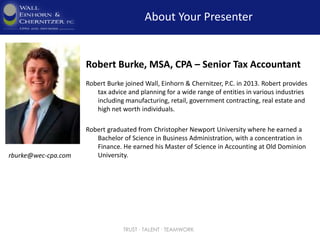
Robert Burke, MSA, CPA – Senior Tax Accountant
Robert Burke joined Wall, Einhorn & Chernitzer, P.C. in 2013. Robert provides
tax advice and planning for a wide range of entities in various industries
including manufacturing, retail, government contracting, real estate and
high net worth individuals.
Robert graduated from Christopher Newport University where he earned a
Bachelor of Science in Business Administration, with a concentration in
Finance. He earned his Master of Science in Accounting at Old Dominion
University.
Start-up Accounting
Robert Burke, CPA
Senior Tax Accountant
Who cares?
Accounting is nerdy and boring, I am trying to run a
business.
• Over 28% of businesses declaring bankruptcy cite problems with
the financial structure of the company as their main cause of
failure.
TRUST ∙ TALENT ∙ TEAMWORK
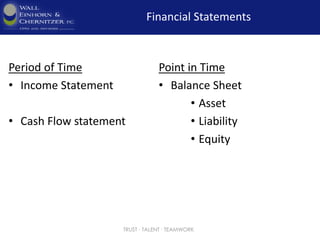
Financial Statements
Period of Time
• Income Statement
• Cash Flow statement
Point in Time
• Balance Sheet
• Asset
• Liability
• Equity
TRUST ∙ TALENT ∙ TEAMWORK
Integrate your Accounting System
• Should be part of the Business Process
– Just like product development, marketing, etc.
• Update Daily
• Create a 12 month Budget, review and compare to
actual
• Understand your Margins
TRUST ∙ TALENT ∙ TEAMWORK
Hire Someone?
• Bookkeeper: Keep Records
• Accountant: More complicated financial matters
• What is a CPA?
TRUST ∙ TALENT ∙ TEAMWORK
Common Mistakes
1) Poor Record Keeping
2) Blending Business and Personal Finances
3) Not correctly deducting Business Expenses
4) Not using the Right Tools
TRUST ∙ TALENT ∙ TEAMWORK
Common Mistakes (cont.)
5) Not understanding Tax Obligations
6) Not asking for Professional Tax Help
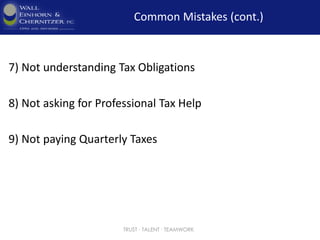
7) Not paying Quarterly Taxes
8) Poor Funding decisions
TRUST ∙ TALENT ∙ TEAMWORK
Common Mistakes (cont.)
9) Wrong Legal Entity…
TRUST ∙ TALENT ∙ TEAMWORK
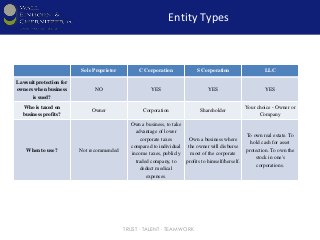
Entity Types
TRUST ∙ TALENT ∙ TEAMWORK
Sole Proprietor C Corporation S Corporation LLC
Lawsuit protection for
owners when business
is sued?
NO YES YES YES
Who is taxed on
business profits?
Owner Corporation Shareholder
Your choice - Owner or
Company
When to use? Not recommended
Own a business, to take
advantage of lower
corporate taxes
compared to individual
income taxes, publicly
traded company, to
deduct medical
expenses.
Own a business where
the owner will disburse
most of the corporate
profits to himself/herself.
To own real estate. To
hold cash for asset
protection. To own the
stock in one's
corporations.
Entity Types(cont.)
TRUST ∙ TALENT ∙ TEAMWORK
Sole Proprietor C Corporation S Corporation LLC
Benefits
Few - high liability
and fewer tax
deductions than
alternatives listed
here.
Only 15%
corporate tax on
the first $50,000
of income.
Save 15.3% on taxes. Pay
self a small but reasonable
salary and pay the rest as a
"distribution to
shareholders" to save the
12.4% Social Security and
2.9% Medicare for a total
savings of 15.3% on this
portion of income.
When owner (member) is sued there are
provisions in the law to protect assets held
inside of the LLC from being seized.
Taxation
As a sole
proprietorship - all
income flows through
to owner.
Corporation pays
its own taxes
after deductions.
(All "for profit"
corporations are
taxed as C
corporations by
default.)
Shareholders pay the taxes
after deductions. (Must file
an election to attain S
corporation status).
Shareholders can only be
US citizens or resident
aliens.
Your choice. Can be taxed as a sole
proprietorship, partnership, C corporation or
S corporation. By default - taxed as sole
proprietorship if only one owner, as a
partnership if two or more owners. File a tax
form to be taxed as a C corporation and an
additional form to be taxed as an S
corporation
Entity Types(cont.)
TRUST ∙ TALENT ∙ TEAMWORK
Sole Proprietor C Corporation S Corporation LLC
Ownership Sole proprietor Shareholder Shareholder Member
Leadership Sole proprietor
Officer/Director (can
generally be same person)
Officer/Director (can
generally be same person)
Manager/Member (can
generally be same person)
Raising Capital
Borrow money that is
typically guaranteed
personally
Sell shares of stock to
raise capital without
personal guarantee of
owners (subject to
applicable laws)
Sell shares of stock to
raise capital without
personal guarantee of
owners (subject to
applicable laws)
Sell membership interest
to raise capital without
personal guarantee of
owners (subject to
applicable laws)
Guideline Documents None Bylaws Bylaws Operating Agreement
Ownership Documents None Shares Shares
Operating agreement /
Membership Units
Double taxation
required?
NO
NO - only if dividends are
paid. Thus, pay salaries
and bonuses rather than
dividends.
NO NO
Can business deduct
salaries to owner?
NO - business and owner
are one in the same for
tax purposes.
YES YES YES

Startup account pres

  • 1.
    TRUST ∙ TALENT∙ TEAMWORK About Your Presenter rburke@wec-cpa.com Robert Burke, MSA, CPA – Senior Tax Accountant Robert Burke joined Wall, Einhorn & Chernitzer, P.C. in 2013. Robert provides tax advice and planning for a wide range of entities in various industries including manufacturing, retail, government contracting, real estate and high net worth individuals. Robert graduated from Christopher Newport University where he earned a Bachelor of Science in Business Administration, with a concentration in Finance. He earned his Master of Science in Accounting at Old Dominion University.
  • 2.
    Start-up Accounting Robert Burke,CPA Senior Tax Accountant
  • 3.
    Who cares? Accounting isnerdy and boring, I am trying to run a business. • Over 28% of businesses declaring bankruptcy cite problems with the financial structure of the company as their main cause of failure. TRUST ∙ TALENT ∙ TEAMWORK
  • 4.
    Financial Statements Period ofTime • Income Statement • Cash Flow statement Point in Time • Balance Sheet • Asset • Liability • Equity TRUST ∙ TALENT ∙ TEAMWORK
  • 5.
    Integrate your AccountingSystem • Should be part of the Business Process – Just like product development, marketing, etc. • Update Daily • Create a 12 month Budget, review and compare to actual • Understand your Margins TRUST ∙ TALENT ∙ TEAMWORK
  • 6.
    Hire Someone? • Bookkeeper:Keep Records • Accountant: More complicated financial matters • What is a CPA? TRUST ∙ TALENT ∙ TEAMWORK
  • 7.
    Common Mistakes 1) PoorRecord Keeping 2) Blending Business and Personal Finances 3) Not correctly deducting Business Expenses 4) Not using the Right Tools TRUST ∙ TALENT ∙ TEAMWORK
  • 8.
    Common Mistakes (cont.) 5)Not understanding Tax Obligations 6) Not asking for Professional Tax Help 7) Not paying Quarterly Taxes 8) Poor Funding decisions TRUST ∙ TALENT ∙ TEAMWORK
  • 9.
    Common Mistakes (cont.) 9)Wrong Legal Entity… TRUST ∙ TALENT ∙ TEAMWORK
  • 10.
    Entity Types TRUST ∙TALENT ∙ TEAMWORK Sole Proprietor C Corporation S Corporation LLC Lawsuit protection for owners when business is sued? NO YES YES YES Who is taxed on business profits? Owner Corporation Shareholder Your choice - Owner or Company When to use? Not recommended Own a business, to take advantage of lower corporate taxes compared to individual income taxes, publicly traded company, to deduct medical expenses. Own a business where the owner will disburse most of the corporate profits to himself/herself. To own real estate. To hold cash for asset protection. To own the stock in one's corporations.
  • 11.
    Entity Types(cont.) TRUST ∙TALENT ∙ TEAMWORK Sole Proprietor C Corporation S Corporation LLC Benefits Few - high liability and fewer tax deductions than alternatives listed here. Only 15% corporate tax on the first $50,000 of income. Save 15.3% on taxes. Pay self a small but reasonable salary and pay the rest as a "distribution to shareholders" to save the 12.4% Social Security and 2.9% Medicare for a total savings of 15.3% on this portion of income. When owner (member) is sued there are provisions in the law to protect assets held inside of the LLC from being seized. Taxation As a sole proprietorship - all income flows through to owner. Corporation pays its own taxes after deductions. (All "for profit" corporations are taxed as C corporations by default.) Shareholders pay the taxes after deductions. (Must file an election to attain S corporation status). Shareholders can only be US citizens or resident aliens. Your choice. Can be taxed as a sole proprietorship, partnership, C corporation or S corporation. By default - taxed as sole proprietorship if only one owner, as a partnership if two or more owners. File a tax form to be taxed as a C corporation and an additional form to be taxed as an S corporation
  • 12.
    Entity Types(cont.) TRUST ∙TALENT ∙ TEAMWORK Sole Proprietor C Corporation S Corporation LLC Ownership Sole proprietor Shareholder Shareholder Member Leadership Sole proprietor Officer/Director (can generally be same person) Officer/Director (can generally be same person) Manager/Member (can generally be same person) Raising Capital Borrow money that is typically guaranteed personally Sell shares of stock to raise capital without personal guarantee of owners (subject to applicable laws) Sell shares of stock to raise capital without personal guarantee of owners (subject to applicable laws) Sell membership interest to raise capital without personal guarantee of owners (subject to applicable laws) Guideline Documents None Bylaws Bylaws Operating Agreement Ownership Documents None Shares Shares Operating agreement / Membership Units Double taxation required? NO NO - only if dividends are paid. Thus, pay salaries and bonuses rather than dividends. NO NO Can business deduct salaries to owner? NO - business and owner are one in the same for tax purposes. YES YES YES