The Business of Dentistry
A CPA’s Insights
for Dental Students
The Business of Dentistry
Who is this guy?
What is he going to talk about?
G&R Chartered Professional
Accountants
• Steven R. Gray, CPA, CA graduated Magna Cum
Laude from Robie Street High in 2000
• Formerly Rector Colavecchia Roche - Chartered
Accountancy firm operated in Dartmouth for over
30 years
• Recently re-branded as G&R Chartered
Professional Accountants
• Work with dental clients around the province
within a two hour radius of Halifax
Today’s Seminar
• Employment & associate options
• Acquiring & incorporating a dental practice
– Pros
– Cons
– Steps to take
• Tax time reminders
– Upcoming deadlines
Employment & Associate Options
• Corporate dentistry is a growing trend
– e.g., Dental Corporation of Canada
• Dentists work as employees and earn a salary
– T4 income is easy-peasy, any accountant will do
– RRSP, TFSA, Life Insurance savings plans available
• Associates work as self-employed contractors
– E.g., 60/40 split between the practice & associate
– T2125 income is trickier
– Tax saving options similar to employees
Employment & Associate Options
Pros to the employment option include:
– Focus on patient care, being a dentist!
– Reduced administrative burden
– Potentially less stress as a result
– Work/life balance improvement
Cons to the employment option include:
– Reduced access to tax savings and planning opportunities
– $$$, there’s a reason corporations want to own dental
practices - a 29.1% profit margin for dental businesses with
production over $1,164,000
Acquiring a Dental Practice
• Topic for a seminar all on its own!
• Asset purchase – buyer’s preference (generally)
– Tangible assets - equipment, systems, leaseholds, etc.
– Intangible assets - patient list / goodwill / staff
• Share purchase – vendor’s preference (generally)
– Shares of the company that owns these assets
• Asset or share price is a negotiation, not a science
• Financing available – big banks love dentists
• Location & personal fit with you is crucial – associate 1st
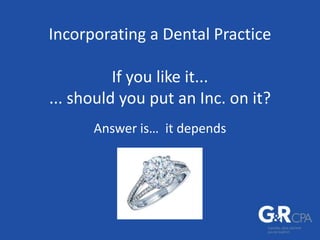
Incorporating a Dental Practice
If you like it...
... should you put an Inc. on it?
Answer is… it depends
Why Incorporate? The Pros
• Legal reasons exist
– Limited liability & creditor protection
– Separate legal entity – succession
– Accountants are not lawyers
– Talk to a qualified lawyer regarding incorporation
as you should for:
• Associate & non-compete agreements
• Wills & estate plans
• Shareholder & share purchase agreements
Why Incorporate? The Pros
• Taxes, taxes, taxes
– Potential tax savings may exist with:
• Corporate tax rates
• Income splitting opportunities
– Potential tax deferral may exist
• Funds left in corporations
• Similar to an RRSP
– Canada Pension Plan (“CPP”) ramifications
Potential Income Tax Savings
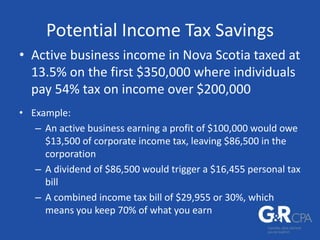
• Active business income in Nova Scotia taxed at
13.5% on the first $350,000 where individuals
pay 54% tax on income over $200,000
• Example:
– An active business earning a profit of $100,000 would owe
$13,500 of corporate income tax, leaving $86,500 in the
corporation
– A dividend of $86,500 would trigger a $16,455 personal tax
bill
– A combined income tax bill of $29,955 or 30%, which
means you keep 70% of what you earn
Potential Income Tax Savings
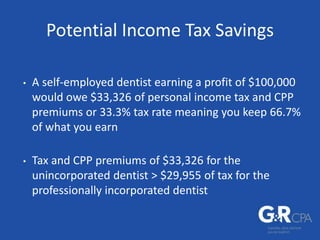
• A self-employed dentist earning a profit of $100,000
would owe $33,326 of personal income tax and CPP
premiums or 33.3% tax rate meaning you keep 66.7%
of what you earn
• Tax and CPP premiums of $33,326 for the
unincorporated dentist > $29,955 of tax for the
professionally incorporated dentist
Income Splitting Opportunities
• Control rests with the dentist
– Nova Scotia Dental Act (“NSDA”) 40 (1) allows
dentistry to be performed by a corporation
– NSDA 40 (2) requires the majority of the voting shares
in the corporation to be held by one or more licensed
dentists
• Opportunity for wider share ownership to
provide income splitting
– Consult your accountant & lawyer to determine what
share structure is right for you
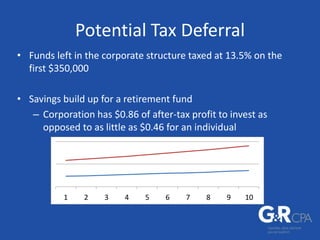
Potential Tax Deferral
• Funds left in the corporate structure taxed at 13.5% on the
first $350,000
• Savings build up for a retirement fund
– Corporation has $0.86 of after-tax profit to invest as
opposed to as little as $0.46 for an individual
1 2 3 4 5 6 7 8 9 10
Tax Planning Opportunities
• Optimal tax savings often come from two key
strategies:
– Income Splitting - “Even-Steven” income between
spouses or common law partners
– Income smoothing - Smooth income over time
• Pay too much tax in peak years
• Don’t pay enough tax in trough years
Canada Pension Plan (CPP)
• Incorporating provides the potential to “save”
Canada Pension Plan contributions
– CPP is a forced savings of 9.27% on your first
$54,900 of self-employed income in 2016
– Employee portion is $2,544.30 (4.95%)
– Employer portion is $2,544.30 (4.95%)
– First $3,500 is CPP exempt
– Total forced savings of $5,088.60 whether you like it or not
If you can “save” CPP...
... should you?
Answer is… it depends!
“Saving” CPP Contributions
• Pros for CPP
– Forced savings work for some personalities
– Professionally managed portfolio
– Secure annuity for as long as you live
– Death, disability, and survivor benefits
“Saving” CPP Contributions
• Cons for CPP
– Forced savings don’t work for some personalities
– Non-liquid investments, you can’t access your
principle
– Death – benefits may not outweigh the costs
Why Incorporate? The Cons
• The “*” is an accountant’s best friend
• Legal-ese warning along the lines of:
“Please consult with a qualified tax advisor or accountant
to ensure a corporation is right for you”
• CPA’s have the enviable role of playing “Debbie Downer”
when it comes to investment or tax saving schemes
plans.
• We get to break the bad news, the cons
Why Incorporate? The Cons
• Do you want to complicate your life?
– Corporations will complicate your life by bringing
another entity into your world
• Legal protection and benefits may be limited
– Bankers will require guarantees
– Reputation in the business community
• There are seven degrees of separation in the world
and maybe two or three in Nova Scotia
– Insurance coverage requirements and costs
are similar – consult a broker
Why incorporate? The Cons
• Tax saving benefits may be limited if:
– You require your profit to fund your lifestyle or
personal debts (i.e., no tax deferral)
– You are single (i.e., no income splitting)
– Your children are minors (i.e., also no income
splitting)
– You “save” the CPP, but fail to save for retirement
Why Incorporate? The Cons
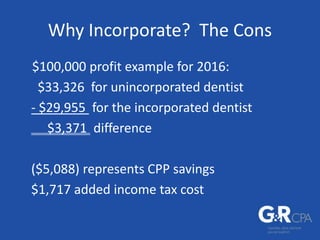
$100,000 profit example for 2016:
$33,326 for unincorporated dentist
- $29,955 for the incorporated dentist
$3,371 difference
($5,088) represents CPP savings
$1,717 added income tax cost
Why Incorporate? The Cons
Corporations come with costs for “necessary evils”
Why Incorporate? The Cons
• Necessary evils often come wearing suits,
shirts, smiles, ties…
– Accountants to file tax returns, T-slips, etc.
– Lawyers to incorporate, reorganize, dissolve, etc.
– Banks to manage accounts and credit cards
– Licensing boards, registry of joint stocks, etc.
• Overall, an increased paper burden whose
costs ($2,500 per year and up) may outweigh
the benefits of incorporating
Steps To Take
• Consult a lawyer, an accountant, and colleagues
who have acquired a practice to see if the pros will
outweigh the cons for your situation
• Hire an accountant early to review your personal
tax situation (if you are an associate) or the
acquisition with you
• Hire a lawyer to incorporate your company
properly and register it with the Registry of Joint
Stocks and adhere to the Nova Scotia Dental Act
Tax Time Reminders
• Individuals
– RRSP contribution deadline is March 1, 2017
– Income taxes and CPP are due May 1, 2017 at the latest
(assuming installments are up-to-date)
– Tax returns for self-employed individuals (i.e., associates)
are due by June 15, 2017
• Corporations
– Taxes are due within three months of their year-end at the
latest (assuming installments are up-to-date)
– Tax returns for corporations are due within six
months of their year-end
Questions?
230-3 Spectacle Lake Drive
Dartmouth, NS B3B 1W8
Telephone: (902) 463-9571
steven@grcpa.ca

Updated Dental Student Presentation Inc - G&R Final

  • 1.
    The Business ofDentistry A CPA’s Insights for Dental Students
  • 2.
    The Business ofDentistry Who is this guy? What is he going to talk about?
  • 3.
    G&R Chartered Professional Accountants •Steven R. Gray, CPA, CA graduated Magna Cum Laude from Robie Street High in 2000 • Formerly Rector Colavecchia Roche - Chartered Accountancy firm operated in Dartmouth for over 30 years • Recently re-branded as G&R Chartered Professional Accountants • Work with dental clients around the province within a two hour radius of Halifax
  • 4.
    Today’s Seminar • Employment& associate options • Acquiring & incorporating a dental practice – Pros – Cons – Steps to take • Tax time reminders – Upcoming deadlines
  • 5.
    Employment & AssociateOptions • Corporate dentistry is a growing trend – e.g., Dental Corporation of Canada • Dentists work as employees and earn a salary – T4 income is easy-peasy, any accountant will do – RRSP, TFSA, Life Insurance savings plans available • Associates work as self-employed contractors – E.g., 60/40 split between the practice & associate – T2125 income is trickier – Tax saving options similar to employees
  • 6.
    Employment & AssociateOptions Pros to the employment option include: – Focus on patient care, being a dentist! – Reduced administrative burden – Potentially less stress as a result – Work/life balance improvement Cons to the employment option include: – Reduced access to tax savings and planning opportunities – $$$, there’s a reason corporations want to own dental practices - a 29.1% profit margin for dental businesses with production over $1,164,000
  • 7.
    Acquiring a DentalPractice • Topic for a seminar all on its own! • Asset purchase – buyer’s preference (generally) – Tangible assets - equipment, systems, leaseholds, etc. – Intangible assets - patient list / goodwill / staff • Share purchase – vendor’s preference (generally) – Shares of the company that owns these assets • Asset or share price is a negotiation, not a science • Financing available – big banks love dentists • Location & personal fit with you is crucial – associate 1st
  • 8.
    Incorporating a DentalPractice If you like it... ... should you put an Inc. on it? Answer is… it depends
  • 9.
    Why Incorporate? ThePros • Legal reasons exist – Limited liability & creditor protection – Separate legal entity – succession – Accountants are not lawyers – Talk to a qualified lawyer regarding incorporation as you should for: • Associate & non-compete agreements • Wills & estate plans • Shareholder & share purchase agreements
  • 10.
    Why Incorporate? ThePros • Taxes, taxes, taxes – Potential tax savings may exist with: • Corporate tax rates • Income splitting opportunities – Potential tax deferral may exist • Funds left in corporations • Similar to an RRSP – Canada Pension Plan (“CPP”) ramifications
  • 11.
    Potential Income TaxSavings • Active business income in Nova Scotia taxed at 13.5% on the first $350,000 where individuals pay 54% tax on income over $200,000 • Example: – An active business earning a profit of $100,000 would owe $13,500 of corporate income tax, leaving $86,500 in the corporation – A dividend of $86,500 would trigger a $16,455 personal tax bill – A combined income tax bill of $29,955 or 30%, which means you keep 70% of what you earn
  • 12.
    Potential Income TaxSavings • A self-employed dentist earning a profit of $100,000 would owe $33,326 of personal income tax and CPP premiums or 33.3% tax rate meaning you keep 66.7% of what you earn • Tax and CPP premiums of $33,326 for the unincorporated dentist > $29,955 of tax for the professionally incorporated dentist
  • 13.
    Income Splitting Opportunities •Control rests with the dentist – Nova Scotia Dental Act (“NSDA”) 40 (1) allows dentistry to be performed by a corporation – NSDA 40 (2) requires the majority of the voting shares in the corporation to be held by one or more licensed dentists • Opportunity for wider share ownership to provide income splitting – Consult your accountant & lawyer to determine what share structure is right for you
  • 14.
    Potential Tax Deferral •Funds left in the corporate structure taxed at 13.5% on the first $350,000 • Savings build up for a retirement fund – Corporation has $0.86 of after-tax profit to invest as opposed to as little as $0.46 for an individual 1 2 3 4 5 6 7 8 9 10
  • 15.
    Tax Planning Opportunities •Optimal tax savings often come from two key strategies: – Income Splitting - “Even-Steven” income between spouses or common law partners – Income smoothing - Smooth income over time • Pay too much tax in peak years • Don’t pay enough tax in trough years
  • 16.
    Canada Pension Plan(CPP) • Incorporating provides the potential to “save” Canada Pension Plan contributions – CPP is a forced savings of 9.27% on your first $54,900 of self-employed income in 2016 – Employee portion is $2,544.30 (4.95%) – Employer portion is $2,544.30 (4.95%) – First $3,500 is CPP exempt – Total forced savings of $5,088.60 whether you like it or not
  • 17.
    If you can“save” CPP... ... should you? Answer is… it depends!
  • 18.
    “Saving” CPP Contributions •Pros for CPP – Forced savings work for some personalities – Professionally managed portfolio – Secure annuity for as long as you live – Death, disability, and survivor benefits
  • 19.
    “Saving” CPP Contributions •Cons for CPP – Forced savings don’t work for some personalities – Non-liquid investments, you can’t access your principle – Death – benefits may not outweigh the costs
  • 20.
    Why Incorporate? TheCons • The “*” is an accountant’s best friend • Legal-ese warning along the lines of: “Please consult with a qualified tax advisor or accountant to ensure a corporation is right for you” • CPA’s have the enviable role of playing “Debbie Downer” when it comes to investment or tax saving schemes plans. • We get to break the bad news, the cons
  • 21.
    Why Incorporate? TheCons • Do you want to complicate your life? – Corporations will complicate your life by bringing another entity into your world • Legal protection and benefits may be limited – Bankers will require guarantees – Reputation in the business community • There are seven degrees of separation in the world and maybe two or three in Nova Scotia – Insurance coverage requirements and costs are similar – consult a broker
  • 22.
    Why incorporate? TheCons • Tax saving benefits may be limited if: – You require your profit to fund your lifestyle or personal debts (i.e., no tax deferral) – You are single (i.e., no income splitting) – Your children are minors (i.e., also no income splitting) – You “save” the CPP, but fail to save for retirement
  • 23.
    Why Incorporate? TheCons $100,000 profit example for 2016: $33,326 for unincorporated dentist - $29,955 for the incorporated dentist $3,371 difference ($5,088) represents CPP savings $1,717 added income tax cost
  • 24.
    Why Incorporate? TheCons Corporations come with costs for “necessary evils”
  • 25.
    Why Incorporate? TheCons • Necessary evils often come wearing suits, shirts, smiles, ties… – Accountants to file tax returns, T-slips, etc. – Lawyers to incorporate, reorganize, dissolve, etc. – Banks to manage accounts and credit cards – Licensing boards, registry of joint stocks, etc. • Overall, an increased paper burden whose costs ($2,500 per year and up) may outweigh the benefits of incorporating
  • 26.
    Steps To Take •Consult a lawyer, an accountant, and colleagues who have acquired a practice to see if the pros will outweigh the cons for your situation • Hire an accountant early to review your personal tax situation (if you are an associate) or the acquisition with you • Hire a lawyer to incorporate your company properly and register it with the Registry of Joint Stocks and adhere to the Nova Scotia Dental Act
  • 27.
    Tax Time Reminders •Individuals – RRSP contribution deadline is March 1, 2017 – Income taxes and CPP are due May 1, 2017 at the latest (assuming installments are up-to-date) – Tax returns for self-employed individuals (i.e., associates) are due by June 15, 2017 • Corporations – Taxes are due within three months of their year-end at the latest (assuming installments are up-to-date) – Tax returns for corporations are due within six months of their year-end
  • 28.
    Questions? 230-3 Spectacle LakeDrive Dartmouth, NS B3B 1W8 Telephone: (902) 463-9571 steven@grcpa.ca