SUBSECRETARÍA	
  DE	
  FUNDAMENTOS	
  EDUCATIV0S	
  
DIRECCIÓN NACIONAL DE CURRÍCULO
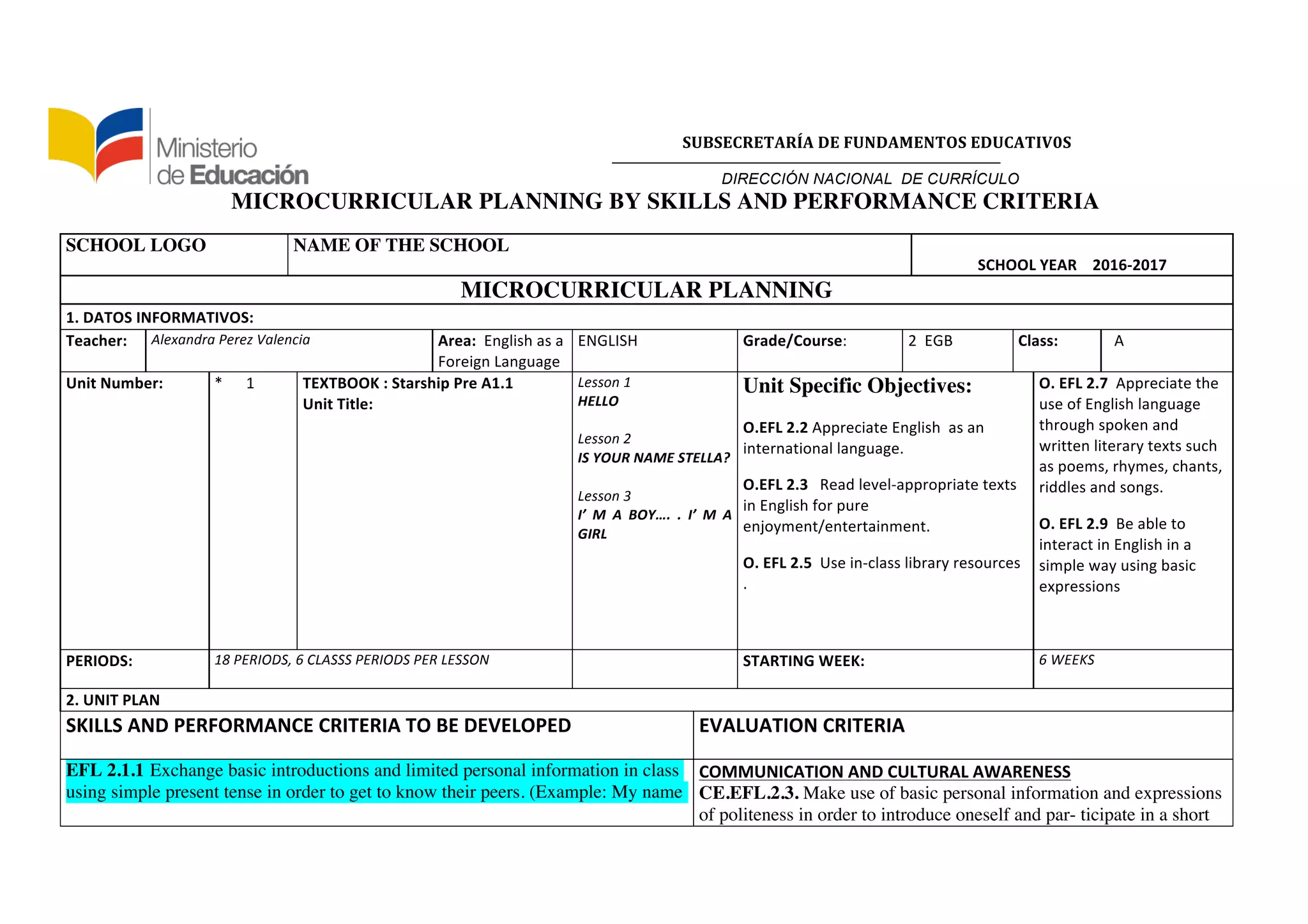
MICROCURRICULAR PLANNING BY SKILLS AND PERFORMANCE CRITERIA
SCHOOL LOGO NAME OF THE SCHOOL
SCHOOL	
  YEAR	


  2016-­‐2017	
  
MICROCURRICULAR PLANNING 	
  
1.	
  DATOS	
  INFORMATIVOS:	
  
Teacher:	
  	
   Alexandra	
  Perez	
  Valencia	
   Area:	
  	
  English	
  as	
  a	
  
Foreign	
  Language	
  
ENGLISH	
   Grade/Course:	
  	
   2	
  	
  EGB	
   Class:	


  A	
  
Unit	
  Number:	
  	
   *	


  1	
   TEXTBOOK	
  :	
  Starship	
  Pre	
  A1.1	
  
Unit	
  Title:	
  	
  
Lesson	
  1	
  
HELLO	


Lesson	
  2	
  
IS	
  YOUR	
  NAME	
  STELLA?	


Lesson	
  3	
  
I’	
   M	
   A	
   BOY….	
   .	
   I’	
   M	
   A	
  
GIRL	
  
Unit Specific Objectives:
O.EFL	
  2.2	
  Appreciate	
  English	
  	
  as	
  an	
  
international	
  language.	
  	
  
O.EFL	
  2.3	
  	
  	
  Read	
  level-­‐appropriate	
  texts	
  
in	
  English	
  for	
  pure	
  
enjoyment/entertainment.	
  
O.	
  EFL	
  2.5	
  	
  Use	
  in-­‐class	
  library	
  resources	
  
.	
  
O.	
  EFL	
  2.7	
  	
  Appreciate	
  the	
  
use	
  of	
  English	
  language	
  
through	
  spoken	
  and	
  
written	
  literary	
  texts	
  such	
  
as	
  poems,	
  rhymes,	
  chants,	
  
riddles	
  and	
  songs.	
  
O.	
  EFL	
  2.9	
  	
  Be	
  able	
  to	
  
interact	
  in	
  English	
  in	
  a	
  
simple	
  way	
  using	
  basic	
  
expressions	
  	
  
PERIODS:	
   18	
  PERIODS,	
  6	
  CLASSS	
  PERIODS	
  PER	
  LESSON	
   	
   STARTING	
  WEEK:	
   6	
  WEEKS	
  
2.	
  UNIT	
  PLAN	
  
SKILLS	
  AND	
  PERFORMANCE	
  CRITERIA	
  TO	
  BE	
  DEVELOPED	


EVALUATION	
  CRITERIA	
  	
  
EFL 2.1.1 Exchange basic introductions and limited personal information in class
using simple present tense in order to get to know their peers. (Example: My name
COMMUNICATION	
  AND	
  CULTURAL	
  AWARENESS	
  
CE.EFL.2.3. Make use of basic personal information and expressions
of politeness in order to introduce oneself and par- ticipate in a short
 
is, ..I am …..etc)
STUDENT	
  BOOK	
  Lesson	
  1	
  
• Greetings	
  (Hello.,	
  My	
  name’s…,	
  What’s	
  your	
  name?)	
  
Wh-questions with BE (What’s) (What’s this? It’s a book/a pencil/an eraser)
STUDENT	
  BOOK	
  Lesson	
  2	
  
• Greetings	
  (Hello.	
  Hi.)	
  
Questions about names (Is your name Stella? No, it isn’t. Yes, it is.)
STUDENT	
  BOOK	
  Lesson	
  3	
  
Describing oneself and others (I’m a boy. I’m a girl. He’s a boy. She’s a girl.)
EFL.2.1.6 Understand and use common expressions of politeness in class while
working in pairs or groups on projects. (Example: please, sorry, thank you, etc.)
STUDENT	
  BOOK	
  Lesson	
  3	
  
Asking	
  others	
  to	
  do	
  things	
  (please)
ORAL COMMUNICATION
EFL 2.2.3 Recognize familiar names, words, and short phrases about simple
everyday topics whether heard in isolation or within short, simple spoken texts
describing people and objects. (Example: vocabulary about self, family, friends
and immediate surroundings at school and home, color and size, etc.)
STUDENT	
  BOOK	
  Lesson	
  1	
  
• Asking	
  others	
  to	
  do	
  things	
  (Open	
  your	
  book.	
  Close	
  your	
  book.	
  Point	
  to	
  the	
  book.	
  
Look.	
  Listen.	
  Write.	
  Say	
  book.)	
  
Wh-questions with BE (What’s) (What’s this? It’s a book/a pencil/an eraser)
STUDENT	
  BOOK	
  Lesson	
  2	
  
• Questions	
  about	
  names	
  and	
  things	
  (Is	
  your	
  name	
  Stella?	
  No,	
  it	
  isn’t.	
  Yes,	
  it	
  is.	
  Is	
  
conversation.
ORAL COMMUNICATION
CE.EFL.2.7. Listening for Information: Follow short and simple
spoken texts that include familiar vocabulary and are set in everyday
contexts. Identify key items of information within the text, and record
or act upon them.
CE.EFL.2.9. Production - Fluency: Utterances are sometimes
produced slowly but use appropriate words and phrases to express
basic ideas, initiate conversations and respond to questions, including
some chunks of language and short sentences.
 
this	
  a	
  board/door/window/chair/desk??	
  No,	
  it	
  isn’t.	
  It’s	
  a...	
  Yes,	
  it	
  is.)	
  
Simple phrasal verbs (sit down, stand up)
STUDENT	
  BOOK	
  Lesson	
  3	
  
• Describing	
  oneself	
  and	
  others	
  (I’m	
  a	
  boy.	
  I’m	
  a	
  girl.	
  He’s	
  a	
  boy.	
  He’s	
  a	
  girl.)	
  
Describing things you see (What do you see? I see a crayon/pen/ruler.)
ACTIVITY	
  BOOK	
  All	
  Lessons	
  
• Listen	
  and	
  check	
  sections	


Listen and say sections
EFL 2.2.4 Identify items of specific information within simple messages or from
short and simple descriptions about familiar contexts, especially if visual support is
provided. (Example: letters of the alphabet, numbers, prices and times, days, dates
and months, etc.)
STUDENT	
  BOOK	
  Lesson	
  1	
  
Wh-questions with BE (What’s) (What’s this? It’s a book/a pencil/an eraser.)
STUDENT	
  BOOK	
  Lesson	
  2	
  
Questions about names and things (Is this a board/door/window/chair/desk?? No, it
isn’t. It’s a... Yes, it is.)
STUDENT	
  BOOK	
  Lesson	
  3	
  
Describing things you see (I see a crayon/pen/ruler.)
ACTIVITY	
  BOOK	
  All	
  Lessons	
  
• Listen	
  and	
  check	
  sections	


• Listen	
  and	
  say	
  sections	
  
Listen and match sections
EFL 2.2.5 Record key items of specific information from a heard message or
description, either in written form or by drawing picture. (Example: letters of the
 
alphabet, numbers, prices and times, days, dates and months, etc.)
EFL.2.2.11 Produce simple, mainly isolated utterances using very short phrases
and sometimes individual words, possibly with slow and/or hesitant delivery.
(Example: words, phrases, and short sentences about people, animals, things, etc.)
STUDENT	
  BOOK	
  Lesson	
  1	
  
• Greetings	
  (Hello.,	
  My	
  name’s…,	
  What’s	
  your	
  name?	
  Good-­‐bye,	
  …)	
  
• Asking	
  others	
  to	
  do	
  things	
  (Open	
  your	
  book.	
  Close	
  your	
  book.	
  Point	
  to	
  the	
  book.	
  
Look.	
  Listen.	
  Write.	
  Say	
  book.)	
  
Wh-questions with BE (What’s) (What’s this? It’s a book/a pencil/an eraser)
STUDENT	
  BOOK	
  Lesson	
  2	
  
• Greetings	
  (Hello.	
  Hi.)	
  
• Questions	
  about	
  names	
  and	
  things	
  (Is	
  your	
  name…?	
  No,	
  it	
  isn’t.	
  Yes,	
  it	
  is.	
  Is	
  this	
  a	
  
board/door/window/chair/desk??	
  No,	
  it	
  isn’t.	
  It’s	
  a...	
  Yes,	
  it	
  is.)	
  
Asking others to do things. (Stand up. Sit down. Come here. Go to the board. Open
the window. Close the door.)
STUDENT	
  BOOK	
  Lesson	
  3	
  
• Describing	
  oneself	
  and	
  others	
  (I’m	
  a	
  boy.	
  I’m	
  a	
  girl.	
  He’s	
  a	
  boy.	
  He’s	
  a	
  girl.)	
  
• Asking	
  others	
  to	
  do	
  things	
  (Hands	
  up.	
  Hands	
  down.	
  Be	
  quiet,	
  please.	
  Work	
  in	
  
pairs.	
  Work	
  in	
  groups.)	
  
Describing things you see (What do you see? I see a crayon/pen/ruler.)
ACTIVITY	
  BOOK	
  All	
  Lessons	
  
Listen and say sections
EFL.2.2.12 Respond to simple questions in quite a short time and initiate basic
interaction spontaneously when there are opportunities to speak. Speech is
produced a little less slowly and hesitantly.
READING
CE.EFL.2.11. Identify and understand individual every-day words,
 
READING
EFL 2.3.1 Demonstrate basic reading comprehension skills by identifying the
meaning of individual words, phrases, and sentences, including simple written
instructions
STUDENT	
  BOOK	
  Lesson	
  1	
  
• Greetings	
  (Hello.,	
  My	
  name’s…,	
  What’s	
  your	
  name?)	
  
• Asking	
  others	
  to	
  do	
  things	
  (Open	
  your	
  book.	
  Close	
  your	
  book.	
  Point	
  to	
  the	
  book.	
  
Look.	
  Listen.	
  Write.	
  Say	
  book.)	
  
Wh-questions with BE (What’s) (What’s this? It’s a book/a pencil/an eraser)
STUDENT	
  BOOK	
  Lesson	
  2	
  
• Greetings	
  (Hello.	
  Hi.)	
  
• Questions	
  about	
  names	
  and	
  things	
  (Is	
  your	
  name…?	
  No,	
  it	
  isn’t.	
  Yes,	
  it	
  is.	
  Is	
  this	
  a	
  
board/door/window/chair/desk??	
  No,	
  it	
  isn’t.	
  It’s	
  a...	
  Yes,	
  it	
  is.)	
  
• Simple	
  phrasal	
  verbs	
  (sit	
  down,	
  stand	
  up)	
  
Asking others to do things. (Stand up. Sit down. Come here. Go to the board. Open
the window. Close the door.)
STUDENT	
  BOOK	
  Lesson	
  3	
  
• Describing	
  oneself	
  and	
  others	
  (I’m	
  a	
  boy.	
  I’m	
  a	
  girl.	
  He’s	
  a	
  boy.	
  He’s	
  a	
  girl.)	
  
• Asking	
  others	
  to	
  do	
  things	
  (Hands	
  up.	
  Hands	
  down.	
  Be	
  quiet,	
  please.	
  Work	
  in	
  
pairs.	
  Work	
  in	
  groups.)	
  
Describing things you see (What do you see? I see a crayon/pen/ruler.)
ACTIVITY	
  BOOK	
  All	
  Lessons	
  
• Read	
  and	
  say	
  sections	


• Match	
  sections	
  
Read and match sections
phrases, and sentences, including instructions.
WRITING
 
WRITING
EFL 2.4.3 Write simple words by hand and/or on the computer with correct use of
standard writing mechanics. Example: blue, cat, dog, son, etc
STUDENT	
  BOOK	
  All	
  Lessons	
  
Vocabulary	
  	
  (see	
  Scope	
  and	
  Sequence)
EFL 2.4.4 Write simple words, phrases and sentences for controlled practice of
language arts.
STUDENT	
  BOOK	
  All	
  Lessons	
  
Language	
  Items	
  	
  	
  (see	
  Scope	
  and	
  Sequence)
LANGUAGE THROUGH THE ARTS
EFL 2.5.1 Identify key information such as events, characters, and objects in
stories and other age-appropriate literary texts if there is visual support
STUDENT	
  BOOK	
  All	
  Lessons	
  
Look,	
  listen,	
  and	
  say	
  sections	
  	
  
CE.EFL.2.18. Writing in order to perform controlled practice of
vocabulary and grammar ítems.
LANGUAGE THROUGH THE ARTS
CE.EFL.2.21. Distinguish key information in stories and other age-
appropriate literary texts, both oral and written.
	
  
METHODOLOGICAL
STRATEGIES
RESOURCES	
   PERFORMANCE INDICATORS


  EVALUATION/ ACTIVITIES
TECHNIQUES/INSTRUMENTS
	
  
This performance criteria could be
evaluated by:
1.Mimic gestures or movements to
learn and show comprehension
2.Work in small groups to greet
Lesson 1
Flash Cards 1–10• Star 
Stella puppets• Audio
CD:T1–5• Song Audio
CD• Activity Book: pp.
AB4–AB7 • Optional: box
	
  
COMMUNICATION	
  AND	
  CULTURAL	
  AWARENESS	
  
• I.EFL.2.3.1. Learners can use basic personal
information and expressions of politeness in short
Lesson 1 Warm-Up (5 minutes):
Preview the greeting song from the
lesson’s Sing activity. As the song
plays, use gestures to introduce the
words.
Lesson 2 Warm-Up (5 minutes):
 
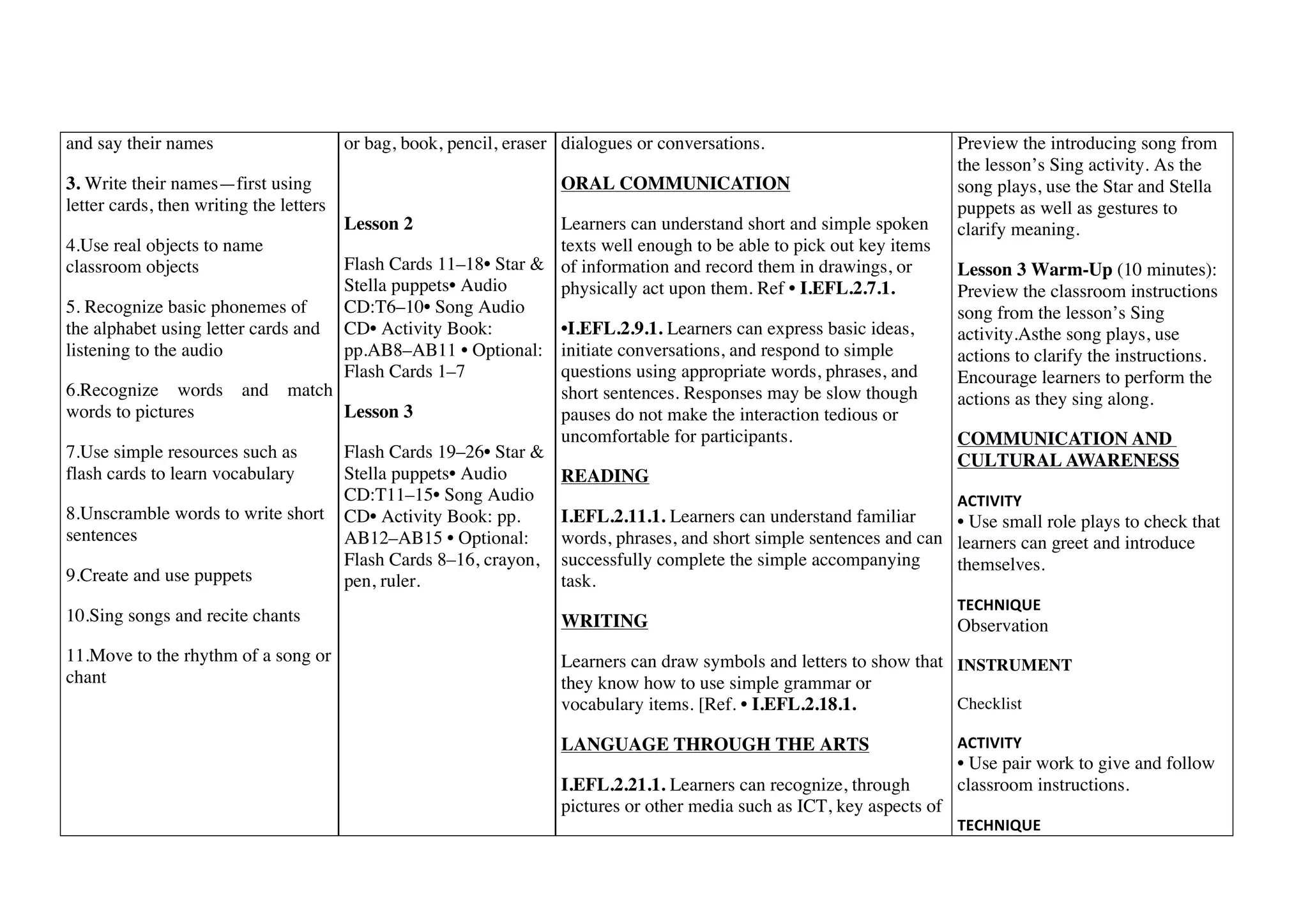
and say their names
3. Write their names—first using
letter cards, then writing the letters
4.Use real objects to name
classroom objects
5. Recognize basic phonemes of
the alphabet using letter cards and
listening to the audio
6.Recognize words and match
words to pictures
7.Use simple resources such as
flash cards to learn vocabulary
8.Unscramble words to write short
sentences
9.Create and use puppets 
10.Sing songs and recite chants
11.Move to the rhythm of a song or
chant
	
  
or bag, book, pencil, eraser
Lesson 2
Flash Cards 11–18• Star 
Stella puppets• Audio
CD:T6–10• Song Audio
CD• Activity Book:
pp.AB8–AB11 • Optional:
Flash Cards 1–7
Lesson 3
Flash Cards 19–26• Star 
Stella puppets• Audio
CD:T11–15• Song Audio
CD• Activity Book: pp.
AB12–AB15 • Optional:
Flash Cards 8–16, crayon,
pen, ruler.


dialogues or conversations.
ORAL COMMUNICATION
Learners can understand short and simple spoken
texts well enough to be able to pick out key items
of information and record them in drawings, or
physically act upon them. Ref • I.EFL.2.7.1.
•I.EFL.2.9.1. Learners can express basic ideas,
initiate conversations, and respond to simple
questions using appropriate words, phrases, and
short sentences. Responses may be slow though
pauses do not make the interaction tedious or
uncomfortable for participants.
READING
I.EFL.2.11.1. Learners can understand familiar
words, phrases, and short simple sentences and can
successfully complete the simple accompanying
task.
WRITING
Learners can draw symbols and letters to show that
they know how to use simple grammar or
vocabulary items. [Ref. • I.EFL.2.18.1.
LANGUAGE THROUGH THE ARTS
I.EFL.2.21.1. Learners can recognize, through
pictures or other media such as ICT, key aspects of
Preview the introducing song from
the lesson’s Sing activity. As the
song plays, use the Star and Stella
puppets as well as gestures to
clarify meaning.
Lesson 3 Warm-Up (10 minutes):
Preview the classroom instructions
song from the lesson’s Sing
activity.Asthe song plays, use
actions to clarify the instructions.
Encourage learners to perform the
actions as they sing along.
COMMUNICATION AND
CULTURAL AWARENESS
ACTIVITY	
  
• Use small role plays to check that
learners can greet and introduce
themselves.
TECHNIQUE	
  
Observation
INSTRUMENT
Checklist
ACTIVITY	
  
• Use pair work to give and follow
classroom instructions.
TECHNIQUE	
  
 
a story or literary text (orally).
	
  
Observation
INSTRUMENT
Checklist
ORAL COMMUNICATION
ACTIVITY	
  
•Have learners work in pairs to ask
and answer questions about
classroom objects.
TECHNIQUE	
  
Observation
INSTRUMENT
Rating scale
ACTIVITY	
  
•Ask learners to act out the actions
in the song for Lesson 3.
TECHNIQUE	
  
Quiz
INSTRUMENT
Sampling song
READING
ACTIVITY	
  
 
•Check word recognition by asking
learners to point to a word and say
it.
TECHNIQUE	
  
Observation	
  
INSTRUMENT
Data collection
ACTIVITY	
  
•Check word recognition by asking
learners to match words and
pictures with a line.
TECHNIQUE	
  
INSTRUMENT
WRITING
ACTIVITY	
  
•Check spelling skills by asking
learners to unscramble the letters in
a word.
TECHNIQUE	
  
INSTRUMENT
 
ACTIVITY	
  
• Check writing skills by asking
learners to label a picture.
TECHNIQUE	
  
Observation
INSTRUMENT
Participation Chart
LANGUAGE THROUGH THE
ARTS
ACTIVITY	
  
• Check vocabulary comprehension
by asking learners to act out
classroom instructions.
TECHNIQUE	
  
Interview
INSTRUMENT
Cuestionary
ACTIVITY	
  
•Have learners listen to a song or
chant about classroom objects and
draw something they hear.
TECHNIQUE	
  
Observation


*Información	
  tomada	
  de	
  la	
  planificación	
  curricular	
  anual.	
  
INSTRUMENT
Participation Chart
3. ADAPTED CURRICULUM
Specification of Educational Needs
	
  
Specification of the adapted material to be applied


  Struggling Learners
Below Level Learners


  Face students when speaking. Speak clearly and slowly. Pause frequently.• Preview the lesson by
having learners look at the pictures and think about what they will learn.• Initially use whole group
for instruction, then divide learners into small groups or pairs.• Use pictures and flash cards to help
learners connect meaning. Have learners create their own flash cards. • Use props, real classroom
objects, and gestures.• Provide word walls for learners to reference.• Have learners draw pictures to
illustrate meaning. Learners share pictures to contribute to conversations. • Ask learners to add
pictures or drawings to a book activity.


CLIL COMPONENTS
Science: Look at the map of outer space -
the home of Star and Stella
TRANSVERSAL AXES Respect, etc
PREPARED BY:	
   REVISED BY:	
   APPROVED BY:	
  
Teacher:	
   Coordinator:	
   Viceprincipal:	
  
Signature:	
  	
   Signature:	
   Signature:	
  
Date	
   Date	
   Date	
  

Starship english-pre-a1-1-2-3-4-egb

  • 1.
      SUBSECRETARÍA  DE  FUNDAMENTOS  EDUCATIV0S   DIRECCIÓN NACIONAL DE CURRÍCULO MICROCURRICULAR PLANNING BY SKILLS AND PERFORMANCE CRITERIA SCHOOL LOGO NAME OF THE SCHOOL SCHOOL  YEAR        2016-­‐2017   MICROCURRICULAR PLANNING   1.  DATOS  INFORMATIVOS:   Teacher:     Alexandra  Perez  Valencia   Area:    English  as  a   Foreign  Language   ENGLISH   Grade/Course:     2    EGB   Class:          A   Unit  Number:     *            1   TEXTBOOK  :  Starship  Pre  A1.1   Unit  Title:     Lesson  1   HELLO     Lesson  2   IS  YOUR  NAME  STELLA?     Lesson  3   I’   M   A   BOY….   .   I’   M   A   GIRL   Unit Specific Objectives: O.EFL  2.2  Appreciate  English    as  an   international  language.     O.EFL  2.3      Read  level-­‐appropriate  texts   in  English  for  pure   enjoyment/entertainment.   O.  EFL  2.5    Use  in-­‐class  library  resources   .   O.  EFL  2.7    Appreciate  the   use  of  English  language   through  spoken  and   written  literary  texts  such   as  poems,  rhymes,  chants,   riddles  and  songs.   O.  EFL  2.9    Be  able  to   interact  in  English  in  a   simple  way  using  basic   expressions     PERIODS:   18  PERIODS,  6  CLASSS  PERIODS  PER  LESSON     STARTING  WEEK:   6  WEEKS   2.  UNIT  PLAN   SKILLS  AND  PERFORMANCE  CRITERIA  TO  BE  DEVELOPED       EVALUATION  CRITERIA     EFL 2.1.1 Exchange basic introductions and limited personal information in class using simple present tense in order to get to know their peers. (Example: My name COMMUNICATION  AND  CULTURAL  AWARENESS   CE.EFL.2.3. Make use of basic personal information and expressions of politeness in order to introduce oneself and par- ticipate in a short
  • 2.
      is, ..I am…..etc) STUDENT  BOOK  Lesson  1   • Greetings  (Hello.,  My  name’s…,  What’s  your  name?)   Wh-questions with BE (What’s) (What’s this? It’s a book/a pencil/an eraser) STUDENT  BOOK  Lesson  2   • Greetings  (Hello.  Hi.)   Questions about names (Is your name Stella? No, it isn’t. Yes, it is.) STUDENT  BOOK  Lesson  3   Describing oneself and others (I’m a boy. I’m a girl. He’s a boy. She’s a girl.) EFL.2.1.6 Understand and use common expressions of politeness in class while working in pairs or groups on projects. (Example: please, sorry, thank you, etc.) STUDENT  BOOK  Lesson  3   Asking  others  to  do  things  (please) ORAL COMMUNICATION EFL 2.2.3 Recognize familiar names, words, and short phrases about simple everyday topics whether heard in isolation or within short, simple spoken texts describing people and objects. (Example: vocabulary about self, family, friends and immediate surroundings at school and home, color and size, etc.) STUDENT  BOOK  Lesson  1   • Asking  others  to  do  things  (Open  your  book.  Close  your  book.  Point  to  the  book.   Look.  Listen.  Write.  Say  book.)   Wh-questions with BE (What’s) (What’s this? It’s a book/a pencil/an eraser) STUDENT  BOOK  Lesson  2   • Questions  about  names  and  things  (Is  your  name  Stella?  No,  it  isn’t.  Yes,  it  is.  Is   conversation. ORAL COMMUNICATION CE.EFL.2.7. Listening for Information: Follow short and simple spoken texts that include familiar vocabulary and are set in everyday contexts. Identify key items of information within the text, and record or act upon them. CE.EFL.2.9. Production - Fluency: Utterances are sometimes produced slowly but use appropriate words and phrases to express basic ideas, initiate conversations and respond to questions, including some chunks of language and short sentences.
  • 3.
      this  a  board/door/window/chair/desk??  No,  it  isn’t.  It’s  a...  Yes,  it  is.)   Simple phrasal verbs (sit down, stand up) STUDENT  BOOK  Lesson  3   • Describing  oneself  and  others  (I’m  a  boy.  I’m  a  girl.  He’s  a  boy.  He’s  a  girl.)   Describing things you see (What do you see? I see a crayon/pen/ruler.) ACTIVITY  BOOK  All  Lessons   • Listen  and  check  sections       Listen and say sections EFL 2.2.4 Identify items of specific information within simple messages or from short and simple descriptions about familiar contexts, especially if visual support is provided. (Example: letters of the alphabet, numbers, prices and times, days, dates and months, etc.) STUDENT  BOOK  Lesson  1   Wh-questions with BE (What’s) (What’s this? It’s a book/a pencil/an eraser.) STUDENT  BOOK  Lesson  2   Questions about names and things (Is this a board/door/window/chair/desk?? No, it isn’t. It’s a... Yes, it is.) STUDENT  BOOK  Lesson  3   Describing things you see (I see a crayon/pen/ruler.) ACTIVITY  BOOK  All  Lessons   • Listen  and  check  sections       • Listen  and  say  sections   Listen and match sections EFL 2.2.5 Record key items of specific information from a heard message or description, either in written form or by drawing picture. (Example: letters of the
  • 4.
      alphabet, numbers, pricesand times, days, dates and months, etc.) EFL.2.2.11 Produce simple, mainly isolated utterances using very short phrases and sometimes individual words, possibly with slow and/or hesitant delivery. (Example: words, phrases, and short sentences about people, animals, things, etc.) STUDENT  BOOK  Lesson  1   • Greetings  (Hello.,  My  name’s…,  What’s  your  name?  Good-­‐bye,  …)   • Asking  others  to  do  things  (Open  your  book.  Close  your  book.  Point  to  the  book.   Look.  Listen.  Write.  Say  book.)   Wh-questions with BE (What’s) (What’s this? It’s a book/a pencil/an eraser) STUDENT  BOOK  Lesson  2   • Greetings  (Hello.  Hi.)   • Questions  about  names  and  things  (Is  your  name…?  No,  it  isn’t.  Yes,  it  is.  Is  this  a   board/door/window/chair/desk??  No,  it  isn’t.  It’s  a...  Yes,  it  is.)   Asking others to do things. (Stand up. Sit down. Come here. Go to the board. Open the window. Close the door.) STUDENT  BOOK  Lesson  3   • Describing  oneself  and  others  (I’m  a  boy.  I’m  a  girl.  He’s  a  boy.  He’s  a  girl.)   • Asking  others  to  do  things  (Hands  up.  Hands  down.  Be  quiet,  please.  Work  in   pairs.  Work  in  groups.)   Describing things you see (What do you see? I see a crayon/pen/ruler.) ACTIVITY  BOOK  All  Lessons   Listen and say sections EFL.2.2.12 Respond to simple questions in quite a short time and initiate basic interaction spontaneously when there are opportunities to speak. Speech is produced a little less slowly and hesitantly. READING CE.EFL.2.11. Identify and understand individual every-day words,
  • 5.
      READING EFL 2.3.1 Demonstratebasic reading comprehension skills by identifying the meaning of individual words, phrases, and sentences, including simple written instructions STUDENT  BOOK  Lesson  1   • Greetings  (Hello.,  My  name’s…,  What’s  your  name?)   • Asking  others  to  do  things  (Open  your  book.  Close  your  book.  Point  to  the  book.   Look.  Listen.  Write.  Say  book.)   Wh-questions with BE (What’s) (What’s this? It’s a book/a pencil/an eraser) STUDENT  BOOK  Lesson  2   • Greetings  (Hello.  Hi.)   • Questions  about  names  and  things  (Is  your  name…?  No,  it  isn’t.  Yes,  it  is.  Is  this  a   board/door/window/chair/desk??  No,  it  isn’t.  It’s  a...  Yes,  it  is.)   • Simple  phrasal  verbs  (sit  down,  stand  up)   Asking others to do things. (Stand up. Sit down. Come here. Go to the board. Open the window. Close the door.) STUDENT  BOOK  Lesson  3   • Describing  oneself  and  others  (I’m  a  boy.  I’m  a  girl.  He’s  a  boy.  He’s  a  girl.)   • Asking  others  to  do  things  (Hands  up.  Hands  down.  Be  quiet,  please.  Work  in   pairs.  Work  in  groups.)   Describing things you see (What do you see? I see a crayon/pen/ruler.) ACTIVITY  BOOK  All  Lessons   • Read  and  say  sections       • Match  sections   Read and match sections phrases, and sentences, including instructions. WRITING
  • 6.
      WRITING EFL 2.4.3 Writesimple words by hand and/or on the computer with correct use of standard writing mechanics. Example: blue, cat, dog, son, etc STUDENT  BOOK  All  Lessons   Vocabulary    (see  Scope  and  Sequence) EFL 2.4.4 Write simple words, phrases and sentences for controlled practice of language arts. STUDENT  BOOK  All  Lessons   Language  Items      (see  Scope  and  Sequence) LANGUAGE THROUGH THE ARTS EFL 2.5.1 Identify key information such as events, characters, and objects in stories and other age-appropriate literary texts if there is visual support STUDENT  BOOK  All  Lessons   Look,  listen,  and  say  sections     CE.EFL.2.18. Writing in order to perform controlled practice of vocabulary and grammar ítems. LANGUAGE THROUGH THE ARTS CE.EFL.2.21. Distinguish key information in stories and other age- appropriate literary texts, both oral and written.   METHODOLOGICAL STRATEGIES RESOURCES   PERFORMANCE INDICATORS    EVALUATION/ ACTIVITIES TECHNIQUES/INSTRUMENTS   This performance criteria could be evaluated by: 1.Mimic gestures or movements to learn and show comprehension 2.Work in small groups to greet Lesson 1 Flash Cards 1–10• Star Stella puppets• Audio CD:T1–5• Song Audio CD• Activity Book: pp. AB4–AB7 • Optional: box   COMMUNICATION  AND  CULTURAL  AWARENESS   • I.EFL.2.3.1. Learners can use basic personal information and expressions of politeness in short Lesson 1 Warm-Up (5 minutes): Preview the greeting song from the lesson’s Sing activity. As the song plays, use gestures to introduce the words. Lesson 2 Warm-Up (5 minutes):
  • 7.
      and say theirnames 3. Write their names—first using letter cards, then writing the letters 4.Use real objects to name classroom objects 5. Recognize basic phonemes of the alphabet using letter cards and listening to the audio 6.Recognize words and match words to pictures 7.Use simple resources such as flash cards to learn vocabulary 8.Unscramble words to write short sentences 9.Create and use puppets 10.Sing songs and recite chants 11.Move to the rhythm of a song or chant   or bag, book, pencil, eraser Lesson 2 Flash Cards 11–18• Star Stella puppets• Audio CD:T6–10• Song Audio CD• Activity Book: pp.AB8–AB11 • Optional: Flash Cards 1–7 Lesson 3 Flash Cards 19–26• Star Stella puppets• Audio CD:T11–15• Song Audio CD• Activity Book: pp. AB12–AB15 • Optional: Flash Cards 8–16, crayon, pen, ruler.       dialogues or conversations. ORAL COMMUNICATION Learners can understand short and simple spoken texts well enough to be able to pick out key items of information and record them in drawings, or physically act upon them. Ref • I.EFL.2.7.1. •I.EFL.2.9.1. Learners can express basic ideas, initiate conversations, and respond to simple questions using appropriate words, phrases, and short sentences. Responses may be slow though pauses do not make the interaction tedious or uncomfortable for participants. READING I.EFL.2.11.1. Learners can understand familiar words, phrases, and short simple sentences and can successfully complete the simple accompanying task. WRITING Learners can draw symbols and letters to show that they know how to use simple grammar or vocabulary items. [Ref. • I.EFL.2.18.1. LANGUAGE THROUGH THE ARTS I.EFL.2.21.1. Learners can recognize, through pictures or other media such as ICT, key aspects of Preview the introducing song from the lesson’s Sing activity. As the song plays, use the Star and Stella puppets as well as gestures to clarify meaning. Lesson 3 Warm-Up (10 minutes): Preview the classroom instructions song from the lesson’s Sing activity.Asthe song plays, use actions to clarify the instructions. Encourage learners to perform the actions as they sing along. COMMUNICATION AND CULTURAL AWARENESS ACTIVITY   • Use small role plays to check that learners can greet and introduce themselves. TECHNIQUE   Observation INSTRUMENT Checklist ACTIVITY   • Use pair work to give and follow classroom instructions. TECHNIQUE  
  • 8.
      a story orliterary text (orally).   Observation INSTRUMENT Checklist ORAL COMMUNICATION ACTIVITY   •Have learners work in pairs to ask and answer questions about classroom objects. TECHNIQUE   Observation INSTRUMENT Rating scale ACTIVITY   •Ask learners to act out the actions in the song for Lesson 3. TECHNIQUE   Quiz INSTRUMENT Sampling song READING ACTIVITY  
  • 9.
      •Check word recognitionby asking learners to point to a word and say it. TECHNIQUE   Observation   INSTRUMENT Data collection ACTIVITY   •Check word recognition by asking learners to match words and pictures with a line. TECHNIQUE   INSTRUMENT WRITING ACTIVITY   •Check spelling skills by asking learners to unscramble the letters in a word. TECHNIQUE   INSTRUMENT
  • 10.
      ACTIVITY   • Checkwriting skills by asking learners to label a picture. TECHNIQUE   Observation INSTRUMENT Participation Chart LANGUAGE THROUGH THE ARTS ACTIVITY   • Check vocabulary comprehension by asking learners to act out classroom instructions. TECHNIQUE   Interview INSTRUMENT Cuestionary ACTIVITY   •Have learners listen to a song or chant about classroom objects and draw something they hear. TECHNIQUE   Observation
  • 11.
        *Información  tomada  de  la  planificación  curricular  anual.   INSTRUMENT Participation Chart 3. ADAPTED CURRICULUM Specification of Educational Needs   Specification of the adapted material to be applied    Struggling Learners Below Level Learners    Face students when speaking. Speak clearly and slowly. Pause frequently.• Preview the lesson by having learners look at the pictures and think about what they will learn.• Initially use whole group for instruction, then divide learners into small groups or pairs.• Use pictures and flash cards to help learners connect meaning. Have learners create their own flash cards. • Use props, real classroom objects, and gestures.• Provide word walls for learners to reference.• Have learners draw pictures to illustrate meaning. Learners share pictures to contribute to conversations. • Ask learners to add pictures or drawings to a book activity.     CLIL COMPONENTS Science: Look at the map of outer space - the home of Star and Stella TRANSVERSAL AXES Respect, etc PREPARED BY:   REVISED BY:   APPROVED BY:   Teacher:   Coordinator:   Viceprincipal:   Signature:     Signature:   Signature:   Date   Date   Date