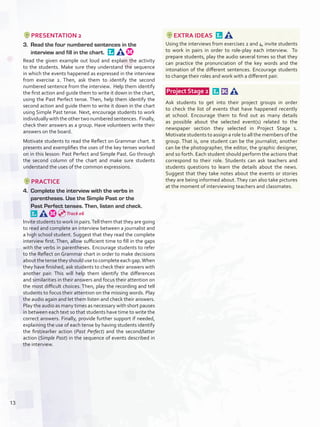
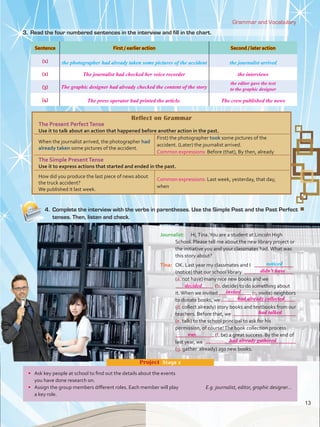
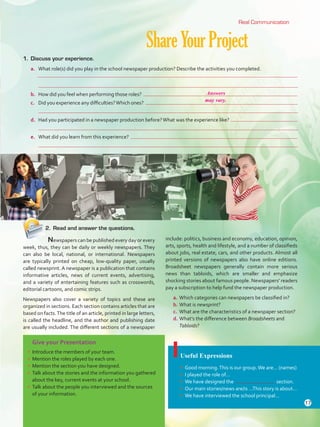
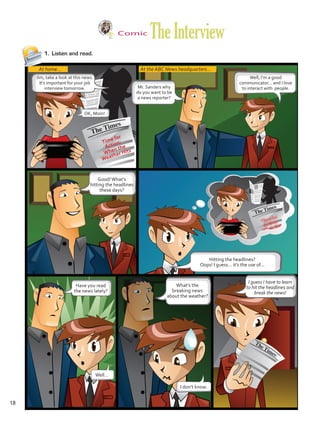
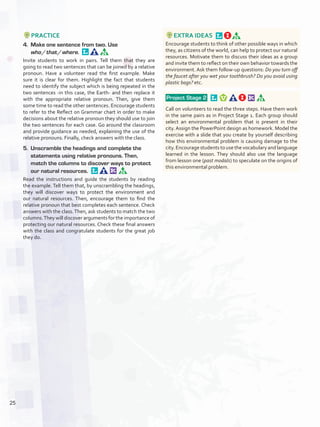
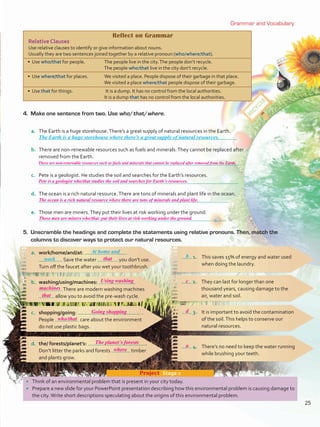
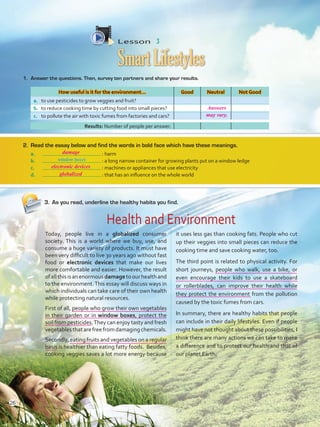
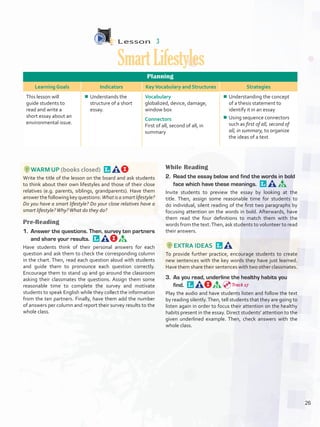
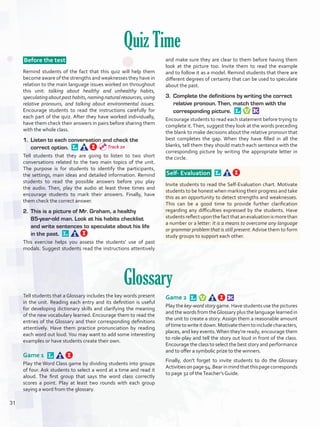
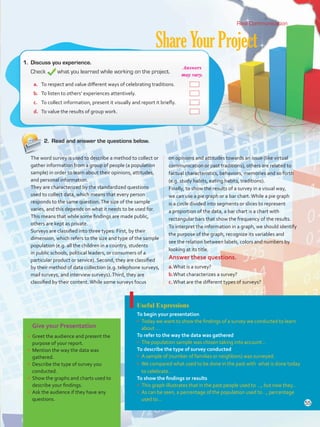
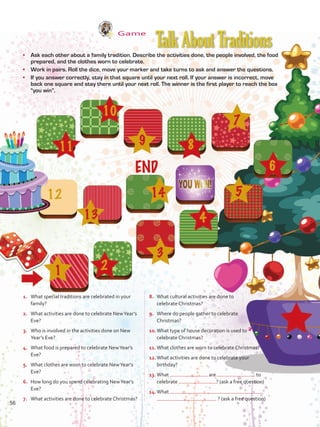
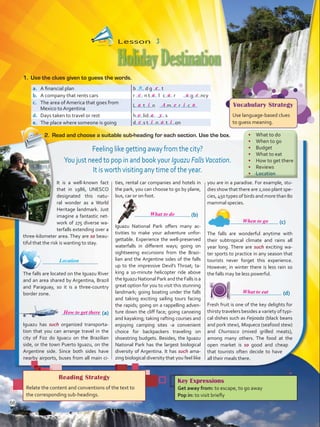
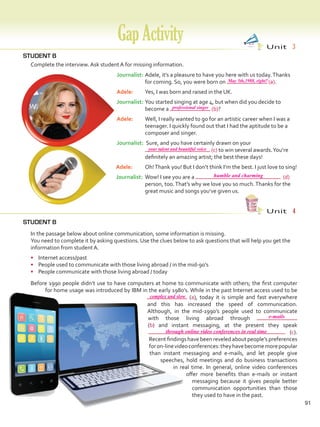
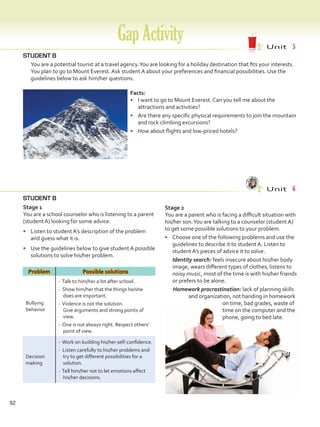
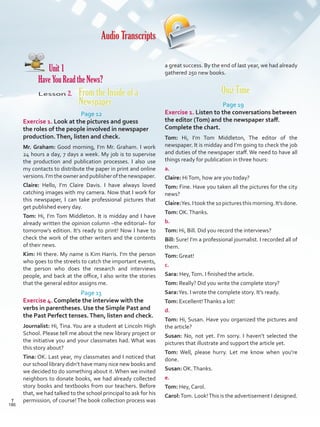
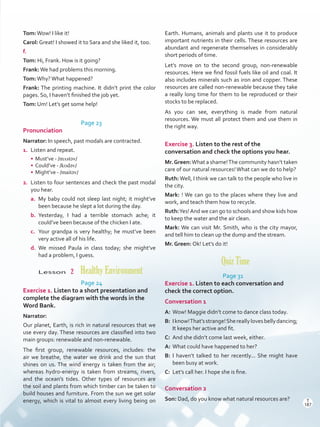
FREE COPY
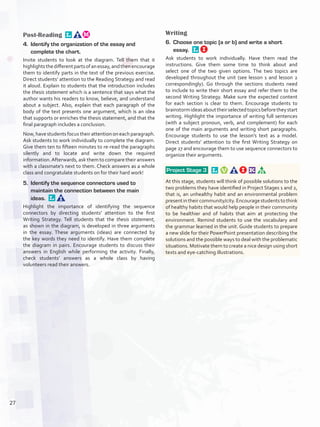
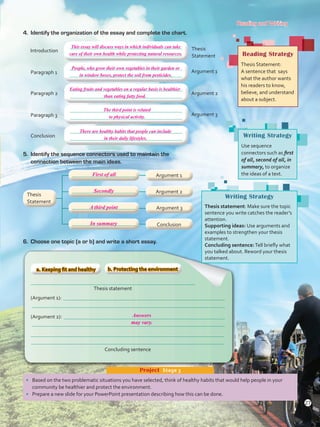
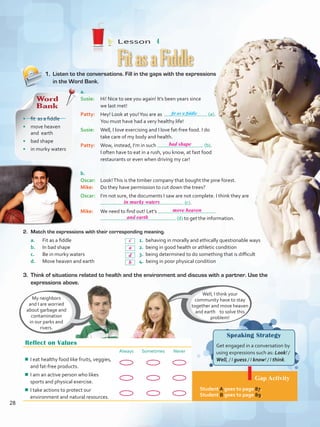
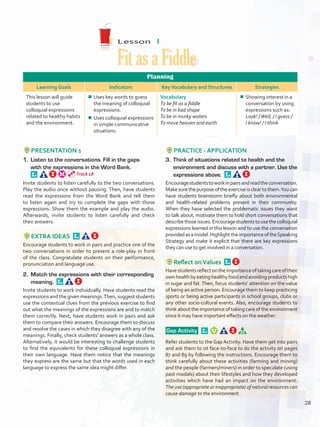
NOT FOR SALETEACHER´S BOOK
Level
ENGLISH
B1.1
ENGLISH-B1.1-BGU
Bachillerato General Unificado
PRESIDENTE DE LA REPÚBLICA
Rafael Correa Delgado
MINISTRO DE EDUCACIÓN
Augusto Espinosa Andrade
Viceministro de Educación
Freddy Peñafiel Larrea
Viceministra de Gestión Educativa
DaysiValentina Rivadeneira Zambrano
Subsecretario de Fundamentos Educativos (E)
Miguel Ángel Herrera Pavo
Subsecretaria de Administración Escolar
Mirian Maribel Guerrero Segovia
Directora Nacional de Currículo (S)
María Cristina Espinosa Salas
Directora Nacional de Operaciones y Logística
Ada Leonora ChamorroVásquez
© Ministerio de Educación del Ecuador, 2016
Av. Amazonas N34-451 y Atahualpa
Quito, Ecuador
www.educacion.gob.ec
La reproducción parcial o total de esta publicación,
en cualquier forma y en cualquier medio mecánico o
electrónico, está permitida siempre y cuando sea autorizada
por los editores y se cite correctamente la fuente.
English B1.1,
Teacher’s Guide
Authors
Claudia Marcela Chapetón Castro,
Astrid Núñez Pardo, Mariluz Murcia Sierra
Editor-in-Chief
Javier AndrésTibaquirá Pinto
Editor
Carlos Sanabria Páez
Assistant Editors
Germán Obando, Adriana Molano,
Jonnathan Loaiza, Marisela Niño
Proofreaders
Andrea Peña, Margarita Orbegozo,
Francisco Castro, Nicolás Romero,
Marco Giraldo
Consulting Reviewers
Thomas Francis Frederick
Mark Forbes
Art Director
Gloria EsperanzaVásquez
Designers
Leonardo Rivas, Libardo Mahecha,
Clara Inés Angarita, Juan CarlosVera,
Nohora Betancourt
Illustrators
Miguel Jiménez, José Luis Jiménez,
Juan Carlos Baena, Mery Laura Hernández
Photography
Shutterstock ®
© Grupo Editorial Norma SA
Avenida Isaac Albéniz E3-154,Wolfgang Mozart
Quito, Ecuador
ISBN
Primera impresión:
Impreso en Ecuador por: ElTelégrafo E.P.
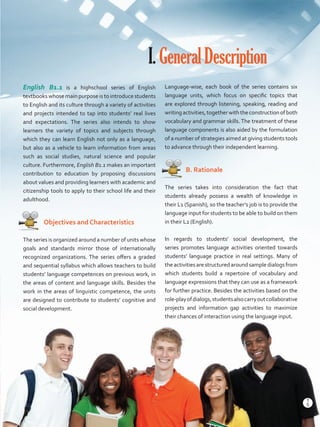
English B1.1 is a highschool series of English
textbooks whose main purpose is to introduce students
to English and its culture through a variety of activities
and projects intended to tap into students’ real lives
and expectations. The series also intends to show
learners the variety of topics and subjects through
which they can learn English not only as a language,
but also as a vehicle to learn information from areas
such as social studies, natural science and popular
culture. Furthermore, English B1.1 makes an important
contribution to education by proposing discussions
about values and providing learners with academic and
citizenship tools to apply to their school life and their
adulthood.
   Objectives and Characteristics
The series is organized around a number of units whose
goals and standards mirror those of internationally
recognized organizations. The series offers a graded
and sequential syllabus which allows teachers to build
students’ language competences on previous work, in
the areas of content and language skills. Besides the
work in the areas of linguistic competence, the units
are designed to contribute to students’ cognitive and
social development.
I.GeneralDescription
Language-wise, each book of the series contains six
language units, which focus on specific topics that
are explored through listening, speaking, reading and
writingactivities,togetherwiththeconstructionofboth
vocabulary and grammar skills. The treatment of these
language components is also aided by the formulation
of a number of strategies aimed at giving students tools
to advance through their independent learning.
   B. Rationale
The series takes into consideration the fact that
students already possess a wealth of knowledge in
their L1 (Spanish), so the teacher’s job is to provide the
language input for students to be able to build on them
in their L2 (English).
In regards to students’ social development, the
series promotes language activities oriented towards
students’ language practice in real settings. Many of
the activities are structured around sample dialogs from
which students build a repertoire of vocabulary and
language expressions that they can use as a framework
for further practice. Besides the activities based on the
role-playofdialogs,studentsalsocarryoutcollaborative
projects and information gap activities to maximize
their chances of interaction using the language input.
5
T
5
T
Prelim_VP5IngGuideCol2012.indd 5 5/25/16 8:53 PM
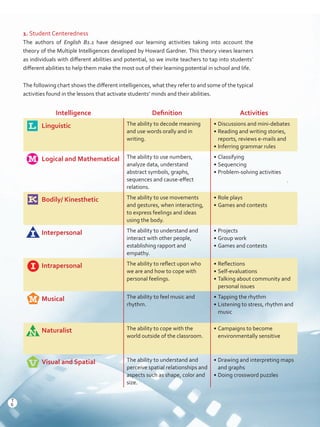
1. Student Centeredness
The authors of English B1.1 have designed our learning activities taking into account the
theory of the Multiple Intelligences developed by Howard Gardner. This theory views learners
as individuals with different abilities and potential, so we invite teachers to tap into students’
different abilities to help them make the most out of their learning potential in school and life.
The following chart shows the different intelligences, what they refer to and some of the typical
activities found in the lessons that activate students’ minds and their abilities.
Intelligence Definition Activities
Linguistic The ability to decode meaning
and use words orally and in
writing.
• Discussions and mini-debates
• Reading and writing stories,
reports, reviews e-mails and
• Inferring grammar rules
Logical and Mathematical The ability to use numbers,
analyze data, understand
abstract symbols, graphs,
sequences and cause-effect
relations.
• Classifying
• Sequencing
• Problem-solving activities
Bodily/ Kinesthetic The ability to use movements
and gestures, when interacting,
to express feelings and ideas
using the body.
• Role plays
• Games and contests
Interpersonal The ability to understand and
interact with other people,
establishing rapport and
empathy.
• Projects
• Group work
• Games and contests
Intrapersonal The ability to reflect upon who
we are and how to cope with
personal feelings.
• Reflections
• Self-evaluations
• Talking about community and
personal issues
Musical The ability to feel music and
rhythm.
• Tapping the rhythm
• Listening to stress, rhythm and
music
Naturalist The ability to cope with the
world outside of the classroom.
• Campaigns to become
environmentally sensitive
Visual and Spatial The ability to understand and
perceive spatial relationships and
aspects such as shape, color and
size.
• Drawing and interpreting maps
and graphs
• Doing crossword puzzles
6
T
6
T
Prelim_VP5IngGuideCol2012.indd 6 5/25/16 8:53 PM
2. Teaching and Learning Approach
EnglishB1.1isbasedonaneclecticbutinformedseriesof
ideas and constructs in language teaching and learning.
However, English B1.1 has been developed taking B.
Kumaravadivelu’s (2003) ideas into account. He clearly
conceptualizes teaching as being enacted through the
parameters of particularity, practicality, and possibility.
Particularity has to do with the fact that teaching has
to be responsive to particular contexts where teachers
and learners are entitled to have their own ideas about
learning. Practicality is related to the idea that teachers
needtocometotermswiththedichotomyoftheoryand
practice, in order to empower themselves to figure out
their own theories of language and teaching through
their classroom practices. Lastly, the idea of Possibility
has to do with the empowering of learners so that they
can critically appraise both the social and historical
conditions of their learning, and therefore pursue new
forms of understanding and recreating reality.
English B1.1 also derives its theoretical foundations
from task-based instruction, cooperative learning,
cross-curricular studies and the cross-cultural approach
to language teaching and learning. The main idea
behind task-based learning is the fact that learners will
beengagedinaseriesofreal-lifelanguagetasksthatwill
help them improve their language skills and enhance
their world knowledge. The series approach also takes
into consideration the situation of both teachers and
students in EFL contexts.These textbooks therefore are
aided by focused instruction especially in the areas of
vocabulary and grammar as important building blocks
for students’ progress in their language proficiency.
Cooperative learning is the basis of many of the
activities in English B1.1, since students need to adopt
a variety of interaction patterns: individual, pair and
group work. One of the highlights of each unit is the
work students do progressively to create, develop
and present a group project related to the topic of the
unit. This project also involves the making of some
sort of product that helps students use the language
meaningfully when creating and presenting it.
In the design of other cooperative tasks, English
B1.1 has also considered the ideas of Spencer Kagan
(1994) who suggested the acronym PIES to stand
for the basic principles of cooperative work, where P
stands for Positive Interdependence, I is for Individual
Accountability, E stands for Equal Participation, and S
for Simultaneous Interaction. Positive Interdependence
means that group members need be aware of the fact
that there is no I in group work and that the group
benefitsfromthecontributionofallmembers.Individual
Accountability has to do with the responsibility that
each member has to have for the success of the entire
group’s project. Equal Participation calls for the idea
of an inclusive group where all members are entitled
to have a say regardless of the quality of their ideas
or, in the case of language learning, their accuracy
and fluency. Simultaneous Interaction has to do with
the amount of participation that each member of the
group has in different projects.
Cross-curricular activities are among the most
important features of English B1.1 since students
are exposed to a wide variety of topics and activities
from areas such as natural science, technology, social
studies, literature, arts, etc. Consequently, students
are engaged in activities that reflect what they need
to know in these subjects. For example, the use of
timelines for historic or personal events and the use
of graphs and tables to make sense of information in
social studies or science.
The cross-cultural approach also runs through the
entire series since students will be able to expand
their intercultural awareness by studying topics
in which they are able to see the contributions of
different countries and peoples to the world progress
in different fields. Moreover, the series contains topics
about family, school, and workplace interactions that
appeal to a wide variety of communities since they are
not necessarily related to English speaking countries or
cultures.
7
T
7
T
Prelim_VP5IngGuideCol2012.indd 7 5/25/16 8:53 PM
   C. Lesson Planning
Lesson planning is perhaps one of the most fundamental aspects that contribute to learning. Teachers have the
responsibility to create conditions for students to get the most out of the language lessons.Thus, the lessons in the
units follow predictable structure, namely Warm Up, Presentation, Practice, and Application.
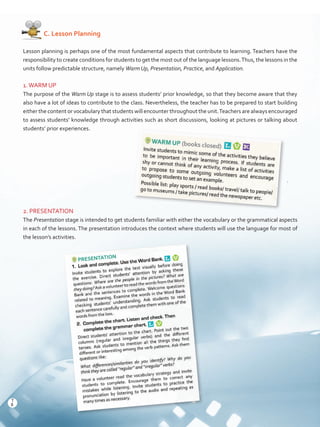
1.WARM UP
The purpose of the Warm Up stage is to assess students’ prior knowledge, so that they become aware that they
also have a lot of ideas to contribute to the class. Nevertheless, the teacher has to be prepared to start building
either the content or vocabulary that students will encounter throughout the unit.Teachers are always encouraged
to assess students’ knowledge through activities such as short discussions, looking at pictures or talking about
students’ prior experiences.
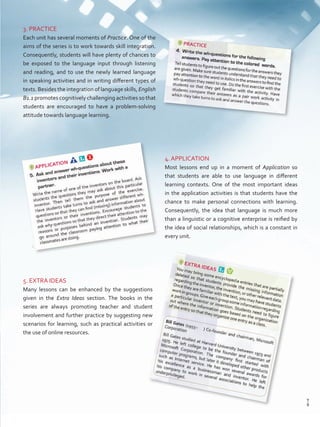
2. PRESENTATION
The Presentation stage is intended to get students familiar with either the vocabulary or the grammatical aspects
in each of the lessons. The presentation introduces the context where students will use the language for most of
the lesson’s activities.
8
T
8
T
Prelim_VP5IngGuideCol2012.indd 8 5/25/16 8:53 PM
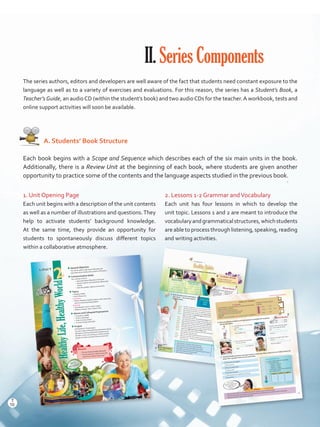
3. PRACTICE
Each unit has several moments of Practice. One of the
aims of the series is to work towards skill integration.
Consequently, students will have plenty of chances to
be exposed to the language input through listening
and reading, and to use the newly learned language
in speaking activities and in writing different types of
texts. Besides the integration of language skills, English
B1.1 promotes cognitively challenging activities so that
students are encouraged to have a problem-solving
attitude towards language learning.
4. APPLICATION
Most lessons end up in a moment of Application so
that students are able to use language in different
learning contexts. One of the most important ideas
in the application activities is that students have the
chance to make personal connections with learning.
Consequently, the idea that language is much more
than a linguistic or a cognitive enterprise is reified by
the idea of social relationships, which is a constant in
every unit.
5. EXTRA IDEAS
Many lessons can be enhanced by the suggestions
given in the Extra Ideas section. The books in the
series are always promoting teacher and student
involvement and further practice by suggesting new
scenarios for learning, such as practical activities or
the use of online resources.
9
T
9
T
Prelim_VP5IngGuideCol2012.indd 9 5/25/16 8:53 PM
II.SeriesComponents
The series authors, editors and developers are well aware of the fact that students need constant exposure to the
language as well as to a variety of exercises and evaluations. For this reason, the series has a Student’s Book, a
Teacher’sGuide, an audioCD (within the student’s book) and two audioCDs for the teacher.A workbook, tests and
online support activities will soon be available.
   A. Students’ Book Structure
Each book begins with a Scope and Sequence which describes each of the six main units in the book.
Additionally, there is a Review Unit at the beginning of each book, where students are given another
opportunity to practice some of the contents and the language aspects studied in the previous book.
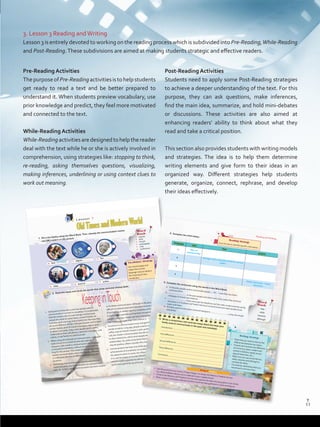
1. Unit Opening Page
Each unit begins with a description of the unit contents
as well as a number of illustrations and questions.They
help to activate students’ background knowledge.
At the same time, they provide an opportunity for
students to spontaneously discuss different topics
within a collaborative atmosphere.
2. Lessons 1-2 Grammar andVocabulary
Each unit has four lessons in which to develop the
unit topic. Lessons 1 and 2 are meant to introduce the
vocabularyandgrammaticalstructures,whichstudents
are able to process through listening, speaking, reading
and writing activities.
HealthyLife,HealthyWorld
UNIT
HealthyLife,HealthyWorld
2
uuGeneral Objective
You will be able to talk about lifestyles and
speculate about habits and customs of the past.
uuCommunication Goals
You will learn how to
•	 speculate about lifestyles in the past.
•	 express opinion and possibility about past
events.
•	 describe people, objects, and events.
uuTopics
•	 Healthy Habits
•	 Earth Resources
Vocabulary
•	 Words related to healthy habits, earth resources,
and environmental degradation
Grammar
•	 Past Modals: must / could / might /
•	 Relative clauses: who / where / that
uuIdioms and Colloquial Expressions
•	 To	be	fit	as	a	fiddle
•	 To	be	in	bad	shape
•	 To	be	in	murky	waters
•	 To	move	heaven	and	earth
uuProject
A PowerPoint Presentation
You will create a PowerPoint presentation about
lifestyles to share problematic situations you
identify in your community, as well as actions
people can take to protect the environment.
Discuss:
•	 Do you have a healthy lifestyle?
•	 Do you and your community take
care of our natural resources?
Useful Expressions•	 Use I know! to show agreement with what someone says.
•	 Use I guess to express your opinion about something you are
not sure about.
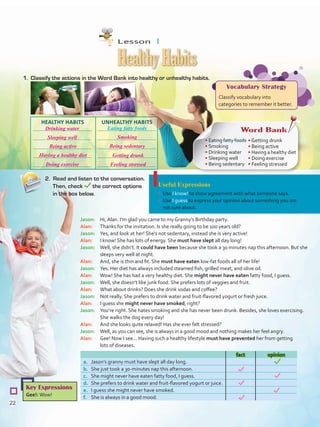
1. Classify the actions in the Word Bank into healthy or unhealthy habits.
HealthyHabits
2. Read and listen to the conversation.
Then, check the correct optionsin the box below.
Key ExpressionsGee!: Wow!
fact
opinion
a. Jason’s granny must have slept all day long.
b. She just took a 30-minutes nap this afternoon.
c. She might never have eaten fatty food, I guess.
d. She	prefers	to	drink	water	and	fruit-flavored	yogurt	or	juice.
e. I guess she might never have smoked.
f. She is always in a good mood.
Vocabulary StrategyClassify vocabulary intocategories to remember it better.
Jason: Hi, Alan. I’m glad you came to my Granny’s Birthday party.
Alan: Thanks for the invitation. Is she really going to be 100 years old?
Jason: Yes, and look at her! She‘s not sedentary, instead she is very active!
Alan: I know! She has lots of energy. She must have slept all day long!
Jason: Well, she didn’t. It could have been because she took a 30 minutes nap this afternoon. But she
sleeps very well at night.Alan:	 And,	she	is	thin	and	fit.	She	must have eaten low-fat foods all of her life!
Jason: Yes.	Her	diet	has	always	included	steamed	fish,	grilled	meat,	and	olive	oil.
Alan: Wow! She has had a very healthy diet. She might never have eaten fatty food, I guess.
Jason: Well, she doesn’t like junk food. She prefers lots of veggies and fruit.
Alan:	 What	about	drinks?	Does	she	drink	sodas	and	coffee?
Jason: Not	really.	She	prefers	to	drink	water	and	fruit-flavored	yogurt	or	fresh	juice.
Alan: I guess she might never have smoked, right?
Jason: You’re right. She hates smoking and she has never been drunk. Besides, she loves exercising.
She walks the dog every day!Alan: And she looks quite relaxed! Has she ever felt stressed?
Jason: Well, as you can see, she is always in a good mood and nothing makes her feel angry.
Alan: Gee! Now I see... Having such a healthy lifestyle must have prevented her from getting
lots of diseases.
Word Bank•	Eating fatty foods•	Smoking
•	Drinking water•	Sleeping well
•	Being sedentary
•	Getting drunk•	Being active• Having a healthy diet•	Doing exercise•	Feeling stressed
UNHEALTHY HABITS
HEALTHY HABITS
Eating fatty foods
Lesson 1
22
Grammar and Vocabulary
•	 Work by pairs.Think of an unhealthy habit that is present in your community today.
•	 Prepare a PowerPoint presentation describing how this unhealthy habit is a problem for the community.
•	 Speculate about the origins of this bad habit.
Project Stage 1
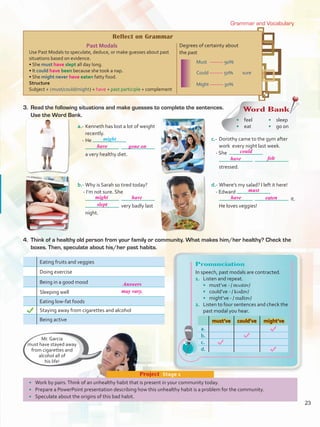
Reflect on Grammar
Past Modals
Use Past Modals to speculate, deduce, or make guesses about past
situations based on evidence.
•	She	must have slept all day long.
•	It	could have been because she took a nap.
•	She	might never have eaten fatty food.
Structure
Subject + (must/could/might) + have + past participle + complement
Degrees of certainty / about
the past
a.- Kenneth has lost a lot of weight
recently.
- He
a very healthy diet.
c.- Dorothy came to the gym after
work every night last week.
- She
stressed.
b.- Why is Sarah so tired today?
- I’m not sure. She
very badly last
night.
d.- Where’s my salad? I left it here!
- Edward it.
He loves veggies!
3. Read the following situations and make guesses to complete the sentences.
Use the Word Bank.
4. Think of a healthy old person from your family or community. What makes him/her healthy? Check the
boxes. Then, speculate about his/her past habits.
Word Bank
•	 feel
•	 eat
•	 sleep
•	 go on
must’ve could’ve might’ve
a.
b.
c.
d.
Pronunciation
In speech, past modals are contracted.
1. Listen and repeat.
•	 must’ve - / mʌstǝv/
•	 could’ve - / kʊdǝv/
•	 might’ve - / maItǝv/
2. Listen to four sentences and check the
past modal you hear.
Eating fruits and veggies
Doing exercise
Being in a good mood
Sleeping well
Eating low-fat foods
Staying away from cigarettes and alcohol
Being active
Mr. Garcia
must have stayed away
from cigarettes and
alcohol all of
his life!
Must -------- 90%
Could -------- 50%
Might -------- 30%
sure
might
23
10
T
10
T
Prelim_VP5IngGuideCol2012.indd 10 5/25/16 8:53 PM
3. Lesson 3 Reading andWriting
Lesson 3 is entirely devoted to working on the reading process which is subdivided into Pre-Reading,While-Reading
and Post-Reading.These subdivisions are aimed at making students strategic and effective readers.
Pre-Reading Activities
ThepurposeofPre-Readingactivitiesistohelpstudents
get ready to read a text and be better prepared to
understand it. When students preview vocabulary, use
prior knowledge and predict, they feel more motivated
and connected to the text.
While-Reading Activities
While-Readingactivitiesaredesignedtohelpthereader
deal with the text while he or she is actively involved in
comprehension, using strategies like: stopping to think,
re-reading, asking themselves questions, visualizing,
making inferences, underlining or using context clues to
work out meaning.
Post-Reading Activities
Students need to apply some Post-Reading strategies
to achieve a deeper understanding of the text. For this
purpose, they can ask questions, make inferences,
find the main idea, summarize, and hold mini-debates
or discussions. These activities are also aimed at
enhancing readers’ ability to think about what they
read and take a critical position.
This section also provides students with writing models
and strategies. The idea is to help them determine
writing elements and give form to their ideas in an
organized way. Different strategies help students
generate, organize, connect, rephrase, and develop
their ideas effectively.
Lesson 3
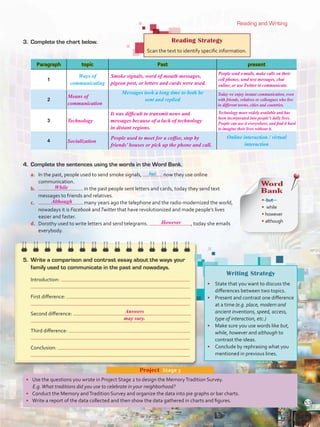
OldTimesandModernWorld
2. Read the essay and circle the words that show contrast among ideas.
1. Going back in time lets us see how people used	to
communicate in contrast to nowadays. It is undeniable
that the reasons why humans beings communicate
remain the same (to share news, contact friends, do
business, send warnings and so forth), but the ways they
do	so	are	different.	While	in	the	past	people	used	to	send	
smoke signals, word of mouth messages, pigeon post,
or letters and cards, today most people send e-mails,
make calls on their cell phones, send text messages, chat
online, or useTwitter to communicate.
2. When using old methods of communication, messages
took a long time to both be sent and replied.
However, with modern communication the message
is received immediately, without having to wait too
long for the answer.This means that today we enjoy
instant communication, even with friends, relatives
or	colleagues	who	live	in	different	towns,	cities	and	
countries.
3. Technology has contributed to the development of
communication, which has become incorporated into
daily life. In fact, online communication has been created
to facilitate communication. Although in the past, it was
difficult	to	transmit	news	and	messages	because	of	a	lack	
of technology in distant regions, nowadays technology
is more widely available and has been incorporated into
people’s daily lives. People can use it everywhere and
find	it	hard	to	imagine	their	lives	without	it.	
4. Inventions in communication have changed the way
people socialize. Long ago, people used to meet for a
coffee,	stop	by	friends’	houses	or	pick	up	the	phone	and	
call, but modern communication has decreased face-
to-face interaction, which some people think damages
relationships. So, while some think that socializing online
may be positive, others consider this change negative.
5. Communication has been one of the greatest
achievements of humankind. Its evolution over time,
the	speed	at	which	it	works,	the	influence	of	technology	
in it, and its impact on human interaction have made
communication possible for billions of people around the
world that used to be out of touch!
a. text
	 c. pigeon
e. fire
b. video
d. word of
f. online
KeepinginTouch
1. Fill in the blanks using the Word Bank. Then, classify the communication means
into (M) modern or (A) ancient.
Word
Bank
•	 signals
•	 post
•	 mouth
•	 messaging
•	 chat
•	 conference
Vocabulary Strategy
Use visual images and
relate them to the
language clues to deduce
the meaning of new
vocabulary.
messaging
M
52
Reading and Writing
3. Complete the chart below.
Writing Strategy• State that you want to discuss thedifferences	between	two	topics.		• Present	and	contrast	one	difference	at a time (e.g.	place,	modern	and	ancient	inventions,	speed,	access,	type	of	interaction,	etc.)	• Make sure you use words like but,while, however and although tocontrast the ideas.• Conclude by rephrasing what youmentioned in previous lines.
Paragraph
topic
Past
present
1 Ways of
communicating
2 Messages took a long time to both be sent andreplied
3
4
Online interaction / virtualinteraction
Introduction:
First	difference:
Second	difference:
Third	difference:
Conclusion:
4. Complete the sentences using the words in the Word Bank.
a. In the past, people used to send smoke signals,
now they use online
communication.b.
in the past people sent letters and cards, today they send text
messages to friends and relatives.
c.
many years ago the telephone and the radio modernized the world,
nowadays it is Facebook	and	Twitter	that have revolutionized and made people’s lives
easier and faster.d. Dorothy used to write letters and send telegrams.
, today she emails
everybody.
Reading StrategyScan	the	text	to	identify	specific	information.
5. Write a comparison and contrast essay about the ways your
family used to communicate in the past and nowadays.
•	 Use the questions you wrote in Project Stage 2 to design the MemoryTradition Survey.
						E.g.	What	traditions	did	you	use	to	celebrate	in	your	neighborhood?		
•	 Conduct the Memory andTradition Survey and organize the data into pie graphs or bar charts.
•	 Write	a	report	of	the	data	collected	and	then	show	the	data	gathered	in	charts	and	figures.	
Project Stage 3
Word
Bank
but
while
however
although
but
53
11
T
11
T
Prelim_VP5IngGuideCol2012.indd 11 5/25/16 8:53 PM
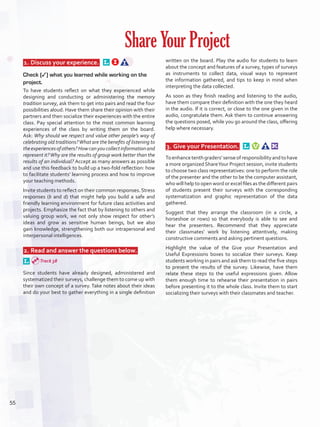
4. Lesson 4 Real Communication
Lesson 4 is entitled Real Communication. The purpose
of this lesson is to help students widen their oral
skills through the learning of idiomatic expressions
associated to cultural aspects of the language. This
page ends with a Reflect on Values section, whose
purpose is to make students aware of cultural aspects
that underlie the lesson contents and to help them
learn to be self-critical about their attitudes and values.
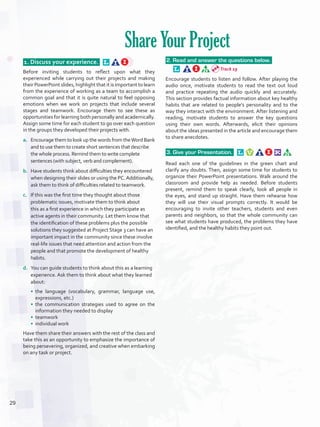
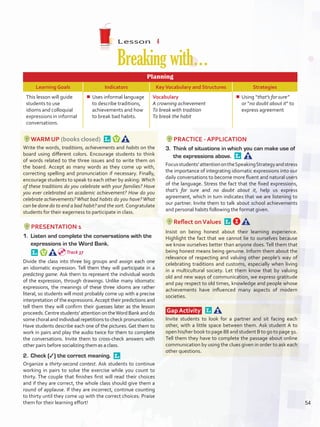
5. ShareYour Project
Lesson 4 has a second section, Share Your Project,
to help students wrap up their ideas about the class
project. This particular page has students reflect upon
the nature of cooperative work, and gives them extra
ideastofinishtheirprojectsandgivetheirpresentation.
6. Comic
Units 1, 3, and 5 have a Comic section that helps
students look at the class topics, language structures
and vocabulary from a different perspective. It wraps
up the unit in a memorable and relaxed way.The comic
can be used for either reading or listening practice.
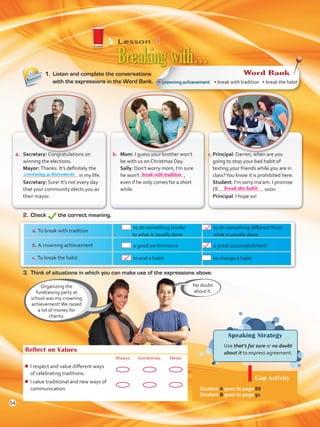
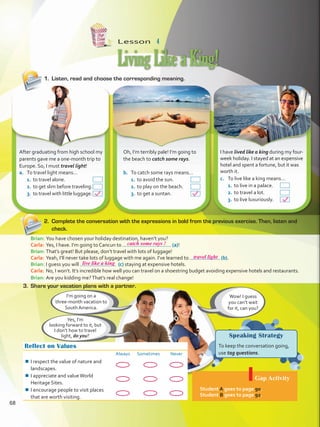
Lesson 4
Speaking StrategyGet engage in a conversation by
using expressions such as: Look!		/	
Well,		/	I	guess	/	I	know!	/	I	think.
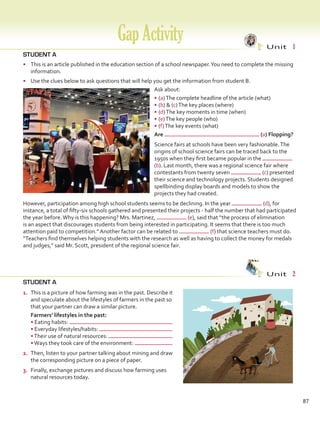
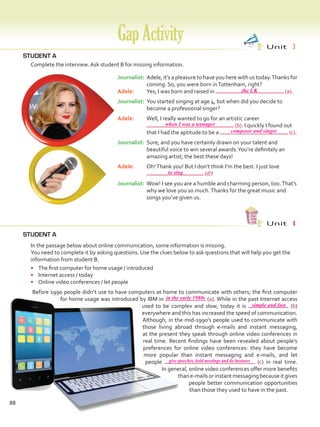
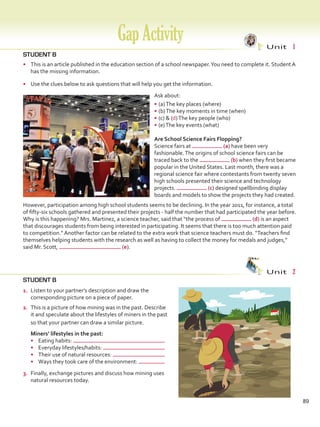
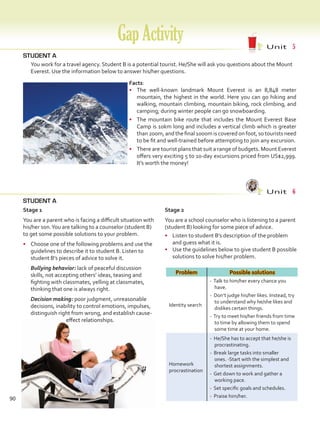
Gap ActivityStudent A goes to page 87.
Student B goes to page 89.
1. Listen to the conversations. Fill in the gaps with the expressions
in the Word Bank.
2. Match the expressions with their corresponding meaning.
a. Fit	as	a	fiddle	 	
	
1. behaving in morally and ethically questionable ways
b. In bad shape
2. being in good health or athletic condition
c. Be in murky waters
3.		being	determined	to	do	something	that	is	difficult
d. Move heaven and earth
4. being in poor physical condition
FitasaFiddle
Reflect on Values
Always Sometimes Never
¾ I eat healthy food like fruits, veggies,
and fat-free products.¾ I am an active person who likes
sports and physical exercise.¾ I take actions to protect ourenvironment and natural resources.
Well, I think yourcommunity have to staytogether and move heavenand earth to solve thisproblem!
My neighborsand I are worriedabout garbage andcontaminationin our parks and
rivers.
a.
Susie: Hi! Nice to see you again! It’s been years since
we last met!Patty: Hey! Look at you!You are as
(a).
You must have had a very healthy life!
Susie: Well, I love exercising and I love fat-free food. I do
take care of my body and health.
Patty: Wow, instead, I’m in such
(b).
I often have to eat in a rush, you know, at fast food
restaurants or even when driving my car!b.
Oscar: Look!This is the timber company that bought the pine forest.
Mike: Do they have permission to cut down the trees?
Oscar: I’m not sure, the documents I saw are not complete. I think they are(c).
Mike:		 We	need	to	find	out!	Let’s	
(d) to get the information.
3. Think of situations related to health and the environment and discuss with a partner. Use the
expressions above.
Word
Bank
•	 fit		as	a	fiddle
•	 move heaven
and earth
•	 bad shape
•	 in murky waters
fit as a fiddle
28
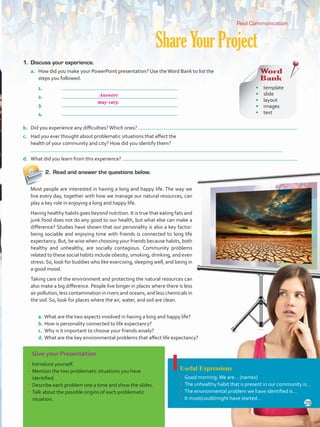
ShareYourProject
Give	your	Presentation
•	 Introduce yourself.
•	 Mention the two problematic situations you have
identified.
•	 Describe each problem one a time and show the slides.
•	 Talk about the possible origins of each problematic
situation.
Useful Expressions
•	 Good morning.We are… (names)
•	 The unhealthy habit that is present in our community is…
•	 The	environmental	problem	we	have	identified	is…
•	 It must/could/might have started…
2. Read and answer the questions below.
Real Communication
1. Discuss your experience.
a. How did you make your PowerPoint presentation? Use theWord Bank to list the
steps you followed.
1.
2.
3.
4.
b. Did	you	experience	any	difficulties?	Which	ones?	
c. Had	you	ever	thought	about	problematic	situations	that	affect	the	
health of your community and city? How did you identify them?
d. What did you learn from this experience?
Word
Bank
•	 template
•	 slide
•	 layout
•	 images
•	 text
a. What are the two aspects involved in having a long and happy life?
b. How is personality connected to life expectancy?
c. Why is it important to choose your friends wisely?
d. What	are	the	key	environmental	problems	that	affect	life	expectancy?
Most people are interested in having a long and happy life. The way we
live every day, together with how we manage our natural resources, can
play a key role in enjoying a long and happy life.
Having healthy habits goes beyond nutrition. It is true that eating fats and
junk food does not do any good to our health, but what else can make a
difference?	Studies	have	shown	that	our	personality	is	also	a	key	factor:	
being sociable and enjoying time with friends is connected to long life
expectancy. But, be wise when choosing your friends because habits, both
healthy and unhealthy, are socially contagious. Community problems
related to these social habits include obesity, smoking, drinking, and even
stress. So, look for buddies who like exercising, sleeping well, and being in
a good mood.
Taking care of the environment and protecting the natural resources can
also	make	a	big	difference.	People	live	longer	in	places	where	there	is	less	
air pollution, less contamination in rivers and oceans, and less chemicals in
the soil. So, look for places where the air, water, and soil are clean.
29
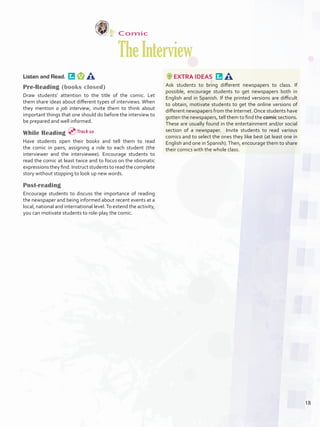
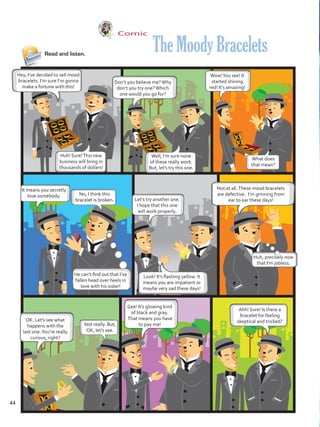
Comic
Read and listen.
Hey, I’ve decided to sell mood
bracelets. I’m sure I’m gonna
make a fortune with this! Don’t you believe me?Why
don’t you try one?Which
one would you go for?
Not at all.These mood braceletsare defective. I’m grinning from
ear to ear these days!
Gee! It’s glowing kind
of black and gray.
That means you have
to pay me!
OK. Let’s see what
happens with the
last one.You’re really
curious, right?
TheMoodyBraceletes
Huh! Sure!This new
business will bring in
thousands of dollars!
Well, I’m sure none
of these really work.
But, let’s try this one.
It means you secretly
love somebody.
Let’s try another one.
I hope that this one
will work properly.
Wow!You see! It
started shining
red! It’s amazing!
No, I think this
bracelet is broken.
He	can’t	find	out	that	I’ve	
fallen head over heels in
love with his sister!
Huh, precisely now
that I’m jobless.Look!	It’s	flashing	yellow.	It	
means you are impatient or
maybe very sad these days?
What does
that mean?
Not really. But,
OK, let’s see.
Ahh! Sure! Is there a
bracelet for feeling
skeptical and tricked?
44
12
T
12
T
Prelim_VP5IngGuideCol2012.indd 12 5/25/16 8:54 PM
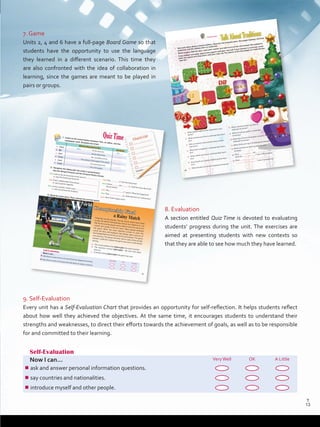
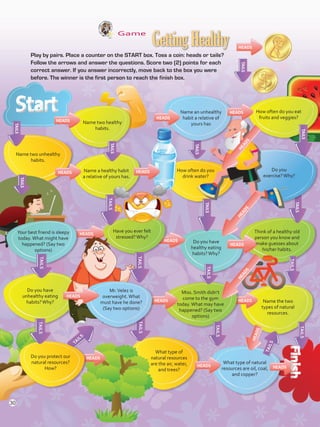
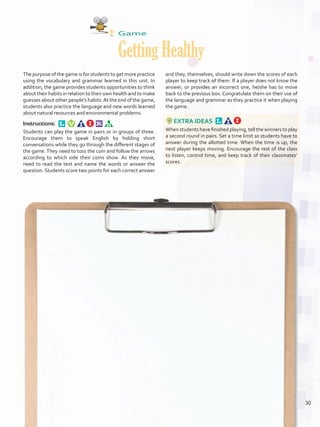
7. Game
Units 2, 4 and 6 have a full-page Board Game so that
students have the opportunity to use the language
they learned in a different scenario. This time they
are also confronted with the idea of collaboration in
learning, since the games are meant to be played in
pairs or groups.
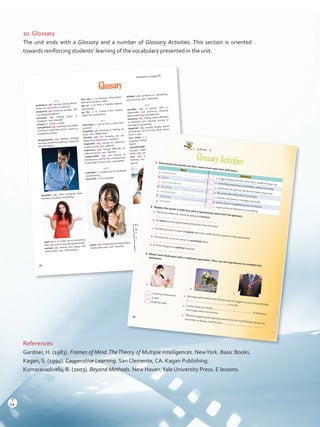
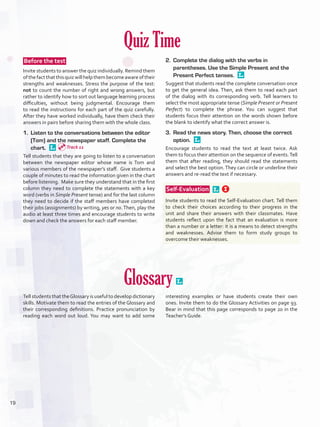
8. Evaluation
A section entitled Quiz Time is devoted to evaluating
students’ progress during the unit. The exercises are
aimed at presenting students with new contexts so
that they are able to see how much they have learned.
9. Self-Evaluation
Every unit has a Self-Evaluation Chart that provides an opportunity for self-reflection. It helps students reflect
about how well they achieved the objectives. At the same time, it encourages students to understand their
strengths and weaknesses, to direct their efforts towards the achievement of goals, as well as to be responsible
for and committed to their learning.
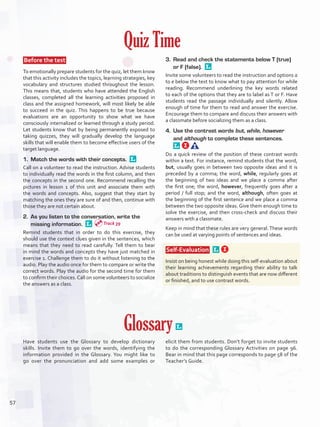
Game
• Ask each other about a family tradition. Describe the activities done, the people involved, the food
prepared, and the clothes worn to celebrate.
• Work in pairs. Roll the dice, move your marker and take turns to ask and answer the questions.
• If you answer correctly, stay in that square until your next roll. If your answer is incorrect, move
back one square and stay there until your next roll. The winner is the first player to reach the box
“you win”.
1. What special traditions are celebrated in your
family?
2. What activities are done to celebrate NewYear’s
Eve?
3. Who is involved in the activities done on New
Year’s Eve?
4. What food is prepared to celebrate NewYear’s
Eve?
5. What clothes are worn to celebrate NewYear’s
Eve?
6. How long do you spend celebrating NewYear’s
Eve?
7. What activities are done to celebrate Christmas?
8. What cultural activities are done to
celebrate Christmas?
9. Where do people gather to celebrate
Christmas?
10.What type of house decoration is used to
celebrate Christmas?
11.What clothes are worn to celebrate Christmas?
12.What activities are done to celebrate your
birthday?
13. What
are
to
celebrate
? (ask a free question)
14.What ? (ask a free question)
TalkAboutTraditions
56
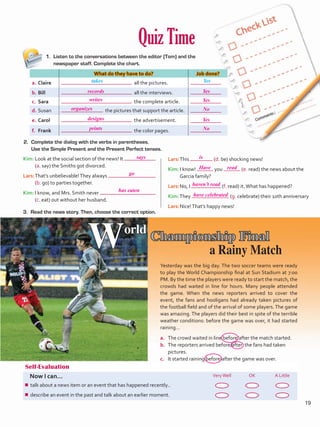
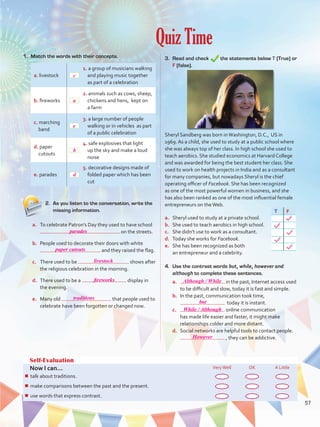
Quiz Time
Self-EvaluationNow I can...
VeryWell OK
A Little
¾ talk about a news item or an event that has happened recently.
¾ describe an event in the past and talk about an earlier moment.
Kim:Look at the social section of the news! It
(a. say) the Smiths got divorced.Lars:That’s unbelievable!They always(b. go) to parties together.Kim:I know, and Mrs. Smith never(c. eat) out without her husband.
Lars:This
(d. be) shocking news!Kim:I know!
you
(e. read) the news about the
Garcia family?
Lars: No, I
(f. read) it.What has happened?
Kim:They
(g. celebrate) their 10th
anniversary!
Lars: Nice!That’s happy news!
Yesterday was the big day. The two soccer teams were ready
to	play	the	World	Championship	final	at	Sun	Stadium	at	7:00	
PM. By the time the players were ready to start the match, the
crowds had waited in line for hours. Many people attended
the game. When the news reporters arrived to cover the
event, the fans and hooligans had already taken pictures of
the	football	field	and	of	the	arrival	of	some	players.	The	game	
was amazing. The players did their best in spite of the terrible
weather	conditions:	before	the	game	was	over,	it	had	started	
raining…
a. The crowd waited in line before/after the match started.
b. The reporters arrived before/after the fans had taken
pictures.
c. It started raining before/after the game was over.
1. Listen to the conversations between Tom, an editor, and the
newspaper staff. Complete the chart.
2. Complete the dialog with the verbs in parentheses.
Use the Simple Present and the Present Perfec tenses.
What do they have to do?
Job done?
a. Claire
all the pictures.
b. Bill
all the interviews.
c. Sara
the complete article.
d. Susan
the pictures that support the article.
e. Carol
the advertisement.
f. Frank
the color pages.
takes
Yes
World
Championship Final
a Rainy Match
3. Read the news story. Then, choose the correct option.
19
1. Listen to the questions and check the
correct answer.
a. I’m 12 years old. I’m	fine,	thanks.
b. I’m	fine,	thanks.	 I’m 11 years old.
c. I’m Peter Smith. I’m from Portugal.
d. Mark It’s mark@e-pals.com.
2. Match column A with column B.
Column A Column B
a. Country Asia
b. Age Japanese
c. City 12 years old
d. Continent Tokyo
e. Nationality Japan
3. Check the correct option to complete the
sentences.
a. This is Mary. She American.
1. is 2. are 3. am
b. Hi, I Japanese.
1. is 2. are 3. am
c. Hello, you Susan, right?
1. is 2. are 3. am
d. This isThomas. is from Amsterdam.
1. She 2. It 3. He
e. I’m from Lima. is the capital of Peru.
1. She 2. It 3. He
f. Where you from?
1. is 2. are 3. am
g. What your name?
1. is 2. are 3. am
4. Read the profiles. Then, circle and correct the
mistakes in the sentences (a-f) below.
Self-Evaluation
Now I can... VeryWell OK A Little
¾ask and answer personal information questions.
¾say countries and nationalities.
¾introduce myself and other people.
a. Larry Page is a computer scientist . He is
Portuguese.
b. Cristiano Ronaldo is Brazilian. He is a soccer
player.
c. Martina Garcia is Colombian. She is athletic.
d. Larry Page is sociable. He is a computer scientist.
e. Cristiano Ronaldo is 32 years old. He is athletic.
f. Martina García is creative. She is 28 years old.
This is Larry Page, the
creator of Google. He is a
computer scientist. He is
from Michigan in the USA.
He is 40 years old. He is
creative.
This is Cristiano Ronaldo.
He is a soccer player. He
is 28 years old. He is from
Madeira. It is a Portuguese
island. He is athletic.
This is Martina Garcia. She is
an actress. She is 32 years old.
She is Colombian. She is from
Bogota. She is sociable.
Quiz Time
19
13
T
13
T
Prelim_VP5IngGuideCol2012.indd 13 5/25/16 8:54 PM
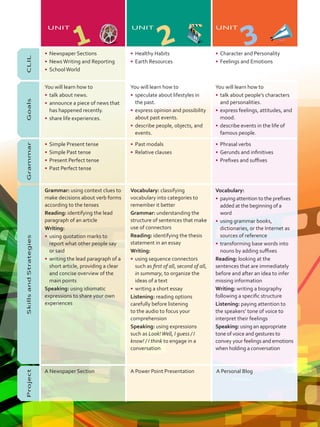
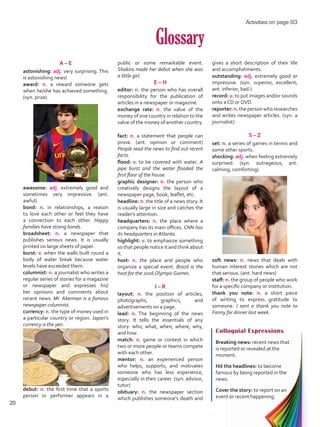
10. Glossary
The unit ends with a Glossary and a number of Glossary Activities. This section is oriented
towards reinforcing students’ learning of the vocabulary presented in the unit.
References
Gardner, H. (1983). Frames of Mind.TheTheory of Multiple Intelligences. NewYork. Basic Books.
Kagan, S. (1994). Cooperative Learning. San Clemente, CA. Kagan Publishing.
Kumaravadivelu, B. (2003). Beyond Methods. New Haven.Yale University Press. E lessons.
find out: v. to discover information.
I	found	out	he	was	in	Peru.
get on: v. to have a friendly relation
with people.
go for: v. to choose from various
options or possibilities.
H-I
hold back: v. not to tell or show how
you feel.
hopeless: adj. showing or feeling no
hope. (syn. desperate)
humble: adj. not thinking you are
better than others.(syn. modest)
impatient: adj. having no patience;
unable to wait. (ant. patient)
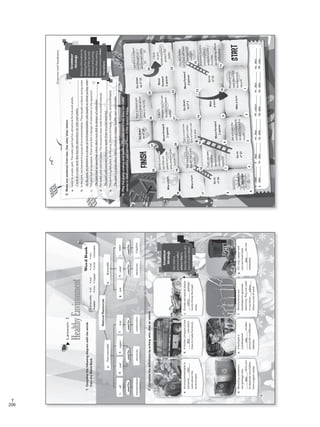
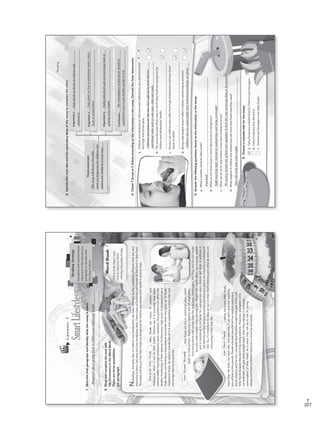
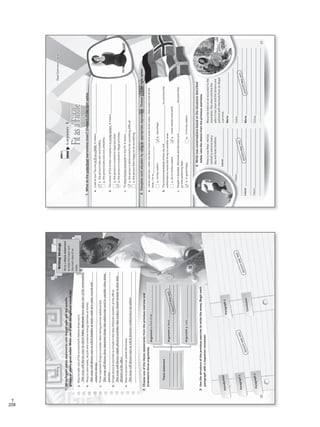
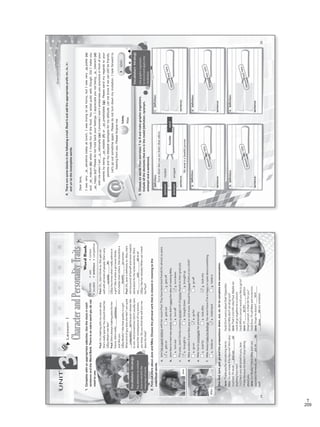
indecisive: adj.	 having	 difficulty	 to	
make decisions. (ant. decisive)
irresponsible: adj. not having or
showing any care for the consequences
of personal actions. (ant. responsible)
K-R
look after: v. to take care of somebody
or something.
look into: v. to investigate.
polite: adj. being kind and behaving in
an educated way. (ant. impolite)
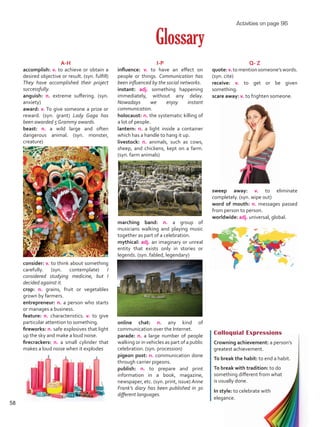
Glossary
Colloquial Expressions
Grin from ear to ear: feeling very
happy.
Head over heels in love: falling in
love with someone.
Make your blood boil: feeling very
angry.
Your heart sinks: feeling
very sad.
Activities on page 95
A-G
ambitious: adj. having a strong desire
to be rich, successful, or famous.
analytical: adj. involving analysis. She	
is	an	analytical	person.
annoyed: adj. feeling angry or
impatient. (ant. pleased)
bring in: v. to earn money.
competitive: adj. wanting to be better
or achieve more than others. Jason	is	a	
competitive	person.
disappointed: adj. feeling unhappy
because something that you hoped for
did not happen.
doubtful: adj. when someone does
not feel sure about something.
draw on: v. to make use of something
that	you	have	for	your	personal	benefit.
excited: adj. feeling very happy and
enthusiastic. (syn. enthusiastic)
reliable: adj. someone or something
you can trust. (ant. unreliable)
S-V
sensible: adj. a person who is
reasonable and practical; showing
good reasoning and judgment.
sensitive: adj.	feeling	easily	offended	
or annoyed and reacting quickly or
strongly to something.
skeptical: adj. having doubts about
something; not believing what others
think is true.
turn down: v. to reject or refuse a
proposal,	invitation,	or	job	offer.	(syn.	
reject)
unpredictable: adj. a person who
changes his/her behavior or mind
easily. (ant. predictable)
vain: adj. being very proud and
thinking you are very attractive or
special.
46
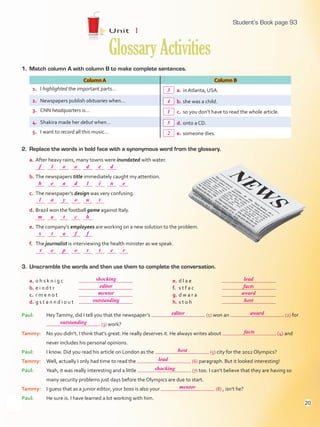
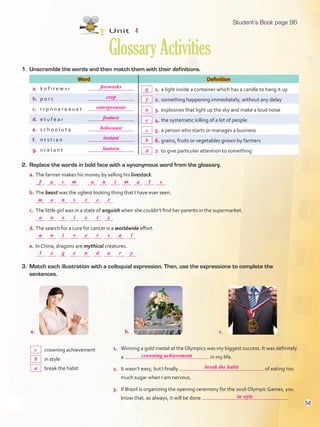
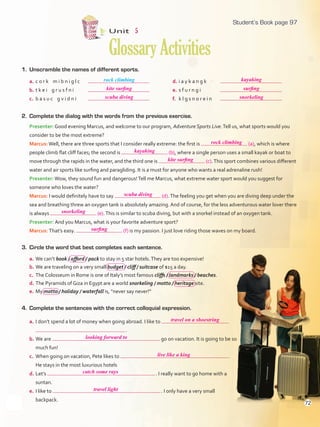
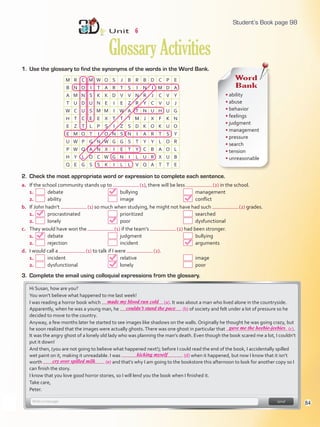
1. Unscramble the words and then match them with their definitions.Word
Definition
a. k o f i r e w s r
1. a light inside a container which has a candle to hang it up
b. p o r c
2. something happening immediately, without any delay
c. r r p n n e r e e u e t
3. explosives that light up the sky and make a loud noise
d. e t u f e a r
4. the systematic killing of a lot of people
e. s c h o o l u t a
5. a person who starts or manages a business
f. n t s t i a n
6. grains, fruits or vegetables grown by farmers
g. n r e l a n t
7. to give particular attention to something
Unit 4
GlossaryActivities
3. Match each illustration with a colloquial expression. Then, use the expressions to complete the
sentences.
1. Winning a gold medal at the Olympics was my biggest success. It was definitely
a
in my life.2. It wasn’t easy, but I finally
of eating too
much sugar when I am nervous.
3. If Brazil is organizing the opening ceremony for the 2016 Olympic Games, you
know that, as always, it will be done
.
crowning achievement
in style
break the habit
a.
b.
2. Replace the words in bold face with a synonymous word from the glossary.
a. The farmer makes his money by selling his livestock.
b. The beast was the ugliest looking thing that I have ever seen.
c. The little girl was in a state of anguish when she couldn’t find her parents in the supermarket.
d. The search for a cure for cancer is a worldwide effort.
e. In China, dragons are mythical creatures.
c.
96
14
T
14
T
Prelim_VP5IngGuideCol2012.indd 14 5/25/16 8:54 PM
To Our Students
The textbook that you have in your hands is a very important tool that will help
you learn in the best way possible. A textbook should not be your only source of
study and discovery; however, it will always be a good friend that will allow you to
discover for yourself the wonder of learning.
The Ministry of Education has made a curricular adjustment with the goal of
providing better opportunities for all students in the country as part of a project
that promotes full personal development and integration into a society that is
guided by the principles of Good Living, democratic participation and harmonious
coexistence.
To accompany the launching of this educational initiative, we have prepared
several resources according to age and years of schooling. Children in first grade
will receive a textbook that integrates stories and activities appropriate for their
age and that will help to develop the holistic curriculum designed for this Subnivel
de Educación General Básica. Teachers will receive a CD with songs in order to use
music to familiarize students with their first words in English as a complementary
material. From then on, until they complete the Bachillerato General Unificado,
students will receive textbooks, audio CDs and extra resources that will contribute
to the development of their learning in the areas of Science, Social Sciences,
Language and Literature, Mathematics and Foreign Language-English.Itisalso importanttoknowthatteacherswill receiveteachingguides(teacher’s
books) that will enhance the teaching-learning approach of the student book,
thereby allowing teachers to develop students’ research and learning outside the
classroom.
This resource should be considered a support for the teaching-learning
approach that must be guided by teachers and carried out by students in
order to achieve its goal.
We hope that this adventure of knowledge will be the pathto achieving Good Living.
Ministry of Education
2016
15
T
15
T
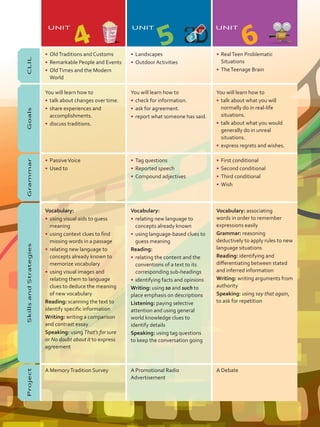
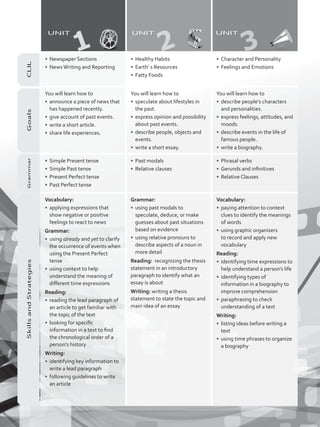
CLIL
•	 Newspaper Sections
•	 NewsWriting and Reporting
•	 SchoolWorld
•	 Healthy Habits
•	 Earth Resources
•	 Character and Personality
•	 Feelings and Emotions
Goals
You will learn how to
•	 talk about news.
•	 announce a piece of news that
has happened recently.
•	 share life experiences.
You will learn how to
•	 speculate about lifestyles in
the past.
•	 express opinion and possibility
about past events.
•	 describe people, objects, and
events.
You will learn how to
•	 talk about people’s characters
and personalities.
•	 express feelings, attitudes, and
mood.
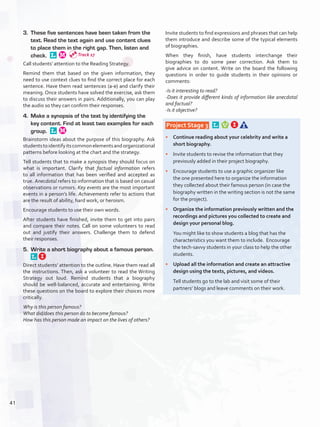
•	 describe events in the life of
famous people.
Grammar
•	 Simple Present tense
•	 Simple Past tense
•	 Present Perfect tense
•	 Past Perfect tense
•	 Past modals
•	 Relative clauses
•	 Phrasal verbs
•	 Gerunds and infinitives
•	 Prefixes and suffixes
SkillsandStrategies
Grammar: using context clues to
make decisions about verb forms
according to the tenses
Reading: identifying the lead
paragraph of an article
Writing:
•	 using quotation marks to
report what other people say
or said
•	 writing the lead paragraph of a
short article, providing a clear
and concise overview of the
main points
Speaking: using idiomatic
expressions to share your own
experiences
Vocabulary: classifying
vocabulary into categories to
remember it better
Grammar: understanding the
structure of sentences that make
use of connectors
Reading: identifying the thesis
statement in an essay
Writing:
•	 using sequence connectors
such as first of all, second of all,
in summary, to organize the
ideas of a text
•	 writing a short essay
Listening: reading options
carefully before listening
to the audio to focus your
comprehension
Speaking: using expressions
such as Look!Well, I guess / I
know! / I think to engage in a
conversation
Vocabulary:
•	 paying attention to the prefixes
added at the beginning of a
word
•	 using grammar books,
dictionaries, or the Internet as
sources of reference
•	 transforming base words into
nouns by adding suffixes
Reading: looking at the
sentences that are immediately
before and after an idea to infer
missing information
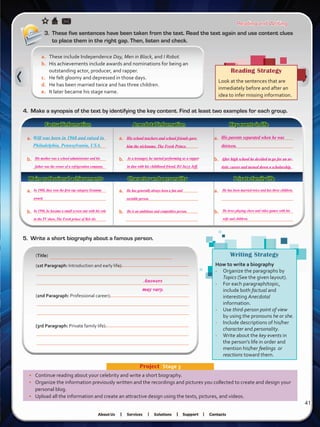
Writing: writing a biography
following a specific structure
Listening: paying attention to
the speakers’ tone of voice to
interpret their feelings
Speaking: using an appropriate
tone of voice and gestures to
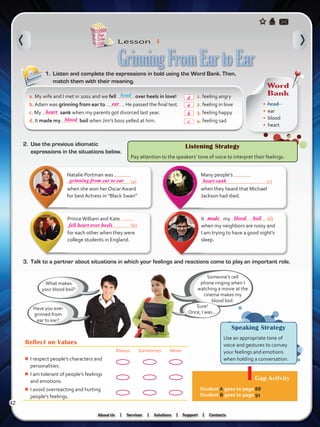
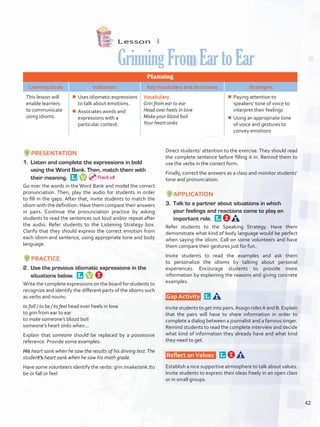
convey your feelings and emotions
when holding a conversation
Project
A Newspaper Section A Power Point Presentation A Personal Blog
UNIT
1
UNIT
2
UNIT
3
VP5Preliminares.indd 4 19/05/2016 02:35:20 p.m.
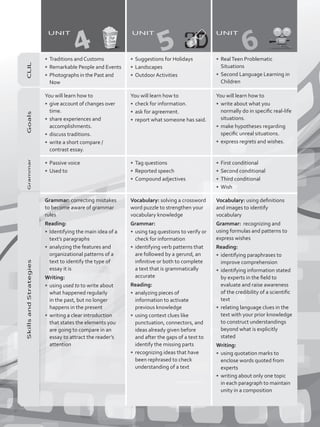
CLIL
•	 OldTraditions and Customs
•	 Remarkable People and Events
•	 OldTimes and the Modern
World
•	 Landscapes
•	 Outdoor Activities
•	 RealTeen Problematic
Situations
•	 TheTeenage Brain
Goals
You will learn how to
•	 talk about changes over time.
•	 share experiences and
accomplishments.
•	 discuss traditions.
You will learn how to
•	 check for information.
•	 ask for agreement.
•	 report what someone has said.
You will learn how to
•	 talk about what you will
normally do in real-life
situations.
•	 talk about what you would
generally do in unreal
situations.
•	 express regrets and wishes.
Grammar
•	 PassiveVoice
•	 Used to
•	 Tag questions
•	 Reported speech
•	 Compound adjectives
•	 First conditional
•	 Second conditional
•	 Third conditional
•	 Wish
SkillsandStrategies
Vocabulary:
•	 using visual aids to guess
meaning
•	 using context clues to find
missing words in a passage
•	 relating new language to
concepts already known to
memorize vocabulary
•	 using visual images and
relating them to language
clues to deduce the meaning
of new vocabulary
Reading: scanning the text to
identify specific information
Writing: writing a comparison
and contrast essay
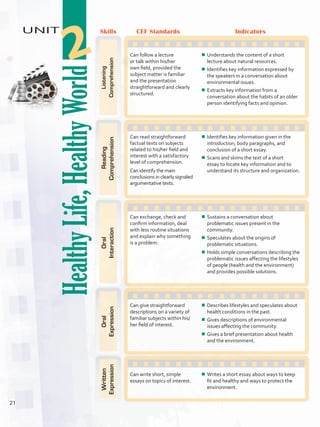
Speaking: using That’s for sure
or No doubt about it to express
agreement
Vocabulary:
•	 relating new language to
concepts already known
•	 using language-based clues to
guess meaning
Reading:
•	 relating the content and the
conventions of a text to its
corresponding sub-headings
•	 identifying facts and opinions
Writing: using so and such to
place emphasis on descriptions
Listening: paying selective
attention and using general
world knowledge clues to
identify details
Speaking: using tag questions
to keep the conversation going
Vocabulary: associating
words in order to remember
expressions easily
Grammar: reasoning
deductively to apply rules to new
language situations
Reading: identifying and
differentiating between stated
and inferred information
Writing: writing arguments from
authority
Speaking: using say that again,
to ask for repetition
Project
A MemoryTradition Survey A Promotional Radio
Advertisement
A Debate
UNIT
4
UNIT
5
UNIT
6
VP5Preliminares.indd 5 19/05/2016 02:35:21 p.m.
Review
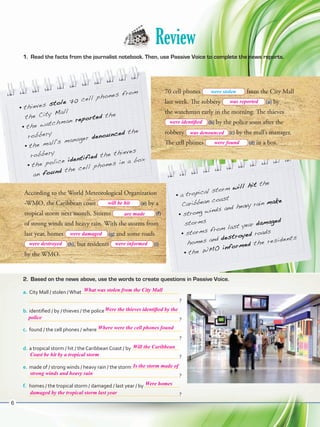
1.	 Read the facts from the journalist notebook. Then, use Passive Voice to complete the news reports.
•	thieves stole 70 cell phones from
the City Mall
•	the watchman reported the
robbery
•	the mall's manager denounced the
robbery
•	the police identified the thieves
an found the cell phones in a box
70 cell phones from the City Mall
last week. The robbery  (a) by
the watchman early in the morning. The thieves
 (b) by the police soon after the
robbery  (c) by the mall’s manager.
The cell phones  (d) in a box.
According to the World Meteorological Organization
-WMO, the Caribbean coast  (e) by a
tropical storm next month. Storms  (f)
of strong winds and heavy rain. With the storms from
last year, homes  (g) and some roads
 (h), but residents  (i)
by the WMO.
•	a tropical storm will hit the
Caribbean coast
•	strong winds and heavy rain make
storms
•	storms from last year damaged
homes and destroyed roads
•	the WMO informed the residents
2.	 Based on the news above, use the words to create questions in Passive Voice.
a.	City Mall / stolen /What
 ?
b.	identified / by / thieves / the police
 ?
c.	 found / the cell phones / where
 ?
d.	a tropical storm / hit / the Caribbean Coast / by
 ?
e.	made of / strong winds / heavy rain / the storm
 ?
f.	 homes / the tropical storm / damaged / last year / by
 ?
were stolen
6
was reported
were identified
was denounced
were found
will be hit
are made
were damaged
were destroyed
What was stolen from the City Mall
Were homes
Is the storm made of
Where were the cell phones found
Will the Caribbean
Were the thieves identified by the
were informed
police
Coast be hit by a tropical storm
strong winds and heavy rain
damaged by the tropical storm last year
VP5ReviewUnit.indd 6 3/30/16 11:43 AM
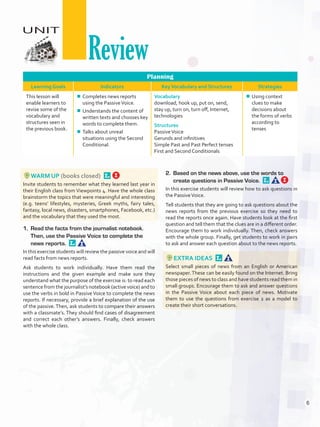
Planning
Learning Goals Indicators KeyVocabulary and Structures Strategies
This lesson will
enable learners to
revise some of the
vocabulary and
structures seen in
the previous book.
¾¾ Completes news reports
using the PassiveVoice.
¾¾ Understands the content of
written texts and chooses key
words to complete them.
¾¾ Talks about unreal
situations using the Second
Conditional.
Vocabulary
download, hook up, put on, send,
stay up, turn on, turn off, Internet,
technologies
Structures
PassiveVoice
Gerunds and infinitives
Simple Past and Past Perfect tenses
First and Second Conditionals
¾¾ Using context
clues to make
decisions about
the forms of verbs
according to
tenses
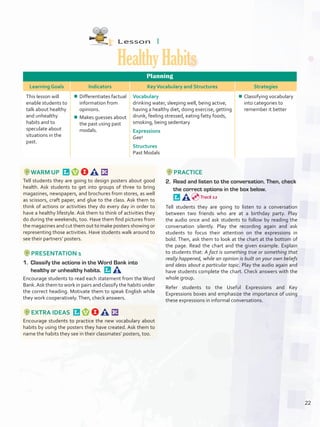
WARM UP (books closed) 
Invite students to remember what they learned last year in
their English class from Viewpoints 4. Have the whole class
brainstorm the topics that were meaningful and interesting
(e.g. teens’ lifestyles, mysteries, Greek myths, fairy tales,
fantasy, local news, disasters, smartphones, Facebook, etc.)
and the vocabulary that they used the most.
1.	 Read the facts from the journalist notebook.
Then, use the Passive Voice to complete the
news reports. 
In this exercise students will review the passive voice and will
read facts from news reports.
Ask students to work individually. Have them read the
instructions and the given example and make sure they
understand what the purpose of the exercise is: to read each
sentence from the journalist’s notebook (active voice) and to
use the verbs in bold in Passive Voice to complete the news
reports. If necessary, provide a brief explanation of the use
of the passive.Then, ask students to compare their answers
with a classmate’s. They should find cases of disagreement
and correct each other’s answers. Finally, check answers
with the whole class.
2.	 Based on the news above, use the words to
create questions in Passive Voice. 
In this exercise students will review how to ask questions in
the PassiveVoice.
Tell students that they are going to ask questions about the
news reports from the previous exercise so they need to
read the reports once again. Have students look at the first
question and tell them that the clues are in a different order.
Encourage them to work individually. Then, check answers
with the whole group. Finally, get students to work in pairs
to ask and answer each question about to the news reports.
EXTRA IDEAS 
Select small pieces of news from an English or American
newspaper.These can be easily found on the Internet. Bring
those pieces of news to class and have students read them in
small groups. Encourage them to ask and answer questions
in the Passive Voice about each piece of news. Motivate
them to use the questions from exercise 2 as a model to
create their short conversations.
UNIT
Review
6
U0_VP5IngGuideCol2012.indd 6 3/23/16 11:25 AM
3.	 Circle the correct verb form to complete the
conversation. Circle both when either the gerund
or the infinitive can be used. 
The aim of this exercise is for students to review the use
of verb patterns that include gerunds and infinitives after
certain verbs.
Encourage students to look at the picture and to describe
what they see. Then, read the instructions and make sure
they are clear to them. If needed, provide a brief explanation
about gerunds and infinitives so that students can
remember their use. Invite them to work in pairs and to read
the conversation once. Have them read the conversation
a second time to choose the best option. To check their
answers, ask volunteers to read the conversation aloud.
EXTRA IDEAS 
Get students organized into new pairs and encourage them
to role-play the conversation. Go around the classroom
checking that they use the verb forms appropriately.
Then, invite students to follow the model to create similar
conversations which describe their plans after they finish
high school.
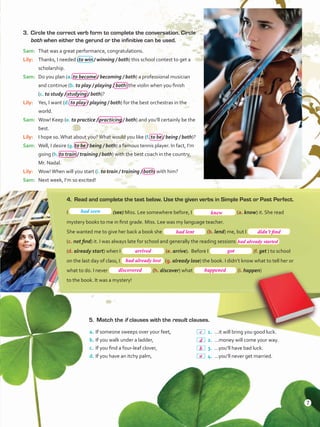
4.	 Read and complete the text below. Use the given
verbs in Simple Past or Past Perfect. 
In this exercise students will review two tenses: The Simple
Past and the Past Perfect.
Tell students to read the text once to get the general
idea. Remind them that it is important to understand the
sequence in which the events happened so that they need
to identify the first action (and use the Past Perfect tense)
and then the second action (and use the Simple Past tense).
Encourage them to complete the exercise individually. To
check their answers as a group, have volunteers write their
answers on the board.
5.	 Match the if clauses with the result clauses. 
In this exercise students will review the First Conditional.
Remind them that we use this structure to talk about future
events that are likely to happen.
Ask students to read the statements in the first column and
make sure they are familiar with the key vocabulary (e.g.
sweep, ladder, four-leaf clover, itchy palm). Then, have them
read the statements from the second column and do the
matching by writing the letters in the right box. Go around
the classroom providing any extra guidance students may
need. When they have finished, ask them to compare their
answers with a classmate’s.
EXTRA IDEAS 
Write the following question on the board: Are you a
superstitious person? Encourage students to answer and
give reasons to support their answers. Invite them to read
the superstitions from exercise 5 and ask them if they
think they are true. Have them think of other superstitions
in their first language and let them share with the whole
class.
7
U0_VP5IngGuideCol2012.indd 7 3/23/16 11:25 AM
3.	 Circle the correct verb form to complete the conversation. Circle
both when either the gerund or the infinitive can be used.
Sam:	 That was a great performance, congratulations.
Lily:	 Thanks, I needed (to win / winning / both) this school contest to get a
scholarship.
Sam:	 Do you plan (a. to become / becoming / both) a professional musician
and continue (b. to play / playing / both) the violin when you finish
(c. to study / studying / both)?
Lily:	 Yes, I want (d. to play / playing / both) for the best orchestras in the
world.
Sam:	 Wow! Keep (e. to practice / practicing / both) and you’ll certainly be the
best.
Lily:	 I hope so.What about you?What would you like (f. to be / being / both)?
Sam:	 Well, I desire (g. to be / being / both) a famous tennis player. In fact, I’m
going (h. to train / training / both) with the best coach in the country,
Mr. Nadal.
Lily:	 Wow!When will you start (i. to train / training / both) with him?
Sam:	 Next week, I’m so excited!
4.	 Read and complete the text below. Use the given verbs in Simple Past or Past Perfect.
I (see) Miss. Lee somewhere before, I (a. know) it. She read
mystery books to me in first grade. Miss. Lee was my language teacher.
She wanted me to give her back a book she (b. lend) me, but I
(c. not find) it. I was always late for school and generally the reading sessions
(d. already start) when I (e. arrive). Before I (f. get ) to school
on the last day of class, I (g. already lose) the book. I didn’t know what to tell her or
what to do. I never (h. discover) what (i. happen)
to the book. It was a mystery!
5.	 Match the if clauses with the result clauses.
a.	If someone sweeps over your feet,
b.	If you walk under a ladder,
c.	 If you find a four-leaf clover,
d.	If you have an itchy palm,
 1.	…it will bring you good luck.
 2.	…money will come your way.
 3.	…you’ll have bad luck.
 4.	…you’ll never get married.
had seen
7
knew
had lent didn’t find
had already started
arrived
had already lost
discovered happened
c
a
d
b
got
VP5ReviewUnit.indd 7 3/30/16 11:43 AM
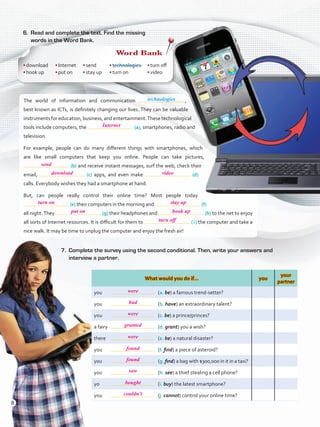
6.	 Read and complete the text. Find the missing
words in the Word Bank.
What would you do if… you
your
partner
you	 	 (a. be) a famous trend-setter?
you	 	 (b. have) an extraordinary talent?
you	 	 (c. be) a prince/princes?
a fairy	 	 (d. grant) you a wish?
there	 	 (e. be) a natural disaster?
you	 	 (f. find) a piece of asteroid?
you	 	 (g. find) a bag with $300,000 in it in a taxi?
you	 	 (h. see) a thief stealing a cell phone?
yo	 	 (i. buy) the latest smartphone?
you	 	 (j. cannot) control your online time?
The world of information and communication  ,
best known as ICTs, is definitely changing our lives. They can be valuable
instruments for education, business, and entertainment.These technological
tools include computers, the (a), smartphones, radio and
television.
For example, people can do many different things with smartphones, which
are like small computers that keep you online. People can take pictures,
(b) and receive instant messages, surf the web, check their
email, (c) apps, and even make (d)
calls. Everybody wishes they had a smartphone at hand.
But, can people really control their online time? Most people today
(e) their computers in the morning and (f)
all night.They (g) their headphones and (h) to the net to enjoy
all sorts of Internet resources. It is difficult for them to ( i ) the computer and take a
nice walk. It may be time to unplug the computer and enjoy the fresh air!
7.	 Complete the survey using the second conditional. Then, write your answers and
interview a partner.
Word Bank
•	download
•	hook up
•	Internet
•	put on
•	send
•	stay up
•	technologies
•	turn on
•	turn off
•	video
technologies
8
Internet
send
download
turn on
put on hook up
turn off
were
had
were
granted
were
found
found
saw
bought
couldn’t
stay up
video
VP5ReviewUnit.indd 8 3/30/16 11:43 AM
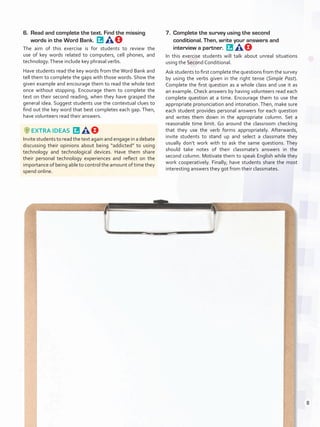
6.	 Read and complete the text. Find the missing
words in the Word Bank. 
The aim of this exercise is for students to review the
use of key words related to computers, cell phones, and
technology.These include key phrasal verbs.
Have students read the key words from the Word Bank and
tell them to complete the gaps with those words. Show the
given example and encourage them to read the whole text
once without stopping. Encourage them to complete the
text on their second reading, when they have grasped the
general idea. Suggest students use the contextual clues to
find out the key word that best completes each gap. Then,
have volunteers read their answers.
EXTRA IDEAS 
Invite students to read the text again and engage in a debate
discussing their opinions about being “addicted” to using
technology and technological devices. Have them share
their personal technology experiences and reflect on the
importance of being able to control the amount of time they
spend online.
7.	 Complete the survey using the second
conditional. Then, write your answers and
interview a partner. 
In this exercise students will talk about unreal situations
using the Second Conditional.
Ask students to first complete the questions from the survey
by using the verbs given in the right tense (Simple Past).
Complete the first question as a whole class and use it as
an example. Check answers by having volunteers read each
complete question at a time. Encourage them to use the
appropriate pronunciation and intonation. Then, make sure
each student provides personal answers for each question
and writes them down in the appropriate column. Set a
reasonable time limit. Go around the classroom checking
that they use the verb forms appropriately. Afterwards,
invite students to stand up and select a classmate they
usually don’t work with to ask the same questions. They
should take notes of their classmate’s answers in the
second column. Motivate them to speak English while they
work cooperatively. Finally, have students share the most
interesting answers they got from their classmates.
8
U0_VP5IngGuideCol2012.indd 8 3/23/16 11:25 AM
BreakingNews
UNIT
1
9
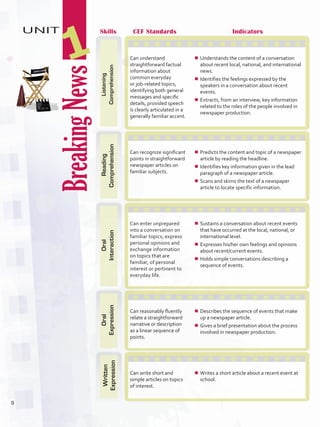
Skills CEF Standards Indicators
Listening
Comprehension
Can understand
straightforward factual
information about
common everyday
or job-related topics,
identifying both general
messages and specific
details, provided speech
is clearly articulated in a
generally familiar accent.
¾¾ Understands the content of a conversation
about recent local, national, and international
news.
¾¾ Identifies the feelings expressed by the
speakers in a conversation about recent
events.
¾¾ Extracts, from an interview, key information
related to the roles of the people involved in
newspaper production.
Reading
Comprehension
Can recognize significant
points in straightforward
newspaper articles on
familiar subjects.
¾¾ Predicts the content and topic of a newspaper
article by reading the headline.
¾¾ Identifies key information given in the lead
paragraph of a newspaper article.
¾¾ Scans and skims the text of a newspaper
article to locate specific information.
Oral
Interaction
Can enter unprepared
into a conversation on
familiar topics, express
personal opinions and
exchange information
on topics that are
familiar, of personal
interest or pertinent to
everyday life.
¾¾ Sustains a conversation about recent events
that have occurred at the local, national, or
international level.
¾¾ Expresses his/her own feelings and opinions
about recent/current events.
¾¾ Holds simple conversations describing a
sequence of events.
Oral
Expression
Can reasonably fluently
relate a straightforward
narrative or description
as a linear sequence of
points.
¾¾ Describes the sequence of events that make
up a newspaper article.
¾¾ Gives a brief presentation about the process
involved in newspaper production.
Written
Expression
Can write short and
simple articles on topics
of interest.
¾¾ Writes a short article about a recent event at
school.
U1_VP5IngGuideCol2012.indd 9 3/23/16 11:28 AM
BreakingNews
UNIT
1
uuGeneral Objective
	 You will be able to talk about events that have
happened recently and share experiences of your school
community.
uuCommunication Goals
	 You will learn how to
•	 	talk about news.
•	 	announce a piece of news that
has happened recently.
•	 	share life experiences.
uuCLIL
•	 	Newspaper Sections
•	 	NewsWriting and Reporting
•	 SchoolWorld
	Vocabulary
•	 	Sections of a Newspaper
•	 	Words related to news writing and reporting
	Grammar
•	 	Simple Present and Simple Past tenses
•	 Present Perfect and Past Perfect tenses
uuIdioms and Colloquial Expressions
•	 	To hit the headlines
•	 That’s breaking news
•	 To cover the story
uu	Project
	 A Newspaper Section
	 You will create a newspaper section to narrate
recent news and key stories of your school
Discuss:
•	 Is there a newspaper at your school?
•	 What is the most famous newspaper
in your town and country?
U1_VP5 21 x 28.indd 9 5/19/16 2:42 PM
Lesson  1
HaveYouReadtheNews?
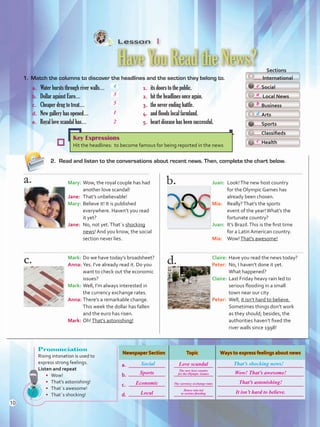
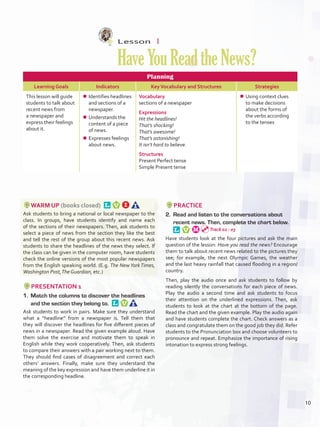
1.	 Match the columns to discover the headlines and the section they belong to.
2.	 Read and listen to the conversations about recent news. Then, complete the chart below.
a. 	 Water bursts through river walls…	 1.	 its doors to the public.
b.	 Dollar against Euro…	 2.	 hit the headlines once again.
c. 	 Cheaper drug to treat…	 3.	 the never ending battle.
d.	 New gallery has opened…	 4.	 and floods local farmland.
e. 	 Royal love scandal has…	 5.	 heart disease has been successful.
4
  Sections
International
Social
Local News
Business
Arts
Sports
Classifieds
Health
Key Expressions
Hit the headlines: to become famous for being reported in the news
Mary:	Wow, the royal couple has had
another love scandal!
Jane:	 That’s unbelievable!
Mary:	Believe it! It is published
everywhere. Haven’t you read
it yet?
Jane:	 No, not yet.That´s shocking
news! And you know, the social
section never lies.
Mark:	Do we have today’s broadsheet?
Anna:	Yes. I’ve already read it. Do you
want to check out the economic
issues?
Mark:	Well, I’m always interested in
the currency exchange rates.
Anna:	There’s a remarkable change.
This week the dollar has fallen
and the euro has risen.
Mark:	Oh!That’s astonishing!
Juan:	 Look!The new host country
for the Olympic Games has
already been chosen.
Mia:	 Really?That’s the sports
event of the year!What’s the
fortunate country?
Juan:	 It’s Brazil.This is the first time
for a Latin American country.
Mia:	 Wow!That’s awesome!
Claire:	Have you read the news today?
Peter:	 No, I haven’t done it yet.
What happened?
Claire:	Last Friday heavy rain led to
serious flooding in a small
town near our city
Peter:	 Well, it isn’t hard to believe.
Sometimes things don’t work
as they should; besides, the
authorities haven’t fixed the
river walls since 1998!
d
Pronunciation
Rising intonation is used to
express strong feelings.
Listen and repeat
•	 Wow!
•	 That’s astonishing!
•	 That´s awesome!
•	 That´s shocking!
Newspaper Section Topic Ways to express feelings about news
a.
b.
c.
d.
Social That’s shocking news!
10
3
e
5 b
1
a
2
c
Sports Wow! That’s awesome!
That’s astonishing!
It isn’t hard to believe.
The new host country
for the Olympic Games
Heavy rain led
to serious flooding
Love scandal
Economic The currency exchange rates
Local
U1_VP5 21 x 28.indd 10 4/19/16 11:49 AM
Lesson  1
HaveYouReadtheNews?
Planning
Learning Goals Indicators KeyVocabulary and Structures Strategies
This lesson will guide
students to talk about
recent news from
a newspaper and
express their feelings
about it.
¾¾ Identifies headlines
and sections of a
newspaper.
¾¾ Understands the
content of a piece
of news.
¾¾ Expresses feelings
about news.
Vocabulary
sections of a newspaper
Expressions
Hit the headlines!
That’s shocking!
That’s awesome!
That’s astonishing!
It isn’t hard to believe.
Structures
Present Perfect tense
Simple Present tense
¾¾ Using context clues
to make decisions
about the forms of
the verbs according
to the tenses
WARM UP (books closed) 
Ask students to bring a national or local newspaper to the
class. In groups, have students identify and name each
of the sections of their newspapers. Then, ask students to
select a piece of news from the section they like the best
and tell the rest of the group about this recent news. Ask
students to share the headlines of the news they select. If
the class can be given in the computer room, have students
check the online versions of the most popular newspapers
from the English speaking world. (E.g. The New York Times,
Washington Post,The Guardian, etc.)
PRESENTATION 1
1.	 Match the columns to discover the headlines
and the section they belong to. 
Ask students to work in pairs. Make sure they understand
what a “headline” from a newspaper is. Tell them that
they will discover the headlines for five different pieces of
news in a newspaper. Read the given example aloud. Have
them solve the exercise and motivate them to speak in
English while they work cooperatively. Then, ask students
to compare their answers with a pair working next to them.
They should find cases of disagreement and correct each
others’ answers. Finally, make sure they understand the
meaning of the key expression and have them underline it in
the corresponding headline.
PRACTICE
2.	 Read and listen to the conversations about
recent news. Then, complete the chart below. 
Have students look at the four pictures and ask the main
question of the lesson: Have you read the news? Encourage
them to talk about recent news related to the pictures they
see; for example, the next Olympic Games, the weather
and the last heavy rainfall that caused flooding in a region/
country.
Then, play the audio once and ask students to follow by
reading silently the conversations for each piece of news.
Play the audio a second time and ask students to focus
their attention on the underlined expressions. Then, ask
students to look at the chart at the bottom of the page.
Read the chart and the given example. Play the audio again
and have students complete the chart. Check answers as a
class and congratulate them on the good job they did. Refer
students to the Pronunciation box and choose volunteers to
pronounce and repeat. Emphasize the importance of rising
intonation to express strong feelings.
Track 02 - 03
10
U1_VP5IngGuideCol2012.indd 10 8/10/16 16:11
EXTRA IDEAS 
Encourage students to practice the conversations in pairs.
While students listen to the audio again, ask them to assume
different roles and practice. Have them pay special attention
to the rising intonation used to express strong feelings and
encourage them to imitate the speaker they listen to in
the recording. Focus their attention on the four different
expressions.
As an additional activity, encourage students to create a
conversation aboutthenewstheyhaveselectedintheWarm
Up section above. Motivate them to use any of the previous
conversations as a model and to include the Key Expressions
they have learned in order to express their feelings about
the news.
PRESENTATION 2
3.	 Complete the sentences. Use the verbs in the
Word Bank in the Simple Present and Present
Perfect tenses. 
Have students read the Reflect on Grammar chart. Go
through the second column of the chart and make sure
students understand the uses of the key expressions and
frequency adverbs.
Refer students to the school newspaper.Ask them to tell you
the name of the newspaper: The Gateway and the name of
the school: Windmill. Ask volunteers to read the headlines.
Go through the verbs from the Word Bank and tell students
to use them in the Present Perfect or Simple Present tense,
to complete each text. Focus students’ attention on the
Grammar Strategy and motivate them to use context clues
to make decisions about the forms of the verbs according
to the tenses. Have students compare their answers with a
classmate.
EXTRA IDEAS 
Have students work in pairs and ask them to select one of
the pieces of news from exercise 3. Motivate them to think
about similar recent news from their own school. Encourage
them to write two short sentences to state the piece of
news using the Present Perfect and Simple Present tenses.
Go around the classroom checking that they use the tenses
appropriately. Then, invite students to write their piece of
news on a small piece of colored paper and to stick it on
the board or on the walls around the classroom. Then, tell
students to go around and read each others’ school news.
Congratulate them on their work.
 Project Stage 1  
Motivate students to make their first project of the book.
Explain that it is divided into three sections, one section per
lesson, with the presentation taking place in the 4th lesson.
Call on volunteers to read the three steps. Give them time
to form their groups. Suggest that they give a name to their
group. Each group should select their favorite newspaper
section and provide reasons for their choice. Model the
exercise with your own information. Based on their choice,
encourage students to find out and list recent news about
the specific events that have happened recently at school.
11
U1_VP5IngGuideCol2012.indd 11 3/23/16 11:28 AM
Reflect on Grammar
The Present PerfectTense
Use it to talk about events that occurred at a non-specific time
in the past and continue to the present.
• I´ve already read it.
•  The host country for the Olympic Games has been chosen.
•  I haven’t read the local newspaper yet.
•  Haven´t you read it yet?
•  Use already to say that something happened
sooner than expected in affirmative
sentences.
•  Use yet to mean “until now” in negative
sentences and questions.
The Simple PresentTense
Use it to express routines and facts.
•  I’m always interested in the currency exchange rates.
•  And you know, the social section never lies.
•  Sometimes things don’t work as they should.
Use frequency adverbs to indicate the frequency
of routines and habitual actions.
	always	 sometimes	 never
	100%	 50%	 0%
has won
Grammar and Vocabulary
3.	 Complete the sentences. Use the Word Bank in the Simple Present and the Present Perfect tenses.
Word
Bank
•	 win (2x)
•	like
•	 send
•	 be
•	 attend
•	 arrive
•	 show
•	 close
•	 buy
•	 create
Grammar
Strategy
Use context clues
to make decisions
about the forms of
the verbs according
to the tenses.
Our basketball team	 the interschool championship
again. It is the third time our players	 (a) the
trophy and succeeded in this important sports event.
The majority of the school´s families 	 (b) the Arts Festival this year.This is
awesome news! Students 	 (c) already 	 (d) the families a thank you note.
The school science fair always 	 (e) students’ creativity and love for design.
On this occasion, a 10th grade girl 	 (f) some innovative software for
learning English in a fun way.
It’s a fact that most students 	 (g)
new technologies and the computer lessons.
However, the school’s computers are very
old and don’t work properly.The school
	 (h) new ones yet.
The school 	 (i) already
	(j) its doors to new
students.Admissions for the next academic
year	 (k) now over.
The school principal is still on vacation.She 	 (l)
	(m) from Houston,Texas yet.
•	 Get into groups of three.
•	 Select your favorite section of a newspaper and justify your choice.
•	 Do some research about events, news and stories that have happened at your school.
Project  Stage 1
Monday January 30, 2013
11
have won
have attended
have sent
shows
has created
like has
closed
are
hasn’t
arrived
hasn’t bought
U1_VP5 21 x 28.indd 11 3/30/16 8:35 AM
1.	 Look at the pictures and guess the roles of the people involved in newspaper production. Then,
listen and check.
2.	 Listen and complete the interview with words in exercise 1.
Lesson  2
FromtheInsideofaNewspaper
Matt:	 Good afternoon, Mr. Graham. I want to know about
the process of newspaper production. How did
you produce the last piece of news about the truck
accident?!
Mr. Graham:	Well, we published it last week and we worked
as a team.The process involved different stages and
different staff. At 4:00 AM, the 	 went to
the scene where the event had taken place. (1)When
she arrived, the photographer had already taken
some pictures of the accident.
Matt:	 What did the journalist do after she arrived on the
scene?
Mr. Graham:	At 4:15, the 	 (a)
asked questions and recorded the
information. (2) Before the
interviews, she had checked her voice
recorder, of course! At 5:30, the
journalist wrote the news story.
Matt:	 Did the journalist show her article to the
	 (b)?
Mr. Graham:	Yes. (3) By the time the editor gave the
text to the 	 (c), he
had already checked the content of the story.
The graphic designer used the pictures that the
	 (d) had sent him one hour
	 before and selected those that best illustrated and
supported the article.
Matt:	 What happened during the final stages of the
process?
Mr. Graham:	Finally, the graphic designer created
the page layout and produced the final version
of the newspaper article. It was ready at 7:30.
(4) We published the news at 8:00 after the
		 (e) had printed it.
journalist
Mr. Graham
	 Graphic Designer
	 Publisher
Claire Davis
	Photographer
	 Columnist
Tom Middleton
	 Press Operator
	 Editor
Kim Harris
	Journalist
	 Secretary
12
editor
graphic designer
photographer
press operator
journalist
U1_VP5 21 x 28.indd 12 3/30/16 8:35 AM
Lesson  2
FromtheInsideofaNewspaper
Planning
Learning Goals Indicators KeyVocabulary and Structures Strategies
This lesson will
guide students
to talk about the
production of news
and the people
who are involved in
the process.
¾¾ Identifies the different
roles that exist in the
production of news.
¾¾ Understands the
sequence in which
events occur.
Vocabulary
graphic designer, publisher,
photographer, columnist, press
operator, editor, journalist
Structures
Past Perfect tense
Simple PastTense
¾¾ Identifying and
describing a sequence of
events
WARM UP (books closed) 
Askstudentsabouttheirpersonalexperiences:Haveyouever
participated in your school’s newspaper production? Which
roles have you performed? Which activities did you develop?
If the school does not have a newspaper, ask students to
speculate about the people who work in the production of
a local/regional or national newspaper: Who are the people
involved in newspaper production? What do these people do?
If you worked for a newspaper, which role would you like to
perform?
PRESENTATION 1
1.	 Look at the pictures and guess the roles of the
people involved in newspaper production. Then,
listen and check. 
Read the title of the lesson and tell students that they are
going to learn about the people involved in the production
of a newspaper. Invite students to look at the people in the
pictures and to make guesses. Then, have them compare
their answers.Tell students to justify their choices by making
use of their background knowledge. Finally, play the audio
once and check the answers as a group. Congratulate them
on their work.
PRACTICE
2.	 Listen and complete the interview with words in
exercise 1. 
Tell students that they are going to listen to a conversation in
which the production process of a piece of news is described.
Write the following steps on the board and ask students to
organize them to make guesses about the news production
process: interview the people involved, take pictures, go to the
place, record the interview, write the report, edit the text.
Afterward, have them guess what the news is about by
looking at the picture. Encourage them to follow the
conversation by reading silently as they listen. Play the
recording once. Play it again and make some short pauses
in between each text so that students have time to write the
key words. Check the spelling by asking volunteers to spell
the words they write to complete the interview.
Track 04
Track 05
12
U1_VP5IngGuideCol2012.indd 12 8/10/16 14:06
PRESENTATION 2
3.	 Read the four numbered sentences in the
interview and fill in the chart. 
Read the given example out loud and explain the activity
to the students. Make sure they understand the sequence
in which the events happened as expressed in the interview
from exercise 2. Then, ask them to identify the second
numbered sentence from the interview. Help them identify
the first action and guide them to write it down in the chart,
using the Past Perfect tense. Then, help them identify the
second action and guide them to write it down in the chart
using Simple Past tense. Next, encourage students to work
individuallywiththeothertwonumberedsentences. Finally,
check their answers as a group. Have volunteers write their
answers on the board.
Motivate students to read the Reflect on Grammar chart. It
presents and exemplifies the uses of the key tenses worked
on in this lesson: Past Perfect and Simple Past. Go through
the second column of the chart and make sure students
understand the uses of the common expressions.
PRACTICE
4.	 Complete the interview with the verbs in
parentheses. Use the Simple Past or the
Past Perfect tenses. Then, listen and check. 
Invite students to work in pairs.Tell them that they are going
to read and complete an interview between a journalist and
a high school student. Suggest that they read the complete
interview first. Then, allow sufficient time to fill in the gaps
with the verbs in parentheses. Encourage students to refer
to the Reflect on Grammar chart in order to make decisions
aboutthetensetheyshouldusetocompleteeachgap.When
they have finished, ask students to check their answers with
another pair. This will help them identify the differences
and similarities in their answers and focus their attention on
the most difficult choices. Then, play the recording and tell
students to focus their attention on the missing words. Play
the audio again and let them listen and check their answers.
Play the audio as many times as necessary with short pauses
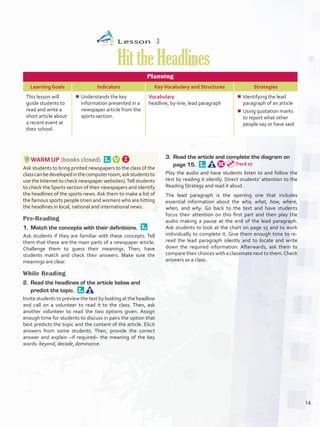
in between each text so that students have time to write the
correct answers. Finally, provide further support if needed,
explaining the use of each tense by having students identify
the first/earlier action (Past Perfect) and the second/latter
action (Simple Past) in the sequence of events described in
the interview.
EXTRA IDEAS 
Using the interviews from exercises 2 and 4, invite students
to work in pairs in order to role-play each interview. To
prepare students, play the audio several times so that they
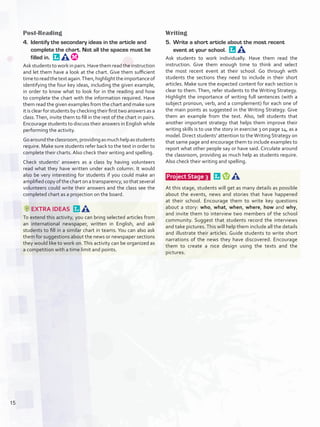
can practice the pronunciation of the key words and the
intonation of the different sentences. Encourage students
to change their roles and work with a different pair.
 Project Stage 2  
Ask students to get into their project groups in order
to check the list of events that have happened recently
at school. Encourage them to find out as many details
as possible about the selected event(s) related to the
newspaper section they selected in Project Stage 1.
Motivate students to assign a role to all the members of the
group. That is, one student can be the journalist; another
can be the photographer, the editor, the graphic designer,
and so forth. Each student should perform the actions that
correspond to their role. Students can ask teachers and
students questions to learn the details about the news.
Suggest that they take notes about the events or stories
they are being informed about.They can also take pictures
at the moment of interviewing teachers and classmates.
Track 06
13
U1_VP5IngGuideCol2012.indd 13 8/10/16 14:08
4.	 Complete the interview with the verbs in parentheses. Use the Simple Past and the Past Perfect
tenses. Then, listen and check.
Grammar and Vocabulary
Journalist:	 Hi,Tina.You are a student at Lincoln High
School. Please tell me about the new library project or
the initiative you and your classmates had.What was
this story about?
Tina:	 OK. Last year my classmates and I	
(notice) that our school library	
(a. not have) many nice new books and we
	(b. decide) to do something about
it.When we invited 	 (c. invite) neighbors
to donate books, we
(d. collect already) story books and textbooks from our
teachers. Before that, we
(e. talk) to the school principal to ask for his
permission, of course!The book collection process
	(f. be) a great success. By the end of
last year, we
(g. gather  already) 250 new books.
noticed
Sentence First / earlier action Second / later action
(1)
(2)
(3)
(4)
the photographer had already taken some pictures of the accident the journalist arrived
•	 Ask key people at school to find out the details about the events
you have done research on.
•	 Assign the group members different roles. Each member will play 	 E.g. journalist, editor, graphic designer...
a key role.
Project  Stage 2
3.	 Read the four numbered sentences in the interview and fill in the chart.
Reflect on Grammar
The Present PerfectTense
Use it to talk about an action that happened before another action in the past.
When the journalist arrived, the photographer had
already taken some pictures of the accident.
First) the photographer took some pictures of the
accident. (Later) the journalist arrived.
Common expressions: Before (that), By then, already
The Simple PresentTense
Use it to express actions that started and ended in the past.
How did you produce the last piece of news about
the truck accident?
We published it last week.
Common expressions: Last week, yesterday, that day,
when
13
The journalist had checked her voice recorder
The press operator had printed the article.
The graphic designer had already checked the content of the story
the interviews
The crew published the news
the editor gave the text
to the graphic designer
didn’t have
decided
invited
had already collected
had talked
was
had already gathered
U1_VP5 21 x 28.indd 13 3/30/16 8:35 AM
Lesson  3
1.	 Match the concepts with their definitions.
a. 	Headline	 1. 	The key or main information of an article
b.	 By-line	 2.	 The title of an article
c.	 Lead paragraph 	 3. 	The body or secondary ideas of an article
d.	 Supporting details	4.	Line that gives the writer´s name
2.	 Read the headlines of the article below and predict the topic.
The article is about theWilliams sisters’ life after ten years of practice.
The article is about the success of theWilliams sisters over the last ten years.
3.	 Read the article and complete the diagram on page 15.
HittheHeadlines
Reading Strategy
The lead paragraph of an article
is always the first lines of it.
Writing Strategy
•	 Use quotation marks “ ” to report what other people say or said.
•	 E.g. “We also eat very healthy food and if we get an injury, we take
good care of it until recovery,” saidVenus.
In professional women’s tennis around
the world there are two sisters who
have already made history since their
debut in 1994. They are Venus and
Serena Williams. They were born in the
United States, in the 80’s, and they live
in Florida with their family.TheWilliams
sisters have played in professional
tennis matches since the 1990’s and by
the year 2003 both had become No. 1 in
the world.
They have hit the headlines several
times and have made history for
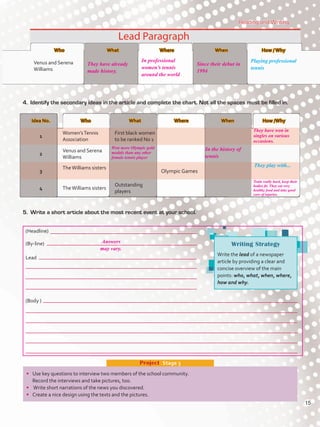
various reasons. First, the Women’s
Tennis Association (WTA) has ranked
the Williams sisters World No. 1 in
singles on various occasions. Second,
they became the first black women
to accomplish this goal in the history
of tennis. Third, they have won more
Olympic gold medals than any other
female tennis player. “We play with our
hearts and souls for our country and
for all the women we represent in the
world,” saidVenus.
But what makes the Williams sisters
such outstanding tennis players? “We
train really hard every day and keep
our bodies fit to build an aggressive
style,” said Serena. It is noticeable
that it takes discipline and great
physical effort on their part. “We also
eat very healthy food and if we get
an injury, we take good care of it until
recovery,” said Venus. But mental and
emotional aspects also play a key role.
“Sometimes, they can get nervous
when they get near the finish line in a
key set,” said Richard Williams, their
father, best friend and mentor. They
love each other and have strong family
bonds.
a
14
c
d
b
U1_VP5 21 x 28.indd 14 5/23/16 4:28 PM
Lesson  3
HittheHeadlines
Planning
Learning Goals Indicators KeyVocabulary and Structures Strategies
This lesson will
guide students to
read and write a
short article about
a recent event at
their school.
¾¾ Understands the key
information presented in a
newspaper article from the
sports section.
Vocabulary
headline, by-line, lead paragraph
¾¾ Identifying the lead
paragraph of an article
¾¾ Using quotation marks
to report what other
people say or have said
WARM UP (books closed) 
Ask students to bring printed newspapers to the class (if the
classcanbedevelopedinthecomputerroom,askstudentsto
use the Internet to check newspaper websites).Tell students
to check the Sports section of their newspapers and identify
the headlines of the sports news. Ask them to make a list of
the famous sports people (men and women) who are hitting
the headlines in local, national and international news.
Pre-Reading
1.	 Match the concepts with their definitions. 
Ask students if they are familiar with these concepts. Tell
them that these are the main parts of a newspaper article.
Challenge them to guess their meanings. Then, have
students match and check their answers. Make sure the
meanings are clear.
While Reading
2.	 Read the headlines of the article below and
predict the topic. 
Invite students to preview the text by looking at the headline
and call on a volunteer to read it to the class. Then, ask
another volunteer to read the two options given. Assign
enough time for students to discuss in pairs the option that
best predicts the topic and the content of the article. Elicit
answers from some students. Then, provide the correct
answer and explain –if required– the meaning of the key
words: beyond, decade, dominance.
3.	 Read the article and complete the diagram on
page 15. 
Play the audio and have students listen to and follow the
text by reading it silently. Direct students’ attention to the
Reading Strategy and read it aloud.
The lead paragraph is the opening one that includes
essential information about the who, what, how, where,
when, and why. Go back to the text and have students
focus their attention on this first part and then play the
audio making a pause at the end of the lead paragraph.
Ask students to look at the chart on page 15 and to work
individually to complete it. Give them enough time to re-
read the lead paragraph silently and to locate and write
down the required information. Afterwards, ask them to
compare their choices with a classmate next to them.Check
answers as a class.
Track 07
14
U1_VP5IngGuideCol2012.indd 14 8/10/16 14:08
Post-Reading
4.	 Identify the secondary ideas in the article and
complete the chart. Not all the spaces must be
filled in. 
Askstudentstoworkinpairs.Havethemreadtheinstruction
and let them have a look at the chart. Give them sufficient
timetoreadthetextagain.Then,highlighttheimportanceof
identifying the four key ideas, including the given example,
in order to know what to look for in the reading and how
to complete the chart with the information required. Have
them read the given examples from the chart and make sure
it is clear for students by checking their first two answers as a
class.Then, invite them to fill in the rest of the chart in pairs.
Encourage students to discuss their answers in English while
performing the activity.
Goaroundtheclassroom,providingasmuchhelpasstudents
require. Make sure students refer back to the text in order to
complete their charts. Also check their writing and spelling.
Check students’ answers as a class by having volunteers
read what they have written under each column. It would
also be very interesting for students if you could make an
amplified copy of the chart on a transparency, so that several
volunteers could write their answers and the class see the
completed chart as a projection on the board.
EXTRA IDEAS 
To extend this activity, you can bring selected articles from
an international newspaper, written in English, and ask
students to fill in a similar chart in teams. You can also ask
them for suggestions about the news or newspaper sections
they would like to work on.This activity can be organized as
a competition with a time limit and points.
Writing
5.	 Write a short article about the most recent
event at your school. 
Ask students to work individually. Have them read the
instruction. Give them enough time to think and select
the most recent event at their school. Go through with
students the sections they need to include in their short
articles. Make sure the expected content for each section is
clear to them. Then, refer students to the Writing Strategy.
Highlight the importance of writing full sentences (with a
subject pronoun, verb, and a complement) for each one of
the main points as suggested in the Writing Strategy. Give
them an example from the text. Also, tell students that
another important strategy that helps them improve their
writing skills is to use the story in exercise 3 on page 14, as a
model. Direct students’ attention to theWriting Strategy on
that same page and encourage them to include examples to
report what other people say or have said. Circulate around
the classroom, providing as much help as students require.
Also check their writing and spelling.
 Project Stage 3   
At this stage, students will get as many details as possible
about the events, news and stories that have happened
at their school. Encourage them to write key questions
about a story: who, what, when, where, how and why,
and invite them to interview two members of the school
community. Suggest that students record the interviews
and take pictures.This will help them include all the details
and illustrate their articles. Guide students to write short
narrations of the news they have discovered. Encourage
them to create a nice design using the texts and the
pictures.
15
U1_VP5IngGuideCol2012.indd 15 3/23/16 11:28 AM
•	 Use key questions to interview two members of the school community.
Record the interviews and take pictures, too.
•	 Write short narrations of the news you discovered.
•	 Create a nice design using the texts and the pictures.
Project  Stage 3
Writing Strategy
Write the lead of a newspaper
article by providing a clear and
concise overview of the main
points: who, what, when, where,
how and why.
Reading and Writing
Playing professional
tennis
They play with...
(Headline)
(By-line)
Lead
(Body )
5.	 Write a short article about the most recent event at your school.
4.	 Identify the secondary ideas in the article and complete the chart. Not all the spaces must be filled in.
Who	 What	 Where	 When	 How / Why
Venus and Serena
Williams
Idea No. Who What Where When How /Why
1
Women’sTennis
Association
First black women
to be ranked No 1
2
Venus and Serena
Williams
3
TheWilliams sisters
Olympic Games
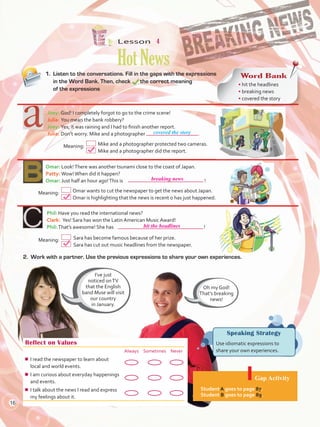
4 TheWilliams sisters
Outstanding
players
15
They have already
made history.
In professional
women’s tennis
around the world
Won more Olympic gold
medals than any other
female tennis player
Since their debut in
1994
In the history of
tennis
They have won in
singles on various
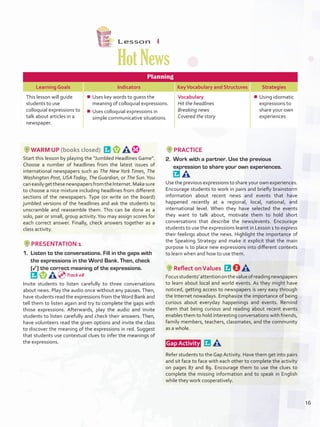
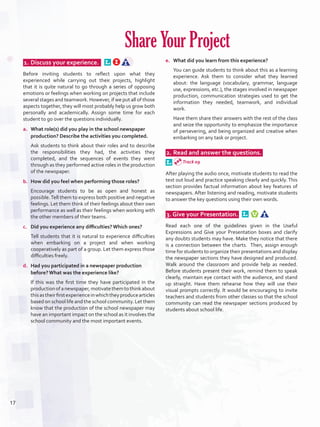
occasions.
Train really hard, keep their
bodies fit. They eat very
healthy food and take good
care of injuries.
Answers
may vary.
U1_VP5 21 x 28.indd 15 3/30/16 8:35 AM
Lesson  4
HotNews
Reflect on Values
Always Sometimes Never
¾¾ I read the newspaper to learn about
local and world events.
¾¾ I am curious about everyday happenings
and events.
¾¾ I talk about the news I read and express
my feelings about it.
Gap Activity
Student A goes to page 87.
Student B goes to page 89.
1.	 Listen to the conversations. Fill in the gaps with the expressions
in the Word Bank. Then, check 	 the correct meaning
of the expressions
Joey:	God! I completely forgot to go to the crime scene!
Julia:	You mean the bank robbery?
Joey:	Yes, it was raining and I had to finish another report.
Julia:	Don’t worry. Mike and a photographer	 .
	Meaning:	Mike and a photographer protected two cameras.
		 Mike and a photographer did the report.
Omar:	Look!There was another tsunami close to the coast of Japan.
Patty:	Wow!When did it happen?
Omar:	Just half an hour ago!This is	 !
Phil:	Have you read the international news?
Clark:  Yes! Sara has won the Latin American Music Award!
Phil:	That’s awesome! She has 	 !
Speaking Strategy
Use idiomatic expressions to
share your own experiences.
Word Bank
• hit the headlines
• breaking news
• covered the story
I’ve just
noticed onTV
that the English
band Muse will visit
our country
in January.
Oh my God!
That’s breaking
news!
covered the story
	Meaning:	 Omar wants to cut the newspaper to get the news about Japan.
			 Omar is highlighting that the news is recent o has just happened.
Meaning:	 Sara has become famous because of her prize.
			 Sara has cut out music headlines from the newspaper.
2.	 Work with a partner. Use the previous expressions to share your own experiences.
16
breaking news
hit the headlines
U1_VP5 21 x 28.indd 16 3/30/16 8:35 AM
Lesson  4
HotNews
Planning
Learning Goals Indicators KeyVocabulary and Structures Strategies
This lesson will guide
students to use
colloquial expressions to
talk about articles in a
newspaper.
¾¾ Uses key words to guess the
meaning of colloquial expressions.
¾¾ Uses colloquial expressions in
simple communicative situations.
Vocabulary
Hit the headlines
Breaking news
Covered the story
¾¾ Using idiomatic
expressions to
share your own
experiences
WARM UP (books closed) 
Start this lesson by playing the “Jumbled Headlines Game”.
Choose a number of headlines from the latest issues of
international newspapers such as The New York Times, The
Washington Post, USAToday, The Guardian, or The Sun.You
caneasilygetthesenewspapersfromtheInternet.Makesure
to choose a nice mixture including headlines from different
sections of the newspapers. Type (or write on the board)
jumbled versions of the headlines and ask the students to
unscramble and reassemble them. This can be done as a
solo, pair or small, group activity.You may assign scores for
each correct answer. Finally, check answers together as a
class activity.
PRESENTATION 1
1.	 Listen to the conversations. Fill in the gaps with
the expressions in the Word Bank. Then, check
(✓) the correct meaning of the expressions. 
Invite students to listen carefully to three conversations
about news. Play the audio once without any pauses. Then,
have students read the expressions from theWord Bank and
tell them to listen again and try to complete the gaps with
those expressions. Afterwards, play the audio and invite
students to listen carefully and check their answers. Then,
have volunteers read the given options and invite the class
to discover the meaning of the expressions in red. Suggest
that students use contextual clues to infer the meanings of
the expressions.
PRACTICE
2.	 Work with a partner. Use the previous
expression to share your own experiences. 
Use the previous expressions to share your own experiences.
Encourage students to work in pairs and briefly brainstorm
information about recent news and events that have
happened recently at a regional, local, national, and
international level. When they have selected the events
they want to talk about, motivate them to hold short
conversations that describe the news/events. Encourage
students to use the expressions learnt in Lesson 1 to express
their feelings about the news. Highlight the importance of
the Speaking Strategy and make it explicit that the main
purpose is to place new expressions into different contexts
to learn when and how to use them.
Reflect onValues 
Focusstudents’attentiononthevalueofreadingnewspapers
to learn about local and world events. As they might have
noticed, getting access to newspapers is very easy through
the Internet nowadays. Emphasize the importance of being
curious about everyday happenings and events. Remind
them that being curious and reading about recent events
enables them to hold interesting conversations with friends,
family members, teachers, classmates, and the community
as a whole.
 Gap Activity  
Refer students to the Gap Activity. Have them get into pairs
and sit face to face with each other to complete the activity
on pages 87 and 89. Encourage them to use the clues to
complete the missing information and to speak in English
while they work cooperatively.
Track 08
16
U1_VP5IngGuideCol2012.indd 16 8/10/16 14:11
 1.	Discuss your experience.   
Before inviting students to reflect upon what they
experienced while carrying out their projects, highlight
that it is quite natural to go through a series of opposing
emotions or feelings when working on projects that include
several stages and teamwork. However, if we put all of those
aspects together, they will most probably help us grow both
personally and academically. Assign some time for each
student to go over the questions individually.
a.	 What role(s) did you play in the school newspaper
production? Describe the activities you completed.
Ask students to think about their roles and to describe
the responsibilities they had, the activities they
completed, and the sequences of events they went
through as they performed active roles in the production
of the newspaper.
b.	 How did you feel when performing those roles?
Encourage students to be as open and honest as
possible.Tell them to express both positive and negative
feelings. Let them think of their feelings about their own
performance as well as their feelings when working with
the other members of their teams.
c.	 Did you experience any difficulties? Which ones?
Tell students that it is natural to experience difficulties
when embarking on a project and when working
cooperatively as part of a group. Let them express those
difficulties freely.
d.	 Had you participated in a newspaper production
before? What was the experience like?
If this was the first time they have participated in the
productionofanewspaper,motivatethemtothinkabout
thisastheirfirstexperienceinwhichtheyproducearticles
based on school life and the school community. Let them
know that the production of the school newspaper may
have an important impact on the school as it involves the
school community and the most important events.
e.	 What did you learn from this experience?
You can guide students to think about this as a learning
experience. Ask them to consider what they learned
about: the language (vocabulary, grammar, language
use, expressions, etc.), the stages involved in newspaper
production, communication strategies used to get the
information they needed, teamwork, and individual
work.
Have them share their answers with the rest of the class
and seize the opportunity to emphasize the importance
of persevering, and being organized and creative when
embarking on any task or project.
 2.	Read and answer the questions.  
After playing the audio once, motivate students to read the
text out loud and practice speaking clearly and quickly. This
section provides factual information about key features of
newspapers. After listening and reading, motivate students
to answer the key questions using their own words.
 3. Give your Presentation.  
Read each one of the guidelines given in the Useful
Expressions and Give your Presentation boxes and clarify
any doubts students may have. Make they notice that there
is a connection between the charts. Then, assign enough
time for students to organize their presentations and display
the newspaper sections they have designed and produced.
Walk around the classroom and provide help as needed.
Before students present their work, remind them to speak
clearly, maintain eye contact with the audience, and stand
up straight. Have them rehearse how they will use their
visual prompts correctly. It would be encouraging to invite
teachers and students from other classes so that the school
community can read the newspaper sections produced by
students about school life.
Share Your Project
Track 09
17
U1_VP5IngGuideCol2012.indd 17 8/10/16 14:11
Give your Presentation
•	 Introduce the members of your team.
•	 Mention the roles played by each one.
•	 Mention the section you have designed.
•	 Talk about the stories and the information you gathered
about the key, current events at your school.
•	 Talk about the people you interviewed and the sources
of your information.
ShareYourProject
Useful Expressions
•	 Good morning.This is our group.We are… (names)
•	 I played the role of…
•	 We have designed the section.
•	 Our main stories/news are/is …This story is about…
•	 We have interviewed the school principal…
1.	 Discuss your experience.
a.	 What role(s) did you play in the school newspaper production? Describe the activities you completed.
	
	
b.	 How did you feel when performing those roles?
c.	 Did you experience any difficulties?Which ones?
	
d.	 Had you participated in a newspaper production before?What was the experience like?
	
e.	 What did you learn from this experience?
	
	 Newspapers can be published every day or every
week, thus, they can be daily or weekly newspapers. They
can also be local, national, or international. Newspapers
are typically printed on cheap, low-quality paper, usually
called newsprint. A newspaper is a publication that contains
informative articles, news of current events, advertising,
and a variety of entertaining features such as crosswords,
editorial cartoons, and comic strips.
Newspapers also cover a variety of topics and these are
organized in sections. Each section contains articles that are
based on facts.The title of an article, printed in large letters,
is called the headline, and the author and publishing date
are usually included. The different sections of a newspaper
include: politics, business and economy, education, opinion,
arts, sports, health and lifestyle, and a number of classifieds
about jobs, real estate, cars, and other products. Almost all
printed versions of newspapers also have online editions.
Broadsheet newspapers generally contain more serious
news than tabloids, which are smaller and emphasize
shocking stories about famous people. Newspapers’ readers
pay a subscription to help fund the newspaper production.
a.	Which categories can newspapers be classified in?
b.	What is newsprint?
c.	 What are the characteristics of a newspaper section?
d.	What’s the difference between Broadsheets and
Tabloids?
Real Communication
2.	 Read and answer the questions.
17
Answers
may vary.
U1_VP5 21 x 28.indd 17 4/19/16 11:51 AM
Comic
TheInterview
1.	 Listen and read.
At home... At the ABC News headquarters...
Jim, take a look at this news.
It’s important for your job
interview tomorrow.
OK, Mom!
Mr. Sanders why
do you want to be
a news reporter?
Well, I’m a good
communicator… and I love
to interact with people.
Good!What’s
hitting the headlines
these days?
Hitting the headlines?
Oops! I guess… it’s the use of...
Have you read
the news lately?
Well…
I don’t know.
What’s the
breaking news
about the weather?
I guess I have to learn
to hit the headlines and
break the news!
Time for
Action:
When the
Weather Hits
18
U1_VP5 21 x 28.indd 18 3/30/16 8:35 AM
Comic
TheInterview
Listen and Read. 
Pre-Reading (books closed)
Draw students’ attention to the title of the comic. Let
them share ideas about different types of interviews. When
they mention a job interview, invite them to think about
important things that one should do before the interview to
be prepared and well informed.
While Reading
Have students open their books and tell them to read
the comic in pairs, assigning a role to each student (the
interviewer and the interviewee). Encourage students to
read the comic at least twice and to focus on the idiomatic
expressions they find. Instruct students to read the complete
story without stopping to look up new words.
Post-reading
Encourage students to discuss the importance of reading
the newspaper and being informed about recent events at a
local, national and international level.To extend the activity,
you can motivate students to role-play the comic.
EXTRA IDEAS 
Ask students to bring different newspapers to class. If
possible, encourage students to get newspapers both in
English and in Spanish. If the printed versions are difficult
to obtain, motivate students to get the online versions of
different newspapers from the Internet.Once students have
gotten the newspapers, tell them to find the comic sections.
These are usually found in the entertainment and/or social
section of a newspaper. Invite students to read various
comics and to select the ones they like best (at least one in
English and one in Spanish).Then, encourage them to share
their comics with the whole class.
Track 10
18
U1_VP5IngGuideCol2012.indd 18 8/10/16 16:11
Quiz Time
 Before the test 
Invite students to answer the quiz individually. Remind them
ofthefactthatthisquizwillhelpthembecomeawareoftheir
strengths and weaknesses. Stress the purpose of the test:
not to count the number of right and wrong answers, but
rather to identify how to sort out language learning process
difficulties, without being judgmental. Encourage them
to read the instructions for each part of the quiz carefully.
After they have worked individually, have them check their
answers in pairs before sharing them with the whole class.
1.	 Listen to the conversations between the editor
(Tom) and the newspaper staff. Complete the
chart. 
Tell students that they are going to listen to a conversation
between the newspaper editor whose name is Tom and
various members of the newspaper’s staff. Give students a
couple of minutes to read the information given in the chart
before listening. Make sure they understand that in the first
column they need to complete the statements with a key
word (verbs in Simple Present tense) and for the last column
they need to decide if the staff members have completed
their jobs (assignments) by writing, yes or no.Then, play the
audio at least three times and encourage students to write
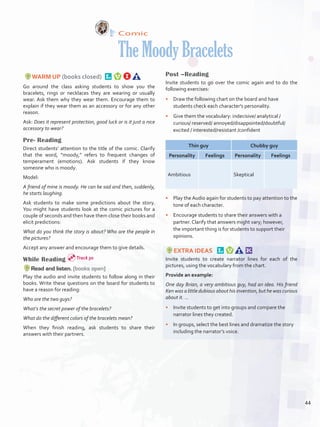
down and check the answers for each staff member.
2.	 Complete the dialog with the verbs in
parentheses. Use the Simple Present and the
Present Perfect tenses. 
Suggest that students read the complete conversation once
to get the general idea. Then, ask them to read each part
of the dialog with its corresponding verb. Tell learners to
select the most appropriate tense (Simple Present or Present
Perfect) to complete the phrase. You can suggest that
students focus their attention on the words shown before
the blank to identify what the correct answer is.
3.	 Read the news story. Then, choose the correct
option. 
Encourage students to read the text at least twice. Ask
them to focus their attention on the sequence of events.Tell
them that after reading, they should read the statements
and select the best option.They can circle or underline their
answers and re-read the text if necessary.
 Self-Evaluation  
Invite students to read the Self-Evaluation chart. Tell them
to check their choices according to their progress in the
unit and share their answers with their classmates. Have
students reflect upon the fact that an evaluation is more
than a number or a letter: it is a means to detect strengths
and weaknesses. Advise them to form study groups to
overcome their weaknesses.
Glossary 
Tell students that theGlossary is useful to develop dictionary
skills. Motivate them to read the entries of the Glossary and
their corresponding definitions. Practice pronunciation by
reading each word out loud. You may want to add some
interesting examples or have students create their own
ones. Invite them to do the Glossary Activities on page 93.
Bear in mind that this page corresponds to page 20 in the
Teacher’s Guide.
Track 11
19
U1_VP5IngGuideCol2012.indd 19 8/10/16 14:13
Quiz Time
2.	 Complete the dialog with the verbs in parentheses.
Use the Simple Present and the Present Perfect tenses.
3.	 Read the news story. Then, choose the correct option.
1.	 Listen to the conversations between the editor (Tom) and the
newspaper staff. Complete the chart.
Self-Evaluation
Now I can... VeryWell OK A Little
¾¾ talk about a news item or an event that has happened recently..
¾¾ describe an event in the past and talk about an earlier moment.
What do they have to do? Job done?
a.	Claire all the pictures.
b.	Bill all the interviews.
c.	 Sara the complete article.
d.	Susan the pictures that support the article.
e.	Carol the advertisement.
f.	 Frank the color pages.
World
Championship Final
Yesterday was the big day. The two soccer teams were ready
to play the World Championship final at Sun Stadium at 7:00
PM. By the time the players were ready to start the match, the
crowds had waited in line for hours. Many people attended
the game. When the news reporters arrived to cover the
event, the fans and hooligans had already taken pictures of
the football field and of the arrival of some players. The game
was amazing. The players did their best in spite of the terrible
weather conditions: before the game was over, it had started
raining…
a.	 The crowd waited in line before/after the match started.
b.	 The reporters arrived before/after the fans had taken
pictures.
c.	 It started raining before/after the game was over.
Kim:	Look at the social section of the news! It
(a. say) the Smiths got divorced.
Lars:	That’s unbelievable!They always
(b. go) to parties together.
Kim:	I know, and Mrs. Smith never
(c. eat) out without her husband.
Lars:	This (d. be) shocking news!
Kim:	I know! you (e. read) the news about the
Garcia family?
Lars:	No, I (f. read) it.What has happened?
Kim:They (g. celebrate) their 10th anniversary
Lars:	Nice!That’s happy news!
takes Yes
a Rainy Match
19
records
writes
organizes
designs
prints
says is
readHave
haven’t read
have celebrated
go
has eaten
Yes
Yes
No
Yes
No
U1_VP5 21 x 28.indd 19 4/19/16 11:54 AM
Glossary
A – E
astonishing: adj. very surprising. This
is astonishing news!
award: n. a reward someone gets
when he/she has achieved something.
(syn. prize)
awesome: adj. extremely good and
sometimes very impressive. (ant.
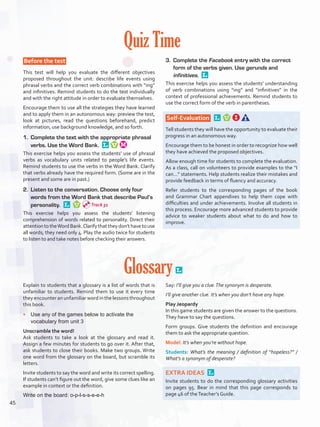
awful)
bond: n. in relationships, a reason
to love each other or feel they have
a connection to each other. Happy
families have strong bonds.
broadsheet: n. a newspaper that
publishes serious news. It is usually
printed on large sheets of paper.
burst: v. when the walls built round a
body of water break because water
levels have exceeded them.
columnist: n. a journalist who writes a
regular series of stories for a magazine
or newspaper and expresses his/
her opinions and comments about
recent news. Mr. Akerman is a famous
newspaper columnist.
currency: n. the type of money used in
a particular country or region. Japan’s
currency is the yen.
debut: n. the first time that a sports
person or performer appears in a
Colloquial Expressions
Breaking news: recent news that
is reported or revealed at the
moment.
Hit the headlines: to become
famous by being reported in the
news.
Cover the story: to report on an
event or recent happening.
public or some remarkable event.
Shakira made her debut when she was
a little girl.
E – H
editor: n. the person who has overall
responsibility for the publication of
articles in a newspaper or magazine.
exchange rate: n. the value of the
money of one country in relation to the
value of the money of another country.
fact: n. a statement that people can
prove. (ant. opinion or comment)
People read the news to find out recent
facts.
flood: v. to be covered with water. A
pipe burst and the water flooded the
first floor of the house.
graphic designer: n. the person who
creatively designs the layout of a
newspaper page, book, leaflet, etc.
headline: n. the title of a news story. It
is usually large in size and catches the
reader’s attention.
headquarters: n. the place where a
company has its main offices. CNN has
its headquarters in Atlanta.
highlight: v. to emphasize something
so that people notice it and think about
it.
host: n. the place and people who
organize a special event. Brazil is the
host for the 2016 Olympic Games.
I – R
layout: n. the position of articles,
photographs, graphics, and
advertisements on a page.
lead: n. The beginning of the news
story. It tells the essentials of any
story: who, what, when, where, why,
and how.
match: n. game or contest in which
two or more people or teams compete
with each other.
mentor: n. an experienced person
who helps, supports, and motivates
someone who has less experience,
especially in their career. (syn. advisor,
tutor)
obituary: n. the newspaper section
which publishes someone’s death and
gives a short description of their life
and accomplishments.
outstanding: adj. extremely good or
impressive. (syn. superior, excellent;
ant. inferior, bad.)
record: v. to put images and/or sounds
onto a CD or DVD.
reporter: n. the person who researches
and writes newspaper articles. (syn. a
journalist)
S – Z
set: n. a series of games in tennis and
some other sports.
shocking: adj. when feeling extremely
surprised. (syn. outrageous; ant.
calming, comforting)
soft news: n. news that deals with
human interest stories which are not
that serious. (ant. hard news)
staff: n. the group of people who work
for a specific company or institution.
thank you note: n. a short piece
of writing to express gratitude to
someone. I sent a thank you note to
Fanny for dinner last week.
Activities on page 93
20
U1_VP5 21 x 28.indd 20 3/30/16 8:35 AM
1. Match column A with column B to make complete sentences.
Column A Column B
1. I highlighted the important parts… a. in Atlanta, USA.
2. Newspapers publish obituaries when… b. she was a child.
3. CNN headquarters is… c. so you don’t have to read the whole article.
4. Shakira made her debut when… d. onto a CD.
5. I want to record all this music… e. someone dies.
2. Replace the words in bold face with a synonymous word from the glossary.
a. After heavy rains, many towns were inundated with water.
b. The newspapers title immediately caught my attention.
c. The newspaper’s design was very confusing.
d. Brazil won the football game against Italy.
e. The company’s employees are working on a new solution to the problem.
f. The journalist is interviewing the health minister as we speak.
Unit 1
GlossaryActivities
3. Unscramble the words and then use them to complete the conversation.
a. o h s k n i g c
b. e i o d t r
c. r m e n o t
d. g s t a n n d i o u t
e. d l a e
f. s t f a c
g. d w a r a
h. s t o h
Paul: HeyTammy, did I tell you that the newspaper’s (1) won an (2) for
(3) work?
Tammy: No you didn’t. I think that’s great. He really deserves it. He always writes about (4) and
never includes his personal opinions.
Paul: I know. Did you read his article on London as the (5) city for the 2012 Olympics?
Tammy: Well, actually I only had time to read the (6) paragraph. But it looked interesting!
Paul: Yeah, it was really interesting and a little (7) too. I can’t believe that they are having so
many security problems just days before the Olympics are due to start.
Tammy: I guess that as a junior editor, your boss is also your (8) , isn’t he?
Paul: He sure is. I have learned a lot working with him.
93
shocking lead
mentor award
editor facts
outstanding
editor award
outstanding
facts
host
lead
shocking
mentor
host
f
h
l
m
s
r
l
e
a
a
t
e
o
a
y
t
a
p
o
d
o
c
f
o
d
l
u
h
f
r
e
i
t
t
d
3
4
1
5
2
n
e
e
r
Student’s Book page 93
20
U1_VP5IngGuideCol2012.indd 20 4/19/16 11:31 AM
HealthyLife,HealthyWorld
UNIT
2
Skills CEF Standards Indicators
Listening
Comprehension
Can follow a lecture
or talk within his/her
own field, provided the
subject matter is familiar
and the presentation
straightforward and clearly
structured.
¾¾ Understands the content of a short
lecture about natural resources.
¾¾ Identifies key information expressed by
the speakers in a conversation about
environmental issues.
¾¾ Extracts key information from a
conversation about the habits of an older
person identifying facts and opinion.Reading
Comprehension
Can read straightforward
factual texts on subjects
related to his/her field and
interest with a satisfactory
level of comprehension.
Can identify the main
conclusions in clearly signaled
argumentative texts.
¾¾ Identifies key information given in the
introduction, body paragraphs, and
conclusion of a short essay.
¾¾ Scans and skims the text of a short
essay to locate key information and to
understand its structure and organization.
Oral
Interaction
Can exchange, check and
confirm information, deal
with less routine situations
and explain why something
is a problem.
¾¾ Sustains a conversation about
problematic issues present in the
community.
¾¾ Speculates about the origins of
problematic situations.
¾¾ Holds simple conversations describing the
problematic issues affecting the lifestyles
of people (health and the environment)
and provides possible solutions.
Oral
Expression
Can give straightforward
descriptions on a variety of
familiar subjects within his/
her field of interest.
¾¾ Describes lifestyles and speculates about
health conditions in the past.
¾¾ Gives descriptions of environmental
issues affecting the community.
¾¾ Gives a brief presentation about health
and the environment.
Written
Expression
Can write short, simple
essays on topics of interest.
¾¾ Writes a short essay about ways to keep
fit and healthy and ways to protect the
environment.
21
U2_VP5IngGuideCol2012.indd 21 3/23/16 11:32 AM
HealthyLife,HealthyWorld
UNIT
HealthyLife,HealthyWorld
2
uuGeneral Objective
	 You will be able to talk about lifestyles and
speculate about habits and customs of the past.
uuCommunication Goals
	 You will learn how to
•	 	speculate about lifestyles in the past.
•	 	express opinion and possibility about past
events.
•	 	describe people, objects, and events.
uuCLIL
•	 	Healthy Habits
•	 Earth Resources
	 Vocabulary
•	 	Words related to healthy habits, earth resources,
and environmental degradation
	Grammar
•	 	Past Modals: must / could / might /
•	 	Relative clauses: who / where / that
uuIdioms and Colloquial Expressions
•	 To be fit as a fiddle
•	 To be in bad shape
•	 To be in murky waters
•	 To move heaven and earth
uuProject
	 A PowerPoint Presentation
	 You will create a PowerPoint presentation about
lifestyles to share problematic situations you
identify in your community, as well as actions
people can take to protect the environment.
Discuss:
•	 	Do you have a healthy lifestyle?
•	 Do you and your community take
care of our natural resources?
VP5 U2.indd 21 19/05/2016 02:50:42 p.m.
Useful Expressions
•	 Use I know! to show agreement with what someone says.
•	 Use I guess to express your opinion about something you are
not sure about.
1.	 Classify the actions in the Word Bank into healthy or unhealthy habits.
HealthyHabits
2. Read and listen to the conversation.
Then, check the correct options
in the box below.
Key Expressions
Gee!: Wow!
fact opinion
a.	 Jason’s granny must have slept all day long.
b.	 She just took a 30-minutes nap this afternoon.
c.	 She might never have eaten fatty food, I guess.
d.	 She prefers to drink water and fruit-flavored yogurt or juice.
e.	 I guess she might never have smoked.
f.	 She is always in a good mood.
Vocabulary Strategy
Classify vocabulary into
categories to remember it better.
Jason:	 Hi, Alan. I’m glad you came to my Granny’s Birthday party.
Alan:	 Thanks for the invitation. Is she really going to be 100 years old?
Jason:	 Yes, and look at her! She‘s not sedentary, instead she is very active!
Alan: 	 I know! She has lots of energy. She must have slept all day long!
Jason:	 Well, she didn’t. It could have been because she took a 30 minutes nap this afternoon. But she
sleeps very well at night.
Alan:	 And, she is thin and fit. She must have eaten low-fat foods all of her life!
Jason:	 Yes. Her diet has always included steamed fish, grilled meat, and olive oil.
Alan:	 Wow! She has had a very healthy diet. She might never have eaten fatty food, I guess.
Jason:	 Well, she doesn’t like junk food. She prefers lots of veggies and fruit.
Alan:	 What about drinks? Does she drink sodas and coffee?
Jason:	 Not really. She prefers to drink water and fruit-flavored yogurt or fresh juice.
Alan:	 I guess she might never have smoked, right?
Jason:	 You’re right. She hates smoking and she has never been drunk. Besides, she loves exercising.
She walks the dog every day!
Alan:	 And she looks quite relaxed! Has she ever felt stressed?
Jason:	 Well, as you can see, she is always in a good mood and nothing makes her feel angry.
Alan:	 Gee! Now I see... Having such a healthy lifestyle must have prevented her from getting
lots of diseases.
Word Bank
• Eating fatty foods
• Smoking
• Drinking water
• Sleeping well
• Being sedentary
• Getting drunk
• Being active
• Having a healthy diet
• Doing exercise
• Feeling stressed
UNHEALTHY HABITSHEALTHY HABITS
Eating fatty foods
Lesson  1
22
Drinking water
Smoking
Being active
Getting drunk
Sleeping well
Being sedentary
Having a healthy diet
Feeling stressedDoing exercise
VP5 U2.indd 22 23/03/2016 08:19:19 a.m.
Lesson  1
HealthyHabits
Planning
Learning Goals Indicators KeyVocabulary and Structures Strategies
This lesson will
enable students to
talk about healthy
and unhealthy
habits and to
speculate about
situations in the
past.
¾¾ Differentiates factual
information from
opinions.
¾¾ Makes guesses about
the past using past
modals.
Vocabulary
drinking water, sleeping well, being active,
having a healthy diet, doing exercise, getting
drunk, feeling stressed, eating fatty foods,
smoking, being sedentary
Expressions
Gee!
Structures
Past Modals
¾¾ Classifying vocabulary
into categories to
remember it better
WARM UP 
Tell students they are going to design posters about good
health. Ask students to get into groups of three to bring
magazines, newspapers, and brochures from stores, as well
as scissors, craft paper, and glue to the class. Ask them to
think of actions or activities they do every day in order to
have a healthy lifestyle. Ask them to think of activities they
do during the weekends, too. Have them find pictures from
the magazines and cut them out to make posters showing or
representing those activities. Have students walk around to
see their partners’ posters.
PRESENTATION 1
1.	 Classify the actions in the Word Bank into
healthy or unhealthy habits. 
Encourage students to read each statement from the Word
Bank.Ask them to work in pairs and classify the habits under
the correct heading. Motivate them to speak English while
they work cooperatively.Then, check answers.
EXTRA IDEAS 
Encourage students to practice the new vocabulary about
habits by using the posters they have created. Ask them to
name the habits they see in their classmates’ posters, too.
PRACTICE
2.	 Read and listen to the conversation. Then, check
the correct options in the box below. 
Tell students they are going to listen to a conversation
between two friends who are at a birthday party. Play
the audio once and ask students to follow by reading the
conversation silently. Play the recording again and ask
students to focus their attention on the expressions in
bold. Then, ask them to look at the chart at the bottom of
the page. Read the chart and the given example. Explain
to students that: A fact is something true or something that
really happened, while an opinion is built on your own beliefs
and ideas about a particular topic. Play the audio again and
have students complete the chart. Check answers with the
whole group.
Refer students to the Useful Expressions and Key
Expressions boxes and emphasize the importance of using
these expressions in informal conversations.
Track 12
22
U2_VP5IngGuideCol2012.indd 22 8/10/16 14:17
PRESENTATION 2
3.	 Read the following situations and make guesses
to complete the sentences. Use the Word Bank. 
Get students to read the Reflect on Grammar chart. It
presents and exemplifies the uses of the past modals worked
on in this lesson: must have, could have, and might have.
Go through the second column of the chart and make sure
students understand the degrees of certainty about the past
that each modal expresses.
Now draw students’ attention to the exercise and ask a
volunteer to read the first situation and the given answer.
HavestudentslookattheWordBankandcompletethethree
situations that remain. Explain to students the importance
of noticing the degrees of certainty expressed in each
sentence, in order to complete each text correctly.To do so,
direct their attention to key expressions such as I’m not sure
or he loves veggies and highlight the importance of inferring
the degrees of certainty through those expressions. Have
students compare their answers with a classmate’s. Then,
ask volunteers to read each complete text and check their
choices as a group.
APPLICATION
4.	 Think of a healthy old person in your family or
community. What makes him/her healthy?
Check the boxes. Then, speculate about his/her
past habits. 
Have students work individually. Encourage them to think of
the elderly person and write his/her name down. Have them
read the statements in the list to check the corresponding
boxes. Then, have students work in pairs. Encourage them
to follow the given model to hold short conversations with
their classmates. Go around the classroom checking to
make sure they use the past modals appropriately.
Before having students share, direct their attention to
the Pronunciation chart. Have them listen and repeat the
contraction for each past modal.Then play the audio at least
twice for students to listen to the four sentences and check
the appropriate column. Check answers with the group.
 Project Stage 1  
Tell students they will now carry out their second project
of the book. Explain that it is divided into three sections,
and that each section is to be done in each lesson. Call on
volunteers to read the three steps. Give them time to get
into pairs. Suggest they give a name to their group. Each
group should select an unhealthy habit that is present
in their community. Assign the PowerPoint design as
homework. Model the exercise with a slide that you create
on your own. Encourage students to use the language
learned in the lesson to speculate on the origins of the bad
habit they have selected.
Alternatively, you can provide the following model
presentation to the students: The unhealthy habit present in
our community is smoking. It affects our community because
people are smoking at a young age; this is a risk for their own
health and for the health of others as cigarettes contaminate
the air.This bad habit might have been originated in bars and
streets.
Track 13
23
U2_VP5IngGuideCol2012.indd 23 8/10/16 16:12
Grammar and Vocabulary
•	 Work by pairs.Think of an unhealthy habit that is present in your community today.
•	 Prepare a PowerPoint presentation describing how this unhealthy habit is a problem for the community.
•	 Speculate about the origins of this bad habit.
Project  Stage 1
Reflect on Grammar
Past Modals
Use Past Modals to speculate, deduce, or make guesses about past
situations based on evidence.
• She must have slept all day long.
• It could have been because she took a nap.
• She might never have eaten fatty food.
Structure
Subject + (must/could/might) + have + past participle + complement
Degrees of certainty about
the past
a.-	Kenneth has lost a lot of weight
recently.
-	He
a very healthy diet.
c.-	Dorothy came to the gym after
work every night last week.
- She
stressed.
b.-	Why is Sarah so tired today?
- I’m not sure. She
very badly last
night.
d.-	Where’s my salad? I left it here!
- Edward
it.
He loves veggies!
3.	 Read the following situations and make guesses to complete the sentences.
Use the Word Bank.
4.	 Think of a healthy old person from your family or community. What makes him/her healthy? Check the
boxes. Then, speculate about his/her past habits.
Word Bank
•	 feel
•	 eat
•	 sleep
•	 go on
must’ve could’ve might’ve
a.
b.
c.
d.
Pronunciation
In speech, past modals are contracted.
1.	 Listen and repeat.
•	 must’ve - / mʌstǝv/
•	 could’ve - / kʊdǝv/
•	 might’ve - / maItǝv/
2.	 Listen to four sentences and check the
past modal you hear.
Eating fruits and veggies
Doing exercise
Being in a good mood
Sleeping well
Eating low-fat foods
Staying away from cigarettes and alcohol
Being active
Mr. Garcia
must have stayed away
from cigarettes and
alcohol all of
his life!
Must -------- 90%
Could -------- 50%
Might -------- 30%
sure
might
23
have
might
Answers
may vary.
slept
must
could
have
have
gone on
have
felt
eaten
VP5 U2.indd 23 23/03/2016 08:19:20 a.m.
Lesson  2
HealthyEnvironment
2.	 Read and listen to the conversation.
1. Listen to a short presentation and complete the diagram with the words in the Word Bank.
a.	 Talk to the people who live in the city.
b.	 Close the timber company.
c.	 Teach the community how to recycle.
d.	 Go to schools and show kids how to keep the water clean.
e.	 Take the garbage and the scrap iron to another city.
3.	 Listen to the rest of the conversation and check the options you hear.
Mr. Green:	How was your trip around the outskirts of the city?
Ruth: 	 It was very alarming.We found many environmental problems.
Mark: 	 We visited the place where people dispose of their garbage.
Ruth: 	 We found out that ten years ago, it was a nice forest.
Mark: 	 But there is a timber company that bought the forest and has
cut down all the trees!There are no plants anymore!
Ruth: 	 Now, it is a dump that contains waste of all kinds, even chemicals,
fuels, and scrap iron.
Mark: 	 Also, the people who live in the city don’t recycle.The waste is all
mixed in there.
Ruth: 	 In the past, there was a river there, but now there’s only a small slow-
flowing stream that is really dirty and smelly.
Mark: 	 It is a dump that has no control from the local authorities and
it has contaminated the soil, the water, and the air.
Mr. Green:	What a shame!The community hasn’t taken care of our
natural resources!What can we do to help?
Listening Strategy
Read the options carefully before
you listen to the audio to focus
your comprehension.
Word
Bank
•	 solar energy
•	 renewable
•	 oil
•	 tides
•	 wind
•	 iron
•	 coal
•	 timber
•	 copper
•	 streams
NaturalResources
Non-renewable
(a)
(d)
(e)
(b)
(c)
fossil fuels
minerals
energy
(f)
(g)
(h)
(i)
air
plants
Key Expressions
What a shame! that’s too bad
Actions to be taken:
water
sun
hydro-energy
wind
24
Renewable
tides
streams
timber
solar energy
oil
coal
iron
copper
VP5 U2.indd 24 23/03/2016 08:19:23 a.m.
Lesson  2
HealthyEnvironment
Planning
Learning Goals Indicators KeyVocabulary and Structures Strategies
This lesson will
guide students to
talk about natural
resources and to
describe people,
objects, and
events.
¾¾ Talks about natural
resources.
¾¾ Describes people, objects,
and events making use of
relative clauses.
Vocabulary
solar energy, renewable, oil, tides,
wind, iron, coal, timber, copper,
streams
Expressions
What a shame!
Structures
Relative Clauses
¾¾ Focusing attention by
reading selected options
before listening
WARM UP (books closed) 
Write the following question on the board: What is a healthy
environment? Ask students to think about this question and,
based on their personal experiences, elicit their opinions
and answers. Encourage them to characterize, describe, and
provide features that make up a healthy environment for
humans, animals, and plants to live in.
PRESENTATION 1
1.	 Listen to a short presentation and complete
the diagram with the words in the Word Bank. 
Tell students that they are going to listen to an expert
talking about natural resources. Play the audio once and
have students listen with their books closed. Then, ask
students to open their books and look at the pictures on the
page. Have them identify the resources that are illustrated.
Read the words from the Word Bank with the students and
play the audio again, directing students’ attention to the
diagram. Ask students to listen a third time to complete the
diagram using the words from the Word Bank. Then, check
the answers as a group. Finally, encourage students to look
up the unknown words in a dictionary. Make sure all the
meanings are clear.
PRESENTATION 2
2.	 Read and listen to the conversation. 
Tell students that they are going to listen to a conversation
in which two young environmentalists report to their boss
about their visit to the outskirts of the city. Play the audio
once and have students follow by reading silently. Clarify
the meaning of unknown words. Direct students’ attention
to the final expression uttered by Mr. Green: What a shame!
and encourage them to infer its meaning by looking at the
context provided by the conversation. Finally, have students
look at the Key Expressions box to see if their inferences
match the given meaning.
EXTRA IDEAS 
To extend this activity, ask students to identify the main
problems found by the two environmentalists by underlining
each problem with a different color.
Encourage students to practice the conversation in groups
of three. While students listen to the recording again, ask
them to assume a role and practice. Have them pay special
attention to the intonation used to show concern and
motivate them to imitate the speakers as they listen.
3.	 Listen to the rest of the conversation and check
the options you hear. 
Have students read the last line of the conversation in
exercise 2. Then, read the instructions and tell them they
need to find answers to the final question (What can we
do to help?) Direct students’ attention to the Listening
Strategy and make sure it is clear to them. Assign some
reasonable time for students to go through each one of the
options. Play the audio at least twice. Check answers with
the class.
Now, play the audio again and direct students’ attention
to the words in bold. Motivate students to read the Reflect
on Grammar chart. It presents and exemplifies the uses of
the relative pronouns worked on in this lesson: who/where/
that. Go through the different examples of the chart and
make sure students understand the uses of each one of the
relative pronouns.
Track 14
Track 15
Track 16
24
U2_VP5IngGuideCol2012.indd 24 8/10/16 14:24
PRACTICE
4.	 Make one sentence from two. Use
who / that / where. 
Invite students to work in pairs. Tell them that they are
going to read two sentences that can be joined by a relative
pronoun. Have a volunteer read the first example. Make
sure it is clear for them. Highlight the fact that students
need to identify the subject which is being repeated in the
two sentences -in this case, the Earth- and then replace it
with the appropriate relative pronoun. Then, give them
some time to read the other sentences. Encourage students
to refer to the Reflect on Grammar chart in order to make
decisions about the relative pronoun they should use to join
the two sentences for each case. Go around the classroom
and provide guidance as needed, explaining the use of the
relative pronouns. Finally, check answers with the class.
5.	 Unscramble the headings and complete the
statements using relative pronouns. Then,
match the columns to discover ways to protect
our natural resources. 
Read the instructions and guide the students by reading
the example. Tell them that, by unscrambling the headings,
they will discover ways to protect the environment and
our natural resources. Then, encourage them to find the
relative pronoun that best completes each sentence. Check
answers with the class.Then, ask students to match the two
columns.They will discover arguments for the importance of
protecting our natural resources. Check these final answers
with the class and congratulate students for the great job
they do.
EXTRA IDEAS 
Encourage students to think of other possible ways in which
they, as citizens of the world, can help to protect our natural
resources. Motivate them to discuss their ideas as a group
and invite them to reflect on their own behavior towards the
environment. Ask them follow-up questions: Do you turn off
the faucet after you wet your toothbrush? Do you avoid using
plastic bags? etc.
 Project Stage 2  
Call on volunteers to read the three steps. Have them work
in the same pairs as in Project Stage 1. Each group should
select an environmental problem that is present in their
city. Assign the PowerPoint design as homework. Model the
exercise with a slide that you create by yourself describing
how this environmental problem is causing damage to the
city. Encourage students to use the vocabulary and language
learned in the lesson. They should also use the language
from lesson one (past modals) to speculate on the origins of
this environmental problem.
25
U2_VP5IngGuideCol2012.indd 25 3/23/16 11:32 AM
Grammar and Vocabulary
•	 Think of an environmental problem that is present in your city today.
•	 Prepare a new slide for your PowerPoint presentation describing how this environmental problem is causing damage to
the city.Write short descriptions speculating about the origins of this environmental problem.
Project  Stage 2
4.	 Make one sentence from two. Use who/that/where.
a.	 The Earth is a huge storehouse.There’s a great supply of natural resources in the Earth.
	
b.	 There are non-renewable resources such as fuels and minerals.They cannot be replaced after
removed from the Earth.
c.	 Pete is a geologist. He studies the soil and searches for the Earth’s resources.
	
d.	 The ocean is a rich natural resource.There are tons of minerals and plant life in the ocean.
e.	 Those men are miners.They put their lives at risk working under the ground.
1.	 This saves 15% of energy and water used
when doing the laundry.
a.	 work/home/and/at:
	 . Save the water you don’t use.
Turn off the faucet after you wet your toothbrush.
b.	 washing/using/machines:
.There are modern washing machines
allow you to avoid the pre-wash cycle.
2.	 They can last for longer than one
thousand years, causing damage to the
air, water and soil.
3.	 It is important to avoid the contamination
of the soil.This helps to conserve our
natural resources.
c.	 shopping/going: .
People care about the environment
do not use plastic bags.
4.	 There’s no need to keep the water running
while brushing your teeth.
d.	 the/ forests/planet’s: .
Don’t litter the parks and forests timber
and plants grow.
5.	 Unscramble the headings and complete the statements using relative pronouns. Then, match the
columns to discover ways to protect our natural resources.
Reflect on Grammar
Relative Clauses
Use relative clauses to identify or give information about nouns.
Usually they are two sentences joined together by a relative pronoun (who/where/that).
• Use who/that for people. The people live in the city.The people don’t recycle.
The people who/that live in the city don’t recycle.
• Use where/that for places. We visited a place. People dispose of their garbage in that place.
We visited a place where/that people dispose of their garbage.
• Use that for things. It is a dump. It has no control from the local authorities.
It is a dump that has no control from the local authorities.
The Earth is a huge storehouse where there’s a great supply of natural resources.
b
At home and
work
25
There are non-renewable resources such as fuels and minerals that cannot be replaced after removed from the Earth.
Pete is a geologist who/that studies the soil and searches for Earth´s resources.
The ocean is a rich natural resource where there are tons of minerals and plant life.
Those men are miners who/that put their lives at risk working under the ground.
that
c
d
a
Using washing
Going shopping
The planet´s forests
who/that
where
machines
that
VP5 U2.indd 25 23/03/2016 08:19:24 a.m.
Lesson  3
SmartLifestyles
3.	 As you read, underline the healthy habits you find.
1.	 Answer the questions. Then, survey ten partners and share your results.
How useful is it for the environment… Good Neutral Not Good
a.	 to use pesticides to grow veggies and fruit?
b.	 to reduce cooking time by cutting food into small pieces?
c.	 to pollute the air with toxic fumes from factories and cars?
Today, people live in a globalized consumer
society. This is a world where we buy, use, and
consume a huge variety of products. It must have
been very difficult to live 30 years ago without fast
food or electronic devices that make our lives
more comfortable and easier. However, the result
ofallthisisanenormousdamagetoourhealthand
to the environment.This essay will discuss ways in
which individuals can take care of their own health
while protecting natural resources.
First of all, people who grow their own vegetables
in their garden or in window boxes, protect the
soil from pesticides.They can enjoy tasty and fresh
vegetablesthatarefreefromdamagingchemicals.
Secondly, eating fruits and vegetables on a regular
basis is healthier than eating fatty foods. Besides,
cooking veggies saves a lot more energy because
it uses less gas than cooking fats. People who cut
up their veggies into small pieces can reduce the
cooking time and save cooking water, too.
The third point is related to physical activity. For
short journeys, people who walk, use a bike, or
even encourage their kids to use a skateboard
or rollerblades, can improve their health while
they protect the environment from the pollution
caused by the toxic fumes from cars.
In summary, there are healthy habits that people
can include in their daily lifestyles. Even if people
might have not thought about these possibilities, I
think there are many actions we can take to make
a difference and to protect our health and that of
our planet Earth.
2.	 Read the essay below and find the words in bold face which have these meanings.
a.	 : harm
b.	 : a long narrow container for growing plants put on a window ledge
c.	 : machines or appliances that use electricity
d.	 : that has an influence on the whole world
Results: Number of people per answer.
Health and Environment
window boxes
26
Answers
may vary.
damage
electronic devices
globalized
VP5 U2.indd 26 19/04/2016 10:05:34 a.m.
Lesson  3
SmartLifestyles
Planning
Learning Goals Indicators KeyVocabulary and Structures Strategies
This lesson will
guide students to
read and write a
short essay about an
environmental issue.
¾¾ Understands the
structure of a short
essay.
Vocabulary
globalized, device, damage,
window box
Connectors
First of all, second of all, in
summary
¾¾ Understanding the concept
of a thesis statement to
identify it in an essay
¾¾ Using sequence connectors
such as first of all, second of
all, in summary, to organize
the ideas of a text
WARM UP (books closed) 
Write the title of the lesson on the board and ask students
to think about their own lifestyles and those of their close
relatives (e.g. parents, siblings, grandparents). Have them
answer the following key questions: What is a smart lifestyle?
Do you have a smart lifestyle? Do your close relatives have a
smart lifestyle?Why?What do they do?
Pre-Reading
1.	 Answer the questions. Then, survey ten partners
and share your results. 
Have students think of their personal answers for each
question and ask them to check the corresponding column
in the chart. Then, read each question aloud with students
and guide them to pronounce each question correctly.
Encourage them to stand up and go around the classroom
asking their classmates the questions. Assign them some
reasonable time to complete the survey and motivate
students to speak English while they collect the information
from the ten partners. Finally, have them add the number
of answers per column and report their survey results to the
whole class.
While Reading
2.	 Read the essay below and find the words in bold
face which have these meanings. 
Invite students to preview the essay by looking at the
title. Then, assign some reasonable time for students to
do individual, silent reading of the first two paragraphs by
focusing attention on the words in bold. Afterwards, have
them read the four definitions to match them with the
words from the text.Then, ask students to volunteer to read
their answers.
EXTRA IDEAS 
To provide further practice, encourage students to create
new sentences with the key words they have just learned.
Have them share their sentences with two other classmates.
3.	 As you read, underline the healthy habits you
find. 
Play the audio and have students listen and follow the text
by reading silently.Then, tell students that they are going to
listen again in order to focus their attention on the healthy
habits present in the essay. Direct students’ attention to the
given underlined example. Then, check answers with the
whole class.
Track 17
26
U2_VP5IngGuideCol2012.indd 26 8/10/16 14:27
Post-Reading 
4.	 Identify the organization of the essay and
complete the chart.
Invite students to look at the diagram. Tell them that it
highlightsthedifferentpartsofanessay,andthenencourage
them to identify parts in the text of the previous exercise.
Direct students’ attention to the Reading Strategy and read
it aloud. Explain to students that the introduction includes
the thesis statement which is a sentence that says what the
author wants his readers to know, believe, and understand
about a subject. Also, explain that each paragraph of the
body of the text presents one argument, which is an idea
that supports or enriches the thesis statement, and that the
final paragraph includes a conclusion.
Now, have students focus their attention on each paragraph.
Ask students to work individually to complete the diagram.
Give them ten to fifteen minutes to re-read the paragraphs
silently and to locate and write down the required
information.Afterwards, ask them to compare their answers
with a classmate’s next to them. Check answers as a whole
class and congratulate students on for their hard work!
5.	 Identify the sequence connectors used to
maintain the connection between the main
ideas. 
Highlight the importance of identifying the sequence
connectors by directing students’ attention to the first
Writing Strategy. Tell students that the thesis statement,
as shown in the diagram, is developed in three arguments
in the essay. These arguments (ideas) are connected by
the key words they need to identify. Have them complete
the diagram in pairs. Encourage students to discuss their
answers in English while performing the activity. Finally,
check students’ answers as a whole class by having
volunteers read their answers.
Writing
6.	 Choose one topic (a or b) and write a short
essay. 
Ask students to work individually. Have them read the
instructions. Give them some time to think about and
select one of the two given options. The two topics are
developed throughout the unit (see lesson 1 and lesson 2
correspondingly). Go through the sections students need
to include to write their short essay and refer them to the
second Writing Strategy. Make sure the expected content
for each section is clear to them. Encourage students to
brainstormideasabouttheirselectedtopicsbeforetheystart
writing. Highlight the importance of writing full sentences
(with a subject pronoun, verb, and complement) for each
one of the main arguments and writing short paragraphs.
Encourage students to use the lesson’s text as a model.
Direct students’ attention to the first Writing Strategy on
page 27 and encourage them to use sequence connectors to
organize their arguments.
 Project Stage 3   
At this stage, students will think of possible solutions to the
two problems they have identified in Project Stages 1 and 2,
that is, an unhealthy habit and an environmental problem
presentintheircommunity/city.Encouragestudentstothink
of healthy habits that would help people in their community
to be healthier and of habits that aim at protecting the
environment. Remind students to use the vocabulary and
the grammar learned in the unit. Guide students to prepare
a new slide for their PowerPoint presentation describing the
solutions and the possible ways to deal with the problematic
situations. Motivate them to create a nice design using short
texts and eye-catching illustrations.
27
U2_VP5IngGuideCol2012.indd 27 3/23/16 11:32 AM
Reading and Writing
•	 Based on the two problematic situations you have selected, think of healthy habits that would help people in your
community be healthier and protect the environment.
•	 Prepare a new slide for your PowerPoint presentation describing how this can be done.
Project  Stage 3
4.	 Identify the organization of the essay and complete the chart.
Writing Strategy
Use sequence
connectors such as first
of all, second of all, in
summary, to organize
the ideas of a text.
Writing Strategy
Thesis statement: Make sure the topic
sentence you write catches the reader’s
attention.
Supporting ideas: Use arguments and
examples to strengthen your thesis
statement.
Concluding sentence:Tell briefly what
you talked about. Reword your thesis
statement.
Introduction
5.	 Identify the sequence connectors used to maintain the
connection between the main ideas.
6.	 Choose one topic (a or b) and write a short essay.
Reading Strategy
Thesis Statement:
A sentence that says
what the author wants
his readers to know,
believe, and understand
about a subject.
Argument 1
Argument 2
Argument 3
Conclusion
Thesis
Statement
Thesis
Statement
Paragraph 1
Paragraph 2
Paragraph 3
Argument 1
Argument 2
Argument 3
Conclusion
a. Keeping fit and healthy b. Protecting the environment
Thesis statement
Concluding sentence
(Argument 1):
(Argument 2):
27
Answers
may vary.
First of all
Secondly
A third point
In summary
This essay will discuss ways in which individuals can take
care of their own health while protecting natural resources.
People, who grow their own vegetables in their garden or
in window boxes, protect the soil from pesticides.
Eating fruits and vegetables on a regular basis is healthier
than eating fatty food.
The third point is related
to physical activity.
There are healthy habits that people can include
in their daily lifestyles.
VP5 U2.indd 27 23/03/2016 08:19:27 a.m.
Lesson  4
Speaking Strategy
Get engaged in a conversation by
using expressions such as: Look! /
Well, / I guess / I know! / I think.
Gap Activity
Student A goes to page 87.
Student B goes to page 89.
1.	 Listen to the conversations. Fill in the gaps with the expressions
in the Word Bank.
2.	 Match the expressions with their corresponding meaning.
a.	 Fit as a fiddle				 1. behaving in morally and ethically questionable ways
b.	 In bad shape				 2. being in good health or athletic condition
c.	 Be in murky waters			 3. being determined to do something that is difficult
d.	 Move heaven and earth			 4. being in poor physical condition
FitasaFiddle
Reflect on Values
Always Sometimes Never
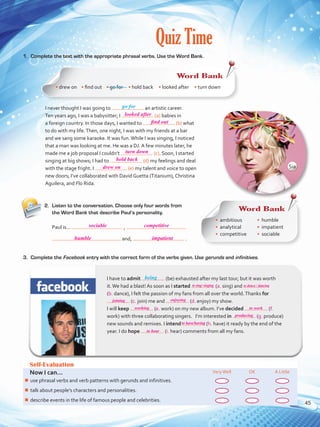
¾¾ I eat healthy food like fruits, veggies,
and fat-free products.
¾¾ I am an active person who likes
sports and physical exercise.
¾¾ I take actions to protect our
environment and natural resources.
Well, I think your
community have to stay
together and move heaven
and earth to solve this
problem!
My neighbors
and I are worried
about garbage and
contamination
in our parks and
rivers.
a.	
Susie: 	 Hi! Nice to see you again! It’s been years since
we last met!
Patty: 	 Hey! Look at you!You are as (a).
You must have had a very healthy life!
Susie: 	 Well, I love exercising and I love fat-free food. I do
take care of my body and health.
Patty: 	 Wow, instead, I’m in such (b).
I often have to eat in a rush, you know, at fast food
restaurants or even when driving my car!
b.	
Oscar: 	 Look!This is the timber company that bought the pine forest.
Mike: 	 Do they have permission to cut down the trees?
Oscar: 	 I’m not sure, the documents I saw are not complete. I think they are
(c).
Mike: 	 We need to find out! Let’s
(d) to get the information.
3. 	Think of situations related to health and the environment and discuss with a partner. Use the
expressions above.
Word
Bank
•	 fit as a fiddle
•	 move heaven
and earth
•	 bad shape
•	 in murky waters
fit as a fiddle
28
bad shape
in murky waters
move heaven
and earth
c
a
b
d
VP5 U2.indd 28 19/04/2016 10:22:33 a.m.
Lesson  4
Fit as a Fiddle
Planning
Learning Goals Indicators KeyVocabulary and Structures Strategies
This lesson will guide
students to use
colloquial expressions
related to healthy habits
and the environment.
¾¾ Uses key words to guess
the meaning of colloquial
expressions.
¾¾ Uses colloquial expressions
in simple communicative
situations.
Vocabulary
To be fit as a fiddle
To be in bad shape
To be in murky waters
To move heaven and earth
¾¾ Showing interest in a
conversation by using
expressions such as:
Look! /Well, / I guess /
I know! / I think
PRESENTATION 1
1.	 Listen to the conversations. Fill in the gaps
with the expressions in the Word Bank. 
Invite students to listen carefully to the two conversations.
Play the audio once without pausing. Then, have students
read the expressions from the Word Bank and tell them
to listen again and try to complete the gaps with those
expressions. Show them the example and play the audio.
Afterwards, invite students to listen carefully and check
their answers.
EXTRA IDEAS 
Encourage students to work in pairs and practice one of the
two conversations in order to present a role-play in front
of the class. Congratulate students on their performance,
pronunciation and language use.
2.	 Match the expressions with their corresponding
meaning. 
Invite students to work individually. Have students read the
expressions and the given meanings.Then, suggest students
use the contextual clues from the previous exercise to find
out what the meanings of the expressions are and to match
them correctly. Next, have students work in pairs and ask
them to compare their answers. Encourage them to discuss
and resolve the cases in which they disagree with any of the
meanings. Finally, check students’ answers as a whole class.
Alternatively, it would be interesting to challenge students
to find the equivalents for these colloquial expressions in
their own language. Have them notice that the meanings
they express are the same but that the words used in each
language to express the same idea might differ.
PRACTICE - APPLICATION
3.	 Think of situations related to health and the
environment and discuss with a partner. Use the
expressions above. 
Encouragestudentstoworkinpairsandreadtheconversation.
Make sure the purpose of the exercise is clear to them.You can
have students brainstorm briefly about both environmental
and health-related problems present in their community.
When they have selected the problematic issues they want
to talk about, motivate them to hold short conversations that
describethoseissues.Encouragestudentstousethecolloquial
expressions learned in this lesson and to use the conversation
providedasamodel.HighlighttheimportanceoftheSpeaking
Strategy and make it explicit that there are key expressions
they can use to get involved in a conversation.
Reflect onValues 
Havestudentsreflectontheimportanceoftakingcareoftheir
ownhealthbyeatinghealthyfoodandavoidingproductshigh
in sugar and fat.Then, focus students’ attention on the value
of being an active person. Encourage them to keep practicing
sports or being active participants in school groups, clubs or
any other socio-cultural events. Also, encourage students to
think about the importance of taking care of the environment
since it may have important effects on the weather.
 Gap Activity   
Refer students to the Gap Activity. Have them get into pairs
and ask them to sit face-to-face to do the activity on pages
87 and 89 by following the instructions. Encourage them to
think carefully about these activities (farming and mining)
and the people (farmers/miners) in order to speculate (using
past modals) about their lifestyles and how they developed
activities which have had an impact on the environment:
The use (appropriate or inappropriate) of natural resources can
cause damage to the environment.
Track 18
28
U2_VP5IngGuideCol2012.indd 28 8/10/16 14:29
 1. Discuss your experience.  
Before inviting students to reflect upon what they
experienced while carrying out their projects and making
their PowerPoint slides, highlight that it is important to learn
from the experience of working as a team to accomplish a
common goal and that it is quite natural to feel opposing
emotions when we work on projects that include several
stages and teamwork. Encourage them to see these as
opportunities for learning both personally and academically.
Assign some time for each student to go over each question
in the groups they developed their projects with.
a.	 Encourage them to look up the words from theWord Bank
and to use them to create short sentences that describe
the whole process. Remind them to write complete
sentences (with subject, verb and complement).
b.	 Have students think about difficulties they encountered
when designing their slides or using the PC.Additionally,
ask them to think of difficulties related to teamwork.
c.	 If this was the first time they thought about those
problematic issues, motivate them to think about
this as a first experience in which they participate as
active agents in their community. Let them know that
the identification of these problems plus the possible
solutions they suggested at Project Stage 3 can have an
important impact in the community since these involve
real-life issues that need attention and action from the
people and that promote the development of healthy
habits.
d.	 You can guide students to think about this as a learning
experience. Ask them to think about what they learned
about:
•	 the language (vocabulary, grammar, language use,
expressions, etc.)
•	 the communication strategies used to agree on the
information they needed to display
•	 teamwork
•	 individual work
Have them share their answers with the rest of the class and
take this as an opportunity to emphasize the importance of
being persevering, organized, and creative when embarking
on any task or project.
 2. Read and answer the questions below.  
Encourage students to listen and follow. After playing the
audio once, motivate students to read the text out loud
and practice repeating the audio quickly and accurately.
This section provides factual information about key healthy
habits that are related to people’s personality and to the
way they interact with the environment. After listening and
reading, motivate students to answer the key questions
using their own words. Afterwards, elicit their opinions
about the ideas presented in the article and encourage them
to share anecdotes.
 3. Give your Presentation.  
Read each one of the guidelines in the green chart and
clarify any doubts. Then, assign some time for students to
organize their PowerPoint presentations. Walk around the
classroom and provide help as needed. Before students
present, remind them to speak clearly, look all people in
the eyes, and stand up straight. Have them rehearse how
they will use their visual prompts correctly. It would be
encouraging to invite other teachers, students and even
parents and neighbors, so that the whole community can
see what students have produced, the problems they have
identified, and the healthy habits they point out.
Share Your Project
Track 19
29
U2_VP5IngGuideCol2012.indd 29 8/10/16 14:30
ShareYourProject
Give your Presentation
•	 Introduce yourself.
•	 Mention the two problematic situations you have
identified.
•	 Describe each problem one a time and show the slides.
•	 Talk about the possible origins of each problematic
situation.
Useful Expressions
•	 Good morning.We are… (names)
•	 The unhealthy habit that is present in our community is…
•	 The environmental problem we have identified is…
•	 It must/could/might have started…
2.	 Read and answer the questions below.
Real Communication
1.	 Discuss your experience.
a.	 How did you make your PowerPoint presentation? Use theWord Bank to list the
steps you followed.
1.	
2.	
3.	
4.	
b.	 Did you experience any difficulties?Which ones?
c.	 Had you ever thought about problematic situations that affect the
health of your community and city? How did you identify them?
d.	 What did you learn from this experience?
Word
Bank
•	 template
•	 slide	
•	 layout
•	 images
•	 text
a.	What are the two aspects involved in having a long and happy life?
b.	How is personality connected to life expectancy?
c.	 Why is it important to choose your friends wisely?
d.	What are the key environmental problems that affect life expectancy?
Most people are interested in having a long and happy life. The way we
live every day, together with how we manage our natural resources, can
play a key role in enjoying a long and happy life.
Having healthy habits goes beyond nutrition. It is true that eating fats and
junk food does not do any good to our health, but what else can make a
difference? Studies have shown that our personality is also a key factor:
being sociable and enjoying time with friends is connected to long life
expectancy. But, be wise when choosing your friends because habits, both
healthy and unhealthy, are socially contagious. Community problems
related to these social habits include obesity, smoking, drinking, and even
stress. So, look for buddies who like exercising, sleeping well, and being in
a good mood.
Taking care of the environment and protecting the natural resources can
also make a big difference. People live longer in places where there is less
air pollution, less contamination in rivers and oceans, and less chemicals in
the soil. So, look for places where the air, water, and soil are clean.
29
Answers
may vary.
VP5 U2.indd 29 23/03/2016 08:19:30 a.m.
Game
	 Play by pairs. Place a counter on the START box. Toss a coin: heads or tails?
Follow the arrows and answer the questions. Score two (2) points for each
correct answer. If you answer incorrectly, move back to the box you were
before. The winner is the first person to reach the finish box.
Name two healthy
habits.
Name an unhealthy
habit a relative of
yours has
How often do you eat
fruits and veggies?
TAILS
TAILS
TAILS
TAILS
TAILS
TAILS
TAILS
TAILS
TAILS
TAILS
TAILS
TAILSTAILS
TAILS
TAILS
TAILS
TAILS
TAILS
Name two unhealthy
habits.
Name a healthy habit
a relative of yours has.
How often do you
drink water?
Do you
exercise?Why?
HEADS
HEADS HEADS
HEADS
HEADS
HEADS
HEADS
HEADS HEADS
HEADS HEADS
HEADS
HEADS
HEADS
HEADS
Your best friend is sleepy
today.What might have
happened? (Say two
options)
Have you ever felt
stressed?Why?
Do you have
healthy eating
habits?Why?
Think of a healthy old
person you know and
make guesses about
his/her habits.
Do you have
unhealthy eating
habits?Why?
Mr.Velez is
overweight.What
must have he done?
(Say two options)
Miss. Smith didn’t
come to the gym
today.What may have
happened? (Say two
options)
Name the two
types of natural
resources.
What type of natural
resources are oil, coal,
and copper?
What type of
natural resources
are the air, water,
and trees?
Do you protect our
natural resources?
How?
GettingHealthy
HEADS
HEADS
HEADS
HEADS
TAILS
30
VP5 U2.indd 30 23/03/2016 08:19:31 a.m.
Game
Getting Healthy
The purpose of the game is for students to get more practice
using the vocabulary and grammar learned in this unit. In
addition, the game provides students opportunities to think
about their habits in relation to their own health and to make
guesses about other people’s habits.At the end of the game,
students also practice the language and new words learned
about natural resources and environmental problems.
Instructions: 
Students can play the game in pairs or in groups of three.
Encourage them to speak English by holding short
conversations while they go through the different stages of
the game. They need to toss the coin and follow the arrows
according to which side their coins show. As they move,
need to read the text and name the words or answer the
question. Students score two points for each correct answer
and they, themselves, should write down the scores of each
player to keep track of them. If a player does not know the
answer, or provides an incorrect one, he/she has to move
back to the previous box. Congratulate them on their use of
the language and grammar as they practice it when playing
the game.
EXTRA IDEAS 
When students have finished playing, tell the winners to play
a second round in pairs. Set a time limit so students have to
answer during the allotted time. When the time is up, the
next player keeps moving. Encourage the rest of the class
to listen, control time, and keep track of their classmates’
scores.
30
U2_VP5IngGuideCol2012.indd 30 3/23/16 11:32 AM
Quiz Time
 Before the test 
Remind students of the fact that this quiz will help them
become aware of the strengths and weaknesses they have in
relation to the main language issues worked on throughout
this unit: talking about healthy and unhealthy habits,
speculatingaboutpasthabits,namingnaturalresources,using
relative pronouns, and talking about environmental issues.
Encourage students to read the instructions carefully for
each part of the quiz. After they have worked individually,
have them check their answers in pairs before sharing them
with the whole class.
1.	 Listen to each conversation and check the
correct option. 
Tell students that they are going to listen to two short
conversations related to the two main topics of the unit.
The purpose is for students to identify the participants,
the settings, main ideas and detailed information. Remind
students to read the possible answers before you play
the audio. Then, play the audio at least three times and
encourage students to mark their answers. Finally, have
them check the correct answer.
2.	 This is a picture of Mr. Graham, a healthy
85-year-old man. Look at his habits checklist
and write sentences to speculate about his life
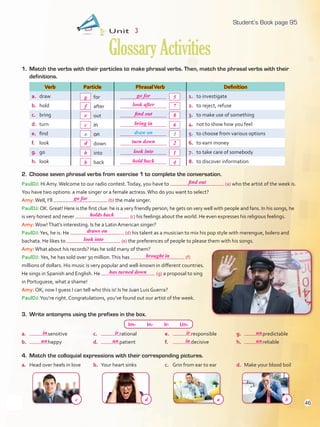
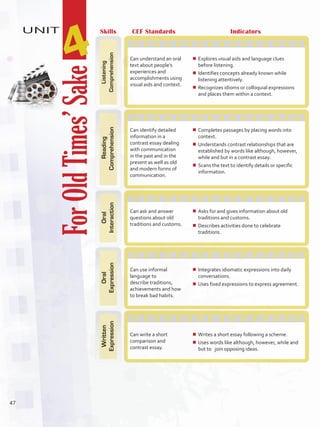
in the past. 
This exercise helps you assess the students’ use of past
modals. Suggest students read the instructions attentively
and make sure they are clear to them before having them
look at the picture too. Invite them to read the example
and to follow it as a model. Remind students that there are
different degrees of certainty that can be used to speculate
about the past.
3.	 Complete the definitions by writing the correct
relative pronoun. Then, match them with the
corresponding picture. 
Encourage students to read each statement before trying to
complete it.Then, suggest they look at the words preceding
the blank to make decisions about the relative pronoun that
best completes the gap. When they have filled in all the
blanks, tell them they should match each sentence with the
corresponding picture by writing the appropriate letter in
the circle.
 Self- Evaluation  
Invite students to read the Self-Evaluation chart. Motivate
students to be honest when marking their progress and take
this as an opportunity to detect strengths and weaknesses.
This can be a good time to provide further clarification
regarding any difficulties expressed by the students. Have
studentsreflectuponthefactthatanevaluationismorethan
a number or a letter: It is a means to overcome any language
or grammar problem that is still present.Advise them to form
study groups to support each other.
Glossary
Tell students that a Glossary includes the key words present
in the unit. Reading each entry and its definition is useful
for developing dictionary skills and clarifying the meaning
of the new vocabulary learned. Encourage them to read the
entries of the Glossary and their corresponding definitions
attentively. Have them practice pronunciation by reading
each word out loud.You may want to add some interesting
examples or have students create their own.
Game 1 
Play the Word Class game by dividing students into groups
of four. Ask students to select a word at a time and read it
aloud. The first group that says the word class correctly
scores a point. Play at least two rounds with each group
saying a word from the glossary.
Game 2 
Play the key-word story game. Have students use the pictures
and the words from theGlossary plus the language learned in
the unit to create a story. Assign them a reasonable amount
oftimetowriteitdown.Motivatethemtoincludecharacters,
places, and key events.When they’re ready, encourage them
to role-play and tell the story out loud in front of the class.
Encourage the class to select the best story and performance
and to offer a symbolic prize to the winners.
Finally, don’t forget to invite students to do the Glossary
Activitiesonpage94.Bearinmindthatthispagecorresponds
to page 32 of theTeacher’s Guide.
Track 20
31
U2_VP5IngGuideCol2012.indd 31 8/10/16 14:32
Quiz Time
1.	 Listen to each conversation and check the correct option.
Self-Evaluation
Now I can... VeryWell OK A Little
¾¾ talk about healthy lifestyles and ways to protect the environment.
¾¾ speculate about possibilities in the past.
¾¾ describe people, objects, and events by joining clauses.
2. 	This is a picture of Mr. Graham, a healthy 85 year-old man. Look at his habits checklist and write sentences to
speculate about his life in the past.
a. Being active He must have been really active all his life.
b.	 Drinking alcohol
c.	 Eating low-fat foods
d.	 Being in a good mood
e.	 Smoking
f.	 Sleeping well
Conversation 1
a.	 What keeps these women active and fit?
• Gym sessions 	 	
• Belly dance sessions 	
• Yoga sessions		
b.	 Who has missed the dance class lately?
• Patty 	 		
• Sally 	 		
• Maggie			
c.	 What could have happened to her?
• She might have been busy at work.	
• She may have fallen ill. 	 	
• She might have found another job.	
Conversation 2
a.	 Who are the people talking in this conversation?
• Mom and dad			
• Teacher and student 	 	
• Dad and his son			
b.	 What are they talking about?
• Natural resources 	 		
• Earth’s nature 	 		
• Economical resources		
c.	 Which renewable resources do they mention?
• Plants, water, and solar energy	
• Energy, the wind, and soil 		
• The air, sun, and plants		
3.	 Complete the definitions by writing the correct relative pronoun. Then, match them with the corresponding
picture.
a.	 Geologists are people extract minerals and fuels from the soil.
b.	 Oil and coal are non-renewable resources cannot be replaced after they are used.
c.	 The Earth is the place there are renewable and non- renewable natural resources.
d.	 Water is a renewable resource we use for drinking, cooking, and washing.
31
Answers
may vary.
who
c d a b
that
where
that
VP5 U2.indd 31 23/03/2016 08:19:33 a.m.
L-Q
layout: n. the design and organiza-
tion of pictures and text on a page or
PowerPoint slide. (syn. design, format,
setup)
litter: v. to leave pieces of trash in pub-
lic places or the outdoors and not in a
trash can. People shouldn’t litter.
nap: n. short, light sleep during the
day. (syn. kip, siesta)
natural resources: n. substances or
materials such as oil or wood that are
found in nature. Water is a natural re-
source.
oil: n. athick,darkliquidobtainedfrom
mineral deposits that is used as fuel.
outskirts: n. the areas surrounding the
center of a town or city. (ant. down-
town)
R-S
renewable: adj. possible to be re-
placed or renewed indefinitely. (ant.
non-renewable)
scrap: n. waste material, especially
metals suitable for reprocessing. We
can recycle scrap metal.
sedentary: adj. sitting most of the
time and not exercising a lot. (ant.
moving, active)
Glossary
A-K
buddy: n. (informal) friend. (ant. en-
emy)
coal: n. a hard black rock that is found
in the ground and is used as a fuel to
provide heat. In the past many trains
ran on coal.
copper: n. a red-brown metal used to
make wire or pipes that conduct elec-
tricity or heat.
dig: v. to make a hole in sand or soil.
(syn. burrow)
disease: n.  a condition of a living thing
or of one of its parts that impairs nor-
mal functioning and is manifested by
certain symptoms. (syn. illness, sick-
ness)
dump: n. a place where waste material
and garbage is left. The dump was re-
ally dirty and smelly.
faucet: n. a tap on the bath or sink that
controls the flow of water. (syn. tap,
spigot)
flowing: adj. a stream of water that
moves along. (ant. stagnant, still)
fossil fuel: n. fuels formed from the re-
mains of plants and animals that lived
in an earlier era.
iron: n. a hard, silvery heavy metal that
is abundant in the earth and is used to
make building structures. The gates are
made of iron.
junk food: n. food that is unhealthy as
it contains lots of fat, sugar, or salt. Tim
eats too much junk food.
Colloquial Expressions
Be as fit as a fiddle: be in good
health.
Be in bad shape: be in a poor
physical condition.
Be in murky waters: behave
in morally and ethically
questionable ways.
Move heaven and earth:
be determined to do or get
something that is difficult.
slide: n. the page of a PowerPoint pre-
sentation that contains pictures and
text.
soil: n. the surface layer of the Earth,
the ground. (syn. dirt, earth)
storehouse: n. a place where things
are kept in large quantities. (syn. ware-
house)
stream: n. a natural flow of water nar-
rower than a river.
T-Z
template: n. a computer document
with a basic format you can use and
adapt.
tide: n. the way the ocean waters fall
and rise during the day. (syn. current)
timber: n. wood used for building.
(syn. wood, logs)
tired: adj. being weak and in the need
of rest and sleep. (ant. energetic)
veggies: n. (informal) vegetables. My
veggie garden is small.
weight: n. a measurement that says
how heavy something is. (syn. heavi-
ness)
wise: adj. intelligent and able to make
good choices and decisions. (syn. per-
ceptive)
Activities on page 94
32
VP5 U2.indd 32 23/03/2016 08:19:34 a.m.
1. Answer the crossword puzzle.
Unit 2
GlossaryActivities
2. Circle the most appropriate word or expression to complete each sentence.
a. My dad is a very man. I always ask him for advice when I have a problem.
1. tired 2.wise 3. sedentary 4. flowing
b. like petroleum and natural gasses are formed from the remains of plants and animals from
previous eras.
1. Junk food 2.Veggies 3. Diseases 4. Fossil fuels
c. A well-balanced diet includes lots of fruit and .
1. junk food 2.scraps 3. veggies 4. diseases
d. We have many different colors in our .
1. storehouse 2.dump 3. outskirts 4. layout
Across:
a. a hard, silvery heavy metal that is abundant in the earth and
is used to make building structures
b. a place where waste material and garbage is left
c. a hard black rock that is found in the ground and is used as a
fuel to provide heat
d. waste material, especially metals suitable for reprocessing
e. a measurement that says how heavy something is
f. wood used for building
Down:
g. a red-brown metal used to make wire or pipes that conduct
electricity or heat
h. the way the ocean waters fall and rise during the day
i. a short, light sleep during the day
j. a thick, dark liquid obtained from mineral deposits that is
used as fuel
k. the surface layer of the Earth
l. a sickness or an illness
f
l
h
g
j
c
b
d
a
k
i
e
3. Find words in the glossary that are antonyms to
the following words.
4. Match the colloquial expressions with their
meanings.
Glossary Word Antonym
a. downtown
b. enemy
c. energetic
d. moving
e. non-renewable
f. stagnant
Colloquial Expression Definition
a. be in murky
waters
be in a poor physical
condition
b. be in bad shape be in good health
c. move heaven and
earth
behave in morally and
ethically questionable
ways
d. be as fit as a fiddle be determined to do or get
something that is difficult
94
o
d c i
w e i g h t c o a l
s i p
t i m b e r d u m p
a e e
s i r o n
e a
s c r a p
o
i
l
outskirts
buddy
tired
sedentary
renewable
flowing
b
d
a
c
Student’s Book page 94
32
U2_VP5IngGuideCol2012.indd 32 4/19/16 11:34 AM
This test assesses students’ achievements at the B1 level
of the Common European Framework of Reference for
Languages. It covers the topics presented in units 1 and 2,
including exercises to evaluate all competences (listening,
reading, speaking and writing). At the same time it provides
the opportunity to practice test-taking strategies.
Listening
You will hear a radio interview. For questions 1-5,
check the correct answer in the answer box. You
will listen to the recording twice.
Ask students to read the instructions individually, and check
if they have understood what they are supposed to do.
Direct their attention to the example and have them look at
the answer grid.Tell them that the interview is about natural
resources so that they can associate the content and the
information with the concepts already learned in lesson 2.
Allow them some time to read the questions and options
before playing the audio. Afterwards, have students listen
to the recording two or three times, allowing them to decide
on the appropriate option that best answers each question.
Strategy:Associating new information with familiar concepts
Test Training A
Speaking
Clarify that the exercise is divided into two stages. Have
each candidate read the instructions for the first stage and
the given examples. Then, clarify any doubts about the
conversation they are supposed to hold and the language
they should use. Suggest Candidate A be a good listener so
that he/she can give some advice to Candidate B on how to
improve his/her lifestyle.
Now, invite him/her to read the instructions attentively for
the second stage and make use of the clues given in the
list to talk about his/her lifestyle over the past year. He/She
should speak clearly and listen carefully to Candidate B who
will provide advice in response.
Strategy: Using clues for receiving and sending messages
Track 21
33
U2_VP5IngGuideCol2012.indd 33 8/10/16 16:13
Listening
Youwillheararadiointerview.Forquestions1-5,checkthecorrectanswerintheanswer
box.Youwilllistentotherecordingtwice.
Answers
0ABC
1ABC
2ABC
3ABC
4ABC
5ABC
TestTrainingA
0.Arenewableresourceisonewhich
A.isreplacedovertimethroughnaturalprocesses.
B.cannotbereplacedinnatureatarateclosetoitsrateofuse.
C.existsinfixedamountsandisusedupfasterthancanbereplaced
innature.
1.Someexamplesofnon-renewableresourcesinclude
A.plants,mineralsandthesea.
B.water,windandsun.
C.oil,coalandcopper.
2.Themajorproblemwiththewayoursocietyuses
non-renewableresourcesisthat
A.wedon’thavethemoneytoreproducethem
efficiently.
B.weusethemfasterthantheycannaturallybe
replaced.
C.weshouldbeusingthemmorefrequently.
3.Ifwecontinuetousenon-renewableresourcesso
quickly,weruntheriskof
A.significantlyreducingtheworld’ssuppliesofthese
resources.
B.havingtoomanydifferentkindsofnon-renewable
resources.
C.runningoutofrenewableresources.
VP5_TestTraining_A.indd5923/03/201607:59:34a.m.
SpeakingCandidateA
Stage1
CandidateBisgoingtotellyouabouthis/herlifestyleoverthepastyear.
Listentowhathe/shesaysandmakesomepredictionsaboutthewayhe/shemighthavefelt.
Givesomepiecesofadviceonhowtoimprovehis/herlifestyle.Usetheexpressionscould’ve,
should’veormust’ve.
E.g.Youcould’vemademoretimeforexercise.
Youmust’vebeentiredalot.
Stage2
TellcandidateBaboutyourlifestyleoverthepastyear.
Usethelistbelowofthingsyoudidordidn’t.He/Shewillmakesomepredictionsaboutyour
well-beingandgiveyousomeadviceonhowtobecomehealthier.
•Gotupearly
•Hadunhealthybreakfasts
•Rodebiketoandfromwork
•Hadhamburgersforlunch
•DranktoomuchCoke
•Hadlightdinners
•Regularlywenttobedearly
4.Eventhoughtreesaretechnicallyconsideredrenewableresources,
A.theycan’tbenaturallyreproduced.
B.theyarealwaysconsumedmoreslowlythantheycanbe
reproduced.
C.theyareoftenconsumedinanon-renewablefashion.
5.AccordingtoDr.Rice,peoplecanhelpprotectournaturalresources
by
A.takingcoldshowers.
B.recycling.
C.usingbothkindsofresources.
VP5_TestTraining_A.indd6023/03/201607:58:54a.m.
33
VP5 TestTra A montaje.indd 33 3/30/16 9:40 AM
0.AcomeBcameChascomeDhadcome
6.AhasdemolishedBhavedemolishedChaddemolishedDdemolish
7.AforcedBhadforcedChasforcedDhaveforced
8.AareBisCwasDhadbeen
9.AwhatBwhoCwhereDthat
10.AspendsBhavespentCspentDspend
11.AhadfailedBhavefailedCfailDfails
12.AhashadBhavehadChasDhad
13.AannouncesBannouncedChaveannouncedDhadannounced
14.AcommitBhascommittedChavecommittedDhadcommitted
15.AcontinuesBhadcontinuedChascontinuedDcontinued
Answers
0ABCD
6ABCD
7ABCD
8ABCD
9ABCD
10ABCD
11ABCD
12ABCD
13ABCD
14ABCD
15ABCD
Reading
Readthefollowingnewspaperarticle.Selectthecorrectoptionforeachspace.
Markthebestanswer(A,B,CorD)intheanswerbox.
Brazil:UndertheWorld’sSpotlight
Withonlytwoyearsuntilthe2014FIFAWorldCupand4yearsuntilthe2016Olympic
Games,Brazil(0)intotheglobalspotlightforinternationalsports
competitions.However,withsuccessoftencomescontroversy.
Localcouncils(6)manylow-incomesettlements,knownasfavelas,
andreplacedthemwithluxury5starhotelsandnewroadsaimedatreducingtraffic
congestion.Whiletheimprovementswillbelonglastingforthecity,effectively,they
(7)hugenumbersofthecity’spoorerurbanresidentstobecome
displaced.
Aswithmostbiginternationalevents,security(8)amajorissueleading
uptothe2016Olympics.Infact,England,thecountry(9)hostedthe2012OlympicGames
(10)around$680millionUSDonsecurity.Theoriginalbudgethadtobeincreasedafterthe
privatesecuritycompany,G4S,admittedthatit(11)torecruitenoughsecuritystaff,therefore
theBritishmilitary(12)totakeover.
AnothermajorchallengeforBrazilisthetransportationservice.Thenationalgovernment(13)
onMondaythatithas$4.3billionforurbantransportationinfrastructurewhilestateandlocalauthorities(14)
another$2.15billionsincethen.
LikepreviousFIFAWorldCupsandOlympicsGameshostcountries,Brazilwantstodisplayitsbestpossible
imageasit(15)itsascentontheglobalstage.Suchadvancesarealwaysmetwithproblems,
buttherealtestishowBrazilstepsuptothechallenge.
VP5_TestTraining_A.indd6123/03/201607:59:35a.m.
Writing
FrenchwomanJeanneCalment,whodiedin1997atage122,hadthelongestdocumented
humanlifespan.
Speculateaboutherlifestyleandwhatshemusthave,mighthaveormayhavedoneinorderto
havelivedforsuchalongtime.
Writebetween30and45words.
SpeakingCandidateB
Stage1
YouaregoingtotellcandidateAaboutyourlifestyleoverthepastyear.
Usethelistbelowofthingsyoudidordidn’t.He/Shewillmakesomepredictionsaboutyour
well-beingandgiveyousomeadviceonhowtobecomehealthier.
•Gotuplateinthemornings
•Hadhealthybreakfasts
•Didn’texercise
•Drovetowork
•Regularlyskippedlunchandonlyatesnacks
•Hadbigdinners
•Alwayswenttobedlate
Stage2
NowcandidateAisgoingtotellyouabouthis/herlifestyleoverthepastyear.
Listentowhathe/shesaysandmakesomepredictionsaboutthewayhe/shemighthavefelt.
Givesomepiecesofadviceonhowtoimprovehis/herlifestyle.Usetheexpressionscould’ve,
should’veormust’ve.
E.g.Youcould’vedrunkmorewaterorfreshjuice.
Youmust’vegainedextraweight.
VP5_TestTraining_A.indd6223/03/201607:59:36a.m.
34
VP5 TestTra A montaje.indd 34 3/30/16 9:40 AM
Reading
Read the following newspaper article. Select the
correct option for each space. Mark the best
answer (A, B, C or D) in the answer box.
Ask students to read the instructions carefully so that
they understand what they are expected to do. Stress the
importance of focusing their attention on the information
given before and after each space. Also, you may advise
students to carefully read the four options given to complete
each gap before they make any decisions.
Allow some minutes for the completion of the ten
statements so that students feel they are doing a careful
learning activity and not simply rushing to get to the last
one.The purpose of this reading test is to complete the text
of a newspaper article with the best option. Go around the
classroom and check if they still have any difficulties with
any of the questions.
Strategy: Focusing attention on grammar patterns and
context clues
Writing
Frenchwoman Jeanne Calment, who died in 1997
at age 122, had the longest documented human
lifespan. Speculate about her lifestyle and what she
must have, might have or may have done in order to
have lived for such a long time.
Write between 30 and 45 words.
Invite students to read the instructions carefully to complete
this part of the test. Confirm students’ understanding of the
activity by asking questions, reminding them to include all
the aspects involved when describing their speculations/
guesses about the lifestyle of this woman’s personality traits
and healthy lifestyle.
Remind students that to describe the lifestyle of a person,
they can think of healthy and unhealthy habits.Suggest they
use blank paper sheets on which they should brainstorm
their ideas and organize the descriptive details they want
to include. Suggest they double check their final drafts for
spelling mistakes, word choice, and grammar and tenses.
Strategy: Brainstorming and organizing descriptive details
34
U2_VP5IngGuideCol2012.indd 34 3/23/16 11:32 AM
WhatLiesWithinUs
UNIT
3
Skills CEF Standards Indicators
Listening
Comprehension
Can understand the
main points of clear
standard input on
familiar matters
regularly encountered
in contexts such as
work, school and leisure
activities.
¾¾ Understands the main points of a radio
program that talks about a well-known
celebrity.
Reading
Comprehension
Can understand texts
that consist of mainly
high frequency words
associated with familiar
topics.
¾¾ Understands the principal ideas of a short
biography.
¾¾ Analyzes a biography’s organizational
pattern.
Oral
Interaction
Can deal with most
situations likely to
arise while traveling or
in familiar situations
pertinent to everyday
life or of personal
interest.
¾¾ Describes and talks about how his/her
personality has changed over the years.
¾¾ Talks about how she/he deals with her/his
feelings and emotions.
¾¾ Uses idiomatic expressions to comment on
personal experiences, feelings and emotions.
Oral
Expression
Can narrate experiences
and events, giving
brief reasons and
explanations.
¾¾ Narrates important facts and anecdotal
information about a famous person.
¾¾ Describes a famous person’s life
achievements.
Written
Expression
Can produce simple,
connected texts on
topics which are familiar
or of personal interest.
¾¾ Writes a blog about a famous person.
¾¾ Uses a graphic organizer to write a
biography.
35
U3_VP5IngGuideCol2012.indd 35 3/23/16 11:40 AM
UNIT
WhatLiesWithinUs
3
uuGeneral Objective
	 You will be able to describe people’s characters,
feelings and emotions.
uuCommunication Goals
	 You will learn how to
•	 	talk about people’s characters and personalities.
•	 	express feelings, attitudes, and mood.
•	 	describe events in the life of famous people.
uuCLIL
•	 	Character and Personality
•	 	Feelings and Emotions
	 Vocabulary
•	 	Descriptors of character and personality
•	 	Words related to feelings and emotions
	Grammar
•	 	Phrasal verbs
•	 	Gerunds and infinitives
•	 	Prefixes and suffixes
uuIdioms and Colloquial Expressions
•	 Grin from ear to ear
•	 Head over heels in love
•	 	Make your blood boil
•	 	Your heart sinks
uuProject
	 A Personal Blog
	 You will design a personal blog to show
and share your feelings about someone’s
personality and key life events.
Discuss:
•	 What do you like about your personality
and character?What don’t you like?
•	 What do you like about the personality
and character of other people?What
don’t you like?
•	 Is it easy or difficult for you to express
your feelings and emotions?
VP5 U3.indd 35 19/05/2016 02:52:03 p.m.
Libra personality traits Virgo personality traits
•They get on well with people.
•They use common sense.
•They’re proud and expect admiration.
•They do not accept delay calmly.
• You can trust them.
• They look into things deeply.
• They don’t make decisions easily.
• They don’t think they are better than others.
Leo Pisces
• They eagerly want wealth and fame.
• You never know what they are going to do.
• They love to find out people’s private
information.
• They hate to lose.
• They become angry or upset easily.
• They tend to hold back their feelings.
• They don’t care about the consequences of
their actions.
Lesson  1
CharacterandPersonalityTraits
1.	 Look at the pictures. What do you know about this artist?
2.	 Listen to the conversation and check the correct options.
4.	 Read and discover the character and personality traits for each sign. Use the Word Bank. Then,
listen to the second part of the radio show and confirm.
sociable
Name Nickname Age Personality
What is true about Paulina Rubio?
a.	 She is from .	 Spain	 Mexico 	 Miami
b.	 She has a personality.	 friendly	 shy	 vain
c.	 She has been a successful .	 model	 singer	 writer
3.	 Listen again and circle the best option to complete the
statements.
a.	 Well, I’ll go the female singer.
• on	 • for	 • with
b.	 She looked her friend’s baby for a whole weekend!
• after	 • into	 • for
c.	 She draws her talent to make all her projects a success.
• up	 • in	 • on
d.	 Her various businesses have brought thousands of dollars.
• up	 • on	 • in
e.	 She even turned a proposal to play the lead role in a film.
• down	 • out	 • away
Listening Strategy
Read the statements and the
given options before listening
to predict what you will hear.
Vocabulary Strategy
Pay attention to the prefixes
added at the beginning of a
word. Im-, In-, Ir-, and Un-,
are prefixes which mean NOT.
Impatient = not patient
Word Bank
• ambitious
• analytical
• competitive
• humble
• impatient
• indecisive
•	 irresponsible
•	 reliable
•	 reserved
•	 sensible
•	 sensitive
•	 sociable
•	 curious
•	 unpredictable
•	 vain
(a)
(b)
(c)
(d)
(e)
(g)
(f)
(h)
(i)
(j)
(k)
(l)
(m)
(n)
36
Paulina Rubio
for
after
on
sensible
reliable
ambicious
curious
vain
analytical
sensitive
unpredictable
competitive
impatient
indecisive
reserved
humble
irresponsible
in
down
La Chica Dorada Answers may vary.
VP5 U3.indd 36 19/04/2016 12:26:06 p.m.
Lesson  1
CharacterandPersonalityTraits
Planning
Learning Goals Indicators KeyVocabulary and Structures Strategies
This lesson will
enable learners to
describe people’s
characters and
personality traits.
¾¾ Describes and talks
about people’s
characters and
personality traits.
¾¾ Uses prefixes to figure
out the meaning of
adjectives.
Vocabulary
ambitious, analytical, competitive, humble,
impatient, indecisive, irresponsible,
reliable, reserved, sensible, sensitive,
sociable, curious, unpredictable, vain
Structures
Phrasal verbs
Prefixes
¾¾ Using prior knowledge
to predict information
before listening
¾¾ Paying attention to
prefixes of a word
WARM UP (books closed) 
Hangman
Prepare the names of some famous people or movie
characters.Write on the board lines for each of the letters of
their first and last names. Give students some clues as they
call out letters to discover who the person is.
Person Clue
Harry Potter
Lionel Messi
Batman
magical, can do magic
talented, can play soccer
better than most people.
mysterious, can fly
PRESENTATION 1
1.	 Look at the pictures. What do you know about
this artist? 
Direct students’ attention to the pictures of Paulina Rubio.
Encourage volunteers to give information about the artist.
Then, ask them to complete the chart.
2.	 Listen to the conversation and check the correct
options. 
Call on a volunteer to read the Listening Strategy.
Have them say their option using the phrasal verb, “go for.”
Ask: Where do you think she’s from? I’ll go for Spain. Play the
audio for students to confirm their answers.
3.	 Listen again and circle the best option to
complete the statements. 
Invite students to focus their attention on the possible verb
- particle combinations as students go over the statements
and the possible answers.
Play the audio and have students compare their answers in
pairs. After that, invite them to explain the meaning of the
phrasal verbs in their own words.
PRESENTATION 2
4.	 Read and discover the character and personality
traits for each sign. Use the Word Bank. Then,
listen to the second part of the radio show and
confirm. 
Contextualize the exercise by discussing with students the
use of the astrological signs to describe personalities. Invite
students to say all the zodiac signs in English. Write on the
board:
Aries=	 /ˈeəriːz /
Aquarius=	 /əˈkweəriəs/
Pisces=	 /ˈpaɪsiːz/
Taurus=	 /ˈtɔːrəs/
Gemini=	 /ˈdʒemənaɪ/
Cancer=	 /ˈkænsər/
Leo=	 /ˈliːəʊ/
Virgo=	 /vɝgəʊ/
Libra=	 /ˈli:brə/
Scorpio=	 /ˈskɔrpiəʊ/
Sagittarius=	 /ˌsædʒəˈteəriəs/
Capricorn=	 /ˈkæprɪkɔrn/
Then ask: What’s your zodiac sign? Have students provide a
typical personality trait of each sign.
What are Leos like? Are they brave? Encourage and accept
any answer.
Afterthat,directstudents’attentiontotheexerciseandhave
a volunteer read the example.Then, go over the Word Bank
with the students. Point out the Vocabulary Strategy. Invite
students to identify and underline all the words containing
these prefixes.
Once students are familiar with the vocabulary, have them
read and complete the chart. Remind students to use all the
cluesthecontextprovides(prefixes,synonyms,associations).
Then, play the audio so they can confirm their answers.
Track 22
Track 23
Track 24
36
U3_VP5IngGuideCol2012.indd 36 8/10/16 14:37
EXTRA IDEAS 
Personalize
Have students give some personality characteristics of their
own signs. Encourage them to use the vocabulary from the
exercise.
•	 Challenge students to create a similar radio program
where they talk about the other signs of the zodiac. Have
students listen again and focus their attention on the
expressions used in the show to describe the signs:
Virgos are… / AVirgo is… /They can be …
Another characteristic they have is that they’re …
They tend to be …
PRACTICE
5.	 Match the phrasal verbs with their meanings. 
•	 Explain that the students should match each phrasal
verb with its definition. Refer students to the Grammar
box. Clarify that the particle changes the meaning of the
verb. Have students identify the verb (in blue) and the
particle (in green). Explain that the particle can be an
adverb or a preposition.
Provide more examples with the verb look:
Look at /look up /look down /look back/look away.
Indicate the different meanings by using body language.
•	 Encourage students to go back through the lesson and
identify examples with these phrasal verbs, e.g. Paulina
Rubio looked after her friend’s baby for a whole
weekend.
6.	 Form the opposite of the following words by
using the appropriate prefix: Im-, In-, Ir-, and Un-. 
Have students close their books and remember the words
containing the prefixes Im-, In-, Ir-, and Un-. Invite a
volunteer to provide an explanation for the prefixes. After
that, refer students to the exercise and have them come up
with the opposites. Invite students to check their answers
in pairs.
EXTRA IDEAS 
•	 Challenge students to remember or identify common
suffixes used in adjective formation:
-able / -ous /-ive / -ible/able
•	 Ask them to provide examples from the lesson.
7.	 Fill in the gaps with the correct form of the
phrasal verbs from exercise 5. Then, describe
each person’s character using the words from
the Word Bank in exercise 4. 
With this exercise you can check students’ understanding
and use of the lesson’s vocabulary.
Make sure students look at the pictures and read the
complete sentences to understand the context. Go over
example (a) and (e) with students. Have them look at the
picture and find an adjective to describe Sam’s behavior,
or based on John’s picture and description, have them
complete sentence (e) with the correct phrasal verb.
Ask students to write the correct adjective under each of
the pictures. After students finish, have them compare their
answers with a partner's. Encourage students to read the
complete sentences and role play each dialog. Call on some
volunteers to perform them to check pronunciation.
To expand on pronunciation, direct students' attention to the
Pronunciation box. Explain to them that they will listen to
some sentences which they need to complete using a phrasal
verb. After students have complete the exercise, invite them
to reflect on the emphasis that is given to the particle in
contrast to the common pronunciation of prepositions. Give
some more examples for students to contrast:
This is for Sam (no emphasis)
I’ll go for Sam. (emphasis)
The box is on the table. (no emphasis)
I get on well with all my classmates. (emphasis)
APPLICATION
8.	 Think of your own character and personality.
Has it changed over the years? How? Discuss
with a partner. 
Give students enough time to prepare their answers.
Encourage them to use the new vocabulary and to work with
different partners. When students finish, have them report
interesting information about their partners. Ask: What did
you learn from your partners?What do you have in common?
 Project Stage 1  
Encourage students to discover if anyone has the same
favorite famous person. This project will help them share
some of their preferences with people who share similar
interests.
Give students some important advice about using the web:
Double check information, don’t copy and paste, quote the
source they use.
Students should write a description using adjectives to
describe character and personality.
Remind students to investigate about important events in
this person’s life for the next class.
Track 25
37
U3_VP5IngGuideCol2012.indd 37 8/10/16 16:14
Grammar and Vocabulary
Pronunciation
In phrasal verbs, the particle is emphasized.
Listen and complete.Then practice.
a.	 Actors often their own life experiences.
b.	 I well with my school friends.
c.	 The police will the bank robbery.
d.	 People shouldn’t their feelings.
e.	 Mom has a job offer abroad.
a.	 A:Which dessert does Sam want, the bitter or the sweet one? 	
B:	Better ask him.You never know which option Sam will . 	
b.	 A:Who can the baby while we go out?
B:	Mary. She is a great nanny and I trust her.
c.	 A: IsTom in Hollywood now?
B:	Sure! He loves that movie project. It’ll a
thousand dollars a week.
d.	 A: Who solved the last crime case?Was it CatherineWillows?
B:	Yes, she examined the evidence until she who
committed the crime.
e.	 A:What has made John so anxious?
B:	Well, his girlfriend her feelings towards him.
a.	 sensitive c.	 happy
tolerant reliable
b.	 mature d.	 rational
polite resistible
a
go for
Sam is .
Mary is .
Tom is .
John is .
Cath is .
•	 In pairs, choose a famous person from the world of
sports, fashion,TV, movies, arts, or music.
•	 Look for information about this person on the Internet.
•	 Write a description of his/her character and personality.
Project  Stage 1
(E.g. date of birth, zodiac sign, etc.)
5.	 Match the phrasal verbs with their meanings.
a.	 bring in	 	 have a good relation with
b.	 find out	 	choose
c.	 get on	 	discover
d.	 go for 	 	 earn money
e.	 hold back 	 	investigate
f.	 look after 	 	 not to show how you feel
g.	 look into 	 	reject
h.	 turn down 	 	 take care of somebody
i.	 draw on	 	 make use of something
6.	 Form the opposite of the following words by
using the appropriate prefix: Im-, In-, Ir-, and Un-.
Reflect on Grammar
PhrasalVerbs
Phrasal verbs are verb-particle combinations.The particle gives a special meaning to the verb.
• She looks after her baby. (Meaning: to take care of somebody/something)
• They look into things deeply. (Meaning: to investigate)
7.	 Fill in the gaps with the correct form of the phrasal verbs from exercise 5. Then, describe
each person’s character using the words from the Word Bank in exercise 4.
8.	 Think of your own character and personality.
Has it changed over the years?
How? Discuss with a partner.
In the past,
I was very shy. Now,
I get on with people
very well. I’m a
sociable person.
In
impatient
37
indecisive
reliable
ambitious
analytical
look after
bring in
found out
holds back
draw on
get on
look into
hold back
turned down
c
In Un
Un
IrIm
IrIm
d
b
g
e
h
f
i
VP5 U3.indd 37 23/03/2016 08:30:32 a.m.
Reflect on Grammar
Gerunds and Infinitives
Some words, verbs and prepositions are followed by a specific form of another verb. Read, complete, and check :
... you consider harder to get better
grades.
The verb consider is followed by:
a. Gerund (-ing) b. Infinitive (to…)
... you prefer with it by yourself.
... you prefer your best friend.
The verb prefer is followed by:
a. Gerund (-ing) b. Infinitive (to…)
... hopeless at to convince them.
... interested in something fun.
... doubtful about obedient.
Prepositions are followed by:
a. Gerund (-ing) b. Infinitive (to…)
... shocking news makes you a deep breath.
... you let them and release your pain.
... try not to help him better.
Verbs make/let/help are followed by the object and:
a. Infinitive with to b. Infinitive without to
Lesson  2
1.	 Take the test and then complete the grammar chart below.
HowdoyoudealwithyourEmotions?
a.	 When you have bad grades at school, you consider…
1. ignoring the issue.
2. studying harder to get better grades.
3. complaining to your teachers.
d.	 When you get shocking news, it makes you…
1. take a deep breath and do nothing.
2. talk to somebody to see what can be done.
3. cry a lot and feel extremely upset.
b.	 When you have a problem, you prefer…
1. to deal with it by yourself without telling
anybody.
2. looking for your best friend to get some advice.
3. to tell everyone so you feel people care
about you.
e.	 When your friends have a problem, you let them…
1. talk and release their pain. But you don’t really
listen to them.
2. explain the problem.Then, you give them some
advice.
3. get desperate and create a drama.You don’t
feel you can comfort them.
c.	 When your parents don’t let you go out at night, you
tend to…
1. be hopeless at trying to convince them.
2. become interested in doing something fun
at home.
3. be doubtful about being obedient.
f.	 When your best friend is embarrassed, you…
1. try not to help him/her feel better.
2. do your best to help him/her feel better.
3. feel embarrassed that you can´t help him/her at all.
Scoring System: Answers No. 1 = 2 points; Answers No. 2 = 4 points; Answers No. 3 = 6 points.
Your score:
2-12: You never express your feelings; you hold them back and try to forget them.
13-24: You react in a measured way and you can express your emotions calmly and easily.
25-36: You tend to overreact and lose your temper. Sometimes you want to find a person to blame.You should avoid the
instinctive reaction that makes you lose control.
studying
PostingYourFeelings
andEmotions
38
Answers may
vary.
to deal
trying
doing
being
talk
feel
looking for
take
VP5 U3.indd 38 19/04/2016 10:36:24 a.m.
Lesson  2
PostingYourFeelingsandEmotions
Planning
Learning Goals Indicators KeyVocabulary and Structures Strategies
This lesson will
enable learners to
describe people’s
life events and
emotions.
¾¾ Narrates important events in
the life of a famous person.
¾¾ Describes this person’s
emotions and relates them to
a specific circumstance.
Vocabulary
annoyed, disappointed, doubtful,
excited, hopeless, interested,
pleased, resistant, skeptical
Structures
Gerunds and infinitives
¾¾ Turning nouns into
adjectives by adding
a suffix at the end of
words
WARM UP (books closed) 
Invite students to brainstorm the names of different
emotions and feelings. Give them some examples and
continue eliciting information. Write their contributions on
one side of the board.
Then, draw, photocopy or project some of these faces
(emoticons) on the board, and invite students to identify the
feeling.
Have students match the image to the words they have
previously said. There are many possibilities. Go over their
pronunciation.
Possible words:
embarrassed, disappointed, upset
surprised, afraid, pleased, proud, satisfied
shocked, relieved, thoughtful, sleepy
You might like to use the vocabulary from exercise 4 as a
way to pre–teach these words.
Once students have finished, invite them to explain the
situations when they feel these emotions. Provide an
example:
I always feel afraid when I see a spider.
PRESENTATION 1
1.	 Take the test and then complete the grammar
chart below. 
Give students some time to skim the text in order to discover
what kind of text it is (a psychological test).
Go over the question, How do you deal with your emotions?
Explain to students that deal means to manage, or to control
their emotions.
Invite students to take the test and go around the classroom
providing help with difficult vocabulary.
After students score themselves, have them compare their
answers in groups of three. Encourage them to change the
pronoun you for I.
To share answers, ask students to report some interesting
similarities or differences among them. Now, focus on the
correct form of the verbs in bold.
Drawstudents’attentiontothegrammarboxandreferthem
back to the test to complete the spaces with the appropriate
verb form.
Go over the responses as a class.
EXTRA IDEAS 
Have students close their books. Draw a Venn diagram on
the board and challenge them to run to the board to group
the verbs they remember.
38
U3_VP5IngGuideCol2012.indd 38 3/23/16 11:40 AM
PRACTICE
2.	 Classify the verbs in the Word Bank into the
appropriate categories. 
Invite a volunteer to read the instructions. Remind students
that using a chart or visual organizers helps learners improve
their recall of words.
Give students time to classify, and then invite them to
compare their answers with a partner's.
3.	 Read the news posted in this personal blog. Fill
in the gaps with the correct form of the verbs in
parentheses. Then, listen and check. 
Directstudents’ attention to theblogandhavethemidentify
the principal features of blogs (posts, comments, photos,
and links).
Ask students to look at the picture and identify the famous
character. Elicit from the class some of her personal
information.
Then, invite students to read the title (Paris Hilton and
her productive career). Encourage them to scan the blog
to find out about important events that have made her
career productive. Have students underline the two most
important ones.
Next, have students read carefully and complete the
sentences using the correct form of the verbs.
Refer them to the Vocabulary Strategy box and clarify that
there are different combinations, depending on the first
verb used. They can find these verbs in reference materials
such as grammar books, dictionaries and the sort.
Ask them to check their answers with a partner's. Finally,
play the audio for pairs to confirm their responses.
4.	 How do people react? Read the bloggers’ entries
and write the way they feel. Use the Word Bank. 
Invite students to continue reading the blog. Tell them that
they will read the comments or entries and then should
analyzeeachperson’sreactiontotheblogaboutParisHilton.
Remind students to use the words from the Word Bank and
refer them to the Vocabulary Strategy. Encourage them to
provide more examples with the suffixes –ful, and -less.
careful - careless
helpful - helpless
powerful - powerless
•	 Go over the answers as a class and appoint some
students to explain the reasons for their choices.
 Project Stage 2   
•	 Choose one important event in which your famous
person was the protagonist.
Remind students to narrate or describe the events in their
own words. Have them go over their ideas to check the
different verb combinations they made.
•	 Write a description of his/her feelings and emotions
related to the event.
Challenge students to use the vocabulary they learned in
class.
•	 Write your own feelings, emotions, and reactions about
both the famous person and the event.
Emphasize that the idea is for them to use the grammar and
the vocabulary from lessons 1 and 2.
EXTRA IDEAS 
Organizeacontest.Dividetheclassintotwogroups.Prepare
a list of adjectives with their corresponding antonyms and
synonyms. Select a student from each group. Give them
both a marker. Shout out a word and the instructions for the
two students to run to the board and write a synonym or
antonym of the word.
Teacher: hopeless
Student1: antonym - hopeful
Teacher: patient
Student 2: antonym - impatient
Track 26
39
U3_VP5IngGuideCol2012.indd 39 8/10/16 14:40
Vocabulary Strategy
Use grammar books, dictionaries, or
the Internet as sources of reference.
Grammar and Vocabulary
2.	 Classify the verbs in the Word Bank into the appropriate categories.
•	 Choose one important event in which your famous person was
the protagonist.
•	 Write a description of his/her feelings and emotions related to
the event.
•	 Write your own feelings, emotions, and reactions about both
the famous person and the event.
Project  Stage 2
Paris Hilton and her productive career
People may be tired of hearing news about Paris Hilton, but her professional success seems (be) improving.
She has never avoided (a. talk) about her many products and she has even admitted working hard on each
project: “I decided (b. get) involved in my various businesses and products and I’ll continue (c. do)
so”. She also claims that her many stores, perfumes, and product lines have helped her (d. earn) over $1billion
in revenue for the last 8 years. She has plans to keep (e. grow): “I intend (f. open) a new Beach Club
Chain in the USA and I’ll also start (g. produce) a new album which I hope (h. have) ready next year”.
Posted:24hoursago
Mike Smith Kuljangilovy DJJP
Verbs followed by
Gerunds
Verbs followed by
Infinitives
Verbs followed by
Gerunds or Infinitives
avoid
to be
3.	 Read the news posted in this personal blog. Fill in the gaps with the
correct form of the verbs in parentheses. Then, listen and check.
4.	 How do people react? Read the bloggers’ entries and write the
way they feel. Use the Word Bank.
37Comments Showing3comments
Word Bank
•	 continue
•	 decide
•	 hope
•	 avoid
•	 intend
•	 keep
•	 seem
•	 start
•	 enjoy
Mike Smith	 Dallas,Texas	 6 hours ago
I find it hard to believe that Paris has managed to earn
so much money. She may need help with her math.
Kuljangilovy	 Milano, Italy	 10 hours ago
Wow!! A beach club chain in the USA! Can she open
one here in Italy? It’d be great!!
DJJP	 Cancun, Mexico		 17 hours ago
I cannot imagine another album.What a nightmare!
Word Bank
•	 annoyed
•	 disappointed
•	 doubtful
•	 excited
•	 hopeless
•	 interested
•	 pleased
•	 resistant
•	 skeptical
doubtful
Vocabulary Strategy
Make nouns into adjectives by adding a suffix at the
end of a word:
Doubtful: full of doubt; Hopeful: full of hope.
Doubtless: without doubt; Hopeless: without hope.
39
keep
enjoy
decide start
seem continue
hope intend
talking
to get
producing
growing to open
earn
skeptical interested hopeless
excited annoyed
resistant pleased disappointed
to have
to do
VP5 U3.indd 39 23/03/2016 08:30:35 a.m.
Lesson  3
People’sHighlights
Quick Facts
Name:
Occupation:
Place of birth:
Date of Birth:
Zodiac sign:
Personality:
Famous for:
1.	 How much do you know about this celebrity? Complete the chart.
2.	 Have a quick look at the text below and find examples of words made with the
suffixes: –er, –or, and –ist.
suffix base word new word
– ist - -
– or
- act
-
- actor
-
– er
-
-
-
-
-
-
-
-
TheFreshPrince:ACharmingStar
Willard Christopher Smith Jr. is a successful actor, producer, and singer. He was born in 1968 and raised in Philadelphia,
Pennsylvania, USA. His mother was a school administrator and his father was the owner of a refrigeration company.
His parents separated when he was thirteen. 1. However, he has generally always been a fun, sociable person.
That is why his school teachers and school friends gave him the nickname, The Fresh Prince. 2. As a teenager,
he started performing as a rapper in duo with his childhood friend, “DJ Jazzy Jeff”, a turntablist who was great at beat
mixing when playing their hip-hop music. In 1988, they won the first rap category Grammy award, which they were
really excited about!
Will was a very good student with excellent grades, but after high school he decided to go for an artistic career and
turn down a scholarship to study engineering. In 1990, he became a small screen star with his role in theTV show,
The Fresh Prince of Bel-Air. As ambitious and competitive as he is,Will Smith has drawn on his talent, and energetic
and charming personality to build a successful acting career which has brought in millions of dollars. He has starred in
various blockbuster films. 3. His movies have earned him a great reputation as a film star. 4. .
Smith has a very happy family life. 5. His second child, Jaden, was his co-star in The Pursuit of
Happiness, and his youngest child,Willow Camille, appeared as his daughter in I Am Legend. He is a
loving parent and husband who looks after his family, and he even finds the time to take his
mother on vacation every year. People have heard him say he loves playing chess and
video games with his wife and children.
Vocabulary Strategy
Transform base words into nouns
about people by adding any of
these suffixes: –er, –or, and –ist.
c
40
turntable turntablist
administratoradministration
teenage
produce
sing
own
teenager
producer
singer
owner
e
b
d
a
Answers may
vary.
VP5 U3.indd 40 19/04/2016 10:40:09 a.m.
Lesson  3
People’sHighlights
Planning
Learning Goals Indicators
KeyVocabulary
and Structures
Strategies
This lesson will
enable learners
to identify key
elements and
synthesize
information in order
to write a biography.
¾¾ Understands word formation and use
of suffixes.
¾¾ Identifies how biographies are typically
organized.
¾¾ Synthesizes information from a
biography, identifying the key content.
¾¾ Writes a synopsis based on information
collected.
Vocabulary
charming, successful,
producer, administrator,
sociable, rapper,
turntablist, ambitious,
competitive, energetic
¾¾ Transforming base
words into nouns by
adding suffixes
¾¾ Using context clues
to locate extra
sentences
WARM UP (books closed) 
Have students relate occupations to typical personalities.
Divide the class into two groups. Give a marker to each
group. Tell students, a volunteer from each group will race
to the board and write an occupation and a personality
characteristic of that occupation.
Comedian- funny
Soccer player - strong, agile
Software designer – brainy
Model- vain
Tolerant, patient – teacher
Rational, analytical – scientist
Competitive – sportsperson
Pre-Reading
1.	 How much do you know about this celebrity?
Complete the chart. 
Show a picture of this actor, but do not ask students to open
their books. Play a game. Copy the chart on the board and
call on volunteers to say the actor’s name. Tell students to
complete the chart as quickly as they can. Make groups of
3 or 4 and select a student from each group to call out an
answer. Have them write their answers on the board.
First and last names: students should know how to spell his
name correctly.
Occupation: (ask students to mention at least two)
Date and Place of birth: As dates are difficult to remember,
encourage students to guess and the closest date and year
to the real one wins.
Personality: ask students to mention at least two adjectives.
Famous for: ask students to mention at least two events
which the person is famous for.
-After that, tell them the correct answers and select a
winner. Continue with the same procedure for each of the
items in the table. Add the points each team earned and
select a winning group.
2.	 Have a quick look at the text below and find
examples of words made with the suffixes: –er,
–or, and –ist. 
Refer students to theVocabulary Strategy box.
Invite them to skim the text to identify words made with
the suffixes to form occupations. Allow enough time for
students to complete the chart.
You might want to encourage students to use their
dictionaries to work out the base forms of the words.
Remind them that dictionaries will provide an entry word
(base word) and under the same entry, some information of
the most common suffixes and prefixes will be mentioned.
Finally, ask them to compare their answers in pairs.
40
U3_VP5IngGuideCol2012.indd 40 3/23/16 11:40 AM
3.	 These five sentences have been taken from the
text. Read the text again and use content clues
to place them in the right gap. Then, listen and
check. 
Call students’ attention to the Reading Strategy.
Remind them that based on the given information, they
need to use context clues to find the correct place for each
sentence. Have them read sentences (a-e) and clarify their
meaning. Once students have solved the exercise, ask them
to discuss their answers in pairs. Additionally, you can play
the audio so they can confirm their responses.
4.	 Make a synopsis of the text by identifying the
key content. Find at least two examples for each
group. 
Brainstorm ideas about the purpose of this biography. Ask
studentstoidentifyitscommonelementsandorganizational
patterns before looking at the chart and the strategy.
Tell students that to make a synopsis they should focus on
what is important. Clarify that factual information refers
to all information that has been verified and accepted as
true. Anecdotal refers to information that is based on casual
observations or rumors. Key events are the most important
events in a person’s life. Achievements refer to actions that
are the result of ability, hard work, or heroism.
Encourage students to use their own words.
After students have finished, invite them to get into pairs
and compare their notes. Call on some volunteers to read
out and justify their answers. Challenge them to defend
their responses.
5.	 Write a short biography about a famous person. 
Direct students’ attention to the outline. Have them read all
the instructions. Then, ask a volunteer to read the Writing
Strategy out loud. Remind students that a biography
should be well-balanced, accurate and entertaining. Write
these questions on the board to explore their choices more
critically.
Why is this person famous?
What did/does this person do to become famous? 
How has this person made an impact on the lives of others?
Invite students to find expressions and phrases that can help
them introduce and describe some of the typical elements
of biographies.
When they finish, have students interchange their
biographies to do some peer correction. Ask them to
give advice on content. Write on the board the following
questions in order to guide students in their opinions or
comments:
-Is it interesting to read?
-Does it provide different kinds of information like anecdotal
and factual?
-Is it objective?
 Project Stage 3  
•	 Continue reading about your celebrity and write a
short biography.
•	 Invite students to revise the information that they
previously added in their project biography.
•	 Encourage students to use a graphic organizer like
the one presented here to organize the information
they collected about their famous person (in case the
biography written in the writing section is not the same
for the project).
•	 Organize the information previously written and the
recordings and pictures you collected to create and
design your personal blog.
	 You might like to show students a blog that has the
characteristics you want them to include. Encourage
the tech-savvy students in your class to help the other
students.
•	 Upload all the information and create an attractive
design using the texts, pictures, and videos.
	 Tell students go to the lab and visit some of their
partners’ blogs and leave comments on their work.
Track 27
41
U3_VP5IngGuideCol2012.indd 41 8/10/16 14:41
Reading and Writing
Factual information Anecdotal information Key events in life
•	 Continue reading about your celebrity and write a short biography.
•	 Organize the information previously written and the recordings and pictures you collected to create and design your
personal blog.
•	 Upload all the information and create an attractive design using the texts, pictures, and videos.
Project  Stage 3
Will was born in 1968 and raised in
Philadelphia, Pennsylvania, USA.
a.	 These include Independence Day, Men in Black, and I Robot.
b.	 His achievements include awards and nominations for being an
outstanding actor, producer, and rapper.
c.	 He felt gloomy and depressed in those days.
d.	 He has been married twice and has three children.
e.	 It later became his stage name.
3.	 These five sentences have been taken from the text. Read the text again and use content clues
to place them in the right gap. Then, listen and check.
Reading Strategy
Look at the sentences that are
inmediately before and after an
idea to infer missing information.
4.	 Make a synopsis of the text by identifying the key content. Find at least two examples for each group.
a.	
b.
a.	
b.
a.	
b.
a.	
b.
a.	
b.
a.	
b.
Main professional achievements Character and personality Private family life
5.	 Write a short biography about a famous person.
(Title)
(1st Paragraph: Introduction and early life):
(2nd Paragraph: Professional career):
(3rd Paragraph: Private family life):
Writing Strategy
How to write a biography
-	 Organize the paragraphs by
Topics (See the given layout).
-	 For each paragraph/topic,
include both factual and
interesting Anecdotal
information.
-	 Use third-person point of view
by using the pronouns he or she.
-	 Include descriptions of his/her
character and personality.
-	 Write about the key events in
the person’s life in order and
mention his/her feelings or
reactions toward them.
41
Answers
may vary.
His mother was a school administrator and his
father was the owner of a refrigeration company.
In 1988, they won the first rap category Grammy
award.
His school teachers and school friends gave
him the nickname, The Fresh Prince.
His parents separated when he was
He has been married twice and has three children.
As a teenager, he started performing as a rapper
in duo with his childhood friend, DJ Jazzy Jeff.
After high school he decided to go for an ar-
tistic career and turned down a scholarship.
He loves playing chess and video games with his
wife and children.
He has generally always been a fun and
sociable person.
He is an ambitious and competitive person.In 1990, he became a small screen star with his role
in the TV show, The Fresh prince of Bel-Air.
thirteen.
VP5 U3.indd 41 23/03/2016 08:30:38 a.m.
Lesson  4
Speaking Strategy
Use an appropriate tone of
voice and gestures to convey
your feelings and emotions
when holding a conversation.
1.	 Listen and complete the expressions in bold using the Word Bank. Then,
match them with their meaning.
GrinningFromEartoEar
Reflect on Values
Always Sometimes Never
¾¾ I respect people’s characters and
personalities.
¾¾ I am tolerant of people’s feelings
and emotions.
¾¾ I avoid overreacting and hurting
people’s feelings.
Gap Activity
Student A goes to page 88.
Student B goes to page 91.
Many people’s
(c)
when they heard that Michael
Jackson had died.
Natalie Portman was
(a)
when she won her Oscar Award
for best Actress in “Black Swan”
It my (d)
when my neighbors are noisy and
I am trying to have a good night’s
sleep.
PrinceWilliam and Kate
(b)
for each other when they were
college students in England.
Someone’s cell
phone ringing when I
watching a movie at the
cinema makes my
blood boil.
What makes
your blood boil?
Have you ever
grinned from
ear to ear?
a. My wife and I met in 2001 and we fell over heels in love! 	 1. feeling angry
b. Adam was grinning from ear to . He passed the final test. 	 2. feeling in love
c. My sank when my parents got divorced last year. 		 3. feeling happy
d. It made my boil when Jim’s boss yelled at him. 		 4. feeling sad
3.	 Talk to a partner about situations in which your feelings and reactions come to play an important role.
Listening Strategy
Pay attention to the speakers’ tone of voice to interpret their feelings.
2.	 Use the previous idiomatic
expressions in the situations below.
Sure!
Once, I was…
Word
Bank
•	 head
•	 ear
•	 blood
•	 heart
head
42
d
ear
heart
blood
a
b
c
grinning from ear to ear heart sank
fell heart over heels
blood boilmade
VP5 U3.indd 42 19/04/2016 10:42:20 a.m.
Lesson  4
GrinningFromEartoEar
Planning
Learning Goals Indicators KeyVocabulary and Structures Strategies
This lesson will
enable learners
to communicate
using idioms.
¾¾ Uses idiomatic expressions
to talk about emotions.
¾¾ Associates words and
expressions with a
particular context.
Vocabulary
Grin from ear to ear
Head over heels in love
Make your blood boil
Your heart sinks
¾¾ Paying attention to
speakers’ tone of voice to
interpret their feelings
¾¾ Using an appropriate tone
of voice and gestures to
convey emotions
PRESENTATION
1.	 Listen and complete the expressions in bold
using the Word Bank. Then, match them with
their meaning. 
Go over the words in the Word Bank and model the correct
pronunciation. Then, play the audio for students in order
to fill in the gaps. After that, invite students to match the
idiom with the definition. Have them compare their answers
in pairs. Continue the pronunciation practice by asking
students to read the sentences out loud and/or repeat after
the audio. Refer students to the Listening Strategy box.
Clarify that they should express the correct emotion from
each idiom and sentence, using appropriate tone and body
language.
PRACTICE
2.	 Use the previous idiomatic expressions in the
situations below. 
Write the complete expressions on the board for students to
recognize and identify the different parts of the idioms such
as verbs and nouns:
to fall / to be / to feel head over heels in love
to grin from ear to ear
to make someone’s blood boil
someone’s heart sinks when...
Explain that someone should be replaced by a possessive
reference. Provide some examples:
His heart sank when he saw the results of his driving test.The
student’s heart sank when he saw his math grade.
Have some volunteers identify the verbs: grin /make/sink /to
be or fall or feel
Direct students’ attention to the exercise. They should read
the complete sentence before filling it in. Remind them to
use the verbs in the correct form.
Finally, correct the answers as a class and monitor students’
tone and pronunciation.
APPLICATION
3.	 Talk to a partner about situations in which
your feelings and reactions come to play an
important role. 
Refer students to the Speaking Strategy. Have them
demonstrate what kind of body language would be perfect
when saying the idiom. Call on some volunteers and have
them compare their gestures just for fun.
Invite students to read the examples and ask them
to personalize the idioms by talking about personal
experiences. Encourage students to provide more
information by explaining the reasons and giving concrete
examples.
 Gap Activity  
Invite students to get into pairs.Assign rolesA and B. Explain
that the pairs will have to share information in order to
complete a dialog between a journalist and a famous singer.
Remind students to read the complete interview and decide
what kind of information they already have and what kind
they need to get.
 Reflect onValues  
Establish a nice supportive atmosphere to talk about values.
Invite students to express their ideas freely in an open class
or in small groups.
Track 28
42
U3_VP5IngGuideCol2012.indd 42 8/10/16 14:44
 1. Discuss your experience.  
Assign some time to answer the questions. Encourage
students to give concrete examples based on their project
experience. Invite them to share their answers in groups.
Challenge students to use the vocabulary they learned
throughout the lesson. Draw conclusions and tell students
to believe in their work and present it neatly.
 2. Listen and read.Then, answer the questions. 
You might like to use this section to clear up any doubts
and introduce students to the project of the unit. Ask some
preliminary questions to introduce the topic and invite
students to speculate a little about the content. Also advise
them to have a clear purpose for the reading.
- While reading, invite them to have the questions below
the text in mind. After reading, invite them to summarize
the principal ideas. Encourage students to give complete
answers.
-You might want to check the pronunciation as you ask
volunteers to read out loud.
 3. Give your Presentation.  
If possible, invite students to show their blog online if
there is Internet connection. If it is not possible, follow
the procedure for PowerPoint presentations. Arrange all
equipment and materials beforehand. Make sure to leave a
comment on each person’s blog. Do not use the comment to
grade the student. Instead, make a genuine comment about
the content and the emotions it produces in you as a reader.
Ask a volunteer to read the Useful Expressions box to the
class.
Go over the pronunciation of the phrases and encourage
students to use the appropriate body language. To remind
students of some important recommendations for
presenting their blog, have some volunteers read the tips
presented in the Give your Presentation box.
Share Your Project
Track 29
43
U3_VP5IngGuideCol2012.indd 43 8/10/16 14:47
ShareYourProject
2.	 Listen and read. Then, answer the questions.
Real CommunicationReal Communication
Give your Presentation
•	 Give a presentation of your personal blog.
•	 Use power point slides showing screenshots of the blog you
have created.
•	 Show the main content of your blog and read the biography
you’ve written about the famous person you selected.
•	 Invite your teacher and classmates to visit your blog and make
constructive comments.
Useful Expressions
•	 This is my Personal Blog.You can find it on the
Internet at http//name. …
•	 Here you will find the following sections/
content…
•	 The famous person I selected is…
•	 I wrote a biography entitled: …
1.	 Discuss your experience.
a.	How did you feel working on this project by yourself?
b.	What traits of your personality helped you to successfully work on the project?
	
c.	 What traits of your personality and character did not help?
d.	What did you like the most about your Personal Blog?
A blog is a personal website published on the World Wide Web. It can include a range of sections
and contents. It is usually designed by an individual to show his/her main interests, likes, dislikes,
feelings, or opinions about different topics and events. It might also include descriptions of his/her
personal life as well as accounts of the life of famous people who are of interest to the blog owner.
The texts on a blog are called “entries”, “blog posts” or “posts”.The person who creates the blog is
called a “blogger” and the act of posting texts, maintaining the blog, and updating the information
is called “blogging”.
A blog can also include pictures, videos, hypertexts, and even links to other web pages or
websites. This makes a blog an interactive tool where visitors can explore its content and leave
their comments. Bloggers usually react to the blog posts and expect responses from other visitors.
This interactivity distinguishes a blog from other static websites.Thus, blogging is a type of social
networking where bloggers can build up social relationships and make new friends.
Answer:
•	 What are the characteristics of a blog?
•	 What’s the difference between “blogging”, “blogger” and “blog posts”?
•	 What makes blogs interactive?
43
Answers
may vary.
VP5 U3.indd 43 19/04/2016 10:51:54 a.m.
Comic
Read and listen.
Hey, I’ve decided to sell mood
bracelets. I’m sure I’m gonna
make a fortune with this!
Don’t you believe me?Why
don’t you try one?Which
one would you go for?
Not at all.These mood bracelets
are defective. I’m grinning from
ear to ear these days!
Gee! It’s glowing kind
of black and gray.
That means you have
to pay me!
OK. Let’s see what
happens with the
last one.You’re really
curious, right?
TheMoodyBracelets
Huh! Sure!This new
business will bring in
thousands of dollars!
Well, I’m sure none
of these really work.
But, let’s try this one.
It means you secretly
love somebody.
Let’s try another one.
I hope that this one
will work properly.
Wow!You see! It
started shining
red! It’s amazing!
No, I think this
bracelet is broken.
He can’t find out that I’ve
fallen head over heels in
love with his sister!
Huh, precisely now
that I’m jobless.
Look! It’s flashing yellow. It
means you are impatient or
maybe very sad these days!
What does
that mean?
Not really. But,
OK, let’s see.
Ahh! Sure! Is there a
bracelet for feeling
skeptical and tricked?
44
VP5 U3.indd 44 23/03/2016 08:30:42 a.m.
Comic
TheMoodyBracelets
WARM UP (books closed) 
Go around the class asking students to show you the
bracelets, rings or necklaces they are wearing or usually
wear. Ask them why they wear them. Encourage them to
explain if they wear them as an accessory or for any other
reason.
Ask: Does it represent protection, good luck or is it just a nice
accessory to wear?
Pre- Reading
Direct students’ attention to the title of the comic. Clarify
that the word, “moody,” refers to frequent changes of
temperament (emotions). Ask students if they know
someone who is moody.
Model:
A friend of mine is moody. He can be sad and then, suddenly,
he starts laughing.
Ask students to make some predictions about the story.
You might have students look at the comic pictures for a
couple of seconds and then have them close their books and
elicit predictions:
What do you think the story is about? Who are the people in
the pictures?
Accept any answer and encourage them to give details.
While Reading
Read and listen. (books open)
Play the audio and invite students to follow along in their
books. Write these questions on the board for students to
have a reason for reading:
Who are the two guys?
What‘s the secret power of the bracelets?
What do the different colors of the bracelets mean?
When they finish reading, ask students to share their
answers with their partners.
Post –Reading
Invite students to go over the comic again and to do the
following exercises:
•	 Draw the following chart on the board and have
students check each character's personality. 
•	 Give them the vocabulary: indecisive/ analytical /
curious/ reserved/ annoyed/disappointed/doubtful/
excited / interested/resistant /confident
Thin guy Chubby guy
Personality Feelings Personality Feelings
Ambitious Skeptical
•	 Play the Audio again for students to pay attention to the
tone of each character.
•	 Encourage students to share their answers with a
partner. Clarify that answers might vary; however,
the important thing is for students to support their
opinions.  
EXTRA IDEAS  
Invite students to create narrator lines for each of the
pictures, using the vocabulary from the chart.
Provide an example:
One day Brian, a very ambitious guy, had an idea. His friend
Ken was a little dubious about his invention, but he was curious
about it. …
•	 Invite students to get into groups and compare the
narrator lines they created.
•	 In groups, select the best lines and dramatize the story
including the narrator’s voice.
Track 30
44
U3_VP5IngGuideCol2012.indd 44 8/10/16 16:15
Quiz Time
 Before the test 
This test will help you evaluate the different objectives
proposed throughout the unit: describe life events using
phrasal verbs and the correct verb combinations with “ing”
and infinitives. Remind students to do the test individually
and with the right attitude in order to evaluate themselves.
Encourage them to use all the strategies they have learned
and to apply them in an autonomous way: preview the test,
look at pictures, read the questions beforehand, predict
information, use background knowledge, and so forth.
1.	 Complete the text with the appropriate phrasal
verbs. Use the Word Bank. 
This exercise helps you assess the students’ use of phrasal
verbs as vocabulary units related to people’s life events.
Remind students to use the verbs in the Word Bank. Clarify
that verbs already have the required form. (Some are in the
present and some are in past.)
2.	 Listen to the conversation. Choose only four
words from the Word Bank that describe Paul’s
personality. 
This exercise helps you assess the students’ listening
comprehension of words related to personality. Direct their
attentiontotheWordBank.Clarifythattheydon’thavetouse
all words; they need only 4. Play the audio twice for students
to listen to and take notes before checking their answers.
3.	 Complete the Facebook entry with the correct
form of the verbs given. Use gerunds and
infinitives. 
This exercise helps you assess the students’ understanding
of verb combinations using “ing” and “infinitives” in the
context of professional achievements. Remind students to
use the correct form of the verb in parentheses.
Self-Evaluation  
Tell students they will have the opportunity to evaluate their
progress in an autonomous way.
Encourage them to be honest in order to recognize how well
they have achieved the proposed objectives.
Allow enough time for students to complete the evaluation.
As a class, call on volunteers to provide examples to the “I
can…” statements. Help students realize their mistakes and
provide feedback in terms of fluency and accuracy.
Refer students to the corresponding pages of the book
and Grammar Chart appendixes to help them cope with
difficulties and under achievements. Involve all students in
this process. Encourage more advanced students to provide
advice to weaker students about what to do and how to
improve.
Glossary 
Explain to students that a glossary is a list of words that is
unfamiliar to students. Remind them to use it every time
they encounter an unfamiliar word in the lessons throughout
this book.
•	 Use any of the games below to activate the
vocabulary from unit 3
Unscramble the word!
Ask students to take a look at the glossary and read it.
Assign a few minutes for students to go over it. After that,
ask students to close their books. Make two groups. Write
one word from the glossary on the board, but scramble its
letters.
Invite students to say the word and write its correct spelling.
If students can’t figure out the word, give some clues like an
example in context or the definition.
Write on the board: o-p-l-s-s-e-e-h
Say: I’ll give you a clue.The synonym is desperate.
I’ll give another clue. It’s when you don’t have any hope.
Play Jeopardy
In this game students are given the answer to the questions.
They have to say the questions.
Form groups. Give students the definition and encourage
them to ask the appropriate question.
Model: It’s when you’re without hope.
Students: What’s the meaning / definition of “hopeless?” /
What’s a synonym of desperate?
EXTRA IDEAS 
Invite students to do the corresponding glossary activities
on pages 95. Bear in mind that this page corresponds to
page 46 of theTeacher’s Guide.
Track 31
45
U3_VP5IngGuideCol2012.indd 45 8/10/16 14:49
Quiz Time
1.	 Complete the text with the appropriate phrasal verbs. Use the Word Bank.
2.	 Listen to the conversation. Choose only four words from
the Word Bank that describe Paul’s personality.
Self-Evaluation
Now I can... VeryWell OK A Little
¾¾ use phrasal verbs and verb patterns with gerunds and infinitives.
¾¾ talk about people’s characters and personalities.
¾¾ describe events in the life of famous people and celebrities.
go for
I have to admit (be) exhausted after my last tour, but it was worth
it.We had a blast! As soon as I started (a. sing) and
(b. dance), I felt the passion of my fans from all over the world.Thanks for
(c. join) me and (d. enjoy) my show. 	
I will keep (e. work) on my new album. I’ve decided (f.
work) with three collaborating singers. I’m interested in (g. produce)
new sounds and remixes. I intend (h. have) it ready by the end of the
year. I do hope (i. hear) comments from all my fans.
being
I never thought I was going to an artistic career.
Ten years ago, I was a babysitter; I (a) babies in
a foreign country. In those days, I wanted to (b) what
to do with my life.Then, one night, I was with my friends at a bar
and we sang some karaoke. It was fun.While I was singing, I noticed
that a man was looking at me. He was a DJ. A few minutes later, he
made me a job proposal I couldn’t (c). Soon, I started
singing at big shows; I had to (d) my feelings and deal
with the stage fright. I (e) my talent and voice to open
new doors; I’ve collaborated with David Guetta (Titanium), Christina
Aguilera, and Flo Rida.
Paul is...	 ,
and, .
3.	 Complete the Facebook entry with the correct form of the verbs given. Use gerunds and infinitives.
Word Bank
• drew on • find out    • go for • hold back • looked after • turn down
Word Bank
•	 ambitious
•	 analytical
•	 competitive
•	 humble
•	 impatient
•	 sociable
Sia
45
drew on
hold back
turn down
find out
sociable competitive
humble impatient
looked after
to sing/ singing to dance / dancing
joining enjoying
working to work
producing
to have/having
to hear
VP5 U3.indd 45 23/03/2016 08:30:43 a.m.
find out: v. to discover information.
I found out he was in Peru.
get on: v. to have a friendly relation
with people.
go for: v. to choose from various
options or possibilities.
H-I
hold back: v. not to tell or show how
you feel.
hopeless: adj. showing or feeling no
hope. (syn. desperate)
humble: adj. not thinking you are
better than others.(syn. modest)
impatient: adj. having no patience;
unable to wait. (ant. patient)
indecisive: adj. having difficulty to
make decisions. (ant. decisive)
irresponsible: adj. not having or
showing any care for the consequences
of personal actions. (ant. responsible)
K-R
look after: v. to take care of somebody
or something.
look into: v. to investigate.
polite: adj. being kind and behaving in
an educated way. (ant. impolite)
Glossary
Colloquial Expressions
Grin from ear to ear: feeling very
happy.
Head over heels in love: falling in
love with someone.
Make your blood boil: feeling very
angry.
Your heart sinks: feeling
very sad.
Activities on page 95
A-G
ambitious: adj. having a strong desire
to be rich, successful, or famous.
analytical: adj. involving analysis. She
is an analytical person.
annoyed: adj. feeling angry or
impatient. (ant. pleased)
bring in: v. to earn money.
competitive: adj. wanting to be better
or achieve more than others. Jason is a
competitive person.
disappointed: adj. feeling unhappy
because something that you hoped for
did not happen.
doubtful: adj. when someone does
not feel sure about something.
draw on: v. to make use of something
thatyouhaveforyourpersonalbenefit.
excited: adj. feeling very happy and
enthusiastic. (syn. enthusiastic)
reliable: adj. someone or something
you can trust. (ant. unreliable)
S-V
sensible: adj. a person who is
reasonable and practical; showing
good reasoning and judgment.
sensitive: adj. feeling easily offended
or annoyed and reacting quickly or
strongly to something.
skeptical: adj. having doubts about
something; not believing what others
think is true.
turn down: v. to reject or refuse a
proposal, invitation, or job offer. (syn.
reject)
unpredictable: adj. a person who
changes his/her behavior or mind
easily. (ant. predictable)
vain: adj. being very proud and
thinking you are very attractive or
special.
46
VP5 U3.indd 46 23/03/2016 08:30:56 a.m.
1. Match the verbs with their particles to make phrasal verbs. Then, match the phrasal verbs with their
definitions.
Verb Particle PhrasalVerb Definition
a. draw for 1. to investigate
b. hold after 2. to reject, refuse
c. bring out 3. to make use of something
d. turn in 4. not to show how you feel
e. find on 5. to choose from various options
f. look down 6. to earn money
g. go into 7. to take care of somebody
h. look back 8. to discover information
Unit 3
GlossaryActivities
3. Write antonyms using the prefixes in the box.
a. Head over heels in love b. Your heart sinks c. Grin from ear to ear d. Make your blood boil
4. Match the colloquial expressions with their corresponding pictures.
Im- In- Ir- Un-
a. sensitive
b. happy
c. rational
d. patient
e. responsible
f. decisive
g. predictable
h. reliable
a draw on 3
PaulDJ: Hi Amy.Welcome to our radio contest.Today, you have to (a) who the artist of the week is.
You have two options: a male singer or a female actress.Who do you want to select?
Amy:Well, I’ll (b) the male singer.
PaulDJ:OK.Great! Here is the first clue: he is a very friendly person; he gets on very well with people and fans. In his songs, he
is very honest and never (c) his feelings about the world. He even expresses his religious feelings.
Amy:Wow!That’s interesting. Is he a Latin American singer?
PaulDJ:Yes, he is. He (d) his talent as a musician to mix his pop style with merengue, bolero and
bachata. He likes to (e) the preferences of people to please them with his songs.
Amy:What about his records? Has he sold many of them?
PaulDJ: Yes, he has sold over 30 million.This has (f)
millions of dollars. His music is very popular and well-known in different countries.
He sings in Spanish and English. He (g) a proposal to sing
in Portuguese, what a shame!
Amy: OK, now I guess I can tell who this is! Is he Juan Luis Guerra?
PaulDJ:You’re right. Congratulations, you’ve found out our artist of the week.
2. Choose seven phrasal verbs from exercise 1 to complete the conversation.
95
c
e
f
g
d
h
b
bring in
find out
look after
go for
turn down
look into
go for
look into
holds back
draws on
find out
brought in
has turned down
in ir ir un
un un in un
c d a b
hold back
6
8
7
5
2
1
4
Student’s Book page 95
46
U3_VP5IngGuideCol2012.indd 46 4/19/16 11:37 AM
ForOldTimes’Sake
UNIT
4
Skills CEF Standards Indicators
Listening
Comprehension
Can understand an oral
text about people’s
experiences and
accomplishments using
visual aids and context.
¾¾ Explores visual aids and language clues
before listening.
¾¾ Identifies concepts already known while
listening attentively.
¾¾ Recognizes idioms or colloquial expressions
and places them within a context.
Reading
Comprehension
Can identify detailed
information in a
contrast essay dealing
with communication
in the past and in the
present as well as old
and modern forms of
communication.
¾¾ Completes passages by placing words into
context.
¾¾ Understands contrast relationships that are
established by words like although, however,
while and but in a contrast essay.
¾¾ Scans the text to identify details or specific
information.
Oral
Interaction
Can ask and answer
questions about old
traditions and customs.
¾¾ Asks for and gives information about old
traditions and customs.
¾¾ Describes activities done to celebrate
traditions.
Oral
Expression
Can use informal
language to
describe traditions,
achievements and how
to break bad habits.
¾¾ Integrates idiomatic expressions into daily
conversations.
¾¾ Uses fixed expressions to express agreement.
Written
Expression
Can write a short
comparison and
contrast essay.
¾¾ Writes a short essay following a scheme.
¾¾ Uses words like although, however, while and
but to join opposing ideas.
47
U4_VP5IngGuideCol2012.indd 47 3/23/16 11:47 AM
UNIT
4
uuGeneral Objective
	 You will be able to talk about old traditions and remarkable
people’s achievements.
uuCommunication Goals
	 You will learn how to
•	 talk about changes over time.
•	 share experiences and accomplishments.
•	 discuss traditions.
uuCLIL
•	 OldTraditions and Customs
•	 Remarkable People and Events
•	 OldTimes and the ModernWorld
	 Vocabulary
•	 Words related to customs, traditions, remarkable
experiences and accomplishments
	Grammar
•	 PassiveVoice
•	 Used to
uuIdioms and Colloquial Expressions
•	 In style
•	 To break with tradition
•	 A crowning achievement
•	 To break the habit
uuProject:
	 A Memory andTradition Survey
	 You will carry out a survey about memories of past traditions,
finding out what is done today, and asking what used to be
done in the past.
ForOldTimes’Sake
Discuss:
•	 Who are the people in the pictures?
•	 Do you think they are remarkable?
•	 How have technology and communication
means changed over time?
VP5 U4.indd 47 19/05/2016 02:54:56 p.m.
1.	 Look and label the pictures with the words in the
Word Bank. Then, listen and repeat.
AppealofTraditions!
2.	 Fill in the blanks with words from the previous exercise. Then, listen and check.
Key Expressions
In style: to celebrate with
elegance
Vocabulary Strategy
Use context clues to find missing words.
Vocabulary Strategy
Use visual aids to guess
meaning.
KeepingTraditionsAliveFireworks are an American tradition on the Fourth of
July. On that day in 1776, the thirteen colonies declared
their independence from Great Britain. It was a historic
moment that eventually led to the USA’s independence.
That is why this day is known as Independence Day and
Americans celebrate the birthday of their country with
on the streets, floats and extraordinary
(a) that light up the sky.
Even though fireworks were invented in China in the 7th
century and were used to scare away evil spirits, today
they are seen as spectacular displays that are out of this
world and make people happy, not only on Independence
Day, but also on New Year’s Eve, at Christmas, as well
as during important ceremonies in many countries
worldwide!
Word Bank
a.	 parade
b.	 livestock
c.	 crops
d.	 beast
e.	 lantern
f.	 fireworks
g.	 envelope
h.	 spring
The Chinese New Year is also known as the Spring Festival.
This old tradition marks the end of winter and the beginning
of (b), a time when there is heavy rain
and lots of flowers blossom. Originally, the Spring Festival
was celebrated to defend their villages from the mythical
evil (c) the Nian, who came to eat
(d) like cows and horses, as well as fruit,
vegetable crops and children. It was believed that putting
food in front of their doors at the beginning of every year and
wearing red clothes would prevent the Nian from attacking
people. Nowadays, several customs are observed during this
special celebration.
TheChinese celebrate in style by buying gifts, food, clothing,
and decorations. Houses are decorated with red paper
cutouts, red (e) to illuminate the village,
and scrolls with poems about fortune and happiness.The day
before the Chinese New Year, people have a family dinner,
visit friends and relatives, give red (f) filled
with money and finish the night with firecrackers that make
a loud noise when they explode.
a
parades
Lesson  1
48
fireworks
spring
beast
livestock
lanterns
envelopes
b e f
h cg d
VP5 U4.indd 48 23/03/2016 08:41:57 a.m.
Lesson  1
AppealofTraditions!
Planning
Learning Goals Indicators KeyVocabulary and Structures Strategies
This lesson will
lead students to
talk about changes
over time.
¾¾ Asks for and gives
information about old
traditions and customs.
¾¾ Describes activities
carried out to celebrate
traditions.
Vocabulary
Wordsrelatedtooldcustomsandtraditions
Expressions
In style
Structures
Passive voice in Simple Present tense
Passive voice in Simple Past tense
¾¾ Using visual aids to
guess meaning
¾¾ Using context clues
to find missing words
WARM UP 
Direct student’s attention to the unit heading: For Old
Times’ Sake. Ask them to analyze it word by word and see
if they can come up with the meaning of the expression.
Suggest that they should start by analyzing each word of
the expression in order to figure out its meaning. Accept
as many ideas as they come up with and write them on the
board. Prompt them by asking: What’s the purpose of doing
something for old times’ sake? They are expected to say: To
remember a special or happy time in the past. Ask: Why do
people remember special or happy times? Can you recall some
special family celebrations? Invite them to describe the
pictures on page 47 and ask: What do these old traditions and
customs refer to? What traditions do you celebrate? How do
you celebrate holiday traditions?
PRESENTATION 1
1.	 Look and label the pictures with the words in the
Word Bank. Then, listen and repeat. 
Encourage students to play Hangman with words related
to celebrations. Make use of some words in the Word Bank.
Someofthemhavealreadybeenlearnedinpreviouscourses
like (parade) and (spring). Then, continue with the new and
more complex words. Do some individual and choral drills
of the words presented. Challenge students to tell you the
place the pictures of the lantern, the envelope, and the beast
represent.Ask: In what place of the world do you think people
use these things? They will most probably relate it to China.
Every time they give you a correct letter, encourage them
by saying, That’s Right! You’re getting there! After finishing
each word, have them repeat and then define it.
PRACTICE 
2.	 Fill in the blanks with words from the previous
exercise. Then, listen and check.
Get students to work in pairs. Refer them to the Vocabulary
Strategy and then, explain and model it with the example
given. Let them know the correct word is parades because it
is done on the streets and can include marching bands and
floats (this is the context given in the text). Refer students to
the Key Expressions box and give them examples related
to their own background such as, Our school celebrates
graduation ceremonies in style by inviting our family members
and offering music bands and shows! Get them to quickly
find those expressions in the passages (paragraph 4, line 1).
Challenge them to complete the reading, without listening
to the recording but using the context clues provided to
infer the meaning of unfamiliar words. Play the audio once
to have them confirm their answers or write the correct
information. Have them cross-check their answers before
listening to the recording for the second time and socializing
them as a class. Finally, get them to work in pairs to discuss:
Why should we keep traditions alive? What’s the value of
keeping traditions nowadays? Are traditions important for the
younger generations? Stimulate them by saying: You’ve done
it!You should be proud of yourselves!
Track 32
Track 33
48
U4_VP5IngGuideCol2012.indd 48 8/10/16 14:54
3.	 Complete the sentences using the past
participle form of the verbs in parentheses.
Then, check T (true) or F (false). 
Invite a volunteer to read the instruction and make sure
everybody understands the task. Suggest that they read
sentences (a - d) and identify the reading passage it refers
to. Use sentence a. as an example by asking: When did the
conflict between the colonies and Great Britain finish? Ask
themtogiveacompleteanswer.(ItfinishedonJuly4th,1778).
Students can work individually at first, and then, compare
their answers in pairs while you go around the class to help
them if necessary. Check the answers orally as a class by
inviting some volunteers to read the sentences, say whether
they are true or false, and give reasons for their answers
using the connector, because, and the corresponding
passage. If needed, correct pronunciation.
PRESENTATION 2
4.	 Complete the grammar chart. 
Draw students’ attention to the Reflect on Grammar chart
to have them recall when to use Passive Voice. Have them
read the examples given in the table and deduce how to
form Passive Voice affirmative and interrogative sentences
in the Simple Present and Simple Past tenses. Have them
complete the missing information in the Grammar Chart.
Have students notice the use of the preposition, by, to
introduce the doer or performer of the action. Get them to
workinpairsandpracticethepastparticipleformofdifferent
verbs. Draw the table below on the board and inform them
that an easy way to learn such verb forms is by classifying or
grouping them.
Irregular verbs whose
base Simple Past and past
participle forms are identical:
put	put	
read	read	
hit	hit	
set	set	
Irregular verbs with similar
Simple Past and past
participle forms:
make	made	
tell	told	
buy	bought	
Irregular verbs with different
Simple Past and past
participle forms:
get	got	
give	gave	
go	went	
Regular verbs with identical
Simple Past and past
participle forms:
celebrated	
prohibited	
revived		
reconstructed	
Invite students to first complete the table and then, tell
them to cross-check their answers with other pairs. Next,
ask some volunteers to socialize their answers as a class.
PRACTICE
5.	 Change the paragraph below from active into
Passive Voice. 
Have students do some picture description. Invite them to
read the paragraph quickly and then ask: Where and when is
the Sun Festival celebrated?Where did it originate?When was
this festival prohibited?Who prohibited this celebration?What
activities are done to celebrate it? Get them to work in pairs.
Go around the class and provide help if needed. Encourage
some volunteers to take turns going up to the board to
write the paragraph in Passive Voice. Correct spelling and
pronunciation if necessary. Congratulate them for their
effort!
APPLICATION
6.	 Talk with a partner about traditions. 
To strengthen the linguistic and interpersonal intelligences,
get students to work in pairs. Encourage them to talk about
traditions that are celebrated in their families, including
places where those traditions are commemorated, activities
done to celebrate the tradition, and so forth. Go around the
classroom, listening to each pair of students and guiding
them if required.
 Project Stage 1  
To get a better picture of the project, go to the Share Your
Project section on page 55 and notice the features and types
of surveys listed. Present the project with enthusiasm; tell
students it will be developed over three stages, and then
socialized at the end of the unit, in the Share Your Project
section. Let them know that the Memory and Tradition
Survey that they have to carry out will give them the
opportunity to learn about or recall the origins of their
traditions and customs. Have students work in pairs to
search for information about their families’, neighborhoods’
and hometown’s memories of past remarkable events.
Advise them to look at their families’ photo albums and
to list traditions and activities celebrated, along with the
people and places involved in them.
49
U4_VP5IngGuideCol2012.indd 49 3/23/16 11:47 AM
Grammar and Vocabulary
•	 In pairs, search for information about your family’s, neighborhood’s and hometown’s memories of past remarkable
events. E.g. Christmas Eve/ NewYear’s Eve.
•	 Look at your family’s photo albums to list traditions and activities celebrated and the people and places involved in
them. E.g.The Christmas tree is decorated with lights.
Project  Stage 1
Reflect on Grammar
PassiveVoice
Use the PassiveVoice to emphasize actions or when the doer of the action is not important or unknown.
To form PassiveVoice sentences, use the auxiliary verb and the form of the main verb.
Simple Present Statements
Houses are with red paper.
Interrogative
How houses ?
Simple Past Fireworks invented in China to scare
away evil spirits.
Where were fireworks invented?
Why fireworks invented?
Note:To introduce the doer or performer of the action in PassiveVoice sentences use the preposition by:
Fireworks were invented by the Chinese in the 7th Century.
Where are
these traditions
celebrated?
What traditions
are celebrated in
your family?
3. 	Complete the sentences using the past participle form of the verbs in parentheses. Then, check T
(true) or F (false).
T F
5.	 Change the paragraph below from active into Passive Voice.
Every year, Peruvians celebrate the Festival of the Sun on June 24th.The Spanish conquerors prohibited this
Incan Festival in the 16th century. However, in the 1940’s the writings of “El Inca”, a half-conqueror, half-Incan
poet, revived and reconstructed the Festival of the Sun and its traditions.Today, the festival offers colorful
exhibitions, live concerts, traditional dances, and activities where actors and singers bring the past alive.This is
the second biggest festival in Latin America, after the Rio Carnival.
a.	The conflict between the colonies and Great Britain was (finish) on July 4th, 1778.
b.	The Chinese NewYear is also (know) as the Spring Festival.
c.	 The USA’s birthday isn’t (celebrate) with colorful parades and fireworks.
d.	Red envelopes with money are (give) to children on the Chinese NewYear’s Eve.
6.	 Talk with a partner about traditions.
4.	 Complete the grammar chart.
finished
decorated
49
known
to be past participle
are decorated
were
were
celebrated
given
Answers
may vary.
VP5 U4.indd 49 23/03/2016 08:41:58 a.m.
Reflect on Grammar
PassiveVoice inThe Present PerfectTense
Use the Present Perfect Passive to describe something that was done in the past, especially when you might not know
when or by whom the action was done.
- Anne Frank’s diary has been published in 30 languages.
- Martin Luther King Jr., and Nelson Mandela have been
honored with the Nobel Peace Prize.
-The iPad has been considered Apple’s greatest invention.
Contractions:
- I’ve been given an iPad.
- He’s been portrayed as the symbolical leader of African-
Americans.
Lesson  2
PastEchoinginthePresent
2.	 Listen and complete with verbs from the previous exercise.
1.	 Match the verbs (a - f) with their synonyms.
3.	 Complete the statements using the Present Perfect Passive.
a.	 The Civil Rights to protect individuals’ freedom.
b.	 The ideal of giving everybody equal opportunities for years.
c.	 High-tech gadgets to education lately.
d.	 There are few leaders who as benefactors of humanity.
a.	 thought quoted d.	 used considered
b.	 cited created e.	 invented applied
c.	 printed portrayed f.	 described published
d.	 The Civil Rights Movement leader, Martin Luther King Jr., has been as
the symbolic leader of African-Americans. He won the Nobel Peace Prize in 1964.
c.	 Apple’s current CEO (Chief Executive Officer) has been as saying, “the iPad is the
most important thing we’ve ever done,” when asked about his company’s greatest invention.
b.	 Nelson Mandela has been a symbol of the human struggle for justice and
equality. He was an anti-apartheid activist who became president in the first democratic
elections in South Africa in 1994.
a.	 Anne Frank’s diary has been all over the world in 30 different languages. Her
literary legacy has helped people understand the terror and anguish of the Holocaust through
the eyes of a child.
Vocabulary Strategy
Relate new language to concepts
already known to memorize
vocabulary.
published
create
consider
apply
portray
a
50
b
considered
quoted
described
have been created
has been considered
have been applied
have been portrayed
e
f
d
c
VP5 U4.indd 50 23/03/2016 08:41:59 a.m.
Lesson  2
PastEchoinginthePresent
Planning
Learning Goals Indicators KeyVocabulary and Structures Strategies
This lesson will enable
learners to mention
people’s experiences
and accomplishments.
¾¾ Talks about
remarkable historical
people and events.
Vocabulary
quoted, portrayed, considered,
cited, printed, published
Structures
Present Perfect Passive
Used to
¾¾ Relating new language
to concepts already
known to memorize
vocabulary
WARM UP (books closed) 
Focus students’ attention on the pictures of the people
that appear throughout the lesson and ask: Who are the
remarkable people in the pictures? Why are they famous? Do
you think any of these historical characters are remarkable?
Why? What have they contributed to society? What have
they done to benefit our society? Alternatively, bring in
printed photographs of these characters, that can be
either alive or dead, along with printed information of their
achievements. Stick the photos on the board and distribute
the achievements among the groups of five students so as to
have them do the matching as follows.
Angela Merkel is the chancellor of Germany.
Steve Jobs
was an American businessman,
designer and inventor / co-founder,
chairman and chief executive
officer of Apple-Inc.
Anne Frank
was the German-Jewish teenager
who was forced to hide during the
Holocaust.
Nelson Mandela
was the first democratically elected
president in South Africa.
Lady Gaga
is a famous eccentric American
singer and songwriter.
Mark Zuckerberg
is the creator of the social network,
Facebook.
Martin Luther King Jr.
was the Civil Rights Movement
leader in North America.
Sheryl Sandberg
is the chief operating officer of
Facebook.
Congratulate them for their hard work.
PRESENTATION 1
1.	 Match the verbs (a-f) with their synonyms. 
Center students’ attention on the Vocabulary Strategy
and exemplify it by reading it to your students: We have
just learned about eight people that have been recognized,
distinguished or admired for their remarkable achievements.
Emphasize the ending of the verbs in past participle form
and say that they are synonyms. Write on the board the six
verbs and challenge students to come up with a synonym.
Have them work in pairs to do the matching exercise while
you go around the classroom to help them if necessary.
Ask students to compare answers with other pairs before
socializing them as a class. Do some choral and individual
drills of the verbs and encourage them to choose one verb
and write an example on the board.
PRACTICE
2.	 Listen and complete with verbs from the
previous exercise. 
Prior to having students listen to the audio, refer them to the
Reflect on Grammar chart. Guide them to realizing when to
use and how to form the Present Perfect Passive by having
them reflect upon the examples given. Then, invite them
to read the first sentence (a) of the exercise and notice the
structure. Get them to work in pairs to solve the exercise
without listening. Play the audio once for them to confirm
or write the correct verb.To socialize answers as a class, play
the audio for the second time and stop it when you hear the
verb. Once they have re-confirmed the verb, release the
audio again.
Track 34
50
U4_VP5IngGuideCol2012.indd 50 8/10/16 14:58
3.	 Complete the statements using the Present
Perfect Passive. 
In this exercise, students have to complete the sentences
by applying the grammar structures from the Reflect on
Grammar chart. Encourage some volunteers to read the
statements and then, ask them to work in pairs. Invite
students to cross-check answers with other pairs before
socializing them as a class.
PRESENTATION 2
4.	 Read and check the statements below T (true)
or F (false). 
Direct students’ attention to the Reflect on Grammar chart
and have them study the structure of used to and its usage
(to talk about habits or situations that were true in the past,
but no longer happen in the present). Model by writing some
examples close to the students’ environment, making sure
you use a different color (When you were little, did you use
to play with remote-control cars/play with lifelike baby dolls/
ride your bike all day long/ run and play under the rain? and
so forth).
Then, ask students to read the texts. Get them to work in
pairs to decide whether the statements are right or wrong
and ask them to correct the wrong ones. Invite them to
compare their answers with other pairs before socializing
them as a class. Work on the pronunciation of used to: The
base form of the verb, use, is pronounced /ju:z/; in the past
tense, used, is pronounced /ju:zd/; and the modal verb, used
to, is pronounced /ju:st∂/. Alternatively, you can come up
with a pronunciation exercise in which students are asked
to identify the phonetic differences of some sentences that
are read out loud.You can follow the example shown in the
following box.
use
/ju:z/
used
/ju:zd/
used to
/ju:st∂/
a.	 When I was a child, I used to
play with fire.
✔
b.	 We used the computer
yesterday.
✔
c.	 Did you use to fight against
your siblings?
✔
d.	 A long time ago, she used to
be a singer.
✔
Have students do some choral and individual drills of used
to. Praise them for their effort.
PRACTICE
5.	 Complete the dialog. Use the verbs in
parentheses with used to. Then, listen and
check. 
Brainstorm information about Lady Gaga’s life before she
became famous and her achievements. Accept all students’
ideas related to her personal life and professional career.
Encourage students to work in pairs to complete the
conversation. Call on two volunteers to read the dialog to
check the answers as a class, or play the audio for students
to confirm. As a follow-up activity, invite them to role-play
the dialog between the interviewer and Lady Gaga while
you go around, listening to them.Correct pronunciation and
intonation if necessary.
 Project Stage 2  
Remind students to choose two remarkable events from the
past that call their attention the most. Invite them to write
questions to find out what is done today and what used to
be done in the past. Advise them to use their class notes or
textbooks to check structures.
Track 35
51
U4_VP5IngGuideCol2012.indd 51 8/10/16 14:58
Grammar and Vocabulary
•	 Select two remarkable events from the past that call your attention the most.
•	 Write questions to find out what is done today to remember them and what
used to be done in the past.
Project  Stage 2
Host: 	Thank you for being with us here on “Famous
Guest Stars”.
LG: 	 It’s a pleasure to be here.
Host: 	Could you tell us about your early years?
LG: 	 Sure. As a child, I (study)
at a religious school. I was a good student and
got high grades.
Host: 	Did you use to be happy at school? 	
LG: 	 Well, I (a. not be) happy
because my classmates
(b. make) fun of me for being eccentric in the
theater roles I
(c. perform in). Also, I (d. be)
a victim of bullying. But, it isn’t a problem
anymore. I’m surrounded by open-minded
people at work now.
Host: 	How did you (e. deal with)
that situation?
LG: 	 I had to deal with it by myself. Now I am more
open about how I feel, but I
(f. not tell) anyone about my feelings.
Host: 	I understand you have created a
foundation for young people, haven’t you?
LG: 	 That’s right. Since I
(g. not feel) safe at school, I want the children
and teens of today to develop into loving and
open-minded people.
Host: 	That’s great news!
5.	 Complete the dialog. Use the verbs in parentheses with used to. Then, listen and check.
4.	 Read and check the statements below T (true) or F (false).
Communication has been influenced by Facebook, the social network created by Mark Zuckerberg.
This creation was the result of his computer hobby. As a child he used to create computer games
and small software applications. As a teenager, he used to have computer lessons with a private
tutor. Today he is managing his company and has been considered one of the most successful
entrepreneurs of our time.
Angela Merkel is the chancellor of Germany. She has been chosen as the world’s most powerful
woman by Forbes magazine, for being “the head of the one real global economy in Europe.” As
a student, she used to be a member of the Socialist Youth Movement. She studied physics and
received a doctorate in Quantum Chemistry. When Merkel was younger, she didn’t use to work in
politics, like she does today, but as a researcher at the Central Institute for Physical Chemistry.
a.	Angela Merkel used to work in politics after finishing university.
b.	Mark Zuckerberg used to be interested business when he was a child.
c.	 Angela Merkel didn’t use to be part of any political movement at University.
d.	As a child, Mark Zuckerberg used to have a private tutor.
Reflect on Grammar
Used to
Use it to talk about what happened regularly in the past but no longer happens in the present (a habit or a situation).
Affirmative As a child he used to create computer games and small software applications.
Negative She didn’t use to work in politics but as a researcher.
Interrogative Did she use to work as a politician?
T F
What traditions are celebrated in your
neighborhood?
What activities are done to celebrate it?
used to study
51
didn’t use to be
used to make
used to perform in
used to be
didn’t use to feel
didn’t use to tell
use to deal with
VP5 U4.indd 51 23/03/2016 08:42:00 a.m.
Lesson  3
OldTimesandModernWorld
2.	 Read the essay and circle the words that show contrast among ideas.
1.	 Going back in time lets us see how people used to
communicate in contrast to nowadays. It is undeniable
that the reasons why humans beings communicate
remain the same (to share news, contact friends, do
business, send warnings and so forth), but the ways they
do so are different.While in the past people used to send
smoke signals, word of mouth messages, pigeon post,
or letters and cards, today most people send e-mails,
make calls on their cell phones, send text messages, chat
online, or useTwitter to communicate.
2.	 When using old methods of communication, messages
took a long time to both be sent and replied.
However, with modern communication the message
is received immediately, without having to wait too
long for the answer.This means that today we enjoy
instant communication, even with friends, relatives
or colleagues who live in different towns, cities and
countries.
3.	 Technology has contributed to the development of
communication, which has become incorporated into
daily life. In fact, online communication has been created
to facilitate communication. Although in the past, it was
difficult to transmit news and messages because of a lack
of technology in distant regions, nowadays technology
is more widely available and has been incorporated into
people’s daily lives. People can use it everywhere and
find it hard to imagine their lives without it.
4.	 Inventions in communication have changed the way
people socialize. Long ago, people used to meet for a
coffee, stop by friends’ houses or pick up the phone and
call, but modern communication has decreased face-
to-face interaction, which some people think damages
relationships. So, while some think that socializing online
may be positive, others consider this change negative.
5.	 Communication has been one of the greatest
achievements of humankind. Its evolution over time,
the speed at which it works, the influence of technology
in it, and its impact on human interaction have made
communication possible for billions of people around the
world that used to be out of touch!
a.	 text c.	 pigeon e.	 fire
b.	 video d.	 word of f.	 online
KeepinginTouch
1.	 Fill in the blanks using the Word Bank. Then, classify the communication means
into (M) modern or (A) ancient. Word
Bank
•	 signals
•	 post
•	 mouth
•	 messaging
•	 chat
•	 conference
Vocabulary Strategy
Use visual images and
relate them to the
language clues to deduce
the meaning of new
vocabulary.
messaging
M
52
A
post signals
chatmouthconference
AM
A
M
VP5 U4.indd 52 23/03/2016 08:42:02 a.m.
Lesson  3
OldTimesandModernWorld
Planning
Learning Goals Indicators KeyVocabulary and Structures Strategies
This lesson will enable
learners to discuss
about how means of
communication have
changed over time.
¾¾ Identifies
communication
differences between
the past and the
present.
Vocabulary
text messaging, pigeon post, fire
signals, video conference, word
of mouth, online chat
Connectors
although, however, while, but
¾¾ Using visual images and
relating them to language
clues to deduce the
meaning of new vocabulary
¾¾ Scanning the text to
identify specific information
WARM UP (books closed) 
Discuss the concept of communication with your students.
You might want to start the class by asking them to guess
the concept. Write on the board clue words or ideas such
as interchange of thoughts, opinions, or information by
speech, writing, or signs; something that is interchanged,
or transmitted; a document or message reporting news,
views, or information; it allows people to contact and make
friends, promote group organizations, and do business,
and the sort and then ask them to guess. Once they have
come up with the word communication, challenge them to
define the word. Get them to work in groups of five and
to think of five different means of communication (e.g.
the Internet, newspapers, radio, telephone, television).
Ask a group representative to come up to the board and
jot them down. Accept contributions in Spanish and
help them with the corresponding translation. Correct
spelling and pronunciation. To get closer to the lesson’s
topic, you can pose questions such as: Which of those
means of communication have been used by your parents
/ grandparents? Did you use to communicate through
fax machines / radiotelephones? Which are your favorite
means of communication today? Which of these means
of communication can be considered modern and which
ones old? Do not forget to praise your students for their
contributions by saying, Good work!
Pre-Reading
1.	 Fill in the blanks using the Word Bank. Then,
classify the communication means into (M)
modern or (A) ancient. 
Focus students’ attention on the Vocabulary Strategy and
emphasize the importance of reading visual images and
relating them to the language clues to deduce vocabulary.
Do some picture exploitation by asking: What are the
people in pictures d and f doing? Do they look enthusiastic?
Is face-to-face communication better than other types of
communication? Have students read the words in the Word
Bank and do some choral and individual repetitions of the
words. Ask them to do the exercise individually, and then
compare their answers with their partner’s before socializing
them as a class.
While Reading
2.	 Read the essay and circle the words that show
contrast among ideas. 
Refer students to the text heading. Ask them to tell you
what it means. Accept as many ideas as they come up
with and copy them on the board. Tell them that along the
passage, they will find words that show contrast among
ideas like the word, while, circled in blue. Model with a
shortened version to facilitate understanding: While in the
past people used to send letters, today they use e-mails. Invite
them to read and listen to the text individually, and then,
do the exercise in pairs. Go around the class to help them
if necessary. Call on some volunteers to check answers as
a class. Check pronunciation of the contrast words. Finally,
challenge students to find an expression that contrasts in
meaning with Keep in touch (Out of touch- last line of the
fifth paragraph).
Track 36
52
U4_VP5IngGuideCol2012.indd 52 8/10/16 14:58
Post-Reading
3.	 Complete the chart below. 
Prior to having students do the exercise, direct their
attention to the Reading Strategy and model it by asking
them to scan the text (reading or moving their eyes quickly to
find specific information) in order to find the phrases given as
an example in the box.Congratulate them for their scanning
abilities. Have them read the four topics they need to
concentrate on. See if there are any doubts and solve them
quickly. Divide the class into groups of five. Advise them to
go back to the reading and highlight the information they
need to complete the table. Ask them to cross-check their
answer with other groups before socializing them as a class.
Pre-Writing
4.	 Complete the sentences using the words in the
Word Bank. 
Challenge students to recall the contrast words they
have just underlined in exercise 2 and write them on the
board. Invite them to confirm the words by having them
read the contrast expressions in the Word Bank and check
pronunciation. To do the exercise in a more dynamic way,
call on some volunteers to read the sentences aloud while
the rest of the class think and choose the correct contrast
word/expression. Every time they come up with the correct
contrast word, invite them to congratulate themselves for
their attitude toward learning and their effort.
Writing
5.	 Write a comparison and contrast essay about
the ways your family used to communicate in the
past and nowadays. 
Encourage students to recall the type of text they have read
in this lesson (a comparison and contrast essay) and ask
them to consider the 5 different paragraphs entailed in it.
Likewise, advise students to look at the table in exercise 3
for them to see the different aspects that were compared
between communication in the past and in the present.
Draw students’ attention to the Writing Strategy and
have them go through each one of the steps to write their
essay. Emphasize that they should begin by stating the two
topics they want to compare; then they should continue by
comparing and contrasting one aspect at a time. Make sure
they use the contrast words studied throughout this lesson;
and finally, they need to finish with a conclusion that wraps
up all the aspects presented and developed throughout the
essay by rephrasing or rewording them.
 Project Stage 3  
Letstudentsknowthatsurveysareconducted/administered
in order to find out about people’s opinions, attitudes,
and their personal or factual information. Invite them
to use the questions they wrote in stage 2 to design the
memory tradition survey, which should be friendly (easy to
answer) and attractive (with a beautiful design). Similarly,
let them know that there are three salient features of a
survey: the size of the sample population (the number of
participants/respondents), the method used to collect the
information (personal interview, telephone interview, e-mail
questionnaire), and the content itself (opinion, attitudes, or
facts). As the content has already been chosen, tell them to
decide on the number of the population sample they want
to survey (which family members) and the method to gather
data. By surveying a population sample, they refine their
interpersonal intelligence.
To organize the data into pie graphs or bar charts, have them
recall that the segments of a pie graph show a proportion
of the data, and that the rectangular bars of a bar chart
represent the frequency of the results.
Highlight that to write the report of the data gathered, they
need to interpret the information represented in graphical
form.To do so, they need to state the objective of the graph,
identify its variables, and understand the relation of labels,
colors and numbers with the title of the pie graph or bar
chart. By interpreting numerical results, they develop both
their linguistic and logical and mathematical intelligences.
Remind students to organize a study schedule to prepare
and rehearse the presentation of their surveys. In other
words, they should be ready to socialize their survey in the
Share your Project Section at the end of this unit.
53
U4_VP5IngGuideCol2012.indd 53 3/23/16 11:47 AM
Reading and Writing
3.	 Complete the chart below.
Writing Strategy
•	 State that you want to discuss the
differences between two topics.
•	 Present and contrast one difference
at a time (e.g. place, modern and
ancient inventions, speed, access,
type of interaction, etc.)
•	 Make sure you use words like but,
while, however and although to
contrast the ideas.
•	 Conclude by rephrasing what you
mentioned in previous lines.
Paragraph topic Past present
1
Ways of
communicating
2
Messages took a long time to both be
sent and replied
3
4
Online interaction / virtual
interaction
Introduction:
First difference:
Second difference:
Third difference:
Conclusion:
4.	 Complete the sentences using the words in the Word Bank.
a.	 In the past, people used to send smoke signals, now they use online
communication.
b.	 in the past people sent letters and cards, today they send text
messages to friends and relatives.
c.	 many years ago the telephone and the radio modernized the world,
nowadays it is Facebook andTwitter that have revolutionized and made people’s lives
easier and faster.
d.	 Dorothy used to write letters and send telegrams. , today she emails
everybody.
Reading Strategy
Scan the text to identify specific information.
5.	 Write a comparison and contrast essay about the ways your
family used to communicate in the past and nowadays.
•	 Use the questions you wrote in Project Stage 2 to design the MemoryTradition Survey.
E.g.What traditions did you use to celebrate in your neighborhood?
•	 Conduct the Memory andTradition Survey and organize the data into pie graphs or bar charts.
•	 Write a report of the data collected and then show the data gathered in charts and figures.
Project  Stage 3
Word
Bank
• but
• while
• however
• although
but
53
Means of
communication
Smoke signals, word of mouth messages,
pigeon post, or letters and cards were used.
People send e-mails, make calls on their
cell phones, send text messages, chat
online, or use Twitter to communicate.
It was difficult to transmit news and
messages because of a lack of technology
in distant regions.
Today we enjoy instant communication, even
with friends, relatives or colleagues who live
in different towns, cities and countries.
Technology more widely available and has
been incorporated into people’s daily lives.
People can use it everywhere, and find it hard
to imagine their lives without it.
People used to meet for a coffee, stop by
friends’ houses or pick up the phone and call.
Technology
Socialization
While
Although
However
Answers
may vary.
VP5 U4.indd 53 19/04/2016 10:57:07 a.m.
Lesson  4
Speaking Strategy
	 Use that’s for sure or no doubt
about it to express agreement.
1.	 Listen and complete the conversations
with the expressions in the Word Bank.
Breakingwith…
Organizing the
fundraising party at
school was my crowning
achievement!We raised
a lot of money for
charity.
Reflect on Values
Always Sometimes Never
¾¾ I respect and value different ways
of celebrating traditions.
¾¾ I value traditional and new ways of
communication.
2.	Check the correct meaning.
No doubt
about it.
a.	 Secretary: Congratulations on
winning the elections.
	Mayor: Thanks. It’s definitely the
in my life.
	Secretary: Sure! It’s not every day
that your community elects you as
their mayor.
b.	 Mom: I guess your brother won’t
be with us on Christmas Day.
	Sally: Don’t worry mom, I’m sure
he won’t ,
even if he only comes for a short
while.
c.	Principal: Darren, when are you
going to stop your bad habit of
texting your friends while you are in
class?You know it is prohibited here.
	 Student: I’m sorry ma’am. I promise
I’ll soon.
	 Principal: I hope so!
3.	 Think of situations in which you can make use of the expressions above.
a. To break with tradition
	 to do something similar
to what is usually done
	 to do something different from
what is usually done
b. A crowning achievement 	 a good performance 	 a great accomplishment
c. To break the habit 	 to end a habit 	 to change a habit
Gap Activity
Student A goes to page 88.
Student B goes to page 91.
• crowning achievement • break with tradition • break the habit
Word Bank
crowning achievement
54
break with tradition
break the habit
VP5 U4.indd 54 23/03/2016 08:42:04 a.m.
Lesson  4
Breakingwith…
Planning
Learning Goals Indicators KeyVocabulary and Structures Strategies
This lesson will guide
students to use
idioms and colloquial
expressions in informal
conversations.
¾¾ Uses informal language
to describe traditions,
achievements and how
to break bad habits.
Vocabulary
A crowning achievement
To break with tradition
To break the habit
¾¾ Using “that’s for sure”
or “no doubt about it” to
express agreement
WARM UP (books closed) 
Write the words, traditions, achievements and habits on the
board using different colors. Encourage students to think
of words related to the three issues and to write them on
the board. Accept as many words as they come up with,
correcting spelling and pronunciation if necessary. Finally,
encourage students to speak to each other by asking: Which
of these traditions do you celebrate with your families? Have
you ever celebrated an academic achievement? How do you
celebrate achievements? What bad habits do you have? What
can be done do to end a bad habit? and the sort. Congratulate
students for their eagerness to participate in class.
PRESENTATION 1
1.	 Listen and complete the conversations with the
expressions in the Word Bank. 
Divide the class into three big groups and assign each one
an idiomatic expression. Tell them they will participate in a
predicting game. Ask them to represent the individual words
of the expression, through drawings. Unlike many idiomatic
expressions, the meanings of these three idioms are rather
literal, so students will most probably come up with a precise
interpretation of the expressions.Accept their predictions and
tell them they will confirm their guesses later as the lesson
proceeds.Centrestudents’attentionontheWordBankanddo
some choral and individual repetitions to check pronunciation.
Have students describe each one of the pictures. Get them to
work in pairs and play the audio twice for them to complete
the conversations. Invite them to cross-check answers with
other pairs before socializing them as a class.
2.	 Check (✓) the correct meaning. 
Organize a thirty-second contest. Ask students to continue
working in pairs to solve the exercise while you count to
thirty. The couple that finishes first will read their choices
and if they are correct, the whole class should give them a
round of applause. If they are incorrect, continue counting
to thirty until they come up with the correct choices. Praise
them for their learning effort!
PRACTICE - APPLICATION
3.	 Think of situations in which you can make use of
the expressions above. 
Focusstudents’attentionontheSpeakingStrategyandstress
the importance of integrating idiomatic expressions into our
daily conversations to become more fluent and natural users
of the language. Stress the fact that the fixed expressions,
that’s for sure and no doubt about it, help us express
agreement, which in turn indicates that we are listening to
our partner. Invite them to talk about school achievements
and personal habits following the format given.
Reflect onValues 
Insist on being honest about their learning experience.
Highlight the fact that we cannot lie to ourselves because
we know ourselves better than anyone does. Tell them that
being honest means being genuine. Inform them about the
relevance of respecting and valuing other people’s way of
celebrating traditions and customs, especially when living
in a multicultural society. Let them know that by valuing
old and new ways of communication, we express gratitude
and pay respect to old times, knowledge and people whose
achievements have influenced many aspects of modern
societies.
Gap Activity  
Invite students to look for a partner and sit facing each
other, with a little space between them. Ask student A to
open his/her book to page 88 and student B to go to page 91.
Tell them they have to complete the passage about online
communication by using the clues given in order to ask each
other questions.
Track 37
54
U4_VP5IngGuideCol2012.indd 54 8/10/16 15:13
 1.	Discuss your experience.  
Check (✓) what you learned while working on the
project.
To have students reflect on what they experienced while
designing and conducting or administering the memory
tradition survey, ask them to get into pairs and read the four
possibilities aloud. Have them share their opinion with their
partners and then socialize their experiences with the entire
class. Pay special attention to the most common learning
experiences of the class by writing them on the board.
Ask: Why should we respect and value other people’s way of
celebrating old traditions?What are the benefits of listening to
theexperiencesofothers?Howcanyoucollectinformationand
represent it?Why are the results of group work better than the
results of an individual? Accept as many answers as possible
and use this feedback to build up a two-fold reflection: how
to facilitate students’ learning process and how to improve
your teaching methods.
Invite students to reflect on their common responses. Stress
responses (b and d) that might help you build a safe and
friendly learning environment for future class activities and
projects. Emphasize the fact that by listening to others and
valuing group work, we not only show respect for other’s
ideas and grow as sensitive human beings, but we also
gain knowledge, strengthening both our intrapersonal and
interpersonal intelligences.
 2.	Read and answer the questions below.  
Since students have already designed, administered and
systematized their surveys, challenge them to come up with
their own concept of a survey. Take notes about their ideas
and do your best to gather everything in a single definition
written on the board. Play the audio for students to learn
about the concept and features of a survey, types of surveys
as instruments to collect data, visual ways to represent
the information gathered, and tips to keep in mind when
interpreting the data collected.
As soon as they finish reading and listening to the audio,
have them compare their definition with the one they heard
in the audio. If it is correct, or close to the one given in the
audio, congratulate them. Ask them to continue answering
the questions posed, while you go around the class, offering
help where necessary.
 3.	Give your Presentation.  
Toenhancetenthgraders’senseofresponsibilityandtohave
a more organized ShareYour Project session, invite students
to choose two class representatives: one to perform the role
of the presenter and the other to be the computer assistant,
who will help to open word or excel files as the different pairs
of students present their surveys with the corresponding
systematization and graphic representation of the data
gathered.
Suggest that they arrange the classroom (in a circle, a
horseshoe or rows) so that everybody is able to see and
hear the presenters. Recommend that they appreciate
their classmates’ work by listening attentively, making
constructive comments and asking pertinent questions.
Highlight the value of the Give your Presentation and
Useful Expressions boxes to socialize their surveys. Keep
students working in pairs and ask them to read the five steps
to present the results of the survey. Likewise, have them
relate these steps to the useful expressions given. Allow
them enough time to rehearse their presentation in pairs
before presenting it to the whole class. Invite them to start
socializing their surveys with their classmates and teacher.
Share Your Project
Track 38
55
U4_VP5IngGuideCol2012.indd 55 8/10/16 15:13
ShareYourProject
2.	 Read and answer the questions below.
Real Communication
Give your Presentation
•	 Greet the audience and present the
purpose of your report.
•	 Mention the way the data was
gathered.
•	 Describe the type of survey you
conducted.
•	 Show the graphs and charts used to
describe your findings.
•	 Ask the audience if they have any
questions.
Useful Expressions
To begin your presentation
•	 Today we want to show the findings of a survey we conducted to learn
about …
To refer to the way the data was gathered
•	 The population sample was chosen taking into account…
To describe the type of survey conducted
•	 A sample of (number of families or neighbors) was surveyed.
•	 We compared what used to be done in the past with what is done today
to celebrate…
To show the findings or results
•	 This graph illustrates that in the past people used to …, but now they…
•	 As can be seen, a percentage of the population used to…, percentage
used to…
1.	 Discuss you experience.
Check what you learned while working on the project.
The word survey is used to describe a method to collect or
gather information from a group of people (a population
sample) in order to learn about their opinions, attitudes,
and personal information.
They are characterized by the standardized questions
used to collect data, which means that every person
responds to the same question.The size of the sample
varies, and this depends on what it needs to be used for.
This means that while some findings are made public,
others are kept as private.
Surveys are classified into three types: First, by their
dimension, which refers to the size and type of the sample
population (e.g. all the children in a country, students
in public schools, political leaders, or consumers of a
particular product or service). Second, they are classified
by their method of data collection (e.g. telephone surveys,
mail surveys, and interview surveys).Third, they are
classified by their content.While some surveys focus
on opinions and attitudes towards an issue (like virtual
communication or past traditions), others are related to
factual characteristics, behaviors, memories and so forth
(e.g. study habits, eating habits, traditions).
Finally, to show the results of a survey in a visual way,
we can use a pie graph or a bar chart.While a pie graph
is a circle divided into segments or slices to represent
a proportion of the data, a bar chart is a chart with
rectangular bars that show the frequency of the results.
To interpret the information in a graph, we should identify
the purpose of the graph, recognize its variables and
see the relation between labels, colors and numbers by
looking at its title.
Answer these questions.
a.	What is a survey?
b.	What characterizes a survey?
c.	What are the different types of surveys?
a.	 To respect and value different ways of celebrating traditions. 	
b.	 To listen to others’ experiences attentively. 	
c.	 To collect information, present it visually and report it briefly. 	
d.	 To value the results of group work. 	
55
Answers
may vary.
VP5 U4.indd 55 23/03/2016 08:42:05 a.m.
Game
•	 Ask each other about a family tradition. Describe the activities done, the people involved, the food
prepared, and the clothes worn to celebrate.
•	 Work in pairs. Roll the dice, move your marker and take turns to ask and answer the questions.
•	 If you answer correctly, stay in that square until your next roll. If your answer is incorrect, move
back one square and stay there until your next roll. The winner is the first player to reach the box
“you win”.
1.	 What special traditions are celebrated in your
family?
2.	 What activities are done to celebrate NewYear’s
Eve?
3.	 Who is involved in the activities done on New
Year’s Eve?
4.	 What food is prepared to celebrate NewYear’s
Eve?
5.	 What clothes are worn to celebrate NewYear’s
Eve?
6.	 How long do you spend celebrating NewYear’s
Eve?
7.	 What activities are done to celebrate Christmas?
8.	 What cultural activities are done to
celebrate Christmas?
9.	 Where do people gather to celebrate
Christmas?
10.	What type of house decoration is used to
celebrate Christmas?
11.	What clothes are worn to celebrate Christmas?
12.	What activities are done to celebrate your
birthday?
13.	What are to
celebrate ? (ask a free question)
14.	What
? (ask a free question)
TalkAboutTraditions
56
VP5 U4.indd 56 23/03/2016 08:42:06 a.m.
Game
TalkAboutTraditions
Instructions: 
¾¾ Ask each other about a family tradition. Describe the
activities done, the people involved, the food prepared,
and the clothes worn to celebrate the tradition.
¾¾ Work in pairs. Roll the dice, move your marker and take
turns to ask and answer questions.
¾¾ If you answer correctly, stay on that square until your
next roll. If your answer is incorrect, move back one
square and stay there until your next roll.The winner is
the first player to reach the box, YouWon.
Introducing games to the classroom is an excellent
opportunity to break the routine of a formal class and to
promote different learning styles. Regarding the topic
of multiple intelligences, usually both intrapersonal and
interpersonal intelligences come into play since students
are supposed to share their own experiences with others.
This game in particular deals with the topic of traditions and
involves family feelings, emotions and relationships.
Call on a volunteer to read the instructions and make sure
everybody understands the mechanics of the game. Invite
students to start playing and reward the winners by giving
them the possibility to socialize their family traditions with
the whole class.
EXTRA IDEAS 
Alternatively,numberstudentsfromonetothirtyanddivide
the class into two big teams: even numbers are groupA and
odd numbers are group B. Invite the two groups to make
two circles. Team A members will make the inner circle and
teamBmemberswillmaketheoutercircle.Students in both
circles should sit so as to be face-to-face with their partner
from the opposite group. This will result in the integration
of peers that usually do not work together, which in turn,
will help them develop their interpersonal intelligence.
Continue by repeating the same procedure suggested in
the previous part.
Alternatively, students can be encouraged to think of other
types of traditions and customs or special celebrations
they have in their countries. This will give them the
opportunity to use the target language while talking about
content- subjects like history (e.g. Independence Day),
political science/ law (e.g. Labor Day), natural sciences (e.g.
Environment Day/ Earth Day), anthropology (e.g. Race Day,
HomeTown Patron’s Day), and the sort.
56
U4_VP5IngGuideCol2012.indd 56 3/23/16 11:47 AM
Quiz Time
 Before the test 
To emotionally prepare students for the quiz, let them know
that this activity includes the topics, learning strategies, key
vocabulary and structures studied throughout the lesson.
This means that, students who have attended the English
classes, completed all the learning activities proposed in
class and the assigned homework, will most likely be able
to succeed in the quiz. This happens to be true because
evaluations are an opportunity to show what we have
consciously internalized or learned through a study period.
Let students know that by being permanently exposed to
taking quizzes, they will gradually develop the language
skills that will enable them to become effective users of the
target language.
1.	 Match the words with their concepts. 
Call on a volunteer to read the instruction. Advise students
to individually read the words in the first column, and then
the concepts in the second one. Recommend recalling the
pictures in lesson 1 of this unit and associate them with
the words and concepts. Also, suggest that they start by
matching the ones they are sure of and then, continue with
those they are not certain about.
2.	 As you listen to the conversation, write the
missing information. 
Remind students that in order to do this exercise, they
should use the context clues given in the sentences, which
means that they need to read carefully. Tell them to bear
in mind the words and concepts they have just matched in
exercise 1. Challenge them to do it without listening to the
audio. Play the audio once for them to compare or write the
correct words. Play the audio for the second time for them
to confirm their choices.Call on some volunteers to socialize
the answers as a class.
3.	 Read and check the statements below T (true)
or F (false). 
Invite some volunteers to read the instruction and options a
to e below the text to know what to pay attention for while
reading. Recommend underlining the key words related
to each of the options that they are to label as T or F. Have
students read the passage individually and silently. Allow
enough of time for them to read and answer the exercise.
Encourage them to compare and discuss their answers with
a classmate before socializing them as a class.
4.	 Use the contrast words but, while, however
and although to complete these sentences. 
Do a quick review of the position of these contrast words
within a text. For instance, remind students that the word,
but, usually goes in between two opposite ideas and it is
preceded by a comma; the word, while, regularly goes at
the beginning of two ideas and we place a comma after
the first one; the word, however, frequently goes after a
period / full stop; and the word, although, often goes at
the beginning of the first sentence and we place a comma
between the two opposite ideas. Give them enough time to
solve the exercise, and then cross-check and discuss their
answers with a classmate.
Keep in mind that these rules are very general.These words
can be used at varying points of sentences and ideas.
 Self-Evaluation  
Insist on being honest while doing this self-evaluation about
their learning achievements regarding their ability to talk
about traditions to distinguish events that are now different
or finished, and to use contrast words.
Glossary 
Have students use the Glossary to develop dictionary
skills. Invite them to go over the words, identifying the
information provided in the Glossary. You might like to
go over the pronunciation and add some examples or
elicit them from students. Don’t forget to invite students
to do the corresponding Glossary Activities on page 96.
Bear in mind that this page corresponds to page 58 of the
Teacher’s Guide.
Track 39
57
U4_VP5IngGuideCol2012.indd 57 8/10/16 15:14
Quiz Time
Self-Evaluation
Now I can... VeryWell OK A Little
¾¾ talk about healthy lifestyles and ways to protect the environment.
¾¾ speculate about possibilities in the past.
¾¾ describe people, objects, and events by joining clauses.
Self-Evaluation
Now I can... VeryWell OK A Little
¾¾ talk about traditions.
¾¾ make comparisons between the past and the present.
¾¾ use words that express contrast.
1.	 Match the words with their concepts.
a. livestock
1. a group of musicians walking
and playing music together
as part of a celebration
b. fireworks
2. animals such as cows, sheep,
chickens and hens, kept on
a farm
c. marching
band
3. a large number of people
walking or in vehicles as part
of a public celebration
d. paper
cutouts
4. safe explosives that light
up the sky and make a loud
noise
e. parades
5. decorative designs made of
folded paper which has been
cut
4.	 Use the contrast words but, while, however and
although to complete these sentences.
a.	 in the past, Internet access used
to be difficult and slow, today it is fast and simple.
b.	 In the past, communication took time,
today it is instant.
c.	 online communication
has made life easier and faster, it might make
relationships colder and more distant.
d.	 Social networks are helpful tools to contact people.
, they can be addictive.
3.	 Read and check the statements below T (True) or
F (false).
Sheryl Sandberg was born inWashington, D.C., US in
1969. As a child, she used to study at a public school where
she was always top of her class. In high school she used to
teach aerobics. She studied economics at Harvard College
and was awarded for being the best student her class. She
used to work on health projects in India and as a consultant
for many companies, but nowadays Sheryl is the chief
operating officer of Facebook. She has been recognized
as one of the most powerful women in business, and she
has also been ranked as one of the most influential female
entrepreneurs on theWeb.
a.	 Sheryl used to study at a private school.
b.	 She used to teach aerobics in high school.
c.	 She didn’t use to work as a consultant.
d.	 Today she works for Facebook.
e.	 She has been recognized as both
an entrepreneur and a celebrity.
2.	 As you listen to the conversation, write the
missing information.
a.	 To celebrate Patron’s Day they used to have school
on the streets.
b.	 People used to decorate their doors with white
and they raised the flag.
c.	 There used to be shows after
the religious celebration in the morning.
d.	 There used to be a display in
the evening.
e.	 Many old that people used to
celebrate have been forgotten or changed now.
T F
57
c
a
e
b
d
parades
paper cutouts
livestock
fireworks
traditions
Although / While
but
While / Although
However
VP5 U4.indd 57 23/03/2016 08:42:07 a.m.
I-P
influence: v. to have an effect on
people or things. Communication has
been influenced by the social networks.
instant: adj. something happening
immediately, without any delay.
Nowadays we enjoy instant
communication.
holocaust: n. the systematic killing of
a lot of people.
lantern: n. a light inside a container
which has a handle to hang it up.
livestock: n. animals, such as cows,
sheep, and chickens, kept on a farm.
(syn. farm animals)
marching band: n. a group of
musicians walking and playing music
together as part of a celebration.
mythical: adj. an imaginary or unreal
entity that exists only in stories or
legends. (syn. fabled, legendary)
online chat: n. any kind of
communication over the Internet.
parade: n. a large number of people
walking or in vehicles as part of a public
celebration. (syn. procession)
pigeon post: n. communication done
through carrier pigeons.
publish: n. to prepare and print
information in a book, magazine,
newspaper, etc. (syn. print, issue) Anne
Frank’s diary has been published in 30
different languages.
Glossary
A-H
accomplish: v. to achieve or obtain a
desired objective or result. (syn. fulfill)
They have accomplished their project
successfully.
anguish: n. extreme suffering. (syn.
anxiety)
award: v. To give someone a prize or
reward. (syn. grant) Lady Gaga has
been awarded 5 Grammy awards.
beast: n. a wild large and often
dangerous animal. (syn. monster,
creature)
consider: v. to think about something
carefully. (syn. contemplate) I
considered studying medicine, but I
decided against it.
crop: n. grains, fruit or vegetables
grown by farmers.
entrepreneur: n. a person who starts
or manages a business.
feature: n. characteristics. v. to give
particular attention to something.
fireworks: n. safe explosives that light
up the sky and make a loud noise.
firecrackers: n. a small cylinder that
makes a loud noise when it explodes
Colloquial Expressions
Crowning achievement: a person’s
greatest achievement.
To break the habit: to end a habit.
To break with tradition: to do
something different from what
is usually done.
In style: to celebrate with
elegance.
Q- Z
quote:v.tomentionsomeone’swords.
(syn. cite)
receive: v. to get or be given
something.
scare away: v. to frighten someone.
sweep away: v. to eliminate
completely. (syn. wipe out)
word of mouth: n. messages passed
from person to person.
worldwide: adj. universal, global.
Activities on page 96
58
VP5 U4.indd 58 23/03/2016 08:42:17 a.m.
1. Unscramble the words and then match them with their definitions.
Word Definition
a. k o f i r e w s r 1. a light inside a container which has a candle to hang it up
b. p o r c 2. something happening immediately, without any delay
c. r r p n n e r e e u e t 3. explosives that light up the sky and make a loud noise
d. e t u f e a r 4. the systematic killing of a lot of people
e. s c h o o l u t a 5. a person who starts or manages a business
f. n t s t i a n 6. grains, fruits or vegetables grown by farmers
g. n r e l a n t 7. to give particular attention to something
Unit 4
GlossaryActivities
3. Match each illustration with a colloquial expression. Then, use the expressions to complete the
sentences.
1. Winning a gold medal at the Olympics was my biggest success. It was definitely
a in my life.
2. It wasn’t easy, but I finally of eating too
much sugar when I am nervous.
3. If Brazil is organizing the opening ceremony for the 2016 Olympic Games, you
know that, as always, it will be done .
crowning achievement
in style
break the habit
a. b.
2. Replace the words in bold face with a synonymous word from the glossary.
a. The farmer makes his money by selling his livestock.
b. The beast was the ugliest looking thing that I have ever seen.
c. The little girl was in a state of anguish when she couldn’t find her parents in the supermarket.
d. The search for a cure for cancer is a worldwide effort.
e. In China, dragons are mythical creatures.
c.
96
fireworks
crop
entrepreneur
feature
holocaust
instant
lantern
g
f
a
e
c
b
d
f a
l
c
crowning achievement
break the habit
in style
b
a
u
a
m
a
n
e
e
t
a n
e
n
n
o
l
d
r
t
e
r i
g
i
x
n
s
a
s
y
r
m m
e
v
i
s
r
a
y
l
Student’s Book page 96
58
U4_VP5IngGuideCol2012.indd 58 4/19/16 11:39 AM
Stress that the real meaning of the learning process is
to achieve one’s learning goals. Inform students that to
do so they need to build and maintain a positive attitude
towards learning a language. This can be done, on the one
hand, by paying attention to class explanations, doing class
work, asking for clarification when having doubts, revising
class notes and the textbook, doing homework, creating a
study group, finding the right place to study, discovering
their most productive time intervals, and so forth. On the
other hand, they can benefit from the realization that the
learning strategies presented and applied in the English
lessons help them learn effectively and eventually become
more independent learners. Likewise, remind them of the
importance of being on time for the test, which in turn will
give them time to organize their materials (pencil, paper,
eraser) and relax a little.
Listening
You will hear someone talking about people’s
personality traits and feelings. For questions 1-5,
check the correct answer in the answer box. You
will listen to the recording twice.
Invite students to read the instruction carefully and have
them observe the example. Refer them to the Answer box
and draw their attention to the 5 cells in the black column
and the corresponding spaces for them to tick their answers.
Highlight that there are 5 questions in the black column (1-5)
and that each one has 3 options (A, B and C).
Strategies:
Using background knowledge
Paying attention to context clues
Test Training B
Speaking Candidate A
Stage 1
¾¾ Talk about celebrations with Candidate B.
¾¾ Choose one of the following celebrations and use the
guidelines.
Stage 2
¾¾ Find out Candidate B’s celebration.
¾¾ Ask him/her questions using the guidelines on the right.
Have students read the instructions of the two stages. Ask
them to carefully observe the picture of the two celebrations
and read both, the guidelines / key words given and the
prompts for questions. Besides this, encourage students
to remember that to talk about traditions and celebrations
they can resort to both their knowledge of context and
their general world knowledge. They can also use language
structures like Simple Past in Passive Voice and used to.
Finally, encourage Student A to start answering Student B’s
questions about the chosen celebration.
Strategy:
Checking comprehensionTrack 40
59
U4_VP5IngGuideCol2012.indd 59 8/10/16 16:16
Listening
Youwillhearsomeonetalkingaboutpeople’spersonalitytraitsandfeelings.Forquestions1-5,
checkthecorrectanswerintheanswerbox.Youwilllistentotherecordingtwice.
Answers
0ABC
1ABC
2ABC
3ABC
4ABC
5ABC
TestTrainingB
0.Thetopicoftheradioprogramisaboutthelinkbetween
A.personalityandself-esteem.
B.personalityandprofession.
C.personalityandcommunication.
1.Beingawareofpeople’spersonalitytraitsmaybenefitrelationships
becauseit
A.helpspeoplesolveindividualcommunicationproblems.
B.letspeopleinteracteffectivelywithothers.
C.allowspeopletogetmorefriends.
2.Competitivepeoplecanberecognizedbecausetheytendto
A.keepalowprofile.
B.haveagreatsenseofhumor.
C.lookforrecognition.
3.Tointeractwithcompetitivepeopleinamoreeffectiveway,it’s
advisableto
A.recognizetheirdisciplinetoachievegoals.
B.criticizetheirpersonality.
C.listenattentivelytowhattheysay.
VP5_TestTraining_B.indd5923/03/201608:01:34a.m.
SpeakingCandidateA
Stage1
uuTalkaboutcelebrationswithcandidateB.
uuChooseoneofthefollowingcelebrationsandusetheguidelines.
4.Reservedpeoplecanberecognizedbecausetheytendto
A.besociable.
B.beambitious.
C.beshy.
5.Tointeractwithreservedpeopleinamoreeffectiveway,it’s
advisableto
A.bepolite.
B.beagoodlistener.
C.beindifferent.
•Whatcelebration/talkabout/goingto?
•When/celebrated?
•Whatactivities/done/tocelebrateit?
•redenvelopes
•fireworks
•familyreunion
•specialdinner
•lanterns
•parades
TheChineseNewYearIndependenceDayinyourcountry
•militaryparades
•liveconcerts
•other…
Stage2
uuFindoutcandidateB’scelebration.
uuAskhim/herquestionsusingtheguidelinesontheright.
VP5_TestTraining_B.indd6023/03/201608:01:36a.m.
59
VP5 TestTra B montaje.indd 59 3/30/16 10:05 AM
Answers
0ABCD
6ABCD
7ABCD
8ABCD
9ABCD
10ABCD
11ABCD
12ABCD
13ABCD
14ABCD
15ABCD
Reading
Readthebiographybelowandchoosethecorrectwordorwordsforeachspace.
Forquestions6to15,markthebestoption(A,B,CorD)foreachspace.
TheUnstoppableShiningCelebrity
OprahWinfreyisa(0)NorthAmericanactress,producer,TVtalk
showhost,businesswoman,politicalactivist,humanitarianandwriter.Shewasbornon
January29thin1954andraisedinKosciusko,Mississippi,USA.She(6)
calledthemostinfluentialwomanintheworld.Herworldwidehumanitarianefforts
(7)recognizedbytheAcademyofMotionPictureArtsandSciences
withtheJeanHersholtHumanitarianAward.Asachild,she(8)a
happygirlbecausehermotherdidn’t(9)herproperly.However,ata
veryearlyage,sheusedtoreadaloudandrecitesermonsinherchurch.Herfameand
fortunestartedinhighschoolwhenshe(10)workasapart-time
radionewsbroadcaster.Attheageofnineteen,shestartedtoworkasreporterfora
radiostation(11)Nashvilleandthenshestudiedacareerinradioand
televisionbroadcastingatTennesseeStateUniversity.Then,she(12)
ontolocalTVnews,andafterthat,tothefamousTheOprahWinfreyShowthatwas
broadcastnationally,andverysoonbecamethenumberonetalkshowinthecountry.
In1985,Winfrey(13)foranAcademyAwardforbestperformancein
StevenSpielberg’sfilmTheColorPurple.Hertalkshow(14)awarded
threeDaytimeEmmyAwardsinthecategoriesofOutstandingHost,OutstandingTalk/
ServiceProgramandOutstandingDirection,andOprahherself(15)the
InternationalRadioandTelevisionSociety’sBroadcasteroftheYearaward.
0.ApatientBsuccessfulCcuriousDambitious
6.AhasBhavebeenChasbeenDhadbeen
7.AhavebeenBhadbeenChasbeenDwere
8.Ahasn’tbeenBisn’tChadn’tbeenDwasn’t
9.AlookafterBlookedafterClookintoDlookedinto
10.AusedBdidn’tuseCusedtoDuse
11.AatBinConDfrom
12.AmovesBmoveChasmovedDmoved
13.AwasnominatedBisnominatedCwerenominatedDhasbeennominated
14.AhavebeenBhadbeenChasbeenDwasbeing
15.AhavereceivedBhasreceivedChadreceivedDreceived
VP5_TestTraining_B.indd6123/03/201608:01:37a.m.
Writing
Writeashortbiographyaboutafamousperson.UsetheQuickFactschartbelowfor
brainstorming.
QuickFacts
Name
Occupation
Placeanddateofbirth
Earlychildhood(habitsorsituationsthatwere
trueinthepast)
Remarkableachievements
SpeakingCandidateB
Stage1
uuTalkaboutcelebrationswithcandidateA.
uuFindoutcandidateA’scelebration.
uuAskhim/herquestionsusingtheguidelinesontheright.
•Whatcelebration/talkabout/goingto?
•When/celebrated?
•Whatactivities/done/tocelebrateit?
•marchingbands
•fireworks
•sportingevents
•bar-b-ques
USAIndependenceDayChristmasathome
•gifts/presents
•Christmastree
•church
•other...,
Stage2
uuChooseoneofthecelebrationsyouwanttotalkaboutandusetheguidelines.
uuAnswerstudentA’squestions.
VP5_TestTraining_B.indd6223/03/201608:01:39a.m.
60
VP5 TestTra B montaje.indd 60 3/30/16 10:05 AM
Reading
Read the biography below and choose the correct
word or words for each space. For questions 6 to
15, mark the best option (A, B, C or D) for each
space.
Guide students to read the instructions before reading
the passage in order for them to know the purpose of the
reading.
Strategies:
Contextualizing
Transferring (using previously acquired linguistic knowledge
to facilitate the completion of a new language task)
Deducing logically
Draw their attention to the Answer box. Highlight that there
are ten questions in the black column (6-15) and that each
one has four options (A, B, C and D) for them to check one.
With the reading purpose in mind and the reading strategies
to do the reading comprehension exercise, students can
start reading the passage and completing it by filling in the
blanks accordingly.
Writing
Write a short biography about a famous person.
Use the Quick Facts chart below for brainstorming.
Invite students to read the instructions and the Quick
Facts chart that contains five issues / aspects which they
should include in their famous person’s biography. Allow a
few minutes for them to think and chose their personage.
Highlightthepurposeofthewritingexercise;togivedetailed
information and describe events in the life of a famous
person. Ask them to first complete the information in the
Quick Facts chart as a way to brainstorm facts and events.
Next, advise students to organize the facts and events, and
then, write the first draft of their biography on a separate
piece of paper. Encourage them to read it through and check
content, spelling, structure and punctuation. Finally, have
them write the edited version of their biography.
Strategy:
Brainstorming
Speaking Candidate B
Stage 1
¾¾ Talk about celebrations with Candidate A.
¾¾ Find out Candidate A’s celebration.
¾¾ Ask him/her questions using the guidelines on the right.
Stage 2
¾¾ Choose one of the celebrations you want to talk about
and use the guidelines.
¾¾ Answer Student A’s questions.
Ask students to read the instructions of the two stages
carefully. Have them carefully observe the picture of the two
celebrations and read, both the guidelines and key words
given, as well as the prompts for questions. Besides this,
encourage them to remember that to talk about traditions
and celebrations, they can resort to both their knowledge of
context and their general world knowledge. Also, they can
use language structures like the Past Simple Passive Voice
and used to. Finally, encourage Student B to start answering
Student A’s questions about the chosen celebration.
Strategy:
Checking comprehension
60
U4_VP5IngGuideCol2012.indd 60 3/23/16 11:47 AM
GettingAway
UNIT
5
Skills CEF Standards Indicators
Listening
Comprehension
Can understand the
main points of standard
input on familiar
matters regularly
encountered in leisure
issues.
¾¾ Pays selective attention and uses general
world knowledge clues to identify details.
¾¾ Uses visual aids and context to identify details.
¾¾ Recognizes idioms or colloquial expressions
and places them within a context.
Reading
Comprehension
Can recognize facts and
opinions in standard
input on familiar
matters regularly
encountered in leisure
issues.
¾¾ Distinguishes facts from opinions in a holiday
brochure.
¾¾ Relates content and conventions to the
corresponding subheadings in a holiday
brochure.
Oral
Interaction
Can handle short
social conversations
on familiar topics and
activities.
¾¾ Checks for information and asks for agreement
about activities and places visited while on
vacation.
Oral
Expression
Can use informal
expressions to briefly
describe travel
experiences, events and
plans.
¾¾ Uses tag questions to keep the conversation
going.
Written
Expression
Can produce simple
connected texts on
topics which are familiar
or of personal interest.
¾¾ Writes a short holiday brochure following both
a model and the guidelines given.
¾¾ Uses so (so + adjective) and such (such +
adjective + noun) to place emphasis on
descriptions.
61
U5_VP5IngGuideCol2012.indd 61 3/23/16 11:50 AM
UNIT
GettingAway
5
uuGeneral Objective
	 You will be able to talk about activities and
places visited while on vacation.
uuCommunication Goals
	 You will learn how to
•	 check for information.
•	 ask for agreement.
•	 report what someone has said.
uuCLIL
•	 Landscapes • Outdoor Activities
	 Vocabulary
•	 	Words related to holiday destinations,
weather, typical food, activities and
attractions
	Grammar
•	 	Tag questions
•	 	Reported speech
•	 	Compound adjectives
uuIdioms and Colloquial Expressions
•	 To look forward to
•	 Travel on a shoestring
•	 To catch some rays
•	 To live like a king
•	 To travel light
uuProject
	 A Promotional Radio Advertisement
	 You will create and record a radio
advertisement to promote
a holiday destination.
Discuss:
•	 Have you planned your vacation already?
•	 Have you chosen your holiday destination?
•	 What places are worth visiting?
•	 What activities can you do there?
•	 What’s the weather like there?
•	 What’s the typical food like?
VP5 U5.indd 61 19/05/2016 02:58:02 p.m.
Joan:	 Ron, you will book the hotel
reservation, ? (c)
Ron: 	 Yes. I’ll make it for two weeks.
Joan:	 But we will be back before
our daughter’s birthday,
? (d)
Ron:	 Yeah, we couldn’t afford more
days at that expensive hotel.
Joan: 	 Oh, I can’t wait for the vibrant
city of Los Angeles!
Ron: 	 That’s true, L.A., is a dazzling
city!
Liz: 	 Oh Albert, I’m looking forward
to our vacation in Spain!
Albert:	 You´re booking the flight,
? (e)
Liz:	 Yes, I’m looking for cheap
flights on the Internet.
Albert:	 And do not forget that
we’re not staying at a hotel,
? (f)
Liz: 	 Yeah, I haven’t forgotten.We
have to travel on little money.
Tina:	 Emily enjoys traveling,
?
Tim: 	 Yes, she loves it!
Tina: 	 But, she hasn’t chosen her
holiday destination yet,
? (a)
Tim: 	 Yes, she has, she’s going to
Dubai!
Tina:	 Wow! But she hates traveling
by plane, ? (b)
Tim: 	 Yeah, but she’ll have to do it.
Harold:	You have planned everything for
your holiday, ? (g)
Diane:	 Yes, I have. I’m going to the exotic
beaches of Krabi and Phuket in
Thailand.
Harold:	That’s interesting!There you can
enjoy many water sports!
Diane:	 Yes, I know.
Harold:	But you haven’t packed yet,
? (h)
Diane:	 No, I haven’t found the suitcases yet!
Harold:	Gosh!You must hurry up!
Lesson  1
GoingonVacation
1.	 Listen and complete the conversations with the words you hear.
Then, match each conversation with its corresponding picture.
doesn’t she
Pronunciation
•	 Use falling intonation
to check information.
Eileen likes city tours,
doesn’t she?
•	 Use rising intonation
to ask for something
you don’t know or
you’re not sure of.
You haven’t packed
yet, have you?
a.	 To book 	 1.To be able to pay for something.
b.	 To afford 	 2.To arrange for tickets in advance.
c.	 To look for 	 3.To put things into a suitcase.
d.	 To stay 	 4.To search for or seek something.
e.	 To pack 	 5.To inhabit a place temporarily.
Key Expressions
To look forward: to
expect something
with pleasure
Hurry up!: to make
someone move faster
Vocabulary Strategy
Relatenewlanguagetoconcepts
alreadyknown.
2.	 Match the expressions with their definitions based on the previous conversations.
a
a
62
has she
doesn’t she
aren’t you
haven’t you
have you
won’t we
are we
won’t you
b
e
c
d
b
c
d
VP5 U5.indd 62 19/04/2016 11:04:19 a.m.
Lesson  1
GoingonVacation
Planning
Learning Goals Indicators KeyVocabulary and Structures Strategies
This lesson will lead
students to talk
about activities and
places visited while
on vacation.
¾¾ Checks for
information and
asks for agreement
about activities
and places visited
while on vacation.
Vocabulary
Words related to holiday destinations, weather,
typical food, activities and attractions
Expressions
To look forward to
Hurry up
Structures
Tag questions
¾¾ Relating new
language to already-
known concepts
¾¾ Paying selective
attention and using
general world
knowledge clues to
identify details
WARM UP (books closed) 
Direct students’ attention to the photos on page 61. Invite
them to have a buzz word about the pictures with their
partners for a minute. Then, ask What are they doing? Are
they happy/sad? Do they look excited? Where are they? What
sort of clothes are they wearing? Have you ever gone to the
beach?Which has been your best vacation?What activities did
you do there?Where did you go on your last vacation? Finally,
prompt them by having them answer the questions at the
bottom of page 61.
PRESENTATION 1
1.	 Listen and complete the conversations with the
words you hear. Then, match each conversation
with its corresponding picture. 
Focus students’ attention on the pictures and challenge
them to tell you the name of those holiday destinations
(Dubai:Atlantis Hotel, Palm Island;Spain: La puerta deAlcalá,
Madrid; Los Angeles: Hollywood Boulevard, Hollywood Walk
of Fame; andThailand: Phuket Island). Every time they come
up with a place write it on the board.Tell them that they will
check their guesses later on.
Then, have students read the conversations silently and see
if they can fill in the blanks without listening to the recording
following the example given, which makes reference to tag
questions. Play the recording once allowing some time after
each conversation for students to fill in the gaps. Have them
cross-check answers with their partners. Play the recording
as many times as necessary for them to confirm their
answers or to do the task. Check the responses orally as a
whole class by inviting some volunteers to read or role-play
the conversations.
Now, ask them to match the conversations with the
correspondingpicturesandconfirmthestudents’predictions
made at the beginning of the exercise.
After that, refer students to the Key Expressions box and
exemplify by saying: I’m looking forward to my vacation in
the Amazon next month! There isn’t much time to book my
hotel. I must hurry up! Encourage them to do a quick search
of the two expressions and then, to personalize the example
by choosing an imaginary holiday destination.
PRESENTATION 2
2.	 Match the expressions with their definitions
based on the previous conversations. 
Get students to work in pairs. Call students’ attention to the
Vocabulary Strategy and encourage them to associate the
new or unknown words to what they already know. Elicit
answers as a whole class. Do not forget to stimulate them
with a rewarding expression like: Well done!
Track 41 - 42
62
U5_VP5IngGuideCol2012.indd 62 8/10/16 16:17
PRACTICE
3.	 Finish the questions in column A. Then, match
them with the corresponding answers in
column B. 
Prior to having students do the task, center their attention
on the Reflect on Grammar box. Ask them to read the
examples given in the table and have them notice the use of
the corresponding auxiliary verb of the sentence’s tense and
subject pronoun.Write a couple of contextualized examples
on the board and make sure you use an eye-catching color
for both the auxiliary verb and the subject pronoun: You are
already familiar with tag questions, aren’t you? Have them
complete the missing information in the Grammar Chart
individually.
Then, draw students’ attention to the Pronunciation box
and have them realize that we use falling intonation to
check information by reading the example given (Eileen
likes city tours, doesn’t she? Do the same with the second
example to demonstrate that we use rising intonation to
ask for something we don’t know or we’re not sure of (You
haven’t packed yet, have you?) After that, have them do
some choral and individual drills of the given tags with their
rising or falling intonation. Invite students to go back to the
conversations in exercise 1 and identify the ones that check
information and those that ask for something people don’t
know or are not sure of. Make sure they do some choral drills
with the corresponding intonation.
Finally, ask students to solve the exercise. Suggest that they
write the corresponding tag questions first, and then do the
corresponding matching between the two columns. Ask
students to cross-check answers with another couple before
checking them as a class. To practice both the rising and
falling intonations, write the sentences on the board and
draw some arrows going up and down in front of each one,
and have them read those accordingly. If needed, correct
spelling. Congratulate them for their pronunciation skills!
4.	 Listen and complete the details. 
Draw students’ attention to the five parts of the radio
advertisement they are going to listen to. Challenge them
to give you a synonym of the word motto (slogan) and see if
they can come up with a definition.Alternatively, encourage
them to use the glossary to find out the meaning of this
word. Have them recall some water sports they know of
or remember having learned before. Direct their attention
to the Listening Strategy emphasizing that associating our
general world knowledge with the topic or information that
is being studied makes our understanding easier. Play the
recording once for students to fill in the blanks. Ask them to
cross-check answers with another pair of students. Play the
audio for the second time for them to confirm before asking
some volunteers to read them to the class.
5.	 Listen and check if people are checking or asking
for information. 
Havestudentsrecallboththefallingandtherisingintonation
of tag questions, which are used to check information and
to ask for something people don’t know about or are not
sure of respectively. If necessary, refer them again to the
Pronunciationboxonpage62.Getthemtoworkindividually.
Play the audio once and have them compare their answers
with a classmate’s. Play the audio for the second time for
them to confirm or correct their answers before checking
them as a whole class. As a follow-up, challenge students to
listen for the third time and see if they can catch the whole
question. Correct spelling if necessary. Do some individual
and choral drills, making sure they use both the rising and
the falling intonation accordingly. Praise them for their
learning effort!
 Project Stage 1  
For you to get a complete idea of the project go to the
Share Your Project section (page 69) and carefully read
about it. Likewise, for students to envision the project invite
them to go over the three stages that need to be carried
out when creating a radio advertisement or at the end of
lessons 1, 2 and 3. Motivate students to work on their radio
advertisement by presenting it with enthusiasm during the
presentation at the end of the unit, in the ShareYour Project
section. Have students think of a tourist place they consider
worth visiting and write it secretly on a piece of paper with
their names. Each paper is read aloud and students form
groups of four. Recommend that they think of and write
three attractions and benefits of their selected holiday
destinations. Get them to brainstorm words and ideas to
create a motto that captures listeners’ attention and gets
the promotional message across.
Track 43
Track 44
63
U5_VP5IngGuideCol2012.indd 63 8/10/16 15:26
Grammar and Vocabulary
•	 In groups, think of a tourist place you consider worth visiting and write it secretly on a piece of paper.
•	 State three attractions and benefits of their selected holiday destinations. E.g. The Galapagos Islands are located to
the west of the Ecuadorian coast.
•	 Brainstorm words and ideas to create a motto that gets the promotional message across. E.g.The Galapagos Islands
are the perfect holiday destination for lovers!
Project  Stage 1
Reflect on Grammar
Tag Questions
Tag questions turn statements into questions and are used to check or to ask for information. Notice the use of the
corresponding auxiliary verb of the sentence’s tense and subject pronoun.
Simple Present tense
He travels on little money, he?
They travel by plane, they?
She likes city tours, ?
Present Progressive tense
She is booking the flight, ?
He is ordering the meal for us, ?
We’re not traveling tomorrow morning, ?
Future tense
Hewillmakethehotelreservation, ?
Wewillbebackinthreeweeks, ?
Theywon’tstayatahotel, ?
Present Perfect tense
Shehasboughtthetickets, ?
Ithasbeenourbestholidaydestination, ?
Theyhaven’tbeentoLondon, ?
3.	 Finish the questions in column A. Then, match them with the corresponding answers in column B.
5.	 Listen and check if people are
checking or asking for information.
A B
a.	 She loves sunny beaches, ? 1. No, I won’t. I can’t afford it.
b.	 He is making the hotel reservation, ? 2. Yes, they have already bought them.
c.	 You won’t stay at an expensive hotel, ? 3. No, we haven’t been there yet.
d.	 They have bought the tickets, ? 4. No, he isn’t. He is booking the flight only.
e.	 We haven’t been to Beijing yet, ? 5. Yes, it is. It offers dazzling landmarks.
f.	 Spain is worth visiting, ? 6. Yes, she enjoys sunbathing.a
4.	 Listen and complete the details.
Atwo-week (g)
forUS$ (h)
(e) and (f) seafood
A unique experience, not to be
missed by fans!beach
Enjoy snorkeling, scuba (a),
(b), kite (c), water-
skiing, (d), and rappelling.
The well-preserved Phuket Island
on the southwest coast ofThailand.
Listening Strategy
To identify details, pay selective attention
and use general world knowledge clues.
asking for
information
checking
information
a.	 Janet
b.	 Paul
c.	 Harold
d.	 Sara
e.	 Annie
doesn’t
63
Asian
499.00
diving
don´t
doesn’t she c
d
e
b
f
isn’t he
will you
haven’t they
have we
isn’t it
won’t he
won’t we
will they
isn’t she
isn’t he
are we
hasn’t she
hasn’t it
have they
doesn’t she
fishing
kayaking
surfing
Western
vacation
VP5 U5.indd 63 23/03/2016 09:36:24 a.m.
Lesson  2
AmazingThingstoDo
2.	 Listen and complete the conversation with words from the previous exercise.
a.	 kite surfing
b.	 snowboarding
c.	 scuba diving
d.	 surfing
e.	 rappelling
f.	 rock climbing	
g.	 kayaking
h.	 mountain biking
i.	 hiking
j.	 snorkeling
k.	 tobogganing
l.	 helicopter rides
Beth Agent
a.	 She said that she wanted to go to the Matterhorn Mountain in
Switzerland.
b.	 ShesaidthattheMatterhorn was a 4,478metermountainwith
365daysofsnow.
c.	 She said that she would be able to practice lots of sports.
d.	 She said that she was traveling on a shoestring.
e.	 She said that they had started to accept credit cards.
Beth: 	 I want to go to the Matterhorn
Mountain in Switzerland on vacation.
Can you give me some information
about it?
Agent:	Sure!The well-known Matterhorn is
a 4,478 meter mountain with 365
days of snow; something you can
only find in Zermatt!
Beth: 	 Wow! I will be able to practice lots of
sports, won’t I?
Agent: 	Yes, you will be able to go
(a), and practice
(b),
(c), and (d) there.
Beth: 	 Great!There is lots to do.
Agent: Besides those previously mentioned,
you can also go (e).
Beth: 	 Oh, I can’t wait for this adventure!
What about cheap hotels and tickets?
Agent: 	You’re traveling on little money,
aren’t you?
Beth: 	 Yeah, I’m traveling on a shoestring
this time.
Agent:	Then, you can stay in
accommodations for backpackers
and get a second-class ticket.
Beth:	 Great!You accept credit cards,
	 don’t you?
Agent: 	Yes, we started to accept all
	 of them last month.
1.	 Label the pictures.
3.	 Go back to the dialog and check who said the statements below.
Key Expressions
Travel on a shoestring:
to travel on little money
a
64
hiking
rock climbing mountain biking
snowboarding
tobogganing
f h g l
bc
i k
d
e j
VP5 U5.indd 64 23/03/2016 09:36:27 a.m.
Lesson  2
AmazingThingstoDo
Planning
Learning Goals Indicators KeyVocabulary and Structures Strategies
This lesson will
enable learners to
talk about well-
known holiday
destinations.
¾¾ Reports what
someone has said.
Vocabulary
Words related to outdoor activities
Expressions
Travel on a shoestring
Structures
Reported Speech
¾¾ Reasoning
deductively to apply
general rules to new
target language
situations
WARM UP (books closed) 
To center the students’ attention on the 12 outdoor activities
make an unscramble game. Write the twelve activities on a
piece of paper, cut them into individual letters, and put them
into twelve colorful balloons, plastic bags or envelopes.
Divide the class into 12 groups and give each group a
balloon, bag or envelope and so forth. Tell them that they
will have thirty seconds to unscramble the outdoor activity
and mimic it in front of the class. Invite them to take turns
mimicking the outdoor activities, have the rest of the class
guess it and stick the pieces of paper on the board so as to
form the word. Keep their motivation up by saying: How
extraordinary! Outstanding performance! Etc. Alternatively,
ask students to think about amazing things to do while on
vacation. Copy/write every activity they mention on the
board and make sure they include the ones presented in the
lesson. Check spelling and pronunciation and have them
rank those activities from the most to the least exciting.
Congratulate them for their effort.
PRESENTATION 1
1.	 Label the pictures. 
Focus students’ attention on the pictures and have them
name them aloud without seeing the word in the Word
Bank. Stress that they are applying a Vocabulary Strategy
they are already familiar with, which consists of evoking
prior knowledge through visual aids. Then, invite students
to work in pairs to participate in a two-minute competition
to have them label the pictures. Go around the classroom to
prompt them if necessary. The pair of students that finishes
first will read the answers aloud for the rest of the class to
confirm or correct theirs. Do some choral and individual
drills on the pronunciation of outdoor activities.
PRACTICE
2.	 Listen and complete the conversation with
words from the previous exercise. 
Get students to work in pairs. Allow some minutes for
students to complete the task while you go around the
classroom providing guidance if needed. Play the audio a
second time for students to confirm or write their answers.
Invite them to compare their answers with a partner’s.
Before directing students’ attention to the Key Expressions
box, ask: What is needed to travel? (time and money), Do we
need lot of money to travel? Is it possible to travel on very little
money? (this was previously presented in conversation b, in
lesson 1). Ask students to go back to the text and look for the
expression to travel on a shoestring and have them deduce
its meaning. Tell them to pay attention to what the agent
asks and to what Beth replies. Now, refer students to the
Key Expressions box to confirm their deduction.
3.	 Go back to the dialog and check (✓) who said the
statements below. 
To motivate students bring a magazine or newspaper cutout
of the Swiss Matterhorn mountain and challenge them to
say its location and describe it in terms of the weather and
outdoor activities people can do there.
Then, get students to work in pairs. Call on two volunteers
to read the instructions and the statements in the table. Ask
them to go back to the previous conversation to solve the
exercise. Have them cross-check answers with other pairs
before checking them as a class.
Track 45
64
U5_VP5IngGuideCol2012.indd 64 8/10/16 15:26
PRESENTATION 2
4.	 Rewrite the statements as reported speech. 
Before having students do the exercise, draw their attention
to the Reflect on Grammar chart. Have them realize the
time changes that take place in sentences (pronouns and
verbs). To facilitate understanding, have them notice the
contrast between the reported statement and the original
one by underlining the two verb forms in the examples of
the Grammar Chart (e.g. want and wanted; started - had
started, and so on). Additionally, you can draw a simple
graph where you evidence the relationships among tenses
in Reported Speech like the one on page 103.This action may
help them internalize or learn by heart the related tenses in
reporting. To practice more, model reported statements by
eliciting some examples from students’ life experiences.You
might ask them about their favorite holiday destinations
and unforgettable vacations as well as some landmarks or
landscapes worth visiting. Copy what they say on the board
and then report those things making sure you use different
colors to indicate the change in the tense of the verb. Finally,
have students do the exercise in pairs while you go around
the class to provide help if needed.Check answers as a whole
class by calling on some volunteers to write the sentences
on the board.
PRESENTATION 3
5.	 Write the correct compound adjective. Use the
Word Bank. 
Do some exploration of students’ background knowledge
of famous landmarks like: The Great Wall of China, Machu
Picchu, The Colosseum, The Egyptian pyramids, etc. Ask:
Are these well-known holiday destinations? Does Thailand
have first-class beaches? Have you ever gone on a four-week
vacation? Do you think the Eiffel Tower/ Buckingham Palace
is a well-preserved monument?, and so forth. Invite students
to carefully read and study the Reflect on Grammar box on
compoundadjectives.Havestudentsrecallwhatanadjective
is and ask them to give you some examples while you write
them on the board. Take advantage of the opportunity
to remind them that adjectives are descriptive words that
generally do not have plural forms and go before nouns.
Emphasize that to form compound adjectives or a two-word
adjective, we join two describing words with a hyphen, right
before the noun they qualify.
Then, go over the exercise and call on a volunteer to read
the Word Bank and do some choral and individual drills of
those words. Get students to work in pairs to do the task.
Have them compare their answers with another pair of
students before checking them as a class. Praise them for
their incredible learning abilities!
 Project Stage 2  
Highlightthatasholidaybrochuresandradioadvertisements
help people choose, plan and book their next vacation, they
should start looking for printed or online holiday brochures
that may give them fresh ideas. Also, recommend that they
listen to promotional radio advertisements to get familiar
with the language, tone of voice and intonation that are
typically used. Encourage them to search information on the
internet about the selected destination, including pictures,
factsandfigures,andvideos.Stresstheimportanceofstating
the value and benefits of the tourist place by describing the
landscapes, transport, activities and attractions, weather,
food, and costs.
65
U5_VP5IngGuideCol2012.indd 65 3/23/16 11:50 AM
5.	 Write the correct compound adjective. Use the Word Bank.
a.	Ian wants to go to the mountain of Machu Picchu. It’s one of the
most famous Peruvian mountains.
b.	Jo went on a vacation to Mexico. He spent 15 days there.
c.	 Liz wants to visit the GreatWall of China. The structure still looks
magnificent.
d.	Anna will probably go to a beach inThailand this December. It’s one of
the best beaches in the country.
e.	They have booked a flight in the economy class. They will be in the
air half a day.
Grammar and Vocabulary
•	 Search information on the Internet about the selected destination, including pictures, facts, and videos.
•	 State the value and benefits of the tourist place by describing the landscapes, transport, activities and attractions,
weather, food, and cost.
E.g. The well-known Galapagos Islands were chosen as the best islands by the “World’s 10 Best Awards.”
Project  Stage 2
Reflect on Grammar
Reported Speech
To report what a person says, we change the tense of the verb because we are usually making reference to a time in the
past.
Simple Present
Simple Past
Present Progressive
Future
Direct speech
“I want to go to Matterhorn Mountain.”
“We started to accept credit cards last
month.”
“I´m traveling on a shoestring.”
“I will go hiking and practice climbing.”
Simple Past
Past Perfect
Past Progressive
Would
Reported speech
She said she wanted to go to
Matterhorn Mountain.
She said they had started to accept
credit cards last month.
She said she was traveling on a
shoestring.
She said she would go hiking and
practice rock climbing.
a.	 My favorite mountain sport is rappelling.
b.	 I saw the well-known GreatWall of China
on a 20-minute helicopter ride.
c.	 We are going on a three-week scuba
diving and kite surfing training lesson.
d.	 I will go mountain climbing on the well-known
Mount Everest next month; it’s an 8,848 meter
mountain.
4.	 Rewrite the statements as reported speech.
She said that…
Reflect on Grammar
Compound Adjectives
Compound adjectives are two word adjectives that modify a noun.
Adverb - adjective - noun
Buenos Aires is a well-known city.
France has well-preserved monuments.
Mexico offers first-class beaches.
Figure – noun – noun:The first two nouns work as an adjective.
We went on a two-week vacation.
This is a 700-year-old castle.
It was a 6-hour flight.
Word Bank
• known	
• twelve	
• preserved	
• week	
• first	
• class	
• well (x2)
• hour
• three
well-known
65
three-week
her favorite sport was rappelling.
He said that he had seen the well-known Great
Wall of China on a 20-minute helicopter ride.
She said that she would go mountain climbing
on the well-known Mount Everest next month.
They said that they were going on a three-week
scuba diving and kite surfing training lesson.
well-preserved
first-class
twelve-hour
VP5 U5.indd 65 19/04/2016 11:06:35 a.m.
It is a well-known fact
that in 1986, UNESCO
designated this natu-
ral wonder as a World
Heritage landmark. Just
imagine a fantastic net-
work of 275 diverse wa-
terfalls extending over a
three-kilometer area. They are so beau-
tiful that the risk is wanting to stay.
	
The falls are located on the Iguazu River
and an area shared by Argentina, Brazil
and Paraguay, so it is a three-country
border zone.
	       (a)
Iguazu has such organized transporta-
tion that you can arrange travel in the
city of Foz do Iguacu on the Brazilian
side, or the town Puerto Iguazu, on the
Argentine side. Since both sides have
nearby airports, buses from all main ci-
ties, rental car companies and hotels in
the park, you can choose to go by plane,
bus, car or on foot.
	 (b)
Iguazu National Park offers many ac-
tivities to make your adventure unfor-
gettable. Experience the well-preserved
waterfalls in different ways; going on
sightseeing excursions from the Brazi-
lian and the Argentine sides of the falls
up to the impressive Devil’s Throat; ta-
king a 10-minute helicopter ride above
theIguazu National Park and the Falls is a
great option for you to visit this stunning
landmark; going boating under the falls
and taking exciting sailing tours facing
the rapids; going on a rappelling adven-
ture down the cliff face; going canoeing
and kayaking; taking rafting courses and
enjoying camping sites -a convenient
choice for backpackers traveling on
shoestring budgets. Besides, the Iguazu
National Park has the largest biological
diversity of Argentina. It has such ama-
zing biological diversity that you feel like
you are in a paradise. For example, stu-
dies show that there are 2,000 plant spe-
cies, 450 types of birds and more than 80
mammal species.
	 (c)
The falls are wonderful anytime with
their subtropical climate and rains all
year long. There are such exciting wa-
ter sports to practice in any season that
tourists never forget this experience.
However, in winter there is less rain so
the falls may be less powerful.
	 (d)
Fresh fruit is one of the key delights for
thirsty travelers besides a variety of typi-
cal dishes such as Feijoada (black beans
and pork stew), Moqueca (seafood stew)
and Churrasco (mixed grilled meats),
among many others. The food at the
open market is so good and cheap
that tourists often decide to have
all their meals there.
Lesson  3
HolidayDestination
Reading Strategy
Relate the content and conventions of the text to
the corresponding sub-headings.
a.	 A financial plan b d g t
b.	 A company that rents cars r n t l c r g ncy
c.	 The area of America that goes from
Mexico to Argentina
L t n m r c
d.	 Days taken to travel or rest h lid s
e.	 The place where someone is going d s t n t on
1.	 Use the clues given to guess the words.
2.	 Read and choose a suitable sub-heading for each section. Use the box.
Key Expressions
Get away from: to escape, to go away
Pop in: to visit briefly
u
Vocabulary Strategy
Use language-based clues
to guess meaning.
Feeling like getting away from the city?
You just need to pop in and book your Iguazu FallsVacation.
It is worth visiting any time of the year.
•	 What to do
•	 When to go
•	 Budget
•	 What to eat
•	 How to get there
•	 Reviews
•	 Location
Location
66
e
e a a a e
aieAia
o a y
e i a i
What to do
How to get there
What to eat
When to go
VP5 U5.indd 66 23/03/2016 09:36:30 a.m.
Lesson  3
HolidayDestination
Planning
Learning Goals Indicators KeyVocabulary and Structures Strategies
This lesson will
enable learners to
recognize facts and
opinions in holiday
brochures.
¾¾ Distinguishes facts
from opinions.
¾¾ Relates content
and conventions to
the corresponding
subheadings in a
holiday brochure.
Vocabulary
Words related to holiday
and travel
Expressions
Get away from
Pop in
Structures
So
Such
¾¾ Relating the content and
conventions of the text to the
corresponding sub-headings
¾¾ Identifying both factual
information and personal
opinions
¾¾ Using so/such to place
emphasis on descriptions
WARM UP (books closed) 
Bring some holiday brochures of famous landmarks and
landscapes in Latin America. Ask students to form groups of
four. Distribute the brochures among them and ask them to
identify and label the type of information they include (e.g.
motto, place, weather, activities, food, prices, etc.). Give
them enough time to do the task while you go around the
classroom to provide help as needed. Encourage them to
choose a representative per group to tell their classmates
and the teacher about their holiday destination, landmark
or landscape. Finally, invite students to conduct a survey
among the participants of each group in which they will
choose their favorite place.As they report the findings of the
survey, put a check in front of the destination to see what is
the most attractive and the least attractive for them. Do not
forget to praise them for their contributions with something
like: Thanks for helping! Good work!Well done! Etc.
Pre-Reading
1.	 Use the clues given to guess the words. 
Focus students’ attention on the Vocabulary Strategy and
highlight the benefits of using language-based clues to
guess meaning. Write the word vacation on the board and
brainstorm words related to it. Prompt them to see if they
can come up with some of the words given in the exercise.
You can ask something like: What’s a word for a period of time
used to travel and rest? What’s the word for a place where
people go to rest or relax? What’s the name for the amount of
money you have to spend? Call on some volunteers to read
the instructions and the clues from a to e.Ask them to do the
exercise individually, and then compare their answers with
their partners’ before checking them as a class.
While Reading
2.	 Read and choose a suitable sub-heading for each
section. Use the box. 
Do some picture exploitation by asking: What is this famous
landmark? Have you heard about it?Where is it located? Have
you ever gone there? What’s the weather like? Does it have
seasons? What can you do there? Etc. Challenge students to
find the motto or slogan of this holiday destination. Then,
have them recall the definition of a motto (a short sentence
or phrase that expresses a belief or purpose). Ask: Why is this
motto persuasive/convincing?
Now, direct students’ attention to the Reading Strategy
and model it by having them relate the first convention (a
world map) of the text to the corresponding sub-headings
(location).Ask: Why are these two items related to each other?
(a world map indicates places, sites, localities, positions,
etc.) What does the text underneath this convention refer to?
(where the landmark is located) Where are the Iguazu Falls
located? and the like. Immediately, have students carefully
read the Key Expressions and their corresponding meanings.
Encourage them to look for these expressions in the text
(both of them appear in the motto). Get students to work
individually and then have them compare their answers
with their classmates’ before checking answers as a class.
Alternatively, don’t forget that you can make use of the
audio to check answers. Keep their motivation up by saying:
Super job!Very impressive! Etc.
Track 46
66
U5_VP5IngGuideCol2012.indd 66 8/10/16 15:29
Post-Reading
3.	 Based on the reading determine which
statements are F (facts) and which ones are O
(opinions). 
Prior to having them do the exercise, have students read
the Reading Strategy. Model by saying and writing: Buenos
Aires is the capital of Argentina. I think that Buenos Aires is
a sophisticated city. Make sure you write the verb think and
the word capital in a different color. Then have them decide
which of these two statements is a fact or an opinion. Have
them realize that the former is a truth/something that
actually exists and the latter is what we consider or believe
about something. Get students working in groups of four
to do the task. Recommend that they go back to the text,
locate and underline the information then decide whether
the statement is a fact or an opinion. Ask them to cross-
check their answers with other groups before checking them
as a class.
4.	 Circle the correct word so or such to complete
the sentences. 
Before inviting students to do the task, call their attention to
the Writing Strategy. Have them carefully read the use of so
+ adjective and such + adjective + noun to place emphasis on
descriptions. Exemplify by saying Machu Picchu is so majestic
that people want to stay there forever! TheGreatWall ofChina
has such organized transportation facilities that you can get
there very easily. Now, challenge students to go back to the
reading and do a quick search of the examples with so and
such. Give them some minutes to find and underline them.
Call on some volunteers to read them aloud. Congratulate
students for their learning attitude. After that, get students
working in pairs to solve the exercise. Encourage them to
cross-check answers before checking them as a class.
Writing
5.	 Use the guidelines to write a short holiday
brochure. 
Invite students to write their favorite holiday destination
and their name on a piece of paper.Collect all the pieces and
put them into a paper bag. After shaking the bag to get the
pieces mixed, invite students to take one piece. They are
expected to look for the person whose name is on the piece
of paper and work in pairs.As soon as they get together they
should negotiate their preferences and choose one to write
about. Emphasize that they should also search the internet,
read printed holiday brochures and look for information
in travel guides. Stress the importance of including facts,
experts’ reviews, tourist comments, and amazing things to
make their holiday brochure more convincing or persuasive.
Advise them to include some pictures to make the layout
more attractive.As a follow-up, invite students to share their
holiday brochures by placing them on the classroom walls so
that everybody can go around browsing and learning from
their classmates’ outstanding work! Alternatively design a
check list which includes the five aspects of the given layout
(e.g. Does it include a headline/motto? Does it mention facts?
Does it offer experts’ reviews and tourists’ comments?, etc.).
This way you can invite students to give peer feedback on
their holiday brochures and minimize mistakes.
 Project Stage 3  
Prior to having students working on their project, give them
some practical hints on preparing radio advertising such as
listening to other commercials before writing theirs, revising
the text or script of their radio advertisement to make sure
it includes all aspects that comprise a typical radio advert
and adding key information like location, e-mail addresses,
contact phone numbers, or websites. Avoid mistakes by
correcting the tone of voice, practicing the script until they
feel confident and ready to record it, and getting good
music and suitable background sounds. Remind them to be
ready to release their radio advertisement in the Share your
Project Section at the end of this unit.
67
U5_VP5IngGuideCol2012.indd 67 3/23/16 11:50 AM
(e)
Our tourist plans suit a range of budgets.
Iguazu offers such exciting 5 to 10 day
excursions priced from US $1,499 that it
is worth the money. Although bringing
US dollars facilitates monetary deals,
Argentine pesos and international credit
cards are also accepted.
	 (f)
When Ms. Glem, a travel expert, was
asked about her holiday experience,
she said thatIguazuFallswas a stunning
holiday destination for adventure and
nature lovers!
Some tourists said, “I think Iguazu Falls
is out of this world! We believe that
these falls are a unique landmark!”
Reading and Writing
•	 Add key information like location, e-mail
addresses, contact phone numbers, or websites.
•	 Recording your radio advertisement.
•	 Choose the correct tone of voice and add
suitable background sounds.
Project  Stage 3
Writing Strategy
Use so / such to place
emphasis on descriptions.
•	 so + adjective
•	 such + adjective + noun
3.	 Based on the reading determine which statements are F (facts) and which ones are O (opinions).
•	 Headline
•	 Well-knownfacts:
•	 Attractions/benefits:
•	 Experts’ and tourists’ reviews:
•	 Key information (contact phone numbers, e-mail address, or websites:
a.	 I think the Iguazu Falls are out of this world! O
b.	 The Iguazu Falls has been aWorld Heritage landmark since 1986.
c.	 The Iguazu Falls is a stunning destination for adventure and nature lovers.
d.	 It is a network of 275 drops extending over a three-kilometer area.
e.	 We believe that these falls are a unique landmark!
f.	 The falls are located in a three-country border area.
g.	 The variety of fruit and food suits all travelers’ tastes.
h.	 Examples of its biological diversity include 2,000 plant species and 450 bird
species.
4.	 Circle the correct word so or such to complete the sentences.
a.	 Iguazu falls are so / such stunning!They have been designated aWorld Heritage area.
b.	 This triple-country border area offers so / such powerful waterfalls that any other falls
pales by comparison.
c.	 Iguazu has so / such a huge rainforest that it holds the largest biological diversity of
Argentina.
d.	 Food is so / such delicious that it suits all travelers’ tastes.
e.	 Iguazu National Park offers so / such amazing things to do that nobody gets bored.
5.	 Use the guidelines to write a short holiday brochure.
Reading Strategy
To identify facts, look
for figures/numbers/
percentages, geographical
features, experts’
comments, true examples,
official recognitions, studies
and so forth.
To recognize opinions, look
for signal verbs like think,
consider, believe, suppose,.
Book your vacation today.
You won’t miss the chance to enjoy this adventure, will you?
Contactusat3202551155 • VisitusatSouthAmericanTours.com
67
F
O
F
O
F
O
F
Reviews
Answers may vary.
Budget
VP5 U5.indd 67 23/03/2016 09:36:31 a.m.
Lesson  4
Speaking Strategy
To keep the conversation going,
use tag questions.
LivingLikeaKing!
Reflect on Values
Always Sometimes Never
¾¾ I respect the value of nature and
landscapes.
¾¾ I appreciate and valueWorld
Heritage Sites.
¾¾ I encourage people to visit places
that are worth visiting.
Gap Activity
Student A goes to page 90.
Student B goes to page 92.
Wow! I guess
you can’t wait
for it, can you?
I’m going on a
three-month vacation to
South America.
1.	 Listen, read and choose the corresponding meaning.
2.	 Complete the conversation with the expressions in bold from the previous exercise. Then, listen and
check.
After graduating from high school my
parents gave me a one-month trip to
Europe. So, I must travel light!
Oh, I’m terribly pale! I’m going to
the beach to catch some rays.
I have lived like a king during my four-
week holiday. I stayed at an expensive
hotel and spent a fortune, but it was
worth it.
c.	 To live like a king means…
1.	to live in a palace.
2.	to travel a lot.
3.	to live luxuriously.
b.	 To catch some rays means…
1.	to avoid the sun.
2.	to play on the beach.
3.	to get a suntan.
a.	 To travel light means…
1.	 to travel alone.
2.	 to get slim before traveling.
3.	 to travel with little luggage.
3.	 Share your vacation plans with a partner.
Yes, I’m
looking forward to it, but
I don’t how to travel
light, do you?
Brian:	You have chosen your holiday destination, haven’t you?
Carla: 	Yes, I have. I’m going to Cancun to (a)!
Brian: 	That’s great! But please, don’t travel with lots of luggage!
Carla: 	Yeah, I’ll never take lots of luggage with me again. I’ve learned to (b).
Brian:	I guess you will (c) staying at expensive hotels.
Carla: 	No, I won’t. It’s incredible how well you can travel on a shoestring budget avoiding expensive hotels and restaurants.
Brian:	Are you kidding me?That’s real change!
68
catch some rays !
travel light
live like a king
VP5 U5.indd 68 23/03/2016 09:36:33 a.m.
Lesson  4
LivingLikeaKing!
Planning
Learning Goals Indicators KeyVocabulary and Structures Strategies
This lesson will guide
students to use
idioms and colloquial
expressions in informal
conversations.
¾¾ Uses informal language
to talk about activities,
places to visit and related
issues while on vacation.
Vocabulary
To catch some rays
To live like a king
To travel light
¾¾ Using tag questions
to keep the
conversation going
WARM UP (books closed) 
Get some illustrations of people travelling with big and
heavy suitcases, some tourists lying on a beach sunbathing,
and a couple of rich people on a luxurious cruise. Show them
to the students and do some picture exploitation by having
them briefly describe the pictures.Ask: What do you do when
you go to the beach? Do you usually travel on a shoestring?
Do you carry a lot of money with you when you travel? When
you travel, do you usually bring big and heavy suitcases? Is it
practical to travel with a light suitcase or backpack? Do you
prefer expensive hotels or cheaper accommodations? What
means of transportation do you use when you travel? Accept
as many answers as possible, jot them down on the board
and have students draw some conclusions based on their
responses. Congratulate students for their contributions!
PRESENTATION 1
1.	 Listen, read and choose the corresponding
meaning. 
Havestudentsdescribetoeachotherthepicturesonpage68.
As in the previous unit, the meaning of these three idioms is
rather literal, so students will most probably be able to guess
the meaning of the idiom by choosing the correct alternative.
Accept their predictions and tell them they will be able to
confirm them later as they listen and read the situations.Ask
them to continue working in pairs and play the audio once or
twice in order for them to confirm their choices or to select
the right alternative. Invite them to cross-check answers with
other pairs before checking them as a class.
PRACTICE
2.	 Complete the conversation with the expressions
in bold from the previous exercise. Then, listen
and check. 
Prior to having students do the task, do some choral and
individual drills of the three idioms.Ask students to continue
working in pairs to solve the exercise while you go around
the classroom to help if necessary. Give them enough time
to complete the conversation with the idioms. The couple
that finishes first will role-play the conversation as a way
to check answers. Play the audio as many times as needed
for them to confirm their answers or to choose the correct
alternative. Praise them for their learning effort!
APPLICATION
3.	 Share your vacation plans with a partner. 
Focus students’ attention on the Speaking Strategy and
stress the importance of incorporating tag questions into
our daily conversation to keep it going. Highlight that
tag questions help us confirm information or ask about
something we are not sure of. Invite them to talk about their
vacation with a partner following the example given. Go
around the class to help if needed.
Reflect onValues 
Insist on their being honest with themselves, especially
when dealing with personal values. Inform them about the
relevance of respecting the value of nature and landscapes,
appreciating and valuing World Heritage Sites, and
encouraging people to go to places that are worth visiting.
Let them know that by valuing world landscapes and
landmarks we acknowledge both natural and man-made
wonders.
Gap Activity  
Get students to work in pairs. Ask them to read the
instructions and perform their corresponding roles. Then,
ask them to change partners and carry out the activity
playing a different role.
Track 47
Track 48
68
U5_VP5IngGuideCol2012.indd 68 8/10/16 15:34
 1. Discuss you experience.  
Check (✓) what you learned while working on the
project.
Get students in their groups. Have them reflect on what
they experienced while creating their radio advertisement
to promote a holiday destination. Ask them to read and
discuss the four alternatives given. Encourage them to share
their opinion with their partners and then to share their
experiences with their classmates and teachers. Once they
have done so, ask them to identify the learning situation
that was most difficult to deal with and the most rewarding
one. Accept all the possibilities from the groups and use this
feedback to continue building a two-fold reflection: how to
motivate and assist students’ learning process and how to
improve your teaching practice.
Highlight the fact that by identifying others’ abilities and
working together to achieve a common goal, we not only
recognize others’ strengths and grow as receptive human
beings but also gain knowledge and self-confidence, which
may contribute to the development of our intrapersonal and
interpersonal intelligences.
 2. Read and listen.  
As students have already created and recorded their
own radio advertisement, invite them to share their own
concept of a radio commercial. As they express their ideas,
write them down on the board. Have them read all their
contributions and invite them to build the class definition of
a radio advertisement. Play the audio for students to read as
they listen about the concept of radio commercials.
 3. Answer the following questions.  
Recommend that students go back to the reading passage
and locate the paragraph where the information appears.
Suggest that they can underline or highlight the details or
specific information they are looking for. Get them to work
in pairs and allow them plenty of time to do the task. Go
around the class to providehelp if necessary.Take advantage
of any opportunity to correct pronunciation and intonation.
Invite students to cross-check their answers with another
pair of students before checking them as a class.
 4. Give your Presentation.  
Ask the students to choose a class arrangement (a circle, a
semi-circle, a horseshoe or rows) so that everybody is able
to see the group members, the presenter and the audio
assistant. Advise them to show respect for their classmates’
work by listening attentively and giving constructive
feedback, especially by making positive comments, helpful
suggestions and asking pertinent questions.
Highlight the value of the Give your Presentation and Useful
Expressions boxes in helping to present their Radio Ad and
discuss their experience while creating and recording it.
Encourage students to continue in groups and ask them to
read the four stages involved in presenting and releasing
their radio ad.Similarly, have them relate these stages to the
useful expressions given in the blue box. Invite them to start
socializing their radio commercials with their classmates
and the teacher.
Share Your Project
Track 49
69
U5_VP5IngGuideCol2012.indd 69 8/10/16 15:34
ShareYourProject
Real CommunicationReal Communication
Give your Presentation
•	 Introduce the place of interest your radio ad
promotes.
•	 Talk about the type of radio ad and the
information you included.
•	 Release your radio ad.
•	 Say if you enjoyed creating the radio ad.
Useful Expressions
Begin your presentation
•	 Good morning/afternoon, our radio ad promotes...
•	 The characterization of this well-known landmark includes
information about … and ...
•	 Now, we leave you with the following radio spot/commercial.
•	 This has been an experience because in your opinion...
Although many people think that the
radio is a less popular medium than the television or
the Internet, it is still a popular communication means
to advertise. It penetrates areas of our daily lives that
other mass media cannot because the listeners can
listen to the radio in their cars, taxis, waiting rooms,
cafeterias, restaurants, grocery stores and so forth.
A radio advertisement or a spot is a radio
commercial that captures the listeners’ attention for
30 or 60 seconds that promote products or services.
The commercial usually records a voice reading
the advertising copy or the text of a product with
background music playing. The person who creates
the advertising copy is the copywriter. He/She should
be careful with the words they choose for the text to
make sure it captures the listener’s attention: The spot
may start with a motto or catchphrase that expresses
a belief or purpose to get people’s attention, and
include the benefits that make the product or service
worth getting. The ad or spot can also give and repeat
key information like location, address, contact phone
numbers, or available websites.
The two main types of radio ads are live reads
and produced spots. In live reads an announcer reads
the spot from a copy, fact page or personal previous
knowledge. In a produced spot the radio studio or an
advertising agency records it for the customer and it
can have diverse formats such as a straight read with
sound effects or background music, a dialog, or a
monolog.
Keep in mind two advertising strategies for an
effective spot: First, define the clear target audience
(E.g. families, children, teenagers, adults, workers, etc.)
you want to invite to take action. Second, include a
short attractive motto. Third, keep your message easy
to understand, including the benefits and the value of
your product, emphasizing the features and inviting
the listener to make a decision.
1.	 Discuss your experience.
Check what you learned while working on the project.
2.	 Read and listen.
a.	 To look for key information
about common places of interest
that are worth visiting.
r
c.	 To collectively create the
full text of a recorded radio
advertisement.
r
b.	 To consider others’ ideas to
write a motto that will capture
the listener’s attention.
r
d.	 To identify others’ abilities
and work together to achieve
a common goal.
r
3.	 Answer the following questions.
•	 What is a radio advertisement?
•	 What information should go in a radio ad?
•	 What are the types of radio ads?
69
Answers may vary.
VP5 U5.indd 69 23/03/2016 09:36:35 a.m.
Comic
Listen and read.
Yeah, I’ve just arrived from Europe.
Next week, I’ll be in the USA.
ATripParadox
Paris, FrancePisa, Italy Niagara Falls, Canada
Second day in Canada...
Have you
traveled a
lot?
Oh,Yeah. Iguazu.
That place is in
my country.
Hmm,…To be
honest, I haven’t
been there yet.
The Niagara Falls are
the most amazing
waterfalls I’ve ever seen.
Oh, how interesting!
You know other
places better than
your own homeland.
Really!You’re
very lucky.You can
go there anytime
you want.
Well... I think the Iguazu Falls are
the best.The place is colorful and
the nature is simply beautiful.
70
VP5 U5.indd 70 23/03/2016 09:36:40 a.m.
Comic
ATripParadox
Listen and read. 
Comic strips are an excellent teaching and learning
resource because they can be used in various ways. For
example, comic strips demonstrate vocabulary in context,
illustrate idioms and colloquial expressions, simulate daily
conversations are humorous and provide a basis for class
reflection and discussion on culture and values.
Pre-Reading
Center students’ attention on the comic strip. Ask them to
take a quick look at it. Have them make some predictions by
asking and writing on the board: What does a paradox mean?
What do you think the comic is about? How many characters
are involved? What are they like? Where do you think they
are from? Are they married/ siblings/ tourists/ friends? Do you
recognize the landmarks it shows? Can you name them? And
others of that sort.
While Reading
Play the audio for students to read and listen to the comic.
Ask them to answer the questions you wrote on the board
and see if their predictions were right.
Encourage them to reflect further by asking them to discuss
these questions: Why is it good to visit historical places and
places of natural beauty?Why is it important to know our own
homeland? What do we learn when we travel? Do we need a
lot of money to travel in our homeland? Is it expensive to travel
to other countries in Latin America? Why should we respect
nature and landscapes? What is one way of appreciating and
valuingWorld Heritage Sites? and the like.
Post-Reading
As soon as they have finished reading and interpreting the
comic strip, challenge them to tell you what the trip paradox
in the comic strip is. (They may say that the paradox consists
of preferring to visit foreign landmarks and landscapes over
our national tourist attractions; some people give more
prominence to foreign tourist attractions than to national
ones) To have students ponder further on the paradox, ask
them: If you were given the opportunity to visit any landmark
in the world, which one would you choose? Which places in
your own country would you recommend someone to visit?
What places are worthier of visiting, foreign tourist sites
or national ones? Why? Are foreign tourist attractions and
national ones equally important? Why? Praise students for
their outstanding contributions.
EXTRA IDEAS 
Alternatively, encourage students to: (a) role-play the comic
strip by adapting it to their own homeland, (b) continue
developing the comic strip so as to see how far the they
can take the reflection and conversation between the
two characters and (c) rewrite the comic strip depicting a
different paradoxical situation.
Track 50
70
U5_VP5IngGuideCol2012.indd 70 8/10/16 16:18
Quiz Time
Before the test
Tosetthetoneforthequizandemotionallypreparestudents
to succeed, stress that this activity includes the topics,
learning strategies, and key vocabulary and structures they
have already studied in this unit.
Emphasize that evaluations are opportunities to show what
we have learned during a study period. Besides that, inform
them that this regular exposure to English quizzes will help
them to develop the language skills that should enable them
to become effective users of the target language. Encourage
students to answer the quiz individually and then, cross-
check their answers with a classmate’s prior to checking
them as a class.
1.	 Fill in the blanks with the correct form of the
verbs. Use the Word Bank. 
Call on a couple of volunteers to read the instructions and
the words in the Word Bank. Advise students to individually
read the conversation and look for correct verbs to fill in
the blanks, bearing in mind the verb form and tense that
can be deduced from the context. Allow enough time for
students to complete the task.Go around the classroom and
help if needed. Invite them to compare their answers with a
partner’s before checking them as a whole class.
2.	 Write the correct tag question. 
Remind students of the use of the corresponding auxiliary
verb of the sentence’s tense and subject pronoun in the tag.
Allow them enough time to do the task and then to cross-
check answers with a classmate. Call on some volunteers to
read out their answers and allow class to check.
3.	 Rewrite the statements in reported speech. 
Have them recall that in Reported Speech there is a change
in the tense of the main verb of the sentence. Illustrate an
example, e.g. “I like the film” changes to “he/she said” “he/
she had liked the film”. Invite some volunteers to read the
instruction and the statements from a to e. Allow plenty
of time for them to read and rewrite the statements. Go
around the classroom to guide if needed. Encourage them
to compare and discuss their answers with a classmate
before checking them as a class.
 Self-Evaluation  
Encourage students to be as honest as possible while doing
this self-evaluation of their learning achievements, which
includes talking about holiday destinations, checking or
confirming information, asking for unknown information,
and reporting what someone has said.
Glossary 
Have students read the Glossary. Ask them to center their
attention on the word categories given in each definition.
For example, the lower-case letters in red indicate if the
word is a noun, a verb or an adjective. Have them notice
if the words have synonyms or antonyms and have them
read the examples given. Finally, invite them to do the
glossary activities on page 97. Bear in mind that this page
corresponds to page 72 in theTeacher’s Guide.
71
U5_VP5IngGuideCol2012.indd 71 3/23/16 11:50 AM
Quiz Time
Self-Evaluation
Now I can... VeryWell OK A Little
¾¾ talk about holiday destinations.
¾¾ check if something is true and ask for information.
¾¾ report what someone has said.
a.	 Our favorite school excursion
is the stunning diving course
in the Galapagos Islands.
b.	 I saw the impressive
Niagara Falls on a 15-minute
helicopter ride.
c.	 I’m going on an exotic cruise
to Phuket Island.
d.	 We will visit the magnificent
Saint Peter’s Basilica in
Rome next summer.
e.	 My favorite landmarks are
well-preserved monuments.
Ann: 	 What are you doing with that suitcase?
Bob: 	 I’m (a). I’m going on a three-week
vacation to Mexico.
Ann: 	 Wow!That’s wonderful. Have you already
(b) the flight?
Bob: 	 Yes, I have booked a cheap flight and made the hotel
reservation.
Ann: 	 Are you (c) at an expensive hotel?
Bob: 	 No, I couldn’t (d) it; you know I´m
traveling on a shoestring budget.
Ann: 	 You have (e) exotic beaches, haven’t
you?
Bob: 	 Yes, I have. I can´t wait to swim in the sea and feel
the sun rays.
Ann: 	 When are you traveling?
Bob: 	 Tomorrow morning.
Ann: 	 Gosh!You must hurry up!
1.	 Fill in the blanks with the correct form of the verbs.
Use the Word Bank.
Word Bank
• look for • afford • stay • book • pack
a.	 They don’t like helicopter rides, ?
b.	 She is taking a course, ?
c.	 We will try snowboarding this winter, ?
d.	 He doesn’t practice rappelling, ?
e.	 She hasn’t surfed this week, ?
f.	 We won’t go kayaking, ?
g.	 You won’t miss the diving excursion, ?
2.	 Write the correct tag question.
3.	 Rewrite the statements in reported speech.
71
packing
booked
staying
afford
looked for
do they
isn’t she
won’t we
does he
has she
will we
will you
They said that their favorite school
He said that he was going on
She said that her favorite
She said that she had seen the
They said that they would visit the
excursion was the stunning diving course in Galapagos Islands.
an exotic cruise to Phuket Island.
landmarks were well-preserved monuments.
impressive Niagara Falls on a 15-minute helicopter ride.
magnificent Saint Peter’s Basilica in Rome next summer.
VP5 U5.indd 71 23/03/2016 09:36:42 a.m.
landmark: n. place of interest for
tourists to visit due to its attractive
physical characteristics, historical
importance. The Great Barrier Reef is
an Australian landmark.
M-S
motto: n. short sentence or phrase
that expresses a belief or purpose.
mountain biking: n. to ride on hills/
mountains and rough grounds.
mountain climbing: n. a mountain
sport consisting of climbing elevated
points for sport, pleasure and research.
pack: v. to put things into a suitcase or
bag. I haven’t packed for my vacation
yet.
R-Z
rappelling: n. to descend or move
down a vertical surface like a cliff or
wall.
rental car agency: n. a company that
rents cars.
reservation: n. an arraignment to get
to have something like a room in a
hotel or a seat on a plane in the future.
(syn. booking)
Glossary
A - L
afford: v. to be able to pay for
something. I can´t afford staying at an
expensive hotel.
beach: n. a sandy and sunny area near
the sea. (syn. seaside)
book: v. to arrange for tickets in
advance. (syn. reserve)
budget: n. a financial plan.
canoeing: n. to travel in a canoe. Let’s
go canoeing.
cliff: n. a rock face.
destination: n. the place where
someone is going.
heritage: n. the cultural value of a
place, thing or person. Stonehenge is a
World Heritage site.
hiking:n.anoutdooractivityconsisting
of taking a walk in mountains or fields.
holidays: n. a period taken to travel,
rest or relax. (syn. vacation, break)
kayaking: n. a water sport that
requires a boat and a paddle to move
across water.
kite surfing: n. an extreme water sport
that combines surfing, windsurfing,
wakeboarding, paragliding and
gymnastics.
Colloquial Expressions
To catch some rays: to get a suntan.
To live like a king: to live in a
luxurious way.
To look forward to: to expect
something with pleasure.
To travel light: to travel with little
luggage.
To travel on a shoestring: to
travel on little money.
rock climbing: n. the outdoor sport of
climbing rock faces using specialized
techniques and equipment.
scuba diving: n. a water sport
consisting of swimming and diving
deep underwater with oxygen tanks. It
feels like you’re floating in space when
you go scuba diving.
snorkel: n. a tube swimmers hold in
their mouth to help them breath if
their faces are under the water.
snorkeling: n. a water sport consisting
of swimming and using a snorkel. 	
snowboarding: n. an outdoor sport
consisting of moving over snow using
a snowboard.
stay: v. to remain in a place.We stayed
at Monffit Hotel in London.
surfing: n. a water sport consisting of
riding on a wave on a board.
suitcase: n. a rectangular bag with
a handle for carrying clothes and
toiletries.
tobogganing: n. a winter sport
consisting of sitting on a board and
sliding over snow or ice.
waterfall: n. a stream or river that falls
over a cliff.
Activities on page 97
72
VP5 U5.indd 72 5/23/16 4:33 PM
1. Unscramble the names of different sports.
Unit 5
GlossaryActivities
2. Complete the dialog with the words from the previous exercise.
Presenter: Good evening Marcus, and welcome to our program, Adventure Sports Live.Tell us, what sports would you
consider to be the most extreme?
Marcus:Well, there are three sports that I consider really extreme: the first is (a), which is where
people climb flat cliff faces; the second is (b), where a single person uses a small kayak or boat to
move through the rapids in the water, and the third one is (c).This sport combines various different
water and air sports like surfing and paragliding. It is a must for anyone who wants a real adrenaline rush!
Presenter:Wow, they sound fun and dangerous!Tell me Marcus, what extreme water sport would you suggest for
someone who loves the water?
Marcus: I would definitely have to say (d).The feeling you get when you are diving deep under the
sea and breathing threw an oxygen tank is absolutely amazing. And of course, for the less adventurous water lover there
is always (e).This is similar to scuba diving, but with a snorkel instead of an oxygen tank.
Presenter: And you Marcus, what is your favorite adventure sport?
Marcus: That’s easy. (f) is my passion. I just love riding those waves on my board.
3. Circle the word that best completes each sentence.
a. We can’t book / afford / pack to stay in 5 star hotels.They are too expensive!
b. We are traveling on a very small budget / cliff / suitcase of $15 a day.
c. The Colosseum in Rome is one of Italy’s most famous cliffs / landmarks / beaches.
d. The Pyramids of Giza in Egypt are a world snorkeling / motto / heritage site.
e. My motto / holiday / waterfall is, “never say never!”
4. Complete the sentences with the correct colloquial expression.
a. I don’t spend a lot of money when going abroad. I like to
.
b. We are go on vacation. It is going to be so
much fun!
c. When going on vacation, Pete likes to .
He stays in the most luxurious hotels
d. Let’s . I really want to go home with a
suntan.
e. I like to . I only have a very small
backpack.
rock climbinga. c o r k m i b n i g l c
b. t k e i g r u s f n i
c. b a s u c g v i d n i
d. i a y k a n g k
e. s f u r n g i
f. k l g s n o r e i n
97
kite surfing
scuba diving
kayaking
surfing
snorkeling
rock climbing
kayaking
kite surfing
scuba diving
travel on a shoestring
looking forward to
live like a king
catch some rays
travel light
snorkeling
surfing
Student’s Book page 97
72
U5_VP5IngGuideCol2012.indd 72 4/19/16 11:43 AM
TeenageMatters
UNIT
6
Skills CEF Standards Indicators
Listening
Comprehension
Can understand detailed
information of standard
input on familiar
matters.
¾¾ Explores visual aids and uses both language
clues and context before listening.
¾¾ Deduces meaning of idioms or colloquial
expressions in informal conversations.
Reading
Comprehension
Can identify specific
information in
informative articles
about familiar issues.
¾¾ Identifies true and false statements in written
texts.
¾¾ Recognizes expressions that make reference
to an expert or authority in a field of research.
¾¾ Distinguishes stated information from that
which is inferred in an informative article.
Oral
Interaction
Can briefly state what
people do in both real-
life and unreal familiar
situations.
¾¾ States what people will normally do in real-
life situations.
¾¾ States what people would generally do in
unreal situations.
¾¾ Expresses regrets and wishes.
Oral
Expression
Can use informal
expressions to briefly
talk about familiar
experiences.
¾¾ Incorporates idiomatic expressions into
everyday conversations.
¾¾ Uses fixed expressions to ask for repetition.
Written
Expression
Can produce a short
connected article on
topics which are familiar
or of personal interest.
¾¾ Uses authoritative arguments to support
viewpoints.
¾¾ Introduces authoritative quotes or citations
using fixed expressions.
73
U6_VP5IngGuideCol2012.indd 73 3/23/16 11:53 AM
TeenageMatters
uuGeneral Objective
	 You will be able to talk about teen
problematic situations.
uuCommunication Goals
	 You will learn how to
•	 talk about what you will normally
do in real-life situations.
•	 	talk about what you would
generally do in unreal situations.
•	 	express regrets and wishes.
uuCLIL
•	 RealTeen Problematic Situations
•	 TheTeenage Brain
	Vocabulary
•	 	Words related to teen life events
	Grammar
•	 	First and second conditional
•	 	Third conditional
•	 	Wish
uuIdioms and Colloquial Expressions
•	 A thorny issue
•	 Make your blood
run cold
•	 Can’t stand the pace
•	 Cry over spilled milk
•	 To give the
heebie-jeebies
•	 To kick oneself
•	 Your wish is my
command
uuProject
	 A Debate
	 You will set up a debate to discuss
real-life problematic situations that
teenagers face.
UNIT
6
Discuss:
•	 What real-life problematic situations
have you been through?
•	 Have you ever been a victim of
bullying?
•	 Are you currently under pressure at
school?
•	 Can brain changes justify teens’ real-
life problems?
VP5 Unidad 6.indd 73 19/05/2016 03:01:33 p.m.
Lesson  1
1.	Fill in the blanks using the Word Bank. Then, listen and check.
2.	Read the conversations and identify the problem in each situation.
Meg:	 You’ve dealt with a thorny issue, haven’t you?
Bob:	 Yes, my son Bill has been bullied continuously at school.
Meg:	 Oh dear, those bullying incidents make your blood
run cold!
Bob:	 If he continues being bullied, I’ll report it to the police.
Meg:	 Wait! If you informed the school principal and teachers
first, they would stop the bullies.
Meg:	 Why has Lina failed? Last year she did very well at
school.
Anna:	Yeah, but this year there were so many school
projects and extracurricular activities that she
couldn’t stand the pace.
Meg:	 Maybe that’s true, but if you give her a second
chance, she will succeed. So don’t worry.
Mike:	Hey Meg, I’m in trouble! My parents know I
procrastinate on my homework.
Meg:	 Yes, Mike, they are right; we should do our homework
as soon as we get home.
Mike:	And they also tell me what to study.
Meg:	 If your parents tell you what to study, you have to tell
them not to push you!
Mike:	Yeah, their comments make me fear facing my future.
Meg:	 If I were you, I would tell them I don’t want to make
decisions that conflict with my own skills and interests.
3.	Check the statements below as T (true)
or F (false).
	 		 T	 F
a.	Bill has bullying incidents at school.  
b.	Mike puts homework off until the last minute.  
c.	 Lina has experienced school pressure.  
d.	Meg tells Mike how to deal with parental
pressure.  
e.	Lina can overcome school pressure.  
a. homework
b. school d. bullying f. parental g. body
c. identity e. rejection
procrastination
Vocabulary Strategy
Associate words in order to
remember expressions easily.
Key Expressions
A thorny issue: to deal with a difficult problem
Make your blood run cold: something scary
Can’t stand the pace: to be unable to do well under a lot of pressure
Word
Bank
•	 pressure (x2)
•	 image
•	 search
•	 feelings
•	 incidents
•	 procrastination
Dealing with Difficult Situations
a.	 c.	
b.	
School pressure
74
pressure
Bullying incidents
Parental pressure
incidents pressure image
search feelings
VP5 Unidad 6.indd 74 23/03/2016 10:41:55 a.m.
Lesson  1
DealingwithDifficultSituations
Planning
Learning Goals Indicators KeyVocabulary and Structures Strategies
This lesson will lead
students to identify
difficult situations
faced by teenagers.
¾¾ States what people will
normally do in real-life
situations.
¾¾ States what people
would generally do in
unreal or hypothetical
situations.
¾¾ Expresses wishes.
Vocabulary
Words related to teen life events
Expressions
A thorny issue
Make your blood run cold
Can’t stand the pace
Structures
First and Second Conditional
Expressions with Wish
¾¾ Associating words in
order to remember
expressions easily
¾¾ Reasoning
deductively to apply
rules to new language
situations
WARM UP (books closed) 
Introduce the topic of the class by asking students: What
are the pros and cons of being a teenager? What troubles
teenagers? Have you ever been through a very difficult
situation? Copy all their contributions on the board and
center on those that refer to difficult or problematic
situations most students might be familiar with. Write on
the board and ask them to discuss the following questions:
How have you ever dealt with a difficult situation? What have
you learned from them? What can you do to prevent these
situations? Who is responsible for finding alternative solutions
to these problems? And so forth. Call on some volunteers
to share what they have discussed. Capitalize on both the
difficult situations and the possible solutions that students
come up with by drawing two columns on the board and
writing their findings underneath.Congratulate students for
their contributions and their positive learning attitude!
PRESENTATION 1
1.	 Fill in the blanks using the Word Bank. Then,
listen and check. 
Personalize the vocabulary of the lesson by having students
close their eyes, think and visualize the most difficult
situation they have ever faced. Allow some minutes for
them to think about it and then call on some volunteers
to share their experiences. Let them know they will learn
about teenage matters like the ones they have just shared.
Invite two volunteers to read the instructions and the Word
Bank. Refer students to the Vocabulary Strategy, and let
them know that associating words can help them to learn
compound or fixed expressions easily. Demonstrate with
the example given and ask: What is this boy doing? Don’t
you think he is wasting time and delaying doing his homework
until the last minute? Stress that the boy is procrastinating
when he should be doing his homework. Get students to
work in pairs while you go around the classroom, offering
help where needed. Encourage them to cross-check answers
with other pairs of students before checking them as a class.
Every time they label a picture correctly, congratulate them
by saying: That’s right! Perfect!
PRACTICE
2.	 Read the conversations and identify the problem
in each situation. 
Encourage them to do the activity in pairs by reading
the conversations aloud and going back to the difficult
situations studied in the previous exercise. Have them cross-
check answers with other pairs of students before checking
them as a class. Challenge students to justify their answers
by pointing out the text cues that led them to make their
choices. Do not forget to stimulate them with rewarding
expressions like: You’ve done it!Well done! Etc.
Now, direct students’ attention to the Key Expressions box
and ask them to look for the expressions in the dialogs. Use
the context to make sure they understand the meaning and
come up with extra examples such as: bullying has become a
thorny issue in many schools, seeing horror movies makes your
blood run cold, and the sort. Then, get them to work in pairs.
Challenge them to come up with a personalized example
using any of the expressions. Invite them to copy them onto
the board. Correct spelling and pronunciation if necessary.
3.	 Check the statements below as T (true) or F
(false). 
Invite a volunteer to read the instructions and sentences (a -
e). Ask them to work individually first. Suggest that they go
backtotheconversationsandunderlinekeyinformationthat
helps identify true or false statements. Go around the class
Track 51
Track 52
74
U6_VP5IngGuideCol2012.indd 74 8/10/16 15:42
and help them if necessary. Encourage them to compare
their answers with those of a classmate before checking the
answers orally as a class. Have them give reasons for their
answers (using because).
PRESENTATION 2
4.	 Based on the previous exercises, complete the
grammar chart. 
Draw students’ attention to the Reflect on Grammar chart.
Have them recall the use of First and Second Conditional.
Highlight that the former is used to refer to what one will
usually do in real-life situations (real events), whereas the
latter deals with what one would generally do in unreal
situations (imaginary events). Help them realize that in the
FirstConditional, the if clause is the condition, which is given
by the Simple Present tense of the verb and the result clause
is marked by the modal verb will. Similarly, help them notice
that in the Second Conditional, the if clause is the condition,
which is given by the Simple Past tense of the verb and
the result clause is marked by the modal verb would. Make
students notice the use of were for all the pronouns in the
Second Conditional.
Have them work in pairs. Recommend that they follow
the structure given in the Grammar Chart and use the
information from exercises 2 and 3. Have them complete
the examples given in the Grammar Chart. Go around the
classroom to help if needed. Invite students to cross-check
answers with other pairs of students before asking some
volunteers to read their answers to the class.
PRACTICE
5.	 Complete Meg’s pieces of advice by circling the
correct option. 
Centre students’ attention on the Grammar Strategy. Let
them know that by being fully aware of the verbal form of
both the condition (the if clause) and the result clause, they
can easily finish Meg’s pieces of advice. Have them work
individually first, and then, encourage them to cross-check
answers with a classmate. Go around the class and help
if needed. As they discuss answers as a class, ask them to
identify the condition and the result in each statement.
6.	 Listen and match each person with his/her
corresponding wish. 
Focus students’ attention on the Reflect on Grammar chart.
Help them notice that we express wishes about the present
when it is based on a real or true situation we want to be
different now. Stress that the wish is followed by a verb in
the Simple Past tense and make sure you write it using a
different color. Divide the board into two columns: one
for the real/present situation and the other for the wish or
what we want to be different now. Demonstrate its use by
reading the examples given about Bill and Lina, the two
main characters of exercise 2’s dialogs. Invite students to
complete the exercise individually. Play the audio as many
times as necessary for students to match each person with
the corresponding wish. Have them cross-check answers
with a classmate before socializing them as a class.
Project Stage 1  
To get a full picture of the project, go to the Share your
Project section (page 81) and notice what a debate
implies, what it promotes, and the elements involved in
the elaboration of arguments. Motivate students to work
on setting up a debate to discuss real-life problematic
situations that they face as teenagers. Let them know
that class debates involve researching different sources,
elaborating their arguments as they write, speaking,
listening, and working as a team.
Track 53
75
U6_VP5IngGuideCol2012.indd 75 8/10/16 15:42
4.	Based on the previous exercises, complete the grammar chart.
Grammar and Vocabulary
Reflect on Grammar
First conditional
Use it to talk about what you will normally do in real-life situations.
If clause (condition)
If + subject + simple present
If you her a second chance,
Result clause
subject +will + verb
she .
Second Conditional
Use it to talk about what you would generally do in imaginary or hypothetical situations.
If clause (condition)
If + subject + simple past
- If you the school principal and teachers first,
- IfIwereyou,
Result clause
subject + would + verb
they the bullies.
I them I don’t want…
Note: Use were for all the pronouns in second conditional.
I would inform the school staff if I were you.
She would succeed if she were given a second chance.
Questions: Wh-word + would + subject + infinitive verb + if clause?
What would you do to stop school conflicts if you were the school principal?
6.	Listen and match each person with his/her
corresponding wish.
a.	Thomas  1.	She wishes there were effective negotiation
strategies and mediation procedures for
solving school conflicts.
b.	Pamela  2.	He wishes his parents didn’t decide on his
future studies.
c.	 Karla  3.	I wish we didn’t put homework off until the
last minute.
d.	Brenda  4.	I wish they didn’t have too many
extracurricular activities.
e.	Bill  5.	He wishes he weren’t rejected by his partners.
•	 In groups of 4, brainstorm real-life problematic
situations that have happened to people your age.
E.g. Being a victim of bullying at school; having rejection
feelings at home; procrastinating on homework;
struggling with body image, etc.
Project  Stage 1
Reflect on Grammar
Wish
Use wish followed by a verb in the
past tense to express what you
want to be true or real now, but that
is not.
Real situation:
•	 Bill has been bullied at school.
•	 Lina has experienced school
pressure.
Wish:
•	 Bill wishes he weren’t bullied at
school.
•	 Lina wishes she didn’t experience
school pressure.
5.	Complete Meg’s pieces of advice by circling the correct option.
Grammar Strategy
Reason deductively to apply rules to new language situations.
a.	If you stop homework procrastination, you will / would learn and succeed.
b.	If I were you, I will / would use reconciliation strategies for conflict resolution.
c.	 We won’t / wouldn’t have so many bullying incidents if people were more tolerant.
d.	If teens feel rejected, they will / would do anything for identity search.
e.	If teens related their own skills with their fields of interest, they won’t / wouldn’t
doubt what to study.
f.	 If teenagers have a good self-esteem, they will / would accept and value their body
image.
a
75
give
b
e
d
c
informed
would tell
would stop
will succeed
VP5 Unidad 6.indd 75 23/03/2016 10:41:56 a.m.
Lesson  2
WhatWouldYouHaveDoneIf…?
1.	Which situations are the most difficult to deal with? Number them from 1 to 8, with 1 being the
most difficult and 8 the easiest.
decision making
anxiety
procrastination	
time management	
family issues	
isolation	
school grades	
peer pressure	
2.	Read and listen to the debate.
Reflect on Grammar
Third Conditional
Use it to talk about possible or hypothetical situations in the past that wouldn’t have happened if the given circumstances
had been different.
If clause (condition)
If	+	subject	 +	 Past Perfect ...,
If		 Ian	 	 had learned to plan his routine,
If		 they	 	 had realized Ian was facing this situation,
Result clause
Subject	+	 would	 +	 present perfect
he		wouldn’t		have done wrong at school.
they		would		have helped him.
3.	Match the condition with the corresponding result.
 1.	he’d have improved his grades.
 2.	he’d have learned to manage his time better.
 3.	he wouldn’t have had problems with time
management.
 4.	he’d have done well at school.
a.	If Ian hadn’t procrastinated when it came to school homework,…
b.	If Ian had received support in his elementary school,…
c.	 If Ian had been conscious about the things that distracted him
from his school duties,…
d.	If Ian’s parents had helped him to plan his daily routine,…
Meg: Hello.The topic for today’s show is time management with the case of Ian, a boy who failed the
school year because of procrastination.We have invited Mrs. Smith, a family specialist, and Mr.Wilkinson,
a school principal, to discuss Ian’s problem. Good afternoon and welcome to our program.
Mrs. Smith - Mr. Wilkinson: Good afternoon, Meg.Thanks for your invitation.
Meg: According to Ian’s mother, Ian procrastinates and rarely finishes his school assignments. Mrs. Smith,
what’s your opinion?
Mrs. Smith: In my opinion, if Ian had learned to plan his daily routine, he wouldn’t have done
wrong at school.This is something you have to learn in elementary school with the help of
parents and teachers. Probably, if Ian’s parents had realized he was facing this situation
before, they would have helped him by implementing schedules or set goals for every day.
Meg:Thanks Mrs. Smith. Now, let’s listen to Mr.Wilkinson.
Mr. Wilkinson: Thank you. I totally agree with Mrs. Smith. Still, I’d like to add that there
are other factors that affect time management such as lack of concentration and decision
making. To my mind, Ian would have dealt with procrastination if he had kept himself away
from the things that easily distract him. For example, it’s very common seeing people working
on their computers while checking their Facebook accounts, watching videos, chatting and so
forth. Doing this affects both performance and concentration dramatically.
Mrs. Smith:Well, I disagree a little bit with Mr.Wilkinson because today people are multitasking. I
mean they can do many things at the same time.
a
76
Answers may vary.
d
b
c
VP5 Unidad 6.indd 76 23/03/2016 10:41:58 a.m.
Lesson  2
WhatWouldYouHaveDoneIf...?
Planning
Learning Goals Indicators KeyVocabulary and Structures Strategies
This lesson will
enable learners
to talk about
past personal
experiences.
¾¾ Talks about
hypothetical or unreal
situations in the past.
¾¾ Expresses wishes about
past events.
Vocabulary
Words related to teen life events
Expressions
Cry over spilled milk
Structures
Third Conditional
Expressions with Wish
¾¾ Reasoning deductively to
apply rules to new language
situations
WARM UP (books closed) 
Call students’ attention to these quotes (you might want
to write them on the board): “The troubles of adolescence
eventually all go away - it’s just like a really long, bad cold,”
DawnRuelas;“Itishardtoconvinceahigh-schoolstudentthat
he will encounter a lot of problems more difficult than those
of algebra and geometry,” Edgar W. Howe; “All the problems
of the world could be settled if people were only willing to
think. The trouble is that people very often resort to all sorts
of devices in order not to think, because thinking is such hard
work,”Thomas J. Watson. Ask students to think about them
for a minute. Invite them to form four groups, select one
of the quotes, discuss what it means or says and figure out
difficult situations it may be referring to. Allow enough time
for students to reflect on and interpret the quotes.Then, call
on some volunteers to share their reflections and ideas.
PRESENTATION 1
1.	 Which situations are the most difficult to deal
with? Number them from 1 to 8, with 1 being
the most difficult and 8 the easiest. 
Call on a volunteer to read the instruction and the
situations aloud. Invite students to rank the situations
individually. Encourage them to share their ranking with
their classmates. Divide the class into two big teams, A and
B. Have each group conduct a quick class survey to find out
which situations were ranked as the most complex, and
which the easiest.Allow plenty of time for them to come up
with the result. Write their findings on the board and ask:
Why do you think it is the most difficult/ the easiest situation?
What does it mean/ imply? Can you think of some symptoms
of such a difficult situation? Can you think about possible
solutions? and the like. Praise students for their hard work!
2.	 Read and listen to the debate. 
Inform students that they will listen to a radio debate with
the participation of a journalist (Meg, who plays the role
of the moderator) and two panelists (Mrs. Smith, a family
specialist, and Mr. Wilkinson, a school principal). Let them
know that the debate will give them ideas for developing
their own projects. Play the audio as many times as needed
for them to work individually to identify the expressions
used to introduce the topic of the debate, present the
debaters, introduce a point of view, and indicate someone
is in favor of or against something/someone. Invite them to
cross-check answers with their classmates’ before checking
them as a class.
Now,referstudentstotheReflectonGrammarbox.Tellthem
that unlike the First and the Second Conditionals, the Third
Conditional allows us to talk about possible or hypothetical
situations in the past that wouldn’t have happened if the
circumstances had been different. Have them read the
examples given. Invite them to do a quick search to find a
Third Conditional structure in the text of the debate and to
identify the condition and the result.
PRACTICE
3.	 Match the condition with the corresponding
result. 
Have students recall the condition and the result clauses in
the Third Conditional form. Call on some volunteers to read
both the instruction and the sentences (a-d). Advise them
to go back to Grammar Chart if necessary. Have them work
individually at first, and then, cross-check their answers with
a classmate’s before checking them as a class.
Track 54
76
U6_VP5IngGuideCol2012.indd 76 8/10/16 15:42
4.	 Complete the sentences using the correct form
of the verbs in parentheses. 
As students have just been exposed to recognizing the two
clauses (the condition and the result) that form the Third
Conditional, make sure they complete the sentences with
the correct form of the verb in parentheses, without going
back to the Grammar Chart. Have them work individually at
first, and then, ask them to self-correct their sentences with
the help of the information given in the Grammar Chart.
Have them cross-check their answers with other pairs. Call
on some volunteers to read out their answers to the class.
PRESENTATION 2
5.	 Listen and read. 
Direct students’ attention to the Reflect on Grammar box
and have them study both a situation in the past that didn’t
happen and the corresponding wish/desire that shows
that you wanted it to be different. Model by writing some
examples which would be familiar to students, making sure
you use different colors for the verb that indicates the past
situation and for the wish followed by the Past Perfect to
express regret about the situation. Again, have them scan
the conversation to find an example of a past situation and
the corresponding wish (Karl didn’t bring his homework
and failed - He wishes he hadn’t followed his classmates
recommendations. He wishes peer pressure hadn’t affected
him.) Now, ask them to find an expression which indicates a
complaint about a situation: Don’t cry over spilled milk. Draw
students’ attention to the Key Expressions box, and reflect
on the fact that we shouldn’t complain about something
that cannot be solved or remedied, but instead we should
assumetheconsequencesofouractions.Playtheaudioonce
for them to read and listen to the conversation. Encourage
them to think about a similar past situation they have
experienced and then share it with a classmate. Challenge
some volunteers to share their experience with the students
and the teacher. Reward them by saying: Awesome!You have
mastered theThird Conditional!
APPLICATION
6.	 Write the corresponding wish to each situation. 
Before tackling the exercise, challenge students to come up
with a synonym for the words, anxious (nervous/worried),
shy (timid/introverted), indecisive (uncertain/unsure) and
self-confident (self-assured/self-possessed) to facilitate their
understanding of the particular feeling in each past situation.
Get students to work in pairs. Advise them to refer to the
information in the Reflect on Grammar chart and the
conversation in exercise 5 in case they need to remember
the structure. Also, recommend that they use a distinctive
color for the wish followed by the Past Perfect. Go around
the classroom to help them if necessary.
 Project Stage 2  
Let students know they are to elaborate arguments in
order to hold a class debate. Remind students to choose
two situations out of the ones discussed in stage 1. Advise
them to assign each member a role in the debate. Inform
them that the moderator maintains the focus and controls
the flow of the debate by posing questions to both the
panelists and the audience, and the panelists or experts in
the field of study assume opposed positions on the topic
discussed. Suggest that to elaborate arguments they need
to state their points of view regarding the problematic
issues. Recommend that they search the internet and other
sources (like printed newspapers and magazines) for solid
foundations, real evidence, and facts or statements to
support their viewpoints. Finally, emphasize the importance
of taking notes about the real evidence they find along with
the name of the expert or authority on the problematic
issues.
Track 55
77
U6_VP5IngGuideCol2012.indd 77 8/10/16 15:42
Grammar and Vocabulary
Key
Expressions
Cry over
spilled milk: to
complain about
a situation you
cannot remedy
•	 Pick two situations out of the ones discussed in stage 1.
•	 Set the roles of each member in the debate (moderator
– panelists) and state your point of view regarding the
problematic issues.
•	 Search the Internet and other sources (like printed
newspapers and magazines) for real evidence to
support your viewpoints.
Project  Stage 2
4.	Complete the sentences using the correct form of the verbs in parentheses.
a.	If I (know) that you were having time management problems, I
(give) you hints on planning schedules.
b.	If she (know) her brother was experiencing isolation, she
(talk) to him often after school.
c.	 If people (realize) they were suffering from anxiety and stress before,
they (take) short breaks and exercised more.
d.	If he (trust) more in his skills, he (not let)
peer pressure determine his behavior.
5.	Listen and read.
Laura:	 What’s wrong Karl?You look down.
Karl:	 I wish I hadn’t followed my classmates’ recommendations.
Laura:	 What happened?
Karl:	 They told me not to bring an assignment for yesterday’s class hoping our
teacher would give us more time to develop it. But he didn’t. So, I failed.
Laura:	 It’s always the same story with you. If you had done what you had to, you
wouldn’t have failed.
Karl:	 I know! I wish peer pressure hadn’t affected me. I wish I had made the
correct decision.
Laura:	 You have to trust more in yourself. But don’t cry over spilled milk. Face
the situation and learn from it.
6.	Write the corresponding wish to each situation.
Past situation Wish
a.	My brother got really anxious during his oral
presentation yesterday.
He wishes he hadn’t been anxious during his presentation.
b.	Sally was very shy in high school. She felt lonely most of
the time.
c.	 Pete was very indecisive years ago. He was afraid of
making important decisions.
d.	Sophie was not self-confident enough to face school
pressure.
Reflect on Grammar
Wish
Use wish followed by the past perfect to express regrets about a situation in the past that didn’t occur but that you
wanted it to be different.
Past situation Wish
- Pete followed his friends’ recommendations.
- Pete let peer pressure affect him.
- He wishes he hadn’t followed his classmates’ recommendations.
- He wishes peer pressure hadn’t affected him.
had known
77
would have given
had known
would have talked
had realized
would have taken
had trusted
She whishes she hadn´t been shy in high school.
He wishes he hadn´t been indecisive when making
important decisions.
She wishes she had been more self-confident
to face school pressure.
wouldn´t have let
VP5 Unidad 6.indd 77 23/03/2016 10:41:59 a.m.
Lesson  3
TheTeenageBrain
1.	Discuss the questions below with your partners.
a.	Do you think a teenage brain is equal to an adult brain?Why?
b.	Are teenagers more emotional than rational?Why?
c.	 Why do you think teens’ behavior and decisions are sometimes
considered unreasonable?
The Teenage Brain
Understanding Teens’ Behavior
Teenagers’ behavior is generally believed to stress
families. Parents even think that adolescence is the
most challenging period they have to face while
bringing up their children. However, families may
alleviate the worry this issue raises by getting to
know the biological, mental and gender features of
the teenage brain in relation to its development.
The first question to be posed is: What makes the
teenage brain unique? According to Dr. Frances
Jensen, an expert in Epilepsy Research, most people
have considered the teenage brain to be an adult
brain, ignoring that in biological terms, it differs a lot
from it.Quoting her words, what makes it different is
the fact that “The teenage brain has a different level
of ability to learn, but still has some vulnerabilities
hidden.” This double-fold feature happens because
the intermediate zone of the teenage brain is not
completely developed at the point of adulthood, and
researchers have not fully looked into this issue yet.
So far, neuroscience research has shown that during
adolescence the brain grows and changes while
its different areas connect to each other to ensure
the development of mental, physical, and sensorial
functions. Such process is known as the brain’s
connectivity system.
The second aspect to consider has to do with mental
health.Understandingthebrainconnectivitysystem’s
pace sheds light on teens’ mental health: Why do
teenagers seem to be so reckless or irresponsible
in determined situations? To this respect, Dr. Jay
Giedd mentions that “The greatest changes to the
parts of the brain that are responsible for impulse-
control, judgment, decision making, planning, and
organization occur in adolescence.” Additionally, he
statesthatthe“thinkingpartofthebraincontinuesto
thicken throughout childhood as the brain itself gets
extra connections; it is much like a tree growing extra
branches, twists and roots.” Because the teenage
brain is not completely developed, teenagers lack
the ability to control emotions and make responsible
decisions. Dr. Jensen adds that “As we get older we
develop better and stronger connections between
our different regions of the brain.”
The third issue refers to the differences in brain
development for girls and boys. Dr. Jensen affirms
that “girls’ brains seem to reach maturity two or
three years earlier than boys’.” Regarding this
process it is believed that for girls it takes until the
end of the teenage years while for boys until their
early twenties, which leads to what some experts
have called gender-based learning differences.
A last concern worth mentioning deals with being
aware of the teenage brain vulnerabilities to injury
fromalcoholabuseandaddictionwhich,accordingto
Dr. Jensen, “uses the same system as when learning
a task.” As addiction is a kind of formal learning, the
more teens are exposed to consumption, the more
attraction they feel for it. Studies
have shown that a teenage
brain is more vulnerable
than an adult’s and can
get addicted faster and
stronger. The life-long
problem they may have
2.	Read an article about the teenage brain. Circle
the expressions that make reference to an expert
or authority in this field of research.
10.
20.
30.
40.
50.
60.
78
VP5 Unidad 6.indd 78 23/03/2016 10:42:01 a.m.
Lesson  3
TheTeenageBrain
Planning
Learning Goals Indicators KeyVocabulary and Structures Strategies
This lesson will
enable learners
to identify and
differentiate
between stated
and inferred
information.
¾¾ Recognizes expressions that
make reference to an expert or
authority in a field of research.
¾¾ Distinguishes stated information
from that which is inferred in an
informative article.
¾¾ Identifies authoritative
arguments.
Vocabulary
Words related to brain
development
Expressions
Shed light on
¾¾ Identifying and
differentiating between
stated and inferred
information
¾¾ Using quotation marks
to refer to authoritative
arguments
WARM UP (books closed) 
Scramble the word, brain, making sure you leave the first
and the last letters in their original place, and write it on the
board: biarn. Give a clue like: An organ that is used to think
with, and invite students to unscramble it.
Now, divide the class into teams of five students. Give each
team a large piece of paper for them to prepare a flip chart
(provide large sheets of paper that can be easily turned over,
mounted on a stand or hinged) and use it in a hand-written
presentation. Ask them to brainstorm ideas about what
the brain is and what it does for us. Suggest that they use
mind maps (e.g. a circle map, a bubble map, a tree map, a
flow map, etc.) to write their ideas. Invite them to choose a
representative to present their findings. Stick the flip charts
on the board, so during exercise 2 students will be able to
check their predictions.
Pre-Reading
1.	 Discuss the questions below with your partners. 
Do some picture exploitation by asking: What is this
adolescent holding in his hand? Why does he look at it with
awe/admiration? What do the blue signal-like lines suggest?
How does our brain work?What is the science that studies the
brain?Why is it important to know about our brain? Then, call
a volunteer to read the instruction and the questions posed.
Have them work in pairs to complete the task. Go around
the class and listen to their reasons giving feedback where
necessary.
While Reading
2.	 Read an article about the teenage brain. Circle
the expressions that make reference to an
expert or authority in this field of research. 
Call on a volunteer to read the instruction. Focus students’
attention on the text heading. Ask them what it means.
Accept as many ideas as they come up with and jot them
down on the board. Then, direct their attention to the
example circled in blue to illustrate expressions that make
reference to experts or authorities in this field of research,
whose information or points of view can be considered as
trustworthy arguments, based on real evidence or facts.
Invite them to cross-check answers with their classmates
before inviting them to come up to the board to write the
expressions.
Finally, have them relate the heading of the passage to the
Key Expressions box. Challenge them to quickly find the
expression in the text (line 28, paragraph 3), and confirm
understanding by asking: What else can shed light on
understanding teenage behavior?
Track 56
78
U6_VP5IngGuideCol2012.indd 78 8/10/16 15:42
Post-Reading
3.	 Based on the text, determine which of the
following ideas are S (explicitly stated) and
which ones are I (inferred). Write down the lines
of the text where you identify the information. 
Prior to having students do the exercise, refer them to the
Reading Strategy. Tell them that an easy way to distinguish
stated information from that which is inferred is to identify
the information that explicitly appears in the text. On the
contrary, information which is not explicitly stated and has
to be deduced or guessed is called inferred information.
After reading the instruction and the statements (a-g),
encourage them to work individually. Allow sufficient time
for the completion of the task, while you go around the
classroom to help if necessary. Encourage them to cross-
check answers with their partner’s before sharing them with
their classmates and teacher.
Writing
4.	 Write an informative article about the problem
you have been working on in project stages 1
and 2. Make use of arguments from authority. 
Remind students that they have already covered stages 1
and 2 of their projects: Setting a debate to discuss real-life
problematic situations that teenagers face. Make them
recall the problematic situation they have been working
on. Centre students’ attention on the Writing Strategy and
make them notice that while reading the passage in exercise
2 of this lesson, they did two things: first, they identified the
authoritative arguments or the comments made by experts
in this field of study, and second, they circled the expressions
used to introduce these kinds of arguments which make use
of quotation marks (“...”) to state the information.Tell them
that these kinds of arguments are points of view supported
by real evidence or facts, which are given by the authorities
or experts in this field of study. Give students enough time
to write their article while you go around the classroom,
offering guidance if needed. Have them give peer feedback
by following the check list below, which should be copied
onto the board.
Criteria
1. Does the article include a heading? ✓
2. Does it present the author’s points of view? ✗
3. Does it include authoritative arguments?
4. Does it quote the experts’ ideas?
5. Does it include a conclusion?
Encouragestudentstogiveandreceivetheirpeers’feedback.
Again, give them enough time to incorporate the feedback
and make any corresponding adjustments. Invite students
to organize a writing display so they can read what their
classmates think of the problematic issue they are dealing
with in their projects. Congratulate them for their learning
attitude and effort by saying: Outstanding performance!
Phenomenal work! And so on.
 Project Stage 3  
Remind students to continue preparing themselves to hold
a debate in order to discuss real-life problematic situations
that teenagers face. Inform them that debates are excellent
learning and communicative activities that give students the
opportunity to formally discuss an issue which is of interest
to them. Likewise, let them know that to participate in class
debates, they should be able to build arguments, either in
favor of or against the topic being discussed. Mention that
an important mode of argumentation is the authoritative
argument which comes from qualified, knowledgeable
experts or researchers who have looked into the issue to
be discussed. Suggest that they elaborate authoritative
arguments to support their viewpoints by using both the
expressions to introduce them and quotation marks to cite
their ideas. Emphasize that they should also express what
they -as teenagers- would have done in such a problematic
situation.
79
U6_VP5IngGuideCol2012.indd 79 3/23/16 11:53 AM
Reading and Writing
3.	Based on the text, determine which of the following ideas are S (explicitly stated) and which
ones are I (inferred). Write down the lines of the text where you identify the information.
in trying to give up alcohol is the worst thing they
can face.
In sum, by being aware of the biological differences
between a teenage and an adult brain, the ability
girls’brainshavetomaturesoonerthanboys’,andthe
irreversible impact of alcohol addiction on teenage
brain growth, we will better understand and prevent
teens’ unreasonable decision making and risky
behaviors. Further scientific research on the teenage
brain will give high school students new information
about school subject learning and sources of
vulnerability, which will benefit them in refining their
own decision making and behavior tools.
•	 Elaborate authoritative arguments to support your
viewpoint and express what you would have done in
such a situation.
E.g. Bullying incidents affect the school’s peaceful
coexistence. According to Psychologist Benson, “most
bullying incidents originate in…”
Project  Stage 3
Key Expressions
Shed light on: to make
something clearer
4.	 Write an informative article about the problem you have been working on
in project stages 1 and 2. Make use of arguments from authority.
Writing Strategy
• Arguments from authority
come from knowledgeable
experts that have looked
into the field of study and
their ideas must be quoted
using quotation marks.
•To introduce authoritative
quotes or citations,
use - Quoting Dr. “…”;
”According to, “…”; He
mentions that ”…”; In her
book/article she states
that “…”; etc.
Reading Strategy
The information that
explicitly appears in the
text is called stated.
The information that
has to be found out by
making logical guesses
is called inferred.
S / I Line
Most people ignore the fact that biologically a teenage brain
differs from an adult one.
S 12
Thinking that the brain is fully developed by the end of
childhood is a misconception.
17
A teen’s late childhood brain explains why teens often do
not make the most responsible and reasonable decisions.
38
Brain connectivity is in charge of impulse-control judgment
and decision making.
31
Girls’ brain ability to mature sooner than boys’ may lead to
high school curriculum considerations.
46
A teenage brain is more vulnerable to substance abuse and
addiction than an adult one.
60
Neuroscience research has contributed to the
understanding of teens’ social and educational behavior.
73


70.
79
I
S
S
I
S
I
Answers may vary.
VP5 Unidad 6.indd 79 23/03/2016 10:42:02 a.m.
a.	 b.	 c.	
Reflect on Values
Always Sometimes Never
¾¾ I show respect for others’ regrets.
¾¾ I am tolerant of people’s fears.
¾¾ I understand individuals’ wishes.
Lesson  4
YourWishIsMyCommand!
1.	Label these pictures with the corresponding idiomatic expression. Use the Word Bank.
4.	 Think of situations that you experienced to complete the sentences below. Then discuss with a partner.
Speaking Strategy
Use say that again, to ask
for repetition.
a.	I felt like kicking myself when
 .
b.	
gave me the heebie-jeebies.
Pete has
for flunking math.
Sorry, can you
say that again?
I said that Pete has
been kicking himself
for failing math.
been kicking himself
Your wish is my
Word
Bank
•	 To kick oneself
•	 To give the
heebie-jeebies
•	 Your wish is my
command
a.	The heebie-jeebies
b.	To kick oneself
c.	 Your wish is my command
 To say that you will do whatever the
other person asks.
 To have strong feelings of fear,
worry, nervousness or anxiety.
 To regret something you did or an
opportunity that you missed.
3.	Match the expressions with their meanings.
2.	Listen to three conversations and match the corresponding excerpts.
a.	Please, don’t start talking about ghosts and evil phantoms.
b.	Your wish is my command.
c.	 I explained it to her, but she didn’t trust me.
 1.	Whatever you ask me to do, I’ll do for you.
 2.	Oh, I felt like kicking myself! I ruined it all.
 3.	You know, they give me the heebie-jeebies.
command
Gap Activity
Student A goes to page 90.
Student B goes to page 92.
80
To kick oneself To give the
heebie-jeebies
c
b
c
a
a
b
Answers may vary.
Answers may vary.
VP5 Unidad 6.indd 80 19/04/2016 11:16:43 a.m.
Lesson  4
YourWishIsMyCommand!
Planning
Learning Goals Indicators KeyVocabulary and Structures Strategies
This lesson will guide students
to recognize the use idioms
or colloquial expressions in
informal conversations about
teenage matters.
¾¾ Uses informal language
to talk about teenage
matters.
Vocabulary
To give the heebie-jeebies
To kick oneself
Your wish is my command
¾¾ Uses, say that again,
to ask for repetition
PRESENTATION
1.	 Label these pictures with the corresponding
idiomatic expression. Use the Word Bank. 
Refer students to the lesson heading and challenge them to
tell you the corresponding meaning. Accept as many ideas
as possible and copy them on the board. Call on a volunteer
to read the expressions in the Word Bank and do some
choral and individual repetitions to check pronunciation.
Then, have students describe each of the pictures.Get them
to work individually at first, and then, compare their answers
with their classmates’ before checking them as a class.
2.	 Listen to three conversations and match the
corresponding excerpts. 
Let students know that we can always use the context to
join two parts of a conversation. Challenge students to
individually do the matching without listening to the audio.
Have them cross-check answers with their partners. Play
the audio once for them to confirm their arrangement or to
correct it. Play the audio as many times as needed. Invite
some volunteers to read out their answers to the class. Later,
do some choral and individual repetitions of the expressions
in context to check pronunciation and intonation. Highlight
the intonation used in the recording to convey the intended
meaning.
3.	 Match the expressions with their meanings. 
Get students to work in pairs. As they might have already
deduced the meaning of the three idiomatic expressions, set
a 30-second time limit for students to do the exercise. Invite
them to cross-check answers with other pairs of students
before checking them as a class.
PRACTICE - APPLICATION
4.	 Think of situations that you experienced to
complete the sentences below. Then discuss
with a partner. 
As soon as the students finish the task, focus their attention
on the Speaking Strategy. Stress that to ask for repetition,
we can use, say that again. Remind students that they can
use please or could you to sound more polite. Encourage
them to look for a partner, read the conversation sample
aloud, and start sharing their experiences.
Reflect onValues 
Emphasize the need to show respect for others’ regrets, to
be tolerant of people’s fears, and to understand individuals’
wishes. It is only by respecting and understanding others
that one can expect to be equally respected and understood.
 Gap Activity  
Tell students to work in pairs and assign roles for each one.
Explain that each person has part of the information. They
have to share it by asking each other the corresponding
questions. Invite some pairs to role-play the situations in
front of the class and encourage them to spontaneously
expand their conversations.
Track 57
80
U6_VP5IngGuideCol2012.indd 80 8/10/16 15:48
 1. Discuss your experience.  
Check (✓) what you learned while working on the
project.
To have students reflect on what they experienced while
setting up the debate, ask them to get into their groups,
read the three possibilities aloud, and answer.
Emphasize that ideally, class debates make them take a
position, listen to others, and provide ideas when discussing
arguable issues. Additionally, setting class debates leads
them to work cooperatively for the achievement of
individual and group objectives. Finally, let them know that
besides promoting active engagement, debates help them
improve both their oral communication and critical thinking
skills.
Concentrate on the choices which were checked the most
while asking them to justify their answers.
Last, but by no means least, encourage them to be kind
to each other, to use suitable expressions, to express
agreement or disagreement, to be receptive towards others’
ideas, attitudes and beliefs, and to keep the discussion
sophisticated.
Tell them you think very highly of them, you trust their
capabilities, and that you know they have put both their
minds and hearts into the accomplishment of their projects
and so expect their class debate to be a real success!
 2. Read and answer the questions below.  
Prior to having students read or listen, call on a volunteer to
read the questions beneath the reading passage. Make sure
everybody understands them.This way, they will know what
to center their attention on. Suggest that as they identify
the specific information asked for, they can underline or
highlight it. Invite students to work individually at first, and
then, compare their answers with their classmate’s. Finally,
encourage them to discuss their answers as a class.
 3. Give your Presentation.  
To improve students’ sense of duty and to have a more
organized Share your Project session, suggest that they
make a classroom arrangement so that the moderator and
the panelists are able to see and hear the audience. Advise
them to listen attentively to their classmates’ point of views
and arguments and to ask pertinent questions at the end of
the debate.
Remark on the value of the Give your Presentation and
Useful Expressions boxes when holding a class debate. Keep
students working in their groups and ask them to read the
four duties stated for both the moderator and the panelists
in the green box. Similarly, encourage them to associate
these duties to the useful expressions given for the debaters
and the moderator. Give them some minutes to study the
arguments before starting the discussion.
Congratulate students’ learning effort and attitude by using
expressions like: Amazing effort! Unbelievable work!Thumbs
up! Your project is first-rate! To keep their motivation up,
reward the whole class by having a round of applause for
their outstanding work.
Share Your Project
Track 58
81
U6_VP5IngGuideCol2012.indd 81 8/10/16 15:48
Give your Presentation
Moderator
•	 Introduce the problematic situation to be
discussed.
•	 Introduce the panelists of your group.
•	 Invite the panelists to start up the
discussion.
Panelists
•	 State your point of view about the
situation described.
•	 Express agreement or disagreement with
your partners’ arguments.
•	 Invite the group members to express their
arguments for and against the issue and
say what you would have done in such a
situation.
Moderator
•	 Wrap up the debate by summarizing the
main points of the discussion.
Useful Expressions
Moderator
•	 Today we will discuss a problematic
situation that…
•	 We have invited three panelists…
(your partners’ names)
•	 I’d like to hear our first panelist…
Panelists
•	 I think that… / I consider that… /
I believe that…
•	 I agree / don’t agree with…
Moderator
•	 In conclusion…
ShareYourProject1.	Discuss your experience.
	 Check what you learned while working on the project.
Real Communication
Answer:
a.	What skills are promoted by debates?
b.	What is an argument?
c.	 What should be kept in mind when elaborating an argument?
d.	What is one mode of argumentation?
A debate is originated in the communication about a
given topic that people establish among themselves in a
particular environment. It promotes research skills, critical
thinking, elaboration of arguments, problem resolution, and
communicative abilities. Quoting Bruner (2000), “the concepts
of interaction, solidarity, collective aims, dialogue and inclusion
are part of students’ communication that develops their critical
thinking skills.”
The ability to elaborate arguments for a position in favor
of or against a controversial issue may be exploitable through
debates, as part of the development that every person should
have. Formal debates include a moderator who maintains the
focus and controls the flow of the debate by posing questions
to both the panelists and the audience, and at least two
panelists or experts who assume opposed positions on the topic
discussed.To participate in debates of real-life problematic and
controversial situations, we should be able to build arguments
either in favor of or against the topic being discussed.
To elaborate an argument, we should first state our point
of view and support it with real evidence, which allows the
participant to debate using solid foundations or statements.
One important mode of argumentation is the argument of
authority which comes from qualified, knowledgeable experts
or researchers who have looked into the topic in question or
the issue being discussed. For an authoritative argument to be
used, sources must be cited or quoted, which means that we
need to use quotation marks.
 Tolookintoteens’
reallifeproblematic
situationsusing
differentsources.
2.	Read and answer the questions below.
 Toassumeaposition,listen
toothers,andprovide
ideaswhendebating
problematicissues.
 Toworkforthe
achievementof
individualandgroup
objectives/targets.
81
Answers may vary.
VP5 Unidad 6.indd 81 23/03/2016 10:42:05 a.m.
9.
What result
would you have
gotten if you
had studied
harder for your
English test?
Game
WhatTroublesTeens?•	 Talk about your attitude when facing problems.
•	 Work in pairs. Roll the dice, move your marker and take turns asking and answering the questions.
•	 If you answer correctly, stay on that square until your next roll. If you answer incorrectly, move back
one square and stay there until your next roll. The winner is the first player to reach the finish box.
10.
What will you
do if your
best friend is
facing alcohol
abuse?
11.
What would
you do if
you were
suffering from
a body image
problem?
12.
Miss a turn
13.
What would
you have done
if you had
been asked
to prepare
today’s English
lesson?
8.
What would
you do if you
were under so
much parental
pressure?
7.
What will
happen if you
are not able
to manage
stress?
6.
Miss a turn
5.
What would
you do if you
were under so
much school
pressure?
4.
What will your
parents do if
you fail the
school year?
3.
What would
you have
done if you
hadn’t been
accepted by
your peers?
2.
What would
you do if
you didn’t
have a good
relationship
with your
parents?
1.
What will
happen if you
get involved
in a school
conflict?
26.
Free
question
25.
What would
you do if you
felt rejected
by your
classmates?
24.
What would
you do if you
didn’t have
the chance to
express your
arguments in a
class debate?
23.
What would
you say if
you were
asked to give
hints on time
management?
22.
Miss a turn
21.
What will you
do if your
best friend is
facing school
pressure?
20.
What would
you do to
reduce school
conflicts if you
were the school
principal?
19.
What would
you do if your
best friend
were having
identity
problems?
18.
What will
happen if you
procrastinate
on your
homework?
17.
Go two spaces
forward!
16.
What would
have happened
if your parents
hadn’t allowed
you to join the
school leisure
activities?
15.
What would
your parents
do if you were
a school bully?
14.
What would
you say to your
best friend if he
didn’t want to
come back to
school?
82
VP5 Unidad 6.indd 82 23/03/2016 10:42:06 a.m.
Game
WhatTroublesTeens?
Instructions 
•	 Talk about your attitude when facing problems.
•	 Work in pairs. Roll the dice, move your marker and
take turns asking and answering the questions.
•	 If you answer correctly, stay on that square until your
next roll. If you answer incorrectly, move back one
square and stay there until your next roll.The winner
is the first player to reach the finish box.
Centre students’ attention on the heading of the game.
Have them recall the difficult teenage matters or real-life
problematic situations they have dealt with in this unit.
Encourage them to go up to the board and contribute with
at least one problematic situation or a symptom of such a
difficult event.To further prepare them for the game, refresh
their memory by asking them to finish the three questions in
the centre of the game layout:
What will you do if ...?;
What would you do if...?;
What would you have done if...?
Call on a volunteer to read the instructions and to ensure
everybody understands the dynamics of the game. Invite
students to start playing. Don’t forget to congratulate the
winners.
EXTRA IDEAS 
Alternatively, divide the class into two big teams: Group
A will answer the even-numbered questions and group B
will answer the odd-numbered questions. For a livelier and
perhaps noisier possibility, ask students to make two lines.
Suggest that they sit in front of each other, leaving plenty of
space between them.This way, they will refine their listening
skills as everybody will ask different questions at the same
time and at a relatively high volume given that the pairs of
students are quite far from each other.
82
U6_VP5IngGuideCol2012.indd 82 3/23/16 11:53 AM
Quiz Time
Before the test
To reduce the level of anxiety that taking a test may cause
in some students, tell them that quizzes are an excellent
learning opportunity that let them know how much they
have internalized about the English language. Moreover, tell
them that the quiz includes the topics, the key vocabulary
and expressions, the learning strategies, and the language
structures studied in this lesson.This means that they should
not be afraid of seeing unknown or new topics.
Mention that by frequently taking quizzes, they will
gradually develop both the test-taking skills and the
language skills that will enable them to become effective
users of the target language.
1.	 Label each group of signs or symptoms. Use the
box. 
Invite a volunteer to read the instruction and the expressions
in the Word Bank. Recommend that they associate or relate
the signs or symptoms to the general category of the
problematic situation. Ask them to work individually at first,
and then, to compare their answers with a partner before
checking them as a whole class.
2.	 Complete the sentences using the correct
verbal form of the verbs in parentheses. 
Make students recall the use of the Third Conditional. Ask
them to do the exercise individually, and then, cross-check
answers with a classmate before checking answers as a
whole class.
3.	 Read and then label the statements below as I
(inferred) or S (stated). 
Call on some volunteers to read the instruction and options
(a-d) below the text to know what to pay attention for
while reading. Have them recall how to distinguish stated
information from that which is inferred. They may say that:
Statedinformationisexplicitlywritteninthepassage,whereas
inferred information must be logically deduced or guessed.Ask
students to read the passage individually and silently.
4.	 Read the present and past situations and
express wishes and regrets. 
Have students recall how to express wishes in the present
and in the past. In the former, the wish is followed by a verb
intheSimplePastTenseandinthelatter,thewishisfollowed
by the verb in the past perfect. Advise them to use both the
context given in the sentence and the verb in parentheses.
Have them work individually at first and then cross-check
answers with a partner before checking them as a class.
Self-Evaluation  
Stress the importance of being honest while doing this Self-
Evaluation of their learning achievements regarding their
language use and comprehension of the topics covered
throughout the unit.
Glossary 
Invite students to read theGlossary. Focus their attention on
the word categories given in each definition. For instance,
the lower-case letters in red indicate if the word is a noun,
a verb or an adjective. Have them notice if the words
have synonyms or antonyms and then have them read
the examples given. Don’t forget to invite them to do the
Glossary Activities on page 98. Bear in mind that this page
corresponds to page 84 of theTeacher’s Guide.
83
U6_VP5IngGuideCol2012.indd 83 3/23/16 11:53 AM
Quiz Time
Self-Evaluation
Now I can... VeryWell OK A Little
¾¾ talk about what I would do in hypothetical situations.
¾¾ express wishes and regrets.
¾¾ identify inferred and stated information.
1.	 Label each group of signs or symptoms. Use the box.
risky behavior (RB)   time management (TM)   family tension (FT)   stress management (SM)
  a.	People taking a test, being sick, or facing the death of a relative
  b.	People’s reckless conduct, poor judgment, unreasonable decisions and alcohol abuse
  c.	 People’s emotional problems, parents’ divorce and dysfunctional families
  d.	People’s procrastination, lack of planning and prioritizing skills and lack of organization
2.	 Complete the sentences using the correct verbal form of the verbs in parentheses.
a.	If we hadn’t procrastinated, we (succeed) in the school project.
b.	If he hadn’t been bullied, he (not run away) from school.
c.	 School conflicts (increase) much more if the school staff hadn’t launched an effective
campaign for peaceful coexistence.
d.	Students (waste) valuable time for school homework and extracurricular activities if
they had known how to manage time efficiently.
3.	 Read and then label the statements below as I (inferred) or S (stated).
Scientific research suggests that while adults engage in rational thinking when facing emotional decisions, teenagers
are not ready to reason in the same way. Since the adolescent brain is not completely developed, they lack ability to
control emotions, impulses, distinguish right and wrong, and establish cause-effect relationships in the way adults
do. Quoting Dr. Yurgelun-Todd, “Good judgment is learned, but you can’t learn it if you don’t have the necessary
hardware.” This indicates that teens need support to make rational decisions when dealing with emotional impulses. It
is evident that the teen brain is a work in progress, and that parents and educators can help this progress through open
communication.
  a.	Teenage brain reasoning needs maturation to deal with emotional decisions.
 b.	Research may help teens suffering from behavioral or emotional problems.
 c.	Parents and educators can facilitate quality decision-making processes in teenagers.
 d.	Teens’ brains’ lack of full development can explain their reckless behavior.
4.	 Read the present and past situations and express wishes and regrets.
a.	 Tina feels rejected because she doesn’t behave as others do. She wishes she (not behave)
differently so she would be accepted by her classmates.
b.	 Daniel is under too much tension. He wishes he (not have) any arguments with his girlfriend.
c.	 Ingrid’s parents didn’t allow her to study a music career. She wishes her parents (allow) her to
study a music career.
d.	 Michael suffered an accident. He wishes he (not take) the risky decision of practicing extreme
board skating.
83
wouldn’t have run away
would have increased
wouldn’t have wasted
didn’t have
had allowed
hadn’t taken
would have succeeded
SM
RB
FT
TM
didn’t behave
S
I
I
S
VP5 Unidad 6.indd 83 23/03/2016 10:42:07 a.m.
A-I
ability: n. a skill that enables beings to
perform tasks. (syn. skill)
abuse: n. the act of exceeding use or
consumption. (syn. misuse) Alcohol
abuse
argument: n. a viewpoint supported
by real evidence. She gave arguments
in favor and against.
behavior: n. a conduct that
characterizes living beings and
organisms. (syn. conduct)
bullying: n. the act of hurting or
frightening someone smaller or less
powerful.
conflict: n. a disagreement, difference
or quarrel among people. (ant.
harmony)
debate: n. a formal discussion of an
issue in a given context. Let’s have a
class debate.
feeling: n. an emotion towards a
person or thing. (syn. emotion)
incident: n. a given event, happening
or situation. The incident happened at
10 pm.
J-P
judgment: n. a decision derived from a
particular issue. (syn. conclusion)
lonely: adj. characterized by being
alone, without companionship. (ant.
accompanied)
management: n. the ability to
organize, administrate or supervise
processes. (syn. administration)
parental: adj. related to mothers
and fathers. Parental guardianship is
obligatory.
poor: adj. characterized by being of
low quality or without money.
pressure: n. a type of tension, stress,
or anxiety that interferes with well-
being. (syn. strain)
prioritize: v. to set immediate
objectives and procedures. I need to
prioritize my tasks.
procrastinate:v.delayorputthingsoff
until the last minute. To procrastinate is
a waste of time.
Q-Z
rejection: n. when someone refuses
to accept or believe someone or
something. (ant. acceptance)
relative: n. a member of the family. My
cousins are my relatives.
risky: adj. characterized by being
dangerous or unsafe. Risky behavior
search: n. an act of looking for
something. (syn. hunt)
tension: n. stress that affects well-
being. (syn. anxiety)
unreasonable: adj. characterized by
lack of being rational.
Glossary
Colloquial Expressions
A thorny issue: to deal with a
difficult problem.
Can’t stand the pace: to be unable
to do well under a lot of pressure.
Cry over spilled milk: to complain
about a situation you cannot
remedy.
Make your blood run cold:
something scary.
To give the heebie-jeebies: to
have strong feelings of fear, worry,
nervousness or anxiety.
To kick oneself: to regret
something you did or an
opportunity that you missed.
Your wish is my command:
to say that you will do
whatever the other
person asks.
Activities on page 98
84
VP5 Unidad 6.indd 84 23/03/2016 10:42:08 a.m.
1. Use the glossary to find the synonyms of the words in the Word Bank.
Unit 6
GlossaryActivities
M R C M W O S J B R B D C P E
B N O I T A R T S I N I M D A
A M N S K K D V V N R J C V Y
T U D U N E I E Z R Y C V U J
W C U S M M I W A T N U H U G
H T C E E X T T T M J X F K N
E Z T L P S I Z S D K O K U O
E M O T I O N S N I A R T S Y
U W P G N W G G S T Y Y L O R
P W Q A N X I E T Y C B A O L
H Y L O C W G N I L U R X U B
Q E G S S K I L L V Q A T T E
Word
Bank
• ability
• abuse
• behavior
• feelings
• judgment
• management
• pressure
• search
• tension
• unreasonable
2. Check the most appropriate word or expression to complete each sentence.
a. If the school community stands up to (1), there will be less (2) in the school.
1. debate bullying management
2. ability image conflict
b. If John hadn’t (1) so much when studying, he might not have had such (2) grades.
1. procrastinated prioritized searched
2. lonely poor dysfunctional
c. They would have won the (1) if the team’s (2) had been stronger.
1. debate judgment bullying
2. rejection incident arguments
d. I would call a (1) to talk if I were (2).
1. incident relative image
2. dysfunctional lonely poor
3. Complete the email using colloquial expressions from the glossary.
Hi Susan, how are you?
You won’t believe what happened to me last week!
I was reading a horror book which (a). It was about a man who lived alone in the countryside.
Apparently, when he was a young man, he (b) of society and felt under a lot of pressure so he
decided to move to the country.
Anyway, a few months later he started to see images like shadows on the walls. Originally he thought he was going crazy, but
he soon realized that the images were actually ghosts.There was one ghost in particular that (c).
It was the angry ghost of a lonely old lady who was planning the man’s death. Even though the book scared me a lot, I couldn’t
put it down!
And then, (you are not going to believe what happened next!); before I could read the end of the book, I accidentally spilled
wet paint on it, making it unreadable. I was (d) when it happened, but now I know that it isn’t
worth (e) and that’s why I am going to the bookstore this afternoon to look for another copy so I
can finish the story.
I know that you love good horror stories, so I will lend you the book when I finished it.
Take care,
Peter.
98
made my blood run cold
couldn’t stand the pace
gave me the heebie-jeebies
kicking myself
cry over spilled milk
Student’s Book page 98
84
U6_VP5IngGuideCol2012.indd 84 4/19/16 11:45 AM
Emphasize that the test includes the four language skills and
that they are focused on the vocabulary, grammar structures
and learning strategies dealt within the units 5 and 6. For
these reasons, they should come prepared to show how
much they have learned.
Finally, recommend that they pay special attention to the
teacher’s hints on the format of the test.
Reading
Read the following sentences about landmarks.
Read the descriptions below to decide if each
sentence (1-10) is correct or incorrect. If it is
correct, check box A. If it is incorrect, check box B.
Havestudentsreadtheinstructionsbeforereadingsentences
1-10 to find out the purpose of the reading. Remind students
of the reading strategy: Reading for detailed or specific
information (scanning), which means that they should go
over the whole text moving their eyes quickly to find the
detailed information they are interested in. Once students
have understood the purpose of the reading and the reading
strategy to do the reading comprehension exercise, draw
their attention to the Answer box. Explain that there are ten
questions in the black column (1-10) and that each one has
two options (A and B) for them to check.
Strategy: Scanning
Speaking Candidates A - B
Stage 1
Tell Candidate A that he/she is going to play the role of a
travel agent. Ask him/her to give Candidate B (a potential
tourist) information about the place where he/she wants to
go(oneoftheplaceslisted).He/sheshouldusetheguidelines
in cards 1 and 2 to answer Candidate B’s questions.
Stage 2
Now tell Candidate A that he/she is a potential tourist. Ask
him/her to choose one of the two given destinations. Then,
askCandidate B (the travel agent) questions about the place
he/she wants to go. Find out information about the location,
activities, food, and accommodation.
Have students read the instructions of the two stages
carefully. Have them carefully observe the picture of
the place and read the information in the cards, paying
special attention to the details needed to give information
to their partners about location, activities, food, and
accommodation. Besides this, also have them recall that to
describe holiday destinations, they can use adjectives and
Test Training C
compound adjectives. Likewise, remind them that to place
emphasis on descriptions, they can use so + adjective and
such + adjective + noun. Finally, encourage StudentA to start
giving Candidate B information about a holiday destination.
Strategy: Comprehensively reviewing a set of printed
materials and associating them with what is already known
Listening
You will listen to a radio interview. For questions
11-15, check the correct answer in the answer
box. You will listen to the recording twice.
Ask students to read the instruction carefully and have them
study the example. Direct students’ attention to the Answer
box and point out the five cells in the black column as well
as the corresponding spaces for them to tick their answers.
Tell them that in this exercise they can rely on three essential
clues to help them choose the answers: The context given
by the sentence fragments, the language clues, and their
background knowledge on the problematic situation. Have
students read the sentence fragments, 1-5, and the three
choices given in order for them to know what they should
focus their attention on. Play the audio recording twice for
students to complete the task individually.
Strategy: Reading questions before listening to know what
specific information to listen for
Writing
Write a short description about a place that you
would recommend for a vacation. Keep in mind the
following aspects.
Description of the place
Attractions
Activities to do there
Invite students to read the instructions. Refer them to
the three aspects they should include in their description.
Make them aware of the purpose of the writing exercise,
which is to give detailed information of a place that is
worth visiting. To facilitate the writing task, invite students
to start by brainstorming ideas for each one of the three
aspects that they should include (content). Then, advise
them to organize the ideas and write the first draft of their
description on a separate piece of paper. Next, encourage
them to read it through and check spelling, structure and
punctuation. Finally, have them write the edited version of
their descriptions.
Track 59
85
U6_VP5IngGuideCol2012.indd 85 8/10/16 16:19
Reading
Readthefollowingsentencesaboutlandmarks.Readthedescriptions
belowtodecideifeachsentence(1-10)iscorrectorincorrect.Ifitis
correct,checkboxA.Ifitisincorrect,checkboxB.
0.TheseholidaydestinationsarelocatedinEurope.
1.Theseholidaydestinationsareforpeoplewholikepeaceandquiet.
2.Theseholidaydestinationsareforpeoplewholikeadventureandsports.
3.Manydifferentactivitiesandsportsareofferedattheseholidaydestinations.
4.Oneofthesedestinationsoffersactivitiesthatrequirebeingphysicallyfit.
5.Alltheselandmarkshavehistoricandarchitecturalvalue.
6.OneofthesedestinationsislocatedinSouthAmerica.
7.Intwoofthesedestinations,variouswatersportscanbepracticed.
8.Alldestinationshavebeenrecognizedfortheirnaturalrichness.
9.Twoofthesedestinationsareconsiderednaturalwondersoftheworld.
10.ThreeoftheseholidaydestinationsareonWorldHeritagelistings.
Answers
0AB
1AB
2AB
3AB
4AB
5AB
6AB
7AB
8AB
9AB
10AB
TestTrainingC
ExploringLandmarks!
I’vehadtheopportunitytotravelandexplorethehistoric,naturalandarchitecturalfeatures
ofdifferentlandmarksaroundtheworld.Mostofthemarewell-knownworld-wideand
haveeitherafunctionalorsymbolicsignificance.Iwouldsaythatthefollowingholiday
destinationsshouldnotbemissed.
TheGreatWallofChina,oneofthegreatestwondersoftheworld,waslistedasaWorld
HeritagesitebyUNESCOin1987.TheGreatWallgoesup,downandacrossmountains,
grasslands,andflatterrains,extending8,851.8kilometersfromeasttowestChina.
Althoughsomeofthesectionsareinruins,itisstilloneoftheworld’smostappealing
attractionsduetoitsarchitecturalmagnificence,spectacularviewsandhistoricalworth.
Visitingthislandmarkisanunforgettableexperienceforhistorylovers!
MountEverestisthehighestmountainintheworld,measuring8,848metersabove
sealevel,andlocatedontheborderbetweenNepalandChina.Itisalsoconsidereda
naturalwonderoftheworld.Togomountainclimbing,mountainbiking,hiking,androck
climbing,touristsneedtobephysicallypreparedandfollowspecificroutes.Duringwinter
peoplecanevengosnowboarding.Thisisauniqueexperiencethatshouldn’tbemissedby
adventurelovers!
VP5_TestTraining_C.indd8523/03/201608:04:11a.m.
TheCoffeeTriangleofColombiawasofficiallyinauguratedintotheUNESCOWorld
HeritageLandscapelistingsonJune25th,2011.Itscentenarytraditionofgrowing
coffeemakesthissiteanexampleofaproductiveculturallandscapeworthvisiting
anytimeoftheyear.Thisuniqueandpopulartouristdestinationoffersthemeparks
liketheNationalCoffeePark,wherevisitorslearnabouttheprocessofmakingcoffee,
andPanacaPark,wherepeoplecaninteractwithfarmanimals.Theregionalsooffers
adventuresportslikehorsebackriding,canoeing,raftingandparaglidingaswellas
delicioustypicalfoodtosuitallsortsoftastes.Thepeopleareveryfriendlyandthe
pricesaresoreasonablethattheriskiswantingtostay.
TheGreatBarrierReefisoneofthesevennaturalwondersoftheworldandis
locatedinAustralia.Itsnaturalbeautymakesitanextraordinarydestinationwhere
visitorscanseediversemarinewildlifewhileswimmingwiththefishandadmiring
theamazingcolorsofthecoralreef.Ithassuchwonderfulbiologicaldiversitythatit
isascubadivingparadise.Itoffersislanddaytripsandscubadivingintheouterreef.
Avisittothisuniquenaturalwonderisamustforanyholiday!
Card1
MatterhornMountain
Switzerland
•BasicInfo:4,478mmountainwithsnow365daysof
theyear.AplaceyoucanonlyfindinZermatt!
•Activities:Hiking,mountainclimbing,rock
climbing,snowboardingandtobogganing
•Accommodation:Low-pricedhotelsand
economicalhostelsforbackpackers
Card2
MachuPicchu
Peru
•BasicInfo:ListedasaWorldHeritagesite
byUNESCOin1983.Themostspectacular
achievementoftheIncaEmpire
•Activities:Hiking,walkingtheIncatrailand
climbingtheHuaynaPicchu’ssummit.Explore
thewell-knownarcheologicalIncaruins,enjoythe
amazingmountainlandscape,andtasteavarietyof
typicaldishes!
•Accommodation:Low-pricedhotelsand
economicalhostelsforbackpackers
Stage2
uuYouareapotentialtourist.
uuChooseonedestination:TheGreatWallofChinaorTheIguazuFalls
uuAskcandidateB(thetravelagent)questionsabouttheplaceyouwanttogo.Findoutinformation
aboutthelocation,activities,food,andaccommodation.
SpeakingCandidateA
Stage1
uuYouareatravelagent.GivecandidateB(apotentialtourist)informationabouttheplacewherehe/she
wantstogo(oneoftheplacesbelow).
uuUsetheguidelinesincards1and2toanswercandidateB’squestions.
VP5_TestTraining_C.indd8623/03/201608:04:12a.m.
85
VP5 TestTra C montaje.indd 85 3/30/16 10:30 AM
Listening
Youwilllistentoaradiointerview.Forquestions11-15,checkthe
correctanswerintheanswerbox.Youwilllistentotherecordingtwice.
Answers
0ABC
11ABC
12ABC
13ABC
14ABC
15ABC
0.Bullyingisathornyissuebecauseit
A.affectspeople’swell-being.
B.canbeeasilysolved.
C.involvesmanypeople.
11.Bullyingisunderstoodastheactof
A.helpingsomeonewhoissmallerorlessskillful.
B.persuadingsomeonetodosomethingtheydonotwanttodo.
C.beingphysicallyorverballyaggressivetosomeonewhoislesspowerful.
12.Theprincipalconsequencesforapersonwhoisavictimofbullyingare
A.highacademicachievementandactiveparticipationincurricularactivities.
B.poorschoolperformanceandfeelingsofrejectionandisolation.
C.toomuchfamilyandschoolpressure,aswellasconfusionandconflict.
13.arenecessarytofindsolutionstobullying
incidents.
A.Individual-isolatedactions
B.Actionsfromthewholeschoolcommunity
C.Actionsfromthewidercommunity
14.shouldhelppreventbullying.
A.Studentsandteachers
B.Teachersandparents
C.Thewholeschoolcommunity
15.Topreventbullyingincidents,youngstersshouldbeguidedin
A.dealingwithemotionaldecisionsandimpulses,aswellastakingcareoftheir
friends’problems.
B.listeningtotheirfriends’problemsandgivingadvice.
C.controllingimpulsesandestablishingcause-effectrelationships.
VP5_TestTraining_C.indd8723/03/201608:04:12a.m.
Card1
TheGreatWallofChina
•Basicinfo:ClosetoBeijing,itextends8,851.8
kilometersfromeasttowestChina.ListedasaWorld
HeritagesitebyUNESCOin1987.Knownasoneof
thegreatestwondersoftheworld
•Activities:TheMutianyusectionisoneofthemost
amazingattractionsforitsarchitecturalmagnificence.
Contemplatethearchitectureandbeautifulmountain
scenery.Tastearangeoftypicalfoodlikefriedrice,
noodlesoup,dumplingsandfriedvegetables
•Accommodation:Stayinlow-pricedhotelsorhostels
forbackpackers
Card2
IguazuFalls
•BasicInfo:Anaturalwonderthatwaslistedasa
WorldHeritagelandmarkin1984.Thefallsare
dividedbetween3countries:Argentina,Braziland
Paraguay
•Activities:Sight-seeingexcursions,helicopter
rides,boating,canoeing,rappelling,kayakingand
rafting.Tastefreshfruitandtypicaldishessuchas
Paraguayancake,galetoandrapadura
•Accommodation:Stayinlow-pricedhotelsor
hostelsforbackpackers
SpeakingCandidateB
Stage1
uuYouareapotentialtourist.
uuChooseonedestination:MatterhornMountaininSwitzerlandorthehistoricsanctuaryofMachuPicchu,
Peru.
uuAskcandidateA(thetravelagent)questionsabouttheplaceyouwanttogo.Findoutinformationabout
thelocation,activities,food,andaccommodation.
Stage2
uuYouareatravelagent.GivecandidateA(apotentialtourist)informationabouttheplacewherehe/she
wantstogo(oneoftheplacesbelow).
uuUsetheinformationincards1and2asguidelinestoanswercandidateA’squestions.
Writing
Writeashortdescriptionaboutaplacethatyouwouldrecommendforavacation.Keepinmind
thefollowingaspects.
uuDescriptionoftheplace
uuAttractions
uuActivitiestodothere
VP5_TestTraining_C.indd8823/03/201608:04:14a.m.
86
VP5 TestTra C montaje.indd 86 3/30/16 10:30 AM
STUDENT A
•	 This is an article published in the education section of a school newspaper.You need to complete the missing
information.
•	 Use the clues below to ask questions that will help you get the information from student B.
Ask about:
•	(a)The complete headline of the article (what)
•	(b)  (c)The key places (where)
•	(d)The key moments in time (when)
•	(e)The key people (who)
•	(f)The key events (what)
STUDENT A
GapActivity Unit  1
Unit  2
Are (a) Flopping?
Science fairs at schools have been very fashionable.The
origins of school science fairs can be traced back to the
1950s when they first became popular in the
(b). Last month, there was a regional science fair where
contestants from twenty seven (c) presented
their science and technology projects. Students designed
spellbinding display boards and models to show the
projects they had created.
However, participation among high school students seems to be declining. In the year (d), for
instance, a total of fifty-six schools gathered and presented their projects - half the number that had participated
the year before.Why is this happening? Mrs. Martinez, (e), said that “the process of elimination
is an aspect that discourages students from being interested in participating. It seems that there is too much
attention paid to competition.” Another factor can be related to (f) that science teachers must do.
“Teachers find themselves helping students with the research as well as having to collect the money for medals
and judges,” said Mr. Scott, president of the regional science fair.
87
1.	 This is a picture of how farming was in the past. Describe it
and speculate about the lifestyles of farmers in the past so
that your partner can draw a similar picture.
	 Farmers’ lifestyles in the past:
• Eating habits:
• Everyday lifestyles/habits:
•Their use of natural resources:
•Ways they took care of the environment:
2.	 Then, listen to your partner talking about mining and draw
the corresponding picture on a piece of paper.
3.	 Finally, exchange pictures and discuss how farming uses
natural resources today.
VP5 Gap U1-U6.indd 87 23/03/2016 07:37:01 a.m.
88
STUDENT A
STUDENT A
	 Complete the interview. Ask student B for missing information.
GapActivity Unit  3
Unit  4
	 In the passage below about online communication, some information is missing.
	 You need to complete it by asking questions. Use the clues below to ask questions that will help you get the
information from student B.
•	 The first computer for home usage / introduced
•	 Internet access / today
•	 Online video conferences / let people
	 Before 1990 people didn’t use to have computers at home to communicate with others; the first computer
for home usage was introduced by IBM in (a). While in the past Internet access
used to be complex and slow, today it is (b)
everywhere and this has increased the speed of communication.
Although, in the mid-1990’s people used to communicate with
those living abroad through e-mails and instant messaging,
at the present they speak through online video conferences in
real time. Recent findings have been revealed about people’s
preferences for online video conferences: they have become
more popular than instant messaging and e-mails, and let
people (c) in real time.
In general, online video conferences offer more benefits
thane-mailsorinstantmessagingbecauseitgives
people better communication opportunities
than those they used to have in the past.
Journalist:	Adele, it’s a pleasure to have you here with us today.Thanks for
coming. So, you were born inTottenham, right?
Adele:	 Yes, I was born and raised in (a).
Journalist:	You started singing at age 4, but when did you decide to
become a professional singer?
Adele:	 Well, I really wanted to go for an artistic career
(b). I quickly I found out
that I had the aptitude to be a (c).
Journalist:	Sure, and you have certainly drawn on your talent and
beautiful voice to win several awards.You’re definitely an
amazing artist; the best these days!
Adele:	 Oh!Thank you! But I don’t think I’m the best. I just love
(d)!
Journalist:	Wow! I see you are a humble and charming person, too.That’s
why we love you so much.Thanks for the great music and
songs you’ve given us.
the UK
in the early 1980s
when I was a teenager
simple and fast
give speeches, hold meetings and do business
composer and singer
to sing
VP5 Gap U1-U6.indd 88 5/23/16 4:39 PM
GapActivity Unit  1
89
STUDENT B
•	 This is an article published in the education section of a school newspaper.You need to complete it. Student A
has the missing information.
•	 Use the clues below to ask questions that will help you get the information.
Ask about:
•	(a)The key places (where)
•	(b)The key moments in time (when)
•	(c)  (d)The key people (who)
•	(e)The key events (what)
Are School Science Fairs Flopping?
Science fairs at (a) have been very
fashionable.The origins of school science fairs can be
traced back to the (b) when they first became
popular in the United States. Last month, there was a
regional science fair where contestants from twenty seven
high schools presented their science and technology
projects. (c) designed spellbinding display
boards and models to show the projects they had created.
However, participation among high school students seems to be declining. In the year 2011, for instance, a total
of fifty-six schools gathered and presented their projects - half the number that had participated the year before.
Why is this happening? Mrs. Martinez, a science teacher, said that “the process of (d) is an aspect
that discourages students from being interested in participating. It seems that there is too much attention paid
to competition.” Another factor can be related to the extra work that science teachers must do. “Teachers find
themselves helping students with the research as well as having to collect the money for medals and judges,”
said Mr. Scott, (e).
STUDENT B
Unit  2
1.	 Listen to your partner’s description and draw the
corresponding picture on a piece of paper.
2.	 This is a picture of how mining was in the past. Describe
it and speculate about the lifestyles of miners in the past
so that your partner can draw a similar picture.
	 Miners’ lifestyles in the past: 	
•	 Eating habits:
•	 Everyday lifestyles/habits:
•	 Their use of natural resources:
•	 Ways they took care of the environment:
3.	 Finally, exchange pictures and discuss how mining uses
natural resources today.
VP5 Gap U1-U6.indd 89 23/03/2016 07:37:12 a.m.
STUDENT A
	 You work for a travel agency. Student B is a potential tourist. He/She will ask you questions about the Mount
Everest. Use the information below to answer his/her questions.
STUDENT A
GapActivity Unit  5
Unit  6
90
Stage 1
You are a parent who is facing a difficult situation with
his/her son.You are talking to a counselor (student B)
to get some possible solutions to your problem.
•	 Choose one of the following problems and use the
guidelines to describe it to student B. Listen to
student B’s pieces of advice to solve it.
Bullying behavior: lack of peaceful discussion
skills, not accepting others’ ideas, teasing and
fighting with classmates, yelling at classmates,
thinking that one is always right.
Decision making: poor judgment, unreasonable
decisions, inability to control emotions, impulses,
distinguish right from wrong, and establish cause-
effect relationships.
Stage 2
You are a school counselor who is listening to a parent
(student B) looking for some piece of advice.
•	 Listen to student B’s description of the problem
and guess what it is.
•	 Use the guidelines below to give student B possible
solutions to solve his/her problem.
Facts:
•	 The well-known landmark Mount Everest is an 8,848 meter
mountain, the highest in the world. Here you can go hiking and
walking, mountain climbing, mountain biking, rock climbing, and
camping; during winter people can go snowboarding.
•	 The mountain bike route that includes the Mount Everest Base
Camp is 10km long and includes a vertical climb which is greater
than 200m, and the final 1000m is covered on foot, so tourists need
to be fit and well-trained before attempting to join any excursion.
•	 There are tourist plans that suit a range of budgets. Mount Everest
offers very exciting 5 to 10-day excursions priced from US$2,999.
It’s worth the money!
Problem Possible solutions
Identity search
- Talk to him/her every chance you
have.
- Don’t judge his/her likes. Instead, try
to understand why he/she likes and
dislikes certain things.
- Try to meet his/her friends from time
to time by allowing them to spend
some time at your home.
Homework
procrastination
- He/She has to accept that he/she is
procrastinating.
- Break large tasks into smaller
ones. -Start with the simplest and
shortest assignments.
- Get down to work and gather a
working pace.
- Set specific goals and schedules.
- Praise him/her.
VP5 Gap U1-U6.indd 90 23/03/2016 07:37:19 a.m.
GapActivity Unit  3
STUDENT B
91
STUDENT B
	 Complete the interview. Ask student A for missing information.
Unit  4
	 In the passage below about online communication, some information is missing.
	 You need to complete it by asking questions. Use the clues below to ask questions that will help you get the
information from student A.
•	 Internet access/past
•	 People used to communicate with those living abroad / in the mid-90’s
•	 People communicate with those living abroad / today
	 Before 1990 people didn’t use to have computers at home to communicate with others; the first computer
for home usage was introduced by IBM in the early 1980’s. While in the past Internet access used to be
(a), today it is simple and fast everywhere
and this has increased the speed of communication.
Although, in the mid-1990’s people used to communicate
with those living abroad through
(b) and instant messaging, at the present they speak
(c).
Recent findings have been reveled about people’s preferences
foron-linevideoconferences:theyhavebecomemorepopular
than instant messaging and e-mails, and let people give
speeches, hold meetings and do business transactions
in real time. In general, online video conferences
offer more benefits than e-mails or instant
messaging because it gives people better
communication opportunities than those
they used to have in the past.
Journalist:	Adele, it’s a pleasure to have you here with us today.Thanks
for coming. So, you were born on (a).
Adele: 	 Yes, I was born and raised in the UK.
Journalist:	You started singing at age 4, but when did you decide to
become a (b)?
Adele: 	 Well, I really wanted to go for an artistic career when I was a
teenager. I quickly found out that I had the aptitude to be a
composer and singer.
Journalist:	Sure, and you have certainly drawn on your
(c) to win several awards.You’re
definitely an amazing artist; the best these days!
Adele: 	 Oh!Thank you! But I don’t think I’m the best. I just love to sing!
Journalist:	Wow! I see you are a (d)
person, too.That’s why we love you so much.Thanks for the
great music and songs you’ve given us.
May 5th,1988, right?
professional singer
your talent and beautiful voice
humble and charming
e-mails
complex and slow
through online video conferences in real time
VP5 Gap U1-U6.indd 91 5/26/16 5:33 PM
92
GapActivity Unit  5
STUDENT B
	 You are a potential tourist at a travel agency.You are looking for a holiday destination that fits your interests.
You plan to go to Mount Everest. Ask student A about your preferences and financial possibilities. Use the
guidelines below to ask him/her questions.
STUDENT B
Unit  6
Stage 1
You are a school counselor who is listening to a parent
(student A) looking for some advice.
•	 Listen to student A’s description of the problem
and guess what it is.
•	 Use the guidelines below to give student A possible
solutions to solve his/her problem.
Problem Possible solutions
Bullying
behavior
- Talk to him/her a lot after school.
- Show him/her that the things he/she
does are important.
- Violence is not the solution.
Give arguments and strong points of
view.
- One is not always right. Respect others’
point of view.
Decision
making
- Work on building his/her self-confidence.
- Listen carefully to his/her problems and
try to get different possibilities for a
solution.
- Tell him/her not to let emotions affect
his/her decisions.
Facts:
•	 I want to go to Mount Everest. Can you tell me about the
attractions and activities?
•	 Are there any specific physical requirements to join the mountain
and rock climbing excursions?
•	 How about flights and low-priced hotels?
Stage 2
You are a parent who is facing a difficult situation with
his/her son.You are talking to a counselor (student A)
to get some possible solutions to your problem.
•	 Choose one of the following problems and use the
guidelines to describe it to student A. Listen to
student A’s pieces of advice it to solve.
Identity search: feels insecure about his/her body
image, wears different types of clothes, listens to
noisy music, most of the time is with his/her friends
or prefers to be alone.
Homework procrastination: lack of planning skills
and organization, not handing in homework
on time, bad grades, waste of
time on the computer and the
phone, going to bed late.
VP5 Gap U1-U6.indd 92 23/03/2016 07:37:32 a.m.
T
185
Audioscrip.indd 185 3/14/16 10:17 AM
Audio Transcripts
Unit 1
Have You Read the News?
Lesson 2. From the Inside of a
Newspaper
Page 12
Exercise 1. Look at the pictures and guess
the roles of the people involved in newspaper
production.Then, listen and check.
Mr. Graham: Good morning, I’m Mr. Graham. I work
24 hours a day, 7 days a week. My job is to supervise
the production and publication processes. I also use
my contacts to distribute the paper in print and online
versions.I’mtheownerandpublisherofthenewspaper.
Claire: Hello, I’m Claire Davis. I have always loved
catching images with my camera. Now that I work for
this newspaper, I can take professional pictures that
get published every day.
Tom: Hi, I’m Tom Middleton. It is midday and I have
already written the opinion column –the editorial– for
tomorrow’s edition. It’s ready to print! Now I have to
check the work of the other writers and the contents
of their news.
Kim: Hi there. My name is Kim Harris. I’m the person
who goes to the streets to catch the important events,
the person who does the research and interviews
people, and back at the office, I also write the stories
that the general editor assigns me.
Page 13
Exercise 4. Complete the interview with the
verbs in parentheses. Use the Simple Past and
the Past Perfect tenses.Then, listen and check.
Journalist: Hi, Tina. You are a student at Lincoln High
School. Please tell me about the new library project or
the initiative you and your classmates had. What was
this story about?
Tina: OK. Last year, my classmates and I noticed that
our school library didn’t have many nice new books and
we decided to do something about it. When we invited
neighbors to donate books, we had already collected
story books and textbooks from our teachers. Before
that, we had talked to the school principal to ask for his
permission, of course!The book collection process was
a great success. By the end of last year, we had already
gathered 250 new books.
Quiz Time
Page 19
Exercise 1. Listen to the conversations between
the editor (Tom) and the newspaper staff.
Complete the chart.
Tom: Hi, I’m Tom Middleton, The editor of the
newspaper. It is midday and I’m going to check the job
and duties of the newspaper staff. We need to have all
things ready for publication in three hours:
a.
Claire: HiTom, how are you today?
Tom: Fine. Have you taken all the pictures for the city
news?
Claire:Yes.Itookthe10picturesthismorning.It’sdone.
Tom: OK.Thanks.
b.
Tom: Hi, Bill. Did you record the interviews?
Bill: Sure! I’m a professional journalist. I recorded all of
them.
Tom: Great!
c.
Sara: Hey,Tom. I finished the article.
Tom: Really? Did you write the complete story?
Sara:Yes. I wrote the complete story. It’s ready.
Tom: Excellent!Thanks a lot!
d.
Tom: Hi, Susan. Have you organized the pictures and
the article?
Susan: No, not yet. I’m sorry. I haven’t selected the
pictures that illustrate and support the article yet.
Tom: Well, please hurry. Let me know when you’re
done.
Susan: OK.Thanks.
e.
Tom: Hey, Carol.
Carol:Tom. Look!This is the advertisement I designed.
186
T
186
T
Scrips_VP5IngGuide.indd 186 3/23/16 12:01 PM
Tom:Wow! I like it!
Carol: Great! I showed it to Sara and she liked it, too.
f.
Tom: Hi, Frank. How is it going?
Frank:We had problems this morning.
Tom:Why?What happened?
Frank: The printing machine. It didn’t print the color
pages. So, I haven’t finished the job yet.
Tom: Um! Let’s get some help!
Page 23
Pronunciation
Narrator: In speech, past modals are contracted.
1.	 Listen and repeat.
•	 Must’ve - /mʌstǝv/
•	 Could’ve - /kʊdǝv/
•	 Might’ve - /maitǝv/
2.	 Listen to four sentences and check the past modal
you hear.
a.	 My baby could not sleep last night; it might’ve
been because he slept a lot during the day.
b.	 Yesterday, I had a terrible stomach ache; it
could’ve been because of the chicken I ate.
c.	 Your grandpa is very healthy; he must’ve been
very active all of his life.
d.	 We missed Paula in class today; she might’ve
had a problem, I guess.
Lesson  2  Healthy Environment
Page 24
Exercise 1. Listen to a short presentation and
complete the diagram with the words in the
Word Bank.
Narrator:
Our planet, Earth, is rich in natural resources that we
use every day. These resources are classified into two
main groups: renewable and non-renewable.
The first group, renewable resources, includes: the
air we breathe, the water we drink and the sun that
shines on us. The wind energy is taken from the air;
whereas hydro-energy is taken from streams, rivers,
and the ocean’s tides. Other types of resources are
the soil and plants from which timber can be taken to
build houses and furniture. From the sun we get solar
energy, which is vital to almost every living being on
Earth. Humans, animals and plants use it to produce
important nutrients in their cells. These resources are
abundant and regenerate themselves in considerably
short periods of time.
Let’s move on to the second group, non-renewable
resources. Here we find fossil fuels like oil and coal. It
also includes minerals such as iron and copper. These
resources are called non-renewable because they take
a really long time for them to be reproduced or their
stocks to be replaced.
As you can see, everything is made from natural
resources. We must all protect them and use them in
the right way.
Exercise 3. Listen to the rest of the
conversation and check the options you hear.
Mr.Green:What a shame!The community hasn’t taken
care of our natural resources!What can we do to help?
Ruth:Well, I think we can talk to the people who live in
the city.
Mark: ! We can go to the places where they live and
work, and teach them how to recycle.
Ruth:Yes!And we can go to schools and show kids how
to keep the water and the air clean.
Mark: We can visit Mr. Smith, who is the city mayor,
and tell him to clean up the dump and the stream.
Mr. Green: Ok! Let’s do it!
Quiz Time
Page 31
Exercise 1. Listen to each conversation and
check the correct option.
Conversation 1
A:	Wow! Maggie didn’t come to dance class today.
B:	 Iknow!That’sstrange!Shereallylovesbellydancing;
It keeps her active and fit.
C:	 And she didn’t come last week, either.
A:	What could have happened to her?
B:	I haven’t talked to her recently... She might have
been busy at work.
C:	 Let’s call her. I hope she is fine.
Conversation 2
Son: Dad, do you know what natural resources are? T
187
T
187
Scrips_VP5IngGuide.indd 187 3/23/16 12:01 PM
to use these resources so quickly, we will be at risk
of significantly reducing the world’s supplies and
eventually running out of these resources.
Interviewer: And what about trees? Are they a
renewable or non-renewable resource?
Dr. Rice:This is a very good question.Technically trees
are a renewable resource because we can replant
them and replace what we use in about 20 years; but,
unfortunately there are many examples where trees
have been consumed in a non-renewable fashion.
Often whole forests are cut down making it impossible
to replace what has been consumed.
Interviewer: And finally, what advice can you give to
our listeners to help protect our natural resources?
Dr. Rice: The best thing people can do is begin to use
renewable energy like solar energy, hydro energy and
wind power. Also recycling is very important.
Interviewer: Dr. Rice, thank you very much for joining
us today. Hopefully our listeners will start to become
more environmentally conscious.
Unit 3
What Lies Within Us
Lesson  1 Character and
Personality Traits
Page 36
Exercise 2. Listen to the conversation and check
the correct options.
DJ David: Hi I’m David and welcome to our radio
program. Today, we are talking to Angie from Miami.
She is a paparazzi journalist and she is going to tell us
some recent news about a couple of artists. Hi, Angie,
it’s nice to have you on our radio program.
Angie:Thanks for inviting me.Today, I have some news
about two famous singers. One is a male and the other
is a female.Who would you like to hear about first?
DJ David:Well, I’ll go for the female singer.
Angie: OK. Great! So, let’s talk about Paulina Rubio;
“La Chica Dorada” from Mexico whose father is from
Spain.
DJ David: Sounds good! Paulina is very friendly and
sociable. She would do anything for her close friends. I
once heard that her best friend had an emergency trip
abroad and she looked after her baby for the whole
weekend!
Dad: Yes, I do. There are both renewable and non-
renewable resources.
Son: What are renewable resources? Can you give me
some examples?
Dad: Renewable resources are those that can be
replaced by nature faster than people use them. Some
examples of these resources includes the sun, the air
and plants.
Son:OK. I get it.So non-renewable resources are those
that cannot be replaced faster than people use them,
right?
Dad: Exactly. That’s why we all need to protect the
environment so that we can continue using all its
natural resources for a long time.
Test Training A
Page 33
Listening
You will hear a radio interview. For questions
1-5, check (✓) the correct answer in the answer
box.You will listen to the recording twice.
Interviewer: Good afternoon Dr. Rice and welcome to
our program,Talking Nature!
Dr. Rice:Good afternoon and thank you for inviting me
to participate on your program.
Interviewer: First, please tell us a little about the
difference between renewable and non-renewable
resources.
Dr. Rice: Well, as many listeners may know, renewable
resourcesarethosethatarereplacedovertimethrough
natural processes. However, non-renewable resources
exist in fixed amounts and are used up faster than they
can be replaced in nature.
Interviewer: And what are some examples of each
resource?
Dr. Rice: Examples of renewable resources include the
sun or solar energy and energy that comes from bodies
of water like streams or tides. Wind energy is another
type of renewable resource. Non-renewable resources
include fossil fuels like oil and coal and different
minerals such as iron and copper.
Interviewer: What is the major problem with the way
our society uses non-renewable resources?
Dr. Rice: As a society we are using non-renewable
resources such as oil and coal at a much faster rate
than they can naturally be replaced. If we continue
188
T
188
T
Scrips_VP5IngGuide.indd 188 3/23/16 12:01 PM
Angie:You’re right. She is a very reliable person who is
as curious as a cat.The interesting news is, besides her
wonderful career as a singer, she has been successful
as a businesswoman. She draws on her talent and
beauty to make all her projects a success. What people
may not know is that Paulina is wise with money, and
her various businesses have brought in thousands of
dollars for herself and her family.
DJ David:Wow! I didn’t know that.
Angie: Yes. She even turned down a proposal to play
the lead role in a film so she could continue running her
businesses.
DJ David: That sounds very interesting! Angie, tell us
about her last album...
Exercise 4. Read and discover the character and
personality traits for each sign. Use the Word
Bank.Then, listen to the second part of the
radio show and confirm.
DJ David: Let’s continue with the second part of our
program. I have invited Bertha. She is going to tell us
about the character and personality traits for some
signs. Bertha what do you have for us today?
Bertha: Hi, David. Well. Let’s start with Libra. People
with this sign are very sociable; they get on well with
other people. They use their common sense and they
are sensible. They’re proud and expect admiration; in
fact, they can be a little vain and they can also be very
impatient and not accept delay calmly.
DJ David: Wow! So Libras are sociable, sensible, vain,
and impatient.
Bertha: That’s right. Now, let’s talk about Virgo. You
can trust these people because they are reliable. They
look into things deeply and they are very analytical.
But, they have a problem; they are indecisive and never
know what they are going to do from one minute to the
next.A good characteristic is that they don’t think they
are better than others; they are very humble.
DJ David: Ok. Let me see, so people from Virgo are
reliable, analytical, indecisive, and humble.
Bertha: Yes! Let me continue with Leo. They can be
very ambitious people; they are often obsessed with
wealth and fame, etc. Also, you never know what they
are going to do because they are really unpredictable.
Another characteristic of a Leo is that they are
really curious and love finding out people’s personal
information. Finally, they hate to lose; they are very
competitive people.
DJ David: Gee! So, Leos are ambitious, unpredictable,
curious, and competitive.
Bertha: You got it! Let’s finish with Pisces. They are
very sensitive and become angry or upset easily. They
tend to hold back their feelings, so they are reserved
people.The problem with Pisces is that they don’t care
about the consequences of their actions; hence, they
can be very irresponsible.
DJ David:That makes sense. My best friend is a Pisces!
So to resume, Pisces are sensitive, reserved, and
irresponsible.
Bertha: That’s correct. If you would you like to know
about other signs of the zodiac…
Page 37
Pronunciation
In phrasal verbs, the particle is emphasized.
Listen and complete.Then practice.
a.	 Actors often draw on their own life experiences.
b.	 I get on well with my school friends.
c.	 The police will look into the bank robbery.
d.	 People shouldn’t hold back their feelings.
e.	 Mom has turned down a job offer abroad.
Quiz Time
Page 45
Exercise 2. Listen to the conversation. Choose
only four words from theWord Bank that
describe Paul’s personality.
A:	 Hey Mom!You know, I’ve met this guy at school, His
name is Paul.
B:	 Paul? Right. Are you good friends?
A:	Well, yes, we are. In fact, he gets on very well with
everyone and he has lots of friends at school and in
the neighborhood.
B:	 Ok. So, he is a very sociable person.
A:	Yes. And he plays the electric guitar. He won the
last talent contest at school. He hates to lose, so he
worked really hard to win the first place.
B:	 I see. So, he is a very competitive guy. I like that!
A:	And you know what? He is really humble! He
doesn’t think he’s better than other people; he’s
very modest.
B:	 Wow! He’s humble indeed! T
189
T
189
Scrips_VP5IngGuide.indd 189 3/23/16 12:01 PM
A:	But there’s a problem. He does not accept delay
calmly, he can be very impatient.
B:	 Oh, I’m impatient, too! It makes my blood boil when
people are late, let’s go…
Unit 4
For Old Times’ Sake
Lesson  2 Past Echoing
in the Present
Page 50
Exercise 2. Listen and complete with verbs from
the previous exercise.
a.	 Anne Frank’s diary has been published all over the
world in 30 different languages. Her literary legacy
hashelpedpeopleunderstandtheterrorandanguish
of the Holocaust through the eyes of a child.
b.	 Nelson Mandela has been considered a symbol of
the human struggle for justice and equality. He was
an anti-apartheid activist who became president in
the first democratic elections inSouthAfrica in 1994.
c.	 Apple’s current CEO (Chief Executive Officer)
has been quoted as saying, “the iPad is the most
important thing we’ve ever done,” when asked
about his company’s greatest invention.
d.	 The Civil Rights Movement leader, Martin Luther
King Jr., has been described as the symbolic leader
of African-Americans. He won the Nobel Peace Prize
in 1964.
Quiz Time
Page 57
Exercise 2. As you listen to the conversation,
write the missing information.
Man: What local tradition did you use to celebrate in
your hometown?
Woman: Today many of our traditions have been
influenced by other cultures, but in the past we used to
celebrate our Patron’s Day in a very special way.
Man: Really?What activates were done to celebrate it?
Woman: I remember that it used to be the most
exciting celebration with fantastic school parades and
marching bands on the streets.
Man: That sounds great! What decorations were used
to celebrate it?
Woman: We all had to clean our houses and decorate
our doors with white paper cutouts.We had to raise our
national flag before sunrise.
Man: What other entertaining activities were carried
out?
Woman: There used to be many, but my favorite ones
were the livestock shows after the religious celebration
in the morning, and the spectacular fireworks display in
the evening!
Man: Wow! That sounds like it used to be a real
celebration; people didn’t use to just spend the day at
home.
Woman: That’s for sure! Many old traditions that
people used to celebrate have been forgotten or
changed now.
Test Training B
Page 59
Listening
You will hear someone talking about people’s
personality traits and feelings. For questions
1-5, check (✓) the correct answer in the answer
box.You will listen to the recording twice.
Narrator:
Hello! On today’s radio program we’ll talk about
how personality affects social interaction. Being
aware of people’s personality traits might benefit
our relationships in various aspects. For instance, it
may reduce our anxiety levels and clear up our minds
to avoid potential misunderstandings and get the
message across.
To better illustrate the link between personality and
communication, let’s analyze two personality cases.
The first case has to do with competitive people. You
can recognize them because they usually want to be
the center of attention in every conversation or social
meeting.They look for gaining recognition and can also
be described as unpredictable and ambitious. In order to
interact effectively with this kind of people it is advisable
to maximize the advantages of their personality traits
such as hard work and discipline to achieve both
personal and professional goals. This attitude will allow
them to be open-minded regarding positive criticism
when discussing crucial issues of any kind.
190
T
190
T
Scrips_VP5IngGuide.indd 190 3/23/16 12:01 PM
The second case sheds lights on how to interact with
reserved people. They are recognized for having an
introverted and shy personality. In social contexts,
they prefer to keep a low profile instead of calling
everybody’s attention. For instance, when facing a
problem, they prefer to deal with it by themselves. An
effective way to interact with this kind of personality is
by listening to them attentively and showing that we
are interested in what they think and feel.
After this short introduction, let’s welcome…
Unit 5
Getting Away
Lesson  1  Going on Vacation
Page 63
Exercise 4. Listen and complete the details.
Narrator:
You are looking forward to a vacation and feeling like
getting away from everyday work, aren’t you?You just
need to pop in and book your holiday on Phuket Island.
A unique experience, not to be missed by beach fans!
This well-preserved site on the southwest coast of
Thailand offers blue skies, warm waters, gold sand,
and fantastic sunbathing spots. Come and enjoy
snorkeling, scuba diving, fishing, kite surfing, water-
skiing, kayaking, and rappelling.
Phuket Island is famous for its huge selection of
Western and Asian seafood.
Bookyourtwo-weekvacationtodayforjustUS$499.00!
You won’t miss the chance to enjoy this experience, will
you?
You can contact us at THAI TRAVEL -12 High Street,
NY, call us at 321-4 55 22 55 or visit our website www.
thaitravel.com
Exercise 5. Listen and check if people are
checking or asking for information.
a.
Janet:	Roger loves staying at expensive hotels,
doesn’t he?
Daniel:	Yes, he loves staying at luxurious hotels and he
can afford them.
b.
Paul:	 You have booked the flight, haven’t you?
Diane:	 Yes, I have already booked a cheap flight.
c.
Harold:	Beijing, the Chinese capital, is worth visiting,
isn’t it?
Helen:	Of course! It is well-known for its luxurious
temples and palaces, and huge stone walls and gates.
d.
Sara:	 You look excited Mel! You are planning your
vacation, aren’t you?
Mel:	 Yes, I’m making the hotel reservation for a two-
week vacation in Cancun!
e.
Annie:	 You will visit us after your vacation, won’t you?
David:	 Yes, mom. Don’t worry, I promise I’ll visit you.
Annie:	 You have already packed, haven´t you?
David:	No, I haven’t packed yet. Please, mom, help
me do it!
Lesson  2  Amazing Things to Do
Page 64
Exercise 2. Listen and complete the
conversation with words from the previous
exercise.
Beth:	 I want to go to the Matterhorn Mountain
in Switzerland on vacation. Can you give me some
information about it?
Agent:	Sure! The well-known Matterhorn is a 4,478
meter mountain with 365 days of snow something you
can only find in Zermatt!
Beth: 	 Wow! I will be able to practice lots of sports,
won’t I?
Agent:Yes, you will be able to go hiking, and practice
rock climbing, mountain biking, and snowboarding
there.
Beth: Great! There is lots to do. How about winter
activities?
Agent: Besides those previously mentioned, you can
also go tobogganing.
Beth: 	 Oh, I can’t wait for this adventure! What about
cheap hotels and tickets?
Agent:You’re traveling on little money, aren’t you?
Beth: 	 Yeah, I’m traveling on a shoestring this time.
T
191
T
191
Scrips_VP5IngGuide.indd 191 3/23/16 12:01 PM
Page 75
Exercise 6. Listen and match each person with
his/her corresponding wish.
a.
Lilian:Why are you sad,Thomas?
Thomas: I feel lonely and rejected by my partners.
Lilian:Why do you have those rejection feelings?
Thomas: It’s all because I don’t do class work or share
time with them.
Lilian: You are such a nice person, Thomas. If you let
your partners know you, they will recognize and accept
you for what you are.
Thomas: But I don’t know how to do it.
Lilian: One thing you can do is to ask them to let you
work with them in their groups.
Thomas: I wish I were friendlier, more sociable to be
accepted by all my partners.
Lilian:Another thing you can do is to start sharing time
and playing with them in the recess and you will see
that it works out!You will be amazed at how much nicer
it is sharing with your partners.
Thomas:Thanks for being my friend, Lilian; you always
listen to me and...
b.
Principal: I’m terribly worried, Pamela.There are many
school conflicts among our students.
Pamela: But we have already implemented the peer
mediation Program to resolve conflicts, haven’t we?
Principal: Yes, but our students need to learn more
about how to negotiate and mediate among them to
resolve their conflicts.
Pamela: I wish there were more effective negotiation
strategies and mediation procedures for conflict
resolution.
Principal: I agree with you, but I think that the first
thing we should do is to teach our students to listen to
each other; to listen to everybody’s voice in integrative
decisions so real communication can really flourish
among students.
Pamela:Yes, you are right, we...
c.
Karla: Oh! I’m exhausted.This year has been chaotic!
Brian: You’re right, Karla. There has been too much
work!
Karla: I’m worried because many of my students have
failed.
Agent: Then, you can stay in accommodations for
backpackers and get a second-class ticket.
Beth: 	 Great!You accept credit cards, don’t you?
Agent:	Yes, we started to accept all of them last
month.
Lesson  4  Living Like a King!
Page 68
Exercise 2. Complete the conversation with the
expressions in bold from the previous exercise.
Then, listen and check.
Brian: You have chosen your holiday destination,
haven’t you?
Carla: Yes, I have. I’m going to Cancun to catch some
rays!
Brian:That’s great! But please, don’t travel with lots of
luggage!
Carla: Yeah, I’ll never take lots of luggage with me
again. I’ve learned to travel light!
Brian: I guess you will live like a king staying at
expensive hotels.
Carla: No, I won’t. It’s incredible how well you can travel
on a shoestring budget avoiding expensive hotels and
restaurants.
Brian: Are you kidding me?That’s real change!
Unit 6
Teenage Matters
Lesson  1 Dealing with Difficult
Situations
Page 74
Exercise 1. Fill in the blanks using theWord
Bank.Then, listen and check.
Narrator:
a.	 Homework procrastination
b.	 School pressure
c.	 Identity search
d.	 Bullying incidents
e.	 Rejection feelings
f.	 Parental pressure
g.	 Body image
192
T
192
T
Scrips_VP5IngGuide.indd 192 3/23/16 12:01 PM
Lesson  4 Your Wish Is My
Command!
Page 80
Exercise 2. Listen to three conversations and
match the corresponding excerpts.
a.
A:	Hi, Eileen. Have you read the latest news on
upcoming horror movies?
B:	Sorry? Can you repeat that, please? Can you say
that again?
A:	I’ve just asked if you have read the updates on
upcoming horror films with teens.
B:	No, I haven’t, Frank. You know I’m not keen on
horror movies.
A:	But you shouldn’t miss “Lost in the Storm”. It’s the
scary story of six people that die in mysterious ways
after being detained in a stormySaturday afternoon
and...
B:	Please, don’t start talking about ghosts and evil
phantoms. You know they give me the heebie-
jeebies!
b.
A:	Happy birthday, grandma. I wish you all the best!
B:	 Thanks, darling.
A:	What would like to do to celebrate?
B:	This is our secret: I want to go paragliding on my
65th birthday!
A:	Your wish is my command, grandma! Whatever you
ask me to do, I’ll do it for you.
c.
A:	What troubles you?What’s the matter?
B:	Yesterday, Karen the girl I’m dating, told me she
didn’t want to see me again.
A:	Sorry, can you say that again? What were her
reasons?
B:	 She simply saw me at a restaurant with Joan, my ex-
girlfriend.
A:	But you can explain it to her.
B:	I explained it to her, but she didn’t trust me. Oh, I
felt like kicking myself! I ruined it all. If she hadn’t
seen me with Joan, we would have continued our
relationship.
Brian: I guess they have had many extracurricular
activities to deal with over the last two periods.
Karla: No doubt about it. I wish they didn’t have
too many extracurricular activities so they could
concentrate on their academic results.
Brian: That’s for true. If they have more time to study,
they will most probably succeed.
d.
Edward: Hey, Brenda. Why don’t we go hiking on
Sunday?
Brenda: I’d love it, but we have homework to do.
Edward:We can do it on Sunday evening.
Brenda: No way! We always procrastinate on our
homework!
Edward: But in the end we do it!
Brenda: Yeah, but in the morning we feel tired and
can hardly concentrate in class. I wish we didn’t put
homework off until the last minute.
Edward: Come on, Brenda. Don’t be so hard on you.
Only for this time.
e.
Bill: My parents and the elders in my family are always
telling me what to study and what to do with my future
life.
Anne: I know what you mean, Bill. Mine used to do the
same all the time. But last month I told to them what I
am good at, what I really like doing and what I would
like to do if I were asked.
Bill: Really?What did they say?
Anne: At the beginning they couldn’t believe it, but at
the end they understood. As they know me well, they
realized I was telling the truth. So, they stop putting
pressure on me!
Bill: Oh! I wish my parents didn’t decide on my future
studies.
Anne: If I were you, I would identify my skills and
interests and I would tell them what I really want to
study.
T
193
T
193
Scrips_VP5IngGuide.indd 193 3/23/16 12:01 PM
Host: As I see it, elementary and high school students
are the main age group at risk of bullying. So, based
on your experience, what is the role of young people
in preventing and responding to incidents of bullying?
Dr.F: I think that it is not only the students who
should be confronting this issue, but adults also play
an important role in preventing bullying behavior.
This problem must be addressed by the whole school
community, including principals, teachers and parents,
who must reevaluate the rules of coexistence with
respect to bullying. I believe that together we can help
stop the pain and suffering caused by bullying and help
find solutions to this growing problem.
Host:What can be done to stop this phenomenon?
Dr.F: I strongly believe that students, parents,
teachers, school administrators, and the community
as a whole must be committed to guiding and teaching
our youngsters to deal with their emotional decisions
and impulses, to distinguish between right and wrong
when making decisions, and to establish cause-effect
relationships so that they grow up being active and
responsible citizens who help create and sustain a safe
environment in our schools.
Host: 	 Thank you very much, Dr. Fonte. Finally, I
would like to invite you to take part in our second
on-line forum about bullying, which will be held next
month at….
Test Training C
Page 86
Listening
You will listen to a radio interview. For
questions 11-15, check (✓) the correct answer in
the answer box.You will listen to the recording
twice.
Host: Dr. Fante, thank you for being with us this
afternoon.
Dr.F:Thank you; it’s a pleasure to be here.
Host: Dr. Cleó Fante, an expert in Bullying, is here
to discuss this thorny issue that concerns students,
educators, parents and society as a whole. Dr. Fante,
please define the phenomenon of bullying.
Dr.F:Well, bullying can be defined as a kind of violence
that happens between students within a school’s
establishments or outside it. It happens when a student
adopts repetitive aggressive behaviors towards a less
powerful student, making him/her suffer for no reason.
Host:What are the main consequences of bullying?
Dr.F: Bullying incidents have terrible consequences
such as failing grades at school, insupportable pain for
the victim of bullying, isolation, feelings of rejection,
and family confusion.
194
T
194
T
Scrips_VP5IngGuide.indd 194 3/23/16 12:01 PM
WORKBOOK
Level
ENGLISH
B1.1
Bachillerato General Unificado
PRESIDENTE DE LA REPÚBLICA
Rafael Correa Delgado
MINISTRO DE EDUCACIÓN
Augusto Espinosa Andrade
Viceministro de Educación
Freddy Peñafiel Larrea
Viceministra de Gestión Educativa
DaysiValentina Rivadeneira Zambrano
Subsecretario de Fundamentos Educativos (E)
Miguel Ángel Herrera Pavo
Subsecretaria de Administración Escolar
Mirian Maribel Guerrero Segovia
Directora Nacional de Currículo (S)
María Cristina Espinosa Salas
Directora Nacional de Operaciones y Logística
Ada Leonora ChamorroVásquez
© Ministerio de Educación del Ecuador, 2016
Av. Amazonas N34-451 y Atahualpa
Quito, Ecuador
www.educacion.gob.ec
La reproducción parcial o total de esta publicación,
en cualquier forma y en cualquier medio mecánico o
electrónico, está permitida siempre y cuando sea autorizada
por los editores y se cite correctamente la fuente.
English B1.1,
Workbook
Author
Judith Castellanos Jaimes
Editor-in-Chief
Javier AndrésTibaquirá Pinto
Editors
Carlos Sanabria Páez, Shirley Duque
Proofreaders
Claudia Prieto, Nicolás Romero,
Andrea Peña, Randall Barfield
Consulting Reviewers
Thomas Francis Frederick, Mark Forbes
Art Director
Gloria EsperanzaVásquez
Designers
Libardo Mahecha, Alexandra Romero,
Nohora Betancourt
Illustrators
Diego Delgado, Gisela Bohórquez
Photography
Shutterstock ®
© Grupo Editorial Norma SA
Avenida Isaac Albéniz E3-154,Wolfgang Mozart
Quito, Ecuador
ADVERTENCIA
Un objetivo manifiesto del Ministerio de Educación es combatir el sexismo y la discriminación de género en la sociedad
ecuatoriana y promover, a través del sistema educativo, la equidad entre mujeres y hombres. Para alcanzar este objetivo,
promovemos el uso de un lenguaje que no reproduzca esquemas sexistas, y de conformidad con esta práctica preferimos
emplearennuestrosdocumentosoficialespalabrasneutras,talescomolaspersonas(enlugardeloshombres)oelprofesorado
(en lugar de los profesores), etc. Sólo en los casos en que tales expresiones no existan, se usará la forma masculina como
genérica tanto para hacer referencia a las personas del sexo femenino como masculino. Esta práctica comunicativa, que es
recomendada por la RealAcademia Española en su Diccionario Panhispánico de Dudas, obedece a dos razones: (a) en español
es posible referirse a colectivos mixtos a través del género gramatical masculino, y (b) es preferible aplicar la ley lingüísti-
ca de la economía expresiva para así evitar el abultamiento gráfico y la consiguiente ilegibilidad que ocurriría en caso de
utilizar expresiones como las y los, os/as y otras fórmulas que buscan visibilizar la presencia de ambos sexos.
To Our Students
The textbook that you have in your hands is a very important tool that will help
you learn in the best way possible. A textbook should not be your only source of
study and discovery; however, it will always be a good friend that will allow you to
discover for yourself the wonder of learning.
The Ministry of Education has made a curricular adjustment with the goal of
providing better opportunities for all students in the country as part of a project
that promotes full personal development and integration into a society that is
guided by the principles of Good Living, democratic participation and harmonious
coexistence.
To accompany the launching of this educational initiative, we have prepared
several resources according to age and years of schooling. Children in first grade
will receive a textbook that integrates stories and activities appropriate for their
age and that will help to develop the holistic curriculum designed for this Subnivel
de Educación General Básica. Teachers will receive a CD with songs in order to use
music to familiarize students with their first words in English as a complementary
material. From then on, until they complete the Bachillerato General Unificado,
students will receive textbooks, audio CDs and extra resources that will contribute
to the development of their learning in the areas of Science, Social Sciences,
Language and Literature, Mathematics and Foreign Language-English.Itisalso importanttoknowthatteacherswill receiveteachingguides(teacher’s
books) that will enhance the teaching-learning approach of the student book,
thereby allowing teachers to develop students’ research and learning outside the
classroom.
This resource should be considered a support for the teaching-learning
approach that must be guided by teachers and carried out by students in
order to achieve its goal.
We hope that this adventure of knowledge will be the pathto achieving Good Living.
Ministry of Education
2016
CLIL
•	 Newspaper Sections
•	 NewsWriting and Reporting
•	 Healthy Habits
•	 Earth’ s Resources
•	 Fatty Foods
•	 Character and Personality
•	 Feelings and Emotions
Goals
You will learn how to
•	 announce a piece of news that
has happened recently.
•	 give account of past events.
•	 write a short article.
•	 share life experiences.
You will learn how to
•	 speculate about lifestyles in
the past.
•	 express opinion and possibility
about past events.
•	 describe people, objects and
events.
•	 write a short essay.
You will learn how to
•	 describe people’s characters
and personalities.
•	 express feelings, attitudes, and
moods.
•	 describe events in the life of
famous people.
•	 write a biography.
Grammar
•	 Simple Present tense
•	 Simple Past tense
•	 Present Perfect tense
•	 Past Perfect tense
•	 Past modals
•	 Relative clauses
•	 Phrasal verbs
•	 Gerunds and infinitives
•	 Relative Clauses
SkillsandStrategies
Vocabulary:
•	 applying expressions that
show negative or positive
feelings to react to news
Grammar:
•	 using already and yet to clarify
the occurrence of events when
using the Present Perfect
tense
•	 using context to help
understand the meaning of
different time expressions
Reading:
•	 reading the lead paragraph of
an article to get familiar with
the topic of the text
•	 looking for specific
information in a text to find
the chronological order of a
person’s history
Writing:
•	 identifying key information to
write a lead paragraph
•	 following guidelines to write
an article
Grammar:
•	 using past modals to
speculate, deduce, or make
guesses about past situations
based on evidence
•	 using relative pronouns to
describe aspects of a noun in
more detail
Reading: recognizing the thesis
statement in an introductory
paragraph to identify what an
essay is about
Writing: writing a thesis
statement to state the topic and
main idea of an essay
Vocabulary:
•	 paying attention to context
clues to identify the meanings
of words
•	 using graphic organizers
to record and apply new
vocabulary
Reading:
•	 identifying time expressions to
help understand a person’s life
•	 identifying types of
information in a biography to
improve comprehension
•	 paraphrasing to check
understanding of a text
Writing:
•	 listing ideas before writing a
text
•	 using time phrases to organize
a biography
UNIT
1
UNIT
2
UNIT
3
VP5_WB_Preliminares.indd 4 19/05/2016 03:23:25 p.m.
CLIL
•	 Traditions and Customs
•	 Remarkable People and Events
•	 Photographs in the Past and
Now
•	 Suggestions for Holidays
•	 Landscapes
•	 Outdoor Activities
•	 RealTeen Problematic
Situations
•	 Second Language Learning in
Children
Goals
You will learn how to
•	 give account of changes over
time.
•	 share experiences and
accomplishments.
•	 discuss traditions.
•	 write a short compare /
contrast essay.
You will learn how to
•	 check for information.
•	 ask for agreement.
•	 report what someone has said.
You will learn how to
•	 write about what you
normally do in specific real-life
situations.
•	 make hypotheses regarding
specific unreal situations.
•	 express regrets and wishes.
Grammar
•	 Passive voice
•	 Used to
•	 Tag questions
•	 Reported speech
•	 Compound adjectives
•	 First conditional
•	 Second conditional
•	 Third conditional
•	 Wish
SkillsandStrategies
Grammar: correcting mistakes
to become aware of grammar
rules
Reading:
•	 Identifying the main idea of a
text’s paragraphs
•	 analyzing the features and
organizational patterns of a
text to identify the type of
essay it is
Writing:
•	 using used to to write about
what happened regularly
in the past, but no longer
happens in the present
•	 writing a clear introduction
that states the elements you
are going to compare in an
essay to attract the reader’s
attention
Vocabulary: solving a crossword
word puzzle to strengthen your
vocabulary knowledge
Grammar:
•	 using tag questions to verify or
check for information
•	 identifying verb patterns that
are followed by a gerund, an
infinitive or both to complete
a text that is grammatically
accurate
Reading:
•	 analyzing pieces of
information to activate
previous knowledge
•	 using context clues like
punctuation, connectors, and
ideas already given before
and after the gaps of a text to
identify the missing parts
•	 recognizing ideas that have
been rephrased to check
understanding of a text
Vocabulary: using definitions
and images to identify
vocabulary
Grammar: recognizing and
using formulas and patterns to
express wishes
Reading:
•	 identifying paraphrases to
improve comprehension
•	 identifying information stated
by experts in the field to
evaluate and raise awareness
of the credibility of a scientific
text
•	 relating language clues in the
text with your prior knowledge
to construct understandings
beyond what is explicitly
stated
Writing:
•	 using quotation marks to
enclose words quoted from
experts
•	 writing about only one topic
in each paragraph to maintain
unity in a composition
UNIT
4
UNIT
5
UNIT
6
VP5_WB_Preliminares.indd 5 19/05/2016 03:23:26 p.m.
200
T
Review
1.CompleteusingthepassivevoiceintheSimplePasttense.Then,
numberfrom1to6Mr.Smith’srepliestoorganizethedialog.
Reporter:What__________________(steal)Mr.Smith?
Mr.Smith:Everybody__________________(a.keep)inthemain
officewhiletherobberyhappened.
Reporter:__________________anyone__________________(b.injure)?
Mr.Smith:Anemergencycallsignal_____________________
(c.detect).Thepoliceimmediatelyidentifiedthelocation.
Reporter:Where__________________theemployeesandclients
__________________(d.take)duringtherobbery?
Mr.Smith:Fortunatelynot.Everybody____________________
(e.rescue)safely.
Reporter:How_____________thehostages____________________
(f.rescue)?
Mr.Smith:Yestheywere.Therobbers_____________________
(g.catch)threehourslaterwhiletheywerehidinginafarmhouseoutside
thecity.
Reporter:_______________thethieves____________________(h.catch)?
Mr.Smith:Approximatelyabilliondollarsinnotesandgold
_____________________(i.steal).
Reporter:How__________________they__________________(j.find)?
Mr.Smith:Aransom_____________________(k.give)inexchangeforthe
employeesandclients.
2.Writeanewsreportforthemorningpaper.Usethepassivevoice
andtheinformationinexercise1.
BandofThievesCaughtafterBillionaireBankRobbery
Yesterday,TheNationalBankwasrobbedbyabandoffivethieves.Mr.
Smith,thepresidentofthebank,witnessedtherobberyandtoldusthata
billiondollarsinnotesandgold…
_______________________________________________________________
_____________________________________________________________
____________________________________________________________
___________________________________________________________
__________________________________________________________
__________________________________________________________
___________________________________________________________
________________________________________________________________
________________________________________________________________
WritingStrategy
Usethepassivevoicetohelpyou
writeashortnewsreport.Include
themainpointsofthestory:who,
what,when,where,howandwhy.
1
6
wasstolen
waskept
were
injured
wasdetected
were
taken
wasrescued
rescued
werecaught
caughtWere
wasstolen
werefound
wasgiven
Answersmayvary.
3
6
2
5
4
Was
VP5_WB_Review.indd63/22/164:51PM
GrammarandVocabulary
3.Completethetextusingagerundoraninfinitive.Writebothwheneitherthegerund
ortheinfinitivecanbeused.
PeterVesterbacka,CMORovioCompany
NiklasHed:TheBrainbehindAngryBirds
WhenIwasachild,Ienjoyed__________________________(a.talk)aboutgames
and____________________(b.try)tocomeupwithideasforcomputeranimations.
Iwasveryinterestedin____________________(c.create)physicsgamesandIbegan
____________________(d.code)inPascal,acomputerprogramminglanguage.WhenI
was12,Idecided____________________(e.design)aballthatmovedanditworked!I
enrolled____________________(f.study)computerscienceatHelsinkiUniversity.In2003
twoofmyfriendsandIenteredacompetitionheldbyNokiaandHPtocreateamobile
multiplayergameononeoftheveryfirstsmartphones.Wewonandbecametech-savvy.
WhenIgraduated,Iwasalreadyinterestedin____________________(g.open)myown
companysoIjoinedforceswithmycousinMikaelandcreatedRovioin2004.Later,
PeterVesterbackastarted________________________(h.work)withus.Wewanted
____________________(i.create)agameforsmartphonesbecause
webelievedtheywouldbecomehugelypopular.Wewereclose
tobankruptcywhenwefinallylaunchedAngryBirdsin2009.
Wewouldlike____________________(j.explore)potential
partnershipsandcontinue________________________(k.grow).
Today,AngryBirdsismorethanasmartphoneapplication:itisa
brand.
4.UnscramblethewordsinboldbelowtocompletetheinterviewwithPeterVesterbacka.
Tim:Arethereanyanecdotesyoucansharewithusabout
thecreationofAngryBirds?
PV:Irememberthemomentwesawthefirstgrumpy
cartoonsketch.___________________________________
saw/this/people/picture(a)anditwasjustmagical.
_____________________________we/seen/had/never
(b)anythinglikeitbefore!
Tim:Didyouusetestplayers?
PV:Ofcourse.Thetestplayerslikedthegamebut_______
_________________________didn’t/they/understand(c)
whythebirdsweresoangry.
Tim:Howdidyouexplainthistothem?
PV:Weinventedabackstory!Wetoldthemthat
_______________________________pigs/had/the/
stolen(d)thebirds’eggs.
Tim:Howclever!Howaboutfamilymembers?Didthey
lovethegame?
PV:Ohyes!Niklasknew_____________________________
had/cracked/we/it(e)when________________________
_____________________mother/his/burned/a/turkey/
Christmas(f)becauseshewassodistractedwiththegame.
Tim:That’safunnystoryandagreatindicatorthatthe
gameisentertaining.ThankyouPeterforsharingthisstory
withourreaders.
5.Findandcorrectthemistakesintheuseofthefirstandsecondconditionalinthe
sentencesbelow.
a.Ifyouhadtheabilitytocreate
somethingandyoustrengthenit,you
masterit.
_________________________________
b.Ifyouwilldaretobecompetitiveand
creative,youwouldprosperinwhatyou
wanttodo.
_________________________________
c.Ifyouwantyourproductorideato
succeed,youwouldhavetobepatient
andmakeseveralattempts.
_________________________________
d.Ifyoudesiretohaveasolidcompany,
youhadtoexplorepotential
partnerships.
_________________________________
7
talking
trying
coding/tocode
todesign
tostudy
opening
working/towork
tocreate
toexplore
growing/togrow
Peoplesawthispicture
Wehadneverseen
theydidn’tunderstand
thepigshadstolen
wehadcrackedit
hismotherburneda
Christmasturkey
Ifyouhavetheabilitytocreatesomething...
Ifyoudaredtobecompetitive,creative...
...,youhavetobepatientandmakeseveral...
...,youhavetoexplorepotencialpartnerships.
creating
VP5_WB_Review.indd73/22/164:51PM
WB Facsimil_5.indd 200 5/26/16 10:59 AM
201
T
Lesson1
HaveYouReadtheNews?
UNIT
11.Matchtheheadlineswiththenewsbelow.Therearetwoextraheadlines.
a.MaryandPeter________________________TheAmazing
Spider-Man____________,butCarlhas.
b.CarlandPeter____________________________________
CharlyGarcia’snewsong,butMaryhasn’t.
c.MaryandPeter________________________ThreeMeters
AbovetheSky____________,butCarlhas.
d.Carl,MaryandPeter________________________
____________theexhibition,ViaCrucis.
PeterCarlMary
a.HaveyouseenTheAmazing
Spider-Manyet?
b.HaveyouheardCharly
Garcia’snewsong?
c.HaveyoureadThree
MetersabovetheSkyyet?
d.Haveyouattendedthe
exhibition,ViaCrucis,yet?
haven’tseen
2.Readthesurveyandcompletethesentences.Usealreadyandyet.
a.TimBurton’sNewMovie
HitstheHeadlines
b.ANovelTurnedinto
aMovie
c.RockFestivalRevivesa
RockStar
d.TheStoryGoesBack
totheOrigins
e.AnArtist’s
PresenttoaCity
f.PeterJacksonHasFinished
Filming“TheHobbit”
TheSenTinelJuly25,n.3TheSentinelNewspaper
TheAmazingSpider-Man
hasalreadybeenshot.Itisnot
thecontinuationofSpider-Man
3.Infact,thismovieincludesan
allnewcastandanallnewlook,
butitisessentiallythesameoriginalstory.However,
thenewfilmhasaddeddifferentdetailstotheoriginal
onethatexploremoremodernideasofthissuperhero
asaperson.
cLatinAmericanshavenot
forgottentheArgentineanrock
legend,CharlyGarcia,yet!He
closedBogota’s18thannual
RockintheParkmusicfestival.
Thespectatorshavedescribedthisconcertas
unforgettable.Thelegendperformedsongsfromhis
firstband,SuiGeneris,andsongsfromhissolocareer.
Thishasbeenthemostdiverseversionofthefestival
untilnowbecauseitincludedvariousmusicgenres.
ThreeMetersAbovetheSky
isthefilmadaptationofthefirst
novelbytheItalian,Federico
Moccia.Itfocusesonthelovestory
betweenanupperclassteenagegirl,
Babi,andayoungmotorcycleracer
namedHugo.Mocciahasassuredthathischaracters
represent“realItalianteenagers.”However,hiscritics
havedescribedMoccia’scharactersasstereotyped
andatypicalItalianteenagers.TheSpanishfilm
director,FernandoGonzalez,hasalreadyadapted
Moccia’ssecondnovel,IWantYou.
World-renownedColombian
artist,FernandoBotero,hasalready
turned80yearsold.Aspartof
hisbirthdaycelebration,hehas
donatedabigcollectiontothe
MuseumofAntioquiainMedellin,
Colombia.Hismostimportantgifttohiscityhasbeen
theexhibition,ViaCrucis(LatinfortheWayofthe
Cross),whichhasscenesfromthepassionofChrist.
Haveyouseenthisexhibitionyet?Ifnot,youare
missingagreatvisualexperience!
Grammar
Strategy
Usealready
tomake
affirmative
sentences
andyet
tomake
negative
sentences
andquestions
inthePresent
Perfecttense.
✗✓✗
✓✓✗
✗✓✗
✓✓✓
8
d
be
yet
havealreadyheard
haven’tread
yet
havealready
attended
VP5_WB_UNIT_1.indd83/23/168:57AM
TheSenTinel
a.The
Amazing
Spider-Manhasn’t
beenshotyet.
_________________
_________________
_________________
GrammarandVocabulary
3.Basedonexercise1,correctorcompletethefollowingsentencesby
usingalreadyoryet.
TheAmazing
Spider-Manhas
alreadybeenshot.
4.CompletetheinterviewbywritingthecorrectWh-andyes/noquestionsinthePresentPerfecttense.
b.Grammarbooster
Use________only
inquestionsand
negativesentences
inthePresent
Perfecttense.
c.FernandoBotero
hasn’tturned80
yearsoldyet.
_________________
_________________
_________________
d.Grammarbooster
Use____________
mainlyinaffirmative
sentencesinthe
PresentPerfect
tense.
e.LatinAmericans
havealready
forgottenthe
Argentineanrock
legendCharly
Garcia!____________
__________________
__________________
f.Grammarbooster
Use___________tosay
somethinghashappened
soonerthanexpected.
Use______toemphasize
thatweareexpecting
somethingtohappen.
g.FernandoGonzalez
hasn’tadaptedthe
novel,IWantYou,
yet.
_______________
_______________
_______________
h.FernandoBotero
hasn’tdonatedhis
paintingcollection,
ViaCrucis,yet.
_________________
_________________
_________________
I:Iwouldliketoaskyousomequestions
aboutyourfantasticcareerasafilmmaker
Mr.Burton.___________________________
_____________________________________
T.B.:Well,Ihavemadearound21well-
knownmovies.Someofthemareanimated
films.
I:___________________________________
______________________________(a)yet?
T.B.:Yes,I’vealreadyfinishedfilmingmy
latestmovie.ItiscalledDarkShadows.
I:Inyouropinion,what________________
____________________________________
__________________________________(b)?
T.B.:Themostpersonalandemotionalfilm
IhaveevermadeisBigFish.Imadethisfilm
shortlyaftermyfatherdied.
I:Youhavehadsadandremarkable
momentsinyourlife;what______________
___________(c)themostremarkable
moment?
T.B.:Themostremarkablemomentwas
myson’sbirthinOctober,2003.
I:__________yourson__________________
________________________________(d)?
T.B.:No,hehasn’tmadeanymoviesyet,
buthe’screatedacoupleofanimatedvideos
basedonhisfavoritepicturebooks!Hehas
alreadyuploadedthevideosonYouTube.
I:That’samazing!Onelastquestion
Mr.Burton._______________________
______________________________(e)?
T.B.:Yes,IhavealreadyvisitedLatin
America.IhavevacationedinArgentina
andBrazil.LatinAmericaisfascinating!
I:ThankyouverymuchforyourtimeMr.
Burton.
T.B.:Thankyouforyourinvitation.
Howmanyfilms
haveyoumade?
9
Haveyoufinishedfilmingyour
latestmovie
hasbeenthe
mostpersonalandemotional
filmyouhaveevermade
has
been
Has
moviesyet
madeany
Haveyouvisited
LatinAmericayet
yet
FernandoBotero
hasalreadyturned
80yearsold.
FernandoBoterohas
alreadydonatedhispainting
collection,ViaCrucis.
already
FernandoGonzalez
hasalreadyadapted
thenovel,IWantYou.
already
yetLatinAmericans
haven’tforgottenthe
ArgentineanlegendCGyet.
VP5_WB_UNIT_1.indd93/23/168:57AM
WB Facsimil_5.indd 201 5/26/16 10:59 AM
202
T
Lesson2
FromtheInsideofaNewspaper
1.Readthedescriptionsofthedifferentpeople
thatworkforTheCityNewspaperandwrite
theirjobs.Choosewordsfromthe
WordBank.
Lindawasn’talwaysawell-knownjournalist.Beforebecomingone,shehadworkedasawaitressduringhercollegeyears.BythetimeshestartedworkingatTheCityNewspaper,shehadalreadygraduatedfromcollegewithhonors.Whenshestartedworkingforthenewspaper,shewasinchargeoftheentertainmentcolumn.HerstoryaboutLadyGaga’sarrivalinthecitywonherapromotiontocolumnist.Beforethatshehadnevercoveredabigstory.
a.Lindaisinchargeoftheentertainmentcolumn.She
writesnewsstoriesforTheCityNewspaperabout
peopleinshowbiz.Sheisa__________________.
b.MarcoalwaysworkswithLinda.Hegoestothe
sceneswhereeventshappenandtakesphotographs.
Heisa_________________________.
c.Mr.FritzrevisesandcorrectsLinda’s
column.Heisthe_____________________
ofthenewspaper.
d.Marymakesthepagelayoutandproducesthefinal
versionofLinda’sarticles.Sheisthe______________
__________________.
e.Peteristhe_______________________.Heoperates
thepressandprintsthenewspapersthatwillbesold.
November5,
LastweekIfeltcompletelydepressedbecauseIdidn’thaveanyimportant
eventstowriteabout,butlastFridayeverythingchanged!WhenIwent/had
gonetobed,Ihadalreadycontactedanairportworker.Hetoldmethathe
heard/hadheard(a)arumoraboutLadyGaga’sarrivalinherjetthenextday.
BythetimeIwenttobed,Iplanned/hadalreadyplanned(b)togotothe
airportthenextmorning.Ihungupthephonecompletelyastonished.Before
that,Marcosent/hadsent(c)meatextmessageaskingaboutourplansforthe
nextday.WhenItextedhimwiththeexcitingnews,Iprepared/Ihadalready
prepared(d)myvoicerecorder,andmyIpadforthenextday’sadventure.
2.ReadaboutLinda’slife.UnderlinetheSimple
PasttenseandcirclethePastPerfecttense.
3.Basedontheprevioustext,completethefollowinggrammarreflection.
a.Usewhenandbythetimewiththe____________________________________tensetoindicateanactioninthe
past.
b.Usebeforethat,andalreadywiththe__________________________________tensetoindicatethatsomething
happenedbeforeanotheractioninthepast.
4.CompleteLinda’sjournalentry.Circlethecorrectoption:thePastPerfecttenseortheSimple
Pasttense.
WordBank
•photographer
•journalist
•editor
•pressoperator
•graphicdesigner
GrammarStrategy
Usethecontexttomakeappropriate
inferencesabouttheuseofbythetime,
beforethat,already,andwhen.
10
simplepast
pastperfect
journalist
photographer
editor
graphic
designer
pressoperator
VP5_WB_UNIT_1.indd104/21/169:48AM
GrammarandVocabulary
5.Choosetheoptionthatbestcompleteseachsentence.Then,orderthepicturesaboutLinda’scoverage
ofLadyGaga’sarrival.
a.Marco,thephotographer,quickly__________________(download)the
photographstouseinthecolumn.
b.BythetimeLindastartedtowritethecolumn,she_______________________
(talk)totheeditorofthenewspaper.
c.Theeditor___________________(say)thatthestorywouldbeprintedimmediately
onthefrontpageofthenewspaper,evenbeforeLindashowedhim.
d.Lindawaspromotedtocolumnist.Beforethat,she
_____________________________(never/cover)animportanteventinthe
newspaper.
Beforetheyleft,________
a.theyhadalreadytakentonsof
picturesandaskedLadyGaga
afewquestions.
b.theytooktonsofpictures
andaskedLadyGagaafew
questions.
First,Linda________
a.heardaboutLadyGaga’sarrivalfrom
anairportworker.
b.hadheardaboutLadyGaga’sarrival
fromanairportworker.Then,she
contactedthephotographer.
Whentheygotthere,Lady
Gaga’sjet________
a.hadalreadylanded.
b.lands.
Theywenttotheairport.
Beforethat,they________
a.hadalreadypreparedthe
equipment.
b.preparedtheequipment.
Theyrantothelandingstripand
________
a.hadalreadyrealizedtheywere
theonlyjournalistscovering
thestory.
b.realizedtheyweretheonly
journalistscoveringthestory.
WhenLadyGaga________
a.hadgotteninthelimousine,
b.gotinthelimousine,
theyhadalreadycoveredthe
mostimportantentertainment
newsoftheday.
6.FinishLinda’sstory.CompletethesentenceswiththeSimplePastorthePastPerfecttenses.
a
1
11
downloaded
hadalreadytalked
hadsaid
hadnevercovered
a
b
a
b
b
53
2
4
6
VP5_WB_UNIT_1.indd113/23/168:57AM
WB Facsimil_5.indd 202 5/26/16 10:59 AM
203
T
Lesson3
HittheHeadlines
1.Readtheleadparagraphofthearticle.Then,writethecorrectWh-wordineachbox.
2.Readthearticleandcompletethetimelines.UsetheSimplePastorthePastPerfect.
FabioLeguizamoisan“IncredibleTeacher”.
HefoundedIncredibleProductionsinthe90’s,
aBraziliancompanythatproduceseducational
presentationsthatFabiodesignstotrain,motivate
andinspirebothyoungandoldpeople.
Heistheonlychildoftwoteachers.Bythe
timehestartedschool,Fabiohadalready
learnedtoread.Byfirstgrade,hehad
taughtotherchildrenhowtoread.
Thestimulatingadventureof
readingledhimtosearchtheschool
libraryforbooksondifferenttopics.
Particularly,heenjoyedreading
abouttricks,puzzles,scienceprojects,
jokesandriddles,puppets,dramaand
storytelling.
WhenFabiofinishedsecondgrade,hehad
alreadywritten,directedandactedinhisclass
Christmasproduction.Bysixthgrade,hehad
earnedhisfirstsalaryperforminghistricksand
puppetshowsforelementary
schoolsandchurchesnearhis
homeinBrazilia.
Asayoungster,Fabioparticipated
andwonseveralperformingarts
contestsatlocal,stateandregional
levels.Duringcollegehepolished
hispresentationskillsbyleadinganddirecting
teamsofcollegestudents.Theteamstraveled
throughoutBrazilpresentingencouraging
messagestopeopleofallages.Asa
graduatestudent,Fabioworkedperforming
showsfordifferentinstitutionslikedaycare
centers,schools,libraries,campsand
businesscorporations.
Hehasworkedasaprofessorfor
morethan30years.Hehascombined
educationandentertainment,which
iscallededutainment,inthecollege
classroom.Now,withIncredible
Productionshehastraveledaround
LatinAmericaandNorthAmerica.
Inhispresentations,heingeniously
communicatesimportanteducational
messagesforchildren.Fabiokeepson
makinglearningfuneverywherehegoes
byusingtricks,illusions,drama,puppetry,
stories,andmusic.
Iaskedhimaboutthekeytohissuccessandhe
saidtome:“Dowhatyouwanttodo,anddoit
aswellasyoucanifyouwanttobesuccessful.”
Butbeingpassionateaboutwhatyoudoisnot
enough.“Ialsocountedontwoamazingpeople
inmylifethatsupportedmycrazyideas:My
parents,”saidFabio.
FabioLeguizamo:TheIncredibleTeacher
ByAlexandraLuna
ReadingStrategy
Readtheleadparagraph
ofanarticletogetfamiliar
withthetopicofthetext.
a.b.c.d.
witheducational
presentationsto
train,motivateand
inspireyoungand
oldpeople
hefounded
Incredible
Productions
FabioLeguizamoinBrazilinthe90s
localnews
How
12
WhatWhoWhereWhen
VP5_WB_UNIT_1.indd123/23/168:57AM
_____________________
_____________________
_____________________
_____________________
_____________________
_____________________
_____________________
_____________________
_____________________
_____________________
_____________________
__________________
Reading
HistoryofFabioLeguizamo
Hehadalreadyearned
hisfirstsalary.
3.Check(✓)true(T)orfalse(F).CorrectthefalsestatementsaboutFabioLeguizamo.
Duringthepasttwenty-fiveyearswithIncredibleProductions,Fabiohasgivenmorethan__________________
_____________________________________________________________________________________________
______________________________________________________________________________________________
______________________________________________________________________________________________
_____________________________________________________________________________________________
______________________________________________________________________________________________
______________________________________________________________________________________________
4.Createthelastparagraphofthearticle.Takeintoaccountthe
contentoftheprevioustext.Thefirstsentenceisgiven.
_____________________
_____________________
_____________________
_____________________
_____________________
_____________________
TF
a.Bythetimehestartedschool,Fabiohadalreadylearnedtoread.
___________________________________________________________________
b.Bythirdgrade,hehadtaughtotherchildrenhowtoread.
___________________________________________________________________
c.Whenhefinishedsecondgrade,Fabiohadalreadywritten,directedandactedina
Broadwayproduction.
___________________________________________________________________
d.Bysecondgrade,hehadearnedhisfirstsalary.
___________________________________________________________________
1st
grade2nd
grade6th
gradeasayoungster
incollegethepast30yearsnow
_____________________
_____________________
_____________________
Reading
Strategy
Lookforspecific
informationina
texttofindthe
chronological
orderofa
person’shistory.
13
Answersmayvary.
Hehadalreadytaught
otherchildrenhowto
read.
Hehadalreadywritten,
directedandactedinhis
classChristmasproduction.
Heparticipatedandwon
severalperformingarts
contestsatlocal,state
andregionallevels.
Hepolishedhispresentation
skillsbyleadinganddirecting
teamsofcollegestudents.
Hehasworkedasa
professor.
HehastraveledaroundLatin
AmericaandNorthAmerica
withIncredibleProductions.
When
Byfirstgrade,hehadtaughtotherchildrenhowtoread.
Whenhefinishedsecondgrade,Fabiohadalreadywritten,directedandactedinaChristmas
production.
Bysixthgrade,hehadearnedhisfirstsalary.
VP5_WB_UNIT_1.indd133/23/168:57AM
WB Facsimil_5.indd 203 5/26/16 10:59 AM
204
T
Writing
1.SinceherdebutinthesitcomModernFamily
2.SofiaVergara
3.PlayingtheroleofGloriaDelgado-Pritchett
4.InHollywood
5.Hashadherbigbreak
Sofia’sLatestFilmSofia’sBigScandalSofia’sBigBreakinHollywood
Lead__________________________________________________________________________________
______________________________________________________________________________________
______________________________________________________________________________________
____________________________________________________________________________________
Herfirstacting
jobinEnglish
RecentfilmsAward
nominations
____________________________________________________________________________________________________
____________________________________________________________________________________________________
_____________________________________________________________________________________________________
___________________________________________________________________________________________________
_____________________________________________________________________________________________________
___________________________________________________________________________________________________
1.Readthebitsofinformationofanarticle’sleadparagraphaboutSofiaVergaraandmatchthem
withthecorrectWh-word.
a.Who
b.What
c.Where
d.How
e.When
2.Selectatitleforthearticle.
3.Organizethepreviousinformationandwritetheleading
paragraphofanarticleaboutSofiaVergara.
4.LookforinformationaboutSofiaVergaraandcomplete
thefollowinglistofsupportingideasto
writethebodyparagraphforanarticle.
5.Writethebodyparagraph.Usethesupportingideasfromthepreviousexercise.
Heading
By-line
WritingStrategy
Identifykeyinformation
towritealeadparagraph.
WritingStrategy
Followaprocesstowritea
bodyparagraphofanarticle.
______________________________
______________________________
______________________________
______________________________
______________________________
______________________________
______________________________
______________________________
______________________________
14
Answersmayvary.
Answersmayvary.
Answersmayvary.
Answersmayvary.
Answersmayvary.
Sofia’sBigBreakinHollywood
Answersmayvary.
e
a
d
c
b
VP5_WB_UNIT_1.indd143/23/168:57AM
Lesson4
HotNews
1.Organizethefollowingexpressionsintonegativeorpositivefeelingsorreactions.
UsetheWordBank.
That’shardtobelieve/awesomenews!
That’sthemostawesome/horribleiPhoneyet!
That’sawesome/shockingnews!
That’shardtobelieve/awesome!
2.Circlethemostsuitablereaction
toeachnewsheading.Usethe
faces.
a.NewMichaelJackson’ssongshavebeen
released
b.TheAppleCompanyhascreatedanew
iPhone.
c.TsunamihitsJapan
again.
d.BizStone,founderofTwitterhas
quit.
3.Circlethebestreplyinthefollowingconversation.
Paula:Twitterhitstheheadlinesagain!
Bob:Really?What’sthat?/That’s
shocking!(a)
Paula:BizStonehasdecidedtoquit
Twitter.
Bob:That’sawesome/hardtobelieve!
(b)Hehasgainedmassesofpopularity.
Besides,he’stheonekeepingthesite
afloat.
Paula:Iknow.Buthewantstofind
thenext“bigthing”ontheinternet.
Bob:That’shorrible!/amazing!(c)
Hisgeniusneverrests.
VocabularyStrategy
Makerepliestoexpressnegativeandpositivefeelingsinaconversation.
Vocabulary
Strategy
Applyexpressions
thatshownegative
orpositivefeelings
toreacttonews.
Positivefeelingsorreactions
____________________________________
____________________________________
____________________________________
Negativefeelingsorreactions
____________________________________
____________________________________
____________________________________
Word
Bank
•That’sshocking!
•That’sawesome!
•That’shorrible!
•That’shardtobelieve!
RealCommunication
15
That’sawesome!That’sshocking!
That’shorrible!
That’shardtobelieve!
VP5_WB_UNIT_1.indd154/21/169:51AM
WB Facsimil_5.indd 204 5/26/16 10:59 AM
205
T
Lesson1
HealthyHabits
UNIT
21.	Unscramble	the	words	and	identify	healthy	and	unhealthy	habits.	Then,	check	(√)	the	ones	you	see	in	
yourcommunity.
a.ngaeti/ttyfa/soodfe.sominkg
b.drkining/weatrf.dinog/ercxseie
c.bgein/sendarteyg.hanvig/a/haltehy/deti
d.dinnkrig/sdoa/ppsoh.slenepig/wlel
2.Completethehypotheseswiththehabitsfromexercise1usingthecorrectformoftheverbs.Then,
matchthemwiththeproblems.
OnlywatchTVandplaycomputer
gamesforonehourinthe
afternoons
Nightsareforsleepingandresting
Fruitandveggies
keepyouactiveand
inagoodmood
Youwillfinda
greatvariety
inour
cafeteria
Therecessisforhavingfun
Joininthedifferentsportsonoffer
MonWed:Volleyball
TueThu:Basketball
Fri:Soccer
ProblemsHypotheses
a.Someofourclassmatesarrivedlateto
classandlookedverytired.
1.Theymustnothave____________
enough_______________beforethe
physicaleducationclass.
b.Somepartnershavegainedextra
weight.Obesityisnowmoreevident
inourschool.
2.Theymightnothave___________
_______________atnightafter
watchingTVorusingthecomputer.
c.Someclassmatesgotreallytired
duringphysicaleducationclassand
haddifficultydoingtheaerobics
exercises.
3.Theycouldhave______________
___________________whenthey
werechildrenandnowtheydonot
likedoinganyphysicalactivity.
d.Theolderstudentsdonotenjoy
participatinginanysportsordoing
exerciseonweekends.
4.Thechildrenmusthave_________
_________________withtheirlunch
insteadofwater,milkorfruitjuice.
e.Primaryschoolteacherssaidthat
childrenwereveryhyperactiveinclass
andcouldn’tconcentrate.
5.Theymighthave______________
______________likehamburgers,
potatochipsandsodas.
3.Forbigproblems,therearebigsolutions.Readthefollowingposters.Whathealthyhabits
arethestudentsencouraging?
a.___________________b.___________________c.____________________
eatingfattyfoods
beaten
UnhealthyHabitsatFranklinHigh
fattyfoods
16
Havingahealthydiet
Doingexercise
Sleepingwell
c
a
d
e
drunk
water
slept
well
been
sedentary
drunk
sodapops
drinkingwater
beingsedentary
drinkingsodapops
smoking
doingexercise
havingahealthydiet
sleepingwell
VP5_WB_UNIT_2.indd163/23/169:09AM
a.Thechildrenprobablyateveggiesintheirlunch.
__________________________________________________________________________
b.Theschoolprincipalwenttothegymafterschoolyesterday.Heprobablyfeltstressed.
__________________________________________________________________________
c.Thestudentsaresweating.Itcouldbethattheyplayedvolleyballduringthebreak.
__________________________________________________________________________
d.TheEnglishteacherwasinagoodmood.It’sverylikelythatthestudentspracticedtheir
presentationathome.
__________________________________________________________________________
e.Mostchildrenwereeatingfruit.It’spossiblethatthecafeteriahadhealthyoptions.
__________________________________________________________________________
GrammarandVocabulary
4.JaneFondaisinherearly70sandstillisaveryfitperson.Use
thepicturesandtheWordBanktospeculatewhysheisstillfit.
5.Completethefollowingconversationsbyusingthemodalthatbestsuits.UsetheWordBank.
6.Rewritethesentencesbysubstitutingthe
underlinedwordsforamodalverb.
UsetheinformationintheWordBank.
Theymusthaveeatenveggiesintheirlunch.
Grammar
Strategy
UsePastModalsmust
have/couldhave/
mighthave+verb
inpastparticiple,to
speculate,deduce,or
makeguessesabout
pastsituationsbased
onevidence.
•stayaway
•beactive
•sleepwell
•eathealthy
food
Word
Bank
a._______________________c._______________________
b._______________________d._______________________
a.WhydoesPhiliplooktired?Hesometimesexercises
inbetweenclasses.He___________________have
playedsoccerduringthebreak.
b.IneverthoughtTinaworriedmuchabouther
appearance,butshehaslostafewpounds!She
___________________havefeltoverweight.
Shemusthavebeenactive.
d.IsatwithmyfriendsCaroland
Mikeduringthebreak.Iwentto
grabsomewaterandwhenIcame
backmycandybarwasgone.
MikelovescandybutCarol
doesn’t.Mike_________________
havetakenit.
e.Linaisnotusuallyveryactiveinclass.Buttodayshewas
veryfulloflifeanddidn’tfallasleepinanyclass!
Well,shewatchesTVuntilmidnighteveryday.Last
night,she___________________havegonetobedearly.
c.Maryhasarrivedearlyforonce!It’s
unbelievable!
Herparentsboughtheranewbike,
soshe___________________have
bikedtoschool.
•Must-90%
•Might-50%
Word
Bank
WordBank
must
•Probably=musthave
•It’sverylikelythat=musthave
•Itcouldbethat=couldhave
•It’spossible=mighthave
17
Theschoolprincipalmusthavefeltstressed.
Thestudentscouldhaveplayedvolleyballduringthebreak.
Thestudentsmusthavepracticedtheirpresentationathome.
Thecafeteriamighthavehadhealthyoptions.
might
must
must
might
Shemusthaveeatenhealthyfood.Shemusthavesleptwell.
Shemusthavestayedaway
fromalcohol.
VP5_WB_UNIT_2.indd174/21/169:54AM
WB Facsimil_5.indd 205 5/26/16 10:59 AM
206
T
Lesson2
HealthyEnvironment
1.Completethefollowingdiagramwiththewords
fromtheWordBank.
NaturalResources
b.a.
c.d.e.f.
electricityconstructiontransportationelectricityirrigation
usedforusedfor
a.Anenvironmentalistis
someone__________
caresaboutthe
environment.
b.Atimbercompanyisone
___________cutsdown
treestomakefurniture.
c.Dumpsarespecialplaces
_____________garbage
trucksthrowthetrash
away.
d.Recyclingcontainers
aregarbagecans
____________allowyou
toseparaterecyclables
fromorganicwaste.
e.Abiologistis
aprofessional
_____________studies
animallifeindifferent
habitats.
f.Windturbinesare
developedtogenerate
electricity.Theyareused
incountries___________
thereisalotofwind.
g.Oil,coal,copperand
ironarefossilfuels
_____________arenot
renewable.
2.Completethedefinitionsbywritingwho,that,orwhere.
g.h.i.
who
water
usedfor
WordBank
•renewable
•water
•oil
•iron
•sun
•copper
•coal
•wind
•non-
renewable
Grammar
Strategy
Userelative
pronounswho/
where/thatto
describeaspectsofa
nouninmoredetail.
usedforusedfor
18
thatwhere
thatwho
where
that
Non-renewable
oilcoalcopperironsunwind
Renewable
VP5_WB_UNIT_2.indd183/23/169:09AM
GrammarandVocabulary
1.____________
3.____________
7.____________
11.____________
12.____________
15.____________
16.____________
19.____________
21.____________
23.____________
24.____________
26.____________
3.Makeonesentencefromtwo.Usewho/that/where.
a.Iwenttoawaterpark.Thewaterparkhadfunattractionsforkidsandadults.
____________________________________________________________________________
b.Inthepark,welistenedtoagroupofenvironmentalists.Theytaughtusaboutsavingwater.
____________________________________________________________________________
c.Theparkhadanaquarium.Therewerefishindangerofextinctionintheaquarium.
___________________________________________________________________________
d.Thewaterparksoldsouvenirs.Thesouvenirsweremadefromrecycledmaterial.
___________________________________________________________________________
e.Theparkisagreatplace.Inthisarea,citizensarehappy,healthy,andcomfortable.
___________________________________________________________________________
Iwenttoawaterparkthathadfunattractionsforkidsandadults.
4.Playthegamesnakesandladders.Findthewordthatdoesnotmake
senseineachsentenceandcorrecttheminthespacesbelow.
Finish
Godown
ton°19
Peteisabiologist
wheretestsallthe
lakesinmycity.
Godown
ton°23
Iwenttoaconcert
whotaughtus
aboutroadsafety.
Missaturn
Somescientists
saythatour
planetisn´tthe
onlyonewhocan
sustainlife.
Moveforward
2spaces
Experts
recommendtouse
faucetswhosave
water.
Move
forward
2spaces
Ilove
tojoin
initiativeswhere
protectthe
water.
Missaturn
TheareawhoIlive
doesn’thaveany
trees.
Thisisacoalmine
whosold1billion
tonsofbrowncoal
lastyear.
Godown
ton°2
Moveforward
2spaces
Ifoundaforest
whohasnotbeen
damagedby
manyet.
Goto
n°16
Fuelsarenon-
renewable
resourceswho
cannotbe
replaced.
Moveforward
2spaces
Miss
aturn
Goto
n°12
Scientistsfounda
solutionwhere
protectstowns
fromthe
devastatingeffects
offlooding.
Gobackto
thestart
Goto
n°15
Wewilltestthe
waterwhopeople
drinktocheckifit
issafe.
Missaturn
Peoplewhere
careaboutthe
environment,
recycle.
Start
2827262524
Grammar
Strategy
Reduceinformationby
deletingtherepeated
phraseofthesecond
sentenceandjoining
thetwoideasusinga
relativepronoun(who/
that/where).
1920212223
16151413
12
18
17
11
78910
6
4321
5
who
19
that
that
that
that
that
where
that
that
that
that
who
Inthepark,welistenedtoagroupofenvironmentalistswhotaughtusaboutsavingwater.
Theparkhadanaquariumwheretherewerefishindangerofextinction.
Theparksoldsouvenirsthatweremadefromrecycledmaterial.
Theparkisagreatplacewherecitizensarehappy,healthyandcomfortable.
VP5_WB_UNIT_2.indd193/23/169:09AM
WB Facsimil_5.indd 206 5/26/16 10:59 AM
207
T
Lesson3
SmartLifestyles
1.Skimthefirstparagraphandidentifywhattheessayisabout.
___________________________________________________________________
__________________________________________________________________
Nowadays,thedailydietofchildrenandadolescentshasbeenaffectedbytheavailabilityoffoodsthatarevery
attractivetothem,buthaveverylownutritionalvalue.Thesetypesoffoodsarewell-knownasfastfoodorfattyfood.
Thisessaywilldiscusshowfattyfoodsaredangerousforchildrenandadolescents’healthinseveralways.
,fattyfoodsareheavyincaloriesand
cholesterol,whichisbadfortheirhealth.Doctorssayitissurprisinghowmany
childrensufferfromhighcholesterollevelsnowadays.Thisproblemcanaffectthe
healthyfunctioningoftheirarteries.Furthermore,highlevelsofcholesterolarea
majorfactorcontributingtoheartdiseaseandstrokewhentheygrowup.Tolower
cholesterollevels,weneedtoincludelotsoffruitandvegetablesintheirdiet,and
encouragethemtodoexercise.
,fattyfoodsarelowinnutritionalvalue,which
leadstomalnutrition.Replacingahealthydietofvegetables,
fruitandproteinswithemptyfoodlikesodapops,hamburgers,hotdogsandthesortmight
provokeunderweightissuesamongkids.Weightlossmightaffecttheimmunesystem
andisconsideredariskfactorforosteoporosiswhenchildrengetolder.Inaddition,it
hasbeenfoundthatfatigue,dizzinessandattentiondeficitarelinkedtoanunbalanced
diet.So,it’simportanttokeepaneyeonhowmuchvitaminsandmineralsteensare
consumingintheirdailylife.
,eatingtoomanyfattyfoods,
morethanthebodycandealwith,andespeciallyifyoudon’texerciseregularly,
youwillputonthepounds.Peoplewhoexercisealotsuchasrunners,swimmers,
soccerplayers,andthesort,caneasilylosetheextraweighttheygainiftheyeat
fattyfoodsbecausetheyburnitbydoingexercise.However,youngsterswho
aresedentarywillgainextraweighteasilywhentheyindulgeinexcessive
consumptionoffattyfoods.Asaresulttheywillbeatriskofhaving
obesityandheartproblems.Exerciseisamustforeverybody.
2.Readandcompletethetextwith
theconnectorsintheWordBank.
Therearethreepossibilities
perparagraph.
ReadingStrategy
Recognizeandreadthethesis
statementintheintroductory
paragraphtoidentifywhat
theessayisabout.
WordBank
•Firstofall/Next/Last
•First/Second/Third
•Firstly/Secondly/Finally
20
Firstofall/First/Firstly
Next/Second/Secondly
Last/Third/Finally
Dangerouseffectsoffattyfoodsinchildrenandadolescents’health.
VP5_WB_UNIT_2.indd203/23/169:09AM
Reading
3.Identifythemainideaandthesecondaryideasoftheessaytocompletethechart.
Thesisstatement:
_________________________________
_________________________________
_________________________________
_________________________________
Argument1:___________________________________________
_____________________________________________________
6.Chooseasuitabletitlefortheessay.
a.FattyFoodsAreaHealthRiskforChildrenandTeenagers
b.FattyFoodsAreVeryAttractive
c.ChildrenandTeenagersLoveFattyFoods
TF
5.Answerthefollowingquestionsbasedontheinformationintheessay.
a.Whatisanothernameforfattyfoods?
______________________________________________________________________________
b.Whatarethethreewaysinwhichfattyfoodsaredangerous?
______________________________________________________________________________
c.Whatcanwedotohelpchildrenlowertheircholesterollevels?
______________________________________________________________________________
d.Whathappensifchildrenandadolescentseatmorefattyfoodsthantheyneed?
______________________________________________________________________________
4.	Check	T	(true)	or	F	(false)	according	to	the	information	in	the	essay.	Correct	the	false	statements.
a.Childrenandadolescents’diethavebeenaffectedbyveryattractivefood
withhighnutritionalvalue.
_____________________________________________________________
_____________________________________________________________
b.Theessaydiscussesthreewaysinwhichfattyfoodsaredangerousfor
childrenandadolescents’health.
_____________________________________________________________
c.Doctorssaychildrenwhosufferfromhighcholesterolcouldhaveheart
issuesasadults.
_____________________________________________________________
d.Beingunderweightdoesn’taffectchildren’sperformanceatschool.
_____________________________________________________________
Argument2:___________________________________________
_____________________________________________________
Argument3:___________________________________________
_____________________________________________________
Conclusion:____________________________________________
_____________________________________________________
21
Fastfood
Sufferingfromhighcholesterol,malnutritionandbeingoverweight
Weneedtoincludelotsoffruitandvegetablesintheirdietandencouragethemtodoexercise.
Theywilleasilygainextraweight.
Childrenandadolescents´diethavebeenaffectedbyfoodwithlow
nutritionalvaluesuchassodapops,chipsandcandy.
Childrenwhoareunderweightshowbehavioralproblemsatschool.
Fattyfoodsareheavyincaloriesand
cholesterol.
Fattyfoodsarelowinnutritionalvalue,which
leadstomalnutrition.
Eatingfattyfoodsandnotexercisingleadsto
gainingextraweight.
Theconsumptionoffattyfoodsshouldbe
regulatedbecauseitputshealthandlifeatrisk.
Thisessaywilldiscusshowfatty
foodsaredangerousforchildrenand
adolescents’healthinseveralways.
VP5_WB_UNIT_2.indd213/23/169:09AM
WB Facsimil_5.indd 207 5/26/16 10:59 AM
208
T
Writing
2.Chooseoneofthethesisstatementsfromthepreviousexerciseand
brainstormthreearguments.
Introduction
Paragraph1
Paragraph3
Conclusion
1.Writelogicalthesisstatementswiththephrasesandthespecific
groupsorplacesgivenbelow.Makeuseofyourbackgroundknowledge.
Thesisstatement
________________________
________________________
________________________
________________________
Argument1:Firstofall,____________________
________________________________________
________________________________________
Argument2:Next,________________________
________________________________________
________________________________________
Argument3:Last,________________________
________________________________________
________________________________________
3.Usethestructureofthepreviousexercisetowritetheessay.Begineach
paragraphwithasequenceconnector.
WritingStrategy
Writeathesisstatement
tostatethetopicand
themainideaofan
essay.
a.Waystotakecareoftheenvironment(NativeAmericans):
_______________________________________________________________________________
b.Waystosavewater,recycleandconserveenergy(familiesathome):
_______________________________________________________________________________
_______________________________________________________________________________
c.Threeimportantthingstoconsiderwhendoingexercise(adolescents):
_______________________________________________________________________________
_______________________________________________________________________________
d.Simplephysicalactivitiestoincludeinthedailylifestyles(workersattheoffice):
_______________________________________________________________________________
_______________________________________________________________________________
e.Waystoprotectourplanet(factories):
_______________________________________________________________________________
_______________________________________________________________________________
ThisessaywilldiscusswaysinwhichNativeAmericanshavetakencareoftheenvironment.
Paragraph2
22
Answersmayvary.
Answersmayvary.
Answersmayvary.
Thisessaywilldiscusswaysinwhichfamiliesathomecouldsavewater,recycleand
conserveenergy.
Thisessaywilldiscussthreeimportantthingsthatadolescentsneedtoconsiderwhendoing
exercise.
Thisessaywilldiscusssimplephysicalactivitiesthatworkersshouldincludeintheirdaily
lifestylesattheoffice.
Thisessaywilldiscusswaysinwhichfactoriescouldprotectourplanet.
VP5_WB_UNIT_2.indd223/23/169:09AM
Lesson4
FitasaFiddle
1.Whatdotheunderlinedexpressionsmean?Choose()	the	right	option.	
2.Completeeachsituationbyusinganappropriateexpression.Choose()	the	right	option.
3.Writetwoconversationsbasedonthesituationsdescribed
below.Usetheidiomsfromthepreviousexercises.
a.Lookatyou!Youareasfitasafiddle.Itmeans___________________________________
1.thepersonlooksslimandhealthy.
2.thepersonlookssickandunhealthy.
b.Theownerofthetimbercompanyisinmurkywaters.Itmeans_____________________
1.thepersonisinvolvedinlegalactivities.
2.thepersonisinvolvedinillegalactivities.
c.I’llmoveheavenandearthtostayfit.Itmeans___________________________________
1.thepersonisdeterminedtodosomethingdifficult.
2.thepersonfeelshappytodosomething.
a.Ineverexercise.Iofteneatfattyfoodsandrarelydrinkwater.Ifeelreallytiredallthe
time.I’min___________________.
1.murkywaters2.badshape
b.Theenvironmentalistsofthiscitywill___________________________toconvincethe
authoritiestomovethedumptoanotherarea.
1.beinmurkywaters2.moveheavenandearth
c.PeopleinSweden,DenmarkandGermanyare_____________________becausethey
goeverywherebybike.
1.ingoodshape2.inmurkywaters
Peterisnowfitter.Hehas
startedtoexerciseevery
dayandlookshealthier.
Laura:_____________________
_______________________________
__________________________________
Peter:________________________________
____________________________________________
Laura:_________________________________________
____________________________________________
Peter:__________________________________________
____________________________________________
Mariahasbeenonanexcursiontothe
mountains.Sheobservedthatthe
placeisnotcleanandthestreamsare
pollutedwithchemicalsfromanillegal
coalmine.
Maria:______________________________
_______________________________________
Kate:__________________________________________
______________________________________________
Maria:_______________________________________________
______________________________________________
Kate:___________________________________________
______________________________________________
RealCommunication
23
Answersmayvary.
Answersmayvary.
VP5_WB_UNIT_2.indd233/23/169:09AM
WB Facsimil_5.indd 208 5/26/16 10:59 AM
209
T
WordBank
•humble
•sociable
•vain
•ambitious
•curious
•competitive
Lesson1
CharacterandPersonalityTraits
UNIT
31.Completewithanappropriateadjective.Usethecluesineach
sentenceandtheWordBank.Thereisanextrawordyoudonot
needtouse.
Jane:Thankyouforintroducingmeto
Mike.Doyouknowifhelikesme?He’svery
reserved.I’llnever__________________(a)
anythingfromhim!
Paul:He’sveryattractedtoyou,Jane.
Iknowbecausehedoesn’tstoptalking
aboutyou.
Jane:Oh!Really?IthinkMikeandIare
opposites!However,we______________(b)
well.
a.JanehasagoodrelationwithhercousinPaul.Theyhavebeenbestfriendsforalmost10years.
1.getson2.getsout3.	gets	off
b.Janelikestomeetnewpeople,soshedidn’trejecttheideaofmeetingMike.
1.turnout2.	turn	off	3.turndown
c.Thisyear,Jane’sfamilycompanyearnedalotofmoneythankstotheirgreatjob.
1.broughtin2.broughtdown3.broughtup
d.MikewondersifJanelikespoporrockmusic.ShouldhechooseFUN’sorU2’sDVD?
1.goon2.gofor3.	go	off
e.Mikehastoinvestigateherpersonality.
1.lookfor2.lookafter3.lookinto
f.Mikealwayshideshisfeelings.Youneverknowifheishappyorupsetaboutsomething.
1.holdson2.holdsback3.holdsin
VocabularyStrategy
Payattentiontocontext
cluestoidentifythe
meaningsofwords.
Jane
Mike
3.Usefind,turn,get,goandtheprepositionsdown,out,on,fortocompletetheconversation.
Paul:I’mchattingwithmycousinJane.
She’sreallyspecial.Youshouldmeether.
Mike:What’sshelike?
Paul:She’salwaysmakingplansforher
future.She’sreally__________________.
Justlikeyou.
Mike:Really?Ilikethatqualityinagirl.
Whatkindofguydoesshelike?Iamquite
_______________(a)becauseIalwayslike
towin.AndsometimesIdon’tusuallycare
abouttheconsequencesofmyactions,
youknow.Doyouthinkshewillturnme
downforthat?
findout
ambitious
2.FindoutmoreaboutJaneandMike.Choosethephrasalverbthatisclosestinmeaningtothe
underlinedwords.
Paul:Oh,Idon’tthinkso.Shegetson
wellwithallkindsofpeople.She’svery
_____________________(b).
Mike:YouknowwhatIreallyadmirein
agirl?Ilikeitwhenagirlneverthinks
she’sbetterthanothers.Sheshouldbea
_____________________(c)woman.
Paul:	Oh,	Jane	is	definitely	so.	Also,	she’s	
nottooproudofherselfandneverexpects
admirationforherachievements.She’s
not____________________(d)atall.
Mike:Ilikeheralready!WhencanImeet
herPaul?
Paul:Don’tworryaboutthat!Opposites
attract!Whydon’tweallgoout?
Jane:	That’s	a	terrific	idea	Paul.	Maybe	we	
couldallgotogethertoaconcert.
Paul:Whichconcertwouldyouliketogoto?
Jane:I’ll__________________(c)Don
Omar’sconcert.IsthatOKforyou?
Paul:Sure.I’llcallMikeandinvitehim.
Jane:Ihopehedoesn’t____________
_____________(d)ourinvitation.
24
geton
gofor
turn
down
competitive
sociable
humble
vain
VP5_WB_UNIT_3.indd244/21/1610:31AM
DearJane,
Iwasvery____sensitivetodayatlunch.Iwastryingtobefunny,butIwasvery___polite(a)
and____mature(b)whenImadefunofthefood.Youactedquitewell,though.DidImakeyou
____happy(c)?Pleasedonotholdbackyourfeelings.Iappreciateyounotbeing____tolerant(d)
withmewhenIact____rationally(e)!IpromiseIwon’tembarrassyouanymoreinfrontofyour
parentsbybeing____reliable(f)or____predictable(g).Pleasesendmyregardstoyour
parentsandmydeepestapologiesformyattitude.Letmeknowifwecanstillbefriends.
Let’sgooutsometimeagain.Pleasedonotturndownmyinvitation.Ilookforwardto
hearingfromyou.Pleaseforgiveme.
Love,
Mike
GrammarandVocabulary
4.Therearesomeblanksinthefollowinge-mail.Readitandaddtheappropriateprefixim-,in-,ir-,
andun-totheincompletewords.
synonym
antonymarrogant
modest
in
5.Choosesixwordsfromexercises1to4andmakegraphicorganizers.
Includealltheelementsthatareinthemodel(definition,synonym,
antonymandasentence).
VocabularyStrategy
Usegraphicorganizers
torecordandapplynew
vocabulary.
wordhumble
definition:
Nottothinkthatyouarebetterthanothers.
sentence:
Mymomisahumbleperson.
a.	definition:
b.	definition:
sentence:
c.	definition:
d.	definition:
e.	definition:
sentence:sentence:
sentence:sentence:
25
Answersmayvary.
Answersmayvary.
Answersmayvary.
Answersmayvary.
Answersmayvary.
im
im
un
ir
unun
in
VP5_WB_UNIT_3.indd253/23/169:43AM
WB Facsimil_5.indd 209 5/26/16 10:59 AM
210
T
Lesson2
PostingYourFeelingsandEmotions
2.Writetheappropriateformoftheverbsinparenthesestocompletetheinterviewscript.
Honey,it’sbeenayearsincewesplitup,
butourlovehasproventobetrueeven
throughtheworstoftimes.Everysingle
dayIthankGodbecauseheletsusbe/
being(f)together.Iloveyoumorethan
youcouldeverimagine.I’mhopeless
attostop/stopping(g)it.Baby,you
meantheuniversetome.I’mnotat
alldoubtfulaboutloving/toloveyou
(h).Ourloveiswhatkeepsmesmiling
/smile(i).Iknowthatyoucareandwill
alwaysbethere.
OK,boys.Thisistoocheesy.
Hahaha…
Bono,fromU2,ismyfavoriteartist.Whyisthat?It’ssimple:he’sanamazingsingerandatirelessactivist.
ImustconfessthatIwasskeptical.Notmanyfamousartistsconsider____________(help)peopleinneed.
1.Readthefollowingadvicecolumninanonlinemagazineforteenagers.Circlethecorrectverbform.
Then,makeacommentaboutthetext.
TheNet’sInquirer
WhatAreYouPostingonYourWall?
Socialnetworksandpersonalblogsarefullofemotionalpostsor
comments.Itseemsthatpeoplepreferexpress/toexpressjusttheir
feelings,insteadofstatingaseriouspointofview.Thismayhavepros
andcons.Ontheonehand,youcouldmakeapersonfeel/tofeel(a)
betterbyshowingsympathyorsupportifheorsheisinadifficult
situation.Ontheotherhand,thereareothercontextsinwhich
postingfeelingswillmakeyoulooking/look(b)foolishorexpose
youtomockery.TakealookatthefollowingpostonaFacebookwall:
Thismessagemakesmewondering/wonder(c)whythesender
decidedmaking/tomake(d)thisletterpublic?Wouldyouletanyone
post/topost(e)somethinglikethisonyourpublicpage?Apparently,
today’ssocietyislookingforasecondkindofrecognition,avirtual
one.Somepsychologistshavestudiedthisphenomenonandfound
outthatourself-esteemisbeingaffected.Tellmewhatyouthink.
Dr.Castañeda
Interviewer:I’mreallypleasedandexcitedto
haveyouheretoday.WhendidyoujoinU2?
Bono:Wow!That’sancienthistory…in
October1976whileIwasstillinhighschool.
Bythenweonlyhoped________________(a.play)inbars
andbelovedinourhometown.
I:Oh,butlookwhatyouhaveaccomplished!Youare
internationalstars.
B:Wearen’tdisappointedorannoyedwiththatresult,I’ll
tellyouthat.
I:Butyoudidn’twanttobeacommonstar,didyou?When
didyoudecide______________(b.become)anactivist?
B:Inthemid-eightiesIwasinspiredbyLiveAid,andI
traveledtoEthiopiatoworkinafeedingcampwithmy
wifeAliandthecharityWorldVision.Sincethen,Ihave
beeninterestedin______________(c.use)myfameto
callattentiontoglobalproblems,includingworld
poverty,andAIDS.
I:Willyoucontinue_________________(d.use)
yourmusictoraisepeople’sconsciousnessofthese
problems?
B:	Definitely,	I	will	keep	
_______________(e.work)hard
togenerateawarenessofmany
globalproblems.
I:Youcertainlyseem
________________(f.be)
doubtlessaboutyourplansandare
determinedtomakethemwork.
B:Absolutely.Mypassionisto
entertain,butmymissionistohelp
others,beusefultosociety,youknow.
Comments:__________________________________________________________________________________________
helping
26
toplay
tobecome
using
using
working
tobe
VP5_WB_UNIT_3.indd263/23/169:43AM
GrammarandVocabulary
a.______________
_____________________________________________
_____________________________________________
b.______________
_____________________________________________
_____________________________________________
c.______________
_____________________________________________
_____________________________________________
d.______________
_____________________________________________
_____________________________________________
e.______________
_____________________________________________
_____________________________________________
3.Completethecharttoformadjectiveswiththesuffix–lessand–ful.
Root-lessMeaning-fulMeaning
useuselesswithoutuse(s)usefulfullofuse(s)
withouthope/curehopeful
doubt
withouthelp
carefullofcare
fearful
colorless
4.CompletethecommentsaboutBono’sinterview.UsetheWordBank.
ThankyouforpostingBono’sinterview.Iheardaboutthisbandfrommymom!It’sfunnytolikethe
samemusicyourparentslike(LOL).Momsaysshegotreallyinspiredtoopenherowncompany
withsocialresponsibilityinmindbecauseofBono.Nowshe’svery_______________(a)withmoney
becauseshe’ssavingtoopenhernewbusinessandbringinsomeincometothefamily.Shefeels
______________(b)andhereyeslightupwhenshetalksaboutherplantoinvolvewomenwhoare
singleparentsinthebusiness.
Myoldestcousinisa_______________(c)fan.Sheisincurable!ShehasallU2’srecordsandDVD’s.
Ithinksheisreallyobsessed.Oneanecdote!ShewenttoU2’sconcertinMexicoCityin1997when
shewasinher20’sandshestillwearsthesamepairofjeanssheworetotheconcert.Shealways
says,“thesearemyluckyjeans!Theyare_______________(d)fromusingandwashingthema
lot,butIwillalwayswearthem.”
It’snicetofindapostthatisnotgibberishornonsense.Thisis______________(e)
informationformysocialstudiesclassbecausewearediscussingcurrentworldleaders
andinspirationalpeople.I’lldefinitelytalkaboutBonoinmyclass.Thankyouforyour
post!
5.Add-dor-edtotheverbsineachtipofthestar.Writetheresultingadjectivetocompletethelist.Then,
makesentencesusingeachwordexpressinghowyoufeltaboutcommentsyouhavereceivedonyour
wall.
annoy
-d
-ed
please
lovedisappoint
excite
OnceIpostedphotosofmy15thbirthdaypartyandIfelt
disappointedbecausemyfriendsmadefunofmyhairdoandmydress.
Disappointed
WordBank
•hopeful•colorless•careful•cheerful•useful
27
Pleased
Excited
Annoyed
Loved
Answersmayvary.
careful
hopeful
cheerful
colorless
useful
hope
help
fear
color
hopeless
doubtless
helpless
careless
fearless
withoutdoubt
withoutcare
withoutfear
withoutcolor
doubtful
helpful
careful
colorful
fullofhope
fullofdoubt
fullofhelp
fulloffear
fullofcolor
VP5_WB_UNIT_3.indd274/21/1610:41AM
WB Facsimil_5.indd 210 5/26/16 10:59 AM
211
T
Lesson3
People’sHighlights
1.ReadthefollowingextractofaninterviewwithKristenStewartandcircletheright
answer.
Interviewer:Youstartedwhenyouwerenineyearsold.Youwantedtoact,right?Itwasn’tlikeyou
wereforcedintoitbecauseyourparentswereintheindustry?
Kristen:No.Notatall.Myparentsarecrew.TheywerebothconfusedwhentheyfoundoutthatI
wantedtoact.ButtheyhavesupportedanythingthatmybrothersandIhavewantedtodo.Itwas
somethingIthoughtwasfunbecauseIgrewuponsets.
Interviewer:Doesitbotheryoutoseeyourselfinthetabloids?
Kristen:There’snothingyoucandoaboutit,tobehonest.Idon’tleavemyhotelroom—literally,
Idon’t.Idon’ttalktoanybodyaboutmypersonallife,andmaybethatperpetuatesit,too.Butit’s
reallyimportanttoownwhatyouwantandkeepittoyourself.
a.Shestartedactingasakid/teenager.
b.Herparentsinfluenced/didnotinfluenceherdecisiontobecomeanactress.
c.Sheisannoyed/indifferentaboutthetabloids.
d.KristenStewardisreserved/openaboutherpersonallife.
•Earlylife
•Professional
career
•Privatelife
2.PutthefollowingbiographyinorderbywritingA,B,andCinthecorrect
place.Then,writethetopicforeachparagraphusingtheoptionsgivenin
theboxontheright.
Nowadays,KristenlivesinLosAngeles.Apartfromacting,sheisalsointerestedinattending
collegeinthenearfuturetostudyliterature.Shewantstobeawriter.”Sincemeetingonthesetof
Twilightin2008,Kristenandco-starRobertPattinsonhavebeenromanticallylinkedandmanyrumours
abouttheirrelationshiphaveincludedbothabreak-upandamarriageproposal.Sheisveryquietabout
her	personal	life;	she	says:	“I’m	selfish.	I	always	say	to	myself	I’m	never	going	to	give	anything	away	
because	there’s	never	any	point	or	benefit	for	me.”	She	affirms	that	if	she	ever	gets	married	or	has	a	baby	
shewillnotrevealherkid’snameforalongtime.Kristenisalsoananimallover.Shehasonecatand
threedogs,andadoreslookingafterthem.Herreal-lifehobbiesincludereadingbooksandwriting.She
drawsonherlifeexperiencestowriteimaginarystories.
Shebecameanartistataveryearlyage.Heractingcareerbeganattheageofnine,afteranagent
sawherperforminherelementaryschool’sChristmasplay.Oneyearlater,	she	had	her	first	role	in	a	
movie.	It	was	a	small	nonspeaking	part	in	the	Disney	Channel	original	film	TheThirteenthYear.Afterthat,
shehadseveralsmallpartsinmoviesandevenastarringrole,butitwasn’tuntil2008thatshebecame
famousforherstarringroleasBellaSwaninTheTwilightSaga.	Because	of	these	films,	Kristen	Stewart	
hasalreadyearnedaplaceinthemagazinesofpop-culturehistory.In2012,Kristenwasthehighestpaid
actressinHollywood,earningmillionsofdollarsfortheTwilightseries,includingroyalties.Someofthe
criticshavesaidsheisatremendousactressandherperformanceinthesagawasmesmerizingwhile
others	find	her	role	in	the	saga	unconvincing.	She	is	truly	an	enigmatic	actress	and	it	is	difficult	to	say	what	
exactlyhercharismais.Onemagazinewritersaid:“It’stheunwrittennatureofStewart’sownstorynow,
withitssurrealsubplotsandrecenttwistsandturns,thatmakeshercompellingtowatch.”
Adapted	from	http://www.interviewmagazine.com/film/kristen-stewart-1/#page3
Reading
Strategy
Identifytime
expressionsto
helpyouto
understanda
person’slifeevents
inabiography:
nowadays,…ata
veryearlyage,one
yearlater,andthe
sort.
28
PrivateLife
C
ProfessionalCareer
B
VP5_WB_UNIT_3.indd283/23/169:43AM
Lesson3
People’sHighlights
Reading
KristenJaymesStewartisanAmericanactress.ShewasbornonApril9th
,1990inLosAngeles,California,USA.
SheisbestknownforplayingBellaSwaninTheTwilightSaga.Herfatherisastagemanagerandtelevisionproducer
andhermotherisanAustralianscriptsupervisor.Kristenhasanolderbrotherandanadoptedbrother.Asachild
shewasahard-workingstudent,andwouldpanicifshedidn’tturnherhomeworkin.Butherstayinschoolwas
shortbecausesheattendeduntiltheseventhgradeandthencontinuedhereducationbycorrespondenceuntilshe
completedhighschool.EverybodythinksKristen’spersonalityislikethecharacterBellainTheTwilight,butitis
not.Kristendescribedherselfasshyandlonelyasakid.Sheisextremelymatureandserious,atraitassociatedwith
introverts.	She	defines	herself	as	a	logical	thinker,	making	sure	that	each	step	rests	firmly	on	previous	knowledge;	
sheislikeascientistinthatsense.
3.Gobacktothetextandclassifytheinformationbelow.Usethechartontheleft.
InformationType
a.KristenwasbornonApril9th
,1990inLosAngeles,
California,USA.
b.Anagentsawherperforminherelementaryschool’s
Christmasplay.
c.Oneofherbrothersisadopted.
d.Sheisextremelymatureandserious.
e.Sheandco-starRobertPattinsonhavebeenromantically
linked.
f.In2012,KristenwasthehighestpaidactressinHollywood.
g.TherearemanystoriesaboutKristenandRobwritten
inthepress,includingrumoursaboutabreak-upanda
marriageproposal.
Typeof
Information
Abbr.
AnecdotalA
FactualF
PersonalityP
PrivatePr
KeyEventK
4.Searchfortheanswerstothefollowingquestionsinthebiography.
a.WhatisKristenbestknownfor?________________________________________________
b.When	did	she	have	her	first	role	in	a	movie?	_______________________________________
c.WhatisTheThirteenYear?_____________________________________________________
d.Wherewassheborn?________________________________________________________
e.Whyisshereservedaboutherpersonallife?______________________________________
f.Whendidshebecomefamous?_________________________________________________
a.KristenStewartisananimallover.
Thismeansthat__________________________________________________________
b.Asachildshewasahard-workingstudent.
Inotherwords,___________________________________________________________
c.Sheisveryquietaboutherpersonallife.
Thatistosaythat________________________________________________________
d.She	defines	herself	as	a	logical	thinker.	
Thismeansthat__________________________________________________________
e.I’malwayssaytomyselfI’mnevergoingtogiveanythingawaybecausethere’snever
any	point	or	benefit	for	me.”
Inotherwords,___________________________________________________________
shelikesanimalsverymuch.ReadingStrategy
Paraphrase(describe
awordorphraseusing
different	words)	to	check	
understandingofthetext.
Useexpressionssuchas:
•Inotherwords…
•Thatistosaythat…
•Thismeansthat…
5.Describethemeaningofthefollowingsentencesfromthebiographyusingyourownwords.
FReadingStrategy
Identifytypesof
informationina
biographytoimprove
comprehension.
KeyEventsinLife:
Informationthat
talksaboutadecisive
experienceina
person’slife.
AnecdotalInformation:
Informationthatisnot
basedoncarefulstudy.
FactualInformation:
Informationthatisreal,
ittellsthetruthand
talksaboutsomething
thatactuallyexists.
29
shewasanexcellentanddisciplinedstudent.
shedoesn’tliketomakepublicherpersonallife.
sheisveryrationalandthoughtful.
sheknowsthatmakingpublicherlifeisnotworthdoing.
ForherstarringroleasBellaSwaninTheTwilightSaga.
Whenshewastenyearsold.
Thefirstmoviesheappearedin.
ShewasborninLosAngeles,California,USA.
Becauseshesaysit’snotbeneficialforher.
Shebecamefamousin2008.
K
Pr
P
Pr
F
A
EarlyLife
A
VP5_WB_UNIT_3.indd293/23/169:43AM
WB Facsimil_5.indd 211 5/26/16 10:59 AM
212
T
Writing
1.Readthefollowingtipsonwritingabiographyandmatchtheheadingsofeachonewiththe
correspondingexplanation.
FactualInformation
Earlylife:_________________________________
_________________________________________
_________________________________________
Professionallife:___________________________
_________________________________________
_________________________________________
Private/Family:____________________________
_________________________________________
________________________________________
Keyevents:________________________________
_______________________________________
_______________________________________
AnecdotalInformation
Name:_________________________________
Earlylife:_______________________________
_______________________________________
_______________________________________
Professionallife:_________________________
_______________________________________
_______________________________________
Private/Family:__________________________
_______________________________________
_______________________________________
Introduction
andEarlyLife
PrivateFamily
Life
Professional
Career
_______________________________________________
_______________________________________________
_______________________________________________
______________________________________________
2.Followtheprevioustipsandthenlistideasaboutawell-knownpersonwhointerestsyou.
Writeonlykeywordsorshortphrases.
3.Writeashortbiographyofthepersonyouhavechosen.Usetheinformationfromthepreviouslist.
1.Organizethestoryofaperson’slifeinchronologicalorder.Itallowsthe
readertotracethesubject’slifefrombeginningtopresentday.
2.You	should	mention	personal	achievements	and	how	these	have	affected	
a	person’s	life.	You	can	also	incorporate	any	personal	influences.	
3.It	is	very	important	that	you	confirm	the	information	to	be	accurate.	
Ifyouobtaininformationfromsourcesonthenet,makesurethesesites
aretrustworthy.
4.Obtainessentialinformationabouttheindividual:theperson’sfullname,
dateandplaceofbirthandfamilybackground.
a.Getbasicinformationabout
theperson.
b.Listachievementsand
influences.
c.Arrangeinformation.
d.Verifyinformation.
Writing
Strategy
Listideasbefore
writingatext.
WritingStrategy
Usetimephrasesto
organizeabiography:
•She/Hewasborn…
•Asachild/kid/
teenager...
•Afterhighschool/
college/graduating...
•Whenshe/hewas…
•She/Hebecamea…
•Ataveryearlyage/at
theageof….
_______________________________________________
_______________________________________________
_______________________________________________
______________________________________________
_______________________________________________
_______________________________________________
_______________________________________________
______________________________________________
TipsExplanations
30
Answersmayvary.
Answersmayvary.
Answersmayvary.
Answersmayvary.
Answersmayvary.
c
b
d
a
VP5_WB_UNIT_3.indd303/23/169:43AM
Lesson4
GrinningfromEartoEar
3.Answerthefollowingquestionsabouttimeswhenyouremotionshave
comeintoplay.
a.Whenwasthelasttimeyourheartsank?_______________________________
_________________________________________________________________
b.Haveyourecentlyfallenheadoverheelsinloveforaperson?____________
________________________________________________________________
c.Whatorwhomakesyougrinfromeartoear?___________________________
_______________________________________________________________
@TheBritsinger,Adele,continuescollectingawards!Sheisunstoppable.Overall,Adelehas
received	103	awards	from	186	nominations	since	she	released	her	first	album	in	2008.	
@DJSOD
Awesomenews!Istillrememberhowshegrinnedfromeartoaer_________________(a)
whenreceivingher6th
Grammyawardin2012.
@BritProducer
Soon	as	I	heard	her	for	the	first	time,	I	fellhdae________________(b)overheelsinlovefor
hervoice.She’stheforbest.
@KellyOzz
Sheisoftencriticizedforbeingabig-sizedwoman!Thismakesmyboold_______________(c)
boil.Iknowwhatit’slikebecauseIusedtostrugglewithmyweight.ButIsaydownwiththose
comments.	Adele	is	a	terrific	artist.	Your	weight	does	not	define	who	you	are,	your	talent	does!
@AdeleFanForever
Adele	had	a	very	difficult	break	up	with	her	boyfriend.	Her	album	21	is	inspired	entirely	by	
thatevent.Myhraet_______________(d)sunkwhenIlistenedtohersong
“someonelikeyou.”Itisreallysadandbeautifulatthesametime.
1.Readthefollowingnewsfromasocialnetworkandsomeresponsesfromfollowers.Unscramble
thewordsinboldtocompletetheidiomaticexpressions.
2.ChoosethemostappropriateidiomaticexpressionfromtheWordBankto
completetheconversations.Puttheverbsinthecorrecttense.
A:IjustreadthatAdelehasaseriousvocal
cordsurgery.Iwasreallysurprisedaboutit.
B:Oh,thatisatragedy.My_____________
_______________(a)toowhenIreadthe
newsIhopesherecovers100%.
A:HaveyouheardAdele’snewsong?
B:Ofcourse,IboughtitoniTunestoday.
AfterIheardit,Iimmediately_________
_________________________(b)withit.
A:Lookatthiswonderfulphotographof
Adele.She’s_______________________
__________(c).
B:	This	is	definitely	a	photo	to	remember	her	
by.Shelooksabsolutelystunning!
WordBank
•yourheartsinks
•grinfromeartoear
•makeyourbloodboil
•fallheadoverheelsinlove
|June19
|June19
|June20
|June20
|June20
Reply|Retweet
Reply|Retweet
Reply|Retweet
Reply|Retweet
Reply|Retweet
31
ear
head
blood
heart
fell
griningfromearto
Answersmayvary.
heart
sank
headoverheelsinlove
ear
VP5_WB_UNIT_3.indd313/23/169:43AM
WB Facsimil_5.indd 212 5/26/16 10:59 AM
213
T
Lesson1
AppealofTraditions!
UNIT
4
b.Inthiscountry,forninedaysbefore
Christmas,posadaorlodgingprocessions
passthroughthestreets.Thefiguresof
MaryandJosephare____________
toafriend’shouse,whereacarolis
_____________,askingforlodging
fortheHolyFamily.
1.Panama
2.Guatemala
3.Argentina
c.Whatcarnivalis_________________
forhavingpeoplewhopainttheir
facesblackonedayandwhitethe
followingday?
1.TheCarnivalinPasto,
Colombia
2.TheCarnivalinRiode
Janeiro,Brazil
3.TheCarnivalinOruro,
Bolivia
a.Inthiscountrypeoplecelebratetheir
birthdaytwice:ontheirbirthdateand
ontheirnameday.Forthesecond
celebration,everyonewhohasthe
nameofasaintwhois____________
bythechurch,celebratestheir
birthdayonthatsaint’sday,too.
1.France
2.Italy
3.Greece
d.Hewas_________________asthe
patronsaintofacountry.Onhisday,
millionsofpeopleweargreenand
celebratewithparadesandgood
cheer.
1.St.PatrickofIreland
2.St.PauloftheCross
3.St.PeterClaver
1.UsetheWordBanktocompletethetriviaabouttraditional
celebrationsaroundtheworld.Then,answerit.
TRIVIA
2.Completethefollowingconversations.UsethepassiveformoftheverbsinparenthesesintheSimple
PresentorSimplePasttense.
Andy:Why________you_________________ingreen?(dressup)
Kathy:TodayisSt.Patrick’sDay.ItisanIrishtraditiontoweargreen!
Ioanna:Whosenameday____________________________today,mom?(a.celebrate)
Adela:Mine!Thankyouforrememberingit.Let’smakeGreekdishesandinvitesome
friends.
Laura:Dearfamily,itisourturnfortheeighthposadatomorrow.
Pedro:When______________we______________?(b.choose)
Laura:Wewerechosenbythepriestduringmassyesterday.
Pedro:Great!I’lltakeoutthesaints.Where____________they_________________
(c.putaway)lastyear?
Cristina:Where___________theblackpaint______________(d.keep)?
Patricia:Onthetopshelf,butwhatdoyouneedblackpaintfor?
Cristina:Oh,it’sblackdayattheCarnivaltoday.Weareallgoingtotheplazawithour
facespaintedblack.You___________________(e.invite)tojoinus.Comeon,it’llbefun!
aredressedup
WordBank
•honored•carried•recognized
•renowned•sung
honored
32
carried
sung
recognized
renowned
iscelebrated
werechosen
wereputaway
iskept
areinvited
VP5_WB_UNIT_4.indd324/22/164:18PM
GrammarandVocabulary
3.ReadthestoryofMaryandJosephgoingtoBethlehem.Circleeightmistakesintheuseofthe
passivevoice.Writethecorrectforminthespacesbelow.
NotmanydetailsareknewaboutMaryandJoseph’striptoBethlehem,buttheir
storyiscelebrateallaroundtheworldandthesceneofthemangerisexhibitby
millionsofChristiansduringChristmastime.Moreover,historians,theologiansand
scientistsarefascinatebythistopic.ThemostacceptedstorysaysthatMaryand
JosephusedtoliveinalandthatwasgovernedbytheRomanEmpire.Ithappened
thattheEmperorAugustuswantedtohavealistofallthepeopleintheempireand
makesuretheypaidtheirtaxes.Everyonewasordertoreturntothetownwhere
theirfamiliesoriginallycamefrom.Therewasaregisterorcensuswheretheirnames
wererecord.ThetripfromNazarethtoBethlehemisknowntohavebeenlongand
arduous;therefore,MaryandJosephtraveledveryslowlybecauseJesuswasdueto
bebornsoon.WhentheyreachedBethlehemtheywerefacedwithaproblem:so
manypeoplehadcomeforthecensusthateveryinnwasfullandthereweren’tany
roomsleft.Therefore,theywasn’tgivenaproperbedtorestin,butastablewith
livestock.InthispoorplaceJesus,theSonofGod,wasborn.Therewasn’tacradle
availableforbabyJesus,sowherewasbabyJesuslaydown?Jesus’bedwasthe
mangerthattheanimalsatetheirhayfrom.
a.__________________
b.__________________
c.__________________
d.__________________
e.__________________
f.__________________
g.__________________
h.__________________
known
4.Unscramblethesentencesandcheck(3)iftheyareT(true)orF(false).
a.renowned/MaryandJoseph’strip/by/is/allaround/Christians/the/world/.
___________________________________________________________________________
b.RomanEmpire/the/was/by/ruled/theEmperorHerod/.
___________________________________________________________________________
c.was/Everyone/to/ordered/returnto/the/in/land/used/they/tolive/.
___________________________________________________________________________
d.MaryandJoseph’snames/weren’t/the/census/entered/in/.
___________________________________________________________________________
e.were/they/normal/given/accommodation/the/night/for/.
___________________________________________________________________________
f.Jesus/baby/was/tosleep/put/in/a/bed/comfortable/.
___________________________________________________________________________
5.Readthetextbelowandchoosebetweenpassiveoractivevoice.
Santiago:Wheredidyouputaway/wereputawaytheChristmasdecorationslast
year?
David:Iputthemonthetopshelfofmycloset.Doyouwantmetotakethemout,Dad?
Santiago:Yes,please.Aretheydamaged/Dotheydamagethem?(a)
David:Thedecorationslookfine/arelookedfine(b),butthelightsareburntout.
Santiago:Already?Theybought/werebought(c)lastyear.Iguesswe’llhaveto
buynewones.
David:CanIcome?Youchosethem/werechosen(d)lasttime.Iwantto
choosethisyear…
TF
MaryandJoseph’stripisrenownedbyChristiansallaroundtheworld.
33
celebrated
exhibited
fascinated
ordered
recorded
weren´t
laid
TheRomanEmpirewasruledbytheEmperorHerod.
Everyonewasorderedtoreturntothelandtheyusedtolivein.
MaryandJoseph’snamesweren’tenteredinthecensus.
Theyweregivennormalaccommodationforthenight.
BabyJesuswasputtosleepinacomfortablebed.
VP5_WB_UNIT_4.indd333/23/1610:14AM
WB Facsimil_5.indd 213 5/26/16 11:00 AM
214
T
Lesson2
PastEchoinginthePresent
1.ChoosethebestoptiontocompletethedialoginpassivevoiceinthePresentPerfecttense.
2.CompletethetextwiththeappropriateverbintheWordBank.
UsethepassivevoiceinthePresentPerfecttense.Thenmatch
thepictureswiththecorrespondingtext
3.Searchthewebandfindexamplesofpeopleinthe21st
centuryassociatedwiththefollowingtopics.
Topics
a.Advancedcancer
treatment
b.Women’s
equality
c.Worldpovertyd.Children’s
rights
e.Spacetravel
NameJamesWatson
Action
Researchthatshowsitis
wrongforadvancedcancer
patientstotakemultivitamins
Thefirstlab-grownorgantobe
implantedinahuman_____________
_______________attheWakeForest
InstituteforRegenerativeMedicine.
TheInstitute____________________
____________(a)byDr.AnthonyAtala
since2004.Hehasmadeasignificant
contributiontosciencebygrowing
humantissuesandorganslikelivers,
kidneysandbladders.Hisworkwill
savethousandsoflives.
SoniaGhandi___________________(b)
PresidentoftheIndianNational
Congress.Shecameintopoliticsafterthe
demiseofherlatehusbandRajivGandhi,
Ex-PrimeMinisterofIndia.Greatfamein
termsofpositionandinfluenceinIndian
politics____________________(c)bythis
politician.She_____________________
__________(d)twicebyworldmagazines
likeForbesandTimesasoneofthemost
influentialwomenoftheyear.
Onlyonewoman_________________
__________________(e)withaNobel
PrizeinthefieldofEconomics.Elinor
Ostromwastherecipientofthisprize
in2009forheranalysisofeconomic
governanceofcommonpropertylike
air,waterandpublicspaces.These
______________________________(f)
theworld’smosturgentproblems
thatrequirecollectiveaction.
a.
WordBank
•develop
•gain
•honor
•nominate
•direct
•elect
•consider
b.c.
Teacher:Goodmorningeverybody.Today’stopic
isaboutremarkablepeopleofthe21st
centuryand
theircontributions.Canyoumentionanyexamples?
Janet:Well,Ireadthatasignificantcontribution
tosciencehavebeenmade/hasbeenmadebyDr.
AnthonyAtala.
Teacher:Great,whathavebeenhiscontribution/
hasbeenhiscontribution(a)?
Janet:He’sascientistwhohascreatedhuman
organsattheWakeForestInstitutefor
RegenerativeMedicine.
Teacher:ThatisafineexampleJanet.
Thankyouforyourcontribution.Anybodyelse?
Gabriel:Howaboutwomen,hastheybeenhonored
/havetheybeenhonored(b)withtheNobelPrize?
Norman:Yes,infact,oneofthemisElinorOstrom.
Thankstoherresearch,theuseofnaturalresources
likeairandwaterhasbeenconsidered/havebeen
considered(c)animportantissue.
Teacher:ThankyouGabrielandNorman.Sheis
alsoafineexamplefortoday’sclass.
hasbeen
developed
34
bca
hasbeendirected
hasbeenelected
hasbeengained
hasbeennominated
hasbeen
honored
havebeenconsidered
Answersmayvary.
VP5_WB_UNIT_4.indd344/21/1610:52AM
GrammarandVocabulary
4.MatchcolumnsAandBtoformsentenceswithusedto.
AB
a.DaveEggersusedtoliveinChicago,
but
1.presentlyheisawriter,
publishingentrepreneurand
activist.
b.Heusedtoworkforalocal
newspaper,but
2.nowadayshisworkshave
receivedcriticalacclaim.
c.Whenhewasaboyhedidn’tuseto
write,but
3.afterhisparentsdied
hemovedtoBerkeley,
California.
d.Heusedtobeanunknownwriter,
but
4.nowwritingishispassion.
e.Heusedtowriteabouthispersonal
lifeandlocalpolitics,but
5.overtimehiswritingtopics
havebecomemoreuniversal
andsocialoriented.
5.Readthechartandfillintheblanksusingusedto.Then,matchthethreecolumns
basedontheproducttheydescribe.
DaveEggers
a.Mobilephones
b.Hamburgers
c.Bluejeans
ProductPastPresent
1.In1885,ayoungAmericancalledCharlieNagreen
_______________(sell)meatballs.Herealizedthat
theycouldbeputbetweentwopiecesofbreadso
peoplecouldhavethismealtogo.Thatisoneofthe
storiesofhowthisfastfooddishwasborn.
Howmuchdidit_________________(a.cost)?
Onlyafewcents!
Todaythisfashionitemhasbecome
theworld’smostpopulargarment.The
clothingindustrycontinuestodevelop
thisitemofclothinginmorefabricsand
stylesthaneverbefore.
2.In1873LeviStraussinventedthisgarment.Atthat
timeitwasonlywornbymenwhoworkedinUSgold
mines.Didwomen___________________(b.wear)
it?No,theydidn’t__________________(c.wear)it.
Itstartedbeingwornbywomeninthe1950s.Teens
first,andthen,bythe60s,everyone
waswearingit.
Today,restaurantsaroundtheworldtry
tocreatereallyexpensiveversionsofthis
dish.OnerestaurantinNewYorksells
LeBurgerExtravagantandcostsaround
$300dollars.Howmuch
wouldyoupayforit?
3.Inthelastcentury,onlyafewpeople
_______________(d.have)them.Whydidit
_______________(e.be)soexclusive?Some
expertssaythatoncetechnologyismassproduced,
itbecomesaccessibleandlessexpensivefor
everyone.
Inthiscentury,theyareusedbymany
peopleandareconsideredoneofthe
world’smostimportantinventionsinthe
fieldofcommunicationinthemodern
times.
usedtosell
a
b
35
usetocost
c
a
usetowear
usetowear
2
1
3
usedtohave
usetobe
b
d
c
e
VP5_WB_UNIT_4.indd353/23/1610:14AM
WB Facsimil_5.indd 214 5/26/16 11:00 AM
215
T
Lesson3
OldTimesandModernWorld
1.Readthedescriptionofeachcamera.Then,identifytheircorrespondingpicture.
2.ReadtheessayandmarktheparaphrasesbeloweachparagraphasTS(topicsentence)or
SS(supportingsentence).
200YearsofPhotographs
Photosareourmemoriesof
people,places,tripsandparties.
Today,ourlivesaredocumented
onFacebook,Twitterand
Instagram.However,itdidn’t
usetobelikethis;wesimplyused
tokeepphotosinourshoeboxesoralbums.Itissaidthat
theoldestpictureislessthan200yearsold.So,whousedto
takephotosandwhyandhowdidtheyusetotakethem?
Howdifferentisitnowadays?
a.Photographscanbeseenastangibleprojections
ofourmemory.
b.Theearliestpicturewastakentwocenturiesago.
Inthepast,veryfewpeoplewereabletoshootphotos,while
today,mostpeoplecan.Thecameraobscura,inventedinthe
10thcenturyA.D.,isconsideredthefirsttypeofcamera,and
isusedasasketchingaidbyartists.Withthefirstcommercial
camerainthe19thCentury,onlyinventors,photographers
andphotojournalistsused
totakephotos.TheKodak’s
Browniecameras,inventedin
the1900s,becameavailableforpeoplewhocouldafford
tobuyone.Hence,amateurscouldbegintoexploretheir
ownideasandcreativity.Soonafter,camerasfoundtheir
wayintomosthouseholds,sopeoplecouldkeepmemories
ofimportantdatesandcelebrations.Becausetechnology
hasflourishedinthe21stcentury,nowanybodycantake
photos,atanytimeandanyplace.
c.Oneinventionthatcanbeconsideredasakindof
earlycamerawasusedtomakedrawings.
d.Onlyafewprofessionalscouldaffordacamera
andtakepictures.
Thereasonswhyweshootphotosnowadaysisdifferent.
Thesedays,everyparty,birthday,sportsgameandconcert
isdocumentedindetailsothatpeoplecanrememberthe
event.Inthepasthowever,thereasonswereverydifferent.
Kodak’sBrowniewas
producedfrom1900until
1960.Itbecameacheap
cameraforbringing
photographytothemasses.
Itwasdevelopedin1948and
consistedofasandwichof
chemicalsandpaperwhich
couldself-developthephotos
inafewminutes.
Itisbelievedtobethefirst
commerciallyproduced
camera.Itwasintroduced
totheworldin1839.
a.BrownieCamerab.PolaroidCamerac.Daguerreotype
TS
SS
36
SS
TS
cab
VP5_WB_UNIT_4.indd363/23/1610:14AM
Reading
Forexample,withtheinitiationof
photographyintheVictorianera,an
uncommonpracticewasdeveloped:
thedeadwerephotographed.It
iswellknownthatmortalityrates
werehigh,sowhenlovedones
died,theVictoriansimmortalized
theminphotographs.Post-
mortemphotographswerethe
onlyphotographafamilyhadofthe
deceasedbecausephotosusedtobeveryexpensiveand
mostfamiliesdidn’tusetoownacamera.
e.Thepresentpurposesoftakingphotosdifferfrom
theonesinthepast.
f.Householdsdidnothaveacameraand
photographswerecostly.
Thewayinwhichweshootphotoshas
changeddrastically.Inthepast,only
physical(analog)photosweretaken:firstin
blackandwhiteandlaterincolor.Theywere
usuallydevelopedandstoredinshoeboxesor
inalbums.
The20thcenturywasthegoldenageofanalog
photography:It’sbeenestimatedthataround
85billionphysicalphotosweretakenintheyear
2000,thismeansarateof2,500photosper
second.Incontrast,inthenewmillennium,any
activitythatapersondoesmightbedocumented
digitally.Newgadgetslikethetabletandthecell
phonehavebuilt-incamerasthatmakephotosand
highdefinitionvideos.PeoplesharephotosonFacebook,
TwitterandInstagramdirectlyfromtheirphones.Everytwo
minutestodayweshootasmanyphotosasthewholeof
humanitydidinthe1800s.
g.Thecommunicationtoolsthatweusetoday
includeapplicationsforphotosandvideos.
h.Themannerinwhichwetakephotoshas
undergoneconsiderablechanges.
Insum,ithasbeenalmost200hundredyearssince
thefirstphotographwastaken.Diversepurposes,
numeroustypesofcameras,anddifferentkinds
ofphotosunderliethisancientpractice.Although
analogpictureshavealmostdisappeared,the
growthofphotoscontinues.
3.	Based	on	the	text,	check	(√)	the	best	answer.
a.Theprimarypurposeoftheessayisto:
Statetheadvantagesanddisadvantagesofdifferenttypes
ofcamerasandphotos.
Discussthehistoryofphotographyandcameras.
Compareandcontrastpastandpresentusageofphotos.
b.Accordingtotheessay,whichofthefollowingistrueabout
Victorians:
Theyusedtophotographtheliving.
Theyusedtophotographdeadanimals.
Theyusedtopayareasonablepriceforthepost-mortem
photos.
c.Theessaymentionseachofthefollowing,EXCEPT:
Peoplehavehaddifferentreasonstoshootphotos
throughouttheyears.
ShootingphotoswasapopularactivityafterWorldWarII.
Analogpictureshavealmostdisappearedduetothe
inventionofthedigitalcamera.
4.Readthetextagainandidentifythe
organizationoftheessay.Circlethe
correctinformation.
a.Theessaybeginswithanintroductionto
attract/turndownthereader.
b.Theessaypresentstheprosandcons/a
comparisonandcontrastofthetopic.
c.Eachbodyparagraphhasoneideastatedin
thetopicsentence/supportingsentence.
d.Eachbodyparagraphcontainstrue
examples/statistics/facts/allofthemto
supportthetopicsentence.
e.Thelastparagraphisasummaryof
thebodyparagraphs/presentsnew
comparisons.
ReadingStrategy
Locatetheinformationrequiredbyeachquestioninthe
correctparagraphtochoosethebestresponse.
ReadingStrategy
Analyzethefeaturesofthetextandfind
organizationalpatternstoidentifythetype
ofessay.
37
SS
TS
TS
SS
VP5_WB_UNIT_4.indd373/23/1610:14AM
WB Facsimil_5.indd 215 5/26/16 11:00 AM
216
T
Writing
________________________________________________________________________
________________________________________________________________________
________________________________________________________________________
________________________________________________________________________
________________________________________________________________________
______________________________________________________________________
Paragraph1______________________________________________________________________________
________________________________________________________________________________________
________________________________________________________________________________________
Paragraph2______________________________________________________________________________
________________________________________________________________________________________
________________________________________________________________________________________
Conclusion_______________________________________________________________________________
________________________________________________________________________________________
________________________________________________________________________________________
1.Investigatethefollowingcelebrationsandtraditionsinthegivencountries
andcompletethedescriptionscomparingandcontrastingsuch
celebrationsinthepastandthepresent.
a.ChristmasintheUSA
1.Inthepast,forChristmasdinner,peoplehadporkandvegetableswhichwere
growninthehouse’svegetablegarden,whilenow______________________
_____________________________________________________________.
2.Before,intheChristmasstocking,therewouldbeanorange,sweetsand
nutsandmaybeabook.However,atpresent________________________
______________________________________________________________.
3.AlthoughchildrenusedtoplaygamesonChristmasEve,nowadays______
_______________________________________________________________.
b.EasterinColombia
1.Although_______________________________________________________,
atthepresenttime,societyhastakenEasterandcommercializeditsothatmost
peoplethinkofhavingbigmealswithfishinsteadoftheimportanceofChrist’s
Resurrection.
2.Whileinthepast__________________________________________________,
nowadays,thewholeofHolyWeekisoftenaholidayusedfortravelingand
tourism.
3.Earlier,onPalmSunday,mostpeoplewenttomass,bringingpalmleavesand
branchestobeblessedbythepriest,but________________________________
__________________________________________________________________.
2.Chooseoneofthecelebrationsfromthepreviousexerciseandwrite
theintroductoryparagraphofacomparisonandcontrastessay.
3.Developtwobodyparagraphsandtheconclusionoftheessay.Usethethreedifferencesyou
wroteaboutthetopicinexerciseone.
WritingStrategy
Inanintroduction,write
somethinginterestingabout
thetopicasahooktoattract
thereader’sattention.Then,
statedirectlywhatyou
aregoingtocompareand
contrastintheessay.
WritingStrategy
Useusedtotowrite
aboutwhathappened
regularlyinthepast,but
nolongerhappensin
thepresent.
38
Answersmayvary.
Answersmayvary.
Answersmayvary.
Answersmayvary.
Answersmayvary.
Answersmayvary.
Answersmayvary.
VP5_WB_UNIT_4.indd383/23/1610:14AM
Lesson4
Breakingwith…
1.ReadthesummaryofanepisodeoftheAmericansitcomTheBig
BangTheoryandunderlinethreecolloquialexpressions.
4.ReadaboutthetraditionofNewYear’sresolutionsandcompletetheideaswithyourowninformation.
Oh,Penny!Iwillnever
______________________
______________________.
Whenwillyou
______________________
ofusingonlyfacts?
Well,Idisputethatclaim.
ItwasLeibniz,notNewton
whoinventedcalculus.
Whydon’tyoubelieveitwas
SirIsaacNewtonwhoinvented
calculus?Thatwasoneofhis
__________________________.
SheldonChangesChristmastoNewton-mas
Inthisepisode,theChristmastreeisdecoratedbyPennyandLeonard.Sheldon
doesnotwanttoparticipatebecausehedoesnotcelebrateChristmas.Hesays
thatJesuswasnotbornonDecember25th
,butinthesummer.Asusual,Sheldon
refusestobreakthehabitofusingscientificfacts.HeclaimsthatJesus’
birthdaywaschangedtowintertimetoreplaceapaganfestivity.
However,SirIsaacNewtonisveryChristmassybecausehewasborn
onDecember25th,1642;hiscrowningachievement,accordingto
Sheldon,wastheinventionofcalculus.Sheldonmakeseverybody
uncomfortabletryingtobreakwithtraditionbyrenaming
Christmas“Newton-mas”andtryingtoputthebustofNewtonon
topoftheChristmastree.
RealCommunication
2.Answerthequestionsbasedontheprevioustext.
a.WhathabitdoesSheldonrefusetobreak?_____________________________________________________________
b.WhatisSirIsaacNewton’scrowningachievement?_____________________________________________________
c.WhattraditionisSheldontryingtobreak?_____________________________________________________________
3.Completethefollowingconversations.UsetheWordBank.
ForNewYear…
a.I’llbreakthehabitof_________________________________________________________________________________.
b.Mycrowningachievementwillbe______________________________________________________________________.
c.Iwon’t_________________________________________________________________;forsure,I’llbreakwithtradition!
OnNewYear’sEve,AmericanswriteNewYear’sresolutions.ANewYear’sresolutionisacommitmentthataperson
makestoachieveoneormorepersonalgoalsorprojects,orthereformingofahabit.
•breakthehabit
•crowningachievement
•breakwithtradition
WordBank
39
Herefusestobreakthehabitofusingscientificfacts.
Hiscrowningachievementistheinventionofcalculus.
HeistryingtobreakwiththetraditionofChristmas.
breakthehabit
breakwithtradition
crowningachievements
Answersmayvary.
VP5_WB_UNIT_4.indd393/23/1610:14AM
WB Facsimil_5.indd 216 5/26/16 11:00 AM
217
T
Lesson1
GoingonVacation
UNIT
51.Answerthesurveyanddiscusswithapartner.
2.Completetheconversationsaboutholidaypreferenceswiththeappropriatetagquestion.
Mary:Ourvacationsarearoundthecorner,
_____________?
Pedro:Ohyeah!Weshouldstartplanning.
Actuallyinthissurveythereareacoupleofideas.
Mary:Youarenotlookingforwardtoany
adventureactivitiesornightlife,___________(a)?
Pedro:Notreally,Ijustwanttorelax.Youlike
goingtolittletowns,_____________(b)?How
abouttheCulturalCoffeeLandscapeinColombia.
Mary:OhI’dlovetogothere!It’dbe
theperfectplacetorelax,_____________(c)?
Pedro:Let’slookforaplacetostay.Thisweb
pageshowssomefarmsthatareforrent.
Mary:Lookatthatone;it’ssopretty,
_____________(d)?
Pedro:Itsureis.Ithasaprivatepoolandasauna!
Wecanaffordit,_____________(e)?
Mary:Yeah!Let’scallimmediatelyandbookit!
Travelagent:PleasefilloutthissurveyandIwillbe
withyouinamoment.
Mike:Thanks.Let’ssee…We’dprefertogoona
beachholiday.That’dbegreat,_______________(f)?
Patty:Yes!Andyoucouldgosnorkeling,
______________________(g)?
Mike:Ofcourse.Wecouldgoshopping,sightseeing,
andenjoythenightlife!
Patty:Butwecan’taffordit,________________(h)?
Mike:Iguessnot.
Travelagent:Hi,again,Ioverheardthat
youhavedoubtsaboutgoingonabeachholiday,
______________________(i)?
Patty:Yes,wethinkitcouldbetooexpensiveunless
westayinhostelsforbackpackers.Wedon’twant
that,___________________(j)?
Mike:Ofcoursenot!Wedreamofaniceall-inclusive
hotelonaparadisebeach.
Travelagent:Well,IthinkIhavetheperfectplace
attherightprice.Givemeaminute…
aren’tthey
Grammar
Strategy
Usetagquestions
toverifyorcheck
forinformation.
Apositive
statementis
followedbya
negativetag,
andanegative
statementis
followedbya
positivetag.
Whatareyourholidaypreferences?
a.Onvacationyouprefer…
goingbacktoplacesyouhavevisitedbefore.
goingtoanewdestination.
stayingathome.
b.Igoonvacation…
everysixmonths.
onceayear.
notevenonce.
c.Whowouldyouliketogowithtothefollowing
destinations?
beachsafariluxuryspacruise
mydad
mymom
mysibling
mycouple
d.Thetopthreeholidaydestinationsin
yourcountryare…
1._______________________________
2._______________________________
3._______________________________
e.Youwouldliketogoto…
CanadaMexico
FranceItaly
BahamasOther_____________
f.Whichofthefollowingactivitiesdoyou
lookforwardtoonavacation?
snorkelingscubadiving
kitesurfingwaterskiing
justrelaxingsightseeing
sunbathingshopping
Other_____________________
40
Answersmayvary.
Answersmayvary.
areyou
don’tyou
wouldn’tit
isn’tit
can’twe
wouldn’tit
couldn’tyou
canwe
don’tyou
dowe
VP5_WB_UNIT_5.indd403/23/1610:48AM
GrammarandVocabulary
3.MikeandPattyarediscussingthefinaldetailsoftheirtrip.Writethecorrecttagquestion.
Theywillservebreakfast
at8AMbythepool,
_________________(j)?
4.CompletethefollowingemailwiththeverbsintheWordBank.
Usetheinfinitiveorthe–ingformswhenneeded.
DearMr.andMs.Ramirez,
Accordingtotheconversationwehadonthephone,yousaidthatyouwanted
totraveltothecoffeegrowingregionofColombiawithyourwifeanddaughter,
didn’tyou?Youalsosaidthatyouwantedtorentafarm.BeforeIcontinue
___________________________(a)somefarmsforrent,Iwouldliketoaskyousome
otherquestions.Wouldyoulike_____________(b)afarmwithrecreationalareaslikea
poolandabarbecue?Whatkindoffarmwouldyouandyourfamilylike,oldfashioned
ormodern?Nearorfarfromanysights,recreation,nightlifeorshopping?Howabout
theweather,wouldyoulikeahotplaceorwouldyoupreferacoolerlocation?How
longwouldyoulike_____________(c)?Andfinally,whatisyourbudget?Thisisareally
importantquestionbecauseIwillbeabletochooseoptionsthatyoucanafford.Ifyou
getbacktomesoon,Iwillfindtheperfectdestinationandyouandyourfamilywillbe
able_____________(d)yoursuitcasesforawonderfultrip!
Sincerely,
JohanSalamanca
TransAmericanTravelAgency
1565FolsomSt.Boulder,CO80302
Phone:+46(0)452200439
5.LookatthechartofpreferencessentbytheRamirezfamily.Check()thepicturethatbestsuitsthem.
Swimmingpool
Barbecue
Farfromsightseeingplaces,
recreation,nightlifeandshopping
Modern
Oldfashioned
Hotplace
Coldplace
START
FINISH
Patty,youmade
thehotelreservation,
_______________(a)?
Mike,youdidthe
onlinecheck-in,
_______________(b)?
Wehave
finishedpackingour
suitcases,
_______________(c)?
Thehotellooks
fantastic,
_______________(d)?
Theflightis
notdelayed,
_______________(e)?
Thetaxiwillpick
usupat8o’clock,
_______________(f)?
Theflightticketsand
thepassportsarein
ourcarry-onbags,
______________(g)?
Webookedaroomwith
aviewofthebeach,
_______________(h)?
Mealsarenot
includedintheplan,
_______________(i)?
WordBank
•book•stay
•lookfor•pack
a.b.c.
GrammarStrategy
Identifyverbpatternsthat
arefollowedbyagerund,an
infinitiveorbothtomakeatext
grammaticallyaccurate.
41
didn’tyou
didn’tyou
haven’twe
aren’tthey
won’tit
isitdoesn’tit
didn’twearethey
won’tthey
tobook
tostay
topack
tolookfor/lookingfor
VP5_WB_UNIT_5.indd414/21/1610:57AM
WB Facsimil_5.indd 217 5/26/16 11:00 AM
218
T
Lesson2
AmazingThingstoDo
1.Completethecrosswordpuzzleaboutsportsandadventure
activitiespeopleoftendoonholiday.Across
a.Movingacrosssnowonaboard
b.Ridingonthecrestoralongthe
tunnelofawave
c.Descendingaverticalsurface,such
asaclifforwall,byslidingdown
witharope
d.Racinginalightweightcanoe
e.Cyclingoff-road,onatrailorondirt
f.Goingdownahillorotherslopefor
recreationusingasimplesledor
toboggan
Down
g.Divingusingasnorkel
h.Climbingrocksurfacesusing
specializedtechniquesand
equipment
i.Underwaterswimmingusingatank
andaspecialsuit
j.Goingonanextendedwalkfor
pleasureorexercise
2.Rephrasetheunderlinedpartsofthefollowingsentencesbywriting
compoundadjectives.
a.ChileansenjoyskiinginthemountainsclosetothecityofSantiago.
Everybodyknowsaboutthesemountains._______________________________________
___________________________________________________________________________
b.WewentonamountainbikeadventureinGuatemalafortwoweeks.
Wewentona________________________________________________________________
c.Nassaupreservesitscoralreefsverywell.
Nassauhas____________________________________________________________________
d.TheslopesforsnowboardinginAustriaarefirstclass.
Austriaoffers_______________________________________________________________
e.PilgrimsthattaketheWayofSt.JamesinSpainhavetowalk100km.
St.Jamesisa_____________________________________________________________
f.ThetraditionofwalkingtheWayofSt.Jamesisabout1,500yearsold.
WalkingtheWayofSt.Jamesisa_____________________________________________
Chileansenjoyskiinginthewell-known
GrammarStrategy
Someadjectivesconsistoftwowords,e.g.well
known.Theyareoftenconnectedwithahyphen
beforenounssothatyoucanclearlyseeitisone
adjective,e.g.awell-knownperson.
mountainsclosetothecityofSantiago.
a
b
c
d
e
f
g
h
i
j
42
snowboarding
surfing
rappelling
kayaking
mountainbike
tobogganing
s
c
u
b
d
i
v
i
n
g
o
c
k
c
l
m
b
i
g
n
o
k
e
l
i
n
h
i
k
n
g
two-weekmountainbikeadventure.
verywell-preservedcoralreefs.
first-classslopesforsnowboarding.
100kmwalkway.
1,500-year-oldtradition.
VP5_WB_UNIT_5.indd423/23/1610:48AM
GrammarandVocabulary
3.Readeachofthereportedspeechsentencesbelow.Then,check()theoptionthatcontainsthe
originalmessage.
4.Reporttheanswersgivenbytheinterviewees.Changethetensewhennecessary.
Thesistersaidthat_____________
_____________________________
_____________________________
_____________________________
_____________________________
Ikersaidthat__________________
_____________________________
_____________________________
_____________________________
_____________________________
Shesaidthat__________________
_____________________________
_____________________________
_____________________________
_____________________________
a.Reporter:Sister,tellusabout
yourexperiencethisholiday.
..................................................
Sister:WewalkedtheWayofSt.
JamesinSpain.Weweretraveling
withlittlemoneysowehadtoask
forfoodfromthelocals.Itwasan
interestingexperience.
b.Reporter:HerecomesIker
Casillas.Wheredidyougolast
holiday?
.................................................
Iker:IwentsnorkelinginNassau.
Ireallylovedthecoralreefsthere.
Iwillneverforgetsuchagreat
time!
c.Reporter:Whereareyou
comingfrom?
.................................................
Woman:Itookaspa-holiday
inSamuiislandin
Thailand.It’sawell-known
placetorelax.Ifeel
completelyrefreshed!
a.Shesaidthatapproximately100,000peoplewould
arrivefromdestinationsabroad.
1.“Approximately100,000peoplearrivefrom
destinationsabroad.”
2.“Approximately100,000peoplewillarrive
fromdestinationsabroad.”
3.“Approximately100,000peoplearearriving
fromdestinationsabroad.”
b.Thelocalnewsbroadcastersaidthat300,000
peoplewerearrivinginthecityreturningfromtheir
holidayvacation.
1.“300,000peoplearearrivinginthecity
returningfromtheirholidayvacation.”
2.“300,000peoplewerearrivinginthecity
returningfromtheirholidayvacation.”
3.“300,000peoplearrivedinthecityreturning
fromtheirholidayvacation.”
c.Shesaidthatitwasthebusiestvacationinthelastdecade.
1.“Itwasthebusiestvacationinthelastdecade.”
2.“Itwillbethebusiestvacationinthelastdecade.”
3.“Itisthebusiest
vacationinthelast
decade.”
d.Shesaidthatthisphenomenon
wasaffectingtrafficinthecity.
1.“Thisphenomenonis
affectingtrafficinthe
city.”
2.“Thisphenomenonwas
affectingtrafficinthe
city.”
3.“Thisphenomenon
willbeaffectingtrafficin
thecity.”
43
shehadtakena
spa-holidayinSamuiislandin
Thailand,it’sawell-knownplace
torelax.Sheaddedthatshefelt
completelyrefreshed!
hehadgone
snorkelinginNassau.Hehadreally
lovedthecoralreefsthere.Headded
thathewouldneverforgetsucha
greattime!
theyhadwalkedthe
WayofSt.JamesinSpain.Theyhadbeen
travelingwithlittlemoneysotheyhadhad
toaskforfoodfromthelocals.Theyadded
thatithadbeenaninterestingexperience.
VP5_WB_UNIT_5.indd433/23/1610:48AM
WB Facsimil_5.indd 218 5/26/16 11:00 AM
219
T
Lesson3
HolidayDestination
1.Examinethetitleoftheflyer.Listtheideasthatcometomindaboutthistitle.
a.__________________________
b.__________________________
DonotmissoutonwhatMotherNaturehastooffer…
VisitMachuPicchu,Peru,andbepreparedtobeblownaway!
c.__________________________
d.__________________________
e.__________________________
2.Sevensentenceshavebeenremoved.Asyouread,choosethesentences[a-h]tocompletethetext.
Thereisoneextrasentencewhichyoudonotneedtouse.
Anoldsayinggoes“beautyisintheeyeofthebeholder,”butwhenvisitingMachuPicchuin
Peru,allwillundoubtedlyseebeautysostunningthatitwillfilltheeyeandwarmtheheart.
Thename‘MachuPicchu’means‘OldPeak,”anditisoneofthemostmysteriousancientsites
intheworld.MachuPicchu,accordingtolegend,usedtobeconsideredasacredplacea
longtimeago.ThecreationoftheastonishingcityisattributedtotheIncapeople.TheIncas
startedbuildingitaround1400AD,butabandoneditacenturylateratthetimeofthe
SpanishConquest.____________(1)ItwastheNorthAmericanhistorianHiramBingham,
whorediscoveredtheruinsin1911.
Today,therearewell-preservedbaths,temples,
palaces,andabout150houses.Thesegraygranite
structuresaresoperfectthattheyarequitesimplyworks
ofarchitecturalgenius.
Reading
Strategy
Analyzepieces
ofinformation
toactivate
yourprevious
knowledge.
a.Ithastobebookedwellinadvance.
b.OnewayisbytakingthetrainfromnearbyCusco.
c.Someofthemostextraordinaryones,forexample,
aretheRuinsofIntipata,theGateoftheSun,and
themountainofWaynaPicchu.
d.Althoughitremainedwellknownlocally,itwas
unknowntotheouterworld.
e.Otherroutesareopen,butroadsmaybeclosed
suddenlybecauseoflandslidesandflooding.
f.Donotmissthechancetotryallkindsofspicyfood.
g.However,thebest
Peruvianspecialties
aremainlyfoundinthe
countryside.
ReadingStrategy
Usecontextclueslike
punctuation,connectors,andthe
ideasalreadygiven,beforeand
afterthegap,toidentifywhere
missingpartsfit.
Location
Thecitywasbuilt2,430mabovetheUrubambaRiver,
inthemiddleofatropicalmountainforest.
d
44
Answersmayvary.
Answersmayvary.
VP5_WB_UNIT_5.indd443/23/1610:48AM
Reading
3.Usesoorsuchtocompletethesentences.Then,check()T(true)orF(false)accordingtothetext.
aMachuPicchu’sconstructionsare______________magnificentstructures
thattheyareconsideredaworkofart.
bWhenyoutakethetrainyoucanobserve______________astonishing
scenerythatyouwillbeamazed.
cJulyandAugustare______________rainythatitisnotrecommendedto
visitMachuPicchuduringthistime.
dTheIncatrailis______________dangerousinFebruarythatitisclosedin
ordertopreventaccidents.
ePeruhas____________agreatvarietyofdishesthatyouwon’tbeableto
trythemall.
Howtogetthere
TherearethreemainwaystogettoMachuPicchu.
____________(2)Thetraintrip,whichisfourhourslong,takes
passengersthroughsuchmagnificentscenerythattimewillfly.
Thisisthemostpopularwayamongtouristswhoarenotfit
enoughtohiketheIncaTrail,thesecondwaytogetthere.
Thetrailisa28-milelongandtakesyouthrougholdvillages,
forests,valleys,andmountains.____________(3)Finally,a
shortertrainjourneytoMachuPicchuisfromOllantaytambo,
alsohometosomeimpressiveruins.
Whattodothere
Adventuroustravelerscanhikeallthewayto
MachuPicchu.OtherscancombineanInca
TrailwalkwithvisitstoCuscoandMachu
PicchubytakingaSacredValleytour
iftheyhaveaweektospendinthe
area.Thereareabout15attractions
inMachuPicchuthattravelerscanvisit.
____________(4)
Whentogo
JanuaryandFebruaryaretherainiest
monthsinthisarea,soitisnotrecommended
togothereduringthistime.Ifyouaretemptedtotravelto
MachuPicchuduringtheheaviestpartoftherainyseason,
thereareafewthingstoconsider.TheIncaTrailisclosedin
Februarybecauseofdangerousconditions.____________(5)
ThepeaktouristseasonisduringthedryseasoninJulyand
Augustbecausethenightsarecoolandthedaysareusually
dry.Buyticketswellinadvancefortravelduringthisseasonto
avoidbeingturnedawayfromtransportation.However,many
peoplevisitthesiteinNovemberandAprilto
avoidthecrowds.
Whattoeat
Peruhasoneoftheworld’sfinest
cuisines.Manypeoplearoundthe
worldarefamiliarwithquinoa,a
typeofseedusedindifferentdishes,
andpiscosourcocktails.____________
(6)ThereissuchagreatvarietyofPeruvianspecialtiestotry
whenyougotoMachuPicchuthatthetimewillnotbeenough.
Tryforexampleceviche,apreparationofrawfishmarinated
incitrusjuiceandatraditionalcausa,atypeofcasserolewith
layersofpotatoesandavocados.Thesedishesaresupposed
tobegoodenoughtodiefor.
Budget
Ourtravelagentscanhelpyoucustomizeyourtripaccording
toyouravailability,tastesandpreferences.Thereareplansthat
suitarangeofbudgets.Thereare1-dayto30-daytoursfrom
US$300.Donothesitatetocontactus.
Contactusat+0051-84-254341
info@machupicchu.com•machupicchutours@gmail.com
likeusonFacebookfollowusontwitter
ReadingStrategy
Recognizeideasthat
havebeenwritten
indifferentwordsto
checkunderstanding
ofthetext.
TF
*Landslides:whendirtandrocksslidedownamountain.
*Flooding:tocoverwithliquid,usuallywater
45
such
such
so
so
such
a
g
c
e
b
VP5_WB_UNIT_5.indd453/23/1610:48AM
WB Facsimil_5.indd 219 5/26/16 11:00 AM
220
T
Writing
1.Identifythemainfeaturesofthebrochurebelow.Underlinethecontentandmatchitwiththe
correspondingfeature.
TurksandCaicosIslands:
Adreamdestinationfordivers
Theattractivecoloroftheseaaroundthisgroupofislands
intheSouthBahamaswillmakeyouwanttobatheinits
watersandexploreitsunderseaworldforever.TheResortof
BlueWatersisinGraceBay,whichisinthenorth-eastofthe
mainisland.
Colorfulchaletsblendwiththepalmtreesalongthesandy
beach.
Thisresortisforactiveseniorswhoknowhowtokeepthe
goodtimesrollingwithactivitiesforthebody,mind,and
spirit.Spendyourdaysinfitnessclasses,socialgatherings,
andattendseminarsonhealthyliving.Gofishing,bikingor
boating.Tryballdancingorzumbagold,ahigh-energyLatin-
inspireddanceworkoutforseniors.Mr.andMs.Freyfrom
Canadasaid:“Webelievewecertainlyvisitedthemoststunning
siteintheworld.”Theyconsiderthatthetravelagentswere
politeandpatientrespondingtoalltheemailstheysentwith
thousandsofquestionsaboutthetrip.
Booknow!
www.holidays4fun.com
USandCanada+1-866-930-7358
International+1-626-399-8688
(Place):_______________________________________________________________
______________________________________________________________________
______________________________________________________________________
Itis___________________________________________________________________
______________________________________________________________________
______________________________________________________________________
Thereyoucan_________________________________________________________
______________________________________________________________________
Mr._____________saidthat______________________________________________
Contactus!____________________________________________________________
Createacatchyheadline
Includeinterestingfacts
Presentsomeattractions
Writeavividdescription
2.Writeashortholidaybrochure.Usesomeofthefeaturesthatyouidentifiedinexercise1.
Writeapositivereview
Addcontactinformation
a.Acatchy
headline
b.Interestingfacts
c.Someattractions
e.Contact
information
d.Positive
reviews
46
Answersmayvary.
VP5_WB_UNIT_5.indd463/23/1610:48AM
Lesson4
LivingLikeaKing!
1.Readthefollowingsituationandanswerthequestionsbelow.
Well,Ibelievethebestaccommodation
andfoodarenotinthemostexpensive
hotelsandrestaurants.
a.Whatdoesthewomaninnumber1mean?
1.Shereallywantedtohaveaholidayvacation.
2.Shewasn’tinterestedinaholidayvacation.
b.Whatdoesthemaninnumber2mean?
1.Hewilltakethefamilytoaluxurioushoteland
expensiverestaurants.
2.Hewillavoidtakingthefamilytoaluxurious
hotelandexpensiverestaurants.
c.Whatdoesthegirlinnumber3mean?
1.Shethinkstheywillstayinaluxuriousplace.
2.Shebelievestheyarearichfamily.
d.Whatdoesthewomaninnumber4mean?
1.Shebelievestheywillhavealuxurious
vacation.
2.Sherealizestheyhavelittlemoneytospend
ontheirvacations.
2.Completetheexpressionswiththewordsthatbestcompletethestatements.
a.Backpackersusuallytakelongtripstofarawayplaces.Maybethat’swhytheytravelking/light/rays.
b.Don’tmissoutonthechancetocatchsomeking/light/raysonthesepearl-likebeaches.
c.Isavedmoneyallyearlongjusttolivelikealight/rays/kingforafewdaysinBarbados.
d.IwonderifIcouldevergotoAustralia.Iusuallytravel/go/spendonashoestringbudgetandSydneyisreallyfar
awayandexpensive.
e.Lastweekend,wewereenjoyingarelaxingtimeonourfarmwhensuddenly15relativespoppedover/in/uptosay
hello.Wewerecompletelysurprised.
3.Replacetheunderlinedpartsoftheconversationswiththeappropriateidiomaticexpression.
a.Sarah:Aftergraduating,I’ll
spendamonthtraveling
aroundEgypt.
Felipe:Wow!That’sgreatbut
you’llhavetotravelwithlittle
luggage.
____________________________
b.David:Laura,youlookso
tanned.Haveyoubeen
sunbathing?
Laura:Yes!I’vebeentothe
beach.
____________________________
c.Val:Isthatacruisetothe
Caribbean?
Juliana:Aha!I’mgoingtobe
livingluxuriouslyforthenext15
days!
____________________________
RealCommunication
2.
Finally,wearegoingto
livelikekingsforawhile!
Ican’tbelievewe’rehere!Iwasso
lookingforwardtothisholiday!
3.
1.
5.
Youhaveto
bekidding!
Ohno!Thismeansweare
travelingonashoestring
again,aren’twe?
4.
47
travellight
catchingsomerayslikeaking
VP5_WB_UNIT_5.indd474/21/1611:21AM
WB Facsimil_5.indd 220 5/26/16 11:00 AM
221
T
Lesson1
DealingwithDifficultSituations
UNIT
61.Findthewordsinthepuzzlerelatedtoproblemsthatteensoftenhave.
Usethedefinitionstofindthewords.
a.Todelayaction(v).
b.Thestateofbeingunaccepted(n).
c.Theactofharassingorintimidating
others(n).
d.Theimpressionapersongivesto
thepublic(n).
e.Tomakesomeoneelsedo
somethingbyarguingor
persuading(v).
f.Theselforindividualityofaperson
thatdistinguisheshis/herfrom
others(n).
procrastinatefn
iimpportanyoffe
dmarrroadinamos
eaneedrejection
ngioseamacibenw
tepcsatecenturu
ieouunbullyingj
tnlprobeeyetmuu
ytaoeredempcion
2.Readandcompletetheconversationswithsomeofthewordsabove.Then,check(✔)theword
thatisnotasynonymofthewordyouwrote.
Tina:Oh,no!It’sTuesdayandI
haven’tdonemymathassignment.
It’sduetomorrow.
Raj:Whydoyou_______________?
Ifyouwant,I’llgiveyouahandwith
theassignmentbutpromisemeyou’ll
keepupyourworkinthefuture.
bringforwardpostponedelay
Lin:Lookatthesemodels.They
aresoskinny!Oh,I’msoenvious.
Whatdoyouthink,Leva?
Ieva:That’snotprettyLin!They
lookill.I’mnotsoconcerned
aboutmy_____________________
tostarvemyselflikethat.Whatmattersformeis
tostayhealthyandfeelhappywithmyself.
interiorappearancelooks
Jose:Youareahomeroom
teacher,aren’tyou?What’sthat
like?
Valerie:Oh,myteensaregreat!
Ilovethemsomuchbutlatelyone
ofthemhasbeen__________________
otherteens.Iamworkinghardonstoppingit.
intimidatingmaltreatingsupporting
Fabio:Ugh!There’ssomuch
tostudy.Ican’tstandthe
_____________________ofschool!
Judy:Don’tworry!Comeandstudy
withus!Wehaveastudygroup.If
someonehasdifficulties,wehelpeach
other.
stressrelaxationtension
Vocabulary
Strategy
Usedefinitions
andimages
toidentify
vocabulary.
a.
b.
c.
d.
procrastinate
48
bullying
image
pressure
VP5_WB_UNIT_6.indd483/23/1610:58AM
3.Choosethewordthatbestcompletestheideasontheleft.
Then,matchthemtotheircorrespondingparaphrase.
a.IfIexercise/exercised30minutesa
day,I’llfeelhappyandimprovemy
mood,accordingtoaresearchstudy.
b.IfIwereavictimofsomeonewho
postedafakeprofileonasocial
network,Iwould/willreportittosite
monitors.That’swhattheyadviseyou
todo.
c.Ifapersonintimidates/intimidated
me,Iwilltalktosomeoneaboutitand
makesurethattheyhelptomakeit
stop.Theschoolpsychologistonce
advisedmethat.
d.IfIam/wereyou,Iwouldn’tletfailing
atesttakecontrolofmylifebecause
thatwouldmakemefailmore!
1.Itismyresponsibilitytolet
someoneknowI’mbeingbullied
sohe/shecandosomethingto
endit.
2.Iwouldinformtheweb-site
administratorsaboutimposters
ontheinternet,incasethey
causedmeanyharm.
3.IfIletonefailuretakeovermy
mind,itwouldmakemethink
negativelyaboutmyfuture
testsandImightfailthemtoo.
4.Itisagoodideatohaveadaily
physicalactivitytodoforhalf
anhourbecauseithelpsyouto
stayinagoodmood.
4.Completethedialogue.UsetheWordBankand
puttheverbsinthecorrecttensetoform
thesecondconditional.
Mia:Wu,areyousurfingthenet
again?Whatwouldyoudoifthe
internet__________________?
Beth:Oh,I________________
(a)boredallthetimeifthat
_________________________(b).IknowI’maddictedto
theinternetandthatcanbeaproblem.
Mia:Maybeyouwouldbemorecreativewithyourfree
time.Tryimaginingwhatyouwoulddo.
Beth:OK,let’ssee…oh,I_________________________(c)
exercisingmore;Ilikeridingbikes.Also,______________
___________________(d)ahobbylikepainting,creative
writingorrobotics.Howaboutyou,Mia.Whatwouldyou
doifyoucouldn’t_________________(e)socialnetworks
oremail?
Mia:Ohthat’sahardone.MaybeIwould____________(f)
myfriendsmoreoften.Ifwedidn’t_________timeto
meet,we’dprobably______________letterstoeachother
tocatchup;that’swhatourgrandparentsusedtodo.
5.Readeachsituationandwritethecorresponding
wishordesirablesituation.
a.Jimhastochoosebetweentwoextra-curricular
activities:roboticsandenvironment.Helikes
thembothverymuch.
_________________________________________
________________________________________
b.Sandralovesexercisingbuttherearen’tenough
hoursforphysicaleducationatschool.
Shewishes_______________________________
________________________________________
c.Jimcan’tgoouttonightbecausehehassoccer
practiceearlyinthemorning.
He_______________________________________
________________________________________
d.Danielisn’tcommunicatingwithhisparentsvery
well.
He_______________________________________
________________________________________
e.Jim’sfriendsaren’tverysupportive.
Hewishes________________________________
________________________________________
Hewisheshedidn’thavetochoosebetween
roboticsandenvironment.
ReadingStrategy
Identifyparaphrasetoimprovecomprehension
andbeabletointerpret,understand,learn,and
useatextyouhaveread.
c.
c.
c.
c.
GrammarandVocabulary
GrammarStrategy
Recognizeanduseformulasandpatternsto
expresswhatyouwanttobetrueorreal.
•start
•disappear
•takeup
WordBank
•write
•have
•happen
•be
•use
•visit
disappeared
49
c
b
d
a
wouldbe
happened
wouldstart
Iwould
takeup
use
visit
have
write
thereweremorehoursfor
physicaleducationatschool.
wisheshecouldgoouttonight.
wisheshewerecommunicating
withhisparents.
hisfriendswerevery
supportive.
VP5_WB_UNIT_6.indd493/23/1610:58AM
WB Facsimil_5.indd 221 5/26/16 11:00 AM
222
T
Lesson2
WhatWouldYouHaveDoneif…?
1.MatchthepictureswiththephrasesintheWordBank.Thenorganizethepicturesfrom1to6to
determinethesequenceofevents.
Mario’sChainReaction
2.UsetheideasaboveandtheWordBanktoreflectonMario’sstory.Usethethirdconditional.
a.IfMariohadn’tusedFacebookuntilmidnight,he____________________tobedearly.
b.Ifhehadn’twokenuplate,he___________________________toclassontime.
c.Ifhehadn’tarrivedlatetoclass,he_________________________theteacher’sexplanation.
d.Ifhehadn’tmissedtheteacher’sexplanation,he____________________hisownnotesinclass.
e.Ifhehadn’tforgottentotakenotesfromhisclassmates,___________________________them
forthetest.
f.Ifhehadstudiedforthetest,__________________________________it.
3.Identifyandcirclethemistakesinthefollowingregrets.Then,correctthem.
a.IfIhadpassthetest,Iwouldhaveobtainedahighergradeinthesubject.
b.IfIhadobtainedahighergrade,Iwouldhaveapplyforaninternshipina
multinationalcompany.
c.IfIdidthatinternship,IwouldhavebeenacceptedtoTheUniversityof
Japan.
d.IfIhadbeenacceptedtoTheUniversityofJapan,Iwouldhavestudy
AsianStudies.
e.IfIhadstudiedAsianStudies,mybiggestdreamswouldhavecametrue.
a.missingthe
teacher’s
explanation
b.arrivinglateto
class
c.failingatest
d.notbeing
abletostudy
withoutclass
notes
e.wakinguplate
f.usingFacebook
untilmidnight
Word
Bank
Word
Bank
wouldhavegone
__________
__________
__________
__________
__________
passed
c.
c.
c.
c.
c.
c.
1
c.c.
c.c.
c.c.
c.c.
c.c.
c.c.
f
•hear
•get
•go
•fail
•take
•review
50
bc
de
wouldhavegotten
wouldhaveheard
wouldhavetaken
hewouldhavereviewed
hewouldn’thavefailed
applied
haddone
studied
come
634
52
a
VP5_WB_UNIT_6.indd504/21/1611:24AM
GrammarandVocabulary
5.Whatwouldyouhavedoneinthesituation
describedabove?
a.IfIhadbeeninJulia’sshoes,
Iwouldhave__________________________
_____________________________________
b.IfIhadbeenMartha,
I_____________________________________
______________________________________
c.IfIhadbeenintheteacher’splace,
I_____________________________________
______________________________________
d.IfIhadhadtosolvethesituation,
I_____________________________________
______________________________________
4.Completethefollowingconversation.Usetheverbsin
parentheses.
Teacher:Youlookworried.What’swrongSimone?
Simone:It’sjustthatIwishI_______________(notkeep)quietabouta
bullyinmyclass.
Teacher:Why?
Simone:IfI______________________(a.tell)youthatmyfriendJulia’s
homeworkwasstolen,shewouldn’t_______________________(b.get)
abadgrade.
Teacher:That’sterribleSimone.
Simone:IwishI______________________(c.make)therightdecision.
Teacher:Ithinkit’snevertoolatetotellthetruth.Besides,youhaveto
denouncebulliesbecausewecandosomethingtostopit.
Simone:ThanksforlisteningMs.Castro.
Teacher:JuliaandMartha,Ihaveaskedyoutocometotrytosolvethings.
Martha:Iappreciatethatteacher.IknowIactedterriblywrongandI’msorryfor
that.
Julia:Iappreciateit,too;Ithinkthatifwereallytry,we_____________________
(d.can)makeupandstartfresh.Iwishthis___________________________
(e.nothappen).Istillcan’tunderstandwhyyoustolemyhomework,Martha.
Martha:IapologizefordoingthatJulia.IwishI________________________
(f.notdo)so.Iwasdesperate!Icouldn’tunderstandtheassignmentandIreally
neededagoodgrade.Itwon’thappenagain.
Teacher:I’mgladyouregrethavingdoneit.
Julia:Iamgladtoo.IforgiveyouMarthaandinthefutureyoushouldaskforhelp
whenyoudon’tunderstandsomething.Ifyou______________(g.need)myhelp,
I____________________(h.explain)thetoughtopicstoyou.Youcancountonme.
Martha:Oh,thatwouldbegreatJulia.I’mverygoodatchemistry,soIoffermyhelp
toyou,too.ThankyouverymuchMs.Castroforhelpingusreconcile.
Teacher:Ithinkyoutwohavereachedanagreement.Now,howaboutahandshake
andahug?
6.Paraphrasethefollowingideasusingwish
followedbythePastPerfecttense.
a.Pablofeelssadthathedidn’tattendhis
paintingclasses.
He_____________________________________
________________________________________
b.Lauraregretsthatshedidn’thaveprivate
tuitiontohelpwithherEnglishclass.
________________________________________
________________________________________
c.Paulissorryhespenthismoneyonrunning
shoes.
________________________________________
________________________________________
hadn’tkept
51
hadtold
havegotten
hadmade
hadn’tdone
can
hadn’thappened
need
willexplain
Answersmayvary.
Answersmayvary.
Answersmayvary.
Answersmayvary.
wisheshehadattendedhis
paintingclasses.
Shewishes,shehadhadprivatetuitiontohelp
withherEnglishclass.
Hewisheshehadn’tspenthismoneyon
runningshoes.
VP5_WB_UNIT_6.indd513/23/1610:58AM
WB Facsimil_5.indd 222 5/26/16 11:00 AM
223
T
Lesson3
TheTeenageBrain
1.Canyoureadthis?
AoccdrnigtorseearchtaCmabrigdeUinervtisy,itdeosn’t
mttaerniwahtoredrtheltteersinawrodare,etholny
iprmoatnttihngistahtthefristandlsatltteerareinthe
rghitpclae.Thersetcanbeatoatlmsesandyoucansitll
raeditwouthitaporbelm.Tihsisbcuseaethehuamnmnid
deosnotraederveylteterbyistlef,butthewrodasawlohe.
1.TheWernicke’sareaisthe
regionofthebraininvolved
inthecomprehensionof
speech.
2.Inmostpeople(97%),both
Broca’sareaandWernicke’s
areaarefoundinonlytheleft
hemisphereofthebrain.
3.TheBroca’sareaistheregion
ofthebraininvolvedinthe
productionofspeech.
3.Matchthestatements(a,b,c)withthe
correspondingpiecesofinformationbelow.
a.Thisareaallowsyoutospeakalanguage.
b.Thisareaallowsyoutounderstandalanguage.
c.Thisisthehemisphereinwhichyoufindlanguageprocesses.
4.Readthefollowinginterviewandidentifytheintroductory
statementsthatmakereferencetoscientificinformation.
thelantern
SpecialReport
EarlyAgeandSecondLanguageLearning
Forthisspecialissueofourschool’snewspaper,ourstudent-reporterinterviewed
Prof.Sanchez,PhDinSecondLanguageAcquisitionfromtheUniversityof
Salamanca,aboutsecondlanguagelearninginchildrenwhoareveryyoung.
ReadingStrategy
Identifyscientificinformationstated
byexpertstoraiseawarenessofthe
credibilityinascientifictext.
2.Answerthequestions.
a.Didyouknowyourbraincouldreadmixed-upwords?
_____________________________________________
_____________________________________________
b.Canyouwriteashortsentencewithmixed-upwords?
Whatisthetrick?
_____________________________________________
_____________________________________________
_____________________________________________
frontal
lobe
Broca’s
area
spinal
cord
cerebellum
auditory
cortex
Wernicke’s
area
parietal
lobe
52
Answersmayvary.
abc
Answersmayvary.
Leavethefirstandlastletterof
eachwordintherightplace.
VP5_WB_UNIT_6.indd523/23/1610:58AM
Reading
5.Readeachideaanddecidewhichoneisstatedexplicitly(S)inthetextandwhichoneis(I)inferred.
a.Thecriticalageperiod:
1.Thecriticalageperiodoccursbetweenbirth
andteenageyearsmakingittheidealtimeto
learnasecondlanguage.
2.Itisbettertolearnalanguagewhenchildren
areveryyoung.
b.L2andbrainprocesses:
1.EarlylearnersstoretheL2moreefficiently
thanlatelearners.
2.Theearlylearner’sbrainstoresasignificant
amountofinformationabouttheL1andL2in
thesameareas.
c.Ageandlearning:
1.Learnersbetween3and6yearsolddon’t
facemanydifficultieswithpronunciation.
2.Olderlearnersaremorelikelytospeaktheir
L2withaforeignaccent.
d.Girlsandboys:
1.Genderisnotanindicatorofsuccessful
secondlanguagelearning.
2.Beforepuberty,girlslearnwithmore
precisionthanboysatthebeginningofthe
process.
ReadingStrategy
Connectthelanguagecluesinthetextwithyourpriorknowledgeto
constructunderstandingsbeyondwhatisexplicitlystatedinthetext.
Reporter:Prof.Sanchez,isthereanidealagetolearna
secondlanguage?
Prof.Sanchez:AccordingtosomelinguistslikePenfield
andRobertsin1959,childrenhaveidealconditionsto
acquireasecondlanguage(L2)beforepuberty.They
calleditthecriticalageperiod.Theyassertthatthere
isavitalstagebetweenbirthandpubertytolearna
secondlanguage.
Reporter:Inwhatsenseisthisperiodidealorvital?
Prof.Sanchez:Ithasbeenprovedthatearlylearners
–between3and6yearsold–finditeasiertocontrol
overthegrammar,accentandrhythmofthelanguage.
Forexample,theywillimitatethesoundsofthe
secondlanguagemuchmoreaccuratelythanthose
whostartlearningafterpuberty.Thesediscoveries
wereshownbylinguistssuchasJohnson,Newport
andKrashen.
Reporter:Howisthispossible?Whyisiteasier?
Prof.Sanchez:Tounderstandthisyouhaveto
comparethebrainprocessesofearlylearnersand
latelearners.WhenanL2islearnedduringthecritical
period,itsharessomeregionsusedbythemother
tongue(L1).Underthisconditionthebrainworks
fasterbyrecognizinglinguisticpatternsbetweenthe
twolanguagesandstoringthem.Functionalmagnetic
resonances(scansshowingelectromagneticenergy)
haveshownthatBroca’sareaisheavilyinvolvedinthis
process.Ifthelanguageislearnedatalaterperiod,
theL1isalreadystronglyestablishedandittherefore
interfereswiththelearningoftheL2.
Reporter:Amazing!Whataboutgender.Isiteasierfor
boystolearnanL2thangirls?
Prof.Sanchez:Infact,itmaybetheotherway
around.AccordingtoDr.LiañoMartinez,aresearcher
andlecturer,thereisatendencyforearlylanguage
acquisitiontobemorepreciseingirlsthaninboys,
suggestingthatgirlswillbebetteratacquiringa
secondlearninginthebeginningthanboys.However,
thedifferenceswilldisappearoncetheirbrainsdevelop
completely.
Reporter:So,studyingasecondlanguageatanearly
ageinschoolscanbeadvantageousforchildren
becausetheirbrainshavetheflexibilitytodoso.Also,
childrencanimitatethenewlanguagesoundsbetter.
Prof.Sanchez:That’scorrect.Furthermore,academic
achievementincreaseswhenchildrenlearnasecond
languageintheirfirstyearsofschooling.However,they
mayforgetiteasilyiftheydonotusethelanguage.
Reporter:ThankyouProf.Sanchezforyour
observationsaboutsecondlanguagelearning.
Adaptedfrom:LanguageDevelopment,Criticalperiod.TheNewport.
ReportoftheRochesterUniversity,NewYork,USA.
53
S
I
I
S
S
I
I
S
VP5_WB_UNIT_6.indd533/23/1610:58AM
WB Facsimil_5.indd 223 5/26/16 11:00 AM
224
T
Writing
Oneadvantageis:
____________________
____________________
____________________
________________
Accordingto__________________________,
“___________________________________
__________________________________”
Studiesshowthat______________________
____________________________________.Learning
Languageswith
VideoGames
2.Useyourideasfromthepreviousactivityand
writeashortscientificarticle.
Anotheradvantageis:
____________________
____________________
____________________
_______________
Prof./Dr.____________________statesthat
“___________________________________
__________________________________”
Studiesshowthat______________________
____________________________________
WritingStrategy
Usequotationmarks“…”toenclosewordsquotedfrom
experts.Donotincludethemwhenyouusesynonymsand
differentgrammartosummarizewhattheysaid.
1.Carryoutsomeresearchaboutthetopicof
LearninglanguageswithVideoGames,and
completethefollowingoutlinebelow.
WritingStrategy
Writeaboutonlyonetopicineachparagraphto
maintainunityinacomposition.Usetransitionsignals
toachievecoherenceinthecomposition:Infact,also,
secondly,indeed,finally,mostconvincingly,insum.
LearningLanguageswithVideoGames
Introduction(completethethesisstatementwiththetwoadvantages)
Learningalanguagecanbedifficult,butwiththeaidofaplayfulelementtheexperiencecanbeverypositive.
Therefore,learninglanguageswithvideogamescanbeadvantageousforchildrenbecause_____________________
________________________________________and_____________________________________________________
_________________________________________________________________________________________________
Firstparagraph(writethe1stadvantageandsupportitwithanargumentfromauthority,astudyorastatistic)
Infact,___________________________________________________________________________________________
_________________________________________________________________________________________________
_______________________________________________________________________________________________
Secondparagraph(writethe2ndadvantageandsupportitwithanargumentfromauthority,astudyorastatistic)
Also,____________________________________________________________________________________
_________________________________________________________________________________________
________________________________________________________________________________________
Conclusion(restatethetwoadvantagesusingdifferentwords)
Insum____________________________________________________________________________
___________________________________________________________________________
__________________________________________________________________________
54
Answersmayvary.
Answersmayvary.
Answersmayvary.
Answersmayvary.
Answersmayvary.
Answersmayvary.
Answersmayvary.
Answersmayvary.
VP5_WB_UNIT_6.indd543/23/1610:58AM
Lesson4
YourWishIsMyCommand!
1.Completetheconversationsusingtheexpressions
intheWordBank.Usethecorrectformofthe
verbs.
A:Didyouhearthechildren’s
storyaboutabigspiderintheir
class?
B:Yes,mysontoldmeit!
It________________________
__________________________
_________________________
2.Completethetextswiththeidiomaticexpressionsabove.
Then,matchthemwiththecorrectpictures.
a.WhenIaskedmyparentstobuymeatabletIwashopingtheywouldsay“son,_____________
______________________________,”butinsteadtheytoldmetoearnitbybeingresponsible
inmyschoolduties,beingagoodson,andhelpingaroundthehouse.
b.Iexplainedtomyclasstherulesofagamecalledamnesiacs,butwhenIfinished,oneof
mystudentssaid“teacherwedidthatlastweek.”Ifeltreallyembarrassedandwanted
______________________________,butthenwealllaughedandhadagoodanecdotetotell.
c.WereadTheBlackCatbyEdgarAllanPoeinourEnglishclass.Thestory___________________
_________________becauseitisreallyspooky!However,Ienjoyeditalot.
3.Completewithpersonalinformation.
a.Whatbookormoviegaveyoutheheebie-jeebies?________________________
___________________________________________________________________
b.Whendidyoureallywanttokickyourselfaboutsomething?_______________
__________________________________________________________________
c.Whenwasthelasttimeyoumadesomeone’swishesyourcommand?Whatdid
youdoforher/him?________________________________________________
__________________________________________________________________
A:Honey,What’swrong?
B:Dad,todayIleftmy
homeworkathomeandIgota
poorgrade.
__________________________
__________________________
_________________________
A:Ms.Johnson,canwedecide
whattodoforthetalent
show?
B:Ofcourse!
__________________________
__________________________
_________________________
RealCommunication
•Togivetheheebie-jeebies
•Tokickoneself
WordBank
•Yourwishismy
command
c.c.
c.c.
c.c.
1.
2.
3.
55
gavemethe
heebie-jeebies.
Iwantedtokickmyself.Yourwishismy
command.
yourwish
ismycommand
tokickmyself
heebie-jeebies
gavemethe
Answersmayvary.
Answersmayvary.
Answersmayvary.
VP5_WB_UNIT_6.indd553/23/1610:58AM
WB Facsimil_5.indd 224 5/26/16 11:00 AM
English B1.1
InEnglishB1.1,threeTestTrainingshavebeenpreparedtopromotecontinuous
evaluation and to have a more accurate picture of students’ progress
throughout the book. The format of the tests resembles the one used in
diverseinternationalexaminations.Thisdecisionisbasedondifferentreasons.
First, it has been widely recognized that international tests measure the levels
of the CEF performance descriptors appropriately; second, by providing an
international examination format and linking it to the CEF standards, both
teachers and students will have a consistent point of reference concerning
foreign language achievement; finally, by using this format students will have
the opportunity to become familiar with and develop the strategies needed
to take an international exam for evaluating foreign or second language
proficiency.
These tests can serve two purposes: a) as an opportunity for teachers to work
on ongoing assessment practices; b) as summative or cumulative evaluations
to get a sense of the CEF standards consolidated through the program and
what areas need further practice.
The editors
TestTrainingSections–RubricsandGrading
T
225
Viewpoints 2 BGU.indd 225 5/26/16 11:04 AM
For grading the speaking and writing tasks, the following rubrics should be
used. Each rubric corresponds to a different aspect of the tasks and to a score
that has been specified at top of each column. The sum of the corresponding
scores per rubric, including all aspects, should yield the final score.
Test Training A (Units 1 and 2) - Rubrics
Qualitative Aspects of Spoken Language: Interaction (10 points)
Grading Scale 0.5 1.0 1.5 2.0
Vocabulary
range
Has an insufficient
repertoire of words
and simple phrases
to talk and make
predictions about
an imaginary past
event. His / Her
low vocabulary
range impedes
communication.
Has a limited
repertoire of words
and expressions
to talk and make
predictions about
an imaginary past
event. Most of the
time confuses the
meaning of words or
expressions, making
the message unclear.
Has a good
repertoire of words
and expressions
to talk and make
predictions about
an imaginary past
event. Confuses
or lacks some of
the vocabulary
at times, but this
does not affect
communication.
Has an outstanding
repertoire of words
and expressions
to talk and make
predictions about an
imaginary past event.
His / Her vocabulary
control facilitates
communication.
Accuracy
Shows very
limited control
of grammatical
structures and
patterns to talk and
make predictions
about imaginary past
events (tenses and
modals). Excessive
confusion and
inaccurate use of
these structures and
patterns impedes
communication.
Uses, with a lot of
effort, grammatical
structures and
patterns to talk and
make predictions
about imaginary past
events (tenses and
modals). Confuses
these structures
and patterns
systematically,
which usually causes
communication
breakdowns.
Uses a basic
repertoire of
grammatical
structures and
patterns to talk and
make predictions
about imaginary
past events (tenses
and modals). Some
confusion may be
present, but this
does not affect
communication.
Uses structures and
patterns to talk and
make predictions
about imaginary
past events (tenses
and modals).The
appropriate use of
these structures and
patterns facilitates
communication.
226
T
Viewpoints 2 BGU.indd 226 5/26/16 11:04 AM
Fluency
Manages only
isolated sentences
and confuses tenses.
Struggles to handle
pre-packaged
utterances, with a lot
of pausing to search
for expressions.
Speech is slow and
hesitant.
Can make himself /
herself understood in
very short utterances,
even though pauses,
false starts and
reformulation are very
evident. Speech is still
slow and hesitant.
Has enough
language to
keep going
comprehensively,
even though
pauses for
grammatical and
lexical planning.
Repair is evident,
especially in
longer stretches of
production.
Has an outstanding
language command
to keep going
comprehensively,
even though
occasionally pauses
for grammatical and
lexical planning.
Interaction
Has great difficulty
making predictions
about an imaginary
past event and
expressing his / her
opinion about it.
Finds it hard to
initiate, maintain,
respond and close
the conversation.
Requires constant
repetition of the
message delivered by
the other speaker.
Can, with a lot
of effort, make
predictions about an
imaginary past event
and express his / her
opinion about it.Very
rarely understands
enough to keep the
discussion going of
his /her own accord.
Repetition on part of
the other speaker is
required.
Can, with some
hesitation, make
predictions about
an imaginary past
event and express
his / her opinion
about it. Responses
are adequate
in the ongoing
conversation most
of the time.
Can successfully make
predictions about an
imaginary past event
and express his / her
opinion about it. Is able
to provide extra details
spontaneously in the
ongoing conversation.
Coherence
Presents the required
information (based on
a suggested plan) in a
very inconsistent way.
Finds it very difficult
to organize his / her
ideas, especially when
asking questions or
when following the
conversation.Total or
notable omission of
task input. Meaning is
not conveyed.
Connects ideas
inappropriately,
especially when
asking questions.
Natural conversation
tone is not achieved.
Task input is
inadequately covered
or omitted. Meaning
is usually lost.
Organizes, with
some sufficiency,
his / her ideas when
making predictions
about an imaginary
past event.The
message is clear
although there
are some hesitant
sentences.Task
input is used.
Organizes his / her
ideas successfully,
especially when
making predictions
and expressing
his / her points of view
about an imaginary
past event.The
message is clear and
concrete and the task
input is fully used.
T
227
Viewpoints 2 BGU.indd 227 5/26/16 11:04 AM
Test Training A (Units 1 and 2) - Rubrics
Qualitative Aspects of Writing ( 10 points )
Grading Scale 0.5 1.0 1.5 2.0
Content
The text largely
lacks data or it is
hardly related to the
information suggested
in the prompt
(speculate about the
lifestyle of a person
who lived for 122 years).
The information
included in the
text is sometimes
unclear and
confusing. A lot of
the information
related to the
task prompt
(speculate about
the llifestyle of a
person who lived
for 122 years) is
missing.
The text presents
the intended
message.
However, some
circumlocutions
make sentences too
long and
unconnected,
impeding
communication to a
certain extent.
The text clearly
presents the
information
suggested
(speculate about the
lifestyle of a person
who lived for 122
years).
Grammatical
accuracy
Inappropriate use of
modals in the past
(must, might and could)
to speculate about the
lifestyle of a person
who lived for 122 years.
Little demonstration
or no understanding of
their use.
Attempts to use
modals in the
past (must, might
and could) to
speculate about
the lifestyle of a
person who lived
for 122 years.
Sometimes
demonstrates
understanding
of their use;
however, the
message is still
confusing.
Appropriate use of
modals in the past
(must, might and
could) to speculate
about the lifestyle of
a person who lived
for 122 years. A few
mistakes may be
present, but they do
not impede a clear
message.
Modals in the past
(must, might and
could) to speculate
about the lifestyle of
a person who lived
for 122 years are
successfully used.
This makes the
message clear.
228
T
Viewpoints 2 BGU.indd 228 5/26/16 11:04 AM
Vocabulary range
Very limited control
and range of words and
expressions related
to healthy habits.
Frequent misuse of
vocabulary completely
obscures the message.
Limited control
of words and
expressions
related to healthy
habits. Lexical
limitations may
obscure the
message.
Shows control of an
average range of
vocabulary related
to healthy habits.
Some confusion
might be present,
but it does not
greatly impede
communication.
Shows an excellent
and accurate control
of words and
expressions related
to healthy habits.
Organization and
cohesion
The text lacks
punctuation marks and
capitals.The message
consists mostly of
a vague argument
and unconnected
supporting sentences.
The poor organization
and cohesion make
the message mostly
incomprehensible.Too
far below the number of
words required by the
task.
The text shows
some attempts at
capitalizing and
using punctuation
marks, but most
of the time this is
done incorrectly.
Attempts to
connect the
argument to
supporting
sentences, but
this is not done
consistently.The
text is still shorter
than suggested in
the task.
Capitals and
punctuation
marks are used
appropriately
most of the time.
The argument
and supporting
sentences of
the text are
connected
appropriately.The
text covers most of
the prompts asked
for in the task.
Capitals and
punctuation
marks are used
when necessary.
The argument
and supporting
sentences of the
text are linked with
the appropriate
connectors.The
message is clear,
precise and within
the number of words
required.
Appropriateness
of register and
format
The expressions and the
layout used make the
text’s register (formal)
and format (opinion
paragraph) mostly
inappropriate for or
inconsistent with the
task.The thesis in
the text is not clearly
presented.
The expressions
and the layout
used make the
text’s register
(formal) and
format (opinion
paragraph)
somewhat
inappropriate for
or inconsistent
with the task.
The thesis in
the text is not
appropriately
supported.
The expressions
and the layout used
make, most of the
time, the text’s
register (formal)
and format
(opinion paragraph)
appropriate for the
task.The thesis
in the text is also
appropriately
presented.
The expressions
and the layout used
consistently make
the text’s register
(formal) and format
(opinion paragraph)
appropriate for the
task.
T
229
Viewpoints 2 BGU.indd 229 5/26/16 11:04 AM
Test Training A (Units 1 and 2) – How to Grade
Section CEF Standard Performance Descriptor
Listening
(5 points)
Can follow a
lecture or talk
within his/her own
field, provided the
subject matter is
familiar and the
presentation is
straightforward
and clearly
structured.
Excellent
(5)
Easily understands the general topic and extracts the essential
information from a straightforward and clearly structured talk.
Good
(3-4)
Understands the general topic and extracts the essential
information from a straightforward and clearly structured talk,
but shows some misunderstanding at times.
Needs practice
(0-2)
Has difficulty to understand the general topic and extract
the essential information from a straightforward and clearly
structured talk.
Reading
(10 points)
Can scan longer
texts in order to
locate desired
information,
and gather
information from
different parts of
a text to fulfill a
specific task.
Excellent
(10)
Successfully draws logical conclusions based on the
information provided in long texts.
Good
(6-9)
Draws logical conclusions based on the information provided
in long texts. Difficulties may be present when inferring some
ideas, but these do not affect comprehension.
Needs practice
(0-5)
Fails to draw logical conclusions based on the information
provided in long texts.
Writing
(10 points)
Can write
straightforward
connected texts
on a range of
familiar subjects
within his / her
field of interest,
by linking a
series of diverse
elements into a
linear sequence.
Excellent
(10)
Accurately writes a coherent short text including a general
statement and cause-effect relations to support facts,
reflections and conclusions.
Good
(6-9)
Writes a short text including a general statement and cause-
effect relations to support facts, reflections and conclusions.
However, still has language problems in terms of grammar,
vocabulary, and spelling.
Needs practice
(0-5)
Fails to write a coherent short text including a general
statement and cause-effect relations to support facts,
reflections and conclusions.
Speaking
(10 points)
Can give or seek
personal views
and opinions in
discussing topics
of interest.
Excellent
(10)
Is able to hold a discussion about an imaginary past event. Is
able to ask for information and give his / her personal views
and opinions in order to interact appropriately.
Good
(6-9)
Although holds a discussion about an imaginary past event,
some occasional language mistakes do not allow him / her to
complete the task appropriately.
Needs practice
(0-5)
Fails to hold a conversation about an imaginary past event.
Grammar problems cause misunderstandings and a lack of
interaction.Very limited fluency because of hesitant speech
and a lack of appropriate structures.
230
T
Viewpoints 2 BGU.indd 230 5/26/16 11:04 AM
Test Training B (Units 3 and 4) - Rubrics
Qualitative Aspects of Spoken Language: Interaction (10 points)
Grading Scale 0.5 1.0 1.5 2.0
Vocabulary
range
Has a very basic
repertoire of words
and expressions to
describe a famous
celebration around
the world.
Has a basic
repertoire of words
and expressions to
describe famous
celebrations around
the world.
Has a good
repertoire of words
and expressions to
describe famous
celebrations
around the world.
Has an outstanding
repertoire of words
and expressions to
describe famous
celebrations around
the world.
Accuracy
Does not manage the
PassiveVoice in the
Simple Past, Simple
Present and Present
Perfect tenses to
describe famous
celebrations around
the world.
Hardly uses the
PassiveVoice in
the Simple Past,
Simple Present and
Present Perfect
tenses to describe
famous celebrations
around the world.
Confuses expressions
systematically,
which may cause
communication
failure.
Correctly uses the
PassiveVoice in
the Simple Past,
Simple Present
and Present
Perfect tenses to
describe famous
celebrations
around the world.
Sometimes
confuses the use
of verb tenses
and expressions,
but this does not
greatly affect
communication.
Uses in an appropriate
way the PassiveVoice
in the Simple Past,
Simple Present and
Present Perfect tenses
to describe famous
celebrations around
the world.
T
231
Viewpoints 2 BGU.indd 231 5/26/16 11:04 AM
Fluency
Manages very short,
isolated sentences
with mainly pre-
packaged utterances.
Too much pausing to
search for expressions
and speech is slow and
hesitant.
Can make himself /
herself understood in
very short utterances,
even though pauses,
false starts and
reformulation are very
evident. Speech is still
slow and hesitant.
Has enough
language to
keep going
comprehensively,
even though
pauses for
grammatical and
lexical planning.
Repair is evident,
especially in
longer stretches of
production.
Has an outstanding
language command
to keep going
comprehensively, even
though some pausing
for grammatical and
lexical planning may
occur.
Interaction
Has great difficulty
responding to simple
statements and asking
questions. Finds it
hard to initiate and
hold a face-to-face
conversation when
talking about to
describe famous
celebrations around
the world. Requires
repetition of the
message delivered
by the other speaker
because he/ she is
unable to understand.
Can, with a lot of
effort, respond to
simple statements
and initiate and
hold a face-to-face
conversation.Very
rarely understands
enough to keep the
conversation going.
Repetition on part of
the other speaker is
required to maintain
the conversation.
Can, with some
hesitation,
respond to simple
statements and
hold a face-to-face
conversation about
to describe famous
celebrations
around the world.
Both responses
and questions are
adequate in the on
going conversation
most of the time.
Can successfully
respond to simple
statements and
hold a face-to-face
conversation about
to describe famous
celebrations around
the world. Is
able to provide extra
details spontaneously
in the on going
conversation.
Coherence
Finds it very difficult
to organize his / her
ideas, especially
when asking
questions (using the
PassiveVoice in the
Simple Past, Simple
Present and Present
Perfect tenses) or
when following the
conversation.Total
or notable omission
of task input and
meaning is not
conveyed.
Connects ideas
inappropriately,
especially when asking
questions (using the
PassiveVoice in the
Simple Past, Simple
Present and Present
Perfect tenses) or
when trying to follow
the conversation.Task
input is inadequately
covered or omitted.
Meaning usually gets
lost.
Can organize, with
some sufficiency,
his / her ideas
when asking
questions, (using
the PassiveVoice
in the Simple Past,
Simple Present and
Present Perfect
tenses) or following
the conversation.
The message is
clear, although
there are some
hesitant sentences.
Task input is used.
Is able to organize his /
her ideas successfully,
especially when asking
questions (using the
PassiveVoice in the
Simple Past, Simple
Present and Present
Perfect tenses)
or following the
conversation.The
message is clear and
concrete.
232
T
Viewpoints 2 BGU.indd 232 5/26/16 11:04 AM
Test Training B (Units 3 and 4) - Rubrics
Qualitative Aspects of Writing (10)
Grading Scale 0.5 1.0 1.5 2.0
Content
The topic and
the task are not
developed. It
lacks the intended
message. Does not
provide biographical
information about a
famous person.
The topic and
the task are
not completely
developed. It
lacks most of the
intended message.
Does not provide
enough biographical
information about a
famous person.
The topic and the task
are developed, but the
blog entry lacks part
of the intended
message. Provides
biographical
information about a
famous person, but
some relevant points
are missing.
The topic and
the task are
well-developed
achieving the
intended message.
All the biographical
information
requested about a
famous person is
provided.
Grammatical
accuracy
Shows insufficient
control of simple
and complex
grammatical
structures (mainly
the Simple Present
tense, the Simple
Past tense, used
to, the Passive
Voice in the Present
Perfect tense,)
and patterns to
provide biographical
information.
Excessive confusion
and inaccurate use of
these structures and
patterns impedes
communication.
Uses, with a lot
of effort, simple
and complex
grammatical
structures (mainly
the Simple
Present tense, the
Simple Past tense,
used to, the Passive
Voice in the Present
Perfect tense)
and patterns to
provide biographical
information.
Confuses these
structures
and patterns
systematically,
which causes
communication
breakdowns.
Is able to identify and
Uses a basic repertoire
of simple and
complex grammatical
structures (mainly
the Simple Present
tense, the Simple
Past tense, used to,
the PassiveVoice in
the Present Perfect
tense) and patterns to
provide biographical
information. Some
confusion may be
present, but this
does not impede
communication.
Successfully uses
simple and
complex
grammatical
structures (mainly
the Simple Present
tense, the Simple
Past tense, used to,
the PassiveVoice
in the Present
Perfect tense) and
patterns to provide
biographical
information.
The appropriate
use of these
structures and
patterns facilitates
communication.
Vocabulary range
The range of
vocabulary to write a
biography (personal
information,
achievements,
regular / irregular
verbs) is very
limited. Frequent
misuse of vocabulary
completely obscures
the message.
The range of
vocabulary to write a
biography (personal
information,
achievements
regular / irregular
verbs) is limited.
Lexical limitations
may obscure the
message.
Shows control of an
average range of
vocabulary to write a
biography (personal
information,
achievements, regular
/ irregular verbs). Some
circumlocutions might
be present, but they
do not greatly impede
communication.
Shows an excellent
range and accurate
control of words to
write a biography
(personal
information,
achievements,
regular / irregular
verbs).
T
233
Viewpoints 2 BGU.indd 233 5/26/16 11:04 AM
Organization and
cohesion
Writes a biography
ignoring the
suggested
indications.
Incorrect use of time
expressions to show
sequence of events
causes transitional
problems among
ideas all the time.
Does not include
all of the suggested
indications for
writing a biography.
Recurrent incorrect
use of time
expressions to show
sequence of events
causes transitional
problems among
ideas.
Writes a biography
following most
of the suggested
indications.
Most of the time
expressions to show
sequence of events
are used correctly.
This makes the
transition among
ideas clear.
Excellent
completion
of the suggested
indications
for writing a
biography. Correct
use of time
expressions
to show sequence
of events makes
the message
clear and easily
understandable.
Appropriateness
of register and
format
The register
(formal) and format
(biography) are
inappropriate or
inconsistent with
the task.
The register
(formal) and format
(biography)
are sometimes
inappropriate or
inconsistent with the
task.
The biography has
a formal register
and well-structured
sentences, which are,
most of the time,
appropriate for the
task.
The biography has
a formal register
and well-structured
sentences, which
are consistently
appropriate for the
task.
234
T
Viewpoints 2 BGU.indd 234 5/26/16 11:04 AM
Test Training B (Units 3 and 4) – How to Grade
Section CEF Standard Performance Descriptor
Listening
(5 points)
Can follow a
lecture or talk
within his/her own
field, provided the
subject matter is
familiar and the
presentation is
straightforward
and clearly
structured.
Excellent
(5)
Easily understands the general topic and extracts the
essential information from a straightforward and clearly
structured talk.
Good
(3-4)
Understands the general topic and extracts the
essential information from a straightforward and clearly
structured talk, but shows some misunderstanding at
times.
Needs practice
(0-2)
Has difficulty to understand the general topic and
extract the essential information from a straightforward
and clearly structured talk.
Reading
(10 points)
Can scan longer
texts in order to
locate desired
information, and
gather information
from different
parts of a text to
fulfill a specific
task.
Excellent
(10)
Successfully draws logical conclusions based on the
information provided in long texts.
Good
(6-9)
Draws logical conclusions based on the information
provided in long texts. Difficulties may be present
when inferring some ideas, but these do not affect
comprehension.
Needs practice
(0-5)
Fails to draw logical conclusions based on the
information provided in long texts.
Writing
(10 points)
Can write
straightforward
connected texts on
a range of familiar
subjects within his/
her flied of interest.
Excellent
(10)
Excels at writing a biography about a famous person he/
she is interested in.
Good
(6-9)
Is able to write a biography about a famous person he/
she is interested in. Some inaccuracies in grammar
and vocabulary may be present, but they do not affect
communication.
Needs practice
(0-5)
Fails to write a biography about a famous person he/
she is interested in. Incorrect use of grammar and
vocabulary.
Speaking
(10 points)
Can describe
events, real or
imagined.
Excellent
(10)
Successfully describes people, actions and places when
talking about a famous celebration around the world.
Good
(6-9)
Describes people, actions and places when talking about
a famous celebration around the world. Some lexical
and grammatical mistakes and hesitations may be
present, but these do not greatly affect communication.
Needs practice
(0-5)
Shows difficulty to describe people, actions and places
when talking about a famous celebration around
the world.Very often uses inappropriate vocabulary
and patterns to express ideas, which may cause
communication failure.
T
235
Viewpoints 2 BGU.indd 235 5/26/16 11:04 AM
Test Training C (Units 5 and 6) - Rubrics
Qualitative Aspects of Spoken Language: Interaction (10 points)
Grading Scale 0.5 1.0 1.5 2.0
Vocabulary
range
Has an insufficient
repertoire of words
and expressions to be
part of a conversation
about a tourist
attraction in which
he / she has to play
the role of a travel
agent or the role of a
tourist.
Has a basic repertoire
of words and
expressions to be
part of a conversation
about a tourist
attraction in which
he / she has to play
the role of a travel
agent or the role of a
tourist.
Has a good repertoire
of words and
expressions to be
part of a conversation
about a tourist
attraction in which
he / she has to play
the role of a travel
agent or the role of a
tourist.
Has an outstanding
repertoire of words
and expressions to be
part of a conversation
about a tourist
attraction in which
he / she has to play
the role of a travel
agent or the role of a
tourist.
Accuracy
Shows very
limited control
of grammatical
structures and
patterns to give or ask
for information about
a tourist attraction.
Excessive confusion
and inaccurate use
of these structures
and patterns impedes
communication.
Uses, with a lot of
effort, grammatical
structures and
patterns to give or
ask for information
about a tourist
attraction. Confuses
these structures
and patterns
systematically,
which causes
communication
failure.
Uses grammatical
structures and
patterns to give or ask
for information about
a tourist attraction.
Sometimes confuses
these structures
and patterns, but
communication is not
greatly affected.
Successfully uses
grammatical
structures and
patterns to give or
ask for information
about a tourist
attraction.The
appropriate use of
these structures and
patterns facilitates
communication.
Fluency
Manages only very
short, isolated
sentences and
fragmented speech.
Utterances are mainly
pre-packaged, with
a lot of pausing
to search for
expressions. Speech is
slow and hesitant.
Can make himself /
herself understood in
very short utterances,
even though pauses,
false starts and
reformulation are
evident. Speech is
slow and hesitant
and takes time to
complete sentences
with fluency.
Has enough language
to keep going
comprehensively,
even though pauses
for grammatical and
lexical planning.
Repair is evident,
especially in
longer stretches
of production.
However, this does
not greatly affect
communication.
Has an outstanding
language command
to keep going
comprehensively,
even though
occasionally pauses
for grammatical and
lexical planning.
236
T
Viewpoints 2 BGU.indd 236 5/26/16 11:04 AM
Interaction
His/Her ability to ask
and answer questions,
initiate, maintain and
close a face-to-face
conversation about
a tourist attraction
is very limited.
Communication is
totally dependent on
the repetition of pre-
fabricated patterns.
Can, with a lot of
effort, ask and
answer questions,
initiate, maintain and
close a face-to-face
conversation about
a tourist attraction.
Rarely understands
enough to keep the
conversation going of
his / her own accord.
Can, with some
hesitation, ask and
answer questions,
and initiate, maintain
and close a face-to-
face conversation
about a tourist
attraction. Responses
are adequate in the
ongoing conversation
most of the time.
Can successfully ask
and answer questions,
and initiate, maintain
and close a face-to-
face conversation
about a tourist
attraction. Is able
to provide extra
details spontaneously
in the ongoing
conversation.
Coherence
Does not organize his
/ her ideas, especially
when asking or
answering specific
questions.Total or
notable omission of
task input. Meaning is
not conveyed.
Connects ideas
inappropriately,
especially when
asking or answering
specific questions.
Task input is
inadequately covered
or omitted and the
meaning usually gets
lost.
Can organize, with
some sufficiency,
his / her ideas.The
message is clear
although there
are some hesitant
sentences.Task input
is used to a certain
extent.
Is able to organize
his / her ideas
successfully when
talking about the
problems students
usually experience at
school.The message
is clear and concrete,
and task input is fully
used.
T
237
Viewpoints 2 BGU.indd 237 5/26/16 11:04 AM
Test Training C (Units 5 and 6) - Rubrics
Qualitative Aspects of Writing (10)
Grading Scale 0.5 1.0 1.5 2.0
Content
The text largely
lacks data or it is
poorly related to the
information requested
in the task prompt
(recommend a place
for vacation). Reduced
writing.Too many
circumlocutions,
which make the text
incomprehensible.
The information
provided
(name, location,
attractions,
activities) in
the text is
disorganized. A
lot of the data
related to the
task prompt is
missing. Some
circumlocutions
make the
message
confusing.
The text presents
the intended
message. Some of
task input is used.
Ideas are short
and simple. Some
circumlocutions are
still present, but
they do not obscure
communication.
The text fully
presents the
information
requested. It
includes practical
advice on how to
achieve academic
success and how to
face new challenges.
Ideas are clear.Task
input is entirely
used and letter
sections are clearly
differentiated.
Grammatical
accuracy
Inappropriate use of
verb tenses, modals,
and compound
adjectives to
recommend a place
for vacation. Little
demonstration or no
understanding of their
use.
Attempts to
use verb tenses,
modals, and
compound
adjectives to
recommend
a place for
vacation.
Sometimes
demonstrates
understanding
of their use;
however, the
message is still
confusing.
Appropriate use of
verb tenses, modals,
and compound
adjectives to
recommend a place
for vacation. A few
mistakes may be
present, but they do
not impede a clear
message.
Verb tenses, modals,
and compound
adjectives to
recommend a place
for vacation are
used correctly.This
makes the message
clear.
Vocabulary range
The range of
vocabulary to
recommend a place
for vacation is very
limited. Permanent
use of inappropriate
words impedes
communication.
Limited range
of vocabulary
to recommend
a place for
vacation. Lexical
limitations
may distort
communication.
Average range
and control of
vocabulary to
recommend a place
for vacation. Some
circumlocutions
might be present,
but they do not
greatly impede
communication.
Shows sufficient
range and
accurate control
of vocabulary to
recommend a place
for vacation.
238
T
Viewpoints 2 BGU.indd 238 5/26/16 11:04 AM
Organization and
cohesion
The text lacks
punctuation marks
and capitals.Wrong
or no attempts at
using connectors.The
message is too short
and simple. Sentences
do not seem to connect
together or follow a
logical sequence.
Attempts to
capitalize and
use punctuation
marks, but most
of the time this is
done incorrectly.
The text is
confusing.The
message is much
shorter than
requested in the
task. Attempts to
use connectors,
but writing is
incoherent.
The text is kept
short and practical.
Capitals and
punctuation marks,
most of the time,
used appropriately.
The message is
still shorter than
requested in
the task. Use of
connectors helps to
make the text flow
logically.
The structure
of the text does
not lend itself to
confusion because
of its clarity. Capitals
and punctuation
marks are used
when necessary.
The message flows
naturally as a result
of the excellent use
of connectors.
Appropriateness
of register and
format
The expressions and
the layout used make
the text’s register
(formal) and format
(description) mostly
inappropriate for or
inconsistent with the
task and its audience.
The expressions
and the layout
used make
the text’s
register (formal
and format
(description)
somewhat
inappropriate for
or inconsistent
with the task and
its audience.
The expressions
and the layout
used in general
make the text’s
register (formal) and
format (description)
appropriate for
the task and its
audience.
The expressions
and the layout used
make the text’s
register (format) and
format (description)
consistently
appropriate for
the task and its
audience.
T
239
Viewpoints 2 BGU.indd 239 5/26/16 11:04 AM
Test Training C (Units 5 and 6) – How to Grade
Section CEF Standard Performance Descriptor
Listening
(5 points)
Can follow a lecture
or talk within his/
her own field,
provided the
subject matter is
familiar and the
presentation is
straightforward
and clearly
structured.
Excellent
(5)
Easily understands the general topic and extracts the
essential information from a straightforward and clearly
structured talk.
Good
(3-4)
Understands the general topic and extracts the
essential information from a straightforward and clearly
structured talk, but shows some misunderstanding at
times.
Needs practice
(0-2)
Has difficulty to understand the general topic and
extract the essential information from a straightforward
and clearly structured talk.
Reading
(10 points)
Can recognize
significant points
in straightforward
newspaper
articles on familiar
subjects.
Excellent
(10)
Easily finds and accurately understands the who
(people) and the what (activities) described in
straightforward newspaper articles on familiar subjects.
Good
(6-9)
Finds and understands the who (people) and the what
(activities) described in in straightforward newspaper
articles on familiar subjects, but gets confused at times,
affecting comprehension.
Needs practice
(0-5)
Shows great difficulty to find and understand the
who (people) and the what (activities) described in
straightforward newspaper articles on familiar subjects.
This clearly indicates that comprehension has not
occurred.
Writing
(10 points)
Can write
straightforward,
detailed
descriptions on a
range of familiar
subjects within his/
her field of interest.
Excellent
(10)
Accurately produces a descriptive text that aims at
recommending a place for vacation to the readers.
Good
(6-9)
Is able to produce a descriptive text that aims at
recommending a place for vacation to the readers.
Some inaccuracies in text structure, grammar and
vocabulary may be present, but they do not greatly
affect communication.
Needs practice
(0-5)
Fails to produce a descriptive text that aims at
recommending a place for vacation to the readers.
Speaking
(10 points)
Can take part in
routine formal
discussion of
familiar subjects
which is conducted
in clearly
articulated speech
in the standard
dialect and which
involves the
exchange of factual
information.
Excellent
(10)
Excels at interacting confidently and clearly in instructed
situations and conversations by asking and answering
questions, responding appropriately to his / her partner
and using expressions to sound more natural.
Good
(6-9)
Interacts in instructed situations and conversations by
asking and answering questions, responding to his / her
partner and using expressions to sound more natural.
Sometimes confuses expressions, but this does not
affect communication.
Needs practice
(0-5)
Has many difficulties interacting confidently and
clearly in instructed situations and conversations.
Often does not ask and answer questions, does not
use expressions to sound more natural, and cannot
respond appropriately to his / her partner causing
communication failure.
240
T
Viewpoints 2 BGU.indd 240 5/26/16 11:04 AM
SUBSECRETARÍADEFUNDAMENTOSEDUCATIV0S
DIRECCIÓNNACIONALDECURRÍCULO
EducamosparatenerPatria
Av.AmazonasN34-451yAv.Atahualpa,PBX(593-2)3961322,3961508
Quito-Ecuadorwww.educacion.gob.ec
MICROCURRICULARPLANNINGBYSKILLSANDPERFORMANCECRITERIA
School’sName:_______________________________________________________________________Year:________________________
1.INFORMATIVEDATA
Teacher:Area:EnglishasaForeignLanguageGrade/Course:2nd
BGUClass:
Book:EnglishB1.1Unit:1
BreakingNews
Objectives:
O.EFL5.4Deployarangeoflearningstrategies,therebyincreasingdispositionandabilitytoindependentlyaccessfurther(language)learning
andpracticeopportunities.Respectthemselvesandotherswithinthecommunicationprocess,cultivatinghabitsofhonestyandintegrityinto
responsibleacademicbehavior.
O.EFL5.6Throughselectedmedia,participateinreasonablyextendedspokenorwrittendialoguewithpeersfromdifferentL1backgroundson
work,study,orgeneraltopicsofcommoninterest,expressingideasandopinionseffectivelyandappropriately.
O.EFL5.7Interactquiteclearly,confidently,andappropriatelyinarangeofformalandinformalsocialsituationswithalimitedbuteffective
commandofthespokenlanguage.
Periods:30,6classperiodsperlessonWeeks:6
2.UNITPLAN
SkillsandPerformanceCriteriaEvaluationCriteria
CommunicationandCulturalAwareness
EFL5.1.5Identify,discussandanalyzeculturalproductsfromEcuadorandbeyondanduse
themtoexploretheperspectivesoftheculture.
CE.EFL.5.2Demonstrateanabilitytodiscussculturebyanalyzingculturalproductsandreferents
fromEcuadorandothercountrieswhilemakinginformedchoicesaboutandtakingactionon
issuesofprejudiceanddiscrimination.
OralCommunication:(ListeningandSpeaking)
EFL5.2.11Expressopinionsonabstracttopics,suchasfilmandmusic,andconcretetopics,
suchaspersonalexperiences,whiledescribingone’sreactionstothemandothers’opinions.
CE.EFL.5.8Interaction–Interpersonal:Respondtoandbuildonotherpeople’sideasinextended
conversationsonfamiliarsocialandacademictopicsbyexpressingopinionsandfeelingsand
clarifyingmeaning.
Reading
EFL5.3.4Findthemostimportantinformationinprintoronlinesourcesinordertosupportan
ideaorargument.(Example:Internetsearchengines,onlineadvertising,onlineorprint
timetables,webpages,posters,adverts,catalogues,etc.)
CE.EFL.5.12Engagewithavarietyofdigitalandprinttextsandresourcesbyevaluatingand
detectingcomplexitiesanddiscrepanciesintheinformationinordertofindthemostappropriate
sourcestosupportanideaorargument.
Writing
EFL5.4.4Selectandmakeeffectiveuseofarangeofdigitaltoolstowrite,edit,reviseand
publishwrittenworkinawaythatsupportscollaboration,learningandproductivity.(Example:
imageediting,GoogleDrive,infographicmakers,audioandvideoediting,presentationapps,
etc.)
EFL5.4.7Usetheprocessofprewriting,drafting,revising,peereditingandproofreading(i.e.,
“thewritingprocess”)toproducewell-constructedinformationaltexts.
CE.EFL.5.14Identify,criticallyevaluateandrecommendavarietyofpotentialresourcesand
references,includingdigitaltoolsthatsupportcollaborationandproductivity,foreducationaland
academicuse.
CE.EFL.5.15Planandproducewell-constructedinformationaltextsbyapplyingthewritingprocess
andwhiledemonstratinganabilitytojustifyone’spositiononanargumentthroughcarefully
selectedinformationandappropriatelanguage,toneandevidence.
LanguagethroughtheArts
EFL5.5.9Engageincollaborativeactivitiesthroughavarietyofstudentgroupingstoshare,
reflecton,expressandinterpretopinionsandevaluationsofarangeofliterarytexts.(Example:
smallgroups,cooperativelearninggroups,literaturecircles,processwritinggroups,etc.)
CE.EFL.5.19Engageincollaborativeactivitiesthroughavarietyofstudentgroupingsinorderto
solveproblemsandreflectonliterarytexts,andproducecriteriaforevaluatingtheeffectivenessof
thegroup.
MethodologicalStrategiesResourcesPerformanceIndicatorsActivities/Techniques/Instruments
CommunicationandCulturalAwareness
•Recognizinginstancesofdiscriminationorprejudiceinone’sdaily
lifeandanalyzingreasonsfortheminsmallgroups.
•Invitingaguestspeakerfromanothercountrytoclassandasking
andansweringquestionsabouthis/herculture/country.
•ResearchingthroughtheInternetaboutotherculturesandways
oflifeandpresentingthemtotheclassusingdigitaltools.
•Workinginsmallgroupstocompleteaculturalproject
OralCommunication:(ListeningandSpeaking)
•Student’sBookEnglish
B1.1(including
interactiveversion)
•AudioCD
•Teacher’sGuide
•Postersandpictures
aboutthetopic
•Photocopiable
worksheets(TG)
•QuizTime(SB)
CommunicationandCulturalAwareness
I.EFL.5.2.1Learnerscanexhibitanabilityto
discussculturebyanalyzingculturalproducts
andreferentsfromEcuadorandothercountries
whilemakinginformedchoicesaboutandtaking
actiononissuesofprejudiceanddiscrimination.
(I.1,I.2,S.2,J.1,J.3)
OralCommunication
I.EFL.5.12.1Learnerscanengagewithavariety
ofdigitalandprinttextsandresourcesby
evaluatinganddetectingcomplexitiesand
discrepanciesintheinformationinordertofind
Activities
•Getintogroupsofthree.
•Selectyourfavoritesectionofanewspaper
andjustifyyourchoice.
•Dosomeresearchaboutevents,newsand
storiesthathavehappenedatyourschool.
•Askkeypeopleatschooltofindoutthedetails
abouttheeventsyouhavedoneresearchon.
•Assignthegroupmembersdifferentroles.
Eachmemberwillplayakeyrole:journalist,
editor,graphicdesigner...
T
241
SUBSECRETARÍADEFUNDAMENTOSEDUCATIV0S
DIRECCIÓNNACIONALDECURRÍCULO
EducamosparatenerPatria
Av.AmazonasN34-451yAv.Atahualpa,PBX(593-2)3961322,3961508
Quito-Ecuadorwww.educacion.gob.ec
•Playingaconversationgame,wherelearnersmovetheirtokens
aroundtheboardafterchoosingacardandansweringthe
question.
•Listeningtoanotherlearner’sanswersinclassandresponding
appropriately.
•Workinginpairstocompleteaninformationgapactivity.
•Doingamingleactivitywherelearnersaskandanswerquestions
aboutthingstheyhaveorhaven’tdone,inordertoextendthe
exchange.
•EstablishingaclearexpectationofEnglishInformalassessment
couldinvolvepersonalnotesfromtheteachertolearnerswhouse
L2regularly.
Reading
•Readquicklylookingforwordseachparagraph.
•Writingnewwordsandphrasesinavocabularynotebookandthen
writingatextusingthreewordsfromyourvocabularynotebook.
•IdentifyingunreliableresourcesontheInternet.
•Readingaboutatopicandthenidentifyingreferencematerials.
•Printingouttheresultsofasearchandhavinglearnersdiscuss
whichresultsseemthemostappropriateandwhy.
Writing
•Findingavarietyofonlinereferencestopracticeagrammar
structure,thenrecommendingthebestonetotheclass.
•Usingnewwordsorinformationfromaclasslessonandcreating
anonlinegametopracticethem,thensharingandplayingthe
gamewiththerestoftheclass.
•Readingadialoguewhichservesasamodeltext,thenwritinga
similardialogueonadifferenttopicwhileimplementingnew
words/expressionsfromtheunit.
LanguagethroughtheArts
•Assigningrolesforagroupproject
•Creatingliteraturecircleswherelearnershavethefreedomtosay
anythingtheywantaboutatextfromclassoroutsideofclass.
•Reflectingontheeffectivenessofthegroup’sworkafteraproject
anddecidingwhatchangesneedtobemadeinordertoimprove
onthenextproject.
themostappropriatesourcestosupportanidea
orargument.(I.2,I.4,J.3)
Reading
I.EFL.5.12.1Learnerscanengagewithavariety
ofdigitalandprinttextsandresourcesby
evaluatinganddetectingcomplexitiesand
discrepanciesintheinformationinordertofind
themostappropriatesourcestosupportanidea
orargument.(I.2,I.4,J.3)
Writing
I.EFL.5.18.1Learnerscanuseavarietyof
criteriaforevaluatingandrecommendingliterary
textstoothers,andrecognizehowchosen
criteriaaffectsevaluation.(S.1,S.4,J.2,J.4)
I.EFL.5.18.1Learnerscanuseavarietyof
criteriaforevaluatingandrecommendingliterary
textstoothers,andrecognizehowchosen
criteriaaffectsevaluation.(S.1,S.4,J.2,J.4)
LanguagethroughtheArts
I.EFL.5.19.1Learnerscanengagein
collaborativeactivitiesthroughavarietyof
studentgroupingsinordertosolveproblemsand
reflectonliterarytexts,andproducecriteriafor
evaluatingtheeffectivenessofthegroup.(I.1,
I.2,S.2,S.3,S.4,J.3,J.4)
•Usekeyquestionstointerviewtwomembers
oftheschoolcommunity.
Recordtheinterviewsandtakepictures,too.
•Writeshortnarrationsofthenewsyou
discovered
•Createanicedesignusingthetextsandthe
pictures.
Techniques
Reading
•Organizedinformationfoundintheinterview.
•Readthearticleandcompletethediagram.
Listening
•Listenandcompletetheinterviews.
•Listentounderstandthecontext.
Speaking
•Useidiomaticexpressionstosharean
experience.
•Useintonationtoexpressstrongfeelings.
Writing
•Writeanarticleaboutatopicofinterest.
•Answerquestionsaboutdifferentkindof
texts.
Instrumentsfororalandwrittenevaluation
•Rubrics
•Portfolio
•Oralinterviewsindividual/inpairs
•EssayTests
•PracticalExams
•WritingTests
•TrainingTest
3.ADAPTEDCURRICULUM
StudentswithSpecialNeedsSpecificationsoftheMaterialtoBeApplied
Teacherswhoworkwithstudentswithspecialneedslearnhowtoidentify
disabilitiesinordertodesignpersonalizedplansbasedonassessmentresultsand
empiricaldata.Thus,theyshouldmodifytheobjectivesandindicatorsin
accordancewiththoseresults,andadaptthecorrespondingactivities.
Itisadvisabletousemainlyvisualmaterialsandmusic,aswellasshorttasks.Inthecaseofassessment,
teachersshouldonlyfocusonthoseskillsstudentshavedeveloped.Classroomstrategiestobeimplemented
include:listingobjectivesandgoalsperlesson;differentiatinginstructionbytiersorlearningstyles/multiple
intelligences;presentinginformationinmultipleformats;usingreviewgamestomakelearningfun.
CLILComponents
Science/Technology/Arts:Tocreateanewspapersectionandnarratearecentnewsandkeystoriesofyourschool.
TransversalAxes
Interculturalawareness,tolerance,respect,multiculturalism,responsibility,
solidarity,etc.
PreparedbyRevisedbyApprovedby
Teacher:Teacher:Teacher:
Signature:Signature:Signature:
Date:Date:Date:
242
T
SUBSECRETARÍADEFUNDAMENTOSEDUCATIV0S
DIRECCIÓNNACIONALDECURRÍCULO
EducamosparatenerPatria
Av.AmazonasN34-451yAv.Atahualpa,PBX(593-2)3961322,3961508
Quito-Ecuadorwww.educacion.gob.ec
MICROCURRICULARPLANNINGBYSKILLSANDPERFORMANCECRITERIA
School’sName:_______________________________________________________________________Year:________________________
1.INFORMATIVEDATA
Teacher:Area:EnglishasaForeignLanguageGrade/Course:2nd
BGUClass:
Book:EnglishB1.1Unit:2
HealthyLife,Healthy
World
Objectives:
O.EFL5.2Drawonthisestablishedpropensityforcuriosityandtolerancetowardsdifferentculturestocomprehendtheroleofdiversityinbuilding
aninterculturalandmultinationalsociety.
O.EFL5.6Throughselectedmedia,participateinreasonablyextendedspokenorwrittendialoguewithpeersfromdifferentL1backgroundson
work,study,orgeneraltopicsofcommoninterest,expressingideasandopinionseffectivelyandappropriately.
O.EFL5.7Interactquiteclearly,confidently,andappropriatelyinarangeofformalandinformalsocialsituationswithalimitedbuteffective
commandofthespokenlanguage.
Periods:30,6classperiodsperlessonWeeks:6
2.UNITPLAN
SkillsandPerformanceCriteriaEvaluationCriteria
CommunicationandCulturalAwareness
EFL5.1.1Displayanunderstandingoftherelationshipbetweenthepracticesandperspectives
ofdifferentculturesbyrecognizingandsharingcross-culturalexperiencesandideas.
CE.EFL.5.1Displayanunderstandingoftheintegrityofdifferentculturesbysharingexperiences
andbyparticipatinginclassactivitiesanddiscussionsinawaythatshowsempathyandrespectfor
others.
OralCommunication:(ListeningandSpeaking)
EFL5.2.2Identifythemainideaandsomedetailsofrecordednewsreports,documentariesand
interviewsreportingonseasonalfestivities,environmentalissues,foodandinternational
customs,climate,weather,etc.,wherethevisualssupportthecommentary.
CE.EFL.5.5ListeningforMeaning:Identifythemainideainavarietyofaudiorecordings(e.g.,
interviews,radioads,newsreports,etc.)anddeducethemeaningsofunfamiliarphrasesandwords
infamiliarcontexts,providedspeechisclearandvisualshelpsupportmeaning.
Reading
EFL5.3.8Identifyandunderstandthemainpointsinstraightforwardtextsonsubjectsof
personalinterestorfamiliaracademictopics.
CE.EFL.5.10Findspecificinformationandidentifythemainpointsinsimple,straightforwardtexts
onsubjectsofpersonalinterestorfamiliaracademictopicswhilemakinginformeddecisionsabout
one’sownreactiontothetext.
Writing
EFL5.4.2Identifyavarietyoftypesandformatsofpotentialresourcesandthevalue,purpose
andaudienceofeachforuseintheeducationaldomain.(Example:audio/video,multimedia,
website,database,book,thesaurus,scholarly/popular,current/historical,etc.)
CE.EFL.5.14Identify,criticallyevaluateandrecommendavarietyofpotentialresourcesand
references,includingdigitaltoolsthatsupportcollaborationandproductivity,foreducationaland
academicuse.
LanguagethroughtheArts
EFL5.5.8Contributetoteamprojectstoproduceoriginalworksandsolveproblemswhile
effectivelynegotiatingandmanaginginteractionstoaccomplishsocialandclassroomtasks.
CE.EFL.5.19Engageincollaborativeactivitiesthroughavarietyofstudentgroupingsinorderto
solveproblemsandreflectonliterarytexts,andproducecriteriaforevaluatingtheeffectivenessof
thegroup.
MethodologicalStrategiesResourcesPerformanceIndicatorsActivities/Techniques/Instruments
CommunicationandCulturalAwareness
•Researchingschoolingfromotherculturesandpresentingthemon
aclassblog.
•Respondingsensitivelytoapeer’sopinionaboutatextreadinclass.
•Watchingavideoandidentifyingdesirablelanguageuse.
•ComparingnonverbalandbodylanguagebetweenL1andL2
cultures.
•Sharingacross-culturalexperience(suchastraveling,tryinga
newfood,meetingsomeonefromanothercountry)inpairsorasa
class.
OralCommunication:(ListeningandSpeaking)
•Usingcontextcluestodeducethemeaningofanexpressionina
conversationbetweenawaiterandacustomer.
•Listeningtoaradioadandidentifyingtheproductbeingsold.
•Usingpicturesandothervisualstopredictthemainideaofashort
conversation
▪NewCurriculumEFL
forSubnivelBGU
▪Student’sBookEnglish
B1.1(including
interactiveversion)
▪AudioCD
▪Teacher’sGuide
▪Postersandpictures
aboutthetopic
▪Photocopiable
worksheets(TG)
▪QuizTime(SB)
CommunicationandCulturalAwareness
I.EFL.5.1.1Learnerscandemonstratean
understandingoftheintegrityofdifferentcultures
bysharingexperiencesandbyparticipatingin
classactivitiesanddiscussionsinawaythat
showsempathyandrespectforothers.(I.3,S.1,
S.2,J.1,J.3)
OralCommunication
I.EFL.5.5.1Learnerscanidentifythemainidea
inavarietyofaudiorecordings(e.g.,interviews,
radioads,newsreports,etc.)anddeducethe
meaningsofunfamiliarphrasesandwordsin
familiarcontextswherespeechisclearand
visualshelpsupportmeaning.(I.3,I.4)
Reading
I.EFL.5.10.1Learnerscanfindspecific
informationandidentifythemainpointsin
simple,straightforwardtextsonsubjectsof
Activities
•Workbypairs.Thinkofanunhealthyhabit
thatispresentinyourcommunitytoday.
•PrepareaPowerPointpresentation
describinghowthisunhealthyhabitisa
problemforthecommunity.
•Speculateabouttheoriginsofthisbadhabit
•Thinkofanenvironmentalproblemthatis
presentinyourcitytoday.
•PrepareanewslideforyourPowerPoint
presentationdescribinghowthisenvironmental
problemiscausingdamagetothecity.Write
shortdescriptionsspeculatingabouttheorigins
ofthisenvironmentalproblem.
•Basedonthetwoproblematicsituationsyou
haveselected,thinkofhealthyhabitsthatwould
helppeopleinyourcommunitybehealthierand
protecttheenvironment.
T
243
SUBSECRETARÍADEFUNDAMENTOSEDUCATIV0S
DIRECCIÓNNACIONALDECURRÍCULO
EducamosparatenerPatria
Av.AmazonasN34-451yAv.Atahualpa,PBX(593-2)3961322,3961508
Quito-Ecuadorwww.educacion.gob.ec
•EstablishingaclearexpectationofEnglishuseforclassroom
functions.Informalassessmentcouldinvolvepersonalnotesfrom
theteachertolearnerswhouseL2regularly.
Reading
•Readingtwoshortsimplecrosscurriculartextsandusingthemto
supportone’sownargumentorhypothesis.
•Agreeingordisagreeingwithastrongopinionstatedinatextand
givingreasonsforone’sownresponse.
•Readingatextandansweringinformationquestions.
•Choosingfromalistofwordstocompletegapsfromareading.
Writing
•Findingavarietyofonlinereferencestopracticeagrammar
structure,thenrecommendingthebestonetotheclass.
•Identifyingthebestresourcesforawritingprojectinpairs.
•Usingalistofcriteriainordertoevaluateawebsite.
•Analyzingthreedifferenttypesofdictionaries.
LanguagethroughtheArts
•Analyzingthreedifferentrubricsanddiscussinghoweachone
mightinfluencethewayitisevaluated.
•Reflectingontheeffectivenessofthegroup’sworkafteraproject
anddecidingwhatchangesneedtobemadeinordertoimprove
onthenextproject.
•Participatinginclassroomgamesinwhichproblem-solvingasa
teamisimportant
personalinterestorfamiliaracademictopics
whilemakinginformeddecisionsaboutone’s
ownreactiontothetext.(I.1,I.2,S.2)
Writing
I.EFL.5.14.1Learnerscanidentify,critically
evaluateandrecommendavarietyofpotential
resourcesandreferences,includingdigitaltools,
thatsupportcollaborationandproductivity,for
educationalandacademicuse.(I.1,I.2,S.3,S.4)
LanguagethroughtheArts
I.EFL.5.19.1Learnerscanengagein
collaborativeactivitiesthroughavarietyof
studentgroupingsinordertosolveproblemsand
reflectonliterarytexts,andproducecriteriafor
evaluatingtheeffectivenessofthegroup.(I.1,
I.2,S.2,S.3,S.4,J.3,J.4)
•PrepareanewslideforyourPowerPoint
presentationdescribinghowthiscanbedone
Techniques
Reading
•Readanarticletoestablishdifferences
betweenfactsandopinions.
•Readtoidentifythemainideaofatext.
Listening
•Listenshortlecturestocompletediagrams.
•Listenconversationstocompletemissing
information.
Speaking
•Makespeculationsaboutsomebody’slife.
•Usethevocabularylearnedtoexpress
his/heropinionaboutenvironmentaltopics.
Writing
•Classifyinformationaccordingtoasemantic
field.
•Writesubordinateclausesusinginformation
provided.
Instrumentsfororalandwrittenevaluation
▪Rubrics
▪Portfolio
▪Oralinterviewsindividual/inpairs
▪EssayTests
▪PracticalExams
▪WritingTests
▪TrainingTest
3.ADAPTEDCURRICULUM
StudentswithSpecialNeedsSpecificationsoftheMaterialtoBeApplied
Teacherswhoworkwithstudentswithspecialneedslearnhowtoidentify
disabilitiesinordertodesignpersonalizedplansbasedonassessmentresultsand
empiricaldata.Thus,theyshouldmodifytheobjectivesandindicatorsin
accordancewiththoseresults,andadaptthecorrespondingactivities.
Itisadvisabletousemainlyvisualmaterialsandmusic,aswellasshorttasks.Inthecaseofassessment,
teachersshouldonlyfocusonthoseskillsstudentshavedeveloped.Classroomstrategiestobeimplemented
include:listingobjectivesandgoalsperlesson;differentiatinginstructionbytiersorlearningstyles/multiple
intelligences;presentinginformationinmultipleformats;usingreviewgamestomakelearningfun.
CLILComponents
Science/Technology/Arts:ToelaborateaPowerPointpresentationaboutlifestylestoshareproblematicsituationsyou
identifyinyourcommunity,aswellasactionspeoplecantaketoprotecttheenvironment.
TransversalAxes
Interculturalawareness,tolerance,respect,multiculturalism,responsibility,
solidarity,etc.
PreparedbyRevisedbyApprovedby
Teacher:Teacher:Teacher:
Signature:Signature:Signature:
Date:Date:Date:
244
T
SUBSECRETARÍADEFUNDAMENTOSEDUCATIV0S
DIRECCIÓNNACIONALDECURRÍCULO
EducamosparatenerPatria
Av.AmazonasN34-451yAv.Atahualpa,PBX(593-2)3961322,3961508
Quito-Ecuadorwww.educacion.gob.ec
MICROCURRICULARPLANNINGBYSKILLSANDPERFORMANCECRITERIA
School’sName:_______________________________________________________________________Year:________________________
1.INFORMATIVEDATA
Teacher:Area:EnglishasaForeignLanguageGrade/Course:2nd
BGUClass:
Book:EnglishB1.1Unit:3
WhatLiesWithinUs
Objectives:
O.EFL5.2Drawonthisestablishedpropensityforcuriosityandtolerancetowardsdifferentculturestocomprehendtheroleofdiversityinbuilding
aninterculturalandmultinationalsociety.
O.EFL5.3Accessgreaterflexibilityofmind,creativity,enhancedlinguisticintelligence,andcriticalthinkingskillsthroughanappreciationof
linguisticdifferences.EnjoyanenrichedperspectiveoftheirownL1andoflanguageuseforcommunicationandlearning.
O.EFL5.7Interactquiteclearly,confidently,andappropriatelyinarangeofformalandinformalsocialsituationswithalimitedbuteffective
commandofthespokenlanguage.(CEFRB1level).
Periods:30,6classperiodsperlessonWeeks:6
2.UNITPLAN
SkillsandPerformanceCriteriaEvaluationCriteria
CommunicationandCulturalAwareness
EFL5.1.1Displayanunderstandingoftherelationshipbetweenthepracticesandperspectives
ofdifferentculturesbyrecognizingandsharingcross-culturalexperiencesandideas.
CE.EFL.5.1Displayanunderstandingoftheintegrityofdifferentculturesbysharingexperiences
andbyparticipatinginclassactivitiesanddiscussionsinawaythatshowsempathyandrespect
forothers.
OralCommunication:(ListeningandSpeaking)
EFL5.2.9Buildonothers’ideaswhenengagedinpair,grouporwhole-classdiscussionson
personal,social,communityandacademictopics.
CE.EFL.5.8Interaction–Interpersonal:Respondtoandbuildonotherpeople’sideasinextended
conversationsonfamiliarsocialandacademictopicsbyexpressingopinionsandfeelingsand
clarifyingmeaning.
Reading
EFL5.3.4Findthemostimportantinformationinprintoronlinesourcesinordertosupportan
ideaorargument.(Example:Internetsearchengines,onlineadvertising,onlineorprint
timetables,webpages,posters,adverts,catalogues,etc.)
EFL5.3.5Assess,compareandevaluatethequalityofwrittentextsandvisualpresentations
usingdifferentcriteriaandICTtoolsrelatedtotheorganization,subjectareaandpurposeofa
text.(Examplesoftexttypes:editorials,letterstotheeditor,politicalspeeches,illustrations,
charts,advertisements,etc.)
CE.EFL.5.12Engagewithavarietyofdigitalandprinttextsandresourcesbyevaluatingand
detectingcomplexitiesanddiscrepanciesintheinformationinordertofindthemostappropriate
sourcestosupportanideaorargument.
Writing
EFL5.4.3Applynewandpriorknowledgeinordertoplanandcreatetextsanddetermineifthe
newknowledgeaddsvaluetoorcontradictspriorinformation.
EFL5.4.5Justifyandexplaintherationaleforapositiononanargument,usingpersuasive
language,tone,evidenceandwell-developedargumentsthroughessays,editorials,movieand
bookreviews,positionpapersandbrochures.
CE.EFL.5.15Planandproducewell-constructedinformationaltextsbyapplyingthewritingprocess
andwhiledemonstratinganabilitytojustifyone’spositiononanargumentthroughcarefully
selectedinformationandappropriatelanguage,toneandevidence.
LanguagethroughtheArts
EFL5.5.2Makepredictions,inferencesanddeductionstodemonstratedifferentlevelsof
meaningofliterarytextspresentedorallyorindigitalform,includingliteralandimpliedmeanings.
(Example:summarizing,explainingandidentifying,wordchoice,symbols,pointsofview,etc.)
CE.EFL.5.17Demonstrateandconveydifferentlevelsofmeaninginliterarytextsbyidentifying
distinguishingfeatures,interpretingimplicitandexplicitmessagesandrespondinginavarietyof
ways.
MethodologicalStrategiesResourcesPerformanceIndicatorsActivities/Techniques/Instruments
CommunicationandCulturalAwareness
•Writingaweeklyjournalentryaboutacross-culturalexperience
•Sharingacross-culturalexperience(suchastraveling,tryinganew
food,meetingsomeonefromanothercountry)inpairsorasaclass.
•Findingrecipesfromotherculturesandregionsandthensharing
theminclass.
ReadingtwolegendsfromdifferentregionsinEcuadorand
completingacharttoshowthedifferences.
▪NewCurriculumEFL
forSubnivelBGU
▪Student’sBookEnglish
B1.1(including
interactiveversion)
▪AudioCD
▪Teacher’sGuide
▪Postersandpictures
aboutthetopic
CommunicationandCulturalAwareness
I.EFL.5.3.1Learnerscaninterpretculturaland
languagepatternsinEnglish,including
nonverbalcommunication,andapplythemin
appropriatecontexts.(I.3,I.4,S.1,S.2)
OralCommunication
I.EFL.5.12.1Learnerscanengagewithavariety
ofdigitalandprinttextsandresourcesby
evaluatinganddetectingcomplexitiesand
Activities
•Inpairs,chooseafamouspersonfromthe
worldofsports,fashion,TV,movies,arts,or
music.
•Lookforinformationaboutthispersononthe
Internet:dateofbirth,zodiacsign.
•Writeadescriptionofhis/hercharacterand
personality.
T
245
SUBSECRETARÍADEFUNDAMENTOSEDUCATIV0S
DIRECCIÓNNACIONALDECURRÍCULO
EducamosparatenerPatria
Av.AmazonasN34-451yAv.Atahualpa,PBX(593-2)3961322,3961508
Quito-Ecuadorwww.educacion.gob.ec
•Brainstormingfeaturesandconventionsofagenreandthen
readinganexampleinordertolocateeachone
•Underlininganddiscussingexamplesofimpliedmeaningsinastory
OralCommunication:(ListeningandSpeaking)
•Comparingandcontrastingtheopinionsoftwoexpertsonatopic
ofpersonalinterest.
•Workinginpairstocompleteaninformationgapactivity.
•Doingamingleactivitywherelearnersaskandanswerquestions
aboutthingstheyhaveorhaven’tdone.
•EstablishingaclearexpectationofEnglishuseforclassroom
functions.
Reading
•Togetfamiliarwiththetopicofatext,takeaquicklookatthe
vocabularyitcontains.
•Comparingandcontrastingtheopinionsoftwoexpertsonatopic
ofpersonalinterest.
•IdentifyingunreliableresourcesontheInternet.
•Readingaboutatopicandthenidentifyingreferencematerialsand
sourcesthatcouldbeusedtofindoutmoreinformation.
Writing
•Findingavarietyofonlinereferencestopracticeagrammar
structure,thenrecommendingthebestonetotheclass.
•Usingarubrictoassessthevalidityofawebsite,accordingto
one’sacademicneeds
•Readingadialoguewhichservesasamodeltext,thenwritinga
similardialogueonadifferenttopicwhileimplementingnew
words/expressionsfromtheunit.
LanguagethroughtheArts
•Completingachartwithliteraryelementsfromatext.
•Usingfeelingsandgesturestoreadadialogue.
•Readingaclassdialogueinthreedifferentways.
•Appropriatelyexhibitingsurprise,joy,sadness,etc.,ina
conversation.
•Brainstormingfeaturesandconventionsofagenreandthen
readinganexampleinordertolocateeachone.
▪Photocopiable
worksheets(TG)
▪QuizTime(SB)
discrepanciesintheinformationinordertofind
themostappropriatesourcestosupportanidea
orargument.(I.2,I.4,J.3)
Reading
I.EFL.5.12.1Learnerscanengagewithavariety
ofdigitalandprinttextsandresourcesby
evaluatinganddetectingcomplexitiesand
discrepanciesintheinformationinordertofind
themostappropriatesourcestosupportanidea
orargument.(I.2,I.4,J.3)
Writing
I.EFL.5.15.1Learnerscanplanandproduce
well-constructedinformationaltextsbyapplying
thewritingprocessandwhiledemonstratingan
abilitytojustifyone’spositiononanargument
throughcarefullyselectedinformationand
appropriatelanguage,toneandevidence.(I.2,
I.3,I.4,S.3,J.1)
LanguagethroughtheArts
I.EFL.5.17.1Learnerscandemonstrateand
conveydifferentlevelsofmeaninginliterary
textsbyidentifyingdistinguishingfeatures,
interpretingimplicitandexplicitmessagesand
respondinginavarietyofways.(I.3,I.4,J.3)
•Chooseoneimportanteventinwhichyour
famouspersonwastheprotagonist.
•Writeadescriptionofhis/herfeelingsand
emotionsrelatedtotheevent.
•Writeyourownfeelings,emotions,and
reactionsaboutboththefamouspersonand
theevent.
•Continuereadingaboutyourcelebrityand
writeashortbiography.
ReadingandWriting
•Uploadalltheinformationandcreatean
attractivedesignusingthetexts,pictures,
andvideos.
Techniques
Reading
•Readtoextractcommoncharacteristics
betweenelementsdescribed.
•Identifypeople'sreactionstoanopinionby
analyzingthewordsusedinablogentry.
Listening
•Useintonationtoidentifyreactions.
•Listentoconfirmtheirguessing.
Speaking
•Talkaboutthechangesinhis/herpersonality.
•Talkabouthis/herfeelingsandreactionsto
playanimportantrole.
Writing
•Writeshortbiographies.
•Writesynopsisofshorttexts.
Instrumentsfororalandwrittenevaluation
▪Rubrics
▪Portfolio
▪Oralinterviewsindividual/inpairs
▪EssayTests
▪PracticalExams
▪WritingTests
▪TrainingTest
3.ADAPTEDCURRICULUM
StudentswithSpecialNeedsSpecificationsoftheMaterialtoBeApplied
Teacherswhoworkwithstudentswithspecialneedslearnhowtoidentify
disabilitiesinordertodesignpersonalizedplansbasedonassessmentresultsand
empiricaldata.Thus,theyshouldmodifytheobjectivesandindicatorsin
accordancewiththoseresults,andadaptthecorrespondingactivities.
Itisadvisabletousemainlyvisualmaterialsandmusic,aswellasshorttasks.Inthecaseofassessment,
teachersshouldonlyfocusonthoseskillsstudentshavedeveloped.Classroomstrategiestobeimplemented
include:listingobjectivesandgoalsperlesson;differentiatinginstructionbytiersorlearningstyles/multiple
intelligences;presentinginformationinmultipleformats;usingreviewgamestomakelearningfun.
CLILComponents
Science/Technology/Arts:Toelaborateapersonalblogtoshowandshareyourfeelingsaboutsomeone’spersonality
andkeylifeevents.
TransversalAxes
Interculturalawareness,tolerance,respect,multiculturalism,responsibility,
solidarity,etc.
PreparedbyRevisedbyApprovedby
Teacher:Teacher:Teacher:
Signature:Signature:Signature:
Date:Date:Date:
246
T
SUBSECRETARÍADEFUNDAMENTOSEDUCATIV0S
DIRECCIÓNNACIONALDECURRÍCULO
EducamosparatenerPatria
Av.AmazonasN34-451yAv.Atahualpa,PBX(593-2)3961322,3961508
Quito-Ecuadorwww.educacion.gob.ec
MICROCURRICULARPLANNINGBYSKILLSANDPERFORMANCECRITERIA
School’sName:_______________________________________________________________________Year:________________________
1.INFORMATIVEDATA
Teacher:Area:EnglishasaForeignLanguageGrade/Course:2nd
BGUClass:
Book:EnglishB1.1Unit:4
ForOldTimes’Sake
Objectives:
O.EFL5.4Deployarangeoflearningstrategies,therebyincreasingdispositionandabilitytoindependentlyaccessfurther(language)learning
andpracticeopportunities.Respectthemselvesandotherswithinthecommunicationprocess,cultivatinghabitsofhonestyandintegrityinto
responsibleacademicbehavior.
O.EFL5.6Throughselectedmedia,participateinreasonablyextendedspokenorwrittendialoguewithpeersfromdifferentL1backgroundson
work,study,orgeneraltopicsofcommoninterest,expressingideasandopinionseffectivelyandappropriately.
Periods:30,6classperiodsperlessonWeeks:6
2.UNITPLAN
SkillsandPerformanceCriteriaEvaluationCriteria
CommunicationandCulturalAwareness
EFL5.1.5Identify,discussandanalyzeculturalproductsfromEcuadorandbeyondandusethem
toexploretheperspectivesoftheculture.
CE.EFL.5.2Demonstrateanabilitytodiscussculturebyanalyzingculturalproductsandreferents
fromEcuadorandothercountrieswhilemakinginformedchoicesaboutandtakingactiononissues
ofprejudiceanddiscrimination.
OralCommunication:(ListeningandSpeaking)
EFL5.2.14Requestandprovideinformationandassistanceorallyforpersonal,socialand
academicpurposesinordertoclarifyandextendmeaninginspokeninteractions.
CE.EFL.5.8Interaction–Interpersonal:Respondtoandbuildonotherpeople’sideasinextended
conversationsonfamiliarsocialandacademictopicsbyexpressingopinionsandfeelingsand
clarifyingmeaning.
Reading
EFL5.3.3Determinethemainconclusionintextswhichclearlyargueapointofviewinorderto
makeinformeddecisionsaboutone’sownopinionandreactiontothetext.
EFL5.3.8Identifyandunderstandthemainpointsinstraightforwardtextsonsubjectsofpersonal
interestorfamiliaracademictopics.
CE.EFL.5.10Findspecificinformationandidentifythemainpointsinsimple,straightforwardtexts
onsubjectsofpersonalinterestorfamiliaracademictopicswhilemakinginformeddecisionsabout
one’sownreactiontothetext.
Writing
EFL5.4.5Selectandmakeeffectiveuseofarangeofdigitaltoolstowrite,edit,reviseandpublish
writtenworkinawaythatsupportscollaboration,learningandproductivity.(Example:image
editing,GoogleDrive,infographicmakers,audioandvideoediting,presentationapps,etc.)
EFL5.4.7Usetheprocessofprewriting,drafting,revising,peereditingandproofreading(i.e.,“the
writingprocess”)toproducewell-constructedinformationaltexts.
CE.EFL.5.15Planandproducewell-constructedinformationaltextsbyapplyingthewritingprocess
andwhiledemonstratinganabilitytojustifyone’spositiononanargumentthroughcarefullyselected
informationandappropriatelanguage,toneandevidence.
LanguagethroughtheArts
EFL5.5.1Compareandpresentpersonalandformalresponsestoandinterpretationsofpublished
literarytextsandtheworksofpeers,referringtodetailsandfeaturesofthetext.(Example:text
structure,plot,ideas,events,vocabulary,etc.)
CE.EFL.5.5ListeningforMeaning:Identifythemainideainavarietyofaudiorecordings(e.g.,
interviews,radioads,newsreports,etc.)anddeducethemeaningsofunfamiliarphrasesandwords
infamiliarcontexts,providedspeechisclearandvisualshelpsupportmeaning.
MethodologicalStrategiesResourcesPerformanceIndicatorsActivities/Techniques/Instruments
CommunicationandCulturalAwareness
•Recognizinginstancesofdiscriminationorprejudiceinone’sdaily
lifeandanalyzingreasonsfortheminsmallgroups.
•Invitingaguestspeakerfromanothercountrytoclassandasking
andansweringquestionsabouthis/herculture/country.
•ResearchingthroughtheInternetaboutotherculturesandwaysof
lifeandpresentingthemtotheclassusingdigitaltools.
•Workinginsmallgroupstocompleteaculturalproject.
•Readingalistofactionspeopletakeandevaluatinganddiscussing
theconsequencesonothers(includingontheenvironment).
OralCommunication:(ListeningandSpeaking)
•Comparinganswersinpairsorsmallgroups.
•Conductingaroleplaybetweentwostudentsonagiventopic.
▪NewCurriculumEFL
forSubnivelBGU
▪Student’sBookEnglish
B1.1(including
interactiveversion)
▪AudioCD
▪Teacher’sGuide
▪Postersandpictures
aboutthetopic
▪Photocopiable
worksheets(TG)
▪QuizTime(SB)
CommunicationandCulturalAwareness
I.EFL.5.2.1Learnerscanexhibitanabilityto
discussculturebyanalyzingculturalproducts
andreferentsfromEcuadorandothercountries
whilemakinginformedchoicesaboutandtaking
actiononissuesofprejudiceanddiscrimination.
(I.1,I.2,S.2,J.1,J.3)
OralCommunication
I.EFL.5.8.1Learnerscanrespondtoandbuild
onotherpeople’sideasinextended
conversationsonfamiliarsocialandacademic
topicsbyexpressingopinionsandfeelingsand
clarifyingmeaning.(I.3,I.4,S.1,J.3,J.4)
Activities
•Inpairs,searchforinformationaboutyour
family’s,neighborhood’sandhometown’s
memoriesofpastremarkableevents:
ChristmasEve/NewYear’sEve.
•Lookatyourfamily’sphotoalbumstolist
traditionsandactivitiescelebratedandthe
peopleandplacesinvolvedinthem:The
Christmastreeisdecoratedwithlights.
•Selecttworemarkableeventsfromthepast
thatcallyourattentionthemost.
•Writequestionstofindoutwhatisdonetoday
torememberthemandwhatusedtobedone
inthepast.
T
247
SUBSECRETARÍADEFUNDAMENTOSEDUCATIV0S
DIRECCIÓNNACIONALDECURRÍCULO
EducamosparatenerPatria
Av.AmazonasN34-451yAv.Atahualpa,PBX(593-2)3961322,3961508
Quito-Ecuadorwww.educacion.gob.ec
•Showingamovietrailerandaskinglearnerstosharetheir
opinionsinpairsandsaywhethertheywouldgoseethatmovieor
not.
•EstablishingaclearexpectationofEnglishuseforclassroom
functions.
•Informalassessmentcouldinvolvepersonalnotesfromtheteacher
tolearnerswhouseL2regularly.
Reading
•Readingabiographyandputtingeventsonatimeline.
•Readingablogpostandwritingacomment.
•Readingashorttextandshowingcomprehensionbycompleting
theaccompanyinggraphicorganizer.
•Comparingandcontrastingtheopinionsoftwoexpertsonatopic
ofpersonalinterest.
•IdentifyingunreliableresourcesontheInternet.
•Readingaboutatopicandthenidentifyingreferencematerialsand
sourcesthatcouldbeusedtofindoutmoreinformation.
Writing
•Readingadialoguewhichservesasamodeltext,thenwritinga
similardialogueonadifferenttopicwhileimplementingnew
words/expressionsfromtheunit.
•Completinganonlinegraphicorganizerinordertohelpplana
pieceofwriting.
•Readingadialoguewhichservesasamodeltext,thenwritinga
similardialogueonadifferenttopicwhileimplementingnew
words/expressionsfromtheunit.
LanguagethroughtheArts
•Explainingthroughpictures,physicalexpressionorcharts(ICT)
howatextmakesthelearnerfeel.
•UsingICTtoresearchaboutatopicoflearners’choiceandwriting
ashort,creativestorywiththefindings.
Reading
I.EFL.5.10.1Learnerscanfindspecific
informationandidentifythemainpointsin
simple,straightforwardtextsonsubjectsof
personalinterestorfamiliaracademictopics
whilemakinginformeddecisionsaboutone’s
ownreactiontothetext.(I.1,I.2,S.2)
Writing
I.EFL.5.15.1Learnerscanplanandproduce
well-constructedinformationaltextsbyapplying
thewritingprocessandwhiledemonstratingan
abilitytojustifyone’spositiononanargument
throughcarefullyselectedinformationand
appropriatelanguage,toneandevidence.(I.2,
I.3,I.4,S.3,J.1)
LanguagethroughtheArts
I.EFL.5.5.1Learnerscanidentifythemainidea
inavarietyofaudiorecordings(e.g.,interviews,
radioads,newsreports,etc.)anddeducethe
meaningsofunfamiliarphrasesandwordsin
familiarcontextswherespeechisclearand
visualshelpsupportmeaning.(I.3,I.4)
•UsethequestionsyouwroteinProjectStage
2todesigntheMemoryTraditionSurvey:
Whattraditionsdidyouusetocelebratein
yourneighborhood?
•ConducttheMemoryandTraditionSurvey
andorganizethedataintopiegraphsorbar
charts.
•Writeareportofthedatacollectedandthen
showthedatagatheredinchartsand
figures.
Techniques
Reading
•Identifytrueandfalseinformationinatext.
•Recognizethewordsthatestablishcontrast
betweentheideas.
Listening
•Listentocheckhis/heranswers.
•Usecontexttofindoutmeaningofunknown
words.
Speaking
•Talkabouthis/hertraditions.
Writing
•Usevocabularylearnedtocompletemissing
information.
•Writeshorttextscontrastingideas.
Instrumentsfororalandwrittenevaluation
▪Rubrics
▪Portfolio
▪Oralinterviewsindividual/inpairs
▪EssayTests
▪PracticalExams.
▪WritingTests
▪TrainingTest
3.ADAPTEDCURRICULUM
StudentswithSpecialNeedsSpecificationsoftheMaterialtoBeApplied
Teacherswhoworkwithstudentswithspecialneedslearnhowtoidentify
disabilitiesinordertodesignpersonalizedplansbasedonassessmentresultsand
empiricaldata.Thus,theyshouldmodifytheobjectivesandindicatorsin
accordancewiththoseresults,andadaptthecorrespondingactivities.
Itisadvisabletousemainlyvisualmaterialsandmusic,aswellasshorttasks.Inthecaseofassessment,
teachersshouldonlyfocusonthoseskillsstudentshavedeveloped.Classroomstrategiestobeimplemented
include:listingobjectivesandgoalsperlesson;differentiatinginstructionbytiersorlearningstyles/multiple
intelligences;presentinginformationinmultipleformats;usingreviewgamestomakelearningfun.
CLILComponents
Science/Technology/Arts:Tocarryoutasurveyaboutmemoriesofpasttraditions,findingoutwhatisdonetoday,and
askingwhatusedtobedoneinthepast.
TransversalAxes
Interculturalawareness,tolerance,respect,multiculturalism,responsibility,
solidarity,etc.
PreparedbyRevisedbyApprovedby
Teacher:Teacher:Teacher:
Signature:Signature:Signature:
Date:Date:Date:
248
T
SUBSECRETARÍADEFUNDAMENTOSEDUCATIV0S
DIRECCIÓNNACIONALDECURRÍCULO
EducamosparatenerPatria
Av.AmazonasN34-451yAv.Atahualpa,PBX(593-2)3961322,3961508
Quito-Ecuadorwww.educacion.gob.ec
MICROCURRICULARPLANNINGBYSKILLSANDPERFORMANCECRITERIA
School’sName:_______________________________________________________________________Year:________________________
1.INFORMATIVEDATA
Teacher:Area:EnglishasaForeignLanguageGrade/Course:2nd
BGUClass:
Book:EnglishB1.1Unit:5
GettingAway
Objectives:
O.EFL5.1Encountersocio-culturalaspectsoftheirownandothercountriesinathoughtfulandinquisitivemanner,maturely,andopenly
experiencingotherculturesandlanguagesfromthesecurestandpointoftheirownnationalandculturalidentity.
O.EFL5.6Throughselectedmedia,participateinreasonablyextendedspokenorwrittendialoguewithpeersfromdifferentL1backgroundson
work,study,orgeneraltopicsofcommoninterest,expressingideasandopinionseffectivelyandappropriately.
O.EFL5.7Interactquiteclearly,confidently,andappropriatelyinarangeofformalandinformalsocialsituationswithalimitedbuteffective
commandofthespokenlanguage.
Periods:30,6classperiodsperlessonWeeks:6
2.UNITPLAN
SkillsandPerformanceCriteriaEvaluationCriteria
CommunicationandCulturalAwareness
EFL5.1.3IFindparallelsbetweenEcuadorianculturalandpoliticalreferentsandthoseofother
countriesbytalkingaboutholidays,symbols,customsandschooling.
CE.EFL.5.2Demonstrateanabilitytodiscussculturebyanalyzingculturalproductsandreferents
fromEcuadorandothercountrieswhilemakinginformedchoicesaboutandtakingactionon
issuesofprejudiceanddiscrimination.
OralCommunication:(ListeningandSpeaking)
EFL5.2.2Identifythemainideaandsomedetailsofrecordednewsreports,documentariesand
interviewsreportingonseasonalfestivities,environmentalissues,foodandinternational
customs,climate,weather,etc.,wherethevisualssupportthecommentary.
CE.EFL.5.5ListeningforMeaning:Identifythemainideainavarietyofaudiorecordings:interviews,
radioads,newsreportsanddeducethemeaningsofunfamiliarphrasesandwordsinfamiliar
contexts,providedspeechisclearandvisualshelpsupportmeaning.
Reading
EFL5.3.2Identifyandusereadingstrategiestomakeinformativeandnarrativetexts
comprehensibleandmeaningful.(Example:skimming,scanning,previewing,readingformain
ideasanddetails,usingstructuralandcontextclues,cognates,format,sequence,etc.)
CE.EFL.5.11Identifyandapplyarangeofreadingstrategiesinordertomaketextsmeaningfuland
toselectinformationwithinatextthatmightbeofpracticaluseforone’sownacademicneeds.
Writing
EFL5.4.4Selectandmakeeffectiveuseofarangeofdigitaltoolstowrite,edit,reviseand
publishwrittenworkinawaythatsupportscollaboration,learningandproductivity.(Example:
imageediting,GoogleDrive,infographicmakers,audioandvideoediting,presentationapps,
etc.)
CE.EFL.5.14Identify,criticallyevaluateandrecommendavarietyofpotentialresourcesand
references,includingdigitaltools,thatsupportcollaborationandproductivity,foreducationaland
academicuse.
LanguagethroughtheArts
EFL5.5.5Createoriginal,imaginativestoriesusingappropriatevocabularyandelementsofthe
literaturelearnershavereadorheard.
CE.EFL.5.16Respondtoandinterpretliterarytexts,includingoriginalstorieswrittenbypeers,
referringtodetailsandliteraryelementsofthetext.
MethodologicalStrategiesResourcesPerformanceIndicatorsActivities/Techniques/Instruments
CommunicationandCulturalAwareness
•Makingavideoblogtorecordcomparisonsandideasfromclass
lessons.
•Researchingandwritingashortparagraphaboutanewtopicand
usingappropriatereferencestosupportyourideas.
•Watchingavideoandidentifyingdesirablelanguageuse.
•ComparingnonverbalandbodylanguagebetweenL1andL2
cultures.
•Creatingselfievideosforclassassignmentsandsharingthemona
classblog.
•Writingalettertoyourfutureself
OralCommunication:(ListeningandSpeaking)
•Usingcontextcluestodeducethemeaningofanexpressionina
conversationbetweenawaiterandacustomer.
▪NewCurriculumEFL
forSubnivelBGU
▪Student’sBookEnglish
B1.1(including
interactiveversion)
▪AudioCD
▪Teacher’sGuide
▪Postersandpictures
aboutthetopic
▪Photocopiable
worksheets(TG)
▪QuizTime(SB)
CommunicationandCulturalAwareness
I.EFL.5.2.1Learnerscanexhibitanabilityto
discussculturebyanalyzingculturalproducts
andreferentsfromEcuadorandothercountries
whilemakinginformedchoicesaboutandtaking
actiononissuesofprejudiceanddiscrimination.
(I.1,I.2,S.2,J.1,J.3)
OralCommunication
I.EFL.5.5.1Learnerscanidentifythemainidea
inavarietyofaudiorecordings(e.g.,interviews,
radioads,newsreports,etc.)anddeducethe
meaningsofunfamiliarphrasesandwordsin
familiarcontextswherespeechisclearand
visualshelpsupportmeaning.(I.3,I.4)
Activities
•Ingroups,thinkofatouristplaceyouconsider
worthvisitingandwriteitsecretlyonapiece
ofpaper.
•Statethreeattractionsandbenefitsoftheir
selectedholidaydestinations:The
GalapagosIslandsarelocatedtothewestof
theEcuadoriancoast.
•Brainstormwordsandideastocreateamotto
thatgetsthepromotionalmessageacross:
TheGalapagosIslandsaretheperfect
holidaydestinationforlovers!
T
249
SUBSECRETARÍADEFUNDAMENTOSEDUCATIV0S
DIRECCIÓNNACIONALDECURRÍCULO
EducamosparatenerPatria
Av.AmazonasN34-451yAv.Atahualpa,PBX(593-2)3961322,3961508
Quito-Ecuadorwww.educacion.gob.ec
•Listeningtoaradioadandidentifyingtheproductbeingsold.
•Usingpicturesandothervisualstopredictthemainideaofashort
conversation.
•Listeningtoastraightforwardarticleandcorrectingfalse
statements
•Listeningtoadialogueandcompletingachartwithkey
information.(Example:problemandproposedsolution,cityand
transportationproblem
Reading
•Skimmingonlinereferencewebsitesforonesthathavethe
informationneededforaresearchproject.
•Scanningatextforthemaincharacters.
•Readingaboutatopicandthenidentifyingreferencematerialsand
sourcesthatcouldbeusedtofindoutmoreinformation.
•Usingalisttochoosethebestsourcesforfindinginformationona
topic.
•Readingtextsfromdifferentsubjectareasandchoosingthebest
titleforeach.
•Underliningmainideasfromtextsandthenusingthemtowrite
questionsthelearnerhasaboutthetopic.
Writing
•Findingavarietyofonlinereferencestopracticeagrammar
structure,thenrecommendingthebestonetotheclass.
•Collaboratingonabrainstormthroughtheuseofanonlinebulletin
boardsuchaspadlet.com.
•Addingpicturestoagrouppresentation.
•Creatingagrouppresentationusingbiteslide.com.
LanguagethroughtheArts
•Usingawebsitesuchasstorybird.cominordertoproduceand
sharecreativewritingventures.
•Writingquestionsthelearnerswouldliketoaskacharacterinthe
storyandusingtheimaginedanswerstowritethenextscene.
Reading
I.EFL.5.11.1LearnerscanIdentifyandapplya
rangeofreadingstrategiesinordertomake
textsmeaningfulandtoselectinformationwithin
atextthatmightbeofpracticaluseforone’s
ownacademicneeds.(I.1,I.2,I.4,S.3)
Writing
I.EFL.5.14.1Learnerscanidentify,critically
evaluateandrecommendavarietyofpotential
resourcesandreferences,includingdigitaltools,
thatsupportcollaborationandproductivity,for
educationalandacademicuse.(I.1,I.2,S.3,S.4)
LanguagethroughtheArts
I.EFL.5.16.1Learnerscanrespondtoand
interpretliterarytexts,includingoriginalstories
writtenbypeers,referringtodetailsandliterary
elementsofthetext.(S.1,S.4,J.2)
•SearchinformationontheInternetaboutthe
selecteddestination,includingpictures,
facts,andvideos.
•Statethevalueandbenefitsofthetourist
placebydescribingthelandscapes,
transport,activitiesandattractions,weather,
food,andcost:Thewell-knownGalapagos
Islandswerechosenasthebestislandsby
the“World’s10BestAwards.”
•Addkeyinformationlikelocation,e-mail
addresses,contactphonenumbers,or
websites.
•Recordingyourradioadvertisement.
•Choosethecorrecttoneofvoiceandadd
suitablebackgroundsounds.
Techniques
Reading
•Usethecontexttoidentifythemostsuitable
headline.
Listening
•Listentocompletethedetails.
•Identifyspeakerexperiences.
Speaking
•Sharehis/herplansforvacations.
•Provideanewsreport.
Writing
•Reportsomeoneopinions.
•Writeashortholidaybrochure.
Instrumentsfororalandwrittenevaluation
▪Rubrics
▪Portfolio
▪Oralinterviewsindividual/inpairs
▪EssayTests
▪PracticalExams
▪WritingTests
▪TrainingTest
3.ADAPTEDCURRICULUM
StudentswithSpecialNeedsSpecificationsoftheMaterialtoBeApplied
Teacherswhoworkwithstudentswithspecialneedslearnhowtoidentify
disabilitiesinordertodesignpersonalizedplansbasedonassessmentresultsand
empiricaldata.Thus,theyshouldmodifytheobjectivesandindicatorsin
accordancewiththoseresults,andadaptthecorrespondingactivities.
Itisadvisabletousemainlyvisualmaterialsandmusic,aswellasshorttasks.Inthecaseofassessment,
teachersshouldonlyfocusonthoseskillsstudentshavedeveloped.Classroomstrategiestobeimplemented
include:listingobjectivesandgoalsperlesson;differentiatinginstructionbytiersorlearningstyles/multiple
intelligences;presentinginformationinmultipleformats;usingreviewgamestomakelearningfun.
CLILComponents
Science/Technology/Arts:TocreateaPromotionalRadioAdvertisementandrecordaradioadvertisementtopromote
aholidaydestination.
TransversalAxes
Interculturalawareness,tolerance,respect,multiculturalism,responsibility,
solidarity,etc.
PreparedbyRevisedbyApprovedby
Teacher:Teacher:Teacher:
Signature:Signature:Signature:
Date:Date:Date:
250
T
SUBSECRETARÍADEFUNDAMENTOSEDUCATIV0S
DIRECCIÓNNACIONALDECURRÍCULO
EducamosparatenerPatria
Av.AmazonasN34-451yAv.Atahualpa,PBX(593-2)3961322,3961508
Quito-Ecuadorwww.educacion.gob.ec
MICROCURRICULARPLANNINGBYSKILLSANDPERFORMANCECRITERIA
School’sName:_______________________________________________________________________Year:________________________
1.INFORMATIVEDATA
Teacher:Area:EnglishasaForeignLanguageGrade/Course:2nd
BGUClass:
Book:EnglishB1.1Unit:6
TeenagersMatters
Objectives:
O.EFL5.4Deployarangeoflearningstrategies,therebyincreasingdispositionandabilitytoindependentlyaccessfurther(language)learning
andpracticeopportunities.Respectthemselvesandotherswithinthecommunicationprocess,cultivatinghabitsofhonestyandintegrityinto
responsibleacademicbehavior.
O.EFL5.5Directlyaccessthemainpointsandimportantdetailsofup-to-dateEnglishlanguagetexts,suchasthosepublishedontheweb,for
professionalorgeneralinvestigation,throughtheefficientuseofICTandreferencetoolswhererequired.
O.EFL5.7Interactquiteclearly,confidently,andappropriatelyinarangeofformalandinformalsocialsituationswithalimitedbuteffective
commandofthespokenlanguage.
Periods:30,6classperiodsperlessonWeeks:6
2.UNITPLAN
SkillsandPerformanceCriteriaEvaluationCriteria
CommunicationandCulturalAwareness
EFL5.1.4Interpretanddemonstrateknowledgeofnonverbalandoralcommunicationfeatures
byapplyingtheminappropriatecontexts.(Example:useofstress,intonation,pace,etc.)
CE.EFL.5.3InterpretculturalandlanguagepatternsinEnglish,includingnonverbalcommunication,
andapplytheminappropriatecontexts.
OralCommunication:(ListeningandSpeaking)
EFL5.2.6Usenewwordsandexpressionswhichoccurinconversationsinthepersonaland
educationaldomains,andmakeuseofsuchtermsandexpressionswhereverappropriateand
necessary.
CE.EFL.5.7Production–AccuracyandIntelligibility:Useappropriatevocabularyandlanguageina
varietyoforalinteractionsforarangeofaudiencesandlevel-appropriatepurposes.
Reading
EFL5.3.6Displayanappreciationofthelanguagebyinteractingandengagingwithavarietyof
digitalandprinttextsandresourcesandbyselectingandevaluatingthesematerialsasameans
topromoteandstrengthenliteracyskillsandlanguageacquisition.
CE.EFL.5.12Engagewithavarietyofdigitalandprinttextsandresourcesbyevaluatingand
detectingcomplexitiesanddiscrepanciesintheinformationinordertofindthemostappropriate
sourcestosupportanideaorargument.
Writing
EFL5.4.1Criticallyevaluateinformationfromreferences,includingthosefoundontheweb,and
recommendprintanddigitalsourcestootherlearners.
CE.EFL.5.4Communicateeffectivelyusingavarietyofmediaandformats,includingICT,bysaying
thingsinalternativewaysandapplyingself-correctingandself-monitoringstrategieswhenneeded.
LanguagethroughtheArts
EFL5.5.9Engageincollaborativeactivitiesthroughavarietyofstudentgroupingstoshare,
reflecton,expressandinterpretopinionsandevaluationsofarangeofliterarytexts.(Example:
smallgroups,cooperativelearninggroups,literaturecircles,processwritinggroups,etc.)
CE.EFL.5.19Engageincollaborativeactivitiesthroughavarietyofstudentgroupingsinorderto
solveproblemsandreflectonliterarytexts,andproducecriteriaforevaluatingtheeffectivenessof
thegroup.
MethodologicalStrategiesResourcesPerformanceIndicatorsActivities/Techniques/Instruments
CommunicationandCulturalAwareness
•Participatinginshortroleplaysusingarangeofverbaland
nonverbalcommunication.
•Talkinginpairsaboutavideolearnershavewatchedusingonly
English.
•Demonstratingappropriatelanguageuseduringclass,groupand
pairdiscussions
•Watchingavideoandidentifyingdesirablelanguageuse.
•ComparingnonverbalandbodylanguagebetweenL1andL2
cultures.
•Creatingselfievideosforclassassignmentsandsharingthemona
classblog.
▪NewCurriculumEFL
forSubnivelBGU
▪Student’sBookEnglish
B1.1(including
interactiveversion)
▪AudioCD
▪Teacher’sGuide
▪Postersandpictures
aboutthetopic
▪Photocopiable
worksheets(TG)
▪QuizTime(SB)
CommunicationandCulturalAwareness
I.EFL.5.3.1Learnerscaninterpretculturaland
languagepatternsinEnglish,including
nonverbalcommunication,andapplythemin
appropriatecontexts.(I.3,I.4,S.1,S.2)
OralCommunication
I.EFL.5.7.1Learnerscancommunicateclearly
andeffectivelybyusingappropriatevocabulary
andlanguageinavarietyoforalinteractionsfor
arangeofaudiencesandlevel-appropriate
purposes.(I.2,I.3,J.2)
Reading
I.EFL.5.12.1Learnerscanengagewithavariety
ofdigitalandprinttextsandresourcesby
Activities
•Ingroupsof4,brainstormreal-lifeproblematic
situationsthathavehappenedtopeopleyour
age:Beingavictimofbullyingatschool;
havingrejectionfeelingsathome;
procrastinatingonhomework;strugglingwith
bodyimage,etc.
•Picktwosituationsoutoftheonesdiscussed
instage1.
•SearchtheInternetandothersources(like
printednewspapersandmagazines)forreal
evidencetosupportyourviewpoints.
T
251
SUBSECRETARÍADEFUNDAMENTOSEDUCATIV0S
DIRECCIÓNNACIONALDECURRÍCULO
EducamosparatenerPatria
Av.AmazonasN34-451yAv.Atahualpa,PBX(593-2)3961322,3961508
Quito-Ecuadorwww.educacion.gob.ec
OralCommunication:(ListeningandSpeaking)
•Recordingin-classconversationsanddialoguesinordertomake
noteofcorrectandappropriatelanguageusageandintelligibility.
•Havinglearnersmakeaselfievideotosaywhattheyknowabouta
topicbeforecomingtoclass.Observingthattheycansaywhat
theywantwithouttoomanylongpauses.
•Askingthelearnerstoreadadialogueinpairs.Learnersrecord
themselvesandthenlistentotherecordinginordertoassess
clarityofsounds,productionofphonemes,rhythmandintonation.
Reading
•Recommendinganinformationalwebsitetoanotherlearner.
•Creatingaclasslistofreliablesourcesofinformationand
publishingitonlineordisplayingitonaposterinclass.
•Readingtwoarticlesonthesametopicandrecording
discrepanciesintheinformation.
•Comparingandcontrastingtheopinionsoftwoexpertsonatopic
ofpersonalinterest.
•IdentifyingunreliableresourcesontheInternet.
.Writing
•Usingnewwordsorinformationfromaclasslessonandcreating
anonlinegametopracticethem,thensharingandplayingthe
gamewiththerestoftheclass.
•Usingsocialmediatonetworkwithteensacrosstheglobe.
•Ratingone’sselfafteraspeakingactivity,accordingtoasetrubric.
•Practicingaspecificself-correctingstrategyduringapairwork
activity.
•Recordingstudentinteractionsinclassandwatchingthemlaterin
ordertoidentifybehaviorsthelearnersneedtoincreaseandthose
theyneedtodecrease.
LanguagethroughtheArts
•Analyzingthreedifferentrubricsanddiscussinghoweachone
mightinfluencethewayitisevaluated.
•Discussinghowvisualpresentationcanchangeyourresponsetoa
literarytext.
evaluatinganddetectingcomplexitiesand
discrepanciesintheinformationinordertofind
themostappropriatesourcestosupportanidea
orargument.(I.2,I.4,J.3)
Writing
I.EFL.5.4.1Learnerscancommunicate
effectivelyusingavarietyofmediaandformats,
includingICT,bysayingthingsinalternative
waysandapplyingself-correctingandself-
monitoringstrategieswhenneeded.(I.1,I.3,J.4)
LanguagethroughtheArts
I.EFL.5.19.1Learnerscanengagein
collaborativeactivitiesthroughavarietyof
studentgroupingsinordertosolveproblemsand
reflectonliterarytexts,andproducecriteriafor
evaluatingtheeffectivenessofthegroup.(I.1,
I.2,S.2,S.3,S.4,J.3,J.4)
•Settherolesofeachmemberinthedebate
(moderator–panelists)andstateyourpointof
viewregardingtheproblematicissues.
•Elaborateauthoritativeargumentstosupport
yourviewpointandexpresswhatyouwould
havedoneinsuchasituation:Bullying
incidentsaffecttheschool’speaceful
coexistence.AccordingtoPsychologist
Benson,“mostbullyingincidentsoriginate
in…”
.
Techniques
Reading
•Readtoidentifyspecificproblematic
situations.
•Readtoknowtheconsequencesofacertain
situation.
Listening
•Listentoidentifyeachpersonexpectations.
•Learnexpressionsthatmakereferencetoan
expert.
Speaking
•Useidiomaticexpressionstotalkaboutan
experience.
•Discusshis/herexperience.
Writing
•Writetheconsequencesofapastsituation.
•Writeanarticleaboutthestagesofaproject.
Instrumentsfororalandwrittenevaluation
▪Rubrics
▪Portfolio
▪Oralinterviewsindividual/inpairs
▪EssayTests
▪PracticalExams
▪WritingTests
▪TrainingTest
3.ADAPTEDCURRICULUM
StudentswithSpecialNeedsSpecificationsoftheMaterialtoBeApplied
Teacherswhoworkwithstudentswithspecialneedslearnhowtoidentify
disabilitiesinordertodesignpersonalizedplansbasedonassessmentresultsand
empiricaldata.Thus,theyshouldmodifytheobjectivesandindicatorsin
accordancewiththoseresults,andadaptthecorrespondingactivities.
Itisadvisabletousemainlyvisualmaterialsandmusic,aswellasshorttasks.Inthecaseofassessment,
teachersshouldonlyfocusonthoseskillsstudentshavedeveloped.Classroomstrategiestobeimplemented
include:listingobjectivesandgoalsperlesson;differentiatinginstructionbytiersorlearningstyles/multiple
intelligences;presentinginformationinmultipleformats;usingreviewgamestomakelearningfun.
CLILComponents
Science/Technology/Arts:Tosetupadebatetodiscussreal-lifeproblematicsituationsthatteenagersface.
TransversalAxes
Interculturalawareness,tolerance,respect,multiculturalism,responsibility,
solidarity,etc.
PreparedbyRevisedbyApprovedby
Teacher:Teacher:Teacher:
Signature:Signature:Signature:
Date:Date:Date:
252
T
Unit 1
*	 StartYour Own Newspaper
http://www.newspaper-info.com/
*	 Cheating vs.Values and Ethics: High School Sports
http://www.gracepointwellness.org/28-child-adolescent-development-overview/article/15297-cheating-vs-values-
and-ethics-high-school-sports
Unit 2
*	 HealthTopics
http://www.cyh.com/healthtopics/healthtopicdetails.aspx?p=243id=2162np=292
*	 Story of Stuff
http://storyofstuff.org/
*	 FoodWaste
http://www.worldfooddayusa.org/food_waste_the_facts
Unit 3
*	 The Marks of Maturity
https://www.psychologytoday.com/blog/artificial-maturity/201211/the-marks-maturity
*	 What is Personality?
http://www.livescience.com/41313-personality-traits.html
Unit 4
*	 The Impact of Social Media in the 21st Century
http://wpmu.mah.se/nmict141group4/2014/03/11/the-impact-of-social-media-in-the-21st-century/
*	 Are Social Networking Sites Good for Our Society?
http://socialnetworking.procon.org/
*	 Social Media
https://www.youtube.com/watch?v=Iibedok4Bvo
Unit 5
*	 The Negative Impacts ofTourism
http://green.hotelscombined.com/Rtg-Negative-Impacts-of-Tourism.php
*	 SustainableTourism
http://www.sustainabletourism.net/
*	 Stats and Facts aboutVacation andTraveling
http://www.ineedmotivation.com/blog/2015/06/interesting-stats-and-facts-about-vacations-and-traveling-
infographic/
Unit 6
*	 The Importance of Outdoor Activities
http://www.myhealthylivingcoach.com/why-sports-and-outdoor-activities-are-important-for-kids/
*	 What are Extreme Sports?
http://kinooze.com/what-are-extreme-sports/
*	 The Risks of Extreme Sports
http://www.bbc.com/future/story/20120302-extreme-sports-a-risky-business
*	 Handling Difficult Situations
http://www.wikihow.com/Tackle-Difficult-Situations
SuggestedOnlineResourcesUsefulWebsites
Students
*	 www.bbc.co.uk/worldservice/learningenglish
*	 esl.about.com/od/beginningenglish/u/start/htm
*	 learnenglishteens.britishcouncil.org
*	 www.eslpod.com
*	 vocabsushi.com
*	 www.examenglish.com
*	 dictionary.cambridge.org
*	 www.elllo.org
*	 www.nationalgeographic.com
*	 education.nationalgeographic.com/education/st/?ar_a=4
*	 www.youtube.com/user/CCProse
*	 www.brainpop.com
*	 www.discoveryeducation.com/students
*	 www.phrasemix.com
Teachers / Parents
*	 teachingenglish.org.uk
*	 vocabsushi.com/pro/teachers
*	 www.englishgrammar.org
*	 education.nationalgeographic.com/education/
?ar_a=1
*	 education.nationalgeographic.com/education/fm/?ar_a=3
*	 www.discoveryeducation.com/teachers
*	 www.discoveryeducation.com/parents T
253
VP_References_TG_2BGU.indd 253 5/26/16 11:14 AM
References Most texts included in this book are the result of the authors’ creativity and academic background.
In specific cases, the texts were based on the following sources:
*	 Breen, M.P. (1997) “Theory and Practice of Education”, in Signs 19, October-December
(ISSN 11318600).
*	 Brow, D. (2001) “Teaching by Principles”, inTeaching by Principles: an Interactive Approach
to Language Pedagogy, AddisonWesley Longman.
*	 Christison, MA (2005) Multiple Intelligences and Language Learning: A Guidebook ofTheory,
Activities, Inventories and Resources, Alta Book Center Publishers.
*	 Gardner, H. (1983). Frames of Mind.TheTheory of Multiple Intelligences. NewYork. Basic Books.
*	 Kagan, S. (1994). Cooperative Learning. San Clemente, CA. Kagan Publishing.
*	 Kumaravadivelu, B. (2003). Beyond Methods. New Haven.Yale University Press. E lessons.
*	 Oxford, R. (1990) Language Learning Strategies:What EveryTeacher Should Know, Heinle
Cengage Learning.
254
T
VP_References_TG_2BGU.indd 254 5/26/16 11:14 AM
TRACKLIST
Track Contents
Track 01 Credits
Track 02 Page 10, Exercise 2
Track 03 Page 10, Pronunciation
Track 04 Page 12, Exercise 1
Track 05 Page 12, Exercise 2
Track 06 Page 13, Exercise 4
Track 07 Page 14, Exercise 3
Track 08 Page 16, Exercise 1
Track 09 Page 17, Exercise 2
Track 10 Page 18, Comic
Track 11 Page 19, Exercise 1
Track 12 Page 22, Exercise 2
Track 13 Page 23, Pronunciation
Track 14 Page 24, Exercise 1
Track 15 Page 24, Exercise 2
Track 16 Page 24, Exercise 3
Track 17 Page 26, Exercise 3
Track 18 Page 28, Exercise 1
Track 19 Page 29, Exercise 2
Track 20 Page 31, Exercise 1
Track 21 Page 33, Test Training A
Track 22 Page 36, Exercise 2
Track 23 Page 36, Exercise 3
Track 24 Page 36, Exercise 4
Track 25 Page 37, Pronunciation
Track 26 Page 39, Exercise 3
Track 27 Page 41, Exercise 3
Track 28 Page 42, Exercise 1
Track 29 Page 43, Exercise 2
Track 30 Page 44, Comic
Track 31 Page 45, Exercise 2
T
255
Scrips_VP5IngGuide.indd 195 3/23/16 12:01 PM
TRACKLIST
Track Contents
Track 32 Page 48, Exercise 1
Track 33 Page 48, Exercise 2
Track 34 Page 50, Exercise 2
Track 35 Page 51, Exercise 5
Track 36 Page 52, Exercise 2
Track 37 Page 54, Exercise 1
Track 38 Page 55, Exercise 2
Track 39 Page 57, Exercise 2
Track 40 Page 59, Test Training B
Track 41 Page 62, Exercise 1
Track 42 Page 62, Pronunciation
Track 43 Page 63, Exercise 4
Track 44 Page 63, Exercise 5
Track 45 Page 64, Exercise 2
Track 46 Page 66, Exercise 2
Track 47 Page 68, Exercise 1
Track 48 Page 68, Exercise 2
Track 49 Page 69, Exercise 2
Track 50 Page 70, Comic
Track 51 Page 74, Exercise 1
Track 52 Page 74, Exercise 2
Track 53 Page 75, Exercise 6
Track 54 Page 76, Exercise 2
Track 55 Page 77, Exercise 5
Track 56 Page 78, Exercise 2
Track 57 Page 80, Exercise 2
Track 58 Page 81, Exercise 2
Track 59 Page 86, Test Training C
256
T
Scrips_VP5IngGuide.indd 196 3/23/16 12:01 PM

Teacher 5 english