SCHOOL OF BASIC EDUCATION
"" SCHOOL YEAR
2020-2021
ANNUAL CURRICULAR PLAN FOR ENGLISH
General Regulations to the LOEI Art.
1. INFORMATIVE DATA
YEAR PARALLEL
EGB
TEACHER NAME:
VALUES:
Responsibility.
I respect
Autonomy
Civility
Puntuality.
SUBJECT: ABP START
DATE:
END DATE:
LEARNING OBJECTIVE: OBJECTIVE OF THE SUBNLEVEL:
SPECIFIC OBJECTIVES:
• Students will understand that, to solve problems of daily life related to social, environmental, economic,
cultural issues, among others, it is necessary to apply logical, creative, critical, complex reasoning
strategies, and communicate our ideas in an assertive way to act with autonomy and independence.
• Students will understand the most relevant aspects of life and its diversity, from the study of its origin,
its importance, its challenges and its commitment to maintain sustainable environments that ensure
integral health, the continuity of life in its different ways, applying values such as empathy and
communicating them in a timely manner.
• Students will understand that certain actions of human beings negatively and directly affect phenomena
that occur in nature and increase environmental problems such as global warming, thus contributing to
awareness and assertive and responsible decision making with the immediate environment,
communicating it in various spaces using environmentally friendly resources.
• Students will understand that history, technology, science, and art intertwine and evolve together,
fostering human curiosity to know and build a better world.
• Students will understand that health, culture and entertainment are fundamental axes in the
development of the life project and that their dissemination is important, through artistic and cultural
manifestations.
• Students will understand that Ecuador is part of a megadiverse and multicultural world, contributing to
the construction and care of a more just and equitable human society through assertive communication
in its near and distant environment.
• Students will understand that world citizenship and a culture of peace require the respect and practice
of human rights, social justice, diversity, equality among all human beings, and environmental
sustainability in order to promote a world and a better future for all.
1 y 2. PRIMER QUIMESTRE
NOMBRE DEL
PROYECTO/FIC
HAS
TEMA TIEMPO DESTREZAS CON CRITERIO
DE DESEMPEÑO
CRITERIO DE EVALUACIÓN CONTENIDOS
FROM 11
AUGUST
TO 04
SEPTEM
BER
2020
PROBLE
MS OF
THE
CONTEM
PORARY
WORLD
The /Z/ sound
in words and
verbs
4
SEMANAS
EFL 2.3.1.
Demonstrate basic
reading
comprehension skills
by identifying the
meaning of individual
words, phrases, and
sentences, including
simple written
instructions.
I.EFL.2.11.1. Learners can
understand familiar words,
phrases, and short simple
sentences and can
successfully complete the
simple accompanying task.
● Demonstrate basic r
comprehension
● Participating in short dialogues
greetings and leave-taking.
● Listening to or reading short dia
and answering questions abo
speakers’ names, grades, schoo
● Practicing the use of express
politeness during collaborative p
small group work.
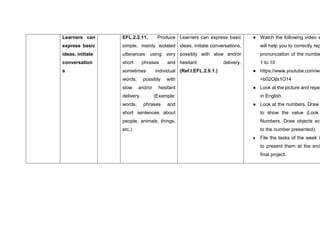
Learners can
express basic
ideas, initiate
conversation
s
EFL.2.2.11. Produce
simple, mainly isolated
utterances using very
short phrases and
sometimes individual
words, possibly with
slow and/or hesitant
delivery. (Example:
words, phrases and
short sentences about
people, animals, things,
etc.)
Learners can express basic
ideas, initiate conversations,
possibly with slow and/or
hesitant delivery.
(Ref.I.EFL.2.9.1.)
● Watch the following video w
will help you to correctly rep
pronunciation of the numbe
1 to 10
● https://www.youtube.com/wa
=b02Ojls1O14
● Look at the picture and repea
in English.
● Look at the numbers. Draw
to show the value (Look
Numbers. Draw objects acc
to the number presented).
● File the tasks of the week in
to present them at the end
final project.
Verbs in the
simple
present
EFL.2.9.1 Learners can
express basic ideas,
initiate conversations,
possibly with slow and/or
hesitant delivery.
Learners can express basic
ideas, initiate conversations,
possibly with slow and/or
hesitant delivery.
(Ref.I.EFL.2.9.1.)
● Count and write how many
you see
● Watch the following vide
repeat the counting of the nu
from one to ten. (obse
siguiente video y repite el con
los números del uno al diez.
● https://www.youtube.com/wa
=b02Ojls1O14
FROM 07
SEPTEM
BER TO
08
OCTOBE
R 2020
LIFE
AND
DIVERSI
TY
Occupations
and activities
5
SEMANAS
EFL 2.1.4. Express
curiosity about the
world and other
cultures by asking
simple WH- questions
in class after reading
and/or participating in
presentations or other
group work.
Learners can understand a
simple text on an everyday
topic. (Ref.EFL.2.12.1)
● Drawing different houses
labeling different rooms and
in a house.
● Using question words (who
where) to ask about places.
● Showing the student some
flashcards of familiar voca
items and asking them to s
words. (Example: It’s a ho
school, a car, a bike, to see
are easily understood, etc.)
Ask the learner to sing a s
recite a chant together
group of friends or wi
teacher. Record the st
production with the rec
device quite near to the st
mouth and listen to the rec
to assess clarity of s
production of phonemes,
and intonation.
Actions and
subjects in
school
EFL 2.3.2. Read a short
simple text (online or
print) and demonstrate
understanding of the gist
and some basic details
of the content.
Learners can understand a
simple text on an everyday
topic. (Ref.
.EFL.2.12.1)
● Listening to very short (spo
recorded) descriptions of s
and writing, coloring, or d
items within them. (Ex
learners are given a simple
of a classroom. They liste
description of it and ident
table where Sara sits and
pens and a red book on it, e
● Listening to a short dialogu
filling in a simple form. (Exam
conversation between a boy
teacher meeting for the firs
Learners fill in the boy’s nam
birth date, (part of his) a
(e.g., house number or
name), favorite subject, etc
simple form.)
● Listening to a short tex
demonstrating understandin
using an accompanying g
organizer. (Example:markin
route on a map while liste
directions, etc.)
FROM
OCTOBE
R 19 TO
NOVEMB
ER 18,
2020
GLOBAL
WARMIN
G
Dairy
Products on
the Farm
4
SEMANAS
EFL.2.2.8. Mimic
individual sounds of the
English language,
especially those
phonemes that do not
exist in the student's own
L1, both in isolation and
within key vocabulary
elements. (Example: / ŋ /
/ ð / / ʌ / / i: / y en
words like sing, these,
up, sea, etc.)
Learners can pronounce
most familiar vocabulary
items accurately.
They can also produce some
phrases and short sentences
clearly. (Ref. I.EFL.2.8.1.)
• Showing the student some
flashcards of familiar voca
items and asking them to s
words. (Example: It’s a ho
school, a car, a bike, to see
are easily understood, etc.)
• Ask the learner to sing a s
recite a chant together with a
of friends or with the te
Record the student’s pro
with the recording device
near to the student’s mou
listen to the recording to
clarity of sounds, produc
phonemes, rhythm and into
Farm
Products
EFL.2.2.4. Identify items
of specific information
within simple messages
or from short and simple
descriptions about
familiar contexts,
especially if visual
support is provided.
(Example: letters of the
alphabet, numbers,
prices and times, days,
dates and months, etc.)
Learners can understand
short and simple spoken
texts well enough to be able
to pick out key items of
information. Ref.
I.EFL.2.7.1. (I.3)
● Watch the following video and p
the pronunciation of the memb
your family.
● Look, point and repeat the word
● Look at the graph and write its n
English and its meaning in Span
Old
MacDonald
EFL.2.2.6. Enjoy
extensive listening in
English. Example: listen
to stories, watch short
movies, experience
song lyrics or poetry,
etc.)
Learners can understand the
main ideas in short simple
spoken texts. Ref.:
I.EFL.2.6.1. (I.3)
● Find a clean and uncluttered
area.
● Follow the instructions that
teacher gives you to improv
listening and pronunciation.
● Look, listen, and read, then s
song.
● You can watch the video and pr
the pronunciation of the song th
macdonald
● https://www.youtube.com/watch
AjeA2ggPs&list=RD1EAjeA2gg
rt_radio=1
● Draw the animals on the farm
notebook.
FROM
NOVEMB
ER 19 TO
09
DECEMB
ER.
TECHNO
LOGY,
SCIENCE
AND
ART
Musical
Instruments
4
SEMANAS
EFL.2.1.4. Express
curiosity about the world
and other cultures by
asking simple WH-
questions in class after
reading and/or
participating in
presentations or other
group work.
Learners can recognize
differences between where
people live and write about
their own surroundings, as
well ask simple questions.
(I.2, S.2) REF.( I.EFL.2.1.1)
● Listening to very short (spo
recorded) descriptions of s
and writing, coloring, or d
items within them. (Ex
learners are given a simple
of a classroom. They liste
description of it and ident
table where Sara sits and
pens and a red book on it, e
Listening to a short tex
demonstrating understandin
using an accompanying g
organizer. (Example: marki
route on a map while liste
directions, etc.)
Can, can’t EFL.2.5.5. Apply ICT
and/or other resources
to communicate simple
thoughts in small groups.
Learners can communicate
thoughts, feelings, and/or
personal experiences
through a range of resources
and other media, including
ICT. Ref I.EFL.2.24.1. (I.2,
I.3, I.4)
● Find information about what
famous and influential peo
home, school or work on a
day?
● Prepare a set of quest
interview our partner about
lifestyle.
● Read and answer the questi
● I can play the guitar. Can yo
the piano?
● What instrument can you pla
● I can play the marimba. I ca
the trumpet and you?
● At the end, file your work
school portfolio.
There is /
There are
EFL 2.3.7. Read and
understand the main
ideas in a short simple
text on a cross-curricular
topic. (Example: art,
music, history, etc.)
*The content is from other
school subjects like art,
music, math, science,
geography. Ref.
I.EFL.2.16.1.
● Identifying the main ideas in
simple cross-curricular
(Example: Text: short desc
of towns in Ecuador;
● Task: circle the correct photo
● Reading short simple instr
on a cross-curricular subje
making something. (Exam
sandwich, origami, or a mas
● Studying simple cross-cu
information presented in the
a graph, diagram, map, or ch
answering the yes / no que
(Example: a graph showin
long different animals live
answering yes or no to qu
about them, etc.)
FROM
DECEMB
ER 09 TO
DECEMB
ER 23,
2020
HEALTH,
CULTUR
E AND
ENTERT
AINMEN
T
Expressions
of time
3
SEMANAS
EFL.2.2.1. Understand
meanings expressed in
short dialogues on
familiar topics, as well as
basic spoken
instructions and simple
questions about self,
people, animals, or
things, especially when
spoken slowly and
clearly. (Example:
greetings, short phrases,
basic range of classroom
instructions, common
personal information
questions: What’s your
name? etc.)
Learners can understand the
main ideas in short simple
spoken texts. Ref.:
I.EFL.2.6.1.
(I.3)
● Doing a mingle activity
learners meet and greet eac
and ask and answer
questions. Observing to
whether the learner can i
effectively, and whether th
able to ask for repetition
required, and / or
appropriately to res
received. (Example: Find so
who…. Do you have a re
Yes? Great! – writes down n
person.)
● Establishing a clear expecta
English use for clas
functions. (Example: gr
requesting, thanking, aski
repetition / clarification, o
help, taking leave, etc.) In
assessment could involve
chart, with points for learne
use L2 regularly.
Numbers 80-
90
EFL.2.2.4. Identify items
of specific information
within simple messages
or from short and simple
descriptions about
familiar contexts,
especially if visual
support is provided.
(Example: letters of the
alphabet, numbers,
prices and times, days,
dates and months, etc.)
Learners can pronounce
most familiar vocabulary
items accurately. They can
also produce some phrases
and short sentences clearly.
Ref. I.EFL.2.8.1.
• Form groups to describe
pictures and what activiti
they doing?
• Describe what the peop
wearing?
● Prepare a creative collage a
the season and prepare a
description for it.
Progressive/c
ontinuous
Tense
EFL.2.2.1. Understand
meanings expressed in
short dialogues on
familiar topics, as well as
basic spoken
instructions and simple
questions about self,
people, animals, or
things, especially when
spoken slowly and
clearly. (Example:
greetings, short phrases,
basic range of classroom
instructions, common
personal information
questions: What’s your
name? etc.)
Learners can understand the
main ideas in short simple
spoken texts. Ref.:
I.EFL.2.6.1. (I.3)
● Doing a mingle activity
learners meet and greet eac
and ask and answer
questions. Observing to
whether the learner can i
effectively, and whether th
able to ask for repetition
required, and / or
appropriately to res
received. (Example: Find so
who…. Do you have a re
Yes? Great! – writes down n
person.)
● Establishing a clear expecta
English use for clas
functions. (Example: gr
requesting, thanking, aski
repetition / clarification, o
help, taking leave, etc.) In
assessment could involve
chart, with points for learne
use L2 regularly.
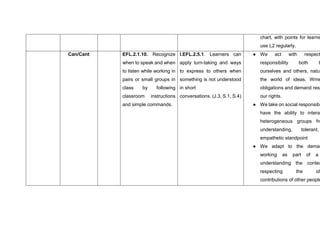
Can/Cant EFL.2.1.10. Recognize
when to speak and when
to listen while working in
pairs or small groups in
class by following
classroom instructions
and simple commands.
I.EFL.2.5.1. Learners can
apply turn-taking and ways
to express to others when
something is not understood
in short
conversations. (J.3, S.1, S.4)
● We act with respect
responsibility both t
ourselves and others, natur
the world of ideas. Wme
obligations and demand resp
our rights.
● We take on social responsibi
have the ability to interac
heterogeneous groups fro
understanding, tolerant,
empathetic standpoint
● We adapt to the deman
working as part of a
understanding the contex
respecting the ide
contributions of other people
FROM
DECEMB
ER 21 TO
JANUAR
Y 29,
2020
MEGADI
VERSE
AND
CULTUR
AL
ECUADO
R
Short /o/ and
/u/.
5
SEMANAS
EFL2.2.3. Recognize
familiar names, words,
and short phrases about
simple everyday topics
whether heard in
isolation or within short,
simple spoken texts
describing people and
objects. (Example:
vocabulary about self,
family, friends and
immediate surroundings
at school and home,
adjectives for color and
size, etc.)
Learners can understand
short and simple spoken
texts well enough to be able
to pick out key items of
information. Ref.
I.EFL.2.7.1. (I.3)
● Listening to very short (spo
recorded) descriptions of s
and writing, coloring, or d
items within them. (Ex
learners are given a simple
of a classroom.
● They listen to a description o
identify the table where Sa
and draw 3 pens and a red b
it, etc.)
● Listening to a short dialogu
filling in a simple form. (Exam
conversation between a boy
teacher meeting for the firs
Learners fill in the boy’s nam
birth date, (part of his) a
(e.g., house number or
name), favorite subject, etc
simple form.)
● Listening to a short tex
demonstrating understandin
using an accompanying g
organizer. (Example: marki
route on a map while liste
directions, etc.)
Jobs and
Professions
Frequency
Adverbs
EFL 2.1.4. Express
curiosity about the world
and other cultures by
asking simple WH-
questions in class after
reading and/or
participating in
presentations or other
group work.
Learners can recognize
differences between where
people live and write about
their own surroundings, as
well ask simple questions.
(I.2, S.2) REF.( I.EFL.2.1.1)
● Drawing different houses
labeling different rooms and
in a house.
● Using question words (who
where) to ask about places.
● Showing the student some
flashcards of familiar voca
items and asking them to s
words. (Example: It’s a ho
school, a car, a bike, to see
are easily understood, etc.)
● Ask the learner to sing a s
recite a chant together with a
of friends or with the te
Record the student’s pro
with the recording device qui
to the student’s mouth and l
the recording to assess cla
sounds, production of phon
rhythm and intonation.
Math EFL.2.2.4. Identify items
of specific information
within simple messages
or from short and simple
descriptions about
familiar contexts,
especially if visual
support is provided.
(Example: letters of the
alphabet, numbers,
prices and times, days,
dates and months, etc.)
Learners can pronounce
most familiar vocabulary
items accurately. They can
also produce some phrases
and short sentences clearly.
Ref. I.EFL.2.8.1.
● Watch the following video and p
the pronunciation of the memb
your family.
● Look, point and repeat the word
● Look at the graph and write its n
English and its meaning in Span
FEBRUA
RY 01,
2021
WE ARE
ALL THE
SAME
AND WE
SHARE
THE
SAME
SUN
Numbers 5
SEMANAS
EFL.2.2.4. Identify items
of specific information
within simple messages
or from short and simple
descriptions about
familiar contexts,
especially if visual
support is provided.
(Example: letters of the
alphabet, numbers,
prices and times, days,
dates and months, etc.)
Learners can pronounce
most familiar vocabulary
items accurately. They can
also produce some phrases
and short sentences clearly.
Ref. I.EFL.2.8.1.
● Watch the following video and p
the pronunciation of the memb
your family.
● Look, point and repeat the word
● Look at the graph and w
name in English and its mea
Spanish.
Food and
Verbs in the
Present
Simple
EFL.2.1.9.
Communicate to peers
and teacher when
something is not
understood in class
through the use of
simple basic questions.
I.EFL.2.5.1. Learners can
apply turn-taking and ways
to express to others when
something is not understood
in short
conversations. (J.3, S.1, S.4)
● Access greater flexibility of
creativity, enhanced lin
intelligence, and critical thinkin
through an appreciation of lin
differences.
● Enjoy an enriched perspective
own L1 and of language u
communication and learning.
● Role-playing and participating i
dialogues.
● Playing games that practice clas
language and turn-taking.
● Singing songs or chants that p
helpful language.
● Working in pairs and groups on
project.
ELABORADO REVISADO APROBADO
DOCENTE:
________________________________________
___
COORDINADORA PEDAGÓGICA SUBNIVEL
___________:
______________________________________________
DIRECTORA:
Mgs. Narcisa Olaya Ramírez
Firma: Firma: Firma:
Fecha: Fecha: Fecha:

PCA 4TO INGLES.docx

  • 1.
    SCHOOL OF BASICEDUCATION "" SCHOOL YEAR 2020-2021 ANNUAL CURRICULAR PLAN FOR ENGLISH General Regulations to the LOEI Art. 1. INFORMATIVE DATA YEAR PARALLEL EGB TEACHER NAME: VALUES: Responsibility. I respect Autonomy Civility Puntuality. SUBJECT: ABP START DATE: END DATE: LEARNING OBJECTIVE: OBJECTIVE OF THE SUBNLEVEL: SPECIFIC OBJECTIVES: • Students will understand that, to solve problems of daily life related to social, environmental, economic, cultural issues, among others, it is necessary to apply logical, creative, critical, complex reasoning strategies, and communicate our ideas in an assertive way to act with autonomy and independence. • Students will understand the most relevant aspects of life and its diversity, from the study of its origin, its importance, its challenges and its commitment to maintain sustainable environments that ensure integral health, the continuity of life in its different ways, applying values such as empathy and communicating them in a timely manner. • Students will understand that certain actions of human beings negatively and directly affect phenomena that occur in nature and increase environmental problems such as global warming, thus contributing to awareness and assertive and responsible decision making with the immediate environment, communicating it in various spaces using environmentally friendly resources. • Students will understand that history, technology, science, and art intertwine and evolve together, fostering human curiosity to know and build a better world.
  • 2.
    • Students willunderstand that health, culture and entertainment are fundamental axes in the development of the life project and that their dissemination is important, through artistic and cultural manifestations. • Students will understand that Ecuador is part of a megadiverse and multicultural world, contributing to the construction and care of a more just and equitable human society through assertive communication in its near and distant environment. • Students will understand that world citizenship and a culture of peace require the respect and practice of human rights, social justice, diversity, equality among all human beings, and environmental sustainability in order to promote a world and a better future for all. 1 y 2. PRIMER QUIMESTRE NOMBRE DEL PROYECTO/FIC HAS TEMA TIEMPO DESTREZAS CON CRITERIO DE DESEMPEÑO CRITERIO DE EVALUACIÓN CONTENIDOS
  • 3.
    FROM 11 AUGUST TO 04 SEPTEM BER 2020 PROBLE MSOF THE CONTEM PORARY WORLD The /Z/ sound in words and verbs 4 SEMANAS EFL 2.3.1. Demonstrate basic reading comprehension skills by identifying the meaning of individual words, phrases, and sentences, including simple written instructions. I.EFL.2.11.1. Learners can understand familiar words, phrases, and short simple sentences and can successfully complete the simple accompanying task. ● Demonstrate basic r comprehension ● Participating in short dialogues greetings and leave-taking. ● Listening to or reading short dia and answering questions abo speakers’ names, grades, schoo ● Practicing the use of express politeness during collaborative p small group work.
  • 4.
    Learners can express basic ideas,initiate conversation s EFL.2.2.11. Produce simple, mainly isolated utterances using very short phrases and sometimes individual words, possibly with slow and/or hesitant delivery. (Example: words, phrases and short sentences about people, animals, things, etc.) Learners can express basic ideas, initiate conversations, possibly with slow and/or hesitant delivery. (Ref.I.EFL.2.9.1.) ● Watch the following video w will help you to correctly rep pronunciation of the numbe 1 to 10 ● https://www.youtube.com/wa =b02Ojls1O14 ● Look at the picture and repea in English. ● Look at the numbers. Draw to show the value (Look Numbers. Draw objects acc to the number presented). ● File the tasks of the week in to present them at the end final project.
  • 5.
    Verbs in the simple present EFL.2.9.1Learners can express basic ideas, initiate conversations, possibly with slow and/or hesitant delivery. Learners can express basic ideas, initiate conversations, possibly with slow and/or hesitant delivery. (Ref.I.EFL.2.9.1.) ● Count and write how many you see ● Watch the following vide repeat the counting of the nu from one to ten. (obse siguiente video y repite el con los números del uno al diez. ● https://www.youtube.com/wa =b02Ojls1O14
  • 6.
    FROM 07 SEPTEM BER TO 08 OCTOBE R2020 LIFE AND DIVERSI TY Occupations and activities 5 SEMANAS EFL 2.1.4. Express curiosity about the world and other cultures by asking simple WH- questions in class after reading and/or participating in presentations or other group work. Learners can understand a simple text on an everyday topic. (Ref.EFL.2.12.1) ● Drawing different houses labeling different rooms and in a house. ● Using question words (who where) to ask about places. ● Showing the student some flashcards of familiar voca items and asking them to s words. (Example: It’s a ho school, a car, a bike, to see are easily understood, etc.) Ask the learner to sing a s recite a chant together group of friends or wi teacher. Record the st production with the rec device quite near to the st mouth and listen to the rec to assess clarity of s
  • 7.
  • 8.
    Actions and subjects in school EFL2.3.2. Read a short simple text (online or print) and demonstrate understanding of the gist and some basic details of the content. Learners can understand a simple text on an everyday topic. (Ref. .EFL.2.12.1) ● Listening to very short (spo recorded) descriptions of s and writing, coloring, or d items within them. (Ex learners are given a simple of a classroom. They liste description of it and ident table where Sara sits and pens and a red book on it, e ● Listening to a short dialogu filling in a simple form. (Exam conversation between a boy teacher meeting for the firs Learners fill in the boy’s nam birth date, (part of his) a (e.g., house number or name), favorite subject, etc simple form.) ● Listening to a short tex demonstrating understandin using an accompanying g
  • 9.
    organizer. (Example:markin route ona map while liste directions, etc.) FROM OCTOBE R 19 TO NOVEMB ER 18, 2020 GLOBAL WARMIN G Dairy Products on the Farm 4 SEMANAS EFL.2.2.8. Mimic individual sounds of the English language, especially those phonemes that do not exist in the student's own L1, both in isolation and within key vocabulary elements. (Example: / ŋ / / ð / / ʌ / / i: / y en words like sing, these, up, sea, etc.) Learners can pronounce most familiar vocabulary items accurately. They can also produce some phrases and short sentences clearly. (Ref. I.EFL.2.8.1.) • Showing the student some flashcards of familiar voca items and asking them to s words. (Example: It’s a ho school, a car, a bike, to see are easily understood, etc.) • Ask the learner to sing a s recite a chant together with a of friends or with the te Record the student’s pro with the recording device near to the student’s mou listen to the recording to clarity of sounds, produc phonemes, rhythm and into
  • 10.
    Farm Products EFL.2.2.4. Identify items ofspecific information within simple messages or from short and simple descriptions about familiar contexts, especially if visual support is provided. (Example: letters of the alphabet, numbers, prices and times, days, dates and months, etc.) Learners can understand short and simple spoken texts well enough to be able to pick out key items of information. Ref. I.EFL.2.7.1. (I.3) ● Watch the following video and p the pronunciation of the memb your family. ● Look, point and repeat the word ● Look at the graph and write its n English and its meaning in Span
  • 11.
    Old MacDonald EFL.2.2.6. Enjoy extensive listeningin English. Example: listen to stories, watch short movies, experience song lyrics or poetry, etc.) Learners can understand the main ideas in short simple spoken texts. Ref.: I.EFL.2.6.1. (I.3) ● Find a clean and uncluttered area. ● Follow the instructions that teacher gives you to improv listening and pronunciation. ● Look, listen, and read, then s song. ● You can watch the video and pr the pronunciation of the song th macdonald ● https://www.youtube.com/watch AjeA2ggPs&list=RD1EAjeA2gg rt_radio=1 ● Draw the animals on the farm notebook.
  • 12.
    FROM NOVEMB ER 19 TO 09 DECEMB ER. TECHNO LOGY, SCIENCE AND ART Musical Instruments 4 SEMANAS EFL.2.1.4.Express curiosity about the world and other cultures by asking simple WH- questions in class after reading and/or participating in presentations or other group work. Learners can recognize differences between where people live and write about their own surroundings, as well ask simple questions. (I.2, S.2) REF.( I.EFL.2.1.1) ● Listening to very short (spo recorded) descriptions of s and writing, coloring, or d items within them. (Ex learners are given a simple of a classroom. They liste description of it and ident table where Sara sits and pens and a red book on it, e Listening to a short tex demonstrating understandin using an accompanying g organizer. (Example: marki route on a map while liste directions, etc.)
  • 13.
    Can, can’t EFL.2.5.5.Apply ICT and/or other resources to communicate simple thoughts in small groups. Learners can communicate thoughts, feelings, and/or personal experiences through a range of resources and other media, including ICT. Ref I.EFL.2.24.1. (I.2, I.3, I.4) ● Find information about what famous and influential peo home, school or work on a day? ● Prepare a set of quest interview our partner about lifestyle. ● Read and answer the questi ● I can play the guitar. Can yo the piano? ● What instrument can you pla ● I can play the marimba. I ca the trumpet and you? ● At the end, file your work school portfolio.
  • 14.
    There is / Thereare EFL 2.3.7. Read and understand the main ideas in a short simple text on a cross-curricular topic. (Example: art, music, history, etc.) *The content is from other school subjects like art, music, math, science, geography. Ref. I.EFL.2.16.1. ● Identifying the main ideas in simple cross-curricular (Example: Text: short desc of towns in Ecuador; ● Task: circle the correct photo ● Reading short simple instr on a cross-curricular subje making something. (Exam sandwich, origami, or a mas ● Studying simple cross-cu information presented in the a graph, diagram, map, or ch answering the yes / no que (Example: a graph showin long different animals live answering yes or no to qu about them, etc.)
  • 15.
    FROM DECEMB ER 09 TO DECEMB ER23, 2020 HEALTH, CULTUR E AND ENTERT AINMEN T Expressions of time 3 SEMANAS EFL.2.2.1. Understand meanings expressed in short dialogues on familiar topics, as well as basic spoken instructions and simple questions about self, people, animals, or things, especially when spoken slowly and clearly. (Example: greetings, short phrases, basic range of classroom instructions, common personal information questions: What’s your name? etc.) Learners can understand the main ideas in short simple spoken texts. Ref.: I.EFL.2.6.1. (I.3) ● Doing a mingle activity learners meet and greet eac and ask and answer questions. Observing to whether the learner can i effectively, and whether th able to ask for repetition required, and / or appropriately to res received. (Example: Find so who…. Do you have a re Yes? Great! – writes down n person.) ● Establishing a clear expecta English use for clas functions. (Example: gr requesting, thanking, aski repetition / clarification, o help, taking leave, etc.) In assessment could involve chart, with points for learne use L2 regularly.
  • 16.
    Numbers 80- 90 EFL.2.2.4. Identifyitems of specific information within simple messages or from short and simple descriptions about familiar contexts, especially if visual support is provided. (Example: letters of the alphabet, numbers, prices and times, days, dates and months, etc.) Learners can pronounce most familiar vocabulary items accurately. They can also produce some phrases and short sentences clearly. Ref. I.EFL.2.8.1. • Form groups to describe pictures and what activiti they doing? • Describe what the peop wearing? ● Prepare a creative collage a the season and prepare a description for it.
  • 17.
    Progressive/c ontinuous Tense EFL.2.2.1. Understand meanings expressedin short dialogues on familiar topics, as well as basic spoken instructions and simple questions about self, people, animals, or things, especially when spoken slowly and clearly. (Example: greetings, short phrases, basic range of classroom instructions, common personal information questions: What’s your name? etc.) Learners can understand the main ideas in short simple spoken texts. Ref.: I.EFL.2.6.1. (I.3) ● Doing a mingle activity learners meet and greet eac and ask and answer questions. Observing to whether the learner can i effectively, and whether th able to ask for repetition required, and / or appropriately to res received. (Example: Find so who…. Do you have a re Yes? Great! – writes down n person.) ● Establishing a clear expecta English use for clas functions. (Example: gr requesting, thanking, aski repetition / clarification, o help, taking leave, etc.) In assessment could involve
  • 18.
    chart, with pointsfor learne use L2 regularly. Can/Cant EFL.2.1.10. Recognize when to speak and when to listen while working in pairs or small groups in class by following classroom instructions and simple commands. I.EFL.2.5.1. Learners can apply turn-taking and ways to express to others when something is not understood in short conversations. (J.3, S.1, S.4) ● We act with respect responsibility both t ourselves and others, natur the world of ideas. Wme obligations and demand resp our rights. ● We take on social responsibi have the ability to interac heterogeneous groups fro understanding, tolerant, empathetic standpoint ● We adapt to the deman working as part of a understanding the contex respecting the ide contributions of other people
  • 19.
    FROM DECEMB ER 21 TO JANUAR Y29, 2020 MEGADI VERSE AND CULTUR AL ECUADO R Short /o/ and /u/. 5 SEMANAS EFL2.2.3. Recognize familiar names, words, and short phrases about simple everyday topics whether heard in isolation or within short, simple spoken texts describing people and objects. (Example: vocabulary about self, family, friends and immediate surroundings at school and home, adjectives for color and size, etc.) Learners can understand short and simple spoken texts well enough to be able to pick out key items of information. Ref. I.EFL.2.7.1. (I.3) ● Listening to very short (spo recorded) descriptions of s and writing, coloring, or d items within them. (Ex learners are given a simple of a classroom. ● They listen to a description o identify the table where Sa and draw 3 pens and a red b it, etc.) ● Listening to a short dialogu filling in a simple form. (Exam conversation between a boy teacher meeting for the firs Learners fill in the boy’s nam birth date, (part of his) a (e.g., house number or name), favorite subject, etc simple form.) ● Listening to a short tex demonstrating understandin
  • 20.
    using an accompanyingg organizer. (Example: marki route on a map while liste directions, etc.)
  • 21.
    Jobs and Professions Frequency Adverbs EFL 2.1.4.Express curiosity about the world and other cultures by asking simple WH- questions in class after reading and/or participating in presentations or other group work. Learners can recognize differences between where people live and write about their own surroundings, as well ask simple questions. (I.2, S.2) REF.( I.EFL.2.1.1) ● Drawing different houses labeling different rooms and in a house. ● Using question words (who where) to ask about places. ● Showing the student some flashcards of familiar voca items and asking them to s words. (Example: It’s a ho school, a car, a bike, to see are easily understood, etc.) ● Ask the learner to sing a s recite a chant together with a of friends or with the te Record the student’s pro with the recording device qui to the student’s mouth and l the recording to assess cla sounds, production of phon rhythm and intonation.
  • 22.
    Math EFL.2.2.4. Identifyitems of specific information within simple messages or from short and simple descriptions about familiar contexts, especially if visual support is provided. (Example: letters of the alphabet, numbers, prices and times, days, dates and months, etc.) Learners can pronounce most familiar vocabulary items accurately. They can also produce some phrases and short sentences clearly. Ref. I.EFL.2.8.1. ● Watch the following video and p the pronunciation of the memb your family. ● Look, point and repeat the word ● Look at the graph and write its n English and its meaning in Span
  • 23.
    FEBRUA RY 01, 2021 WE ARE ALLTHE SAME AND WE SHARE THE SAME SUN Numbers 5 SEMANAS EFL.2.2.4. Identify items of specific information within simple messages or from short and simple descriptions about familiar contexts, especially if visual support is provided. (Example: letters of the alphabet, numbers, prices and times, days, dates and months, etc.) Learners can pronounce most familiar vocabulary items accurately. They can also produce some phrases and short sentences clearly. Ref. I.EFL.2.8.1. ● Watch the following video and p the pronunciation of the memb your family. ● Look, point and repeat the word ● Look at the graph and w name in English and its mea Spanish.
  • 24.
    Food and Verbs inthe Present Simple EFL.2.1.9. Communicate to peers and teacher when something is not understood in class through the use of simple basic questions. I.EFL.2.5.1. Learners can apply turn-taking and ways to express to others when something is not understood in short conversations. (J.3, S.1, S.4) ● Access greater flexibility of creativity, enhanced lin intelligence, and critical thinkin through an appreciation of lin differences. ● Enjoy an enriched perspective own L1 and of language u communication and learning. ● Role-playing and participating i dialogues. ● Playing games that practice clas language and turn-taking. ● Singing songs or chants that p helpful language. ● Working in pairs and groups on project. ELABORADO REVISADO APROBADO DOCENTE: ________________________________________ ___ COORDINADORA PEDAGÓGICA SUBNIVEL ___________: ______________________________________________ DIRECTORA: Mgs. Narcisa Olaya Ramírez Firma: Firma: Firma:
  • 25.