English
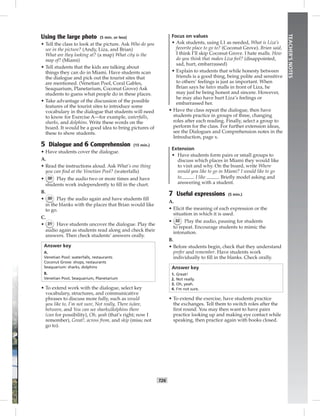
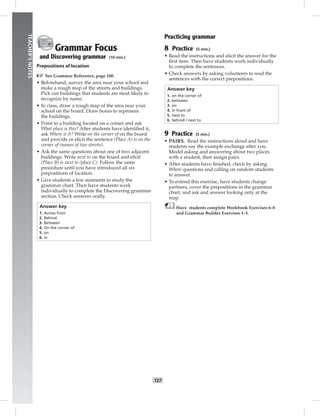
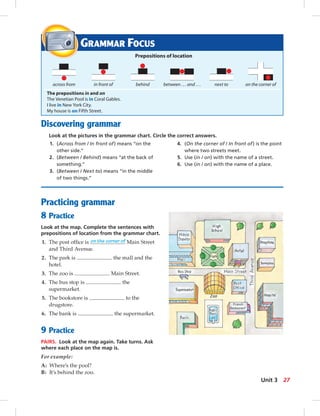
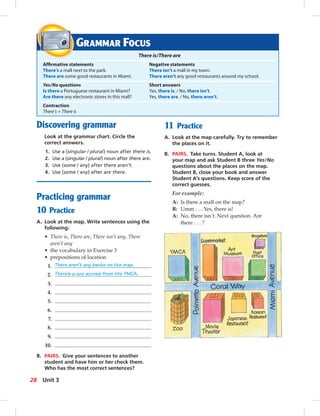
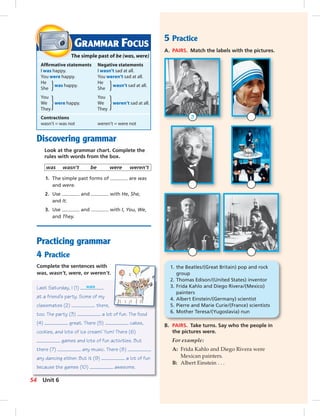
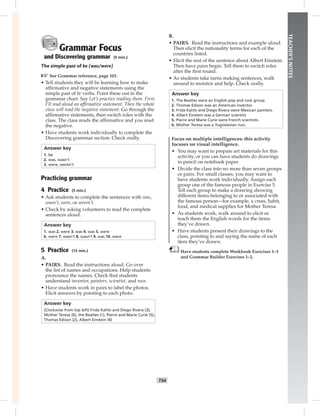
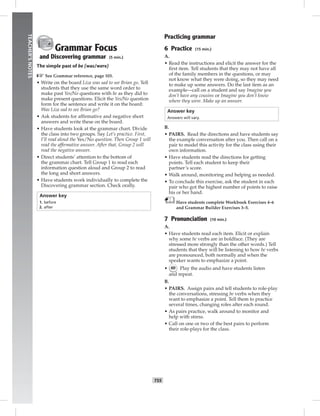
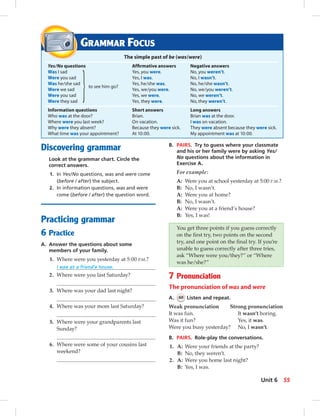
Level 2
PRESIDENTE DE LA REPÚBLICA
Rafael Correa Delgado
MINISTRO DE EDUCACIÓN
Augusto Espinosa Andrade
Viceministro de Educación
Pablo Cevallos Estarellas
Viceministro de Gestión Educativa
Darío Rodríguez Rodríguez
Subsecretaria de Fundamentos Educativos
Miriam Chacón Calderón
Subsecretario de Administración Escolar
Roberto Pazmiño Alvear
Directora Nacional de Comunicación Social
María Lorena Portalanza Zambrano
Equipo técnico
Proyecto de Fortalecimiento de Enseñanza de Inglés
© Ministerio de Educación del Ecuador, 2013
Av. Amazonas N34-451 y Atahualpa
Quito, Ecuador
www.educacion.gob.ec
DISTRIBUCIÓN GRATUITA - PROHIBIDA SU VENTA
TEACHER'S BOOK - LEVEL 2
Postcards 1B, Teacher's Book
Second Edition
Authorized adaptation from the United Kingdom edition, entitled
Snapshot, first edition, published by Pearson Education Limited
publishing under its Longman imprint.
Copyright © 1998.
American English adaptation, published by Pearson Education,
Inc. Copyright © 2008.
Copyright © 2008 by Pearson Education, Inc.
All rights reserved. No part of this publication may be
reproduced, stored in a retrieval system, or transmitted in any
form or by any means, electronic, mechanical, photocopying,
recording, or otherwise, without the prior permission of the
publisher.
Pearson Education, 10 Bank Street, White Plains, NY 10606
ISBN-13: 978-0-13-324794-7
ISBN-10: 0-13-324794-5
Impreso por El Telégrafo
La reproducción parcial o total de esta publicación, en cualquier forma y por
cualquier medio mecánico o electrónico, está permitida siempre y cuando
sea autorizada por los editores y se cite correctamente la fuente.
TO OUR TEACHERS
The Ministry of Education aims at providing Ecuador’s students with both the foreign
language knowledge and the skills needed to succeed in today’s globalized world
as English is the international language that will allow them to access knowledge
and information and that will become an instrument of personal and professional
empowerment to build a more prosperous, equitable society.
For the first time, the Ministry of Education will provide free English textbooks
to students. This will contribute to the learning process in a positive manner,
for every student will have an additional resource to aid them in their language
acquisition process.
These textbooks as well as the teaching-learning approach adopted are guided
by the Common European Framework of Reference for Languages: Learning,
Teaching, Assessment, which is an internationally recognized standard for the
explicit description of educational objectives, content elaboration, and methods as
well as a basis for the reflection on current educational practices.
Furthermore, because students will be taught under the Communicative Language
Approach, which perceives language learning as a dynamic, flexible process, and
promotes learner autonomy, teachers and learners are enthusiastically invited to
make use of the English language for meaningful communication and as a tool to
open windows to the world, unlock doors to opportunities, and expand their minds
to the understanding of new ideas and other cultures.
The Ministry of Education has also created in-service teacher standards aligned
to TESOL, establishing the benchmark as to what teachers need to know.
The B2 benchmark (CEFR), which states the minimum language proficiency level
for pre-service and in-service English teachers, has also been institutionalized,
thus guaranteeing students will have teachers who are proficient in the language.
Finally, through a rigorous evaluation procedure and teachers’ development plan,
the Ministry of Education will assist current in-service English teachers in improving
their present language proficiency levels to foster the teaching-learning processes
in the classroom.
We hope that by way of these innovations
—new standards, a new curriculum, and new
textbooks—students and teachers alike will be more
motivated in their classrooms to gain thorough
knowledge of English while developing their
personal language skills and enhancing their
professional abilities, respectively.
Ministry of Education
d
Postcards
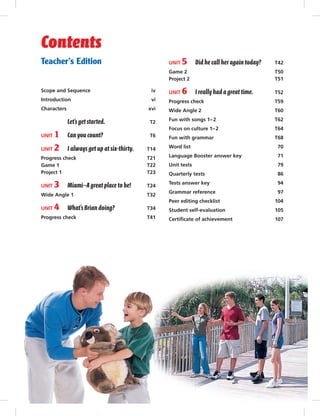
Teacher’s Edition
Scope and Sequence iv
Introduction vi
Characters xvi
Let’s get started. T2
UNIT 1 Can you count? T6
UNIT 2 I always get up at six-thirty. T14
Progress check T21
Game 1 T22
Project 1 T23
UNIT 3 Miami—A great place to be! T24
Wide Angle 1 T32
UNIT 4 What’s Brian doing? T34
Progress check T41
UNIT 5 Did he call her again today? T42
Game 2 T50
Project 2 T51
UNIT 6 I reallyhad a great time. T52
Progress check T59
Wide Angle 2 T60
Fun with songs 1–2 T62
Focus on culture 1–2 T64
Fun with grammar T68
Word list 70
Language Booster answer key 71
Unit tests 79
Quarterly tests 86
Tests answer key 94
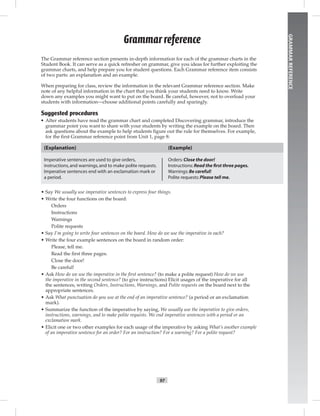
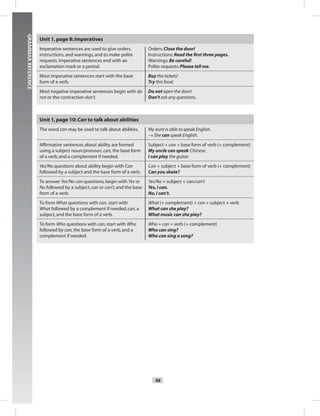
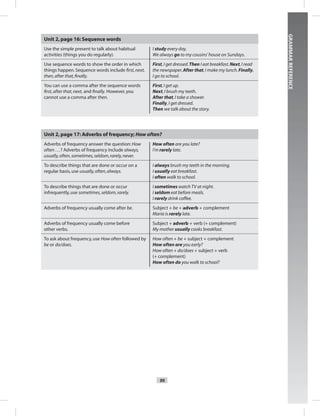
Grammar reference 97
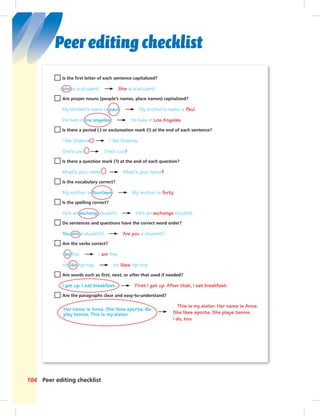
Peer editing checklist 104
Student self-evaluation 105
Certificate of achievement 107
Contents
Postcards_splitB_TE1_FM.indd iii 3/22/07 3:32:46 PM
Postcards
Can you count?
Pages 6–13
Ask for permission
Talk about abilities
(Can I?)
Imperatives
Can to talk about abilities
I always get up at
six-thirty.
Pages 14–20
Talk about daily routines Sequence words: first, then, after that, next,
finally
Adverbs of frequency: always, usually, often,
sometimes, rarely/seldom, never
How often?
Positions of frequency adverbs
Page 21
Page 22
Page 23
Progress check Units 1 and 2 Test-taking tip: Do easier test items first.
Game 1: Racetrack
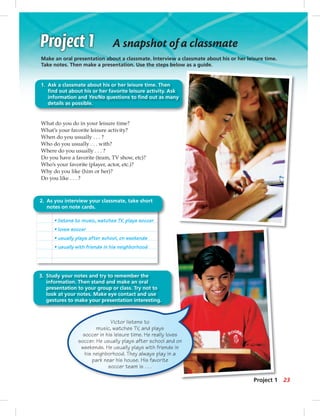
Project 1: A snapshot of a classmate
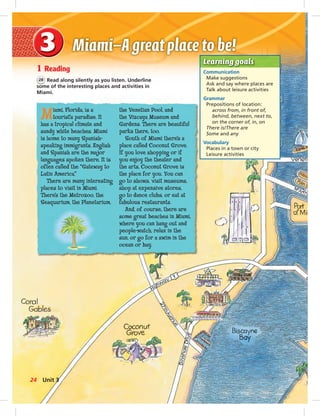
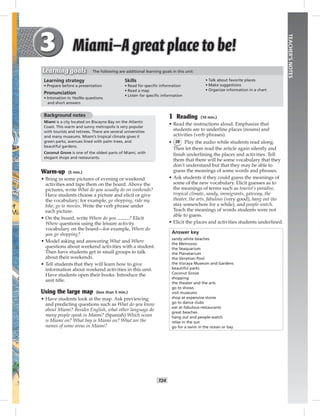
Miami—A great place
to be!
Pages 24–31
Make suggestions
Ask and say where places are
Talk about leisure activities
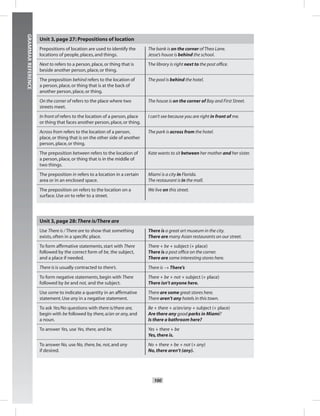
Prepositions of location: across from, in front
of, behind, between, next to, on the corner
of, in, on
There is/There are
Some and any
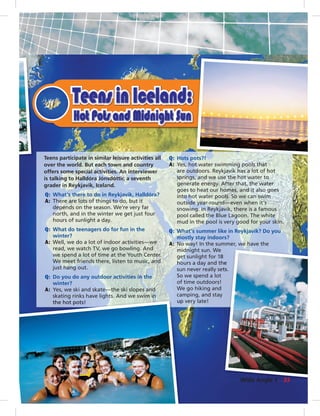
Pages 32–33 Wide Angle 1: Teens in Iceland: Hot pots and midnight sun
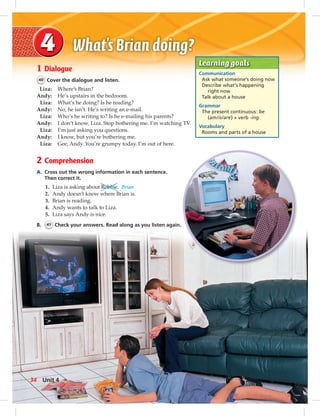
What’s Brian doing?
Pages 34–40
Ask what someone’s doing
now
Describe what’s happening
right now
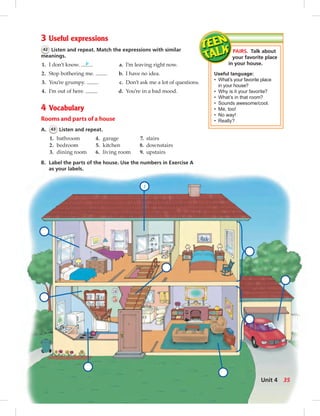
Talk about a house
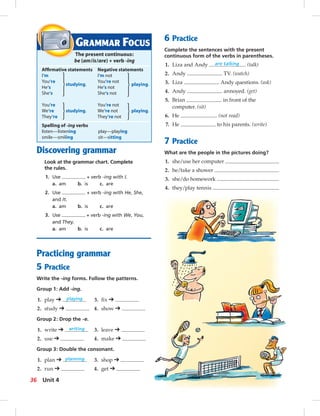
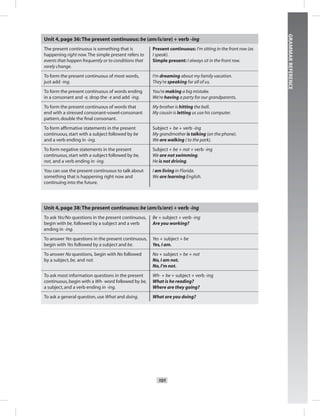
Present continuous: be (am/is/are) + verb -ing
– Affirmative and negative statements
– Yes/No questions
– Information questions
Page 41 Progress check Units 3 and 4 Test-taking tip: Work carefully.
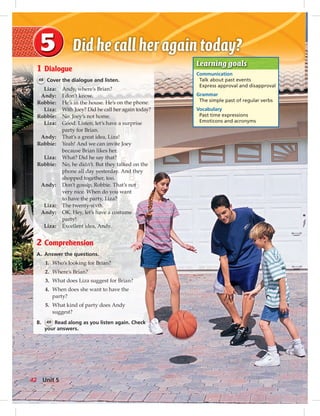
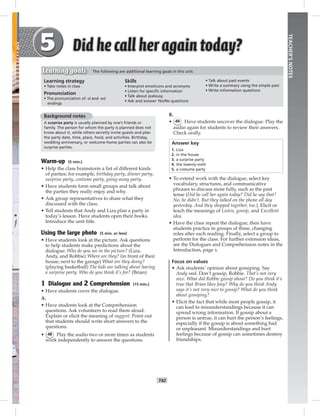
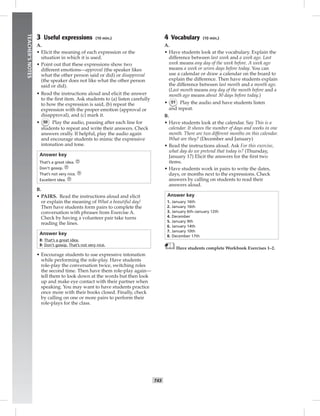
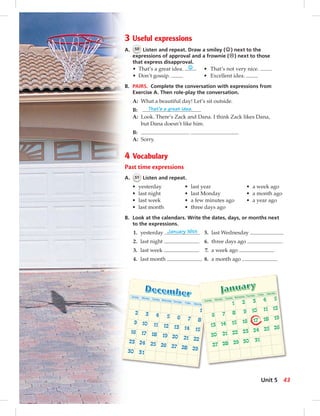
Did he call her again
today?
Pages 42–49
Talk about past events
Express approval and
disapproval
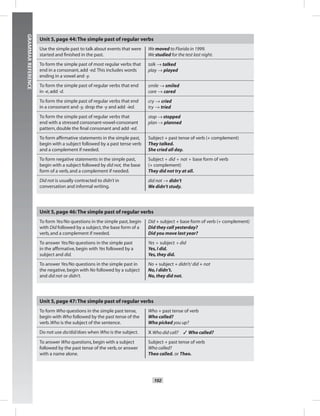
Simple past of regular verbs
– Affirmative and negative statements
– Yes/No questions
– Information questions
Page 50
Page 51
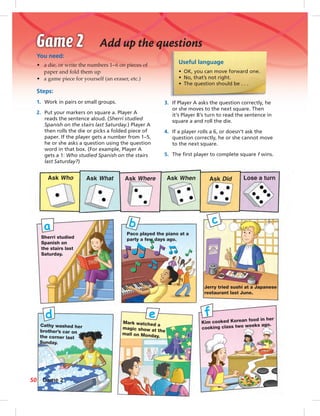
Game 2: Add up the questions
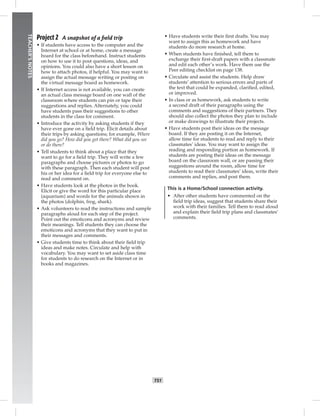
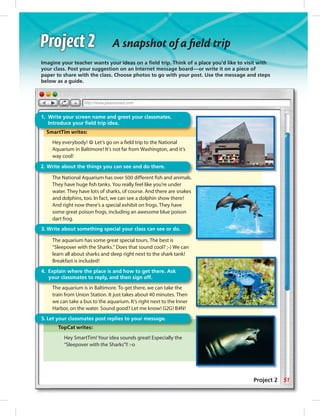
Project 2: A snapshot of a field trip
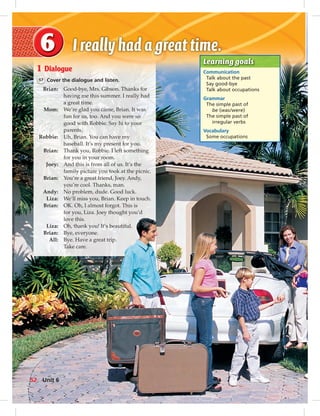
I reallyhad a great time.
Pages 52–58
Talk about the past
Greet people and say good-bye
Talk about occupations
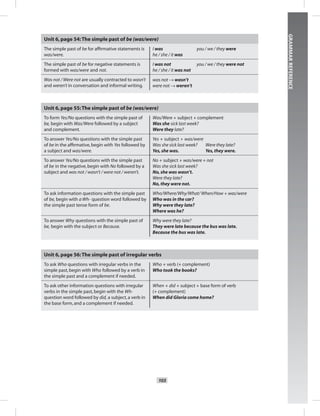
Simple past of be (was/were)
– Affirmative and negative statements
– Yes/No questions
– Information questions
Simple past of irregular verbs
– Affirmative and negative statements
– Yes/No questions
– Information questions
Progress check Units 5 and 6 Test-taking tip: Review your answers.Page 59
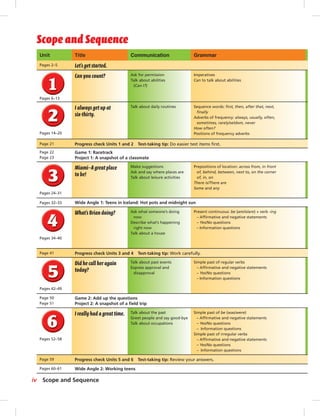
Wide Angle 2: Working teensPages 60–61
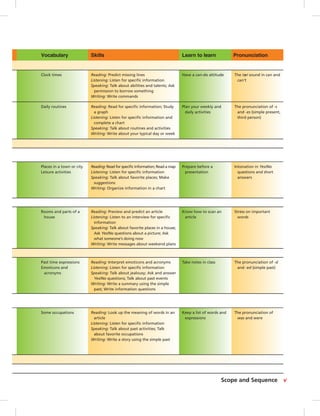
Pages 2–5 Let’s get started.
iv Scope and Sequence
Unit Title Communication Grammar
Scope and Sequence
Postcards_splitB_TE1_FM.indd iv 2/27/07 10:23:12 AM
Stress on important
words
Clock times Reading: Predict missing lines
Listening: Listen for specific information
Speaking: Talk about abilities and talents; Ask
permission to borrow something
Writing: Write commands
Have a can-do attitude The /æ/ sound in can and
can’t
Daily routines Reading: Read for specific information; Study
a graph
Listening: Listen for specific information and
complete a chart
Speaking: Talk about routines and activities
Writing: Write about your typical day or week
Plan your weekly and
daily activities
The pronunciation of -s
and -es (simple present,
third person)
Places in a town or city
Leisure activities
Reading: Read for specific information; Read a map
Listening: Listen for specific information
Speaking: Talk about favorite places; Make
suggestions
Writing: Organize information in a chart
Prepare before a
presentation
Intonation in Yes/No
questions and short
answers
Rooms and parts of a
house
Reading: Preview and predict an article
Listening: Listen to an interview for specific
information
Speaking: Talk about favorite places in a house;
Ask Yes/No questions about a picture; Ask
what someone’s doing now
Writing: Write messages about weekend plans
Know how to scan an
article
The pronunciation of -d
and -ed (simple past)
Past time expressions
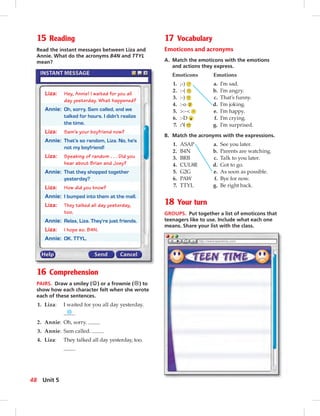
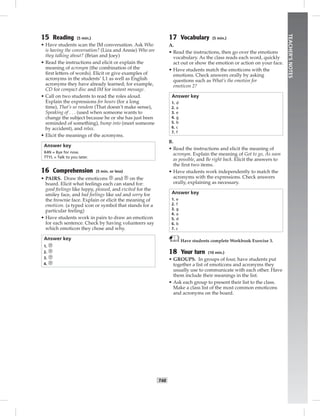
Emoticons and
acronyms
Reading: Interpret emoticons and acronyms
Listening: Listen for specific information
Speaking: Talk about jealousy; Ask and answer
Yes/No questions; Talk about past events
Writing: Write a summary using the simple
past; Write information questions
Take notes in class
Some occupations Reading: Look up the meaning of words in an
article
Listening: Listen for specific information
Speaking: Talk about past activities; Talk
about favorite occupations
Writing: Write a story using the simple past
Keep a list of words and
expressions
The pronunciation of
was and were
vScope and Sequence
Vocabulary Skills Learn to learn Pronunciation
Postcards_splitB_TE1_FM.indd v 2/27/07 10:23:13 AM0:23:12 AM
Postcards
vi
INTRODUCTION
Principles behind the course
1. Postcards immediately captures students’
attention by:
• Introducing teenage characters with whom
students readily identify
• Presenting the real-life language that young
speakers of American English use
• Focusing on up-to-date situations, topics, and
themes that teenagers inherently recognize and
respond to
• Providing stimulating sensory input through
engaging photos, illustrations, and realia chosen
especially for the teen learner
2. Postcards holds teenagers’ attention by:
• Offering a great variety of lesson formats,
exercises, and activities
• Personalizing learning through activities that
allow students to talk about themselves, their
world, and their ideas
• Providing activities that challenge students’ minds
as well as their linguistic skills
• Offering extensive communicative practice,
cross-cultural exploration, group and individual
projects, song activities, games, and competitions
3. Postcards gives all students the opportunity to
achieve success and a sense of achievement by:
• Giving clear, concise, and easy-to-understand
language presentations
• Providing carefully sequenced exercises that allow
students to easily master English grammar and
vocabulary
• Offering level-appropriate communicative
activities that enable students to express
themselves with the English they’ve learned
• Providing extensive recycling as well as follow-
up reinforcement and practice in the Language
Booster Workbook and Grammar Builder
4. Postcards helps students set goals, develop
learner independence, and monitor progress
by:
• Setting clear goals for each unit and section
• Presenting an inductive approach to grammar
• Providing explicit instruction and practice in
learning strategies
• Offering extensive pair and group work with a
focus on cooperative learning and peer feedback
• Allowing opportunities for students to regularly
monitor their progress through Progress checks,
Student self-evaluation checklists, and unit and
quarterly tests
Course components
Student Book
Each Student Book consists of six units divided into
sections of two units. Each unit is followed either
by Putting it together (a photostory activity) or a
Progress check. The pattern is as follows:
Photo
StoryUnit Pages
Progress
CheckUnit Pages
Unit 1
Unit 2
Each Student Book also contains optional materials
that can be done with or after each of the units.
Suggestions as to when to complete each activity
are listed in this Teacher’s Edition. The optional
activities are: Games, Projects, Wide Angle on the
world, Fun with songs, Focus on culture, and Fun
with grammar.
Language Booster
The Language Booster is divided into two parts:
• A Workbook, and
• A Grammar Builder containing grammar
reference pages and extra grammar practice
exercises.
The Workbook section is divided into units
that correspond to those in the Student Book.
It gives practice in Grammar, Vocabulary, and
Communication. It also provides additional practice
in reading and writing.
The Workbook includes three levels of exercises for
each Grammar, Vocabulary, and Communication
section: Get started (easy), Move on (medium),
and Reach for the top (challenging). Designed
for mixed-level and mixed-ability classes, the
Language Booster recognizes that all students will
be motivated if they are given tasks that allow them
to succeed as well as to achieve higher goals.
Most students will benefit from completing the first
two levels of the Workbook exercises, and some may
wish to attempt all three. Students who already have
a basic knowledge of English may find they need to
complete only the second and third levels.
Introduction
Dear Teacher,
Welcome to the second edition of Postcards, a
four-level language course designed specifically for
young teenagers who are studying English.
Postcards_splitB_TE1_FM.indd vi 2/27/07 10:23:13 AM
vii
INTRODUCTION
The Skills development section includes additional
readings and skills practice.
The Grammar Builder section provides additional
grammar exercises as well as grammar reference
pages called Grammar highlights. This section
reviews and clarifies structures presented in each
unit of the Student Book.
The Grammar Builder can be used alongside
the Workbook units or at a later stage for extra
reinforcement or review.
The Language Booster is a flexible resource that
offers self-access material for students in a wide
range of teaching situations. It is not necessary for
students to work through all the material, although
they can do so if they wish.
Teacher’s Edition
The Teacher’s Edition contains unit-by-unit lesson
notes interleaved with the relevant Student Book
pages. The notes include suggestions on how to
teach the material, ideas for extension activities, as
well as all answer keys and listening audioscripts.
Photocopiable unit and quarterly tests are provided
at the end of the Teacher’s Edition, as well as an
extensive Grammar reference section.
All answer keys to the Language Booster and the
tests are found at the end of the Teacher’s Edition.
Class Audio CDs
The Class Audio CDs contain all the recorded
material from the Student Book: the Dialogues, the
Pronunciation, Useful expressions, the Vocabulary
sections, the Listening exercises, the models for the
Communication activities, the Readings, and the
Putting it together photostories.
Posters
Each level has six colorful Posters presenting key
grammatical structures, functions, and vocabulary
learned in the Student Books. They come with
teaching and review activities, and can be displayed
temporarily or permanently in the classroom.
DVDs
The DVD program is a stimulating accompaniment
to the Postcards series. The interesting, dramatic
action portrayed in the DVD program motivates
students and allows them to listen to natural
spoken language used by native speakers of
American English. A DVD Guidebook contains the
videoscripts and teacher’s notes, with suggestions
for activities that can be used to further enrich the
use of the DVD in the classroom.
Placement Test
The Placement Test allows you to know exactly
which level of Postcards is most appropriate for a
student.
ExamView®Test Generator
The Test Generator CD-ROM contains a test
generator engine which allows you to create tests
from Postcards question banks, customize tests to
meet your classroom needs, and create your own
tests for in-class or Internet use.
Teaching tips
Classroom management
Setting up an environment where students feel
encouraged, motivated, challenged, and valued is
the key to a successful class. Some helpful practices
include:
• Maintain class structure. Plan each lesson well.
Maintain a regular routine when beginning and
ending class, when doing exercises and practices,
when assigning pairs and groups, and when
checking work; in this way students will have a
clear understanding of the structure of the class
and what is expected of them.
• Personalize. Learn student names at the start of
the term. Learn about your students’ personalities
and interests; use this to tailor exercises and
content to a particular class. Maintain eye contact
with your students as you teach. Let each student
know you are interested in his or her progress.
• Keep students involved. Limit the amount of
time you spend explaining information—instead,
elicit information from students by asking simple
questions in English. Alternate asking questions
of the entire class and calling on individual
students to answer; this will ensure all students
are listening, involved, and have an opportunity to
participate
• Maintain a fun, challenging pace. Set a time limit
for activities so students will know they have a
limited amount of time to complete the activity;
when most students have finished an activity,
move on to the next stage—this will motivate
students to work hard and maintain student
interest in the lesson.
• Give clear instructions. Always elicit one or
more answers at the start of a written exercise
or provide a model (teacher-student, student-
student, etc.) for pair and group work so that all
students understand what to do. If you discover
at the start of an exercise that many students have
misunderstood the instructions, immediately stop
the activity to clarify instructions and provide
another model.
• Monitor and reward students. Walk around the
room as individuals, pairs, or groups are working
on an activity. Keep an eye on all students so that
you know which ones need your help or guidance.
Reward students both verbally and nonverbally
for their effort and achievement as they work.
When students have finished an activity, always
perform a check for the class and give feedback.
Postcards_splitB_TE1_FM.indd vii 2/27/07 10:23:13 AM0:23:13 AM
Postcards
viii
INTRODUCTION
Teaching techniques
The choice of teaching techniques obviously
depends on the individual classroom situation
and your preferred teaching style. Below are some
suggested techniques:
➤ Pair and group work
Many of the exercises in Postcards are designed so
that students can work in pairs simultaneously.
In pair work, students’ talking time is increased
dramatically, and students engage in extensive
practice in a short period of time. It’s important
to vary pairings in class so each student gets an
opportunity to work with a variety of others. Vary
pairs by having students work with the student on
the left, on the right, in front of, or behind them.
To assign pairs efficiently, give explicit verbal
instructions and examples, such as Work with the
partner on your right. (pointing to the student at the
end of the row) You’re A. (pointing to the student on
his or her right) You’re B. (pointing at the next pair)
You’re A; you’re B. (pointing at the next row) You’re A;
you’re B. Etc.
You can also form random pairs. This works
especially well when you have pairs stand to
perform the exercise. Say, for example: Stand and find
a partner you haven’t worked with before. You have fifteen
seconds to find a partner. Everybody, stand and find a
partner!
Students can work in groups when they do
discussions, task-based activities, role-plays,
questionnaires, and projects. Group work is an
effective vehicle for encouraging cooperation and
independent learning. It also provides shy students
the opportunity to open up and participate. You
can form groups with students of similar ability so
that each student is performing at his or her level.
Alternatively, you can form groups of students with
mixed ability so that the more capable students can
help others. As with pairs, vary group members so
students are exposed to a variety of others. To assign
groups efficiently, give explicit instructions and
examples of how students are to form their groups.
Setting up: modeling and time limits
When students will be working independently in
pairs or groups, follow written or verbal instructions
with a model to ensure all students understand how
to proceed. Depending on student level and the
complexity of the task, you may wish to model in
more than one of the following ways to make sure
students know what to do:
• Teacher to self (T-T):
T: What’s your name? (Pause) I’m Mr. Mori.
• Teacher to student (T-S):
T: (Pointing to student) What’s your name? S: I’m Taro.
• Student to teacher (S-T):
T: (Pointing to student) Ask me. S: What’s your
name? T: I’m Mr. Mori.
• Student to student (S-S):
T: (Pointing to student) Ask Taro. S1: What’s your
name? S2: I’m Taro.
• Student 1 to Student 2 to Student 3, etc., in a chain
(S1-S2-S3):
T: (Pointing to student) Taro, ask Miki. Miki, answer
and ask Tomo. Tomo, answer and ask the next student,
and so on. S1: What’s your name? S2: I’m Miki.
What’s your name? S3: I’m Tomo. What’s your name?
S4: I’m . . .
To make sure students are focused and work quickly,
set a time limit for the task. Warn students halfway
through the task how many minutes they have left.
Warn them again one minute or so before the time
is up.
Monitoring and correction
After modeling, it’s important to move around
the classroom and unobtrusively monitor pairs or
groups. While monitoring:
• Make sure students are demonstrating that
they understand how to do the exercise; if most
students have not understood, you may need to
do another model.
• Make sure that students are using the main target
language (the grammatical or lexical focus of
the practice) correctly; if most students are not,
you may want to stop to do a quick review and
encourage students to pay attention to language
usage.
• Don’t correct minor errors. Just take note of any
important ones or ones which would be helpful
for the whole class to give feedback on later.
• Move unobtrusively from group to group to help,
encourage, and praise students as needed. Listen
for pairs or groups with typical or interesting
conversations—you may wish to call on these to
share their work during the check.
Following through: checking
After pairs or groups have finished an exercise, it
is important to check by calling on a few pairs or
groups to present their exchanges, ideas, summaries,
etc., to the class. This will allow the class to see
typical or interesting examples of pair and group
work, and provide feedback and closure. For
dialogues and exchanges, call on pairs or groups
to stand and perform for the class. For discussions,
you may wish to call on one person from the pair or
group to summarize the conversation.
➤ Repetition and choral practice
Repetition and choral practice helps students
reproduce and remember sounds, words, and
structural patterns. Repeating chorally can also help
students gain confidence before they are asked to
perform individually. Repetition and choral practice
can be used with Dialogues, Putting it together
photostories, Grammar focus charts, Pronunciation
exercises, Vocabulary lists, Useful expressions, and
Communication and Speaking exchanges.
Postcards_splitB_TE1_FM.indd viii 2/27/07 10:23:14 AM
ix
INTRODUCTION
Options
Below are some different patterns for repetition and
choral practice:
• Whole class: Everyone, repeat after me/the CD.
Optimal for the first time a dialogue, exchange,
or vocabulary item is presented—the whole class
repeats after the teacher or audio.
• Half the class at a time: This half of the class repeat
after A, then this half of the class after B. Useful for
dialogues or exchanges with two roles, or for
encouraging competition between two sides of a
class for each line of a dialogue or exchange. This
can also be done with horizontal or vertical rows:
(Pointing to the appropriate rows) Even-numbered
rows repeat after A, odd-numbered rows repeat after B.
• Groups: This group repeats after A, this group after
B, and this group after C. Useful with dialogues or
exchanges involving multiple roles. Make sure
each group gets to repeat after each role once.
• Individual checks: Pedro, repeat. Useful for
monitoring individual pronunciation and keeping
all students actively involved, individual checks
can be interspersed with any class or group choral
repetition.
Techniques
A good technique for choral practice is
“backchaining,” in which students repeat an
utterance—usually a sentence—in parts, starting
from the end and building up to the complete
utterance; for example: Repeat after me, everybody
. . . start? . . . movie start? . . . does the movie start? . . .
What time does the movie start? The key to effective
backchaining is to keep intonation consistent.
Choral repetition must be fast-paced and
challenging in order to maintain student
involvement. A good technique for maintaining
pace is “overlapping,” or presenting the beginning
of a new line or phrase just as students are finishing
repeating the previous one; for example:
Teacher: How are you?
Class: How are you?
Teacher: I’m fine, thanks. (as students
are saying you)
Important stress and intonation patterns can be
emphasized by exaggerating and using body
language during choral repetition; for example,
saying stressed words more loudly and with
gestures: What TIME does the movie START?
➤ Homework and homework correction
The writing exercises in the Student Book and in
the Language Booster may be given as homework.
It is a good idea to prepare students beforehand
for homework by making sure that instructions
are understood, clarifying any new vocabulary or
expressions, and eliciting one or two exercise items
for each step or exercise.
Homework can be corrected in the following ways:
• Check answers to exercises by eliciting the
answers orally in class and writing answers on the
board as needed.
• Have students correct their partner’s exercises
using a photocopied answer key or with the
teacher reading out the answers.
• For written paragraphs and compositions, have
students check their partner’s work using the Peer
editing checklist (page 138 of the Student Book).
Suggested procedures for the Student Book
The Student Book offers an array of interesting and
engaging material that students will enjoy doing in
class. Below are some suggested general procedures
for each element in the Student Book.
➤ Learning goals
The Learning goals highlight the main points of
Communication, Grammar, and Vocabulary in each
unit. Before starting a lesson, you may want to have
students look at the Learning goals.
Suggested procedures
• Draw students’ attention to the items in the
Communication section; for example, Talk about
abilities, Ask for permission (Unit 1). Ask the class to
give examples, either in English or L1, of language
that they expect to learn in the unit.
• Read or call on a student to read aloud the
Grammar goals. Don’t explain the grammar point
at this time; it is enough to introduce students to
the terminology at this point. Tell students that
they will learn more about the Grammar points in
the unit.
• Refer students to the word groups listed in the
Vocabulary section; for example, Clock times
(Unit 1). Elicit examples of English words students
already know in these groups.
• After students have completed the unit, you may
wish to have students refer back to the Learning
goals. Ask them to give examples for each of the
goals listed, and to confirm that they have met the
goal.
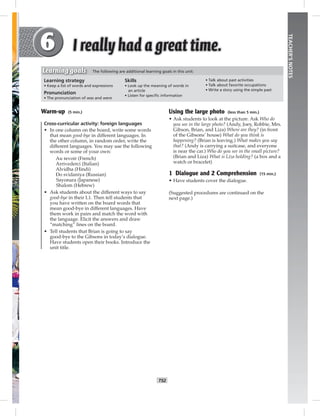
➤ Large photographs
The large photographs that accompany the
presentation material at the beginning of each unit
are an important teaching resource. They can be
used for warm-up and to help students predict the
scene of the dialogue or the focus of the activity.
They can also be used to elicit key vocabulary or to
teach cultural differences between the United States
and the students’ own culture. After the lesson, the
photographs can also be used to review what the
students already know about the characters, such as
their names, ages, and relationships.
Suggested questions for exploiting the large
photographs are given in the teaching notes.
Postcards_splitB_TE1_FM.indd ix 2/27/07 10:23:14 AM0:23:14 AM
Postcards
x
INTRODUCTION
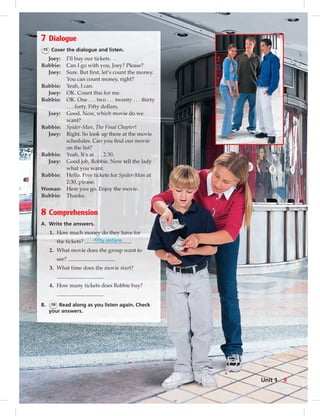
➤ Dialogues and Comprehension exercises
The dialogues in Postcards develop the storyline and
present new structures and functions in context.
The following guidelines are for handling dialogues
in general. Specific suggestions for teaching the
dialogues are given in the lesson notes.
Suggested procedures
Before you play the dialogue:
• Ask questions about the large photograph to
set the scene for the dialogue and help students
predict what it will be about.
• Have students cover the dialogue with a notebook,
a piece of paper, or their hand.
• Tell them to look at the Comprehension
questions. Read or call on students to read the
Comprehension questions aloud. Alternatively,
have students read the questions silently. Preteach
any new vocabulary students will need to
understand to answer the questions.
Depending on your students’ abilities, play the
audio once, twice, or three times. After each
listening, give your students a moment to complete
their answers to the Comprehension questions. You
may want to ask students to raise their hands if
they would like to listen again. When students have
completed the questions:
• Have students uncover the dialogue. Play the
audio and have students read along to check their
answers to the Comprehension questions.
• Elicit the answers, writing them on the board if
needed. If students have difficulty with any of the
items, elicit the line(s) of the dialogue where the
answer is given.
• Play the audio again, stopping at intervals to
explain or elicit the meanings of new vocabulary
or expressions, to elicit the unit’s grammatical
structures, or to give background information
(see dialogue Background notes in this Teacher’s
Edition). Some techniques for teaching new
vocabulary are:
• using real objects in the classroom environment
• showing flashcards or magazine pictures
• using sketches and diagrams on the board or
overhead projector
• miming and acting
• explaining meanings in simple English
• having students use dictionaries
Depending on your students’ needs and your
situation, you may want to either move on to the
next exercise at this point, or you may instead want
to have students practice the dialogue to further
familiarize them with it. Procedures for further
practice are:
• Read or play the dialogue again, pausing after
each sentence or line for students to listen and
repeat chorally and individually. Work on
students’ pronunciation, intonation, and stress.
Vary the choral repetition pattern for different
dialogues (see Options, page ix) and use a
variety of techniques (backchaining, overlapping,
exaggeration and body language; see Techniques,
page ix).
• Assign students to pairs or groups, depending on
the number of characters in the dialogue, and have
them practice reading aloud. Make sure students
switch roles so that each student has the chance to
read each role at least once.
• Time permitting, after the initial pair or group
readings, you may want to do one of the following
actitities to increase students’ fluency and grasp of
the language:
• Have students change partners or groups and
practice each role again; encourage students to
read as quickly and as naturally as they can.
• Have students silently read each line, then look
up and say it, making eye contact with their
partner(s) as they speak.
• Have students stand and act out the parts
dramatically, using facial expressions and
gestures.
• After pair or group practice, call on one or two
pairs or groups to stand and perform the dialogue
in front of the class.
➤ Useful expressions
The Useful expressions are a selected list of phrases
and expressions from the dialogue that are either
common collocations or colloquial expressions. The
students should learn these as fixed items. Do not
attempt to explain the grammar behind the phrases
unless the students ask specifically for information
of this kind. Useful expressions are recycled in
appropriate contexts in the rest of the unit and in the
subsequent units.
Suggested procedures
• Check that the students understand the meanings
of the expressions by eliciting the meaning or
having them give examples of situations when the
expressions are used.
• Play the audio and ask the students to repeat the
phrases chorally. Work on pronunciation, stress,
and intonation as needed. Then have students
complete the exercises.
• You may want to keep a list of the Useful
expressions presented during the course so that
you can use them yourself when interacting with
students and review them at regular intervals.
➤ Vocabulary
Vocabulary is presented in lexical groups and
practiced through exercises and tasks linked to the
grammatical or communicative focus of the unit.
The illustrations in Postcards have been carefully
chosen to help you teach new vocabulary.
Postcards_splitB_TE1_FM.indd x 2/27/07 10:23:14 AM
xi
INTRODUCTION
Suggested procedures
• Play the CD and have students practice
pronouncing the vocabulary items. Pause the
audio and help students as needed. Use the
illustration or another teaching device to make
sure students understand the vocabulary.
• Model or elicit the first one or two exercise items.
Then have students work individually, in pairs, or
in groups to complete each exercise. Monitor, help,
and praise students as they work. When most
students are finished, call on students to share
their answers with the class.
• You may want to have students keep a small
notebook in which they list new words and
expressions along with their definitions.
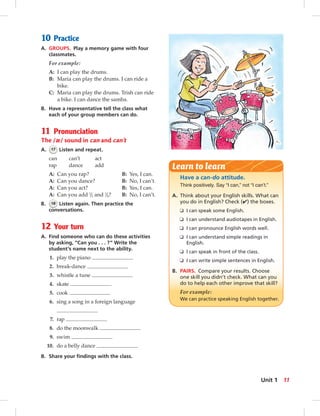
➤ Pronunciation
The Pronunciation exercises isolate and practice
important sounds, stress and intonation patterns, as
well as suprasegmental features (linking, blending,
etc.).
Suggested procedures
• Briefly introduce the pronunciation feature.
Model mouth position for basic sounds; use
the board or gestures for stress, intonation, and
suprasegmental features. Special tips for teaching
each pronunciation item are included in the lesson
notes for each unit.
• Play the audio and have students practice the
target sound several times. Pause the audio and
help students as needed. When students are able
to form the correct sounds, have them complete
the related exercise.
Phonetic transcriptions in the Teacher’s Edition
follow those used in the Longman Dictionary of
American English.
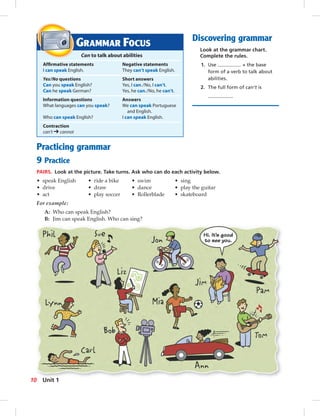
➤ Grammar focus, Discovering grammar, and
Practicing grammar
The Grammar focus charts present the grammatical
forms or structures taught in a unit. The Grammar
focus presentations are always followed by
Discovering grammar. This section invites students
to learn grammar inductively—that is, to figure out
the main grammar rules by themselves. Discovering
grammar is followed by the Practicing grammar
section, which consists of several practice exercises
that enable students to produce the relevant
grammatical form or structure presented in the
Grammar focus chart.
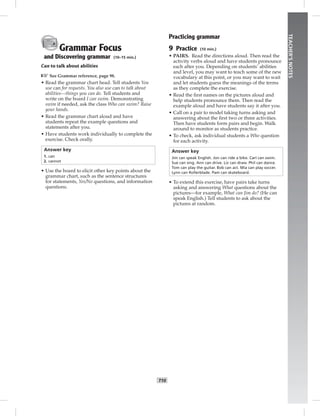
Suggested procedures
• Read the grammar chart heading aloud or call
on a student to read it. Explain or elicit any new
grammatical terms.
• Have students read the examples, either silently or
aloud. Tell them to pay particular attention to the
parts in boldface.
• Ask students to think about the grammar rule or
rules involved. Then have them work individually
or in pairs to complete the Discovering grammar
section.
• Elicit answers to the Discovering grammar section.
Clarify any difficulties.
• Explain or elicit other relevant information about
the grammatical item(s) presented in the chart (see
specific teaching notes for each lesson, as well as
the Grammar reference section at the back of this
Teacher’s Edition). Refer the students back to the
dialogue or presentation text to find examples of
the structures, if helpful.
• Move on to the Practicing grammar section
immediately. These exercises should be done in
class rather than as homework. This will enable
you to detect any problems the students may
have with applying the grammar. The exercises
progress from more controlled to less controlled
application of the grammar.
• For each Practice exercise, model or elicit the first
one or two answers or exchanges. Have students
work individually, in pairs, or groups to complete
each exercise. Walk around the room to monitor,
help, and praise students as they work. When the
majority of the class is finished, elicit the answers
or call on pairs or groups to present to the class.
Write answers on the board as needed.
➤ Communication
The Communication sections focus on the important
communicative functions to be practiced in the
unit. The communication exchanges either develop
the grammar from the unit in a communicative
context—for example, Talk about your routines
(Unit 2)—or exemplify communicative sentences
without emphasis on the underlying grammar—for
example, Make suggestions (Unit 3).
Suggested procedures
• Point out the communicative function to be
practiced and play the audio.
• Practice the exchanges chorally, using
backchaining to help students with overall rhythm
and intonation (see Techniques, page ix).
• Read the instructions for Exercise B and model
the role-play (teacher-student, student-student,
etc.). Have students practice in pairs or groups,
with each student practicing each role one or
more times. To help students internalize and gain
fluency with the language, assign new partners
and have students practice again; alternatively,
have students stand and practice, changing
partners several times (say, for example, Practice
with at least four other students).
• Call on one or more pairs or groups to stand and
perform for the class. If helpful, you may want to
have students write out the conversation after the
oral practice.
Postcards_splitB_TE1_FM.indd xi 2/27/07 10:23:14 AM0:23:14 AM
Postcards
xii
INTRODUCTION
➤ Learn to learn
The Learn to learn sections are designed to help
students become better language learners. This
section presents general learning strategies as well
as specific strategies for reading, listening, speaking,
writing, and vocabulary acquisition. Students are
then given a task with which they can practice
applying the learning strategy.
Suggested procedures
• Read the strategy aloud or call on a student
to read it. Elicit or explain how the strategy is
helpful.
• Tell students that they will now practice using the
strategy. Read or call on students to read the task
instructions. Model or elicit one or more answers if
needed. Then have students complete the task.
• After checking the task, ask students if they found
the strategy helpful. Elicit when and where they
could apply this strategy.
• Recycle the strategy whenever applicable: recycle
a reading strategy in the next reading exercise,
recycle a listening strategy in the next listening
exercise, etc. Recycle by reminding students of the
strategy, eliciting how to perform it, and asking
students to practice applying it. By repeatedly
applying the strategy, students will internalize it.
➤ Teen talk
The Teen talk sections are designed to let students
talk about topics of interest in a casual, relaxing
manner with little or no teacher intervention.
While many of the activities in Postcards focus on
accuracy, Teen talk focuses primarily on teen-to-teen
communication. It gives students a chance to pay
less attention to form and more attention to getting
their ideas across in English.
Suggested procedures
• Read or have students read the instructions, then
quickly chorus the Useful language. Follow with
a teacher-student or student-student model of the
beginning of the discussion.
• Assign groups and let students discuss. Walk
around and monitor as students work. You may
occasionally need to mediate—for example, to
encourage shy students to give their opinions—
but avoid correcting or offering language help
unless asked.
• When students have finished, call on several
students to share their thoughts and ideas on the
topic with the class.
➤ Your turn
The Your turn section personalizes a topic and
allows students to apply recently learned language.
The activity may be oral (see Unit 1, for example) or
written (as in the Focus on culture sections). Follow
standard procedures for pair, group, or writing
activities.
➤ Listening
There are a variety of types of Listening exercises in
Postcards. All include the structures, functions, and
vocabulary in focus. Audioscripts may highlight
a telephone conversation, an extract from a radio
program, an interview, or a recorded continuation
of the storyline featuring the main characters. Each
listening is accompanied by a simple task such as
completing a chart or answering comprehension
questions. Some tasks ask students to listen for
specific information, while others encourage them to
listen for gist rather than at word level.
Suggested procedures
• Set the context of the Listening. Ask warm-up
questions to generate interest.
• Make sure that students understand the
instructions and task.
• Always have students read over the questions,
chart, etc., before they begin. Elicit or explain any
new words in the task.
• Play the audio once for students to grasp the
general idea. Ask a few simple comprehension
questions. Play the audio again once or twice
and have students complete the answers to the
task as they listen. If students still have difficulty
completing the task after a third listening, play
the audio once more and stop at key points where
students need to record information.
• Check the answers to the task. Replay the audio if
helpful.
➤ Reading
The importance of reading cannot be overestimated.
It gives confidence and motivates learning. It
provides context for new language and serves as
a model for writing. Most important of all, it is
a stimulus for ideas and discussion. The reading
texts in Postcards are varied in type and length and
are often adapted from authentic sources such as
brochures, newspapers, and magazines.
Suggested procedures
• Ask a few general warm-up questions to set the
context of the reading. Elicit the title and ask
questions about the photographs. Ask students to
predict what the reading will cover.
• Have students read the instructions and questions
or task, explaining any new vocabulary words
therein. Make sure students understand what they
are to do.
• Have the students read the text silently once
or twice to themselves. Alternatively, play the
audio or read the text aloud the first time with
the students following along in their books, then
let them read the text again silently. Encourage
students to guess the meaning of new words and
expressions as they read.
• Have the class do the comprehension task, either
individually or in pairs.
Postcards_splitB_TE1_FM.indd xii 2/27/07 10:23:14 AM
xiii
INTRODUCTION
• Check the answers. Elicit or explain the meanings
of any key vocabulary items. If helpful, have the
students do a final confirmation reading of the text.
➤ Writing
Writing tasks have a twofold purpose: to consolidate
the language in focus and to help students produce
specific text types. The detailed lesson notes give
guidance for handling specific writing tasks.
Suggested procedures
• There is often a model reading or set of questions
that will help guide students through the
Writing exercise. Encourage them to consider the
model as they think about and then write their
paragraph(s).
• Help students brainstorm about what kind of
content they might include in their writing. You
may wish to do this as a class, in groups, or in
pairs.
• Encourage students to make notes or an outline
before they begin writing. If helpful, review the
relevant paragraph structure with your students;
for example:
• topic sentence
• examples or support
• conclusion
• If students are performing the Writing exercise
in class, circulate to monitor and help them.
Encourage them to check a dictionary for the
spellings of new words.
• After students have finished their writing, have
them exchange papers with a partner and mark
their partner’s work using the Peer editing
checklist on page 138. Then have students take
back and correct their writing before turning it
in to you. You may wish to have students use the
following correction symbols when marking each
others’ work:
sp = spelling gr = grammar wo = word order
v = vocabulary p = punctuation
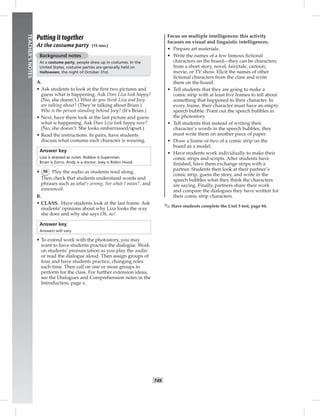
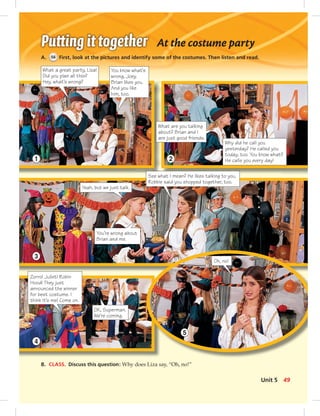
➤ Putting it together
Putting it together is a photostory activity that
occurs at the end of odd-numbered units (Units
1, 3, and 5). It features the main characters and
consolidates previously learned language with a
predicting and listening activity. Follow standard
listening activity procedures.
You may want to extend this section by treating
the photostory text as a dialogue with chorusing
and pronunciation work, pair or group practice,
and dramatic reenactment. The photographs and
dialogue can also be used to discuss American life
and culture and compare it with students’ own.
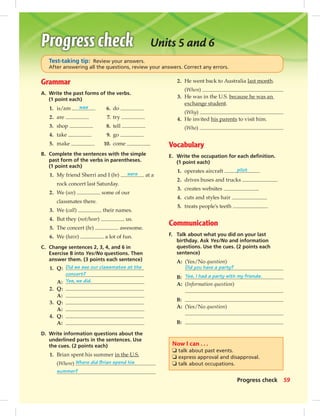
➤ Progress checks
The Progress checks are found after every two
units (Units 2, 4, and 6). They give students a
chance to measure their progress on a regular basis.
Each begins with a Test-taking tip to help students
learn strategies for doing their best on tests. The
Progress check tasks are divided into three sections:
Grammar, Vocabulary, and Communication. There
is also a Now I Can . . . checklist for students to
reflect on what they have learned in the previous
two units.
To calculate student scores on the Progress checks,
simply total the number of possible points per
section (the number of items minus the examples).
Then divide the number of correct responses by the
total number of points. For example, on a test with
63 possible points, a student answered 46 correctly.
Divide 46, the number of correct responses, by 63,
the number of possible points. The calculation
(46 ÷ 63 = .73) results in a score of 73%.
Optional Sections
The following are optional sections that can be
done with or after units. Suggestions as to teaching
procedure and when to complete each activity are
listed at the optional point of use. You may wish to
use all of these activities or just a few, depending on
your situation and student needs.
➤ Games
Games are found after Units 1 and 2 of the Student
Book. The Games are designed to practice relevant
grammar and vocabulary in a relaxed and fun format.
They provide students with the opportunity to
consolidate language while having fun.
➤ Projects
Projects are found after each game. These Projects
provide students with the opportunity to produce a
piece of work based on their own input and ideas,
while at the same time consolidating and expanding
on the language they have learned. Project work
fosters creativity, learner independence, and
cooperation with other students.
Make sure that you and the students can give
sufficient time to each Project. Some may be
completed in one or two class hours, while are
longer-term assignments.
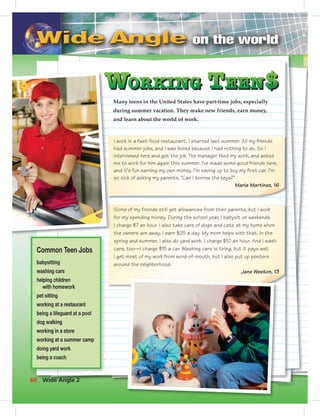
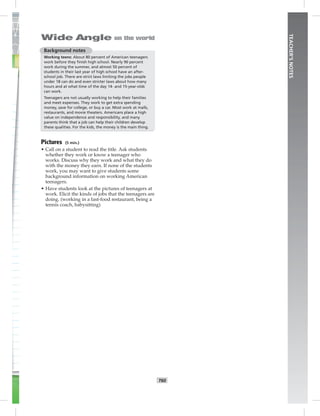
➤ Wide Angle on the world
Wide Angle readings come after every third unit.
Each expands on a theme from previous units.
Wide Angle offers additional integrated practice in
reading, speaking, listening, writing, vocabulary
development, and learning strategies.
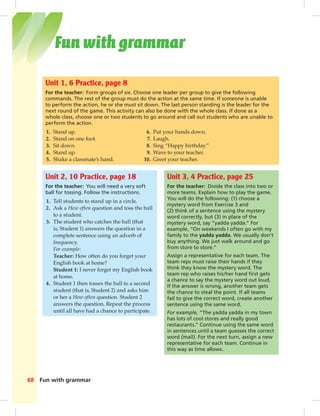
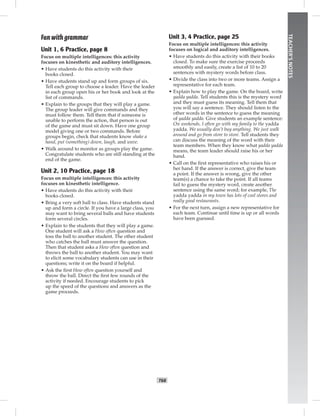
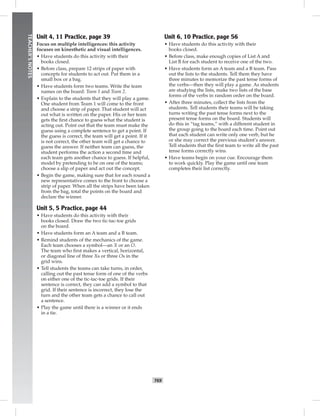
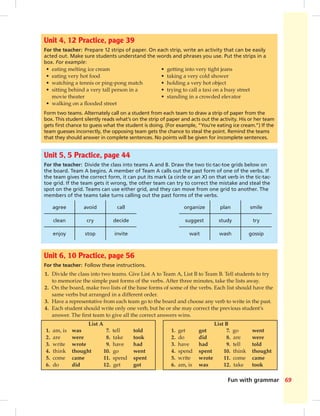
➤ Fun with grammar
Throughout the units, students are referred to
the Fun with grammar activities located in the
back of the Student Book. These grammar-based
competitions are designed to be fun while at the
same time allow for review and reinforcement of
unit content.
Postcards_splitB_TE1_FM.indd xiii 2/27/07 10:23:15 AM0:23:14 AM
Postcards
INTRODUCTION
xiv
➤ Fun with songs
The Fun with songs section is found at the end of
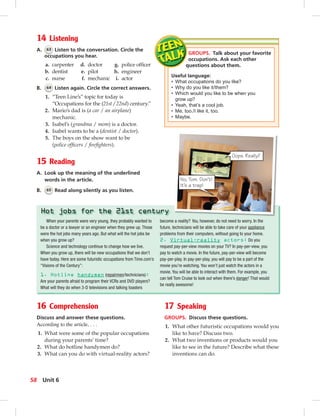
the Student Book. These song projects provide an
opportunity for students to take a break and relax,
listen to and discuss music and musicians, and gain
a greater appreciation and understanding of English
songs.
➤ Focus on culture
Focus on culture pages are found at the end of the
Student Book. These readings allow students to gain
cross-cultural understanding through the study of
other cultures and comparisons with their own. Each
Focus on culture spread includes discussion and
writing practice.
Special Features in the Teacher’s Edition
➤ Background notes
Background notes in this Teacher’s Edition present
in-depth information on U.S. and world culture as
touched on in the dialogues, exercises, and readings
presented in the Student Book. Relevant information
from the notes can be shared with students to
increase their cross-cultural understanding.
➤ Focus on multiple intelligences
Recognizing that students have a variety of learning
styles and abilities, teaching suggestions in this
Teacher’s Edition include notes on activities with
a strong focus on multiple intelligences. These
activities will benefit students with natural affinities
to specific intelligences and related learning styles.
At the same time, focusing on different intelligences
can help all students explore and further develop
a wider range of learning modes. The intelligences
highlighted in the teaching notes are:
Kinesthetic: Students with a strong kinesthetic, or
bodily, intelligence will learn well when engaging
in activities involving motor skills. Activities such
as hands-on projects, games, total physical response
exercises (TPR), and the acting out of dialogues
and scripts with movement and gestures stimulate
kinesthetic intelligence.
Visual: A student with visual/spacial intelligence
responds to visual representations and is good at
creating mental images. Making or using pictures,
diagrams, graphic organizers, maps, symbols,
photos or videos, etc., will be helpful for this type of
learner, as will activities involving visualizing.
Auditory: A student with strong auditory/musical
intelligence is sensitive to sounds and patterns of
rhythm, intonation, and pitch. Students with this
type of intelligence will be stimulated by activities
involving sound—pronunciation and intonation
work, listening exercises, songs, jazz chants, etc.
Logical: A student with developed logical/
mathematical intelligence is good at thinking
logically, recognizing patterns, and doing
calculations. A logical learner will benefit from
activities involving deductive and inductive
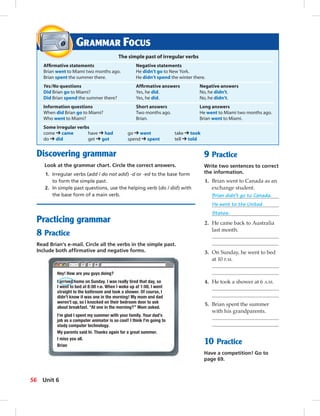
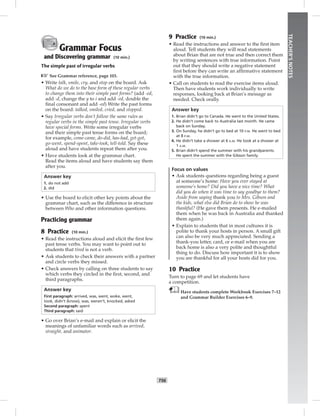
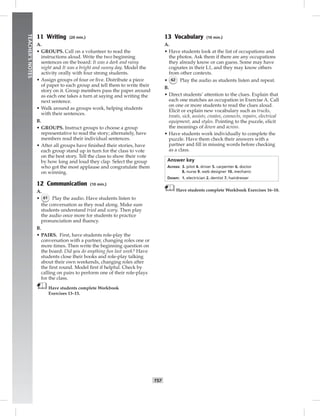
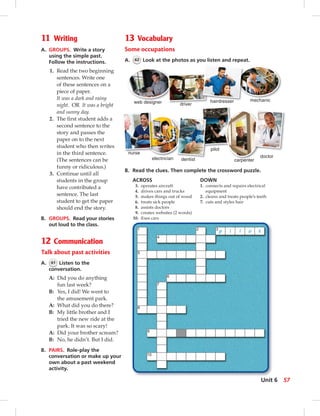
thinking, classification, rules, and processes.
Linguistic: Students with a high degree of linguistic
intelligence are talented at extracting meaning from
text and using language to express meaning. They
tend to be good at learning languages and generally
have an affinity for writing, reading, summarizing,
giving speeches, and other language-based activities.
Interpersonal: Students with a high degree of
interpersonal intelligence have a developed
sensitivity to others and learn well through social
interactions. Pair and group work, collaborative
learning, interviewing, writing dialogues, and
reflecting on social situations presented in dialogues
are examples of activities helpful to an interpersonal
learner.
Intrapersonal: A student who is self-reflective
and sensitive to his or her own feelings tends to
have a high degree of intrapersonal intelligence.
Independent work, self-assessment, self-reflection,
personalizing, journal-writing, and thinking about
one’s personal reaction to situations and topics will
be of benefit to the intrapersonal learner.
➤ Focus on values
As the classroom is one of the best places to help
young people develop values and character, each
unit of the Teacher’s Edition includes notes focusing
on values. The characters and situations presented
in the dialogues and photostories are modeled after
real teens and thus present numerous opportunities
for reflection on appropriate and inappropriate
behavior. Focus on values notes provide suggestions
on how to help students recognize and react to
implicit and explicit values, attitudes, and behavior
in dialogues and photostories.
➤ Cross-curricular activities
The Teacher’s Edition includes Cross-curricular
activity suggestions for each unit of the Student
Book. These activities encourage students to
use—and sometimes expand—their knowledge of
social studies, science, literature, and the arts while
practicing English.
➤ Home/School connection
Parents play a fundamental role in the education
of their children. The more they get involved and
encourage their children, the better results students
achieve. For this reason the Teacher’s Edition
provides Home/School connection suggestions
on increasing parental involvement in students’
English education.
➤ Grammar reference
The Grammar reference section found at the end of
the Teacher’s Edition provides in-depth grammatical
background about the structures and elements in
Postcards_splitB_TE1_FM.indd xiv 2/27/07 10:23:15 AM
INTRODUCTION
xv
each of the grammar charts in the Student Book. The
Grammar reference section provides any necessary
grammatical information the teacher needs to
successfully teach the unit grammar. Depending
on the level and prior knowledge of students, the
teacher may wish to share or elicit some or all of this
extra grammatical information in class.
➤ Unit and Quarterly tests
Photocopiable Unit and Quarterly tests (every
three units), as well as their answer keys, are found
at the end of the Teacher’s Edition. The answer
keys specify the total number of possible points for
each test: 50 points for Unit tests and 150 points for
Quarterly tests. To calculate student scores, simply
divide the number of correct responses by the total
number of possible points. For example, on a test
with 50 possible points, a student answered 45
correctly. Divide 45, the number of correct responses,
by 50, the number of possible points. The calculation
(45 ÷ 50 = .90) results in a score of 90%.
➤ Student self-evaluation checklists
A photocopiable Student self-evaluation checklist is
found at the end of the Teacher’s Edition. You may
copy and give this to students after each unit so that
they may reflect on and assess their own progress.
➤ Certificate of completion
The Certificate of completion at the back of this
Teacher’s Edition may be photocopied and given to
students at the successful completion of this course.
The certificate serves as a concrete symbol of the
effort and progress the student has made in his or
her English study.
Postcards_splitB_TE1_FM.indd xv 2/27/07 10:23:15 AM0:23:15 AM
vi-5_SB1
Summary: In Student Book 1A, Brian
Williams, an exchange student from Australia,
comes to the United States to live with an
American family, the Gibsons, for a summer.
The Gibson children—Andy, Liza, and
Robbie—and Mrs. Gibson meet Brian at the
airport. Liza is immediately attracted to Brian.
She tells her best friend, Annie, about Brian
but refuses to have the two meet. Later, Brian
meets Joey, Liza’s only cousin.
Busy with Brian, Andy has no time for his
girlfriend, Caroline. He forgets her birthday.
When he visits Caroline at her house, she
is understandably upset. She pretends to
be very interested in Brian, which worries
Andy.
vi-5_SB1B_LGS_14106.indd vi 1/22/07 3:06:47 PM
vi-5_SB1B_LGS_14106.indd vii 1/19/07 2:06:28 PM3:06:47 PM
Postcards
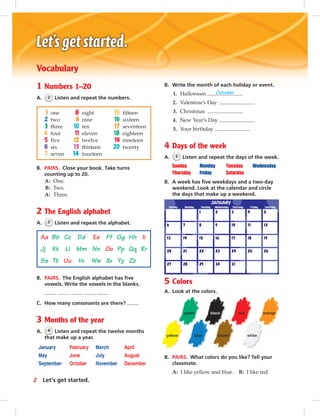
Aa Bb Cc Dd Ee Ff Gg Hh Ii
Jj Kk Ll Mm Nn Oo Pp Qq Rr
Ss Tt Uu Vv Ww Xx Yy Zz
orange
whitebrownblue
red
yellow
blackgreen
Vocabulary
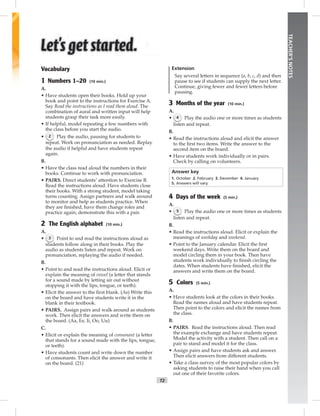
1 Numbers 1–20
A. 2 Listen and repeat the numbers.
B. PAIRS. Close your book. Take turns
counting up to 20.
A: One.
B: Two.
A: Three.
2 The English alphabet
A. 3 Listen and repeat the alphabet.
B. PAIRS. The English alphabet has five
vowels. Write the vowels in the blanks.
C. How many consonants are there?
3 Months of the year
A. 4 Listen and repeat the twelve months
that make up a year.
January February March April
May June July August
September October November December
B. Write the month of each holiday or event.
1. Halloween October
2. Valentine’s Day
3. Christmas
4. New Year’s Day
5. Your birthday
4 Days of the week
A. 5 Listen and repeat the days of the week.
Sunday Monday Tuesday Wednesday
Thursday Friday Saturday
B. A week has five weekdays and a two-day
weekend. Look at the calendar and circle
the days that make up a weekend.
5 Colors
A. Look at the colors.
B. PAIRS. What colors do you like? Tell your
classmate.
A: I like yellow and blue. B: I like red.
1 one 8 eight 15 fifteen
2 two 9 nine 16 sixteen
3 three 10 ten 17 seventeen
4 four 11 eleven 18 eighteen
5 five 12 twelve 19 nineteen
6 six 13 thirteen 20 twenty
7 seven 14 fourteen
2 Let’s get started.
vi-5_SB1B_LGS_14106.indd 2 1/17/07 7:20:26 PM
T2
TEACHER’SNOTES
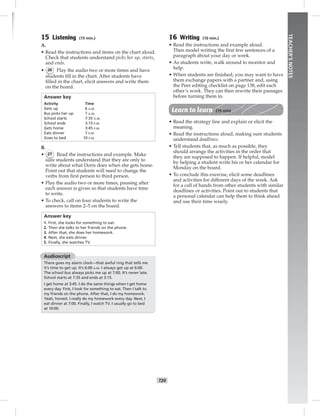
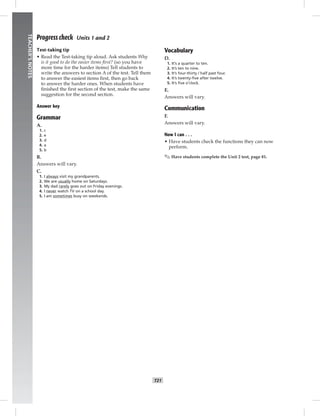
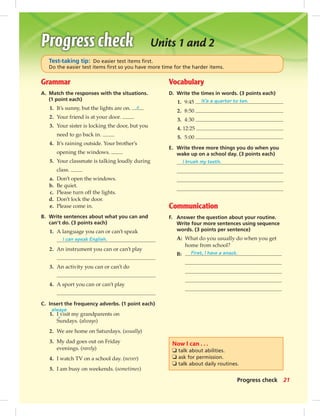
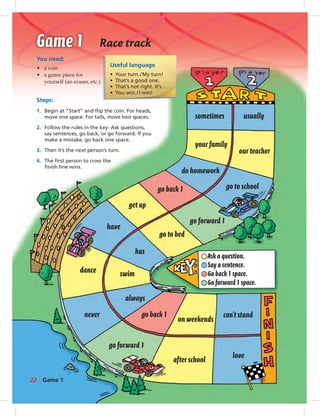
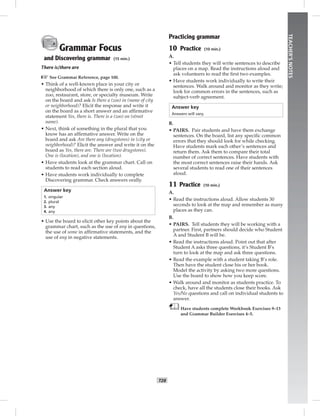
Vocabulary
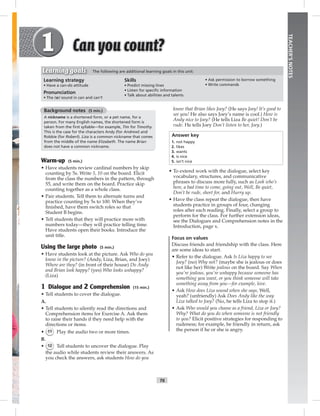
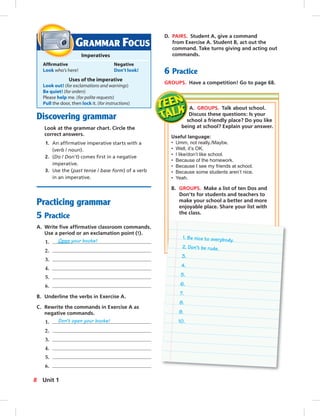
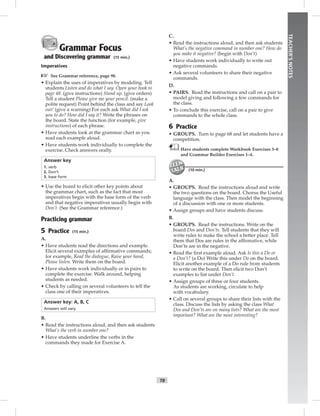
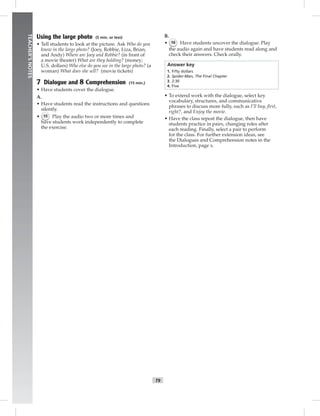
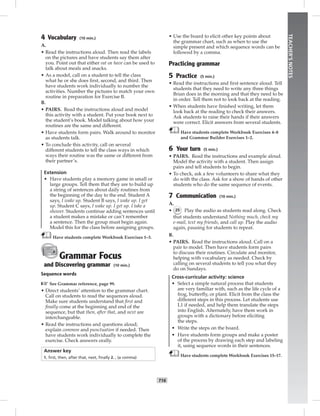
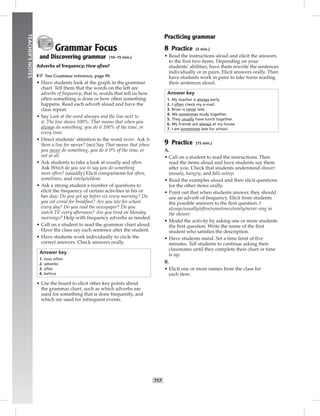
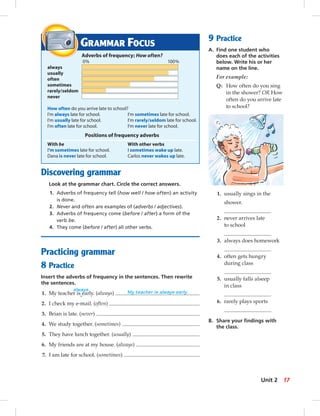
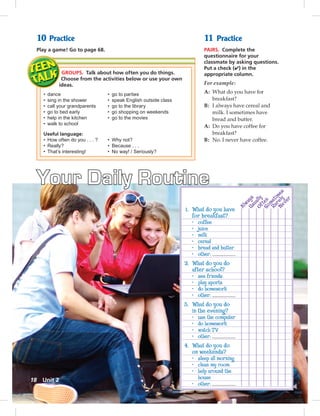
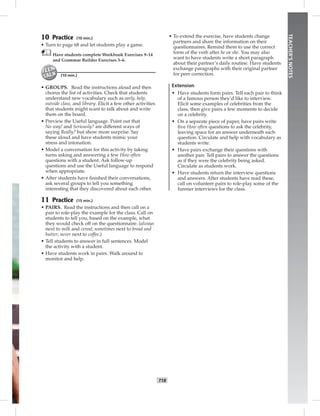
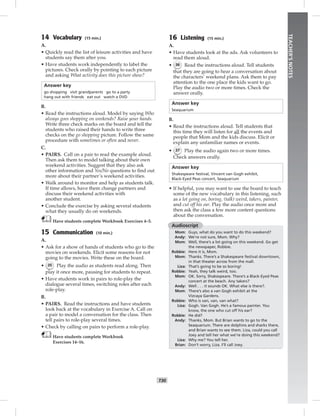
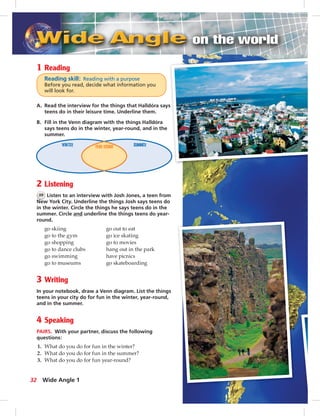
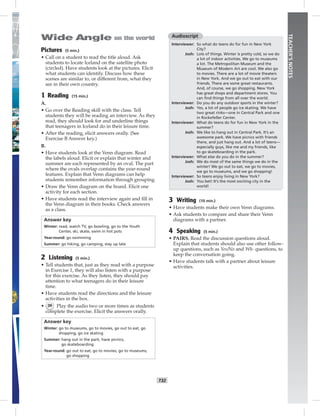
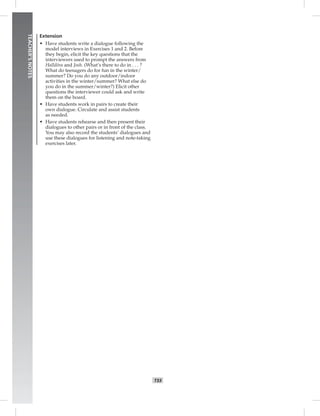
1 Numbers 1–20 (10 min.)
A.
• Have students open their books. Hold up your
book and point to the instructions for Exercise A.
Say Read the instructions as I read them aloud. The
combination of aural and written input will help
students grasp their task more easily.
• If helpful, model repeating a few numbers with
the class before you start the audio.
• 2 Play the audio, pausing for students to
repeat. Work on pronunciation as needed. Replay
the audio if helpful and have students repeat
again.
B.
• Have the class read aloud the numbers in their
books. Continue to work with pronunciation.
• PAIRS. Direct students’ attention to Exercise B.
Read the instructions aloud. Have students close
their books. With a strong student, model taking
turns counting. Assign partners and walk around
to monitor and help as students practice. When
they are finished, have them change roles and
practice again; demonstrate this with a pair.
2 The English alphabet (10 min.)
A.
• 3 Point to and read the instructions aloud as
students follow along in their books. Play the
audio as students listen and repeat. Work on
pronunciation, replaying the audio if needed.
B.
• Point to and read the instructions aloud. Elicit or
explain the meaning of vowel (a letter that stands
for a sound made by letting air out without
stopping it with the lips, tongue, or teeth).
• Elicit the answer to the first blank. (Aa) Write this
on the board and have students write it in the
blank in their textbook.
• PAIRS. Assign pairs and walk around as students
work. Then elicit the answers and write them on
the board. (Aa, Ee, Ii, Oo, Uu)
C.
• Elicit or explain the meaning of consonant (a letter
that stands for a sound made with the lips, tongue,
or teeth).
• Have students count and write down the number
of consonants. Then elicit the answer and write it
on the board. (21)
Extension
Say several letters in sequence (a, b, c, d) and then
pause to see if students can supply the next letter.
Continue, giving fewer and fewer letters before
pausing.
3 Months of the year (10 min.)
A.
• 4 Play the audio one or more times as students
listen and repeat.
B.
• Read the instructions aloud and elicit the answer
to the first two items. Write the answer to the
second item on the board.
• Have students work individually or in pairs.
Check by calling on volunteers.
Answer key
1. October 2. February 3. December 4. January
5. Answers will vary.
4 Days of the week (5 min.)
A.
• 5 Play the audio one or more times as students
listen and repeat.
B.
• Read the instructions aloud. Elicit or explain the
meanings of weekday and weekend.
• Point to the January calendar. Elicit the first
weekend days. Write them on the board and
model circling them in your book. Then have
students work individually to finish circling the
dates. When students have finished, elicit the
answers and write them on the board.
5 Colors (5 min.)
A.
• Have students look at the colors in their books.
Read the names aloud and have students repeat.
Then point to the colors and elicit the names from
the class.
B.
• PAIRS. Read the instructions aloud. Then read
the example exchange and have students repeat.
Model the activity with a student. Then call on a
pair to stand and model it for the class.
• Assign pairs and have students ask and answer.
Then elicit answers from different students.
• Take a class survey of the most popular colors by
asking students to raise their hand when you call
out one of their favorite colors.
Postcards_splitB_TE1_FM.indd T2 2/27/07 10:23:15 AM7:20:26 PM
vi-5_SB1
T3
TEACHER’SNOTES
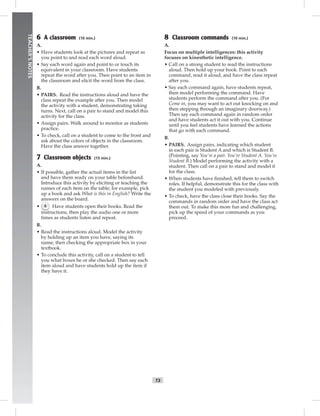
6 A classroom (10 min.)
A.
• Have students look at the pictures and repeat as
you point to and read each word aloud.
• Say each word again and point to or touch its
equivalent in your classroom. Have students
repeat the word after you. Then point to an item in
the classroom and elicit the word from the class.
B.
• PAIRS. Read the instructions aloud and have the
class repeat the example after you. Then model
the activity with a student, demonstrating taking
turns. Next, call on a pair to stand and model this
activity for the class.
• Assign pairs. Walk around to monitor as students
practice.
• To check, call on a student to come to the front and
ask about the colors of objects in the classroom.
Have the class answer together.
7 Classroom objects (15 min.)
A.
• If possible, gather the actual items in the list
and have them ready on your table beforehand.
Introduce this activity by eliciting or teaching the
names of each item on the table; for example, pick
up a book and ask What is this in English? Write the
answers on the board.
• 6 Have students open their books. Read the
instructions, then play the audio one or more
times as students listen and repeat.
B.
• Read the instructions aloud. Model the activity
by holding up an item you have, saying its
name, then checking the appropriate box in your
textbook.
• To conclude this activity, call on a student to tell
you what boxes he or she checked. Then say each
item aloud and have students hold up the item if
they have it.
8 Classroom commands (10 min.)
A.
Focus on multiple intelligences: this activity
focuses on kinesthetic intelligence.
• Call on a strong student to read the instructions
aloud. Then hold up your book. Point to each
command, read it aloud, and have the class repeat
after you.
• Say each command again, have students repeat,
then model performing the command. Have
students perform the command after you. (For
Come in, you may want to act out knocking on and
then stepping through an imaginary doorway.)
Then say each command again in random order
and have students act it out with you. Continue
until you feel students have learned the actions
that go with each command.
B.
• PAIRS. Assign pairs, indicating which student
in each pair is Student A and which is Student B.
(Pointing, say You’re a pair. You’re Student A. You’re
Student B.) Model performing the activity with a
student. Then call on a pair to stand and model it
for the class.
• When students have finished, tell them to switch
roles. If helpful, demonstrate this for the class with
the student you modeled with previously.
• To check, have the class close their books. Say the
commands in random order and have the class act
them out. To make this more fun and challenging,
pick up the speed of your commands as you
proceed.
Postcards_splitB_TE1_FM.indd T3 2/27/07 10:23:17 AM
Stand up.2Come in.1
Close your book.5
Sit down.3
Open your book.4 Write.6
Exchange work
with a classmate.9Raise your hand.8Listen.7
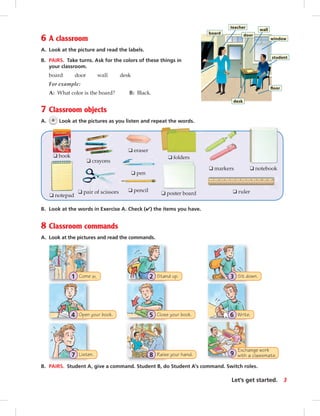
8 Classroom commands
A. Look at the pictures and read the commands.
6 A classroom
A. Look at the picture and read the labels.
B. PAIRS. Take turns. Ask for the colors of these things in
your classroom.
board door wall desk
For example:
A: What color is the board? B: Black.
7 Classroom objects
A. 6 Look at the pictures as you listen and repeat the words.
B. Look at the words in Exercise A. Check (✔) the items you have.
B. PAIRS. Student A, give a command. Student B, do Student A’s command. Switch roles.
❑ book
❑ eraser
❑ markers
❑ notepad
❑ pen
❑ poster board
❑ crayons
❑ folders
❑ notebook
❑ pair of scissors ❑ pencil ❑ ruler
3Let’s get started.
board
teacher
door
wall
window
student
floor
desk
vi-5_SB1B_LGS_14106.indd 3 1/17/07 7:20:31 PM0:23:17 AM
Postcards
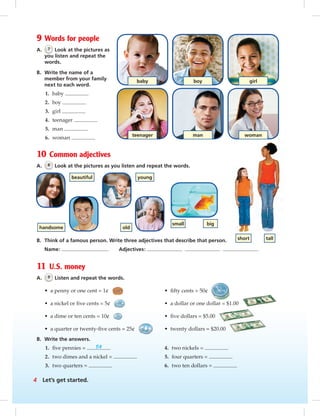
man woman
girl
teenager
baby boy
9 Words for people
A. 7 Look at the pictures as
you listen and repeat the
words.
B. Write the name of a
member from your family
next to each word.
1. baby
2. boy
3. girl
4. teenager
5. man
6. woman
10 Common adjectives
A. 8 Look at the pictures as you listen and repeat the words.
B. Think of a famous person. Write three adjectives that describe that person.
Name: Adjectives:
11 U.S. money
A. 9 Listen and repeat the words.
• a penny or one cent = 1¢ • fifty cents = 50¢
• a nickel or five cents = 5¢ • a dollar or one dollar = $1.00
• a dime or ten cents = 10¢ • five dollars = $5.00
• a quarter or twenty-five cents = 25¢ • twenty dollars = $20.00
B. Write the answers.
1. five pennies = 5¢ 4. two nickels =
2. two dimes and a nickel = 5. four quarters =
3. two quarters = 6. two ten dollars =
beautiful
handsome
young
old
small big
short tall
4 Let’s get started.
vi-5_SB1B_LGS_14106.indd 4 1/17/07 7:20:37 PM
T4
TEACHER’SNOTES
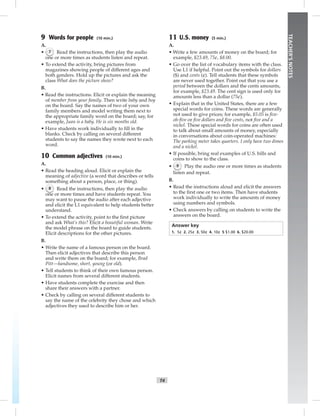
9 Words for people (10 min.)
A.
• 7 Read the instructions, then play the audio
one or more times as students listen and repeat.
• To extend the activity, bring pictures from
magazines showing people of different ages and
both genders. Hold up the pictures and ask the
class What does the picture show?
B.
• Read the instructions. Elicit or explain the meaning
of member from your family. Then write baby and boy
on the board. Say the names of two of your own
family members and model writing them next to
the appropriate family word on the board; say, for
example, Juan is a baby. He is six months old.
• Have students work individually to fill in the
blanks. Check by calling on several different
students to say the names they wrote next to each
word.
10 Common adjectives (10 min.)
A.
• Read the heading aloud. Elicit or explain the
meaning of adjective (a word that describes or tells
something about a person, place, or thing).
• 8 Read the instructions, then play the audio
one or more times and have students repeat. You
may want to pause the audio after each adjective
and elicit the L1 equivalent to help students better
understand.
• To extend the activity, point to the first picture
and ask What’s this? Elicit a beautiful woman. Write
the model phrase on the board to guide students.
Elicit descriptions for the other pictures.
B.
• Write the name of a famous person on the board.
Then elicit adjectives that describe this person
and write them on the board; for example, Brad
Pitt—handsome, short, young (or old).
• Tell students to think of their own famous person.
Elicit names from several different students.
• Have students complete the exercise and then
share their answers with a partner.
• Check by calling on several different students to
say the name of the celebrity they chose and which
adjectives they used to describe him or her.
11 U.S. money (5 min.)
A.
• Write a few amounts of money on the board; for
example, $23.49, 75¢, $8.00.
• Go over the list of vocabulary items with the class.
Use L1 if helpful. Point out the symbols for dollars
($) and cents (¢). Tell students that these symbols
are never used together. Point out that you use a
period between the dollars and the cents amounts,
for example, $23.49. The cent sign is used only for
amounts less than a dollar (75¢).
• Explain that in the United States, there are a few
special words for coins. These words are generally
not used to give prices; for example, $5.05 is five-
oh-five or five dollars and five cents, not five and a
nickel. These special words for coins are often used
to talk about small amounts of money, especially
in conversations about coin-operated machines:
The parking meter takes quarters. I only have two dimes
and a nickel.
• If possible, bring real examples of U.S. bills and
coins to show to the class.
• 9 Play the audio one or more times as students
listen and repeat.
B.
• Read the instructions aloud and elicit the answers
to the first one or two items. Then have students
work individually to write the amounts of money
using numbers and symbols.
• Check answers by calling on students to write the
answers on the board.
Answer key
1. 5¢ 2. 25¢ 3. 50¢ 4. 10¢ 5 $1.00 6. $20.00
Postcards_splitB_TE1_FM.indd T4 2/27/07 10:23:18 AM7:20:37 PM
vi-5_SB1
T5
TEACHER’SNOTES
Grammar
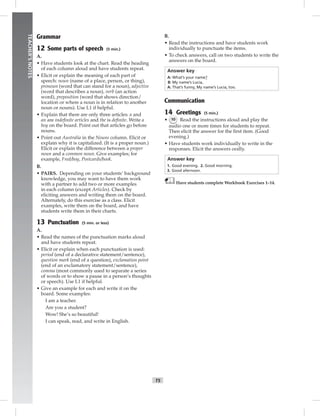
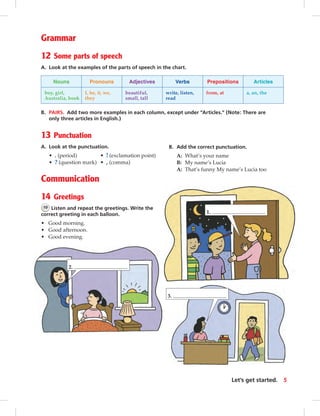
12 Some parts of speech (5 min.)
A.
• Have students look at the chart. Read the heading
of each column aloud and have students repeat.
• Elicit or explain the meaning of each part of
speech: noun (name of a place, person, or thing),
pronoun (word that can stand for a noun), adjective
(word that describes a noun), verb (an action
word), preposition (word that shows direction/
location or where a noun is in relation to another
noun or nouns). Use L1 if helpful.
• Explain that there are only three articles: a and
an are indefinite articles and the is definite. Write a
boy on the board. Point out that articles go before
nouns.
• Point out Australia in the Nouns column. Elicit or
explain why it is capitalized. (It is a proper noun.)
Elicit or explain the difference between a proper
noun and a common noun. Give examples; for
example, Fred/boy, Postcards/book.
B.
• PAIRS. Depending on your students’ background
knowledge, you may want to have them work
with a partner to add two or more examples
in each column (except Articles). Check by
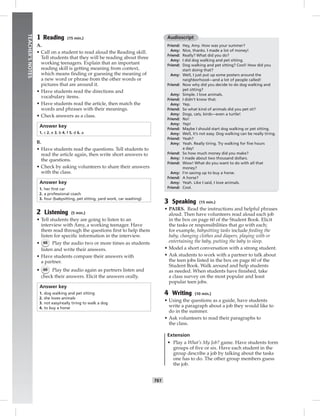
eliciting answers and writing them on the board.
Alternately, do this exercise as a class. Elicit
examples, write them on the board, and have
students write them in their charts.
13 Punctuation (5 min. or less)
A.
• Read the names of the punctuation marks aloud
and have students repeat.
• Elicit or explain when each punctuation is used:
period (end of a declarative statement/sentence),
question mark (end of a question), exclamation point
(end of an exclamatory statement/sentence),
comma (most commonly used to separate a series
of words or to show a pause in a person’s thoughts
or speech). Use L1 if helpful.
• Give an example for each and write it on the
board. Some examples:
I am a teacher.
Are you a student?
Wow! She’s so beautiful!
I can speak, read, and write in English.
B.
• Read the instructions and have students work
individually to punctuate the items.
• To check answers, call on two students to write the
answers on the board.
Answer key
A: What’s your name?
B: My name’s Lucia.
A: That’s funny. My name’s Lucia, too.
Communication
14 Greetings (5 min.)
• 10 Read the instructions aloud and play the
audio one or more times for students to repeat.
Then elicit the answer for the first item. (Good
evening.)
• Have students work individually to write in the
responses. Elicit the answers orally.
Answer key
1. Good evening. 2. Good morning.
3. Good afernoon.
Have students complete Workbook Exercises 1–14.
Postcards_splitB_TE1_FM.indd T5 2/27/07 10:23:19 AM
Grammar
12 Some parts of speech
A. Look at the examples of the parts of speech in the chart.
Nouns Pronouns Adjectives Verbs Prepositions Articles
boy, girl,
Australia, book
I, he, it, we,
they
beautiful,
small, tall
write, listen,
read
from, at a, an, the
B. PAIRS. Add two more examples in each column, except under “Articles.” (Note: There are
only three articles in English.)
13 Punctuation
A. Look at the punctuation.
• . (period) • ! (exclamation point)
• ? (question mark) • , (comma)
Communication
14 Greetings
10 Listen and repeat the greetings. Write the
correct greeting in each balloon.
• Good morning.
• Good afternoon.
• Good evening.
B. Add the correct punctuation.
A: What’s your name
B: My name’s Lucia
A: That’s funny My name’s Lucia too
2.
1.
3.
5Let’s get started.
vi-5_SB1B_LGS_14106.indd 5 1/17/07 7:22:32 PM0:23:19 AM
Postcards
Learning goals
Communication
Talk about abilities
Ask for permission
Grammar
Imperatives
Can to talk about abilities
Vocabulary
Clock times
1 Dialogue
11 Cover the dialogue and listen.
Andy: Look who’s here! Hi, Joey.
Joey: Is this a bad time to come?
Andy: No, no. It’s OK. What time is it?
Joey: One o’clock. Are you guys going out?
Liza: Well, yeah.
Andy: Be quiet, Liza! Don’t be rude.
Brian: Joey! It’s good to see you!
Joey: Thanks.
Brian: Hey, why’s your name Joey?
Joey: It’s short for Josephine.
Brian: Oh, cool. Andy, what time does the
movie start?
Joey: What movie? Can I come, too?
Liza: Joey, we can’t all fit in the car!
Andy: Don’t listen to her, Joey.
Liza: Oh, all right. Hurry up.
2 Comprehension
A. Circle the correct answers.
1. Liza is (happy / not happy) to see Joey.
2. Brian (likes / hates) the name Joey.
3. Joey (wants / doesn’t want) to go to the
movies.
4. Andy (is nice / isn’t nice) to Joey.
5. Liza (is nice / isn’t nice) to Joey.
B. 12 Read along as you listen again. Check
your answers.
6 Unit 1
006-013_SB1B_U01_14106.indd 6 1/17/07 7:25:31 PM
T6
TEACHER’SNOTES
know that Brian likes Joey? (He says Joey! It’s good to
see you! He also says Joey’s name is cool.) How is
Andy nice to Joey? (He tells Liza Be quiet! Don’t be
rude. He tells Joey Don’t listen to her, Joey.)
Answer key
1. not happy
2. likes
3. wants
4. is nice
5. isn’t nice
• To extend work with the dialogue, select key
vocabulary, structures, and communicative
phrases to discuss more fully, such as Look who’s
here, a bad time to come, going out, Well, Be quiet,
Don’t be rude, short for, and Hurry up.
• Have the class repeat the dialogue, then have
students practice in groups of four, changing
roles after each reading. Finally, select a group to
perform for the class. For further extension ideas,
see the Dialogues and Comprehension notes in the
Introduction, page x.
Focus on values
Discuss friends and friendship with the class. Here
are some ideas to start.
• Refer to the dialogue. Ask Is Liza happy to see
Joey? (no) Why not? (maybe she is jealous or does
not like her) Write jealous on the board. Say When
you’re jealous, you’re unhappy because someone has
something you want, or you think someone will take
something away from you—for example, love.
• Ask How does Liza sound when she says, Well,
yeah? (unfriendly) Ask Does Andy like the way
Liza talked to Joey? (No, he tells Liza to stop it.)
• Ask Who would you choose as a friend, Liza or Joey?
Why? What do you do when someone is not friendly
to you? Elicit positive strategies for responding to
rudeness; for example, be friendly in return, ask
the person if he or she is angry.
Background notes (5 min.)
A nickname is a shortened form, or a pet name, for a
person. For many English names, the shortened form is
taken from the first syllable—for example, Tim for Timothy.
This is the case for the characters Andy (for Andrew) and
Robbie (for Robert). Liza is a common nickname that comes
from the middle of the name Elizabeth. The name Brian
does not have a common nickname.
Warm-up (5 min.)
• Have students review cardinal numbers by skip
counting by 5s. Write 5, 10 on the board. Elicit
from the class the numbers in the pattern, through
55, and write them on the board. Practice skip
counting together as a whole class.
• Pair students. Tell them to alternate turns and
practice counting by 5s to 100. When they’ve
finished, have them switch roles so that
Student B begins.
• Tell students that they will practice more with
numbers today—they will practice telling time.
Have students open their books. Introduce the
unit title.
Using the large photo (5 min.)
• Have students look at the picture. Ask Who do you
know in the picture? (Andy, Liza, Brian, and Joey)
Where are they? (in front of their house) Do Andy
and Brian look happy? (yes) Who looks unhappy?
(Liza)
1 Dialogue and 2 Comprehension (15 min.)
• Tell students to cover the dialogue.
A.
• Tell students to silently read the directions and
Comprehension items for Exercise A. Ask them
to raise their hands if they need help with the
directions or items.
• 11 Play the audio two or more times.
B.
• 12 Tell students to uncover the dialogue. Play
the audio while students review their answers. As
you check the answers, ask students How do you
Learning strategy
• Have a can-do attitude
Pronunciation
• The /æ/ sound in can and can’t
Skills
• Predict missing lines
• Listen for specific information
• Talk about abilities and talents
• Ask permission to borrow something
• Write commands
Learning goals The following are additional learning goals in this unit:
Postcards_splitB_TE1_U01.indd T6 2/27/07 10:23:37 AM7:25:31 PM
T7
TEACHER’SNOTES
3 Useful expressions (15 min.)
A.
• Elicit the meaning of each expression or the
situation in which it is used.
• 13 Play the audio, pausing for students
to repeat. Encourage students to mimic the
intonation.
B.
• Read the directions aloud and elicit the answers
for the first two blanks. Then have students work
individually or in pairs to complete the dialogue.
• Check by calling on two students to read the
dialogue aloud.
Answer key
A: Look who’s here! Hi, [Joey].
B: Hi, [Brian]. Are you busy? Is this a bad time
to come?
A: No, no. It’s OK. It’s good to see you.
B: Nice to see you, too. Are you going out?
A: Yeah, to the mall. Would you like to come?
B: All right.
A: Come on. Hurry up.
C.
• PAIRS. Pair students. Have them practice
the conversation in Exercise B several times,
substituting their own names for Joey and Brian.
Tell them to switch roles after the first round.
• To extend the activity, have pairs practice looking
up and making eye contact while speaking, then
practice again with books closed.
4 Vocabulary (15 min.)
A.
• On the board, draw the face of a clock with the
minute hand pointing at twelve and the hour hand
pointing at three. Write the word o’clock on the
board. Ask What time is it? (three o’clock) Redraw
the hour hand to several different hours and elicit
the time.
• Draw the hour hand to point at two and the
minute hand to point at the ten-minute mark. Tell
students that this can be read as ten after two. Write
this on the board. Then redraw the minute hand
so that it points at the fifteen-minute mark. Tell
students that this can be read as a quarter after two;
write this on the board.
• 14 Tell students to look at the clock illustration.
Play the audio as students read along and repeat.
B.
• PAIRS. Read the instructions aloud, then call
on a pair to model the first two items. Tell them
to tell the time as they did in Exercise A, with to
and after.
• Assign pairs and have students begin. Walk
around to monitor and help as students practice.
• Elicit the answers orally from individual
students. Write them on the board, if helpful. Then
erase them and elicit the answers again from the
whole class.
Answer key
1. a quarter after eleven
2. twenty to ten
3. ten to eight
4. a quarter to nine
5. five-thirty / half past five
6. seven o’clock
7. twenty-five after five
8. five after one
9. twenty-five to four
10. ten after three
Have students complete Workbook Exercises 1–2.
Postcards_splitB_TE1_U01.indd T7 2/27/07 10:23:39 AM
o’clock
after
to
thirty
five after
ten after
a quarter after
twenty after
twenty-five after
five to
ten to
a quarter to
twenty to
twenty-five to
3 Useful expressions
A. 13 Listen and repeat.
• Look who’s here! • All right.
• Hurry up. • Is this a bad time to
• It’s good to see come?
you. • No. It’s OK.
B. Complete the dialogues with expressions
from Exercise A.
A: Look who’s here! Hi, [Joey].
B: Hi, [Brian]. Are you busy?
A: No, no. It’s OK.
B: Nice to see you, too. Are you going out?
A: Yeah, to the mall. Would you like to
come?
B: All right.
A: Come on.
C. PAIRS. Role-play the conversation in
Exercise B. Replace the names with your
classmates’ names.
4 Vocabulary
Clock times
A. 14 Look at the clock as you listen and
repeat.
ten o’clock ten-thirty/half past ten
five after ten twenty-five to eleven
ten after ten twenty to eleven
a quarter after ten a quarter to eleven
twenty after ten ten to eleven
twenty-five after ten five to eleven
B. PAIRS. Look at the clocks. Take turns asking
each other for the time.
For example:
A: What time is it?
B: It’s a quarter after eleven.
7Unit 1
0:23:39 AM
Postcards
GRAMMAR FOCUS
Imperatives
Affirmative Negative
Look who’s here! Don’t look!
Uses of the imperative
Look out! (for exclamations and warnings)
Be quiet! (for orders)
Please help me. (for polite requests)
Pull the door, then lock it. (for instructions)
Discovering grammar
Look at the grammar chart. Circle the
correct answers.
1. An affirmative imperative starts with a
(verb / noun).
2. (Do / Don’t) comes first in a negative
imperative.
3. Use the (past tense / base form) of a verb
in an imperative.
Practicing grammar
5 Practice
A. Write five affirmative classroom commands.
Use a period or an exclamation point (!).
1. Open your books!
2.
3.
4.
5.
6.
B. Underline the verbs in Exercise A.
C. Rewrite the commands in Exercise A as
negative commands.
1. Don’t open your books!
2.
3.
4.
5.
6.
A. GROUPS. Talk about school.
Discuss these questions: Is your
school a friendly place? Do you like
being at school? Explain your answer.
Useful language:
• Umm, not really./Maybe.
• Well, it’s OK.
• I like/don’t like school.
• Because of the homework.
• Because I see my friends at school.
• Because some students aren’t nice.
• Yeah.
B. GROUPS. Make a list of ten Dos and
Don’ts for students and teachers to
make your school a better and more
enjoyable place. Share your list with
the class.
D. PAIRS. Student A, give a command
from Exercise A. Student B, act out the
command. Take turns giving and acting out
commands.
6 Practice
GROUPS. Have a competition! Go to page 68.
1. Be nice to everybody.
2. Don’t be rude.
3.
4.
5.
6.
7.
8.
9.
10.
8 Unit 1
006-013_SB1B_U01_14106.indd 8 1/17/07 7:25:47 PM
T8
TEACHER’SNOTES
Grammar Focus
and Discovering grammar (15 min.)
Imperatives
☞ See Grammar reference, page 98.
• Explain the uses of imperatives by modeling. Tell
students Listen and do what I say. Open your book to
page 48. (give instructions) Stand up. (give orders)
Tell a student Please give me your pencil. (make a
polite request) Point behind the class and say Look
out! (give a warning) For each ask What did I ask
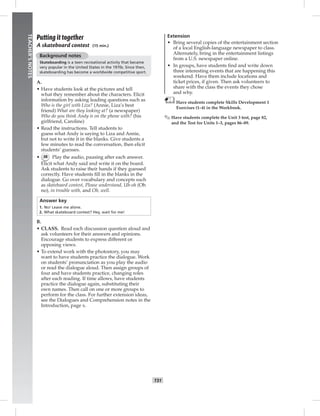
you to do? How did I say it? Write the phrases on
the board. State the function (for example, give
instructions) of each phrase.
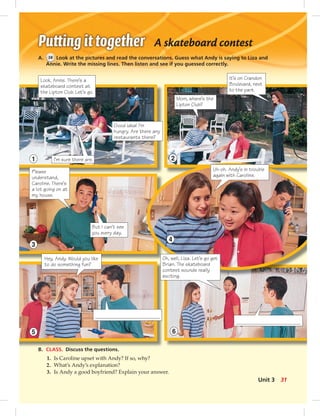
• Have students look at the grammar chart as you
read each example aloud.
• Have students work individually to complete the
exercise. Check answers orally.
Answer key
1. verb
2. Don’t
3. base form
• Use the board to elicit other key points about
the grammar chart, such as the fact that most
imperatives begin with the base form of the verb
and that negative imperatives usually begin with
Don’t. (See the Grammar reference.)
Practicing grammar
5 Practice (15 min.)
A.
• Have students read the directions and example.
Elicit several examples of affirmative commands;
for example, Read the dialogue, Raise your hand,
Please listen. Write them on the board.
• Have students work individually or in pairs to
complete the exercise. Walk around, helping
students as needed.
• Check by calling on several volunteers to tell the
class one of their imperatives.
Answer key: A, B, C
Answers will vary.
B.
• Read the instructions aloud, and then ask students
What’s the verb in number one?
• Have students underline the verbs in the
commands they made for Exercise A.
C.
• Read the instructions aloud, and then ask students
What’s the negative command in number one? How do
you make it negative? (begin with Don’t)
• Have students work individually to write out
negative commands.
• Ask several volunteers to share their negative
commands.
D.
• PAIRS. Read the instructions and call on a pair to
model giving and following a few commands for
the class.
• To conclude this exercise, call on a pair to give
commands to the whole class.
6 Practice
• GROUPS. Turn to page 68 and let students have a
competition.
Have students complete Workbook Exercises 3–8
and Grammar Builder Exercises 1–4.
(10 min.)
A.
• GROUPS. Read the instructions aloud and write
the two questions on the board. Chorus the Useful
language with the class. Then model the beginning
of a discussion with one or more students.
• Assign groups and have students discuss.
B.
• GROUPS. Read the instructions. Write on the
board Dos and Don’ts. Tell students that they will
write rules to make the school a better place. Tell
them that Dos are rules in the affirmative, while
Don’ts are in the negative.
• Read the first example aloud. Ask Is this a Do or
a Don’t? (a Do) Write this under Do on the board.
Elicit another example of a Do rule from students
to write on the board. Then elicit two Don’t
examples to list under Don’t.
• Assign groups of three or four students.
As students are working, circulate to help
with vocabulary.
• Call on several groups to share their lists with the
class. Discuss the lists by asking the class What
Dos and Don’ts are on many lists? What are the most
important? What are the most interesting?
Postcards_splitB_TE1_U01.indd T8 2/27/07 10:23:40 AM7:25:47 PM
006-013_
T9
TEACHER’SNOTES
Using the large photo (5 min. or less)
• Tell students to look at the picture. Ask Who do you
know in the large photo? (Joey, Robbie, Liza, Brian,
and Andy) Where are Joey and Robbie? (in front of
a movie theater) What are they holding? (money;
U.S. dollars) Who else do you see in the large photo? (a
woman) What does she sell? (movie tickets)
7 Dialogue and 8 Comprehension (15 min.)
• Have students cover the dialogue.
A.
• Have students read the instructions and questions
silently.
• 15 Play the audio two or more times and
have students work independently to complete
the exercise.
B.
• 16 Have students uncover the dialogue. Play
the audio again and have students read along and
check their answers. Check orally.
Answer key
1. Fifty dollars
2. Spider-Man, The Final Chapter
3. 2:30
4. Five
• To extend work with the dialogue, select key
vocabulary, structures, and communicative
phrases to discuss more fully, such as I’ll buy, first,
right?, and Enjoy the movie.
• Have the class repeat the dialogue, then have
students practice in pairs, changing roles after
each reading. Finally, select a pair to perform
for the class. For further extension ideas, see
the Dialogues and Comprehension notes in the
Introduction, page x.
Postcards_splitB_TE1_U01.indd T9 2/27/07 10:23:41 AM
7 Dialogue
15 Cover the dialogue and listen.
Joey: I’ll buy our tickets.
Robbie: Can I go with you, Joey? Please?
Joey: Sure. But first, let’s count the money.
You can count money, right?
Robbie: Yeah, I can.
Joey: OK. Count this for me.
Robbie: OK. One . . . two . . . twenty . . . thirty
. . . forty. Fifty dollars.
Joey: Good. Now, which movie do we
want?
Robbie: Spider-Man, The Final Chapter!
Joey: Right. So look up there at the movie
schedules. Can you find our movie
on the list?
Robbie: Yeah. It’s at . . . 2:30.
Joey: Good job, Robbie. Now tell the lady
what you want.
Robbie: Hello. Five tickets for Spider-Man at
2:30, please.
Woman: Here you go. Enjoy the movie.
Robbie: Thanks.
8 Comprehension
A. Write the answers.
1. How much money do they have for
the tickets? Fifty dollars.
2. What movie does the group want to
see?
3. What time does the movie start?
4. How many tickets does Robbie buy?
B. 16 Read along as you listen again. Check
your answers.
9Unit 1
006-013_SB1B_U01_14106.indd 9 1/17/07 7:25:48 PM0:23:41 AM
Postcards
Discovering grammar
Look at the grammar chart.
Complete the rules.
1. Use + the base
form of a verb to talk about
abilities.
2. The full form of can’t is
.
GRAMMAR FOCUS
Can to talk about abilities
Affirmative statements Negative statements
I can speak English. They can’t speak English.
Yes/No questions Short answers
Can you speak English? Yes, I can./No, I can’t.
Can he speak German? Yes, he can./No, he can’t.
Information questions Answers
What languages can you speak? We can speak Portuguese
and English.
Who can speak English? I can speak English.
Contraction
can’t ➔ cannot
Practicing grammar
9 Practice
PAIRS. Look at the picture. Take turns. Ask who can do each activity below.
• speak English • ride a bike • swim • sing
• drive • draw • dance • play the guitar
• act • play soccer • Rollerblade • skateboard
For example:
A: Who can speak English?
B: Jim can speak English. Who can sing?
10 Unit 1
006-013_SB1B_U01_14106.indd 10 1/17/07 7:26:02 PM
T10
TEACHER’SNOTES
Grammar Focus
and Discovering grammar (10–15 min.)
Can to talk about abilities
☞See Grammar reference, page 98.
• Read the grammar chart head. Tell students You
use can for requests. You also use can to talk about
abilities—things you can do. Tell students and
write on the board I can swim. Demonstrating
swim if needed, ask the class Who can swim? Raise
your hands.
• Read the grammar chart aloud and have
students repeat the example questions and
statements after you.
• Have students work individually to complete the
exercise. Check orally.
Answer key
1. can
2. cannot
• Use the board to elicit other key points about the
grammar chart, such as the sentence structures
for statements, Yes/No questions, and information
questions.
Practicing grammar
9 Practice (10 min.)
• PAIRS. Read the directions aloud. Then read the
activity verbs aloud and have students pronounce
each after you. Depending on students’ abilities
and level, you may want to teach some of the new
vocabulary at this point, or you may want to wait
and let students guess the meanings of the terms
as they complete the exercise.
• Read the first names on the pictures aloud and
help students pronounce them. Then read the
example aloud and have students say it after you.
• Call on a pair to model taking turns asking and
answering about the first two or three activities.
Then have students form pairs and begin. Walk
around to monitor as students practice.
• To check, ask individual students a Who question
for each activity.
Answer key
Jim can speak English. Jon can ride a bike. Carl can swim.
Sue can sing. Ann can drive. Liz can draw. Phil can dance.
Tom can play the guitar. Bob can act. Mia can play soccer.
Lynn can Rollerblade. Pam can skateboard.
• To extend this exercise, have pairs take turns
asking and answering What questions about the
pictures—for example, What can Jim do? (He can
speak English.) Tell students to ask about the
pictures at random.
Postcards_splitB_TE1_U01.indd T10 2/27/07 10:23:42 AM7:26:02 PM
006-013_
T11
TEACHER’SNOTES
10 Practice (5 min.)
A.
• GROUPS. Read the instructions aloud and then
call on three students to role-play the example. As
a model, have the same group play the game with
their own information. Tell them to keep going,
adding an ability to the list, until all three students
have reported an ability. Then have each member
say their own and the other two classmates’
abilities.
• Assign groups of four. As student practice, walk
around to monitor and encourage students.
B.
• Have students choose a group representative. Call
on the representative for each group to tell the
class what the group members can do.
Have students complete Workbook Exercises 9–14
and Grammar Builder Exercises 5–7.
11 Pronunciation (5 min.)
A.
• Write can and can’t on the board, underlining the
a. Tell students that these words have the /æ/
sound. Tell students that to pronounce the /æ/
sound they need to open their mouth, spread their
lips, and push their tongue down and to the front.
Model this for the class, and then say the sound
and have students repeat it.
• 17 Play the audio, pausing for students to
repeat.
B.
• 18 Play the audio again. Have students listen
and repeat once more, then take turns practicing
the questions and answers.
12 Your turn (15 min.)
A.
• Have students read the directions. Read number
1 and elicit the question Can you play the piano?
Then read the other items and have students
repeat. Elicit or explain the meaning of new
vocabulary such as whistle and cook.
• Tell students to stand and interview classmates to
find a student who can do each activity. Tell them
they need to write one name in the blank next to
the activity. Model with several students if helpful.
B.
• Ask the class Who can play the piano? Elicit
responses from several volunteers. Do the same
for the other activities.
Learn to learn (15 min.)
• Read the strategy line and explain or elicit the
meaning. If helpful, discuss the ideas presented in
this section in L1.
A.
• Read the instructions and the first item. Ask Who
can speak some English? Raise your hands. Make sure
all students have raised their hands, then say Check
the box.
• Have students work individually to check the
boxes. Walk around to monitor and encourage a
can-do attitude as students work.
B.
• PAIRS. Read the instructions and example. Elicit
some other ideas for how students can help each
other improve their speaking ability, using L1 if
needed. Use this as a platform to teach the class
some English terms that will be helpful in their
discussion.
• Have students form pairs and discuss. Walk
around to monitor, help, and offer suggestions.
• To conclude this exercise, go through the list of
English skills and elicit ways students can help
each other improve their abilities.
Cross-curricular activity: science
• Write on the board octopus, parrot, cat, and owl.
Using pictures, have students identify each
animal. Say the animal names and have students
repeat them.
• Tell students Take a piece of paper. On the left, write
True, and on the right, write False. Model this on
the board. Say I will say a sentence about one of the
animals. If it’s true, write the animal name under
True. If it’s false, write the name under False.
• Read each of the following sentences aloud
twice, pausing for students to mark their papers.
1. An octopus can change color. [True. It can
turn blue when angry or white when scared.]
2. A parrot can learn 20 words. [True. It can
mimic the human voice.]
3. A cat can taste sweet things. [False. Cats
don’t like candy because they can’t taste
sweet things.]
4. An owl can’t hear well. [False. It can hear a
mouse from a kilometer away.]
• Pair students and have them compare answers.
Then go over the answers with the class. Ask
Who thinks it’s true? Raise your hand. Who thinks
it’s false? Raise your hand.
Postcards_splitB_TE1_U01.indd T11 2/27/07 10:23:42 AM
10 Practice
A. GROUPS. Play a memory game with four
classmates.
For example:
A: I can play the drums.
B: Maria can play the drums. I can ride a
bike.
C: Maria can play the drums. Trish can ride
a bike. I can dance the samba.
B. Have a representative tell the class what
each of your group members can do.
11 Pronunciation
The /æ/ sound in can and can’t
A. 17 Listen and repeat.
can can’t act
rap dance add
A: Can you rap? B: Yes, I can.
A: Can you dance? B: No, I can’t.
A: Can you act? B: Yes, I can.
A: Can you add 1
/2 and 1
/4? B: No, I can’t.
B. 18 Listen again. Then practice the
conversations.
12 Your turn
A. Find someone who can do these activities
by asking, “Can you . . . ?” Write the
student’s name next to the ability.
1. play the piano
2. break-dance
3. whistle a tune
4. skate
5. cook
6. sing a song in a foreign language
7. rap
8. do the moonwalk
9. swim
10. do a belly dance
B. Share your findings with the class.
Have a can-do attitude.
Think positively. Say “I can,” not “I can’t.”
A. Think about your English skills. What can
you do in English? Check (✔) the boxes.
❑ I can speak some English.
❑ I can understand audiotapes in English.
❑ I can pronounce English words well.
❑ I can understand simple readings in
English.
❑ I can speak in front of the class.
❑ I can write simple sentences in English.
B. PAIRS. Compare your results. Choose
one skill you didn’t check. What can you
do to help each other improve that skill?
For example:
We can practice speaking English together.
Learn to learn
11Unit 1
006-013_SB1B_U01_14106.indd 11 1/17/07 7:26:05 PM0:23:42 AM
Postcards
13 Communication
Ask for permission
• You can also use can to ask for permission.
A. 19 Listen to the conversation.
Robbie: Can I come in, Liza?
Liza: Sure.
Robbie: [After 5 minutes] Can I play a
game on your computer?
Liza: Not right now, Robbie. I’m busy.
B. PAIRS. Student A, ask if you can borrow or
use one of your classmate’s things. Student
B, say No because you’re using it. Switch
roles. This time, Student A, say Yes.
14 Practice
A. PAIRS. Compete with another pair. Make a
list of questions asking for permission that
are commonly used in class.
For example:
Can I erase the board?
B. Compare your list with that of another pair.
Who wrote the most questions?
Unit 112
006-013_SB1B_U01_14106.indd 12 1/17/07 7:26:07 PM
T12
TEACHER’SNOTES
13 Communication (10 min.)
• Tell students that can is also used to ask for
permission. Give some a few examples and write
them on the board—for example, Can I go to the
restroom? Can I sharpen my pencil?
A.
• Have students look at the illustration. Ask
questions to set the context, such as Where is Liza?
(in her room) Who is knocking on the door? (Robbie)
• 19 Tell students to read along as they listen to
the conversation. Play the audio, and then ask
students How does Liza say yes to Robbie’s first
request? (Sure.) How does she say no to Robbie’s
second request? (Not right now, Robbie. I’m busy.)
Point out that Liza gives a reason and that this is
the polite thing to do.
• 19 To prepare students for Exercise B, play the
audio again and have students repeat.
B.
• PAIRS. Call on a student to read the directions
aloud. Elicit the question and write it on the
board: Can I borrow/use your ___? Then elicit ways
to respond and write them on the board—for
example, Sure, Here you go, OK and No, I’m sorry,
I need it or Not right now, I’m using it. Call on a
volunteer to model the exercise with you.
• Pair students. Have them practice and switch roles
several times. Walk around to help as needed. To
conclude the exercise, call on a pair to stand and
perform the conversation for the class.
14 Practice (5 min.)
A.
• PAIRS. Read the instructions and example aloud
and then elicit several other examples of requests
for permission. Tell students they have a time
limit of three minutes. Assign competing pairs
(sets of two pairs who will compete against each
other) and then tell students to begin. To keep the
competition exciting, notify students when their
time is half finished, then when they have thirty
seconds left.
B.
• Have pairs compare their lists to see who wrote
the most requests. Then ask the “winning” pairs
to raise their hands. Elicit classroom requests from
several of these pairs. Encourage your students to
make their future classroom requests in English.
Have students complete Workbook
Exercises 15–16.
Postcards_splitB_TE1_U01.indd T12 2/27/07 10:23:43 AM7:26:07 PM
5
006-013_
T13
TEACHER’SNOTES
Putting it together
At the amusement park (15 min.)
Background notes
Amusement parks are large, commercial parks with
attractions, such as roller coasters, that are designed to
give riders a thrill. Well-known amusement parks in the
United States are Disneyland in California and Disney
World in Florida. There are many amusement parks in
Florida, including Universal Studios and SeaWorld.
Driver’s licenses in the United States are issued by each
state, and the age at which a teen can obtain one varies.
Though a few states permit students to start learning to
drive at age fourteen, most allow students to start at age
fifteen and get their license at age sixteen.
A.
• Read the title and instructions aloud. Elicit what
students know about amusement parks. Then
have students look at the photos. Help students
predict by asking questions such as Who do you
know in the first picture? (Joey, Brian, Andy, and
Liza) Where are they? (at home) Does Liza look
happy? (no) Where are they on Sunday afternoon?
(at an amusement park) What is Brian looking at in
picture 4? (his watch; the time)
• Have students work individually to read the
dialogue and fill in the blanks. Then elicit
students’ guesses.
B.
• 20 Play the audio and have students check their
answers. Pause after each of the answers is spoken
and elicit it from the class. Ask students to raise
their hands if they got the correct answer.
Answer key
1. No, I can’t
2. No, you can’t
3. Sure
• To extend work with the photostory, go over
vocabulary such as I can’t wait, I’ll be right back,
quick, closed, and instead.
• You may also want to have students practice the
dialogue. Work on students’ pronunciation as you
play the audio or read the dialogue aloud. Then
assign groups of four and have students practice,
changing roles after each reading so that all
students read each role once. If time allows, have
students practice the dialogue again, substituting
their own names. Then call on one or more groups
to perform for the class. For further extension
ideas, see the Dialogues and Comprehension notes
in the Introduction, page xii.
Activities
Fun with songs 1, page 62
Focus on culture 1, pages 64–65
✎ Have students complete the Unit 1 test, page 80.
Postcards_splitB_TE1_U01.indd T13 2/27/07 10:23:44 AM
1 2
3 4
5 6
At the amusement park
A. Before you listen, read the dialogue. Fill in the missing responses.
B. 20 Listen to the conversation. Check your answers.
Really? Great! Uh,
can I come in for a
few minutes?
(2) , Joey.
It’s late, and we’re tired.
It’s already one
o’clock. Better hurry.
I can’t wait to go inside!
Me, too.
Sunday afternoon
There’s a problem, guys.
The park’s closed.
I’ll be right back.
It’d be fun to go to the
amusement park tomorrow.
(1) .
Sorry. Why?
Oh, OK. Andy, call me
tomorrow, OK?
That was quick.
OK. Wait here. I’ll go
get the tickets.
That was a fun
movie! Hey, Brian,
can you drive?
Would you like me to ask Dad?
Guys, wait! Let’s wait
for Dad and Robbie.
(3) .
Well, can we go to
the zoo instead?
Good idea. Let’s tell Dad.
I’m really sorry.
13Unit 1
006-013_SB1B_U01_14106.indd 13 1/17/07 7:26:12 PM0:23:44 AM
Postcards
1 Reading
21 Read along as you listen to Brian’s description of
his typical day.
Brian’s Typical Day
Every morning, on a school day, my alarm goes off at 6:30. But I usually
turn it off and close my eyes again. Of course, it’s never easy to go back
to sleep after the alarm goes off, so I get up.
I do the same things every day. First, I take a shower and get dressed for school. Then I eat breakfast.
After that, I brush my teeth. I sometimes have cereal. But I usually just grab a banana and eat it at the
bus stop. My bus leaves at exactly 7:30.
School starts at 8:00. I’m never late for school. Lunch break is at 12:00. On nice days, my friends and I
sometimes sit outside. Classes end at 3:00, but I never get home until after 6:00. I am on the track and
field team, and I practice after school. After practice, I usually go to the gym.
On Saturdays, my school team often competes with teams from other schools. My dad always watches me when
I compete. I’m always tired after a competition, but I don’t mind it. I love running.
Sunday is my favorite day. It’s usually my lazy day, and I love it.
Learning goals
Communication
Talk about daily routines
Grammar
Sequence words: first, then,
after that, next, finally
Adverbs of frequency
How often?
Vocabulary
Daily routines
14 Unit 2
014-023_SB1B_U02_14106.indd 14 1/17/07 7:27:36 PM
T14
TEACHER’SNOTES
Using the large photo (5 min. or less)
• Have students look at the picture. Ask questions
to help students create a context for the reading
passage: Who do you see in the picture? (Brian) Where
is Brian? (in his room, at home) What time is it?
(six-thirty) Is it morning or evening? (morning) What
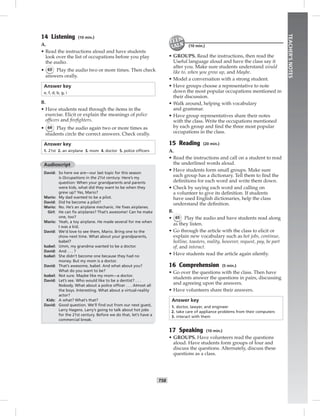
is Brian doing? (waking up; stretching)
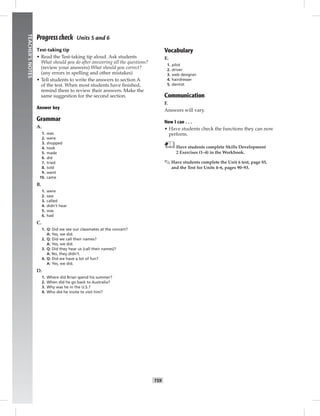
1 Reading (10 min.)
• 21 Play the audio. Tell students to read along
as they listen. Then let them read the article
again silently. Tell them that there will be some
vocabulary that they don’t understand but that
they may be able to guess the meanings of these
words and phrases.
Warm-up (5 min.)
• Bring in some pictures of people doing typical
everyday activities, such as brushing their teeth,
eating breakfast, getting on a bus to go to school,
doing homework, and so on. Tape them on the
board in random order.
• Call on several individual volunteers to come to
the front and rearrange the pictures in an order
reflecting their own day. For each arrangement,
ask for a show of hands of students who perform
the activities in the same order.
• Tell students that they will learn how to tell about
their typical (usual) everyday activities today.
Have students open their books. Introduce the
unit title.
Learning strategy
• Plan your weekly and daily activities
Pronunciation
• The pronunciation of -s and -es
endings
Skills
• Read for specific information
• Study a graph
• Listen for specific information and
complete a chart
• Talk about routines and activities
• Write about your typical day or week
Learning goals The following are additional learning goals in this unit:
Postcards_splitB_TE1_U02.indd T14 2/27/07 10:22:05 AM7:27:36 PM
T15
TEACHER’SNOTES
2 Comprehension (10 min.)
A.
• Have students read the directions and then work
individually to complete the exercise. Check the
answers orally.
Answer key
1. 5
2. 1
3. 2
4. 4
5. 3
B.
• Tell students to write short answers to the
questions. You may want to ask students to
challenge themselves by answering the questions
in this exercise without looking back at the text.
• Check answers as a class. Ask volunteers to
read aloud the passage in the text that answers
the question.
Answer key
1. At 6:30
2. Cereal or a banana
3. Practices track and field and goes to the gym.
4. Track and field / running
• Ask students if they could guess the meanings
of some of the new vocabulary. Ask which
words were new to them. Elicit guesses as to the
meanings of words like alarm, goes off, turn it off,
take a shower, get dressed, brush my teeth, sometimes,
usually, grab (get something quickly), exactly, late,
get home, track and field, competition, don’t mind,
and lazy. Teach the meanings of any terms that
students were not able to guess.
3 Pronunciation (15 min.)
A.
• Explain that there are three different
pronunciations for the -s endings for simple
present, third person. The pronunciation depends
on the last sound of the word the -s is added to.
• In one column on the board, write several verbs
that end in sibilant sounds—/s/, /ʃ/, / /, /z/—
such as practice (/s/), brush (/ʃ/), watch (/ /), and
close (/z/). These endings have a hissing sound.
Write and say the third person present forms of
the verbs. Point out that the -s ending in these
kinds of words is pronounced /iz/.
• Model the pronunciation of each verb with the
/iz/ ending, then ask students to repeat. Ask
students to pronounce the words with their fingers
touching the front of their throats. Point out that
there is a buzzing feeling in the throat when the
/iz/ sound is made.
• Next, in another column, write several verbs
ending in voiceless consonant sounds—/p/, /t/,
/k/, /f/—such as sleep (/p/), get (/t/), compete
(/t/), think (/k/), like (/k/), and laugh (/f/).
When we pronounce voiceless consonants, our
vocal chords do not move or vibrate. Ask students
to put their fingers on the front of their throats as
they say the last sounds of the words. Point out
that there is no buzzing feeling in the throat when
these sounds are made. Tell students that the -s
ending is pronounced /s/ in words like these. On
the board, add an -s to each of these verbs.
Model the pronunciation of each, then ask
students to repeat.
• Do the same with verbs ending in voiced sounds:
grab /b/, run /n/, ring /ŋ/, call /l/, imagine
/n/, end /d/, love /v/, stay /ei/. Point out that
there is a buzzing feeling in the throat when we
pronounce the last sounds of these words. Tell
students that the -s ending is pronounced /z/ in
words like these. Model the pronunciation of each
verb with the /z/ ending, then ask students to
repeat with their fingers touching the front of their
throats to feel the vibration.
• 22 Play the audio a couple of times, pausing
for students to repeat the words. Help with
pronunciation as needed.
B.
• 23 Call on a student to read the directions aloud.
Then play the audio, pausing for students to circle
the verbs with the /z/ or /iz/ sound.
• Check answers by calling on individual students;
elicit the ending sound and write it on the board.
Answer key
1. leaves /z/
2. goes /z/
3. watches /iz/
C.
• 24 Play the audio again and have students
repeat the sentences. Then have students form
pairs. Tell pairs to take turns. If students need
more practice, have them change roles several
times. Check by calling on individuals to read the
sentences aloud.
Postcards_splitB_TE1_U02.indd T15 2/27/07 10:22:07 AM
4
2
1
3
5
2 Comprehension
A. Match the sentences with the pictures.
5 1. Brian’s alarm goes off at 6:30.
2. He takes the bus to school.
3. School starts at 8:00.
4. He has lunch at school.
5. On Saturdays, he competes with
students from other schools.
B. Answer the questions.
1. What time does Brian get up?
2. What does Brian have for breakfast?
3. What does he do after school?
4. What sport does Brian like?
3 Pronunciation
The pronunciation of –s and –es
A. 22 Listen and repeat.
/s/ /z/ /iz/
eats goes watches
wakes leaves brushes
B. 23 Listen. Circle the verbs with the /z/ or
/Iz/ sound.
1. Brian wakes up at 6:30. He leaves home
at 7:30.
2. He goes to high school. He takes the bus
to school.
3. He gets home at 6:30. He watches TV.
C. 24 Listen again and repeat.
15Unit 2
0:22:07 AM
Postcards
4 Vocabulary
Daily routines
A. Number the activities 1 to 12 according to
your routine on school days.
B. PAIRS. Compare your routines.
take a shower go to school
1 get up eat or have breakfast
eat or have dinner do homework
brush my teeth get home from school
watch TV comb/brush my hair
go to bed get dressed
Discovering grammar
Look at the grammar chart. Answer the
questions.
1. What are some common sequence words?
, , ,
,
2. What punctuation can you use after some
sequence words?
Practicing grammar
5 Practice
Write three more things Brian does after he
wakes up on a school day.
1. First, Brian takes a shower.
2.
3.
4.
6 Your turn
PAIRS. Tell your classmate three things you do
after you wake up on a school day.
For example: First, I take a shower.
7 Communication
Talk about your routines
A. 25 Listen and read.
A: What do you do on Sundays?
B: Nothing much. First, I check my e-mail.
Then I text my friends. After that, I call
up my best friend. How about you?
B. PAIRS. Talk about what you do on Sundays.
GRAMMAR FOCUS
Sequence words
First, the alarm rings. Then I turn it off. After that,
I get up.
First, she takes a shower. Next, she gets dressed.
Then she has breakfast. After that, she brushes her
teeth. Finally, she leaves the house.
16 Unit 2
014-023_SB1B_U02_14106.indd 16 1/17/07 7:27:51 PM
T16
TEACHER’SNOTES
4 Vocabulary (10 min.)
A.
• Read the instructions aloud. Then read the labels
on the pictures and have students say them after
you. Point out that either eat or have can be used to
talk about meals and snacks.
• As a model, call on a student to tell the class
what he or she does first, second, and third. Then
have students work individually to number the
activities. Number the pictures to match your own
routine in preparation for Exercise B.
B.
• PAIRS. Read the instructions aloud and model
this activity with a student. Put your book next to
the student’s book. Model talking about how your
routines are the same and different.
• Have students form pairs. Walk around to monitor
as students talk.
• To conclude this activity, call on several
different students to tell the class ways in which
ways their routine was the same or different from
their partner’s.
Extension
• Have students play a memory game in small or
large groups. Tell them that they are to build up
a string of sentences about daily routines from
the beginning of the day to the end. Student A
says, I wake up. Student B says, I wake up. I get
up. Student C says, I wake up. I get up. I take a
shower. Students continue adding sentences until
a student makes a mistake or can’t remember
a sentence. Then the group must begin again.
Model this for the class before assigning groups.
Have students complete Workbook Exercises 1–3.
Grammar Focus
and Discovering grammar (10 min.)
Sequence words
☞See Grammar reference, page 99.
• Direct students’ attention to the grammar chart.
Call on students to read the sequences aloud.
Make sure students understand that first and
finally come at the beginning and end of the
sequence, but that then, after that, and next are
interchangeable.
• Read the instructions and questions aloud;
explain common and punctuation if needed. Then
have students work individually to complete the
exercise. Check answers orally.
Answer key
1. first, then, after that, next, finally 2. , (a comma)
• Use the board to elicit other key points about
the grammar chart, such as when to use the
simple present and which sequence words can be
followed by a comma.
Practicing grammar
5 Practice (5 min.)
• Read the instructions and first sentence aloud. Tell
students that they need to write any three things
Brian does in the morning and that they need to be
in order. Tell them not to look back at the reading.
• When students have finished writing, let them
look back at the reading to check their answers.
Ask students to raise their hands if their answers
were correct. Elicit answers from several students.
Have students complete Workbook Exercises 4–8
and Grammar Builder Exercises 1–2.
6 Your turn (5 min.)
• PAIRS. Read the instructions and example aloud.
Model the activity with a student. Then assign
pairs and tell students to begin.
• To check, ask a few volunteers to share what they
do with the class. Ask for a show of hands of other
students who do the same sequence of events.
7 Communication (10 min.)
A.
• 25 Play the audio as students read along. Check
that students understand Nothing much, check my
e-mail, text my friends, and call up. Play the audio
again, pausing for students to repeat.
B.
• PAIRS. Read the instructions aloud. Call on a
pair to model. Then have students form pairs
to discuss their routines. Circulate and monitor,
helping with vocabulary as needed. Check by
calling on several students to tell you what they
do on Sundays.
Cross-curricular activity: science
• Select a simple natural process that students
are very familiar with, such as the life cycle of a
frog, butterfly, or plant. Elicit from the class the
different steps in this process. Let students use
L1 if needed, and help them translate the steps
into English. Alternately, have them work in
groups with a dictionary before eliciting
the steps.
• Write the steps on the board.
• Have students form groups and make a poster
of the process by drawing each step and labeling
it, using sequence words in their sentences.
Have students complete Workbook Exercises 15–17.
Postcards_splitB_TE1_U02.indd T16 2/27/07 10:22:08 AM7:27:51 PM
014-023_
T17
TEACHER’SNOTES
Grammar Focus
and Discovering grammar (10–15 min.)
Adverbs of frequency; How often?
☞See Grammar reference, page 99.
• Have students look at the graph in the grammar
chart. Tell them that the words on the left are
adverbs of frequency; that is, words that tell us how
often something is done or how often something
happens. Read each adverb aloud and have the
class repeat.
• Say Look at the word always and the line next to
it. The line shows 100%. That means that when you
always do something, you do it 100% of the time, or
every time.
• Direct students’ attention to the word never. Ask Is
there a line for never? (no) Say That means that when
you never do something, you do it 0% of the time, or
not at all.
• Ask students to take a look at usually and often.
Ask Which do you use to say you do something
more often? (usually) Elicit comparisons for often,
sometimes, and rarely/seldom.
• Ask a strong student a number of questions to
elicit the frequency of certain activities in his or
her day: Do you get up before six every morning? Do
you eat cereal for breakfast? Are you late for school
every day? Do you read the newspaper? Do you
watch TV every afternoon? Are you tired on Monday
mornings? Help with frequency adverbs as needed.
• Call on a student to read the grammar chart aloud.
Have the class say each sentence after the student.
• Have students work individually to circle the
correct answers. Check answers orally.
Answer key
1. how often
2. adverbs
3. after
4. before
• Use the board to elicit other key points about
the grammar chart, such as which adverbs are
used for something that is done frequently, and
which are used for infrequent events.
Practicing grammar
8 Practice (5 min.)
• Read the instructions aloud and elicit the answers
to the first two items. Depending on your
students’ abilities, have them rewrite the sentences
individually or in pairs. Elicit answers orally. Then
have students work in pairs to take turns reading
their sentences aloud.
Answer key
1. My teacher is always early.
2. I often check my e-mail.
3. Brian is never late.
4. We sometimes study together.
5. They usually have lunch together.
6. My friends are always at my house.
7. I am sometimes late for school.
9 Practice (15 min.)
A.
• Call on a student to read the instructions. Then
read the items aloud and have students say them
after you. Check that students understand shower
(noun), hungry, and falls asleep.
• Read the examples aloud and then elicit questions
for the other items orally.
• Point out that when students answer, they should
use an adverb of frequency. Elicit from students
the possible answers to the first question: I
always/usually/often/sometimes/rarely/never sing in
the shower.
• Model the activity by asking one or more students
the first question. Write the name of the first
student who satisfies the description.
• Have students stand. Set a time limit of five
minutes. Tell students to continue asking their
classmates until they complete their chart or time
is up.
B.
• Elicit one or more names from the class for
each item.
Postcards_splitB_TE1_U02.indd T17 2/27/07 10:22:10 AM
Discovering grammar
Look at the grammar chart. Circle the correct answers.
1. Adverbs of frequency tell (how well / how often) an activity
is done.
2. Never and often are examples of (adverbs / adjectives).
3. Adverbs of frequency come (before / after) a form of the
verb be.
4. They come (before / after) all other verbs.
Practicing grammar
8 Practice
Insert the adverbs of frequency in the sentences. Then rewrite
the sentences.
1. My teacher is early. (always) My teacher is always early.
2. I check my e-mail. (often)
3. Brian is late. (never)
4. We study together. (sometimes)
5. They have lunch together. (usually)
6. My friends are at my house. (always)
7. I am late for school. (sometimes)
always
^
GRAMMAR FOCUS
Adverbs of frequency; How often?
0% 100%
always
usually
often
sometimes
rarely/seldom
never
How often do you arrive late to school?
I’m always late for school. I’m sometimes late for school.
I’m usually late for school. I’m rarely/seldom late for school.
I’m often late for school. I’m never late for school.
Positions of frequency adverbs
With be With other verbs
I’m sometimes late for school. I sometimes wake up late.
Dana is never late for school. Carlos never wakes up late.
9 Practice
A. Find one student who
does each of the activities
below. Write his or her
name on the line.
For example:
Q: How often do you sing
in the shower? OR How
often do you arrive late
to school?
1. usually sings in the
shower.
2. never arrives late
to school
3. always does homework
4. often gets hungry
during class
5. usually falls alseep
in class
6. rarely plays sports
B. Share your findings with
the class.
17Unit 2
014-023_SB1B_U02_14106.indd 17 1/17/07 7:27:55 PM0:22:10 AM
Postcards
Your Daily Routine
10 Practice
Play a game! Go to page 68.
GROUPS. Talk about how often you do things.
Choose from the activities below or use your own
ideas.
• dance • go to parties
• sing in the shower • speak English outside class
• call your grandparents • go to the library
• go to bed early • go shopping on weekends
• help in the kitchen • go to the movies
• walk to school
Useful language:
• How often do you . . . ? • Why not?
• Really? • Because . . .
• That’s interesting! • No way! / Seriously?
11 Practice
PAIRS. Complete the
questionnaire for your
classmate by asking questions.
Put a check (✔) in the
appropriate column.
For example:
A: What do you have for
breakfast?
B: I always have cereal and
milk. I sometimes have
bread and butter.
A: Do you have coffee for
breakfast?
B: No. I never have coffee.
1. What do you have
for breakfast?
• coffee
• juice
• milk
• cereal
• bread and butter
• other:
2. What do you do
after school?
• see friends
• play sports
• do homework
• other:
3. What do you do
in the evening?
• use the computer
• do homework
• watch TV
• other:
4. What do you do
on weekends?
• sleep all morning
• clean my room
• help around the
house
• other:
18 Unit 2
T18
TEACHER’SNOTES
10 Practice (10 min.)
• Turn to page 68 and let students play a game.
Have students complete Workbook Exercises 9–14
and Grammar Builder Exercises 3–6.
(10 min.)
• GROUPS. Read the instructions aloud and then
chorus the list of activities. Check that students
understand new vocabulary such as early, help,
outside class, and library. Elicit a few other activities
that students might want to talk about and write
them on the board.
• Preview the Useful language. Point out that
No way! and Seriously? are different ways of
saying Really? but show more surprise. Say
these aloud and have students mimic your
stress and intonation.
• Model a conversation for this activity by taking
turns asking and answering a few How often
questions with a student. Ask follow-up
questions and use the Useful language to respond
when appropriate.
• After students have finished their conversations,
ask several groups to tell you something
interesting that they discovered about each other.
11 Practice (15 min.)
• PAIRS. Read the instructions and then call on a
pair to role-play the example for the class. Call on
students to tell you, based on the example, what
they would check off on the questionnaire. (always
next to milk and cereal; sometimes next to bread and
butter; never next to coffee.)
• Tell students to answer in full sentences. Model
the activity with a student.
• Have students work in pairs. Walk around to
monitor and help.
• To extend the exercise, have students change
partners and share the information on their
questionnaires. Remind them to use the correct
form of the verb after he or she. You may also
want to have students write a short paragraph
about their partner’s daily routine. Have students
exchange paragraphs with their original partner
for peer correction.
Extension
• Have students form pairs. Tell each pair to think
of a famous person they’d like to interview.
Elicit some examples of celebrities from the
class, then give pairs a few moments to decide
on a celebrity.
• On a separate piece of paper, have pairs write
five How often questions to ask the celebrity,
leaving space for an answer underneath each
question. Circulate and help with vocabulary as
students write.
• Have pairs exchange their questions with
another pair. Tell pairs to answer the questions
as if they were the celebrity being asked.
Circulate as students work.
• Have students return the interview questions
and answers. After students have read these,
call on volunteer pairs to role-play some of the
funnier interviews for the class.
Postcards_splitB_TE1_U02.indd T18 2/27/07 10:22:10 AM
014-023_
T19
TEACHER’SNOTES
12 Practice (1 hour)
A.
• GROUPS. Read the instructions and have
students fill in the name of their country. Elicit a
few breakfast foods in English. Have students form
groups and write the breakfast foods they usually
eat. (If your class is multinational, arrange students
in groups according to country.) Have students
use a dictionary to find English equivalents or
help students translate from L1 yourself. Check by
eliciting the names of breakfast foods from the class
and writing them on the board.
B.
• This activity requires students to have Internet
access at school or at home. It can either be done in
class or assigned as homework.
• Tell students to use the Internet to get information
about the kinds of food people from other
countries have for breakfast. You may also want
to have students download and print pictures
of these foods. Ask them to write down the
URLs of the websites they got the information or
pictures from. You may want to suggest websites
that all students can use for their basic research;
Wikipedia, for example, has a helpful entry on
breakfasts around the world.
C.
• Have students work in groups to share their
research and complete their charts.
• To check, elicit the names of several breakfast
foods for each country. Elicit or explain what the
foods are, using L1 as needed.
D.
• GROUPS. Model asking and answering several of
the questions in this exercise with a student. Then
have students get together in groups to discuss.
• When groups have finished, discuss these
questions as a class.
Focus on values
• Explain to students that, in general, printing
out information or pictures from the Internet is
allowed for school or personal use. However,
when they use a source for a class assignment,
they should cite it. Explain that when we cite a
source, we say where we got the information.
We have to cite our sources when we take
and use information, ideas, or pictures from
someone’s website, book, speech, song, poem,
play, or artwork. Citing sources is being
respectful and honest.
13 Reading (15 min.)
Cross-curricular activity: math and social studies
• If your students are unaccustomed to working
with averages and bar graphs, ask a student how
many hours of sleep he or she got on different
weeknights—for example, How many hours did
you sleep on Monday night? On Tuesday night?
Write these times on the board. Then average the
time. Show students how you total the hours and
divide the total hours by the number of days.
Draw a vertical y axis on the board and label
it with Hours, and a horizontal x axis with the
label Sleep (as in the Student Book). Complete the
graph by drawing a bar to indicate the average
number of hours of sleep. Ask How many hours
does this bar graph show?
A.
• Have students look at the graph. Tell students that
this shows the average amount of time a student
spends doing things on weekdays. Give students
a few moments to study the chart. Then ask On
the graph, what does Other mean? (other activities
that a student does on a weekday) Ask students
to give examples of activities that might be in this
category. (doing sports or hobbies, going out with
friends, listening to music)
B.
• Have students read the instructions aloud and
complete the exercise individually. Check orally.
Answer key
1. 8 hours
2. 7 hours
3. 2 hours
4. 4 hours
C.
• Read the instructions aloud and have students
look at the unfinished graph. Ask several students
How many hours a day do you sleep? Have students
complete this bar on the graph.
• Have students work individually to complete
their graphs.
14 Speaking (10 min.)
• PAIRS. Read the instructions and example
sentences aloud. Then call on a pair to model
the activity.
• Have students form pairs and discuss their graphs.
Check by calling on several pairs to tell you the
similarities and differences in their daily routines.
Postcards_splitB_TE1_U02.indd T19 2/27/07 10:22:10 AM
12 Practice
A. GROUPS. First, write your country in the
chart. Then write the foods you usually
have for breakfast.
B. Use the Internet to find out what kinds of
food people from other countries have for
breakfast.
C. Complete the chart with the information
from Exercise B.
D. GROUPS. Discuss the questions.
1. Which countries have similar breakfast
foods?
2. Which breakfast foods do you find
unique or interesting?
3. Which breakfast foods from other
countries have you tried? Which ones
would you like to try?
13 Reading
A. Study the graph of a teenager’s typical day.
Your country
B. Answer the questions.
1. How many hours a day does the student
sleep? 8 hours
2. How many hours a day does the student
spend in school?
3. How many hours of homework a day
does the student do?
4. How many hours of television a day does
the student watch?
14 Speaking
PAIRS. Compare your bar graph with that of
your classmate.
For example:
I sleep eight hours a day. You . . .
I do two hours of homework a day. You . . .
I watch three hours of TV a day. You . . .
C. Create a bar graph of your typical school day.
19Unit 2
014-023_SB1B_U02_14106.indd 19 1/17/07 7:28:02 PM0:22:10 AM
Postcards
15 Listening
A. 26 Listen to Doris describe her typical day.
Then complete the chart.
Activity Time
Gets up 6 A.M.
Bus picks her up
School starts
School ends
Gets home
Eats dinner
Goes to bed
B. 27 Listen again and complete the sentences.
When Doris gets home, she always does the
following:
1. First, she looks for something to eat .
2. Then she .
3. After that, she .
4. Next, she .
5. Finally, she .
16 Writing
What’s your typical day or week like? Write
about it on the paper on the right.
Plan your weekly and daily activities.
Planning your activities can help you become more efficient.
Create a personal calendar for next week. Write down all deadlines for homework, quizzes
and tests, projects, birthday parties, and other activities you usually do.
Learn to learn
I am always busy on a school day.
I usually get up at six. First,
20 Unit 2
014-023_SB1B_U02_14106.indd 20 1/17/07 7:28:04 PM
T20
TEACHER’SNOTES
15 Listening (15 min.)
A.
• Read the instructions and items on the chart aloud.
Check that students understand picks her up, starts,
and ends.
• 26 Play the audio two or more times and have
students fill in the chart. After students have
filled in the chart, elicit answers and write them
on the board.
Answer key
Activity Time
Gets up 6 A.M.
Bus picks her up 7 A.M.
School starts 7:35 A.M.
School ends 3:15 P.M.
Gets home 3:45 P.M.
Eats dinner 7 P.M.
Goes to bed 10 P.M.
B.
• 27 Read the instructions and example. Make
sure students understand that they are only to
write about what Doris does when she gets home.
Point out that students will need to change the
verbs from first person to third person.
• Play the audio two or more times, pausing after
each answer is given so that students have time
to write.
• To check, call on four students to write the
answers to items 2–5 on the board.
Answer key
1. First, she looks for something to eat.
2. Then she talks to her friends on the phone.
3. After that, she does her homework.
4. Next, she eats dinner.
5. Finally, she watches TV.
Audioscript
There goes my alarm clock—that awful ring that tells me
it’s time to get up. It’s 6:00 A.M. I always get up at 6:00.
The school bus always picks me up at 7:00. It’s never late.
School starts at 7:35 and ends at 3:15.
I get home at 3:45. I do the same things when I get home
every day. First, I look for something to eat. Then I talk to
my friends on the phone. After that, I do my homework.
Yeah, honest. I really do my homework every day. Next, I
eat dinner at 7:00. Finally, I watch TV. I usually go to bed
at 10:00.
16 Writing (10 min.)
• Read the instructions and example aloud.
Then model writing the first few sentences of a
paragraph about your day or week.
• As students write, walk around to monitor and
help.
• When students are finished, you may want to have
them exchange papers with a partner and, using
the Peer editing checklist on page 138, edit each
other’s work. They can then rewrite their passages
before turning them in.
Learn to learn (15 min)
• Read the strategy line and explain or elicit the
meaning.
• Read the instructions aloud, making sure students
understand deadlines.
• Tell students that, as much as possible, they
should arrange the activities in the order that
they are supposed to happen. If helpful, model
by helping a student write his or her calendar for
Monday on the board.
• To conclude this exercise, elicit some deadlines
and activities for different days of the week. Ask
for a call of hands from other students with similar
deadlines or activities. Point out to students that
a personal calendar can help them to think ahead
and use their time wisely.
Postcards_splitB_TE1_U02.indd T20 2/27/07 10:22:10 AM7:28:04 PM
014-023_
T21
TEACHER’SNOTES
Progress check Units 1 and 2
Test-taking tip
• Read the Test-taking tip aloud. Ask students Why
is it good to do the easier items first? (so you have
more time for the harder items) Tell students to
write the answers to section A of the test. Tell them
to answer the easiest items first, then go back
to answer the harder ones. When students have
finished the first section of the test, make the same
suggestion for the second section.
Answer key
Grammar
A.
1. c
2. e
3. d
4. a
5. b
B.
Answers will vary.
C.
1. I always visit my grandparents.
2. We are usually home on Saturdays.
3. My dad rarely goes out on Friday evenings.
4. I never watch TV on a school day.
5. I am sometimes busy on weekends.
Vocabulary
D.
1. It’s a quarter to ten.
2. It’s ten to nine.
3. It’s four-thirty / half past four.
4. It’s twenty-five after twelve.
5. It’s five o’clock.
E.
Answers will vary.
Communication
F.
Answers will vary.
Now I can . . .
• Have students check the functions they can now
perform.
✎ Have students complete the Unit 2 test, page 81.
Postcards_splitB_TE1_U02.indd T21 2/27/07 10:22:11 AM
Units 1 and 2
Grammar
A. Match the responses with the situations.
(1 point each)
1. It’s sunny, but the lights are on. c
2. Your friend is at your door.
3. Your sister is locking the door, but you
need to go back in.
4. It’s raining outside. Your brother’s
opening the windows.
5. Your classmate is talking loudly during
class.
a. Don’t open the windows.
b. Be quiet.
c. Please turn off the lights.
d. Don’t lock the door.
e. Please come in.
B. Write sentences about what you can and
can’t do. (3 points each)
1. A language you can or can’t speak
I can speak English.
2. An instrument you can or can’t play
3. An activity you can or can’t do
4. A sport you can or can’t play
C. Insert the frequency adverbs. (1 point each)
1. I visit my grandparents on
Sundays. (always)
2. We are home on Saturdays. (usually)
3. My dad goes out on Friday
evenings. (rarely)
4. I watch TV on a school day. (never)
5. I am busy on weekends. (sometimes)
Vocabulary
D. Write the times in words. (3 points each)
1. 9:45 It’s a quarter to ten.
2. 8:50
3. 4:30
4. 12:25
5. 5:00
E. Write three more things you do when you
wake up on a school day. (3 points each)
I brush my teeth.
Communication
F. Answer the question about your routine.
Write four more sentences using sequence
words. (3 points per sentence)
A: What do you usually do when you get
home from school?
B: First, I have a snack.
Now I can . . .
❏ talk about abilities.
❏ ask for permission.
❏ talk about daily routines.
Test-taking tip: Do easier test items first.
Do the easier test items first so you have more time for the harder items.
always
^
21Progress check
014-023_SB1B_U02_14106.indd 21 1/17/07 7:28:10 PM0:22:11 AM
Postcards
sometimes usually
your family
do homework
go back 1
get up
have
dance
never
always
go forward 1
after school
on weekends
can’t stand
love
go back 1
swim
has
go to bed
go forward 1
go to school
our teacher
Ask a question.
Say a sentence.
Go back 1 space.
Go forward 1 space.
You need:
• a coin
• a game piece for
yourself (an eraser, etc.)
Steps:
1. Begin at “Start” and flip the coin. For heads,
move one space. For tails, move two spaces.
2. Follow the rules in the key: Ask questions,
say sentences, go back, or go forward. If you
make a mistake, go back one space.
3. Then it’s the next person’s turn.
4. The first person to cross the
finish line wins.
Race track
Useful language
• Your turn./My turn!
• That’s a good one.
• That’s not right. It’s . . .
• You win./I win!
22 Game 1
014-023_SB1B_U02_14106.indd 22 1/17/07 7:28:12 PM
T22
TEACHER’SNOTES
Game 1 Race track
• Read or call on a student to read the You need
section. Have each student choose a game piece,
then a coin. You may want to bring extra coins to
lend students.
• Read the Useful language aloud and have the class
say it after you.
• Read or have a student read aloud each of the four
numbered steps, modeling the game as you go
along. For example:
1. Show your coin and ask which side is heads
and which is tails. Have all students flip their
coins. Ask students who have gotten heads to
raise their hands. Ask students who have tails
to raise their hands. Tell them that when they
play the game, heads start first. Elicit how many
spaces their game piece can move if they get
heads (one) and how many spaces for tails (two).
2. Choose an able student to model this with
you. Tell the student that you will go first,
then flip your coin. Tell the class whether you
got heads or tails and move your game piece.
Elicit the cue on that space. As Player 1, there
are only two possible spaces for you to land
on: sometimes or your family. Point out the Key
on the page and elicit whether you should
ask a question, make a sentence, or go back or
forward one space. For example, a blue space
with the word sometimes means you have to
make a sentence using sometimes and a yellow
space with the words your family means you
have to ask a question about your partner’s
family. Elicit or give several possible statements
for the cue sometimes; for example, I sometimes
have eggs for breakfast or I sometimes go bowling
on weekends. Elicit or give several possible
questions for the cue your family; for example,
Where does your family live? or Is your family into
sports? Tell students that they can form either
Wh- or Yes/No questions. Point out that if a
player makes a grammatical mistake, or, for
example, says a sentence instead of asking a
question, he or she should go back one space.
3. Have the student you are modeling the game
with take his or her turn, eliciting the steps
the student should take. After the student has
made a question or sentence, elicit several other
possible questions or sentences from the rest
of the class. Model the Useful language when
appropriate.
4. Point out the finish line. If your class has
students of widely varying abilities, you
may want to tell those who finish early to
start again.
• Tell students to form pairs and begin the game.
Have students flip their coins to see who starts
first. Remind them that they can continue
flipping until there is a winner. As students play,
go around the class, helping, monitoring, and
encouraging students.
Postcards_splitB_TE1_U02.indd T22 2/27/07 10:22:11 AM7:28:12 PM
014-023_
T23
TEACHER’SNOTES
Project 1 A snapshot of a classmate
• Tell students that for this project they will be
working with a partner. Partners will interview
each other about their leisure activities, take notes,
and then make an oral presentation. For this
activity, they will practice their listening, writing,
and speaking skills.
• Read the first step aloud. Have a volunteer pair
take turns reading aloud interview questions from
the list of sample questions in the book. Elicit
other questions students might ask and write them
on the board. Remind students to use a balance
of information and Yes/No questions when they
interview each other.
• Read the second step and the example notes. Tell
students to use these as a guide when they make
notes themselves.
• Read the third step aloud. Have students look
at the picture of the student doing an oral
presentation on Victor. Call on a student to read
the text in the speech bubble.
• Assign pairs. Have students interview each other
about their favorite leisure activities using the
questions in the first step and other questions they
may have added to the list. Tell them to write their
notes on note cards.
• Give students time to study their notes. Explain
that their notes should guide them in their
presentation but that they should try not to read
directly from their notes from start to finish.
Making eye contact with their audience and
using gestures can make their presentation more
interesting.
• To help them gain confidence and be familiar with
their presentation, tell students to first practice
presenting to a partner.
This is a Home/School connection activity.
• You may want to ask students to practice
making their presentations at home to their
family members before giving them in class.
• After students have had enough practice, ask
them to take turns standing and making their oral
presentations to the class. If the class is very large,
you may want to have students present to groups
of five or six.
Postcards_splitB_TE1_U02.indd T23 2/27/07 10:22:12 AM
• listens to music, watches TV, plays soccer
• loves soccer
• usually plays after school, on weekends
• usually with friends in his neighborhood
Make an oral presentation about a classmate. Interview a classmate about his or her leisure time.
Take notes. Then make a presentation. Use the steps below as a guide.
What do you do in your leisure time?
What’s your favorite leisure activity?
When do you usually . . . ?
Who do you usually . . . with?
Where do you usually . . . ?
Do you have a favorite (team, TV show, etc)?
Who’s your favorite (player, actor, etc.)?
Why do you like (him or her)?
Do you like . . . ?
Victor listens to
music, watches TV, and plays
soccer in his leisure time. He really loves
soccer. He usually plays after school and on
weekends. He usually plays with friends in
his neighborhood. They always play in a
park near his house. His favorite
soccer team is . . .
1. Ask a classmate about his or her leisure time. Then
find out about his or her favorite leisure activity. Ask
information and Yes/No questions to find out as many
details as possible.
3. Study your notes and try to remember the
information. Then stand and make an oral
presentation to your group or class. Try not to
look at your notes. Make eye contact and use
gestures to make your presentation interesting.
2. As you interview your classmate, take short
notes on note cards.
A snapshot of a classmate
23Project 1
014-023_SB1B_U02_14106.indd 23 1/17/07 7:28:25 PM0:22:12 AM
Postcards
1 Reading
28 Read along silently as you listen. Underline
some of the interesting places and activities in
Miami.
Learning goals
Communication
Make suggestions
Ask and say where places are
Talk about leisure activities
Grammar
Prepositions of location:
across from, in front of,
behind, between, next to,
on the corner of, in, on
There is/There are
Some and any
Vocabulary
Places in a town or city
Leisure activities
Miami, Florida, is a
tourist’s paradise. It
has a tropical climate and
sandy white beaches. Miami
is home to many Spanish-
speaking immigrants. English
and Spanish are the major
languages spoken there. It is
often called the “Gateway to
Latin America.”
There are many interesting
places to visit in Miami.
There’s the Metrozoo, the
Seaquarium, the Planetarium,
the Venetian Pool, and
the Vizcaya Museum and
Gardens. There are beautiful
parks there, too.
South of Miami there’s a
place called Coconut Grove.
If you love shopping or if
you enjoy the theater and
the arts, Coconut Grove is
the place for you. You can
go to shows, visit museums,
shop at expensive stores,
go to dance clubs, or eat at
fabulous restaurants.
And, of course, there are
some great beaches in Miami,
where you can hang out and
people-watch, relax in the
sun, or go for a swim in the
ocean or bay.
24 Unit 3
024-033_SB1B_U03_14106.indd 24 1/17/07 7:30:06 PM
T24
TEACHER’SNOTES
1 Reading (10 min.)
• Read the instructions aloud. Emphasize that
students are to underline places (nouns) and
activities (verb phrases).
• 28 Play the audio while students read along.
Then let them read the article again silently and
finish underlining the places and activities. Tell
them that there will be some vocabulary that they
don’t understand but that they may be able to
guess the meanings of some words and phrases.
• Ask students if they could guess the meanings of
some of the new vocabulary. Elicit guesses as to
the meanings of terms such as tourist’s paradise,
tropical climate, sandy, immigrants, gateway, the
theater, the arts, fabulous (very good), hang out (to
stay somewhere for a while), and people-watch.
Teach the meanings of words students were not
able to guess.
• Elicit the places and activities students underlined.
Answer key
sandy white beaches
the Metrozoo
the Seaquarium
the Planetarium
the Venetian Pool
the Vizcaya Museum and Gardens
beautiful parks
Coconut Grove
shopping
the theater and the arts
go to shows
visit museums
shop at expensive stores
go to dance clubs
eat at fabulous restaurants
great beaches
hang out and people-watch
relax in the sun
go for a swim in the ocean or bay
Background notes
Miami is a city located on Biscayne Bay on the Atlantic
Coast. This warm and sunny metropolis is very popular
with tourists and retirees. There are several universities
and many museums. Miami’s tropical climate gives it
green parks, avenues lined with palm trees, and
beautiful gardens.
Coconut Grove is one of the oldest parts of Miami, with
elegant shops and restaurants.
Warm-up (5 min.)
• Bring in some pictures of evening or weekend
activities and tape them on the board. Above the
pictures, write What do you usually do on weekends?
Have students choose a picture and elicit or give
the vocabulary; for example, go shopping, ride my
bike, go to movies. Write the verb phrase under
each picture.
• On the board, write Where do you ? Elicit
Where questions using the leisure activity
vocabulary on the board—for example, Where do
you go shopping?
• Model asking and answering What and Where
questions about weekend activities with a student.
Then have students get in small groups to talk
about their weekends.
• Tell students that they will learn how to give
information about weekend activities in this unit.
Have students open their books. Introduce the
unit title.
Using the large map (less than 5 min.)
• Have students look at the map. Ask previewing
and predicting questions such as What do you know
about Miami? Besides English, what other language do
many people speak in Miami? (Spanish) Which ocean
is Miami on? What bay is Miami on? What are the
names of some areas in Miami?
Learning strategy
• Prepare before a presentation
Pronunciation
• Intonation in Yes/No questions
and short answers
Skills
• Read for specific information
• Read a map
• Listen for specific information
• Talk about favorite places
• Make suggestions
• Organize information in a chart
Learning goals The following are additional learning goals in this unit:
Postcards_splitB_TE1_U03.indd T24 2/27/07 10:22:29 AM7:30:06 PM
024-033_
T25
TEACHER’SNOTES
2 Comprehension (5 min.)
• Read the instructions aloud. Ask students to
challenge themselves by answering the questions
in this exercise without looking back at the text.
• Check answers orally. Ask volunteers to read
aloud the passage in the text that proves the
statement is true or false. Then ask them to make
any false sentences true.
Answer key
1. True
2. False (English and Spanish)
3. False (warm/tropical)
4. True
5. True
6. False (some great beaches)
3 Vocabulary (10 min.)
A.
• Have students look at the Vocabulary words.
Ask them which words they already know or can
guess. Ask which words students don’t know.
Give a brief definition of these.
• 29 Play the audio and have students listen
and repeat.
B.
• Read or call on different students to read the
descriptions on the right. Elicit or explain any new
vocabulary, such as save, borrow, medicine, artwork,
exhibits, mail, and packages.
• Have students work individually or in pairs to
complete the exercise.
• Check as a class by asking volunteers to read the
name of the place and its description aloud.
Answer key
1. b
2. f
3. l
4. h
5. j
6. e
7. i
8. d
9. k
10. c
11. a
12. g
• To extend this activity, help students connect their
concrete knowledge of places in their city or town
with the vocabulary in this section. Tell students
I’ll say a place—for example, park. If you can think of
the name of a park in our town, raise your hand. Who
can think of the name of a park in our town? Call on
one or more students to tell you the name of the
park they are thinking of. Do the same with other
vocabulary items. Go quickly to make this activity
fun and fast-paced.
4 Practice (10 min.)
• Turn to page 68 and have students play a game.
Have students complete Workbook Exercises 1–3.
Postcards_splitB_TE1_U03.indd T25 2/27/07 10:22:30 AM
2 Comprehension
Write True or False before each statement.
1. Miami is in Florida, U.S.A.
2. Spanish and Portuguese are the two major
languages in Miami.
3. It is usually cold in Miami.
4. You can visit a planetarium in Miami.
5. Tourists can go to Coconut Grove to shop.
6. Miami doesn’t have any beaches.
3 Vocabulary
Places in a town or city
A. 29 Listen and repeat.
• bank • bookstore • bus stop • drugstore
• mall • movie theater • museum • post office
• restaurant • supermarket • zoo • park
B. Match the places with their descriptions.
1. bank b a. a place with lots of stores and
restaurants
2. drugstore b. a place where you save or borrow
money
3. supermarket c. a place where you buy and eat food
4. museum d. a place where you buy books
5. post office e. a place where you watch movies
6. movie theater f. a place where you buy medicine
7. zoo g. a place where you wait for buses
8. bookstore h. a place where you see artwork and
other exhibits
9. park i. a place where you see different
kinds of animals
10. restaurant j. a place where you mail letters and
packages
11. mall k. a place with grass and trees where
you can play and relax
12. bus stop l. a place where you shop for food
and things for the house
4 Practice
Play a word guessing game! Go to page 68.
25Unit 3
024-033_SB1B_U03_14106.indd 25 1/17/07 7:30:18 PM0:22:30 AM
Postcards
5 Dialogue
30 Cover the dialogue and listen.
Andy: So where would you like to go today,
Brian?
Brian: I’m not sure. Can I look at the map?
Venetian Pool . . . Is this just a pool?
Andy: Not really. There are also waterfalls
and restaurants there.
Brian: Let’s go there! Where is it?
Andy: It’s in Coral Gables, between Coral Way
and 40th Street.
Liza: And there’s also the Seaquarium.
Andy: Oh, yeah. You can see sharks there.
Brian: Awesome! Can we go there today?
Andy: Sure. You can see dolphins there, too.
And then we can go to the Planetarium.
Brian: Great! And what about Coconut
Grove? What’s that?
Andy: It’s Liza’s favorite place. It’s across from
Coral Gables.
Liza: It’s a shopping place. There are really
great restaurants there, too.
Brian: Umm, I think I’ll skip Coconut Grove. I
hate malls.
6 Comprehension
A. Look at the chart. Write two things that
you can find in each place.
Venetian Pool Coconut Grove Seaquarium
waterfalls
B. Write the places Brian wants to visit.
, ,
C. 31 Read along as you listen again. Check
your answers.
7 Useful expressions
A. 32 Listen and repeat.
• I’m not sure. • Great!
• Not really. • Oh, yeah.
B. Write the appropriate responses. Use the
expressions in Exercise A.
1. A: Let’s go to the movies.
B: Great!
2. A: Do you like Tom Cruise?
B: . I prefer Brad Pitt.
3. A: It’s Mom’s birthday today, remember?
B:
4. A: What would you like to do today?
B:
26 Unit 3
024-033_SB1B_U03_14106.indd 26 1/17/07 7:30:20 PM
T26
TEACHER’SNOTES
Using the large photo (5 min. or less)
• Tell the class to look at the picture. Ask Who do you
see in the picture? (Andy, Liza, and Brian)
What are they looking at? (a map) What city is the
map of? (Miami)
• Tell students that the kids are talking about
things they can do in Miami. Have students scan
the dialogue and pick out the tourist sites that
are mentioned. (Venetian Pool, Coral Gables,
Seaquarium, Planetarium, Coconut Grove) Ask
students to guess what people do in these places.
• Take advantage of the discussion of the possible
features of the tourist sites to introduce some
vocabulary in the dialogue that students will need
to know for Exercise A—for example, waterfalls,
sharks, and dolphins. Write these words on the
board. It would be a good idea to bring pictures of
these to show students.
5 Dialogue and 6 Comprehension (15 min.)
• Have students cover the dialogue.
A.
• Read the instructions aloud. Ask What’s one thing
you can find at the Venetian Pool? (waterfalls)
• 30 Play the audio two or more times and have
students work independently to fill in the chart.
B.
• 30 Play the audio again and have students fill
in the blanks with the places that Brian would like
to go.
C.
• 31 Have students uncover the dialogue. Play the
audio again as students read along and check their
answers. Then check students’ answers orally.
Answer key
A.
Venetian Pool: waterfalls, restaurants
Coconut Grove: shops, restaurants
Seaquarium: sharks, dolphins
B.
Venetian Pool, Seaquarium, Planetarium
• To extend work with the dialogue, select key
vocabulary, structures, and communicative
phrases to discuss more fully, such as would
you like to, I’m not sure, Not really, There is/are,
between, and You can see sharks/dolphins there
(can for possibility), Oh, yeah (that’s right; now I
remember), Great!, across from, and skip (miss; not
go to).
Focus on values
• Ask students, using L1 as needed, What is Liza’s
favorite place to go to? (Coconut Grove). Brian said,
I think I’ll skip Coconut Grove. I hate malls. How
do you think that makes Liza feel? (disappointed,
sad, hurt, embarrassed)
• Explain to students that while honesty between
friends is a good thing, being polite and sensitive
to others’ feelings is just as important. When
Brian says he hates malls in front of Liza, he
may just be being honest and sincere. However,
he may also have hurt Liza’s feelings or
embarrassed her.
• Have the class repeat the dialogue, then have
students practice in groups of three, changing
roles after each reading. Finally, select a group to
perform for the class. For further extension ideas,
see the Dialogues and Comprehension notes in the
Introduction, page x.
Extension
• Have students form pairs or small groups to
discuss which places in Miami they would like
to visit and why. On the board, write Where
would you like to go in Miami? I would like to go
to . I like . Briefly model asking and
answering with a student.
7 Useful expressions (5 min.)
A.
• Elicit the meaning of each expression or the
situation in which it is used.
• 32 Play the audio, pausing for students
to repeat. Encourage students to mimic the
intonation.
B.
• Before students begin, check that they understand
prefer and remember. Have students work
individually to fill in the blanks. Check orally.
Answer key
1. Great!
2. Not really.
3. Oh, yeah.
4. I’m not sure.
• To extend the exercise, have students practice
the exchanges. Tell them to switch roles after the
first round. You may then want to have pairs
practice looking up and making eye contact while
speaking, then practice again with books closed.
Postcards_splitB_TE1_U03.indd T26 2/27/07 10:22:31 AM7:30:20 PM
024-033_
T27
TEACHER’SNOTES
Grammar Focus
and Discovering grammar (10 min.)
Prepositions of location
☞See Grammar Reference, page 100.
• Beforehand, survey the area near your school and
make a rough map of the streets and buildings.
Pick out buildings that students are most likely to
recognize by name.
• In class, draw a rough map of the area near your
school on the board. Draw boxes to represent
the buildings.
• Point to a building located on a corner and ask
What place is this? After students have identified it,
ask Where is it? Write on the corner of on the board
and provide or elicit the sentence (Place A) is on the
corner of (names of two streets).
• Ask the same questions about one of two adjacent
buildings. Write next to on the board and elicit
(Place B) is next to (place C). Follow the same
procedure until you have introduced all six
prepositions of location.
• Give students a few moments to study the
grammar chart. Then have students work
individually to complete the Discovering grammar
section. Check answers orally.
Answer key
1. Across from
2. Behind
3. Between
4. On the corner of
5. on
6. in
Practicing grammar
8 Practice (5 min.)
• Read the instructions and elicit the answer for the
first item. Then have students work individually
to complete the sentences.
• Check answers by asking volunteers to read the
sentences with the correct prepositions.
Answer key
1. on the corner of
2. between
3. on
4. in front of
5. next to
6. behind / next to
9 Practice (5 min.)
• PAIRS. Read the instructions aloud and have
students say the example exchange after you.
Model asking and answering about two places
with a student, then assign pairs.
• After students have finished, check by asking
Where questions and calling on random students
to answer.
• To extend this exercise, have students change
partners, cover the prepositions in the grammar
chart, and ask and answer looking only at the
map.
Have students complete Workbook Exercises 6–8
and Grammar Builder Exercises 1–3.
Postcards_splitB_TE1_U03.indd T27 2/27/07 10:22:33 AM
GRAMMAR FOCUS
Prepositions of location
The prepositions in and on
The Venetian Pool is in Coral Gables.
I live in New York City.
My house is on Fifth Street.
across from
Practicing grammar
8 Practice
Look at the map. Complete the sentences with
prepositions of location from the grammar chart.
1. The post office is on the corner of Main Street
and Third Avenue.
2. The park is the mall and the
hotel.
3. The zoo is Main Street.
4. The bus stop is the
supermarket.
5. The bookstore is to the
drugstore.
6. The bank is the supermarket.
9 Practice
PAIRS. Look at the map again. Take turns. Ask
where each place on the map is.
For example:
A: Where’s the pool?
B: It’s behind the zoo.
Discovering grammar
Look at the pictures in the grammar chart. Circle the correct answers.
1. (Across from / In front of) means “on the
other side.”
2. (Between / Behind) means “at the back of
something.”
3. (Between / Next to) means “in the middle
of two things.”
4. (On the corner of / In front of) is the point
where two streets meet.
5. Use (in / on) with the name of a street.
6. Use (in / on) with the name of a place.
in front of behind between . . . and . . . next to on the corner of
27Unit 3
024-033_SB1B_U03_14106.indd 27 1/17/07 7:30:26 PM0:22:33 AM
Postcards
Discovering grammar
Look at the grammar chart. Circle the
correct answers.
1. Use a (singular / plural) noun after there is.
2. Use a (singular / plural) noun after there are.
3. Use (some / any) after there aren’t.
4. Use (some / any) after are there.
Practicing grammar
10 Practice
A. Look at the map. Write sentences using the
following:
• There is, There are, There isn’t any, There
aren’t any
• the vocabulary in Exercise 3
• prepositions of location
1. There aren’t any banks on the map.
2. There’s a zoo across from the YMCA.
3.
4.
5.
6.
7.
8.
9.
10.
B. PAIRS. Give your sentences to another
student and have him or her check them.
Who has the most correct sentences?
11 Practice
A. Look at the map carefully. Try to remember
the places on it.
B. PAIRS. Take turns. Student A, look at
your map and ask Student B three Yes/No
questions about the places on the map.
Student B, close your book and answer
Student A’s questions. Keep score of the
correct guesses.
For example:
A: Is there a mall on the map?
B: Umm . . . Yes, there is!
A: No, there isn’t. Next question. Are
there . . . ?
GRAMMAR FOCUS
There is/There are
Affirmative statements Negative statements
There’s a mall next to the park. There isn’t a mall in my town.
There are some good restaurants in Miami. There aren’t any good restaurants around my school.
Yes/No questions Short answers
Is there a Portuguese restaurant in Miami? Yes, there is. / No, there isn’t.
Are there any electronic stores in this mall? Yes, there are. / No, there aren’t.
Contraction
There‘s = There is
28 Unit 3
024-033_SB1B_U03_14106.indd 28 1/17/07 7:30:28 PM
T28
TEACHER’SNOTES
Grammar Focus
and Discovering grammar (15 min.)
There is/there are
☞See Grammar Reference, page 100.
• Think of a well-known place in your city or
neighborhood of which there is only one, such as a
zoo, restaurant, store, or specialty museum. Write
on the board and ask Is there a (zoo) in (name of city
or neighborhood)? Elicit the response and write it
on the board as a short answer and an affirmative
statement Yes, there is. There is a (zoo) on (street
name).
• Next, think of something in the plural that you
know has an affirmative answer. Write on the
board and ask Are there any (drugstores) in (city or
neighborhood)? Elicit the answer and write it on the
board as Yes, there are. There are (two drugstores).
One is (location), and one is (location).
• Have students look at the grammar chart. Call on
students to read each section aloud.
• Have students work individually to complete
Discovering grammar. Check answers orally.
Answer key
1. singular
2. plural
3. any
4. any
• Use the board to elicit other key points about the
grammar chart, such as the use of any in questions,
the use of some in affirmative statements, and the
use of any in negative statements.
Practicing grammar
10 Practice (10 min.)
A.
• Tell students they will write sentences to describe
places on a map. Read the instructions aloud and
ask volunteers to read the first two examples.
• Have students work individually to write their
sentences. Walk around and monitor as they write;
look for common errors in the sentences, such as
subject-verb agreement.
Answer key
Answers will vary.
B.
• PAIRS. Pair students and have them exchange
sentences. On the board, list any specific common
errors that they should look for while checking.
Have students mark each other’s sentences and
return them. Ask them to compare their total
number of correct sentences. Have students with
the most correct sentences raise their hands. Ask
several students to read one of their sentences
aloud.
11 Practice (10 min.)
A.
• Read the instructions aloud. Allow students 30
seconds to look at the map and remember as many
places as they can.
B.
• PAIRS. Tell students they will be working with a
partner. First, partners should decide who Student
A and Student B will be.
• Read the instructions aloud. Point out that after
Student A asks three questions, it’s Student B’s
turn to look at the map and ask three questions.
• Read the example with a student taking B’s role.
Then have the student close his or her book.
Model the activity by asking two more questions.
Use the board to show how you keep score.
• Walk around and monitor as students practice. To
check, have all the students close their books. Ask
Yes/No questions and call on individual students to
answer.
Have students complete Workbook Exercises 9–13
and Grammar Builder Exercises 4–5.
Postcards_splitB_TE1_U03.indd T28 2/27/07 10:22:33 AM7:30:28 PM
024-033_
T29
TEACHER’SNOTES
12 Pronunciation (5 min.)
A.
• Tell students you will ask them a question. Tell
them to listen and decide if your voice is rising
(going up) or falling (going down) at the end.
Ask a Yes/No question, such as Is there a bookcase
in this room? Elicit the fact that your voice is rising
because you are asking a Yes/No question.
• Tell students to listen to a short answer and decide
if your voice is rising or falling at the end. Say a
short answer such as Yes, there is. Elicit the fact that
your intonation is falling.
• 33 Play the audio, pausing for students to
repeat.
B.
• 34 Play the audio again. Have students listen
and repeat once more, then take turns practicing
the questions and answers. To check, call on
several pairs to role-play an exchange for the class.
Learn to learn (5 min. or less)
• Read the strategy line and explain or elicit the
meaning. If helpful, discuss the ideas presented in
this section in L1.
• GROUPS. Read the instructions aloud. Tell
students they will practice making notes when
they do the following exercises.
13 Your turn (30 min.)
A.
• For this activity, prepare art materials
beforehand—construction paper, crayons, colored
pencils, markers.
• GROUPS. Have students make groups of four.
Read the instructions aloud and then explain the
task. Say, for example, Each group is a team of town
planners. The government wants you to plan a town
that teenagers will love to live in or visit. As town
planners, you discuss and decide how your town will
look, what buildings and other things you will have,
and where they will be located. In the end, you also
decide the name of your town. Draw your town on a big
piece of paper. Be sure to make it fun and colorful.
• To get students started, brainstorm with the class
some fun places they might want to include in
their town, such as amusement parks, swimming
pools, game parlors, concert halls, etc. Provide
vocabulary as needed.
B.
• GROUPS. Read the instructions aloud. Tell the
class that each student in the group should present
some information about the town plan. Tell groups
to decide who will talk about the different things
in their town. Refer students back to the Learn to
learn strategy. Tell students to write short notes
about some of the things they will say.
C.
• CLASS. Read the instructions and example
language aloud. Remind “town planners” to use
There is/are and prepositions of location in their
presentations. After the first presentation, have the
rest of the class ask Yes/No and Where questions
about the plans.
D.
• After all teams have presented, ask students to
vote for the plan they like best. Elicit reasons why
the winning plan was chosen.
(5–10 min.)
• GROUPS. Read the instructions aloud and then
go over the Useful language with the class. On the
board, write What can you do ? You
can . Give and then elicit some examples of
this usage of can, such as What can you do at the
zoo? You can see lions and tigers. What can you do at
the amusement park? You can ride the big roller coaster.
You may also want to help students practice
emphatic intonation for these phrases: I love it! It’s
awesome there.
• Model a conversation for this activity with a
student. In addition to using the Useful language
in your model, recycle some language students
have learned in previous units such as Yes/No
questions (Is there a . . . ? / Does it have
a/any . . . ?), Where questions (Where is it?), How
many questions (How many pools are there?), How
often questions (How often do you go there?), and
functional expressions (Really? Seriously? That’s
great!). After your model, elicit the questions and
expressions you used and write them on the board
as a guide to help students in their discussions.
• As students talk, walk around to monitor. After
their discussions, elicit favorite places from several
different groups.
Postcards_splitB_TE1_U03.indd T29 2/27/07 10:22:34 AM
Prepare before a presentation.
Prepare for speaking activities by writing
down some of the things you want to say or
ask.
GROUPS. Prepare for part B of Exercise
13 by writing down some of the things
you want to say in your presentation.
Prepare for part C by writing down some
questions.
Learn to learn
13 Your turn
A. GROUPS. Pretend you’re town planners.
Your government asks you to plan a new
area in your town for teenagers. Follow
these instructions:
1. Discuss the places you want to include
in your town.
2. Make a sketch of your plan on a big
piece of paper. Make your plans colorful
and fun.
3. Name your town.
B. GROUPS. Present your town plans to
the whole class. Use There is, There are,
and prepositions of location in your
presentation.
GROUPS. Talk about a favorite
vacation place or a favorite place
in your town or city. Ask your
classmates about their favorite place.
Find out where it is and what you can do
and see there.
Useful language:
• What’s your favorite . . . ?
• What can you do there?
• My favorite place is . . .
• I love it!
• It’s awesome there.
• It’s in/on . . . (location)
• There’s/There are . . .
• Let’s go there. (Suggest when to go.)
12 Pronunciation
Intonation in Yes/No questions and short answers
A. 33 Listen to the questions and answers. Notice how the voice falls on the last word
in the short answers.
Questions Answers
A: Is there a mall in this area? B: Yes, there is.
A: Is there a hotel near the mall? B: No, there isn’t.
A: Are there any restaurants near your house? B: Yes, there are.
A: Are there any stores in your neighborhood? B: No, there aren’t.
B. 34 Listen again. Then role-play the conversations.
C. CLASS. Ask the town planners questions
about their plans for the town. Ask Yes/
No and Where questions. Give comments
about the plans.
For example:
Student 1: Is there a . . . ?
Presenter: No, there isn’t a . . ./there
aren’t any . . .
Student 1: Why not?
Student 2: Excuse me. I think the public
pool is very small.
D. Vote on the plan that you like best. Explain
your choice.
29Unit 3
024-033_SB1B_U03_14106.indd 29 1/17/07 7:30:29 PM0:22:34 AM
Postcards
14 Vocabulary
Leisure activities
A. Label the pictures with the following:
eat out go to a party
go shopping visit grandparents
hang out with friends watch a DVD
B. Look at Exercise A. Put three checks
(✔✔✔) next to the activities you always
do on weekends; two checks (✔✔) next
to the ones you sometimes or often do on
weekends; and an X next to the ones you
never do on weekends.
C. PAIRS. Talk about your weekend activities.
For example:
A: What do you usually do on weekends?
B: Well, I usually go out with my parents.
How about you?
A: I sometimes visit my grandparents.
15 Communication
Make suggestions
A. 35 Listen to the conversation.
A: Would you like to go to the movies this
weekend?
B: Sorry. I can’t. I don’t have any money.
A: Oh, OK. Let’s watch a DVD at my house
then.
B: Good idea!
B. PAIRS. Invite your classmate to do any of
the activities in Exercise 14A.
16 Listening
A. 36 Look at the ads as you listen to the
conversation. Where do the kids want to
go? Circle the ad.
B. 37 Listen again. Circle the events, people,
and places mom and the kids talk about.
an outdoor movie Seaquarium
Rolling Stones concert Vincent van Gogh
Shakespeare festival exhibit
Picasso exhibit Black Eyed Peas
Planetarium concert
go shopping
30 Unit 3
024-033_SB1B_U03_14106.indd 30 1/17/07 7:30:31 PM
T30
TEACHER’SNOTES
14 Vocabulary (15 min.)
A.
• Quickly read the list of leisure activities and have
students say them after you.
• Have students work independently to label the
pictures. Check orally by pointing to each picture
and asking What activity does this picture show?
Answer key
go shopping visit grandparents go to a party
hang out with friends eat out watch a DVD
B.
• Read the instructions aloud. Model by saying Who
always goes shopping on weekends? Raise your hands.
Write three check marks on the board and tell the
students who raised their hands to write three
checks on the go shopping picture. Follow the same
procedure with sometimes or often and never.
C.
• PAIRS. Call on a pair to read the example aloud.
Then ask them to model talking about their own
weekend activities. Suggest that they also ask
other information and Yes/No questions to find out
more about their partner’s weekend activities.
• Walk around to monitor and help as students talk.
If time allows, have them change partners and
discuss their weekend activities with
another student.
• Conclude the exercise by asking several students
what they usually do on weekends.
Have students complete Workbook Exercises 4–5.
15 Communication (10 min.)
A.
• Ask for a show of hands of students who go to the
movies on weekends. Elicit some reasons for not
going to the movies. Write these on the board.
• 35 Play the audio as students read along. Then
play it once more, pausing for students to repeat.
• Have students work in pairs to role-play the
dialogue several times, switching roles after each
role-play.
B.
• PAIRS. Read the instructions and have students
look back at the vocabulary in Exercise A. Call on
a pair to model a conversation for the class. Then
tell pairs to role-play several times.
• Check by calling on pairs to perform a role-play.
Have students complete Workbook
Exercises 14–16.
16 Listening (15 min.)
A.
• Have students look at the ads. Ask volunteers to
read them aloud.
• 36 Read the instructions aloud. Tell students
that they are going to hear a conversation about
the characters’ weekend plans. Ask them to pay
attention to the one place the kids want to go.
Play the audio two or more times. Check the
answer orally.
Answer key
Seaquarium
B.
• Read the instructions aloud. Tell students that
this time they will listen for all the events and
people that Mom and the kids discuss. Elicit or
explain any unfamiliar names or events.
• 37 Play the audio again two or more times.
Check answers orally.
Answer key
Shakespeare festival, Vincent van Gogh exhibit,
Black-Eyed Peas concert, Seaquarium
• If helpful, you may want to use the board to teach
some of the new vocabulary in this listening, such
as a lot going on, boring, (talk) weird, takers, painter,
and cut off his ear. Play the audio once more and
then ask the class a few more content questions
about the conversation.
Audioscript
Mom: Guys, what do you want to do this weekend?
Andy: We’re not sure, Mom. Why?
Mom: Well, there’s a lot going on this weekend. Go get
the newspaper, Robbie.
Robbie: Here it is, Mom.
Mom: Thanks. There’s a Shakespeare festival downtown,
in that theater across from the mall.
Liza: That’s going to be so boring!
Robbie: Yeah, they talk weird, too.
Mom: OK. Sorry, Shakespeare. There’s a Black-Eyed Peas
concert at the beach. Any takers?
Andy: Well . . . it sounds OK. What else is there?.
Mom: There’s also a van Gogh exhibit at the
Vizcaya Gardens.
Robbie: Who is van, van, van what?
Liza: Gogh. Van Gogh. He’s a famous painter. You
know, the one who cut off his ear?
Robbie: He did?
Andy: Thanks, Mom. But Brian wants to go to the
Seaquarium. There are dolphins and sharks there,
and Brian wants to see them. Liza, could you call
Joey and tell her what we’re doing this weekend?
Liza: Why me? You tell her.
Brian: Don’t worry, Liza. I’ll call Joey.
Postcards_splitB_TE1_U03.indd T30 2/27/07 10:22:35 AM7:30:31 PM
024-033_SB
T31
TEACHER’SNOTES
Putting it together
A skateboard contest (15 min.)
Background notes
Skateboarding is a teen recreational activity that became
very popular in the United States in the 1970s. Since then,
skateboarding has become a worldwide competitive sport.
A.
• Have students look at the pictures and tell
what they remember about the characters. Elicit
information by asking leading questions such as
Who is the girl with Liza? (Annie, Liza’s best
friend) What are they looking at? (a newspaper)
Who do you think Andy is on the phone with? (his
girlfriend, Caroline)
• Read the instructions. Tell students to
guess what Andy is saying to Liza and Annie,
but not to write it in the blanks. Give students a
few minutes to read the conversation, then elicit
students’ guesses.
• 38 Play the audio, pausing after each answer.
Elicit what Andy said and write it on the board.
Ask students to raise their hands if they guessed
correctly. Have students fill in the blanks in the
dialogue. Go over vocabulary and concepts such
as skateboard contest, Please understand, Uh-oh (Oh
no), in trouble with, and Oh, well.
Answer key
1. No! Leave me alone.
2. What skateboard contest? Hey, wait for me!
B.
• CLASS. Read each discussion question aloud and
ask volunteers for their answers and opinions.
Encourage students to express different or
opposing views.
• To extend work with the photostory, you may
want to have students practice the dialogue. Work
on students’ pronunciation as you play the audio
or read the dialogue aloud. Then assign groups of
four and have students practice, changing roles
after each reading. If time allows, have students
practice the dialogue again, substituting their
own names. Then call on one or more groups to
perform for the class. For further extension ideas,
see the Dialogues and Comprehension notes in the
Introduction, page x.
Extension
• Bring several copies of the entertainment section
of a local English-language newspaper to class.
Alternately, bring in the entertainment listings
from a U.S. newspaper online.
• In groups, have students find and write down
three interesting events that are happening this
weekend. Have them include locations and
ticket prices, if given. Then ask volunteers to
share with the class the events they chose
and why.
Have students complete Skills Development 1
Exercises (1–4) in the Workbook.
✎ Have students complete the Unit 3 test, page 82,
and the Test for Units 1–3, pages 86–89.
Postcards_splitB_TE1_U03.indd T31 2/27/07 10:22:37 AM
A skateboard contest
A. 38 Look at the pictures and read the conversations. Guess what Andy is saying to Liza and
Annie. Write the missing lines. Then listen and see if you guessed correctly.
B. CLASS. Discuss the questions.
1. Is Caroline upset with Andy? If so, why?
2. What’s Andy’s explanation?
3. Is Andy a good boyfriend? Explain your answer.
It’s on Crandon
Boulevard, next
to the park.
Look, Annie. There’s a
skateboard contest at
the Lipton Club. Let’s go.
1 2
3
5
Oh, well, Liza. Let’s go get
Brian. The skateboard
contest sounds really
exciting.
Uh-oh. Andy’s in trouble
again with Caroline.
4
6
Good idea! I’m
hungry. Are there any
restaurants there?
I’m sure there are.
Mom, where’s the
Lipton Club?
Please
understand,
Caroline. There’s
a lot going on at
my house.
Hey, Andy. Would you like
to do something fun?
But I can’t see
you every day.
31Unit 3
024-033_SB1B_U03_14106.indd 31 1/17/07 7:30:44 PM0:22:37 AM
Postcards
1 Reading
Reading skill: Reading with a purpose
Before you read, decide what information you
will look for.
A. Read the interview for the things that Halldóra says
teens do in their leisure time. Underline them.
B. Fill in the Venn diagram with the things Halldóra
says teens do in the winter, year-round, and in the
summer.
2 Listening
39 Listen to an interview with Josh Jones, a teen from
New York City. Underline the things Josh says teens do
in the winter. Circle the things he says teens do in the
summer. Circle and underline the things teens do year-
round.
go skiing go out to eat
go to the gym go ice skating
go shopping go to movies
go to dance clubs hang out in the park
go swimming have picnics
go to museums go skateboarding
3 Writing
In your notebook, draw a Venn diagram. List the things
teens in your city do for fun in the winter, year-round,
and in the summer.
4 Speaking
PAIRS. With your partner, discuss the following
questions:
1. What do you do for fun in the winter?
2. What do you do for fun in the summer?
3. What do you do for fun year-round?
s
32 Wide Angle 1
T32
TEACHER’SNOTES
Audioscript
Interviewer: So what do teens do for fun in New York
City?
Josh: Lots of things. Winter is pretty cold, so we do
a lot of indoor activities. We go to museums
a lot. The Metropolitan Museum and the
Museum of Modern Art are cool. We also go
to movies. There are a lot of movie theaters
in New York. And we go out to eat with our
friends. There are some great restaurants.
And, of course, we go shopping. New York
has great shops and department stores. You
can find things from all over the world.
Interviewer: Do you do any outdoor sports in the winter?
Josh: Yes, a lot of people go ice skating. We have
two great rinks—one in Central Park and one
in Rockefeller Center.
Interviewer: What do teens do for fun in New York in the
summer?
Josh: We like to hang out in Central Park. It’s an
awesome park. We have picnics with friends
there, and just hang out. And a lot of teens—
especially guys, like me and my friends, like
to go skateboarding in the park.
Interviewer: What else do you do in the summer?
Josh: We do most of the same things we do in the
winter! We go out to eat, we go to movies,
we go to museums, and we go shopping!
Interviewer: So teens enjoy living in New York?
Josh: You bet! It’s the most exciting city in the
world!
3 Writing (10 min.)
• Have students make their own Venn diagrams.
• Ask students to compare and share their Venn
diagrams with a partner.
4 Speaking (5 min.)
• PAIRS. Read the discussion questions aloud.
Explain that students should also use other follow-
up questions, such as Yes/No and Wh- questions, to
keep the conversation going.
• Have students talk with a partner about leisure
activities.
Pictures (5 min.)
• Call on a student to read the title aloud. Ask
students to locate Iceland on the satellite photo
(circled). Have students look at the pictures. Elicit
what students can identify. Discuss how these
scenes are similar to, or different from, what they
see in their own country.
1 Reading (15 min.)
A.
• Go over the Reading skill with the class. Tell
students they will be reading an interview. As they
read, they should look for and underline things
that teenagers in Iceland do in their leisure time.
• After the reading, elicit answers orally. (See
Exercise B Answer key.)
B.
• Have students look at the Venn diagram. Read
the labels aloud. Elicit or explain that winter and
summer are each represented by an oval. The part
where the ovals overlap contains the year-round
features. Explain that Venn diagrams can help
students remember information through grouping.
• Draw the Venn diagram on the board. Elicit one
activity for each section.
• Have students read the interview again and fill in
the Venn diagram in their books. Check answers
as a class.
Answer key
Winter: read, watch TV, go bowling, go to the Youth
Center, ski, skate, swim in hot pots
Year-round: go swimming
Summer: go hiking, go camping, stay up late
2 Listening (5 min.)
• Tell students that, just as they read with a purpose
in Exercise 1, they will also listen with a purpose
for this exercise. As they listen, they should pay
attention to what teenagers do in their leisure
time.
• Have students read the directions and the leisure
activities in the box.
• 39 Play the audio two or more times as students
complete the exercise. Elicit the answers orally.
Answer key
Winter: go to museums, go to movies, go out to eat, go
shopping, go ice skating
Summer: hang out in the park, have picnics,
go skateboarding
Year-round: go out to eat, go to movies, go to museums,
go shopping
Postcards_splitB_TE1_U03.indd T32 2/27/07 10:22:37 AM
T33
TEACHER’SNOTES
Extension
• Have students write a dialogue following the
model interviews in Exercises 1 and 2. Before
they begin, elicit the key questions that the
interviewers used to prompt the answers from
Halldóra and Josh. (What’s there to do in . . . ?
What do teenagers do for fun in the winter/
summer? Do you do any outdoor/indoor
activities in the winter/summer? What else do
you do in the summer/winter?) Elicit other
questions the interviewer could ask and write
them on the board.
• Have students work in pairs to create their
own dialogue. Circulate and assist students
as needed.
• Have students rehearse and then present their
dialogues to other pairs or in front of the class.
You may also record the students’ dialogues and
use these dialogues for listening and note-taking
exercises later.
Postcards_splitB_TE1_U03.indd T33 2/27/07 10:22:39 AM
Teens participate in similar leisure activities all
over the world. But each town and country
offers some special activities. An interviewer
is talking to Halldóra Jónsdóttir, a seventh
grader in Reykjavik, Iceland.
Q: What’s there to do in Reykjavik, Halldóra?
A: There are lots of things to do, but it
depends on the season. We’re very far
north, and in the winter we get just four
hours of sunlight a day.
Q: What do teenagers do for fun in the
winter?
A: Well, we do a lot of indoor activities—we
read, we watch TV, we go bowling. And
we spend a lot of time at the Youth Center.
We meet friends there, listen to music, and
just hang out.
Q: Do you do any outdoor activities in the
winter?
A: Yes, we ski and skate—the ski slopes and
skating rinks have lights. And we swim in
the hot pots!
Q: Hots pots?!
A: Yes, hot water swimming pools that
are outdoors. Reykjavik has a lot of hot
springs, and we use the hot water to
generate energy. After that, the water
goes to heat our homes, and it also goes
into hot water pools. So we can swim
outside year-round—even when it’s
snowing. In Reykjavik, there is a famous
pool called the Blue Lagoon. The white
mud in the pool is very good for your skin.
Q: What’s summer like in Reykjavik? Do you
mostly stay indoors?
A: No way! In the summer, we have the
midnight sun. We
get sunlight for 18
hours a day and the
sun never really sets.
So we spend a lot
of time outdoors!
We go hiking and
camping, and stay
up very late!
8
he
ts.
g g
the hot pots! upp
33Wide Angle 1
0:22:39 AM
Postcards
Learning goals
Communication
Ask what someone’s doing now
Describe what’s happening
right now
Talk about a house
Grammar
The present continuous: be
(am/is/are) + verb -ing
Vocabulary
Rooms and parts of a house
1 Dialogue
40 Cover the dialogue and listen.
Liza: Where’s Brian?
Andy: He’s upstairs in the bedroom.
Liza: What’s he doing? Is he reading?
Andy: No, he isn’t. He’s writing an e-mail.
Liza: Who’s he writing to? Is he e-mailing his parents?
Andy: I don’t know, Liza. Stop bothering me. I’m watching TV.
Liza: I’m just asking you questions.
Andy: I know, but you’re bothering me.
Liza: Gee, Andy. You’re grumpy today. I’m out of here.
2 Comprehension
A. Cross out the wrong information in each sentence.
Then correct it.
1. Liza is asking about Robbie. Brian
2. Andy doesn’t know where Brian is.
3. Brian is reading.
4. Andy wants to talk to Liza.
5. Liza says Andy is nice.
B. 41 Check your answers. Read along as you listen again.
34 Unit 4
034-041_SB1B_U04_14106.indd 34 1/17/07 7:34:10 PM
T34
TEACHER’SNOTES
1 Dialogue and 2 Comprehension (15 min.)
• Have students cover the dialogue.
A.
• Read the directions aloud. Using the example,
make sure that students understand cross out. Then
call on a volunteer to read the sentences aloud.
• 40 Play the audio two or more times and have
students work independently to complete the
exercise. If helpful, pause after each answer on
the second or third listening to give students time
to write.
B.
• 41 Have students uncover the dialogue. Play the
audio again as students read along. To check, have
volunteers read aloud the original sentences first
before reading the corrected sentences.
Answer key
1. Liza is asking about Brian.
2. Liza doesn’t know where Brian is. / Andy knows where
Brian is.
3. Brian is writing an e-mail.
4. Andy doesn’t want to talk to Liza.
5. Liza says Andy is grumpy.
• To extend work with the dialogue, select key
vocabulary, structures, and communicative
phrases to discuss more fully, such as the present
continuous forms: Is he reading? No, he isn’t. He’s
writing an e-mail. Who’s he writing to? Is he e-mailing
his parents?). Go over phrases such as bothering,
just, I know, Gee, and I’m out of here (I’m leaving
right now).
• Have the class repeat the dialogue, then have
students practice in pairs, changing roles after
each reading. Finally, select a pair to perform
for the class. For further extension ideas, see
the Dialogues and Comprehension notes in the
Introduction, page x.
Warm-up (5 min.)
• Review verbs by asking students What verbs can
you remember from the last few units? Elicit as many
as students can recall and write them on the board.
Give hints for any important ones they’ve missed.
• Tell students You can use these verbs to talk about the
things you usually do. Now you’ll learn how to use
them in a different way. You’ll learn how to talk about
what you are doing right now. Introduce the unit
title. Explain that by using be and adding -ing to
do, you can ask what someone is doing right now.
Using the large photo (less than 5 min.)
• Have students look at the pictures. Ask Who do
you see in the pictures? (Andy, Liza, and Brian)
Where are Andy and Liza? (at home; in the living
room) Is Brian at home? (Yes, he’s at the computer.)
Using the board, help students construct present
continuous statements to answer these questions:
What is Andy doing right now? (He’s watching TV.)
What is Liza doing right now? (She’s talking.)
Learning strategy
• Know how to scan an article
Pronunciation
• Stress on important words
Skills
• Preview and predict an article
• Listen to an interview for specific
information
• Talk about favorite places in a house
• Ask Yes/No questions about a picture
• Ask what someone’s doing now
• Write messages about weekend plans
Learning goals The following are additional learning goals in this unit:
Postcards_splitB_TE1_U04.indd T34 2/27/07 10:20:46 AM7:34:10 PM
034-041_
T35
TEACHER’SNOTES
3 Useful expressions (5 min.)
• 42 Read the instructions aloud, then play the
audio. Pause after each line and have students
repeat. Encourage them to mimic the tone.
• Have students work individually to match the
expressions.
• Check by having volunteers read each Useful
expression and its equivalent.
Answer key
1. b
2. c
3. d
4. a
4 Vocabulary (10 min.)
Background notes
Housing in the United States: In the United States many
families live in houses, especially in small to medium-sized
cities and towns and in suburban areas (areas surrounding
a city).
Single-family houses are surrounded by a yard—an open
area planted with grass, flowers, and trees. Duplexes are
two houses attached by a center wall. Townhouses are
rows of houses, usually two or three stories high, with
connecting walls between them. Mobile homes are house
trailers; although they are on wheels, they are seldom
moved once they are in place.
In urban areas and large cities, it is common for people to
live in apartments or condominiums (condos). A condo is
an apartment that a resident owns.
Students at universities often live in a large building called
a dormitory (dorm). Dorms often have a cluster of sleeping
rooms (a suite) with a shared bathroom and a common
area for socializing.
A.
• 43 Play the audio and help students pronounce
these words. Elicit the meanings of any terms
students may not be able to guess.
B.
• Have students work individually to label the parts
of the house.
• Check answers by pointing to each room and
eliciting the number and name.
Answer key
(First floor and garage, from left to right) 3, 5, 7, 6, 8, 4
(second floor, from left to right) 2, 1, 9
Have students complete Workbook Exercises 1–3.
Extension
• Teach or elicit the vocabulary for the furniture in
the house. Write the words on the board. Then
have students classify them according to which
room they belong in.
• In pairs, students quiz each other on the room
and furniture vocabulary. One student points to
a room or item, and the other student names it.
• Lead a discussion of how the house in the
picture is the same as or different from houses in
the students’ country.
(10 min.)
• PAIRS. Read the instructions and go over
the Useful language with the class. Model a
conversation with a student, incorporating as
much of the Useful language as possible. Then
have students work in pairs. Walk around to
monitor as students talk.
• To check, ask students to share which room or
rooms were the most popular.
Postcards_splitB_TE1_U04.indd T35 2/27/07 10:20:49 AM
1
PAIRS. Talk about
your favorite place
in your house.
Useful language:
• What’s your favorite place
in your house?
• Why is it your favorite?
• What’s in that room?
• Sounds awesome/cool.
• Me, too!
• No way!
• Really?
3 Useful expressions
42 Listen and repeat. Match the expressions with similar
meanings.
1. I don’t know. b a. I’m leaving right now.
2. Stop bothering me. b. I have no idea.
3. You’re grumpy. c. Don’t ask me a lot of questions.
4. I’m out of here. d. You’re in a bad mood.
4 Vocabulary
Rooms and parts of a house
A. 43 Listen and repeat.
1. bathroom 4. garage 7. stairs
2. bedroom 5. kitchen 8. downstairs
3. dining room 6. living room 9. upstairs
B. Label the parts of the house. Use the numbers in Exercise A
as your labels.
35Unit 4
034-041_SB1B_U04_14106.indd 35 1/17/07 7:34:19 PM0:20:49 AM
Postcards
Discovering grammar
Look at the grammar chart. Complete
the rules.
1. Use + verb -ing with I.
a. am b. is c. are
2. Use + verb -ing with He, She,
and It.
a. am b. is c. are
3. Use + verb -ing with We, You,
and They.
a. am b. is c. are
Practicing grammar
5 Practice
Write the -ing forms. Follow the patterns.
Group 1: Add -ing.
1. play ➔ playing 3. fix ➔
2. study ➔ 4. show ➔
Group 2: Drop the -e.
1. write ➔ writing 3. leave ➔
2. use ➔ 4. make ➔
Group 3: Double the consonant.
1. plan ➔ planning 3. shop ➔
2. run ➔ 4. get ➔
6 Practice
Complete the sentences with the present
continuous form of the verbs in parentheses.
1. Liza and Andy are talking . (talk)
2. Andy TV. (watch)
3. Liza Andy questions. (ask)
4. Andy annoyed. (get)
5. Brian in front of the
computer. (sit)
6. He . (not read)
7. He to his parents. (write)
7 Practice
What are the people in the pictures doing?
1. she/use her computer
2. he/take a shower
3. she/do homework
4. they/play tennis
GRAMMAR FOCUS
The present continuous:
be (am/is/are) + verb -ing
Affirmative statements Negative statements
I‘m I‘m not
You‘re
studying.
You‘re not
He‘s He‘s not
playing.
She‘s She‘s not
You‘re You‘re not
We‘re studying. We‘re not playing.
They‘re They‘re not
Spelling of -ing verbs
listen—listening play—playing
smile—smiling sit—sitting
36 Unit 4
034-041_SB1B_U04_14106.indd 36 1/17/07 7:34:25 PM
T36
TEACHER’SNOTES
Grammar Focus
and Discovering grammar (15 min.)
☞See Grammar reference, page 101.
The present continuous: be (am/is/are) + verb -ing
• On the board, write: He is writing an e-mail.
• Say In the sentence He is writing an e-mail, is
writing tells me that the action is happening now. He
is doing it now, right at this very moment. The verb is
in the present continuous.
• Draw separate boxes around is, the main verb
(write), and -ing. Above it, write Present Continuous.
• Have students look at the grammar chart. Read
the affirmative statements aloud as students
say them after you. Then read the affirmative
statements again and have the class read the
negative statements.
• Point out the spelling information at the bottom of
the chart. Tell students that verbs can sometimes
change their spelling when -ing is added. Say The
spelling of listen and play do not change. Ask Does the
spelling of smile change when you add -ing? (Yes, you
drop the e and add -ing.) Ask the same question
about sit.
• Have students work individually to complete the
grammar rules. Check answers orally.
Answer key
1. a 2. b 3. c
• Use the board to elicit other key points about
the grammar chart, such as the spelling rules for
adding -ing.
Practicing grammar
5 Practice (5 min.)
• Read the instructions aloud for the first group
and elicit the spelling change for the first item.
Then have students work individually to write
the present continuous forms of the other verbs
in the group. Follow the same procedures for the
following groups.
• Check by calling on students to come to the board
and spell the continuous forms of items 2–4 in
each group.
Answer key
Group 1: 1. playing 2. studying 3. fixing 4. showing
Group 2: 1. writing 2. using 3. leaving 4. making
Group 3: 1. planning 2. running 3. shopping 4. getting
6 Practice (5 min.)
• Call on a student to read the instructions. Elicit the
answer to the first item. Before having students
work individually to complete the sentences,
remind them to use the spelling rules that they
have just learned.
• Check by asking volunteers to read the answers
and spell out the verbs ending in -ing.
Answer key
1. are talking
2. is watching
3. is asking
4. is getting
5. is sitting
6. is not reading
7. is writing
7 Practice (5 min.)
• As you point to the first picture, ask What is
the girl in the picture doing? Remind students
that they are talking about what the people are
doing right now, so they should answer with the
present continuous. Encourage students to use
contractions. Call on a student to answer.
• Have students work individually to write
sentences about the pictures. Walk around to
monitor as students are working.
• Have students check their answers with a partner
before you elicit them for the class.
Answer key
1. She’s using her computer.
2. He’s taking a shower.
3. She’s doing her homework.
4. They’re playing tennis.
Postcards_splitB_TE1_U04.indd T36 2/27/07 10:20:51 AM7:34:25 PM
034-041_
T37
TEACHER’SNOTES
8 Practice (10–15 min.)
A.
• Have students look at the photograph. Ask Where’s
Brian? (He’s in front of the Gibsons’ house.) What’s
he doing? (He’s smiling.) Tell students that this is
a photo of Brian that he is sending to his parents
in Australia. Introduce the verb attach by asking
students whether they sometimes attach pictures
to their e-mail messages.
• Read the instructions and elicit the answers for
the first two items. Tell students to complete the
e-mail, using contractions when possible. Have
students work individually to complete the text.
• When students have finished, ask if there are any
words in the letter that they don’t understand.
Elicit or explain the meanings.
• Call on volunteers to read the completed
paragraphs. After each answer, ask the student to
spell the verb ending in -ing. Then have students
form pairs and take turns reading the paragraphs
aloud to each other.
Answer key
1. I’m having
2. I’m enjoying
3. I’m sharing
4. I’m using
5. Mr. and Mrs. Gibson are preparing
6. Robbie’s helping
7. Andy and Liza are watching
8. we’re not helping
9. I’m standing
B.
• Read the instructions and elicit the answer to the
first item. Point out that students should first write
a negative statement and then write an affirmative
statement with the correct information. Point
out the use of a subject pronoun in the second
sentence. (He instead of Brian) Then elicit the
answer to the second item orally.
• Have students work individually or in pairs to
complete the exercise. Check orally.
Answer key
1. Brian isn’t sharing Robbie’s bedroom. He’s sharing Andy’s
bedroom.
2. Mr. and Mrs. Gibson aren’t working in the garden.
They’re preparing dinner.
3. Robbie isn’t helping Andy with dinner. He’s helping his
parents with dinner.
4. Andy and Liza aren’t helping their parents. They’re
watching TV in the living room.
5. Brian isn’t doing his homework. He’s writing an e-mail to
his parents.
Focus on values
• Ask What do Andy, Liza, and Brian always do after
dinner at the Gibsons’ house? (They do the dishes.)
Ask students Do you help at home with cooking
or cleaning?
• Elicit or explain the benefits of helping around
the house. (It is polite to help other family
members; You can learn how to take care of
yourself when you are on your own.) If it is
uncommon for students to do chores in their
country, point out that in many countries, such as
the United States, kids usually help out around
the house.
• Ask your students Why do you think Brian does
the dishes? (He wants to help; He may often help
out at home; The Gibson kids always do the
dishes.) Explain that if you are a guest in the
United States, it is polite to offer to help with the
household chores, especially if you are staying
for some time.
Have students complete Workbook Exercises 4–6
and Grammar Builder Exercises 1–2.
Postcards_splitB_TE1_U04.indd T37 2/27/07 10:20:51 AM
8 Practice
A. Complete Brian’s e-mail with the present
continuous form of the verbs in parentheses.
Use contractions where possible.
B. Make two sentences. In the first sentence,
correct the wrong information. In the second
sentence, give the correct information.
1. Brian is sharing Robbie’s bedroom.
Brian isn’t sharing Robbie’s bedroom.
He’s sharing Andy’s bedroom.
2. Mr. and Mrs. Gibson are working in the
garden.
3. Robbie is helping Andy with dinner.
4. Andy and Liza are helping their parents.
5. Brian is doing his homework.
Hi, Mom and Dad. How’s everything at
home? (1. I/have) I’m having a wonderful
time here. (2. I/enjoy) Miami
a lot. It’s a great place! Are you planning to
visit me? You could stay at the Gibsons’ house
during your visit.
The house has four bedrooms. (3. I/share)
Andy’s bedroom. Andy
and I are great friends. He lets me use his
things, including his computer. (4. I/use)
his computer right now.
It’s almost dinnertime here. (5. Mr. and
Mrs. Gibson/prepare)
dinner. (6. Robbie/help)
his parents. (7. Andy and Liza/watch)
TV in the living room. I know,
Mom. You’re wondering why (8. we/not help)
with dinner. Well, Andy, Liza,
and I always do the dishes afterwards.
I’m attaching a picture of me. (9. I/stand)
in front of the Gibson’s house.
Looks great, right? I mean the house, not me.
37Unit 4
034-041_SB1B_U04_14106.indd 37 1/17/07 7:34:27 PM0:20:51 AM
Postcards
Discovering grammar
Look at the grammar chart. Answer the
questions.
1. What comes first in present continuous
Yes/No questions?
Practicing grammar
9 Practice
A. PAIRS. Look at the picture. Try to
remember what each person is doing.
GRAMMAR FOCUS
The present continuous tense: be (am/is/are) + verb –ing
Yes/No questions Affirmative answers Negative answers
Am I Yes, you are. No, you’re not. / No, you aren’t.
Are you Yes, I am. No, I’m not.
Is he
studying?
Yes, he is. No, he’s not. / No, he isn’t.
Is she Yes, she is. No, she’s not. / No, she isn’t.
Are you Yes, we are. No, we’re not. / No, we aren’t.
Are we studying? Yes, we/you are. No, we’re/you’re not. / No, we/you aren’t.
Are they Yes, they are. No, they’re not. / No, they aren’t.
Information questions Short answers Long answers
What are you doing? Studying. I’m studying.
What’s she/he doing? Watching TV. She’s/He’s watching TV.
What are they doing? Doing homework. They’re doing homework.
2. What comes first in present continuous
information questions?
3. Can you contract am + not?
38 Unit 4
034-041_SB1B_U04_14106.indd 38 1/17/07 7:34:34 PM
T38
TEACHER’SNOTES
Grammar Focus
and Discovering grammar (15 min.)
The present continuous tense: be (am/is/are) +
verb -ing
☞See Grammar reference, page 101.
• On the board, write the heading Present continuous
and under it, Yes/No questions. Under Yes/No
questions, write you/study? Elicit how to form a
Yes/No question with these words and write the
answer on the board. (Are you studying?)
• To the right of Yes/No questions, write Affirmative
answers and Negative answers. Elicit the affirmative
and negative answers to Are you studying? (Yes,
I am; No, I’m not.) Write the answers under the
appropriate heading.
• Next, write the heading Information question and
underneath write What/you/do? Elicit how to form
a present continuous information question. (What
are you doing?)
• Have students look at the grammar chart. Read
the Yes/No questions aloud and have students
say them after you. Then read these questions
again and have students read the affirmative and
negative short answers aloud. Follow the same
procedures with the information questions.
• Have students complete the Discovering grammar
questions individually. Check orally.
Answer key
1. be
2. a Wh- question word
3. no
• Use the board to elicit other key points about the
grammar chart, such as how to form information
questions with other Wh- question words.
Practicing grammar
9 Practice (10 min.)
A.
• PAIRS. Have students look at the picture. Elicit or
explain the vocabulary students will need to talk
about the picture, such as teaching, taking notes,
talking, and listening to music. Then quickly read
the names and have students pronounce them
after you.
• Read the instructions aloud. Assign pairs. Give
students thirty seconds to study the picture.
Postcards_splitB_TE1_U04.indd T38 2/27/07 10:20:52 AM7:34:34 PM
034-041_
T39
TEACHER’SNOTES
B.
• PAIRS. Read the instructions and example aloud.
Call on a pair to model asking and answering
Yes/No questions about the people in the picture.
• Assign pairs. Tell pairs to switch roles.
• Have all students close their books. Ask questions
about the picture.
Answer key
1. A: Are Wendy, Tracy, and Daniel taking notes? B: Yes,
they are.
2. A: Is Brad listening to Mrs. Simpson? B: No, he’s not / he
isn’t. (He’s sleeping.)
3. A: Are Jen and Angie playing? B: No, they’re not / they
aren’t. (They’re talking.)
4. A: Is Jessica talking on her cell phone? B: No, she’s not /
she isn’t. (She’s listening to music.)
Have students complete Workbook Exercises 7–10
and Grammar Builder Exercises 3–6.
10 Your turn (less than 5 min.)
• PAIRS. Read the directions and example aloud.
Model if helpful.
11 Practice (10 min.)
• Turn to page 69 and let students have
a competition.
12 Pronunciation (15 min.)
A.
• 44 Play the audio, pausing for students to
repeat. If helpful, use hand gestures to indicate
stressed words.
B.
• Have pairs practice the exchanges.
13 Communication (10 min.)
A.
• 45 Play the audio and have students listen and
repeat with stress on important words.
B.
• PAIRS. First have pairs practice the conversation
in Exercise A, switching roles after the first
reading. Then read the instructions aloud for
Exercise B. Call on a pair to model. Suggest they
use their real names, think of an activity they are
doing and ask their partner about brothers or
sisters. Have students exchange names of family
members before they begin.
• Have students role-play several times; tell them
to change roles after each round. Circulate and
monitor, helping as needed.
• Check by calling on one or more pairs to perform.
Have students complete Workbook Exercises
11–14.
14 Writing (less than 10 min.)
• PAIRS. Read the instructions aloud and tell
students to read the instant message conversation.
Then assign pairs. Tell them to work together to
complete the conversation.
• Call on several pairs to read their messages aloud.
15 Listening (15 min.)
A.
• Read the instructions aloud and explain or elicit
the meanings of inventions, scientists, and the
environment. Then read the statements and check
that students understand robot, makes clothes,
and eats garbage.
• 46 Play the audio two or more times. Then elicit
the answers orally.
Answer key
c, e
B.
• Read the instructions and each statement aloud.
Go over the meanings of saving energy, saving
water, and stopping pollution.
• 46 Play the audio again once or twice. Elicit
the answers orally. If helpful, play the audio once
more, pausing to elicit the gist of the conversation;
then play the audio again for confirmation.
Answer key
a, c, e, f
Audioscript
David: George, people hate household chores, but they
love gadgets. Are you guys working on new
inventions to help with cleaning and
other chores?
George: Of course we are, but we’re making sure that
new inventions help the environment, too.
David: That’s great! Everybody’s worried about the
environment. Can you give us some examples of
what you guys are doing these days?
George: Well, lots of people think it’s important to save
energy and water, and nobody likes pollution.
Right, kids?
Audience: Right!
George: Well, I have wonderful news. Scientists are
working on a machine that washes dishes
without water.
David: Without water? A machine that washes dishes
without water?!
George: Here’s more. We’re working on a robot that can
eat garbage.
David: Eat garbage?
George: Sure. It eats garbage so there’s less pollution.
David: That’s awesome. In other words, scientists are
inventing machines that can do chores AND
help out the environment.
George: We’re trying!
David: Well, good luck. Thanks for coming by.
George: Thanks for having me. Till next time, kids.
Postcards_splitB_TE1_U04.indd T39 2/27/07 10:20:52 AM
B. PAIRS. Student A, close your book. Student
B, ask Yes/No questions about the picture.
Use the cues. Then switch roles.
For example:
A: Is Ms. Simpson singing?
B: No, she’s not.
A: What’s she doing?
B: She’s teaching.
1. Wendy, Tracy, and Daniel/take notes
2. Brad/listen to Mrs. Simpson
3. Jen and Angie/play
4. Jessica/talk on her cell phone
10 Your turn
PAIRS. Take turns. Ask what three people
around you are doing.
For example:
A: What’s Dylan doing?
B: He’s reading a text message. How about . . . ?
A: They’re talking.
11 Practice
Have a competition! Go to page 69.
12 Pronunciation
Stress on important words
A. 44 Listen and repeat.
A: What are you doing?
B: I’m studying.
A: What are they doing?
B: They’re doing their homework.
B. PAIRS. Practice the conversations.
13 Communication
Ask what someone’s doing now
A. 45 Listen to the conversation.
Liza: Hello.
Annie: Hi, Liza. What are you doing right
now?
Liza: Watching TV in my room. Why?
Annie: I’m bored. Are Brian and Andy doing
anything?
Liza: No. Would you like to come over?
Annie: OK.
B. PAIRS. Role-play. Imagine you are at home
after school. Have a phone conversation
like the one in Exercise A.
14 Writing
PAIRS. It’s the weekend. Write instant
messages between you and a classmate. Talk
about what you’re doing and what’s going on.
IMKL: Hey, what are you doing ?
Me2: Watching a music video. You?
IMKL:
Me2:
IMKL: How about your [brother/sister]?
What ?
Me2:
15 Listening
A. 46 Listen to the interview. Circle the two
new inventions the scientists are working
on to help the environment.
a. a robot that cleans your room
b. a robot that makes clothes
c. a robot that eats garbage
d. a machine that cooks your meals
e. a machine that washes dishes without
water
B. Which of these things are important to
George Getty? Circle the letters.
a. the environment
b. making a lot of money
c. saving energy
d. making beautiful machines
e. saving water
f. stopping pollution
39Unit 4
034-041_SB1B_U04_14106.indd 39 1/17/07 7:34:36 PM0:20:52 AM
Postcards
16 Reading
A. Look at the title and the pictures in the
article below. What do you expect to read
about? Circle all that apply.
a. a family with intelligent children
b. a beautifully decorated home
c. a high-tech home
d. high-tech appliances
e. the high cost of houses
f. life in the United States
B. 47 Read along silently as you listen.
17 Comprehension
1. Write what each of these things in the
futuristic home lab can do.
a. the door It can open by itself.
b. the refrigerator
c. the car
d. the oven
2. In the future, what can a bathroom scale do?
Know how to scan an article.
When you scan an article, you read very
quickly and look only for the information you
need.
A. You have 30 seconds. Scan the article
“Intelligent Homes of the Future.” Circle
the rooms of the house in the article.
B. PAIRS. Compare your results with a
classmate.
Learn to learn
18 Speaking
PAIRS. Close your books and see how much
you can remember. Answer this question:
What can an intelligent home do?
For example:
A: The door can open by itself.
B: The lights . . .
In a futuristic home lab in the United
States, this is what’s happening: A man is
walking toward his house. As he is walking
toward the door, it opens by itself. He walks
into the living room; the lights turn on and
his favorite song starts to play. In the garage,
one of his cars is making an appointment
with the mechanic. The man goes to the
kitchen and stops in front of the refrigerator.
It is printing out a shopping list. Science
fiction? No. Everything is real! In this home
lab, engineers are developing
intelligent refrigerators,
lamps, TV sets, and cars.
Some homeowners are
already testing these
intelligent appliances. In
Virginia, some residents
can check that the
doors are locked from
their offices. In
Boston, some
homeowners
are using
intelligent
ovens. They
put food in the oven before going to bed.
Then they program the oven to refrigerate
and cook the food for the next day.
In the future, an intelligent house can
turn up the heat in the bedroom fifteen
minutes before the homeowner wakes
up, turn on the bedroom light when the
alarm clock sounds, and turn on the coffee
maker. The house can also display the news
on the video screen in the bathroom and
turn on the shower. The bathroom scale
is very intelligent, too. If the homeowner
is putting on weight, it can change the
homeowner’s menu. Now that’s pretty cool.
40 Unit 4
034-041_SB1B_U04_14106.indd 40 1/17/07 7:34:39 PM
T40
TEACHER’SNOTES
Learn to learn (10 min.)
• Read the strategy line aloud. If helpful, discuss the
ideas presented in this section in L1. Tell students
that they will be practicing a reading skill called
scanning. Tell students that when they scan, they
let their eyes move quickly over a text to look for
specific information.
A.
• Read the instructions aloud. Point out that the
goal is not to read and understand the article, but
to look for specific words. Have students scan the
article for 30 seconds and circle the names
of rooms.
Answer key
living room garage kitchen
bedroom (twice) bathroom (twice)
B.
• PAIRS. Have partners compare the words
they circled.
• Check by asking a volunteer to share circled words
with the class.
16 Reading (10 min.)
A.
• Read the instructions aloud and then have
volunteers read each item aloud. Elicit or explain
the meanings of intelligent, decorated, high-tech,
appliances, and high cost.
• Have students work independently to complete
the exercise. Check orally.
Answer key
c, d, f
B.
• 47 Play the audio and have students read along.
• Go through the article with the class to elicit or
explain the meanings of futuristic, lab, happening,
by itself, appointment, mechanic, printing; science
fiction, engineers, residents, locked, program,
refrigerate, turn up, display, scale, and putting on
weight.
• Have students read the article again silently.
17 Comprehension (10 min.)
• Read the instructions and the answer to the
first item aloud. Tell students to use can in their
answers and to write in full sentences.
• Check by asking volunteers to read their answers
aloud. If helpful, have them point out the
sentences in the article that support their answers.
Answer key
1. a. It can open by itself.
b. It can print out a shopping list.
c. It can make an appointment with a mechanic.
d. It can refrigerate and cook food automatically.
2. It can change the homeowner’s menu.
18 Speaking (5 min.)
• PAIRS. Call on a student to read the instructions
and example aloud. Then have students close their
books. Have students form pairs and take turns
making statements. Check by eliciting answers
from several students.
Postcards_splitB_TE1_U04.indd T40 2/27/07 10:20:54 AM7:34:39 PM
034-041_
T41
TEACHER’SNOTES
Progress check Units 3 and 4
Test-taking tip
• Read the Test-taking tip aloud. Ask students Why
is it good to work slowly and carefully? (so you don’t
make careless mistakes) Tell students to work
slowly and carefully on each section of the test.
Answer key
Grammar
A.
1. The restaurant is next to the post office.
2. The movie theater is between the drugstore and
the bookstore.
3. The bank is across from the drugstore.
4. The drugstore is on the corner of Paul Street and
First Avenue.
B.
1. There aren’t any
2. There is a
3. There aren’t any
4. There is a
5. There isn’t a
C.
1. is shining
2. ’m/am sitting
3. ’m/am reading
4. are walking
5. are playing
6. are jogging
D.
1. Where are you sitting?
2. What are you reading?
3. What are the kids playing?
4. Who is jogging?
5. Where is the old man sleeping?
Vocabulary
E.
1. b
2. f
3. a
4. d
5. c
6. e
Communication
F.
A: What are you doing?
A: Would you like to go to a volleyball game?
B: Yes, I’d love to.
Now I can . . .
• Have students check the functions they can now
perform.
✎ Have students complete the Unit 4 test, page 83.
Activities
Fun with songs 2, page 63
Focus on culture 2, pages 66–67
Postcards_splitB_TE1_U04.indd T41 2/27/07 10:20:55 AM
Units 3 and 4
Test-taking tip: Work carefully.
Work slowly enough and carefully so you don’t make careless errors.
Grammar
A. Look at the street map and answer the
questions. Use the cues. (2 points each)
D. Ask information questions about the
underlined words. (3 points each)
1. I am sitting on a bench in the park.
(Where) Where are you sitting?
2. I am reading a book.
(What)
3. The kids are playing soccer.
(What)
4. A woman is jogging.
(Who)
5. The old man is sleeping on the grass.
(Where)
Vocabulary
E. Match the places with the objects.
(1 point each)
1. drugstore a. books and magazines
2. museum b. medicine
3. bookstore c. Spider-Man, popcorn
4. post office d. letters, stamps
5. movie theater e. fruits and vegetables
6. supermarket f. paintings, exhibits
Communication
F. Complete the conversation. (3 points each)
A:
B: Nothing much. I’m watching TV. Why?
A:
B: A volleyball game?
Where is it?
A: At the park, next to the police station.
1. Where’s the restaurant? (next to)
The restaurant is next to the post office.
2. Where’s the movie theater? (between . . . and)
3. Where’s the bank? (across from)
4. Where’s the drugstore? (on the corner of)
B. Look at the map again. Complete the
sentences with There is a/There isn’t a or
There are/There aren’t any. (2 points each)
1. There aren’t any cars on the streets.
2. restaurant on the corner
of Paul Street and Second Avenue.
3. houses in the area.
4. bookstore on Paul Street.
5. bank on Second Avenue.
C. Complete the paragraph with the present
continuous. (2 points each)
It’s a nice day. The sun (1. shine) is shining ,
and I (2. sit) on a bench in the
park. I (3. read) a book. Some
people (4. walk) their dogs. Kids
(5. play) soccer. A man and a
woman (6. jog) .
Now I can . . .
❏ make suggestions.
❏ talk about leisure activities.
❏ explain what’s happening now.
41Progress check
034-041_SB1B_U04_14106.indd 41 1/17/07 7:34:49 PM0:20:55 AM
Postcards
Learning goals
Communication
Talk about past events
Express approval and disapproval
Grammar
The simple past of regular verbs
Vocabulary
Past time expressions
Emoticons and acronyms
1 Dialogue
48 Cover the dialogue and listen.
Liza: Andy, where’s Brian?
Andy: I don’t know.
Robbie: He’s in the house. He’s on the phone.
Liza: With Joey? Did he call her again today?
Robbie: No. Joey’s not home.
Liza: Good. Listen, let’s have a surprise
party for Brian.
Andy: That’s a great idea, Liza!
Robbie: Yeah! And we can invite Joey
because Brian likes her.
Liza: What? Did he say that?
Robbie: No, he didn’t. But they talked on the
phone all day yesterday. And they
shopped together, too.
Andy: Don’t gossip, Robbie. That’s not
very nice. When do you want
to have the party, Liza?
Liza: The twenty-sixth.
Andy: OK. Hey, let’s have a costume
party!
Liza: Excellent idea, Andy.
2 Comprehension
A. Answer the questions.
1. Who’s looking for Brian?
2. Where’s Brian?
3. What does Liza suggest for Brian?
4. When does she want to have the
party?
5. What kind of party does Andy
suggest?
B. 49 Read along as you listen again. Check
your answers.
42 Unit 5
042-051_SB1B_U05_14106.indd 42 1/17/07 7:51:06 PM
T42
TEACHER’SNOTES
B.
• 49 Have students uncover the dialogue. Play the
audio again for students to review their answers.
Check orally.
Answer key
1. Liza
2. in the house
3. a surprise party
4. the twenty-sixth
5. a costume party
• To extend work with the dialogue, select key
vocabulary, structures, and communicative
phrases to discuss more fully, such as the past
tense (Did he call her again today? Did he say that?
No, he didn’t. But they talked on the phone all day
yesterday. And they shopped together, too.), Elicit or
teach the meanings of Listen, gossip, and Excellent
idea.
• Have the class repeat the dialogue, then have
students practice in groups of three, changing
roles after each reading. Finally, select a group to
perform for the class. For further extension ideas,
see the Dialogues and Comprehension notes in the
Introduction, page x.
Focus on values
• Ask students’ opinion about gossiping. Say
Andy said, Don’t gossip, Robbie. That’s not very
nice. What did Robbie gossip about? Do you think it’s
true that Brian likes Joey? Why do you think Andy
says it’s not very nice to gossip? What do you think
about gossiping?
• Elicit the fact that while most people gossip, it
can lead to misunderstandings because it can
spread wrong information. If gossip about a
person is untrue, it can hurt the person’s feelings,
especially if the gossip is about something bad
or unpleasant. Misunderstandings and hurt
feelings because of gossip can sometimes destroy
friendships.
Background notes
A surprise party is usually planned by one’s friends or
family. The person for whom the party is planned does not
know about it, while others secretly invite guests and plan
the party date, time, place, food, and activities. Birthday,
wedding anniversary, or welcome-home parties can also be
surprise parties.
Warm-up (5 min.)
• Help the class brainstorm a list of different kinds
of parties; for example, birthday party, dinner party,
surprise party, costume party, going-away party.
• Have students form small groups and talk about
the parties they really enjoy and why.
• Ask group representatives to share what they
discussed with the class.
• Tell students that Andy and Liza plan a party in
today’s lesson. Have students open their books.
Introduce the unit title.
Using the large photo (5 min. or less)
• Have students look at the picture. Ask questions
to help students make predictions about the
dialogue: Who do you see in the picture? (Liza,
Andy, and Robbie) Where are they? (in front of their
house; next to the garage) What are they doing?
(playing basketball) The kids are talking about having
a surprise party. Who do you think it’s for? (Brian)
1 Dialogue and 2 Comprehension (15 min.)
• Have students cover the dialogue.
A.
• Have students look at the Comprehension
questions. Ask volunteers to read them aloud.
Explain or elicit the meaning of suggest. Point out
that students should write short answers to the
questions.
• 48 Play the audio two or more times as students
work independently to answer the questions.
Learning strategy
• Take notes in class
Pronunciation
• The pronunciation of -d and -ed
endings
Skills
• Interpret emoticons and acronyms
• Listen for specific information
• Talk about jealousy
• Ask and answer Yes/No questions
• Talk about past events
• Write a summary using the simple past
• Write information questions
Learning goals The following are additional learning goals in this unit:
Postcards_splitB_TE1_U05.indd T42 2/27/07 10:21:11 AM7:51:06 PM
042-051_
T43
TEACHER’SNOTES
3 Useful expressions (10 min.)
A.
• Elicit the meaning of each expression or the
situation in which it is used.
• Point out that these expressions show two
different emotions—approval (the speaker likes
what the other person said or did) or disapproval
(the speaker does not like what the other person
said or did).
• Read the instructions aloud and elicit the answer
to the first item. Ask students to (a) listen carefully
to how the expression is said, (b) repeat the
expression with the proper emotion (approval or
disapproval), and (c) mark it.
• 50 Play the audio, pausing after each line for
students to repeat and write their answers. Check
answers orally. If helpful, play the audio again
and encourage students to mimic the expressive
intonation and tone.
Answer key
That’s a great idea.
Don’t gossip.
That’s not very nice.
Excellent idea.
B.
• PAIRS. Read the instructions aloud and elicit
or explain the meaning of What a beautiful day!
Then have students form pairs to complete the
conversation with phrases from Exercise A.
Check by having a volunteer pair take turns
reading the lines.
Answer key
B: That’s a great idea.
B: Don’t gossip. That’s not very nice.
• Encourage students to use expressive intonation
while performing the role-play. Have students
role-play the conversation twice, switching roles
the second time. Then have them role-play again—
tell them to look down at the words but then look
up and make eye contact with their partner when
speaking. You may want to have students practice
once more with their books closed. Finally, check
by calling on one or more pairs to perform their
role-plays for the class.
4 Vocabulary (10 min.)
A.
• Have students look at the vocabulary. Explain the
difference between last week and a week ago. Last
week means any day of the week before. A week ago
means a week or seven days before today. You can
use a calendar or draw a calendar on the board to
explain the difference. Then have students explain
the difference between last month and a month ago.
(Last month means any day of the month before and a
month ago means about 30 days before today.)
• 51 Play the audio and have students listen
and repeat.
B.
• Have students look at the calendar. Say This is a
calendar. It shows the number of days and weeks in one
month. There are two different months on this calendar.
What are they? (December and January)
• Read the instructions aloud. Ask For this exercise,
what day do we pretend that today is? (Thursday,
January 17) Elicit the answers for the first two
items.
• Have students work in pairs to write the dates,
days, or months next to the expressions. Check
answers by calling on students to read their
answers aloud.
Answer key
1. January 16th
2. January 16th
3. January 6th–January 12th
4. December
5. January 9th
6. January 14th
7. January 10th
8. December 17th
Have students complete Workbook Exercises 1–2.
Postcards_splitB_TE1_U05.indd T43 2/27/07 10:21:14 AM
3 Useful expressions
A. 50 Listen and repeat. Draw a smiley (☺) next to the
expressions of approval and a frownie (☹) next to those
that express disapproval.
• That’s a great idea. ☺ • That’s not very nice.
• Don’t gossip. • Excellent idea.
B. PAIRS. Complete the conversation with expressions from
Exercise A. Then role-play the conversation.
A: What a beautiful day! Let’s sit outside.
B: That’s a great idea.
A: Look. There’s Zack and Dana. I think Zack likes Dana,
but Dana doesn’t like him.
B: . .
A: Sorry.
4 Vocabulary
Past time expressions
A. 51 Listen and repeat.
• yesterday • last year • a week ago
• last night • last Monday • a month ago
• last week • a few minutes ago • a year ago
• last month • three days ago
B. Look at the calendars. Write the dates, days, or months next
to the expressions.
1. yesterday January 16th 5. last Wednesday
2. last night 6. three days ago
3. last week 7. a week ago
4. last month 8. a month ago
43Unit 5
042-051_SB1B_U05_14106.indd 43 1/17/07 7:51:22 PM0:21:14 AM
Postcards
GRAMMAR FOCUS
The simple past
of regular verbs
Affirmative statements Negative statements
I talked to him yesterday. I didn’t talk to him.
She smiled at him. He didn’t smile back.
He stopped by a He didn’t stop for
few minutes ago. long.
We cried because They didn’t cry at all.
they moved away.
Contractions
didn’t = did not
Discovering grammar
Look at the grammar chart. Complete the
grammar rules with expressions from the
box.
-d simple past ago stop
-ed yesterday last base
1. Use the to talk about
actions that are finished.
2. , , and
are past time expressions.
3. The base form of stopped is .
4. To form the simple past of regular verbs in
affirmative statements, add
or to the
base form of a verb.
5. To form the simple past of verbs in
negative statements, use did + not + the
form of a main verb.
Practicing grammar
5 Practice
Have a competition! Go to page 69.
6 Practice
Complete the sentences with the simple past.
1. Liza (ask) asked about Brian a while ago.
2. Andy and Robbie (play) basketball
in the yard this morning.
3. Brian (stop by) five minutes ago.
4. He (try) to call Joey an hour ago.
5. Liza (worry) that Brian called Joey
again.
6. Brian and Joey (enjoy) shopping
together yesterday.
7. Liza (suggest) a party for Brian.
7 Practice
A. Write a summary of the conversation on
page 42. Use the simple past of the verbs
in the box.
agree plan stop
ask play suggest
This morning, Andy and Robbie played basketball
in the yard. Brian stopped by for a few minutes.
Liza
She
Andy
They
B. PAIRS. Read your classmate’s summary.
Circle any incorrect information or incorrect
use of the simple past. Correct the errors in
your stories together.
44 Unit 5
042-051_SB1B_U05_14106.indd 44 1/17/07 7:51:27 PM
T44
TEACHER’SNOTES
Grammar Focus
and Discovering grammar (15 min.)
The simple past of regular verbs
☞See Grammar reference, page 102.
• Have students scan the affirmative statements
in the grammar chart for past time expressions.
(yesterday, a few minutes ago) Say These past time
expressions tell us that the action is done or is finished.
It happened in the past, not the present. We can also tell
that something happened in the past by how the verb
looks.
• Write the heading Base Form on the board and next
to it Simple Past Form. Write talk under Base Form.
This is the base form of the verb. The base form of a verb
is the simplest form of that verb. Have a volunteer
read the first affirmative statement in the grammar
chart. Then ask What do we add to the base form of the
verb talk to change it into its past form? (-ed) Write
talked next to talk. Next, write smile, then ask What
do we add to the base form of the verb smile to change
it into its past form? (-d) Continue with stop (double
the p, add -ed) and cry. (change the y to i; add -ed)
• Read aloud the verbs in their past form. Ask What
do you notice about the ending sounds of the past tense
form of the verbs? (It is either /t/ or /d/.)
• Have students read through the negative
statements. Say The negative statements all have
the same word. What is it? (didn’t) Elicit the
uncontracted form of didn’t. (did not)
• Read the affirmative and the negative statements
aloud, pausing after each sentence for students
to repeat.
• Have students work individually to complete the
grammar rules in Discovering grammar. Check
answers orally.
Answer key
1. simple past 2. Ago, yesterday, and last
3. stop 4. -d or -ed 5. base
• Use the board to elicit other key points about
the grammar chart, such as the spelling rules for
adding the regular past tense ending.
Practicing grammar
5 Practice (5 min.)
• Turn to page 69 and let students have
a competition.
6 Practice (5 min.)
• Call on a student to read the instructions and the
answer to the first item. Remind students to pay
attention to the spelling of the past tense endings.
Then have students work individually to complete
the exercise.
• To check, call on students to say and spell the
answers orally. Alternately, have six students come
to the front and write the answers to items 2–7 on
the board.
Answer key
1. asked 2. played 3. stopped by 4. tried
5. worried 6. enjoyed 7. suggested
Have students complete Workbook Exercises 4–6
and Grammar Builder Exercises 1–3.
7 Practice (15 min.)
A.
• Read the instructions aloud, then go over the
verbs in the box; make sure students understand
summary, agree, and plan. Read the first set of
sentences aloud. Then have students look back at
the dialogue. Elicit the next two items and write
them on the board. Then have students work in
pairs or small groups to complete the exercise.
B.
• PAIRS. Have students form pairs with a student
from a different pair or group. Have them
exchange their finished summaries and correct
each other’s work.
• To check, call on one or two volunteers to read
their summaries to the class. Write their sentences
on the board.
Postcards_splitB_TE1_U05.indd T44 2/27/07 10:21:15 AM7:51:27 PM
042-051_
T45
TEACHER’SNOTES
(10 min.)
• GROUPS. Read the instructions aloud. Elicit
or explain the meaning of jealous. Then read the
Useful language aloud and have students say
it after you. Make sure students understand
situations, natural, of course, and Can you give
an example?
• With two or three students, take the lead in
modeling a conversation about jealousy. Show
students how to use the Useful language.
• Have students form small groups to discuss the
topic. Walk around to monitor as students work,
helping only when asked.
• Elicit examples of situations when people get
jealous from several groups. Then elicit students’
opinions about jealousy and the best way to deal
with it.
8 Pronunciation (15 min.)
A.
• Elicit from students the ending sounds of regular
simple past verbs. (/t/, /d/, /əd/) Point out the
symbol for each sound. As a class, have students
read through the list of verbs and sound them out
by themselves.
• 52 Play the audio. Have students listen and
repeat the words.
• Review the meaning of a voiceless sound (the
vocal cords do not move or vibrate) and a voiced
sound (the vocal cords vibrate). Point out that
all vowel sounds are voiced sounds. Review
and elicit examples of voiceless (/f/, /k/, /p/,
/s/, /t/) and voiced (/b/, /d/, /g/, /v/, /z/)
consonant sounds.
• Have the class read the past verbs ending in /t/
again. Elicit the base forms of the verbs. (stop,
ask, talk) Ask What are the ending sounds of these
base verbs? (/p/, /k/) Are they voiced or voiceless?
(voiceless) Elicit or give the pronunciation rule: If
the base form of a verb ends in a voiceless sound,
except /t/, the simple past form of the verb ends with
a /t/ sound.
• Follow the same procedures with the past tense
verbs ending in /d/. Elicit or give the rule: If the
base form of a verb ends in a voiced sound, except /d/,
the simple past tense form of the verb ends with a
/d/ sound.
• Repeat with the past tense verbs ending in /ə/.
Point out the three ending sounds in the base form
of the sample verbs—/t/, /d/, and the /i/ sound
of y. Elicit or give the rule: If the base form of a verb
ends in /d/, /t/, or /i/, the simple past tense of the
verb ends with an /əd/ sound.
B.
• 53 Read the instructions aloud. Play the audio
as students listen and circle the verb that ends
with the /t/ sound.
• Check by having volunteers say the verbs
with the /t/ endings first before reading the
complete sentence.
Answer key
1. stopped 2. talked 3. laughed 4. watched
Learn to learn (5–10 min.)
• Read the strategy line and tips. If helpful, discuss
these ideas in the L1.
9 Listening (10 min.)
• Use the pictures in the text and/or L1 equivalents
to preteach the food items mentioned in the
listening exercise. (cake, ice cream, spaghetti,
hamburgers, lemonade, candy, peanuts)
• 54 Tell students that they will first listen and
make notes in the blanks in the Learn to learn
section. Play the audio two or three times. Have
students listen and take notes about the important
parts of Caroline’s message.
• Tell students to answer the questions in the
exercise using their notes. Point out that there may
be more than one answer for each question.
• 54 Play the audio again and have students check
their answers. Then check answers orally. Ask
students if taking notes helped them understand
the listening audio better.
Answer key
1. ice cream, cake 2. two
3. Caroline’s mom 4. spaghetti, hamburgers
5. lemonade, candy, peanuts 6. at four o’clock
Audioscript
Listen to the conversation.
Caroline: Hi, Andy. It’s Caroline. Just want to let you
know that I ordered a cake and two kinds of ice
cream, chocolate and vanilla. Mom cooked some
spaghetti and hamburgers. And remember, I
asked you to pick up some lemonade, candy, and
peanuts from the supermarket before four. Did
you? Let me know. Mom and I are driving the
food to your house at four. Be sure you’re home.
Call me.
Postcards_splitB_TE1_U05.indd T45 2/27/07 10:21:15 AM
8 Pronunciation
The pronunciation of -d and -ed endings
A. 52 Listen and repeat.
/t/ /d/ / d/
stopped enjoyed suggested
asked played wanted
talked tried decided
B. 53 Listen. Circle the verbs that end with
the /t/ sound.
1. I stopped and listened to the music.
2. They talked while they played.
3. She laughed when he tried to kiss her.
4. We stayed home and watched a video.
Take notes in class.
Taking notes in class helps you understand
your lessons.
Here are some note-taking tips:
1. Don’t try to write down every word
you hear.
2. Listen for answers to who, where,
when, and what questions.
For example:
1. Who: Andy , ,
2. What: cake , , ,
, ,
3. When/What time: before 4 ,
Learn to learn
GROUPS. Liza is not happy
because Brian seems to like Joey.
Liza feels jealous of Joey. Talk
about situations when people get
jealous.
Useful language:
• What situations can make people jealous?
• Can you give an example?
• Do you think it’s natural to feel jealous
sometimes?
• Do you get jealous?
• Sometimes.
• Of course.
• I’m sometimes a little jealous of my brother/
sister.
• Do you talk to your parents about it?
• Why not?
9 Listening
54
Listen to Caroline’s message for Andy.
Circle the correct answers.
1. What did Caroline order for the party?
ice cream cake
cookies sandwiches
2. How many kinds of ice cream did she order?
one two three four
3. Who cooked for the party?
Caroline Caroline’s mom
Liza Liza’s mom
4. What did she cook for the party?
hot dogs hamburgers spaghetti cake
5. What did Caroline ask Andy to pick up from
the supermarket?
lemonade candy
peanuts ice cream
6. When is Caroline going to Andy’s house?
at two o’clock at three o’clock
at four o’clock at five o’clock
45Unit 5
042-051_SB1B_U05_14106.indd 45 1/17/07 7:51:28 PM0:21:15 AM
Postcards
Discovering grammar
Look at the grammar chart. Circle the
correct answers.
1. Yes/No questions begin with (did / do).
2. (Add / Do not add) -d or -ed to the main
verbs in simple past questions.
Practicing grammar
10 Practice
A. Write Yes/No questions. Use the simple
past and the cues.
1. finish your homework last night
2. watch a movie last Saturday
3. call your parents this morning
4. like the last Harry Potter movie
5. clean your room last weekend
6. text your friends yesterday
B. PAIRS. Take turns. Ask and answer the
questions in Exercise A.
For example:
A: Did you finish your homework last night?
B: Yes, I did. How about you?
A: No, I didn’t.
11 Practice
A. PAIRS. Complete the questionnaire for
yourself. Put a check (✔) next to the
ones you did and an X next to the ones
you didn’t do. Then ask a classmate the
questions.
GRAMMAR FOCUS
The simple past
of regular verbs
Yes/No questions Short answers
Did you talk to Brian Yes, I did. / No, I
yesterday? didn’t.
Did he stop by a few Yes, he did. / No, he
minutes ago? didn’t.
Did you cry last night? Yes, we did. / No, we
didn’t.
HOW HELPFUL ARE YOU?
Yesterday, did you . . .
• help clean the house?
• wash the dishes after eating?
• clean your room?
• organize your things in
your room?
Me You
HOW STUDIOUS ARE YOU?
Last night, did you . . .
• finish your homework?
• study for your tests?
• prepare your things for the
next day?
Me You
HOW SOCIABLE ARE YOU?
Last weekend, did you . . .
• watch a movie with friends?
• invite friends over to your
house?
• call your friends?
• stop by a friend’s house?
Me You
HOW HEALTHY ARE YOU?
Last weekend, did you . . .
• exercise?
• walk a lot?
• play any sport?
• avoid sweets and junk food?
Me You
B. GROUPS. Join another pair. Compare your
answers. Who is . . .
a. helpful?
b. studious?
c. sociable?
d. healthy?
46 Unit 5
042-051_SB1B_U05_14106.indd 46 1/17/07 7:51:31 PM
T46
TEACHER’SNOTES
Grammar Focus
and Discovering grammar (5 min.)
The simple past of regular verbs
☞See Grammar reference, page 102.
• Tell students they will be learning how to ask
and answer Yes/No questions using the simple
past of regular verbs. Point out the questions and
answers in the grammar chart. Say Let’s practice
reading them. First, I’ll read aloud a Yes/No question.
Then the whole class will read the short answers. Go
through the three questions in the grammar chart,
then switch roles with the class. The class reads
the questions and you read the answers.
• Have students work individually to complete the
Discovering grammar section. Check orally.
Answer key
1. did
2. Do not add
• Use the board to elicit other key points about the
grammar chart, such as the use of Did, instead of
the main verb, as a past tense marker in questions.
Practicing grammar
10 Practice (10 min.)
A.
• Read the instructions aloud. Elicit the answer to
the first item. Explain or elicit the meaning
of finish.
• Have students work individually. Check
answers orally.
Answer key
1. Did you finish your homework last night?
2. Did you watch a movie last Saturday?
3. Did you call your parents this morning?
4. Did you like the last Harry Potter movie?
5. Did you clean your room last weekend?
6. Did you text your friends yesterday?
B.
• PAIRS. Read the instructions and example aloud.
Call on a pair to model the first two items.
• Assign pairs and have students practice. Tell them
to switch roles and start again when they have
finished. Walk around to monitor and help.
• Check by calling on pairs to perform the
exchanges for the class.
11 Practice (15 min.)
A.
• PAIRS. Read the instructions and call on students
to read each question and the possible responses.
Preteach vocabulary from the questionnaire:
organize, studious, prepare, sociable, healthy, exercise,
avoid, sweets, and junk food.
• Have students work individually to complete
the questionnaire. Then have them work with
a partner to practice asking and answering the
Yes/No questions. Point out that students should
respond to the questions with Yes, I did or No,
I didn’t. Have a pair of students model a few
questions and answers for the class. Walk around
to monitor as students practice.
B.
• GROUPS. Have pairs form a group of four to
compare their answers. Ask them to write down
who among them were the most helpful, studious,
sociable, and healthy, based on the number of
checks to the questions.
• Ask volunteers to share with the class what they
discovered in their groups.
Have students complete Workbook Exercises 7–8
and Grammar Builder Exercises 4–5.
Cross-curricular activity: history
• Assign groups, preferably of four students each.
Give each group the name of a famous person in
their country’s history that all students know well.
• Tell groups that they need to write four past
tense Yes/No questions about the historical
figure. Tell them they must use regular verbs in
their questions (not be). Tell students that two
questions should have negative answers, and
two should have affirmative answers. Model
by writing questions about a historical figure on
the board.
• Let groups use dictionaries to look up
vocabulary for their questions. As students
work, walk around to monitor and help.
• Have groups take turns standing and asking
their questions to the class. Each student in the
group should ask one question. He or she then
calls on the first person to raise his or her hand.
If that person gives the correct answer, his or
her group gets a point. If not, the group gets a
negative point (–1). Keep track of points on the
board. The group with the most points wins.
Postcards_splitB_TE1_U05.indd T46 2/27/07 10:21:18 AM7:51:31 PM
042-051_
T47
TEACHER’SNOTES
Grammar Focus
and Discovering grammar (5–10 min.)
The simple past of regular verbs
☞See Grammar reference, page 102.
• Tell students they will be learning how to ask and
answer information questions using the simple past
of regular verbs. Elicit the difference between short
and long answers. (Short answers are only words
or phrases; long answers are complete sentences.)
• Have students look at the grammar chart. Divide
the class into three groups. Tell the first group to
read the question aloud, the second group to read
the short answers aloud, and the third group to
read the long answers.
• Have students work individually to complete
Discovering grammar. Check answers orally.
Answer key
1. do not add -ed 2. don’t use
• Use the board to elicit other key points about the
grammar chart, such as how Who questions differ
in structure from other information questions.
Practicing grammar
12 Practice (less than 10 min.)
A.
• Read the instructions and elicit the answer to
the first item. As students work, walk around to
monitor.
• Check by asking volunteers to read their
questions aloud.
Answer key
1. When did you last exercise?
2. What time did you finish studying last night?
3. What movie did you watch last Saturday?
4. Where did you study yesterday?
5. When did you last clean your room?
6. Why did you call me last night?
B.
• PAIRS. Read the instructions and model if
helpful. Tell students that they should answer in
complete sentences. Point out that they may have
to make up some “false” answers—for example, if
they did not watch a movie last Saturday, they will
need to pretend that they did and say the name
of a movie. Tell students that when they have
finished number 3, they should switch roles and
practice again.
C.
• PAIRS. Have students ask and answer items 4–6.
• To check, ask all six information questions and call
on different students to answer.
13 Practice (less than 10 min.)
• Read the instructions aloud. Point out that
students will use the underlined words and Wh-
word cues to make information questions.
• Do the first item as an example. Point out that
1) the underlined word Andy is the short answer
to the question and 2) the Wh- question word
Who is the first word in the information question.
Elicit the answer to the second item to make sure
students understand how to do the exercise.
• Have students check their answers with a partner
before you check orally.
Answer key
1. Who picked up some snacks?
2. Who did Andy invite to the party?
3. When did Brian arrive in Miami?
4. Why did Liza suggest a party for Brian?
5. Who e-mailed his parents a few days ago?
6. What time did Annie call Liza this morning?
• To extend this exercise, have students form pairs
to take turns asking and answering the questions.
Then have one student in the pair close his or her
book. The other student asks the questions, and
the student must answer from memory. Then have
them change roles.
Have students complete Workbook Exercises 9–11
and Grammar Builder Exercises 6–8.
14 Communication (15 min.)
A.
• 55 Tell students to listen to a conversation
between two people about a television show. Play
the audio and have students repeat. Then ask
them to role-play the conversation several times,
changing roles.
B.
• PAIRS. Read the instructions and model
conversations with two or more students. Assign
pairs and tell students to practice several times.
As students speak, walk around to help with
vocabulary and grammar. If time permits, have
students change partners and practice again.
Check by calling on several pairs to perform for
the class.
Have students complete Workbook Exercises 12–14.
Postcards_splitB_TE1_U05.indd T47 2/27/07 10:21:19 AM
Discovering grammar
Look at the grammar chart. Circle the
correct answers.
1. When you use did with a main verb,
(add -ed / do not add -ed) to the main
verb.
2. When the subject is Who, (use / don’t use)
did with the main verb.
Practicing grammar
12 Practice
A. Write information questions using the cues.
1. When / last exercise
When did you last exercise?
2. What time finish studying / last night
3. What movie / watch / last Saturday
4. Where / study / yesterday
5. When / last clean / your room
6. Why / call / me / last night
B. PAIRS. Student A, ask your classmate
questions 1–3 in Exercise A. Student B,
answer them.
C. PAIRS. Student B, it’s your turn. Ask
questions 4–6. Student A, answer them.
13 Practice
Write information questions for the underlined
words in each sentence.
1. Andy picked up some snacks.
(Who) Who picked up some snacks ?
2. Andy invited Joey to the party.
(Who)
3. Brian arrived in Miami two months ago.
(When)
4. Liza suggested a party for Brian because he’s
leaving.
(Why)
5. Brian e-mailed his parents a few days ago.
(Who)
6. Annie called Liza at 10:00 this morning.
(What time)
14 Communication
Talk about past events
A. 55 Listen to the conversation.
A: Did you watch American Idol last night?
B: No, I didn’t. Did you?
A: Yeah. I didn’t like it at all.
B: I’m glad I didn’t watch it.
B. Talk about what you did last weekend.
GRAMMAR FOCUS
The simple past of regular verbs
Information questions Short answers Long answers
Who did your sister call this morning? Me. My sister called me this morning.
When did you talk to Brian? Yesterday. I talked to him yesterday.
What time did he stop by? A few minutes ago. He stopped by a few minutes ago.
Why did you cry? Because my mom yelled at me. I cried because my mom yelled
at me.
With Who as subject
Who called you this morning? My sister. My sister called me this morning.
47Unit 5
042-051_SB1B_U05_14106.indd 47 1/17/07 7:51:35 PM0:21:19 AM
Postcards
15 Reading
Read the instant messages between Liza and
Annie. What do the acronyms B4N and TTYL
mean?
Liza: Hey, Annie! I waited for you all
day yesterday. What happened?
Annie: Oh, sorry. Sam called, and we
talked for hours. I didn’t realize
the time.
Liza: Sam’s your boyfriend now?
Annie: That’s so random, Liza. No, he’s
not my boyfriend!
Liza: Speaking of random . . . Did you
hear about Brian and Joey?
Annie: That they shopped together
yesterday?
Liza: How did you know?
Annie: I bumped into them at the mall.
Liza: They talked all day yesterday,
too.
Annie: Relax, Liza. They’re just friends.
Liza: I hope so. B4N.
Annie: OK. TTYL.
16 Comprehension
PAIRS. Draw a smiley (☺) or a frownie (☹) to
show how each character felt when she wrote
each of these sentences.
1. Liza: I waited for you all day yesterday.
☹
2. Annie: Oh, sorry.
3. Annie: Sam called.
4. Liza: They talked all day yesterday, too.
17 Vocabulary
Emoticons and acronyms
A. Match the emoticons with the emotions
and actions they express.
Emoticons Emotions
1. ;-) a. I’m sad.
2. :-( b. I’m angry.
3. :-) c. That’s funny.
4. :-o d. I’m joking.
5. >:-< e. I’m happy.
6. :-D f. I’m crying.
7. :’( g. I’m surprised.
B. Match the acronyms with the expressions.
1. ASAP a. See you later.
2. B4N b. Parents are watching.
3. BRB c. Talk to you later.
4. CUL8R d. Got to go.
5. G2G e. As soon as possible.
6. PAW f. Bye for now.
7. TTYL g. Be right back.
18 Your turn
GROUPS. Put together a list of emoticons that
teenagers like to use. Include what each one
means. Share your list with the class.
48 Unit 5
042-051_SB1B_U05_14106.indd 48 1/17/07 7:51:36 PM
T48
TEACHER’SNOTES
15 Reading (5 min.)
• Have students scan the IM conversation. Ask Who
is having the conversation? (Liza and Annie) Who are
they talking about? (Brian and Joey)
• Read the instructions and elicit or explain the
meaning of acronym (the combination of the
first letters of words). Elicit or give examples of
acronyms in the students’ L1 as well as English
acronyms they have already learned; for example,
CD for compact disc and IM for instant message.
• Call on two students to read the roles aloud.
Explain the expressions for hours (for a long
time), That’s so random (That doesn’t make sense),
Speaking of . . . (used when someone wants to
change the subject because he or she has just been
reminded of something), bump into (meet someone
by accident), and relax.
• Elicit the meanings of the acronyms.
Answer key
B4N = Bye for now.
TTYL = Talk to you later.
16 Comprehension (5 min. or less)
• PAIRS. Draw the emoticons and on the
board. Elicit what feelings each can stand for:
good feelings like happy, pleased, and excited for the
smiley face, and bad feelings like sad and sorry for
the frownie face. Explain or elicit the meaning of
emoticon. (a typed icon or symbol that stands for a
particular feeling)
• Have students work in pairs to draw an emoticon
for each sentence. Check by having volunteers say
which emoticon they chose and why.
Answer key
1.
2.
3.
4.
17 Vocabulary (5 min.)
A.
• Read the instructions, then go over the emotions
vocabulary. As the class reads each word, quickly
act out or show the emotion or action on your face.
• Have students match the emoticons with the
emotions. Check answers orally by asking
questions such as What’s the emotion for
emoticon 2?
Answer key
1. d
2. a
3. e
4. g
5. b
6. c
7. f
B.
• Read the instructions and elicit the meaning of
acronym. Explain the meaning of Got to go, As soon
as possible, and Be right back. Elicit the answers to
the first two items.
• Have students work independently to match the
acronyms with the expressions. Check answers
orally, explaining as necessary.
Answer key
1. e
2. f
3. g
4. a
5. d
6. b
7. c
Have students complete Workbook Exercise 3.
18 Your turn (10 min.)
• GROUPS. In groups of four, have students put
together a list of emoticons and acronyms they
usually use to communicate with each other. Have
them include their meanings in the list.
• Ask each group to present their list to the class.
Make a class list of the most common emoticons
and acronyms on the board.
Postcards_splitB_TE1_U05.indd T48 2/27/07 10:21:20 AM7:51:36 PM
Z
H
a
f
t
042-051_
T49
TEACHER’SNOTES
Putting it together
At the costume party (15 min.)
Background notes
At a costume party, people dress up in costumes. In the
United States, costume parties are generally held on
Halloween, the night of October 31st.
A.
• Ask students to look at the first two pictures and
guess what is happening. Ask Does Liza look happy?
(No, she doesn’t.) What do you think Liza and Joey
are talking about? (They’re talking about Brian.)
Who is the person standing behind Joey? (It’s Brian.)
• Next, have them look at the last picture and guess
what is happening. Ask Does Liza look happy now?
(No, she doesn’t. She looks embarrassed/upset.)
• Read the instructions. In pairs, have students
discuss what costume each character is wearing.
Answer key
Liza is dressed as Juliet. Robbie is Superman.
Brian is Zorro. Andy is a doctor. Joey is Robin Hood.
• 56 Play the audio as students read along.
Then check that students understand words and
phrases such as what’s wrong, See what I mean?, and
announced.
B.
• CLASS. Have students look at the last frame. Ask
students’ opinions about why Liza looks the way
she does and why she says Oh, no!
Answer key
Answers will vary.
• To extend work with the photostory, you may
want to have students practice the dialogue. Work
on students’ pronunciation as you play the audio
or read the dialogue aloud. Then assign groups of
four and have students practice, changing roles
each time. Then call on one or more groups to
perform for the class. For further extension ideas,
see the Dialogues and Comprehension notes in the
Introduction, page x.
Focus on multiple intelligences: this activity
focuses on visual and linguistic intelligences.
• Prepare art materials.
• Write the names of a few famous fictional
characters on the board—they can be characters
from a short story, novel, fairytale, cartoon,
movie, or TV show. Elicit the names of other
fictional characters from the class and write
them on the board.
• Tell students that they are going to make a
comic strip with at least five frames to tell about
something that happened to their character. In
every frame, their character must have an empty
speech bubble. Point out the speech bubbles in
the photostory.
• Tell students that instead of writing their
character’s words in the speech bubbles, they
must write them on another piece of paper.
• Draw a frame or two of a comic strip on the
board as a model.
• Have students work individually to make their
comic strips and scripts. After students have
finished, have them exchange strips with a
partner. Students then look at their partner’s
comic strip, guess the story, and write in the
speech bubbles what they think the characters
are saying. Finally, partners share their work
and compare the dialogues they have written for
their comic strip characters.
✎ Have students complete the Unit 5 test, page 84.
Postcards_splitB_TE1_U05.indd T49 2/27/07 10:21:20 AM
A. 56 First, look at the pictures and identify some of the costumes. Then listen and read.
B. CLASS. Discuss this question: Why does Liza say, “Oh, no!”
What are you talking
about? Brian and I
are just good friends.
Yeah, but we just talk.
See what I mean? He likes talking to you.
Robbie said you shopped together, too.
You’re wrong about
Brian and me.
Why did he call you
yesterday? He called you
today, too. You know what?
He calls you every day!
OK, Superman.
We’re coming.
Zorro! Juliet! Robin
Hood! They just
announced the winner
for best costume. I
think it’s me! Come on.
Oh, no!
1 2
5
4
3
At the costume party
What a great party, Liza!
Did you plan all this?
Hey, what’s wrong?
You know what’s
wrong, Joey.
Brian likes you.
And you like
him, too.
49Unit 5
042-051_SB1B_U05_14106.indd 49 1/17/07 7:51:40 PM0:21:20 AM
Postcards
Useful language
• OK, you can move forward one.
• No, that’s not right.
• The question should be . . .
You need:
• a die, or write the numbers 1–6 on pieces of
paper and fold them up
• a game piece for yourself (an eraser, etc.)
Steps:
1. Work in pairs or small groups.
2. Put your markers on square a. Player A
reads the sentence aloud. (Sherri studied
Spanish on the stairs last Saturday.) Player A
then rolls the die or picks a folded piece of
paper. If the player gets a number from 1–5,
he or she asks a question using the question
word in that box. (For example, Player A
gets a 1: Who studied Spanish on the stairs
last Saturday?)
Add up the questions
3. If Player A asks the question correctly, he
or she moves to the next square. Then
it’s Player B’s turn to read the sentence in
square a and roll the die.
4. If a player rolls a 6, or doesn’t ask the
question correctly, he or she cannot move
to the next square.
5. The first player to complete square f wins.
Ask Who Ask What Ask Where Ask When Ask Did Lose a turn
Paco played the piano at a
party a few days ago.Sherri studied
Spanish on
the stairs last
Saturday.
Jerry tried sushi at a Japanese
restaurant last June.
Cathy washed her
brother’s car on
the corner last
Sunday.
Mark watched a
magic show at the
mall on Monday.
Kim cooked Korean food in her
cooking class two weeks ago.
a b c
d e f
50 Game 2
042-051_SB1B_U05_14106.indd 50 1/17/07 7:51:48 PM
T50
TEACHER’SNOTES
Game 2 Add up the questions
• Read the You need section.
• Have students form pairs or groups of three or
four. Distribute one die or one set of numbered
pieces of paper to each pair or group. You can also
have a student in each pair or group tear a sheet of
paper into six pieces, write the numbers 1 through
6 on them, and fold them. To decide the order
in which players take their turns, have students
roll the die or pick a number. The player with the
highest number goes first. The player with the
second highest number goes second, and so on.
Give time for students to choose their game pieces.
• Read or have a student read aloud the five
numbered steps, holding your book for the class
to see and pointing out the elements of the game
as you go along. Point out the boxed die keys and
elicit all questions for square a:
Who studied Spanish on the stairs last Saturday?
What did Sherri study on the stairs last
Saturday?
Where did Sherri study Spanish last Saturday?
When did Sherri study Spanish on the stairs?
Did Sherri study Spanish on the stairs last
Saturday?
• Read the Useful language aloud and have the class
say it after you.
• Have a pair demonstrate the game for the class.
The game begins with square a. Tell the pair of
students to put their game pieces on square a.
Player A reads aloud the sentence Sherri studied
Spanish on the stairs last Saturday, then rolls the die
or picks a folded piece of paper. Tell Player A to
refer to the key.
• If Player A asks the question correctly, he or she
moves to the next square. If he or she doesn’t ask
a question correctly or rolls a 6, he or she cannot
move to the next square.
• Player B then reads the sentence, rolls the die or
picks a number, and asks a question about the
picture in square a.
• When Player B is finished, Player A reads aloud
the sentence in square b, Paco played the piano at a
party a few days ago, then asks a question. Continue
modeling the game until the class understands
how to play it. Tell students that the first player to
complete square f wins.
• As students play, circulate and monitor for correct
question structure and past tense usage.
Postcards_splitB_TE1_U05.indd T50 2/27/07 10:21:21 AM7:51:48 PM
T51
TEACHER’SNOTES
Project 2 A snapshot of a field trip
• If students have access to the computer and the
Internet at school or at home, create a message
board for the class beforehand. Instruct students
on how to use it to post questions, ideas, and
opinions. You could also have a short lesson on
how to attach photos, if helpful. You may want to
assign the actual message writing or posting on
the virtual message board as homework.
• If Internet access is not available, you can create
an actual class message board on one wall of the
classroom where students can pin or tape their
suggestions and replies. Alternately, you could
have students pass their suggestions to other
students in the class for comment.
• Introduce the activity by asking students if they
have ever gone on a field trip. Elicit details about
their trips by asking questions; for example, Where
did you go? How did you get there? What did you see
or do there?
• Tell students to think about a place that they
want to go for a field trip. They will write a few
paragraphs and choose pictures or photos to go
with these paragraph. Then each student will post
his or her idea for a field trip for everyone else to
read and comment on.
• Have students look at the photos in the book.
Elicit or give the word for this particular place
(aquarium) and words for the animals shown in
the photos (dolphin, frog, shark).
• Ask volunteers to read the instructions and sample
paragraphs aloud for each step of the project.
Point out the emoticons and acronyms and review
their meanings. Tell students they can choose the
emoticons and acronyms that they want to put in
their messages and comments.
• Give students time to think about their field trip
ideas and make notes. Circulate and help with
vocabulary. You may want to set aside class time
for students to do research on the Internet or in
books and magazines.
• Have students write their first drafts. You may
want to assign this as homework and have
students do more research at home.
• When students have finished, tell them to
exchange their first-draft papers with a classmate
and edit each other’s work. Have them use the
Peer editing checklist on page 138.
• Circulate and assist the students. Help draw
students’ attention to serious errors and parts of
the text that could be expanded, clarified, edited,
or improved.
• In class or as homework, ask students to write
a second draft of their paragraphs using the
comments and suggestions of their partners. They
should also collect the photos they plan to include
or make drawings to illustrate their projects.
• Have students post their ideas on the message
board. If they are posting it on the Internet,
allow time for students to read and reply to their
classmates’ ideas. You may want to assign the
reading and responding portion as homework. If
students are posting their ideas on the message
board on the classroom wall, or are passing their
suggestions around the room, allow time for
students to read their classmates’ ideas, write their
comments and replies, and post them.
This is a Home/School connection activity.
• After other students have commented on the
field trip ideas, suggest that students share their
work with their families. Tell them to read aloud
and explain their field trip plans and classmates’
comments.
Postcards_splitB_TE1_U05.indd T51 2/27/07 10:21:21 AM
Imagine your teacher wants your ideas on a field trip. Think of a place you’d like to visit with
your class. Post your suggestion on an Internet message board—or write it on a piece of
paper to share with the class. Choose photos to go with your post. Use the message and steps
below as a guide.g
SmartTim writes:
Hey everybody! ☺ Let’s go on a field trip to the National
Aquarium in Baltimore! It’s not far from Washington, and it’s
way cool!
The National Aquarium has over 500 different fish and animals.
They have huge fish tanks. You really feel like you’re under
water. They have lots of sharks, of course. And there are snakes
and dolphins, too. In fact, we can see a dolphin show there!
And right now there’s a special exhibit on frogs. They have
some great poison frogs, including an awesome blue poison
dart frog.
The aquarium has some great special tours. The best is
“Sleepover with the Sharks.” Does that sound cool? ;-) We can
learn all about sharks and sleep right next to the shark tank!
Breakfast is included!
The aquarium is in Baltimore. To get there, we can take the
train from Union Station. It just takes about 40 minutes. Then
we can take a bus to the aquarium. It’s right next to the Inner
Harbor, on the water. Sound good? Let me know! G2G! B4N!
TopCat writes:
Hey SmartTim! Your idea sounds great! Especially the
“Sleepover with the Sharks”!! :-o
SmartTim writes:
1. Write your screen name and greet your classmates.
Introduce your field trip idea.
2. Write about the things you can see and do there.
Th i i i B l i T h k h
4. Explain where the place is and how to get there. Ask
your classmates to reply, and then sign off.
3. Write about something special your class can see or do.
TopCat writes:
5. Let your classmates post replies to your message.
A snapshot of a field trip
51Project 2
0:21:21 AM
Postcards
Learning goals
Communication
Talk about the past
Say good-bye
Talk about occupations
Grammar
The simple past of
be (was/were)
The simple past of
irregular verbs
Vocabulary
Some occupations
1 Dialogue
57 Cover the dialogue and listen.
Brian: Good-bye, Mrs. Gibson. Thanks for
having me this summer. I really had
a great time.
Mom: We’re glad you came, Brian. It was
fun for us, too. And you were so
good with Robbie. Say hi to your
parents.
Robbie: Uh, Brian. You can have my
baseball. It’s my present for you.
Brian: Thank you, Robbie. I left something
for you in your room.
Joey: And this is from all of us. It’s the
family picture you took at the picnic.
Brian: You’re a great friend, Joey. Andy,
you’re cool. Thanks, man.
Andy: No problem, dude. Good luck.
Liza: We’ll miss you, Brian. Keep in touch.
Brian: OK. Oh, I almost forgot. This is
for you, Liza. Joey thought you’d
love this.
Liza: Oh, thank you! It’s beautiful.
Brian: Bye, everyone.
All: Bye. Have a great trip.
Take care.
52 Unit 6
052-061_SB1B_U06_14106.indd 52 1/17/07 7:57:05 PM
T52
TEACHER’SNOTES
Using the large photo (less than 5 min.)
• Ask students to look at the picture. Ask Who do
you see in the large photo? (Andy, Joey, Robbie, Mrs.
Gibson, Brian, and Liza) Where are they? (in front
of the Gibsons’ house) What do you think is
happening? (Brian is leaving.) What makes you say
that? (Andy is carrying a suitcase, and everyone
is near the car.) Who do you see in the small picture?
(Brian and Liza) What is Liza holding? (a box and a
watch or bracelet)
1 Dialogue and 2 Comprehension (15 min.)
• Have students cover the dialogue.
(Suggested procedures are continued on the
next page.)
Warm-up (5 min.)
Cross-curricular activity: foreign languages
• In one column on the board, write some words
that mean good-bye in different languages. In
the other column, in random order, write the
different languages. You may use the following
words or some of your own:
Au revoir (French)
Arrivederci (Italian)
Alvidha (Hindi)
Do svidaniya (Russian)
Sayonara (Japanese)
Shalom (Hebrew)
• Ask students about the different ways to say
good-bye in their L1. Then tell students that
you have written on the board words that
mean good-bye in different languages. Have
them work in pairs and match the word with
the language. Elicit the answers and draw
“matching” lines on the board.
• Tell students that Brian is going to say
good-bye to the Gibsons in today’s dialogue.
Have students open their books. Introduce the
unit title.
Learning strategy
• Keep a list of words and expressions
Pronunciation
• The pronunciation of was and were
Skills
• Look up the meaning of words in
an article
• Listen for specific information
• Talk about past activities
• Talk about favorite occupations
• Write a story using the simple past
Learning goals The following are additional learning goals in this unit:
Postcards_splitB_TE1_U06.indd T52 2/27/07 10:21:41 AM7:57:05 PM
052-061_
T53
TEACHER’SNOTES
1 Dialogue and 2 Comprehension (continued)
A.
• Have students look at the Comprehension
questions. Ask volunteers to read them aloud.
Explain or elicit the meaning of choose. Point out
that students should write notes while they listen
so that later they can answer the questions orally.
• 57 Play the audio two or more times as students
work independently to make notes to answer
the questions.
• Assign pairs and have students take turns
asking and answering the questions orally, using
full sentences.
B.
• 58 Have students uncover the dialogue. Play
the audio again as students read along. Check
answers to Exercise A orally.
Answer key
1. Brian is going back to Australia.
2. Robbie’s present for Brian is his baseball.
3. It’s in Robbie’s room.
4. The family’s present for Brian is a family picture.
5. Joey helped Brian choose a present for Liza.
• To extend work with the dialogue, select key
vocabulary, structures, and communicative
phrases to discuss more fully, such as irregular
past verbs (had, left, took, forgot, thought), the past
of be (was, were), Thanks for having me (thanks
for letting me stay at your house), man and dude
(when boys or men use man and dude to address
each other, it means they are friends or are
comfortable with each other), No problem, miss,
Keep in touch, and Take care (a shortened version of
Take care of yourself, a common way of
saying good-bye).
• Have the class repeat the dialogue, then have
students practice in groups of six, changing
roles after each reading. Finally, select a group to
perform for the class. For further extension ideas,
see the Dialogues and Comprehension notes in the
Introduction, page x.
3 Useful expressions (10 min.)
A.
• Elicit the meaning of each expression or the
situation in which it is used.
• 59 Play the audio, pausing for students to repeat
each expression.
B.
• Read the instructions and elicit the answer for
the first item. Tell students that sometimes more
than one answer is correct. Have students work
individually or in pairs to complete the exercise.
• Elicit all possible responses to each expression.
Answer key
1. d
2. e
3. a/c
4. b/c
5. a/b/d
6. a/b/c/d
Learn to learn (15 min.)
• Read the strategy line and elicit or explain the
meaning. Ask if any students currently keep word
lists. Encourage students to do so. Explain that
keeping a list of common expressions and using
them regularly will increase their vocabulary and
give them more confidence in speaking English.
A.
• PAIRS. Tell students that they will be working
with a partner to make a list of expressions for
greeting and meeting people. Assign pairs. Tell
students to list the expressions in the appropriate
column.
• Ask volunteers to share their expressions; write
these on the board and have students add any new
ones to their list. Encourage students to share any
expression that is not yet written on the board.
B.
• PAIRS. Read the instructions and tip. Model the
activity with a student.
• Walk around to help as students work. When
students have finished, call on several pairs to
model an exchange for the class.
Postcards_splitB_TE1_U06.indd T53 2/27/07 10:21:42 AM
Keep a list of everyday words and
expressions.
Keeping a list of everyday words and
expressions is a good way to increase your
vocabulary.
A. PAIRS. List the expressions for greeting
and meeting people and for saying
good-bye that you’ve learned in this
book.
Meeting and Saying
greeting people good-bye
Hi. Take care.
B. PAIRS. Take turns saying the expressions
and responding to them.
Tip: When you greet and say good-bye to
your teacher and to each other, use the
expressions on your list.
Learn to learn
2 Comprehension
A. Answer the questions orally.
1. What’s special about today?
Brian is going back to Australia.
2. What is Robbie’s present for Brian?
3. Where is Brian’s present for Robbie?
4. What is the family’s present for Brian?
5. Who helped Brian choose a present
for Liza?
B. 58 Read along as you listen again. Check
your answers.
3 Useful expressions
A. 59 Listen and repeat.
1. Good-bye./Bye. Bye.
2. Thanks for having me.
3. Good luck.
4. Keep in touch.
5. Have a great trip.
6. Take care.
B. Write these responses next to the
appropriate expressions in Exercise A.
a. Thanks. d. Bye.
b. OK. e. No problem.
c. You, too.
53Unit 6
052-061_SB1B_U06_14106.indd 53 1/17/07 7:57:29 PM0:21:42 AM
Postcards
5 Practice
A. PAIRS. Match the labels with the pictures.
B. PAIRS. Take turns. Say who the people in
the pictures were.
For example:
A: Frida Kahlo and Diego Rivera were
Mexican painters.
B: Albert Einstein . . .
Discovering grammar
Look at the grammar chart. Complete the
rules with words from the box.
was wasn’t be were weren’t
1. The simple past forms of are was
and were.
2. Use and with He, She,
and It.
3. Use and with I, You, We,
and They.
Practicing grammar
4 Practice
Complete the sentences with
was, wasn’t, were, or weren’t.
Last Saturday, I (1) was
at a friend’s party. Some of my
classmates (2) there,
too. The party (3) a lot of fun. The food
(4) great. There (5) cakes,
cookies, and lots of ice cream! Yum! There (6)
games and lots of fun activities. But
there (7) any music. There (8)
any dancing either. But it (9) a lot of fun
because the games (10) awesome.
GRAMMAR FOCUS
The simple past of be (was, were)
Affirmative statements Negative statements
I was happy. I wasn’t sad at all.
You were happy. You weren’t sad at all.
He
was happy.
He
wasn’t sad at all.
She She
You You
We were happy. We weren’t sad at all.
They They
Contractions
wasn’t = was not weren’t = were not
1. the Beatles/(Great Britain) pop and rock
group
2. Thomas Edison/(United States) inventor
3. Frida Kahlo and Diego Rivera/(Mexico)
painters
4. Albert Einstein/(Germany) scientist
5. Pierre and Marie Curie/(France) scientists
6. Mother Teresa/(Yugoslavia) nun
3
54 Unit 6
052-061_SB1B_U06_14106.indd 54 1/17/07 7:57:37 PM
T54
TEACHER’SNOTES
Grammar Focus
and Discovering grammar (5 min.)
The simple past of be (was/were)
☞See Grammar reference, page 103.
• Tell students they will be learning how to make
affirmative and negative statements using the
simple past of be verbs. Point these out in the
grammar chart. Say Let’s practice reading them. First,
I’ll read aloud an affirmative statement. Then the whole
class will read the negative statement. Go through the
affirmative statements, then switch roles with the
class. The class reads the affirmative and you read
the negative.
• Have students work individually to complete the
Discovering grammar section. Check orally.
Answer key
1. be
2. was, wasn’t
3. were, weren’t
Practicing grammar
4 Practice (5 min.)
• Ask students to complete the sentences with was,
wasn’t, were, or weren’t.
• Check by asking volunteers to read the complete
sentences aloud.
Answer key
1. was 2. were 3. was 4. was 5. were
6. were 7. wasn’t 8. wasn’t 9. was 10. were
5 Practice (15 min.)
A.
• PAIRS. Read the instructions aloud. Go over
the list of names and occupations. Help students
pronounce the names. Check that students
understand inventor, painters, scientist, and nun.
• Have students work in pairs to label the photos.
Elicit answers by pointing to each photo.
Answer key
(Clockwise from top left) Frida Kahlo and Diego Rivera (3),
Mother Teresa (6), the Beatles (1), Pierre and Marie Curie (5),
Thomas Edison (2), Albert Einstein (4)
B.
• PAIRS. Read the instructions and example aloud.
Then elicit the nationality terms for each of the
countries listed.
• Elicit the rest of the sentence about Albert Einstein.
Then have pairs begin. Tell them to switch roles
after the first round.
• As students take turns making sentences, walk
around to monitor and help. Check orally.
Answer key
1. The Beatles were an English pop and rock group.
2. Thomas Edison was an American inventor.
3. Frida Kahlo and Diego Rivera were Mexican painters.
4. Albert Einstein was a German scientist.
5. Pierre and Marie Curie were French scientists.
6. Mother Teresa was a Yugoslavian nun.
Focus on multiple intelligences: this activity
focuses on visual intelligence.
• You may want to prepare art materials for this
activity, or you can have students do drawings
in pencil on notebook paper.
• Divide the class into no more than seven groups
or pairs. For small classes, you may want to
have students work individually. Assign each
group one of the famous people in Exercise 5.
Tell each group to make a drawing showing
different items belonging to or associated with
the famous person—for example, a cross, habit,
food, and medical supplies for Mother Teresa.
• As students work, walk around to elicit or
teach them the English words for the items
they’ve drawn.
• Have students present their drawings to the
class, pointing to and saying the name of each
item they’ve drawn.
Have students complete Workbook Exercises 1–3
and Grammar Builder Exercises 1–2.
Postcards_splitB_TE1_U06.indd T54 2/27/07 10:21:43 AM7:57:37 PM
052-061_
T55
TEACHER’SNOTES
Grammar Focus
and Discovering grammar (5 min.)
The simple past of be (was/were)
☞See Grammar reference, page 103.
• Write on the board Liza was sad to see Brian go. Tell
students that they use the same word order to
make past Yes/No questions with be as they did to
make present questions. Elicit the Yes/No question
form for the sentence and write it on the board:
Was Liza sad to see Brian go?
• Ask students for affirmative and negative short
answers and write these on the board.
• Have students look at the grammar chart. Divide
the class into two groups. Say Let’s practice. First,
I’ll read aloud the Yes/No question. Then Group 1 will
read the affirmative answer. After that, Group 2 will
read the negative answer.
• Direct students’ attention to the bottom of
the grammar chart. Tell Group 1 to read each
information question aloud and Group 2 to read
the long and short answers.
• Have students work individually to complete the
Discovering grammar section. Check orally.
Answer key
1. before
2. after
Practicing grammar
6 Practice (15 min.)
A.
• Read the instructions and elicit the answer for the
first item. Tell students that they may not have all
of the family members in the questions, or may
not know what they were doing, so they may need
to make up some answers. Do the last item as an
example—call on a student and say Imagine you
don’t have any cousins or Imagine you don’t know
where they were. Make up an answer.
Answer key
Answers will vary.
B.
• PAIRS. Read the directions and have students say
the example conversation after you. Then call on a
pair to model this activity for the class using their
own information.
• Have students read the directions for getting
points. Tell each student to keep their
partner’s score.
• Walk around, monitoring and helping as needed.
• To conclude this exercise, ask the student in each
pair who got the highest number of points to raise
his or her hand.
Have students complete Workbook Exercises 4–6
and Grammar Builder Exercises 3–5.
7 Pronunciation (10 min.)
A.
• Have students read each item. Elicit or explain
why some be verbs are in boldface. (They are
stressed more strongly than the other words.) Tell
students that they will be listening to how be verbs
are pronounced, both normally and when the
speaker wants to emphasize a point.
• 60 Play the audio and have students listen
and repeat.
B.
• PAIRS. Assign pairs and tell students to role-play
the conversations, stressing be verbs when they
want to emphasize a point. Tell them to practice
several times, changing roles after each round.
• As pairs practice, walk around to monitor and
help with stress.
• Call on one or two of the best pairs to perform
their role-plays for the class.
Postcards_splitB_TE1_U06.indd T55 2/27/07 10:21:44 AM
Discovering grammar
Look at the grammar chart. Circle the
correct answers.
1. In Yes/No questions, was and were come
(before / after) the subject.
2. In information questions, was and were
come (before / after) the question word.
Practicing grammar
6 Practice
A. Answer the questions about some
members of your family.
1. Where were you yesterday at 5:00 P.M.?
I was at a friend’s house.
2. Where were you last Saturday?
3. Where was your dad last night?
4. Where was your mom last Saturday?
5. Where were your grandparents last
Sunday?
6. Where were some of your cousins last
weekend?
B. PAIRS. Try to guess where your classmate
and his or her family were by asking Yes/
No questions about the information in
Exercise A.
For example:
A: Were you at school yesterday at 5:00 P.M.?
B: No, I wasn’t.
A: Were you at home?
B: No, I wasn’t.
A: Were you at a friend’s house?
B: Yes, I was!
You get three points if you guess correctly
on the first try, two points on the second
try, and one point on the final try. If you’re
unable to guess correctly after three tries,
ask “Where were you/they?” or “Where
was he/she?”
7 Pronunciation
The pronunciation of was and were
A. 60 Listen and repeat.
Weak pronunciation Strong pronunciation
It was fun. It wasn’t boring.
Was it fun? Yes, it was.
Were you busy yesterday? No, I wasn’t.
B. PAIRS. Role-play the conversations.
1. A: Were your friends at the party?
B: No, they weren’t.
2. A: Were you home last night?
B: Yes, I was.
GRAMMAR FOCUS
The simple past of be (was/were)
Yes/No questions Affirmative answers Negative answers
Was I sad Yes, you were. No, you weren’t.
Were you sad Yes, I was. No, I wasn’t.
Was he/she sad
to see him go?
Yes, he/she was. No, he/she wasn’t.
Were we sad Yes, we/you were. No, we/you weren’t.
Were you sad Yes, we were. No, we weren’t.
Were they sad Yes, they were. No, they weren’t.
Information questions Short answers Long answers
Who was at the door? Brian. Brian was at the door.
Where were you last week? On vacation. I was on vacation.
Why were they absent? Because they were sick. They were absent because they were sick.
What time was your appointment? At 10:00. My appointment was at 10:00.
55Unit 6
052-061_SB1B_U06_14106.indd 55 1/17/07 7:57:52 PM0:21:44 AM
Postcards
GRAMMAR FOCUS
The simple past of irregular verbs
Affirmative statements Negative statements
Brian went to Miami two months ago. He didn’t go to New York.
Brian spent the summer there. He didn’t spend the winter there.
Yes/No questions Affirmative answers Negative answers
Did Brian go to Miami? Yes, he did. No, he didn’t.
Did Brian spend the summer there? Yes, he did. No, he didn’t.
Information questions Short answers Long answers
When did Brian go to Miami? Two months ago. He went to Miami two months ago.
Who went to Miami? Brian. Brian went to Miami.
Some irregular verbs
come ➔ came have ➔ had go ➔ went take ➔ took
do ➔ did get ➔ got spend ➔ spent tell ➔ told
9 Practice
Write two sentences to correct
the information.
1. Brian went to Canada as an
exchange student.
Brian didn’t go to Canada.
He went to the United
States.
2. He came back to Australia
last month.
3. On Sunday, he went to bed
at 10 P.M.
4. He took a shower at 6 A.M.
5. Brian spent the summer
with his grandparents.
10 Practice
Have a competition! Go to
page 69.
Discovering grammar
Look at the grammar chart. Circle the correct answers.
1. Irregular verbs (add / do not add) -d or -ed to the base form
to form the simple past.
2. In simple past questions, use the helping verb (do / did) with
the base form of a main verb.
Practicing grammar
8 Practice
Read Brian’s e-mail. Circle all the verbs in the simple past.
Include both affirmative and negative forms.
Hey! How are you guys doing?
I arrived home on Sunday. I was really tired that day, so
I went to bed at 8:00 P.M. When I woke up at 1:00, I went
straight to the bathroom and took a shower. Of course, I
didn’t know it was one in the morning! My mom and dad
weren’t up, so I knocked on their bedroom door to ask
about breakfast. “At one in the morning?” Mom asked.
I’m glad I spent my summer with your family. Your dad’s
job as a computer animator is so cool! I think I’m going to
study computer technology.
My parents said hi. Thanks again for a great summer.
I miss you all.
Brian
56 Unit 6
052-061_SB1B_U06_14106.indd 56 1/17/07 7:57:53 PM
T56
TEACHER’SNOTES
Grammar Focus
and Discovering grammar (10 min.)
The simple past of irregular verbs
☞See Grammar reference, page 103.
• Write talk, smile, cry, and stop on the board. Ask
What do we do to the base form of these regular verbs
to change them into their simple past forms? (add -ed,
add -d, change the y to i and add -ed, double the
final consonant and add -ed) Write the past forms
on the board: talked, smiled, cried, and stopped.
• Say Irregular verbs don’t follow the same rules as
regular verbs in the simple past tense. Irregular verbs
have special forms. Write some irregular verbs
and their simple past tense forms on the board;
for example, come-came, do-did, has-had, get-got,
go-went, spend-spent, take-took, tell-told. Say these
aloud and have students repeat them after you.
• Have students look at the grammar chart.
Read the items aloud and have students say them
after you.
Answer key
1. do not add
2. did
• Use the board to elicit other key points about the
grammar chart, such as the difference in structure
between Who and other information questions.
Practicing grammar
8 Practice (10 min.)
• Read the instructions aloud and elicit the first few
past tense verbs. You may want to point out to
students that tired is not a verb.
• Ask students to check their answers with a partner
and circle verbs they missed.
• Check answers by calling on three students to say
which verbs they circled in the first, second, and
third paragraphs.
Answer key
First paragraph: arrived, was, went, woke, went,
took, didn’t (know), was, weren’t, knocked, asked
Second paragraph: spent
Third paragraph: said
• Go over Brian’s e-mail and explain or elicit the
meanings of unfamiliar words such as arrived,
straight, and animator.
9 Practice (10 min.)
• Read the instructions and answer to the first item
aloud. Tell students they will read statements
about Brian that are not true and then correct them
by writing sentences with true information. Point
out that they should write a negative statement
first before they can write an affirmative statement
with the true information.
• Call on students to read the exercise items aloud.
Then have students work individually to write
responses, looking back at Brian’s message as
needed. Check orally.
Answer key
1. Brian didn’t go to Canada. He went to the United States.
2. He didn’t come back to Australia last month. He came
back on Sunday.
3. On Sunday, he didn’t go to bed at 10 P.M. He went to bed
at 8 P.M.
4. He didn’t take a shower at 6 A.M. He took at a shower at
1 A.M.
5. Brian didn’t spend the summer with his grandparents.
He spent the summer with the Gibson family.
Focus on values
• Ask students questions regarding being a guest
at someone’s home: Have you ever stayed at
someone’s home? Did you have a nice time? What
did you do when it was time to say goodbye to them?
Aside from saying thank you to Mrs. Gibson and
the kids, what else did Brian do to show he was
thankful? (He gave them presents. He e-mailed
them when he was back in Australia and thanked
them again.)
• Explain to students that in most cultures it is
polite to thank your hosts in person. A small gift
can also be very much appreciated. Sending a
thank-you letter, card, or e-mail when you are
back home is also a very polite and thoughtful
thing to do. Discuss how important it is to show
you are thankful for all your hosts did for you.
10 Practice
Turn to page 69 and let students have
a competition.
Have students complete Workbook Exercises 7–12
and Grammar Builder Exercises 6–9.
Postcards_splitB_TE1_U06.indd T56 2/27/07 10:21:45 AM7:57:53 PM
T57
TEACHER’SNOTES
11 Writing (20 min.)
A.
• GROUPS. Call on a volunteer to read the
instructions aloud. Write the two beginning
sentences on the board: It was a dark and rainy
night and It was a bright and sunny day. Model the
activity orally with four strong students.
• Assign groups of four or five. Distribute a piece
of paper to each group and tell them to write their
story on it. Group members pass the paper around
as each one takes a turn at saying and writing the
next sentence.
• Walk around as groups work, helping students
with their sentences.
B.
• GROUPS. Instruct groups to choose a group
representative to read the story; alternately, have
members read their individual sentences.
• After all groups have finished their stories, have
each group stand up in turn for the class to vote
on the best story. Tell the class to show their vote
by how long and loud they clap. Select the group
who got the most applause and congratulate them
on winning.
12 Communication (10 min.)
A.
• 61 Play the audio. Have students listen to
the conversation as they read along. Make sure
students understand tried and scary. Then play
the audio once more for students to practice
pronunciation and fluency.
B.
• PAIRS. First, have students role-play the
conversation with a partner, changing roles one or
more times. Then write the beginning question on
the board: Did you do anything fun last week? Have
students close their books and role-play talking
about their own weekends, changing roles after
the first round. Model first if helpful. Check by
calling on pairs to perform one of their role-plays
for the class.
Have students complete Workbook
Exercises 13–15.
13 Vocabulary (10 min.)
A.
• Have students look at the list of occupations and
the photos. Ask them if there are any occupations
they already know or can guess. Some may have
cognates in their L1, and they may know others
from other contexts.
• 62 Play the audio as students listen and repeat.
B.
• Direct students’ attention to the clues. Explain that
each one matches an occupation in Exercise A. Call
on one or more students to read the clues aloud.
Elicit or explain new vocabulary such as trucks,
treats, sick, assists, creates, connects, repairs, electrical
equipment, and styles. Pointing to the puzzle, elicit
the meanings of down and across.
• Have students work individually to complete the
puzzle. Have them check their answers with a
partner and fill in missing words before checking
as a class.
Answer key
Across: 3. pilot 4. driver 5. carpenter 6. doctor
8. nurse 9. web designer 10. mechanic
Down: 1. electrician 2. dentist 7. hairdresser
Have students complete Workbook Exercises 16–18.
Postcards_splitB_TE1_U06.indd T57 2/27/07 10:21:45 AM
13 Vocabulary
Some occupations
A. 62 Look at the photos as you listen and repeat.
B. Read the clues. Then complete the crossword puzzle.
carpenter
web designer driver
hairdresser mechanic
dentistelectrician
pilot
doctor
driver
hairdresser
nurse
ACROSS DOWN
3. operates aircraft 1. connects and repairs electrical
4. drives cars and trucks equipment
5. makes things out of wood 2. cleans and treats people’s teeth
6. treats sick people 7. cuts and styles hair
8. assists doctors
9. creates websites (2 words)
10. fixes cars
11 Writing
A. GROUPS. Write a story
using the simple past.
Follow the instructions.
1. Read the two beginning
sentences. Write one
of these sentences on a
piece of paper.
It was a dark and rainy
night. OR It was a bright
and sunny day.
2. The first student adds a
second sentence to the
story and passes the
paper on to the next
student who then writes
in the third sentence.
(The sentences can be
funny or ridiculous.)
3. Continue until all
students in the group
have contributed a
sentence. The last
student to get the paper
should end the story.
B. GROUPS. Read your stories
out loud to the class.
12 Communication
Talk about past activities
A. 61 Listen to the
conversation.
A: Did you do anything
fun last week?
B: Yes, I did! We went to
the amusement park.
A: What did you do there?
B: My little brother and I
tried the new ride at the
park. It was so scary!
A: Did your brother scream?
B: No, he didn’t. But I did.
B. PAIRS. Role-play the
conversation or make up your
own about a past weekend
activity.
57Unit 6
0:21:45 AM
Postcards
14 Listening
A. 63 Listen to the conversation. Circle the
occupations you hear.
GROUPS. Talk about your favorite
occupations. Ask each other
questions about them.
Useful language:
• What occupations do you like?
• Why do you like it/them?
• Which would you like to be when you
grow up?
• Yeah, that’s a cool job.
• Me, too./I like it, too.
• Maybe.
16 Comprehension
Discuss and answer these questions.
According to the article, . . .
1. What were some of the popular occupations
during your parents’ time?
2. What do hotline handymen do?
3. What can you do with virtual-reality actors?
When your parents were very young, they probably wanted to
be a doctor or a lawyer or an engineer when they grew up. Those
were the hot jobs many years ago. But what will the hot jobs be
when you grow up?
Science and technology continue to change how we live.
When you grow up, there will be new occupations that we don’t
have today. Here are some futuristic occupations from Time.com’s
“Visions of the Century”:
1. Hotline handymen (repairmen/technicians):
Are your parents afraid to program their VCRs and DVD players?
What will they do when 3-D televisions and talking toasters
become a reality? You, however, do not need to worry. In the
future, technicians will be able to take care of your appliance
problems from their computers, without going to your home.
2. Virtual-reality actors: Do you
request pay-per-view movies on your TV? In pay-per-view, you
pay to watch a movie. In the future, pay-per-view will become
pay-per-play. In pay-per-play, you will pay to be a part of the
movie you’re watching. You won’t just watch the actors in a
movie. You will be able to interact with them. For example, you
can tell Tom Cruise to look out when there’s danger! That would
be really awesome!
Hot jobs for the 21st century
No, Tom. Don’t!
It’s a trap!
Oops. Really?
17 Speaking
GROUPS. Discuss these questions.
1. What other futuristic occupations would you
like to have? Discuss two.
2. What two inventions or products would you
like to see in the future? Describe what these
inventions can do.
B. 64 Listen again. Circle the correct answers.
1. “Teen Line’s” topic for today is
“Occupations for the (21st / 22nd) century.”
2. Mario’s dad is (a car / an airplane)
mechanic.
3. Isabel’s (grandma / mom) is a doctor.
4. Isabel wants to be a (dentist / doctor).
5. The boys on the show want to be
(police officers / firefighters).
15 Reading
A. Look up the meaning of the underlined
words in the article.
B. 65 Read along silently as you listen.
a. carpenter d. doctor g. police officer
b. dentist e. pilot h. engineer
c. nurse f. mechanic i. actor
58 Unit 6
T58
TEACHER’SNOTES
14 Listening (10 min.)
A.
• Read the instructions aloud and have students
look over the list of occupations before you play
the audio.
• 63 Play the audio two or more times. Then check
answers orally.
Answer key
e, f, d, b, g, i
B.
• Have students read through the items in the
exercise. Elicit or explain the meanings of police
officers and firefighters.
• 64 Play the audio again two or more times as
students circle the correct answers. Check orally.
Answer key
1. 21st 2. an airplane 3. mom 4. doctor 5. police officers
Audioscript
David: So here we are—our last topic for this season
is Occupations in the 21st century. Here’s my
question: When your grandparents and parents
were kids, what did they want to be when they
grew up? Yes, Mario?
Mario: My dad wanted to be a pilot.
David: Did he become a pilot?
Mario: No. He’s an airplane mechanic. He fixes airplanes.
Girl: He can fix airplanes? That’s awesome! Can he make
one, too?
Mario: Yeah, a toy airplane. He made several for me when
I was a kid.
David: We’d love to see them, Mario. Bring one to the
show next time. What about your grandparents,
Isabel?
Isabel: Umm, my grandma wanted to be a doctor.
David: And . . . ?
Isabel: She didn’t become one because they had no
money. But my mom is a doctor.
David: That’s awesome, Isabel. And what about you?
What do you want to be?
Isabel: Not sure. Maybe like my mom—a doctor.
David: Let’s see. Who would like to be a dentist? . . .
Nobody. What about a police officer . . . Almost all
the boys. Interesting. What about a virtual-reality
actor?
Kids: A what? What’s that?
David: Good question. We’ll find out from our next guest,
Larry Hagens. Larry’s going to talk about hot jobs
for the 21st century. Before we do that, let’s have a
commercial break.
(10 min.)
• GROUPS. Read the instructions, then read the
Useful language aloud and have the class say it
after you. Make sure students understand would
like to, when you grow up, and Maybe.
• Model a conversation with a strong student.
• Have groups choose a representative to note
down the most popular occupations mentioned in
their discussion.
• Walk around, helping with vocabulary
and grammar.
• Have group representatives share their notes
with the class. Write the occupations mentioned
by each group and find the three most popular
occupations in the class.
15 Reading (20 min.)
A.
• Read the instructions and call on a student to read
the underlined words aloud.
• Have students form small groups. Make sure
each group has a dictionary. Tell them to find the
definitions for each word and write them down.
• Check by saying each word and calling on
a volunteer to give its definition. If students
have used English dictionaries, help the class
understand the definition.
B.
• 65 Play the audio and have students read along
as they listen.
• Go through the article with the class to elicit or
explain new vocabulary such as hot jobs, continue,
hotline, toasters, reality, however, request, pay, be part
of, and interact.
• Have students read the article again silently.
16 Comprehension (5 min.)
• Go over the questions with the class. Then have
students answer the questions in pairs, discussing
and agreeing upon the answers.
• Have volunteers share their answers.
Answer key
1. doctor, lawyer, and engineer
2. take care of appliance problems from their computers
3. interact with them
17 Speaking (10 min.)
• GROUPS. Have volunteers read the questions
aloud. Have students form groups of four and
discuss the questions. Alternately, discuss these
questions as a class.
Postcards_splitB_TE1_U06.indd T58 2/27/07 10:21:46 AM
052-061_
T59
TEACHER’SNOTES
Progress check Units 5 and 6
Test-taking tip
• Read the Test-taking tip aloud. Ask students
What should you do after answering all the questions?
(review your answers) What should you correct?
(any errors in spelling and other mistakes)
• Tell students to write the answers to section A
of the test. When most students have finished,
remind them to review their answers. Make the
same suggestion for the second section.
Answer key
Grammar
A.
1. was
2. were
3. shopped
4. took
5. made
6. did
7. tried
8. told
9. went
10. came
B.
1. were
2. saw
3. called
4. didn’t hear
5. was
6. had
C.
1. Q: Did we see our classmates at the concert?
A: Yes, we did.
2. Q: Did we call their names?
A: Yes, we did.
3. Q: Did they hear us (call their names)?
A: No, they didn’t.
4. Q: Did we have a lot of fun?
A: Yes, we did.
D.
1. Where did Brian spend his summer?
2. When did he go back to Australia?
3. Why was he in the U.S.?
4. Who did he invite to visit him?
Vocabulary
E.
1. pilot
2. driver
3. web designer
4. hairdresser
5. dentist
Communication
F.
Answers will vary.
Now I can . . .
• Have students check the functions they can now
perform.
Have students complete Skills Development
2 Exercises (1–4) in the Workbook.
✎ Have students complete the Unit 6 test, page 85,
and the Test for Units 4–6, pages 90–93.
Postcards_splitB_TE1_U06.indd T59 2/27/07 10:21:48 AM
Grammar
A. Write the past forms of the verbs.
(1 point each)
B. Complete the sentences with the simple
past form of the verbs in parentheses.
(1 point each)
1. My friend Sherri and I (be) were at a
rock concert last Saturday.
2. We (see) some of our
classmates there.
3. We (call) their names.
4. But they (not/hear) us.
5. The concert (be) awesome.
6. We (have) a lot of fun.
C. Change sentences 2, 3, 4, and 6 in
Exercise B into Yes/No questions. Then
answer them. (3 points each sentence)
1. Q: Did we see our classmates at the
concert?
A: Yes, we did.
2. Q:
A:
3. Q:
A:
4. Q:
A:
D. Write information questions about the
underlined parts in the sentences. Use
the cues. (2 points each)
1. Brian spent his summer in the U.S.
(Where) Where did Brian spend his
summer?
2. He went back to Australia last month.
(When)
3. He was in the U.S. because he was an
exchange student.
(Why)
4. He invited his parents to visit him.
(Who)
Vocabulary
E. Write the occupation for each definition.
(1 point each)
1. operates aircraft pilot
2. drives buses and trucks
3. creates websites
4. cuts and styles hair
5. treats people’s teeth
Communication
F. Talk about what you did on your last
birthday. Ask Yes/No and information
questions. Use the cues. (2 points each
sentence)
A: (Yes/No question)
Did you have a party?
B: Yes, I had a party with my friends.
A: (Information question)
B:
A: (Yes/No question)
B:
1. is/am was
2. are
3. shop
4. take
5. make
6. do
7. try
8. tell
9. go
10. come
Now I can . . .
❏ talk about past events.
❏ express approval and disapproval.
❏ talk about occupations.
Units 5 and 6
Test-taking tip: Review your answers.
After answering all the questions, review your answers. Correct any errors.
59Progress check
052-061_SB1B_U06_14106.indd 59 1/17/07 7:59:07 PM0:21:48 AM
Postcards
Some of my friends still get allowances from their parents, but I work
for my spending money. During the school year, I babysit on weekends.
I charge $7 an hour. I also take care of dogs and cats at my home when
the owners are away. I earn $25 a day. My mom helps with that. In the
spring and summer, I also do yard work. I charge $10 an hour. And I wash
cars, too—I charge $15 a car. Washing cars is tiring, but it pays well.
I get most of my work from word-of-mouth, but I also put up posters
around the neighborhood.
Jane Weston, 13
I work in a fast-food restaurant. I started last summer. All my friends
had summer jobs, and I was bored because I had nothing to do. So I
interviewed here and got the job. The manager liked my work, and asked
me to work for him again this summer. I’ve made some good friends here,
and it’s fun earning my own money. I’m saving up to buy my first car. I’m
so sick of asking my parents, “Can I borrow the keys?”
Maria Martinez, 16
Many teens in the United States have part-time jobs, especially
during summer vacation. They make new friends, earn money,
and learn about the world of work.
Common Teen Jobs
babysitting
washing cars
helping children
with homework
pet sitting
working at a restaurant
being a lifeguard at a pool
dog walking
working in a store
working at a summer camp
doing yard work
being a coach
60 Wide Angle 2
T60
TEACHER’SNOTES
Background notes
Working teens: About 80 percent of American teenagers
work before they finish high school. Nearly 90 percent
work during the summer, and almost 50 percent of
students in their last year of high school have an after-
school job. There are strict laws limiting the jobs people
under 18 can do and even stricter laws about how many
hours and at what time of the day 14- and 15-year-olds
can work.
Teenagers are not usually working to help their families
and meet expenses. They work to get extra spending
money, save for college, or buy a car. Most work at malls,
restaurants, and movie theaters. Americans place a high
value on independence and responsibility, and many
parents think that a job can help their children develop
these qualities. For the kids, the money is the main thing.
Pictures (5 min.)
• Call on a student to read the title. Ask students
whether they work or know a teenager who
works. Discuss why they work and what they do
with the money they earn. If none of the students
work, you may want to give students some
background information on working American
teenagers.
• Have students look at the pictures of teenagers at
work. Elicit the kinds of jobs that the teenagers are
doing. (working in a fast-food restaurant, being a
tennis coach, babysitting)
Postcards_splitB_TE1_U06.indd T60 2/27/07 10:21:49 AM
052-061_
T61
TEACHER’SNOTES
1 Reading (15 min.)
A.
• Call on a student to read aloud the Reading skill.
Tell students that they will be reading about three
working teenagers. Explain that an important
reading skill is getting meaning from context,
which means finding or guessing the meaning of
a new word or phrase from the other words or
pictures that are around it.
• Have students read the directions and
vocabulary items.
• Have students read the article, then match the
words and phrases with their meanings.
• Check answers as a class.
Answer key
1. c 2. e 3. b 4. f 5. d 6. a
B.
• Have students read the questions. Tell students to
read the article again, then write short answers to
the questions.
• Check by asking volunteers to share their answers
with the class.
Answer key
1. her first car
2. a professional coach
3. four (babysitting, pet sitting, yard work, car washing)
2 Listening (5 min.)
• Tell students they are going to listen to an
interview with Amy, a working teenager. Have
them read through the questions first to help them
listen for specific information in the interview.
• 66 Play the audio two or more times as students
listen and write their answers.
• Have students compare their answers with
a partner.
• 66 Play the audio again as partners listen and
check their answers. Elicit the answers orally.
Answer key
1. dog walking and pet sitting
2. she loves animals
3. not easy/really tiring to walk a dog
4. to buy a horse
Audioscript
Friend: Hey, Amy. How was your summer?
Amy: Nice, thanks. I made a lot of money!
Friend: Really? What did you do?
Amy: I did dog walking and pet sitting.
Friend: Dog walking and pet sitting? Cool! How did you
start doing that?
Amy: Well, I just put up some posters around the
neighborhood—and a lot of people called!
Friend: Now why did you decide to do dog walking and
pet sitting?
Amy: Simple. I love animals.
Friend: I didn’t know that.
Amy: Yep.
Friend: So what kind of animals did you pet sit?
Amy: Dogs, cats, birds—even a turtle!
Friend: No!
Amy: Yep!
Friend: Maybe I should start dog walking or pet sitting.
Amy: Well, it’s not easy. Dog walking can be really tiring.
Friend: Yeah?
Amy: Yeah. Really tiring. Try walking for five hours
a day!
Friend: So how much money did you make?
Amy: I made about two thousand dollars.
Friend: Wow! What do you want to do with all that
money?
Amy: I’m saving up to buy a horse.
Friend: A horse?
Amy: Yeah. Like I said, I love animals.
Friend: Cool.
3 Speaking (15 min.)
• PAIRS. Read the instructions and helpful phrases
aloud. Then have volunteers read aloud each job
in the box on page 60 of the Student Book. Elicit
the tasks or responsibilities that go with each;
for example, babysitting tasks include feeding the
baby, changing clothes and diapers, playing with or
entertaining the baby, putting the baby to sleep.
• Model a short conversation with a strong student.
• Ask students to work with a partner to talk about
the teen jobs listed in the box on page 60 of the
Student Book. Walk around and help students
as needed. When students have finished, take
a class survey on the most popular and least
popular teen jobs.
4 Writing (10 min.)
• Using the questions as a guide, have students
write a paragraph about a job they would like to
do in the summer.
• Ask volunteers to read their paragraphs to
the class.
Extension
• Play a What’s My Job? game. Have students form
groups of five or six. Have each student in the
group describe a job by talking about the tasks
one has to do. The other group members guess
the job.
Postcards_splitB_TE1_U06.indd T61 2/27/07 10:21:49 AM
I’m a tennis coach at
a summer camp for
physically challenged
elementary school
children. It’s my first
job and it’s been great.
I love tennis and I love
coaching. In fact, I plan to
be a professional coach
in the future. So this job
is giving me some very
good experience. I have
about fifty students, and
I really make them work!
Brandon Parker, 15
1 Reading
Reading skill: Guessing word meaning from context
When you read, try to guess the meanings of new words.
Look for clues in the text and pictures.
A. Read the article and look at the pictures. Then draw lines
from the vocabulary items to their meanings.
1. fast food a. people talking about it
2. earn money b. sports instructor
3. coach c. burgers, French fries, etc.
4. pays well d. money parents give children
5. allowance e. make money by working
6. word-of-mouth f. gives you a lot of money
B. Read the article again. Write short answers to the questions.
1. Why was Maria bored?
2. What does Brandon want to be?
3. How many different jobs does Jane do?
2 Listening
66 Listen to Amy tell her friend about her summer job. Write
short answers to the questions.
1. What job did Amy do?
2. Why did she want to do it?
3. What was bad about the job?
4. What is Amy saving up for?
3 Speaking
PAIRS. Give your opinions of the American teen jobs listed in the
box. Use these words and phrases.
easy interesting exciting good experience pays well
difficult boring tiring dangerous doesn’t pay well
4 Writing
Think of a job for next summer and write a paragraph about it.
Answer these questions:
• Why is it a good job for you?
• What’s good about it? What’s bad about it?
• What do you want to do with the money?
Wide Angle 2 61
052-061_SB1B_U06_14106.indd 61 1/17/07 7:59:23 PM0:21:49 AM
Postcards
Fun with songs 162
A poster of a favorite singer or band
A. GROUPS. Choose a favorite singer or band,
either local or international. Use the Useful
language in your discussion. Choose a song
to play during your presentation.
B. Homework: Research the singer or band.
Find out where they’re from, their real
names, the titles of their hit songs, and any
other fun facts about them. Find pictures of
them in magazines or on the Internet. Bring
your notes, pictures, and a recording of the
song to class.
C. GROUPS. Create a poster featuring your
favorite singer or group. Include the
information and photos you found during
your research.
D. GROUPS. Present your poster to the
class. Give facts about the singer or band
and play their song for the class. Ask
your classmates for their comments and
questions.
Materials:
• Poster board
• Markers or crayons
• Pictures of a favorite singer or group
• Recording of a favorite song
Fun with songs 1
Useful language:
• Who’s your favorite singer or band?
• He/She/They sing(s) the song . . .
• What’s their best song?
• How about . . . ?
• I really like him/her/them/it, too.
• I don’t like him/her/them/it that much.
• Let’s choose . . . as our favorite.
062-063_SB1B_BM_FWS_14106.indd 62 1/17/07 8:00:02 PM
T62
TEACHER’SNOTES
B.
• Ask a volunteer to read the directions aloud. Elicit
the kinds of information that students will need
to look for and where they can find this. Have
students do research on their group’s favorite
singer or band as homework. Remind groups to
find a recording of the song they want to share
with the class and make copies of the song’s
lyrics to distribute to everyone during their
presentation.
C.
• GROUPS. In class, have students make a poster
of their favorite singer or group, using the
information and pictures they have gathered from
their research. Provide poster board, crayons,
markers, and tape or glue.
D.
• GROUPS. Have groups take turns presenting
their posters to the class. Encourage students to
ask questions and make comments about each
group’s presentation. To control class time, you
may wish to have each group play just thirty
seconds or so of their song.
• Have the groups put their posters on the wall so
others can look at them at their leisure.
Extension
• Sing-along. Ask the presenting group to
lead their classmates in singing some or all
of the song.
Fun with songs 1 A poster of a favorite singer
or band
• Elicit the name of the singer in the photo.
(Madonna) Ask students what they know about
her; for example, where she is from or the titles of
her hit songs. Ask for a show of hands of students
who like Madonna. Then ask for volunteers to
share the name of their favorite singer or band.
A.
• GROUPS. Have students read the instructions
and the Useful language. Model asking the
questions in Useful language to a strong student.
Have this student ask you the same questions so
that you can model the answers as well. Tell the
class to use the Useful language in their group
discussion.
• Point out the expression Let’s choose . . . as our
favorite. Tell students that they will first talk
about their favorite singers and bands but, in the
end, they will have to agree on one favorite
singer or band for their group. Emphasize that
they can choose local or international artists, even
though they may not know much about the
singer or the band.
• Have groups choose their favorite musical
artists and a song for the class to listen to during
their presentation.
Postcards_splitB_TE1_BM_62-70.inT62 T62 2/27/07 10:21:56 AM8:00:02 PM
062-063_
T63
TEACHER’SNOTES
Fun with songs 2 A collage about a
favorite song
• Elicit the titles of one or two of the songs students
chose as their favorites in Fun with songs 1 and
write them on the board. Then go over the Useful
language with the class. Ask students about the
songs using questions that would elicit the sample
statements in the Useful language box—for
example, What is the song about? Where are the
characters? How are they feeling? What kind of song
is it?
A.
• GROUPS. Have students get into the same
groups that they were in for the Fun with songs 1
poster activity. This time, they will make a collage
about a favorite song. They may use the same
song as in Fun with songs 1 or choose a different
song. Give students time to select their song, then
elicit choices from different groups.
B.
• Ask a volunteer to read the directions aloud. Have
students do research on their group’s favorite song
as homework.
C.
• GROUPS. Read the instructions aloud. Chorus
the Useful language. Remind students to use the
Useful language as they share their notes and
pictures.
D.
• GROUPS. Have students make a collage of their
song, using the notes and pictures they have
gathered. Provide poster board, crayons, markers,
and tape or glue.
E.
• GROUPS. Have groups take turns talking about
their song and explaining their collage to the class.
Encourage students to ask questions and make
comments about each group’s presentation. To
control class time, you may wish to have each
group play just thirty seconds or so of their song.
• Have the groups put their posters on the wall so
others can look at them at their leisure.
Extension
• Sing-along. Ask the presenting group to
lead their classmates in singing some or all
of the song.
Postcards_splitB_TE1_BM_62-70.inT63 T63 2/27/07 10:21:57 AM
Fun with songs 2 63
Fun with songs 2
Useful language:
• This song is about a girl/a boy/a couple.
• They’re on a beach/in the city.
• It’s early morning/late at night.
• He’s very happy/lonely/angry.
• They like/love/hate/can’t stand each other.
• She wants a boyfriend/a new life.
• It’s a very romantic/happy/sad/ song.
Materials:
• Poster board
• Markers or crayons
• Recording and lyrics of a favorite song
• Pictures illustrating the lyrics
A. GROUPS. Choose a favorite song, either
local or international.
B. Homework:
- Find the lyrics to the song you chose in
Step A. Listen to the song and read the
lyrics. What is the song about?
- Find pictures that illustrate the lyrics.
- Bring the lyrics, your notes, your pictures,
and a recording of the song to class.
C. GROUPS. Discuss what the song is about
and the images the lyrics suggest. Use the
Useful language in your discussion.
A collage about a favorite song
D. GROUPS. Make a collage about the song.
Include the song’s title, the singer or band,
and pictures illustrating the lyrics.
E. GROUPS. Present your collage to the class.
- Talk about the song you’re going to play.
Tell the class what it is about.
- Explain the pictures in the collage.
- Play the song.
- Ask your classmates for their comments
and questions.
062-063_SB1B_BM_FWS_14106.indd 63 1/17/07 8:00:10 PM0:21:57 AM
Postcards
Focus on culture 1
Universal Studios and
Islands of Adventure, U.S.A.
You can see how movies are made at Florida’s
Universal Studios and Islands of Adventure. And
even more fun, you can ride thrill rides based on hit
movies. Revenge of the Mummy, for example, is a
scary indoor roller coaster. Mummies jump out as you
speed through the dark. On the Jurassic Park River
Adventure, there are hungry dinosaurs all around you.
Or try the Incredible Hulk Coaster, a huge high-speed
green roller coaster. You go from 0 to 60 kilometers
per hour in two seconds, and the coaster turns you
upside down seven times!
Port Aventura, Spain
At Spain’s Port Aventura, you can “visit” Mexico,
China, Polynesia, the Mediterranean, and America’s
Far West. You can eat food, buy gifts, and see sights
from each of these places. The Far West is especially
cool—it’s an old cowboy town from the 1800s. And
there are some fantastic rides! In Mexico, you can
ride the Hurakan Condor. It takes you 100 meters up
in the air, then drops you. In China, you can ride the
Dragon Khan—it’s the only roller coaster in the world
with eight full loops.
Futuroscope, France
Visit France’s Futuroscope amusement park to see
the future. In the Robot Zoo, you can see and touch
giant robotic animals and insects. In Travelers by
Sea and Air, you sit in a movie theater of the future.
There is one screen in front of you and one under
your feet. You feel like you’re deep in the sea or high
in the air. Or you can ride on one of the ten 7-meter-
high dancing robot arms of Dances with Robots.
The robots dance to techno music in a robot disco.
As they dance, they turn you in all directions. And
when you’re hungry, you can eat at le Cristal. This
restaurant serves food of the future made by a
famous French chef.
1
V
tt
gg
S
TT
yyyyyyyy
ii
hh
TTT
AA
wwww
rrrr
fff
Focus on culture 164
2
1
T64
TEACHER’SNOTES
Focus on culture 1 Amusement Parks around
the World
• Have students look at the title and pictures. Ask
What’s the article about? (amusement parks) Point
to the paragragh heads and ask Where are these
amusement parks? (the United States, Spain, France)
• Have students silently read the passage.
Postcards_splitB_TE1_BM_62-70.inT64 T64 2/27/07 10:21:57 AM
T65
TEACHER’SNOTES
1 Comprehension
A.
• Read the instructions and descriptions aloud.
Check that students understand mummies and
dinosaurs.
• Have students work individually. Then check
answers as a class.
Answer key
1. c
2. b
3. a
B.
• Have students match the photos with the names of
the attractions.
• Walk around, helping and monitoring students as
they work.
• Check answers by calling on individual students.
Answer key
5 Robot Zoo
4 America’s Far West
3 Incredible Hulk Coaster
1 Travelers by Sea and Air
2 Jurassic Park River Adventure
• To extend work with the reading, ask detailed
comprehension questions such as What can you
see at Florida’s Universal Studios and Islands of
Adventure? Describe what you see in picture number
one. What do you see in picture number three? How
fast does the Incredible Hulk go?
2 Comparing cultures
• GROUPS. Assign groups of three or four. Read
the first item aloud and elicit several answers
from students. Have volunteers read aloud the
other questions.
• Have students discuss the questions in
their groups.
• Circulate among the groups, helping and
encouraging students.
• To check, elicit answers from individual groups
or the class as a whole. You may want to discuss
which amusement park students like best and
their reasons.
3 Your turn
• Tell students they will write about an amusement
park in their country. Have them use the questions
in Exercise 2 to guide them in their writing. They
can also reread the different paragraphs on page
64 to help them compose their own.
• You can have students complete their paragraphs
in class if there is time or assign this as homework.
If you assign it as homework, ask students who
have pictures of the amusement parks to bring
their photos and share them with the class.
• Ask students to read their paragraphs and show
their photos to a partner or to the class. You may
also post the students’ paragraphs and the photos
on the wall for students to read and look at.
Focus on culture 1 65
3
4
5
1 Comprehension
A. Write the letter of each amusement park
next to its description below.
a. Universal Studios and Islands of
Adventure
b. Port Aventura
c. Futuroscope
1. You can feel like you’re visiting the
future.
2. You can imagine you’re in different
countries.
3. You can see mummies and
dinosaurs from hit movies.
B. What does each photo show? Write the
number of the photo next to the name of
the attraction in the box below.
5 Robot Zoo
America’s Far West
Incredible Hulk Coaster
Travelers by Sea and Air
Jurassic Park River Adventure
2 Comparing cultures
GROUPS. Discuss these questions.
1. What are some fun amusement parks in
your country?
2. Where are they?
3. What are some cool rides there?
4. What is each ride like?
3 Your turn
Write a paragraph about an amusement park
in your country.
Postcards
Focus on culture 2
66 Focus on culture 2
Lauren, New York City
I spend a lot of time in my room. I
talk to friends on my cell, surf the
Internet, do homework, read, and just
relax. My room is long and narrow,
but it’s pretty big—at least for New
York. I have a computer desk,
bookshelves, and a four-poster
bed. On my walls I have posters,
photos of friends, and a big red
heart. My best friend gave me the
heart for my birthday. I also have
blue curtains, a hot pink chair,
and a green hanging basket. I
like bright colors. My mom says
my room is messy. But I like to
have my clothes and things
scattered around. That way I
can find things easily!
Judy, Los Angeles
My room is very personal to me. It’s my
space, and my parents can’t come in. My
room is my work of art, my diary, and my
scrapbook. My walls are dark orange—my
favorite color. I don’t write things down in a
diary. Instead, I write my thoughts and ideas
on my walls. That way I can look at them and
think about them anytime. I also put other
things I like on my walls—notes from friends,
photos, tickets, pages from magazines,
whatever. Do you want to know the real me?
Just look at my room.
In the United States, a teenager’s room is
usually very important to him or her. Some
teens share a room with a brother or sister,
but most have their own space. You can
learn a lot about American teens by looking
at their rooms.
2
1
064-067_SB1B_BM_Culture_14106.in66 66 1/17/07 8:03:21 PM
T66
TEACHER’SNOTES
Focus on culture 2
Teens’ Rooms around the U.S.
• Have students look at the pictures and identify
what they see in the rooms of the three teenagers.
Ask students what things in their own bedrooms
can be found in the bedrooms of the teenagers in
the photos.
• Have students silently read the passage.
Postcards_splitB_TE1_BM_62-70.inT66 T66 2/27/07 10:21:57 AM8:03:21 PM
064-067_
T67
TEACHER’SNOTES
1 Comprehension
A.
• Have students match the photos with the names of
the teenagers.
• Check answers by calling on individual students.
Answer key
Judy 3
Lauren 1
Terry 2
B.
• Read the instructions and questions aloud. Elicit
the answer to the first item from the class.
• Have students answer the questions individually.
• Check answers by asking one student to read the
question and another to read the answer.
Answer key
1. Because she likes bright colors.
2. Because she can find them easily.
3. Because he can be pretty loud.
4. Because he likes things simple.
5. Because she likes to look at them and think about them.
6. Because she puts a lot of personal things on her walls.
• To extend work with the reading, ask detailed
comprehension questions using the photos; for
example: (pointing at picture number one) Whose
room is this? What does she do there? Where does she
surf the Internet? What other things does she have in
her room? Do you think her room is messy?
2 Comparing cultures
• PAIRS. Read the first item aloud and elicit several
answers from students. Have volunteers read the
other questions aloud.
• Have students discuss the questions with
their partners.
• Circulate to help and encourage students.
• Have pairs present the most important or
interesting information that they discovered about
each other.
3 Your turn
• Tell students they will write about their own
rooms. Have them use the questions in Exercise
2 to guide them in their writing. They can also
reread the different paragraphs on pages 66–67 to
help them compose their own.
• You can have students complete their paragraphs
in class if there is time or assign this as homework.
If you assign it as homework, ask students who
have pictures of their rooms to bring their photos
and share them with the class.
• Ask students to read their paragraphs to a partner
or to the class. You may also post the students’
paragraphs and the photos on the wall for
students to read and look at.
This is a Home/School connection activity.
• Have students take their paragraphs home to
share with their family. Tell students to read
aloud and explain what they’ve written.
Postcards_splitB_TE1_BM_62-70.inT67 T67 2/27/07 10:21:58 AM
67Focus on culture 2
Terry, Chicago
My room is my studio. I
play my keyboards and
practice for gigs there. I’m
in a hip-hop band called
Box, and we sometimes
play in my garage. My
room is above the garage,
away from the other
rooms in the house. So I
can be pretty loud in my
room. That’s my favorite
thing about it. I don’t
have a lot of stuff. I just
have an old bunk bed, a
dresser, my keyboard,
and speakers. I guess
I like things simple. I
sleep and play music
in my room, and that’s
about it.
1 Comprehension
A. Whose room is it? Write the number of the
photo next to each name.
Judy Lauren Terry
B. Write short answers to the questions
below. Begin each answer with Because.
1. Why does Lauren have blue curtains and
a hot pink chair? Because she likes bright
colors.
2. Why does Lauren like her clothes and
things scattered around?
3. What is Terry’s favorite thing about his
room?
4. Why doesn’t Terry have a lot of stuff?
5. Why does Judy write her thoughts and
ideas on her walls?
6. How is Judy’s room her “scrapbook”?
2 Comparing cultures
PAIRS. Discuss these questions.
1. Is your room important to you?
Why/Why not?
2. Do you spend much time in your room?
Why/Why not?
3. What furniture do you have?
4. What do you have on your walls? Why?
5. What else is special about your room? Why?
3 Your turn
Write a paragraph about your own room.
Explain what it shows about you.
3
064-067_SB1B_BM_Culture_14106.in67 67 1/17/07 8:03:46 PM0:21:58 AM
Postcards
Fun with grammar68
Unit 2, 10 Practice, page 18
For the teacher: You will need a very soft
ball for tossing. Follow the instructions.
1. Tell students to stand up in a circle.
2. Ask a How often question and toss the ball
to a student.
3. The student who catches the ball (that
is, Student 1) answers the question in a
complete sentence using an adverb of
frequency.
For example:
Teacher: How often do you forget your
English book at home?
Student 1: I never forget my English book
at home.
4. Student 1 then tosses the ball to a second
student (that is, Student 2) and asks him
or her a How often question. Student 2
answers the question. Repeat the process
until all have had a chance to participate.
Unit 3, 4 Practice, page 25
For the teacher: Divide the class into two or
more teams. Explain how to play the game.
You will do the following: (1) choose a
mystery word from Exercise 3 and
(2) think of a sentence using the mystery
word correctly, but (3) in place of the
mystery word, say “yadda yadda.” For
example, “On weekends I often go with my
family to the yadda yadda. We usually don’t
buy anything. We just walk around and go
from store to store.”
Assign a representative for each team. The
team reps must raise their hands if they
think they know the mystery word. The
team rep who raises his/her hand first gets
a chance to say the mystery word out loud.
If the answer is wrong, another team gets
the chance to steal the point. If all teams
fail to give the correct word, create another
sentence using the same word.
For example, “The yadda yadda in my town
has lots of cool stores and really good
restaurants.” Continue using the same word
in sentences until a team guesses the correct
word (mall). For the next turn, assign a new
representative for each team. Continue in
this way as time allows.
Unit 1, 6 Practice, page 8
For the teacher: Form groups of six. Choose one leader per group to give the following
commands. The rest of the group must do the action at the same time. If someone is unable
to perform the action, he or she must sit down. The last person standing is the leader for the
next round of the game. This activity can also be done with the whole class. If done as a
whole class, choose one or two students to go around and call out students who are unable to
perform the action.
1. Stand up. 6. Put your hands down.
2. Stand on one foot. 7. Laugh.
3. Sit down. 8. Sing “Happy birthday.”
4. Stand up. 9. Wave to your teacher.
5. Shake a classmate’s hand. 10. Greet your teacher.
Fun with grammar
068-069_SB1B_BM_FWG_14106.indd 68 1/17/07 8:04:17 PM
T68
TEACHER’SNOTES
Fun with grammar
Unit 1, 6 Practice, page 8
Focus on multiple intelligences: this activity
focuses on kinesthetic and auditory intelligences.
• Have students do this activity with their
books closed.
• Have students stand up and form groups of six.
Tell each group to choose a leader. Have the leader
in each group open his or her book and look at the
list of commands.
• Explain to the groups that they will play a game.
The group leader will give commands and they
must follow them. Tell them that if someone is
unable to perform the action, that person is out
of the game and must sit down. Have one group
model giving one or two commands. Before
groups begin, check that students know shake a
hand, put (something) down, laugh, and wave.
• Walk around to monitor as groups play the game.
Congratulate students who are still standing at the
end of the game.
Unit 2, 10 Practice, page 18
Focus on multiple intelligences: this activity
focuses on kinesthetic intelligence.
• Have students do this activity with their
books closed.
• Bring a very soft ball to class. Have students stand
up and form a circle. If you have a large class, you
may want to bring several balls and have students
form several circles.
• Explain to the students that they will play a game.
One student will ask a How often question and
toss the ball to another student. The other student
who catches the ball must answer the question.
Then that student asks a How often question and
throws the ball to another student. You may want
to elicit some vocabulary students can use in their
questions; write it on the board if helpful.
• Ask the first How often question yourself and
throw the ball. Direct the first few rounds of the
activity if needed. Encourage students to pick
up the speed of the questions and answers as the
game proceeds.
Unit 3, 4 Practice, page 25
Focus on multiple intelligences: this activity
focuses on logical and auditory intelligences.
• Have students do this activity with their books
closed. To make sure the exercise proceeds
smoothly and easily, create a list of 10 to 20
sentences with mystery words before class.
• Divide the class into two or more teams. Assign a
representative for each team.
• Explain how to play the game. On the board, write
yadda yadda. Tell students this is the mystery word
and they must guess its meaning. Tell them that
you will say a sentence. They should listen to the
other words in the sentence to guess the meaning
of yadda yadda. Give students an example sentence:
On weekends, I often go with my family to the yadda
yadda. We usually don’t buy anything. We just walk
around and go from store to store. Tell students they
can discuss the meaning of the word with their
team members. When they know what yadda yadda
means, the team leader should raise his or her
hand.
• Call on the first representative who raises his or
her hand. If the answer is correct, give the team
a point. If the answer is wrong, give the other
team(s) a chance to take the point. If all teams
fail to guess the mystery word, create another
sentence using the same word; for example, The
yadda yadda in my town has lots of cool stores and
really good restaurants.
• For the next turn, assign a new representative for
each team. Continue until time is up or all words
have been guessed.
Postcards_splitB_TE1_BM_62-70.inT68 T68 2/27/07 10:21:58 AM8:04:17 PM
068-069_
T69
TEACHER’SNOTES
Unit 4, 11 Practice, page 39
Focus on multiple intelligences: this activity
focuses on kinesthetic and visual intelligences.
• Have students do this activity with their
books closed.
• Before class, prepare 12 strips of paper with
concepts for students to act out. Put them in a
small box or a bag.
• Have students form two teams. Write the team
names on the board: Team 1 and Team 2.
• Explain to the students that they will play a game.
One student from Team 1 will come to the front
and choose a strip of paper. That student will act
out what is written on the paper. His or her team
gets the first chance to guess what the student is
acting out. Point out that the team must make the
guess using a complete sentence to get a point. If
the guess is correct, the team will get a point. If it
is not correct, the other team will get a chance to
guess the answer. If neither team can guess, the
student performs the action a second time and
each team gets another chance to guess. If helpful,
model by pretending to be on one of the teams;
choose a slip of paper and act out the concept.
• Begin the game, making sure that for each round a
new representative comes to the front to choose a
strip of paper. When all the strips have been taken
from the bag, total the points on the board and
declare the winner.
Unit 5, 5 Practice, page 44
• Have students do this activity with their
books closed. Draw the two tic-tac-toe grids
on the board.
• Have students form an A team and a B team.
• Remind students of the mechanics of the game.
Each team chooses a symbol—an X or an O.
The team who first makes a vertical, horizontal,
or diagonal line of three Xs or three Os in the
grid wins.
• Tell students the teams can take turns, in order,
calling out the past tense form of one of the verbs
on either one of the tic-tac-toe grids. If their
sentence is correct, they can add a symbol to that
grid. If their sentence is incorrect, they lose the
turn and the other team gets a chance to call out
a sentence.
• Play the game until there is a winner or it ends
in a tie.
Unit 6, 10 Practice, page 56
• Have students do this activity with their
books closed.
• Before class, make enough copies of List A and
List B for each student to receive one of the two.
• Have students form an A team and a B team. Pass
out the lists to the students. Tell them they have
three minutes to memorize the past tense forms of
the verbs—then they will play a game. As students
are studying the lists, make two lists of the base
forms of the verbs in random order on the board.
• After three minutes, collect the lists from the
students. Tell students their teams will be taking
turns writing the past tense forms next to the
present tense forms on the board. Students will
do this in “tag teams,” with a different student in
the group going to the board each time. Point out
that each student can write only one verb, but he
or she may correct the previous student’s answer.
Tell students that the first team to write all the past
tense forms correctly wins.
• Have teams begin on your cue. Encourage them
to work quickly. Play the game until one team
completes their list correctly.
Postcards_splitB_TE1_BM_62-70.inT69 T69 2/27/07 10:21:58 AM
Fun with grammar 69
Unit 6, 10 Practice, page 56
For the teacher: Follow these instructions.
1. Divide the class into two teams. Give List A to Team A, List B to Team B. Tell students to try
to memorize the simple past forms of the verbs. After three minutes, take the lists away.
2. On the board, make two lists of the base forms of some of the verbs. Each list should have the
same verbs but arranged in a different order.
3. Have a representative from each team go to the board and choose any verb to write in the past.
4. Each student should write only one verb, but he or she may correct the previous student’s
answer. The first team to give all the correct answers wins.
List A List B
1. am, is was
2. are were
3. write wrote
4. think thought
5. come came
6. do did
7. tell told
8. take took
9. have had
10. go went
11. spend spent
12. get got
1. get got
2. do did
3. have had
4. spend spent
5. write wrote
6. am, is was
7. go went
8. are were
9. tell told
10. think thought
11. come came
12. take took
Unit 4, 12 Practice, page 39
For the teacher: Prepare 12 strips of paper. On each strip, write an activity that can be easily
acted out. Make sure students understand the words and phrases you use. Put the strips in a
box. For example:
• eating melting ice cream
• eating very hot food
• watching a tennis or ping-pong match
• sitting behind a very tall person in a
movie theater
• walking on a flooded street
• getting into very tight jeans
• taking a very cold shower
• holding a very hot object
• trying to call a taxi on a busy street
• standing in a crowded elevator
Form two teams. Alternately call on a student from each team to draw a strip of paper from the
box. This student silently reads what’s on the strip of paper and acts out the activity. His or her team
gets first chance to guess what the student is doing. (For example, “You’re eating ice cream.”) If the
team guesses incorrectly, the opposing team gets the chance to steal the point. Remind the teams
that they should answer in complete sentences. No points will be given for incomplete sentences.
Unit 5, 5 Practice, page 44
For the teacher: Divide the class into teams A and B. Draw the two tic-tac-toe grids below on
the board. Team A begins. A member of Team A calls out the past form of one of the verbs. If
the team gives the correct form, it can put its mark (a circle or an X) on that verb in the tic-tac-
toe grid. If the team gets it wrong, the other team can try to correct the mistake and steal the
spot on the grid. Teams can use either grid, and they can move from one grid to another. The
members of the teams take turns calling out the past forms of the verbs.
agree avoid call organize plan smile
clean cry decide suggest study try
enjoy stop invite wait wash gossip
068-069_SB1B_BM_FWG_14106.indd 69 1/17/07 8:04:18 PM0:21:58 AM
Postcards
Let’s get started.
baby, 4
beautiful, 4
big, 4
black, 2
blue, 2
board, 3
book, 3
boy, 4
brown, 2
crayons, 3
desk, 3
dime, 4
dollar, 4
door, 3
eraser, 3
floor, 3
folders, 3
girl, 4
green, 2
handsome, 4
man, 4
markers, 3
nickel, 4
notebook, 3
notepad, 3
old, 4
orange, 2
pair of scissors, 3
pen, 3
pencil, 3
penny, 4
poster board, 3
quarter, 4
red, 2
ruler, 3
short, 4
small, 4
student, 3
tall, 4
teacher, 3
teenager, 4
wall, 3
week, 2
weekend, 2
white, 2
window, 3
woman, 4
yellow, 2
young, 4
Unit 1
act, 10
borrow, 12
break dance, 11
can, 6
count, 9
dance, 10
draw, 10
drive, 10
erase, 12
help, 8
piano, 11
play soccer, 10
play the guitar, 10
ride a bike, 10
rude, 6
sing, 10
skateboard (v.), 10
speak, 10
swim, 10
Unit 2
alarm, 14
after that, 14
always, 14
banana, 14
brush teeth, 14
cereal, 14
check e-mail, 17
comb/brush hair, 16
do homework, 16
early, 17
eat or have breakfast, 14
eat or have dinner, 16
finally, 16
first, 14
get dressed, 14
get home from school, 16
get up, 14
go to bed, 16
go to school, 16
late, 14
never, 14
next, 16
nothing much, 16
often, 17
rarely, 17
seldom, 17
sleep, 14
sometimes, 14
start, 14
take a shower, 14
then, 14
usually, 14
wake up, 17
watch TV, 16
Unit 3
across from, 26
any, 28
bank, 25
beaches, 24
behind, 27
between, 26
bookstore, 25
bus stop, 25
dance club, 24
dolphins, 26
drugstore, 25
eat out, 30
go shopping, 30
go to a party, 30
go to the movies, 30
hang out, 28
mall, 25
movie theater, 25
museum, 24
next to, 27
on the corner of, 27
paradise, 24
park, 24
place, 24
pool, 26
post office, 25
restaurant, 24
some, 24
supermarket, 25
there is/are, 24
visit, 24
watch a DVD, 30
waterfalls, 26
zoo, 24
Unit 4
bathroom, 35
bathroom scale, 40
bedroom, 34
bored, 39
bothering, 34
dining room, 35
downstairs, 35
garage, 35
grumpy, 34
kitchen, 35
living room, 35
oven, 40
refrigerator, 40
stairs, 35
upstairs, 35
Unit 5
a few minutes ago, 43
a month ago, 43
a week ago, 43
a year ago, 43
agree, 44
cake, 45
costume party, 42
decide, 45
gossip, 42
invite, 42
last Monday, 43
last month, 43
last night, 43
last week, 43
last year, 43
lemonade, 45
stop, 44
stop by, 44
suggest, 42
surprise party, 42
three days ago, 43
want, 42
yesterday, 42
Unit 6
actor, 58
animator, 56
appliance, 58
carpenter, 57
dentist, 57
doctor, 57
driver, 57
dude, 52
electrician, 57
engineer, 58
glad, 52
hairdresser, 57
handymen, 57
mechanic, 57
nun, 54
nurse, 57
painter, 54
pilot, 57
police officer, 58
repairmen, 58
scientist, 54
technician, 58
virtual reality, 58
web designer, 57
70 Word list
Word list
Postcards_splitB_TE1_BM_62-70.in70 70 3/22/07 3:33:48 PM
97
GRAMMARREFERENCE
The Grammar reference section presents in-depth information for each of the grammar charts in the
Student Book. It can serve as a quick refresher on grammar, give you ideas for further exploiting the
grammar charts, and help prepare you for student questions. Each Grammar reference item consists
of two parts: an explanation and an example.
When preparing for class, review the information in the relevant Grammar reference section. Make
note of any helpful information in the chart that you think your students need to know. Write
down any examples you might want to put on the board. Be careful, however, not to overload your
students with information—choose additional points carefully and sparingly.
Suggested procedures
• After students have read the grammar chart and completed Discovering grammar, introduce the
grammar point you want to share with your students by writing the example on the board. Then
ask questions about the example to help students figure out the rule for themselves. For example,
for the first Grammar reference point from Unit 1, page 8:
(Explanation)
Imperative sentences are used to give orders,
instructions,and warnings,and to make polite requests.
Imperative sentences end with an exclamation mark or
a period.
(Example)
Orders:Close the door!
Instructions:Read the first three pages.
Warnings:Be careful!
Polite requests:Please tell me.
• Say We usually use imperative sentences to express four things.
• Write the four functions on the board:
Orders
Instructions
Warnings
Polite requests
• Say I’m going to write four sentences on the board. How do we use the imperative in each?
• Write the four example sentences on the board in random order:
Please, tell me.
Read the first three pages.
Close the door!
Be careful!
• Ask How do we use the imperative in the first sentence? (to make a polite request) How do we use
the imperative in the second sentence? (to give instructions) Elicit usages of the imperative for all
the sentences, writing Orders, Instructions, Warnings, and Polite requests on the board next to the
appropriate sentences.
• Ask What punctuation do you use at the end of an imperative sentence? (a period or an exclamation
mark).
• Summarize the function of the imperative by saying, We usually use the imperative to give orders,
instructions, warnings, and to make polite requests. We end imperative sentences with a period or an
exclamation mark.
• Elicit one or two other examples for each usage of the imperative by asking What’s another example
of an imperative sentence for an order? For an instruction? For a warning? For a polite request?
Grammar reference
Postcards_splitB_TE1_GR.indd 97 2/27/07 10:22:18 AM0:21:03 AM
Postcards
98
GRAMMARREFERENCE
Unit 1,page 8: Imperatives
Imperative sentences are used to give orders,
instructions,and warnings,and to make polite
requests.Imperative sentences end with an
exclamation mark or a period.
Orders:Close the door!
Instructions:Read the first three pages.
Warnings:Be careful!
Polite requests:Please tell me.
Most imperative sentences start with the base
form of a verb.
Buy the tickets!
Try this food.
Most negative imperative sentences begin with do
not or the contraction don’t.
Do not open the door!
Don’t ask any questions.
Unit 1,page 10: Can to talk about abilities
The word can may be used to talk about abilities. My aunt is able to speak English.
→ She can speak English.
Affirmative sentences about ability are formed
using a subject noun/pronoun,can, the base form
of a verb,and a complement if needed.
Subject + can + base form of verb (+ complement)
My uncle can speak Chinese.
I can play the guitar.
Yes/No questions about ability begin with Can
followed by a subject and the base form of a verb.
Can + subject + base form of verb (+ complement)
Can you skate?
To answer Yes/No can questions,begin with Yes or
No followed by a subject,can or can’t,and the base
form of a verb.
Yes/No + subject + can/can’t
Yes,I can.
No,I can’t.
To form What questions with can, start with
What followed by a complement if needed,can,a
subject,and the base form of a verb.
What (+ complement) + can + subject + verb
What can she play?
What music can she play?
To form Who questions with can,start with Who
followed by can,the base form of a verb,and a
complement if needed.
Who + can + verb (+ complement)
Who can sing?
Who can sing a song?
Postcards_splitB_TE1_GR.indd 98 2/27/07 10:22:19 AM
99
GRAMMARREFERENCE
Unit 2,page 16: Sequence words
Use the simple present to talk about habitual
activities (things you do regularly).
I study every day.
We always go to my cousins’house on Sundays.
Use sequence words to show the order in which
things happen.Sequence words include first,next,
then,after that,finally.
First,I get dressed.Then I eat breakfast.Next,I read
the newspaper.After that,I make my lunch.Finally,
I go to school.
You can use a comma after the sequence words
first,after that,next, and finally. However,you
cannot use a comma after then.
First,I get up.
Next,I brush my teeth.
After that,I take a shower.
Finally,I get dressed.
Then we talk about the story.
Unit 2,page 17: Adverbs of frequency; How often?
Adverbs of frequency answer the question:How
often ...? Adverbs of frequency include always,
usually,often,sometimes,seldom,rarely,never.
How often are you late?
I’m rarely late.
To describe things that are done or occur on a
regular basis,use usually,often,always.
I always brush my teeth in the morning.
I usually eat breakfast.
I often walk to school.
To describe things that are done or occur
infrequently,use sometimes,seldom,rarely.
I sometimes watchTV at night.
I seldom eat before meals.
I rarely drink coffee.
Adverbs of frequency usually come after be. Subject + be + adverb + complement
Maria is rarely late.
Adverbs of frequency usually come before
other verbs.
Subject + adverb + verb (+ complement)
My mother usually cooks breakfast.
To ask about frequency,use How often followed by
be or do/does.
How often + be + subject + complement
How often are you early?
How often + do/does + subject + verb
(+ complement)
How often do you walk to school?
Postcards_splitB_TE1_GR.indd 99 2/27/07 10:22:19 AM0:22:19 AM
Postcards
100
GRAMMARREFERENCE
Unit 3,page 27: Prepositions of location
Prepositions of location are used to identify the
locations of people,places,and things.
The bank is on the corner ofTheo Lane.
Jesse’s house is behind the school.
Next to refers to a person,place,or thing that is
beside another person,place,or thing.
The library is right next to the post office.
The preposition behind refers to the location of
a person,place,or thing that is at the back of
another person,place,or thing.
The pool is behind the hotel.
On the corner of refers to the place where two
streets meet.
The house is on the corner of Bay and First Street.
In front of refers to the location of a person,place
or thing that faces another person,place,or thing.
I can’t see because you are right in front of me.
Across from refers to the location of a person,
place,or thing that is on the other side of another
person,place,or thing.
The park is across from the hotel.
The preposition between refers to the location of
a person,place,or thing that is in the middle of
two things.
Kate wants to sit between her mother and her sister.
The preposition in refers to a location in a certain
area or in an enclosed space.
Miami is a city in Florida.
The restaurant is in the mall.
The preposition on refers to the location on a
surface.Use on to refer to a street.
We live on this street.
Unit 3,page 28: There is/There are
Use There is /There are to show that something
exists,often in a specific place.
There is a great art museum in the city.
There are many Asian restaurants on our street.
To form affirmative statements,start with There
followed by the correct form of be, the subject,
and a place if needed.
There + be + subject (+ place)
There is a post office on the corner.
There are some interesting stores here.
There is is usually contracted to there’s. There is → There’s
To form negative statements,begin with There
followed by be and not, and the subject.
There + be + not + subject (+ place)
There isn’t anyone here.
Use some to indicate a quantity in an affirmative
statement.Use any in a negative statement.
There are some great stores here.
There aren’t any hotels in this town.
To ask Yes/No questions with there is/there are,
begin with be followed by there,a/an or any,and
a noun.
Be + there + a/an/any + subject (+ place)
Are there any good parks in Miami?
Is there a bathroom here?
To answer Yes, use Yes, there, and be. Yes + there + be
Yes,there is.
To answer No, use No, there,be, not,and any
if desired.
No + there + be + not (+ any)
No,there aren’t (any).
Postcards_splitB_TE1_GR.indd 100 2/27/07 10:22:19 AM
101
GRAMMARREFERENCE
Unit 4,page 36:The present continuous: be (am/is/are) + verb -ing
The present continuous is something that is
happening right now.The simple present refers to
events that happen frequently or to conditions that
rarely change.
Present continuous: I’m sitting in the front row (as
I speak).
Simple present: I always sit in the front row.
To form the present continuous of most words,
just add -ing.
I’m dreaming about my family vacation.
They’re speaking for all of us.
To form the present continuous of words ending
in a consonant and -e, drop the -e and add -ing.
You’re making a big mistake.
We’re having a party for our grandparents.
To form the present continuous of words that
end with a stressed consonant-vowel-consonant
pattern,double the final consonant.
My brother is hitting the ball.
My cousin is letting us use his computer.
To form affirmative statements in the present
continuous,start with a subject followed by be
and a verb ending in -ing.
Subject + be + verb -ing
My grandmother is talking (on the phone).
We are walking ( to the park).
To form negative statements in the present
continuous,start with a subject followed by be,
not, and a verb ending in -ing.
Subject + be + not + verb -ing
We are not swimming.
He is not driving.
You can use the present continuous to talk about
something that is happening right now and
continuing into the future.
I am living in Florida.
We are learning English.
Unit 4,page 38:The present continuous: be (am/is/are) + verb -ing
To ask Yes/No questions in the present continuous,
begin with be, followed by a subject and a verb
ending in -ing.
Be + subject + verb -ing
Are you working?
To answer Yes questions in the present continuous,
begin with Yes followed by a subject and be.
Yes + subject + be
Yes,I am.
To answer No questions, begin with No followed
by a subject,be, and not.
No + subject + be + not
No,I am not.
No,I’m not.
To ask most information questions in the present
continuous,begin with a Wh- word followed by be,
a subject,and a verb ending in -ing.
Wh- + be + subject + verb -ing
What is he reading?
Where are they going?
To ask a general question,use What and doing. What are you doing?
Postcards_splitB_TE1_GR.indd 101 2/27/07 10:22:19 AM0:22:19 AM
Postcards
102
GRAMMARREFERENCE
Unit 5,page 44:The simple past of regular verbs
Use the simple past to talk about events that were
started and finished in the past.
We moved to Florida in 1999.
We studied for the test last night.
To form the simple past of most regular verbs that
end in a consonant,add -ed.This includes words
ending in a vowel and -y.
talk → talked
play → played
To form the simple past of regular verbs that end
in -e,add -d.
smile → smiled
care → cared
To form the simple past of regular verbs that end
in a consonant and -y, drop the -y and add -ied.
cry → cried
try → tried
To form the simple past of regular verbs that
end with a stressed consonant-vowel-consonant
pattern,double the final consonant and add -ed.
stop → stopped
plan → planned
To form affirmative statements in the simple past,
begin with a subject followed by a past tense verb
and a complement if needed.
Subject + past tense of verb (+ complement)
They talked.
She cried all day.
To form negative statements in the simple past,
begin with a subject followed by did not, the base
form of a verb,and a complement if needed.
Subject + did + not + base form of verb
(+ complement)
They did not try at all.
Did not is usually contracted to didn’t in
conversation and informal writing.
did not → didn’t
We didn’t study.
Unit 5,page 46:The simple past of regular verbs
To form Yes/No questions in the simple past,begin
with Did followed by a subject,the base form of a
verb,and a complement if needed.
Did + subject + base form of verb (+ complement)
Did they call yesterday?
Did you move last year?
To answer Yes/No questions in the simple past
in the affirmative,begin with Yes followed by a
subject and did.
Yes + subject + did
Yes,I did.
Yes,they did.
To answer Yes/No questions in the simple past in
the negative,begin with No followed by a subject
and did not or didn’t.
No + subject + didn’t/ did + not
No,I didn’t.
No,they did not.
Unit 5,page 47:The simple past of regular verbs
To form Who questions in the simple past tense,
begin with Who followed by the past tense of the
verb.Who is the subject of the sentence.
Who + past tense of verb
Who called?
Who picked you up?
Do not use do/did/does when Who is the subject. X Who did call? ✓ Who called?
To answer Who questions,begin with a subject
followed by the past tense of the verb,or answer
with a name alone.
Subject + past tense of verb
Who called?
Theo called. or Theo.
Postcards_splitB_TE1_GR.indd 102 2/27/07 10:22:20 AM
103
GRAMMARREFERENCE
Unit 6,page 54:The simple past of be (was/were)
The simple past of be for affirmative statements is
was/were.
I was you / we / they were
he / she / it was
The simple past of be for negative statements is
formed with was/were and not.
I was not you / we / they were not
he / she / it was not
Was not / Were not are usually contracted to wasn’t
and weren’t in conversation and informal writing.
was not → wasn’t
were not → weren’t
Unit 6,page 55:The simple past of be (was/were)
To form Yes/No questions with the simple past of
be, begin with Was/Were followed by a subject
and complement.
Was/Were + subject + complement
Was she sick last week?
Were they late?
To answer Yes/No questions with the simple past
of be in the affirmative,begin with Yes followed by
a subject and was/were.
Yes + subject + was/were
Was she sick last week? Were they late?
Yes,she was. Yes,they were.
To answer Yes/No questions with the simple past
of be in the negative,begin with No followed by a
subject and was not / wasn’t / were not / weren’t.
No + subject + was/were + not
Was she sick last week?
No,she was wasn’t.
Were they late?
No,they were not.
To ask information questions with the simple past
of be, begin with a Wh- question word followed by
the simple past tense form of be.
Who/Where/Why/What/ When/How + was/were
Who was in the car?
Why were they late?
Where was he?
To answer Why questions with the simple past of
be, begin with the subject or Because.
Why were they late?
They were late because the bus was late.
Because the bus was late.
Unit 6,page 56:The simple past of irregular verbs
To ask Who questions with irregular verbs in the
simple past,begin with Who followed by a verb in
the simple past and a complement if needed.
Who + verb (+ complement)
Who took the books?
To ask other information questions with irregular
verbs in the simple past,begin with the Wh-
question word followed by did, a subject,a verb in
the base form,and a complement if needed.
When + did + subject + base form of verb
(+ complement)
When did Gloria come home?
Postcards_splitB_TE1_GR.indd 103 2/27/07 10:22:20 AM0:22:20 AM
Postcards
Peer editing checklist
Is the first letter of each sentence capitalized?
she is a student. She is a student.
Are proper nouns (people’s names, place names) capitalized?
My brother’s name is paul . My brother’s name is Paul.
He lives in los angeles . He lives in Los Angeles.
Is there a period (.) or exclamation mark (!) at the end of each sentence?
I like Shakira I like Shakira.
She’s cool She’s cool!
Is there a question mark (?) at the end of each question?
What’s your name What’s your name?
Is the vocabulary correct?
My mother is fourteen . My mother is forty.
Is the spelling correct?
He’s an excheng student. He’s an exchange student.
Do sentences and questions have the correct word order?
You are a student? Are you a student?
Are the verbs correct?
I be fine. I am fine.
He like hip-hop. He likes hip-hop.
Are words such as first, next, or after that used if needed?
I get up. I eat breakfast. First I get up. After that, I eat breakfast.
Are the paragraphs clear and easy-to-understand?
Her name is Anna. She likes sports. We
play tennis. This is my sister.
This is my sister. Her name is Anna.
She likes sports. She plays tennis.
I do, too.
104
Postcards_splitB_TE1_GR.indd 104 2/27/07 10:22:20 AM
105
STUDENTSELF-EVALUATION
Look back over the last unit. Think about what you learned. Answer these questions:
1. For me, everything in this unit was:
easy OK difficult.
[If you checked “difficult,” answer this question:]
How can I learn the material in this unit?
2. The grammar was:
easy OK difficult.
[If you checked “difficult,” answer this question:]
How can I learn the grammar in this unit?
3. The vocabulary was:
easy OK difficult.
[If you checked “difficult,” answer this question:]
How can I learn the vocabulary in this unit?
4. My favorite words in this unit are:
, , , and .
5. My favorite useful expression in this unit is:
6. Lately, I think I am improving my:
speaking listening pronunciation.
7. Lately, I think I need more practice with:
speaking listening pronunciation.
8. Lately, I am…
always sometimes not so often
…attending class regularly.
…speaking English only in class.
…studying at home.
…completing all assignments.
…asking the teacher or other students for help.
Student self-evaluation
Name Unit: Date
Copyright © 2008 by Pearson Education, Inc.
Permission granted to reproduce for classroom use.
Postcards_splitB_TE1_GR.indd 105 2/27/07 10:22:21 AM0:22:20 AM
PostcardsPostcards_splitB_TE1_GR.indd 106 2/27/07 10:22:22 AM
CertificateofAchievement
hassuccessfullycompletedPostcardsLevel1Bandhas
demonstratedsatisfactoryproficiencyintheEnglishlanguage.
Thiscertificateisherebyawardedthis_dayof_,intheyear_.
Copyright © 2008 by Pearson Education, Inc. Permission granted to reproduce for classroom use.
Postcards_splitB_TE1_GR.indd 107 2/27/07 10:22:22 AM0:22:22 AM
Postcards_splitB_TE1_GR.indd 108 2/27/07 10:22:22 AM
Illustration credits
Daniel Delvalle: pp. 30 (top), 54; Michael Hortens: pp. 19, 30 (bottom), 35, 40, 45;
Brian Hughes: pp. 3 (top and middle), 4; Hal Just: pp. 24-25, 28; Patrick Merrell:
p. 22; Chris Reed: pp. 5, 10, 16; Robert Roper: pp. 12, 50; Andrew Shiff: pp. 3
(bottom), 17, 27; Ron Zalme: p. 38.
Photo credits
All original photography by Michal Heron; cover (Miami) Angelo Cavalli/Getty
Images, (shell) Dorling Kindersley; borders (globe) Larry Williams/Corbis,
(clouds) Royalty-Free/Corbis; p. 9 (theater) Abdiel Thorne; p. 15 (1) John & Dallas
Heaton/Corbis, (2) Jim Scourletis/PictureQuest, (3) Kathy Ferguson-
Johnson/PhotoEdit, (4) Steve Skjold/PhotoEdit; p. 18 Images; p. 20 Vicky
Kasala/Getty Images; p. 23 (top) Photodisc/Getty Images, (bottom) Jonathan
Nourok/PhotoEdit; p. 32 (top) Annebicque Bernard/Corbis Sygma, (middle) The
Living Earth, Inc., (bottom) Bob Krist/Corbis; p. 33 (top) Paul A. Souders/Corbis,
(bottom right) Catherine Karnow/Corbis, (bottom left) Richard T. Nowitz/Corbis;
p. 40 Handout/Getty Images; p. 51 (top to bottom) Creative Eye/MIRA.com,
Shutterstock.com, Nature Picture Library, Nature Picture Library; p. 54 (top left)
Bettmann/Corbis, (top right) Tim Graham/Getty Images, (middle left) Corbis,
(middle right) Topham/The Image Works, (bottom left) Bettmann/Corbis, (bottom
right) Underwood & Underwood/Corbis; p. 57 (top left to right) Mark
Richards/PhotoEdit, DesignPics Inc./Index Stock Imagery, Image 100/Fotosearch,
ThinkStock LLC/Index Stock Imagery, (bottom left to right) Jon Feingersh/Corbis,
PhotoDisc/Fotosearch, Corbis/Fotosearch, Omni Photo Communications
Inc./Index Stock Imagery, Bill Miles/Corbis, Michael Keller/Corbis; p. 58 Royalty-
Free/Corbis, (inset) Paramount/The Kobal Collection; p. 60 (top) Photo Research-
ers, Inc., (bottom) Mary Kate Denny/PhotoEdit; p. 61 Tony Freeman/PhotoEdit; p.
62 Maurizio Gambarini/epa/Corbis; p. 63 Dorling Kindersley; p. 64 (1) 2004
Universal Orlando. All rights reserved, (2) Courtesy Parc du Futuroscope, (3)
2001 Universal Orlando. All rights reserved; p. 65 (4) 1999 Universal Studios
Escape. A Universal Studios/Rank Group joint venture, (5) Maury
Christian/Corbis Sygma, (6) Kuka/Digital Vision/Prod AFP-futuroscope; p. 66 (1)
Digital Vision/Getty Images, (2) Steve Prezant/Corbis; p. 67 Image Source/Getty
Images.
0:22:22 AM
Postcards_splitB_TE1_GR.indd 108 2/27/07 10:22:22 AM
Notes
0:22:22 AM
Notes
Notes
Notes
Notes
Notes
Notes
Notes
Notes
Notes
Notes
Notes

English book 2 teacher

  • 1.
  • 2.
    PRESIDENTE DE LAREPÚBLICA Rafael Correa Delgado MINISTRO DE EDUCACIÓN Augusto Espinosa Andrade Viceministro de Educación Pablo Cevallos Estarellas Viceministro de Gestión Educativa Darío Rodríguez Rodríguez Subsecretaria de Fundamentos Educativos Miriam Chacón Calderón Subsecretario de Administración Escolar Roberto Pazmiño Alvear Directora Nacional de Comunicación Social María Lorena Portalanza Zambrano Equipo técnico Proyecto de Fortalecimiento de Enseñanza de Inglés © Ministerio de Educación del Ecuador, 2013 Av. Amazonas N34-451 y Atahualpa Quito, Ecuador www.educacion.gob.ec DISTRIBUCIÓN GRATUITA - PROHIBIDA SU VENTA TEACHER'S BOOK - LEVEL 2 Postcards 1B, Teacher's Book Second Edition Authorized adaptation from the United Kingdom edition, entitled Snapshot, first edition, published by Pearson Education Limited publishing under its Longman imprint. Copyright © 1998. American English adaptation, published by Pearson Education, Inc. Copyright © 2008. Copyright © 2008 by Pearson Education, Inc. All rights reserved. No part of this publication may be reproduced, stored in a retrieval system, or transmitted in any form or by any means, electronic, mechanical, photocopying, recording, or otherwise, without the prior permission of the publisher. Pearson Education, 10 Bank Street, White Plains, NY 10606 ISBN-13: 978-0-13-324794-7 ISBN-10: 0-13-324794-5 Impreso por El Telégrafo La reproducción parcial o total de esta publicación, en cualquier forma y por cualquier medio mecánico o electrónico, está permitida siempre y cuando sea autorizada por los editores y se cite correctamente la fuente.
  • 3.
    TO OUR TEACHERS TheMinistry of Education aims at providing Ecuador’s students with both the foreign language knowledge and the skills needed to succeed in today’s globalized world as English is the international language that will allow them to access knowledge and information and that will become an instrument of personal and professional empowerment to build a more prosperous, equitable society. For the first time, the Ministry of Education will provide free English textbooks to students. This will contribute to the learning process in a positive manner, for every student will have an additional resource to aid them in their language acquisition process. These textbooks as well as the teaching-learning approach adopted are guided by the Common European Framework of Reference for Languages: Learning, Teaching, Assessment, which is an internationally recognized standard for the explicit description of educational objectives, content elaboration, and methods as well as a basis for the reflection on current educational practices. Furthermore, because students will be taught under the Communicative Language Approach, which perceives language learning as a dynamic, flexible process, and promotes learner autonomy, teachers and learners are enthusiastically invited to make use of the English language for meaningful communication and as a tool to open windows to the world, unlock doors to opportunities, and expand their minds to the understanding of new ideas and other cultures. The Ministry of Education has also created in-service teacher standards aligned to TESOL, establishing the benchmark as to what teachers need to know. The B2 benchmark (CEFR), which states the minimum language proficiency level for pre-service and in-service English teachers, has also been institutionalized, thus guaranteeing students will have teachers who are proficient in the language. Finally, through a rigorous evaluation procedure and teachers’ development plan, the Ministry of Education will assist current in-service English teachers in improving their present language proficiency levels to foster the teaching-learning processes in the classroom. We hope that by way of these innovations —new standards, a new curriculum, and new textbooks—students and teachers alike will be more motivated in their classrooms to gain thorough knowledge of English while developing their personal language skills and enhancing their professional abilities, respectively. Ministry of Education d
  • 4.
  • 5.
    Teacher’s Edition Scope andSequence iv Introduction vi Characters xvi Let’s get started. T2 UNIT 1 Can you count? T6 UNIT 2 I always get up at six-thirty. T14 Progress check T21 Game 1 T22 Project 1 T23 UNIT 3 Miami—A great place to be! T24 Wide Angle 1 T32 UNIT 4 What’s Brian doing? T34 Progress check T41 UNIT 5 Did he call her again today? T42 Game 2 T50 Project 2 T51 UNIT 6 I reallyhad a great time. T52 Progress check T59 Wide Angle 2 T60 Fun with songs 1–2 T62 Focus on culture 1–2 T64 Fun with grammar T68 Word list 70 Language Booster answer key 71 Unit tests 79 Quarterly tests 86 Tests answer key 94 Grammar reference 97 Peer editing checklist 104 Student self-evaluation 105 Certificate of achievement 107 Contents Postcards_splitB_TE1_FM.indd iii 3/22/07 3:32:46 PM
  • 6.
    Postcards Can you count? Pages6–13 Ask for permission Talk about abilities (Can I?) Imperatives Can to talk about abilities I always get up at six-thirty. Pages 14–20 Talk about daily routines Sequence words: first, then, after that, next, finally Adverbs of frequency: always, usually, often, sometimes, rarely/seldom, never How often? Positions of frequency adverbs Page 21 Page 22 Page 23 Progress check Units 1 and 2 Test-taking tip: Do easier test items first. Game 1: Racetrack Project 1: A snapshot of a classmate Miami—A great place to be! Pages 24–31 Make suggestions Ask and say where places are Talk about leisure activities Prepositions of location: across from, in front of, behind, between, next to, on the corner of, in, on There is/There are Some and any Pages 32–33 Wide Angle 1: Teens in Iceland: Hot pots and midnight sun What’s Brian doing? Pages 34–40 Ask what someone’s doing now Describe what’s happening right now Talk about a house Present continuous: be (am/is/are) + verb -ing – Affirmative and negative statements – Yes/No questions – Information questions Page 41 Progress check Units 3 and 4 Test-taking tip: Work carefully. Did he call her again today? Pages 42–49 Talk about past events Express approval and disapproval Simple past of regular verbs – Affirmative and negative statements – Yes/No questions – Information questions Page 50 Page 51 Game 2: Add up the questions Project 2: A snapshot of a field trip I reallyhad a great time. Pages 52–58 Talk about the past Greet people and say good-bye Talk about occupations Simple past of be (was/were) – Affirmative and negative statements – Yes/No questions – Information questions Simple past of irregular verbs – Affirmative and negative statements – Yes/No questions – Information questions Progress check Units 5 and 6 Test-taking tip: Review your answers.Page 59 Wide Angle 2: Working teensPages 60–61 Pages 2–5 Let’s get started. iv Scope and Sequence Unit Title Communication Grammar Scope and Sequence Postcards_splitB_TE1_FM.indd iv 2/27/07 10:23:12 AM
  • 7.
    Stress on important words Clocktimes Reading: Predict missing lines Listening: Listen for specific information Speaking: Talk about abilities and talents; Ask permission to borrow something Writing: Write commands Have a can-do attitude The /æ/ sound in can and can’t Daily routines Reading: Read for specific information; Study a graph Listening: Listen for specific information and complete a chart Speaking: Talk about routines and activities Writing: Write about your typical day or week Plan your weekly and daily activities The pronunciation of -s and -es (simple present, third person) Places in a town or city Leisure activities Reading: Read for specific information; Read a map Listening: Listen for specific information Speaking: Talk about favorite places; Make suggestions Writing: Organize information in a chart Prepare before a presentation Intonation in Yes/No questions and short answers Rooms and parts of a house Reading: Preview and predict an article Listening: Listen to an interview for specific information Speaking: Talk about favorite places in a house; Ask Yes/No questions about a picture; Ask what someone’s doing now Writing: Write messages about weekend plans Know how to scan an article The pronunciation of -d and -ed (simple past) Past time expressions Emoticons and acronyms Reading: Interpret emoticons and acronyms Listening: Listen for specific information Speaking: Talk about jealousy; Ask and answer Yes/No questions; Talk about past events Writing: Write a summary using the simple past; Write information questions Take notes in class Some occupations Reading: Look up the meaning of words in an article Listening: Listen for specific information Speaking: Talk about past activities; Talk about favorite occupations Writing: Write a story using the simple past Keep a list of words and expressions The pronunciation of was and were vScope and Sequence Vocabulary Skills Learn to learn Pronunciation Postcards_splitB_TE1_FM.indd v 2/27/07 10:23:13 AM0:23:12 AM
  • 8.
    Postcards vi INTRODUCTION Principles behind thecourse 1. Postcards immediately captures students’ attention by: • Introducing teenage characters with whom students readily identify • Presenting the real-life language that young speakers of American English use • Focusing on up-to-date situations, topics, and themes that teenagers inherently recognize and respond to • Providing stimulating sensory input through engaging photos, illustrations, and realia chosen especially for the teen learner 2. Postcards holds teenagers’ attention by: • Offering a great variety of lesson formats, exercises, and activities • Personalizing learning through activities that allow students to talk about themselves, their world, and their ideas • Providing activities that challenge students’ minds as well as their linguistic skills • Offering extensive communicative practice, cross-cultural exploration, group and individual projects, song activities, games, and competitions 3. Postcards gives all students the opportunity to achieve success and a sense of achievement by: • Giving clear, concise, and easy-to-understand language presentations • Providing carefully sequenced exercises that allow students to easily master English grammar and vocabulary • Offering level-appropriate communicative activities that enable students to express themselves with the English they’ve learned • Providing extensive recycling as well as follow- up reinforcement and practice in the Language Booster Workbook and Grammar Builder 4. Postcards helps students set goals, develop learner independence, and monitor progress by: • Setting clear goals for each unit and section • Presenting an inductive approach to grammar • Providing explicit instruction and practice in learning strategies • Offering extensive pair and group work with a focus on cooperative learning and peer feedback • Allowing opportunities for students to regularly monitor their progress through Progress checks, Student self-evaluation checklists, and unit and quarterly tests Course components Student Book Each Student Book consists of six units divided into sections of two units. Each unit is followed either by Putting it together (a photostory activity) or a Progress check. The pattern is as follows: Photo StoryUnit Pages Progress CheckUnit Pages Unit 1 Unit 2 Each Student Book also contains optional materials that can be done with or after each of the units. Suggestions as to when to complete each activity are listed in this Teacher’s Edition. The optional activities are: Games, Projects, Wide Angle on the world, Fun with songs, Focus on culture, and Fun with grammar. Language Booster The Language Booster is divided into two parts: • A Workbook, and • A Grammar Builder containing grammar reference pages and extra grammar practice exercises. The Workbook section is divided into units that correspond to those in the Student Book. It gives practice in Grammar, Vocabulary, and Communication. It also provides additional practice in reading and writing. The Workbook includes three levels of exercises for each Grammar, Vocabulary, and Communication section: Get started (easy), Move on (medium), and Reach for the top (challenging). Designed for mixed-level and mixed-ability classes, the Language Booster recognizes that all students will be motivated if they are given tasks that allow them to succeed as well as to achieve higher goals. Most students will benefit from completing the first two levels of the Workbook exercises, and some may wish to attempt all three. Students who already have a basic knowledge of English may find they need to complete only the second and third levels. Introduction Dear Teacher, Welcome to the second edition of Postcards, a four-level language course designed specifically for young teenagers who are studying English. Postcards_splitB_TE1_FM.indd vi 2/27/07 10:23:13 AM
  • 9.
    vii INTRODUCTION The Skills developmentsection includes additional readings and skills practice. The Grammar Builder section provides additional grammar exercises as well as grammar reference pages called Grammar highlights. This section reviews and clarifies structures presented in each unit of the Student Book. The Grammar Builder can be used alongside the Workbook units or at a later stage for extra reinforcement or review. The Language Booster is a flexible resource that offers self-access material for students in a wide range of teaching situations. It is not necessary for students to work through all the material, although they can do so if they wish. Teacher’s Edition The Teacher’s Edition contains unit-by-unit lesson notes interleaved with the relevant Student Book pages. The notes include suggestions on how to teach the material, ideas for extension activities, as well as all answer keys and listening audioscripts. Photocopiable unit and quarterly tests are provided at the end of the Teacher’s Edition, as well as an extensive Grammar reference section. All answer keys to the Language Booster and the tests are found at the end of the Teacher’s Edition. Class Audio CDs The Class Audio CDs contain all the recorded material from the Student Book: the Dialogues, the Pronunciation, Useful expressions, the Vocabulary sections, the Listening exercises, the models for the Communication activities, the Readings, and the Putting it together photostories. Posters Each level has six colorful Posters presenting key grammatical structures, functions, and vocabulary learned in the Student Books. They come with teaching and review activities, and can be displayed temporarily or permanently in the classroom. DVDs The DVD program is a stimulating accompaniment to the Postcards series. The interesting, dramatic action portrayed in the DVD program motivates students and allows them to listen to natural spoken language used by native speakers of American English. A DVD Guidebook contains the videoscripts and teacher’s notes, with suggestions for activities that can be used to further enrich the use of the DVD in the classroom. Placement Test The Placement Test allows you to know exactly which level of Postcards is most appropriate for a student. ExamView®Test Generator The Test Generator CD-ROM contains a test generator engine which allows you to create tests from Postcards question banks, customize tests to meet your classroom needs, and create your own tests for in-class or Internet use. Teaching tips Classroom management Setting up an environment where students feel encouraged, motivated, challenged, and valued is the key to a successful class. Some helpful practices include: • Maintain class structure. Plan each lesson well. Maintain a regular routine when beginning and ending class, when doing exercises and practices, when assigning pairs and groups, and when checking work; in this way students will have a clear understanding of the structure of the class and what is expected of them. • Personalize. Learn student names at the start of the term. Learn about your students’ personalities and interests; use this to tailor exercises and content to a particular class. Maintain eye contact with your students as you teach. Let each student know you are interested in his or her progress. • Keep students involved. Limit the amount of time you spend explaining information—instead, elicit information from students by asking simple questions in English. Alternate asking questions of the entire class and calling on individual students to answer; this will ensure all students are listening, involved, and have an opportunity to participate • Maintain a fun, challenging pace. Set a time limit for activities so students will know they have a limited amount of time to complete the activity; when most students have finished an activity, move on to the next stage—this will motivate students to work hard and maintain student interest in the lesson. • Give clear instructions. Always elicit one or more answers at the start of a written exercise or provide a model (teacher-student, student- student, etc.) for pair and group work so that all students understand what to do. If you discover at the start of an exercise that many students have misunderstood the instructions, immediately stop the activity to clarify instructions and provide another model. • Monitor and reward students. Walk around the room as individuals, pairs, or groups are working on an activity. Keep an eye on all students so that you know which ones need your help or guidance. Reward students both verbally and nonverbally for their effort and achievement as they work. When students have finished an activity, always perform a check for the class and give feedback. Postcards_splitB_TE1_FM.indd vii 2/27/07 10:23:13 AM0:23:13 AM
  • 10.
    Postcards viii INTRODUCTION Teaching techniques The choiceof teaching techniques obviously depends on the individual classroom situation and your preferred teaching style. Below are some suggested techniques: ➤ Pair and group work Many of the exercises in Postcards are designed so that students can work in pairs simultaneously. In pair work, students’ talking time is increased dramatically, and students engage in extensive practice in a short period of time. It’s important to vary pairings in class so each student gets an opportunity to work with a variety of others. Vary pairs by having students work with the student on the left, on the right, in front of, or behind them. To assign pairs efficiently, give explicit verbal instructions and examples, such as Work with the partner on your right. (pointing to the student at the end of the row) You’re A. (pointing to the student on his or her right) You’re B. (pointing at the next pair) You’re A; you’re B. (pointing at the next row) You’re A; you’re B. Etc. You can also form random pairs. This works especially well when you have pairs stand to perform the exercise. Say, for example: Stand and find a partner you haven’t worked with before. You have fifteen seconds to find a partner. Everybody, stand and find a partner! Students can work in groups when they do discussions, task-based activities, role-plays, questionnaires, and projects. Group work is an effective vehicle for encouraging cooperation and independent learning. It also provides shy students the opportunity to open up and participate. You can form groups with students of similar ability so that each student is performing at his or her level. Alternatively, you can form groups of students with mixed ability so that the more capable students can help others. As with pairs, vary group members so students are exposed to a variety of others. To assign groups efficiently, give explicit instructions and examples of how students are to form their groups. Setting up: modeling and time limits When students will be working independently in pairs or groups, follow written or verbal instructions with a model to ensure all students understand how to proceed. Depending on student level and the complexity of the task, you may wish to model in more than one of the following ways to make sure students know what to do: • Teacher to self (T-T): T: What’s your name? (Pause) I’m Mr. Mori. • Teacher to student (T-S): T: (Pointing to student) What’s your name? S: I’m Taro. • Student to teacher (S-T): T: (Pointing to student) Ask me. S: What’s your name? T: I’m Mr. Mori. • Student to student (S-S): T: (Pointing to student) Ask Taro. S1: What’s your name? S2: I’m Taro. • Student 1 to Student 2 to Student 3, etc., in a chain (S1-S2-S3): T: (Pointing to student) Taro, ask Miki. Miki, answer and ask Tomo. Tomo, answer and ask the next student, and so on. S1: What’s your name? S2: I’m Miki. What’s your name? S3: I’m Tomo. What’s your name? S4: I’m . . . To make sure students are focused and work quickly, set a time limit for the task. Warn students halfway through the task how many minutes they have left. Warn them again one minute or so before the time is up. Monitoring and correction After modeling, it’s important to move around the classroom and unobtrusively monitor pairs or groups. While monitoring: • Make sure students are demonstrating that they understand how to do the exercise; if most students have not understood, you may need to do another model. • Make sure that students are using the main target language (the grammatical or lexical focus of the practice) correctly; if most students are not, you may want to stop to do a quick review and encourage students to pay attention to language usage. • Don’t correct minor errors. Just take note of any important ones or ones which would be helpful for the whole class to give feedback on later. • Move unobtrusively from group to group to help, encourage, and praise students as needed. Listen for pairs or groups with typical or interesting conversations—you may wish to call on these to share their work during the check. Following through: checking After pairs or groups have finished an exercise, it is important to check by calling on a few pairs or groups to present their exchanges, ideas, summaries, etc., to the class. This will allow the class to see typical or interesting examples of pair and group work, and provide feedback and closure. For dialogues and exchanges, call on pairs or groups to stand and perform for the class. For discussions, you may wish to call on one person from the pair or group to summarize the conversation. ➤ Repetition and choral practice Repetition and choral practice helps students reproduce and remember sounds, words, and structural patterns. Repeating chorally can also help students gain confidence before they are asked to perform individually. Repetition and choral practice can be used with Dialogues, Putting it together photostories, Grammar focus charts, Pronunciation exercises, Vocabulary lists, Useful expressions, and Communication and Speaking exchanges. Postcards_splitB_TE1_FM.indd viii 2/27/07 10:23:14 AM
  • 11.
    ix INTRODUCTION Options Below are somedifferent patterns for repetition and choral practice: • Whole class: Everyone, repeat after me/the CD. Optimal for the first time a dialogue, exchange, or vocabulary item is presented—the whole class repeats after the teacher or audio. • Half the class at a time: This half of the class repeat after A, then this half of the class after B. Useful for dialogues or exchanges with two roles, or for encouraging competition between two sides of a class for each line of a dialogue or exchange. This can also be done with horizontal or vertical rows: (Pointing to the appropriate rows) Even-numbered rows repeat after A, odd-numbered rows repeat after B. • Groups: This group repeats after A, this group after B, and this group after C. Useful with dialogues or exchanges involving multiple roles. Make sure each group gets to repeat after each role once. • Individual checks: Pedro, repeat. Useful for monitoring individual pronunciation and keeping all students actively involved, individual checks can be interspersed with any class or group choral repetition. Techniques A good technique for choral practice is “backchaining,” in which students repeat an utterance—usually a sentence—in parts, starting from the end and building up to the complete utterance; for example: Repeat after me, everybody . . . start? . . . movie start? . . . does the movie start? . . . What time does the movie start? The key to effective backchaining is to keep intonation consistent. Choral repetition must be fast-paced and challenging in order to maintain student involvement. A good technique for maintaining pace is “overlapping,” or presenting the beginning of a new line or phrase just as students are finishing repeating the previous one; for example: Teacher: How are you? Class: How are you? Teacher: I’m fine, thanks. (as students are saying you) Important stress and intonation patterns can be emphasized by exaggerating and using body language during choral repetition; for example, saying stressed words more loudly and with gestures: What TIME does the movie START? ➤ Homework and homework correction The writing exercises in the Student Book and in the Language Booster may be given as homework. It is a good idea to prepare students beforehand for homework by making sure that instructions are understood, clarifying any new vocabulary or expressions, and eliciting one or two exercise items for each step or exercise. Homework can be corrected in the following ways: • Check answers to exercises by eliciting the answers orally in class and writing answers on the board as needed. • Have students correct their partner’s exercises using a photocopied answer key or with the teacher reading out the answers. • For written paragraphs and compositions, have students check their partner’s work using the Peer editing checklist (page 138 of the Student Book). Suggested procedures for the Student Book The Student Book offers an array of interesting and engaging material that students will enjoy doing in class. Below are some suggested general procedures for each element in the Student Book. ➤ Learning goals The Learning goals highlight the main points of Communication, Grammar, and Vocabulary in each unit. Before starting a lesson, you may want to have students look at the Learning goals. Suggested procedures • Draw students’ attention to the items in the Communication section; for example, Talk about abilities, Ask for permission (Unit 1). Ask the class to give examples, either in English or L1, of language that they expect to learn in the unit. • Read or call on a student to read aloud the Grammar goals. Don’t explain the grammar point at this time; it is enough to introduce students to the terminology at this point. Tell students that they will learn more about the Grammar points in the unit. • Refer students to the word groups listed in the Vocabulary section; for example, Clock times (Unit 1). Elicit examples of English words students already know in these groups. • After students have completed the unit, you may wish to have students refer back to the Learning goals. Ask them to give examples for each of the goals listed, and to confirm that they have met the goal. ➤ Large photographs The large photographs that accompany the presentation material at the beginning of each unit are an important teaching resource. They can be used for warm-up and to help students predict the scene of the dialogue or the focus of the activity. They can also be used to elicit key vocabulary or to teach cultural differences between the United States and the students’ own culture. After the lesson, the photographs can also be used to review what the students already know about the characters, such as their names, ages, and relationships. Suggested questions for exploiting the large photographs are given in the teaching notes. Postcards_splitB_TE1_FM.indd ix 2/27/07 10:23:14 AM0:23:14 AM
  • 12.
    Postcards x INTRODUCTION ➤ Dialogues andComprehension exercises The dialogues in Postcards develop the storyline and present new structures and functions in context. The following guidelines are for handling dialogues in general. Specific suggestions for teaching the dialogues are given in the lesson notes. Suggested procedures Before you play the dialogue: • Ask questions about the large photograph to set the scene for the dialogue and help students predict what it will be about. • Have students cover the dialogue with a notebook, a piece of paper, or their hand. • Tell them to look at the Comprehension questions. Read or call on students to read the Comprehension questions aloud. Alternatively, have students read the questions silently. Preteach any new vocabulary students will need to understand to answer the questions. Depending on your students’ abilities, play the audio once, twice, or three times. After each listening, give your students a moment to complete their answers to the Comprehension questions. You may want to ask students to raise their hands if they would like to listen again. When students have completed the questions: • Have students uncover the dialogue. Play the audio and have students read along to check their answers to the Comprehension questions. • Elicit the answers, writing them on the board if needed. If students have difficulty with any of the items, elicit the line(s) of the dialogue where the answer is given. • Play the audio again, stopping at intervals to explain or elicit the meanings of new vocabulary or expressions, to elicit the unit’s grammatical structures, or to give background information (see dialogue Background notes in this Teacher’s Edition). Some techniques for teaching new vocabulary are: • using real objects in the classroom environment • showing flashcards or magazine pictures • using sketches and diagrams on the board or overhead projector • miming and acting • explaining meanings in simple English • having students use dictionaries Depending on your students’ needs and your situation, you may want to either move on to the next exercise at this point, or you may instead want to have students practice the dialogue to further familiarize them with it. Procedures for further practice are: • Read or play the dialogue again, pausing after each sentence or line for students to listen and repeat chorally and individually. Work on students’ pronunciation, intonation, and stress. Vary the choral repetition pattern for different dialogues (see Options, page ix) and use a variety of techniques (backchaining, overlapping, exaggeration and body language; see Techniques, page ix). • Assign students to pairs or groups, depending on the number of characters in the dialogue, and have them practice reading aloud. Make sure students switch roles so that each student has the chance to read each role at least once. • Time permitting, after the initial pair or group readings, you may want to do one of the following actitities to increase students’ fluency and grasp of the language: • Have students change partners or groups and practice each role again; encourage students to read as quickly and as naturally as they can. • Have students silently read each line, then look up and say it, making eye contact with their partner(s) as they speak. • Have students stand and act out the parts dramatically, using facial expressions and gestures. • After pair or group practice, call on one or two pairs or groups to stand and perform the dialogue in front of the class. ➤ Useful expressions The Useful expressions are a selected list of phrases and expressions from the dialogue that are either common collocations or colloquial expressions. The students should learn these as fixed items. Do not attempt to explain the grammar behind the phrases unless the students ask specifically for information of this kind. Useful expressions are recycled in appropriate contexts in the rest of the unit and in the subsequent units. Suggested procedures • Check that the students understand the meanings of the expressions by eliciting the meaning or having them give examples of situations when the expressions are used. • Play the audio and ask the students to repeat the phrases chorally. Work on pronunciation, stress, and intonation as needed. Then have students complete the exercises. • You may want to keep a list of the Useful expressions presented during the course so that you can use them yourself when interacting with students and review them at regular intervals. ➤ Vocabulary Vocabulary is presented in lexical groups and practiced through exercises and tasks linked to the grammatical or communicative focus of the unit. The illustrations in Postcards have been carefully chosen to help you teach new vocabulary. Postcards_splitB_TE1_FM.indd x 2/27/07 10:23:14 AM
  • 13.
    xi INTRODUCTION Suggested procedures • Playthe CD and have students practice pronouncing the vocabulary items. Pause the audio and help students as needed. Use the illustration or another teaching device to make sure students understand the vocabulary. • Model or elicit the first one or two exercise items. Then have students work individually, in pairs, or in groups to complete each exercise. Monitor, help, and praise students as they work. When most students are finished, call on students to share their answers with the class. • You may want to have students keep a small notebook in which they list new words and expressions along with their definitions. ➤ Pronunciation The Pronunciation exercises isolate and practice important sounds, stress and intonation patterns, as well as suprasegmental features (linking, blending, etc.). Suggested procedures • Briefly introduce the pronunciation feature. Model mouth position for basic sounds; use the board or gestures for stress, intonation, and suprasegmental features. Special tips for teaching each pronunciation item are included in the lesson notes for each unit. • Play the audio and have students practice the target sound several times. Pause the audio and help students as needed. When students are able to form the correct sounds, have them complete the related exercise. Phonetic transcriptions in the Teacher’s Edition follow those used in the Longman Dictionary of American English. ➤ Grammar focus, Discovering grammar, and Practicing grammar The Grammar focus charts present the grammatical forms or structures taught in a unit. The Grammar focus presentations are always followed by Discovering grammar. This section invites students to learn grammar inductively—that is, to figure out the main grammar rules by themselves. Discovering grammar is followed by the Practicing grammar section, which consists of several practice exercises that enable students to produce the relevant grammatical form or structure presented in the Grammar focus chart. Suggested procedures • Read the grammar chart heading aloud or call on a student to read it. Explain or elicit any new grammatical terms. • Have students read the examples, either silently or aloud. Tell them to pay particular attention to the parts in boldface. • Ask students to think about the grammar rule or rules involved. Then have them work individually or in pairs to complete the Discovering grammar section. • Elicit answers to the Discovering grammar section. Clarify any difficulties. • Explain or elicit other relevant information about the grammatical item(s) presented in the chart (see specific teaching notes for each lesson, as well as the Grammar reference section at the back of this Teacher’s Edition). Refer the students back to the dialogue or presentation text to find examples of the structures, if helpful. • Move on to the Practicing grammar section immediately. These exercises should be done in class rather than as homework. This will enable you to detect any problems the students may have with applying the grammar. The exercises progress from more controlled to less controlled application of the grammar. • For each Practice exercise, model or elicit the first one or two answers or exchanges. Have students work individually, in pairs, or groups to complete each exercise. Walk around the room to monitor, help, and praise students as they work. When the majority of the class is finished, elicit the answers or call on pairs or groups to present to the class. Write answers on the board as needed. ➤ Communication The Communication sections focus on the important communicative functions to be practiced in the unit. The communication exchanges either develop the grammar from the unit in a communicative context—for example, Talk about your routines (Unit 2)—or exemplify communicative sentences without emphasis on the underlying grammar—for example, Make suggestions (Unit 3). Suggested procedures • Point out the communicative function to be practiced and play the audio. • Practice the exchanges chorally, using backchaining to help students with overall rhythm and intonation (see Techniques, page ix). • Read the instructions for Exercise B and model the role-play (teacher-student, student-student, etc.). Have students practice in pairs or groups, with each student practicing each role one or more times. To help students internalize and gain fluency with the language, assign new partners and have students practice again; alternatively, have students stand and practice, changing partners several times (say, for example, Practice with at least four other students). • Call on one or more pairs or groups to stand and perform for the class. If helpful, you may want to have students write out the conversation after the oral practice. Postcards_splitB_TE1_FM.indd xi 2/27/07 10:23:14 AM0:23:14 AM
  • 14.
    Postcards xii INTRODUCTION ➤ Learn tolearn The Learn to learn sections are designed to help students become better language learners. This section presents general learning strategies as well as specific strategies for reading, listening, speaking, writing, and vocabulary acquisition. Students are then given a task with which they can practice applying the learning strategy. Suggested procedures • Read the strategy aloud or call on a student to read it. Elicit or explain how the strategy is helpful. • Tell students that they will now practice using the strategy. Read or call on students to read the task instructions. Model or elicit one or more answers if needed. Then have students complete the task. • After checking the task, ask students if they found the strategy helpful. Elicit when and where they could apply this strategy. • Recycle the strategy whenever applicable: recycle a reading strategy in the next reading exercise, recycle a listening strategy in the next listening exercise, etc. Recycle by reminding students of the strategy, eliciting how to perform it, and asking students to practice applying it. By repeatedly applying the strategy, students will internalize it. ➤ Teen talk The Teen talk sections are designed to let students talk about topics of interest in a casual, relaxing manner with little or no teacher intervention. While many of the activities in Postcards focus on accuracy, Teen talk focuses primarily on teen-to-teen communication. It gives students a chance to pay less attention to form and more attention to getting their ideas across in English. Suggested procedures • Read or have students read the instructions, then quickly chorus the Useful language. Follow with a teacher-student or student-student model of the beginning of the discussion. • Assign groups and let students discuss. Walk around and monitor as students work. You may occasionally need to mediate—for example, to encourage shy students to give their opinions— but avoid correcting or offering language help unless asked. • When students have finished, call on several students to share their thoughts and ideas on the topic with the class. ➤ Your turn The Your turn section personalizes a topic and allows students to apply recently learned language. The activity may be oral (see Unit 1, for example) or written (as in the Focus on culture sections). Follow standard procedures for pair, group, or writing activities. ➤ Listening There are a variety of types of Listening exercises in Postcards. All include the structures, functions, and vocabulary in focus. Audioscripts may highlight a telephone conversation, an extract from a radio program, an interview, or a recorded continuation of the storyline featuring the main characters. Each listening is accompanied by a simple task such as completing a chart or answering comprehension questions. Some tasks ask students to listen for specific information, while others encourage them to listen for gist rather than at word level. Suggested procedures • Set the context of the Listening. Ask warm-up questions to generate interest. • Make sure that students understand the instructions and task. • Always have students read over the questions, chart, etc., before they begin. Elicit or explain any new words in the task. • Play the audio once for students to grasp the general idea. Ask a few simple comprehension questions. Play the audio again once or twice and have students complete the answers to the task as they listen. If students still have difficulty completing the task after a third listening, play the audio once more and stop at key points where students need to record information. • Check the answers to the task. Replay the audio if helpful. ➤ Reading The importance of reading cannot be overestimated. It gives confidence and motivates learning. It provides context for new language and serves as a model for writing. Most important of all, it is a stimulus for ideas and discussion. The reading texts in Postcards are varied in type and length and are often adapted from authentic sources such as brochures, newspapers, and magazines. Suggested procedures • Ask a few general warm-up questions to set the context of the reading. Elicit the title and ask questions about the photographs. Ask students to predict what the reading will cover. • Have students read the instructions and questions or task, explaining any new vocabulary words therein. Make sure students understand what they are to do. • Have the students read the text silently once or twice to themselves. Alternatively, play the audio or read the text aloud the first time with the students following along in their books, then let them read the text again silently. Encourage students to guess the meaning of new words and expressions as they read. • Have the class do the comprehension task, either individually or in pairs. Postcards_splitB_TE1_FM.indd xii 2/27/07 10:23:14 AM
  • 15.
    xiii INTRODUCTION • Check theanswers. Elicit or explain the meanings of any key vocabulary items. If helpful, have the students do a final confirmation reading of the text. ➤ Writing Writing tasks have a twofold purpose: to consolidate the language in focus and to help students produce specific text types. The detailed lesson notes give guidance for handling specific writing tasks. Suggested procedures • There is often a model reading or set of questions that will help guide students through the Writing exercise. Encourage them to consider the model as they think about and then write their paragraph(s). • Help students brainstorm about what kind of content they might include in their writing. You may wish to do this as a class, in groups, or in pairs. • Encourage students to make notes or an outline before they begin writing. If helpful, review the relevant paragraph structure with your students; for example: • topic sentence • examples or support • conclusion • If students are performing the Writing exercise in class, circulate to monitor and help them. Encourage them to check a dictionary for the spellings of new words. • After students have finished their writing, have them exchange papers with a partner and mark their partner’s work using the Peer editing checklist on page 138. Then have students take back and correct their writing before turning it in to you. You may wish to have students use the following correction symbols when marking each others’ work: sp = spelling gr = grammar wo = word order v = vocabulary p = punctuation ➤ Putting it together Putting it together is a photostory activity that occurs at the end of odd-numbered units (Units 1, 3, and 5). It features the main characters and consolidates previously learned language with a predicting and listening activity. Follow standard listening activity procedures. You may want to extend this section by treating the photostory text as a dialogue with chorusing and pronunciation work, pair or group practice, and dramatic reenactment. The photographs and dialogue can also be used to discuss American life and culture and compare it with students’ own. ➤ Progress checks The Progress checks are found after every two units (Units 2, 4, and 6). They give students a chance to measure their progress on a regular basis. Each begins with a Test-taking tip to help students learn strategies for doing their best on tests. The Progress check tasks are divided into three sections: Grammar, Vocabulary, and Communication. There is also a Now I Can . . . checklist for students to reflect on what they have learned in the previous two units. To calculate student scores on the Progress checks, simply total the number of possible points per section (the number of items minus the examples). Then divide the number of correct responses by the total number of points. For example, on a test with 63 possible points, a student answered 46 correctly. Divide 46, the number of correct responses, by 63, the number of possible points. The calculation (46 ÷ 63 = .73) results in a score of 73%. Optional Sections The following are optional sections that can be done with or after units. Suggestions as to teaching procedure and when to complete each activity are listed at the optional point of use. You may wish to use all of these activities or just a few, depending on your situation and student needs. ➤ Games Games are found after Units 1 and 2 of the Student Book. The Games are designed to practice relevant grammar and vocabulary in a relaxed and fun format. They provide students with the opportunity to consolidate language while having fun. ➤ Projects Projects are found after each game. These Projects provide students with the opportunity to produce a piece of work based on their own input and ideas, while at the same time consolidating and expanding on the language they have learned. Project work fosters creativity, learner independence, and cooperation with other students. Make sure that you and the students can give sufficient time to each Project. Some may be completed in one or two class hours, while are longer-term assignments. ➤ Wide Angle on the world Wide Angle readings come after every third unit. Each expands on a theme from previous units. Wide Angle offers additional integrated practice in reading, speaking, listening, writing, vocabulary development, and learning strategies. ➤ Fun with grammar Throughout the units, students are referred to the Fun with grammar activities located in the back of the Student Book. These grammar-based competitions are designed to be fun while at the same time allow for review and reinforcement of unit content. Postcards_splitB_TE1_FM.indd xiii 2/27/07 10:23:15 AM0:23:14 AM
  • 16.
    Postcards INTRODUCTION xiv ➤ Fun withsongs The Fun with songs section is found at the end of the Student Book. These song projects provide an opportunity for students to take a break and relax, listen to and discuss music and musicians, and gain a greater appreciation and understanding of English songs. ➤ Focus on culture Focus on culture pages are found at the end of the Student Book. These readings allow students to gain cross-cultural understanding through the study of other cultures and comparisons with their own. Each Focus on culture spread includes discussion and writing practice. Special Features in the Teacher’s Edition ➤ Background notes Background notes in this Teacher’s Edition present in-depth information on U.S. and world culture as touched on in the dialogues, exercises, and readings presented in the Student Book. Relevant information from the notes can be shared with students to increase their cross-cultural understanding. ➤ Focus on multiple intelligences Recognizing that students have a variety of learning styles and abilities, teaching suggestions in this Teacher’s Edition include notes on activities with a strong focus on multiple intelligences. These activities will benefit students with natural affinities to specific intelligences and related learning styles. At the same time, focusing on different intelligences can help all students explore and further develop a wider range of learning modes. The intelligences highlighted in the teaching notes are: Kinesthetic: Students with a strong kinesthetic, or bodily, intelligence will learn well when engaging in activities involving motor skills. Activities such as hands-on projects, games, total physical response exercises (TPR), and the acting out of dialogues and scripts with movement and gestures stimulate kinesthetic intelligence. Visual: A student with visual/spacial intelligence responds to visual representations and is good at creating mental images. Making or using pictures, diagrams, graphic organizers, maps, symbols, photos or videos, etc., will be helpful for this type of learner, as will activities involving visualizing. Auditory: A student with strong auditory/musical intelligence is sensitive to sounds and patterns of rhythm, intonation, and pitch. Students with this type of intelligence will be stimulated by activities involving sound—pronunciation and intonation work, listening exercises, songs, jazz chants, etc. Logical: A student with developed logical/ mathematical intelligence is good at thinking logically, recognizing patterns, and doing calculations. A logical learner will benefit from activities involving deductive and inductive thinking, classification, rules, and processes. Linguistic: Students with a high degree of linguistic intelligence are talented at extracting meaning from text and using language to express meaning. They tend to be good at learning languages and generally have an affinity for writing, reading, summarizing, giving speeches, and other language-based activities. Interpersonal: Students with a high degree of interpersonal intelligence have a developed sensitivity to others and learn well through social interactions. Pair and group work, collaborative learning, interviewing, writing dialogues, and reflecting on social situations presented in dialogues are examples of activities helpful to an interpersonal learner. Intrapersonal: A student who is self-reflective and sensitive to his or her own feelings tends to have a high degree of intrapersonal intelligence. Independent work, self-assessment, self-reflection, personalizing, journal-writing, and thinking about one’s personal reaction to situations and topics will be of benefit to the intrapersonal learner. ➤ Focus on values As the classroom is one of the best places to help young people develop values and character, each unit of the Teacher’s Edition includes notes focusing on values. The characters and situations presented in the dialogues and photostories are modeled after real teens and thus present numerous opportunities for reflection on appropriate and inappropriate behavior. Focus on values notes provide suggestions on how to help students recognize and react to implicit and explicit values, attitudes, and behavior in dialogues and photostories. ➤ Cross-curricular activities The Teacher’s Edition includes Cross-curricular activity suggestions for each unit of the Student Book. These activities encourage students to use—and sometimes expand—their knowledge of social studies, science, literature, and the arts while practicing English. ➤ Home/School connection Parents play a fundamental role in the education of their children. The more they get involved and encourage their children, the better results students achieve. For this reason the Teacher’s Edition provides Home/School connection suggestions on increasing parental involvement in students’ English education. ➤ Grammar reference The Grammar reference section found at the end of the Teacher’s Edition provides in-depth grammatical background about the structures and elements in Postcards_splitB_TE1_FM.indd xiv 2/27/07 10:23:15 AM
  • 17.
    INTRODUCTION xv each of thegrammar charts in the Student Book. The Grammar reference section provides any necessary grammatical information the teacher needs to successfully teach the unit grammar. Depending on the level and prior knowledge of students, the teacher may wish to share or elicit some or all of this extra grammatical information in class. ➤ Unit and Quarterly tests Photocopiable Unit and Quarterly tests (every three units), as well as their answer keys, are found at the end of the Teacher’s Edition. The answer keys specify the total number of possible points for each test: 50 points for Unit tests and 150 points for Quarterly tests. To calculate student scores, simply divide the number of correct responses by the total number of possible points. For example, on a test with 50 possible points, a student answered 45 correctly. Divide 45, the number of correct responses, by 50, the number of possible points. The calculation (45 ÷ 50 = .90) results in a score of 90%. ➤ Student self-evaluation checklists A photocopiable Student self-evaluation checklist is found at the end of the Teacher’s Edition. You may copy and give this to students after each unit so that they may reflect on and assess their own progress. ➤ Certificate of completion The Certificate of completion at the back of this Teacher’s Edition may be photocopied and given to students at the successful completion of this course. The certificate serves as a concrete symbol of the effort and progress the student has made in his or her English study. Postcards_splitB_TE1_FM.indd xv 2/27/07 10:23:15 AM0:23:15 AM
  • 18.
    vi-5_SB1 Summary: In StudentBook 1A, Brian Williams, an exchange student from Australia, comes to the United States to live with an American family, the Gibsons, for a summer. The Gibson children—Andy, Liza, and Robbie—and Mrs. Gibson meet Brian at the airport. Liza is immediately attracted to Brian. She tells her best friend, Annie, about Brian but refuses to have the two meet. Later, Brian meets Joey, Liza’s only cousin. Busy with Brian, Andy has no time for his girlfriend, Caroline. He forgets her birthday. When he visits Caroline at her house, she is understandably upset. She pretends to be very interested in Brian, which worries Andy. vi-5_SB1B_LGS_14106.indd vi 1/22/07 3:06:47 PM
  • 19.
  • 20.
    Postcards Aa Bb CcDd Ee Ff Gg Hh Ii Jj Kk Ll Mm Nn Oo Pp Qq Rr Ss Tt Uu Vv Ww Xx Yy Zz orange whitebrownblue red yellow blackgreen Vocabulary 1 Numbers 1–20 A. 2 Listen and repeat the numbers. B. PAIRS. Close your book. Take turns counting up to 20. A: One. B: Two. A: Three. 2 The English alphabet A. 3 Listen and repeat the alphabet. B. PAIRS. The English alphabet has five vowels. Write the vowels in the blanks. C. How many consonants are there? 3 Months of the year A. 4 Listen and repeat the twelve months that make up a year. January February March April May June July August September October November December B. Write the month of each holiday or event. 1. Halloween October 2. Valentine’s Day 3. Christmas 4. New Year’s Day 5. Your birthday 4 Days of the week A. 5 Listen and repeat the days of the week. Sunday Monday Tuesday Wednesday Thursday Friday Saturday B. A week has five weekdays and a two-day weekend. Look at the calendar and circle the days that make up a weekend. 5 Colors A. Look at the colors. B. PAIRS. What colors do you like? Tell your classmate. A: I like yellow and blue. B: I like red. 1 one 8 eight 15 fifteen 2 two 9 nine 16 sixteen 3 three 10 ten 17 seventeen 4 four 11 eleven 18 eighteen 5 five 12 twelve 19 nineteen 6 six 13 thirteen 20 twenty 7 seven 14 fourteen 2 Let’s get started. vi-5_SB1B_LGS_14106.indd 2 1/17/07 7:20:26 PM
  • 21.
    T2 TEACHER’SNOTES Vocabulary 1 Numbers 1–20(10 min.) A. • Have students open their books. Hold up your book and point to the instructions for Exercise A. Say Read the instructions as I read them aloud. The combination of aural and written input will help students grasp their task more easily. • If helpful, model repeating a few numbers with the class before you start the audio. • 2 Play the audio, pausing for students to repeat. Work on pronunciation as needed. Replay the audio if helpful and have students repeat again. B. • Have the class read aloud the numbers in their books. Continue to work with pronunciation. • PAIRS. Direct students’ attention to Exercise B. Read the instructions aloud. Have students close their books. With a strong student, model taking turns counting. Assign partners and walk around to monitor and help as students practice. When they are finished, have them change roles and practice again; demonstrate this with a pair. 2 The English alphabet (10 min.) A. • 3 Point to and read the instructions aloud as students follow along in their books. Play the audio as students listen and repeat. Work on pronunciation, replaying the audio if needed. B. • Point to and read the instructions aloud. Elicit or explain the meaning of vowel (a letter that stands for a sound made by letting air out without stopping it with the lips, tongue, or teeth). • Elicit the answer to the first blank. (Aa) Write this on the board and have students write it in the blank in their textbook. • PAIRS. Assign pairs and walk around as students work. Then elicit the answers and write them on the board. (Aa, Ee, Ii, Oo, Uu) C. • Elicit or explain the meaning of consonant (a letter that stands for a sound made with the lips, tongue, or teeth). • Have students count and write down the number of consonants. Then elicit the answer and write it on the board. (21) Extension Say several letters in sequence (a, b, c, d) and then pause to see if students can supply the next letter. Continue, giving fewer and fewer letters before pausing. 3 Months of the year (10 min.) A. • 4 Play the audio one or more times as students listen and repeat. B. • Read the instructions aloud and elicit the answer to the first two items. Write the answer to the second item on the board. • Have students work individually or in pairs. Check by calling on volunteers. Answer key 1. October 2. February 3. December 4. January 5. Answers will vary. 4 Days of the week (5 min.) A. • 5 Play the audio one or more times as students listen and repeat. B. • Read the instructions aloud. Elicit or explain the meanings of weekday and weekend. • Point to the January calendar. Elicit the first weekend days. Write them on the board and model circling them in your book. Then have students work individually to finish circling the dates. When students have finished, elicit the answers and write them on the board. 5 Colors (5 min.) A. • Have students look at the colors in their books. Read the names aloud and have students repeat. Then point to the colors and elicit the names from the class. B. • PAIRS. Read the instructions aloud. Then read the example exchange and have students repeat. Model the activity with a student. Then call on a pair to stand and model it for the class. • Assign pairs and have students ask and answer. Then elicit answers from different students. • Take a class survey of the most popular colors by asking students to raise their hand when you call out one of their favorite colors. Postcards_splitB_TE1_FM.indd T2 2/27/07 10:23:15 AM7:20:26 PM
  • 22.
    vi-5_SB1 T3 TEACHER’SNOTES 6 A classroom(10 min.) A. • Have students look at the pictures and repeat as you point to and read each word aloud. • Say each word again and point to or touch its equivalent in your classroom. Have students repeat the word after you. Then point to an item in the classroom and elicit the word from the class. B. • PAIRS. Read the instructions aloud and have the class repeat the example after you. Then model the activity with a student, demonstrating taking turns. Next, call on a pair to stand and model this activity for the class. • Assign pairs. Walk around to monitor as students practice. • To check, call on a student to come to the front and ask about the colors of objects in the classroom. Have the class answer together. 7 Classroom objects (15 min.) A. • If possible, gather the actual items in the list and have them ready on your table beforehand. Introduce this activity by eliciting or teaching the names of each item on the table; for example, pick up a book and ask What is this in English? Write the answers on the board. • 6 Have students open their books. Read the instructions, then play the audio one or more times as students listen and repeat. B. • Read the instructions aloud. Model the activity by holding up an item you have, saying its name, then checking the appropriate box in your textbook. • To conclude this activity, call on a student to tell you what boxes he or she checked. Then say each item aloud and have students hold up the item if they have it. 8 Classroom commands (10 min.) A. Focus on multiple intelligences: this activity focuses on kinesthetic intelligence. • Call on a strong student to read the instructions aloud. Then hold up your book. Point to each command, read it aloud, and have the class repeat after you. • Say each command again, have students repeat, then model performing the command. Have students perform the command after you. (For Come in, you may want to act out knocking on and then stepping through an imaginary doorway.) Then say each command again in random order and have students act it out with you. Continue until you feel students have learned the actions that go with each command. B. • PAIRS. Assign pairs, indicating which student in each pair is Student A and which is Student B. (Pointing, say You’re a pair. You’re Student A. You’re Student B.) Model performing the activity with a student. Then call on a pair to stand and model it for the class. • When students have finished, tell them to switch roles. If helpful, demonstrate this for the class with the student you modeled with previously. • To check, have the class close their books. Say the commands in random order and have the class act them out. To make this more fun and challenging, pick up the speed of your commands as you proceed. Postcards_splitB_TE1_FM.indd T3 2/27/07 10:23:17 AM
  • 23.
    Stand up.2Come in.1 Closeyour book.5 Sit down.3 Open your book.4 Write.6 Exchange work with a classmate.9Raise your hand.8Listen.7 8 Classroom commands A. Look at the pictures and read the commands. 6 A classroom A. Look at the picture and read the labels. B. PAIRS. Take turns. Ask for the colors of these things in your classroom. board door wall desk For example: A: What color is the board? B: Black. 7 Classroom objects A. 6 Look at the pictures as you listen and repeat the words. B. Look at the words in Exercise A. Check (✔) the items you have. B. PAIRS. Student A, give a command. Student B, do Student A’s command. Switch roles. ❑ book ❑ eraser ❑ markers ❑ notepad ❑ pen ❑ poster board ❑ crayons ❑ folders ❑ notebook ❑ pair of scissors ❑ pencil ❑ ruler 3Let’s get started. board teacher door wall window student floor desk vi-5_SB1B_LGS_14106.indd 3 1/17/07 7:20:31 PM0:23:17 AM
  • 24.
    Postcards man woman girl teenager baby boy 9Words for people A. 7 Look at the pictures as you listen and repeat the words. B. Write the name of a member from your family next to each word. 1. baby 2. boy 3. girl 4. teenager 5. man 6. woman 10 Common adjectives A. 8 Look at the pictures as you listen and repeat the words. B. Think of a famous person. Write three adjectives that describe that person. Name: Adjectives: 11 U.S. money A. 9 Listen and repeat the words. • a penny or one cent = 1¢ • fifty cents = 50¢ • a nickel or five cents = 5¢ • a dollar or one dollar = $1.00 • a dime or ten cents = 10¢ • five dollars = $5.00 • a quarter or twenty-five cents = 25¢ • twenty dollars = $20.00 B. Write the answers. 1. five pennies = 5¢ 4. two nickels = 2. two dimes and a nickel = 5. four quarters = 3. two quarters = 6. two ten dollars = beautiful handsome young old small big short tall 4 Let’s get started. vi-5_SB1B_LGS_14106.indd 4 1/17/07 7:20:37 PM
  • 25.
    T4 TEACHER’SNOTES 9 Words forpeople (10 min.) A. • 7 Read the instructions, then play the audio one or more times as students listen and repeat. • To extend the activity, bring pictures from magazines showing people of different ages and both genders. Hold up the pictures and ask the class What does the picture show? B. • Read the instructions. Elicit or explain the meaning of member from your family. Then write baby and boy on the board. Say the names of two of your own family members and model writing them next to the appropriate family word on the board; say, for example, Juan is a baby. He is six months old. • Have students work individually to fill in the blanks. Check by calling on several different students to say the names they wrote next to each word. 10 Common adjectives (10 min.) A. • Read the heading aloud. Elicit or explain the meaning of adjective (a word that describes or tells something about a person, place, or thing). • 8 Read the instructions, then play the audio one or more times and have students repeat. You may want to pause the audio after each adjective and elicit the L1 equivalent to help students better understand. • To extend the activity, point to the first picture and ask What’s this? Elicit a beautiful woman. Write the model phrase on the board to guide students. Elicit descriptions for the other pictures. B. • Write the name of a famous person on the board. Then elicit adjectives that describe this person and write them on the board; for example, Brad Pitt—handsome, short, young (or old). • Tell students to think of their own famous person. Elicit names from several different students. • Have students complete the exercise and then share their answers with a partner. • Check by calling on several different students to say the name of the celebrity they chose and which adjectives they used to describe him or her. 11 U.S. money (5 min.) A. • Write a few amounts of money on the board; for example, $23.49, 75¢, $8.00. • Go over the list of vocabulary items with the class. Use L1 if helpful. Point out the symbols for dollars ($) and cents (¢). Tell students that these symbols are never used together. Point out that you use a period between the dollars and the cents amounts, for example, $23.49. The cent sign is used only for amounts less than a dollar (75¢). • Explain that in the United States, there are a few special words for coins. These words are generally not used to give prices; for example, $5.05 is five- oh-five or five dollars and five cents, not five and a nickel. These special words for coins are often used to talk about small amounts of money, especially in conversations about coin-operated machines: The parking meter takes quarters. I only have two dimes and a nickel. • If possible, bring real examples of U.S. bills and coins to show to the class. • 9 Play the audio one or more times as students listen and repeat. B. • Read the instructions aloud and elicit the answers to the first one or two items. Then have students work individually to write the amounts of money using numbers and symbols. • Check answers by calling on students to write the answers on the board. Answer key 1. 5¢ 2. 25¢ 3. 50¢ 4. 10¢ 5 $1.00 6. $20.00 Postcards_splitB_TE1_FM.indd T4 2/27/07 10:23:18 AM7:20:37 PM
  • 26.
    vi-5_SB1 T5 TEACHER’SNOTES Grammar 12 Some partsof speech (5 min.) A. • Have students look at the chart. Read the heading of each column aloud and have students repeat. • Elicit or explain the meaning of each part of speech: noun (name of a place, person, or thing), pronoun (word that can stand for a noun), adjective (word that describes a noun), verb (an action word), preposition (word that shows direction/ location or where a noun is in relation to another noun or nouns). Use L1 if helpful. • Explain that there are only three articles: a and an are indefinite articles and the is definite. Write a boy on the board. Point out that articles go before nouns. • Point out Australia in the Nouns column. Elicit or explain why it is capitalized. (It is a proper noun.) Elicit or explain the difference between a proper noun and a common noun. Give examples; for example, Fred/boy, Postcards/book. B. • PAIRS. Depending on your students’ background knowledge, you may want to have them work with a partner to add two or more examples in each column (except Articles). Check by eliciting answers and writing them on the board. Alternately, do this exercise as a class. Elicit examples, write them on the board, and have students write them in their charts. 13 Punctuation (5 min. or less) A. • Read the names of the punctuation marks aloud and have students repeat. • Elicit or explain when each punctuation is used: period (end of a declarative statement/sentence), question mark (end of a question), exclamation point (end of an exclamatory statement/sentence), comma (most commonly used to separate a series of words or to show a pause in a person’s thoughts or speech). Use L1 if helpful. • Give an example for each and write it on the board. Some examples: I am a teacher. Are you a student? Wow! She’s so beautiful! I can speak, read, and write in English. B. • Read the instructions and have students work individually to punctuate the items. • To check answers, call on two students to write the answers on the board. Answer key A: What’s your name? B: My name’s Lucia. A: That’s funny. My name’s Lucia, too. Communication 14 Greetings (5 min.) • 10 Read the instructions aloud and play the audio one or more times for students to repeat. Then elicit the answer for the first item. (Good evening.) • Have students work individually to write in the responses. Elicit the answers orally. Answer key 1. Good evening. 2. Good morning. 3. Good afernoon. Have students complete Workbook Exercises 1–14. Postcards_splitB_TE1_FM.indd T5 2/27/07 10:23:19 AM
  • 27.
    Grammar 12 Some partsof speech A. Look at the examples of the parts of speech in the chart. Nouns Pronouns Adjectives Verbs Prepositions Articles boy, girl, Australia, book I, he, it, we, they beautiful, small, tall write, listen, read from, at a, an, the B. PAIRS. Add two more examples in each column, except under “Articles.” (Note: There are only three articles in English.) 13 Punctuation A. Look at the punctuation. • . (period) • ! (exclamation point) • ? (question mark) • , (comma) Communication 14 Greetings 10 Listen and repeat the greetings. Write the correct greeting in each balloon. • Good morning. • Good afternoon. • Good evening. B. Add the correct punctuation. A: What’s your name B: My name’s Lucia A: That’s funny My name’s Lucia too 2. 1. 3. 5Let’s get started. vi-5_SB1B_LGS_14106.indd 5 1/17/07 7:22:32 PM0:23:19 AM
  • 28.
    Postcards Learning goals Communication Talk aboutabilities Ask for permission Grammar Imperatives Can to talk about abilities Vocabulary Clock times 1 Dialogue 11 Cover the dialogue and listen. Andy: Look who’s here! Hi, Joey. Joey: Is this a bad time to come? Andy: No, no. It’s OK. What time is it? Joey: One o’clock. Are you guys going out? Liza: Well, yeah. Andy: Be quiet, Liza! Don’t be rude. Brian: Joey! It’s good to see you! Joey: Thanks. Brian: Hey, why’s your name Joey? Joey: It’s short for Josephine. Brian: Oh, cool. Andy, what time does the movie start? Joey: What movie? Can I come, too? Liza: Joey, we can’t all fit in the car! Andy: Don’t listen to her, Joey. Liza: Oh, all right. Hurry up. 2 Comprehension A. Circle the correct answers. 1. Liza is (happy / not happy) to see Joey. 2. Brian (likes / hates) the name Joey. 3. Joey (wants / doesn’t want) to go to the movies. 4. Andy (is nice / isn’t nice) to Joey. 5. Liza (is nice / isn’t nice) to Joey. B. 12 Read along as you listen again. Check your answers. 6 Unit 1 006-013_SB1B_U01_14106.indd 6 1/17/07 7:25:31 PM
  • 29.
    T6 TEACHER’SNOTES know that Brianlikes Joey? (He says Joey! It’s good to see you! He also says Joey’s name is cool.) How is Andy nice to Joey? (He tells Liza Be quiet! Don’t be rude. He tells Joey Don’t listen to her, Joey.) Answer key 1. not happy 2. likes 3. wants 4. is nice 5. isn’t nice • To extend work with the dialogue, select key vocabulary, structures, and communicative phrases to discuss more fully, such as Look who’s here, a bad time to come, going out, Well, Be quiet, Don’t be rude, short for, and Hurry up. • Have the class repeat the dialogue, then have students practice in groups of four, changing roles after each reading. Finally, select a group to perform for the class. For further extension ideas, see the Dialogues and Comprehension notes in the Introduction, page x. Focus on values Discuss friends and friendship with the class. Here are some ideas to start. • Refer to the dialogue. Ask Is Liza happy to see Joey? (no) Why not? (maybe she is jealous or does not like her) Write jealous on the board. Say When you’re jealous, you’re unhappy because someone has something you want, or you think someone will take something away from you—for example, love. • Ask How does Liza sound when she says, Well, yeah? (unfriendly) Ask Does Andy like the way Liza talked to Joey? (No, he tells Liza to stop it.) • Ask Who would you choose as a friend, Liza or Joey? Why? What do you do when someone is not friendly to you? Elicit positive strategies for responding to rudeness; for example, be friendly in return, ask the person if he or she is angry. Background notes (5 min.) A nickname is a shortened form, or a pet name, for a person. For many English names, the shortened form is taken from the first syllable—for example, Tim for Timothy. This is the case for the characters Andy (for Andrew) and Robbie (for Robert). Liza is a common nickname that comes from the middle of the name Elizabeth. The name Brian does not have a common nickname. Warm-up (5 min.) • Have students review cardinal numbers by skip counting by 5s. Write 5, 10 on the board. Elicit from the class the numbers in the pattern, through 55, and write them on the board. Practice skip counting together as a whole class. • Pair students. Tell them to alternate turns and practice counting by 5s to 100. When they’ve finished, have them switch roles so that Student B begins. • Tell students that they will practice more with numbers today—they will practice telling time. Have students open their books. Introduce the unit title. Using the large photo (5 min.) • Have students look at the picture. Ask Who do you know in the picture? (Andy, Liza, Brian, and Joey) Where are they? (in front of their house) Do Andy and Brian look happy? (yes) Who looks unhappy? (Liza) 1 Dialogue and 2 Comprehension (15 min.) • Tell students to cover the dialogue. A. • Tell students to silently read the directions and Comprehension items for Exercise A. Ask them to raise their hands if they need help with the directions or items. • 11 Play the audio two or more times. B. • 12 Tell students to uncover the dialogue. Play the audio while students review their answers. As you check the answers, ask students How do you Learning strategy • Have a can-do attitude Pronunciation • The /æ/ sound in can and can’t Skills • Predict missing lines • Listen for specific information • Talk about abilities and talents • Ask permission to borrow something • Write commands Learning goals The following are additional learning goals in this unit: Postcards_splitB_TE1_U01.indd T6 2/27/07 10:23:37 AM7:25:31 PM
  • 30.
    T7 TEACHER’SNOTES 3 Useful expressions(15 min.) A. • Elicit the meaning of each expression or the situation in which it is used. • 13 Play the audio, pausing for students to repeat. Encourage students to mimic the intonation. B. • Read the directions aloud and elicit the answers for the first two blanks. Then have students work individually or in pairs to complete the dialogue. • Check by calling on two students to read the dialogue aloud. Answer key A: Look who’s here! Hi, [Joey]. B: Hi, [Brian]. Are you busy? Is this a bad time to come? A: No, no. It’s OK. It’s good to see you. B: Nice to see you, too. Are you going out? A: Yeah, to the mall. Would you like to come? B: All right. A: Come on. Hurry up. C. • PAIRS. Pair students. Have them practice the conversation in Exercise B several times, substituting their own names for Joey and Brian. Tell them to switch roles after the first round. • To extend the activity, have pairs practice looking up and making eye contact while speaking, then practice again with books closed. 4 Vocabulary (15 min.) A. • On the board, draw the face of a clock with the minute hand pointing at twelve and the hour hand pointing at three. Write the word o’clock on the board. Ask What time is it? (three o’clock) Redraw the hour hand to several different hours and elicit the time. • Draw the hour hand to point at two and the minute hand to point at the ten-minute mark. Tell students that this can be read as ten after two. Write this on the board. Then redraw the minute hand so that it points at the fifteen-minute mark. Tell students that this can be read as a quarter after two; write this on the board. • 14 Tell students to look at the clock illustration. Play the audio as students read along and repeat. B. • PAIRS. Read the instructions aloud, then call on a pair to model the first two items. Tell them to tell the time as they did in Exercise A, with to and after. • Assign pairs and have students begin. Walk around to monitor and help as students practice. • Elicit the answers orally from individual students. Write them on the board, if helpful. Then erase them and elicit the answers again from the whole class. Answer key 1. a quarter after eleven 2. twenty to ten 3. ten to eight 4. a quarter to nine 5. five-thirty / half past five 6. seven o’clock 7. twenty-five after five 8. five after one 9. twenty-five to four 10. ten after three Have students complete Workbook Exercises 1–2. Postcards_splitB_TE1_U01.indd T7 2/27/07 10:23:39 AM
  • 31.
    o’clock after to thirty five after ten after aquarter after twenty after twenty-five after five to ten to a quarter to twenty to twenty-five to 3 Useful expressions A. 13 Listen and repeat. • Look who’s here! • All right. • Hurry up. • Is this a bad time to • It’s good to see come? you. • No. It’s OK. B. Complete the dialogues with expressions from Exercise A. A: Look who’s here! Hi, [Joey]. B: Hi, [Brian]. Are you busy? A: No, no. It’s OK. B: Nice to see you, too. Are you going out? A: Yeah, to the mall. Would you like to come? B: All right. A: Come on. C. PAIRS. Role-play the conversation in Exercise B. Replace the names with your classmates’ names. 4 Vocabulary Clock times A. 14 Look at the clock as you listen and repeat. ten o’clock ten-thirty/half past ten five after ten twenty-five to eleven ten after ten twenty to eleven a quarter after ten a quarter to eleven twenty after ten ten to eleven twenty-five after ten five to eleven B. PAIRS. Look at the clocks. Take turns asking each other for the time. For example: A: What time is it? B: It’s a quarter after eleven. 7Unit 1 0:23:39 AM
  • 32.
    Postcards GRAMMAR FOCUS Imperatives Affirmative Negative Lookwho’s here! Don’t look! Uses of the imperative Look out! (for exclamations and warnings) Be quiet! (for orders) Please help me. (for polite requests) Pull the door, then lock it. (for instructions) Discovering grammar Look at the grammar chart. Circle the correct answers. 1. An affirmative imperative starts with a (verb / noun). 2. (Do / Don’t) comes first in a negative imperative. 3. Use the (past tense / base form) of a verb in an imperative. Practicing grammar 5 Practice A. Write five affirmative classroom commands. Use a period or an exclamation point (!). 1. Open your books! 2. 3. 4. 5. 6. B. Underline the verbs in Exercise A. C. Rewrite the commands in Exercise A as negative commands. 1. Don’t open your books! 2. 3. 4. 5. 6. A. GROUPS. Talk about school. Discuss these questions: Is your school a friendly place? Do you like being at school? Explain your answer. Useful language: • Umm, not really./Maybe. • Well, it’s OK. • I like/don’t like school. • Because of the homework. • Because I see my friends at school. • Because some students aren’t nice. • Yeah. B. GROUPS. Make a list of ten Dos and Don’ts for students and teachers to make your school a better and more enjoyable place. Share your list with the class. D. PAIRS. Student A, give a command from Exercise A. Student B, act out the command. Take turns giving and acting out commands. 6 Practice GROUPS. Have a competition! Go to page 68. 1. Be nice to everybody. 2. Don’t be rude. 3. 4. 5. 6. 7. 8. 9. 10. 8 Unit 1 006-013_SB1B_U01_14106.indd 8 1/17/07 7:25:47 PM
  • 33.
    T8 TEACHER’SNOTES Grammar Focus and Discoveringgrammar (15 min.) Imperatives ☞ See Grammar reference, page 98. • Explain the uses of imperatives by modeling. Tell students Listen and do what I say. Open your book to page 48. (give instructions) Stand up. (give orders) Tell a student Please give me your pencil. (make a polite request) Point behind the class and say Look out! (give a warning) For each ask What did I ask you to do? How did I say it? Write the phrases on the board. State the function (for example, give instructions) of each phrase. • Have students look at the grammar chart as you read each example aloud. • Have students work individually to complete the exercise. Check answers orally. Answer key 1. verb 2. Don’t 3. base form • Use the board to elicit other key points about the grammar chart, such as the fact that most imperatives begin with the base form of the verb and that negative imperatives usually begin with Don’t. (See the Grammar reference.) Practicing grammar 5 Practice (15 min.) A. • Have students read the directions and example. Elicit several examples of affirmative commands; for example, Read the dialogue, Raise your hand, Please listen. Write them on the board. • Have students work individually or in pairs to complete the exercise. Walk around, helping students as needed. • Check by calling on several volunteers to tell the class one of their imperatives. Answer key: A, B, C Answers will vary. B. • Read the instructions aloud, and then ask students What’s the verb in number one? • Have students underline the verbs in the commands they made for Exercise A. C. • Read the instructions aloud, and then ask students What’s the negative command in number one? How do you make it negative? (begin with Don’t) • Have students work individually to write out negative commands. • Ask several volunteers to share their negative commands. D. • PAIRS. Read the instructions and call on a pair to model giving and following a few commands for the class. • To conclude this exercise, call on a pair to give commands to the whole class. 6 Practice • GROUPS. Turn to page 68 and let students have a competition. Have students complete Workbook Exercises 3–8 and Grammar Builder Exercises 1–4. (10 min.) A. • GROUPS. Read the instructions aloud and write the two questions on the board. Chorus the Useful language with the class. Then model the beginning of a discussion with one or more students. • Assign groups and have students discuss. B. • GROUPS. Read the instructions. Write on the board Dos and Don’ts. Tell students that they will write rules to make the school a better place. Tell them that Dos are rules in the affirmative, while Don’ts are in the negative. • Read the first example aloud. Ask Is this a Do or a Don’t? (a Do) Write this under Do on the board. Elicit another example of a Do rule from students to write on the board. Then elicit two Don’t examples to list under Don’t. • Assign groups of three or four students. As students are working, circulate to help with vocabulary. • Call on several groups to share their lists with the class. Discuss the lists by asking the class What Dos and Don’ts are on many lists? What are the most important? What are the most interesting? Postcards_splitB_TE1_U01.indd T8 2/27/07 10:23:40 AM7:25:47 PM
  • 34.
    006-013_ T9 TEACHER’SNOTES Using the largephoto (5 min. or less) • Tell students to look at the picture. Ask Who do you know in the large photo? (Joey, Robbie, Liza, Brian, and Andy) Where are Joey and Robbie? (in front of a movie theater) What are they holding? (money; U.S. dollars) Who else do you see in the large photo? (a woman) What does she sell? (movie tickets) 7 Dialogue and 8 Comprehension (15 min.) • Have students cover the dialogue. A. • Have students read the instructions and questions silently. • 15 Play the audio two or more times and have students work independently to complete the exercise. B. • 16 Have students uncover the dialogue. Play the audio again and have students read along and check their answers. Check orally. Answer key 1. Fifty dollars 2. Spider-Man, The Final Chapter 3. 2:30 4. Five • To extend work with the dialogue, select key vocabulary, structures, and communicative phrases to discuss more fully, such as I’ll buy, first, right?, and Enjoy the movie. • Have the class repeat the dialogue, then have students practice in pairs, changing roles after each reading. Finally, select a pair to perform for the class. For further extension ideas, see the Dialogues and Comprehension notes in the Introduction, page x. Postcards_splitB_TE1_U01.indd T9 2/27/07 10:23:41 AM
  • 35.
    7 Dialogue 15 Coverthe dialogue and listen. Joey: I’ll buy our tickets. Robbie: Can I go with you, Joey? Please? Joey: Sure. But first, let’s count the money. You can count money, right? Robbie: Yeah, I can. Joey: OK. Count this for me. Robbie: OK. One . . . two . . . twenty . . . thirty . . . forty. Fifty dollars. Joey: Good. Now, which movie do we want? Robbie: Spider-Man, The Final Chapter! Joey: Right. So look up there at the movie schedules. Can you find our movie on the list? Robbie: Yeah. It’s at . . . 2:30. Joey: Good job, Robbie. Now tell the lady what you want. Robbie: Hello. Five tickets for Spider-Man at 2:30, please. Woman: Here you go. Enjoy the movie. Robbie: Thanks. 8 Comprehension A. Write the answers. 1. How much money do they have for the tickets? Fifty dollars. 2. What movie does the group want to see? 3. What time does the movie start? 4. How many tickets does Robbie buy? B. 16 Read along as you listen again. Check your answers. 9Unit 1 006-013_SB1B_U01_14106.indd 9 1/17/07 7:25:48 PM0:23:41 AM
  • 36.
    Postcards Discovering grammar Look atthe grammar chart. Complete the rules. 1. Use + the base form of a verb to talk about abilities. 2. The full form of can’t is . GRAMMAR FOCUS Can to talk about abilities Affirmative statements Negative statements I can speak English. They can’t speak English. Yes/No questions Short answers Can you speak English? Yes, I can./No, I can’t. Can he speak German? Yes, he can./No, he can’t. Information questions Answers What languages can you speak? We can speak Portuguese and English. Who can speak English? I can speak English. Contraction can’t ➔ cannot Practicing grammar 9 Practice PAIRS. Look at the picture. Take turns. Ask who can do each activity below. • speak English • ride a bike • swim • sing • drive • draw • dance • play the guitar • act • play soccer • Rollerblade • skateboard For example: A: Who can speak English? B: Jim can speak English. Who can sing? 10 Unit 1 006-013_SB1B_U01_14106.indd 10 1/17/07 7:26:02 PM
  • 37.
    T10 TEACHER’SNOTES Grammar Focus and Discoveringgrammar (10–15 min.) Can to talk about abilities ☞See Grammar reference, page 98. • Read the grammar chart head. Tell students You use can for requests. You also use can to talk about abilities—things you can do. Tell students and write on the board I can swim. Demonstrating swim if needed, ask the class Who can swim? Raise your hands. • Read the grammar chart aloud and have students repeat the example questions and statements after you. • Have students work individually to complete the exercise. Check orally. Answer key 1. can 2. cannot • Use the board to elicit other key points about the grammar chart, such as the sentence structures for statements, Yes/No questions, and information questions. Practicing grammar 9 Practice (10 min.) • PAIRS. Read the directions aloud. Then read the activity verbs aloud and have students pronounce each after you. Depending on students’ abilities and level, you may want to teach some of the new vocabulary at this point, or you may want to wait and let students guess the meanings of the terms as they complete the exercise. • Read the first names on the pictures aloud and help students pronounce them. Then read the example aloud and have students say it after you. • Call on a pair to model taking turns asking and answering about the first two or three activities. Then have students form pairs and begin. Walk around to monitor as students practice. • To check, ask individual students a Who question for each activity. Answer key Jim can speak English. Jon can ride a bike. Carl can swim. Sue can sing. Ann can drive. Liz can draw. Phil can dance. Tom can play the guitar. Bob can act. Mia can play soccer. Lynn can Rollerblade. Pam can skateboard. • To extend this exercise, have pairs take turns asking and answering What questions about the pictures—for example, What can Jim do? (He can speak English.) Tell students to ask about the pictures at random. Postcards_splitB_TE1_U01.indd T10 2/27/07 10:23:42 AM7:26:02 PM
  • 38.
    006-013_ T11 TEACHER’SNOTES 10 Practice (5min.) A. • GROUPS. Read the instructions aloud and then call on three students to role-play the example. As a model, have the same group play the game with their own information. Tell them to keep going, adding an ability to the list, until all three students have reported an ability. Then have each member say their own and the other two classmates’ abilities. • Assign groups of four. As student practice, walk around to monitor and encourage students. B. • Have students choose a group representative. Call on the representative for each group to tell the class what the group members can do. Have students complete Workbook Exercises 9–14 and Grammar Builder Exercises 5–7. 11 Pronunciation (5 min.) A. • Write can and can’t on the board, underlining the a. Tell students that these words have the /æ/ sound. Tell students that to pronounce the /æ/ sound they need to open their mouth, spread their lips, and push their tongue down and to the front. Model this for the class, and then say the sound and have students repeat it. • 17 Play the audio, pausing for students to repeat. B. • 18 Play the audio again. Have students listen and repeat once more, then take turns practicing the questions and answers. 12 Your turn (15 min.) A. • Have students read the directions. Read number 1 and elicit the question Can you play the piano? Then read the other items and have students repeat. Elicit or explain the meaning of new vocabulary such as whistle and cook. • Tell students to stand and interview classmates to find a student who can do each activity. Tell them they need to write one name in the blank next to the activity. Model with several students if helpful. B. • Ask the class Who can play the piano? Elicit responses from several volunteers. Do the same for the other activities. Learn to learn (15 min.) • Read the strategy line and explain or elicit the meaning. If helpful, discuss the ideas presented in this section in L1. A. • Read the instructions and the first item. Ask Who can speak some English? Raise your hands. Make sure all students have raised their hands, then say Check the box. • Have students work individually to check the boxes. Walk around to monitor and encourage a can-do attitude as students work. B. • PAIRS. Read the instructions and example. Elicit some other ideas for how students can help each other improve their speaking ability, using L1 if needed. Use this as a platform to teach the class some English terms that will be helpful in their discussion. • Have students form pairs and discuss. Walk around to monitor, help, and offer suggestions. • To conclude this exercise, go through the list of English skills and elicit ways students can help each other improve their abilities. Cross-curricular activity: science • Write on the board octopus, parrot, cat, and owl. Using pictures, have students identify each animal. Say the animal names and have students repeat them. • Tell students Take a piece of paper. On the left, write True, and on the right, write False. Model this on the board. Say I will say a sentence about one of the animals. If it’s true, write the animal name under True. If it’s false, write the name under False. • Read each of the following sentences aloud twice, pausing for students to mark their papers. 1. An octopus can change color. [True. It can turn blue when angry or white when scared.] 2. A parrot can learn 20 words. [True. It can mimic the human voice.] 3. A cat can taste sweet things. [False. Cats don’t like candy because they can’t taste sweet things.] 4. An owl can’t hear well. [False. It can hear a mouse from a kilometer away.] • Pair students and have them compare answers. Then go over the answers with the class. Ask Who thinks it’s true? Raise your hand. Who thinks it’s false? Raise your hand. Postcards_splitB_TE1_U01.indd T11 2/27/07 10:23:42 AM
  • 39.
    10 Practice A. GROUPS.Play a memory game with four classmates. For example: A: I can play the drums. B: Maria can play the drums. I can ride a bike. C: Maria can play the drums. Trish can ride a bike. I can dance the samba. B. Have a representative tell the class what each of your group members can do. 11 Pronunciation The /æ/ sound in can and can’t A. 17 Listen and repeat. can can’t act rap dance add A: Can you rap? B: Yes, I can. A: Can you dance? B: No, I can’t. A: Can you act? B: Yes, I can. A: Can you add 1 /2 and 1 /4? B: No, I can’t. B. 18 Listen again. Then practice the conversations. 12 Your turn A. Find someone who can do these activities by asking, “Can you . . . ?” Write the student’s name next to the ability. 1. play the piano 2. break-dance 3. whistle a tune 4. skate 5. cook 6. sing a song in a foreign language 7. rap 8. do the moonwalk 9. swim 10. do a belly dance B. Share your findings with the class. Have a can-do attitude. Think positively. Say “I can,” not “I can’t.” A. Think about your English skills. What can you do in English? Check (✔) the boxes. ❑ I can speak some English. ❑ I can understand audiotapes in English. ❑ I can pronounce English words well. ❑ I can understand simple readings in English. ❑ I can speak in front of the class. ❑ I can write simple sentences in English. B. PAIRS. Compare your results. Choose one skill you didn’t check. What can you do to help each other improve that skill? For example: We can practice speaking English together. Learn to learn 11Unit 1 006-013_SB1B_U01_14106.indd 11 1/17/07 7:26:05 PM0:23:42 AM
  • 40.
    Postcards 13 Communication Ask forpermission • You can also use can to ask for permission. A. 19 Listen to the conversation. Robbie: Can I come in, Liza? Liza: Sure. Robbie: [After 5 minutes] Can I play a game on your computer? Liza: Not right now, Robbie. I’m busy. B. PAIRS. Student A, ask if you can borrow or use one of your classmate’s things. Student B, say No because you’re using it. Switch roles. This time, Student A, say Yes. 14 Practice A. PAIRS. Compete with another pair. Make a list of questions asking for permission that are commonly used in class. For example: Can I erase the board? B. Compare your list with that of another pair. Who wrote the most questions? Unit 112 006-013_SB1B_U01_14106.indd 12 1/17/07 7:26:07 PM
  • 41.
    T12 TEACHER’SNOTES 13 Communication (10min.) • Tell students that can is also used to ask for permission. Give some a few examples and write them on the board—for example, Can I go to the restroom? Can I sharpen my pencil? A. • Have students look at the illustration. Ask questions to set the context, such as Where is Liza? (in her room) Who is knocking on the door? (Robbie) • 19 Tell students to read along as they listen to the conversation. Play the audio, and then ask students How does Liza say yes to Robbie’s first request? (Sure.) How does she say no to Robbie’s second request? (Not right now, Robbie. I’m busy.) Point out that Liza gives a reason and that this is the polite thing to do. • 19 To prepare students for Exercise B, play the audio again and have students repeat. B. • PAIRS. Call on a student to read the directions aloud. Elicit the question and write it on the board: Can I borrow/use your ___? Then elicit ways to respond and write them on the board—for example, Sure, Here you go, OK and No, I’m sorry, I need it or Not right now, I’m using it. Call on a volunteer to model the exercise with you. • Pair students. Have them practice and switch roles several times. Walk around to help as needed. To conclude the exercise, call on a pair to stand and perform the conversation for the class. 14 Practice (5 min.) A. • PAIRS. Read the instructions and example aloud and then elicit several other examples of requests for permission. Tell students they have a time limit of three minutes. Assign competing pairs (sets of two pairs who will compete against each other) and then tell students to begin. To keep the competition exciting, notify students when their time is half finished, then when they have thirty seconds left. B. • Have pairs compare their lists to see who wrote the most requests. Then ask the “winning” pairs to raise their hands. Elicit classroom requests from several of these pairs. Encourage your students to make their future classroom requests in English. Have students complete Workbook Exercises 15–16. Postcards_splitB_TE1_U01.indd T12 2/27/07 10:23:43 AM7:26:07 PM
  • 42.
    5 006-013_ T13 TEACHER’SNOTES Putting it together Atthe amusement park (15 min.) Background notes Amusement parks are large, commercial parks with attractions, such as roller coasters, that are designed to give riders a thrill. Well-known amusement parks in the United States are Disneyland in California and Disney World in Florida. There are many amusement parks in Florida, including Universal Studios and SeaWorld. Driver’s licenses in the United States are issued by each state, and the age at which a teen can obtain one varies. Though a few states permit students to start learning to drive at age fourteen, most allow students to start at age fifteen and get their license at age sixteen. A. • Read the title and instructions aloud. Elicit what students know about amusement parks. Then have students look at the photos. Help students predict by asking questions such as Who do you know in the first picture? (Joey, Brian, Andy, and Liza) Where are they? (at home) Does Liza look happy? (no) Where are they on Sunday afternoon? (at an amusement park) What is Brian looking at in picture 4? (his watch; the time) • Have students work individually to read the dialogue and fill in the blanks. Then elicit students’ guesses. B. • 20 Play the audio and have students check their answers. Pause after each of the answers is spoken and elicit it from the class. Ask students to raise their hands if they got the correct answer. Answer key 1. No, I can’t 2. No, you can’t 3. Sure • To extend work with the photostory, go over vocabulary such as I can’t wait, I’ll be right back, quick, closed, and instead. • You may also want to have students practice the dialogue. Work on students’ pronunciation as you play the audio or read the dialogue aloud. Then assign groups of four and have students practice, changing roles after each reading so that all students read each role once. If time allows, have students practice the dialogue again, substituting their own names. Then call on one or more groups to perform for the class. For further extension ideas, see the Dialogues and Comprehension notes in the Introduction, page xii. Activities Fun with songs 1, page 62 Focus on culture 1, pages 64–65 ✎ Have students complete the Unit 1 test, page 80. Postcards_splitB_TE1_U01.indd T13 2/27/07 10:23:44 AM
  • 43.
    1 2 3 4 56 At the amusement park A. Before you listen, read the dialogue. Fill in the missing responses. B. 20 Listen to the conversation. Check your answers. Really? Great! Uh, can I come in for a few minutes? (2) , Joey. It’s late, and we’re tired. It’s already one o’clock. Better hurry. I can’t wait to go inside! Me, too. Sunday afternoon There’s a problem, guys. The park’s closed. I’ll be right back. It’d be fun to go to the amusement park tomorrow. (1) . Sorry. Why? Oh, OK. Andy, call me tomorrow, OK? That was quick. OK. Wait here. I’ll go get the tickets. That was a fun movie! Hey, Brian, can you drive? Would you like me to ask Dad? Guys, wait! Let’s wait for Dad and Robbie. (3) . Well, can we go to the zoo instead? Good idea. Let’s tell Dad. I’m really sorry. 13Unit 1 006-013_SB1B_U01_14106.indd 13 1/17/07 7:26:12 PM0:23:44 AM
  • 44.
    Postcards 1 Reading 21 Readalong as you listen to Brian’s description of his typical day. Brian’s Typical Day Every morning, on a school day, my alarm goes off at 6:30. But I usually turn it off and close my eyes again. Of course, it’s never easy to go back to sleep after the alarm goes off, so I get up. I do the same things every day. First, I take a shower and get dressed for school. Then I eat breakfast. After that, I brush my teeth. I sometimes have cereal. But I usually just grab a banana and eat it at the bus stop. My bus leaves at exactly 7:30. School starts at 8:00. I’m never late for school. Lunch break is at 12:00. On nice days, my friends and I sometimes sit outside. Classes end at 3:00, but I never get home until after 6:00. I am on the track and field team, and I practice after school. After practice, I usually go to the gym. On Saturdays, my school team often competes with teams from other schools. My dad always watches me when I compete. I’m always tired after a competition, but I don’t mind it. I love running. Sunday is my favorite day. It’s usually my lazy day, and I love it. Learning goals Communication Talk about daily routines Grammar Sequence words: first, then, after that, next, finally Adverbs of frequency How often? Vocabulary Daily routines 14 Unit 2 014-023_SB1B_U02_14106.indd 14 1/17/07 7:27:36 PM
  • 45.
    T14 TEACHER’SNOTES Using the largephoto (5 min. or less) • Have students look at the picture. Ask questions to help students create a context for the reading passage: Who do you see in the picture? (Brian) Where is Brian? (in his room, at home) What time is it? (six-thirty) Is it morning or evening? (morning) What is Brian doing? (waking up; stretching) 1 Reading (10 min.) • 21 Play the audio. Tell students to read along as they listen. Then let them read the article again silently. Tell them that there will be some vocabulary that they don’t understand but that they may be able to guess the meanings of these words and phrases. Warm-up (5 min.) • Bring in some pictures of people doing typical everyday activities, such as brushing their teeth, eating breakfast, getting on a bus to go to school, doing homework, and so on. Tape them on the board in random order. • Call on several individual volunteers to come to the front and rearrange the pictures in an order reflecting their own day. For each arrangement, ask for a show of hands of students who perform the activities in the same order. • Tell students that they will learn how to tell about their typical (usual) everyday activities today. Have students open their books. Introduce the unit title. Learning strategy • Plan your weekly and daily activities Pronunciation • The pronunciation of -s and -es endings Skills • Read for specific information • Study a graph • Listen for specific information and complete a chart • Talk about routines and activities • Write about your typical day or week Learning goals The following are additional learning goals in this unit: Postcards_splitB_TE1_U02.indd T14 2/27/07 10:22:05 AM7:27:36 PM
  • 46.
    T15 TEACHER’SNOTES 2 Comprehension (10min.) A. • Have students read the directions and then work individually to complete the exercise. Check the answers orally. Answer key 1. 5 2. 1 3. 2 4. 4 5. 3 B. • Tell students to write short answers to the questions. You may want to ask students to challenge themselves by answering the questions in this exercise without looking back at the text. • Check answers as a class. Ask volunteers to read aloud the passage in the text that answers the question. Answer key 1. At 6:30 2. Cereal or a banana 3. Practices track and field and goes to the gym. 4. Track and field / running • Ask students if they could guess the meanings of some of the new vocabulary. Ask which words were new to them. Elicit guesses as to the meanings of words like alarm, goes off, turn it off, take a shower, get dressed, brush my teeth, sometimes, usually, grab (get something quickly), exactly, late, get home, track and field, competition, don’t mind, and lazy. Teach the meanings of any terms that students were not able to guess. 3 Pronunciation (15 min.) A. • Explain that there are three different pronunciations for the -s endings for simple present, third person. The pronunciation depends on the last sound of the word the -s is added to. • In one column on the board, write several verbs that end in sibilant sounds—/s/, /ʃ/, / /, /z/— such as practice (/s/), brush (/ʃ/), watch (/ /), and close (/z/). These endings have a hissing sound. Write and say the third person present forms of the verbs. Point out that the -s ending in these kinds of words is pronounced /iz/. • Model the pronunciation of each verb with the /iz/ ending, then ask students to repeat. Ask students to pronounce the words with their fingers touching the front of their throats. Point out that there is a buzzing feeling in the throat when the /iz/ sound is made. • Next, in another column, write several verbs ending in voiceless consonant sounds—/p/, /t/, /k/, /f/—such as sleep (/p/), get (/t/), compete (/t/), think (/k/), like (/k/), and laugh (/f/). When we pronounce voiceless consonants, our vocal chords do not move or vibrate. Ask students to put their fingers on the front of their throats as they say the last sounds of the words. Point out that there is no buzzing feeling in the throat when these sounds are made. Tell students that the -s ending is pronounced /s/ in words like these. On the board, add an -s to each of these verbs. Model the pronunciation of each, then ask students to repeat. • Do the same with verbs ending in voiced sounds: grab /b/, run /n/, ring /ŋ/, call /l/, imagine /n/, end /d/, love /v/, stay /ei/. Point out that there is a buzzing feeling in the throat when we pronounce the last sounds of these words. Tell students that the -s ending is pronounced /z/ in words like these. Model the pronunciation of each verb with the /z/ ending, then ask students to repeat with their fingers touching the front of their throats to feel the vibration. • 22 Play the audio a couple of times, pausing for students to repeat the words. Help with pronunciation as needed. B. • 23 Call on a student to read the directions aloud. Then play the audio, pausing for students to circle the verbs with the /z/ or /iz/ sound. • Check answers by calling on individual students; elicit the ending sound and write it on the board. Answer key 1. leaves /z/ 2. goes /z/ 3. watches /iz/ C. • 24 Play the audio again and have students repeat the sentences. Then have students form pairs. Tell pairs to take turns. If students need more practice, have them change roles several times. Check by calling on individuals to read the sentences aloud. Postcards_splitB_TE1_U02.indd T15 2/27/07 10:22:07 AM
  • 47.
    4 2 1 3 5 2 Comprehension A. Matchthe sentences with the pictures. 5 1. Brian’s alarm goes off at 6:30. 2. He takes the bus to school. 3. School starts at 8:00. 4. He has lunch at school. 5. On Saturdays, he competes with students from other schools. B. Answer the questions. 1. What time does Brian get up? 2. What does Brian have for breakfast? 3. What does he do after school? 4. What sport does Brian like? 3 Pronunciation The pronunciation of –s and –es A. 22 Listen and repeat. /s/ /z/ /iz/ eats goes watches wakes leaves brushes B. 23 Listen. Circle the verbs with the /z/ or /Iz/ sound. 1. Brian wakes up at 6:30. He leaves home at 7:30. 2. He goes to high school. He takes the bus to school. 3. He gets home at 6:30. He watches TV. C. 24 Listen again and repeat. 15Unit 2 0:22:07 AM
  • 48.
    Postcards 4 Vocabulary Daily routines A.Number the activities 1 to 12 according to your routine on school days. B. PAIRS. Compare your routines. take a shower go to school 1 get up eat or have breakfast eat or have dinner do homework brush my teeth get home from school watch TV comb/brush my hair go to bed get dressed Discovering grammar Look at the grammar chart. Answer the questions. 1. What are some common sequence words? , , , , 2. What punctuation can you use after some sequence words? Practicing grammar 5 Practice Write three more things Brian does after he wakes up on a school day. 1. First, Brian takes a shower. 2. 3. 4. 6 Your turn PAIRS. Tell your classmate three things you do after you wake up on a school day. For example: First, I take a shower. 7 Communication Talk about your routines A. 25 Listen and read. A: What do you do on Sundays? B: Nothing much. First, I check my e-mail. Then I text my friends. After that, I call up my best friend. How about you? B. PAIRS. Talk about what you do on Sundays. GRAMMAR FOCUS Sequence words First, the alarm rings. Then I turn it off. After that, I get up. First, she takes a shower. Next, she gets dressed. Then she has breakfast. After that, she brushes her teeth. Finally, she leaves the house. 16 Unit 2 014-023_SB1B_U02_14106.indd 16 1/17/07 7:27:51 PM
  • 49.
    T16 TEACHER’SNOTES 4 Vocabulary (10min.) A. • Read the instructions aloud. Then read the labels on the pictures and have students say them after you. Point out that either eat or have can be used to talk about meals and snacks. • As a model, call on a student to tell the class what he or she does first, second, and third. Then have students work individually to number the activities. Number the pictures to match your own routine in preparation for Exercise B. B. • PAIRS. Read the instructions aloud and model this activity with a student. Put your book next to the student’s book. Model talking about how your routines are the same and different. • Have students form pairs. Walk around to monitor as students talk. • To conclude this activity, call on several different students to tell the class ways in which ways their routine was the same or different from their partner’s. Extension • Have students play a memory game in small or large groups. Tell them that they are to build up a string of sentences about daily routines from the beginning of the day to the end. Student A says, I wake up. Student B says, I wake up. I get up. Student C says, I wake up. I get up. I take a shower. Students continue adding sentences until a student makes a mistake or can’t remember a sentence. Then the group must begin again. Model this for the class before assigning groups. Have students complete Workbook Exercises 1–3. Grammar Focus and Discovering grammar (10 min.) Sequence words ☞See Grammar reference, page 99. • Direct students’ attention to the grammar chart. Call on students to read the sequences aloud. Make sure students understand that first and finally come at the beginning and end of the sequence, but that then, after that, and next are interchangeable. • Read the instructions and questions aloud; explain common and punctuation if needed. Then have students work individually to complete the exercise. Check answers orally. Answer key 1. first, then, after that, next, finally 2. , (a comma) • Use the board to elicit other key points about the grammar chart, such as when to use the simple present and which sequence words can be followed by a comma. Practicing grammar 5 Practice (5 min.) • Read the instructions and first sentence aloud. Tell students that they need to write any three things Brian does in the morning and that they need to be in order. Tell them not to look back at the reading. • When students have finished writing, let them look back at the reading to check their answers. Ask students to raise their hands if their answers were correct. Elicit answers from several students. Have students complete Workbook Exercises 4–8 and Grammar Builder Exercises 1–2. 6 Your turn (5 min.) • PAIRS. Read the instructions and example aloud. Model the activity with a student. Then assign pairs and tell students to begin. • To check, ask a few volunteers to share what they do with the class. Ask for a show of hands of other students who do the same sequence of events. 7 Communication (10 min.) A. • 25 Play the audio as students read along. Check that students understand Nothing much, check my e-mail, text my friends, and call up. Play the audio again, pausing for students to repeat. B. • PAIRS. Read the instructions aloud. Call on a pair to model. Then have students form pairs to discuss their routines. Circulate and monitor, helping with vocabulary as needed. Check by calling on several students to tell you what they do on Sundays. Cross-curricular activity: science • Select a simple natural process that students are very familiar with, such as the life cycle of a frog, butterfly, or plant. Elicit from the class the different steps in this process. Let students use L1 if needed, and help them translate the steps into English. Alternately, have them work in groups with a dictionary before eliciting the steps. • Write the steps on the board. • Have students form groups and make a poster of the process by drawing each step and labeling it, using sequence words in their sentences. Have students complete Workbook Exercises 15–17. Postcards_splitB_TE1_U02.indd T16 2/27/07 10:22:08 AM7:27:51 PM
  • 50.
    014-023_ T17 TEACHER’SNOTES Grammar Focus and Discoveringgrammar (10–15 min.) Adverbs of frequency; How often? ☞See Grammar reference, page 99. • Have students look at the graph in the grammar chart. Tell them that the words on the left are adverbs of frequency; that is, words that tell us how often something is done or how often something happens. Read each adverb aloud and have the class repeat. • Say Look at the word always and the line next to it. The line shows 100%. That means that when you always do something, you do it 100% of the time, or every time. • Direct students’ attention to the word never. Ask Is there a line for never? (no) Say That means that when you never do something, you do it 0% of the time, or not at all. • Ask students to take a look at usually and often. Ask Which do you use to say you do something more often? (usually) Elicit comparisons for often, sometimes, and rarely/seldom. • Ask a strong student a number of questions to elicit the frequency of certain activities in his or her day: Do you get up before six every morning? Do you eat cereal for breakfast? Are you late for school every day? Do you read the newspaper? Do you watch TV every afternoon? Are you tired on Monday mornings? Help with frequency adverbs as needed. • Call on a student to read the grammar chart aloud. Have the class say each sentence after the student. • Have students work individually to circle the correct answers. Check answers orally. Answer key 1. how often 2. adverbs 3. after 4. before • Use the board to elicit other key points about the grammar chart, such as which adverbs are used for something that is done frequently, and which are used for infrequent events. Practicing grammar 8 Practice (5 min.) • Read the instructions aloud and elicit the answers to the first two items. Depending on your students’ abilities, have them rewrite the sentences individually or in pairs. Elicit answers orally. Then have students work in pairs to take turns reading their sentences aloud. Answer key 1. My teacher is always early. 2. I often check my e-mail. 3. Brian is never late. 4. We sometimes study together. 5. They usually have lunch together. 6. My friends are always at my house. 7. I am sometimes late for school. 9 Practice (15 min.) A. • Call on a student to read the instructions. Then read the items aloud and have students say them after you. Check that students understand shower (noun), hungry, and falls asleep. • Read the examples aloud and then elicit questions for the other items orally. • Point out that when students answer, they should use an adverb of frequency. Elicit from students the possible answers to the first question: I always/usually/often/sometimes/rarely/never sing in the shower. • Model the activity by asking one or more students the first question. Write the name of the first student who satisfies the description. • Have students stand. Set a time limit of five minutes. Tell students to continue asking their classmates until they complete their chart or time is up. B. • Elicit one or more names from the class for each item. Postcards_splitB_TE1_U02.indd T17 2/27/07 10:22:10 AM
  • 51.
    Discovering grammar Look atthe grammar chart. Circle the correct answers. 1. Adverbs of frequency tell (how well / how often) an activity is done. 2. Never and often are examples of (adverbs / adjectives). 3. Adverbs of frequency come (before / after) a form of the verb be. 4. They come (before / after) all other verbs. Practicing grammar 8 Practice Insert the adverbs of frequency in the sentences. Then rewrite the sentences. 1. My teacher is early. (always) My teacher is always early. 2. I check my e-mail. (often) 3. Brian is late. (never) 4. We study together. (sometimes) 5. They have lunch together. (usually) 6. My friends are at my house. (always) 7. I am late for school. (sometimes) always ^ GRAMMAR FOCUS Adverbs of frequency; How often? 0% 100% always usually often sometimes rarely/seldom never How often do you arrive late to school? I’m always late for school. I’m sometimes late for school. I’m usually late for school. I’m rarely/seldom late for school. I’m often late for school. I’m never late for school. Positions of frequency adverbs With be With other verbs I’m sometimes late for school. I sometimes wake up late. Dana is never late for school. Carlos never wakes up late. 9 Practice A. Find one student who does each of the activities below. Write his or her name on the line. For example: Q: How often do you sing in the shower? OR How often do you arrive late to school? 1. usually sings in the shower. 2. never arrives late to school 3. always does homework 4. often gets hungry during class 5. usually falls alseep in class 6. rarely plays sports B. Share your findings with the class. 17Unit 2 014-023_SB1B_U02_14106.indd 17 1/17/07 7:27:55 PM0:22:10 AM
  • 52.
    Postcards Your Daily Routine 10Practice Play a game! Go to page 68. GROUPS. Talk about how often you do things. Choose from the activities below or use your own ideas. • dance • go to parties • sing in the shower • speak English outside class • call your grandparents • go to the library • go to bed early • go shopping on weekends • help in the kitchen • go to the movies • walk to school Useful language: • How often do you . . . ? • Why not? • Really? • Because . . . • That’s interesting! • No way! / Seriously? 11 Practice PAIRS. Complete the questionnaire for your classmate by asking questions. Put a check (✔) in the appropriate column. For example: A: What do you have for breakfast? B: I always have cereal and milk. I sometimes have bread and butter. A: Do you have coffee for breakfast? B: No. I never have coffee. 1. What do you have for breakfast? • coffee • juice • milk • cereal • bread and butter • other: 2. What do you do after school? • see friends • play sports • do homework • other: 3. What do you do in the evening? • use the computer • do homework • watch TV • other: 4. What do you do on weekends? • sleep all morning • clean my room • help around the house • other: 18 Unit 2
  • 53.
    T18 TEACHER’SNOTES 10 Practice (10min.) • Turn to page 68 and let students play a game. Have students complete Workbook Exercises 9–14 and Grammar Builder Exercises 3–6. (10 min.) • GROUPS. Read the instructions aloud and then chorus the list of activities. Check that students understand new vocabulary such as early, help, outside class, and library. Elicit a few other activities that students might want to talk about and write them on the board. • Preview the Useful language. Point out that No way! and Seriously? are different ways of saying Really? but show more surprise. Say these aloud and have students mimic your stress and intonation. • Model a conversation for this activity by taking turns asking and answering a few How often questions with a student. Ask follow-up questions and use the Useful language to respond when appropriate. • After students have finished their conversations, ask several groups to tell you something interesting that they discovered about each other. 11 Practice (15 min.) • PAIRS. Read the instructions and then call on a pair to role-play the example for the class. Call on students to tell you, based on the example, what they would check off on the questionnaire. (always next to milk and cereal; sometimes next to bread and butter; never next to coffee.) • Tell students to answer in full sentences. Model the activity with a student. • Have students work in pairs. Walk around to monitor and help. • To extend the exercise, have students change partners and share the information on their questionnaires. Remind them to use the correct form of the verb after he or she. You may also want to have students write a short paragraph about their partner’s daily routine. Have students exchange paragraphs with their original partner for peer correction. Extension • Have students form pairs. Tell each pair to think of a famous person they’d like to interview. Elicit some examples of celebrities from the class, then give pairs a few moments to decide on a celebrity. • On a separate piece of paper, have pairs write five How often questions to ask the celebrity, leaving space for an answer underneath each question. Circulate and help with vocabulary as students write. • Have pairs exchange their questions with another pair. Tell pairs to answer the questions as if they were the celebrity being asked. Circulate as students work. • Have students return the interview questions and answers. After students have read these, call on volunteer pairs to role-play some of the funnier interviews for the class. Postcards_splitB_TE1_U02.indd T18 2/27/07 10:22:10 AM
  • 54.
    014-023_ T19 TEACHER’SNOTES 12 Practice (1hour) A. • GROUPS. Read the instructions and have students fill in the name of their country. Elicit a few breakfast foods in English. Have students form groups and write the breakfast foods they usually eat. (If your class is multinational, arrange students in groups according to country.) Have students use a dictionary to find English equivalents or help students translate from L1 yourself. Check by eliciting the names of breakfast foods from the class and writing them on the board. B. • This activity requires students to have Internet access at school or at home. It can either be done in class or assigned as homework. • Tell students to use the Internet to get information about the kinds of food people from other countries have for breakfast. You may also want to have students download and print pictures of these foods. Ask them to write down the URLs of the websites they got the information or pictures from. You may want to suggest websites that all students can use for their basic research; Wikipedia, for example, has a helpful entry on breakfasts around the world. C. • Have students work in groups to share their research and complete their charts. • To check, elicit the names of several breakfast foods for each country. Elicit or explain what the foods are, using L1 as needed. D. • GROUPS. Model asking and answering several of the questions in this exercise with a student. Then have students get together in groups to discuss. • When groups have finished, discuss these questions as a class. Focus on values • Explain to students that, in general, printing out information or pictures from the Internet is allowed for school or personal use. However, when they use a source for a class assignment, they should cite it. Explain that when we cite a source, we say where we got the information. We have to cite our sources when we take and use information, ideas, or pictures from someone’s website, book, speech, song, poem, play, or artwork. Citing sources is being respectful and honest. 13 Reading (15 min.) Cross-curricular activity: math and social studies • If your students are unaccustomed to working with averages and bar graphs, ask a student how many hours of sleep he or she got on different weeknights—for example, How many hours did you sleep on Monday night? On Tuesday night? Write these times on the board. Then average the time. Show students how you total the hours and divide the total hours by the number of days. Draw a vertical y axis on the board and label it with Hours, and a horizontal x axis with the label Sleep (as in the Student Book). Complete the graph by drawing a bar to indicate the average number of hours of sleep. Ask How many hours does this bar graph show? A. • Have students look at the graph. Tell students that this shows the average amount of time a student spends doing things on weekdays. Give students a few moments to study the chart. Then ask On the graph, what does Other mean? (other activities that a student does on a weekday) Ask students to give examples of activities that might be in this category. (doing sports or hobbies, going out with friends, listening to music) B. • Have students read the instructions aloud and complete the exercise individually. Check orally. Answer key 1. 8 hours 2. 7 hours 3. 2 hours 4. 4 hours C. • Read the instructions aloud and have students look at the unfinished graph. Ask several students How many hours a day do you sleep? Have students complete this bar on the graph. • Have students work individually to complete their graphs. 14 Speaking (10 min.) • PAIRS. Read the instructions and example sentences aloud. Then call on a pair to model the activity. • Have students form pairs and discuss their graphs. Check by calling on several pairs to tell you the similarities and differences in their daily routines. Postcards_splitB_TE1_U02.indd T19 2/27/07 10:22:10 AM
  • 55.
    12 Practice A. GROUPS.First, write your country in the chart. Then write the foods you usually have for breakfast. B. Use the Internet to find out what kinds of food people from other countries have for breakfast. C. Complete the chart with the information from Exercise B. D. GROUPS. Discuss the questions. 1. Which countries have similar breakfast foods? 2. Which breakfast foods do you find unique or interesting? 3. Which breakfast foods from other countries have you tried? Which ones would you like to try? 13 Reading A. Study the graph of a teenager’s typical day. Your country B. Answer the questions. 1. How many hours a day does the student sleep? 8 hours 2. How many hours a day does the student spend in school? 3. How many hours of homework a day does the student do? 4. How many hours of television a day does the student watch? 14 Speaking PAIRS. Compare your bar graph with that of your classmate. For example: I sleep eight hours a day. You . . . I do two hours of homework a day. You . . . I watch three hours of TV a day. You . . . C. Create a bar graph of your typical school day. 19Unit 2 014-023_SB1B_U02_14106.indd 19 1/17/07 7:28:02 PM0:22:10 AM
  • 56.
    Postcards 15 Listening A. 26Listen to Doris describe her typical day. Then complete the chart. Activity Time Gets up 6 A.M. Bus picks her up School starts School ends Gets home Eats dinner Goes to bed B. 27 Listen again and complete the sentences. When Doris gets home, she always does the following: 1. First, she looks for something to eat . 2. Then she . 3. After that, she . 4. Next, she . 5. Finally, she . 16 Writing What’s your typical day or week like? Write about it on the paper on the right. Plan your weekly and daily activities. Planning your activities can help you become more efficient. Create a personal calendar for next week. Write down all deadlines for homework, quizzes and tests, projects, birthday parties, and other activities you usually do. Learn to learn I am always busy on a school day. I usually get up at six. First, 20 Unit 2 014-023_SB1B_U02_14106.indd 20 1/17/07 7:28:04 PM
  • 57.
    T20 TEACHER’SNOTES 15 Listening (15min.) A. • Read the instructions and items on the chart aloud. Check that students understand picks her up, starts, and ends. • 26 Play the audio two or more times and have students fill in the chart. After students have filled in the chart, elicit answers and write them on the board. Answer key Activity Time Gets up 6 A.M. Bus picks her up 7 A.M. School starts 7:35 A.M. School ends 3:15 P.M. Gets home 3:45 P.M. Eats dinner 7 P.M. Goes to bed 10 P.M. B. • 27 Read the instructions and example. Make sure students understand that they are only to write about what Doris does when she gets home. Point out that students will need to change the verbs from first person to third person. • Play the audio two or more times, pausing after each answer is given so that students have time to write. • To check, call on four students to write the answers to items 2–5 on the board. Answer key 1. First, she looks for something to eat. 2. Then she talks to her friends on the phone. 3. After that, she does her homework. 4. Next, she eats dinner. 5. Finally, she watches TV. Audioscript There goes my alarm clock—that awful ring that tells me it’s time to get up. It’s 6:00 A.M. I always get up at 6:00. The school bus always picks me up at 7:00. It’s never late. School starts at 7:35 and ends at 3:15. I get home at 3:45. I do the same things when I get home every day. First, I look for something to eat. Then I talk to my friends on the phone. After that, I do my homework. Yeah, honest. I really do my homework every day. Next, I eat dinner at 7:00. Finally, I watch TV. I usually go to bed at 10:00. 16 Writing (10 min.) • Read the instructions and example aloud. Then model writing the first few sentences of a paragraph about your day or week. • As students write, walk around to monitor and help. • When students are finished, you may want to have them exchange papers with a partner and, using the Peer editing checklist on page 138, edit each other’s work. They can then rewrite their passages before turning them in. Learn to learn (15 min) • Read the strategy line and explain or elicit the meaning. • Read the instructions aloud, making sure students understand deadlines. • Tell students that, as much as possible, they should arrange the activities in the order that they are supposed to happen. If helpful, model by helping a student write his or her calendar for Monday on the board. • To conclude this exercise, elicit some deadlines and activities for different days of the week. Ask for a call of hands from other students with similar deadlines or activities. Point out to students that a personal calendar can help them to think ahead and use their time wisely. Postcards_splitB_TE1_U02.indd T20 2/27/07 10:22:10 AM7:28:04 PM
  • 58.
    014-023_ T21 TEACHER’SNOTES Progress check Units1 and 2 Test-taking tip • Read the Test-taking tip aloud. Ask students Why is it good to do the easier items first? (so you have more time for the harder items) Tell students to write the answers to section A of the test. Tell them to answer the easiest items first, then go back to answer the harder ones. When students have finished the first section of the test, make the same suggestion for the second section. Answer key Grammar A. 1. c 2. e 3. d 4. a 5. b B. Answers will vary. C. 1. I always visit my grandparents. 2. We are usually home on Saturdays. 3. My dad rarely goes out on Friday evenings. 4. I never watch TV on a school day. 5. I am sometimes busy on weekends. Vocabulary D. 1. It’s a quarter to ten. 2. It’s ten to nine. 3. It’s four-thirty / half past four. 4. It’s twenty-five after twelve. 5. It’s five o’clock. E. Answers will vary. Communication F. Answers will vary. Now I can . . . • Have students check the functions they can now perform. ✎ Have students complete the Unit 2 test, page 81. Postcards_splitB_TE1_U02.indd T21 2/27/07 10:22:11 AM
  • 59.
    Units 1 and2 Grammar A. Match the responses with the situations. (1 point each) 1. It’s sunny, but the lights are on. c 2. Your friend is at your door. 3. Your sister is locking the door, but you need to go back in. 4. It’s raining outside. Your brother’s opening the windows. 5. Your classmate is talking loudly during class. a. Don’t open the windows. b. Be quiet. c. Please turn off the lights. d. Don’t lock the door. e. Please come in. B. Write sentences about what you can and can’t do. (3 points each) 1. A language you can or can’t speak I can speak English. 2. An instrument you can or can’t play 3. An activity you can or can’t do 4. A sport you can or can’t play C. Insert the frequency adverbs. (1 point each) 1. I visit my grandparents on Sundays. (always) 2. We are home on Saturdays. (usually) 3. My dad goes out on Friday evenings. (rarely) 4. I watch TV on a school day. (never) 5. I am busy on weekends. (sometimes) Vocabulary D. Write the times in words. (3 points each) 1. 9:45 It’s a quarter to ten. 2. 8:50 3. 4:30 4. 12:25 5. 5:00 E. Write three more things you do when you wake up on a school day. (3 points each) I brush my teeth. Communication F. Answer the question about your routine. Write four more sentences using sequence words. (3 points per sentence) A: What do you usually do when you get home from school? B: First, I have a snack. Now I can . . . ❏ talk about abilities. ❏ ask for permission. ❏ talk about daily routines. Test-taking tip: Do easier test items first. Do the easier test items first so you have more time for the harder items. always ^ 21Progress check 014-023_SB1B_U02_14106.indd 21 1/17/07 7:28:10 PM0:22:11 AM
  • 60.
    Postcards sometimes usually your family dohomework go back 1 get up have dance never always go forward 1 after school on weekends can’t stand love go back 1 swim has go to bed go forward 1 go to school our teacher Ask a question. Say a sentence. Go back 1 space. Go forward 1 space. You need: • a coin • a game piece for yourself (an eraser, etc.) Steps: 1. Begin at “Start” and flip the coin. For heads, move one space. For tails, move two spaces. 2. Follow the rules in the key: Ask questions, say sentences, go back, or go forward. If you make a mistake, go back one space. 3. Then it’s the next person’s turn. 4. The first person to cross the finish line wins. Race track Useful language • Your turn./My turn! • That’s a good one. • That’s not right. It’s . . . • You win./I win! 22 Game 1 014-023_SB1B_U02_14106.indd 22 1/17/07 7:28:12 PM
  • 61.
    T22 TEACHER’SNOTES Game 1 Racetrack • Read or call on a student to read the You need section. Have each student choose a game piece, then a coin. You may want to bring extra coins to lend students. • Read the Useful language aloud and have the class say it after you. • Read or have a student read aloud each of the four numbered steps, modeling the game as you go along. For example: 1. Show your coin and ask which side is heads and which is tails. Have all students flip their coins. Ask students who have gotten heads to raise their hands. Ask students who have tails to raise their hands. Tell them that when they play the game, heads start first. Elicit how many spaces their game piece can move if they get heads (one) and how many spaces for tails (two). 2. Choose an able student to model this with you. Tell the student that you will go first, then flip your coin. Tell the class whether you got heads or tails and move your game piece. Elicit the cue on that space. As Player 1, there are only two possible spaces for you to land on: sometimes or your family. Point out the Key on the page and elicit whether you should ask a question, make a sentence, or go back or forward one space. For example, a blue space with the word sometimes means you have to make a sentence using sometimes and a yellow space with the words your family means you have to ask a question about your partner’s family. Elicit or give several possible statements for the cue sometimes; for example, I sometimes have eggs for breakfast or I sometimes go bowling on weekends. Elicit or give several possible questions for the cue your family; for example, Where does your family live? or Is your family into sports? Tell students that they can form either Wh- or Yes/No questions. Point out that if a player makes a grammatical mistake, or, for example, says a sentence instead of asking a question, he or she should go back one space. 3. Have the student you are modeling the game with take his or her turn, eliciting the steps the student should take. After the student has made a question or sentence, elicit several other possible questions or sentences from the rest of the class. Model the Useful language when appropriate. 4. Point out the finish line. If your class has students of widely varying abilities, you may want to tell those who finish early to start again. • Tell students to form pairs and begin the game. Have students flip their coins to see who starts first. Remind them that they can continue flipping until there is a winner. As students play, go around the class, helping, monitoring, and encouraging students. Postcards_splitB_TE1_U02.indd T22 2/27/07 10:22:11 AM7:28:12 PM
  • 62.
    014-023_ T23 TEACHER’SNOTES Project 1 Asnapshot of a classmate • Tell students that for this project they will be working with a partner. Partners will interview each other about their leisure activities, take notes, and then make an oral presentation. For this activity, they will practice their listening, writing, and speaking skills. • Read the first step aloud. Have a volunteer pair take turns reading aloud interview questions from the list of sample questions in the book. Elicit other questions students might ask and write them on the board. Remind students to use a balance of information and Yes/No questions when they interview each other. • Read the second step and the example notes. Tell students to use these as a guide when they make notes themselves. • Read the third step aloud. Have students look at the picture of the student doing an oral presentation on Victor. Call on a student to read the text in the speech bubble. • Assign pairs. Have students interview each other about their favorite leisure activities using the questions in the first step and other questions they may have added to the list. Tell them to write their notes on note cards. • Give students time to study their notes. Explain that their notes should guide them in their presentation but that they should try not to read directly from their notes from start to finish. Making eye contact with their audience and using gestures can make their presentation more interesting. • To help them gain confidence and be familiar with their presentation, tell students to first practice presenting to a partner. This is a Home/School connection activity. • You may want to ask students to practice making their presentations at home to their family members before giving them in class. • After students have had enough practice, ask them to take turns standing and making their oral presentations to the class. If the class is very large, you may want to have students present to groups of five or six. Postcards_splitB_TE1_U02.indd T23 2/27/07 10:22:12 AM
  • 63.
    • listens tomusic, watches TV, plays soccer • loves soccer • usually plays after school, on weekends • usually with friends in his neighborhood Make an oral presentation about a classmate. Interview a classmate about his or her leisure time. Take notes. Then make a presentation. Use the steps below as a guide. What do you do in your leisure time? What’s your favorite leisure activity? When do you usually . . . ? Who do you usually . . . with? Where do you usually . . . ? Do you have a favorite (team, TV show, etc)? Who’s your favorite (player, actor, etc.)? Why do you like (him or her)? Do you like . . . ? Victor listens to music, watches TV, and plays soccer in his leisure time. He really loves soccer. He usually plays after school and on weekends. He usually plays with friends in his neighborhood. They always play in a park near his house. His favorite soccer team is . . . 1. Ask a classmate about his or her leisure time. Then find out about his or her favorite leisure activity. Ask information and Yes/No questions to find out as many details as possible. 3. Study your notes and try to remember the information. Then stand and make an oral presentation to your group or class. Try not to look at your notes. Make eye contact and use gestures to make your presentation interesting. 2. As you interview your classmate, take short notes on note cards. A snapshot of a classmate 23Project 1 014-023_SB1B_U02_14106.indd 23 1/17/07 7:28:25 PM0:22:12 AM
  • 64.
    Postcards 1 Reading 28 Readalong silently as you listen. Underline some of the interesting places and activities in Miami. Learning goals Communication Make suggestions Ask and say where places are Talk about leisure activities Grammar Prepositions of location: across from, in front of, behind, between, next to, on the corner of, in, on There is/There are Some and any Vocabulary Places in a town or city Leisure activities Miami, Florida, is a tourist’s paradise. It has a tropical climate and sandy white beaches. Miami is home to many Spanish- speaking immigrants. English and Spanish are the major languages spoken there. It is often called the “Gateway to Latin America.” There are many interesting places to visit in Miami. There’s the Metrozoo, the Seaquarium, the Planetarium, the Venetian Pool, and the Vizcaya Museum and Gardens. There are beautiful parks there, too. South of Miami there’s a place called Coconut Grove. If you love shopping or if you enjoy the theater and the arts, Coconut Grove is the place for you. You can go to shows, visit museums, shop at expensive stores, go to dance clubs, or eat at fabulous restaurants. And, of course, there are some great beaches in Miami, where you can hang out and people-watch, relax in the sun, or go for a swim in the ocean or bay. 24 Unit 3 024-033_SB1B_U03_14106.indd 24 1/17/07 7:30:06 PM
  • 65.
    T24 TEACHER’SNOTES 1 Reading (10min.) • Read the instructions aloud. Emphasize that students are to underline places (nouns) and activities (verb phrases). • 28 Play the audio while students read along. Then let them read the article again silently and finish underlining the places and activities. Tell them that there will be some vocabulary that they don’t understand but that they may be able to guess the meanings of some words and phrases. • Ask students if they could guess the meanings of some of the new vocabulary. Elicit guesses as to the meanings of terms such as tourist’s paradise, tropical climate, sandy, immigrants, gateway, the theater, the arts, fabulous (very good), hang out (to stay somewhere for a while), and people-watch. Teach the meanings of words students were not able to guess. • Elicit the places and activities students underlined. Answer key sandy white beaches the Metrozoo the Seaquarium the Planetarium the Venetian Pool the Vizcaya Museum and Gardens beautiful parks Coconut Grove shopping the theater and the arts go to shows visit museums shop at expensive stores go to dance clubs eat at fabulous restaurants great beaches hang out and people-watch relax in the sun go for a swim in the ocean or bay Background notes Miami is a city located on Biscayne Bay on the Atlantic Coast. This warm and sunny metropolis is very popular with tourists and retirees. There are several universities and many museums. Miami’s tropical climate gives it green parks, avenues lined with palm trees, and beautiful gardens. Coconut Grove is one of the oldest parts of Miami, with elegant shops and restaurants. Warm-up (5 min.) • Bring in some pictures of evening or weekend activities and tape them on the board. Above the pictures, write What do you usually do on weekends? Have students choose a picture and elicit or give the vocabulary; for example, go shopping, ride my bike, go to movies. Write the verb phrase under each picture. • On the board, write Where do you ? Elicit Where questions using the leisure activity vocabulary on the board—for example, Where do you go shopping? • Model asking and answering What and Where questions about weekend activities with a student. Then have students get in small groups to talk about their weekends. • Tell students that they will learn how to give information about weekend activities in this unit. Have students open their books. Introduce the unit title. Using the large map (less than 5 min.) • Have students look at the map. Ask previewing and predicting questions such as What do you know about Miami? Besides English, what other language do many people speak in Miami? (Spanish) Which ocean is Miami on? What bay is Miami on? What are the names of some areas in Miami? Learning strategy • Prepare before a presentation Pronunciation • Intonation in Yes/No questions and short answers Skills • Read for specific information • Read a map • Listen for specific information • Talk about favorite places • Make suggestions • Organize information in a chart Learning goals The following are additional learning goals in this unit: Postcards_splitB_TE1_U03.indd T24 2/27/07 10:22:29 AM7:30:06 PM
  • 66.
    024-033_ T25 TEACHER’SNOTES 2 Comprehension (5min.) • Read the instructions aloud. Ask students to challenge themselves by answering the questions in this exercise without looking back at the text. • Check answers orally. Ask volunteers to read aloud the passage in the text that proves the statement is true or false. Then ask them to make any false sentences true. Answer key 1. True 2. False (English and Spanish) 3. False (warm/tropical) 4. True 5. True 6. False (some great beaches) 3 Vocabulary (10 min.) A. • Have students look at the Vocabulary words. Ask them which words they already know or can guess. Ask which words students don’t know. Give a brief definition of these. • 29 Play the audio and have students listen and repeat. B. • Read or call on different students to read the descriptions on the right. Elicit or explain any new vocabulary, such as save, borrow, medicine, artwork, exhibits, mail, and packages. • Have students work individually or in pairs to complete the exercise. • Check as a class by asking volunteers to read the name of the place and its description aloud. Answer key 1. b 2. f 3. l 4. h 5. j 6. e 7. i 8. d 9. k 10. c 11. a 12. g • To extend this activity, help students connect their concrete knowledge of places in their city or town with the vocabulary in this section. Tell students I’ll say a place—for example, park. If you can think of the name of a park in our town, raise your hand. Who can think of the name of a park in our town? Call on one or more students to tell you the name of the park they are thinking of. Do the same with other vocabulary items. Go quickly to make this activity fun and fast-paced. 4 Practice (10 min.) • Turn to page 68 and have students play a game. Have students complete Workbook Exercises 1–3. Postcards_splitB_TE1_U03.indd T25 2/27/07 10:22:30 AM
  • 67.
    2 Comprehension Write Trueor False before each statement. 1. Miami is in Florida, U.S.A. 2. Spanish and Portuguese are the two major languages in Miami. 3. It is usually cold in Miami. 4. You can visit a planetarium in Miami. 5. Tourists can go to Coconut Grove to shop. 6. Miami doesn’t have any beaches. 3 Vocabulary Places in a town or city A. 29 Listen and repeat. • bank • bookstore • bus stop • drugstore • mall • movie theater • museum • post office • restaurant • supermarket • zoo • park B. Match the places with their descriptions. 1. bank b a. a place with lots of stores and restaurants 2. drugstore b. a place where you save or borrow money 3. supermarket c. a place where you buy and eat food 4. museum d. a place where you buy books 5. post office e. a place where you watch movies 6. movie theater f. a place where you buy medicine 7. zoo g. a place where you wait for buses 8. bookstore h. a place where you see artwork and other exhibits 9. park i. a place where you see different kinds of animals 10. restaurant j. a place where you mail letters and packages 11. mall k. a place with grass and trees where you can play and relax 12. bus stop l. a place where you shop for food and things for the house 4 Practice Play a word guessing game! Go to page 68. 25Unit 3 024-033_SB1B_U03_14106.indd 25 1/17/07 7:30:18 PM0:22:30 AM
  • 68.
    Postcards 5 Dialogue 30 Coverthe dialogue and listen. Andy: So where would you like to go today, Brian? Brian: I’m not sure. Can I look at the map? Venetian Pool . . . Is this just a pool? Andy: Not really. There are also waterfalls and restaurants there. Brian: Let’s go there! Where is it? Andy: It’s in Coral Gables, between Coral Way and 40th Street. Liza: And there’s also the Seaquarium. Andy: Oh, yeah. You can see sharks there. Brian: Awesome! Can we go there today? Andy: Sure. You can see dolphins there, too. And then we can go to the Planetarium. Brian: Great! And what about Coconut Grove? What’s that? Andy: It’s Liza’s favorite place. It’s across from Coral Gables. Liza: It’s a shopping place. There are really great restaurants there, too. Brian: Umm, I think I’ll skip Coconut Grove. I hate malls. 6 Comprehension A. Look at the chart. Write two things that you can find in each place. Venetian Pool Coconut Grove Seaquarium waterfalls B. Write the places Brian wants to visit. , , C. 31 Read along as you listen again. Check your answers. 7 Useful expressions A. 32 Listen and repeat. • I’m not sure. • Great! • Not really. • Oh, yeah. B. Write the appropriate responses. Use the expressions in Exercise A. 1. A: Let’s go to the movies. B: Great! 2. A: Do you like Tom Cruise? B: . I prefer Brad Pitt. 3. A: It’s Mom’s birthday today, remember? B: 4. A: What would you like to do today? B: 26 Unit 3 024-033_SB1B_U03_14106.indd 26 1/17/07 7:30:20 PM
  • 69.
    T26 TEACHER’SNOTES Using the largephoto (5 min. or less) • Tell the class to look at the picture. Ask Who do you see in the picture? (Andy, Liza, and Brian) What are they looking at? (a map) What city is the map of? (Miami) • Tell students that the kids are talking about things they can do in Miami. Have students scan the dialogue and pick out the tourist sites that are mentioned. (Venetian Pool, Coral Gables, Seaquarium, Planetarium, Coconut Grove) Ask students to guess what people do in these places. • Take advantage of the discussion of the possible features of the tourist sites to introduce some vocabulary in the dialogue that students will need to know for Exercise A—for example, waterfalls, sharks, and dolphins. Write these words on the board. It would be a good idea to bring pictures of these to show students. 5 Dialogue and 6 Comprehension (15 min.) • Have students cover the dialogue. A. • Read the instructions aloud. Ask What’s one thing you can find at the Venetian Pool? (waterfalls) • 30 Play the audio two or more times and have students work independently to fill in the chart. B. • 30 Play the audio again and have students fill in the blanks with the places that Brian would like to go. C. • 31 Have students uncover the dialogue. Play the audio again as students read along and check their answers. Then check students’ answers orally. Answer key A. Venetian Pool: waterfalls, restaurants Coconut Grove: shops, restaurants Seaquarium: sharks, dolphins B. Venetian Pool, Seaquarium, Planetarium • To extend work with the dialogue, select key vocabulary, structures, and communicative phrases to discuss more fully, such as would you like to, I’m not sure, Not really, There is/are, between, and You can see sharks/dolphins there (can for possibility), Oh, yeah (that’s right; now I remember), Great!, across from, and skip (miss; not go to). Focus on values • Ask students, using L1 as needed, What is Liza’s favorite place to go to? (Coconut Grove). Brian said, I think I’ll skip Coconut Grove. I hate malls. How do you think that makes Liza feel? (disappointed, sad, hurt, embarrassed) • Explain to students that while honesty between friends is a good thing, being polite and sensitive to others’ feelings is just as important. When Brian says he hates malls in front of Liza, he may just be being honest and sincere. However, he may also have hurt Liza’s feelings or embarrassed her. • Have the class repeat the dialogue, then have students practice in groups of three, changing roles after each reading. Finally, select a group to perform for the class. For further extension ideas, see the Dialogues and Comprehension notes in the Introduction, page x. Extension • Have students form pairs or small groups to discuss which places in Miami they would like to visit and why. On the board, write Where would you like to go in Miami? I would like to go to . I like . Briefly model asking and answering with a student. 7 Useful expressions (5 min.) A. • Elicit the meaning of each expression or the situation in which it is used. • 32 Play the audio, pausing for students to repeat. Encourage students to mimic the intonation. B. • Before students begin, check that they understand prefer and remember. Have students work individually to fill in the blanks. Check orally. Answer key 1. Great! 2. Not really. 3. Oh, yeah. 4. I’m not sure. • To extend the exercise, have students practice the exchanges. Tell them to switch roles after the first round. You may then want to have pairs practice looking up and making eye contact while speaking, then practice again with books closed. Postcards_splitB_TE1_U03.indd T26 2/27/07 10:22:31 AM7:30:20 PM
  • 70.
    024-033_ T27 TEACHER’SNOTES Grammar Focus and Discoveringgrammar (10 min.) Prepositions of location ☞See Grammar Reference, page 100. • Beforehand, survey the area near your school and make a rough map of the streets and buildings. Pick out buildings that students are most likely to recognize by name. • In class, draw a rough map of the area near your school on the board. Draw boxes to represent the buildings. • Point to a building located on a corner and ask What place is this? After students have identified it, ask Where is it? Write on the corner of on the board and provide or elicit the sentence (Place A) is on the corner of (names of two streets). • Ask the same questions about one of two adjacent buildings. Write next to on the board and elicit (Place B) is next to (place C). Follow the same procedure until you have introduced all six prepositions of location. • Give students a few moments to study the grammar chart. Then have students work individually to complete the Discovering grammar section. Check answers orally. Answer key 1. Across from 2. Behind 3. Between 4. On the corner of 5. on 6. in Practicing grammar 8 Practice (5 min.) • Read the instructions and elicit the answer for the first item. Then have students work individually to complete the sentences. • Check answers by asking volunteers to read the sentences with the correct prepositions. Answer key 1. on the corner of 2. between 3. on 4. in front of 5. next to 6. behind / next to 9 Practice (5 min.) • PAIRS. Read the instructions aloud and have students say the example exchange after you. Model asking and answering about two places with a student, then assign pairs. • After students have finished, check by asking Where questions and calling on random students to answer. • To extend this exercise, have students change partners, cover the prepositions in the grammar chart, and ask and answer looking only at the map. Have students complete Workbook Exercises 6–8 and Grammar Builder Exercises 1–3. Postcards_splitB_TE1_U03.indd T27 2/27/07 10:22:33 AM
  • 71.
    GRAMMAR FOCUS Prepositions oflocation The prepositions in and on The Venetian Pool is in Coral Gables. I live in New York City. My house is on Fifth Street. across from Practicing grammar 8 Practice Look at the map. Complete the sentences with prepositions of location from the grammar chart. 1. The post office is on the corner of Main Street and Third Avenue. 2. The park is the mall and the hotel. 3. The zoo is Main Street. 4. The bus stop is the supermarket. 5. The bookstore is to the drugstore. 6. The bank is the supermarket. 9 Practice PAIRS. Look at the map again. Take turns. Ask where each place on the map is. For example: A: Where’s the pool? B: It’s behind the zoo. Discovering grammar Look at the pictures in the grammar chart. Circle the correct answers. 1. (Across from / In front of) means “on the other side.” 2. (Between / Behind) means “at the back of something.” 3. (Between / Next to) means “in the middle of two things.” 4. (On the corner of / In front of) is the point where two streets meet. 5. Use (in / on) with the name of a street. 6. Use (in / on) with the name of a place. in front of behind between . . . and . . . next to on the corner of 27Unit 3 024-033_SB1B_U03_14106.indd 27 1/17/07 7:30:26 PM0:22:33 AM
  • 72.
    Postcards Discovering grammar Look atthe grammar chart. Circle the correct answers. 1. Use a (singular / plural) noun after there is. 2. Use a (singular / plural) noun after there are. 3. Use (some / any) after there aren’t. 4. Use (some / any) after are there. Practicing grammar 10 Practice A. Look at the map. Write sentences using the following: • There is, There are, There isn’t any, There aren’t any • the vocabulary in Exercise 3 • prepositions of location 1. There aren’t any banks on the map. 2. There’s a zoo across from the YMCA. 3. 4. 5. 6. 7. 8. 9. 10. B. PAIRS. Give your sentences to another student and have him or her check them. Who has the most correct sentences? 11 Practice A. Look at the map carefully. Try to remember the places on it. B. PAIRS. Take turns. Student A, look at your map and ask Student B three Yes/No questions about the places on the map. Student B, close your book and answer Student A’s questions. Keep score of the correct guesses. For example: A: Is there a mall on the map? B: Umm . . . Yes, there is! A: No, there isn’t. Next question. Are there . . . ? GRAMMAR FOCUS There is/There are Affirmative statements Negative statements There’s a mall next to the park. There isn’t a mall in my town. There are some good restaurants in Miami. There aren’t any good restaurants around my school. Yes/No questions Short answers Is there a Portuguese restaurant in Miami? Yes, there is. / No, there isn’t. Are there any electronic stores in this mall? Yes, there are. / No, there aren’t. Contraction There‘s = There is 28 Unit 3 024-033_SB1B_U03_14106.indd 28 1/17/07 7:30:28 PM
  • 73.
    T28 TEACHER’SNOTES Grammar Focus and Discoveringgrammar (15 min.) There is/there are ☞See Grammar Reference, page 100. • Think of a well-known place in your city or neighborhood of which there is only one, such as a zoo, restaurant, store, or specialty museum. Write on the board and ask Is there a (zoo) in (name of city or neighborhood)? Elicit the response and write it on the board as a short answer and an affirmative statement Yes, there is. There is a (zoo) on (street name). • Next, think of something in the plural that you know has an affirmative answer. Write on the board and ask Are there any (drugstores) in (city or neighborhood)? Elicit the answer and write it on the board as Yes, there are. There are (two drugstores). One is (location), and one is (location). • Have students look at the grammar chart. Call on students to read each section aloud. • Have students work individually to complete Discovering grammar. Check answers orally. Answer key 1. singular 2. plural 3. any 4. any • Use the board to elicit other key points about the grammar chart, such as the use of any in questions, the use of some in affirmative statements, and the use of any in negative statements. Practicing grammar 10 Practice (10 min.) A. • Tell students they will write sentences to describe places on a map. Read the instructions aloud and ask volunteers to read the first two examples. • Have students work individually to write their sentences. Walk around and monitor as they write; look for common errors in the sentences, such as subject-verb agreement. Answer key Answers will vary. B. • PAIRS. Pair students and have them exchange sentences. On the board, list any specific common errors that they should look for while checking. Have students mark each other’s sentences and return them. Ask them to compare their total number of correct sentences. Have students with the most correct sentences raise their hands. Ask several students to read one of their sentences aloud. 11 Practice (10 min.) A. • Read the instructions aloud. Allow students 30 seconds to look at the map and remember as many places as they can. B. • PAIRS. Tell students they will be working with a partner. First, partners should decide who Student A and Student B will be. • Read the instructions aloud. Point out that after Student A asks three questions, it’s Student B’s turn to look at the map and ask three questions. • Read the example with a student taking B’s role. Then have the student close his or her book. Model the activity by asking two more questions. Use the board to show how you keep score. • Walk around and monitor as students practice. To check, have all the students close their books. Ask Yes/No questions and call on individual students to answer. Have students complete Workbook Exercises 9–13 and Grammar Builder Exercises 4–5. Postcards_splitB_TE1_U03.indd T28 2/27/07 10:22:33 AM7:30:28 PM
  • 74.
    024-033_ T29 TEACHER’SNOTES 12 Pronunciation (5min.) A. • Tell students you will ask them a question. Tell them to listen and decide if your voice is rising (going up) or falling (going down) at the end. Ask a Yes/No question, such as Is there a bookcase in this room? Elicit the fact that your voice is rising because you are asking a Yes/No question. • Tell students to listen to a short answer and decide if your voice is rising or falling at the end. Say a short answer such as Yes, there is. Elicit the fact that your intonation is falling. • 33 Play the audio, pausing for students to repeat. B. • 34 Play the audio again. Have students listen and repeat once more, then take turns practicing the questions and answers. To check, call on several pairs to role-play an exchange for the class. Learn to learn (5 min. or less) • Read the strategy line and explain or elicit the meaning. If helpful, discuss the ideas presented in this section in L1. • GROUPS. Read the instructions aloud. Tell students they will practice making notes when they do the following exercises. 13 Your turn (30 min.) A. • For this activity, prepare art materials beforehand—construction paper, crayons, colored pencils, markers. • GROUPS. Have students make groups of four. Read the instructions aloud and then explain the task. Say, for example, Each group is a team of town planners. The government wants you to plan a town that teenagers will love to live in or visit. As town planners, you discuss and decide how your town will look, what buildings and other things you will have, and where they will be located. In the end, you also decide the name of your town. Draw your town on a big piece of paper. Be sure to make it fun and colorful. • To get students started, brainstorm with the class some fun places they might want to include in their town, such as amusement parks, swimming pools, game parlors, concert halls, etc. Provide vocabulary as needed. B. • GROUPS. Read the instructions aloud. Tell the class that each student in the group should present some information about the town plan. Tell groups to decide who will talk about the different things in their town. Refer students back to the Learn to learn strategy. Tell students to write short notes about some of the things they will say. C. • CLASS. Read the instructions and example language aloud. Remind “town planners” to use There is/are and prepositions of location in their presentations. After the first presentation, have the rest of the class ask Yes/No and Where questions about the plans. D. • After all teams have presented, ask students to vote for the plan they like best. Elicit reasons why the winning plan was chosen. (5–10 min.) • GROUPS. Read the instructions aloud and then go over the Useful language with the class. On the board, write What can you do ? You can . Give and then elicit some examples of this usage of can, such as What can you do at the zoo? You can see lions and tigers. What can you do at the amusement park? You can ride the big roller coaster. You may also want to help students practice emphatic intonation for these phrases: I love it! It’s awesome there. • Model a conversation for this activity with a student. In addition to using the Useful language in your model, recycle some language students have learned in previous units such as Yes/No questions (Is there a . . . ? / Does it have a/any . . . ?), Where questions (Where is it?), How many questions (How many pools are there?), How often questions (How often do you go there?), and functional expressions (Really? Seriously? That’s great!). After your model, elicit the questions and expressions you used and write them on the board as a guide to help students in their discussions. • As students talk, walk around to monitor. After their discussions, elicit favorite places from several different groups. Postcards_splitB_TE1_U03.indd T29 2/27/07 10:22:34 AM
  • 75.
    Prepare before apresentation. Prepare for speaking activities by writing down some of the things you want to say or ask. GROUPS. Prepare for part B of Exercise 13 by writing down some of the things you want to say in your presentation. Prepare for part C by writing down some questions. Learn to learn 13 Your turn A. GROUPS. Pretend you’re town planners. Your government asks you to plan a new area in your town for teenagers. Follow these instructions: 1. Discuss the places you want to include in your town. 2. Make a sketch of your plan on a big piece of paper. Make your plans colorful and fun. 3. Name your town. B. GROUPS. Present your town plans to the whole class. Use There is, There are, and prepositions of location in your presentation. GROUPS. Talk about a favorite vacation place or a favorite place in your town or city. Ask your classmates about their favorite place. Find out where it is and what you can do and see there. Useful language: • What’s your favorite . . . ? • What can you do there? • My favorite place is . . . • I love it! • It’s awesome there. • It’s in/on . . . (location) • There’s/There are . . . • Let’s go there. (Suggest when to go.) 12 Pronunciation Intonation in Yes/No questions and short answers A. 33 Listen to the questions and answers. Notice how the voice falls on the last word in the short answers. Questions Answers A: Is there a mall in this area? B: Yes, there is. A: Is there a hotel near the mall? B: No, there isn’t. A: Are there any restaurants near your house? B: Yes, there are. A: Are there any stores in your neighborhood? B: No, there aren’t. B. 34 Listen again. Then role-play the conversations. C. CLASS. Ask the town planners questions about their plans for the town. Ask Yes/ No and Where questions. Give comments about the plans. For example: Student 1: Is there a . . . ? Presenter: No, there isn’t a . . ./there aren’t any . . . Student 1: Why not? Student 2: Excuse me. I think the public pool is very small. D. Vote on the plan that you like best. Explain your choice. 29Unit 3 024-033_SB1B_U03_14106.indd 29 1/17/07 7:30:29 PM0:22:34 AM
  • 76.
    Postcards 14 Vocabulary Leisure activities A.Label the pictures with the following: eat out go to a party go shopping visit grandparents hang out with friends watch a DVD B. Look at Exercise A. Put three checks (✔✔✔) next to the activities you always do on weekends; two checks (✔✔) next to the ones you sometimes or often do on weekends; and an X next to the ones you never do on weekends. C. PAIRS. Talk about your weekend activities. For example: A: What do you usually do on weekends? B: Well, I usually go out with my parents. How about you? A: I sometimes visit my grandparents. 15 Communication Make suggestions A. 35 Listen to the conversation. A: Would you like to go to the movies this weekend? B: Sorry. I can’t. I don’t have any money. A: Oh, OK. Let’s watch a DVD at my house then. B: Good idea! B. PAIRS. Invite your classmate to do any of the activities in Exercise 14A. 16 Listening A. 36 Look at the ads as you listen to the conversation. Where do the kids want to go? Circle the ad. B. 37 Listen again. Circle the events, people, and places mom and the kids talk about. an outdoor movie Seaquarium Rolling Stones concert Vincent van Gogh Shakespeare festival exhibit Picasso exhibit Black Eyed Peas Planetarium concert go shopping 30 Unit 3 024-033_SB1B_U03_14106.indd 30 1/17/07 7:30:31 PM
  • 77.
    T30 TEACHER’SNOTES 14 Vocabulary (15min.) A. • Quickly read the list of leisure activities and have students say them after you. • Have students work independently to label the pictures. Check orally by pointing to each picture and asking What activity does this picture show? Answer key go shopping visit grandparents go to a party hang out with friends eat out watch a DVD B. • Read the instructions aloud. Model by saying Who always goes shopping on weekends? Raise your hands. Write three check marks on the board and tell the students who raised their hands to write three checks on the go shopping picture. Follow the same procedure with sometimes or often and never. C. • PAIRS. Call on a pair to read the example aloud. Then ask them to model talking about their own weekend activities. Suggest that they also ask other information and Yes/No questions to find out more about their partner’s weekend activities. • Walk around to monitor and help as students talk. If time allows, have them change partners and discuss their weekend activities with another student. • Conclude the exercise by asking several students what they usually do on weekends. Have students complete Workbook Exercises 4–5. 15 Communication (10 min.) A. • Ask for a show of hands of students who go to the movies on weekends. Elicit some reasons for not going to the movies. Write these on the board. • 35 Play the audio as students read along. Then play it once more, pausing for students to repeat. • Have students work in pairs to role-play the dialogue several times, switching roles after each role-play. B. • PAIRS. Read the instructions and have students look back at the vocabulary in Exercise A. Call on a pair to model a conversation for the class. Then tell pairs to role-play several times. • Check by calling on pairs to perform a role-play. Have students complete Workbook Exercises 14–16. 16 Listening (15 min.) A. • Have students look at the ads. Ask volunteers to read them aloud. • 36 Read the instructions aloud. Tell students that they are going to hear a conversation about the characters’ weekend plans. Ask them to pay attention to the one place the kids want to go. Play the audio two or more times. Check the answer orally. Answer key Seaquarium B. • Read the instructions aloud. Tell students that this time they will listen for all the events and people that Mom and the kids discuss. Elicit or explain any unfamiliar names or events. • 37 Play the audio again two or more times. Check answers orally. Answer key Shakespeare festival, Vincent van Gogh exhibit, Black-Eyed Peas concert, Seaquarium • If helpful, you may want to use the board to teach some of the new vocabulary in this listening, such as a lot going on, boring, (talk) weird, takers, painter, and cut off his ear. Play the audio once more and then ask the class a few more content questions about the conversation. Audioscript Mom: Guys, what do you want to do this weekend? Andy: We’re not sure, Mom. Why? Mom: Well, there’s a lot going on this weekend. Go get the newspaper, Robbie. Robbie: Here it is, Mom. Mom: Thanks. There’s a Shakespeare festival downtown, in that theater across from the mall. Liza: That’s going to be so boring! Robbie: Yeah, they talk weird, too. Mom: OK. Sorry, Shakespeare. There’s a Black-Eyed Peas concert at the beach. Any takers? Andy: Well . . . it sounds OK. What else is there?. Mom: There’s also a van Gogh exhibit at the Vizcaya Gardens. Robbie: Who is van, van, van what? Liza: Gogh. Van Gogh. He’s a famous painter. You know, the one who cut off his ear? Robbie: He did? Andy: Thanks, Mom. But Brian wants to go to the Seaquarium. There are dolphins and sharks there, and Brian wants to see them. Liza, could you call Joey and tell her what we’re doing this weekend? Liza: Why me? You tell her. Brian: Don’t worry, Liza. I’ll call Joey. Postcards_splitB_TE1_U03.indd T30 2/27/07 10:22:35 AM7:30:31 PM
  • 78.
    024-033_SB T31 TEACHER’SNOTES Putting it together Askateboard contest (15 min.) Background notes Skateboarding is a teen recreational activity that became very popular in the United States in the 1970s. Since then, skateboarding has become a worldwide competitive sport. A. • Have students look at the pictures and tell what they remember about the characters. Elicit information by asking leading questions such as Who is the girl with Liza? (Annie, Liza’s best friend) What are they looking at? (a newspaper) Who do you think Andy is on the phone with? (his girlfriend, Caroline) • Read the instructions. Tell students to guess what Andy is saying to Liza and Annie, but not to write it in the blanks. Give students a few minutes to read the conversation, then elicit students’ guesses. • 38 Play the audio, pausing after each answer. Elicit what Andy said and write it on the board. Ask students to raise their hands if they guessed correctly. Have students fill in the blanks in the dialogue. Go over vocabulary and concepts such as skateboard contest, Please understand, Uh-oh (Oh no), in trouble with, and Oh, well. Answer key 1. No! Leave me alone. 2. What skateboard contest? Hey, wait for me! B. • CLASS. Read each discussion question aloud and ask volunteers for their answers and opinions. Encourage students to express different or opposing views. • To extend work with the photostory, you may want to have students practice the dialogue. Work on students’ pronunciation as you play the audio or read the dialogue aloud. Then assign groups of four and have students practice, changing roles after each reading. If time allows, have students practice the dialogue again, substituting their own names. Then call on one or more groups to perform for the class. For further extension ideas, see the Dialogues and Comprehension notes in the Introduction, page x. Extension • Bring several copies of the entertainment section of a local English-language newspaper to class. Alternately, bring in the entertainment listings from a U.S. newspaper online. • In groups, have students find and write down three interesting events that are happening this weekend. Have them include locations and ticket prices, if given. Then ask volunteers to share with the class the events they chose and why. Have students complete Skills Development 1 Exercises (1–4) in the Workbook. ✎ Have students complete the Unit 3 test, page 82, and the Test for Units 1–3, pages 86–89. Postcards_splitB_TE1_U03.indd T31 2/27/07 10:22:37 AM
  • 79.
    A skateboard contest A.38 Look at the pictures and read the conversations. Guess what Andy is saying to Liza and Annie. Write the missing lines. Then listen and see if you guessed correctly. B. CLASS. Discuss the questions. 1. Is Caroline upset with Andy? If so, why? 2. What’s Andy’s explanation? 3. Is Andy a good boyfriend? Explain your answer. It’s on Crandon Boulevard, next to the park. Look, Annie. There’s a skateboard contest at the Lipton Club. Let’s go. 1 2 3 5 Oh, well, Liza. Let’s go get Brian. The skateboard contest sounds really exciting. Uh-oh. Andy’s in trouble again with Caroline. 4 6 Good idea! I’m hungry. Are there any restaurants there? I’m sure there are. Mom, where’s the Lipton Club? Please understand, Caroline. There’s a lot going on at my house. Hey, Andy. Would you like to do something fun? But I can’t see you every day. 31Unit 3 024-033_SB1B_U03_14106.indd 31 1/17/07 7:30:44 PM0:22:37 AM
  • 80.
    Postcards 1 Reading Reading skill:Reading with a purpose Before you read, decide what information you will look for. A. Read the interview for the things that Halldóra says teens do in their leisure time. Underline them. B. Fill in the Venn diagram with the things Halldóra says teens do in the winter, year-round, and in the summer. 2 Listening 39 Listen to an interview with Josh Jones, a teen from New York City. Underline the things Josh says teens do in the winter. Circle the things he says teens do in the summer. Circle and underline the things teens do year- round. go skiing go out to eat go to the gym go ice skating go shopping go to movies go to dance clubs hang out in the park go swimming have picnics go to museums go skateboarding 3 Writing In your notebook, draw a Venn diagram. List the things teens in your city do for fun in the winter, year-round, and in the summer. 4 Speaking PAIRS. With your partner, discuss the following questions: 1. What do you do for fun in the winter? 2. What do you do for fun in the summer? 3. What do you do for fun year-round? s 32 Wide Angle 1
  • 81.
    T32 TEACHER’SNOTES Audioscript Interviewer: So whatdo teens do for fun in New York City? Josh: Lots of things. Winter is pretty cold, so we do a lot of indoor activities. We go to museums a lot. The Metropolitan Museum and the Museum of Modern Art are cool. We also go to movies. There are a lot of movie theaters in New York. And we go out to eat with our friends. There are some great restaurants. And, of course, we go shopping. New York has great shops and department stores. You can find things from all over the world. Interviewer: Do you do any outdoor sports in the winter? Josh: Yes, a lot of people go ice skating. We have two great rinks—one in Central Park and one in Rockefeller Center. Interviewer: What do teens do for fun in New York in the summer? Josh: We like to hang out in Central Park. It’s an awesome park. We have picnics with friends there, and just hang out. And a lot of teens— especially guys, like me and my friends, like to go skateboarding in the park. Interviewer: What else do you do in the summer? Josh: We do most of the same things we do in the winter! We go out to eat, we go to movies, we go to museums, and we go shopping! Interviewer: So teens enjoy living in New York? Josh: You bet! It’s the most exciting city in the world! 3 Writing (10 min.) • Have students make their own Venn diagrams. • Ask students to compare and share their Venn diagrams with a partner. 4 Speaking (5 min.) • PAIRS. Read the discussion questions aloud. Explain that students should also use other follow- up questions, such as Yes/No and Wh- questions, to keep the conversation going. • Have students talk with a partner about leisure activities. Pictures (5 min.) • Call on a student to read the title aloud. Ask students to locate Iceland on the satellite photo (circled). Have students look at the pictures. Elicit what students can identify. Discuss how these scenes are similar to, or different from, what they see in their own country. 1 Reading (15 min.) A. • Go over the Reading skill with the class. Tell students they will be reading an interview. As they read, they should look for and underline things that teenagers in Iceland do in their leisure time. • After the reading, elicit answers orally. (See Exercise B Answer key.) B. • Have students look at the Venn diagram. Read the labels aloud. Elicit or explain that winter and summer are each represented by an oval. The part where the ovals overlap contains the year-round features. Explain that Venn diagrams can help students remember information through grouping. • Draw the Venn diagram on the board. Elicit one activity for each section. • Have students read the interview again and fill in the Venn diagram in their books. Check answers as a class. Answer key Winter: read, watch TV, go bowling, go to the Youth Center, ski, skate, swim in hot pots Year-round: go swimming Summer: go hiking, go camping, stay up late 2 Listening (5 min.) • Tell students that, just as they read with a purpose in Exercise 1, they will also listen with a purpose for this exercise. As they listen, they should pay attention to what teenagers do in their leisure time. • Have students read the directions and the leisure activities in the box. • 39 Play the audio two or more times as students complete the exercise. Elicit the answers orally. Answer key Winter: go to museums, go to movies, go out to eat, go shopping, go ice skating Summer: hang out in the park, have picnics, go skateboarding Year-round: go out to eat, go to movies, go to museums, go shopping Postcards_splitB_TE1_U03.indd T32 2/27/07 10:22:37 AM
  • 82.
    T33 TEACHER’SNOTES Extension • Have studentswrite a dialogue following the model interviews in Exercises 1 and 2. Before they begin, elicit the key questions that the interviewers used to prompt the answers from Halldóra and Josh. (What’s there to do in . . . ? What do teenagers do for fun in the winter/ summer? Do you do any outdoor/indoor activities in the winter/summer? What else do you do in the summer/winter?) Elicit other questions the interviewer could ask and write them on the board. • Have students work in pairs to create their own dialogue. Circulate and assist students as needed. • Have students rehearse and then present their dialogues to other pairs or in front of the class. You may also record the students’ dialogues and use these dialogues for listening and note-taking exercises later. Postcards_splitB_TE1_U03.indd T33 2/27/07 10:22:39 AM
  • 83.
    Teens participate insimilar leisure activities all over the world. But each town and country offers some special activities. An interviewer is talking to Halldóra Jónsdóttir, a seventh grader in Reykjavik, Iceland. Q: What’s there to do in Reykjavik, Halldóra? A: There are lots of things to do, but it depends on the season. We’re very far north, and in the winter we get just four hours of sunlight a day. Q: What do teenagers do for fun in the winter? A: Well, we do a lot of indoor activities—we read, we watch TV, we go bowling. And we spend a lot of time at the Youth Center. We meet friends there, listen to music, and just hang out. Q: Do you do any outdoor activities in the winter? A: Yes, we ski and skate—the ski slopes and skating rinks have lights. And we swim in the hot pots! Q: Hots pots?! A: Yes, hot water swimming pools that are outdoors. Reykjavik has a lot of hot springs, and we use the hot water to generate energy. After that, the water goes to heat our homes, and it also goes into hot water pools. So we can swim outside year-round—even when it’s snowing. In Reykjavik, there is a famous pool called the Blue Lagoon. The white mud in the pool is very good for your skin. Q: What’s summer like in Reykjavik? Do you mostly stay indoors? A: No way! In the summer, we have the midnight sun. We get sunlight for 18 hours a day and the sun never really sets. So we spend a lot of time outdoors! We go hiking and camping, and stay up very late! 8 he ts. g g the hot pots! upp 33Wide Angle 1 0:22:39 AM
  • 84.
    Postcards Learning goals Communication Ask whatsomeone’s doing now Describe what’s happening right now Talk about a house Grammar The present continuous: be (am/is/are) + verb -ing Vocabulary Rooms and parts of a house 1 Dialogue 40 Cover the dialogue and listen. Liza: Where’s Brian? Andy: He’s upstairs in the bedroom. Liza: What’s he doing? Is he reading? Andy: No, he isn’t. He’s writing an e-mail. Liza: Who’s he writing to? Is he e-mailing his parents? Andy: I don’t know, Liza. Stop bothering me. I’m watching TV. Liza: I’m just asking you questions. Andy: I know, but you’re bothering me. Liza: Gee, Andy. You’re grumpy today. I’m out of here. 2 Comprehension A. Cross out the wrong information in each sentence. Then correct it. 1. Liza is asking about Robbie. Brian 2. Andy doesn’t know where Brian is. 3. Brian is reading. 4. Andy wants to talk to Liza. 5. Liza says Andy is nice. B. 41 Check your answers. Read along as you listen again. 34 Unit 4 034-041_SB1B_U04_14106.indd 34 1/17/07 7:34:10 PM
  • 85.
    T34 TEACHER’SNOTES 1 Dialogue and2 Comprehension (15 min.) • Have students cover the dialogue. A. • Read the directions aloud. Using the example, make sure that students understand cross out. Then call on a volunteer to read the sentences aloud. • 40 Play the audio two or more times and have students work independently to complete the exercise. If helpful, pause after each answer on the second or third listening to give students time to write. B. • 41 Have students uncover the dialogue. Play the audio again as students read along. To check, have volunteers read aloud the original sentences first before reading the corrected sentences. Answer key 1. Liza is asking about Brian. 2. Liza doesn’t know where Brian is. / Andy knows where Brian is. 3. Brian is writing an e-mail. 4. Andy doesn’t want to talk to Liza. 5. Liza says Andy is grumpy. • To extend work with the dialogue, select key vocabulary, structures, and communicative phrases to discuss more fully, such as the present continuous forms: Is he reading? No, he isn’t. He’s writing an e-mail. Who’s he writing to? Is he e-mailing his parents?). Go over phrases such as bothering, just, I know, Gee, and I’m out of here (I’m leaving right now). • Have the class repeat the dialogue, then have students practice in pairs, changing roles after each reading. Finally, select a pair to perform for the class. For further extension ideas, see the Dialogues and Comprehension notes in the Introduction, page x. Warm-up (5 min.) • Review verbs by asking students What verbs can you remember from the last few units? Elicit as many as students can recall and write them on the board. Give hints for any important ones they’ve missed. • Tell students You can use these verbs to talk about the things you usually do. Now you’ll learn how to use them in a different way. You’ll learn how to talk about what you are doing right now. Introduce the unit title. Explain that by using be and adding -ing to do, you can ask what someone is doing right now. Using the large photo (less than 5 min.) • Have students look at the pictures. Ask Who do you see in the pictures? (Andy, Liza, and Brian) Where are Andy and Liza? (at home; in the living room) Is Brian at home? (Yes, he’s at the computer.) Using the board, help students construct present continuous statements to answer these questions: What is Andy doing right now? (He’s watching TV.) What is Liza doing right now? (She’s talking.) Learning strategy • Know how to scan an article Pronunciation • Stress on important words Skills • Preview and predict an article • Listen to an interview for specific information • Talk about favorite places in a house • Ask Yes/No questions about a picture • Ask what someone’s doing now • Write messages about weekend plans Learning goals The following are additional learning goals in this unit: Postcards_splitB_TE1_U04.indd T34 2/27/07 10:20:46 AM7:34:10 PM
  • 86.
    034-041_ T35 TEACHER’SNOTES 3 Useful expressions(5 min.) • 42 Read the instructions aloud, then play the audio. Pause after each line and have students repeat. Encourage them to mimic the tone. • Have students work individually to match the expressions. • Check by having volunteers read each Useful expression and its equivalent. Answer key 1. b 2. c 3. d 4. a 4 Vocabulary (10 min.) Background notes Housing in the United States: In the United States many families live in houses, especially in small to medium-sized cities and towns and in suburban areas (areas surrounding a city). Single-family houses are surrounded by a yard—an open area planted with grass, flowers, and trees. Duplexes are two houses attached by a center wall. Townhouses are rows of houses, usually two or three stories high, with connecting walls between them. Mobile homes are house trailers; although they are on wheels, they are seldom moved once they are in place. In urban areas and large cities, it is common for people to live in apartments or condominiums (condos). A condo is an apartment that a resident owns. Students at universities often live in a large building called a dormitory (dorm). Dorms often have a cluster of sleeping rooms (a suite) with a shared bathroom and a common area for socializing. A. • 43 Play the audio and help students pronounce these words. Elicit the meanings of any terms students may not be able to guess. B. • Have students work individually to label the parts of the house. • Check answers by pointing to each room and eliciting the number and name. Answer key (First floor and garage, from left to right) 3, 5, 7, 6, 8, 4 (second floor, from left to right) 2, 1, 9 Have students complete Workbook Exercises 1–3. Extension • Teach or elicit the vocabulary for the furniture in the house. Write the words on the board. Then have students classify them according to which room they belong in. • In pairs, students quiz each other on the room and furniture vocabulary. One student points to a room or item, and the other student names it. • Lead a discussion of how the house in the picture is the same as or different from houses in the students’ country. (10 min.) • PAIRS. Read the instructions and go over the Useful language with the class. Model a conversation with a student, incorporating as much of the Useful language as possible. Then have students work in pairs. Walk around to monitor as students talk. • To check, ask students to share which room or rooms were the most popular. Postcards_splitB_TE1_U04.indd T35 2/27/07 10:20:49 AM
  • 87.
    1 PAIRS. Talk about yourfavorite place in your house. Useful language: • What’s your favorite place in your house? • Why is it your favorite? • What’s in that room? • Sounds awesome/cool. • Me, too! • No way! • Really? 3 Useful expressions 42 Listen and repeat. Match the expressions with similar meanings. 1. I don’t know. b a. I’m leaving right now. 2. Stop bothering me. b. I have no idea. 3. You’re grumpy. c. Don’t ask me a lot of questions. 4. I’m out of here. d. You’re in a bad mood. 4 Vocabulary Rooms and parts of a house A. 43 Listen and repeat. 1. bathroom 4. garage 7. stairs 2. bedroom 5. kitchen 8. downstairs 3. dining room 6. living room 9. upstairs B. Label the parts of the house. Use the numbers in Exercise A as your labels. 35Unit 4 034-041_SB1B_U04_14106.indd 35 1/17/07 7:34:19 PM0:20:49 AM
  • 88.
    Postcards Discovering grammar Look atthe grammar chart. Complete the rules. 1. Use + verb -ing with I. a. am b. is c. are 2. Use + verb -ing with He, She, and It. a. am b. is c. are 3. Use + verb -ing with We, You, and They. a. am b. is c. are Practicing grammar 5 Practice Write the -ing forms. Follow the patterns. Group 1: Add -ing. 1. play ➔ playing 3. fix ➔ 2. study ➔ 4. show ➔ Group 2: Drop the -e. 1. write ➔ writing 3. leave ➔ 2. use ➔ 4. make ➔ Group 3: Double the consonant. 1. plan ➔ planning 3. shop ➔ 2. run ➔ 4. get ➔ 6 Practice Complete the sentences with the present continuous form of the verbs in parentheses. 1. Liza and Andy are talking . (talk) 2. Andy TV. (watch) 3. Liza Andy questions. (ask) 4. Andy annoyed. (get) 5. Brian in front of the computer. (sit) 6. He . (not read) 7. He to his parents. (write) 7 Practice What are the people in the pictures doing? 1. she/use her computer 2. he/take a shower 3. she/do homework 4. they/play tennis GRAMMAR FOCUS The present continuous: be (am/is/are) + verb -ing Affirmative statements Negative statements I‘m I‘m not You‘re studying. You‘re not He‘s He‘s not playing. She‘s She‘s not You‘re You‘re not We‘re studying. We‘re not playing. They‘re They‘re not Spelling of -ing verbs listen—listening play—playing smile—smiling sit—sitting 36 Unit 4 034-041_SB1B_U04_14106.indd 36 1/17/07 7:34:25 PM
  • 89.
    T36 TEACHER’SNOTES Grammar Focus and Discoveringgrammar (15 min.) ☞See Grammar reference, page 101. The present continuous: be (am/is/are) + verb -ing • On the board, write: He is writing an e-mail. • Say In the sentence He is writing an e-mail, is writing tells me that the action is happening now. He is doing it now, right at this very moment. The verb is in the present continuous. • Draw separate boxes around is, the main verb (write), and -ing. Above it, write Present Continuous. • Have students look at the grammar chart. Read the affirmative statements aloud as students say them after you. Then read the affirmative statements again and have the class read the negative statements. • Point out the spelling information at the bottom of the chart. Tell students that verbs can sometimes change their spelling when -ing is added. Say The spelling of listen and play do not change. Ask Does the spelling of smile change when you add -ing? (Yes, you drop the e and add -ing.) Ask the same question about sit. • Have students work individually to complete the grammar rules. Check answers orally. Answer key 1. a 2. b 3. c • Use the board to elicit other key points about the grammar chart, such as the spelling rules for adding -ing. Practicing grammar 5 Practice (5 min.) • Read the instructions aloud for the first group and elicit the spelling change for the first item. Then have students work individually to write the present continuous forms of the other verbs in the group. Follow the same procedures for the following groups. • Check by calling on students to come to the board and spell the continuous forms of items 2–4 in each group. Answer key Group 1: 1. playing 2. studying 3. fixing 4. showing Group 2: 1. writing 2. using 3. leaving 4. making Group 3: 1. planning 2. running 3. shopping 4. getting 6 Practice (5 min.) • Call on a student to read the instructions. Elicit the answer to the first item. Before having students work individually to complete the sentences, remind them to use the spelling rules that they have just learned. • Check by asking volunteers to read the answers and spell out the verbs ending in -ing. Answer key 1. are talking 2. is watching 3. is asking 4. is getting 5. is sitting 6. is not reading 7. is writing 7 Practice (5 min.) • As you point to the first picture, ask What is the girl in the picture doing? Remind students that they are talking about what the people are doing right now, so they should answer with the present continuous. Encourage students to use contractions. Call on a student to answer. • Have students work individually to write sentences about the pictures. Walk around to monitor as students are working. • Have students check their answers with a partner before you elicit them for the class. Answer key 1. She’s using her computer. 2. He’s taking a shower. 3. She’s doing her homework. 4. They’re playing tennis. Postcards_splitB_TE1_U04.indd T36 2/27/07 10:20:51 AM7:34:25 PM
  • 90.
    034-041_ T37 TEACHER’SNOTES 8 Practice (10–15min.) A. • Have students look at the photograph. Ask Where’s Brian? (He’s in front of the Gibsons’ house.) What’s he doing? (He’s smiling.) Tell students that this is a photo of Brian that he is sending to his parents in Australia. Introduce the verb attach by asking students whether they sometimes attach pictures to their e-mail messages. • Read the instructions and elicit the answers for the first two items. Tell students to complete the e-mail, using contractions when possible. Have students work individually to complete the text. • When students have finished, ask if there are any words in the letter that they don’t understand. Elicit or explain the meanings. • Call on volunteers to read the completed paragraphs. After each answer, ask the student to spell the verb ending in -ing. Then have students form pairs and take turns reading the paragraphs aloud to each other. Answer key 1. I’m having 2. I’m enjoying 3. I’m sharing 4. I’m using 5. Mr. and Mrs. Gibson are preparing 6. Robbie’s helping 7. Andy and Liza are watching 8. we’re not helping 9. I’m standing B. • Read the instructions and elicit the answer to the first item. Point out that students should first write a negative statement and then write an affirmative statement with the correct information. Point out the use of a subject pronoun in the second sentence. (He instead of Brian) Then elicit the answer to the second item orally. • Have students work individually or in pairs to complete the exercise. Check orally. Answer key 1. Brian isn’t sharing Robbie’s bedroom. He’s sharing Andy’s bedroom. 2. Mr. and Mrs. Gibson aren’t working in the garden. They’re preparing dinner. 3. Robbie isn’t helping Andy with dinner. He’s helping his parents with dinner. 4. Andy and Liza aren’t helping their parents. They’re watching TV in the living room. 5. Brian isn’t doing his homework. He’s writing an e-mail to his parents. Focus on values • Ask What do Andy, Liza, and Brian always do after dinner at the Gibsons’ house? (They do the dishes.) Ask students Do you help at home with cooking or cleaning? • Elicit or explain the benefits of helping around the house. (It is polite to help other family members; You can learn how to take care of yourself when you are on your own.) If it is uncommon for students to do chores in their country, point out that in many countries, such as the United States, kids usually help out around the house. • Ask your students Why do you think Brian does the dishes? (He wants to help; He may often help out at home; The Gibson kids always do the dishes.) Explain that if you are a guest in the United States, it is polite to offer to help with the household chores, especially if you are staying for some time. Have students complete Workbook Exercises 4–6 and Grammar Builder Exercises 1–2. Postcards_splitB_TE1_U04.indd T37 2/27/07 10:20:51 AM
  • 91.
    8 Practice A. CompleteBrian’s e-mail with the present continuous form of the verbs in parentheses. Use contractions where possible. B. Make two sentences. In the first sentence, correct the wrong information. In the second sentence, give the correct information. 1. Brian is sharing Robbie’s bedroom. Brian isn’t sharing Robbie’s bedroom. He’s sharing Andy’s bedroom. 2. Mr. and Mrs. Gibson are working in the garden. 3. Robbie is helping Andy with dinner. 4. Andy and Liza are helping their parents. 5. Brian is doing his homework. Hi, Mom and Dad. How’s everything at home? (1. I/have) I’m having a wonderful time here. (2. I/enjoy) Miami a lot. It’s a great place! Are you planning to visit me? You could stay at the Gibsons’ house during your visit. The house has four bedrooms. (3. I/share) Andy’s bedroom. Andy and I are great friends. He lets me use his things, including his computer. (4. I/use) his computer right now. It’s almost dinnertime here. (5. Mr. and Mrs. Gibson/prepare) dinner. (6. Robbie/help) his parents. (7. Andy and Liza/watch) TV in the living room. I know, Mom. You’re wondering why (8. we/not help) with dinner. Well, Andy, Liza, and I always do the dishes afterwards. I’m attaching a picture of me. (9. I/stand) in front of the Gibson’s house. Looks great, right? I mean the house, not me. 37Unit 4 034-041_SB1B_U04_14106.indd 37 1/17/07 7:34:27 PM0:20:51 AM
  • 92.
    Postcards Discovering grammar Look atthe grammar chart. Answer the questions. 1. What comes first in present continuous Yes/No questions? Practicing grammar 9 Practice A. PAIRS. Look at the picture. Try to remember what each person is doing. GRAMMAR FOCUS The present continuous tense: be (am/is/are) + verb –ing Yes/No questions Affirmative answers Negative answers Am I Yes, you are. No, you’re not. / No, you aren’t. Are you Yes, I am. No, I’m not. Is he studying? Yes, he is. No, he’s not. / No, he isn’t. Is she Yes, she is. No, she’s not. / No, she isn’t. Are you Yes, we are. No, we’re not. / No, we aren’t. Are we studying? Yes, we/you are. No, we’re/you’re not. / No, we/you aren’t. Are they Yes, they are. No, they’re not. / No, they aren’t. Information questions Short answers Long answers What are you doing? Studying. I’m studying. What’s she/he doing? Watching TV. She’s/He’s watching TV. What are they doing? Doing homework. They’re doing homework. 2. What comes first in present continuous information questions? 3. Can you contract am + not? 38 Unit 4 034-041_SB1B_U04_14106.indd 38 1/17/07 7:34:34 PM
  • 93.
    T38 TEACHER’SNOTES Grammar Focus and Discoveringgrammar (15 min.) The present continuous tense: be (am/is/are) + verb -ing ☞See Grammar reference, page 101. • On the board, write the heading Present continuous and under it, Yes/No questions. Under Yes/No questions, write you/study? Elicit how to form a Yes/No question with these words and write the answer on the board. (Are you studying?) • To the right of Yes/No questions, write Affirmative answers and Negative answers. Elicit the affirmative and negative answers to Are you studying? (Yes, I am; No, I’m not.) Write the answers under the appropriate heading. • Next, write the heading Information question and underneath write What/you/do? Elicit how to form a present continuous information question. (What are you doing?) • Have students look at the grammar chart. Read the Yes/No questions aloud and have students say them after you. Then read these questions again and have students read the affirmative and negative short answers aloud. Follow the same procedures with the information questions. • Have students complete the Discovering grammar questions individually. Check orally. Answer key 1. be 2. a Wh- question word 3. no • Use the board to elicit other key points about the grammar chart, such as how to form information questions with other Wh- question words. Practicing grammar 9 Practice (10 min.) A. • PAIRS. Have students look at the picture. Elicit or explain the vocabulary students will need to talk about the picture, such as teaching, taking notes, talking, and listening to music. Then quickly read the names and have students pronounce them after you. • Read the instructions aloud. Assign pairs. Give students thirty seconds to study the picture. Postcards_splitB_TE1_U04.indd T38 2/27/07 10:20:52 AM7:34:34 PM
  • 94.
    034-041_ T39 TEACHER’SNOTES B. • PAIRS. Readthe instructions and example aloud. Call on a pair to model asking and answering Yes/No questions about the people in the picture. • Assign pairs. Tell pairs to switch roles. • Have all students close their books. Ask questions about the picture. Answer key 1. A: Are Wendy, Tracy, and Daniel taking notes? B: Yes, they are. 2. A: Is Brad listening to Mrs. Simpson? B: No, he’s not / he isn’t. (He’s sleeping.) 3. A: Are Jen and Angie playing? B: No, they’re not / they aren’t. (They’re talking.) 4. A: Is Jessica talking on her cell phone? B: No, she’s not / she isn’t. (She’s listening to music.) Have students complete Workbook Exercises 7–10 and Grammar Builder Exercises 3–6. 10 Your turn (less than 5 min.) • PAIRS. Read the directions and example aloud. Model if helpful. 11 Practice (10 min.) • Turn to page 69 and let students have a competition. 12 Pronunciation (15 min.) A. • 44 Play the audio, pausing for students to repeat. If helpful, use hand gestures to indicate stressed words. B. • Have pairs practice the exchanges. 13 Communication (10 min.) A. • 45 Play the audio and have students listen and repeat with stress on important words. B. • PAIRS. First have pairs practice the conversation in Exercise A, switching roles after the first reading. Then read the instructions aloud for Exercise B. Call on a pair to model. Suggest they use their real names, think of an activity they are doing and ask their partner about brothers or sisters. Have students exchange names of family members before they begin. • Have students role-play several times; tell them to change roles after each round. Circulate and monitor, helping as needed. • Check by calling on one or more pairs to perform. Have students complete Workbook Exercises 11–14. 14 Writing (less than 10 min.) • PAIRS. Read the instructions aloud and tell students to read the instant message conversation. Then assign pairs. Tell them to work together to complete the conversation. • Call on several pairs to read their messages aloud. 15 Listening (15 min.) A. • Read the instructions aloud and explain or elicit the meanings of inventions, scientists, and the environment. Then read the statements and check that students understand robot, makes clothes, and eats garbage. • 46 Play the audio two or more times. Then elicit the answers orally. Answer key c, e B. • Read the instructions and each statement aloud. Go over the meanings of saving energy, saving water, and stopping pollution. • 46 Play the audio again once or twice. Elicit the answers orally. If helpful, play the audio once more, pausing to elicit the gist of the conversation; then play the audio again for confirmation. Answer key a, c, e, f Audioscript David: George, people hate household chores, but they love gadgets. Are you guys working on new inventions to help with cleaning and other chores? George: Of course we are, but we’re making sure that new inventions help the environment, too. David: That’s great! Everybody’s worried about the environment. Can you give us some examples of what you guys are doing these days? George: Well, lots of people think it’s important to save energy and water, and nobody likes pollution. Right, kids? Audience: Right! George: Well, I have wonderful news. Scientists are working on a machine that washes dishes without water. David: Without water? A machine that washes dishes without water?! George: Here’s more. We’re working on a robot that can eat garbage. David: Eat garbage? George: Sure. It eats garbage so there’s less pollution. David: That’s awesome. In other words, scientists are inventing machines that can do chores AND help out the environment. George: We’re trying! David: Well, good luck. Thanks for coming by. George: Thanks for having me. Till next time, kids. Postcards_splitB_TE1_U04.indd T39 2/27/07 10:20:52 AM
  • 95.
    B. PAIRS. StudentA, close your book. Student B, ask Yes/No questions about the picture. Use the cues. Then switch roles. For example: A: Is Ms. Simpson singing? B: No, she’s not. A: What’s she doing? B: She’s teaching. 1. Wendy, Tracy, and Daniel/take notes 2. Brad/listen to Mrs. Simpson 3. Jen and Angie/play 4. Jessica/talk on her cell phone 10 Your turn PAIRS. Take turns. Ask what three people around you are doing. For example: A: What’s Dylan doing? B: He’s reading a text message. How about . . . ? A: They’re talking. 11 Practice Have a competition! Go to page 69. 12 Pronunciation Stress on important words A. 44 Listen and repeat. A: What are you doing? B: I’m studying. A: What are they doing? B: They’re doing their homework. B. PAIRS. Practice the conversations. 13 Communication Ask what someone’s doing now A. 45 Listen to the conversation. Liza: Hello. Annie: Hi, Liza. What are you doing right now? Liza: Watching TV in my room. Why? Annie: I’m bored. Are Brian and Andy doing anything? Liza: No. Would you like to come over? Annie: OK. B. PAIRS. Role-play. Imagine you are at home after school. Have a phone conversation like the one in Exercise A. 14 Writing PAIRS. It’s the weekend. Write instant messages between you and a classmate. Talk about what you’re doing and what’s going on. IMKL: Hey, what are you doing ? Me2: Watching a music video. You? IMKL: Me2: IMKL: How about your [brother/sister]? What ? Me2: 15 Listening A. 46 Listen to the interview. Circle the two new inventions the scientists are working on to help the environment. a. a robot that cleans your room b. a robot that makes clothes c. a robot that eats garbage d. a machine that cooks your meals e. a machine that washes dishes without water B. Which of these things are important to George Getty? Circle the letters. a. the environment b. making a lot of money c. saving energy d. making beautiful machines e. saving water f. stopping pollution 39Unit 4 034-041_SB1B_U04_14106.indd 39 1/17/07 7:34:36 PM0:20:52 AM
  • 96.
    Postcards 16 Reading A. Lookat the title and the pictures in the article below. What do you expect to read about? Circle all that apply. a. a family with intelligent children b. a beautifully decorated home c. a high-tech home d. high-tech appliances e. the high cost of houses f. life in the United States B. 47 Read along silently as you listen. 17 Comprehension 1. Write what each of these things in the futuristic home lab can do. a. the door It can open by itself. b. the refrigerator c. the car d. the oven 2. In the future, what can a bathroom scale do? Know how to scan an article. When you scan an article, you read very quickly and look only for the information you need. A. You have 30 seconds. Scan the article “Intelligent Homes of the Future.” Circle the rooms of the house in the article. B. PAIRS. Compare your results with a classmate. Learn to learn 18 Speaking PAIRS. Close your books and see how much you can remember. Answer this question: What can an intelligent home do? For example: A: The door can open by itself. B: The lights . . . In a futuristic home lab in the United States, this is what’s happening: A man is walking toward his house. As he is walking toward the door, it opens by itself. He walks into the living room; the lights turn on and his favorite song starts to play. In the garage, one of his cars is making an appointment with the mechanic. The man goes to the kitchen and stops in front of the refrigerator. It is printing out a shopping list. Science fiction? No. Everything is real! In this home lab, engineers are developing intelligent refrigerators, lamps, TV sets, and cars. Some homeowners are already testing these intelligent appliances. In Virginia, some residents can check that the doors are locked from their offices. In Boston, some homeowners are using intelligent ovens. They put food in the oven before going to bed. Then they program the oven to refrigerate and cook the food for the next day. In the future, an intelligent house can turn up the heat in the bedroom fifteen minutes before the homeowner wakes up, turn on the bedroom light when the alarm clock sounds, and turn on the coffee maker. The house can also display the news on the video screen in the bathroom and turn on the shower. The bathroom scale is very intelligent, too. If the homeowner is putting on weight, it can change the homeowner’s menu. Now that’s pretty cool. 40 Unit 4 034-041_SB1B_U04_14106.indd 40 1/17/07 7:34:39 PM
  • 97.
    T40 TEACHER’SNOTES Learn to learn(10 min.) • Read the strategy line aloud. If helpful, discuss the ideas presented in this section in L1. Tell students that they will be practicing a reading skill called scanning. Tell students that when they scan, they let their eyes move quickly over a text to look for specific information. A. • Read the instructions aloud. Point out that the goal is not to read and understand the article, but to look for specific words. Have students scan the article for 30 seconds and circle the names of rooms. Answer key living room garage kitchen bedroom (twice) bathroom (twice) B. • PAIRS. Have partners compare the words they circled. • Check by asking a volunteer to share circled words with the class. 16 Reading (10 min.) A. • Read the instructions aloud and then have volunteers read each item aloud. Elicit or explain the meanings of intelligent, decorated, high-tech, appliances, and high cost. • Have students work independently to complete the exercise. Check orally. Answer key c, d, f B. • 47 Play the audio and have students read along. • Go through the article with the class to elicit or explain the meanings of futuristic, lab, happening, by itself, appointment, mechanic, printing; science fiction, engineers, residents, locked, program, refrigerate, turn up, display, scale, and putting on weight. • Have students read the article again silently. 17 Comprehension (10 min.) • Read the instructions and the answer to the first item aloud. Tell students to use can in their answers and to write in full sentences. • Check by asking volunteers to read their answers aloud. If helpful, have them point out the sentences in the article that support their answers. Answer key 1. a. It can open by itself. b. It can print out a shopping list. c. It can make an appointment with a mechanic. d. It can refrigerate and cook food automatically. 2. It can change the homeowner’s menu. 18 Speaking (5 min.) • PAIRS. Call on a student to read the instructions and example aloud. Then have students close their books. Have students form pairs and take turns making statements. Check by eliciting answers from several students. Postcards_splitB_TE1_U04.indd T40 2/27/07 10:20:54 AM7:34:39 PM
  • 98.
    034-041_ T41 TEACHER’SNOTES Progress check Units3 and 4 Test-taking tip • Read the Test-taking tip aloud. Ask students Why is it good to work slowly and carefully? (so you don’t make careless mistakes) Tell students to work slowly and carefully on each section of the test. Answer key Grammar A. 1. The restaurant is next to the post office. 2. The movie theater is between the drugstore and the bookstore. 3. The bank is across from the drugstore. 4. The drugstore is on the corner of Paul Street and First Avenue. B. 1. There aren’t any 2. There is a 3. There aren’t any 4. There is a 5. There isn’t a C. 1. is shining 2. ’m/am sitting 3. ’m/am reading 4. are walking 5. are playing 6. are jogging D. 1. Where are you sitting? 2. What are you reading? 3. What are the kids playing? 4. Who is jogging? 5. Where is the old man sleeping? Vocabulary E. 1. b 2. f 3. a 4. d 5. c 6. e Communication F. A: What are you doing? A: Would you like to go to a volleyball game? B: Yes, I’d love to. Now I can . . . • Have students check the functions they can now perform. ✎ Have students complete the Unit 4 test, page 83. Activities Fun with songs 2, page 63 Focus on culture 2, pages 66–67 Postcards_splitB_TE1_U04.indd T41 2/27/07 10:20:55 AM
  • 99.
    Units 3 and4 Test-taking tip: Work carefully. Work slowly enough and carefully so you don’t make careless errors. Grammar A. Look at the street map and answer the questions. Use the cues. (2 points each) D. Ask information questions about the underlined words. (3 points each) 1. I am sitting on a bench in the park. (Where) Where are you sitting? 2. I am reading a book. (What) 3. The kids are playing soccer. (What) 4. A woman is jogging. (Who) 5. The old man is sleeping on the grass. (Where) Vocabulary E. Match the places with the objects. (1 point each) 1. drugstore a. books and magazines 2. museum b. medicine 3. bookstore c. Spider-Man, popcorn 4. post office d. letters, stamps 5. movie theater e. fruits and vegetables 6. supermarket f. paintings, exhibits Communication F. Complete the conversation. (3 points each) A: B: Nothing much. I’m watching TV. Why? A: B: A volleyball game? Where is it? A: At the park, next to the police station. 1. Where’s the restaurant? (next to) The restaurant is next to the post office. 2. Where’s the movie theater? (between . . . and) 3. Where’s the bank? (across from) 4. Where’s the drugstore? (on the corner of) B. Look at the map again. Complete the sentences with There is a/There isn’t a or There are/There aren’t any. (2 points each) 1. There aren’t any cars on the streets. 2. restaurant on the corner of Paul Street and Second Avenue. 3. houses in the area. 4. bookstore on Paul Street. 5. bank on Second Avenue. C. Complete the paragraph with the present continuous. (2 points each) It’s a nice day. The sun (1. shine) is shining , and I (2. sit) on a bench in the park. I (3. read) a book. Some people (4. walk) their dogs. Kids (5. play) soccer. A man and a woman (6. jog) . Now I can . . . ❏ make suggestions. ❏ talk about leisure activities. ❏ explain what’s happening now. 41Progress check 034-041_SB1B_U04_14106.indd 41 1/17/07 7:34:49 PM0:20:55 AM
  • 100.
    Postcards Learning goals Communication Talk aboutpast events Express approval and disapproval Grammar The simple past of regular verbs Vocabulary Past time expressions Emoticons and acronyms 1 Dialogue 48 Cover the dialogue and listen. Liza: Andy, where’s Brian? Andy: I don’t know. Robbie: He’s in the house. He’s on the phone. Liza: With Joey? Did he call her again today? Robbie: No. Joey’s not home. Liza: Good. Listen, let’s have a surprise party for Brian. Andy: That’s a great idea, Liza! Robbie: Yeah! And we can invite Joey because Brian likes her. Liza: What? Did he say that? Robbie: No, he didn’t. But they talked on the phone all day yesterday. And they shopped together, too. Andy: Don’t gossip, Robbie. That’s not very nice. When do you want to have the party, Liza? Liza: The twenty-sixth. Andy: OK. Hey, let’s have a costume party! Liza: Excellent idea, Andy. 2 Comprehension A. Answer the questions. 1. Who’s looking for Brian? 2. Where’s Brian? 3. What does Liza suggest for Brian? 4. When does she want to have the party? 5. What kind of party does Andy suggest? B. 49 Read along as you listen again. Check your answers. 42 Unit 5 042-051_SB1B_U05_14106.indd 42 1/17/07 7:51:06 PM
  • 101.
    T42 TEACHER’SNOTES B. • 49 Havestudents uncover the dialogue. Play the audio again for students to review their answers. Check orally. Answer key 1. Liza 2. in the house 3. a surprise party 4. the twenty-sixth 5. a costume party • To extend work with the dialogue, select key vocabulary, structures, and communicative phrases to discuss more fully, such as the past tense (Did he call her again today? Did he say that? No, he didn’t. But they talked on the phone all day yesterday. And they shopped together, too.), Elicit or teach the meanings of Listen, gossip, and Excellent idea. • Have the class repeat the dialogue, then have students practice in groups of three, changing roles after each reading. Finally, select a group to perform for the class. For further extension ideas, see the Dialogues and Comprehension notes in the Introduction, page x. Focus on values • Ask students’ opinion about gossiping. Say Andy said, Don’t gossip, Robbie. That’s not very nice. What did Robbie gossip about? Do you think it’s true that Brian likes Joey? Why do you think Andy says it’s not very nice to gossip? What do you think about gossiping? • Elicit the fact that while most people gossip, it can lead to misunderstandings because it can spread wrong information. If gossip about a person is untrue, it can hurt the person’s feelings, especially if the gossip is about something bad or unpleasant. Misunderstandings and hurt feelings because of gossip can sometimes destroy friendships. Background notes A surprise party is usually planned by one’s friends or family. The person for whom the party is planned does not know about it, while others secretly invite guests and plan the party date, time, place, food, and activities. Birthday, wedding anniversary, or welcome-home parties can also be surprise parties. Warm-up (5 min.) • Help the class brainstorm a list of different kinds of parties; for example, birthday party, dinner party, surprise party, costume party, going-away party. • Have students form small groups and talk about the parties they really enjoy and why. • Ask group representatives to share what they discussed with the class. • Tell students that Andy and Liza plan a party in today’s lesson. Have students open their books. Introduce the unit title. Using the large photo (5 min. or less) • Have students look at the picture. Ask questions to help students make predictions about the dialogue: Who do you see in the picture? (Liza, Andy, and Robbie) Where are they? (in front of their house; next to the garage) What are they doing? (playing basketball) The kids are talking about having a surprise party. Who do you think it’s for? (Brian) 1 Dialogue and 2 Comprehension (15 min.) • Have students cover the dialogue. A. • Have students look at the Comprehension questions. Ask volunteers to read them aloud. Explain or elicit the meaning of suggest. Point out that students should write short answers to the questions. • 48 Play the audio two or more times as students work independently to answer the questions. Learning strategy • Take notes in class Pronunciation • The pronunciation of -d and -ed endings Skills • Interpret emoticons and acronyms • Listen for specific information • Talk about jealousy • Ask and answer Yes/No questions • Talk about past events • Write a summary using the simple past • Write information questions Learning goals The following are additional learning goals in this unit: Postcards_splitB_TE1_U05.indd T42 2/27/07 10:21:11 AM7:51:06 PM
  • 102.
    042-051_ T43 TEACHER’SNOTES 3 Useful expressions(10 min.) A. • Elicit the meaning of each expression or the situation in which it is used. • Point out that these expressions show two different emotions—approval (the speaker likes what the other person said or did) or disapproval (the speaker does not like what the other person said or did). • Read the instructions aloud and elicit the answer to the first item. Ask students to (a) listen carefully to how the expression is said, (b) repeat the expression with the proper emotion (approval or disapproval), and (c) mark it. • 50 Play the audio, pausing after each line for students to repeat and write their answers. Check answers orally. If helpful, play the audio again and encourage students to mimic the expressive intonation and tone. Answer key That’s a great idea. Don’t gossip. That’s not very nice. Excellent idea. B. • PAIRS. Read the instructions aloud and elicit or explain the meaning of What a beautiful day! Then have students form pairs to complete the conversation with phrases from Exercise A. Check by having a volunteer pair take turns reading the lines. Answer key B: That’s a great idea. B: Don’t gossip. That’s not very nice. • Encourage students to use expressive intonation while performing the role-play. Have students role-play the conversation twice, switching roles the second time. Then have them role-play again— tell them to look down at the words but then look up and make eye contact with their partner when speaking. You may want to have students practice once more with their books closed. Finally, check by calling on one or more pairs to perform their role-plays for the class. 4 Vocabulary (10 min.) A. • Have students look at the vocabulary. Explain the difference between last week and a week ago. Last week means any day of the week before. A week ago means a week or seven days before today. You can use a calendar or draw a calendar on the board to explain the difference. Then have students explain the difference between last month and a month ago. (Last month means any day of the month before and a month ago means about 30 days before today.) • 51 Play the audio and have students listen and repeat. B. • Have students look at the calendar. Say This is a calendar. It shows the number of days and weeks in one month. There are two different months on this calendar. What are they? (December and January) • Read the instructions aloud. Ask For this exercise, what day do we pretend that today is? (Thursday, January 17) Elicit the answers for the first two items. • Have students work in pairs to write the dates, days, or months next to the expressions. Check answers by calling on students to read their answers aloud. Answer key 1. January 16th 2. January 16th 3. January 6th–January 12th 4. December 5. January 9th 6. January 14th 7. January 10th 8. December 17th Have students complete Workbook Exercises 1–2. Postcards_splitB_TE1_U05.indd T43 2/27/07 10:21:14 AM
  • 103.
    3 Useful expressions A.50 Listen and repeat. Draw a smiley (☺) next to the expressions of approval and a frownie (☹) next to those that express disapproval. • That’s a great idea. ☺ • That’s not very nice. • Don’t gossip. • Excellent idea. B. PAIRS. Complete the conversation with expressions from Exercise A. Then role-play the conversation. A: What a beautiful day! Let’s sit outside. B: That’s a great idea. A: Look. There’s Zack and Dana. I think Zack likes Dana, but Dana doesn’t like him. B: . . A: Sorry. 4 Vocabulary Past time expressions A. 51 Listen and repeat. • yesterday • last year • a week ago • last night • last Monday • a month ago • last week • a few minutes ago • a year ago • last month • three days ago B. Look at the calendars. Write the dates, days, or months next to the expressions. 1. yesterday January 16th 5. last Wednesday 2. last night 6. three days ago 3. last week 7. a week ago 4. last month 8. a month ago 43Unit 5 042-051_SB1B_U05_14106.indd 43 1/17/07 7:51:22 PM0:21:14 AM
  • 104.
    Postcards GRAMMAR FOCUS The simplepast of regular verbs Affirmative statements Negative statements I talked to him yesterday. I didn’t talk to him. She smiled at him. He didn’t smile back. He stopped by a He didn’t stop for few minutes ago. long. We cried because They didn’t cry at all. they moved away. Contractions didn’t = did not Discovering grammar Look at the grammar chart. Complete the grammar rules with expressions from the box. -d simple past ago stop -ed yesterday last base 1. Use the to talk about actions that are finished. 2. , , and are past time expressions. 3. The base form of stopped is . 4. To form the simple past of regular verbs in affirmative statements, add or to the base form of a verb. 5. To form the simple past of verbs in negative statements, use did + not + the form of a main verb. Practicing grammar 5 Practice Have a competition! Go to page 69. 6 Practice Complete the sentences with the simple past. 1. Liza (ask) asked about Brian a while ago. 2. Andy and Robbie (play) basketball in the yard this morning. 3. Brian (stop by) five minutes ago. 4. He (try) to call Joey an hour ago. 5. Liza (worry) that Brian called Joey again. 6. Brian and Joey (enjoy) shopping together yesterday. 7. Liza (suggest) a party for Brian. 7 Practice A. Write a summary of the conversation on page 42. Use the simple past of the verbs in the box. agree plan stop ask play suggest This morning, Andy and Robbie played basketball in the yard. Brian stopped by for a few minutes. Liza She Andy They B. PAIRS. Read your classmate’s summary. Circle any incorrect information or incorrect use of the simple past. Correct the errors in your stories together. 44 Unit 5 042-051_SB1B_U05_14106.indd 44 1/17/07 7:51:27 PM
  • 105.
    T44 TEACHER’SNOTES Grammar Focus and Discoveringgrammar (15 min.) The simple past of regular verbs ☞See Grammar reference, page 102. • Have students scan the affirmative statements in the grammar chart for past time expressions. (yesterday, a few minutes ago) Say These past time expressions tell us that the action is done or is finished. It happened in the past, not the present. We can also tell that something happened in the past by how the verb looks. • Write the heading Base Form on the board and next to it Simple Past Form. Write talk under Base Form. This is the base form of the verb. The base form of a verb is the simplest form of that verb. Have a volunteer read the first affirmative statement in the grammar chart. Then ask What do we add to the base form of the verb talk to change it into its past form? (-ed) Write talked next to talk. Next, write smile, then ask What do we add to the base form of the verb smile to change it into its past form? (-d) Continue with stop (double the p, add -ed) and cry. (change the y to i; add -ed) • Read aloud the verbs in their past form. Ask What do you notice about the ending sounds of the past tense form of the verbs? (It is either /t/ or /d/.) • Have students read through the negative statements. Say The negative statements all have the same word. What is it? (didn’t) Elicit the uncontracted form of didn’t. (did not) • Read the affirmative and the negative statements aloud, pausing after each sentence for students to repeat. • Have students work individually to complete the grammar rules in Discovering grammar. Check answers orally. Answer key 1. simple past 2. Ago, yesterday, and last 3. stop 4. -d or -ed 5. base • Use the board to elicit other key points about the grammar chart, such as the spelling rules for adding the regular past tense ending. Practicing grammar 5 Practice (5 min.) • Turn to page 69 and let students have a competition. 6 Practice (5 min.) • Call on a student to read the instructions and the answer to the first item. Remind students to pay attention to the spelling of the past tense endings. Then have students work individually to complete the exercise. • To check, call on students to say and spell the answers orally. Alternately, have six students come to the front and write the answers to items 2–7 on the board. Answer key 1. asked 2. played 3. stopped by 4. tried 5. worried 6. enjoyed 7. suggested Have students complete Workbook Exercises 4–6 and Grammar Builder Exercises 1–3. 7 Practice (15 min.) A. • Read the instructions aloud, then go over the verbs in the box; make sure students understand summary, agree, and plan. Read the first set of sentences aloud. Then have students look back at the dialogue. Elicit the next two items and write them on the board. Then have students work in pairs or small groups to complete the exercise. B. • PAIRS. Have students form pairs with a student from a different pair or group. Have them exchange their finished summaries and correct each other’s work. • To check, call on one or two volunteers to read their summaries to the class. Write their sentences on the board. Postcards_splitB_TE1_U05.indd T44 2/27/07 10:21:15 AM7:51:27 PM
  • 106.
    042-051_ T45 TEACHER’SNOTES (10 min.) • GROUPS.Read the instructions aloud. Elicit or explain the meaning of jealous. Then read the Useful language aloud and have students say it after you. Make sure students understand situations, natural, of course, and Can you give an example? • With two or three students, take the lead in modeling a conversation about jealousy. Show students how to use the Useful language. • Have students form small groups to discuss the topic. Walk around to monitor as students work, helping only when asked. • Elicit examples of situations when people get jealous from several groups. Then elicit students’ opinions about jealousy and the best way to deal with it. 8 Pronunciation (15 min.) A. • Elicit from students the ending sounds of regular simple past verbs. (/t/, /d/, /əd/) Point out the symbol for each sound. As a class, have students read through the list of verbs and sound them out by themselves. • 52 Play the audio. Have students listen and repeat the words. • Review the meaning of a voiceless sound (the vocal cords do not move or vibrate) and a voiced sound (the vocal cords vibrate). Point out that all vowel sounds are voiced sounds. Review and elicit examples of voiceless (/f/, /k/, /p/, /s/, /t/) and voiced (/b/, /d/, /g/, /v/, /z/) consonant sounds. • Have the class read the past verbs ending in /t/ again. Elicit the base forms of the verbs. (stop, ask, talk) Ask What are the ending sounds of these base verbs? (/p/, /k/) Are they voiced or voiceless? (voiceless) Elicit or give the pronunciation rule: If the base form of a verb ends in a voiceless sound, except /t/, the simple past form of the verb ends with a /t/ sound. • Follow the same procedures with the past tense verbs ending in /d/. Elicit or give the rule: If the base form of a verb ends in a voiced sound, except /d/, the simple past tense form of the verb ends with a /d/ sound. • Repeat with the past tense verbs ending in /ə/. Point out the three ending sounds in the base form of the sample verbs—/t/, /d/, and the /i/ sound of y. Elicit or give the rule: If the base form of a verb ends in /d/, /t/, or /i/, the simple past tense of the verb ends with an /əd/ sound. B. • 53 Read the instructions aloud. Play the audio as students listen and circle the verb that ends with the /t/ sound. • Check by having volunteers say the verbs with the /t/ endings first before reading the complete sentence. Answer key 1. stopped 2. talked 3. laughed 4. watched Learn to learn (5–10 min.) • Read the strategy line and tips. If helpful, discuss these ideas in the L1. 9 Listening (10 min.) • Use the pictures in the text and/or L1 equivalents to preteach the food items mentioned in the listening exercise. (cake, ice cream, spaghetti, hamburgers, lemonade, candy, peanuts) • 54 Tell students that they will first listen and make notes in the blanks in the Learn to learn section. Play the audio two or three times. Have students listen and take notes about the important parts of Caroline’s message. • Tell students to answer the questions in the exercise using their notes. Point out that there may be more than one answer for each question. • 54 Play the audio again and have students check their answers. Then check answers orally. Ask students if taking notes helped them understand the listening audio better. Answer key 1. ice cream, cake 2. two 3. Caroline’s mom 4. spaghetti, hamburgers 5. lemonade, candy, peanuts 6. at four o’clock Audioscript Listen to the conversation. Caroline: Hi, Andy. It’s Caroline. Just want to let you know that I ordered a cake and two kinds of ice cream, chocolate and vanilla. Mom cooked some spaghetti and hamburgers. And remember, I asked you to pick up some lemonade, candy, and peanuts from the supermarket before four. Did you? Let me know. Mom and I are driving the food to your house at four. Be sure you’re home. Call me. Postcards_splitB_TE1_U05.indd T45 2/27/07 10:21:15 AM
  • 107.
    8 Pronunciation The pronunciationof -d and -ed endings A. 52 Listen and repeat. /t/ /d/ / d/ stopped enjoyed suggested asked played wanted talked tried decided B. 53 Listen. Circle the verbs that end with the /t/ sound. 1. I stopped and listened to the music. 2. They talked while they played. 3. She laughed when he tried to kiss her. 4. We stayed home and watched a video. Take notes in class. Taking notes in class helps you understand your lessons. Here are some note-taking tips: 1. Don’t try to write down every word you hear. 2. Listen for answers to who, where, when, and what questions. For example: 1. Who: Andy , , 2. What: cake , , , , , 3. When/What time: before 4 , Learn to learn GROUPS. Liza is not happy because Brian seems to like Joey. Liza feels jealous of Joey. Talk about situations when people get jealous. Useful language: • What situations can make people jealous? • Can you give an example? • Do you think it’s natural to feel jealous sometimes? • Do you get jealous? • Sometimes. • Of course. • I’m sometimes a little jealous of my brother/ sister. • Do you talk to your parents about it? • Why not? 9 Listening 54 Listen to Caroline’s message for Andy. Circle the correct answers. 1. What did Caroline order for the party? ice cream cake cookies sandwiches 2. How many kinds of ice cream did she order? one two three four 3. Who cooked for the party? Caroline Caroline’s mom Liza Liza’s mom 4. What did she cook for the party? hot dogs hamburgers spaghetti cake 5. What did Caroline ask Andy to pick up from the supermarket? lemonade candy peanuts ice cream 6. When is Caroline going to Andy’s house? at two o’clock at three o’clock at four o’clock at five o’clock 45Unit 5 042-051_SB1B_U05_14106.indd 45 1/17/07 7:51:28 PM0:21:15 AM
  • 108.
    Postcards Discovering grammar Look atthe grammar chart. Circle the correct answers. 1. Yes/No questions begin with (did / do). 2. (Add / Do not add) -d or -ed to the main verbs in simple past questions. Practicing grammar 10 Practice A. Write Yes/No questions. Use the simple past and the cues. 1. finish your homework last night 2. watch a movie last Saturday 3. call your parents this morning 4. like the last Harry Potter movie 5. clean your room last weekend 6. text your friends yesterday B. PAIRS. Take turns. Ask and answer the questions in Exercise A. For example: A: Did you finish your homework last night? B: Yes, I did. How about you? A: No, I didn’t. 11 Practice A. PAIRS. Complete the questionnaire for yourself. Put a check (✔) next to the ones you did and an X next to the ones you didn’t do. Then ask a classmate the questions. GRAMMAR FOCUS The simple past of regular verbs Yes/No questions Short answers Did you talk to Brian Yes, I did. / No, I yesterday? didn’t. Did he stop by a few Yes, he did. / No, he minutes ago? didn’t. Did you cry last night? Yes, we did. / No, we didn’t. HOW HELPFUL ARE YOU? Yesterday, did you . . . • help clean the house? • wash the dishes after eating? • clean your room? • organize your things in your room? Me You HOW STUDIOUS ARE YOU? Last night, did you . . . • finish your homework? • study for your tests? • prepare your things for the next day? Me You HOW SOCIABLE ARE YOU? Last weekend, did you . . . • watch a movie with friends? • invite friends over to your house? • call your friends? • stop by a friend’s house? Me You HOW HEALTHY ARE YOU? Last weekend, did you . . . • exercise? • walk a lot? • play any sport? • avoid sweets and junk food? Me You B. GROUPS. Join another pair. Compare your answers. Who is . . . a. helpful? b. studious? c. sociable? d. healthy? 46 Unit 5 042-051_SB1B_U05_14106.indd 46 1/17/07 7:51:31 PM
  • 109.
    T46 TEACHER’SNOTES Grammar Focus and Discoveringgrammar (5 min.) The simple past of regular verbs ☞See Grammar reference, page 102. • Tell students they will be learning how to ask and answer Yes/No questions using the simple past of regular verbs. Point out the questions and answers in the grammar chart. Say Let’s practice reading them. First, I’ll read aloud a Yes/No question. Then the whole class will read the short answers. Go through the three questions in the grammar chart, then switch roles with the class. The class reads the questions and you read the answers. • Have students work individually to complete the Discovering grammar section. Check orally. Answer key 1. did 2. Do not add • Use the board to elicit other key points about the grammar chart, such as the use of Did, instead of the main verb, as a past tense marker in questions. Practicing grammar 10 Practice (10 min.) A. • Read the instructions aloud. Elicit the answer to the first item. Explain or elicit the meaning of finish. • Have students work individually. Check answers orally. Answer key 1. Did you finish your homework last night? 2. Did you watch a movie last Saturday? 3. Did you call your parents this morning? 4. Did you like the last Harry Potter movie? 5. Did you clean your room last weekend? 6. Did you text your friends yesterday? B. • PAIRS. Read the instructions and example aloud. Call on a pair to model the first two items. • Assign pairs and have students practice. Tell them to switch roles and start again when they have finished. Walk around to monitor and help. • Check by calling on pairs to perform the exchanges for the class. 11 Practice (15 min.) A. • PAIRS. Read the instructions and call on students to read each question and the possible responses. Preteach vocabulary from the questionnaire: organize, studious, prepare, sociable, healthy, exercise, avoid, sweets, and junk food. • Have students work individually to complete the questionnaire. Then have them work with a partner to practice asking and answering the Yes/No questions. Point out that students should respond to the questions with Yes, I did or No, I didn’t. Have a pair of students model a few questions and answers for the class. Walk around to monitor as students practice. B. • GROUPS. Have pairs form a group of four to compare their answers. Ask them to write down who among them were the most helpful, studious, sociable, and healthy, based on the number of checks to the questions. • Ask volunteers to share with the class what they discovered in their groups. Have students complete Workbook Exercises 7–8 and Grammar Builder Exercises 4–5. Cross-curricular activity: history • Assign groups, preferably of four students each. Give each group the name of a famous person in their country’s history that all students know well. • Tell groups that they need to write four past tense Yes/No questions about the historical figure. Tell them they must use regular verbs in their questions (not be). Tell students that two questions should have negative answers, and two should have affirmative answers. Model by writing questions about a historical figure on the board. • Let groups use dictionaries to look up vocabulary for their questions. As students work, walk around to monitor and help. • Have groups take turns standing and asking their questions to the class. Each student in the group should ask one question. He or she then calls on the first person to raise his or her hand. If that person gives the correct answer, his or her group gets a point. If not, the group gets a negative point (–1). Keep track of points on the board. The group with the most points wins. Postcards_splitB_TE1_U05.indd T46 2/27/07 10:21:18 AM7:51:31 PM
  • 110.
    042-051_ T47 TEACHER’SNOTES Grammar Focus and Discoveringgrammar (5–10 min.) The simple past of regular verbs ☞See Grammar reference, page 102. • Tell students they will be learning how to ask and answer information questions using the simple past of regular verbs. Elicit the difference between short and long answers. (Short answers are only words or phrases; long answers are complete sentences.) • Have students look at the grammar chart. Divide the class into three groups. Tell the first group to read the question aloud, the second group to read the short answers aloud, and the third group to read the long answers. • Have students work individually to complete Discovering grammar. Check answers orally. Answer key 1. do not add -ed 2. don’t use • Use the board to elicit other key points about the grammar chart, such as how Who questions differ in structure from other information questions. Practicing grammar 12 Practice (less than 10 min.) A. • Read the instructions and elicit the answer to the first item. As students work, walk around to monitor. • Check by asking volunteers to read their questions aloud. Answer key 1. When did you last exercise? 2. What time did you finish studying last night? 3. What movie did you watch last Saturday? 4. Where did you study yesterday? 5. When did you last clean your room? 6. Why did you call me last night? B. • PAIRS. Read the instructions and model if helpful. Tell students that they should answer in complete sentences. Point out that they may have to make up some “false” answers—for example, if they did not watch a movie last Saturday, they will need to pretend that they did and say the name of a movie. Tell students that when they have finished number 3, they should switch roles and practice again. C. • PAIRS. Have students ask and answer items 4–6. • To check, ask all six information questions and call on different students to answer. 13 Practice (less than 10 min.) • Read the instructions aloud. Point out that students will use the underlined words and Wh- word cues to make information questions. • Do the first item as an example. Point out that 1) the underlined word Andy is the short answer to the question and 2) the Wh- question word Who is the first word in the information question. Elicit the answer to the second item to make sure students understand how to do the exercise. • Have students check their answers with a partner before you check orally. Answer key 1. Who picked up some snacks? 2. Who did Andy invite to the party? 3. When did Brian arrive in Miami? 4. Why did Liza suggest a party for Brian? 5. Who e-mailed his parents a few days ago? 6. What time did Annie call Liza this morning? • To extend this exercise, have students form pairs to take turns asking and answering the questions. Then have one student in the pair close his or her book. The other student asks the questions, and the student must answer from memory. Then have them change roles. Have students complete Workbook Exercises 9–11 and Grammar Builder Exercises 6–8. 14 Communication (15 min.) A. • 55 Tell students to listen to a conversation between two people about a television show. Play the audio and have students repeat. Then ask them to role-play the conversation several times, changing roles. B. • PAIRS. Read the instructions and model conversations with two or more students. Assign pairs and tell students to practice several times. As students speak, walk around to help with vocabulary and grammar. If time permits, have students change partners and practice again. Check by calling on several pairs to perform for the class. Have students complete Workbook Exercises 12–14. Postcards_splitB_TE1_U05.indd T47 2/27/07 10:21:19 AM
  • 111.
    Discovering grammar Look atthe grammar chart. Circle the correct answers. 1. When you use did with a main verb, (add -ed / do not add -ed) to the main verb. 2. When the subject is Who, (use / don’t use) did with the main verb. Practicing grammar 12 Practice A. Write information questions using the cues. 1. When / last exercise When did you last exercise? 2. What time finish studying / last night 3. What movie / watch / last Saturday 4. Where / study / yesterday 5. When / last clean / your room 6. Why / call / me / last night B. PAIRS. Student A, ask your classmate questions 1–3 in Exercise A. Student B, answer them. C. PAIRS. Student B, it’s your turn. Ask questions 4–6. Student A, answer them. 13 Practice Write information questions for the underlined words in each sentence. 1. Andy picked up some snacks. (Who) Who picked up some snacks ? 2. Andy invited Joey to the party. (Who) 3. Brian arrived in Miami two months ago. (When) 4. Liza suggested a party for Brian because he’s leaving. (Why) 5. Brian e-mailed his parents a few days ago. (Who) 6. Annie called Liza at 10:00 this morning. (What time) 14 Communication Talk about past events A. 55 Listen to the conversation. A: Did you watch American Idol last night? B: No, I didn’t. Did you? A: Yeah. I didn’t like it at all. B: I’m glad I didn’t watch it. B. Talk about what you did last weekend. GRAMMAR FOCUS The simple past of regular verbs Information questions Short answers Long answers Who did your sister call this morning? Me. My sister called me this morning. When did you talk to Brian? Yesterday. I talked to him yesterday. What time did he stop by? A few minutes ago. He stopped by a few minutes ago. Why did you cry? Because my mom yelled at me. I cried because my mom yelled at me. With Who as subject Who called you this morning? My sister. My sister called me this morning. 47Unit 5 042-051_SB1B_U05_14106.indd 47 1/17/07 7:51:35 PM0:21:19 AM
  • 112.
    Postcards 15 Reading Read theinstant messages between Liza and Annie. What do the acronyms B4N and TTYL mean? Liza: Hey, Annie! I waited for you all day yesterday. What happened? Annie: Oh, sorry. Sam called, and we talked for hours. I didn’t realize the time. Liza: Sam’s your boyfriend now? Annie: That’s so random, Liza. No, he’s not my boyfriend! Liza: Speaking of random . . . Did you hear about Brian and Joey? Annie: That they shopped together yesterday? Liza: How did you know? Annie: I bumped into them at the mall. Liza: They talked all day yesterday, too. Annie: Relax, Liza. They’re just friends. Liza: I hope so. B4N. Annie: OK. TTYL. 16 Comprehension PAIRS. Draw a smiley (☺) or a frownie (☹) to show how each character felt when she wrote each of these sentences. 1. Liza: I waited for you all day yesterday. ☹ 2. Annie: Oh, sorry. 3. Annie: Sam called. 4. Liza: They talked all day yesterday, too. 17 Vocabulary Emoticons and acronyms A. Match the emoticons with the emotions and actions they express. Emoticons Emotions 1. ;-) a. I’m sad. 2. :-( b. I’m angry. 3. :-) c. That’s funny. 4. :-o d. I’m joking. 5. >:-< e. I’m happy. 6. :-D f. I’m crying. 7. :’( g. I’m surprised. B. Match the acronyms with the expressions. 1. ASAP a. See you later. 2. B4N b. Parents are watching. 3. BRB c. Talk to you later. 4. CUL8R d. Got to go. 5. G2G e. As soon as possible. 6. PAW f. Bye for now. 7. TTYL g. Be right back. 18 Your turn GROUPS. Put together a list of emoticons that teenagers like to use. Include what each one means. Share your list with the class. 48 Unit 5 042-051_SB1B_U05_14106.indd 48 1/17/07 7:51:36 PM
  • 113.
    T48 TEACHER’SNOTES 15 Reading (5min.) • Have students scan the IM conversation. Ask Who is having the conversation? (Liza and Annie) Who are they talking about? (Brian and Joey) • Read the instructions and elicit or explain the meaning of acronym (the combination of the first letters of words). Elicit or give examples of acronyms in the students’ L1 as well as English acronyms they have already learned; for example, CD for compact disc and IM for instant message. • Call on two students to read the roles aloud. Explain the expressions for hours (for a long time), That’s so random (That doesn’t make sense), Speaking of . . . (used when someone wants to change the subject because he or she has just been reminded of something), bump into (meet someone by accident), and relax. • Elicit the meanings of the acronyms. Answer key B4N = Bye for now. TTYL = Talk to you later. 16 Comprehension (5 min. or less) • PAIRS. Draw the emoticons and on the board. Elicit what feelings each can stand for: good feelings like happy, pleased, and excited for the smiley face, and bad feelings like sad and sorry for the frownie face. Explain or elicit the meaning of emoticon. (a typed icon or symbol that stands for a particular feeling) • Have students work in pairs to draw an emoticon for each sentence. Check by having volunteers say which emoticon they chose and why. Answer key 1. 2. 3. 4. 17 Vocabulary (5 min.) A. • Read the instructions, then go over the emotions vocabulary. As the class reads each word, quickly act out or show the emotion or action on your face. • Have students match the emoticons with the emotions. Check answers orally by asking questions such as What’s the emotion for emoticon 2? Answer key 1. d 2. a 3. e 4. g 5. b 6. c 7. f B. • Read the instructions and elicit the meaning of acronym. Explain the meaning of Got to go, As soon as possible, and Be right back. Elicit the answers to the first two items. • Have students work independently to match the acronyms with the expressions. Check answers orally, explaining as necessary. Answer key 1. e 2. f 3. g 4. a 5. d 6. b 7. c Have students complete Workbook Exercise 3. 18 Your turn (10 min.) • GROUPS. In groups of four, have students put together a list of emoticons and acronyms they usually use to communicate with each other. Have them include their meanings in the list. • Ask each group to present their list to the class. Make a class list of the most common emoticons and acronyms on the board. Postcards_splitB_TE1_U05.indd T48 2/27/07 10:21:20 AM7:51:36 PM
  • 114.
    Z H a f t 042-051_ T49 TEACHER’SNOTES Putting it together Atthe costume party (15 min.) Background notes At a costume party, people dress up in costumes. In the United States, costume parties are generally held on Halloween, the night of October 31st. A. • Ask students to look at the first two pictures and guess what is happening. Ask Does Liza look happy? (No, she doesn’t.) What do you think Liza and Joey are talking about? (They’re talking about Brian.) Who is the person standing behind Joey? (It’s Brian.) • Next, have them look at the last picture and guess what is happening. Ask Does Liza look happy now? (No, she doesn’t. She looks embarrassed/upset.) • Read the instructions. In pairs, have students discuss what costume each character is wearing. Answer key Liza is dressed as Juliet. Robbie is Superman. Brian is Zorro. Andy is a doctor. Joey is Robin Hood. • 56 Play the audio as students read along. Then check that students understand words and phrases such as what’s wrong, See what I mean?, and announced. B. • CLASS. Have students look at the last frame. Ask students’ opinions about why Liza looks the way she does and why she says Oh, no! Answer key Answers will vary. • To extend work with the photostory, you may want to have students practice the dialogue. Work on students’ pronunciation as you play the audio or read the dialogue aloud. Then assign groups of four and have students practice, changing roles each time. Then call on one or more groups to perform for the class. For further extension ideas, see the Dialogues and Comprehension notes in the Introduction, page x. Focus on multiple intelligences: this activity focuses on visual and linguistic intelligences. • Prepare art materials. • Write the names of a few famous fictional characters on the board—they can be characters from a short story, novel, fairytale, cartoon, movie, or TV show. Elicit the names of other fictional characters from the class and write them on the board. • Tell students that they are going to make a comic strip with at least five frames to tell about something that happened to their character. In every frame, their character must have an empty speech bubble. Point out the speech bubbles in the photostory. • Tell students that instead of writing their character’s words in the speech bubbles, they must write them on another piece of paper. • Draw a frame or two of a comic strip on the board as a model. • Have students work individually to make their comic strips and scripts. After students have finished, have them exchange strips with a partner. Students then look at their partner’s comic strip, guess the story, and write in the speech bubbles what they think the characters are saying. Finally, partners share their work and compare the dialogues they have written for their comic strip characters. ✎ Have students complete the Unit 5 test, page 84. Postcards_splitB_TE1_U05.indd T49 2/27/07 10:21:20 AM
  • 115.
    A. 56 First,look at the pictures and identify some of the costumes. Then listen and read. B. CLASS. Discuss this question: Why does Liza say, “Oh, no!” What are you talking about? Brian and I are just good friends. Yeah, but we just talk. See what I mean? He likes talking to you. Robbie said you shopped together, too. You’re wrong about Brian and me. Why did he call you yesterday? He called you today, too. You know what? He calls you every day! OK, Superman. We’re coming. Zorro! Juliet! Robin Hood! They just announced the winner for best costume. I think it’s me! Come on. Oh, no! 1 2 5 4 3 At the costume party What a great party, Liza! Did you plan all this? Hey, what’s wrong? You know what’s wrong, Joey. Brian likes you. And you like him, too. 49Unit 5 042-051_SB1B_U05_14106.indd 49 1/17/07 7:51:40 PM0:21:20 AM
  • 116.
    Postcards Useful language • OK,you can move forward one. • No, that’s not right. • The question should be . . . You need: • a die, or write the numbers 1–6 on pieces of paper and fold them up • a game piece for yourself (an eraser, etc.) Steps: 1. Work in pairs or small groups. 2. Put your markers on square a. Player A reads the sentence aloud. (Sherri studied Spanish on the stairs last Saturday.) Player A then rolls the die or picks a folded piece of paper. If the player gets a number from 1–5, he or she asks a question using the question word in that box. (For example, Player A gets a 1: Who studied Spanish on the stairs last Saturday?) Add up the questions 3. If Player A asks the question correctly, he or she moves to the next square. Then it’s Player B’s turn to read the sentence in square a and roll the die. 4. If a player rolls a 6, or doesn’t ask the question correctly, he or she cannot move to the next square. 5. The first player to complete square f wins. Ask Who Ask What Ask Where Ask When Ask Did Lose a turn Paco played the piano at a party a few days ago.Sherri studied Spanish on the stairs last Saturday. Jerry tried sushi at a Japanese restaurant last June. Cathy washed her brother’s car on the corner last Sunday. Mark watched a magic show at the mall on Monday. Kim cooked Korean food in her cooking class two weeks ago. a b c d e f 50 Game 2 042-051_SB1B_U05_14106.indd 50 1/17/07 7:51:48 PM
  • 117.
    T50 TEACHER’SNOTES Game 2 Addup the questions • Read the You need section. • Have students form pairs or groups of three or four. Distribute one die or one set of numbered pieces of paper to each pair or group. You can also have a student in each pair or group tear a sheet of paper into six pieces, write the numbers 1 through 6 on them, and fold them. To decide the order in which players take their turns, have students roll the die or pick a number. The player with the highest number goes first. The player with the second highest number goes second, and so on. Give time for students to choose their game pieces. • Read or have a student read aloud the five numbered steps, holding your book for the class to see and pointing out the elements of the game as you go along. Point out the boxed die keys and elicit all questions for square a: Who studied Spanish on the stairs last Saturday? What did Sherri study on the stairs last Saturday? Where did Sherri study Spanish last Saturday? When did Sherri study Spanish on the stairs? Did Sherri study Spanish on the stairs last Saturday? • Read the Useful language aloud and have the class say it after you. • Have a pair demonstrate the game for the class. The game begins with square a. Tell the pair of students to put their game pieces on square a. Player A reads aloud the sentence Sherri studied Spanish on the stairs last Saturday, then rolls the die or picks a folded piece of paper. Tell Player A to refer to the key. • If Player A asks the question correctly, he or she moves to the next square. If he or she doesn’t ask a question correctly or rolls a 6, he or she cannot move to the next square. • Player B then reads the sentence, rolls the die or picks a number, and asks a question about the picture in square a. • When Player B is finished, Player A reads aloud the sentence in square b, Paco played the piano at a party a few days ago, then asks a question. Continue modeling the game until the class understands how to play it. Tell students that the first player to complete square f wins. • As students play, circulate and monitor for correct question structure and past tense usage. Postcards_splitB_TE1_U05.indd T50 2/27/07 10:21:21 AM7:51:48 PM
  • 118.
    T51 TEACHER’SNOTES Project 2 Asnapshot of a field trip • If students have access to the computer and the Internet at school or at home, create a message board for the class beforehand. Instruct students on how to use it to post questions, ideas, and opinions. You could also have a short lesson on how to attach photos, if helpful. You may want to assign the actual message writing or posting on the virtual message board as homework. • If Internet access is not available, you can create an actual class message board on one wall of the classroom where students can pin or tape their suggestions and replies. Alternately, you could have students pass their suggestions to other students in the class for comment. • Introduce the activity by asking students if they have ever gone on a field trip. Elicit details about their trips by asking questions; for example, Where did you go? How did you get there? What did you see or do there? • Tell students to think about a place that they want to go for a field trip. They will write a few paragraphs and choose pictures or photos to go with these paragraph. Then each student will post his or her idea for a field trip for everyone else to read and comment on. • Have students look at the photos in the book. Elicit or give the word for this particular place (aquarium) and words for the animals shown in the photos (dolphin, frog, shark). • Ask volunteers to read the instructions and sample paragraphs aloud for each step of the project. Point out the emoticons and acronyms and review their meanings. Tell students they can choose the emoticons and acronyms that they want to put in their messages and comments. • Give students time to think about their field trip ideas and make notes. Circulate and help with vocabulary. You may want to set aside class time for students to do research on the Internet or in books and magazines. • Have students write their first drafts. You may want to assign this as homework and have students do more research at home. • When students have finished, tell them to exchange their first-draft papers with a classmate and edit each other’s work. Have them use the Peer editing checklist on page 138. • Circulate and assist the students. Help draw students’ attention to serious errors and parts of the text that could be expanded, clarified, edited, or improved. • In class or as homework, ask students to write a second draft of their paragraphs using the comments and suggestions of their partners. They should also collect the photos they plan to include or make drawings to illustrate their projects. • Have students post their ideas on the message board. If they are posting it on the Internet, allow time for students to read and reply to their classmates’ ideas. You may want to assign the reading and responding portion as homework. If students are posting their ideas on the message board on the classroom wall, or are passing their suggestions around the room, allow time for students to read their classmates’ ideas, write their comments and replies, and post them. This is a Home/School connection activity. • After other students have commented on the field trip ideas, suggest that students share their work with their families. Tell them to read aloud and explain their field trip plans and classmates’ comments. Postcards_splitB_TE1_U05.indd T51 2/27/07 10:21:21 AM
  • 119.
    Imagine your teacherwants your ideas on a field trip. Think of a place you’d like to visit with your class. Post your suggestion on an Internet message board—or write it on a piece of paper to share with the class. Choose photos to go with your post. Use the message and steps below as a guide.g SmartTim writes: Hey everybody! ☺ Let’s go on a field trip to the National Aquarium in Baltimore! It’s not far from Washington, and it’s way cool! The National Aquarium has over 500 different fish and animals. They have huge fish tanks. You really feel like you’re under water. They have lots of sharks, of course. And there are snakes and dolphins, too. In fact, we can see a dolphin show there! And right now there’s a special exhibit on frogs. They have some great poison frogs, including an awesome blue poison dart frog. The aquarium has some great special tours. The best is “Sleepover with the Sharks.” Does that sound cool? ;-) We can learn all about sharks and sleep right next to the shark tank! Breakfast is included! The aquarium is in Baltimore. To get there, we can take the train from Union Station. It just takes about 40 minutes. Then we can take a bus to the aquarium. It’s right next to the Inner Harbor, on the water. Sound good? Let me know! G2G! B4N! TopCat writes: Hey SmartTim! Your idea sounds great! Especially the “Sleepover with the Sharks”!! :-o SmartTim writes: 1. Write your screen name and greet your classmates. Introduce your field trip idea. 2. Write about the things you can see and do there. Th i i i B l i T h k h 4. Explain where the place is and how to get there. Ask your classmates to reply, and then sign off. 3. Write about something special your class can see or do. TopCat writes: 5. Let your classmates post replies to your message. A snapshot of a field trip 51Project 2 0:21:21 AM
  • 120.
    Postcards Learning goals Communication Talk aboutthe past Say good-bye Talk about occupations Grammar The simple past of be (was/were) The simple past of irregular verbs Vocabulary Some occupations 1 Dialogue 57 Cover the dialogue and listen. Brian: Good-bye, Mrs. Gibson. Thanks for having me this summer. I really had a great time. Mom: We’re glad you came, Brian. It was fun for us, too. And you were so good with Robbie. Say hi to your parents. Robbie: Uh, Brian. You can have my baseball. It’s my present for you. Brian: Thank you, Robbie. I left something for you in your room. Joey: And this is from all of us. It’s the family picture you took at the picnic. Brian: You’re a great friend, Joey. Andy, you’re cool. Thanks, man. Andy: No problem, dude. Good luck. Liza: We’ll miss you, Brian. Keep in touch. Brian: OK. Oh, I almost forgot. This is for you, Liza. Joey thought you’d love this. Liza: Oh, thank you! It’s beautiful. Brian: Bye, everyone. All: Bye. Have a great trip. Take care. 52 Unit 6 052-061_SB1B_U06_14106.indd 52 1/17/07 7:57:05 PM
  • 121.
    T52 TEACHER’SNOTES Using the largephoto (less than 5 min.) • Ask students to look at the picture. Ask Who do you see in the large photo? (Andy, Joey, Robbie, Mrs. Gibson, Brian, and Liza) Where are they? (in front of the Gibsons’ house) What do you think is happening? (Brian is leaving.) What makes you say that? (Andy is carrying a suitcase, and everyone is near the car.) Who do you see in the small picture? (Brian and Liza) What is Liza holding? (a box and a watch or bracelet) 1 Dialogue and 2 Comprehension (15 min.) • Have students cover the dialogue. (Suggested procedures are continued on the next page.) Warm-up (5 min.) Cross-curricular activity: foreign languages • In one column on the board, write some words that mean good-bye in different languages. In the other column, in random order, write the different languages. You may use the following words or some of your own: Au revoir (French) Arrivederci (Italian) Alvidha (Hindi) Do svidaniya (Russian) Sayonara (Japanese) Shalom (Hebrew) • Ask students about the different ways to say good-bye in their L1. Then tell students that you have written on the board words that mean good-bye in different languages. Have them work in pairs and match the word with the language. Elicit the answers and draw “matching” lines on the board. • Tell students that Brian is going to say good-bye to the Gibsons in today’s dialogue. Have students open their books. Introduce the unit title. Learning strategy • Keep a list of words and expressions Pronunciation • The pronunciation of was and were Skills • Look up the meaning of words in an article • Listen for specific information • Talk about past activities • Talk about favorite occupations • Write a story using the simple past Learning goals The following are additional learning goals in this unit: Postcards_splitB_TE1_U06.indd T52 2/27/07 10:21:41 AM7:57:05 PM
  • 122.
    052-061_ T53 TEACHER’SNOTES 1 Dialogue and2 Comprehension (continued) A. • Have students look at the Comprehension questions. Ask volunteers to read them aloud. Explain or elicit the meaning of choose. Point out that students should write notes while they listen so that later they can answer the questions orally. • 57 Play the audio two or more times as students work independently to make notes to answer the questions. • Assign pairs and have students take turns asking and answering the questions orally, using full sentences. B. • 58 Have students uncover the dialogue. Play the audio again as students read along. Check answers to Exercise A orally. Answer key 1. Brian is going back to Australia. 2. Robbie’s present for Brian is his baseball. 3. It’s in Robbie’s room. 4. The family’s present for Brian is a family picture. 5. Joey helped Brian choose a present for Liza. • To extend work with the dialogue, select key vocabulary, structures, and communicative phrases to discuss more fully, such as irregular past verbs (had, left, took, forgot, thought), the past of be (was, were), Thanks for having me (thanks for letting me stay at your house), man and dude (when boys or men use man and dude to address each other, it means they are friends or are comfortable with each other), No problem, miss, Keep in touch, and Take care (a shortened version of Take care of yourself, a common way of saying good-bye). • Have the class repeat the dialogue, then have students practice in groups of six, changing roles after each reading. Finally, select a group to perform for the class. For further extension ideas, see the Dialogues and Comprehension notes in the Introduction, page x. 3 Useful expressions (10 min.) A. • Elicit the meaning of each expression or the situation in which it is used. • 59 Play the audio, pausing for students to repeat each expression. B. • Read the instructions and elicit the answer for the first item. Tell students that sometimes more than one answer is correct. Have students work individually or in pairs to complete the exercise. • Elicit all possible responses to each expression. Answer key 1. d 2. e 3. a/c 4. b/c 5. a/b/d 6. a/b/c/d Learn to learn (15 min.) • Read the strategy line and elicit or explain the meaning. Ask if any students currently keep word lists. Encourage students to do so. Explain that keeping a list of common expressions and using them regularly will increase their vocabulary and give them more confidence in speaking English. A. • PAIRS. Tell students that they will be working with a partner to make a list of expressions for greeting and meeting people. Assign pairs. Tell students to list the expressions in the appropriate column. • Ask volunteers to share their expressions; write these on the board and have students add any new ones to their list. Encourage students to share any expression that is not yet written on the board. B. • PAIRS. Read the instructions and tip. Model the activity with a student. • Walk around to help as students work. When students have finished, call on several pairs to model an exchange for the class. Postcards_splitB_TE1_U06.indd T53 2/27/07 10:21:42 AM
  • 123.
    Keep a listof everyday words and expressions. Keeping a list of everyday words and expressions is a good way to increase your vocabulary. A. PAIRS. List the expressions for greeting and meeting people and for saying good-bye that you’ve learned in this book. Meeting and Saying greeting people good-bye Hi. Take care. B. PAIRS. Take turns saying the expressions and responding to them. Tip: When you greet and say good-bye to your teacher and to each other, use the expressions on your list. Learn to learn 2 Comprehension A. Answer the questions orally. 1. What’s special about today? Brian is going back to Australia. 2. What is Robbie’s present for Brian? 3. Where is Brian’s present for Robbie? 4. What is the family’s present for Brian? 5. Who helped Brian choose a present for Liza? B. 58 Read along as you listen again. Check your answers. 3 Useful expressions A. 59 Listen and repeat. 1. Good-bye./Bye. Bye. 2. Thanks for having me. 3. Good luck. 4. Keep in touch. 5. Have a great trip. 6. Take care. B. Write these responses next to the appropriate expressions in Exercise A. a. Thanks. d. Bye. b. OK. e. No problem. c. You, too. 53Unit 6 052-061_SB1B_U06_14106.indd 53 1/17/07 7:57:29 PM0:21:42 AM
  • 124.
    Postcards 5 Practice A. PAIRS.Match the labels with the pictures. B. PAIRS. Take turns. Say who the people in the pictures were. For example: A: Frida Kahlo and Diego Rivera were Mexican painters. B: Albert Einstein . . . Discovering grammar Look at the grammar chart. Complete the rules with words from the box. was wasn’t be were weren’t 1. The simple past forms of are was and were. 2. Use and with He, She, and It. 3. Use and with I, You, We, and They. Practicing grammar 4 Practice Complete the sentences with was, wasn’t, were, or weren’t. Last Saturday, I (1) was at a friend’s party. Some of my classmates (2) there, too. The party (3) a lot of fun. The food (4) great. There (5) cakes, cookies, and lots of ice cream! Yum! There (6) games and lots of fun activities. But there (7) any music. There (8) any dancing either. But it (9) a lot of fun because the games (10) awesome. GRAMMAR FOCUS The simple past of be (was, were) Affirmative statements Negative statements I was happy. I wasn’t sad at all. You were happy. You weren’t sad at all. He was happy. He wasn’t sad at all. She She You You We were happy. We weren’t sad at all. They They Contractions wasn’t = was not weren’t = were not 1. the Beatles/(Great Britain) pop and rock group 2. Thomas Edison/(United States) inventor 3. Frida Kahlo and Diego Rivera/(Mexico) painters 4. Albert Einstein/(Germany) scientist 5. Pierre and Marie Curie/(France) scientists 6. Mother Teresa/(Yugoslavia) nun 3 54 Unit 6 052-061_SB1B_U06_14106.indd 54 1/17/07 7:57:37 PM
  • 125.
    T54 TEACHER’SNOTES Grammar Focus and Discoveringgrammar (5 min.) The simple past of be (was/were) ☞See Grammar reference, page 103. • Tell students they will be learning how to make affirmative and negative statements using the simple past of be verbs. Point these out in the grammar chart. Say Let’s practice reading them. First, I’ll read aloud an affirmative statement. Then the whole class will read the negative statement. Go through the affirmative statements, then switch roles with the class. The class reads the affirmative and you read the negative. • Have students work individually to complete the Discovering grammar section. Check orally. Answer key 1. be 2. was, wasn’t 3. were, weren’t Practicing grammar 4 Practice (5 min.) • Ask students to complete the sentences with was, wasn’t, were, or weren’t. • Check by asking volunteers to read the complete sentences aloud. Answer key 1. was 2. were 3. was 4. was 5. were 6. were 7. wasn’t 8. wasn’t 9. was 10. were 5 Practice (15 min.) A. • PAIRS. Read the instructions aloud. Go over the list of names and occupations. Help students pronounce the names. Check that students understand inventor, painters, scientist, and nun. • Have students work in pairs to label the photos. Elicit answers by pointing to each photo. Answer key (Clockwise from top left) Frida Kahlo and Diego Rivera (3), Mother Teresa (6), the Beatles (1), Pierre and Marie Curie (5), Thomas Edison (2), Albert Einstein (4) B. • PAIRS. Read the instructions and example aloud. Then elicit the nationality terms for each of the countries listed. • Elicit the rest of the sentence about Albert Einstein. Then have pairs begin. Tell them to switch roles after the first round. • As students take turns making sentences, walk around to monitor and help. Check orally. Answer key 1. The Beatles were an English pop and rock group. 2. Thomas Edison was an American inventor. 3. Frida Kahlo and Diego Rivera were Mexican painters. 4. Albert Einstein was a German scientist. 5. Pierre and Marie Curie were French scientists. 6. Mother Teresa was a Yugoslavian nun. Focus on multiple intelligences: this activity focuses on visual intelligence. • You may want to prepare art materials for this activity, or you can have students do drawings in pencil on notebook paper. • Divide the class into no more than seven groups or pairs. For small classes, you may want to have students work individually. Assign each group one of the famous people in Exercise 5. Tell each group to make a drawing showing different items belonging to or associated with the famous person—for example, a cross, habit, food, and medical supplies for Mother Teresa. • As students work, walk around to elicit or teach them the English words for the items they’ve drawn. • Have students present their drawings to the class, pointing to and saying the name of each item they’ve drawn. Have students complete Workbook Exercises 1–3 and Grammar Builder Exercises 1–2. Postcards_splitB_TE1_U06.indd T54 2/27/07 10:21:43 AM7:57:37 PM
  • 126.
    052-061_ T55 TEACHER’SNOTES Grammar Focus and Discoveringgrammar (5 min.) The simple past of be (was/were) ☞See Grammar reference, page 103. • Write on the board Liza was sad to see Brian go. Tell students that they use the same word order to make past Yes/No questions with be as they did to make present questions. Elicit the Yes/No question form for the sentence and write it on the board: Was Liza sad to see Brian go? • Ask students for affirmative and negative short answers and write these on the board. • Have students look at the grammar chart. Divide the class into two groups. Say Let’s practice. First, I’ll read aloud the Yes/No question. Then Group 1 will read the affirmative answer. After that, Group 2 will read the negative answer. • Direct students’ attention to the bottom of the grammar chart. Tell Group 1 to read each information question aloud and Group 2 to read the long and short answers. • Have students work individually to complete the Discovering grammar section. Check orally. Answer key 1. before 2. after Practicing grammar 6 Practice (15 min.) A. • Read the instructions and elicit the answer for the first item. Tell students that they may not have all of the family members in the questions, or may not know what they were doing, so they may need to make up some answers. Do the last item as an example—call on a student and say Imagine you don’t have any cousins or Imagine you don’t know where they were. Make up an answer. Answer key Answers will vary. B. • PAIRS. Read the directions and have students say the example conversation after you. Then call on a pair to model this activity for the class using their own information. • Have students read the directions for getting points. Tell each student to keep their partner’s score. • Walk around, monitoring and helping as needed. • To conclude this exercise, ask the student in each pair who got the highest number of points to raise his or her hand. Have students complete Workbook Exercises 4–6 and Grammar Builder Exercises 3–5. 7 Pronunciation (10 min.) A. • Have students read each item. Elicit or explain why some be verbs are in boldface. (They are stressed more strongly than the other words.) Tell students that they will be listening to how be verbs are pronounced, both normally and when the speaker wants to emphasize a point. • 60 Play the audio and have students listen and repeat. B. • PAIRS. Assign pairs and tell students to role-play the conversations, stressing be verbs when they want to emphasize a point. Tell them to practice several times, changing roles after each round. • As pairs practice, walk around to monitor and help with stress. • Call on one or two of the best pairs to perform their role-plays for the class. Postcards_splitB_TE1_U06.indd T55 2/27/07 10:21:44 AM
  • 127.
    Discovering grammar Look atthe grammar chart. Circle the correct answers. 1. In Yes/No questions, was and were come (before / after) the subject. 2. In information questions, was and were come (before / after) the question word. Practicing grammar 6 Practice A. Answer the questions about some members of your family. 1. Where were you yesterday at 5:00 P.M.? I was at a friend’s house. 2. Where were you last Saturday? 3. Where was your dad last night? 4. Where was your mom last Saturday? 5. Where were your grandparents last Sunday? 6. Where were some of your cousins last weekend? B. PAIRS. Try to guess where your classmate and his or her family were by asking Yes/ No questions about the information in Exercise A. For example: A: Were you at school yesterday at 5:00 P.M.? B: No, I wasn’t. A: Were you at home? B: No, I wasn’t. A: Were you at a friend’s house? B: Yes, I was! You get three points if you guess correctly on the first try, two points on the second try, and one point on the final try. If you’re unable to guess correctly after three tries, ask “Where were you/they?” or “Where was he/she?” 7 Pronunciation The pronunciation of was and were A. 60 Listen and repeat. Weak pronunciation Strong pronunciation It was fun. It wasn’t boring. Was it fun? Yes, it was. Were you busy yesterday? No, I wasn’t. B. PAIRS. Role-play the conversations. 1. A: Were your friends at the party? B: No, they weren’t. 2. A: Were you home last night? B: Yes, I was. GRAMMAR FOCUS The simple past of be (was/were) Yes/No questions Affirmative answers Negative answers Was I sad Yes, you were. No, you weren’t. Were you sad Yes, I was. No, I wasn’t. Was he/she sad to see him go? Yes, he/she was. No, he/she wasn’t. Were we sad Yes, we/you were. No, we/you weren’t. Were you sad Yes, we were. No, we weren’t. Were they sad Yes, they were. No, they weren’t. Information questions Short answers Long answers Who was at the door? Brian. Brian was at the door. Where were you last week? On vacation. I was on vacation. Why were they absent? Because they were sick. They were absent because they were sick. What time was your appointment? At 10:00. My appointment was at 10:00. 55Unit 6 052-061_SB1B_U06_14106.indd 55 1/17/07 7:57:52 PM0:21:44 AM
  • 128.
    Postcards GRAMMAR FOCUS The simplepast of irregular verbs Affirmative statements Negative statements Brian went to Miami two months ago. He didn’t go to New York. Brian spent the summer there. He didn’t spend the winter there. Yes/No questions Affirmative answers Negative answers Did Brian go to Miami? Yes, he did. No, he didn’t. Did Brian spend the summer there? Yes, he did. No, he didn’t. Information questions Short answers Long answers When did Brian go to Miami? Two months ago. He went to Miami two months ago. Who went to Miami? Brian. Brian went to Miami. Some irregular verbs come ➔ came have ➔ had go ➔ went take ➔ took do ➔ did get ➔ got spend ➔ spent tell ➔ told 9 Practice Write two sentences to correct the information. 1. Brian went to Canada as an exchange student. Brian didn’t go to Canada. He went to the United States. 2. He came back to Australia last month. 3. On Sunday, he went to bed at 10 P.M. 4. He took a shower at 6 A.M. 5. Brian spent the summer with his grandparents. 10 Practice Have a competition! Go to page 69. Discovering grammar Look at the grammar chart. Circle the correct answers. 1. Irregular verbs (add / do not add) -d or -ed to the base form to form the simple past. 2. In simple past questions, use the helping verb (do / did) with the base form of a main verb. Practicing grammar 8 Practice Read Brian’s e-mail. Circle all the verbs in the simple past. Include both affirmative and negative forms. Hey! How are you guys doing? I arrived home on Sunday. I was really tired that day, so I went to bed at 8:00 P.M. When I woke up at 1:00, I went straight to the bathroom and took a shower. Of course, I didn’t know it was one in the morning! My mom and dad weren’t up, so I knocked on their bedroom door to ask about breakfast. “At one in the morning?” Mom asked. I’m glad I spent my summer with your family. Your dad’s job as a computer animator is so cool! I think I’m going to study computer technology. My parents said hi. Thanks again for a great summer. I miss you all. Brian 56 Unit 6 052-061_SB1B_U06_14106.indd 56 1/17/07 7:57:53 PM
  • 129.
    T56 TEACHER’SNOTES Grammar Focus and Discoveringgrammar (10 min.) The simple past of irregular verbs ☞See Grammar reference, page 103. • Write talk, smile, cry, and stop on the board. Ask What do we do to the base form of these regular verbs to change them into their simple past forms? (add -ed, add -d, change the y to i and add -ed, double the final consonant and add -ed) Write the past forms on the board: talked, smiled, cried, and stopped. • Say Irregular verbs don’t follow the same rules as regular verbs in the simple past tense. Irregular verbs have special forms. Write some irregular verbs and their simple past tense forms on the board; for example, come-came, do-did, has-had, get-got, go-went, spend-spent, take-took, tell-told. Say these aloud and have students repeat them after you. • Have students look at the grammar chart. Read the items aloud and have students say them after you. Answer key 1. do not add 2. did • Use the board to elicit other key points about the grammar chart, such as the difference in structure between Who and other information questions. Practicing grammar 8 Practice (10 min.) • Read the instructions aloud and elicit the first few past tense verbs. You may want to point out to students that tired is not a verb. • Ask students to check their answers with a partner and circle verbs they missed. • Check answers by calling on three students to say which verbs they circled in the first, second, and third paragraphs. Answer key First paragraph: arrived, was, went, woke, went, took, didn’t (know), was, weren’t, knocked, asked Second paragraph: spent Third paragraph: said • Go over Brian’s e-mail and explain or elicit the meanings of unfamiliar words such as arrived, straight, and animator. 9 Practice (10 min.) • Read the instructions and answer to the first item aloud. Tell students they will read statements about Brian that are not true and then correct them by writing sentences with true information. Point out that they should write a negative statement first before they can write an affirmative statement with the true information. • Call on students to read the exercise items aloud. Then have students work individually to write responses, looking back at Brian’s message as needed. Check orally. Answer key 1. Brian didn’t go to Canada. He went to the United States. 2. He didn’t come back to Australia last month. He came back on Sunday. 3. On Sunday, he didn’t go to bed at 10 P.M. He went to bed at 8 P.M. 4. He didn’t take a shower at 6 A.M. He took at a shower at 1 A.M. 5. Brian didn’t spend the summer with his grandparents. He spent the summer with the Gibson family. Focus on values • Ask students questions regarding being a guest at someone’s home: Have you ever stayed at someone’s home? Did you have a nice time? What did you do when it was time to say goodbye to them? Aside from saying thank you to Mrs. Gibson and the kids, what else did Brian do to show he was thankful? (He gave them presents. He e-mailed them when he was back in Australia and thanked them again.) • Explain to students that in most cultures it is polite to thank your hosts in person. A small gift can also be very much appreciated. Sending a thank-you letter, card, or e-mail when you are back home is also a very polite and thoughtful thing to do. Discuss how important it is to show you are thankful for all your hosts did for you. 10 Practice Turn to page 69 and let students have a competition. Have students complete Workbook Exercises 7–12 and Grammar Builder Exercises 6–9. Postcards_splitB_TE1_U06.indd T56 2/27/07 10:21:45 AM7:57:53 PM
  • 130.
    T57 TEACHER’SNOTES 11 Writing (20min.) A. • GROUPS. Call on a volunteer to read the instructions aloud. Write the two beginning sentences on the board: It was a dark and rainy night and It was a bright and sunny day. Model the activity orally with four strong students. • Assign groups of four or five. Distribute a piece of paper to each group and tell them to write their story on it. Group members pass the paper around as each one takes a turn at saying and writing the next sentence. • Walk around as groups work, helping students with their sentences. B. • GROUPS. Instruct groups to choose a group representative to read the story; alternately, have members read their individual sentences. • After all groups have finished their stories, have each group stand up in turn for the class to vote on the best story. Tell the class to show their vote by how long and loud they clap. Select the group who got the most applause and congratulate them on winning. 12 Communication (10 min.) A. • 61 Play the audio. Have students listen to the conversation as they read along. Make sure students understand tried and scary. Then play the audio once more for students to practice pronunciation and fluency. B. • PAIRS. First, have students role-play the conversation with a partner, changing roles one or more times. Then write the beginning question on the board: Did you do anything fun last week? Have students close their books and role-play talking about their own weekends, changing roles after the first round. Model first if helpful. Check by calling on pairs to perform one of their role-plays for the class. Have students complete Workbook Exercises 13–15. 13 Vocabulary (10 min.) A. • Have students look at the list of occupations and the photos. Ask them if there are any occupations they already know or can guess. Some may have cognates in their L1, and they may know others from other contexts. • 62 Play the audio as students listen and repeat. B. • Direct students’ attention to the clues. Explain that each one matches an occupation in Exercise A. Call on one or more students to read the clues aloud. Elicit or explain new vocabulary such as trucks, treats, sick, assists, creates, connects, repairs, electrical equipment, and styles. Pointing to the puzzle, elicit the meanings of down and across. • Have students work individually to complete the puzzle. Have them check their answers with a partner and fill in missing words before checking as a class. Answer key Across: 3. pilot 4. driver 5. carpenter 6. doctor 8. nurse 9. web designer 10. mechanic Down: 1. electrician 2. dentist 7. hairdresser Have students complete Workbook Exercises 16–18. Postcards_splitB_TE1_U06.indd T57 2/27/07 10:21:45 AM
  • 131.
    13 Vocabulary Some occupations A.62 Look at the photos as you listen and repeat. B. Read the clues. Then complete the crossword puzzle. carpenter web designer driver hairdresser mechanic dentistelectrician pilot doctor driver hairdresser nurse ACROSS DOWN 3. operates aircraft 1. connects and repairs electrical 4. drives cars and trucks equipment 5. makes things out of wood 2. cleans and treats people’s teeth 6. treats sick people 7. cuts and styles hair 8. assists doctors 9. creates websites (2 words) 10. fixes cars 11 Writing A. GROUPS. Write a story using the simple past. Follow the instructions. 1. Read the two beginning sentences. Write one of these sentences on a piece of paper. It was a dark and rainy night. OR It was a bright and sunny day. 2. The first student adds a second sentence to the story and passes the paper on to the next student who then writes in the third sentence. (The sentences can be funny or ridiculous.) 3. Continue until all students in the group have contributed a sentence. The last student to get the paper should end the story. B. GROUPS. Read your stories out loud to the class. 12 Communication Talk about past activities A. 61 Listen to the conversation. A: Did you do anything fun last week? B: Yes, I did! We went to the amusement park. A: What did you do there? B: My little brother and I tried the new ride at the park. It was so scary! A: Did your brother scream? B: No, he didn’t. But I did. B. PAIRS. Role-play the conversation or make up your own about a past weekend activity. 57Unit 6 0:21:45 AM
  • 132.
    Postcards 14 Listening A. 63Listen to the conversation. Circle the occupations you hear. GROUPS. Talk about your favorite occupations. Ask each other questions about them. Useful language: • What occupations do you like? • Why do you like it/them? • Which would you like to be when you grow up? • Yeah, that’s a cool job. • Me, too./I like it, too. • Maybe. 16 Comprehension Discuss and answer these questions. According to the article, . . . 1. What were some of the popular occupations during your parents’ time? 2. What do hotline handymen do? 3. What can you do with virtual-reality actors? When your parents were very young, they probably wanted to be a doctor or a lawyer or an engineer when they grew up. Those were the hot jobs many years ago. But what will the hot jobs be when you grow up? Science and technology continue to change how we live. When you grow up, there will be new occupations that we don’t have today. Here are some futuristic occupations from Time.com’s “Visions of the Century”: 1. Hotline handymen (repairmen/technicians): Are your parents afraid to program their VCRs and DVD players? What will they do when 3-D televisions and talking toasters become a reality? You, however, do not need to worry. In the future, technicians will be able to take care of your appliance problems from their computers, without going to your home. 2. Virtual-reality actors: Do you request pay-per-view movies on your TV? In pay-per-view, you pay to watch a movie. In the future, pay-per-view will become pay-per-play. In pay-per-play, you will pay to be a part of the movie you’re watching. You won’t just watch the actors in a movie. You will be able to interact with them. For example, you can tell Tom Cruise to look out when there’s danger! That would be really awesome! Hot jobs for the 21st century No, Tom. Don’t! It’s a trap! Oops. Really? 17 Speaking GROUPS. Discuss these questions. 1. What other futuristic occupations would you like to have? Discuss two. 2. What two inventions or products would you like to see in the future? Describe what these inventions can do. B. 64 Listen again. Circle the correct answers. 1. “Teen Line’s” topic for today is “Occupations for the (21st / 22nd) century.” 2. Mario’s dad is (a car / an airplane) mechanic. 3. Isabel’s (grandma / mom) is a doctor. 4. Isabel wants to be a (dentist / doctor). 5. The boys on the show want to be (police officers / firefighters). 15 Reading A. Look up the meaning of the underlined words in the article. B. 65 Read along silently as you listen. a. carpenter d. doctor g. police officer b. dentist e. pilot h. engineer c. nurse f. mechanic i. actor 58 Unit 6
  • 133.
    T58 TEACHER’SNOTES 14 Listening (10min.) A. • Read the instructions aloud and have students look over the list of occupations before you play the audio. • 63 Play the audio two or more times. Then check answers orally. Answer key e, f, d, b, g, i B. • Have students read through the items in the exercise. Elicit or explain the meanings of police officers and firefighters. • 64 Play the audio again two or more times as students circle the correct answers. Check orally. Answer key 1. 21st 2. an airplane 3. mom 4. doctor 5. police officers Audioscript David: So here we are—our last topic for this season is Occupations in the 21st century. Here’s my question: When your grandparents and parents were kids, what did they want to be when they grew up? Yes, Mario? Mario: My dad wanted to be a pilot. David: Did he become a pilot? Mario: No. He’s an airplane mechanic. He fixes airplanes. Girl: He can fix airplanes? That’s awesome! Can he make one, too? Mario: Yeah, a toy airplane. He made several for me when I was a kid. David: We’d love to see them, Mario. Bring one to the show next time. What about your grandparents, Isabel? Isabel: Umm, my grandma wanted to be a doctor. David: And . . . ? Isabel: She didn’t become one because they had no money. But my mom is a doctor. David: That’s awesome, Isabel. And what about you? What do you want to be? Isabel: Not sure. Maybe like my mom—a doctor. David: Let’s see. Who would like to be a dentist? . . . Nobody. What about a police officer . . . Almost all the boys. Interesting. What about a virtual-reality actor? Kids: A what? What’s that? David: Good question. We’ll find out from our next guest, Larry Hagens. Larry’s going to talk about hot jobs for the 21st century. Before we do that, let’s have a commercial break. (10 min.) • GROUPS. Read the instructions, then read the Useful language aloud and have the class say it after you. Make sure students understand would like to, when you grow up, and Maybe. • Model a conversation with a strong student. • Have groups choose a representative to note down the most popular occupations mentioned in their discussion. • Walk around, helping with vocabulary and grammar. • Have group representatives share their notes with the class. Write the occupations mentioned by each group and find the three most popular occupations in the class. 15 Reading (20 min.) A. • Read the instructions and call on a student to read the underlined words aloud. • Have students form small groups. Make sure each group has a dictionary. Tell them to find the definitions for each word and write them down. • Check by saying each word and calling on a volunteer to give its definition. If students have used English dictionaries, help the class understand the definition. B. • 65 Play the audio and have students read along as they listen. • Go through the article with the class to elicit or explain new vocabulary such as hot jobs, continue, hotline, toasters, reality, however, request, pay, be part of, and interact. • Have students read the article again silently. 16 Comprehension (5 min.) • Go over the questions with the class. Then have students answer the questions in pairs, discussing and agreeing upon the answers. • Have volunteers share their answers. Answer key 1. doctor, lawyer, and engineer 2. take care of appliance problems from their computers 3. interact with them 17 Speaking (10 min.) • GROUPS. Have volunteers read the questions aloud. Have students form groups of four and discuss the questions. Alternately, discuss these questions as a class. Postcards_splitB_TE1_U06.indd T58 2/27/07 10:21:46 AM
  • 134.
    052-061_ T59 TEACHER’SNOTES Progress check Units5 and 6 Test-taking tip • Read the Test-taking tip aloud. Ask students What should you do after answering all the questions? (review your answers) What should you correct? (any errors in spelling and other mistakes) • Tell students to write the answers to section A of the test. When most students have finished, remind them to review their answers. Make the same suggestion for the second section. Answer key Grammar A. 1. was 2. were 3. shopped 4. took 5. made 6. did 7. tried 8. told 9. went 10. came B. 1. were 2. saw 3. called 4. didn’t hear 5. was 6. had C. 1. Q: Did we see our classmates at the concert? A: Yes, we did. 2. Q: Did we call their names? A: Yes, we did. 3. Q: Did they hear us (call their names)? A: No, they didn’t. 4. Q: Did we have a lot of fun? A: Yes, we did. D. 1. Where did Brian spend his summer? 2. When did he go back to Australia? 3. Why was he in the U.S.? 4. Who did he invite to visit him? Vocabulary E. 1. pilot 2. driver 3. web designer 4. hairdresser 5. dentist Communication F. Answers will vary. Now I can . . . • Have students check the functions they can now perform. Have students complete Skills Development 2 Exercises (1–4) in the Workbook. ✎ Have students complete the Unit 6 test, page 85, and the Test for Units 4–6, pages 90–93. Postcards_splitB_TE1_U06.indd T59 2/27/07 10:21:48 AM
  • 135.
    Grammar A. Write thepast forms of the verbs. (1 point each) B. Complete the sentences with the simple past form of the verbs in parentheses. (1 point each) 1. My friend Sherri and I (be) were at a rock concert last Saturday. 2. We (see) some of our classmates there. 3. We (call) their names. 4. But they (not/hear) us. 5. The concert (be) awesome. 6. We (have) a lot of fun. C. Change sentences 2, 3, 4, and 6 in Exercise B into Yes/No questions. Then answer them. (3 points each sentence) 1. Q: Did we see our classmates at the concert? A: Yes, we did. 2. Q: A: 3. Q: A: 4. Q: A: D. Write information questions about the underlined parts in the sentences. Use the cues. (2 points each) 1. Brian spent his summer in the U.S. (Where) Where did Brian spend his summer? 2. He went back to Australia last month. (When) 3. He was in the U.S. because he was an exchange student. (Why) 4. He invited his parents to visit him. (Who) Vocabulary E. Write the occupation for each definition. (1 point each) 1. operates aircraft pilot 2. drives buses and trucks 3. creates websites 4. cuts and styles hair 5. treats people’s teeth Communication F. Talk about what you did on your last birthday. Ask Yes/No and information questions. Use the cues. (2 points each sentence) A: (Yes/No question) Did you have a party? B: Yes, I had a party with my friends. A: (Information question) B: A: (Yes/No question) B: 1. is/am was 2. are 3. shop 4. take 5. make 6. do 7. try 8. tell 9. go 10. come Now I can . . . ❏ talk about past events. ❏ express approval and disapproval. ❏ talk about occupations. Units 5 and 6 Test-taking tip: Review your answers. After answering all the questions, review your answers. Correct any errors. 59Progress check 052-061_SB1B_U06_14106.indd 59 1/17/07 7:59:07 PM0:21:48 AM
  • 136.
    Postcards Some of myfriends still get allowances from their parents, but I work for my spending money. During the school year, I babysit on weekends. I charge $7 an hour. I also take care of dogs and cats at my home when the owners are away. I earn $25 a day. My mom helps with that. In the spring and summer, I also do yard work. I charge $10 an hour. And I wash cars, too—I charge $15 a car. Washing cars is tiring, but it pays well. I get most of my work from word-of-mouth, but I also put up posters around the neighborhood. Jane Weston, 13 I work in a fast-food restaurant. I started last summer. All my friends had summer jobs, and I was bored because I had nothing to do. So I interviewed here and got the job. The manager liked my work, and asked me to work for him again this summer. I’ve made some good friends here, and it’s fun earning my own money. I’m saving up to buy my first car. I’m so sick of asking my parents, “Can I borrow the keys?” Maria Martinez, 16 Many teens in the United States have part-time jobs, especially during summer vacation. They make new friends, earn money, and learn about the world of work. Common Teen Jobs babysitting washing cars helping children with homework pet sitting working at a restaurant being a lifeguard at a pool dog walking working in a store working at a summer camp doing yard work being a coach 60 Wide Angle 2
  • 137.
    T60 TEACHER’SNOTES Background notes Working teens:About 80 percent of American teenagers work before they finish high school. Nearly 90 percent work during the summer, and almost 50 percent of students in their last year of high school have an after- school job. There are strict laws limiting the jobs people under 18 can do and even stricter laws about how many hours and at what time of the day 14- and 15-year-olds can work. Teenagers are not usually working to help their families and meet expenses. They work to get extra spending money, save for college, or buy a car. Most work at malls, restaurants, and movie theaters. Americans place a high value on independence and responsibility, and many parents think that a job can help their children develop these qualities. For the kids, the money is the main thing. Pictures (5 min.) • Call on a student to read the title. Ask students whether they work or know a teenager who works. Discuss why they work and what they do with the money they earn. If none of the students work, you may want to give students some background information on working American teenagers. • Have students look at the pictures of teenagers at work. Elicit the kinds of jobs that the teenagers are doing. (working in a fast-food restaurant, being a tennis coach, babysitting) Postcards_splitB_TE1_U06.indd T60 2/27/07 10:21:49 AM
  • 138.
    052-061_ T61 TEACHER’SNOTES 1 Reading (15min.) A. • Call on a student to read aloud the Reading skill. Tell students that they will be reading about three working teenagers. Explain that an important reading skill is getting meaning from context, which means finding or guessing the meaning of a new word or phrase from the other words or pictures that are around it. • Have students read the directions and vocabulary items. • Have students read the article, then match the words and phrases with their meanings. • Check answers as a class. Answer key 1. c 2. e 3. b 4. f 5. d 6. a B. • Have students read the questions. Tell students to read the article again, then write short answers to the questions. • Check by asking volunteers to share their answers with the class. Answer key 1. her first car 2. a professional coach 3. four (babysitting, pet sitting, yard work, car washing) 2 Listening (5 min.) • Tell students they are going to listen to an interview with Amy, a working teenager. Have them read through the questions first to help them listen for specific information in the interview. • 66 Play the audio two or more times as students listen and write their answers. • Have students compare their answers with a partner. • 66 Play the audio again as partners listen and check their answers. Elicit the answers orally. Answer key 1. dog walking and pet sitting 2. she loves animals 3. not easy/really tiring to walk a dog 4. to buy a horse Audioscript Friend: Hey, Amy. How was your summer? Amy: Nice, thanks. I made a lot of money! Friend: Really? What did you do? Amy: I did dog walking and pet sitting. Friend: Dog walking and pet sitting? Cool! How did you start doing that? Amy: Well, I just put up some posters around the neighborhood—and a lot of people called! Friend: Now why did you decide to do dog walking and pet sitting? Amy: Simple. I love animals. Friend: I didn’t know that. Amy: Yep. Friend: So what kind of animals did you pet sit? Amy: Dogs, cats, birds—even a turtle! Friend: No! Amy: Yep! Friend: Maybe I should start dog walking or pet sitting. Amy: Well, it’s not easy. Dog walking can be really tiring. Friend: Yeah? Amy: Yeah. Really tiring. Try walking for five hours a day! Friend: So how much money did you make? Amy: I made about two thousand dollars. Friend: Wow! What do you want to do with all that money? Amy: I’m saving up to buy a horse. Friend: A horse? Amy: Yeah. Like I said, I love animals. Friend: Cool. 3 Speaking (15 min.) • PAIRS. Read the instructions and helpful phrases aloud. Then have volunteers read aloud each job in the box on page 60 of the Student Book. Elicit the tasks or responsibilities that go with each; for example, babysitting tasks include feeding the baby, changing clothes and diapers, playing with or entertaining the baby, putting the baby to sleep. • Model a short conversation with a strong student. • Ask students to work with a partner to talk about the teen jobs listed in the box on page 60 of the Student Book. Walk around and help students as needed. When students have finished, take a class survey on the most popular and least popular teen jobs. 4 Writing (10 min.) • Using the questions as a guide, have students write a paragraph about a job they would like to do in the summer. • Ask volunteers to read their paragraphs to the class. Extension • Play a What’s My Job? game. Have students form groups of five or six. Have each student in the group describe a job by talking about the tasks one has to do. The other group members guess the job. Postcards_splitB_TE1_U06.indd T61 2/27/07 10:21:49 AM
  • 139.
    I’m a tenniscoach at a summer camp for physically challenged elementary school children. It’s my first job and it’s been great. I love tennis and I love coaching. In fact, I plan to be a professional coach in the future. So this job is giving me some very good experience. I have about fifty students, and I really make them work! Brandon Parker, 15 1 Reading Reading skill: Guessing word meaning from context When you read, try to guess the meanings of new words. Look for clues in the text and pictures. A. Read the article and look at the pictures. Then draw lines from the vocabulary items to their meanings. 1. fast food a. people talking about it 2. earn money b. sports instructor 3. coach c. burgers, French fries, etc. 4. pays well d. money parents give children 5. allowance e. make money by working 6. word-of-mouth f. gives you a lot of money B. Read the article again. Write short answers to the questions. 1. Why was Maria bored? 2. What does Brandon want to be? 3. How many different jobs does Jane do? 2 Listening 66 Listen to Amy tell her friend about her summer job. Write short answers to the questions. 1. What job did Amy do? 2. Why did she want to do it? 3. What was bad about the job? 4. What is Amy saving up for? 3 Speaking PAIRS. Give your opinions of the American teen jobs listed in the box. Use these words and phrases. easy interesting exciting good experience pays well difficult boring tiring dangerous doesn’t pay well 4 Writing Think of a job for next summer and write a paragraph about it. Answer these questions: • Why is it a good job for you? • What’s good about it? What’s bad about it? • What do you want to do with the money? Wide Angle 2 61 052-061_SB1B_U06_14106.indd 61 1/17/07 7:59:23 PM0:21:49 AM
  • 140.
    Postcards Fun with songs162 A poster of a favorite singer or band A. GROUPS. Choose a favorite singer or band, either local or international. Use the Useful language in your discussion. Choose a song to play during your presentation. B. Homework: Research the singer or band. Find out where they’re from, their real names, the titles of their hit songs, and any other fun facts about them. Find pictures of them in magazines or on the Internet. Bring your notes, pictures, and a recording of the song to class. C. GROUPS. Create a poster featuring your favorite singer or group. Include the information and photos you found during your research. D. GROUPS. Present your poster to the class. Give facts about the singer or band and play their song for the class. Ask your classmates for their comments and questions. Materials: • Poster board • Markers or crayons • Pictures of a favorite singer or group • Recording of a favorite song Fun with songs 1 Useful language: • Who’s your favorite singer or band? • He/She/They sing(s) the song . . . • What’s their best song? • How about . . . ? • I really like him/her/them/it, too. • I don’t like him/her/them/it that much. • Let’s choose . . . as our favorite. 062-063_SB1B_BM_FWS_14106.indd 62 1/17/07 8:00:02 PM
  • 141.
    T62 TEACHER’SNOTES B. • Ask avolunteer to read the directions aloud. Elicit the kinds of information that students will need to look for and where they can find this. Have students do research on their group’s favorite singer or band as homework. Remind groups to find a recording of the song they want to share with the class and make copies of the song’s lyrics to distribute to everyone during their presentation. C. • GROUPS. In class, have students make a poster of their favorite singer or group, using the information and pictures they have gathered from their research. Provide poster board, crayons, markers, and tape or glue. D. • GROUPS. Have groups take turns presenting their posters to the class. Encourage students to ask questions and make comments about each group’s presentation. To control class time, you may wish to have each group play just thirty seconds or so of their song. • Have the groups put their posters on the wall so others can look at them at their leisure. Extension • Sing-along. Ask the presenting group to lead their classmates in singing some or all of the song. Fun with songs 1 A poster of a favorite singer or band • Elicit the name of the singer in the photo. (Madonna) Ask students what they know about her; for example, where she is from or the titles of her hit songs. Ask for a show of hands of students who like Madonna. Then ask for volunteers to share the name of their favorite singer or band. A. • GROUPS. Have students read the instructions and the Useful language. Model asking the questions in Useful language to a strong student. Have this student ask you the same questions so that you can model the answers as well. Tell the class to use the Useful language in their group discussion. • Point out the expression Let’s choose . . . as our favorite. Tell students that they will first talk about their favorite singers and bands but, in the end, they will have to agree on one favorite singer or band for their group. Emphasize that they can choose local or international artists, even though they may not know much about the singer or the band. • Have groups choose their favorite musical artists and a song for the class to listen to during their presentation. Postcards_splitB_TE1_BM_62-70.inT62 T62 2/27/07 10:21:56 AM8:00:02 PM
  • 142.
    062-063_ T63 TEACHER’SNOTES Fun with songs2 A collage about a favorite song • Elicit the titles of one or two of the songs students chose as their favorites in Fun with songs 1 and write them on the board. Then go over the Useful language with the class. Ask students about the songs using questions that would elicit the sample statements in the Useful language box—for example, What is the song about? Where are the characters? How are they feeling? What kind of song is it? A. • GROUPS. Have students get into the same groups that they were in for the Fun with songs 1 poster activity. This time, they will make a collage about a favorite song. They may use the same song as in Fun with songs 1 or choose a different song. Give students time to select their song, then elicit choices from different groups. B. • Ask a volunteer to read the directions aloud. Have students do research on their group’s favorite song as homework. C. • GROUPS. Read the instructions aloud. Chorus the Useful language. Remind students to use the Useful language as they share their notes and pictures. D. • GROUPS. Have students make a collage of their song, using the notes and pictures they have gathered. Provide poster board, crayons, markers, and tape or glue. E. • GROUPS. Have groups take turns talking about their song and explaining their collage to the class. Encourage students to ask questions and make comments about each group’s presentation. To control class time, you may wish to have each group play just thirty seconds or so of their song. • Have the groups put their posters on the wall so others can look at them at their leisure. Extension • Sing-along. Ask the presenting group to lead their classmates in singing some or all of the song. Postcards_splitB_TE1_BM_62-70.inT63 T63 2/27/07 10:21:57 AM
  • 143.
    Fun with songs2 63 Fun with songs 2 Useful language: • This song is about a girl/a boy/a couple. • They’re on a beach/in the city. • It’s early morning/late at night. • He’s very happy/lonely/angry. • They like/love/hate/can’t stand each other. • She wants a boyfriend/a new life. • It’s a very romantic/happy/sad/ song. Materials: • Poster board • Markers or crayons • Recording and lyrics of a favorite song • Pictures illustrating the lyrics A. GROUPS. Choose a favorite song, either local or international. B. Homework: - Find the lyrics to the song you chose in Step A. Listen to the song and read the lyrics. What is the song about? - Find pictures that illustrate the lyrics. - Bring the lyrics, your notes, your pictures, and a recording of the song to class. C. GROUPS. Discuss what the song is about and the images the lyrics suggest. Use the Useful language in your discussion. A collage about a favorite song D. GROUPS. Make a collage about the song. Include the song’s title, the singer or band, and pictures illustrating the lyrics. E. GROUPS. Present your collage to the class. - Talk about the song you’re going to play. Tell the class what it is about. - Explain the pictures in the collage. - Play the song. - Ask your classmates for their comments and questions. 062-063_SB1B_BM_FWS_14106.indd 63 1/17/07 8:00:10 PM0:21:57 AM
  • 144.
    Postcards Focus on culture1 Universal Studios and Islands of Adventure, U.S.A. You can see how movies are made at Florida’s Universal Studios and Islands of Adventure. And even more fun, you can ride thrill rides based on hit movies. Revenge of the Mummy, for example, is a scary indoor roller coaster. Mummies jump out as you speed through the dark. On the Jurassic Park River Adventure, there are hungry dinosaurs all around you. Or try the Incredible Hulk Coaster, a huge high-speed green roller coaster. You go from 0 to 60 kilometers per hour in two seconds, and the coaster turns you upside down seven times! Port Aventura, Spain At Spain’s Port Aventura, you can “visit” Mexico, China, Polynesia, the Mediterranean, and America’s Far West. You can eat food, buy gifts, and see sights from each of these places. The Far West is especially cool—it’s an old cowboy town from the 1800s. And there are some fantastic rides! In Mexico, you can ride the Hurakan Condor. It takes you 100 meters up in the air, then drops you. In China, you can ride the Dragon Khan—it’s the only roller coaster in the world with eight full loops. Futuroscope, France Visit France’s Futuroscope amusement park to see the future. In the Robot Zoo, you can see and touch giant robotic animals and insects. In Travelers by Sea and Air, you sit in a movie theater of the future. There is one screen in front of you and one under your feet. You feel like you’re deep in the sea or high in the air. Or you can ride on one of the ten 7-meter- high dancing robot arms of Dances with Robots. The robots dance to techno music in a robot disco. As they dance, they turn you in all directions. And when you’re hungry, you can eat at le Cristal. This restaurant serves food of the future made by a famous French chef. 1 V tt gg S TT yyyyyyyy ii hh TTT AA wwww rrrr fff Focus on culture 164 2 1
  • 145.
    T64 TEACHER’SNOTES Focus on culture1 Amusement Parks around the World • Have students look at the title and pictures. Ask What’s the article about? (amusement parks) Point to the paragragh heads and ask Where are these amusement parks? (the United States, Spain, France) • Have students silently read the passage. Postcards_splitB_TE1_BM_62-70.inT64 T64 2/27/07 10:21:57 AM
  • 146.
    T65 TEACHER’SNOTES 1 Comprehension A. • Readthe instructions and descriptions aloud. Check that students understand mummies and dinosaurs. • Have students work individually. Then check answers as a class. Answer key 1. c 2. b 3. a B. • Have students match the photos with the names of the attractions. • Walk around, helping and monitoring students as they work. • Check answers by calling on individual students. Answer key 5 Robot Zoo 4 America’s Far West 3 Incredible Hulk Coaster 1 Travelers by Sea and Air 2 Jurassic Park River Adventure • To extend work with the reading, ask detailed comprehension questions such as What can you see at Florida’s Universal Studios and Islands of Adventure? Describe what you see in picture number one. What do you see in picture number three? How fast does the Incredible Hulk go? 2 Comparing cultures • GROUPS. Assign groups of three or four. Read the first item aloud and elicit several answers from students. Have volunteers read aloud the other questions. • Have students discuss the questions in their groups. • Circulate among the groups, helping and encouraging students. • To check, elicit answers from individual groups or the class as a whole. You may want to discuss which amusement park students like best and their reasons. 3 Your turn • Tell students they will write about an amusement park in their country. Have them use the questions in Exercise 2 to guide them in their writing. They can also reread the different paragraphs on page 64 to help them compose their own. • You can have students complete their paragraphs in class if there is time or assign this as homework. If you assign it as homework, ask students who have pictures of the amusement parks to bring their photos and share them with the class. • Ask students to read their paragraphs and show their photos to a partner or to the class. You may also post the students’ paragraphs and the photos on the wall for students to read and look at.
  • 147.
    Focus on culture1 65 3 4 5 1 Comprehension A. Write the letter of each amusement park next to its description below. a. Universal Studios and Islands of Adventure b. Port Aventura c. Futuroscope 1. You can feel like you’re visiting the future. 2. You can imagine you’re in different countries. 3. You can see mummies and dinosaurs from hit movies. B. What does each photo show? Write the number of the photo next to the name of the attraction in the box below. 5 Robot Zoo America’s Far West Incredible Hulk Coaster Travelers by Sea and Air Jurassic Park River Adventure 2 Comparing cultures GROUPS. Discuss these questions. 1. What are some fun amusement parks in your country? 2. Where are they? 3. What are some cool rides there? 4. What is each ride like? 3 Your turn Write a paragraph about an amusement park in your country.
  • 148.
    Postcards Focus on culture2 66 Focus on culture 2 Lauren, New York City I spend a lot of time in my room. I talk to friends on my cell, surf the Internet, do homework, read, and just relax. My room is long and narrow, but it’s pretty big—at least for New York. I have a computer desk, bookshelves, and a four-poster bed. On my walls I have posters, photos of friends, and a big red heart. My best friend gave me the heart for my birthday. I also have blue curtains, a hot pink chair, and a green hanging basket. I like bright colors. My mom says my room is messy. But I like to have my clothes and things scattered around. That way I can find things easily! Judy, Los Angeles My room is very personal to me. It’s my space, and my parents can’t come in. My room is my work of art, my diary, and my scrapbook. My walls are dark orange—my favorite color. I don’t write things down in a diary. Instead, I write my thoughts and ideas on my walls. That way I can look at them and think about them anytime. I also put other things I like on my walls—notes from friends, photos, tickets, pages from magazines, whatever. Do you want to know the real me? Just look at my room. In the United States, a teenager’s room is usually very important to him or her. Some teens share a room with a brother or sister, but most have their own space. You can learn a lot about American teens by looking at their rooms. 2 1 064-067_SB1B_BM_Culture_14106.in66 66 1/17/07 8:03:21 PM
  • 149.
    T66 TEACHER’SNOTES Focus on culture2 Teens’ Rooms around the U.S. • Have students look at the pictures and identify what they see in the rooms of the three teenagers. Ask students what things in their own bedrooms can be found in the bedrooms of the teenagers in the photos. • Have students silently read the passage. Postcards_splitB_TE1_BM_62-70.inT66 T66 2/27/07 10:21:57 AM8:03:21 PM
  • 150.
    064-067_ T67 TEACHER’SNOTES 1 Comprehension A. • Havestudents match the photos with the names of the teenagers. • Check answers by calling on individual students. Answer key Judy 3 Lauren 1 Terry 2 B. • Read the instructions and questions aloud. Elicit the answer to the first item from the class. • Have students answer the questions individually. • Check answers by asking one student to read the question and another to read the answer. Answer key 1. Because she likes bright colors. 2. Because she can find them easily. 3. Because he can be pretty loud. 4. Because he likes things simple. 5. Because she likes to look at them and think about them. 6. Because she puts a lot of personal things on her walls. • To extend work with the reading, ask detailed comprehension questions using the photos; for example: (pointing at picture number one) Whose room is this? What does she do there? Where does she surf the Internet? What other things does she have in her room? Do you think her room is messy? 2 Comparing cultures • PAIRS. Read the first item aloud and elicit several answers from students. Have volunteers read the other questions aloud. • Have students discuss the questions with their partners. • Circulate to help and encourage students. • Have pairs present the most important or interesting information that they discovered about each other. 3 Your turn • Tell students they will write about their own rooms. Have them use the questions in Exercise 2 to guide them in their writing. They can also reread the different paragraphs on pages 66–67 to help them compose their own. • You can have students complete their paragraphs in class if there is time or assign this as homework. If you assign it as homework, ask students who have pictures of their rooms to bring their photos and share them with the class. • Ask students to read their paragraphs to a partner or to the class. You may also post the students’ paragraphs and the photos on the wall for students to read and look at. This is a Home/School connection activity. • Have students take their paragraphs home to share with their family. Tell students to read aloud and explain what they’ve written. Postcards_splitB_TE1_BM_62-70.inT67 T67 2/27/07 10:21:58 AM
  • 151.
    67Focus on culture2 Terry, Chicago My room is my studio. I play my keyboards and practice for gigs there. I’m in a hip-hop band called Box, and we sometimes play in my garage. My room is above the garage, away from the other rooms in the house. So I can be pretty loud in my room. That’s my favorite thing about it. I don’t have a lot of stuff. I just have an old bunk bed, a dresser, my keyboard, and speakers. I guess I like things simple. I sleep and play music in my room, and that’s about it. 1 Comprehension A. Whose room is it? Write the number of the photo next to each name. Judy Lauren Terry B. Write short answers to the questions below. Begin each answer with Because. 1. Why does Lauren have blue curtains and a hot pink chair? Because she likes bright colors. 2. Why does Lauren like her clothes and things scattered around? 3. What is Terry’s favorite thing about his room? 4. Why doesn’t Terry have a lot of stuff? 5. Why does Judy write her thoughts and ideas on her walls? 6. How is Judy’s room her “scrapbook”? 2 Comparing cultures PAIRS. Discuss these questions. 1. Is your room important to you? Why/Why not? 2. Do you spend much time in your room? Why/Why not? 3. What furniture do you have? 4. What do you have on your walls? Why? 5. What else is special about your room? Why? 3 Your turn Write a paragraph about your own room. Explain what it shows about you. 3 064-067_SB1B_BM_Culture_14106.in67 67 1/17/07 8:03:46 PM0:21:58 AM
  • 152.
    Postcards Fun with grammar68 Unit2, 10 Practice, page 18 For the teacher: You will need a very soft ball for tossing. Follow the instructions. 1. Tell students to stand up in a circle. 2. Ask a How often question and toss the ball to a student. 3. The student who catches the ball (that is, Student 1) answers the question in a complete sentence using an adverb of frequency. For example: Teacher: How often do you forget your English book at home? Student 1: I never forget my English book at home. 4. Student 1 then tosses the ball to a second student (that is, Student 2) and asks him or her a How often question. Student 2 answers the question. Repeat the process until all have had a chance to participate. Unit 3, 4 Practice, page 25 For the teacher: Divide the class into two or more teams. Explain how to play the game. You will do the following: (1) choose a mystery word from Exercise 3 and (2) think of a sentence using the mystery word correctly, but (3) in place of the mystery word, say “yadda yadda.” For example, “On weekends I often go with my family to the yadda yadda. We usually don’t buy anything. We just walk around and go from store to store.” Assign a representative for each team. The team reps must raise their hands if they think they know the mystery word. The team rep who raises his/her hand first gets a chance to say the mystery word out loud. If the answer is wrong, another team gets the chance to steal the point. If all teams fail to give the correct word, create another sentence using the same word. For example, “The yadda yadda in my town has lots of cool stores and really good restaurants.” Continue using the same word in sentences until a team guesses the correct word (mall). For the next turn, assign a new representative for each team. Continue in this way as time allows. Unit 1, 6 Practice, page 8 For the teacher: Form groups of six. Choose one leader per group to give the following commands. The rest of the group must do the action at the same time. If someone is unable to perform the action, he or she must sit down. The last person standing is the leader for the next round of the game. This activity can also be done with the whole class. If done as a whole class, choose one or two students to go around and call out students who are unable to perform the action. 1. Stand up. 6. Put your hands down. 2. Stand on one foot. 7. Laugh. 3. Sit down. 8. Sing “Happy birthday.” 4. Stand up. 9. Wave to your teacher. 5. Shake a classmate’s hand. 10. Greet your teacher. Fun with grammar 068-069_SB1B_BM_FWG_14106.indd 68 1/17/07 8:04:17 PM
  • 153.
    T68 TEACHER’SNOTES Fun with grammar Unit1, 6 Practice, page 8 Focus on multiple intelligences: this activity focuses on kinesthetic and auditory intelligences. • Have students do this activity with their books closed. • Have students stand up and form groups of six. Tell each group to choose a leader. Have the leader in each group open his or her book and look at the list of commands. • Explain to the groups that they will play a game. The group leader will give commands and they must follow them. Tell them that if someone is unable to perform the action, that person is out of the game and must sit down. Have one group model giving one or two commands. Before groups begin, check that students know shake a hand, put (something) down, laugh, and wave. • Walk around to monitor as groups play the game. Congratulate students who are still standing at the end of the game. Unit 2, 10 Practice, page 18 Focus on multiple intelligences: this activity focuses on kinesthetic intelligence. • Have students do this activity with their books closed. • Bring a very soft ball to class. Have students stand up and form a circle. If you have a large class, you may want to bring several balls and have students form several circles. • Explain to the students that they will play a game. One student will ask a How often question and toss the ball to another student. The other student who catches the ball must answer the question. Then that student asks a How often question and throws the ball to another student. You may want to elicit some vocabulary students can use in their questions; write it on the board if helpful. • Ask the first How often question yourself and throw the ball. Direct the first few rounds of the activity if needed. Encourage students to pick up the speed of the questions and answers as the game proceeds. Unit 3, 4 Practice, page 25 Focus on multiple intelligences: this activity focuses on logical and auditory intelligences. • Have students do this activity with their books closed. To make sure the exercise proceeds smoothly and easily, create a list of 10 to 20 sentences with mystery words before class. • Divide the class into two or more teams. Assign a representative for each team. • Explain how to play the game. On the board, write yadda yadda. Tell students this is the mystery word and they must guess its meaning. Tell them that you will say a sentence. They should listen to the other words in the sentence to guess the meaning of yadda yadda. Give students an example sentence: On weekends, I often go with my family to the yadda yadda. We usually don’t buy anything. We just walk around and go from store to store. Tell students they can discuss the meaning of the word with their team members. When they know what yadda yadda means, the team leader should raise his or her hand. • Call on the first representative who raises his or her hand. If the answer is correct, give the team a point. If the answer is wrong, give the other team(s) a chance to take the point. If all teams fail to guess the mystery word, create another sentence using the same word; for example, The yadda yadda in my town has lots of cool stores and really good restaurants. • For the next turn, assign a new representative for each team. Continue until time is up or all words have been guessed. Postcards_splitB_TE1_BM_62-70.inT68 T68 2/27/07 10:21:58 AM8:04:17 PM
  • 154.
    068-069_ T69 TEACHER’SNOTES Unit 4, 11Practice, page 39 Focus on multiple intelligences: this activity focuses on kinesthetic and visual intelligences. • Have students do this activity with their books closed. • Before class, prepare 12 strips of paper with concepts for students to act out. Put them in a small box or a bag. • Have students form two teams. Write the team names on the board: Team 1 and Team 2. • Explain to the students that they will play a game. One student from Team 1 will come to the front and choose a strip of paper. That student will act out what is written on the paper. His or her team gets the first chance to guess what the student is acting out. Point out that the team must make the guess using a complete sentence to get a point. If the guess is correct, the team will get a point. If it is not correct, the other team will get a chance to guess the answer. If neither team can guess, the student performs the action a second time and each team gets another chance to guess. If helpful, model by pretending to be on one of the teams; choose a slip of paper and act out the concept. • Begin the game, making sure that for each round a new representative comes to the front to choose a strip of paper. When all the strips have been taken from the bag, total the points on the board and declare the winner. Unit 5, 5 Practice, page 44 • Have students do this activity with their books closed. Draw the two tic-tac-toe grids on the board. • Have students form an A team and a B team. • Remind students of the mechanics of the game. Each team chooses a symbol—an X or an O. The team who first makes a vertical, horizontal, or diagonal line of three Xs or three Os in the grid wins. • Tell students the teams can take turns, in order, calling out the past tense form of one of the verbs on either one of the tic-tac-toe grids. If their sentence is correct, they can add a symbol to that grid. If their sentence is incorrect, they lose the turn and the other team gets a chance to call out a sentence. • Play the game until there is a winner or it ends in a tie. Unit 6, 10 Practice, page 56 • Have students do this activity with their books closed. • Before class, make enough copies of List A and List B for each student to receive one of the two. • Have students form an A team and a B team. Pass out the lists to the students. Tell them they have three minutes to memorize the past tense forms of the verbs—then they will play a game. As students are studying the lists, make two lists of the base forms of the verbs in random order on the board. • After three minutes, collect the lists from the students. Tell students their teams will be taking turns writing the past tense forms next to the present tense forms on the board. Students will do this in “tag teams,” with a different student in the group going to the board each time. Point out that each student can write only one verb, but he or she may correct the previous student’s answer. Tell students that the first team to write all the past tense forms correctly wins. • Have teams begin on your cue. Encourage them to work quickly. Play the game until one team completes their list correctly. Postcards_splitB_TE1_BM_62-70.inT69 T69 2/27/07 10:21:58 AM
  • 155.
    Fun with grammar69 Unit 6, 10 Practice, page 56 For the teacher: Follow these instructions. 1. Divide the class into two teams. Give List A to Team A, List B to Team B. Tell students to try to memorize the simple past forms of the verbs. After three minutes, take the lists away. 2. On the board, make two lists of the base forms of some of the verbs. Each list should have the same verbs but arranged in a different order. 3. Have a representative from each team go to the board and choose any verb to write in the past. 4. Each student should write only one verb, but he or she may correct the previous student’s answer. The first team to give all the correct answers wins. List A List B 1. am, is was 2. are were 3. write wrote 4. think thought 5. come came 6. do did 7. tell told 8. take took 9. have had 10. go went 11. spend spent 12. get got 1. get got 2. do did 3. have had 4. spend spent 5. write wrote 6. am, is was 7. go went 8. are were 9. tell told 10. think thought 11. come came 12. take took Unit 4, 12 Practice, page 39 For the teacher: Prepare 12 strips of paper. On each strip, write an activity that can be easily acted out. Make sure students understand the words and phrases you use. Put the strips in a box. For example: • eating melting ice cream • eating very hot food • watching a tennis or ping-pong match • sitting behind a very tall person in a movie theater • walking on a flooded street • getting into very tight jeans • taking a very cold shower • holding a very hot object • trying to call a taxi on a busy street • standing in a crowded elevator Form two teams. Alternately call on a student from each team to draw a strip of paper from the box. This student silently reads what’s on the strip of paper and acts out the activity. His or her team gets first chance to guess what the student is doing. (For example, “You’re eating ice cream.”) If the team guesses incorrectly, the opposing team gets the chance to steal the point. Remind the teams that they should answer in complete sentences. No points will be given for incomplete sentences. Unit 5, 5 Practice, page 44 For the teacher: Divide the class into teams A and B. Draw the two tic-tac-toe grids below on the board. Team A begins. A member of Team A calls out the past form of one of the verbs. If the team gives the correct form, it can put its mark (a circle or an X) on that verb in the tic-tac- toe grid. If the team gets it wrong, the other team can try to correct the mistake and steal the spot on the grid. Teams can use either grid, and they can move from one grid to another. The members of the teams take turns calling out the past forms of the verbs. agree avoid call organize plan smile clean cry decide suggest study try enjoy stop invite wait wash gossip 068-069_SB1B_BM_FWG_14106.indd 69 1/17/07 8:04:18 PM0:21:58 AM
  • 156.
    Postcards Let’s get started. baby,4 beautiful, 4 big, 4 black, 2 blue, 2 board, 3 book, 3 boy, 4 brown, 2 crayons, 3 desk, 3 dime, 4 dollar, 4 door, 3 eraser, 3 floor, 3 folders, 3 girl, 4 green, 2 handsome, 4 man, 4 markers, 3 nickel, 4 notebook, 3 notepad, 3 old, 4 orange, 2 pair of scissors, 3 pen, 3 pencil, 3 penny, 4 poster board, 3 quarter, 4 red, 2 ruler, 3 short, 4 small, 4 student, 3 tall, 4 teacher, 3 teenager, 4 wall, 3 week, 2 weekend, 2 white, 2 window, 3 woman, 4 yellow, 2 young, 4 Unit 1 act, 10 borrow, 12 break dance, 11 can, 6 count, 9 dance, 10 draw, 10 drive, 10 erase, 12 help, 8 piano, 11 play soccer, 10 play the guitar, 10 ride a bike, 10 rude, 6 sing, 10 skateboard (v.), 10 speak, 10 swim, 10 Unit 2 alarm, 14 after that, 14 always, 14 banana, 14 brush teeth, 14 cereal, 14 check e-mail, 17 comb/brush hair, 16 do homework, 16 early, 17 eat or have breakfast, 14 eat or have dinner, 16 finally, 16 first, 14 get dressed, 14 get home from school, 16 get up, 14 go to bed, 16 go to school, 16 late, 14 never, 14 next, 16 nothing much, 16 often, 17 rarely, 17 seldom, 17 sleep, 14 sometimes, 14 start, 14 take a shower, 14 then, 14 usually, 14 wake up, 17 watch TV, 16 Unit 3 across from, 26 any, 28 bank, 25 beaches, 24 behind, 27 between, 26 bookstore, 25 bus stop, 25 dance club, 24 dolphins, 26 drugstore, 25 eat out, 30 go shopping, 30 go to a party, 30 go to the movies, 30 hang out, 28 mall, 25 movie theater, 25 museum, 24 next to, 27 on the corner of, 27 paradise, 24 park, 24 place, 24 pool, 26 post office, 25 restaurant, 24 some, 24 supermarket, 25 there is/are, 24 visit, 24 watch a DVD, 30 waterfalls, 26 zoo, 24 Unit 4 bathroom, 35 bathroom scale, 40 bedroom, 34 bored, 39 bothering, 34 dining room, 35 downstairs, 35 garage, 35 grumpy, 34 kitchen, 35 living room, 35 oven, 40 refrigerator, 40 stairs, 35 upstairs, 35 Unit 5 a few minutes ago, 43 a month ago, 43 a week ago, 43 a year ago, 43 agree, 44 cake, 45 costume party, 42 decide, 45 gossip, 42 invite, 42 last Monday, 43 last month, 43 last night, 43 last week, 43 last year, 43 lemonade, 45 stop, 44 stop by, 44 suggest, 42 surprise party, 42 three days ago, 43 want, 42 yesterday, 42 Unit 6 actor, 58 animator, 56 appliance, 58 carpenter, 57 dentist, 57 doctor, 57 driver, 57 dude, 52 electrician, 57 engineer, 58 glad, 52 hairdresser, 57 handymen, 57 mechanic, 57 nun, 54 nurse, 57 painter, 54 pilot, 57 police officer, 58 repairmen, 58 scientist, 54 technician, 58 virtual reality, 58 web designer, 57 70 Word list Word list Postcards_splitB_TE1_BM_62-70.in70 70 3/22/07 3:33:48 PM
  • 157.
    97 GRAMMARREFERENCE The Grammar referencesection presents in-depth information for each of the grammar charts in the Student Book. It can serve as a quick refresher on grammar, give you ideas for further exploiting the grammar charts, and help prepare you for student questions. Each Grammar reference item consists of two parts: an explanation and an example. When preparing for class, review the information in the relevant Grammar reference section. Make note of any helpful information in the chart that you think your students need to know. Write down any examples you might want to put on the board. Be careful, however, not to overload your students with information—choose additional points carefully and sparingly. Suggested procedures • After students have read the grammar chart and completed Discovering grammar, introduce the grammar point you want to share with your students by writing the example on the board. Then ask questions about the example to help students figure out the rule for themselves. For example, for the first Grammar reference point from Unit 1, page 8: (Explanation) Imperative sentences are used to give orders, instructions,and warnings,and to make polite requests. Imperative sentences end with an exclamation mark or a period. (Example) Orders:Close the door! Instructions:Read the first three pages. Warnings:Be careful! Polite requests:Please tell me. • Say We usually use imperative sentences to express four things. • Write the four functions on the board: Orders Instructions Warnings Polite requests • Say I’m going to write four sentences on the board. How do we use the imperative in each? • Write the four example sentences on the board in random order: Please, tell me. Read the first three pages. Close the door! Be careful! • Ask How do we use the imperative in the first sentence? (to make a polite request) How do we use the imperative in the second sentence? (to give instructions) Elicit usages of the imperative for all the sentences, writing Orders, Instructions, Warnings, and Polite requests on the board next to the appropriate sentences. • Ask What punctuation do you use at the end of an imperative sentence? (a period or an exclamation mark). • Summarize the function of the imperative by saying, We usually use the imperative to give orders, instructions, warnings, and to make polite requests. We end imperative sentences with a period or an exclamation mark. • Elicit one or two other examples for each usage of the imperative by asking What’s another example of an imperative sentence for an order? For an instruction? For a warning? For a polite request? Grammar reference Postcards_splitB_TE1_GR.indd 97 2/27/07 10:22:18 AM0:21:03 AM
  • 158.
    Postcards 98 GRAMMARREFERENCE Unit 1,page 8:Imperatives Imperative sentences are used to give orders, instructions,and warnings,and to make polite requests.Imperative sentences end with an exclamation mark or a period. Orders:Close the door! Instructions:Read the first three pages. Warnings:Be careful! Polite requests:Please tell me. Most imperative sentences start with the base form of a verb. Buy the tickets! Try this food. Most negative imperative sentences begin with do not or the contraction don’t. Do not open the door! Don’t ask any questions. Unit 1,page 10: Can to talk about abilities The word can may be used to talk about abilities. My aunt is able to speak English. → She can speak English. Affirmative sentences about ability are formed using a subject noun/pronoun,can, the base form of a verb,and a complement if needed. Subject + can + base form of verb (+ complement) My uncle can speak Chinese. I can play the guitar. Yes/No questions about ability begin with Can followed by a subject and the base form of a verb. Can + subject + base form of verb (+ complement) Can you skate? To answer Yes/No can questions,begin with Yes or No followed by a subject,can or can’t,and the base form of a verb. Yes/No + subject + can/can’t Yes,I can. No,I can’t. To form What questions with can, start with What followed by a complement if needed,can,a subject,and the base form of a verb. What (+ complement) + can + subject + verb What can she play? What music can she play? To form Who questions with can,start with Who followed by can,the base form of a verb,and a complement if needed. Who + can + verb (+ complement) Who can sing? Who can sing a song? Postcards_splitB_TE1_GR.indd 98 2/27/07 10:22:19 AM
  • 159.
    99 GRAMMARREFERENCE Unit 2,page 16:Sequence words Use the simple present to talk about habitual activities (things you do regularly). I study every day. We always go to my cousins’house on Sundays. Use sequence words to show the order in which things happen.Sequence words include first,next, then,after that,finally. First,I get dressed.Then I eat breakfast.Next,I read the newspaper.After that,I make my lunch.Finally, I go to school. You can use a comma after the sequence words first,after that,next, and finally. However,you cannot use a comma after then. First,I get up. Next,I brush my teeth. After that,I take a shower. Finally,I get dressed. Then we talk about the story. Unit 2,page 17: Adverbs of frequency; How often? Adverbs of frequency answer the question:How often ...? Adverbs of frequency include always, usually,often,sometimes,seldom,rarely,never. How often are you late? I’m rarely late. To describe things that are done or occur on a regular basis,use usually,often,always. I always brush my teeth in the morning. I usually eat breakfast. I often walk to school. To describe things that are done or occur infrequently,use sometimes,seldom,rarely. I sometimes watchTV at night. I seldom eat before meals. I rarely drink coffee. Adverbs of frequency usually come after be. Subject + be + adverb + complement Maria is rarely late. Adverbs of frequency usually come before other verbs. Subject + adverb + verb (+ complement) My mother usually cooks breakfast. To ask about frequency,use How often followed by be or do/does. How often + be + subject + complement How often are you early? How often + do/does + subject + verb (+ complement) How often do you walk to school? Postcards_splitB_TE1_GR.indd 99 2/27/07 10:22:19 AM0:22:19 AM
  • 160.
    Postcards 100 GRAMMARREFERENCE Unit 3,page 27:Prepositions of location Prepositions of location are used to identify the locations of people,places,and things. The bank is on the corner ofTheo Lane. Jesse’s house is behind the school. Next to refers to a person,place,or thing that is beside another person,place,or thing. The library is right next to the post office. The preposition behind refers to the location of a person,place,or thing that is at the back of another person,place,or thing. The pool is behind the hotel. On the corner of refers to the place where two streets meet. The house is on the corner of Bay and First Street. In front of refers to the location of a person,place or thing that faces another person,place,or thing. I can’t see because you are right in front of me. Across from refers to the location of a person, place,or thing that is on the other side of another person,place,or thing. The park is across from the hotel. The preposition between refers to the location of a person,place,or thing that is in the middle of two things. Kate wants to sit between her mother and her sister. The preposition in refers to a location in a certain area or in an enclosed space. Miami is a city in Florida. The restaurant is in the mall. The preposition on refers to the location on a surface.Use on to refer to a street. We live on this street. Unit 3,page 28: There is/There are Use There is /There are to show that something exists,often in a specific place. There is a great art museum in the city. There are many Asian restaurants on our street. To form affirmative statements,start with There followed by the correct form of be, the subject, and a place if needed. There + be + subject (+ place) There is a post office on the corner. There are some interesting stores here. There is is usually contracted to there’s. There is → There’s To form negative statements,begin with There followed by be and not, and the subject. There + be + not + subject (+ place) There isn’t anyone here. Use some to indicate a quantity in an affirmative statement.Use any in a negative statement. There are some great stores here. There aren’t any hotels in this town. To ask Yes/No questions with there is/there are, begin with be followed by there,a/an or any,and a noun. Be + there + a/an/any + subject (+ place) Are there any good parks in Miami? Is there a bathroom here? To answer Yes, use Yes, there, and be. Yes + there + be Yes,there is. To answer No, use No, there,be, not,and any if desired. No + there + be + not (+ any) No,there aren’t (any). Postcards_splitB_TE1_GR.indd 100 2/27/07 10:22:19 AM
  • 161.
    101 GRAMMARREFERENCE Unit 4,page 36:Thepresent continuous: be (am/is/are) + verb -ing The present continuous is something that is happening right now.The simple present refers to events that happen frequently or to conditions that rarely change. Present continuous: I’m sitting in the front row (as I speak). Simple present: I always sit in the front row. To form the present continuous of most words, just add -ing. I’m dreaming about my family vacation. They’re speaking for all of us. To form the present continuous of words ending in a consonant and -e, drop the -e and add -ing. You’re making a big mistake. We’re having a party for our grandparents. To form the present continuous of words that end with a stressed consonant-vowel-consonant pattern,double the final consonant. My brother is hitting the ball. My cousin is letting us use his computer. To form affirmative statements in the present continuous,start with a subject followed by be and a verb ending in -ing. Subject + be + verb -ing My grandmother is talking (on the phone). We are walking ( to the park). To form negative statements in the present continuous,start with a subject followed by be, not, and a verb ending in -ing. Subject + be + not + verb -ing We are not swimming. He is not driving. You can use the present continuous to talk about something that is happening right now and continuing into the future. I am living in Florida. We are learning English. Unit 4,page 38:The present continuous: be (am/is/are) + verb -ing To ask Yes/No questions in the present continuous, begin with be, followed by a subject and a verb ending in -ing. Be + subject + verb -ing Are you working? To answer Yes questions in the present continuous, begin with Yes followed by a subject and be. Yes + subject + be Yes,I am. To answer No questions, begin with No followed by a subject,be, and not. No + subject + be + not No,I am not. No,I’m not. To ask most information questions in the present continuous,begin with a Wh- word followed by be, a subject,and a verb ending in -ing. Wh- + be + subject + verb -ing What is he reading? Where are they going? To ask a general question,use What and doing. What are you doing? Postcards_splitB_TE1_GR.indd 101 2/27/07 10:22:19 AM0:22:19 AM
  • 162.
    Postcards 102 GRAMMARREFERENCE Unit 5,page 44:Thesimple past of regular verbs Use the simple past to talk about events that were started and finished in the past. We moved to Florida in 1999. We studied for the test last night. To form the simple past of most regular verbs that end in a consonant,add -ed.This includes words ending in a vowel and -y. talk → talked play → played To form the simple past of regular verbs that end in -e,add -d. smile → smiled care → cared To form the simple past of regular verbs that end in a consonant and -y, drop the -y and add -ied. cry → cried try → tried To form the simple past of regular verbs that end with a stressed consonant-vowel-consonant pattern,double the final consonant and add -ed. stop → stopped plan → planned To form affirmative statements in the simple past, begin with a subject followed by a past tense verb and a complement if needed. Subject + past tense of verb (+ complement) They talked. She cried all day. To form negative statements in the simple past, begin with a subject followed by did not, the base form of a verb,and a complement if needed. Subject + did + not + base form of verb (+ complement) They did not try at all. Did not is usually contracted to didn’t in conversation and informal writing. did not → didn’t We didn’t study. Unit 5,page 46:The simple past of regular verbs To form Yes/No questions in the simple past,begin with Did followed by a subject,the base form of a verb,and a complement if needed. Did + subject + base form of verb (+ complement) Did they call yesterday? Did you move last year? To answer Yes/No questions in the simple past in the affirmative,begin with Yes followed by a subject and did. Yes + subject + did Yes,I did. Yes,they did. To answer Yes/No questions in the simple past in the negative,begin with No followed by a subject and did not or didn’t. No + subject + didn’t/ did + not No,I didn’t. No,they did not. Unit 5,page 47:The simple past of regular verbs To form Who questions in the simple past tense, begin with Who followed by the past tense of the verb.Who is the subject of the sentence. Who + past tense of verb Who called? Who picked you up? Do not use do/did/does when Who is the subject. X Who did call? ✓ Who called? To answer Who questions,begin with a subject followed by the past tense of the verb,or answer with a name alone. Subject + past tense of verb Who called? Theo called. or Theo. Postcards_splitB_TE1_GR.indd 102 2/27/07 10:22:20 AM
  • 163.
    103 GRAMMARREFERENCE Unit 6,page 54:Thesimple past of be (was/were) The simple past of be for affirmative statements is was/were. I was you / we / they were he / she / it was The simple past of be for negative statements is formed with was/were and not. I was not you / we / they were not he / she / it was not Was not / Were not are usually contracted to wasn’t and weren’t in conversation and informal writing. was not → wasn’t were not → weren’t Unit 6,page 55:The simple past of be (was/were) To form Yes/No questions with the simple past of be, begin with Was/Were followed by a subject and complement. Was/Were + subject + complement Was she sick last week? Were they late? To answer Yes/No questions with the simple past of be in the affirmative,begin with Yes followed by a subject and was/were. Yes + subject + was/were Was she sick last week? Were they late? Yes,she was. Yes,they were. To answer Yes/No questions with the simple past of be in the negative,begin with No followed by a subject and was not / wasn’t / were not / weren’t. No + subject + was/were + not Was she sick last week? No,she was wasn’t. Were they late? No,they were not. To ask information questions with the simple past of be, begin with a Wh- question word followed by the simple past tense form of be. Who/Where/Why/What/ When/How + was/were Who was in the car? Why were they late? Where was he? To answer Why questions with the simple past of be, begin with the subject or Because. Why were they late? They were late because the bus was late. Because the bus was late. Unit 6,page 56:The simple past of irregular verbs To ask Who questions with irregular verbs in the simple past,begin with Who followed by a verb in the simple past and a complement if needed. Who + verb (+ complement) Who took the books? To ask other information questions with irregular verbs in the simple past,begin with the Wh- question word followed by did, a subject,a verb in the base form,and a complement if needed. When + did + subject + base form of verb (+ complement) When did Gloria come home? Postcards_splitB_TE1_GR.indd 103 2/27/07 10:22:20 AM0:22:20 AM
  • 164.
    Postcards Peer editing checklist Peerediting checklist Is the first letter of each sentence capitalized? she is a student. She is a student. Are proper nouns (people’s names, place names) capitalized? My brother’s name is paul . My brother’s name is Paul. He lives in los angeles . He lives in Los Angeles. Is there a period (.) or exclamation mark (!) at the end of each sentence? I like Shakira I like Shakira. She’s cool She’s cool! Is there a question mark (?) at the end of each question? What’s your name What’s your name? Is the vocabulary correct? My mother is fourteen . My mother is forty. Is the spelling correct? He’s an excheng student. He’s an exchange student. Do sentences and questions have the correct word order? You are a student? Are you a student? Are the verbs correct? I be fine. I am fine. He like hip-hop. He likes hip-hop. Are words such as first, next, or after that used if needed? I get up. I eat breakfast. First I get up. After that, I eat breakfast. Are the paragraphs clear and easy-to-understand? Her name is Anna. She likes sports. We play tennis. This is my sister. This is my sister. Her name is Anna. She likes sports. She plays tennis. I do, too. 104 Postcards_splitB_TE1_GR.indd 104 2/27/07 10:22:20 AM
  • 165.
    105 STUDENTSELF-EVALUATION Look back overthe last unit. Think about what you learned. Answer these questions: 1. For me, everything in this unit was: easy OK difficult. [If you checked “difficult,” answer this question:] How can I learn the material in this unit? 2. The grammar was: easy OK difficult. [If you checked “difficult,” answer this question:] How can I learn the grammar in this unit? 3. The vocabulary was: easy OK difficult. [If you checked “difficult,” answer this question:] How can I learn the vocabulary in this unit? 4. My favorite words in this unit are: , , , and . 5. My favorite useful expression in this unit is: 6. Lately, I think I am improving my: speaking listening pronunciation. 7. Lately, I think I need more practice with: speaking listening pronunciation. 8. Lately, I am… always sometimes not so often …attending class regularly. …speaking English only in class. …studying at home. …completing all assignments. …asking the teacher or other students for help. Student self-evaluation Name Unit: Date Copyright © 2008 by Pearson Education, Inc. Permission granted to reproduce for classroom use. Postcards_splitB_TE1_GR.indd 105 2/27/07 10:22:21 AM0:22:20 AM
  • 166.
  • 167.
    CertificateofAchievement hassuccessfullycompletedPostcardsLevel1Bandhas demonstratedsatisfactoryproficiencyintheEnglishlanguage. Thiscertificateisherebyawardedthis_dayof_,intheyear_. Copyright © 2008by Pearson Education, Inc. Permission granted to reproduce for classroom use. Postcards_splitB_TE1_GR.indd 107 2/27/07 10:22:22 AM0:22:22 AM
  • 168.
  • 169.
    Illustration credits Daniel Delvalle:pp. 30 (top), 54; Michael Hortens: pp. 19, 30 (bottom), 35, 40, 45; Brian Hughes: pp. 3 (top and middle), 4; Hal Just: pp. 24-25, 28; Patrick Merrell: p. 22; Chris Reed: pp. 5, 10, 16; Robert Roper: pp. 12, 50; Andrew Shiff: pp. 3 (bottom), 17, 27; Ron Zalme: p. 38. Photo credits All original photography by Michal Heron; cover (Miami) Angelo Cavalli/Getty Images, (shell) Dorling Kindersley; borders (globe) Larry Williams/Corbis, (clouds) Royalty-Free/Corbis; p. 9 (theater) Abdiel Thorne; p. 15 (1) John & Dallas Heaton/Corbis, (2) Jim Scourletis/PictureQuest, (3) Kathy Ferguson- Johnson/PhotoEdit, (4) Steve Skjold/PhotoEdit; p. 18 Images; p. 20 Vicky Kasala/Getty Images; p. 23 (top) Photodisc/Getty Images, (bottom) Jonathan Nourok/PhotoEdit; p. 32 (top) Annebicque Bernard/Corbis Sygma, (middle) The Living Earth, Inc., (bottom) Bob Krist/Corbis; p. 33 (top) Paul A. Souders/Corbis, (bottom right) Catherine Karnow/Corbis, (bottom left) Richard T. Nowitz/Corbis; p. 40 Handout/Getty Images; p. 51 (top to bottom) Creative Eye/MIRA.com, Shutterstock.com, Nature Picture Library, Nature Picture Library; p. 54 (top left) Bettmann/Corbis, (top right) Tim Graham/Getty Images, (middle left) Corbis, (middle right) Topham/The Image Works, (bottom left) Bettmann/Corbis, (bottom right) Underwood & Underwood/Corbis; p. 57 (top left to right) Mark Richards/PhotoEdit, DesignPics Inc./Index Stock Imagery, Image 100/Fotosearch, ThinkStock LLC/Index Stock Imagery, (bottom left to right) Jon Feingersh/Corbis, PhotoDisc/Fotosearch, Corbis/Fotosearch, Omni Photo Communications Inc./Index Stock Imagery, Bill Miles/Corbis, Michael Keller/Corbis; p. 58 Royalty- Free/Corbis, (inset) Paramount/The Kobal Collection; p. 60 (top) Photo Research- ers, Inc., (bottom) Mary Kate Denny/PhotoEdit; p. 61 Tony Freeman/PhotoEdit; p. 62 Maurizio Gambarini/epa/Corbis; p. 63 Dorling Kindersley; p. 64 (1) 2004 Universal Orlando. All rights reserved, (2) Courtesy Parc du Futuroscope, (3) 2001 Universal Orlando. All rights reserved; p. 65 (4) 1999 Universal Studios Escape. A Universal Studios/Rank Group joint venture, (5) Maury Christian/Corbis Sygma, (6) Kuka/Digital Vision/Prod AFP-futuroscope; p. 66 (1) Digital Vision/Getty Images, (2) Steve Prezant/Corbis; p. 67 Image Source/Getty Images. 0:22:22 AM
  • 170.
  • 171.
  • 172.
  • 173.
  • 174.
  • 175.
  • 176.
  • 177.
  • 178.
  • 179.
  • 180.
  • 181.
  • 182.