Sara Warisha & Zaman| Sujatha| Grade 9
UNITED ARAB EMIRATES
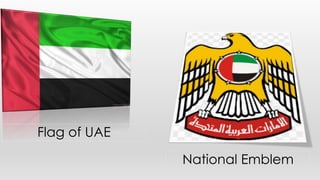
Flag of UAE
National Emblem
• The United Arab Emirates (Arabic: ‫دولة‬‫اإلمارات‬
‫العربية‬‫المتحدة‬ Dawlat al-Imārāt al-‘Arabīyah al-
Muttaḥidah), sometimes simply called
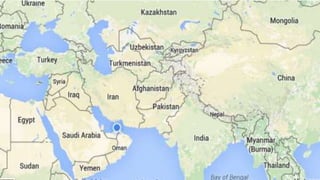
the Emirates or the UAE, is a country located in
the southeast end of the Arabian Peninsula on
the Persian Gulf, bordering Oman to the east
and Saudi Arabia to the south, as well as
sharing sea borders with Qatar and Iran.
WHERE UNITED ARAB EMIRATES IS
LOCATED
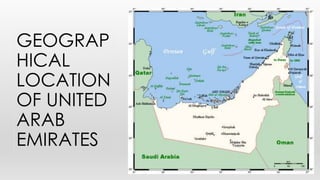
• It shares a 19-kilometer border
with Qatar on the northwest
(according to the UAE), a 530-
kilometer border with Saudi
Arabia on the west, south, and
southeast, and a 450-kilometer
border with Oman on the
southeast and northeast. The
land border with Qatar in
the Khawr al Udayd area is a
source of ongoing dispute (in
fact, whether it even shares a
land border with Qatar is in
dispute). The total area of the
UAE is approximately 83,600
square kilometers.
• The United Arab Emirates is
situated in Middle
East/southwest Asia, bordering
the Gulf of Oman and
the Persian Gulf,
between Oman and Saudi
Arabia; it is on a strategic
location along northern
approaches to the Strait of
Hormuz, a vital transit point for
world crude oil. The UAE lies
between 22°50′ and 26° north
latitude and between 51° and
56°25′ east longitude.
GEOGRAPHIC FEATURES OF UNITED
ARAB EMIRATES
GEOGRAP
HICAL
LOCATION
OF UNITED
ARAB
EMIRATES
• The average annual rainfall in
the coastal area is fewer than
120 mm (4.7 in), but in some
mountainous areas annual
rainfall often reaches 350 mm
(13.8 in). Rain in the coastal
region falls in short, torrential
bursts during the summer
months, sometimes resulting in
floods in ordinarily
dry wadi beds. The region is
prone to occasional,
violent dust storm, which can
severely reduce visibility. The
Jebel Jais mountain cluster
in Ras al Khaimah has
experienced snow only twice
since records began.
• The climate of the UAE
generally is very hot and dry.
The hottest months are July
and August, when average
maximum temperatures reach
above 40 °C (104.0 °F) on the
coastal plain. In the Al Hajar al
Gharbi Mountains,
temperatures are considerably
cooler, a result of increased
altitude. Average minimum
temperatures in January and
February are between 10 and
14 °C (50.0 and 57.2 °F). During
the late summer months, a
humid southeastern wind
known as the sharqi makes the
coastal region especially
unpleasant.
CLIMATE OF UNITED ARAB EMIRATES
• conservation program
on Bani Yas island initiated
by Sheikh Zayed bin Sultan
Al Nahyan in the 1970s,
resulting in the survival of, for
example, Arabian
oryx and leopards. Coastal
fish consist mainly
of mackerel, perch and tun
a, as well
as sharks and whales.
• In the oases grow date
palms, acacia and eucalypt
us trees. In the desert the
flora is very sparse and
consists of grasses and thorn
bushes. The indigenous
fauna had come close to
extinction because of
intensive hunting, which has
led to a
ENVIRONMENT OF UNITED ARAB
EMIRATES
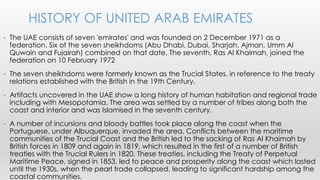
• The UAE consists of seven 'emirates' and was founded on 2 December 1971 as a
federation. Six of the seven sheikhdoms (Abu Dhabi, Dubai, Sharjah, Ajman, Umm Al
Quwain and Fujairah) combined on that date. The seventh, Ras Al Khaimah, joined the
federation on 10 February 1972
• The seven sheikhdoms were formerly known as the Trucial States, in reference to the treaty
relations established with the British in the 19th Century.
• Artifacts uncovered in the UAE show a long history of human habitation and regional trade
including with Mesopotamia. The area was settled by a number of tribes along both the
coast and interior and was Islamised in the seventh century.
• A number of incursions and bloody battles took place along the coast when the
Portuguese, under Albuquerque, invaded the area. Conflicts between the maritime
communities of the Trucial Coast and the British led to the sacking of Ras Al Khaimah by
British forces in 1809 and again in 1819, which resulted in the first of a number of British
treaties with the Trucial Rulers in 1820. These treaties, including the Treaty of Perpetual
Maritime Peace, signed in 1853, led to peace and prosperity along the coast which lasted
until the 1930s, when the pearl trade collapsed, leading to significant hardship among the
coastal communities.
HISTORY OF UNITED ARAB EMIRATES
by Persian culture. Arabian
and Persian inspired architecture is part of
the expression of the local Emirati identity.
Persian influence on Emirati culture is
noticeably visible in traditional Emirati
architecture and folk arts. For example, the
"barjeel" has become an identifying mark of
traditional Emirati architecture and is
attributed to Persian influence. Certain folk
dances, such as "al-habban", are originally
Persian. Local Emirati culture has also been
influenced by the cultures of East Africa
and India
• Major holidays in Dubai include Eid ul-Fitr,
which marks the end of Ramadan,
and National Day (2 December), which
marks the formation of the United Arab
Emirates.
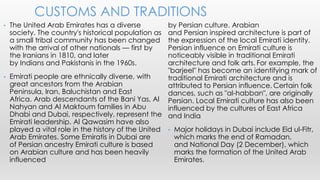
• The United Arab Emirates has a diverse
society. The country's historical population as
a small tribal community has been changed
with the arrival of other nationals — first by
the Iranians in 1810, and later
by Indians and Pakistanis in the 1960s.
• Emirati people are ethnically diverse, with
great ancestors from the Arabian
Peninsula, Iran, Baluchistan and East
Africa. Arab descendants of the Bani Yas, Al
Nahyan and Al Maktoum families in Abu
Dhabi and Dubai, respectively, represent the
Emirati leadership. Al Qawasim have also
played a vital role in the history of the United
Arab Emirates. Some Emiratis in Dubai are
of Persian ancestry Emirati culture is based
on Arabian culture and has been heavily
influenced
CUSTOMS AND TRADITIONS
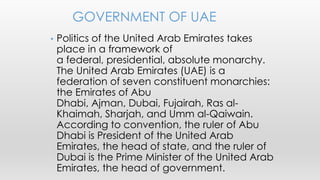
• Politics of the United Arab Emirates takes
place in a framework of
a federal, presidential, absolute monarchy.
The United Arab Emirates (UAE) is a
federation of seven constituent monarchies:
the Emirates of Abu
Dhabi, Ajman, Dubai, Fujairah, Ras al-
Khaimah, Sharjah, and Umm al-Qaiwain.
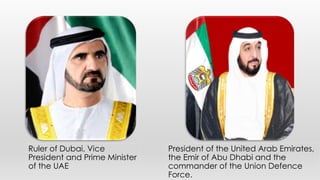
According to convention, the ruler of Abu
Dhabi is President of the United Arab
Emirates, the head of state, and the ruler of
Dubai is the Prime Minister of the United Arab
Emirates, the head of government.
GOVERNMENT OF UAE
Ruler of Dubai, Vice
President and Prime Minister
of the UAE
President of the United Arab Emirates,
the Emir of Abu Dhabi and the
commander of the Union Defence
Force.
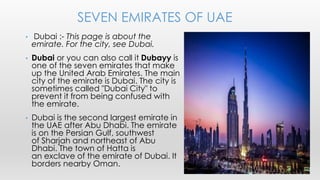
• Dubai :- This page is about the
emirate. For the city, see Dubai.
• Dubai or you can also call it Dubayy is
one of the seven emirates that make
up the United Arab Emirates. The main
city of the emirate is Dubai. The city is
sometimes called "Dubai City" to
prevent it from being confused with
the emirate.
• Dubai is the second largest emirate in
the UAE after Abu Dhabi. The emirate
is on the Persian Gulf, southwest
of Sharjah and northeast of Abu
Dhabi. The town of Hatta is
an exclave of the emirate of Dubai. It
borders nearby Oman.
SEVEN EMIRATES OF UAE
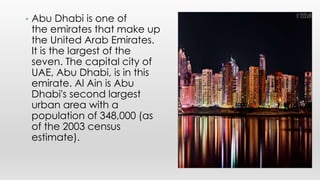
• Abu Dhabi is one of
the emirates that make up
the United Arab Emirates.
It is the largest of the
seven. The capital city of
UAE, Abu Dhabi, is in this
emirate. Al Ain is Abu
Dhabi's second largest
urban area with a
population of 348,000 (as
of the 2003 census
estimate).
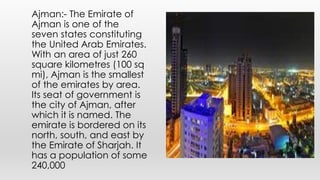
Ajman:- The Emirate of
Ajman is one of the
seven states constituting
the United Arab Emirates.
With an area of just 260
square kilometres (100 sq
mi), Ajman is the smallest
of the emirates by area.
Its seat of government is
the city of Ajman, after
which it is named. The
emirate is bordered on its
north, south, and east by
the Emirate of Sharjah. It
has a population of some
240,000
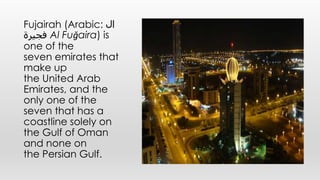
Fujairah (Arabic: ‫ال‬
‫فجيرة‬ Al Fuǧaira) is
one of the
seven emirates that
make up
the United Arab
Emirates, and the
only one of the
seven that has a
coastline solely on
the Gulf of Oman
and none on
the Persian Gulf.
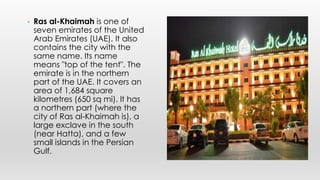
• Ras al-Khaimah is one of
seven emirates of the United
Arab Emirates (UAE). It also
contains the city with the
same name. Its name
means "top of the tent". The
emirate is in the northern
part of the UAE. It covers an
area of 1,684 square
kilometres (650 sq mi). It has
a northern part (where the
city of Ras al-Khaimah is), a
large exclave in the south
(near Hatta), and a few
small islands in the Persian
Gulf.
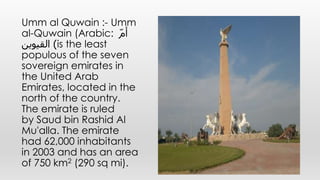
Umm al Quwain :- Umm
al-Quwain (Arabic: ّ‫م‬‫أ‬
‫القيوين‬ )is the least
populous of the seven
sovereign emirates in
the United Arab
Emirates, located in the
north of the country.
The emirate is ruled
by Saud bin Rashid Al
Mu'alla. The emirate
had 62,000 inhabitants
in 2003 and has an area
of 750 km2 (290 sq mi).
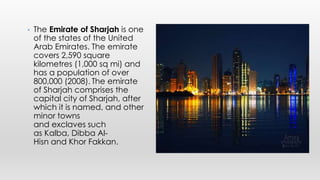
• The Emirate of Sharjah is one
of the states of the United
Arab Emirates. The emirate
covers 2,590 square
kilometres (1,000 sq mi) and
has a population of over
800,000 (2008). The emirate
of Sharjah comprises the
capital city of Sharjah, after
which it is named, and other
minor towns
and exclaves such
as Kalba, Dibba Al-
Hisn and Khor Fakkan.
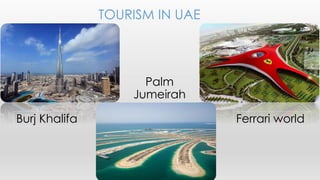
TOURISM IN UAE
Burj Khalifa
Palm
Jumeirah
Ferrari world
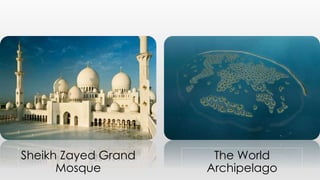
Sheikh Zayed Grand
Mosque
The World
Archipelago

United Arab Emirates

  • 1.
    Sara Warisha &Zaman| Sujatha| Grade 9 UNITED ARAB EMIRATES
  • 2.
  • 3.
    • The UnitedArab Emirates (Arabic: ‫دولة‬‫اإلمارات‬ ‫العربية‬‫المتحدة‬ Dawlat al-Imārāt al-‘Arabīyah al- Muttaḥidah), sometimes simply called the Emirates or the UAE, is a country located in the southeast end of the Arabian Peninsula on the Persian Gulf, bordering Oman to the east and Saudi Arabia to the south, as well as sharing sea borders with Qatar and Iran. WHERE UNITED ARAB EMIRATES IS LOCATED
  • 5.
    • It sharesa 19-kilometer border with Qatar on the northwest (according to the UAE), a 530- kilometer border with Saudi Arabia on the west, south, and southeast, and a 450-kilometer border with Oman on the southeast and northeast. The land border with Qatar in the Khawr al Udayd area is a source of ongoing dispute (in fact, whether it even shares a land border with Qatar is in dispute). The total area of the UAE is approximately 83,600 square kilometers. • The United Arab Emirates is situated in Middle East/southwest Asia, bordering the Gulf of Oman and the Persian Gulf, between Oman and Saudi Arabia; it is on a strategic location along northern approaches to the Strait of Hormuz, a vital transit point for world crude oil. The UAE lies between 22°50′ and 26° north latitude and between 51° and 56°25′ east longitude. GEOGRAPHIC FEATURES OF UNITED ARAB EMIRATES
  • 6.
  • 7.
    • The averageannual rainfall in the coastal area is fewer than 120 mm (4.7 in), but in some mountainous areas annual rainfall often reaches 350 mm (13.8 in). Rain in the coastal region falls in short, torrential bursts during the summer months, sometimes resulting in floods in ordinarily dry wadi beds. The region is prone to occasional, violent dust storm, which can severely reduce visibility. The Jebel Jais mountain cluster in Ras al Khaimah has experienced snow only twice since records began. • The climate of the UAE generally is very hot and dry. The hottest months are July and August, when average maximum temperatures reach above 40 °C (104.0 °F) on the coastal plain. In the Al Hajar al Gharbi Mountains, temperatures are considerably cooler, a result of increased altitude. Average minimum temperatures in January and February are between 10 and 14 °C (50.0 and 57.2 °F). During the late summer months, a humid southeastern wind known as the sharqi makes the coastal region especially unpleasant. CLIMATE OF UNITED ARAB EMIRATES
  • 8.
    • conservation program onBani Yas island initiated by Sheikh Zayed bin Sultan Al Nahyan in the 1970s, resulting in the survival of, for example, Arabian oryx and leopards. Coastal fish consist mainly of mackerel, perch and tun a, as well as sharks and whales. • In the oases grow date palms, acacia and eucalypt us trees. In the desert the flora is very sparse and consists of grasses and thorn bushes. The indigenous fauna had come close to extinction because of intensive hunting, which has led to a ENVIRONMENT OF UNITED ARAB EMIRATES
  • 9.
    • The UAEconsists of seven 'emirates' and was founded on 2 December 1971 as a federation. Six of the seven sheikhdoms (Abu Dhabi, Dubai, Sharjah, Ajman, Umm Al Quwain and Fujairah) combined on that date. The seventh, Ras Al Khaimah, joined the federation on 10 February 1972 • The seven sheikhdoms were formerly known as the Trucial States, in reference to the treaty relations established with the British in the 19th Century. • Artifacts uncovered in the UAE show a long history of human habitation and regional trade including with Mesopotamia. The area was settled by a number of tribes along both the coast and interior and was Islamised in the seventh century. • A number of incursions and bloody battles took place along the coast when the Portuguese, under Albuquerque, invaded the area. Conflicts between the maritime communities of the Trucial Coast and the British led to the sacking of Ras Al Khaimah by British forces in 1809 and again in 1819, which resulted in the first of a number of British treaties with the Trucial Rulers in 1820. These treaties, including the Treaty of Perpetual Maritime Peace, signed in 1853, led to peace and prosperity along the coast which lasted until the 1930s, when the pearl trade collapsed, leading to significant hardship among the coastal communities. HISTORY OF UNITED ARAB EMIRATES
  • 10.
    by Persian culture.Arabian and Persian inspired architecture is part of the expression of the local Emirati identity. Persian influence on Emirati culture is noticeably visible in traditional Emirati architecture and folk arts. For example, the "barjeel" has become an identifying mark of traditional Emirati architecture and is attributed to Persian influence. Certain folk dances, such as "al-habban", are originally Persian. Local Emirati culture has also been influenced by the cultures of East Africa and India • Major holidays in Dubai include Eid ul-Fitr, which marks the end of Ramadan, and National Day (2 December), which marks the formation of the United Arab Emirates. • The United Arab Emirates has a diverse society. The country's historical population as a small tribal community has been changed with the arrival of other nationals — first by the Iranians in 1810, and later by Indians and Pakistanis in the 1960s. • Emirati people are ethnically diverse, with great ancestors from the Arabian Peninsula, Iran, Baluchistan and East Africa. Arab descendants of the Bani Yas, Al Nahyan and Al Maktoum families in Abu Dhabi and Dubai, respectively, represent the Emirati leadership. Al Qawasim have also played a vital role in the history of the United Arab Emirates. Some Emiratis in Dubai are of Persian ancestry Emirati culture is based on Arabian culture and has been heavily influenced CUSTOMS AND TRADITIONS
  • 11.
    • Politics ofthe United Arab Emirates takes place in a framework of a federal, presidential, absolute monarchy. The United Arab Emirates (UAE) is a federation of seven constituent monarchies: the Emirates of Abu Dhabi, Ajman, Dubai, Fujairah, Ras al- Khaimah, Sharjah, and Umm al-Qaiwain. According to convention, the ruler of Abu Dhabi is President of the United Arab Emirates, the head of state, and the ruler of Dubai is the Prime Minister of the United Arab Emirates, the head of government. GOVERNMENT OF UAE
  • 12.
    Ruler of Dubai,Vice President and Prime Minister of the UAE President of the United Arab Emirates, the Emir of Abu Dhabi and the commander of the Union Defence Force.
  • 13.
    • Dubai :-This page is about the emirate. For the city, see Dubai. • Dubai or you can also call it Dubayy is one of the seven emirates that make up the United Arab Emirates. The main city of the emirate is Dubai. The city is sometimes called "Dubai City" to prevent it from being confused with the emirate. • Dubai is the second largest emirate in the UAE after Abu Dhabi. The emirate is on the Persian Gulf, southwest of Sharjah and northeast of Abu Dhabi. The town of Hatta is an exclave of the emirate of Dubai. It borders nearby Oman. SEVEN EMIRATES OF UAE
  • 14.
    • Abu Dhabiis one of the emirates that make up the United Arab Emirates. It is the largest of the seven. The capital city of UAE, Abu Dhabi, is in this emirate. Al Ain is Abu Dhabi's second largest urban area with a population of 348,000 (as of the 2003 census estimate).
  • 15.
    Ajman:- The Emirateof Ajman is one of the seven states constituting the United Arab Emirates. With an area of just 260 square kilometres (100 sq mi), Ajman is the smallest of the emirates by area. Its seat of government is the city of Ajman, after which it is named. The emirate is bordered on its north, south, and east by the Emirate of Sharjah. It has a population of some 240,000
  • 16.
    Fujairah (Arabic: ‫ال‬ ‫فجيرة‬Al Fuǧaira) is one of the seven emirates that make up the United Arab Emirates, and the only one of the seven that has a coastline solely on the Gulf of Oman and none on the Persian Gulf.
  • 17.
    • Ras al-Khaimahis one of seven emirates of the United Arab Emirates (UAE). It also contains the city with the same name. Its name means "top of the tent". The emirate is in the northern part of the UAE. It covers an area of 1,684 square kilometres (650 sq mi). It has a northern part (where the city of Ras al-Khaimah is), a large exclave in the south (near Hatta), and a few small islands in the Persian Gulf.
  • 18.
    Umm al Quwain:- Umm al-Quwain (Arabic: ّ‫م‬‫أ‬ ‫القيوين‬ )is the least populous of the seven sovereign emirates in the United Arab Emirates, located in the north of the country. The emirate is ruled by Saud bin Rashid Al Mu'alla. The emirate had 62,000 inhabitants in 2003 and has an area of 750 km2 (290 sq mi).
  • 19.
    • The Emirateof Sharjah is one of the states of the United Arab Emirates. The emirate covers 2,590 square kilometres (1,000 sq mi) and has a population of over 800,000 (2008). The emirate of Sharjah comprises the capital city of Sharjah, after which it is named, and other minor towns and exclaves such as Kalba, Dibba Al- Hisn and Khor Fakkan.
  • 20.
    TOURISM IN UAE BurjKhalifa Palm Jumeirah Ferrari world
  • 21.