WELCOME
WE ARE THE….
GLADIATORS
12TH BATCH(EMBA); SEC-“B”
DEPARTMENT OF MARKETING
JAGANNATH UNIVERSITY
WE HAVE…
Md. Ahaduzzaman M-17120204752
Monir Uddin M-17120204762
Mahmudul Hasan M-17120204767
Masud Kysar Asif M-17120204774
STARBUCKS—GOING GLOBAL FAST
BACKGROUND
• Starbucks Corporation is an American global coffee company and coffeehouse-chain based in
Seattle, Washington.
• The first Starbucks opened in Seattle, Washington, on March 30, 1971 by three partners that met
while students at the University of San Francisco: English teacher Jerry Baldwin, history teacher Zev
Siegl, and writer Gordon Bowker.
• They sold beans and coffee makers.
• Customers were encouraged to learn how to grind the beans and make their own freshly brewed
coffee at home.
• Starbucks name came from a character in classic novel Moby Dick, published in 1851, which takes
place in sea.
• In 1987, the original owners sold the Starbucks chain to former employee Howard Schultz and
quickly began to expand.
COMPANY GROWTH
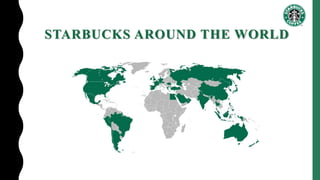
• Starbucks grew from 17 coffee shops in Seattle 15 years ago to over 20,891 outlets in 62
countries.
• Including 13,279 in the United States, 1,324 in Canada, 989 in Japan, 851 in China, 806 in the
United Kingdom, 556 in South Korea, 377 in Mexico, 291 in Taiwan, 206 in the Philippines,
171 in Thailand and 10 in India.
• The company planned to open a net of 900 new stores outside of the United States in 2009.
• Since 1987, Starbucks has opened on average two new stores every day.
• The first store outside the United States or Canada opened in the mid-1990s, and overseas
stores now constitute almost one third of Starbucks' stores.
STARBUCKS AROUND THE WORLD
QUESTION 1
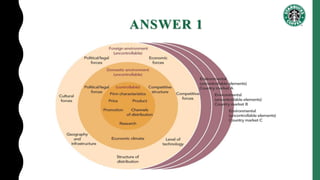
Identify the controllable and uncontrollable elements that Starbucks has encountered in
entering global markets.
ANSWER 1
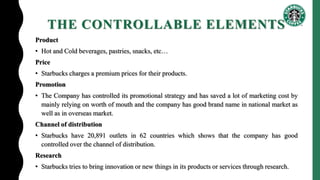
THE CONTROLLABLE ELEMENTS
Product
• Hot and Cold beverages, pastries, snacks, etc…
Price
• Starbucks charges a premium prices for their products.
Promotion
• The Company has controlled its promotional strategy and has saved a lot of marketing cost by
mainly relying on worth of mouth and the company has good brand name in national market as
well as in overseas market.
Channel of distribution
• Starbucks have 20,891 outlets in 62 countries which shows that the company has good
controlled over the channel of distribution.
Research
• Starbucks tries to bring innovation or new things in its products or services through research.
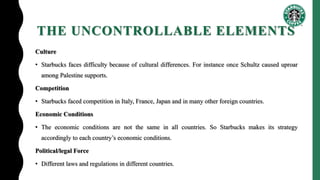
THE UNCONTROLLABLE ELEMENTS
Culture
• Starbucks faces difficulty because of cultural differences. For instance once Schultz caused uproar
among Palestine supports.
Competition
• Starbucks faced competition in Italy, France, Japan and in many other foreign countries.
Economic Conditions
• The economic conditions are not the same in all countries. So Starbucks makes its strategy
accordingly to each country’s economic conditions.
Political/legal Force
• Different laws and regulations in different countries.
QUESTION 2
What are the major sources of risk facing the company and discuss the potential solutions?
ANSWER 2
The major sources of risk that Starbucks faced:
• The home market is becoming saturated.
• The company is facing an ominously hostile reception from its future consumers, the twenty or
thirty something of generation X.
• Starbucks is becoming a far less special place for its employees.
CONTINUE..
The potential solutions could be:
• As Starbucks is facing fierce competition, they need be better than the competitors. They can
lower their prices, better products and services, bring innovation in their operation or they can
incase their product line.
• There needs to be a comprehensive research and bring a new strategy for its generation X
consumers.
• They need to restructure their employees’ working schedule, increase their salary and other
benefits to ensure employee satisfaction.
QUESTION 3
Critique Starbucks overall corporate strategy.
ANSWER 3
Critique of Starbucks overall corporate strategy:
• Starbucks is making less money on each overseas store because most of them are operated with
local partners.
• The workers are not paid well for overtime or over duty.
• Its pricing policy is not suitable for generation X.
• Starbucks only spends $30 million annually on advertising, or roughly 1% of its revenues.
• There are eight states in U.S. with no Starbucks store.
Answer No. 3
QUESTION 4
How might Starbucks improve profitability in Japan?
ANSWER 4
Japan has a very competitive and lucrative market. To improve their profitability in Japan, they
need to position their products and services matching the culture of Japan. They can lower their
products prices, design its stores using Japanese symbols or designs, free Wi-Fi and other
technological facilities and they also should increase their advertising budget to stay in the
competition.
SOME CHALLENGES FACING THE
COMPANY
• The firm closed 475 stores in the U.S. in 2009 to reduce costs.
• Saturated market with over 10,000 stores scattered across the United States and Canada. (there
are still eight states in the United States with no Starbucks stores.)
• self-cannibalization (opening stores in the same area)
• The company facing employees dissatisfaction (Dissatisfaction over odd hours and low pay is
affecting the quality of the service and even the coffee itself)— feeling overworked and
underappreciated.
CONTINUE..
• Starbucks faces competition from competitors such as Nestle, Dunkin’ Donuts and McDonald’s
and their new McCafés .
• Starbucks faces steep competition in Japan, including Starbucks lookalikes.
RECOMMENDATIONS FOR STARBUCKS
• There are 8 cities in the USA that doesn’t have Starbucks. This means there are few people who
don’t have access to Starbucks. Starbucks can set up their store there so that the sales of
Starbucks USA can be increased.
• Starbucks is one of the oldest cafes in the USA. This is one of the reasons due to which lot of
people walk-in into the cafe but the younger generation is sceptical about Starbucks. It is the
responsibility of the management to introduce new products so that Starbucks can be loved by
the younger generation as well.
• The advertising of Starbucks should be increased so that it can look appealing to the youngsters
in the nation.
CONCLUSION
Starbucks is one of the popular coffee stores across the globe but they are certain areas wherein
they need to improve so that they can stay ahead in the competition. The management will have to
work on the Japanese market so that they can survive in Japan. Improvement in the services is one
of the best strategies to stay ahead in the competition, at all possible locations.
Starbucks-Going Global Fast

Starbucks-Going Global Fast

  • 1.
  • 2.
    WE ARE THE…. GLADIATORS 12THBATCH(EMBA); SEC-“B” DEPARTMENT OF MARKETING JAGANNATH UNIVERSITY WE HAVE… Md. Ahaduzzaman M-17120204752 Monir Uddin M-17120204762 Mahmudul Hasan M-17120204767 Masud Kysar Asif M-17120204774
  • 3.
  • 4.
    BACKGROUND • Starbucks Corporationis an American global coffee company and coffeehouse-chain based in Seattle, Washington. • The first Starbucks opened in Seattle, Washington, on March 30, 1971 by three partners that met while students at the University of San Francisco: English teacher Jerry Baldwin, history teacher Zev Siegl, and writer Gordon Bowker. • They sold beans and coffee makers. • Customers were encouraged to learn how to grind the beans and make their own freshly brewed coffee at home. • Starbucks name came from a character in classic novel Moby Dick, published in 1851, which takes place in sea. • In 1987, the original owners sold the Starbucks chain to former employee Howard Schultz and quickly began to expand.
  • 5.
    COMPANY GROWTH • Starbucksgrew from 17 coffee shops in Seattle 15 years ago to over 20,891 outlets in 62 countries. • Including 13,279 in the United States, 1,324 in Canada, 989 in Japan, 851 in China, 806 in the United Kingdom, 556 in South Korea, 377 in Mexico, 291 in Taiwan, 206 in the Philippines, 171 in Thailand and 10 in India. • The company planned to open a net of 900 new stores outside of the United States in 2009. • Since 1987, Starbucks has opened on average two new stores every day. • The first store outside the United States or Canada opened in the mid-1990s, and overseas stores now constitute almost one third of Starbucks' stores.
  • 6.
  • 7.
    QUESTION 1 Identify thecontrollable and uncontrollable elements that Starbucks has encountered in entering global markets.
  • 8.
  • 9.
    THE CONTROLLABLE ELEMENTS Product •Hot and Cold beverages, pastries, snacks, etc… Price • Starbucks charges a premium prices for their products. Promotion • The Company has controlled its promotional strategy and has saved a lot of marketing cost by mainly relying on worth of mouth and the company has good brand name in national market as well as in overseas market. Channel of distribution • Starbucks have 20,891 outlets in 62 countries which shows that the company has good controlled over the channel of distribution. Research • Starbucks tries to bring innovation or new things in its products or services through research.
  • 10.
    THE UNCONTROLLABLE ELEMENTS Culture •Starbucks faces difficulty because of cultural differences. For instance once Schultz caused uproar among Palestine supports. Competition • Starbucks faced competition in Italy, France, Japan and in many other foreign countries. Economic Conditions • The economic conditions are not the same in all countries. So Starbucks makes its strategy accordingly to each country’s economic conditions. Political/legal Force • Different laws and regulations in different countries.
  • 11.
    QUESTION 2 What arethe major sources of risk facing the company and discuss the potential solutions?
  • 12.
    ANSWER 2 The majorsources of risk that Starbucks faced: • The home market is becoming saturated. • The company is facing an ominously hostile reception from its future consumers, the twenty or thirty something of generation X. • Starbucks is becoming a far less special place for its employees.
  • 13.
    CONTINUE.. The potential solutionscould be: • As Starbucks is facing fierce competition, they need be better than the competitors. They can lower their prices, better products and services, bring innovation in their operation or they can incase their product line. • There needs to be a comprehensive research and bring a new strategy for its generation X consumers. • They need to restructure their employees’ working schedule, increase their salary and other benefits to ensure employee satisfaction.
  • 14.
    QUESTION 3 Critique Starbucksoverall corporate strategy.
  • 15.
    ANSWER 3 Critique ofStarbucks overall corporate strategy: • Starbucks is making less money on each overseas store because most of them are operated with local partners. • The workers are not paid well for overtime or over duty. • Its pricing policy is not suitable for generation X. • Starbucks only spends $30 million annually on advertising, or roughly 1% of its revenues. • There are eight states in U.S. with no Starbucks store. Answer No. 3
  • 16.
    QUESTION 4 How mightStarbucks improve profitability in Japan?
  • 17.
    ANSWER 4 Japan hasa very competitive and lucrative market. To improve their profitability in Japan, they need to position their products and services matching the culture of Japan. They can lower their products prices, design its stores using Japanese symbols or designs, free Wi-Fi and other technological facilities and they also should increase their advertising budget to stay in the competition.
  • 18.
    SOME CHALLENGES FACINGTHE COMPANY • The firm closed 475 stores in the U.S. in 2009 to reduce costs. • Saturated market with over 10,000 stores scattered across the United States and Canada. (there are still eight states in the United States with no Starbucks stores.) • self-cannibalization (opening stores in the same area) • The company facing employees dissatisfaction (Dissatisfaction over odd hours and low pay is affecting the quality of the service and even the coffee itself)— feeling overworked and underappreciated.
  • 19.
    CONTINUE.. • Starbucks facescompetition from competitors such as Nestle, Dunkin’ Donuts and McDonald’s and their new McCafés . • Starbucks faces steep competition in Japan, including Starbucks lookalikes.
  • 20.
    RECOMMENDATIONS FOR STARBUCKS •There are 8 cities in the USA that doesn’t have Starbucks. This means there are few people who don’t have access to Starbucks. Starbucks can set up their store there so that the sales of Starbucks USA can be increased. • Starbucks is one of the oldest cafes in the USA. This is one of the reasons due to which lot of people walk-in into the cafe but the younger generation is sceptical about Starbucks. It is the responsibility of the management to introduce new products so that Starbucks can be loved by the younger generation as well. • The advertising of Starbucks should be increased so that it can look appealing to the youngsters in the nation.
  • 21.
    CONCLUSION Starbucks is oneof the popular coffee stores across the globe but they are certain areas wherein they need to improve so that they can stay ahead in the competition. The management will have to work on the Japanese market so that they can survive in Japan. Improvement in the services is one of the best strategies to stay ahead in the competition, at all possible locations.