Tag QuestionsESL Lesson: Expanding Level (4)Created by: Melissa C. Stanton
To develop an understanding of Tag Questions and how they are used in the English language.Let’s Get Started! Our Goal Today is…..
A tag question, sometimes called a question tag, is a small question that comes at the end of a sentence.For Example: It’s a beautiful day, isn’t it?With a partner, examine the sentence above.  What part contains the question tag?CORRECT ANSWER: isn’t itWhat are TAG QUESTIONS ?
Notice above, I have used a question tag. We use question tags for several reasons:To check whether something is true. You’re made at me, aren’t you?To ask the listener to agree with what we have said. It’s a hot day out, isn’t it?To continue a conversation. If I say “You're French", that may be the end of the conversation, because you don't have to say anything. However, if I add a question tag and say, “You're French, aren't you?", I'm asking a question and now you should answer, so the conversation keeps going:- You're French, aren't you?- Yes, I am.You’re learning a lot already, aren’t you?
A positive statement is followed by a negative tag:For Example: You’re English, aren’t you?+			       -		    You’re English,      	     aren’t you?  A negative statement is followed by a positive tag:For Example:  You’re not German, are you?			- 				+        You're not German,              are you? How are Tag Questions formed?
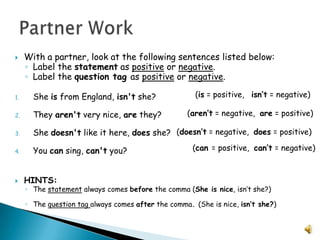
With a partner, look at the following sentences listed below:Label the statement as positive or negative.Label the question tag as positive or negative.She is from England, isn't she?                  They aren't very nice, are they?  She doesn't like it here, does she?   You can sing, can't you? 	HINTS: The statement always comes before the comma (She is nice, isn’t she?)The question tag always comes after the comma. (She is nice, isn’t she?)Partner Work(is = positive,   isn’t = negative)(aren’t = negative,  are = positive)(doesn’t = negative,  does = positive)(can = positive,  can’t = negative)
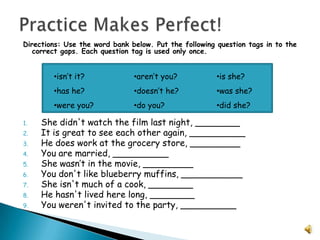
Practice Makes Perfect!Directions: Use the word bank below. Put the following question tags in to the correct gaps. Each question tag is used only once.She didn't watch the film last night, ________ It is great to see each other again, __________ He does work at the grocery store, _________ You are married, __________ She wasn’t in the movie, _________ You don't like blueberry muffins, ___________ She isn't much of a cook, ________ He hasn't lived here long, ________ You weren't invited to the party, __________ isn’t it?
has he?
were you?

Stanton u09a1a.doc

  • 1.
    Tag QuestionsESL Lesson:Expanding Level (4)Created by: Melissa C. Stanton
  • 2.
    To develop anunderstanding of Tag Questions and how they are used in the English language.Let’s Get Started! Our Goal Today is…..
  • 3.
    A tag question,sometimes called a question tag, is a small question that comes at the end of a sentence.For Example: It’s a beautiful day, isn’t it?With a partner, examine the sentence above. What part contains the question tag?CORRECT ANSWER: isn’t itWhat are TAG QUESTIONS ?
  • 4.
    Notice above, Ihave used a question tag. We use question tags for several reasons:To check whether something is true. You’re made at me, aren’t you?To ask the listener to agree with what we have said. It’s a hot day out, isn’t it?To continue a conversation. If I say “You're French", that may be the end of the conversation, because you don't have to say anything. However, if I add a question tag and say, “You're French, aren't you?", I'm asking a question and now you should answer, so the conversation keeps going:- You're French, aren't you?- Yes, I am.You’re learning a lot already, aren’t you?
  • 5.
    A positive statementis followed by a negative tag:For Example: You’re English, aren’t you?+ - You’re English, aren’t you? A negative statement is followed by a positive tag:For Example: You’re not German, are you? - + You're not German, are you? How are Tag Questions formed?
  • 6.
    With a partner,look at the following sentences listed below:Label the statement as positive or negative.Label the question tag as positive or negative.She is from England, isn't she?   They aren't very nice, are they?  She doesn't like it here, does she?   You can sing, can't you? HINTS: The statement always comes before the comma (She is nice, isn’t she?)The question tag always comes after the comma. (She is nice, isn’t she?)Partner Work(is = positive, isn’t = negative)(aren’t = negative, are = positive)(doesn’t = negative, does = positive)(can = positive, can’t = negative)
  • 7.
    Practice Makes Perfect!Directions:Use the word bank below. Put the following question tags in to the correct gaps. Each question tag is used only once.She didn't watch the film last night, ________ It is great to see each other again, __________ He does work at the grocery store, _________ You are married, __________ She wasn’t in the movie, _________ You don't like blueberry muffins, ___________ She isn't much of a cook, ________ He hasn't lived here long, ________ You weren't invited to the party, __________ isn’t it?
  • 8.
  • 9.