ENGLISH LANGUAGE 
PROFICIENCY 1 (WAJ3022) 
NAME NURUL NATALIA BT NASIF 
NURALIA NADERA BT 
MOHAMAD 
NUR HANISAH BT MOHAMAD 
NOR 
HUSNA SU’AD BT TITAN 
LECTURER’S NAME Mr. AZMAN B. MOHAMED NOR
Yes/ No Questions 
(Closed questions)
Yes / No Questions 
• Is apart of closed questions which demand a yes/ no, true/ 
false, or right/ wrong answer. 
• Use do/ does, am/ is are or have/ has as a question words. 
• Use do or have or am with personal pronouns. 
• Use does or has or is with the third person singular pronouns 
(he, she, it) and with singular noun forms. 
• Use do or have or are with other personal pronouns (you, we, 
they) and with plural noun forms.
Examples 
• Am I English? 
• Have I got an English book? 
• Do you like your new teacher? 
• Can you help me? 
• Have you ever been here before?
Exercises 
• Q: Mercury is a liquid metal used in thermometers. _____________ mercury 
have a boiling point? 
A:Yes, __________________. It boils at 356.58˚ C. 
• Q: ______________ snakes have legs? 
A: No, ______________________ 
• Q: ___________________all snakebites poisonous? 
A: No, _______________________ 
• Q: I need a phone. _____________ you have one? 
A: Yes, _____________________.
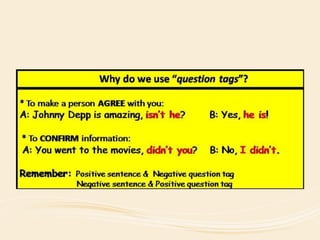
Tag Questions
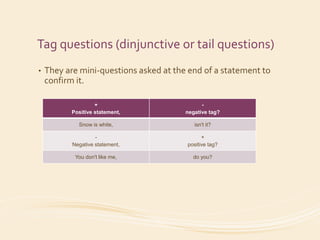
Tag questions (dinjunctive or tail questions) 
• They are mini-questions asked at the end of a statement to 
confirm it. 
+ 
Positive statement, 
- 
negative tag? 
Snow is white, isn't it? 
- 
Negative statement, 
+ 
positive tag? 
You don't like me, do you?
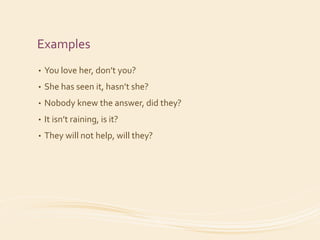
Examples 
• You love her, don’t you? 
• She has seen it, hasn’t she? 
• Nobody knew the answer, did they? 
• It isn’t raining, is it? 
• They will not help, will they?
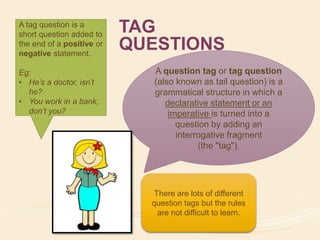
TAG 
QUESTIONS 
A question tag or tag question 
(also known as tail question) is a 
grammatical structure in which a 
declarative statement or an 
imperative is turned into a 
question by adding an 
interrogative fragment 
(the "tag"). 
There are lots of different 
question tags but the rules 
are not difficult to learn. 
A tag question is a 
short question added to 
the end of a positive or 
negative statement. 
Eg: 
• He’s a doctor, isn’t 
he? 
• You work in a bank, 
don’t you?
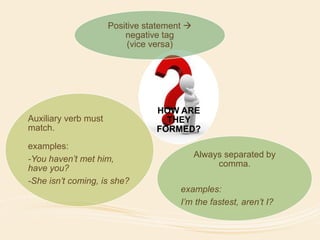
Positive statement  
negative tag 
(vice versa) 
HOW ARE 
THEY 
FORMED? 
Always separated by 
comma. 
examples: 
I’m the fastest, aren’t I? 
Auxiliary verb must 
match. 
examples: 
-You haven’t met him, 
have you? 
-She isn’t coming, is she?
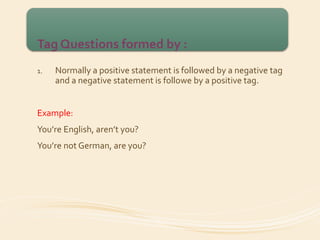
Tag Questions formed by : 
1. Normally a positive statement is followed by a negative tag 
and a negative statement is followe by a positive tag. 
Example: 
You’re English, aren’t you? 
You’re not German, are you?
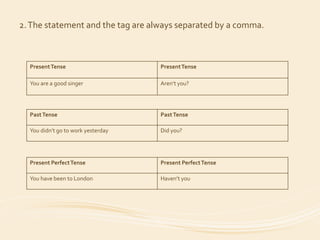
2. The statement and the tag are always separated by a comma. 
Present Tense PresentTense 
You are a good singer Aren’t you? 
Past Tense Past Tense 
You didn’t go to work yesterday Did you? 
Present Perfect Tense Present Perfect Tense 
You have been to London Haven’t you
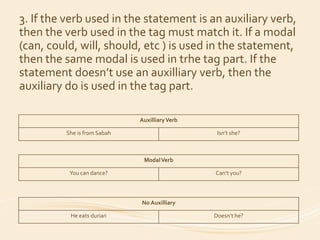
3. If the verb used in the statement is an auxiliary verb, 
then the verb used in the tag must match it. If a modal 
(can, could, will, should, etc ) is used in the statement, 
then the same modal is used in trhe tag part. If the 
statement doesn’t use an auxilliary verb, then the 
auxiliary do is used in the tag part. 
AuxilliaryVerb 
She is from Sabah Isn’t she? 
ModalVerb 
You can dance? Can’t you? 
No Auxilliary 
He eats durian Doesn’t he?
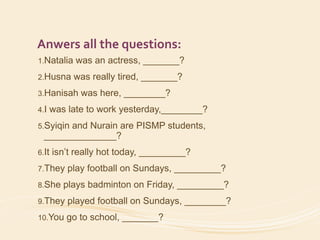
Anwers all the questions: 
1.Natalia was an actress, _______? 
2.Husna was really tired, _______? 
3.Hanisah was here, ________? 
4.I was late to work yesterday,________? 
5.Syiqin and Nurain are PISMP students, 
______________? 
6.It isn’t really hot today, _________? 
7.They play football on Sundays, _________? 
8.She plays badminton on Friday, _________? 
9.They played football on Sundays, ________? 
10.You go to school, _______?
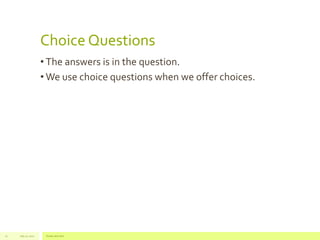
Choice Questions
Choice Questions 
• The answers is in the question. 
•We use choice questions when we offer choices. 
July 22, 17 2012 Footer text here
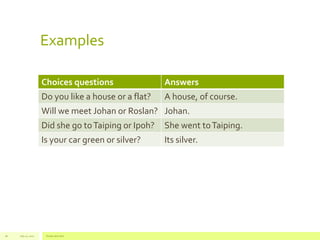
Examples 
Choices questions Answers 
Do you like a house or a flat? A house, of course. 
Will we meet Johan or Roslan? Johan. 
Did she go to Taiping or Ipoh? She went to Taiping. 
Is your car green or silver? Its silver. 
July 22, 18 2012 Footer text here
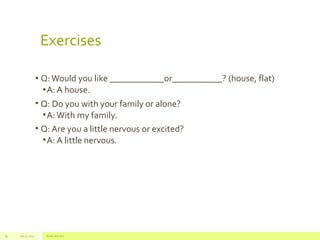
Exercises 
• Q: Would you like ____________or___________? (house, flat) 
•A: A house. 
• Q: Do you with your family or alone? 
•A: With my family. 
• Q: Are you a little nervous or excited? 
•A: A little nervous. 
July 22, 19 2012 Footer text here
INFORMATION QUESTIONS 
(WH-QUESTIONS)
INTRODUCTION 
 Wh-questions are used to ask for information that 
has not been previously mentioned. 
 They are different than Yes/No questions. 
 Wh- questions normally begin with an interrogative 
word 
 There are 6 different Wh- question words.
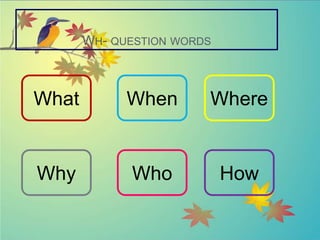
WH- QUESTION WORDS 
What 
When Where 
Who How 
Why
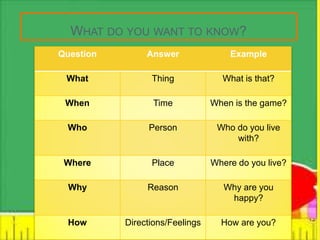
WHAT DO YOU WANT TO KNOW? 
Question Answer Example 
What Thing What is that? 
When Time When is the game? 
Who Person Who do you live 
with? 
Where Place Where do you live? 
Why Reason Why are you 
happy? 
How Directions/Feelings How are you?
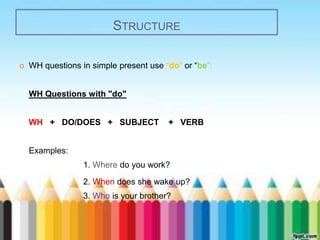
STRUCTURE 
 WH questions in simple present use “do” or “be”: 
WH Questions with "do" 
WH + DO/DOES + SUBJECT + VERB 
Examples: 
1. Where do you work? 
2. When does she wake up? 
3. Who is your brother?
STRUCTURE 
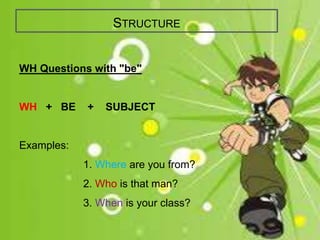
WH Questions with "be" 
WH + BE + SUBJECT 
Examples: 
1. Where are you from? 
2. Who is that man? 
3. When is your class?
STRUCTURE 
 Wh-questions are similar to yes/no questions 
except they 
have WH words at the start. 
Examples: 
Are you from Canada? 
Where are you from?
EXAMPLE QUESTIONS AND ANSWERS 
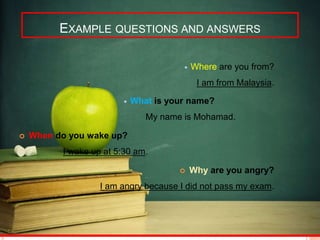
 Where are you from? 
I am from Malaysia. 
 What is your name? 
My name is Mohamad. 
 When do you wake up? 
I wake up at 5:30 am. 
 Why are you angry? 
I am angry because I did not pass my exam.
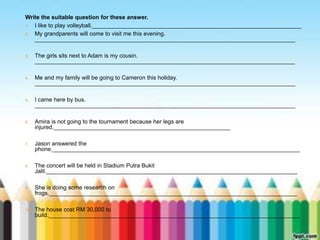
Write the suitable question for these answer. 
1. I like to play volleyball._________________________________________________________________ 
2. My grandparents will come to visit me this evening. 
_________________________________________________________________________________ 
3. The girls sits next to Adam is my cousin. 
_________________________________________________________________________________ 
4. Me and my family will be going to Cameron this holiday. 
_________________________________________________________________________________ 
5. I came here by bus. 
_________________________________________________________________________________ 
6. Amira is not going to the tournament because her legs are 
injured._______________________________________________________ 
7. Jason answered the 
phone._____________________________________________________________________________ 
8. The concert will be held in Stadium Putra Bukit 
Jalil.______________________________________________________________________________ 
9. She is doing some research on 
frogs._____________________________________________________________________________ 
10. The house cost RM 30,000 to 
build.______________________________________________________________________________
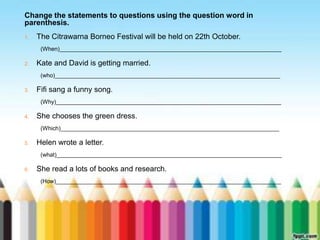
Change the statements to questions using the question word in 
parenthesis. 
1. The Citrawarna Borneo Festival will be held on 22th October. 
(When)_____________________________________________________________________ 
2. Kate and David is getting married. 
(who)______________________________________________________________________ 
3. Fifi sang a funny song. 
(Why)______________________________________________________________________ 
4. She chooses the green dress. 
(Which)____________________________________________________________________ 
5. Helen wrote a letter. 
(what)______________________________________________________________________ 
6. She read a lots of books and research. 
(How)______________________________________________________________________
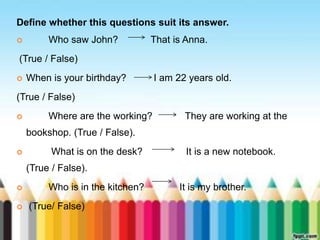
Define whether this questions suit its answer. 
 Who saw John? That is Anna. 
(True / False) 
 When is your birthday? I am 22 years old. 
(True / False) 
 Where are the working? They are working at the 
bookshop. (True / False). 
 What is on the desk? It is a new notebook. 
(True / False). 
 Who is in the kitchen? It is my brother. 
 (True/ False)

english language proficiency 1

  • 1.
    ENGLISH LANGUAGE PROFICIENCY1 (WAJ3022) NAME NURUL NATALIA BT NASIF NURALIA NADERA BT MOHAMAD NUR HANISAH BT MOHAMAD NOR HUSNA SU’AD BT TITAN LECTURER’S NAME Mr. AZMAN B. MOHAMED NOR
  • 2.
    Yes/ No Questions (Closed questions)
  • 3.
    Yes / NoQuestions • Is apart of closed questions which demand a yes/ no, true/ false, or right/ wrong answer. • Use do/ does, am/ is are or have/ has as a question words. • Use do or have or am with personal pronouns. • Use does or has or is with the third person singular pronouns (he, she, it) and with singular noun forms. • Use do or have or are with other personal pronouns (you, we, they) and with plural noun forms.
  • 4.
    Examples • AmI English? • Have I got an English book? • Do you like your new teacher? • Can you help me? • Have you ever been here before?
  • 5.
    Exercises • Q:Mercury is a liquid metal used in thermometers. _____________ mercury have a boiling point? A:Yes, __________________. It boils at 356.58˚ C. • Q: ______________ snakes have legs? A: No, ______________________ • Q: ___________________all snakebites poisonous? A: No, _______________________ • Q: I need a phone. _____________ you have one? A: Yes, _____________________.
  • 6.
  • 7.
    Tag questions (dinjunctiveor tail questions) • They are mini-questions asked at the end of a statement to confirm it. + Positive statement, - negative tag? Snow is white, isn't it? - Negative statement, + positive tag? You don't like me, do you?
  • 8.
    Examples • Youlove her, don’t you? • She has seen it, hasn’t she? • Nobody knew the answer, did they? • It isn’t raining, is it? • They will not help, will they?
  • 9.
    TAG QUESTIONS Aquestion tag or tag question (also known as tail question) is a grammatical structure in which a declarative statement or an imperative is turned into a question by adding an interrogative fragment (the "tag"). There are lots of different question tags but the rules are not difficult to learn. A tag question is a short question added to the end of a positive or negative statement. Eg: • He’s a doctor, isn’t he? • You work in a bank, don’t you?
  • 10.
    Positive statement  negative tag (vice versa) HOW ARE THEY FORMED? Always separated by comma. examples: I’m the fastest, aren’t I? Auxiliary verb must match. examples: -You haven’t met him, have you? -She isn’t coming, is she?
  • 12.
    Tag Questions formedby : 1. Normally a positive statement is followed by a negative tag and a negative statement is followe by a positive tag. Example: You’re English, aren’t you? You’re not German, are you?
  • 13.
    2. The statementand the tag are always separated by a comma. Present Tense PresentTense You are a good singer Aren’t you? Past Tense Past Tense You didn’t go to work yesterday Did you? Present Perfect Tense Present Perfect Tense You have been to London Haven’t you
  • 14.
    3. If theverb used in the statement is an auxiliary verb, then the verb used in the tag must match it. If a modal (can, could, will, should, etc ) is used in the statement, then the same modal is used in trhe tag part. If the statement doesn’t use an auxilliary verb, then the auxiliary do is used in the tag part. AuxilliaryVerb She is from Sabah Isn’t she? ModalVerb You can dance? Can’t you? No Auxilliary He eats durian Doesn’t he?
  • 15.
    Anwers all thequestions: 1.Natalia was an actress, _______? 2.Husna was really tired, _______? 3.Hanisah was here, ________? 4.I was late to work yesterday,________? 5.Syiqin and Nurain are PISMP students, ______________? 6.It isn’t really hot today, _________? 7.They play football on Sundays, _________? 8.She plays badminton on Friday, _________? 9.They played football on Sundays, ________? 10.You go to school, _______?
  • 16.
  • 17.
    Choice Questions •The answers is in the question. •We use choice questions when we offer choices. July 22, 17 2012 Footer text here
  • 18.
    Examples Choices questionsAnswers Do you like a house or a flat? A house, of course. Will we meet Johan or Roslan? Johan. Did she go to Taiping or Ipoh? She went to Taiping. Is your car green or silver? Its silver. July 22, 18 2012 Footer text here
  • 19.
    Exercises • Q:Would you like ____________or___________? (house, flat) •A: A house. • Q: Do you with your family or alone? •A: With my family. • Q: Are you a little nervous or excited? •A: A little nervous. July 22, 19 2012 Footer text here
  • 20.
  • 21.
    INTRODUCTION  Wh-questionsare used to ask for information that has not been previously mentioned.  They are different than Yes/No questions.  Wh- questions normally begin with an interrogative word  There are 6 different Wh- question words.
  • 22.
    WH- QUESTION WORDS What When Where Who How Why
  • 23.
    WHAT DO YOUWANT TO KNOW? Question Answer Example What Thing What is that? When Time When is the game? Who Person Who do you live with? Where Place Where do you live? Why Reason Why are you happy? How Directions/Feelings How are you?
  • 24.
    STRUCTURE  WHquestions in simple present use “do” or “be”: WH Questions with "do" WH + DO/DOES + SUBJECT + VERB Examples: 1. Where do you work? 2. When does she wake up? 3. Who is your brother?
  • 25.
    STRUCTURE WH Questionswith "be" WH + BE + SUBJECT Examples: 1. Where are you from? 2. Who is that man? 3. When is your class?
  • 26.
    STRUCTURE  Wh-questionsare similar to yes/no questions except they have WH words at the start. Examples: Are you from Canada? Where are you from?
  • 27.
    EXAMPLE QUESTIONS ANDANSWERS  Where are you from? I am from Malaysia.  What is your name? My name is Mohamad.  When do you wake up? I wake up at 5:30 am.  Why are you angry? I am angry because I did not pass my exam.
  • 28.
    Write the suitablequestion for these answer. 1. I like to play volleyball._________________________________________________________________ 2. My grandparents will come to visit me this evening. _________________________________________________________________________________ 3. The girls sits next to Adam is my cousin. _________________________________________________________________________________ 4. Me and my family will be going to Cameron this holiday. _________________________________________________________________________________ 5. I came here by bus. _________________________________________________________________________________ 6. Amira is not going to the tournament because her legs are injured._______________________________________________________ 7. Jason answered the phone._____________________________________________________________________________ 8. The concert will be held in Stadium Putra Bukit Jalil.______________________________________________________________________________ 9. She is doing some research on frogs._____________________________________________________________________________ 10. The house cost RM 30,000 to build.______________________________________________________________________________
  • 29.
    Change the statementsto questions using the question word in parenthesis. 1. The Citrawarna Borneo Festival will be held on 22th October. (When)_____________________________________________________________________ 2. Kate and David is getting married. (who)______________________________________________________________________ 3. Fifi sang a funny song. (Why)______________________________________________________________________ 4. She chooses the green dress. (Which)____________________________________________________________________ 5. Helen wrote a letter. (what)______________________________________________________________________ 6. She read a lots of books and research. (How)______________________________________________________________________
  • 30.
    Define whether thisquestions suit its answer.  Who saw John? That is Anna. (True / False)  When is your birthday? I am 22 years old. (True / False)  Where are the working? They are working at the bookshop. (True / False).  What is on the desk? It is a new notebook. (True / False).  Who is in the kitchen? It is my brother.  (True/ False)