Question tagsQuestion tags
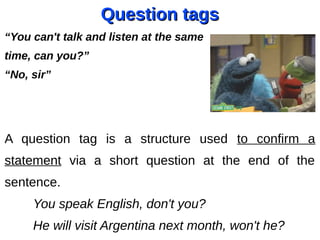
“You can't talk and listen at the same
time, can you?”
“No, sir”
A question tag is a structure used to confirm a
statement via a short question at the end of the
sentence.
You speak English, don't you?
He will visit Argentina next month, won't he?
Question tagsQuestion tags
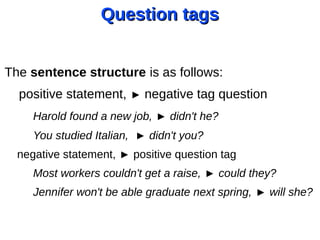
The sentence structure is as follows:
positive statement, ► negative tag question
Harold found a new job, ► didn't he?
You studied Italian, ► didn't you?
negative statement, ► positive question tag
Most workers couldn't get a raise, ► could they?
Jennifer won't be able graduate next spring, ► will she?
Question tagsQuestion tags
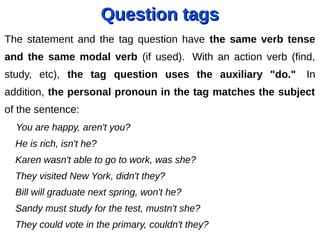
The statement and the tag question have the same verb tense
and the same modal verb (if used). With an action verb (find,
study, etc), the tag question uses the auxiliary "do." In
addition, the personal pronoun in the tag matches the subject
of the sentence:
    You are happy, aren't you?
    He is rich, isn't he?
    Karen wasn't able to go to work, was she?
    They visited New York, didn't they?
    Bill will graduate next spring, won't he?
    Sandy must study for the test, mustn't she?
    They could vote in the primary, couldn't they?
Question tagsQuestion tags
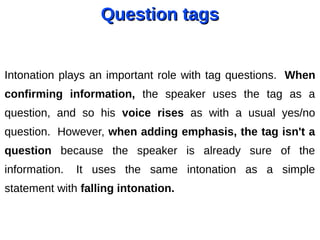
Intonation plays an important role with tag questions. When
confirming information, the speaker uses the tag as a
question, and so his voice rises as with a usual yes/no
question. However, when adding emphasis, the tag isn't a
question because the speaker is already sure of the
information. It uses the same intonation as a simple
statement with falling intonation.
Question tagsQuestion tags
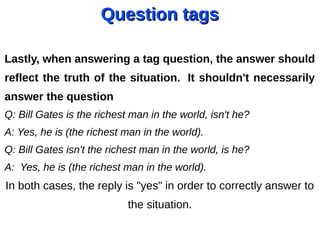
Lastly, when answering a tag question, the answer should
reflect the truth of the situation. It shouldn't necessarily
answer the question
Q: Bill Gates is the richest man in the world, isn't he?
A: Yes, he is (the richest man in the world).
Q: Bill Gates isn't the richest man in the world, is he?
A: Yes, he is (the richest man in the world).
In both cases, the reply is "yes" in order to correctly answer to
the situation.
Question tagsQuestion tags
Lastly, when answering a tag question, the answer should
reflect the truth of the situation. It shouldn't necessarily
answer the question
Q: Bill Gates is the richest man in the world, isn't he?
A: Yes, he is (the richest man in the world).
Q: Bill Gates isn't the richest man in the world, is he?
A: Yes, he is (the richest man in the world).
In both cases, the reply is "yes" in order to correctly answer to
the situation.

Question tags explanation

  • 1.
    Question tagsQuestion tags “Youcan't talk and listen at the same time, can you?” “No, sir” A question tag is a structure used to confirm a statement via a short question at the end of the sentence. You speak English, don't you? He will visit Argentina next month, won't he?
  • 2.
    Question tagsQuestion tags Thesentence structure is as follows: positive statement, ► negative tag question Harold found a new job, ► didn't he? You studied Italian, ► didn't you? negative statement, ► positive question tag Most workers couldn't get a raise, ► could they? Jennifer won't be able graduate next spring, ► will she?
  • 3.
    Question tagsQuestion tags Thestatement and the tag question have the same verb tense and the same modal verb (if used). With an action verb (find, study, etc), the tag question uses the auxiliary "do." In addition, the personal pronoun in the tag matches the subject of the sentence:     You are happy, aren't you?     He is rich, isn't he?     Karen wasn't able to go to work, was she?     They visited New York, didn't they?     Bill will graduate next spring, won't he?     Sandy must study for the test, mustn't she?     They could vote in the primary, couldn't they?
  • 4.
    Question tagsQuestion tags Intonationplays an important role with tag questions. When confirming information, the speaker uses the tag as a question, and so his voice rises as with a usual yes/no question. However, when adding emphasis, the tag isn't a question because the speaker is already sure of the information. It uses the same intonation as a simple statement with falling intonation.
  • 5.
    Question tagsQuestion tags Lastly,when answering a tag question, the answer should reflect the truth of the situation. It shouldn't necessarily answer the question Q: Bill Gates is the richest man in the world, isn't he? A: Yes, he is (the richest man in the world). Q: Bill Gates isn't the richest man in the world, is he? A: Yes, he is (the richest man in the world). In both cases, the reply is "yes" in order to correctly answer to the situation.
  • 6.
    Question tagsQuestion tags Lastly,when answering a tag question, the answer should reflect the truth of the situation. It shouldn't necessarily answer the question Q: Bill Gates is the richest man in the world, isn't he? A: Yes, he is (the richest man in the world). Q: Bill Gates isn't the richest man in the world, is he? A: Yes, he is (the richest man in the world). In both cases, the reply is "yes" in order to correctly answer to the situation.