Indian Standards of drinking water
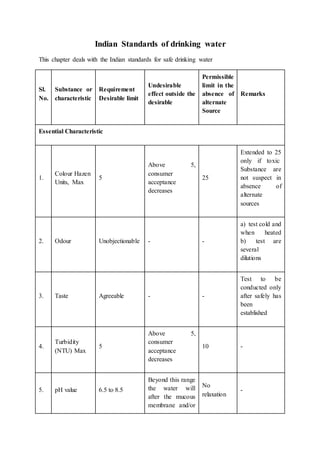
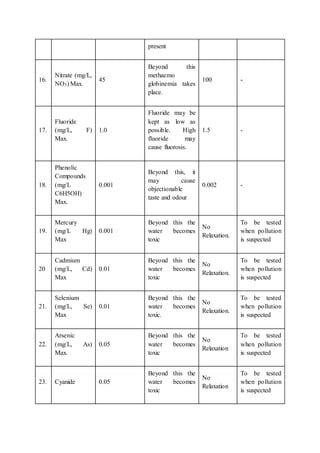
This chapter deals with the Indian standards for safe drinking water
Sl.
No.
Substance or
characteristic
Requirement
Desirable limit
Undesirable
effect outside the
desirable
Permissible
limit in the
absence of
alternate
Source
Remarks
Essential Characteristic
1.
Colour Hazen
Units, Max
5
Above 5,
consumer
acceptance
decreases
25
Extended to 25
only if toxic
Substance are
not suspect in
absence of
alternate
sources
2. Odour Unobjectionable - -
a) test cold and
when heated
b) test are
several
dilutions
3. Taste Agreeable - -
Test to be
conducted only
after safely has
been
established
4.
Turbidity
(NTU) Max
5
Above 5,
consumer
acceptance
decreases
10 -
5. pH value 6.5 to 8.5
Beyond this range
the water will
after the mucous
membrane and/or
No
relaxation
-
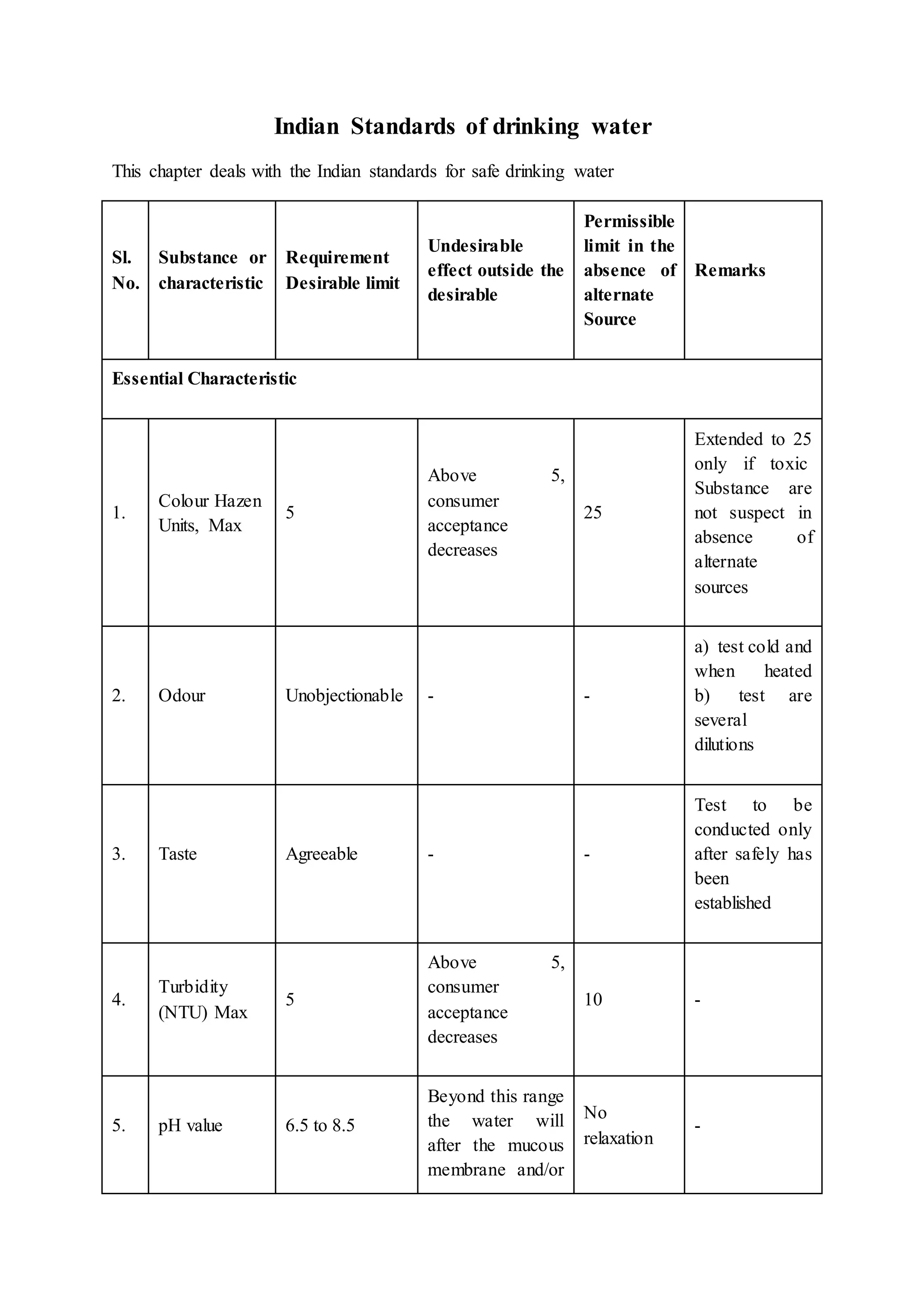
water supply
system
6.
Total
Hardness
(mg/L)
CaCO3
300
Encrustation in
water supply
structure and
adverse effects on
domestic use
600 -
7.
Iron (mg/L,
Fe) Max
0.3
Beyond this limit
taste/appearance
are affected; has
adverse effects on
domestic uses and
water supply
structure and
promotes iron
bacteria
1.0 -
8.
Chlorides 250
(mg/L, Cl)
Max
250
Beyond effects
outside the
desirable limit
1000 -
9.
Residual free
Chlorine
(mg/L), Max
0.2 - -
To be
applicable only
when water is
chlorinated.
Tested at
customer end.
When
protection
against viral
infection is
required, it
should be min.
0.5 mg/L.
Desirable Characteristics
10. Dissolved 500 Beyond this, 2000 -
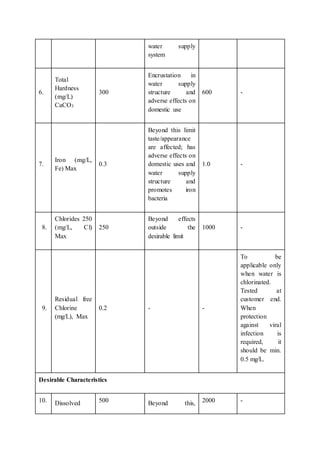
solids mg/L.
Max
palatability
decreases and
may cause
gastrointestinal
irritation.
11.
Calcium
(mg/L, Ca)
Max.
75
Encrustation in
water supply
structure and
adverse effects on
domestic use.
200 -
12.
Magnesium
(mg/L, Mg)
Max
30
Encrustation in
water supply
structure and
adverse effects on
domestic use.
100 -
13.
Copper
(mg/L, Cu)
Max
0.05
Astringent taste
dis coloration and
corrosion of pipes
fittings and
utensils will be
caused beyond
this.
1.5 -
14.
Manganese
(mg/L, Mn)
Max
0.1
Beyond this limit
taste/appearance
are affected, has
advers effect on
domestic use and
water supply
structure
0.3 -
15.
Sulphate
(mg/L, SO4)
Max.
200
Beyond this
causes gastro
intestinal
irritation when
magnesium or
sodium are
400
May be
extended upto
400 provided
magnesium (as
Mg) does not
exceed 30
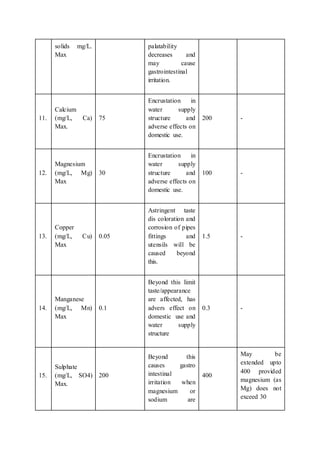
present
16.
Nitrate (mg/L,
NO3) Max.
45
Beyond this
methaemo
globinemia takes
place.
100 -
17.
Fluoride
(mg/L, F)
Max.
1.0
Fluoride may be
kept as low as
possible. High
fluoride may
cause fluorosis.
1.5 -
18.
Phenolic
Compounds
(mg/L
C6H5OH)
Max.
0.001
Beyond this, it
may cause
objectionable
taste and odour
0.002 -
19.
Mercury
(mg/L Hg)
Max
0.001
Beyond this the
water becomes
toxic
No
Relaxation.
To be tested
when pollution
is suspected
20
Cadmium
(mg/L, Cd)
Max
0.01
Beyond this the
water becomes
toxic
No
Relaxation.
To be tested
when pollution
is suspected
21.
Selenium
(mg/L, Se)
Max
0.01
Beyond this the
water becomes
toxic.
No
Relaxation.
To be tested
when pollution
is suspected
22.
Arsenic
(mg/L, As)
Max.
0.05
Beyond this the
water becomes
toxic
No
Relaxation
To be tested
when pollution
is suspected
23. Cyanide 0.05
Beyond this the
water becomes
toxic
No
Relaxation
To be tested
when pollution
is suspected
24.
Lead (mg/L
Pb) Max.
0.05
Beyond this the
water becomes
toxic
No
Relaxation
To be tested
when pollution
is suspected
25.
Zinc (mg/L,
Zn) Max.
5
Beyond this limit
it can cause
astringent taste
and an
opalescence in
water
15
To be tested
when pollution
is suspected
26.
Anionic
detergents
(mg/L,
MBAS) Max
0.2
Beyond this limit
it can cause a
light froth in
water
1.0
To be tested
when pollution
is suspected
27.
Chromium
(mg/L, Cr6+)
0.05
May be
carcinogenic
above this limit
- -
28.
Polynuclear
Aromatic
Hydrocarbons
(mg/l, PAH)
Max
-
May be
carcinogenic
- -
29.
Mineral oil
(mg/L)
0.01
Beyond this limit,
undesirable taste
and odour after
chlorination takes
place
0.03
To be tested
when pollution
is suspected
30.
Pesticides
(mg/L) max
Absent Toxic 0.001 -
Radioactive materials
31. Alpha
emitters Bq/L
- - 0.1 -
Max
32.
Beta emitters
Pci/L Max
- - 1.0 -
33.
Alkalinity
(mg/L,) Max
200
Beyond this limit,
taste becomes
unpleasant
600 -
34.
Aluminum
(mg/L, Al)
Max
0.03
Cumulative effect
is reported to
cause dementia
0.2
35.
Boron (mg/L)
Max
1.0 - 5.0 -

standards of drinking water

  • 1.
    Indian Standards ofdrinking water This chapter deals with the Indian standards for safe drinking water Sl. No. Substance or characteristic Requirement Desirable limit Undesirable effect outside the desirable Permissible limit in the absence of alternate Source Remarks Essential Characteristic 1. Colour Hazen Units, Max 5 Above 5, consumer acceptance decreases 25 Extended to 25 only if toxic Substance are not suspect in absence of alternate sources 2. Odour Unobjectionable - - a) test cold and when heated b) test are several dilutions 3. Taste Agreeable - - Test to be conducted only after safely has been established 4. Turbidity (NTU) Max 5 Above 5, consumer acceptance decreases 10 - 5. pH value 6.5 to 8.5 Beyond this range the water will after the mucous membrane and/or No relaxation -
  • 2.
    water supply system 6. Total Hardness (mg/L) CaCO3 300 Encrustation in watersupply structure and adverse effects on domestic use 600 - 7. Iron (mg/L, Fe) Max 0.3 Beyond this limit taste/appearance are affected; has adverse effects on domestic uses and water supply structure and promotes iron bacteria 1.0 - 8. Chlorides 250 (mg/L, Cl) Max 250 Beyond effects outside the desirable limit 1000 - 9. Residual free Chlorine (mg/L), Max 0.2 - - To be applicable only when water is chlorinated. Tested at customer end. When protection against viral infection is required, it should be min. 0.5 mg/L. Desirable Characteristics 10. Dissolved 500 Beyond this, 2000 -
  • 3.
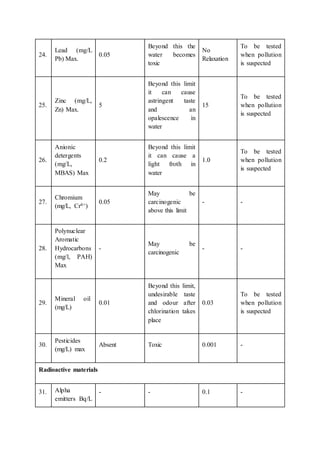
    solids mg/L. Max palatability decreases and maycause gastrointestinal irritation. 11. Calcium (mg/L, Ca) Max. 75 Encrustation in water supply structure and adverse effects on domestic use. 200 - 12. Magnesium (mg/L, Mg) Max 30 Encrustation in water supply structure and adverse effects on domestic use. 100 - 13. Copper (mg/L, Cu) Max 0.05 Astringent taste dis coloration and corrosion of pipes fittings and utensils will be caused beyond this. 1.5 - 14. Manganese (mg/L, Mn) Max 0.1 Beyond this limit taste/appearance are affected, has advers effect on domestic use and water supply structure 0.3 - 15. Sulphate (mg/L, SO4) Max. 200 Beyond this causes gastro intestinal irritation when magnesium or sodium are 400 May be extended upto 400 provided magnesium (as Mg) does not exceed 30
  • 4.
    present 16. Nitrate (mg/L, NO3) Max. 45 Beyondthis methaemo globinemia takes place. 100 - 17. Fluoride (mg/L, F) Max. 1.0 Fluoride may be kept as low as possible. High fluoride may cause fluorosis. 1.5 - 18. Phenolic Compounds (mg/L C6H5OH) Max. 0.001 Beyond this, it may cause objectionable taste and odour 0.002 - 19. Mercury (mg/L Hg) Max 0.001 Beyond this the water becomes toxic No Relaxation. To be tested when pollution is suspected 20 Cadmium (mg/L, Cd) Max 0.01 Beyond this the water becomes toxic No Relaxation. To be tested when pollution is suspected 21. Selenium (mg/L, Se) Max 0.01 Beyond this the water becomes toxic. No Relaxation. To be tested when pollution is suspected 22. Arsenic (mg/L, As) Max. 0.05 Beyond this the water becomes toxic No Relaxation To be tested when pollution is suspected 23. Cyanide 0.05 Beyond this the water becomes toxic No Relaxation To be tested when pollution is suspected
  • 5.
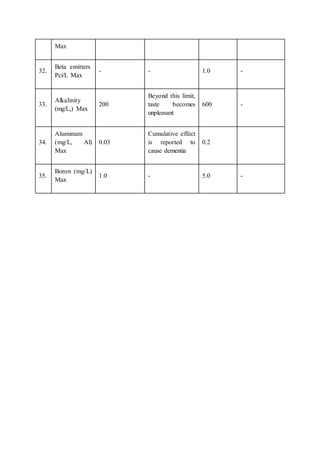
    24. Lead (mg/L Pb) Max. 0.05 Beyondthis the water becomes toxic No Relaxation To be tested when pollution is suspected 25. Zinc (mg/L, Zn) Max. 5 Beyond this limit it can cause astringent taste and an opalescence in water 15 To be tested when pollution is suspected 26. Anionic detergents (mg/L, MBAS) Max 0.2 Beyond this limit it can cause a light froth in water 1.0 To be tested when pollution is suspected 27. Chromium (mg/L, Cr6+) 0.05 May be carcinogenic above this limit - - 28. Polynuclear Aromatic Hydrocarbons (mg/l, PAH) Max - May be carcinogenic - - 29. Mineral oil (mg/L) 0.01 Beyond this limit, undesirable taste and odour after chlorination takes place 0.03 To be tested when pollution is suspected 30. Pesticides (mg/L) max Absent Toxic 0.001 - Radioactive materials 31. Alpha emitters Bq/L - - 0.1 -
  • 6.
    Max 32. Beta emitters Pci/L Max -- 1.0 - 33. Alkalinity (mg/L,) Max 200 Beyond this limit, taste becomes unpleasant 600 - 34. Aluminum (mg/L, Al) Max 0.03 Cumulative effect is reported to cause dementia 0.2 35. Boron (mg/L) Max 1.0 - 5.0 -