May 2001, Issue No. 106 Perishables Handling Quarterly Page 4
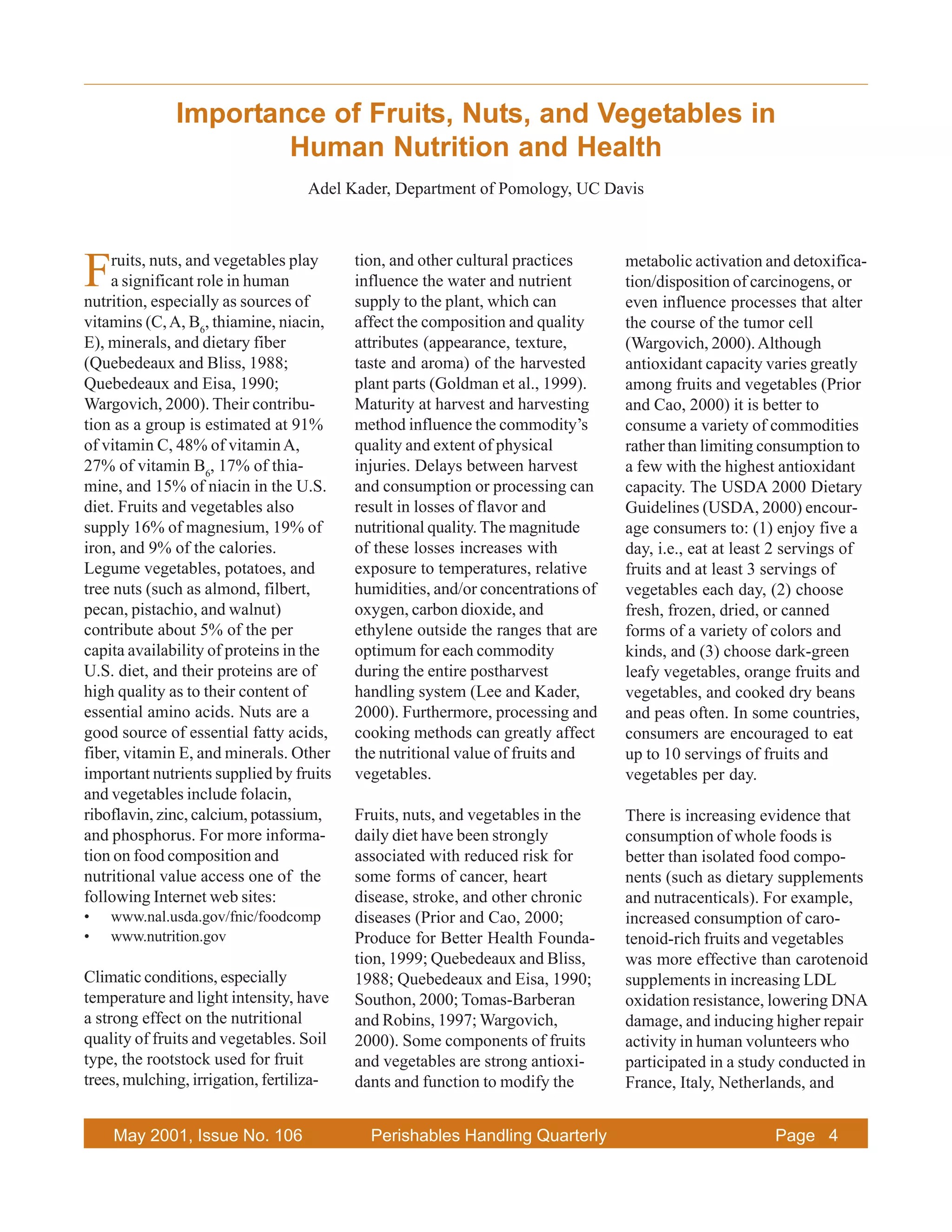
Fruits, nuts, and vegetables play
a significant role in human
nutrition, especially as sources of
vitamins (C,A, B6
, thiamine, niacin,
E), minerals, and dietary fiber
(Quebedeaux and Bliss, 1988;
Quebedeaux and Eisa, 1990;
Wargovich, 2000). Their contribu-
tion as a group is estimated at 91%
of vitamin C, 48% of vitaminA,
27% of vitamin B6
, 17% of thia-
mine, and 15% of niacin in the U.S.
diet. Fruits and vegetables also
supply 16% of magnesium, 19% of
iron, and 9% of the calories.
Legume vegetables, potatoes, and
tree nuts (such as almond, filbert,
pecan, pistachio, and walnut)
contribute about 5% of the per
capita availability of proteins in the
U.S. diet, and their proteins are of
high quality as to their content of
essential amino acids. Nuts are a
good source of essential fatty acids,
fiber, vitamin E, and minerals. Other
important nutrients supplied by fruits
and vegetables include folacin,
riboflavin, zinc, calcium, potassium,
and phosphorus. For more informa-
tion on food composition and
nutritional value access one of the
following Internet web sites:
• www.nal.usda.gov/fnic/foodcomp
• www.nutrition.gov
Climatic conditions, especially
temperature and light intensity, have
a strong effect on the nutritional
quality of fruits and vegetables. Soil
type, the rootstock used for fruit
trees, mulching, irrigation, fertiliza-
Importance of Fruits, Nuts, and Vegetables in
Human Nutrition and Health
Adel Kader, Department of Pomology, UC Davis
tion, and other cultural practices
influence the water and nutrient
supply to the plant, which can
affect the composition and quality
attributes (appearance, texture,
taste and aroma) of the harvested
plant parts (Goldman et al., 1999).
Maturity at harvest and harvesting
method influence the commodity’s
quality and extent of physical
injuries. Delays between harvest
and consumption or processing can
result in losses of flavor and
nutritional quality. The magnitude
of these losses increases with
exposure to temperatures, relative
humidities, and/or concentrations of
oxygen, carbon dioxide, and
ethylene outside the ranges that are
optimum for each commodity
during the entire postharvest
handling system (Lee and Kader,
2000). Furthermore, processing and
cooking methods can greatly affect
the nutritional value of fruits and
vegetables.
Fruits, nuts, and vegetables in the
daily diet have been strongly
associated with reduced risk for
some forms of cancer, heart
disease, stroke, and other chronic
diseases (Prior and Cao, 2000;
Produce for Better Health Founda-
tion, 1999; Quebedeaux and Bliss,
1988; Quebedeaux and Eisa, 1990;
Southon, 2000; Tomas-Barberan
and Robins, 1997; Wargovich,
2000). Some components of fruits
and vegetables are strong antioxi-
dants and function to modify the
metabolic activation and detoxifica-
tion/disposition of carcinogens, or
even influence processes that alter
the course of the tumor cell
(Wargovich, 2000).Although
antioxidant capacity varies greatly
among fruits and vegetables (Prior
and Cao, 2000) it is better to
consume a variety of commodities
rather than limiting consumption to
a few with the highest antioxidant
capacity. The USDA 2000 Dietary
Guidelines (USDA, 2000) encour-
age consumers to: (1) enjoy five a
day, i.e., eat at least 2 servings of
fruits and at least 3 servings of
vegetables each day, (2) choose
fresh, frozen, dried, or canned
forms of a variety of colors and
kinds, and (3) choose dark-green
leafy vegetables, orange fruits and
vegetables, and cooked dry beans
and peas often. In some countries,
consumers are encouraged to eat
up to 10 servings of fruits and
vegetables per day.
There is increasing evidence that
consumption of whole foods is
better than isolated food compo-
nents (such as dietary supplements
and nutracenticals). For example,
increased consumption of caro-
tenoid-rich fruits and vegetables
was more effective than carotenoid
supplements in increasing LDL
oxidation resistance, lowering DNA
damage, and inducing higher repair
activity in human volunteers who
participated in a study conducted in
France, Italy, Netherlands, and
May 2001, Issue No. 106 Perishables Handling Quarterly Page 5
Spain (Southon, 2000). Similar
comparative studies are needed on
other constituents of fruits and
vegetables and on the
bioavailability of nutrients taken as
dietary supplements or as foods
that contain these nutrients.
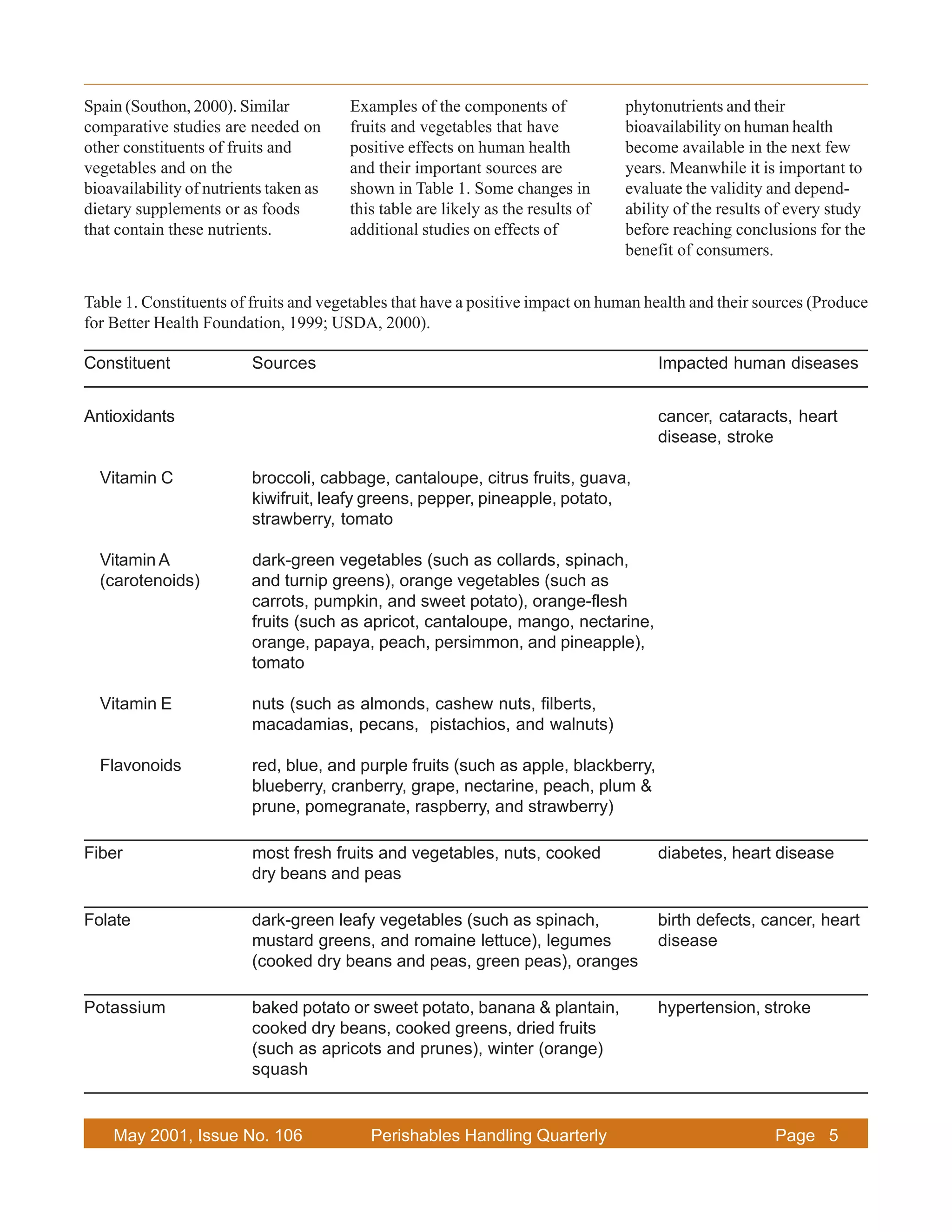
Examples of the components of
fruits and vegetables that have
positive effects on human health
and their important sources are
shown in Table 1. Some changes in
this table are likely as the results of
additional studies on effects of
Constituent Sources Impacted human diseases
Antioxidants cancer, cataracts, heart
disease, stroke
Vitamin C broccoli, cabbage, cantaloupe, citrus fruits, guava,
kiwifruit, leafy greens, pepper, pineapple, potato,
strawberry, tomato
Vitamin A dark-green vegetables (such as collards, spinach,
(carotenoids) and turnip greens), orange vegetables (such as
carrots, pumpkin, and sweet potato), orange-flesh
fruits (such as apricot, cantaloupe, mango, nectarine,
orange, papaya, peach, persimmon, and pineapple),
tomato
Vitamin E nuts (such as almonds, cashew nuts, filberts,
macadamias, pecans, pistachios, and walnuts)
Flavonoids red, blue, and purple fruits (such as apple, blackberry,
blueberry, cranberry, grape, nectarine, peach, plum &
prune, pomegranate, raspberry, and strawberry)
Fiber most fresh fruits and vegetables, nuts, cooked diabetes, heart disease
dry beans and peas
Folate dark-green leafy vegetables (such as spinach, birth defects, cancer, heart
mustard greens, and romaine lettuce), legumes disease
(cooked dry beans and peas, green peas), oranges
Potassium baked potato or sweet potato, banana & plantain, hypertension, stroke
cooked dry beans, cooked greens, dried fruits
(such as apricots and prunes), winter (orange)
squash
Table 1. Constituents of fruits and vegetables that have a positive impact on human health and their sources (Produce
for Better Health Foundation, 1999; USDA, 2000).
phytonutrients and their
bioavailability on human health
become available in the next few
years. Meanwhile it is important to
evaluate the validity and depend-
ability of the results of every study
before reaching conclusions for the
benefit of consumers.
May 2001, Issue No. 106 Perishables Handling Quarterly Page 6
References
Goldman, I.L., Kader, A.A., and
Heintz, C. 1999. Influence of
production, handling, and storage
on phytonutrient content of foods.
Nutrition Reviews 57(9)S46-S52.
Lee, S.K. and Kader, A.A. 2000.
Preharvest and postharvest factors
influencing vitamin C content of
horticultural crops. Postharv. Biol.
Technol. 20:207-220.
Prior, R.L. and Cao, G. 2000.
Antioxidant phytochemicals in
fruits and vegetables; diet and
health implications. HortScience
35:588-592.
Produce for Better Health Founda-
tion. 1999. Dietary guidelines: the
case for fruits and vegetables first.
Produce for Better Health Founda-
tion, Wilmington, DE (Website:
http://www.5aday.com).
Quebedeaux, B. and Bliss, F.A.
1988. Horticulture and human
health. Contributions of fruits and
vegetables. Proc. 1st
Intl. Symp.
Hort. and Human Health. Prentice
Hall, Englewood, NJ.
Quebedeaux, B. and Eisa, H.M.
1990. Horticulture and human
health. Contributions of fruits and
vegetables. Proc. 2nd
Intl. symp.
Hort. and Human Health.
HortScience 25:1473-1532.
Southon, S. 2000. Increased fruit
and vegetable consumption within
the EU: potential health benefits.
Food Res. Intl. 33:211-217.
Tomas-Barberan, F.A. and Robins,
R.J. (eds.). 1997. Phytochemistry
of fruits and vegetables. Oxford
Science Publ., Oxford, UK, 375 pp.
USDA. 2000. Nutrition and your
health: dietary guidelines for
Americans. Home and Garden
Bull. 232, U.S. Dept. Agr., Wash-
ington, D.C. (Website:
www.usda.gov/cnpp).
Wargovich, M.J. 2000. Anticancer
properties of fruits and vegetables.
HortScience 35:573-575

Fruit in human nutrition

  • 1.
    May 2001, IssueNo. 106 Perishables Handling Quarterly Page 4 Fruits, nuts, and vegetables play a significant role in human nutrition, especially as sources of vitamins (C,A, B6 , thiamine, niacin, E), minerals, and dietary fiber (Quebedeaux and Bliss, 1988; Quebedeaux and Eisa, 1990; Wargovich, 2000). Their contribu- tion as a group is estimated at 91% of vitamin C, 48% of vitaminA, 27% of vitamin B6 , 17% of thia- mine, and 15% of niacin in the U.S. diet. Fruits and vegetables also supply 16% of magnesium, 19% of iron, and 9% of the calories. Legume vegetables, potatoes, and tree nuts (such as almond, filbert, pecan, pistachio, and walnut) contribute about 5% of the per capita availability of proteins in the U.S. diet, and their proteins are of high quality as to their content of essential amino acids. Nuts are a good source of essential fatty acids, fiber, vitamin E, and minerals. Other important nutrients supplied by fruits and vegetables include folacin, riboflavin, zinc, calcium, potassium, and phosphorus. For more informa- tion on food composition and nutritional value access one of the following Internet web sites: • www.nal.usda.gov/fnic/foodcomp • www.nutrition.gov Climatic conditions, especially temperature and light intensity, have a strong effect on the nutritional quality of fruits and vegetables. Soil type, the rootstock used for fruit trees, mulching, irrigation, fertiliza- Importance of Fruits, Nuts, and Vegetables in Human Nutrition and Health Adel Kader, Department of Pomology, UC Davis tion, and other cultural practices influence the water and nutrient supply to the plant, which can affect the composition and quality attributes (appearance, texture, taste and aroma) of the harvested plant parts (Goldman et al., 1999). Maturity at harvest and harvesting method influence the commodity’s quality and extent of physical injuries. Delays between harvest and consumption or processing can result in losses of flavor and nutritional quality. The magnitude of these losses increases with exposure to temperatures, relative humidities, and/or concentrations of oxygen, carbon dioxide, and ethylene outside the ranges that are optimum for each commodity during the entire postharvest handling system (Lee and Kader, 2000). Furthermore, processing and cooking methods can greatly affect the nutritional value of fruits and vegetables. Fruits, nuts, and vegetables in the daily diet have been strongly associated with reduced risk for some forms of cancer, heart disease, stroke, and other chronic diseases (Prior and Cao, 2000; Produce for Better Health Founda- tion, 1999; Quebedeaux and Bliss, 1988; Quebedeaux and Eisa, 1990; Southon, 2000; Tomas-Barberan and Robins, 1997; Wargovich, 2000). Some components of fruits and vegetables are strong antioxi- dants and function to modify the metabolic activation and detoxifica- tion/disposition of carcinogens, or even influence processes that alter the course of the tumor cell (Wargovich, 2000).Although antioxidant capacity varies greatly among fruits and vegetables (Prior and Cao, 2000) it is better to consume a variety of commodities rather than limiting consumption to a few with the highest antioxidant capacity. The USDA 2000 Dietary Guidelines (USDA, 2000) encour- age consumers to: (1) enjoy five a day, i.e., eat at least 2 servings of fruits and at least 3 servings of vegetables each day, (2) choose fresh, frozen, dried, or canned forms of a variety of colors and kinds, and (3) choose dark-green leafy vegetables, orange fruits and vegetables, and cooked dry beans and peas often. In some countries, consumers are encouraged to eat up to 10 servings of fruits and vegetables per day. There is increasing evidence that consumption of whole foods is better than isolated food compo- nents (such as dietary supplements and nutracenticals). For example, increased consumption of caro- tenoid-rich fruits and vegetables was more effective than carotenoid supplements in increasing LDL oxidation resistance, lowering DNA damage, and inducing higher repair activity in human volunteers who participated in a study conducted in France, Italy, Netherlands, and
  • 2.
    May 2001, IssueNo. 106 Perishables Handling Quarterly Page 5 Spain (Southon, 2000). Similar comparative studies are needed on other constituents of fruits and vegetables and on the bioavailability of nutrients taken as dietary supplements or as foods that contain these nutrients. Examples of the components of fruits and vegetables that have positive effects on human health and their important sources are shown in Table 1. Some changes in this table are likely as the results of additional studies on effects of Constituent Sources Impacted human diseases Antioxidants cancer, cataracts, heart disease, stroke Vitamin C broccoli, cabbage, cantaloupe, citrus fruits, guava, kiwifruit, leafy greens, pepper, pineapple, potato, strawberry, tomato Vitamin A dark-green vegetables (such as collards, spinach, (carotenoids) and turnip greens), orange vegetables (such as carrots, pumpkin, and sweet potato), orange-flesh fruits (such as apricot, cantaloupe, mango, nectarine, orange, papaya, peach, persimmon, and pineapple), tomato Vitamin E nuts (such as almonds, cashew nuts, filberts, macadamias, pecans, pistachios, and walnuts) Flavonoids red, blue, and purple fruits (such as apple, blackberry, blueberry, cranberry, grape, nectarine, peach, plum & prune, pomegranate, raspberry, and strawberry) Fiber most fresh fruits and vegetables, nuts, cooked diabetes, heart disease dry beans and peas Folate dark-green leafy vegetables (such as spinach, birth defects, cancer, heart mustard greens, and romaine lettuce), legumes disease (cooked dry beans and peas, green peas), oranges Potassium baked potato or sweet potato, banana & plantain, hypertension, stroke cooked dry beans, cooked greens, dried fruits (such as apricots and prunes), winter (orange) squash Table 1. Constituents of fruits and vegetables that have a positive impact on human health and their sources (Produce for Better Health Foundation, 1999; USDA, 2000). phytonutrients and their bioavailability on human health become available in the next few years. Meanwhile it is important to evaluate the validity and depend- ability of the results of every study before reaching conclusions for the benefit of consumers.
  • 3.
    May 2001, IssueNo. 106 Perishables Handling Quarterly Page 6 References Goldman, I.L., Kader, A.A., and Heintz, C. 1999. Influence of production, handling, and storage on phytonutrient content of foods. Nutrition Reviews 57(9)S46-S52. Lee, S.K. and Kader, A.A. 2000. Preharvest and postharvest factors influencing vitamin C content of horticultural crops. Postharv. Biol. Technol. 20:207-220. Prior, R.L. and Cao, G. 2000. Antioxidant phytochemicals in fruits and vegetables; diet and health implications. HortScience 35:588-592. Produce for Better Health Founda- tion. 1999. Dietary guidelines: the case for fruits and vegetables first. Produce for Better Health Founda- tion, Wilmington, DE (Website: http://www.5aday.com). Quebedeaux, B. and Bliss, F.A. 1988. Horticulture and human health. Contributions of fruits and vegetables. Proc. 1st Intl. Symp. Hort. and Human Health. Prentice Hall, Englewood, NJ. Quebedeaux, B. and Eisa, H.M. 1990. Horticulture and human health. Contributions of fruits and vegetables. Proc. 2nd Intl. symp. Hort. and Human Health. HortScience 25:1473-1532. Southon, S. 2000. Increased fruit and vegetable consumption within the EU: potential health benefits. Food Res. Intl. 33:211-217. Tomas-Barberan, F.A. and Robins, R.J. (eds.). 1997. Phytochemistry of fruits and vegetables. Oxford Science Publ., Oxford, UK, 375 pp. USDA. 2000. Nutrition and your health: dietary guidelines for Americans. Home and Garden Bull. 232, U.S. Dept. Agr., Wash- ington, D.C. (Website: www.usda.gov/cnpp). Wargovich, M.J. 2000. Anticancer properties of fruits and vegetables. HortScience 35:573-575