Construction contract procedures and management
Lesson 4
Rights and obligations (continuation)
Textbook: №5 (p.55-70)
PhD, professor Iryna Rudnieva
Employer's right to vary the contract (via the
contract administrator)
Most contracts give the contract administrator the right to issue new
drawings, instructions and other requirements. In JCT and ICE
contracts these are called 'variations', but NEC3 ECC uses the word
'changes' instead.
Variations normally give the contractor a right to more time to
complete the project as well, which is only reasonable.
Employers and insurance
You pay a premium to the insurer for the risk of a specified event
occurring, or 'peril' as it may be called. If this specified event occurs then
you are compensated by the insurer. The amount of compensation
depends on the policy. It may be the value of the article at the time of the
event, or it may be its replacement value.
There are two main types of insurance relevant to the
construction industry:
• Liability insurance — here the insurer indemnifiys (compensates)
the insured person or company against damages and legal costs which
become payable as a result of the specified event. 'Indemnifiy' means that the
insurer will pay these costs for the insured person or company.
An example is Third Party car insurance — you crash into another car and
your insurance company pays out to the owner of the car you have hit, but
doesn't cover damage to your car, so you are being covered for demands on you
by another party.
• Loss insurance — here the insurer compensates the insured person
or company for loss or damage which the insured person or company has
suffered as a result of the specified event, whether the event happened
accidentally or as a result of somebody else's negligence. Sometimes this type
of policy also covers the insured for their own negligence.
An example is Comprehensive car insurance — you crash into another car and
the insurer covers your costs (often car repairs and medical costs, depending
on the policy) as well, even if it was your fault.
Employers and regulations
In the UK, employers are bound by many laws and regulations.
Lack of compliance can lead to fines, or even prison sentences.
A few such regulations are:
• Health and safety legislation (especially CDM)
• Planning legislation
• Building control
• Highways legislation
• Environmental legislation and protected species o The
Competition Act
• Fire regulations
• Waste management and disposal regulations
• The EU procurement directives as transferred into English law.
The contractor contract rights and obligations
The main rights of the contractor are to:
• Be given access (called possession in JCT) of the site at the access
date, or access to those parts of the site that are prescribed in the
contract.
• Be paid in accordance with the contract at the times and in the way
stipulated.
• Proceed with the construction works without interference or
prevention.
• Receive reasonably fast replies to any letters, emails made to the
contract administrator. ICE7 and JCT are silent on this matter,
although a term of a reasonable time would probably be implied by the
courts if necessary. However, in NEC3 ECC a 'period for reply' is inserted
in the contract data. This is stated in 'weeks' and two weeks is
suggested as usually being suitable in the NEC3 ECC Guidance Notes.
• Receive at a suitable time to suit the progress of the works such
further instructions and drawings that are reasonably necessary.
• Receive any goods or materials specified as supplied by the
employer at the times stated in the contract.
Contractor's main obligations
Under most standard forms of contract, the contractor's main
obligations are to:
•Comply with the contract.
•Construct and complete the works in accordance with the contract;
this of course includes the specification and all the drawings.
•Ensure that any sub-contractor also complies with the contract.
•Provide competent supervision and labour.
•Complete the contract works to the standard specified, by the
completion date (or any extension to that date that the contract
administrator may grant).
•Obey the instructions of the contract administrator within its
powers under the contract.
•Comply in full with all health and safety legislation, particularly the
CDM regulations.
• Comply with local authority bylaws, statutory regulations and
other acts and regulations relating to the control of building
works.
• Comply with all regulations relating to the disposal of waste and
the production of site waste management plans.
• Submit a programme to the contract administrator, and update it
as necessary or when so instructed.
• Provide insurance as specified.
• Return to correct any defects in the works after they are taken over
by the employer at completion.
Further obligations of the contractor under many forms of
contract are to:
• Work in a spirit of mutual cooperation.
• Submit regular applications for payment, or 'attend' while measurement
takes place.
• Proceed with 'due expedition' (ICE7 clause 41), or 'regularly and diligently
proceed' (JCT SBC05 clause 2.4). NEC3 ECC has no similar terms, possibly on
the basis that it is in the contractor's interests to do this anyway.
• Give notice of any inconsistencies in the contract documents to the
contract administrator, so that they can be investigated and if necessary
corrected. Under most forms of contract, the contractor will be
compensated for any loss that subsequent correction causes.
• Pay any fees, charges, rates or taxes in respect of the work if this is specified
in the contract. The contractor is usually compensated for this in the
monthly payments.
• Protect and preserve antiquities and other objects of value that may be
found on the site.
• Design all temporary works (equipment needed in the construction process
but removed on completion).
• Design any permanent work (goods and materials that will form part of the
finished project) if so directed in the contract.
Contractor's obligation for health and safety
Many forms of contract have specific clauses relating to health and
safety such as ICE7 clause 8(3). JCT SBC05 clause 3.23 largely
repeates the main obligations under CDM. However, Schedule 8 of the
2009 edition of JCT SBC05, goes on to put four further requirements
on the contractor in clause 2.2:
• Comply with any approved codes of practice (ACOP) issued by
the HSE.
• Implement health and safety site stimulations for all
contractor's personnel and members of their supply chain.
• Provide health and safety advice.
• Ensure health and safety consultation.
This is quite interesting, the CDM regulations are legally binding and
the ACOP are not. The ACOP do of course represent good practice and
any contractor not following them may have to explain why to a court.
So here, JCT is making adherence to the ACOP a contractual
requirement in the contract between the employer and the contractor.
Contractor's obligation for security and control of the
site
Contractors will ensure the safety and security of the site. This is
for three main reasons:
•The contractor is usually contractually responsible for any loss or
damage to materials on-site or the partly completed construction
works.
•The contractor could be responsible for any loss or injury to
members of the public, and anyone else who entered the site.
•The contractor will wish to act in a professionally and maintain
its reputation.
The contractor is also responsible for 'control' of the site. Under CDM
regulation 22 the principal contractor composes the 'site rules' and
prevent access to site by unauthorised persons.
Contractor's obligation for workmanship and materials
Many construction problems relate to either design, workmanship,
unsuitable materials or all three.
In forms of contract based on traditional procurement, the design
organisation is responsible for design and specification of materials,
and the contractor for workmanship and using compliant materials.
The primary role of the contractor is to construct the 'works'.
Permanent works is goods and materials that will form part of the
finished project.
Temporary works are items such as trench supports, any other
temporary supports, settling ponds and lagoons, groundwater pumping
equipment, formwork, scaffolding, tower cranes and so on.
The contract between the employer and the contractor is all about the
quality of the permanent works. The quality of materials and any particular
workmanship requirements are usually set out in the specification and any
related standards such as British Standards or European Standards.
In NEC3 ECC contracts the specification will form part of the works
information and is separate from the pricing mechanism.
In 'building' contracts such as JCT SBC05, the
specification information is usually combined with the
measurement items in the contract bills. JCT SBC()5 refers
to materials in clause 2.3.1 and workmanship in clause 2.3.2
as being 'as described in the contract bills.'
NEC3 ECC simply says 'the contractor provides the
works in accordance with the works information. '
Under most forms of contract the contractor is
responsible for the proper setting out of the works and any
checks made by the contract administrator do not remove
this responsibility (ICE7 clause 17 and JCT SBC05 clause
2.10).
NEC3 ECC is silent on this matter, possibly because it is
now unusual for the employer to pay for extensive site
supervision, reporting to the contract administrator.
Contractor's obligation for defects
A defect is not defined in ICE7 or JCT SBC05 but it is defined in NEC3
ECC. Clause 11.2(5) ofNEC3 ECC defines a defect as part of the works
which is not in accordance with the works information.'
There is a difficulty here, in that in normal language, a 'defect' is
something unsatisfactory or deficient.
In NEC3 ECC, work can be unsatisfactory, but not be defined as a
defect under the contract if it is in accordance with the works information.
In most forms of contract there is a period of time allowed for
correcting defects, usually twelve months in ICE7 and NEC3 ECC
contracts, and a default of six months in JCT SBC05, which can of course
be increased when the tender documents are prepared.
This period is called the rectification period in JCT SBC05. NEC3
ECC uses a different method by stating a defects date as being a number
of weeks after completion of the works. The effect is the same.
If the contractor fails to return and due notice is given, there are
sanctions which allow the employer to deduct money or bring in an
alternative contractor to correct the defect.
Contractor's obligation for insurance
The usual insurance situation is abstracted from NEC3 ECC clause 84 and is
as follows:
'The contractor insures in the joint names of the contractor and the employer
for events which are the contractor's risk (see below for exclusions) from the
starting date until the defects correction certificate is issued (the end of the period
for correcting defects)
• loss of or damage to the works, plant or materials
• loss of or damage to equipment (temporary works)
• liability for loss of or damage to property
• liability for bodily injury to or death of a person (not an employee of the
contractor) caused by activity in connection with this contract
• liability for death or bodily injury to employees of the contractor arising
out of and in the course of their employment in connection with this
contract'
Exclusions to the contractor's risk usually include:
• The unavoidable results of constructing the works
• Negligence, breach of statutory duty or interference with any legal right
by the employer
• A fault in the design of the design organisation
• War, rebellion, riot and similar events.
Chapter summary
• Contracts generally are concerned with the rights and obligations of
the parties.
• Parties are the people or more usually the organisations that make
the contract.
• Increasingly, contracts stipulate that the parties work in a cooperative
manner, where 'cooperative' is used in a behavioural and team work
sense. NEC3 ECC began this trend, and the JCT suite of contracts is
being amended to include it.
• The main obligations of the employer are to provide access to the
site, to pay the contractor in the manner and at the times stipulated in
the contract, and to provide specified insurances.
• There are also legal requirements for the employer not to hinder or
prevent the contractor from carrying out the works.
• Under most contracts, the employer must appoint a contract
administrator, and this contract administrator usually has powers
under the contract to vary (change) the contract works, within
prescribed limits.
• Both the employer and contractor have a crucial responsibility for
health and safety. Their roles and obligations are clearly set out in
the CDM regulations (2007).
• Additionally the contractor has a responsibility for the security and
control of the site, which largely impacts on safety considerations.
• The contractor's main obligation is to construct the contract works
using workmanship and materials to the contract requirements.
• The contractor is required to supply and update a programm under
most forms of contract.
• The contractor usually has a responsibility to correct defects in the
constructed works usually for a period of time after completion. This
period is usually 12 months.
• The contractor is obliged to take out insurance to cover a number of
risks, mainly to the contract works and materials but also to persons
and property.
Questions
Questions.
1. Who are the three main parties in the construction
project?
2. What are the four most important things that
employer must to do?
3. What is Liability insurance?
4. What are the contractor's main obligations?
16
Rights and obligations
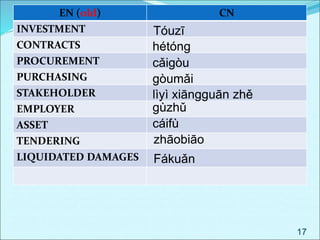
Dictionary (new)
17
EN (old) CN
INVESTMENT
CONTRACTS
PROCUREMENT
PURCHASING
STAKEHOLDER
EMPLOYER
ASSET
TENDERING
LIQUIDATED DAMAGES
Tóuzī
hétóng
cáifù
zhāobiāo
cǎigòu
gòumǎi
gùzhǔ
lìyì xiāngguān zhě
Fákuǎn
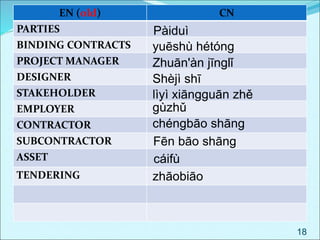
Dictionary (new)
18
EN (old) CN
PARTIES
BINDING CONTRACTS
PROJECT MANAGER
DESIGNER
STAKEHOLDER
EMPLOYER
CONTRACTOR
SUBCONTRACTOR
ASSET
TENDERING
Pàiduì
yuēshù hétóng
chéngbāo shāng
cáifù
Zhuān'àn jīnglǐ
Shèjì shī
gùzhǔ
lìyì xiāngguān zhě
zhāobiāo
Fēn bāo shāng
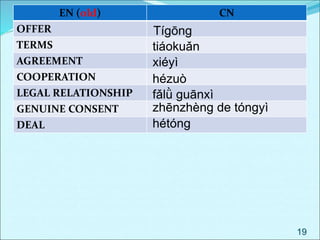
Dictionary (new)
19
EN (old) CN
OFFER
TERMS
AGREEMENT
COOPERATION
LEGAL RELATIONSHIP
GENUINE CONSENT
DEAL
Tígōng
tiáokuǎn
hétóng
xiéyì
hézuò
zhēnzhèng de tóngyì
fǎlǜ guānxì
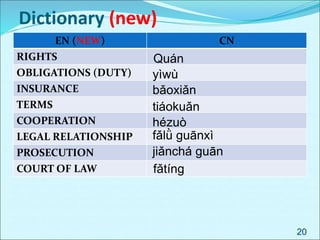
Dictionary (new)
20
EN (NEW) CN
RIGHTS
OBLIGATIONS (DUTY)
INSURANCE
TERMS
COOPERATION
LEGAL RELATIONSHIP
PROSECUTION
COURT OF LAW
Quán
yìwù
jiǎnchá guān
bǎoxiǎn
tiáokuǎn
fǎlǜ guānxì
hézuò
fǎtíng
Construction contract procedures and management
Lesson 4
Tendering and contractor selection
Textbook: №6 (p.71-93)
PhD, professor Iryna Rudnieva
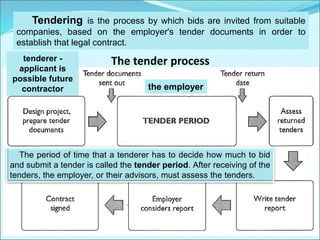
Tendering is the process by which bids are invited from suitable
companies, based on the employer's tender documents in order to
establish that legal contract.
The tender process
The period of time that a tenderer has to decide how much to bid
and submit a tender is called the tender period. After receiving of the
tenders, the employer, or their advisors, must assess the tenders.
the employer
tenderer -
applicant is
possible future
contractor
Tendering is the industry name for obtaining an offer from
a contractor, which can then be accepted by the employer to
form a binding contract.
Employers may produce their own contract documents and assess
tenders themselves, but this is very unlikely. The employer usually
employs a design organisation such as a firm of consulting engineers,
architects or building surveyors to prepare all the tender documents and
then to advise which tender to accept. The employer considers the
tender report and then signs a contract with the successful tenderer who
then becomes 'the contractor' under the contract.
Once the contract is awarded, the tender documents
become the basis of the contract. They become the contract
documents.
Under most forms of contract, additions and changes can then be
made and so the contract documents are constantly changing as
construction work proceeds.
On a large contract, hundreds and possibly thousands of changes,
additions will be made. Under most forms of contract, the contractor is
paid to make these changes to the construction work, and is given more
time to do it.
The employer wishes to find the 'right contractor at the right price' and
the contractor wishes to 'win the contract' but on the right terms and at
the right price for him.
Some good advice on tendering is given in Practice Note 6,
published by the Joint Contracts Tribunal.
Types of tender:
• A single offer (bid) is a tender for one project. This is the
normal tender situation, where a contractor offers to carry out a
particular contract, on particular terms, for a price.
• A framework agreement (sometimes called a standing offer or
serial contract) is a tender to construct a number of projects over
a period of time.
The tender Process for single-bid tendering in detail
Going out for tender
1.The employer decides on a tendering option in order to attract
several tenderers.
2.This decision creates a list of tenderers.
3.The employer determines a suitable tender period.
4.Before sending tender documents to these tenderers employer
needs to reconfirm the tenderers' interest in submitting a tender.
5.The employer sends 'invitation to tender' letters to the tenderers,
accompanied by two sets of tender documents (these tender
documents will become the contract documents when the contract
is signed), and usually a tender return envelope.
6.Tenderers visit site, and make tender enquiries of suppliers and
sub-contractors.
7.Tenderers consider their potential programme and available
resources.
8. Tenderers make any further requests or clarifications from the
employer.
9. Tenderers should raise such requests in writing. The employer
(or usually their design organisation) should respond with a copy
to all tenderers. This ensures good communication and honest
relationship.
10. Tenderers then complete any schedules or information in the
tender documents, price up any bills, or schedules, often using
quotations from sub-contractors and suppliers.
11. Tenderers must submit their tenders by the due date, at the place
and in the manner described in the instructions to tenderers.
Many employers will not open a tender that is even five minutes
late.
12. The employer (usually through the design organisation) evaluates
the tenders, particularly in respect of prices and pricing structure.
13. Any qualifications by the tenderer are reviewed — qualifications
should generally not occur if requests are raised before the tender
is submitted.
14. Withdrawal or rejection of tenders may result because of the
inclusion of unacceptable qualifications or if major errors are
identified in the tender.
15. Finalisation of tender — this stage may allow minor errors to be
corrected. Many employers have rules regarding errors. All
corrections must be recorded in writing.
16. Sometimes a negotiation process takes place if savings have to be
achieved due the employer's budget is exceeded. This cannot be
done with tenders under the EU Directives.
17. A tender report is usually produced by the design organisation.
18. The employer selects one of the tenders on the basis of the tender
report.
After the employer receives the tenders
19. The employer writes to the successful tenderer accepting the
tender (the offer). Usually the acceptance is 'subject to contract'.
20.Signature of the formal contract (and possibly signing it as a
'deed', which is a legal device to give a longer period for breach of
contract claims) confirms the agreement, and a binding contract
is formed between the tenderer and the employer.
21. The successful tenderer is now called the 'contractor' and the
tender documents become the contract documents.
22.Once the contract is awarded every unsuccessful tenderer should
be notified. This notification should be made as soon as possible,
to allow tenderers to reallocate resources to other potential work.
23.Every unsuccessful tenderer should also be issued with a list of
tender prices, and the names of other tenderers, so that they can
assess their commercial position in the market for future
tendering opportunities. For example, if a contractor's tender was
twenty per cent more expensive than the average tender, then
they have misunderstood the tender, or have a serious problem
with competitiveness.
Tender documents
The tender documents describe what is to be built and how
the work will be paid for. Tender documents are usually very
detailed and many months or even years will be spent on
producing them.
The tender documents
1. Invitation to tender and instructions to tenderers
2. Any articles of agreement
3. Conditions of contract and contract data
4. The pricing mechanism
5. The payment mechanism (which may be the same as the
pricing mechanism)
6. Works information including the specification, tender
drawings and health and safety information
7. Site information
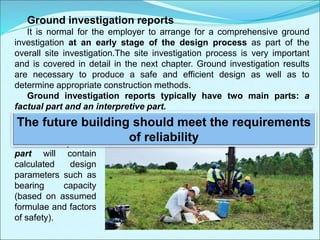
Ground investigation reports
It is normal for the employer to arrange for a comprehensive ground
investigation at an early stage of the design process as part of the
overall site investigation.The site investigation process is very important
and is covered in detail in the next chapter. Ground investigation results
are necessary to produce a safe and efficient design as well as to
determine appropriate construction methods.
Ground investigation reports typically have two main parts: a
factual part and an interpretive part.
The factual part contains sections through boreholes, groundwater
measurements and details of all in situ (in place) and laboratory tests.
The interpretive
part will contain
calculated design
parameters such as
bearing capacity
(based on assumed
formulae and factors
of safety).
The future building should meet the requirements
of reliability
Tendering options
 Tendering options are different ways of selecting the best
contractor.
 The tendering process is the administrative mechanism of
inviting and assessing tenders.
The six main tendering options:
SINGLE-BID Options
• Open tendering
• Single-bid selective tendering
• Pre-qualification
• Negotiated
TWO-BID Options
• Two-stage selective tendering
• Framework agreements
This chapter outlines six tendering options on the p.77-81 (Textbook: №6).
1 Open tendering — in this option, the employer places an advertisement in a
newspaper or journal for any interested party to bid. This option was once used
frequently on the basis that more tenderers should result in the lowest price because
of the increased number of offers being made. It arguably led to some of the
historical problems in the construction industry, which were highlighted in the
Latham and Egan reports. This option is unusual today.
2 Single-bid selective tendering — here the employer compiles lists of 'suitable
contractors', often on the basis of the nature of the contract work and its geographical
location. Such a suitable list might be for laying water mains in Gloucestershire, or
road maintenance work in Derbyshire. Larger employers who use this method may
have a number of different lists perhaps split by county and work type. Each list
could have ten or even twenty or more potential tenderers on it.
For any particular project, a number oftenderers, usually six, are selected from the
relevant list to form a specific short list for that particular tender. A tender list of six
tenderers may often contain the previous successful tenderer for that particular list
plus five others in rotation from the list. Tenderers on the specific tender list then
submit their tenders or bids as they are often known.
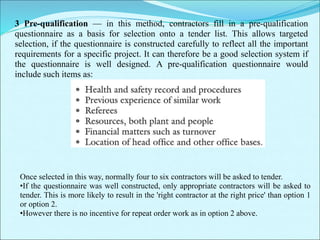
3 Pre-qualification — in this method, contractors fill in a pre-qualification
questionnaire as a basis for selection onto a tender list. This allows targeted
selection, if the questionnaire is constructed carefully to reflect all the important
requirements for a specific project. It can therefore be a good selection system if
the questionnaire is well designed. A pre-qualification questionnaire would
include such items as:
Once selected in this way, normally four to six contractors will be asked to tender.
•If the questionnaire was well constructed, only appropriate contractors will be asked to
tender. This is more likely to result in the 'right contractor at the right price' than option 1
or option 2.
•However there is no incentive for repeat order work as in option 2 above.
4. Negotiated — here the employer negotiates the price, usually with a
known and trusted contractor. This method is not usually possible with contracts
falling under the regulations and, where it is allowed, it is subject to
administrative limitations. Where the regulations do not apply, this method is
often used with 'strategic partnering', where an employer and contractor build
up a long-term relationship based on cooperation, trust and repeat order work.
Contractors will often take a loss on one particular contract in the expectation of
a reasonable profit on future contracts. This requires an acceptance on both
sides that if the employer gains from a contractor's loss on one project, then the
contractor will need to recover this loss on future projects.
The big drawback with negotiated contracts is that after a time the employer
never really knows what the 'market price' is. Many employers take an occasional
competitive bid on a series of negotiated contracts to 'test the market'.

Lecture4construction contract.ppt

  • 1.
    Construction contract proceduresand management Lesson 4 Rights and obligations (continuation) Textbook: №5 (p.55-70) PhD, professor Iryna Rudnieva
  • 2.
    Employer's right tovary the contract (via the contract administrator) Most contracts give the contract administrator the right to issue new drawings, instructions and other requirements. In JCT and ICE contracts these are called 'variations', but NEC3 ECC uses the word 'changes' instead. Variations normally give the contractor a right to more time to complete the project as well, which is only reasonable. Employers and insurance You pay a premium to the insurer for the risk of a specified event occurring, or 'peril' as it may be called. If this specified event occurs then you are compensated by the insurer. The amount of compensation depends on the policy. It may be the value of the article at the time of the event, or it may be its replacement value.
  • 3.
    There are twomain types of insurance relevant to the construction industry: • Liability insurance — here the insurer indemnifiys (compensates) the insured person or company against damages and legal costs which become payable as a result of the specified event. 'Indemnifiy' means that the insurer will pay these costs for the insured person or company. An example is Third Party car insurance — you crash into another car and your insurance company pays out to the owner of the car you have hit, but doesn't cover damage to your car, so you are being covered for demands on you by another party. • Loss insurance — here the insurer compensates the insured person or company for loss or damage which the insured person or company has suffered as a result of the specified event, whether the event happened accidentally or as a result of somebody else's negligence. Sometimes this type of policy also covers the insured for their own negligence. An example is Comprehensive car insurance — you crash into another car and the insurer covers your costs (often car repairs and medical costs, depending on the policy) as well, even if it was your fault.
  • 4.
    Employers and regulations Inthe UK, employers are bound by many laws and regulations. Lack of compliance can lead to fines, or even prison sentences. A few such regulations are: • Health and safety legislation (especially CDM) • Planning legislation • Building control • Highways legislation • Environmental legislation and protected species o The Competition Act • Fire regulations • Waste management and disposal regulations • The EU procurement directives as transferred into English law.
  • 5.
    The contractor contractrights and obligations The main rights of the contractor are to: • Be given access (called possession in JCT) of the site at the access date, or access to those parts of the site that are prescribed in the contract. • Be paid in accordance with the contract at the times and in the way stipulated. • Proceed with the construction works without interference or prevention. • Receive reasonably fast replies to any letters, emails made to the contract administrator. ICE7 and JCT are silent on this matter, although a term of a reasonable time would probably be implied by the courts if necessary. However, in NEC3 ECC a 'period for reply' is inserted in the contract data. This is stated in 'weeks' and two weeks is suggested as usually being suitable in the NEC3 ECC Guidance Notes. • Receive at a suitable time to suit the progress of the works such further instructions and drawings that are reasonably necessary. • Receive any goods or materials specified as supplied by the employer at the times stated in the contract.
  • 6.
    Contractor's main obligations Undermost standard forms of contract, the contractor's main obligations are to: •Comply with the contract. •Construct and complete the works in accordance with the contract; this of course includes the specification and all the drawings. •Ensure that any sub-contractor also complies with the contract. •Provide competent supervision and labour. •Complete the contract works to the standard specified, by the completion date (or any extension to that date that the contract administrator may grant). •Obey the instructions of the contract administrator within its powers under the contract. •Comply in full with all health and safety legislation, particularly the CDM regulations. • Comply with local authority bylaws, statutory regulations and other acts and regulations relating to the control of building works. • Comply with all regulations relating to the disposal of waste and the production of site waste management plans. • Submit a programme to the contract administrator, and update it as necessary or when so instructed. • Provide insurance as specified. • Return to correct any defects in the works after they are taken over by the employer at completion.
  • 7.
    Further obligations ofthe contractor under many forms of contract are to: • Work in a spirit of mutual cooperation. • Submit regular applications for payment, or 'attend' while measurement takes place. • Proceed with 'due expedition' (ICE7 clause 41), or 'regularly and diligently proceed' (JCT SBC05 clause 2.4). NEC3 ECC has no similar terms, possibly on the basis that it is in the contractor's interests to do this anyway. • Give notice of any inconsistencies in the contract documents to the contract administrator, so that they can be investigated and if necessary corrected. Under most forms of contract, the contractor will be compensated for any loss that subsequent correction causes. • Pay any fees, charges, rates or taxes in respect of the work if this is specified in the contract. The contractor is usually compensated for this in the monthly payments. • Protect and preserve antiquities and other objects of value that may be found on the site. • Design all temporary works (equipment needed in the construction process but removed on completion). • Design any permanent work (goods and materials that will form part of the finished project) if so directed in the contract.
  • 8.
    Contractor's obligation forhealth and safety Many forms of contract have specific clauses relating to health and safety such as ICE7 clause 8(3). JCT SBC05 clause 3.23 largely repeates the main obligations under CDM. However, Schedule 8 of the 2009 edition of JCT SBC05, goes on to put four further requirements on the contractor in clause 2.2: • Comply with any approved codes of practice (ACOP) issued by the HSE. • Implement health and safety site stimulations for all contractor's personnel and members of their supply chain. • Provide health and safety advice. • Ensure health and safety consultation. This is quite interesting, the CDM regulations are legally binding and the ACOP are not. The ACOP do of course represent good practice and any contractor not following them may have to explain why to a court. So here, JCT is making adherence to the ACOP a contractual requirement in the contract between the employer and the contractor.
  • 9.
    Contractor's obligation forsecurity and control of the site Contractors will ensure the safety and security of the site. This is for three main reasons: •The contractor is usually contractually responsible for any loss or damage to materials on-site or the partly completed construction works. •The contractor could be responsible for any loss or injury to members of the public, and anyone else who entered the site. •The contractor will wish to act in a professionally and maintain its reputation. The contractor is also responsible for 'control' of the site. Under CDM regulation 22 the principal contractor composes the 'site rules' and prevent access to site by unauthorised persons.
  • 10.
    Contractor's obligation forworkmanship and materials Many construction problems relate to either design, workmanship, unsuitable materials or all three. In forms of contract based on traditional procurement, the design organisation is responsible for design and specification of materials, and the contractor for workmanship and using compliant materials. The primary role of the contractor is to construct the 'works'. Permanent works is goods and materials that will form part of the finished project. Temporary works are items such as trench supports, any other temporary supports, settling ponds and lagoons, groundwater pumping equipment, formwork, scaffolding, tower cranes and so on. The contract between the employer and the contractor is all about the quality of the permanent works. The quality of materials and any particular workmanship requirements are usually set out in the specification and any related standards such as British Standards or European Standards. In NEC3 ECC contracts the specification will form part of the works information and is separate from the pricing mechanism.
  • 11.
    In 'building' contractssuch as JCT SBC05, the specification information is usually combined with the measurement items in the contract bills. JCT SBC()5 refers to materials in clause 2.3.1 and workmanship in clause 2.3.2 as being 'as described in the contract bills.' NEC3 ECC simply says 'the contractor provides the works in accordance with the works information. ' Under most forms of contract the contractor is responsible for the proper setting out of the works and any checks made by the contract administrator do not remove this responsibility (ICE7 clause 17 and JCT SBC05 clause 2.10). NEC3 ECC is silent on this matter, possibly because it is now unusual for the employer to pay for extensive site supervision, reporting to the contract administrator.
  • 12.
    Contractor's obligation fordefects A defect is not defined in ICE7 or JCT SBC05 but it is defined in NEC3 ECC. Clause 11.2(5) ofNEC3 ECC defines a defect as part of the works which is not in accordance with the works information.' There is a difficulty here, in that in normal language, a 'defect' is something unsatisfactory or deficient. In NEC3 ECC, work can be unsatisfactory, but not be defined as a defect under the contract if it is in accordance with the works information. In most forms of contract there is a period of time allowed for correcting defects, usually twelve months in ICE7 and NEC3 ECC contracts, and a default of six months in JCT SBC05, which can of course be increased when the tender documents are prepared. This period is called the rectification period in JCT SBC05. NEC3 ECC uses a different method by stating a defects date as being a number of weeks after completion of the works. The effect is the same. If the contractor fails to return and due notice is given, there are sanctions which allow the employer to deduct money or bring in an alternative contractor to correct the defect.
  • 13.
    Contractor's obligation forinsurance The usual insurance situation is abstracted from NEC3 ECC clause 84 and is as follows: 'The contractor insures in the joint names of the contractor and the employer for events which are the contractor's risk (see below for exclusions) from the starting date until the defects correction certificate is issued (the end of the period for correcting defects) • loss of or damage to the works, plant or materials • loss of or damage to equipment (temporary works) • liability for loss of or damage to property • liability for bodily injury to or death of a person (not an employee of the contractor) caused by activity in connection with this contract • liability for death or bodily injury to employees of the contractor arising out of and in the course of their employment in connection with this contract' Exclusions to the contractor's risk usually include: • The unavoidable results of constructing the works • Negligence, breach of statutory duty or interference with any legal right by the employer • A fault in the design of the design organisation • War, rebellion, riot and similar events.
  • 14.
    Chapter summary • Contractsgenerally are concerned with the rights and obligations of the parties. • Parties are the people or more usually the organisations that make the contract. • Increasingly, contracts stipulate that the parties work in a cooperative manner, where 'cooperative' is used in a behavioural and team work sense. NEC3 ECC began this trend, and the JCT suite of contracts is being amended to include it. • The main obligations of the employer are to provide access to the site, to pay the contractor in the manner and at the times stipulated in the contract, and to provide specified insurances. • There are also legal requirements for the employer not to hinder or prevent the contractor from carrying out the works. • Under most contracts, the employer must appoint a contract administrator, and this contract administrator usually has powers under the contract to vary (change) the contract works, within prescribed limits.
  • 15.
    • Both theemployer and contractor have a crucial responsibility for health and safety. Their roles and obligations are clearly set out in the CDM regulations (2007). • Additionally the contractor has a responsibility for the security and control of the site, which largely impacts on safety considerations. • The contractor's main obligation is to construct the contract works using workmanship and materials to the contract requirements. • The contractor is required to supply and update a programm under most forms of contract. • The contractor usually has a responsibility to correct defects in the constructed works usually for a period of time after completion. This period is usually 12 months. • The contractor is obliged to take out insurance to cover a number of risks, mainly to the contract works and materials but also to persons and property.
  • 16.
    Questions Questions. 1. Who arethe three main parties in the construction project? 2. What are the four most important things that employer must to do? 3. What is Liability insurance? 4. What are the contractor's main obligations? 16 Rights and obligations
  • 17.
    Dictionary (new) 17 EN (old)CN INVESTMENT CONTRACTS PROCUREMENT PURCHASING STAKEHOLDER EMPLOYER ASSET TENDERING LIQUIDATED DAMAGES Tóuzī hétóng cáifù zhāobiāo cǎigòu gòumǎi gùzhǔ lìyì xiāngguān zhě Fákuǎn
  • 18.
    Dictionary (new) 18 EN (old)CN PARTIES BINDING CONTRACTS PROJECT MANAGER DESIGNER STAKEHOLDER EMPLOYER CONTRACTOR SUBCONTRACTOR ASSET TENDERING Pàiduì yuēshù hétóng chéngbāo shāng cáifù Zhuān'àn jīnglǐ Shèjì shī gùzhǔ lìyì xiāngguān zhě zhāobiāo Fēn bāo shāng
  • 19.
    Dictionary (new) 19 EN (old)CN OFFER TERMS AGREEMENT COOPERATION LEGAL RELATIONSHIP GENUINE CONSENT DEAL Tígōng tiáokuǎn hétóng xiéyì hézuò zhēnzhèng de tóngyì fǎlǜ guānxì
  • 20.
    Dictionary (new) 20 EN (NEW)CN RIGHTS OBLIGATIONS (DUTY) INSURANCE TERMS COOPERATION LEGAL RELATIONSHIP PROSECUTION COURT OF LAW Quán yìwù jiǎnchá guān bǎoxiǎn tiáokuǎn fǎlǜ guānxì hézuò fǎtíng
  • 21.
    Construction contract proceduresand management Lesson 4 Tendering and contractor selection Textbook: №6 (p.71-93) PhD, professor Iryna Rudnieva
  • 22.
    Tendering is theprocess by which bids are invited from suitable companies, based on the employer's tender documents in order to establish that legal contract. The tender process The period of time that a tenderer has to decide how much to bid and submit a tender is called the tender period. After receiving of the tenders, the employer, or their advisors, must assess the tenders. the employer tenderer - applicant is possible future contractor
  • 23.
    Tendering is theindustry name for obtaining an offer from a contractor, which can then be accepted by the employer to form a binding contract. Employers may produce their own contract documents and assess tenders themselves, but this is very unlikely. The employer usually employs a design organisation such as a firm of consulting engineers, architects or building surveyors to prepare all the tender documents and then to advise which tender to accept. The employer considers the tender report and then signs a contract with the successful tenderer who then becomes 'the contractor' under the contract. Once the contract is awarded, the tender documents become the basis of the contract. They become the contract documents. Under most forms of contract, additions and changes can then be made and so the contract documents are constantly changing as construction work proceeds.
  • 24.
    On a largecontract, hundreds and possibly thousands of changes, additions will be made. Under most forms of contract, the contractor is paid to make these changes to the construction work, and is given more time to do it. The employer wishes to find the 'right contractor at the right price' and the contractor wishes to 'win the contract' but on the right terms and at the right price for him. Some good advice on tendering is given in Practice Note 6, published by the Joint Contracts Tribunal. Types of tender: • A single offer (bid) is a tender for one project. This is the normal tender situation, where a contractor offers to carry out a particular contract, on particular terms, for a price. • A framework agreement (sometimes called a standing offer or serial contract) is a tender to construct a number of projects over a period of time.
  • 25.
    The tender Processfor single-bid tendering in detail Going out for tender 1.The employer decides on a tendering option in order to attract several tenderers. 2.This decision creates a list of tenderers. 3.The employer determines a suitable tender period. 4.Before sending tender documents to these tenderers employer needs to reconfirm the tenderers' interest in submitting a tender. 5.The employer sends 'invitation to tender' letters to the tenderers, accompanied by two sets of tender documents (these tender documents will become the contract documents when the contract is signed), and usually a tender return envelope. 6.Tenderers visit site, and make tender enquiries of suppliers and sub-contractors. 7.Tenderers consider their potential programme and available resources.
  • 26.
    8. Tenderers makeany further requests or clarifications from the employer. 9. Tenderers should raise such requests in writing. The employer (or usually their design organisation) should respond with a copy to all tenderers. This ensures good communication and honest relationship. 10. Tenderers then complete any schedules or information in the tender documents, price up any bills, or schedules, often using quotations from sub-contractors and suppliers. 11. Tenderers must submit their tenders by the due date, at the place and in the manner described in the instructions to tenderers. Many employers will not open a tender that is even five minutes late.
  • 27.
    12. The employer(usually through the design organisation) evaluates the tenders, particularly in respect of prices and pricing structure. 13. Any qualifications by the tenderer are reviewed — qualifications should generally not occur if requests are raised before the tender is submitted. 14. Withdrawal or rejection of tenders may result because of the inclusion of unacceptable qualifications or if major errors are identified in the tender. 15. Finalisation of tender — this stage may allow minor errors to be corrected. Many employers have rules regarding errors. All corrections must be recorded in writing. 16. Sometimes a negotiation process takes place if savings have to be achieved due the employer's budget is exceeded. This cannot be done with tenders under the EU Directives. 17. A tender report is usually produced by the design organisation. 18. The employer selects one of the tenders on the basis of the tender report. After the employer receives the tenders
  • 28.
    19. The employerwrites to the successful tenderer accepting the tender (the offer). Usually the acceptance is 'subject to contract'. 20.Signature of the formal contract (and possibly signing it as a 'deed', which is a legal device to give a longer period for breach of contract claims) confirms the agreement, and a binding contract is formed between the tenderer and the employer. 21. The successful tenderer is now called the 'contractor' and the tender documents become the contract documents. 22.Once the contract is awarded every unsuccessful tenderer should be notified. This notification should be made as soon as possible, to allow tenderers to reallocate resources to other potential work. 23.Every unsuccessful tenderer should also be issued with a list of tender prices, and the names of other tenderers, so that they can assess their commercial position in the market for future tendering opportunities. For example, if a contractor's tender was twenty per cent more expensive than the average tender, then they have misunderstood the tender, or have a serious problem with competitiveness.
  • 29.
    Tender documents The tenderdocuments describe what is to be built and how the work will be paid for. Tender documents are usually very detailed and many months or even years will be spent on producing them. The tender documents 1. Invitation to tender and instructions to tenderers 2. Any articles of agreement 3. Conditions of contract and contract data 4. The pricing mechanism 5. The payment mechanism (which may be the same as the pricing mechanism) 6. Works information including the specification, tender drawings and health and safety information 7. Site information
  • 30.
    Ground investigation reports Itis normal for the employer to arrange for a comprehensive ground investigation at an early stage of the design process as part of the overall site investigation.The site investigation process is very important and is covered in detail in the next chapter. Ground investigation results are necessary to produce a safe and efficient design as well as to determine appropriate construction methods. Ground investigation reports typically have two main parts: a factual part and an interpretive part. The factual part contains sections through boreholes, groundwater measurements and details of all in situ (in place) and laboratory tests. The interpretive part will contain calculated design parameters such as bearing capacity (based on assumed formulae and factors of safety). The future building should meet the requirements of reliability
  • 31.
    Tendering options  Tenderingoptions are different ways of selecting the best contractor.  The tendering process is the administrative mechanism of inviting and assessing tenders. The six main tendering options: SINGLE-BID Options • Open tendering • Single-bid selective tendering • Pre-qualification • Negotiated TWO-BID Options • Two-stage selective tendering • Framework agreements This chapter outlines six tendering options on the p.77-81 (Textbook: №6).
  • 32.
    1 Open tendering— in this option, the employer places an advertisement in a newspaper or journal for any interested party to bid. This option was once used frequently on the basis that more tenderers should result in the lowest price because of the increased number of offers being made. It arguably led to some of the historical problems in the construction industry, which were highlighted in the Latham and Egan reports. This option is unusual today. 2 Single-bid selective tendering — here the employer compiles lists of 'suitable contractors', often on the basis of the nature of the contract work and its geographical location. Such a suitable list might be for laying water mains in Gloucestershire, or road maintenance work in Derbyshire. Larger employers who use this method may have a number of different lists perhaps split by county and work type. Each list could have ten or even twenty or more potential tenderers on it. For any particular project, a number oftenderers, usually six, are selected from the relevant list to form a specific short list for that particular tender. A tender list of six tenderers may often contain the previous successful tenderer for that particular list plus five others in rotation from the list. Tenderers on the specific tender list then submit their tenders or bids as they are often known.
  • 33.
    3 Pre-qualification —in this method, contractors fill in a pre-qualification questionnaire as a basis for selection onto a tender list. This allows targeted selection, if the questionnaire is constructed carefully to reflect all the important requirements for a specific project. It can therefore be a good selection system if the questionnaire is well designed. A pre-qualification questionnaire would include such items as: Once selected in this way, normally four to six contractors will be asked to tender. •If the questionnaire was well constructed, only appropriate contractors will be asked to tender. This is more likely to result in the 'right contractor at the right price' than option 1 or option 2. •However there is no incentive for repeat order work as in option 2 above.
  • 34.
    4. Negotiated —here the employer negotiates the price, usually with a known and trusted contractor. This method is not usually possible with contracts falling under the regulations and, where it is allowed, it is subject to administrative limitations. Where the regulations do not apply, this method is often used with 'strategic partnering', where an employer and contractor build up a long-term relationship based on cooperation, trust and repeat order work. Contractors will often take a loss on one particular contract in the expectation of a reasonable profit on future contracts. This requires an acceptance on both sides that if the employer gains from a contractor's loss on one project, then the contractor will need to recover this loss on future projects. The big drawback with negotiated contracts is that after a time the employer never really knows what the 'market price' is. Many employers take an occasional competitive bid on a series of negotiated contracts to 'test the market'.