TRUTH TABLE

• Remember:
   –   Decimal to Binary
   –   Binary to Decimal
   –   Binary math
   –   Finish representation of data
         • Numbers
         • Symbols
         • Images
         • Audio
• Today:
   – Boolean Logic
   – Truth Tables
   – Circuits


                                       4-1
4-2
What we will cover…

•   The connection between Boolean logic and circuits
•   Boolean (Propositional) Logic
•   The design of simple logic circuits
•   Representing simple logical sentences in hardware


                                                        4-3
Logic and Logic Circuits

• What is a circuit?
   – the complete path of an electric current, or a collection of electronic
     elements
   – We are interested in logic circuits, those whose output varies
     depending on their input.
• Logic circuits emulate the Boolean logic operators
  from propositional logic


                                                                               4-4
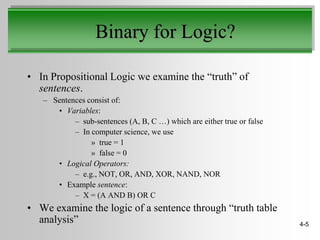
Binary for Logic?

• In Propositional Logic we examine the “truth” of
  sentences.
   – Sentences consist of:
      • Variables:
           – sub-sentences (A, B, C …) which are either true or false
           – In computer science, we use
                » true = 1
                » false = 0
      • Logical Operators:
           – e.g., NOT, OR, AND, XOR, NAND, NOR
      • Example sentence:
           – X = (A AND B) OR C
• We examine the logic of a sentence through “truth table
  analysis”                                                             4-5
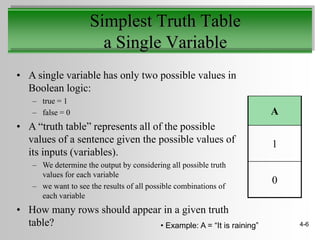
Simplest Truth Table
                      a Single Variable
• A single variable has only two possible values in
  Boolean logic:
   – true = 1
   – false = 0                                                    A
• A “truth table” represents all of the possible
  values of a sentence given the possible values of               1
  its inputs (variables).
   – We determine the output by considering all possible truth
     values for each variable
   – we want to see the results of all possible combinations of
                                                                  0
     each variable
• How many rows should appear in a given truth
  table?                     • Example: A = “It is raining”           4-6
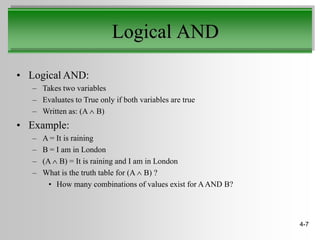
Logical AND

• Logical AND:
   – Takes two variables
   – Evaluates to True only if both variables are true
   – Written as: (A B)
• Example:
   –   A = It is raining
   –   B = I am in London
   –   (A B) = It is raining and I am in London
   –   What is the truth table for (A B) ?
         • How many combinations of values exist for A AND B?


                                                                4-7
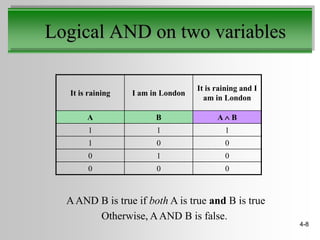
Logical AND on two variables

                                   It is raining and I
  It is raining   I am in London
                                     am in London

       A                B                A       B
       1                1                    1
       1                0                    0
       0                1                    0
       0                0                    0


  A AND B is true if both A is true and B is true
        Otherwise, A AND B is false.
                                                         4-8
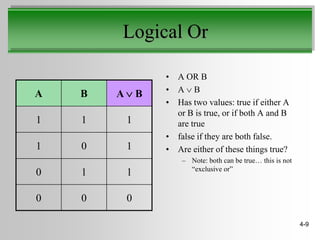
Logical Or

                    • A OR B
                    • A B
A   B   A       B
                    • Has two values: true if either A
                      or B is true, or if both A and B
1   1       1         are true
                    • false if they are both false.
1   0       1       • Are either of these things true?
                        – Note: both can be true… this is not
                          “exclusive or”
0   1       1

0   0       0

                                                                4-9
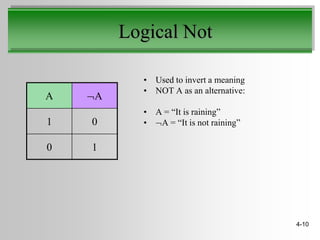
Logical Not

          • Used to invert a meaning
          • NOT A as an alternative:
A   A
          • A = “It is raining”
1   0     •  A = “It is not raining”

0   1


                                       4-10
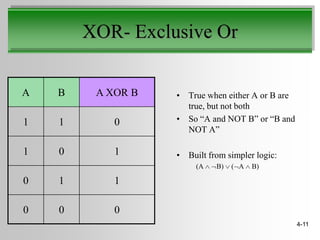
XOR- Exclusive Or

A   B    A XOR B   • True when either A or B are
                     true, but not both
1   1       0      • So “A and NOT B” or “B and
                     NOT A”

1   0       1      • Built from simpler logic:
                        (A   B)   ( A   B)

0   1       1

0   0       0
                                                   4-11
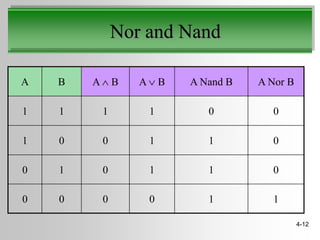
Nor and Nand

A   B   A       B   A       B   A Nand B   A Nor B

1   1       1           1          0         0

1   0       0           1          1         0

0   1       0           1          1         0

0   0       0           0          1         1

                                                     4-12
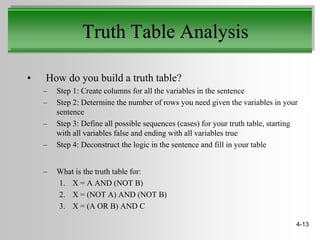
Truth Table Analysis

•   How do you build a truth table?
    –   Step 1: Create columns for all the variables in the sentence
    –   Step 2: Determine the number of rows you need given the variables in your
        sentence
    –   Step 3: Define all possible sequences (cases) for your truth table, starting
        with all variables false and ending with all variables true
    –   Step 4: Deconstruct the logic in the sentence and fill in your table


    –   What is the truth table for:
        1. X = A AND (NOT B)
        2. X = (NOT A) AND (NOT B)
        3. X = (A OR B) AND C

                                                                                   4-13
Logic and Logic Circuits

• What is a circuit?
   – the complete path of an electric current, or a collection of electronic
     elements
   – we will consider transistors to be the basic building blocks of logic
     computer hardware.

   – Logic circuits are built from a series of transistors
      • What is a transistor?


                                                                               4-14
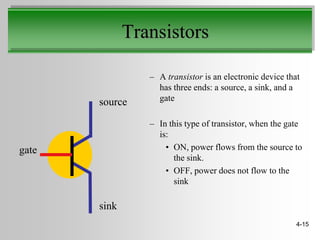
Transistors

                 – A transistor is an electronic device that
                   has three ends: a source, a sink, and a
       source      gate

                 – In this type of transistor, when the gate
                   is:
gate                 • ON, power flows from the source to
                       the sink.
                     • OFF, power does not flow to the
                       sink

       sink
                                                           4-15
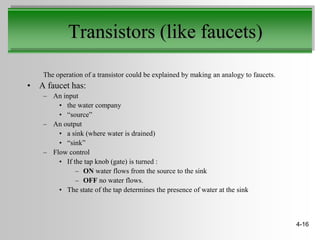
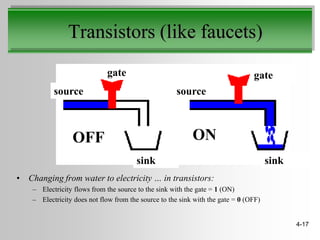
Transistors (like faucets)
    The operation of a transistor could be explained by making an analogy to faucets.
• A faucet has:
    – An input
        • the water company
        • “source”
    – An output
        • a sink (where water is drained)
        • “sink”
    – Flow control
        • If the tap knob (gate) is turned :
              – ON water flows from the source to the sink
              – OFF no water flows.
        • The state of the tap determines the presence of water at the sink


                                                                                        4-16
Transistors (like faucets)
                             gate                                               gate
           source                                    source


                 OFF                                       ON
                                        sink                                          sink
• Changing from water to electricity … in transistors:
    – Electricity flows from the source to the sink with the gate = 1 (ON)
    – Electricity does not flow from the source to the sink with the gate = 0 (OFF)


                                                                                             4-17
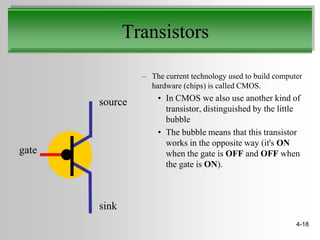
Transistors

                – The current technology used to build computer
                  hardware (chips) is called CMOS.

       source       • In CMOS we also use another kind of
                      transistor, distinguished by the little
                      bubble
                    • The bubble means that this transistor
                      works in the opposite way (it's ON
gate                  when the gate is OFF and OFF when
                      the gate is ON).


       sink
                                                             4-18
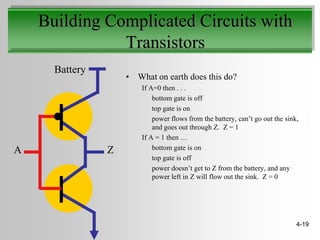
Building Complicated Circuits with
               Transistors
      Battery
                    • What on earth does this do?
                        If A=0 then . . .
                            bottom gate is off
                            top gate is on
                            power flows from the battery, can’t go out the sink,
                            and goes out through Z. Z = 1
                        If A = 1 then …
A               Z           bottom gate is on
                            top gate is off
                            power doesn’t get to Z from the battery, and any
                            power left in Z will flow out the sink. Z = 0


                                                                               4-19
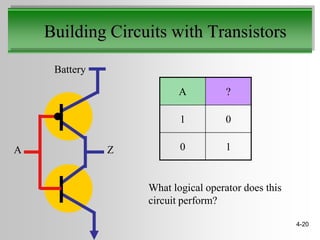
Building Circuits with Transistors

     Battery

                          A          ?

                          1          0

A              Z          0          1


                   What logical operator does this
                   circuit perform?

                                                     4-20

Truth table1

  • 1.
    TRUTH TABLE • Remember: – Decimal to Binary – Binary to Decimal – Binary math – Finish representation of data • Numbers • Symbols • Images • Audio • Today: – Boolean Logic – Truth Tables – Circuits 4-1
  • 2.
  • 3.
    What we willcover… • The connection between Boolean logic and circuits • Boolean (Propositional) Logic • The design of simple logic circuits • Representing simple logical sentences in hardware 4-3
  • 4.
    Logic and LogicCircuits • What is a circuit? – the complete path of an electric current, or a collection of electronic elements – We are interested in logic circuits, those whose output varies depending on their input. • Logic circuits emulate the Boolean logic operators from propositional logic 4-4
  • 5.
    Binary for Logic? •In Propositional Logic we examine the “truth” of sentences. – Sentences consist of: • Variables: – sub-sentences (A, B, C …) which are either true or false – In computer science, we use » true = 1 » false = 0 • Logical Operators: – e.g., NOT, OR, AND, XOR, NAND, NOR • Example sentence: – X = (A AND B) OR C • We examine the logic of a sentence through “truth table analysis” 4-5
  • 6.
    Simplest Truth Table a Single Variable • A single variable has only two possible values in Boolean logic: – true = 1 – false = 0 A • A “truth table” represents all of the possible values of a sentence given the possible values of 1 its inputs (variables). – We determine the output by considering all possible truth values for each variable – we want to see the results of all possible combinations of 0 each variable • How many rows should appear in a given truth table? • Example: A = “It is raining” 4-6
  • 7.
    Logical AND • LogicalAND: – Takes two variables – Evaluates to True only if both variables are true – Written as: (A B) • Example: – A = It is raining – B = I am in London – (A B) = It is raining and I am in London – What is the truth table for (A B) ? • How many combinations of values exist for A AND B? 4-7
  • 8.
    Logical AND ontwo variables It is raining and I It is raining I am in London am in London A B A B 1 1 1 1 0 0 0 1 0 0 0 0 A AND B is true if both A is true and B is true Otherwise, A AND B is false. 4-8
  • 9.
    Logical Or • A OR B • A B A B A B • Has two values: true if either A or B is true, or if both A and B 1 1 1 are true • false if they are both false. 1 0 1 • Are either of these things true? – Note: both can be true… this is not “exclusive or” 0 1 1 0 0 0 4-9
  • 10.
    Logical Not • Used to invert a meaning • NOT A as an alternative: A A • A = “It is raining” 1 0 • A = “It is not raining” 0 1 4-10
  • 11.
    XOR- Exclusive Or A B A XOR B • True when either A or B are true, but not both 1 1 0 • So “A and NOT B” or “B and NOT A” 1 0 1 • Built from simpler logic: (A B) ( A B) 0 1 1 0 0 0 4-11
  • 12.
    Nor and Nand A B A B A B A Nand B A Nor B 1 1 1 1 0 0 1 0 0 1 1 0 0 1 0 1 1 0 0 0 0 0 1 1 4-12
  • 13.
    Truth Table Analysis • How do you build a truth table? – Step 1: Create columns for all the variables in the sentence – Step 2: Determine the number of rows you need given the variables in your sentence – Step 3: Define all possible sequences (cases) for your truth table, starting with all variables false and ending with all variables true – Step 4: Deconstruct the logic in the sentence and fill in your table – What is the truth table for: 1. X = A AND (NOT B) 2. X = (NOT A) AND (NOT B) 3. X = (A OR B) AND C 4-13
  • 14.
    Logic and LogicCircuits • What is a circuit? – the complete path of an electric current, or a collection of electronic elements – we will consider transistors to be the basic building blocks of logic computer hardware. – Logic circuits are built from a series of transistors • What is a transistor? 4-14
  • 15.
    Transistors – A transistor is an electronic device that has three ends: a source, a sink, and a source gate – In this type of transistor, when the gate is: gate • ON, power flows from the source to the sink. • OFF, power does not flow to the sink sink 4-15
  • 16.
    Transistors (like faucets) The operation of a transistor could be explained by making an analogy to faucets. • A faucet has: – An input • the water company • “source” – An output • a sink (where water is drained) • “sink” – Flow control • If the tap knob (gate) is turned : – ON water flows from the source to the sink – OFF no water flows. • The state of the tap determines the presence of water at the sink 4-16
  • 17.
    Transistors (like faucets) gate gate source source OFF ON sink sink • Changing from water to electricity … in transistors: – Electricity flows from the source to the sink with the gate = 1 (ON) – Electricity does not flow from the source to the sink with the gate = 0 (OFF) 4-17
  • 18.
    Transistors – The current technology used to build computer hardware (chips) is called CMOS. source • In CMOS we also use another kind of transistor, distinguished by the little bubble • The bubble means that this transistor works in the opposite way (it's ON gate when the gate is OFF and OFF when the gate is ON). sink 4-18
  • 19.
    Building Complicated Circuitswith Transistors Battery • What on earth does this do? If A=0 then . . . bottom gate is off top gate is on power flows from the battery, can’t go out the sink, and goes out through Z. Z = 1 If A = 1 then … A Z bottom gate is on top gate is off power doesn’t get to Z from the battery, and any power left in Z will flow out the sink. Z = 0 4-19
  • 20.
    Building Circuits withTransistors Battery A ? 1 0 A Z 0 1 What logical operator does this circuit perform? 4-20