Staircase Detection
What is the problem?
◇ According to the World Health Organization
(WHO), about 253 million people are visually
impaired.
◇ Among them, around 36 million people are blind
and rest 217 million people have various vision
impairment.
◇ Among the above 80%, people are 50 years
aged or above.
◇ So, this is actually a severe problem.!!
2
Objectives
◇ To help both the visually impaired people and
the robot technologies so that they could
detect staircase in all possible cases.
◇ Could differentiate between up and down
stairs..
◇ To developed a system that could detect
staircase in any kind of scenario like day and
night.
3
Challenges
◇ Detection of staircase through camera in an
walking stick used by a blind people.
◇ Connecting a raspberry with the device where
the object detection library would run and
send data simultaneously to detect up and
down stair.
◇ A real time device which would detect stairs
without any stoppage and low response time.
4
Technical Details
◇ Raspberry Pie 3.0 model B
◇ Intel core i3 processor
◇ RGB-D camera
◇ Ultrasonic sensor HY-SRF05
◇ Buzzer
◇ Connecting wires
5
Funtionality
“
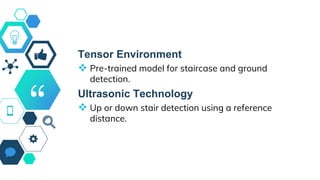
Tensor Environment
 Pre-trained model for staircase and ground
detection.
Ultrasonic Technology
 Up or down stair detection using a reference
distance.
7
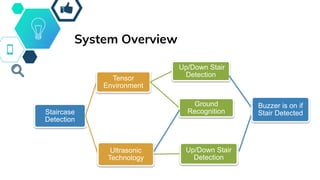
System Overview
8
Staircase
Detection
Tensor
Environment
Up/Down Stair
Detection
Ground
Recognition
Ultrasonic
Technology
Up/Down Stair
Detection
Buzzer is on if
Stair Detected
“
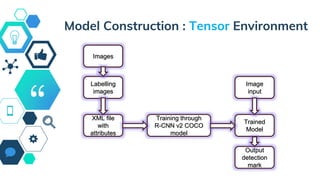
Model Construction : Tensor Environment
9
Trained
Model
Training through
R-CNN v2 COCO
model
Labelling
images
Image
input
Output
detection
mark
Images
XML file
with
attributes
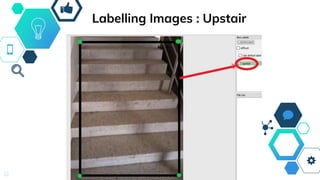
Labelling Images
“LabelImg” is used for labelling images.
LabelImg is an open source image labeling tool
that has pre-built binaries for Windows so it’s
extremely easy to install.
10
Labelling Images : Downstair
11
Labelling Images : Upstair
12
Training Model : COCO model
13
COCO is a large-scale object detection, segmentation,
and captioning dataset.
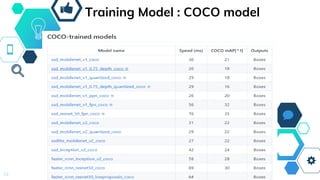
There are many COCO models for training image data.
Training Model : COCO model
14
COCO is a large-scale object detection, segmentation,
and captioning dataset.
There are many COCO models for training image data.
Training Model : COCO model
15
COCO is a large-scale object detection, segmentation,
and captioning dataset.
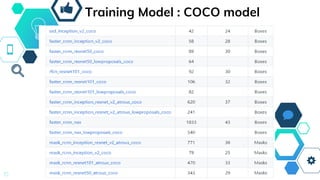
There are many COCO models for training image data.
Faster-RCNN-Inception-V2-COCO model
16
TensorFlow provides several object detection models
(pre-trained classifiers with specific neural network
architectures) in its model zoo.
Some models (such as the SSD-MobileNet model) have
an architecture that allows for faster detection but with
less accuracy, while some models (such as the Faster-
RCNN model) give slower detection but with more
accuracy.
We choose the Faster-RCNN-Inception-V2 model,
which has a speed of 58 milliseconds and mean
average precision of 28.
“
Output : Tensor Environment
17
“
Output : Tensor Environment
18
“
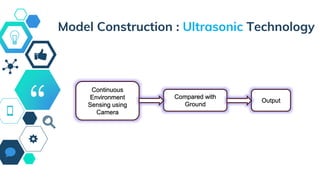
Model Construction : Ultrasonic Technology
19
Output
Compared with
Ground
Continuous
Environment
Sensing using
Camera
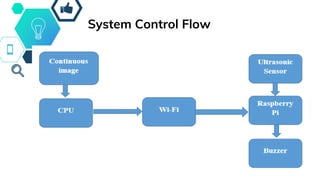
System Control Flow
20
Staircase
Detection
Tensor
Environment
Up/Down Stair
Detection
Ground
Recognition
Ultrasonic
Technology
Up/Down Stair
Detection
Buzzer is on if
Stair Detected
Prototype
21
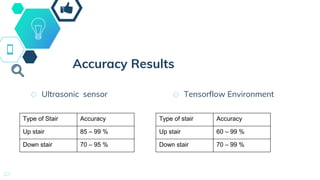
Accuracy Results
◇ Ultrasonic sensor ◇ Tensorflow Environment
23
Type of Stair Accuracy
Up stair 85 – 99 %
Down stair 70 – 95 %
Type of stair Accuracy
Up stair 60 – 99 %
Down stair 70 – 99 %
Possible Applications
◇ For visually impaired people.
◇ Multi floor navigation for robot systems.
24
Limitations
◇ Vision technology would not work on dark places.
◇ The ultrasonic sensor would give the same data for
objects with a minimum height and down stair
even if there is hole ahead of the device.
◇ Deviation of data in noisy places for ultrasonic
sensor.
◇ Heavy processing device required for object
detection through vision technology. 25
Future Work
◇ To make the device less expensive while
using cloud services for stair detection.
◇ More power efficient.
◇ To count the number of stair steps and the
step size.
26
Conclusion
◇ Solving the major problems of the previous models.
◇ Wide range of application.
27

Staircase detection using coco model (TensorFlow)

  • 1.
  • 2.
    What is theproblem? ◇ According to the World Health Organization (WHO), about 253 million people are visually impaired. ◇ Among them, around 36 million people are blind and rest 217 million people have various vision impairment. ◇ Among the above 80%, people are 50 years aged or above. ◇ So, this is actually a severe problem.!! 2
  • 3.
    Objectives ◇ To helpboth the visually impaired people and the robot technologies so that they could detect staircase in all possible cases. ◇ Could differentiate between up and down stairs.. ◇ To developed a system that could detect staircase in any kind of scenario like day and night. 3
  • 4.
    Challenges ◇ Detection ofstaircase through camera in an walking stick used by a blind people. ◇ Connecting a raspberry with the device where the object detection library would run and send data simultaneously to detect up and down stair. ◇ A real time device which would detect stairs without any stoppage and low response time. 4
  • 5.
    Technical Details ◇ RaspberryPie 3.0 model B ◇ Intel core i3 processor ◇ RGB-D camera ◇ Ultrasonic sensor HY-SRF05 ◇ Buzzer ◇ Connecting wires 5
  • 6.
  • 7.
    “ Tensor Environment  Pre-trainedmodel for staircase and ground detection. Ultrasonic Technology  Up or down stair detection using a reference distance. 7
  • 8.
  • 9.
    “ Model Construction :Tensor Environment 9 Trained Model Training through R-CNN v2 COCO model Labelling images Image input Output detection mark Images XML file with attributes
  • 10.
    Labelling Images “LabelImg” isused for labelling images. LabelImg is an open source image labeling tool that has pre-built binaries for Windows so it’s extremely easy to install. 10
  • 11.
    Labelling Images :Downstair 11
  • 12.
  • 13.
    Training Model :COCO model 13 COCO is a large-scale object detection, segmentation, and captioning dataset. There are many COCO models for training image data.
  • 14.
    Training Model :COCO model 14 COCO is a large-scale object detection, segmentation, and captioning dataset. There are many COCO models for training image data.
  • 15.
    Training Model :COCO model 15 COCO is a large-scale object detection, segmentation, and captioning dataset. There are many COCO models for training image data.
  • 16.
    Faster-RCNN-Inception-V2-COCO model 16 TensorFlow providesseveral object detection models (pre-trained classifiers with specific neural network architectures) in its model zoo. Some models (such as the SSD-MobileNet model) have an architecture that allows for faster detection but with less accuracy, while some models (such as the Faster- RCNN model) give slower detection but with more accuracy. We choose the Faster-RCNN-Inception-V2 model, which has a speed of 58 milliseconds and mean average precision of 28.
  • 17.
    “ Output : TensorEnvironment 17
  • 18.
    “ Output : TensorEnvironment 18
  • 19.
    “ Model Construction :Ultrasonic Technology 19 Output Compared with Ground Continuous Environment Sensing using Camera
  • 20.
    System Control Flow 20 Staircase Detection Tensor Environment Up/DownStair Detection Ground Recognition Ultrasonic Technology Up/Down Stair Detection Buzzer is on if Stair Detected
  • 21.
  • 22.
    Accuracy Results ◇ Ultrasonicsensor ◇ Tensorflow Environment 23 Type of Stair Accuracy Up stair 85 – 99 % Down stair 70 – 95 % Type of stair Accuracy Up stair 60 – 99 % Down stair 70 – 99 %
  • 23.
    Possible Applications ◇ Forvisually impaired people. ◇ Multi floor navigation for robot systems. 24
  • 24.
    Limitations ◇ Vision technologywould not work on dark places. ◇ The ultrasonic sensor would give the same data for objects with a minimum height and down stair even if there is hole ahead of the device. ◇ Deviation of data in noisy places for ultrasonic sensor. ◇ Heavy processing device required for object detection through vision technology. 25
  • 25.
    Future Work ◇ Tomake the device less expensive while using cloud services for stair detection. ◇ More power efficient. ◇ To count the number of stair steps and the step size. 26
  • 26.
    Conclusion ◇ Solving themajor problems of the previous models. ◇ Wide range of application. 27