h2oEnsemble: Scalable Ensemble Learning in R
Erin LeDell
H2O.ai
Mountain View, California
USA
July 2, 2015
H2O.ai useR! 2015 July 2, 2015
Introduction
H2O.ai useR! 2015 July 2, 2015
Overview
Ensemble Learning
Model Stacking (aka. Super Learning)
H2O Machine Learning via h2o R package
h2oEnsemble R package
H2O.ai useR! 2015 July 2, 2015
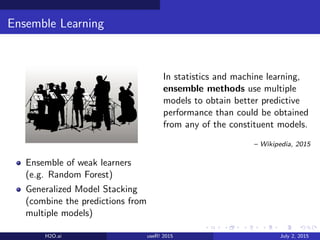
Ensemble Learning
Ensemble of weak learners
(e.g. Random Forest)
Generalized Model Stacking
(combine the predictions from
multiple models)
In statistics and machine learning,
ensemble methods use multiple
models to obtain better predictive
performance than could be obtained
from any of the constituent models.
– Wikipedia, 2015
H2O.ai useR! 2015 July 2, 2015
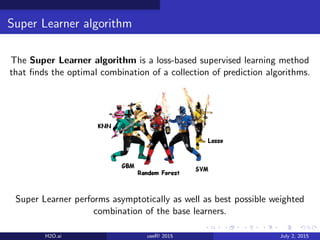
Super Learner algorithm
The Super Learner algorithm is a loss-based supervised learning method
that finds the optimal combination of a collection of prediction algorithms.
Super Learner performs asymptotically as well as best possible weighted
combination of the base learners.
H2O.ai useR! 2015 July 2, 2015
K-fold Cross-validation
Example: 5-fold cross validation
H2O.ai useR! 2015 July 2, 2015
Super Learner algorithm
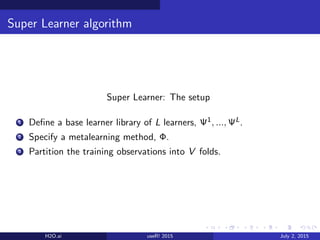
Super Learner: The setup
1 Define a base learner library of L learners, Ψ1, ..., ΨL.
2 Specify a metalearning method, Φ.
3 Partition the training observations into V folds.
H2O.ai useR! 2015 July 2, 2015
Super Learner algorithm
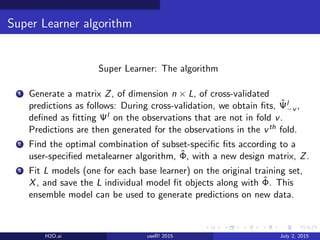
Super Learner: The algorithm
1 Generate a matrix Z, of dimension n × L, of cross-validated
predictions as follows: During cross-validation, we obtain fits, ˆΨl
−v ,
defined as fitting Ψl on the observations that are not in fold v.
Predictions are then generated for the observations in the vth fold.
2 Find the optimal combination of subset-specific fits according to a
user-specified metalearner algorithm, ˆΦ, with a new design matrix, Z.
3 Fit L models (one for each base learner) on the original training set,
X, and save the L individual model fit objects along with ˆΦ. This
ensemble model can be used to generate predictions on new data.
H2O.ai useR! 2015 July 2, 2015
Super Learning for Big Data
Practical solutions to this problem:
1 Develop alternative formulations of Super Learner that learn on
subsets of data to overcome memory limitations.
2 Use candidate learners that can learn iteratively and thus do not
require loading the entire training set into memory at once. (i.e.,
online learning)
3 Make use of distributed algorithms.
4 Rather than native R or Python, use a more “scalable” language
(C++, Java, Scala, Fortran, Julia).
H2O.ai useR! 2015 July 2, 2015
H2O Machine Learning platform
H2O is an open source, distributed, Java machine learning library.
APIs available in:
R, Python, Java, Scala and REST/JSON
H2O.ai useR! 2015 July 2, 2015
H2O Machine Learning platform
Distributed Supervised ML Algorithms available in H2O
Generalized Linear Model with Elastic Net regularization
Gradient Boosting Machines (w/ trees)
Random Forest
Deep Learning: Multi-Layer Feed-Forward Neural Networks
H2O.ai useR! 2015 July 2, 2015
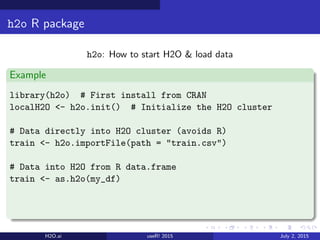
h2o R package
h2o: How to start H2O & load data
Example
library(h2o) # First install from CRAN
localH2O <- h2o.init() # Initialize the H2O cluster
# Data directly into H2O cluster (avoids R)
train <- h2o.importFile(path = "train.csv")
# Data into H2O from R data.frame
train <- as.h2o(my_df)
H2O.ai useR! 2015 July 2, 2015
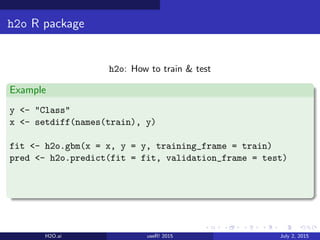
h2o R package
h2o: How to train & test
Example
y <- "Class"
x <- setdiff(names(train), y)
fit <- h2o.gbm(x = x, y = y, training_frame = train)
pred <- h2o.predict(fit = fit, validation_frame = test)
H2O.ai useR! 2015 July 2, 2015
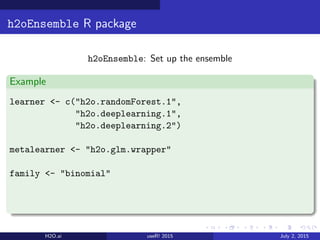
h2oEnsemble R package
h2oEnsemble: Set up the ensemble
Example
learner <- c("h2o.randomForest.1",
"h2o.deeplearning.1",
"h2o.deeplearning.2")
metalearner <- "h2o.glm.wrapper"
family <- "binomial"
H2O.ai useR! 2015 July 2, 2015
h2oEnsemble R package
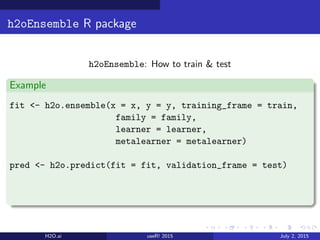
h2oEnsemble: How to train & test
Example
fit <- h2o.ensemble(x = x, y = y, training_frame = train,
family = family,
learner = learner,
metalearner = metalearner)
pred <- h2o.predict(fit = fit, validation_frame = test)
H2O.ai useR! 2015 July 2, 2015
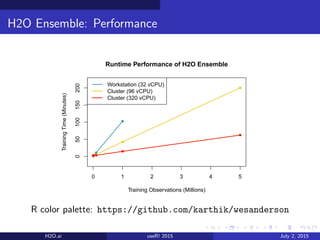
H2O Ensemble: Performance
qq
q
q
0 1 2 3 4 5
050100150200
Runtime Performance of H2O Ensemble
Training Observations (Millions)
TrainingTime(Minutes)
qq
q
q
qqq
q
q
qqq
q
q
Workstation (32 vCPU)
Cluster (96 vCPU)
Cluster (320 vCPU)
R color palette: https://github.com/karthik/wesanderson
H2O.ai useR! 2015 July 2, 2015
Questions
Thank you!
@ledell on Twitter, GitHub
http://www.stat.berkeley.edu/∼ledell
More info at http://h2o.ai
Email: erin@h2o.ai
H2O.ai useR! 2015 July 2, 2015

h2oensemble with Erin Ledell at useR! Aalborg

  • 1.
    h2oEnsemble: Scalable EnsembleLearning in R Erin LeDell H2O.ai Mountain View, California USA July 2, 2015 H2O.ai useR! 2015 July 2, 2015
  • 2.
  • 3.
    Overview Ensemble Learning Model Stacking(aka. Super Learning) H2O Machine Learning via h2o R package h2oEnsemble R package H2O.ai useR! 2015 July 2, 2015
  • 4.
    Ensemble Learning Ensemble ofweak learners (e.g. Random Forest) Generalized Model Stacking (combine the predictions from multiple models) In statistics and machine learning, ensemble methods use multiple models to obtain better predictive performance than could be obtained from any of the constituent models. – Wikipedia, 2015 H2O.ai useR! 2015 July 2, 2015
  • 5.
    Super Learner algorithm TheSuper Learner algorithm is a loss-based supervised learning method that finds the optimal combination of a collection of prediction algorithms. Super Learner performs asymptotically as well as best possible weighted combination of the base learners. H2O.ai useR! 2015 July 2, 2015
  • 6.
    K-fold Cross-validation Example: 5-foldcross validation H2O.ai useR! 2015 July 2, 2015
  • 7.
    Super Learner algorithm SuperLearner: The setup 1 Define a base learner library of L learners, Ψ1, ..., ΨL. 2 Specify a metalearning method, Φ. 3 Partition the training observations into V folds. H2O.ai useR! 2015 July 2, 2015
  • 8.
    Super Learner algorithm SuperLearner: The algorithm 1 Generate a matrix Z, of dimension n × L, of cross-validated predictions as follows: During cross-validation, we obtain fits, ˆΨl −v , defined as fitting Ψl on the observations that are not in fold v. Predictions are then generated for the observations in the vth fold. 2 Find the optimal combination of subset-specific fits according to a user-specified metalearner algorithm, ˆΦ, with a new design matrix, Z. 3 Fit L models (one for each base learner) on the original training set, X, and save the L individual model fit objects along with ˆΦ. This ensemble model can be used to generate predictions on new data. H2O.ai useR! 2015 July 2, 2015
  • 9.
    Super Learning forBig Data Practical solutions to this problem: 1 Develop alternative formulations of Super Learner that learn on subsets of data to overcome memory limitations. 2 Use candidate learners that can learn iteratively and thus do not require loading the entire training set into memory at once. (i.e., online learning) 3 Make use of distributed algorithms. 4 Rather than native R or Python, use a more “scalable” language (C++, Java, Scala, Fortran, Julia). H2O.ai useR! 2015 July 2, 2015
  • 10.
    H2O Machine Learningplatform H2O is an open source, distributed, Java machine learning library. APIs available in: R, Python, Java, Scala and REST/JSON H2O.ai useR! 2015 July 2, 2015
  • 11.
    H2O Machine Learningplatform Distributed Supervised ML Algorithms available in H2O Generalized Linear Model with Elastic Net regularization Gradient Boosting Machines (w/ trees) Random Forest Deep Learning: Multi-Layer Feed-Forward Neural Networks H2O.ai useR! 2015 July 2, 2015
  • 12.
    h2o R package h2o:How to start H2O & load data Example library(h2o) # First install from CRAN localH2O <- h2o.init() # Initialize the H2O cluster # Data directly into H2O cluster (avoids R) train <- h2o.importFile(path = "train.csv") # Data into H2O from R data.frame train <- as.h2o(my_df) H2O.ai useR! 2015 July 2, 2015
  • 13.
    h2o R package h2o:How to train & test Example y <- "Class" x <- setdiff(names(train), y) fit <- h2o.gbm(x = x, y = y, training_frame = train) pred <- h2o.predict(fit = fit, validation_frame = test) H2O.ai useR! 2015 July 2, 2015
  • 14.
    h2oEnsemble R package h2oEnsemble:Set up the ensemble Example learner <- c("h2o.randomForest.1", "h2o.deeplearning.1", "h2o.deeplearning.2") metalearner <- "h2o.glm.wrapper" family <- "binomial" H2O.ai useR! 2015 July 2, 2015
  • 15.
    h2oEnsemble R package h2oEnsemble:How to train & test Example fit <- h2o.ensemble(x = x, y = y, training_frame = train, family = family, learner = learner, metalearner = metalearner) pred <- h2o.predict(fit = fit, validation_frame = test) H2O.ai useR! 2015 July 2, 2015
  • 16.
    H2O Ensemble: Performance qq q q 01 2 3 4 5 050100150200 Runtime Performance of H2O Ensemble Training Observations (Millions) TrainingTime(Minutes) qq q q qqq q q qqq q q Workstation (32 vCPU) Cluster (96 vCPU) Cluster (320 vCPU) R color palette: https://github.com/karthik/wesanderson H2O.ai useR! 2015 July 2, 2015
  • 17.
    Questions Thank you! @ledell onTwitter, GitHub http://www.stat.berkeley.edu/∼ledell More info at http://h2o.ai Email: erin@h2o.ai H2O.ai useR! 2015 July 2, 2015