Webinar: Machine Learning with Spark
Everything you want to know about Machine Learning
but could not find the place and time to ask
Highlights
 Detecting the low hanging fruit for machine learning
 Balancing business and science on your team
 Choosing the best Machine Learning tools, be it small or Big
Data, R, Python or Spark. (And these are not mutually
exclusive).
Copyright © 2016 Elephant Scale. All rights reserved. 2
What does a data scientist need to know
 Familiarity with either Java / Scala / Python language
– Need to be comfortable programming - there are many labs
– Our platform is Spark, basic familiarity is expected
– Our labs are in Scala, basics of Scala will be helpful
 Basic understanding of Linux development environment
– Command line navigation
– Editing files (e.g. using VI or nano)
 This is a Machine Learning with Spark class
– But, no previous of Machine Learning knowledge is assumed
– Class will be paced based on the pace of majority of the
students.
Copyright © 2016 Elephant Scale. All rights reserved. 3
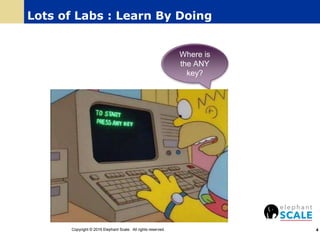
Lots of Labs : Learn By Doing
Copyright © 2016 Elephant Scale. All rights reserved. 4
Where is
the ANY
key?
After The Class…
Copyright © 2016 Elephant Scale. All rights reserved. 5
Machine
Learning
Recommended Books
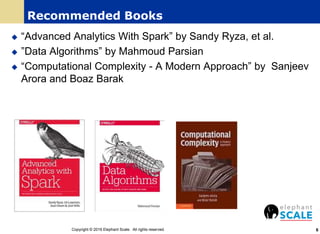
 “Advanced Analytics With Spark” by Sandy Ryza, et al.
 ”Data Algorithms” by Mahmoud Parsian
 “Computational Complexity - A Modern Approach” by Sanjeev
Arora and Boaz Barak
6Copyright © 2016 Elephant Scale. All rights reserved.
Why machine learning?
 Build a model to detect credit card fraud
– thousands of features
– billions of transactions
 Recommend
– millions of products
– to millions of users
 Estimate financial risk
– simulations of portfolios
– With millions of instruments
 Genome data manipulation
– thousands of human genomes
– detect genetic associations with disease
Copyright © 2016 Elephant Scale. All rights reserved.
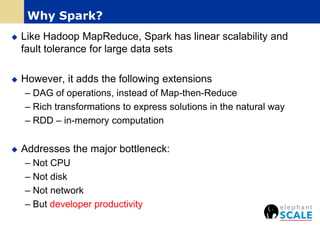
 Like Hadoop MapReduce, Spark has linear scalability and
fault tolerance for large data sets
 However, it adds the following extensions
– DAG of operations, instead of Map-then-Reduce
– Rich transformations to express solutions in the natural way
– RDD – in-memory computation
 Addresses the major bottleneck:
– Not CPU
– Not disk
– Not network
– But developer productivity
Why Spark?
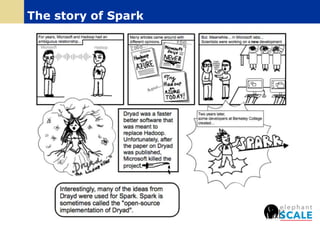
The story of Spark
 It reduces performance overhead
– Be certain the performance adequate
– Scala gives you access to the latest and greatest
– Python and R bindings may come much later
 Scala helps you understand the Spark approach better
– Spark is written in Scala
– Think in Scala, think in Spark
 Just Scala, no other languages needed
– Such as R with SQL
Copyright © 2016 Elephant Scale. All rights reserved.
Why Scala?
 Python
– Popular, well-known
– Many packages
– Graphing
 R
– Very popular, well-known
– Very many packages
– Graphing
Why NOT Scala?
About Machine Learning
 What is Machine Learning?
 It is an algorithm that “learns” from data
– Any algorithm which improves its performance by access to data.
 Machine Learning borrows from applied statistics
 Also considered a branch of AI (Artificial Intelligence)
12
 Sixties
– Commercial computers & mainframes
– Computers play chess
 Eighties
– Computational complexity theory
– Artificial intelligence (AI) gets a bad rap
 21st century
– Big Data changes it all
A glimpse of history
 Computational complexity is simple:
 P – all problems that can be solved fast
– (in polynomial time, like n^p, but not exponential)
– Example: system of linear equations
 NP – all problems that can be verified fast
– That is, just check if the solution is correct
 But folks, it does not matter!
P = NP?
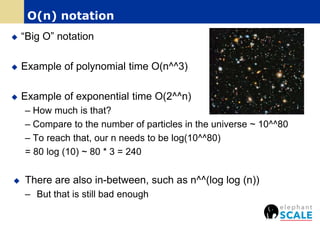
 “Big O” notation
 Example of polynomial time O(n^^3)
 Example of exponential time O(2^^n)
– How much is that?
– Compare to the number of particles in the universe ~ 10^^80
– To reach that, our n needs to be log(10^^80)
= 80 log (10) ~ 80 * 3 = 240
 There are also in-between, such as n^^(log log (n))
– But that is still bad enough
O(n) notation
 Old reasons
– It is too theoretical, talking only about worst case scenario
– There may be new computers, such as quantum computers
 New reason
– Big Data
– Turing machine is inadequate
• Because we hit the size limitations of one computer
• And go into clusters
• And we have other problems than expected
Copyrig
ht ©
2016
Elephant
Scale.
All
rights
reserved
.
Why P and NP do not matter
 Old thinking:
– If you can solve any problem (P = NP), you can be creative
 New thinking:
– You don’t have to solve problems in order to be creative
– Instead, you can pick up the answer from the internet 
– Examples:
• Google translate
• IBM Dr. Watson (Jeopardy winner)
• Lesson: re-use world’s data
 New thinking:
– Rely on the abundance of data
– Find an approximate solution that is good enough
– “Bad algorithms trained on lots of data can outperform good ones
trained on very little” - Deeplearningfor4
How Big Data changed it all
 Turing machine might be too theoretical
 But developers often tend to “just code”
“Думать не за свое дело браться”
(Жаргон лабухов)
“To think is wrong business to undertake”
Russian slang
Copyright © 2016 Elephant Scale. All rights reserved.
The other extreme - no thinking at all
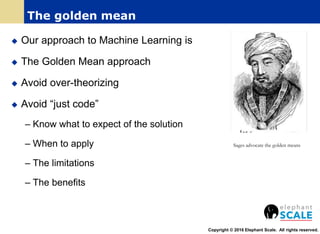
 Our approach to Machine Learning is
 The Golden Mean approach
 Avoid over-theorizing
 Avoid “just code”
– Know what to expect of the solution
– When to apply
– The limitations
– The benefits
Copyright © 2016 Elephant Scale. All rights reserved.
The golden mean
Sages advocate the golden means
Types of Machine Learning
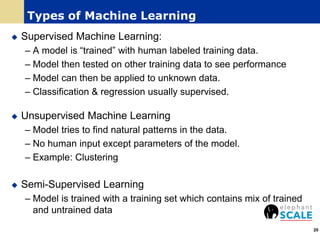
 Supervised Machine Learning:
– A model is “trained” with human labeled training data.
– Model then tested on other training data to see performance
– Model can then be applied to unknown data.
– Classification & regression usually supervised.
 Unsupervised Machine Learning
– Model tries to find natural patterns in the data.
– No human input except parameters of the model.
– Example: Clustering
 Semi-Supervised Learning
– Model is trained with a training set which contains mix of trained
and untrained data
20
Supervised Machine Learning
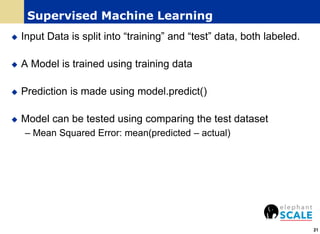
 Input Data is split into “training” and “test” data, both labeled.
 A Model is trained using training data
 Prediction is made using model.predict()
 Model can be tested using comparing the test dataset
– Mean Squared Error: mean(predicted – actual)
21
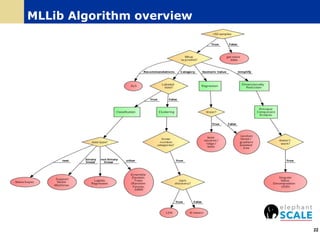
MLLib Algorithm overview
22
Model Validation
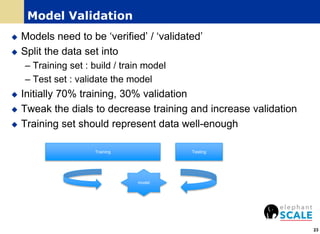
 Models need to be ‘verified’ / ‘validated’
 Split the data set into
– Training set : build / train model
– Test set : validate the model
 Initially 70% training, 30% validation
 Tweak the dials to decrease training and increase validation
 Training set should represent data well-enough
Training Testing
model
23
Creating Feature Vectors: Feature Extraction
 Machine Learning only works with vectors. Feature Vectors
are an n-dimensional point in space.
– Select variables from data
– Turn data into numbers (doubles).
– “normalize” (scale down) high magnitude data.
24
Vectors: Dense versus Sparse
 Dense Vectors
– Usually have a nonzero value for each variable
– The “telecom churn” dataset we use in the labs is a dense dataset.
– Use Vectors.dense
 Sparse Vectors
– Most values are zero (or nonexistent)
– Text Data yields sparse vectors
– One-Hot, factor variables lead to sparse vectors
– Use Vectors.sparse
25
Creating Vectors From Text
 How to create vectors from text?
– TF/IDF: Term Frequency Inverse Document Frequency
• This essentially means the frequency of a term divided by its
frequency in the larger group of documents (the “corpus”)
• Each word in the corpus is then a “dimension” – you would have
thousands of dimensions.
– Word2Vec
• Another vectorization algorithm
• Uses neural network
• Borders on deep learning
26
Visualizing Text using WordCloud
State of The Union Speech 2014
27
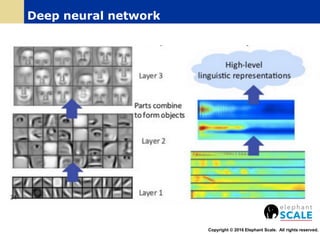
 What is deep learning?
– “A neural network with more than 1 hidden layer”
– Deeplearning4j
 But what is a neural network?
Copyright © 2016 Elephant Scale. All rights reserved.
Deep learning
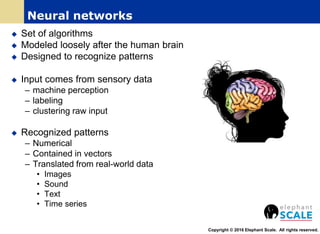
 Set of algorithms
 Modeled loosely after the human brain
 Designed to recognize patterns
 Input comes from sensory data
– machine perception
– labeling
– clustering raw input
 Recognized patterns
– Numerical
– Contained in vectors
– Translated from real-world data
• Images
• Sound
• Text
• Time series
Copyright © 2016 Elephant Scale. All rights reserved.
Neural networks
 Do I have the data?
 Which outputs do I care about?
– Spam – not spam
– Fraud – not fraud
 Do I have labeled data from which to learn? (Supervised
learning)
 Nah, I just need to group things (Unsupervised learning)
– Normal – anomaly
– Group documents
Copyright © 2016 Elephant Scale. All rights reserved.
Basic steps in a neural network
Copyright © 2016 Elephant Scale. All rights reserved.
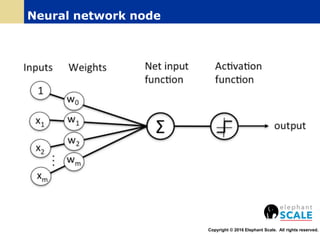
Neural network node
Copyright © 2016 Elephant Scale. All rights reserved.
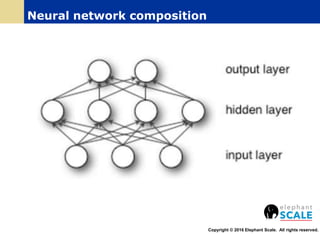
Neural network composition
Copyright © 2016 Elephant Scale. All rights reserved.
Deep neural network
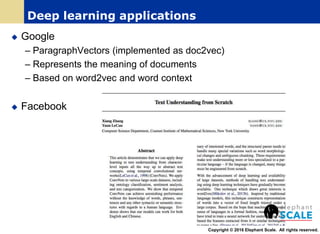
 Google
– ParagraphVectors (implemented as doc2vec)
– Represents the meaning of documents
– Based on word2vec and word context
 Facebook
Copyright © 2016 Elephant Scale. All rights reserved.
Deep learning applications
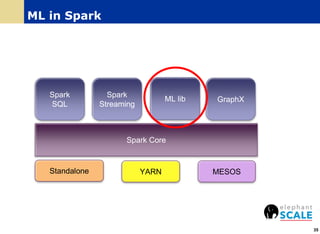
ML in Spark
Spark Core
Spark
SQL
Spark
Streaming
ML lib
Standalone YARN MESOS
GraphX
35
Linear algorithms
Linear algorithms
SVM
Logistic regression
Linear regression
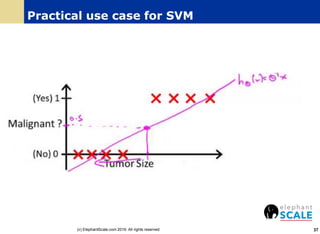
Practical use case for SVM
37(c) ElephantScale.com 2016. All rights reserved
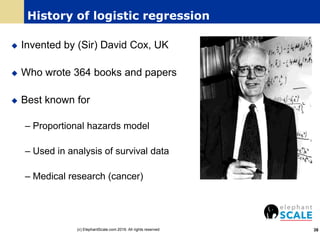
History of logistic regression
 Invented by (Sir) David Cox, UK
 Who wrote 364 books and papers
 Best known for
– Proportional hazards model
– Used in analysis of survival data
– Medical research (cancer)
38(c) ElephantScale.com 2016. All rights reserved
Classification algorithms
Naïve Bayes
Decision Trees
K-Means
Where Naïve Bayes fits in
 There are many classification algorithms in the world
 Naïve Bayes Classifier (NBC) is one of the simplest but most
effective
 K-means and K-nearest neighbors are for numeric data
 But for
– Names
– Symbols
– Emails
– Texts
 NBC may be the best for that
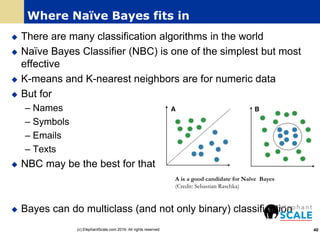
 Bayes can do multiclass (and not only binary) classification
40(c) ElephantScale.com 2016. All rights reserved
A is a good candidate for Naïve Bayes
(Credit: Sebastian Raschka)
History of Bayes
 Discovered by the Reverend Thomas Bayes (1701–1761)
 Edited and read at the Royal Society by Richard Price (1763)
 Independently reproduced and extended by Laplace (1774)
 Naïve Bayes classifiers studied in 1950’s
41(c) ElephantScale.com 2016. All rights reserved
Clustering use case
 Anomaly detection
– Find fraud
– Detect network intrusion attack
– Discover problems on servers
– Or on any machinery with sensors
 Clustering does not necessarily detects fraud
– But it points to unusual data
– And the need for further investigation
42(c) ElephantScale.com 2016. All rights reserved
Network intrusion
 Known unknowns
– Port scanning
– Number of ports accessed per second
– Number of bytes sent/received
 But what about unknown unknowns?
– Biggest thread
– New and as yet unclassified attacks
– Connections that are not knows as attacks
– But are out of the ordinary
– Anomalies that are outside clusters
43(c) ElephantScale.com 2016. All rights reserved
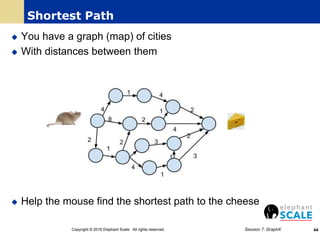
Shortest Path
 You have a graph (map) of cities
 With distances between them
 Help the mouse find the shortest path to the cheese
Copyright © 2016 Elephant Scale. All rights reserved. 44Session 7: GraphX
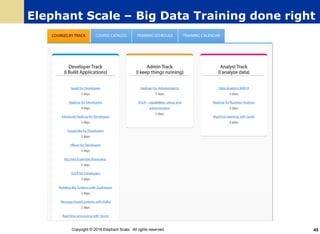
Elephant Scale – Big Data Training done right
45Copyright © 2016 Elephant Scale. All rights reserved.

Machine Learning with Spark

  • 1.
    Webinar: Machine Learningwith Spark Everything you want to know about Machine Learning but could not find the place and time to ask
  • 2.
    Highlights  Detecting thelow hanging fruit for machine learning  Balancing business and science on your team  Choosing the best Machine Learning tools, be it small or Big Data, R, Python or Spark. (And these are not mutually exclusive). Copyright © 2016 Elephant Scale. All rights reserved. 2
  • 3.
    What does adata scientist need to know  Familiarity with either Java / Scala / Python language – Need to be comfortable programming - there are many labs – Our platform is Spark, basic familiarity is expected – Our labs are in Scala, basics of Scala will be helpful  Basic understanding of Linux development environment – Command line navigation – Editing files (e.g. using VI or nano)  This is a Machine Learning with Spark class – But, no previous of Machine Learning knowledge is assumed – Class will be paced based on the pace of majority of the students. Copyright © 2016 Elephant Scale. All rights reserved. 3
  • 4.
    Lots of Labs: Learn By Doing Copyright © 2016 Elephant Scale. All rights reserved. 4 Where is the ANY key?
  • 5.
    After The Class… Copyright© 2016 Elephant Scale. All rights reserved. 5 Machine Learning
  • 6.
    Recommended Books  “AdvancedAnalytics With Spark” by Sandy Ryza, et al.  ”Data Algorithms” by Mahmoud Parsian  “Computational Complexity - A Modern Approach” by Sanjeev Arora and Boaz Barak 6Copyright © 2016 Elephant Scale. All rights reserved.
  • 7.
    Why machine learning? Build a model to detect credit card fraud – thousands of features – billions of transactions  Recommend – millions of products – to millions of users  Estimate financial risk – simulations of portfolios – With millions of instruments  Genome data manipulation – thousands of human genomes – detect genetic associations with disease Copyright © 2016 Elephant Scale. All rights reserved.
  • 8.
     Like HadoopMapReduce, Spark has linear scalability and fault tolerance for large data sets  However, it adds the following extensions – DAG of operations, instead of Map-then-Reduce – Rich transformations to express solutions in the natural way – RDD – in-memory computation  Addresses the major bottleneck: – Not CPU – Not disk – Not network – But developer productivity Why Spark?
  • 9.
  • 10.
     It reducesperformance overhead – Be certain the performance adequate – Scala gives you access to the latest and greatest – Python and R bindings may come much later  Scala helps you understand the Spark approach better – Spark is written in Scala – Think in Scala, think in Spark  Just Scala, no other languages needed – Such as R with SQL Copyright © 2016 Elephant Scale. All rights reserved. Why Scala?
  • 11.
     Python – Popular,well-known – Many packages – Graphing  R – Very popular, well-known – Very many packages – Graphing Why NOT Scala?
  • 12.
    About Machine Learning What is Machine Learning?  It is an algorithm that “learns” from data – Any algorithm which improves its performance by access to data.  Machine Learning borrows from applied statistics  Also considered a branch of AI (Artificial Intelligence) 12
  • 13.
     Sixties – Commercialcomputers & mainframes – Computers play chess  Eighties – Computational complexity theory – Artificial intelligence (AI) gets a bad rap  21st century – Big Data changes it all A glimpse of history
  • 14.
     Computational complexityis simple:  P – all problems that can be solved fast – (in polynomial time, like n^p, but not exponential) – Example: system of linear equations  NP – all problems that can be verified fast – That is, just check if the solution is correct  But folks, it does not matter! P = NP?
  • 15.
     “Big O”notation  Example of polynomial time O(n^^3)  Example of exponential time O(2^^n) – How much is that? – Compare to the number of particles in the universe ~ 10^^80 – To reach that, our n needs to be log(10^^80) = 80 log (10) ~ 80 * 3 = 240  There are also in-between, such as n^^(log log (n)) – But that is still bad enough O(n) notation
  • 16.
     Old reasons –It is too theoretical, talking only about worst case scenario – There may be new computers, such as quantum computers  New reason – Big Data – Turing machine is inadequate • Because we hit the size limitations of one computer • And go into clusters • And we have other problems than expected Copyrig ht © 2016 Elephant Scale. All rights reserved . Why P and NP do not matter
  • 17.
     Old thinking: –If you can solve any problem (P = NP), you can be creative  New thinking: – You don’t have to solve problems in order to be creative – Instead, you can pick up the answer from the internet  – Examples: • Google translate • IBM Dr. Watson (Jeopardy winner) • Lesson: re-use world’s data  New thinking: – Rely on the abundance of data – Find an approximate solution that is good enough – “Bad algorithms trained on lots of data can outperform good ones trained on very little” - Deeplearningfor4 How Big Data changed it all
  • 18.
     Turing machinemight be too theoretical  But developers often tend to “just code” “Думать не за свое дело браться” (Жаргон лабухов) “To think is wrong business to undertake” Russian slang Copyright © 2016 Elephant Scale. All rights reserved. The other extreme - no thinking at all
  • 19.
     Our approachto Machine Learning is  The Golden Mean approach  Avoid over-theorizing  Avoid “just code” – Know what to expect of the solution – When to apply – The limitations – The benefits Copyright © 2016 Elephant Scale. All rights reserved. The golden mean Sages advocate the golden means
  • 20.
    Types of MachineLearning  Supervised Machine Learning: – A model is “trained” with human labeled training data. – Model then tested on other training data to see performance – Model can then be applied to unknown data. – Classification & regression usually supervised.  Unsupervised Machine Learning – Model tries to find natural patterns in the data. – No human input except parameters of the model. – Example: Clustering  Semi-Supervised Learning – Model is trained with a training set which contains mix of trained and untrained data 20
  • 21.
    Supervised Machine Learning Input Data is split into “training” and “test” data, both labeled.  A Model is trained using training data  Prediction is made using model.predict()  Model can be tested using comparing the test dataset – Mean Squared Error: mean(predicted – actual) 21
  • 22.
  • 23.
    Model Validation  Modelsneed to be ‘verified’ / ‘validated’  Split the data set into – Training set : build / train model – Test set : validate the model  Initially 70% training, 30% validation  Tweak the dials to decrease training and increase validation  Training set should represent data well-enough Training Testing model 23
  • 24.
    Creating Feature Vectors:Feature Extraction  Machine Learning only works with vectors. Feature Vectors are an n-dimensional point in space. – Select variables from data – Turn data into numbers (doubles). – “normalize” (scale down) high magnitude data. 24
  • 25.
    Vectors: Dense versusSparse  Dense Vectors – Usually have a nonzero value for each variable – The “telecom churn” dataset we use in the labs is a dense dataset. – Use Vectors.dense  Sparse Vectors – Most values are zero (or nonexistent) – Text Data yields sparse vectors – One-Hot, factor variables lead to sparse vectors – Use Vectors.sparse 25
  • 26.
    Creating Vectors FromText  How to create vectors from text? – TF/IDF: Term Frequency Inverse Document Frequency • This essentially means the frequency of a term divided by its frequency in the larger group of documents (the “corpus”) • Each word in the corpus is then a “dimension” – you would have thousands of dimensions. – Word2Vec • Another vectorization algorithm • Uses neural network • Borders on deep learning 26
  • 27.
    Visualizing Text usingWordCloud State of The Union Speech 2014 27
  • 28.
     What isdeep learning? – “A neural network with more than 1 hidden layer” – Deeplearning4j  But what is a neural network? Copyright © 2016 Elephant Scale. All rights reserved. Deep learning
  • 29.
     Set ofalgorithms  Modeled loosely after the human brain  Designed to recognize patterns  Input comes from sensory data – machine perception – labeling – clustering raw input  Recognized patterns – Numerical – Contained in vectors – Translated from real-world data • Images • Sound • Text • Time series Copyright © 2016 Elephant Scale. All rights reserved. Neural networks
  • 30.
     Do Ihave the data?  Which outputs do I care about? – Spam – not spam – Fraud – not fraud  Do I have labeled data from which to learn? (Supervised learning)  Nah, I just need to group things (Unsupervised learning) – Normal – anomaly – Group documents Copyright © 2016 Elephant Scale. All rights reserved. Basic steps in a neural network
  • 31.
    Copyright © 2016Elephant Scale. All rights reserved. Neural network node
  • 32.
    Copyright © 2016Elephant Scale. All rights reserved. Neural network composition
  • 33.
    Copyright © 2016Elephant Scale. All rights reserved. Deep neural network
  • 34.
     Google – ParagraphVectors(implemented as doc2vec) – Represents the meaning of documents – Based on word2vec and word context  Facebook Copyright © 2016 Elephant Scale. All rights reserved. Deep learning applications
  • 35.
    ML in Spark SparkCore Spark SQL Spark Streaming ML lib Standalone YARN MESOS GraphX 35
  • 36.
  • 37.
    Practical use casefor SVM 37(c) ElephantScale.com 2016. All rights reserved
  • 38.
    History of logisticregression  Invented by (Sir) David Cox, UK  Who wrote 364 books and papers  Best known for – Proportional hazards model – Used in analysis of survival data – Medical research (cancer) 38(c) ElephantScale.com 2016. All rights reserved
  • 39.
  • 40.
    Where Naïve Bayesfits in  There are many classification algorithms in the world  Naïve Bayes Classifier (NBC) is one of the simplest but most effective  K-means and K-nearest neighbors are for numeric data  But for – Names – Symbols – Emails – Texts  NBC may be the best for that  Bayes can do multiclass (and not only binary) classification 40(c) ElephantScale.com 2016. All rights reserved A is a good candidate for Naïve Bayes (Credit: Sebastian Raschka)
  • 41.
    History of Bayes Discovered by the Reverend Thomas Bayes (1701–1761)  Edited and read at the Royal Society by Richard Price (1763)  Independently reproduced and extended by Laplace (1774)  Naïve Bayes classifiers studied in 1950’s 41(c) ElephantScale.com 2016. All rights reserved
  • 42.
    Clustering use case Anomaly detection – Find fraud – Detect network intrusion attack – Discover problems on servers – Or on any machinery with sensors  Clustering does not necessarily detects fraud – But it points to unusual data – And the need for further investigation 42(c) ElephantScale.com 2016. All rights reserved
  • 43.
    Network intrusion  Knownunknowns – Port scanning – Number of ports accessed per second – Number of bytes sent/received  But what about unknown unknowns? – Biggest thread – New and as yet unclassified attacks – Connections that are not knows as attacks – But are out of the ordinary – Anomalies that are outside clusters 43(c) ElephantScale.com 2016. All rights reserved
  • 44.
    Shortest Path  Youhave a graph (map) of cities  With distances between them  Help the mouse find the shortest path to the cheese Copyright © 2016 Elephant Scale. All rights reserved. 44Session 7: GraphX
  • 45.
    Elephant Scale –Big Data Training done right 45Copyright © 2016 Elephant Scale. All rights reserved.

Editor's Notes