DATA STRUCTURE
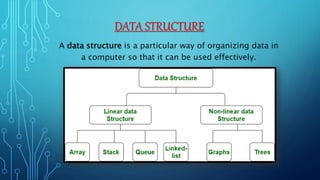
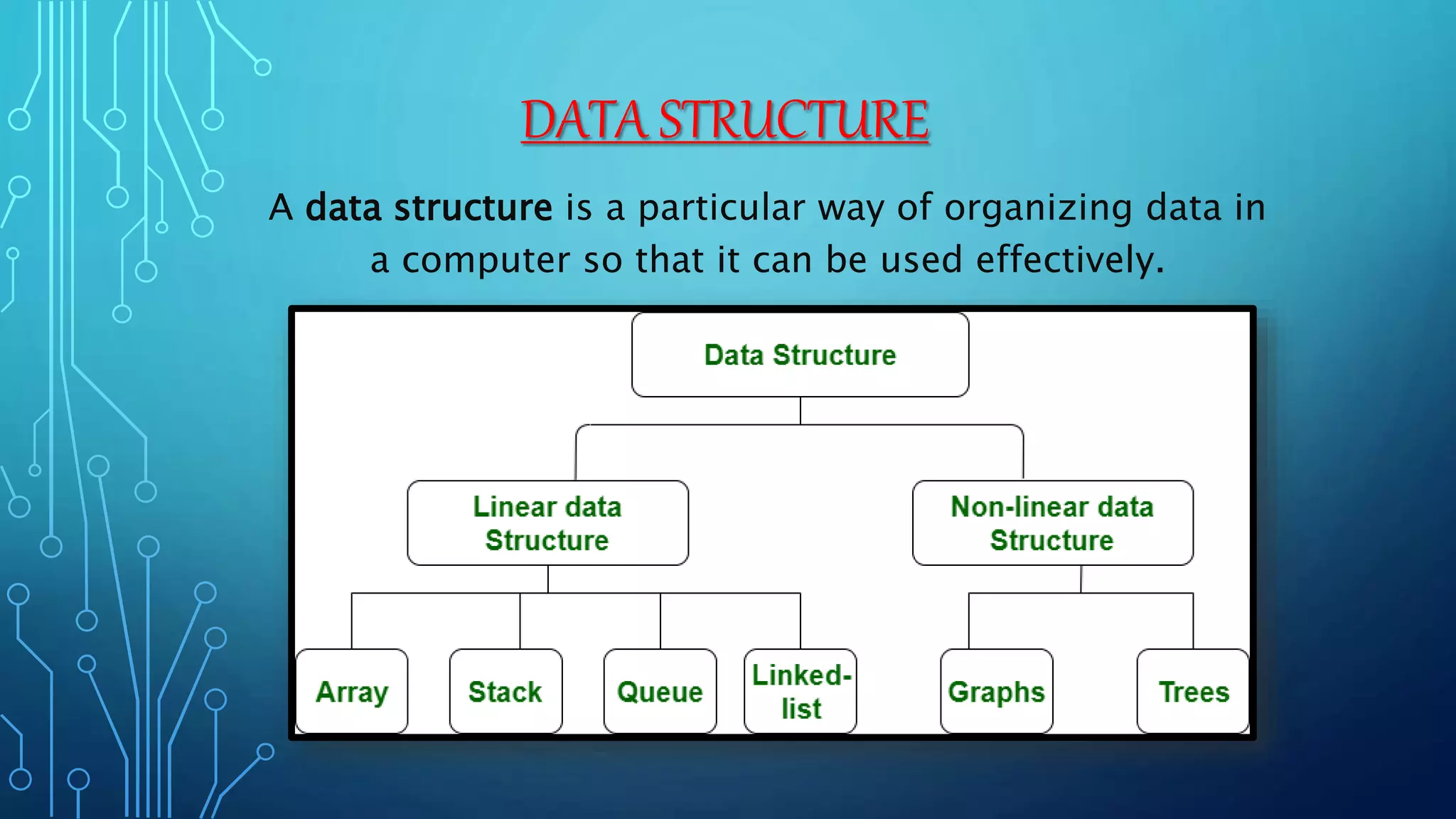
A data structure is a particular way of organizing data in
a computer so that it can be used effectively.
STACK
Stack is a linear data structure which follows a particular order
in which the operations are performed.
It follows the LIFO principle which stands for Last In First Out.
Here, the element which is placed (inserted or added) last, is
accessed first.
It has only one pointer TOP that points the last or top most
element of Stack.
Insertion and Deletion in stack can only be done from top only.
EXAMPLES OF STACK
OPERATIONS OF STACK
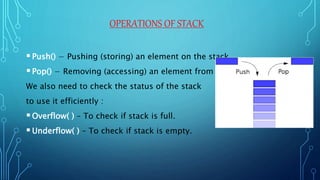
Push() − Pushing (storing) an element on the stack.
Pop() − Removing (accessing) an element from the stack.
We also need to check the status of the stack
to use it efficiently :
Overflow( ) – To check if stack is full.
Underflow( ) – To check if stack is empty.
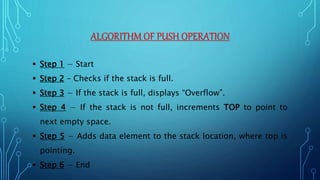
ALGORITHM OF PUSH OPERATION
 Step 1 − Start
 Step 2 – Checks if the stack is full.
 Step 3 − If the stack is full, displays “Overflow”.
 Step 4 − If the stack is not full, increments TOP to point to
next empty space.
 Step 5 − Adds data element to the stack location, where top is
pointing.
 Step 6 − End
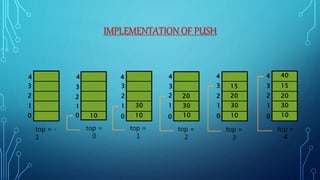
IMPLEMENTATION OF PUSH
10 10
30
10
30
20
10
30
20
15
10
30
20
15
40
0
1
2
3
4 4
3
2
1
0
4
3
2
1
0
4
3
2
1
0 0
1
2
33
4 4
2
1
0
top = -
1
top =
0
top =
1
top =
2
top =
3
top =
4
CODE FOR PUSH OPERATION
void push(int data)
{
if (top == arr.length - 1)
System.out.println("Stack is Full");
else
{
arr[++top] = data;
System.out.println("Pushed data :" + arr[top]);
}
}
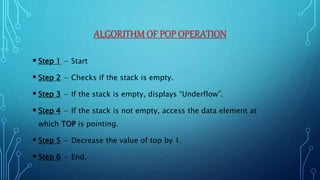
ALGORITHM OF POP OPERATION
 Step 1 − Start
 Step 2 − Checks if the stack is empty.
 Step 3 − If the stack is empty, displays “Underflow”.
 Step 4 − If the stack is not empty, access the data element at
which TOP is pointing.
 Step 5 − Decrease the value of top by 1.
 Step 6 − End.
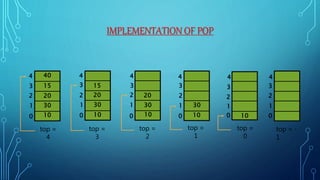
IMPLEMENTATION OF POP
10
30
20
15
40
3
4
2
1
0
top =
4
10
30
20
15
0
1
2
3
4
top =
3
10
30
20
4
3
2
1
0
top =
2
10
30
4
3
2
1
0
top =
1
10
4
3
2
1
0
top =
0
0
1
2
3
4
top = -
1
CODE FOR POP OPERATION
int pop()
{
if (top < 0)
{
System.out.println("Stack Underflow");
return 0;
}
else
{
System.out.println("Popped data : " + arr[top]);
return arr[top--];
}
}
APPLICATIONS OF STACK
Conversion of expressions.
Function calling and return procedure.
Recursion handling.
Decimal to Binary conversion.
TYPES OF ARITHMETIC EXPRESSIONS
Infix Expression : Operator is placed between the operands.
Example : A+B
Prefix Expression : Operator is placed before the operands.
Example : +AB
Postfix Expression : Operator is placed after the operands.
Example : AB+
CONVERSION FROM INFIX TO POSTFIX
1. A + (B * C) – (D / E)
= A + B C * - D E /
= A B C * + - D E /
= A B C * + D E / -
2. (A / B + C) * (D / (E - F))
= (A B / + C ) * (D / E F –)
= (A B / C +) * D E F – /
= A B / C + D E F – / *
3. (M – N )/ (P* ( S – T) + K)
= (M N – ) / (P* (S T – ) + K)
= ( M N –) / ((P S T – *) + K)
= ( M N –) / (P S T – * K +)
= M N – P S T – * K + /
CONVERSION FROM INFIX TO PREFIX
1. A + (B * C) – (D / E)
= A + * B C - / D E
= + A * B C - / D E
= - + A * B C / D E
2. (A / B + C) * (D / (E - F))
= (/ A B + C) * (D / - E F)
= (+ / A B C) * ( / D – E F)
= * + / A B C / D – E F
3. (M – N )/ (P* ( S – T) + K)
= ( - M N ) / (P * ( - S T ) + K)
= (- M N ) / ( (* P – S T) + K)
= (- M N ) / (+ * P – S T K)
= / - M N + * P – S T K

Stack Data Structure

  • 1.
    DATA STRUCTURE A datastructure is a particular way of organizing data in a computer so that it can be used effectively.
  • 2.
    STACK Stack is alinear data structure which follows a particular order in which the operations are performed. It follows the LIFO principle which stands for Last In First Out. Here, the element which is placed (inserted or added) last, is accessed first. It has only one pointer TOP that points the last or top most element of Stack. Insertion and Deletion in stack can only be done from top only.
  • 3.
  • 4.
    OPERATIONS OF STACK Push()− Pushing (storing) an element on the stack. Pop() − Removing (accessing) an element from the stack. We also need to check the status of the stack to use it efficiently : Overflow( ) – To check if stack is full. Underflow( ) – To check if stack is empty.
  • 5.
    ALGORITHM OF PUSHOPERATION  Step 1 − Start  Step 2 – Checks if the stack is full.  Step 3 − If the stack is full, displays “Overflow”.  Step 4 − If the stack is not full, increments TOP to point to next empty space.  Step 5 − Adds data element to the stack location, where top is pointing.  Step 6 − End
  • 6.
    IMPLEMENTATION OF PUSH 1010 30 10 30 20 10 30 20 15 10 30 20 15 40 0 1 2 3 4 4 3 2 1 0 4 3 2 1 0 4 3 2 1 0 0 1 2 33 4 4 2 1 0 top = - 1 top = 0 top = 1 top = 2 top = 3 top = 4
  • 7.
    CODE FOR PUSHOPERATION void push(int data) { if (top == arr.length - 1) System.out.println("Stack is Full"); else { arr[++top] = data; System.out.println("Pushed data :" + arr[top]); } }
  • 8.
    ALGORITHM OF POPOPERATION  Step 1 − Start  Step 2 − Checks if the stack is empty.  Step 3 − If the stack is empty, displays “Underflow”.  Step 4 − If the stack is not empty, access the data element at which TOP is pointing.  Step 5 − Decrease the value of top by 1.  Step 6 − End.
  • 9.
    IMPLEMENTATION OF POP 10 30 20 15 40 3 4 2 1 0 top= 4 10 30 20 15 0 1 2 3 4 top = 3 10 30 20 4 3 2 1 0 top = 2 10 30 4 3 2 1 0 top = 1 10 4 3 2 1 0 top = 0 0 1 2 3 4 top = - 1
  • 10.
    CODE FOR POPOPERATION int pop() { if (top < 0) { System.out.println("Stack Underflow"); return 0; } else { System.out.println("Popped data : " + arr[top]); return arr[top--]; } }
  • 11.
    APPLICATIONS OF STACK Conversionof expressions. Function calling and return procedure. Recursion handling. Decimal to Binary conversion.
  • 12.
    TYPES OF ARITHMETICEXPRESSIONS Infix Expression : Operator is placed between the operands. Example : A+B Prefix Expression : Operator is placed before the operands. Example : +AB Postfix Expression : Operator is placed after the operands. Example : AB+
  • 13.
    CONVERSION FROM INFIXTO POSTFIX 1. A + (B * C) – (D / E) = A + B C * - D E / = A B C * + - D E / = A B C * + D E / -
  • 14.
    2. (A /B + C) * (D / (E - F)) = (A B / + C ) * (D / E F –) = (A B / C +) * D E F – / = A B / C + D E F – / * 3. (M – N )/ (P* ( S – T) + K) = (M N – ) / (P* (S T – ) + K) = ( M N –) / ((P S T – *) + K) = ( M N –) / (P S T – * K +) = M N – P S T – * K + /
  • 15.
    CONVERSION FROM INFIXTO PREFIX 1. A + (B * C) – (D / E) = A + * B C - / D E = + A * B C - / D E = - + A * B C / D E
  • 16.
    2. (A /B + C) * (D / (E - F)) = (/ A B + C) * (D / - E F) = (+ / A B C) * ( / D – E F) = * + / A B C / D – E F 3. (M – N )/ (P* ( S – T) + K) = ( - M N ) / (P * ( - S T ) + K) = (- M N ) / ( (* P – S T) + K) = (- M N ) / (+ * P – S T K) = / - M N + * P – S T K