Unit III
3
UNIT III: Stack and Queue
Stack: Concept, Basic Stack operations, Array representation of stack, Stack
as ADT, Stack
Applications: Reversing data, Arithmetic expressions conversion and
evaluation.
Queue: Concept, Queue operations, Array representation of queue, Queue
as ADT, Circular queue, Priority Queue,
Applications of queue: Categorizing data, Simulation of queue.
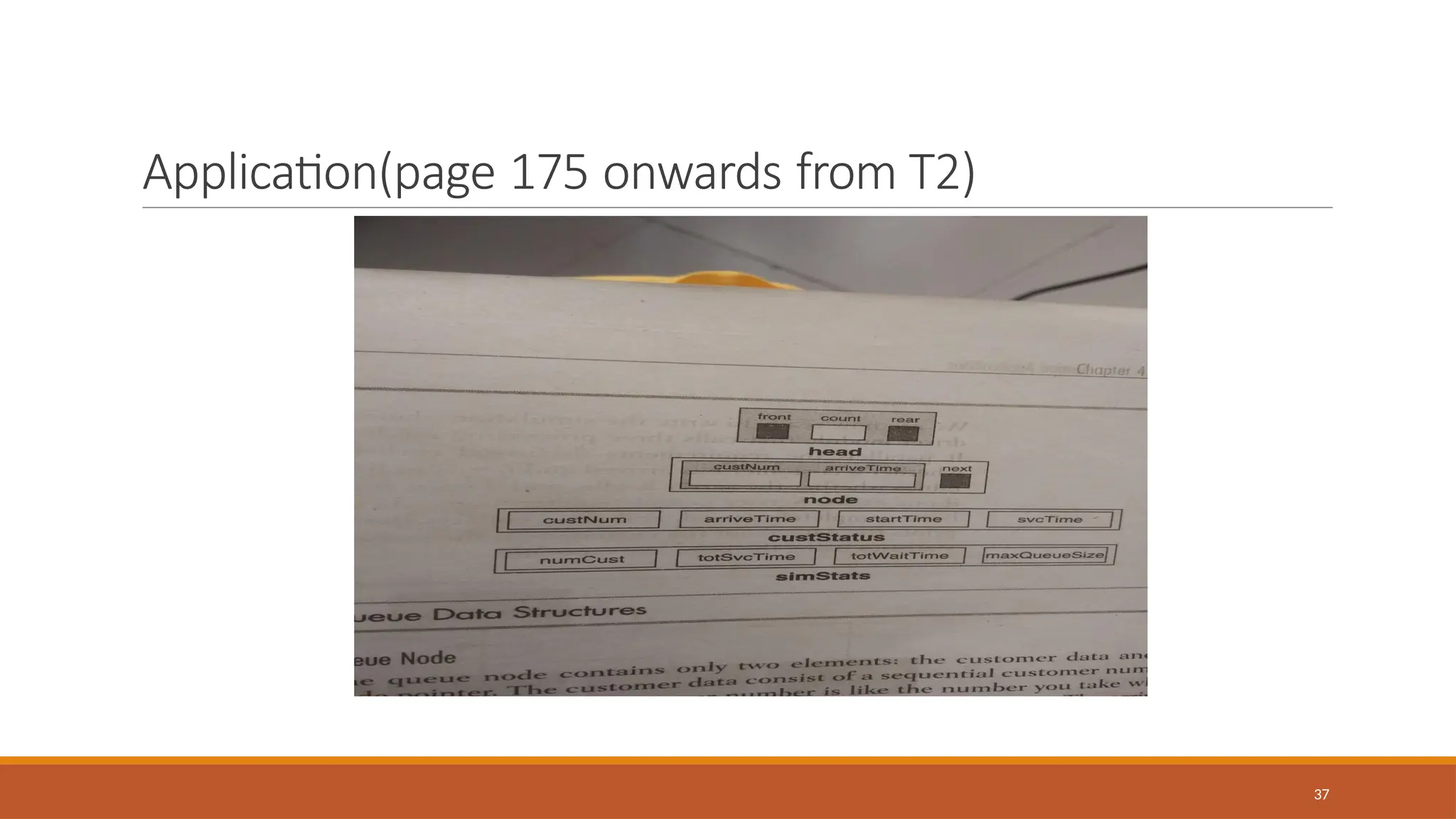
Classification of Data Structures
2
June 23, 2020
Introduction
3
--> An array is a random access data structure, where each element can be
accessed directly and in constant time.
E.g.: A typical illustration of random access is a book - each page of the book
can be open independently of others.
Random access is critical to many algorithms, for example binary search.
-> A linked list is a sequential access data structure, where each element can be
accesed only in particular order.
E.g.: A typical illustration of sequential access is a roll of paper or tape - all prior
material must be unrolled in order to get to data you want.
Stack and Queue
4
Are stacks and queues useful?
• YES. They come up all the time.
 Stacks
• Web browsers store the addresses of recently visited sites on a stack
• Each time the visits a new site ==> pushed on the stack. Browsers allow to “pop” back to
previously visited site.
• The undo-mechanism in an editor
 The changes are kept in a stack. When the user presses “undo” the stack of changes is popped.
• The function-call mechanism
 the active (called but not completed) functions are kept on a stack
 each time a function is called, a new frame describing its context is pushed onto the stack the context of a method: its parameters,
local variables, what needs to be returned, and
where to return (the instruction to be executed upon return)
 when the function returns, its frame is popped, the context is reset to the previous method (now on top of the stack) and the program
continues
by executing the previously suspended method.
Stack and Queue
5
 Queue
•Queue of processes waiting to be processed for e.g. the queue of processes to
be scheduled on the CPU. the process at front is dequeued and processed. New
processes are added at the end of the queue.
•Round-robin scheduling: iterate through a set of processes in a circular manner
and service each element: the process at front is dequeued, allowed to run for
some CPU cycles, and then enqueued at the end of the queue
Stack
6
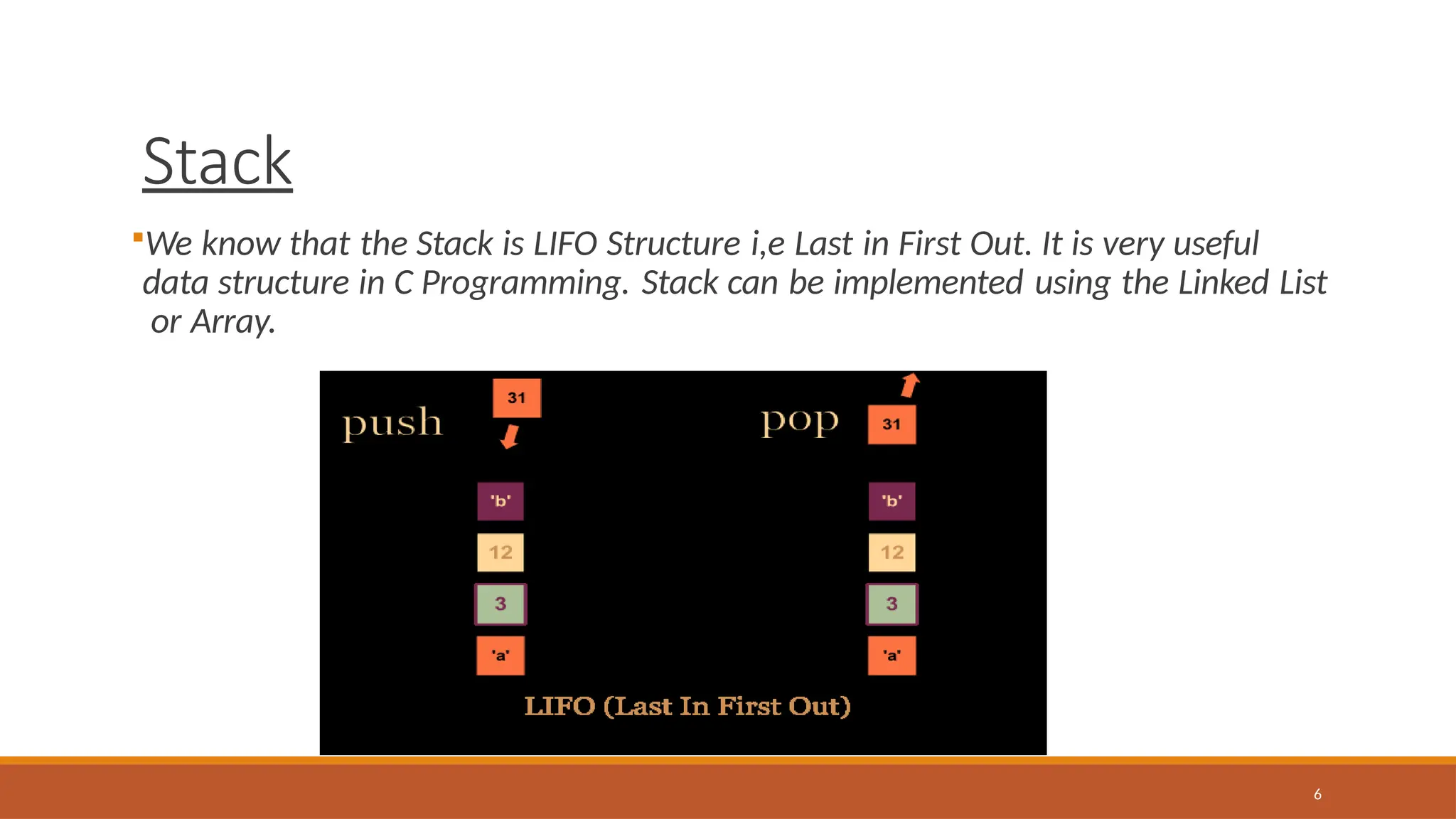
We know that the Stack is LIFO Structure i,e Last in First Out. It is very useful
data structure in C Programming. Stack can be implemented using the Linked List
or Array.
Conditions of Stack
7
1. Stack is LIFO Structure [ Last in First Out ]
2. Stack is Ordered List of Elements of Same Type.
3. Stack is Linear List
4.In Stack all Operations such as Insertion and Deletion are
permitted at only one end called Top
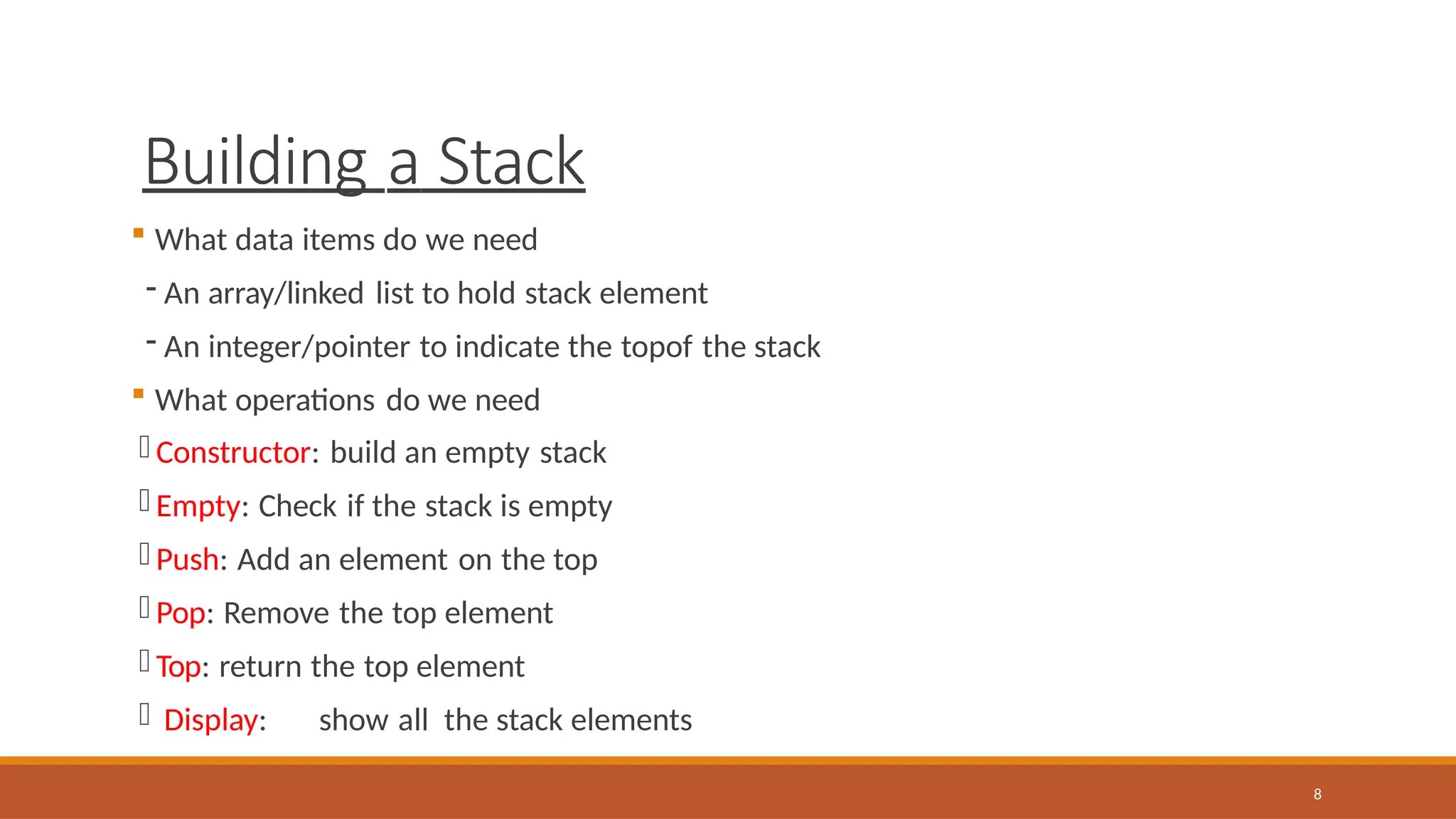
Building a Stack
8
 What data items do we need
- An array/linked list to hold stack element
- An integer/pointer to indicate the topof the stack
 What operations do we need
- Constructor: build an empty stack
- Empty: Check if the stack is empty
- Push: Add an element on the top
- Pop: Remove the top element
- Top: return the top element
- Display: show all the stack elements
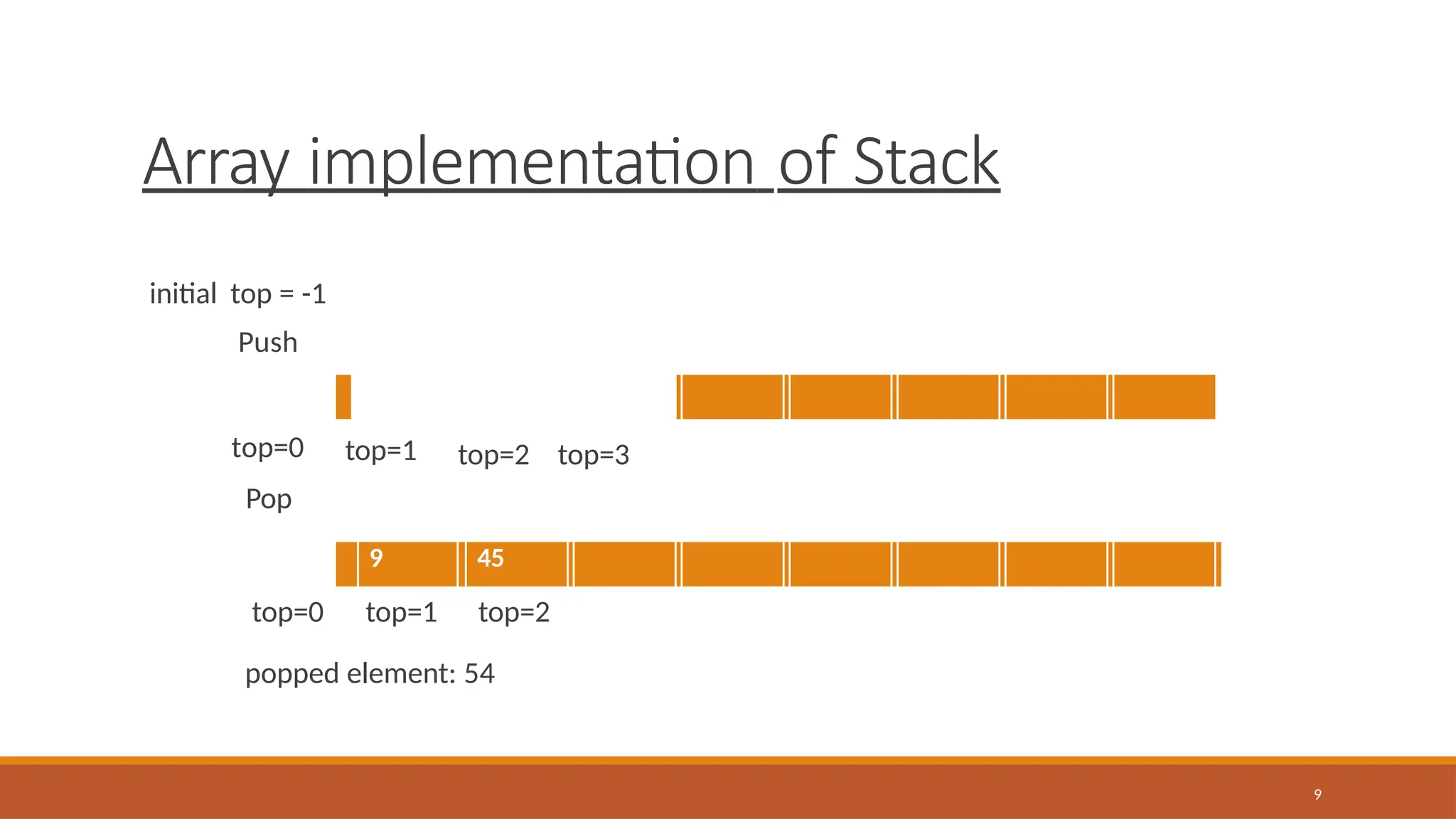
Array implementation of Stack
9
initial top = -1
Push
36 9 45 54
top=0
Pop
top=1 top=2 top=3
36 9 45
top=0 top=1 top=2
popped element: 54
Abstract Data Types (ADTs)
10
 An abstract data type (ADT) is a mathematically specified entity that defines
a
set of its instances.
 An ADT specifies:
 What data is stored
 Interface - Operations on the data
 manipulation
 access
a set of axioms (preconditions and post conditions) that define what
the operations do (not how)
Why ADTs
11
serve as specifications of requirements for the building blocks of an algorithm
encapsulate the data structure and the algorithms that works on the data
structure
 separate issues of correctness and efficiency
Stack ADT
12
 Data Object
 Operations
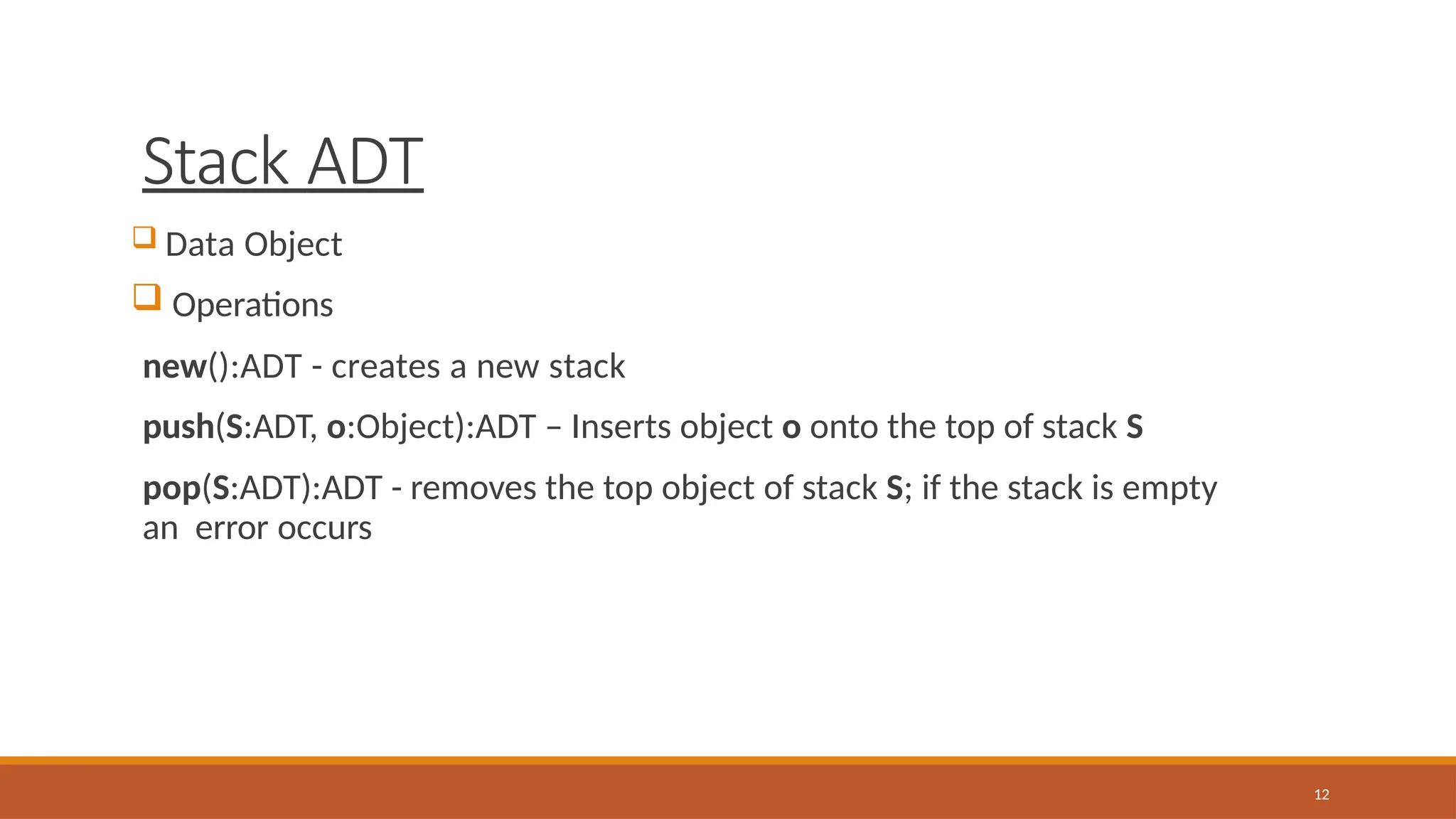
new():ADT - creates a new stack
push(S:ADT, o:Object):ADT – Inserts object o onto the top of stack S
pop(S:ADT):ADT - removes the top object of stack S; if the stack is empty
an error occurs
Stack ADT (Contd)
13
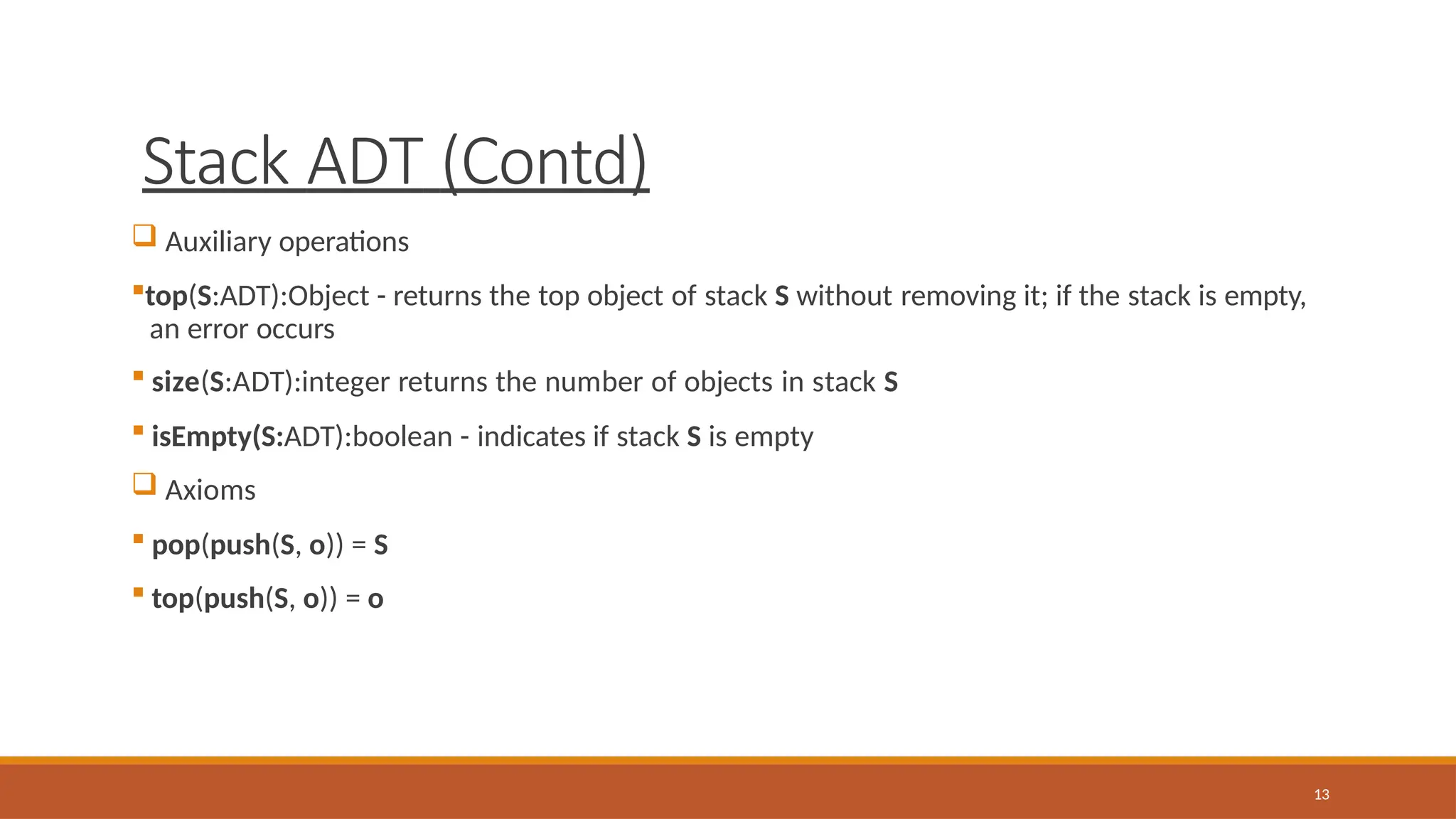
 Auxiliary operations
top(S:ADT):Object - returns the top object of stack S without removing it; if the stack is empty,
an error occurs
 size(S:ADT):integer returns the number of objects in stack S
 isEmpty(S:ADT):boolean - indicates if stack S is empty
 Axioms
 pop(push(S, o)) = S
 top(push(S, o)) = o
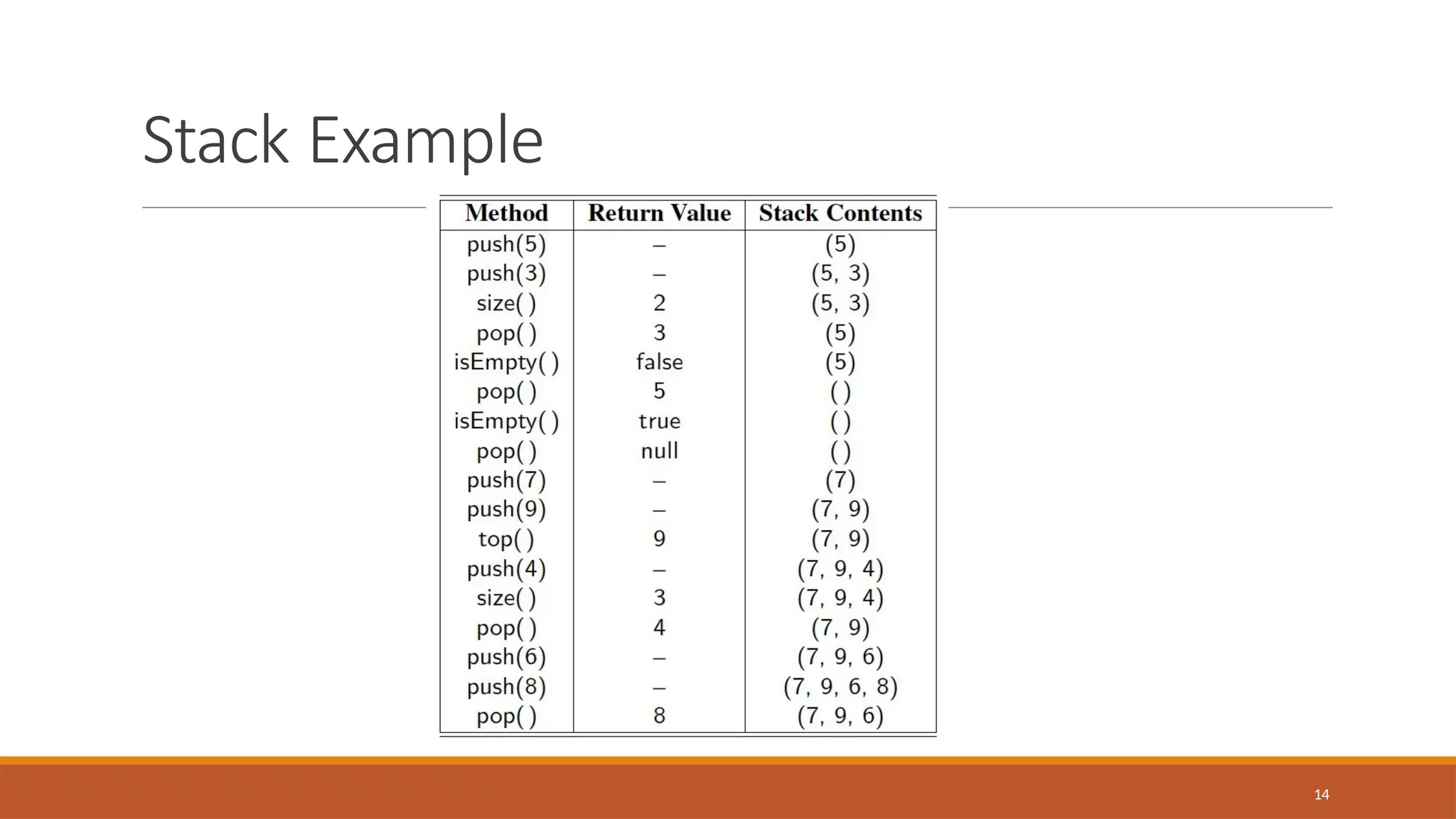
Stack Example
14
Example
15
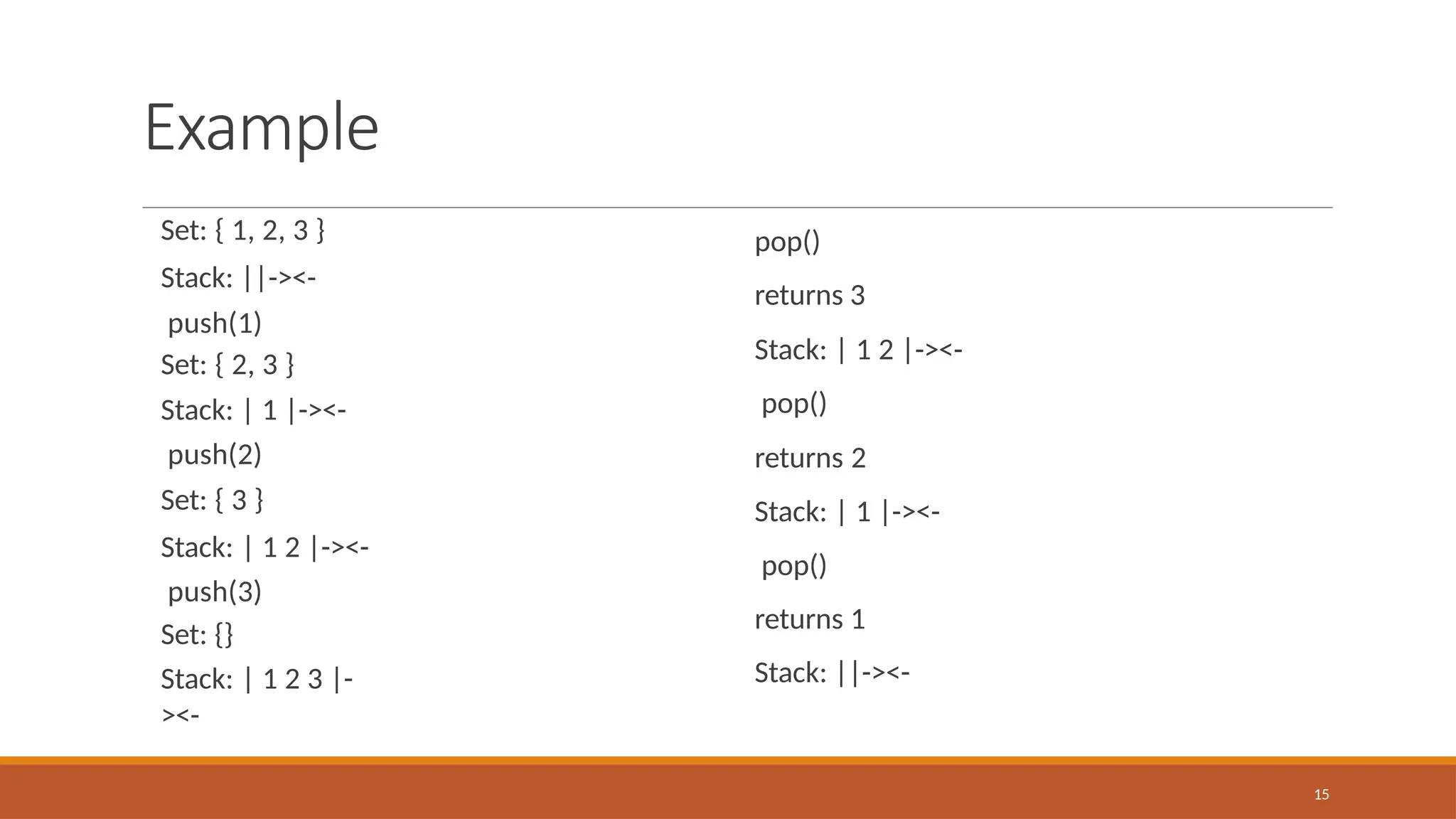
Set: { 1, 2, 3 }
Stack: ||-><-
push(1)
Set: { 2, 3 }
Stack: | 1 |-><-
push(2)
Set: { 3 }
Stack: | 1 2 |-><-
push(3)
Set: {}
Stack: | 1 2 3 |-
><-
pop()
returns 3
Stack: | 1 2 |-><-
pop()
returns 2
Stack: | 1 |-><-
pop()
returns 1
Stack: ||-><-
Stack Applications
16
 The simplest application of a stack is to reverse a word. You push a given word
to stack - letter by letter - and then pop letters from the stack.
Another application is an "undo" mechanism in text editors; this operation is
accomplished by keeping all text changes in a stack.
 Arithmetic expression conversion and evaluation
 Language processing:
◦space for parameters and local variables is created internally using a stack.
◦compiler's syntax check for matching braces is implemented by using stack.
◦ Support for recursion
Infix to Postfix Conversion
17
 We use a stack
 When an operand is read, output it
 When an operator is read
– Pop until the top of the stack has an element of lower precedence
– Then push it
 When ) is found, pop until we find the matching (
 ( has the lowest precedence when in the stack
 but has the highest precedence when in the input
 When we reach the end of input, pop until the stack is empt
Example Infix to Postfix conversion
18
Example
Evaluation of postfix expression
Queue
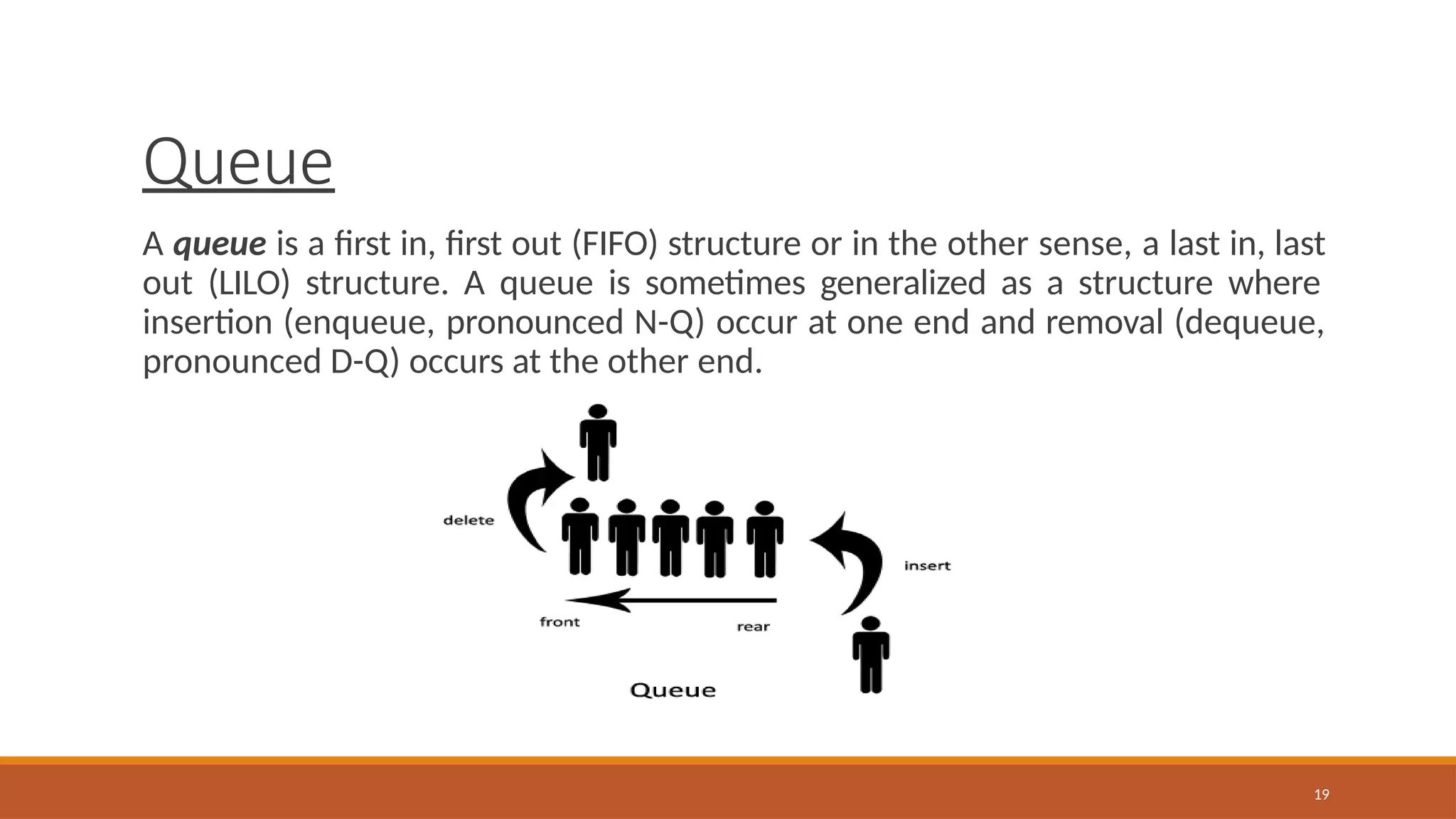
A queue is a first in, first out (FIFO) structure or in the other sense, a last in, last
out (LILO) structure. A queue is sometimes generalized as a structure where
insertion (enqueue, pronounced N-Q) occur at one end and removal (dequeue,
pronounced D-Q) occurs at the other end.
19
Queue
20
The Queue is like the List but with “limited” insertion and deletion.
 Insertion can be done only at the end called as rear end
 Deletion can only be done in the front
 FIFO – first-in-first-out data structure
Main Operations
 enqueue
 dequeue
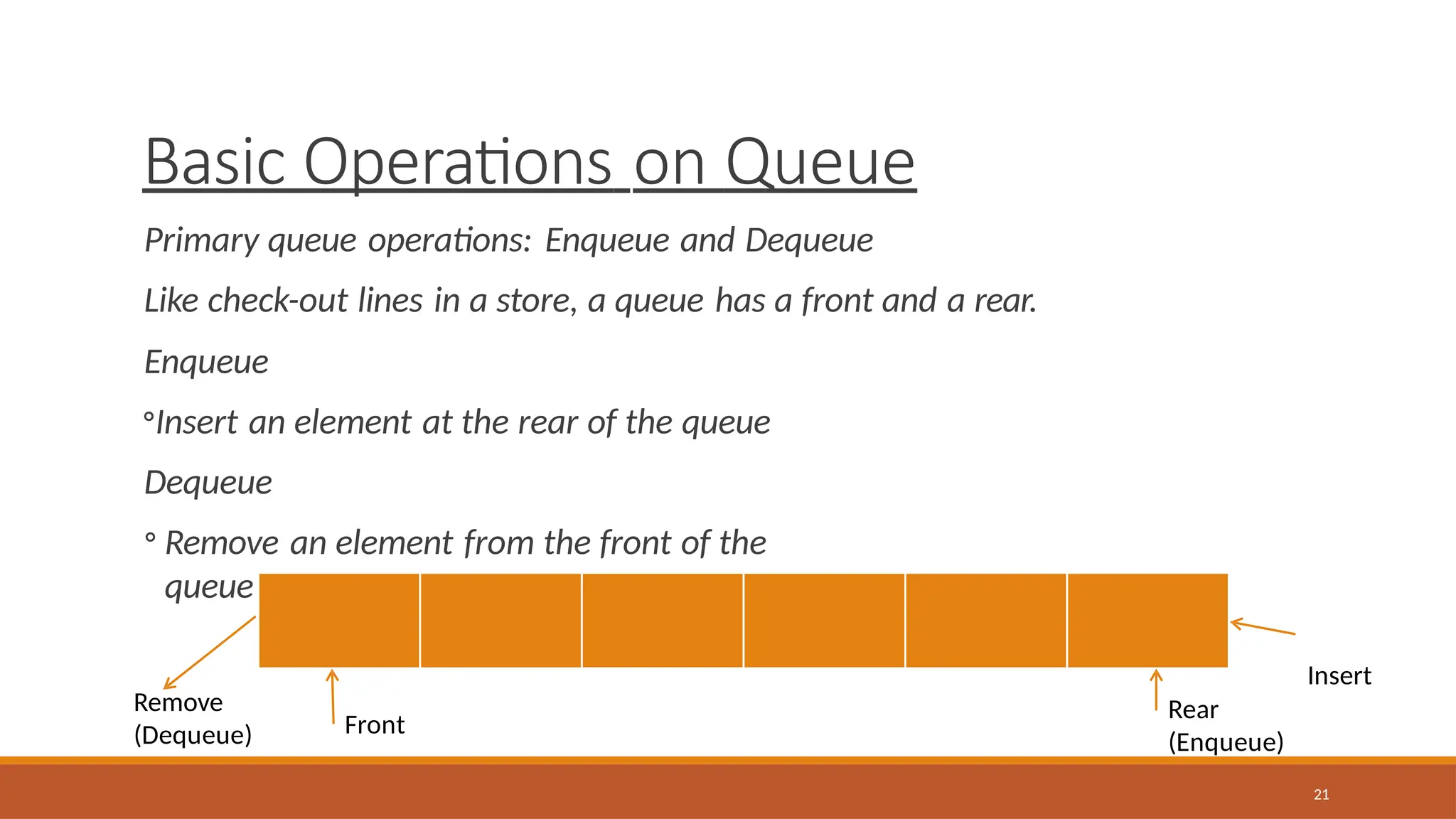
Basic Operations on Queue
Primary queue operations: Enqueue and Dequeue
Like check-out lines in a store, a queue has a front and a rear.
Enqueue
◦Insert an element at the rear of the queue
Dequeue
◦ Remove an element from the front of the
queue
Front
21
Rear
(Enqueue)
Remove
(Dequeue)
Insert
Queue ADT
22
The queue supports the following fundamental methods:
 New():ADT – creates an empty queue
 Enqueue(Q:ADT, o:element):ADT – inserts the object o at the rear of the
queue
Dequeue(Q:ADT):element – removes the object from the front of the queue;
an error occurs if the queue is empty
First(Q:ADT):element – returns, but does not remove the object at the front of
the queue; an error occurs if the queue is empty.
Queue ADT (contd)
23
 Auxiliary methods
 Size(Q:QDT):integer – returns the number of elements in the queue
 isEmpty(Q:ADT):boolean – indicates whether the queue is empty
 Axioms
 Front(Enqueue(New(), v)) = v
 Dequeue(Enqueue(New(), v)) = New()
 Front(Enqueue(Enqueue(Q,w),v)) = Front(Enqueue(Q,w))
 Dequeue(Enqueue(Enqueue(Q,w), v)) =
Enqueue(Dequeue(Enqueue(Q,w),v)
Example of Queue
24
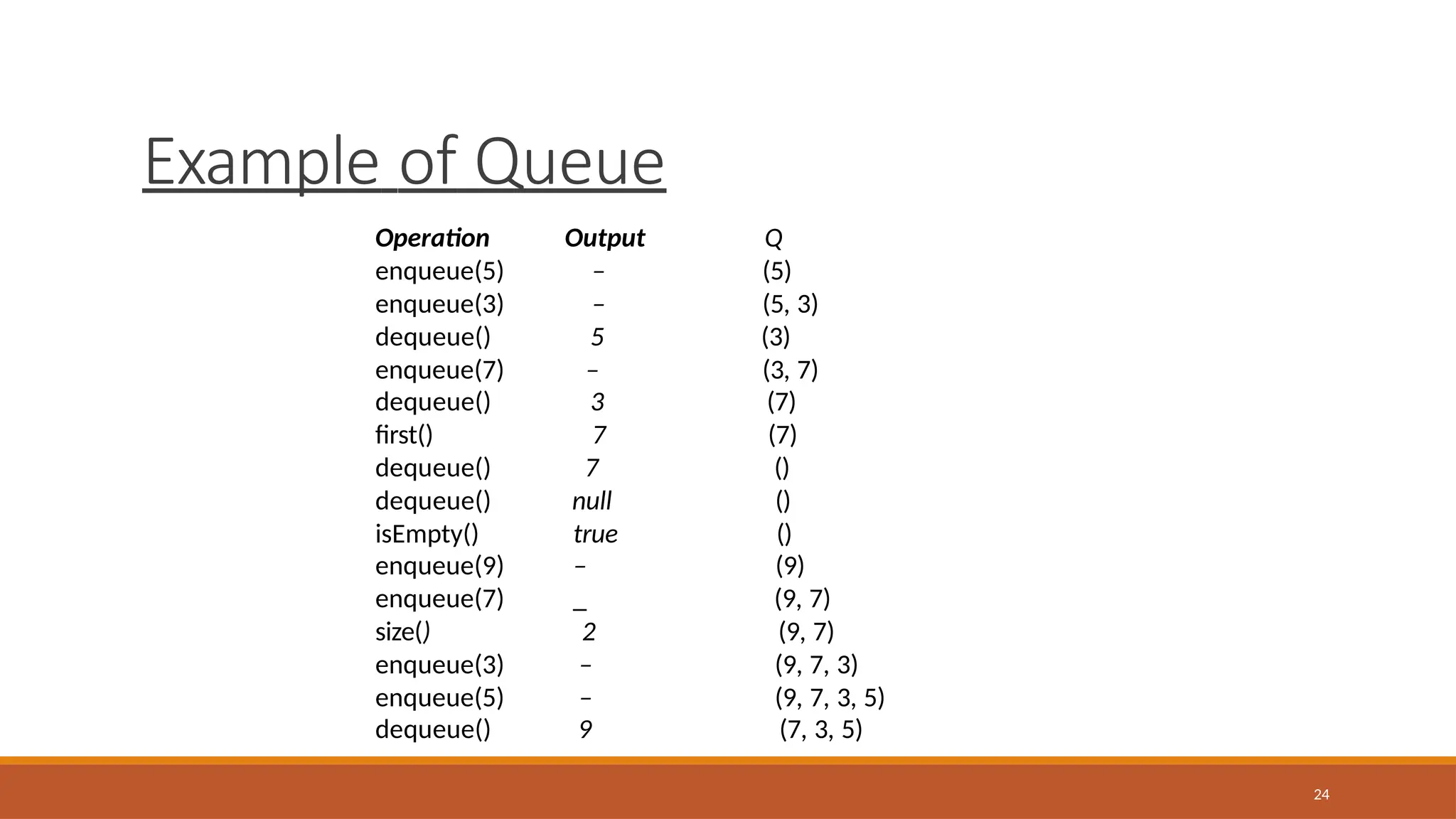
Operation Output Q
enqueue(5) – (5)
enqueue(3) – (5, 3)
dequeue() 5 (3)
enqueue(7) – (3, 7)
dequeue() 3 (7)
first() 7 (7)
dequeue() 7 ()
dequeue() null ()
isEmpty() true ()
enqueue(9) – (9)
enqueue(7) _ (9, 7)
size() 2 (9, 7)
enqueue(3) – (9, 7, 3)
enqueue(5) – (9, 7, 3, 5)
dequeue() 9 (7, 3, 5)
Example of Queue
25
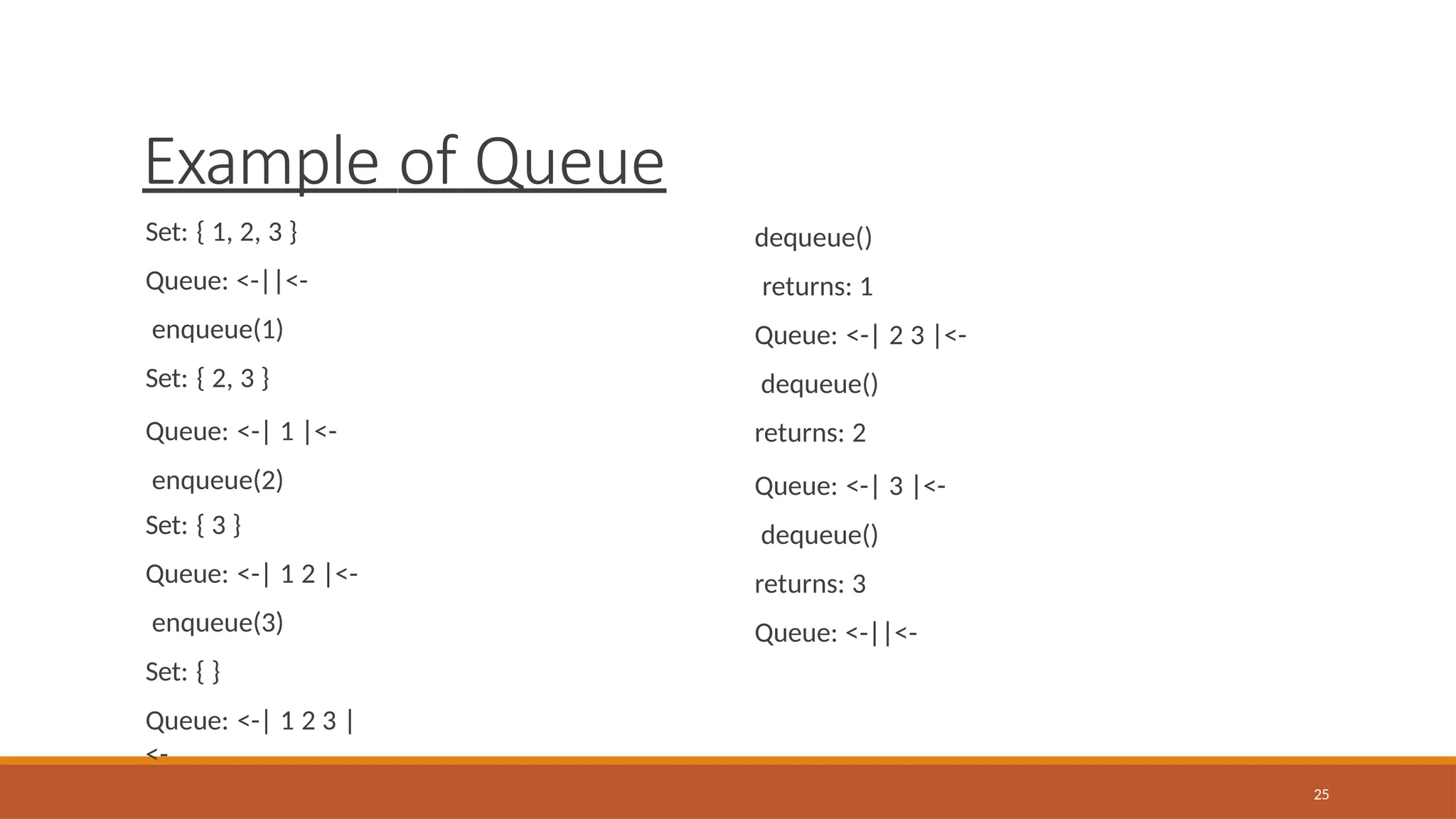
Set: { 1, 2, 3 }
Queue: <-||<-
enqueue(1)
Set: { 2, 3 }
Queue: <-| 1 |<-
enqueue(2)
Set: { 3 }
Queue: <-| 1 2 |<-
enqueue(3)
Set: { }
Queue: <-| 1 2 3 |
<-
dequeue()
returns: 1
Queue: <-| 2 3 |<-
dequeue()
returns: 2
Queue: <-| 3 |<-
dequeue()
returns: 3
Queue: <-||<-
Practice problems
26
For the following sets, insert the elements into a queue and remove the elements again. Do the
same for a stack. Be sure to indicate your arrows clearly.
1. Set = { 4, 7, 2, 8, 1, 5, 9 }
2. Set = {the, lazy, dog, jumped, over, the, fence }
3. Set = {aa, bb, cc, dd, ee}
Circular Queue
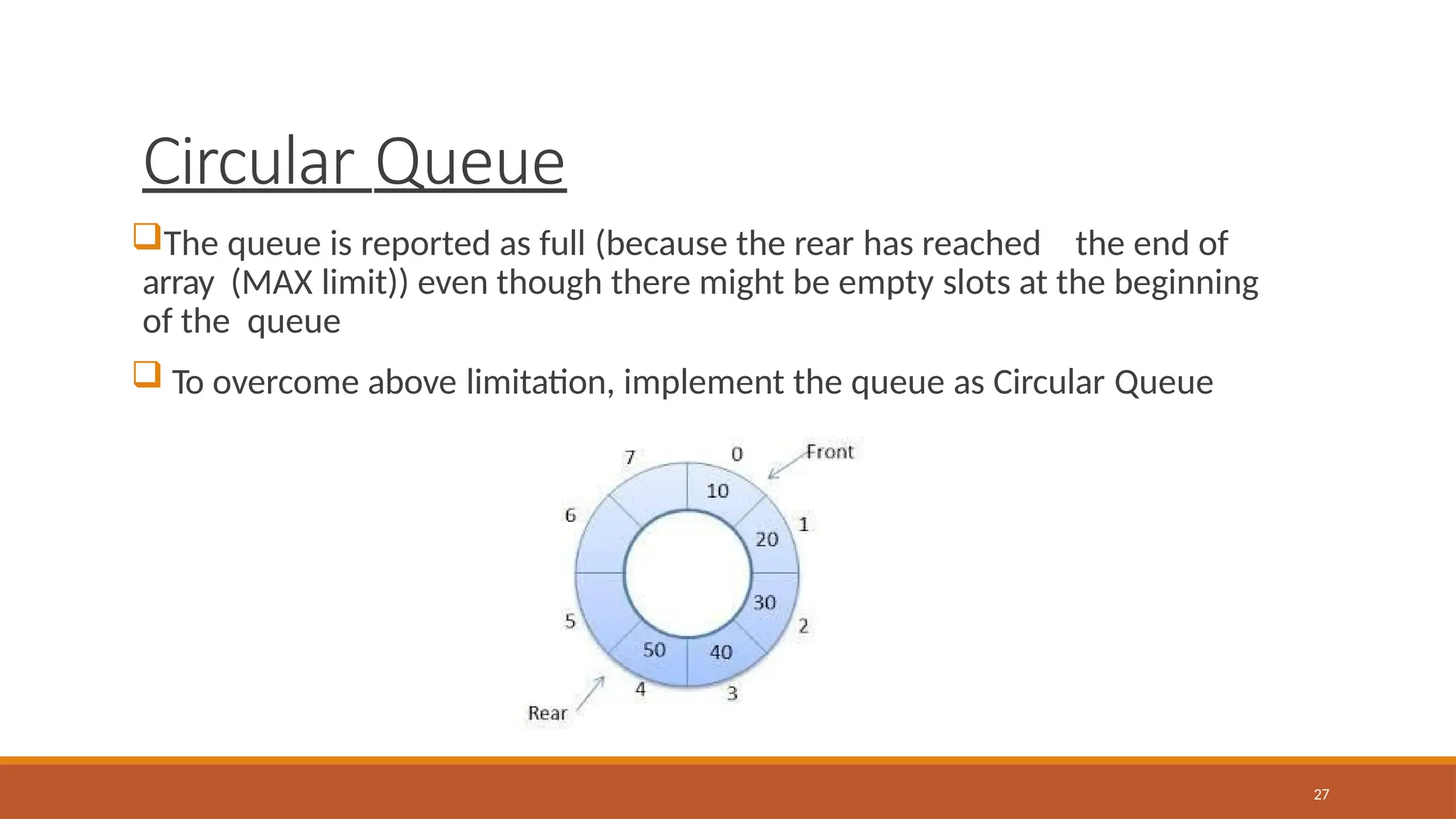
The queue is reported as full (because the rear has reached the end of
array (MAX limit)) even though there might be empty slots at the beginning
of the queue
 To overcome above limitation, implement the queue as Circular Queue
27
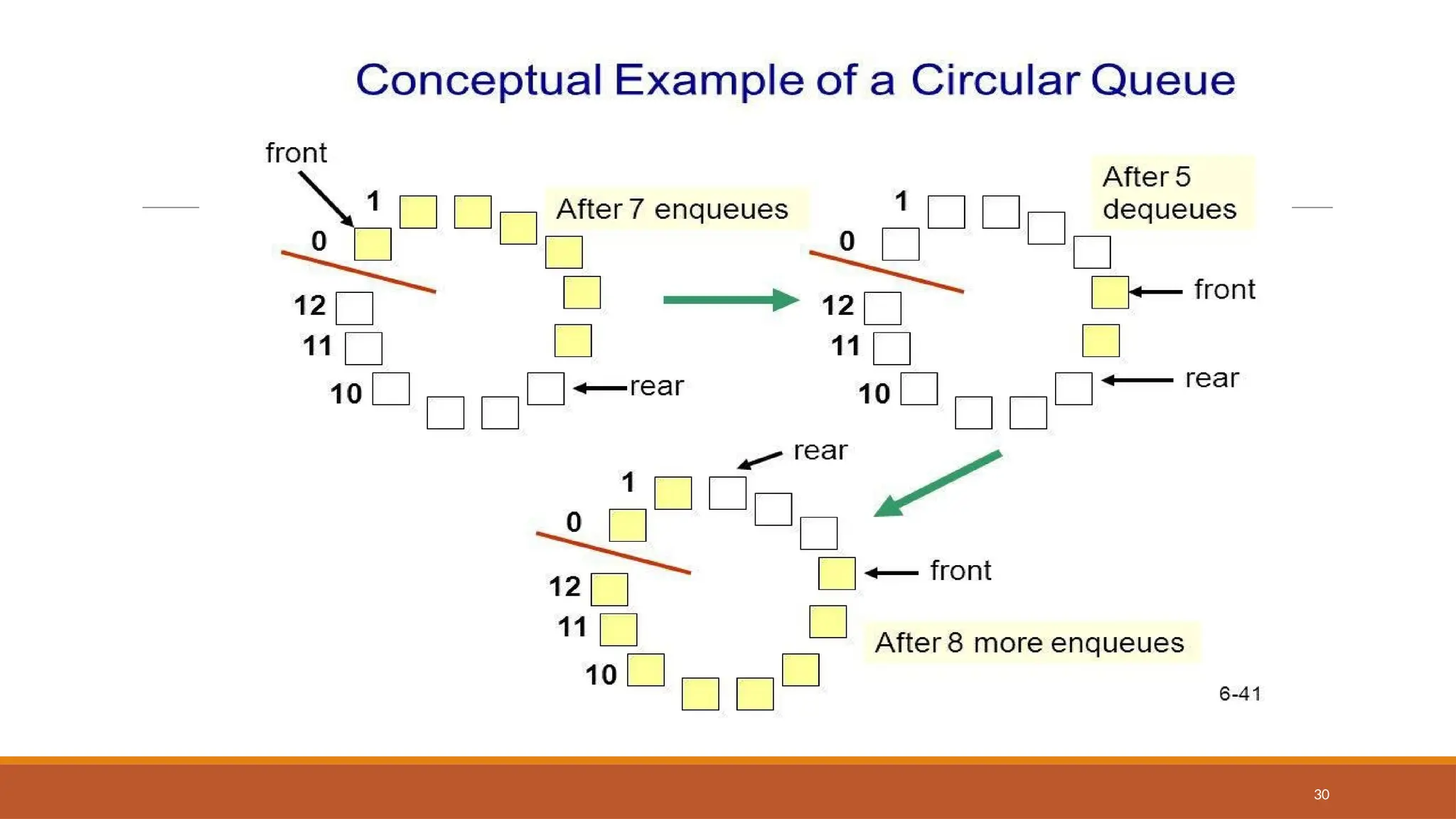
Circular Queue
28
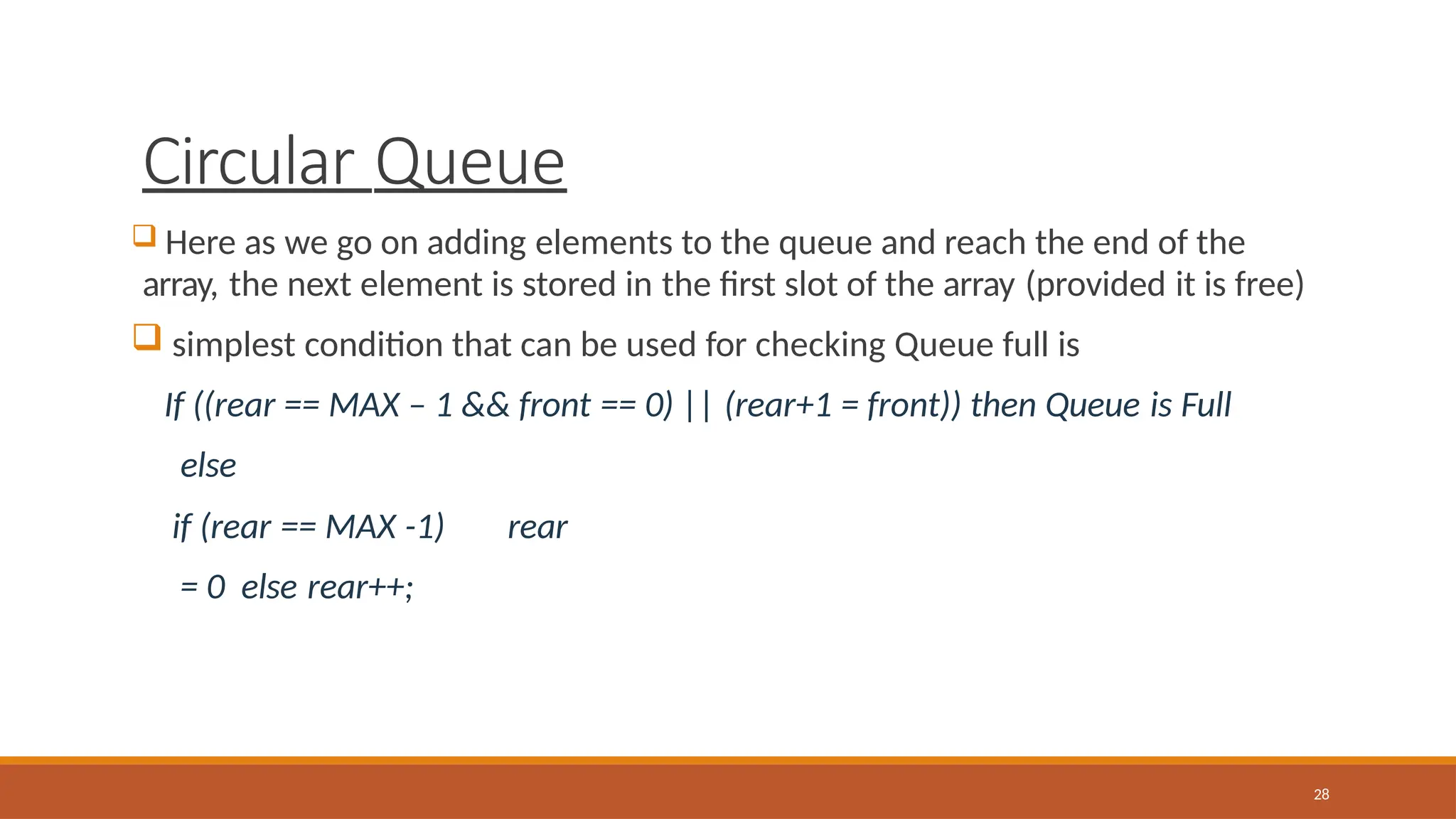
 Here as we go on adding elements to the queue and reach the end of the
array, the next element is stored in the first slot of the array (provided it is free)
 simplest condition that can be used for checking Queue full is
If ((rear == MAX – 1 && front == 0) || (rear+1 = front)) then Queue is Full
else
if (rear == MAX -1) rear
= 0 else rear++;
Circular Queue
29
 Use an array of size N in a circular fashion
 Two variables keep track of the front and size
 f index of the front element
 sz number of stored elements
 When the queue has fewer than N elements, array location r = (f + sz) mod N is the first
empty
slot past the rear of the queue (r – rear)
30
Priority Queue
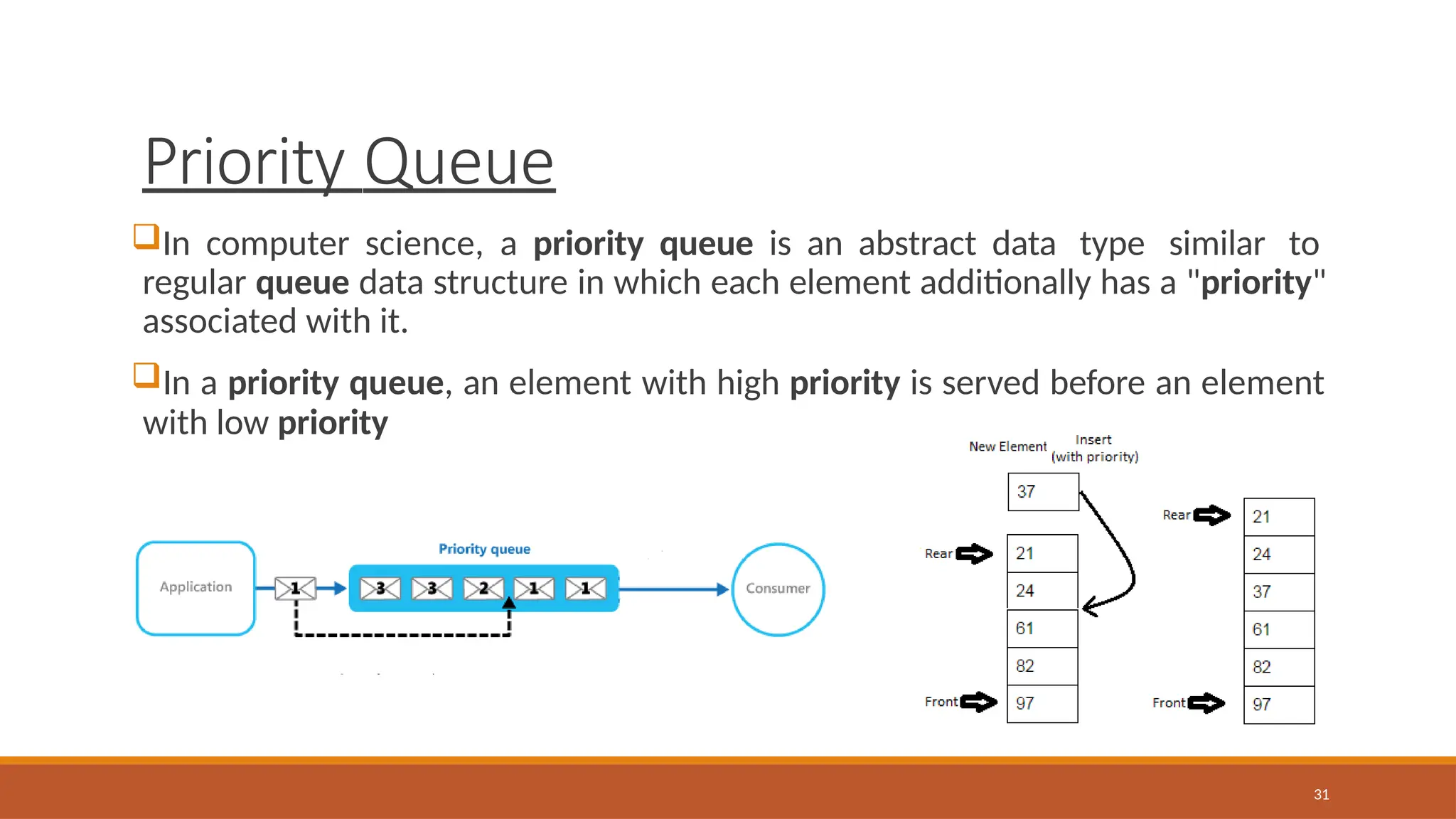
In computer science, a priority queue is an abstract data type similar to
regular queue data structure in which each element additionally has a "priority"
associated with it.
In a priority queue, an element with high priority is served before an element
with low priority
31
Priority Queue
32
 Priority Queue is an extension of queue with following properties.
 Every item has a priority associated with it.
1. An element with high priority is dequeued before an element with low priority.
2. If two elements have the same priority, they are served according to their order in the queue
3.In the below priority queue, element with maximum ASCII value will have the highest priority.
In the below priority queue, element with maximum ASCII value will have the highest priority.
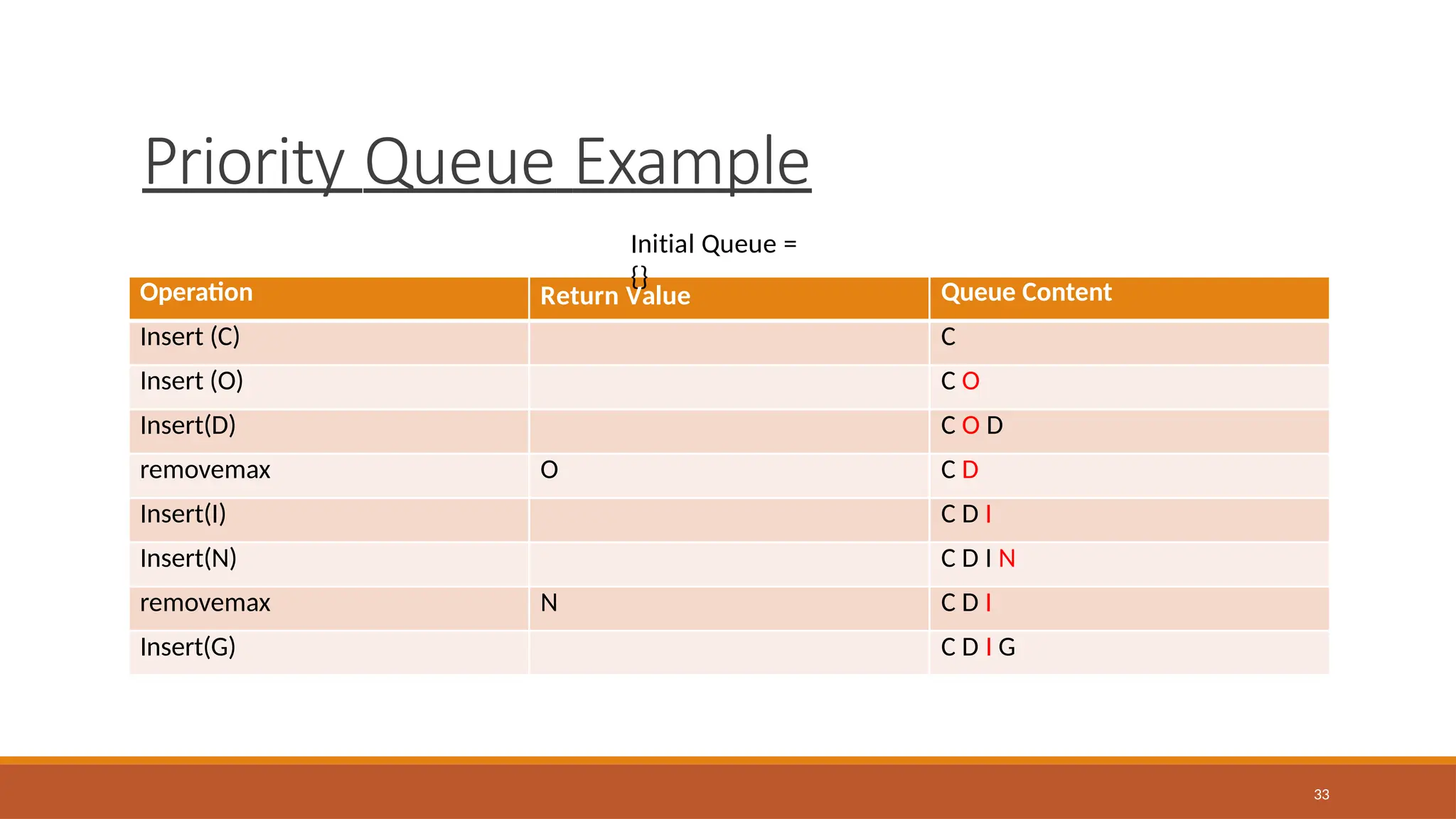
Priority Queue Example
33
Operation Return Value Queue Content
Insert (C) C
Insert (O) C O
Insert(D) C O D
removemax O C D
Insert(I) C D I
Insert(N) C D I N
removemax N C D I
Insert(G) C D I G
Initial Queue =
{}
Implementation
34
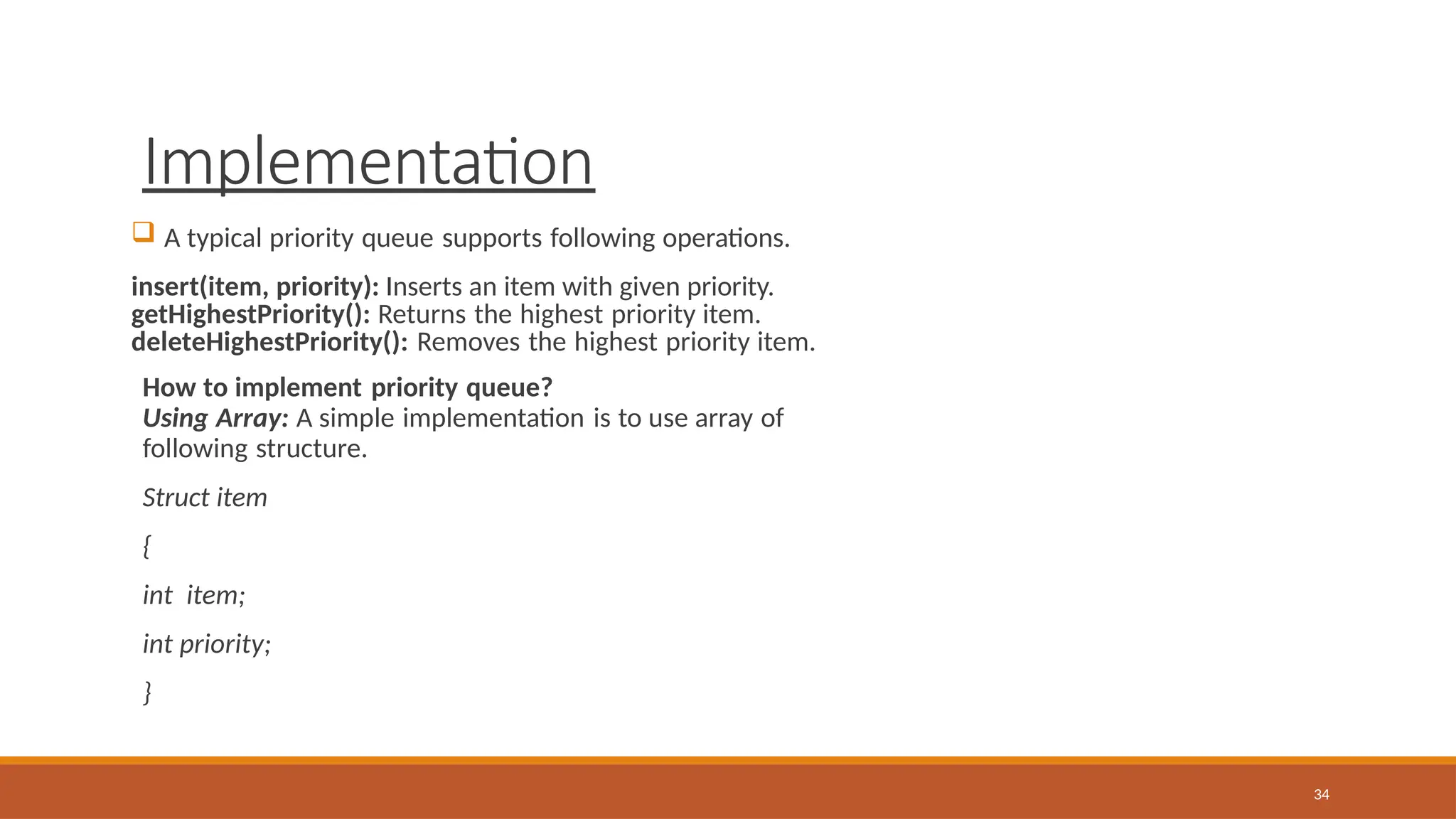
 A typical priority queue supports following operations.
insert(item, priority): Inserts an item with given priority.
getHighestPriority(): Returns the highest priority item.
deleteHighestPriority(): Removes the highest priority item.
How to implement priority queue?
Using Array: A simple implementation is to use array of
following structure.
Struct item
{
int item;
int priority;
}
Applications of Queue
35
1. Categorizing data
2. Simulation of queue.
Queue Simulation
36
 Simulation enables the study of, and experimentation with, the interactions of a
complex system (or a subsystem thereof).
 Informational, organisational, and environmental changes can be simulated and the
changes to the model’s behaviour can be observed.
Knowledge gained by studying the model can be of great value, and may suggest
improvement to the system under investigation.
Changing simulation inputs can help understanding how certain components of the
system interact. Simulation is, among others, used to experiment with new designs or
policies prior to implementation, and may save huge amounts of money.
 Simulations are also used to verify analytical solutions.
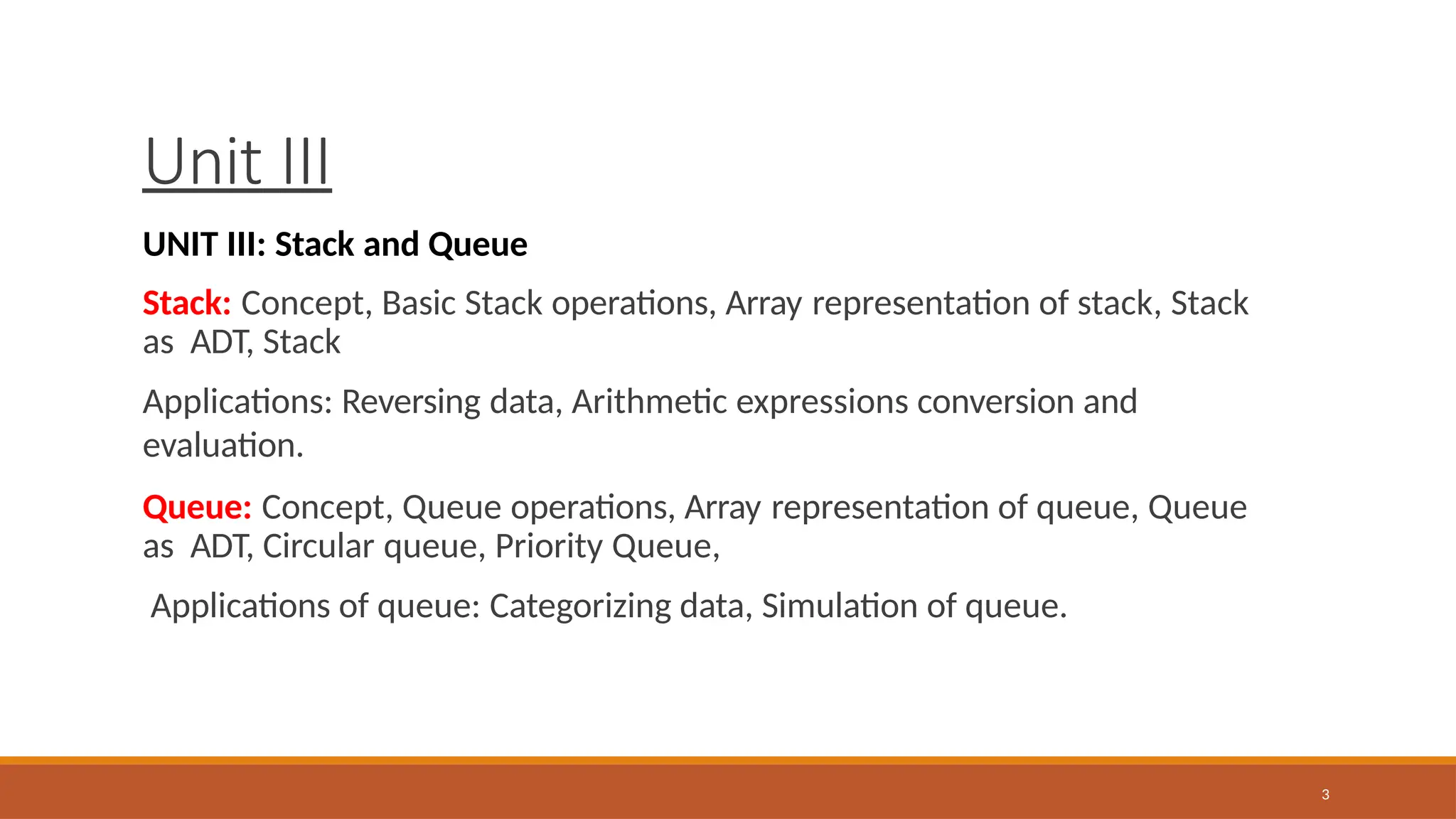
Application(page 175 onwards from T2)
37

Stack and queue detail information.spptx

  • 1.
    Unit III 3 UNIT III:Stack and Queue Stack: Concept, Basic Stack operations, Array representation of stack, Stack as ADT, Stack Applications: Reversing data, Arithmetic expressions conversion and evaluation. Queue: Concept, Queue operations, Array representation of queue, Queue as ADT, Circular queue, Priority Queue, Applications of queue: Categorizing data, Simulation of queue.
  • 2.
    Classification of DataStructures 2 June 23, 2020
  • 3.
    Introduction 3 --> An arrayis a random access data structure, where each element can be accessed directly and in constant time. E.g.: A typical illustration of random access is a book - each page of the book can be open independently of others. Random access is critical to many algorithms, for example binary search. -> A linked list is a sequential access data structure, where each element can be accesed only in particular order. E.g.: A typical illustration of sequential access is a roll of paper or tape - all prior material must be unrolled in order to get to data you want.
  • 4.
    Stack and Queue 4 Arestacks and queues useful? • YES. They come up all the time.  Stacks • Web browsers store the addresses of recently visited sites on a stack • Each time the visits a new site ==> pushed on the stack. Browsers allow to “pop” back to previously visited site. • The undo-mechanism in an editor  The changes are kept in a stack. When the user presses “undo” the stack of changes is popped. • The function-call mechanism  the active (called but not completed) functions are kept on a stack  each time a function is called, a new frame describing its context is pushed onto the stack the context of a method: its parameters, local variables, what needs to be returned, and where to return (the instruction to be executed upon return)  when the function returns, its frame is popped, the context is reset to the previous method (now on top of the stack) and the program continues by executing the previously suspended method.
  • 5.
    Stack and Queue 5 Queue •Queue of processes waiting to be processed for e.g. the queue of processes to be scheduled on the CPU. the process at front is dequeued and processed. New processes are added at the end of the queue. •Round-robin scheduling: iterate through a set of processes in a circular manner and service each element: the process at front is dequeued, allowed to run for some CPU cycles, and then enqueued at the end of the queue
  • 6.
    Stack 6 We know thatthe Stack is LIFO Structure i,e Last in First Out. It is very useful data structure in C Programming. Stack can be implemented using the Linked List or Array.
  • 7.
    Conditions of Stack 7 1.Stack is LIFO Structure [ Last in First Out ] 2. Stack is Ordered List of Elements of Same Type. 3. Stack is Linear List 4.In Stack all Operations such as Insertion and Deletion are permitted at only one end called Top
  • 8.
    Building a Stack 8 What data items do we need - An array/linked list to hold stack element - An integer/pointer to indicate the topof the stack  What operations do we need - Constructor: build an empty stack - Empty: Check if the stack is empty - Push: Add an element on the top - Pop: Remove the top element - Top: return the top element - Display: show all the stack elements
  • 9.
    Array implementation ofStack 9 initial top = -1 Push 36 9 45 54 top=0 Pop top=1 top=2 top=3 36 9 45 top=0 top=1 top=2 popped element: 54
  • 10.
    Abstract Data Types(ADTs) 10  An abstract data type (ADT) is a mathematically specified entity that defines a set of its instances.  An ADT specifies:  What data is stored  Interface - Operations on the data  manipulation  access a set of axioms (preconditions and post conditions) that define what the operations do (not how)
  • 11.
    Why ADTs 11 serve asspecifications of requirements for the building blocks of an algorithm encapsulate the data structure and the algorithms that works on the data structure  separate issues of correctness and efficiency
  • 12.
    Stack ADT 12  DataObject  Operations new():ADT - creates a new stack push(S:ADT, o:Object):ADT – Inserts object o onto the top of stack S pop(S:ADT):ADT - removes the top object of stack S; if the stack is empty an error occurs
  • 13.
    Stack ADT (Contd) 13 Auxiliary operations top(S:ADT):Object - returns the top object of stack S without removing it; if the stack is empty, an error occurs  size(S:ADT):integer returns the number of objects in stack S  isEmpty(S:ADT):boolean - indicates if stack S is empty  Axioms  pop(push(S, o)) = S  top(push(S, o)) = o
  • 14.
  • 15.
    Example 15 Set: { 1,2, 3 } Stack: ||-><- push(1) Set: { 2, 3 } Stack: | 1 |-><- push(2) Set: { 3 } Stack: | 1 2 |-><- push(3) Set: {} Stack: | 1 2 3 |- ><- pop() returns 3 Stack: | 1 2 |-><- pop() returns 2 Stack: | 1 |-><- pop() returns 1 Stack: ||-><-
  • 16.
    Stack Applications 16  Thesimplest application of a stack is to reverse a word. You push a given word to stack - letter by letter - and then pop letters from the stack. Another application is an "undo" mechanism in text editors; this operation is accomplished by keeping all text changes in a stack.  Arithmetic expression conversion and evaluation  Language processing: ◦space for parameters and local variables is created internally using a stack. ◦compiler's syntax check for matching braces is implemented by using stack. ◦ Support for recursion
  • 17.
    Infix to PostfixConversion 17  We use a stack  When an operand is read, output it  When an operator is read – Pop until the top of the stack has an element of lower precedence – Then push it  When ) is found, pop until we find the matching (  ( has the lowest precedence when in the stack  but has the highest precedence when in the input  When we reach the end of input, pop until the stack is empt
  • 18.
    Example Infix toPostfix conversion 18 Example Evaluation of postfix expression
  • 19.
    Queue A queue isa first in, first out (FIFO) structure or in the other sense, a last in, last out (LILO) structure. A queue is sometimes generalized as a structure where insertion (enqueue, pronounced N-Q) occur at one end and removal (dequeue, pronounced D-Q) occurs at the other end. 19
  • 20.
    Queue 20 The Queue islike the List but with “limited” insertion and deletion.  Insertion can be done only at the end called as rear end  Deletion can only be done in the front  FIFO – first-in-first-out data structure Main Operations  enqueue  dequeue
  • 21.
    Basic Operations onQueue Primary queue operations: Enqueue and Dequeue Like check-out lines in a store, a queue has a front and a rear. Enqueue ◦Insert an element at the rear of the queue Dequeue ◦ Remove an element from the front of the queue Front 21 Rear (Enqueue) Remove (Dequeue) Insert
  • 22.
    Queue ADT 22 The queuesupports the following fundamental methods:  New():ADT – creates an empty queue  Enqueue(Q:ADT, o:element):ADT – inserts the object o at the rear of the queue Dequeue(Q:ADT):element – removes the object from the front of the queue; an error occurs if the queue is empty First(Q:ADT):element – returns, but does not remove the object at the front of the queue; an error occurs if the queue is empty.
  • 23.
    Queue ADT (contd) 23 Auxiliary methods  Size(Q:QDT):integer – returns the number of elements in the queue  isEmpty(Q:ADT):boolean – indicates whether the queue is empty  Axioms  Front(Enqueue(New(), v)) = v  Dequeue(Enqueue(New(), v)) = New()  Front(Enqueue(Enqueue(Q,w),v)) = Front(Enqueue(Q,w))  Dequeue(Enqueue(Enqueue(Q,w), v)) = Enqueue(Dequeue(Enqueue(Q,w),v)
  • 24.
    Example of Queue 24 OperationOutput Q enqueue(5) – (5) enqueue(3) – (5, 3) dequeue() 5 (3) enqueue(7) – (3, 7) dequeue() 3 (7) first() 7 (7) dequeue() 7 () dequeue() null () isEmpty() true () enqueue(9) – (9) enqueue(7) _ (9, 7) size() 2 (9, 7) enqueue(3) – (9, 7, 3) enqueue(5) – (9, 7, 3, 5) dequeue() 9 (7, 3, 5)
  • 25.
    Example of Queue 25 Set:{ 1, 2, 3 } Queue: <-||<- enqueue(1) Set: { 2, 3 } Queue: <-| 1 |<- enqueue(2) Set: { 3 } Queue: <-| 1 2 |<- enqueue(3) Set: { } Queue: <-| 1 2 3 | <- dequeue() returns: 1 Queue: <-| 2 3 |<- dequeue() returns: 2 Queue: <-| 3 |<- dequeue() returns: 3 Queue: <-||<-
  • 26.
    Practice problems 26 For thefollowing sets, insert the elements into a queue and remove the elements again. Do the same for a stack. Be sure to indicate your arrows clearly. 1. Set = { 4, 7, 2, 8, 1, 5, 9 } 2. Set = {the, lazy, dog, jumped, over, the, fence } 3. Set = {aa, bb, cc, dd, ee}
  • 27.
    Circular Queue The queueis reported as full (because the rear has reached the end of array (MAX limit)) even though there might be empty slots at the beginning of the queue  To overcome above limitation, implement the queue as Circular Queue 27
  • 28.
    Circular Queue 28  Hereas we go on adding elements to the queue and reach the end of the array, the next element is stored in the first slot of the array (provided it is free)  simplest condition that can be used for checking Queue full is If ((rear == MAX – 1 && front == 0) || (rear+1 = front)) then Queue is Full else if (rear == MAX -1) rear = 0 else rear++;
  • 29.
    Circular Queue 29  Usean array of size N in a circular fashion  Two variables keep track of the front and size  f index of the front element  sz number of stored elements  When the queue has fewer than N elements, array location r = (f + sz) mod N is the first empty slot past the rear of the queue (r – rear)
  • 30.
  • 31.
    Priority Queue In computerscience, a priority queue is an abstract data type similar to regular queue data structure in which each element additionally has a "priority" associated with it. In a priority queue, an element with high priority is served before an element with low priority 31
  • 32.
    Priority Queue 32  PriorityQueue is an extension of queue with following properties.  Every item has a priority associated with it. 1. An element with high priority is dequeued before an element with low priority. 2. If two elements have the same priority, they are served according to their order in the queue 3.In the below priority queue, element with maximum ASCII value will have the highest priority. In the below priority queue, element with maximum ASCII value will have the highest priority.
  • 33.
    Priority Queue Example 33 OperationReturn Value Queue Content Insert (C) C Insert (O) C O Insert(D) C O D removemax O C D Insert(I) C D I Insert(N) C D I N removemax N C D I Insert(G) C D I G Initial Queue = {}
  • 34.
    Implementation 34  A typicalpriority queue supports following operations. insert(item, priority): Inserts an item with given priority. getHighestPriority(): Returns the highest priority item. deleteHighestPriority(): Removes the highest priority item. How to implement priority queue? Using Array: A simple implementation is to use array of following structure. Struct item { int item; int priority; }
  • 35.
    Applications of Queue 35 1.Categorizing data 2. Simulation of queue.
  • 36.
    Queue Simulation 36  Simulationenables the study of, and experimentation with, the interactions of a complex system (or a subsystem thereof).  Informational, organisational, and environmental changes can be simulated and the changes to the model’s behaviour can be observed. Knowledge gained by studying the model can be of great value, and may suggest improvement to the system under investigation. Changing simulation inputs can help understanding how certain components of the system interact. Simulation is, among others, used to experiment with new designs or policies prior to implementation, and may save huge amounts of money.  Simulations are also used to verify analytical solutions.
  • 37.