IJSRD - International Journal for Scientific Research & Development| Vol. 3, Issue 10, 2015 | ISSN (online): 2321-0613
All rights reserved by www.ijsrd.com 237
Stabilization of Blackcotton Soils by using Groundnut Shell Ash
P.V.S Madhusudhan1
G. Naveen kumar2
1
M.Tech. Student 2
Assistant Professor
1,2
Department of Geotechnical Engineering
1,2
Gokul Institute of Technology and Sciences, Piridi, Bobbili, Andrapradesh, India
Abstract— Due to rapid increase in the world’s population
there is increased demand for food, and this has resulted in
the production of different types of crops and consequently
large amounts of agricultural wastes are generated. Hence it
is necessary to dispose these agricultural wastes safely on to
the environment. On other hand BC soils expands and
contracts due to changes in the moisture content of the soil,
causing structural problems through differential movement
of the structure. This isolated movement of sections of the
structure can cause damage to building foundations and
cracking in the exterior or interior wall covering leads to
uneven floors etc. Also cause severe cracking in pavements,
swimming pools, pipelines, sidewalks, highways etc. Hence
there is need to stabilize expansive soil. From these
discussion we should find out the solution for the above two
problems. After studying several research papers it is
concluded that agricultural wastes can be used effectively in
stabilization of BC soils. This project presents stabilization
of BC soils using groundnut shell ash since its production
increased to large extent. On addition of groundnut shell ash
in increment of 15% from 0to 60% to BC soils different
experiments on plasticity characteristics, compaction
characteristics, shear strength characteristics are conducted
.And found gradual improvement in geotechnical properties
of black cotton soils.
Key words: Blackcotton Soils, Groundnut Shell Ash
I. INTRODUCTION
Expansive soils are being distributed widely over all
geographical locations in the world. These soils cause
distress to the structures founded on them because of their
high swelling potential due to the presence of various clay
minerals like montmorillonite, bentonite, smectite,
vermiculite, illite and beidellite etc.
When soil gets wet these clay minerals absorb
water molecules and expand or when they dry they shrink
leaving large voids in the soil. This shrinkage can remove
support from buildings or other structures and result in
damaging. Fissures in the soil can also develop. These
Fissures can facilitate the deep penetration of water when
moist conditions or runoff occurs. These swelling clays
derived from residual soils also exert uplift pressures
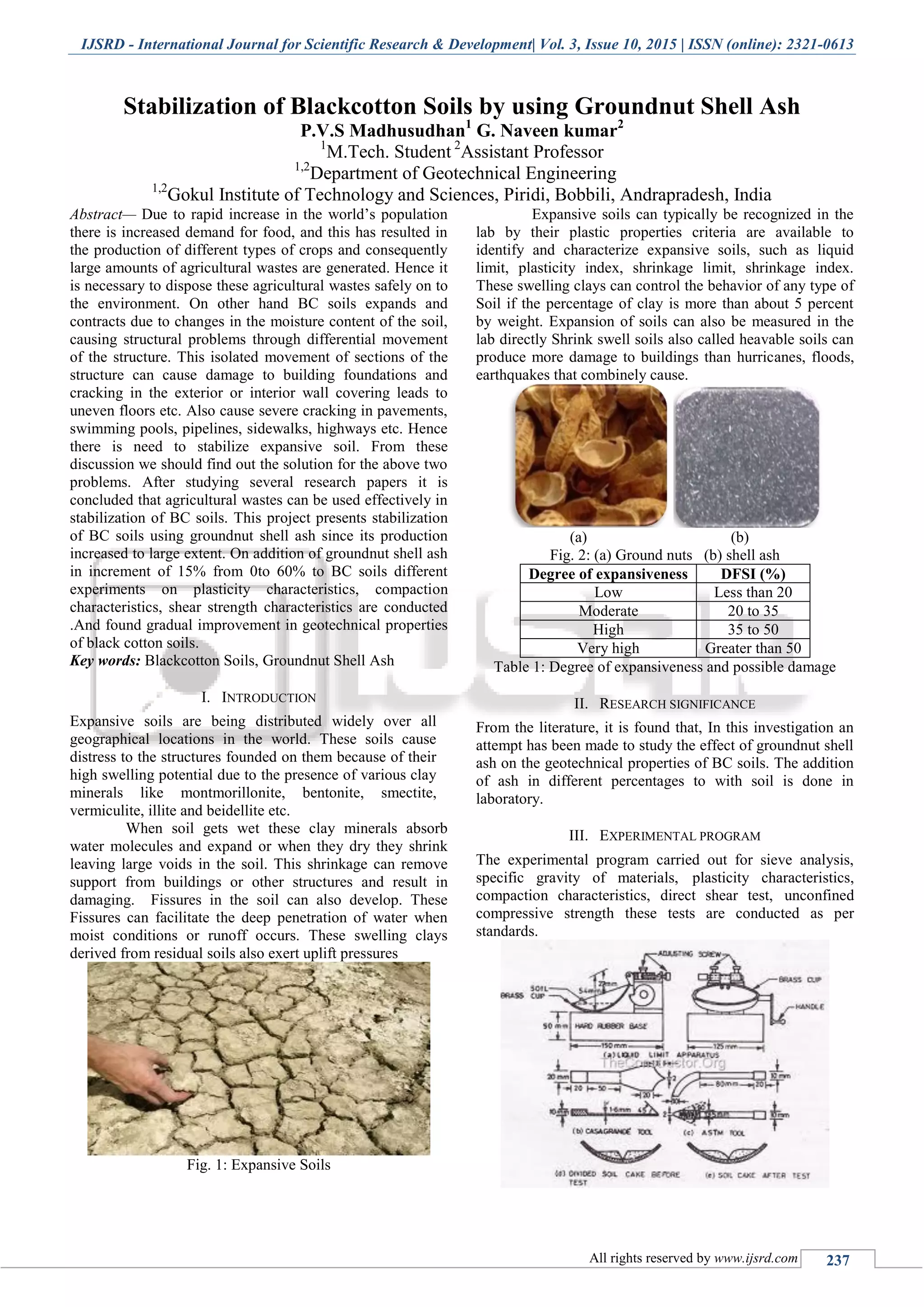
Fig. 1: Expansive Soils
Expansive soils can typically be recognized in the
lab by their plastic properties criteria are available to
identify and characterize expansive soils, such as liquid
limit, plasticity index, shrinkage limit, shrinkage index.
These swelling clays can control the behavior of any type of
Soil if the percentage of clay is more than about 5 percent
by weight. Expansion of soils can also be measured in the
lab directly Shrink swell soils also called heavable soils can
produce more damage to buildings than hurricanes, floods,
earthquakes that combinely cause.
(a) (b)
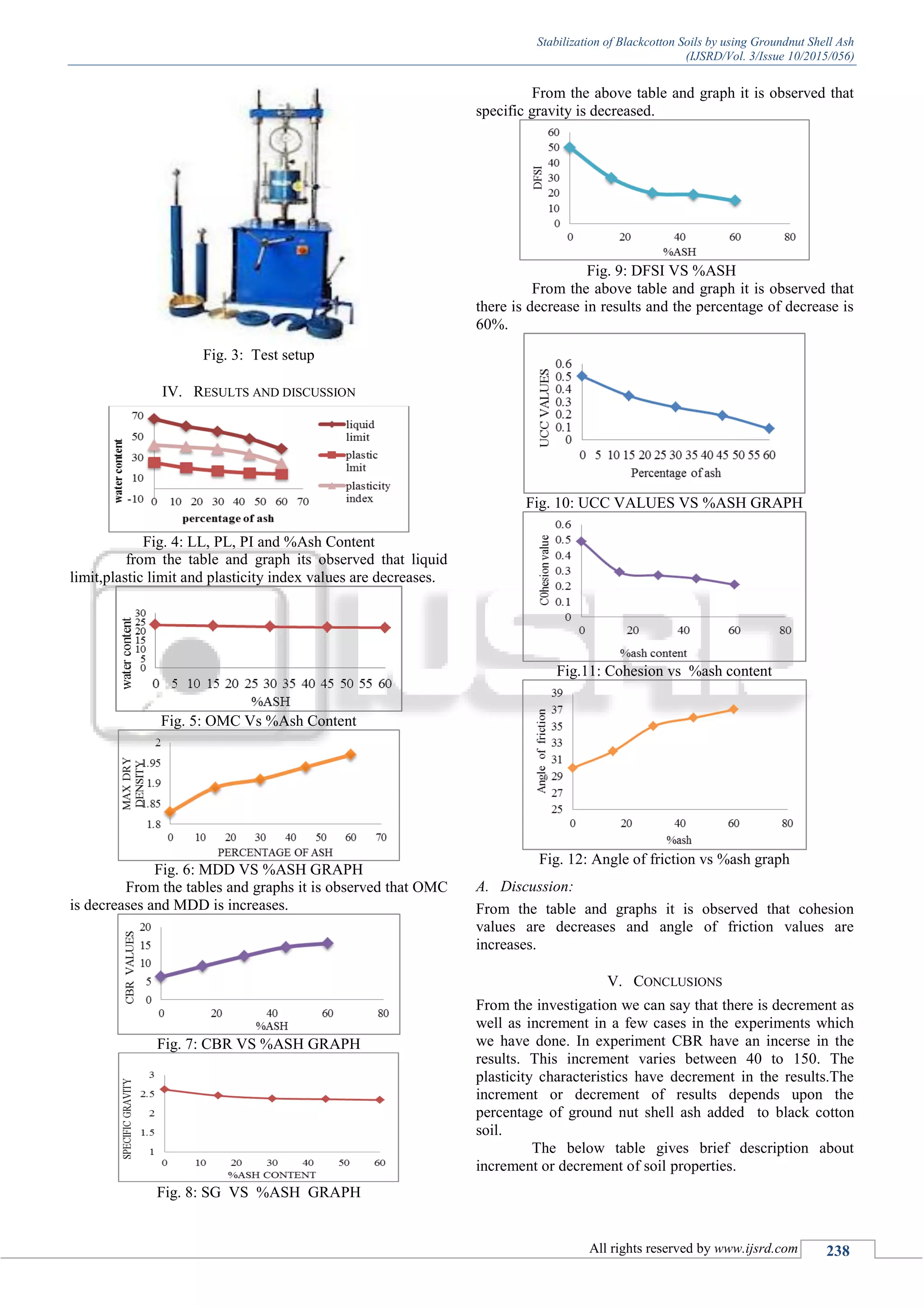
Fig. 2: (a) Ground nuts (b) shell ash
Degree of expansiveness DFSI (%)
Low Less than 20
Moderate 20 to 35
High 35 to 50
Very high Greater than 50
Table 1: Degree of expansiveness and possible damage
II. RESEARCH SIGNIFICANCE
From the literature, it is found that, In this investigation an
attempt has been made to study the effect of groundnut shell
ash on the geotechnical properties of BC soils. The addition
of ash in different percentages to with soil is done in
laboratory.
III. EXPERIMENTAL PROGRAM
The experimental program carried out for sieve analysis,
specific gravity of materials, plasticity characteristics,
compaction characteristics, direct shear test, unconfined
compressive strength these tests are conducted as per
standards.
Stabilization of Blackcotton Soils by using Groundnut Shell Ash
(IJSRD/Vol. 3/Issue 10/2015/056)
All rights reserved by www.ijsrd.com 238
Fig. 3: Test setup
IV. RESULTS AND DISCUSSION
Fig. 4: LL, PL, PI and %Ash Content
from the table and graph its observed that liquid
limit,plastic limit and plasticity index values are decreases.
Fig. 5: OMC Vs %Ash Content
Fig. 6: MDD VS %ASH GRAPH
From the tables and graphs it is observed that OMC
is decreases and MDD is increases.
Fig. 7: CBR VS %ASH GRAPH
Fig. 8: SG VS %ASH GRAPH
From the above table and graph it is observed that
specific gravity is decreased.
Fig. 9: DFSI VS %ASH
From the above table and graph it is observed that
there is decrease in results and the percentage of decrease is
60%.
Fig. 10: UCC VALUES VS %ASH GRAPH
Fig.11: Cohesion vs %ash content
Fig. 12: Angle of friction vs %ash graph
A. Discussion:
From the table and graphs it is observed that cohesion
values are decreases and angle of friction values are
increases.
V. CONCLUSIONS
From the investigation we can say that there is decrement as
well as increment in a few cases in the experiments which
we have done. In experiment CBR have an incerse in the
results. This increment varies between 40 to 150. The
plasticity characteristics have decrement in the results.The
increment or decrement of results depends upon the
percentage of ground nut shell ash added to black cotton
soil.
The below table gives brief description about
increment or decrement of soil properties.
Stabilization of Blackcotton Soils by using Groundnut Shell Ash
(IJSRD/Vol. 3/Issue 10/2015/056)
All rights reserved by www.ijsrd.com 239
Name Of the experiment Increase or decrease
Liquid limit decrease
Plastic limit decrease
Plasticity index decrease
Shrinkage limit decrease
Differential free swell decrease
Unconfined compression test decrease
compaction
OMC decrease
Dry density increases
California bearing ratio
At 2.5mm increases
At 5.0mm increases
Shear box
C decrease
ᶲ increases
Table 2: Increment or decrement of soil properties
ACKNOWLEDGEMENT
I would like to thank Department of Civil Engineering staff
and management of Gokul Institute of Technology and
Sciences for their support in doing this work.
REFERENCES
[1] El Haggar(2003)”Agricultural waste as an energy
source in developing countries”, The American
university in cairo Egypt.
[2] Dr.samir(2005”) Environmental services for improving
water qualities management” Agricultural Research
centre MALR
[3] Sabitti EN(2011)”Utilising agricultural waste to
enhance food security and conserve the Environment”,
Volume11 no:6
[4] Saranjeet Rajesh Soni(2011)”Disposal of agricultural
waste for black cotton soil stabilization” ,Volno.8
International journal of advanced engineering sciences
and technologies.
[5] A sridharan(2000)”Classification procedure for
expansive soils”.
[6] Ijimdiya, T.S.(1995)” Attenuative capacity of
compacted black cotton soil treated with Bagasse”,
Department of civil engineering, Ahamadu Bello
University, Zario, Nigeria.
[7] Babayemi(2008)Application of Waste Cashew Nut
Shell Ash Showed Significant Reduction in Mobility of
Pb and Cd in Waste Battery Contaminated Soil,
Department of chemistry,Nigeria.
[8] Akpabio,E.E(2012)Effects of eggshell ash on strength
properties of cement –stabilized lateritic.International
Journal of Sustainable Construction Engineering &
Technology , Vol 3, Issue 1, 2012.
[9] kerrane(2005) classified about “what are expansive
soils ?”
[10]Amu(2011) “Geotechnical properties of lateritic soil
stabilized with sugarcane straw ash ”, Department of
Civil Engineering, Obafemi Awolowo University, Ile-
Ife, Osun State, Nigeria.
[11]Musa Alhassan (2008)”Potentials of Rice Husk Ash for
Soil Stabilization” . Department of Civil Engineering,
Federal University of Technology ; Minna , Niger State,
Nigeria
[12]Manasseh(2012) “ palm kernel shell ash stabilization of
reclaimed asphalt pavements, as highway pavement
materials”, journal of sustainable development and
Environmental Protection Vol.2 No.1 98
[13]Urena(2012)”use of biomass ash as a stabilization agent
for expansive”, department of geodynamics, university
of granada, campus de fuentenueva s/n. granada. spain.
cgunieto@ugr.es

Stabilisation of Black cotton Soils by Using Groundnut Shell Ash

  • 1.
    IJSRD - InternationalJournal for Scientific Research & Development| Vol. 3, Issue 10, 2015 | ISSN (online): 2321-0613 All rights reserved by www.ijsrd.com 237 Stabilization of Blackcotton Soils by using Groundnut Shell Ash P.V.S Madhusudhan1 G. Naveen kumar2 1 M.Tech. Student 2 Assistant Professor 1,2 Department of Geotechnical Engineering 1,2 Gokul Institute of Technology and Sciences, Piridi, Bobbili, Andrapradesh, India Abstract— Due to rapid increase in the world’s population there is increased demand for food, and this has resulted in the production of different types of crops and consequently large amounts of agricultural wastes are generated. Hence it is necessary to dispose these agricultural wastes safely on to the environment. On other hand BC soils expands and contracts due to changes in the moisture content of the soil, causing structural problems through differential movement of the structure. This isolated movement of sections of the structure can cause damage to building foundations and cracking in the exterior or interior wall covering leads to uneven floors etc. Also cause severe cracking in pavements, swimming pools, pipelines, sidewalks, highways etc. Hence there is need to stabilize expansive soil. From these discussion we should find out the solution for the above two problems. After studying several research papers it is concluded that agricultural wastes can be used effectively in stabilization of BC soils. This project presents stabilization of BC soils using groundnut shell ash since its production increased to large extent. On addition of groundnut shell ash in increment of 15% from 0to 60% to BC soils different experiments on plasticity characteristics, compaction characteristics, shear strength characteristics are conducted .And found gradual improvement in geotechnical properties of black cotton soils. Key words: Blackcotton Soils, Groundnut Shell Ash I. INTRODUCTION Expansive soils are being distributed widely over all geographical locations in the world. These soils cause distress to the structures founded on them because of their high swelling potential due to the presence of various clay minerals like montmorillonite, bentonite, smectite, vermiculite, illite and beidellite etc. When soil gets wet these clay minerals absorb water molecules and expand or when they dry they shrink leaving large voids in the soil. This shrinkage can remove support from buildings or other structures and result in damaging. Fissures in the soil can also develop. These Fissures can facilitate the deep penetration of water when moist conditions or runoff occurs. These swelling clays derived from residual soils also exert uplift pressures Fig. 1: Expansive Soils Expansive soils can typically be recognized in the lab by their plastic properties criteria are available to identify and characterize expansive soils, such as liquid limit, plasticity index, shrinkage limit, shrinkage index. These swelling clays can control the behavior of any type of Soil if the percentage of clay is more than about 5 percent by weight. Expansion of soils can also be measured in the lab directly Shrink swell soils also called heavable soils can produce more damage to buildings than hurricanes, floods, earthquakes that combinely cause. (a) (b) Fig. 2: (a) Ground nuts (b) shell ash Degree of expansiveness DFSI (%) Low Less than 20 Moderate 20 to 35 High 35 to 50 Very high Greater than 50 Table 1: Degree of expansiveness and possible damage II. RESEARCH SIGNIFICANCE From the literature, it is found that, In this investigation an attempt has been made to study the effect of groundnut shell ash on the geotechnical properties of BC soils. The addition of ash in different percentages to with soil is done in laboratory. III. EXPERIMENTAL PROGRAM The experimental program carried out for sieve analysis, specific gravity of materials, plasticity characteristics, compaction characteristics, direct shear test, unconfined compressive strength these tests are conducted as per standards.
  • 2.
    Stabilization of BlackcottonSoils by using Groundnut Shell Ash (IJSRD/Vol. 3/Issue 10/2015/056) All rights reserved by www.ijsrd.com 238 Fig. 3: Test setup IV. RESULTS AND DISCUSSION Fig. 4: LL, PL, PI and %Ash Content from the table and graph its observed that liquid limit,plastic limit and plasticity index values are decreases. Fig. 5: OMC Vs %Ash Content Fig. 6: MDD VS %ASH GRAPH From the tables and graphs it is observed that OMC is decreases and MDD is increases. Fig. 7: CBR VS %ASH GRAPH Fig. 8: SG VS %ASH GRAPH From the above table and graph it is observed that specific gravity is decreased. Fig. 9: DFSI VS %ASH From the above table and graph it is observed that there is decrease in results and the percentage of decrease is 60%. Fig. 10: UCC VALUES VS %ASH GRAPH Fig.11: Cohesion vs %ash content Fig. 12: Angle of friction vs %ash graph A. Discussion: From the table and graphs it is observed that cohesion values are decreases and angle of friction values are increases. V. CONCLUSIONS From the investigation we can say that there is decrement as well as increment in a few cases in the experiments which we have done. In experiment CBR have an incerse in the results. This increment varies between 40 to 150. The plasticity characteristics have decrement in the results.The increment or decrement of results depends upon the percentage of ground nut shell ash added to black cotton soil. The below table gives brief description about increment or decrement of soil properties.
  • 3.
    Stabilization of BlackcottonSoils by using Groundnut Shell Ash (IJSRD/Vol. 3/Issue 10/2015/056) All rights reserved by www.ijsrd.com 239 Name Of the experiment Increase or decrease Liquid limit decrease Plastic limit decrease Plasticity index decrease Shrinkage limit decrease Differential free swell decrease Unconfined compression test decrease compaction OMC decrease Dry density increases California bearing ratio At 2.5mm increases At 5.0mm increases Shear box C decrease ᶲ increases Table 2: Increment or decrement of soil properties ACKNOWLEDGEMENT I would like to thank Department of Civil Engineering staff and management of Gokul Institute of Technology and Sciences for their support in doing this work. REFERENCES [1] El Haggar(2003)”Agricultural waste as an energy source in developing countries”, The American university in cairo Egypt. [2] Dr.samir(2005”) Environmental services for improving water qualities management” Agricultural Research centre MALR [3] Sabitti EN(2011)”Utilising agricultural waste to enhance food security and conserve the Environment”, Volume11 no:6 [4] Saranjeet Rajesh Soni(2011)”Disposal of agricultural waste for black cotton soil stabilization” ,Volno.8 International journal of advanced engineering sciences and technologies. [5] A sridharan(2000)”Classification procedure for expansive soils”. [6] Ijimdiya, T.S.(1995)” Attenuative capacity of compacted black cotton soil treated with Bagasse”, Department of civil engineering, Ahamadu Bello University, Zario, Nigeria. [7] Babayemi(2008)Application of Waste Cashew Nut Shell Ash Showed Significant Reduction in Mobility of Pb and Cd in Waste Battery Contaminated Soil, Department of chemistry,Nigeria. [8] Akpabio,E.E(2012)Effects of eggshell ash on strength properties of cement –stabilized lateritic.International Journal of Sustainable Construction Engineering & Technology , Vol 3, Issue 1, 2012. [9] kerrane(2005) classified about “what are expansive soils ?” [10]Amu(2011) “Geotechnical properties of lateritic soil stabilized with sugarcane straw ash ”, Department of Civil Engineering, Obafemi Awolowo University, Ile- Ife, Osun State, Nigeria. [11]Musa Alhassan (2008)”Potentials of Rice Husk Ash for Soil Stabilization” . Department of Civil Engineering, Federal University of Technology ; Minna , Niger State, Nigeria [12]Manasseh(2012) “ palm kernel shell ash stabilization of reclaimed asphalt pavements, as highway pavement materials”, journal of sustainable development and Environmental Protection Vol.2 No.1 98 [13]Urena(2012)”use of biomass ash as a stabilization agent for expansive”, department of geodynamics, university of granada, campus de fuentenueva s/n. granada. spain. cgunieto@ugr.es