Compact and Sustainable Growth…
in the Age of Walk Score
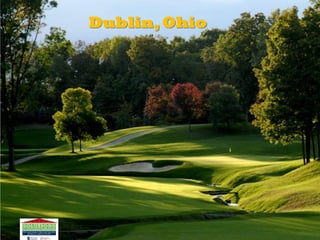
Dublin, Ohio
Agenda
 The view from
  Dublin
 What next??
 Implementing a
  new paradign
The view from a
quintessential suburb…
the suburban model worked
It supported a development model
that attracted educated workers


             Dublin   Ohio   United States
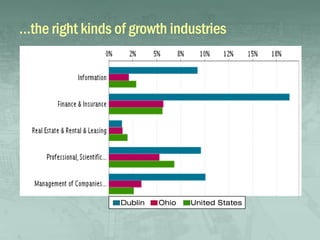
…the right kinds of growth industries


                  Dublin   Ohio   United States
…national recognition
         Top Seven Intelligent Community,
          2010
         Fox Business News:
          Top Small City to Start a Business
         Forbes.com:
          One of 25 Best Places to Move in
          2009
         BusinessWeek:
          Top Small City in Ohio to Start a
          Business
         Columbus Monthly:
          Best Suburban Community


                                       7
…and extraordinary community satisfaction
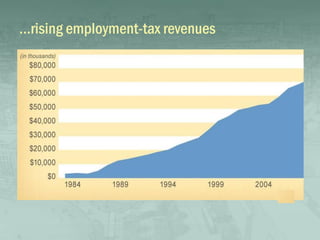
…rising employment-tax revenues
Until the Great Recession showed Dublin
that suburban taxes could drop…
…while rising environmental awareness focused
attention on poor environmental performance
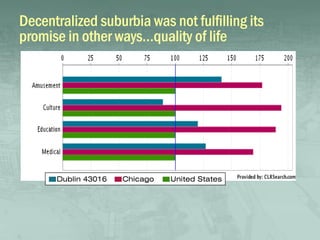
Decentralized suburbia was not fulfilling its
promise in other ways…quality of life


      Dublin 43016   Chicago   United States
…and more affordable lifestyles
…personal health
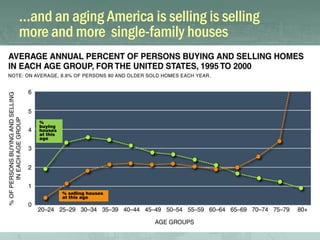
…and an aging America is selling is selling
more and more single-family houses


   %
   buying
   houses
   at this
   age


             % selling houses
             at this age
…and for the first time in three decades…Dublin
questioned its long-term appeal to employers
 50,000 people work in
  Dublin
 Dublin’s employers
  need to hire 5,000-
  8,000 new employees
  every year
While America faces a shortage of knowledge
workers, they seek lifestyles first, jobs second
„Creatives‟ seek urban places…
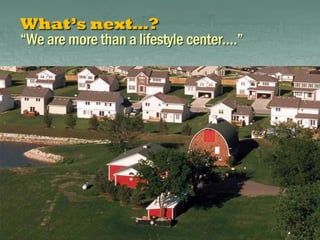
What’s next…?
“We are more than a lifestyle center….”
The past was built for a
very different America
The resent represents the dream
of a very different America
…and many communities have been right
to reject visions of the future
Dublin needed a community-based vision
to guide the community‟s growth
Planning starts with new preferences…for living
 1990…
  •   Golf courses
  •   Large backyards
  •   Homogeneity
  •   Escape from work
  •   Convenient auto
      access
 2011…
  •   Main streets
  •   Transit
  •   Diversity
  •   Live near work
  •   Assumption of
      personal
      responsibility for
      sustainability
…and working
 1990…
  •   Office parks
  •   Convenient auto access
  •   Convenient parking
  •   Escape to home
  •   Prestige address
 2011…
  •   Main Streets
  •   Transit
  •   Live near work
  •   Walkable environment
  •   Fun
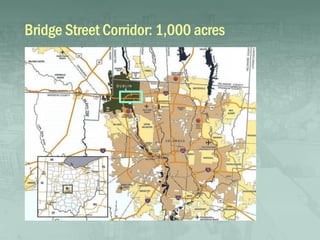
Bridge Street Corridor: 1,000 acres
1900–1955        2009


            28
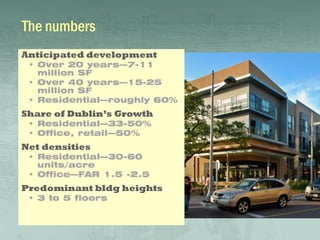
The numbers
Anticipated development
  Over 20 years—7-11
   million SF
  Over 40 years—15-25
   million SF
  Residential—roughly 60%
Share of Dublin’s Growth
  Residential—33-50%
  Office, retail—50%
Net densities
  Residential—30-60
   units/acre
  Office—FAR 1.5 -2.5
Predominant bldg heights
  3 to 5 floors
The impact…on development patterns
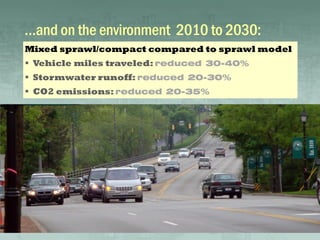
…and on the environment 2010 to 2030:
Mixed sprawl/compact compared to sprawl model
 Vehicle miles traveled: reduced 30-40%
 Stormwater runoff: reduced 20-30%
 CO2 emissions: reduced 20-35%
Vision principles to guide change…
1. Enhance economic
   vitality.
2. Integrate the new center
   into community life.
3. Expand “livability
   choices” for Dublin and
   the region.
4. Embrace Dublin’s
   natural setting and
   commitment to
   sustainability.
5. Create places that
   embody Dublin’s
   commitment to
   community.
Two questions: where can change happen…and
how can Dublin accomplish its principles
Quarter-mile radius walkable areas and prime
redevelopment opportunities:
Focus growth into distinct districts

…integrated with a natural green network:
…centered around Main Streets and squares

New street network:
…served by rubber-tire transit

Transit right of way:
A framework for compact growth
Illustrative build-out (2030-40):
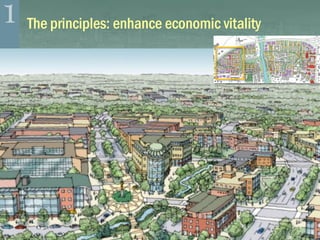
The principles: enhance economic vitality
Integrate the center into
community life
…with vibrant public spaces
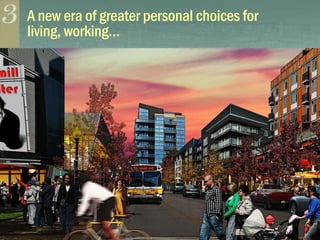
A new era of greater personal choices for
living, working…
What density? What choices do you want?
 1,000 to 2,000
  housing units
  within a 10- to 15-
  minute walk
  support a block of
  Main Street.
 30-60 units per acre
  can support a
  walkable
  community.
 …and new transit
  options
…fun…
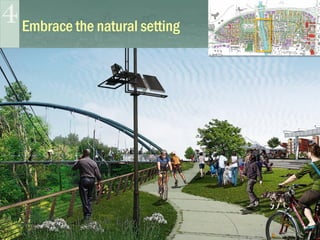
Embrace the natural setting
…enjoying the river as a
new central park
…and adding non-car transportation options
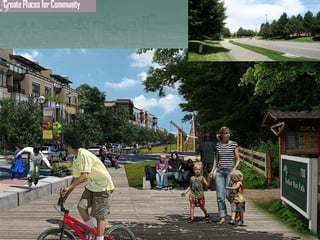
Create places that embody a
commitment to community
Compact sustainable design is
    about creating iconic community
    Start with the
     street
    Enhance the
     context
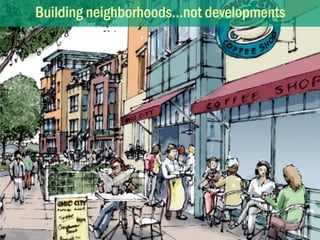
    Build
     neighborhoods…
     not developments
Urban architecture engages the street
…embodying many styles and uses
 National lessons…performance standards for
  growth based on:
   Regional environmental impact
   Comprehensive fiscal and other
     cost/benefits
   Public health
 Public-private partnership to fund SHARED
  infrastructure
 “Eco district” approach to sustainability
 SHARED parking strategies
 Rubber-tire TMA transit, expands over time
 Hybrid zoning
   Form-based
   Incentives to aggregate sites, create lively
     squares, etc.
 Strong planning and design management
…shops, live work, the local library…
Enhancing context means respecting, not
mimicking defining neighborhood qualitieszz
…and embody many styles


            Very contemporary contextual design affordable, mixed-income housing
Building neighborhoods…not developments
Implementing change:
strategies for transition to an uban model
 National lessons…
  performance standards for
  growth based on:
  Regional environmental
   impact
  Comprehensive fiscal and
   other cost/benefits
  Public health
 Public-private partnership to
  fund SHARED infrastructure
 “Eco district” approach to
  sustainability
 SHARED parking strategies
 Hybrid zoning
 Strong planning and design
  management
Goody Clancy concept study
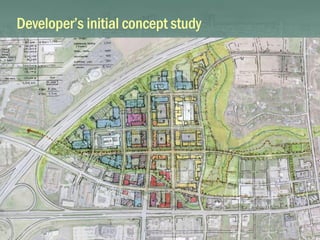
Developer‟s initial concept study
Compact and Sustainable Growth…
in the Age of Walk Score

SSC2011_David Dixon PPT