The Housing Bust and Housing Affordability: Where do we stand?Robert Clifford, Policy AnalystNew England Public Policy CenterFederal Reserve Bank of BostonBringing Workers Home 2011 Regional Forum on Workforce Housing in BostonNational Association REALTORS and National Housing ConferenceJuly 28, 2011*The views expressed in this presentation are mine and not necessarily those of the Federal Reserve Bank of Boston or Federal Reserve System
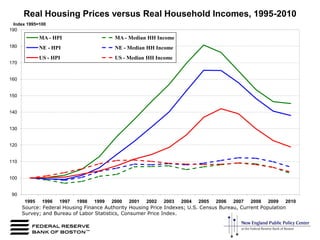
Real Housing Prices versus Real Household Incomes, 1995-2010
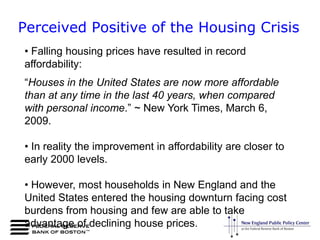
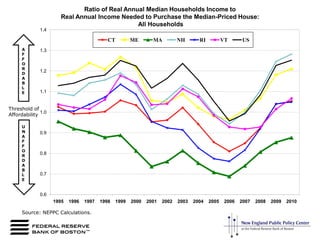
Perceived Positive of the Housing Crisis Falling housing prices have resulted in record affordability:“Houses in the United States are now more affordable than at any time in the last 40 years, when compared with personal income.” ~ New York Times, March 6, 2009. In reality the improvement in affordability are closer to early 2000 levels.
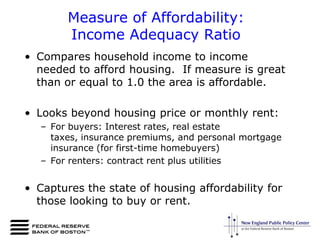
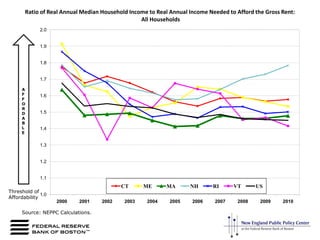
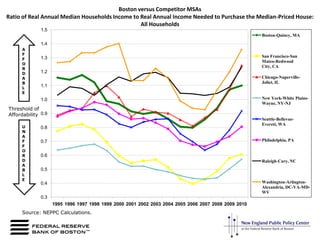
 However, most households in New England and the United States entered the housing downturn facing cost burdens from housing and few are able to take advantage of declining house prices.Measure of Affordability:Income Adequacy RatioCompares household income to income needed to afford housing.  If measure is great than or equal to 1.0 the area is affordable.Looks beyond housing price or monthly rent:For buyers: Interest rates, real estate taxes, insurance premiums, and personal mortgage insurance (for first-time homebuyers)For renters: contract rent plus utilitiesCaptures the state of housing affordability for those looking to buy or rent.
Ratio of Real Annual Median Households Income to Real Annual Income Needed to Purchase the Median-Priced House: All Households
Ratio of Real Annual Median Household Income to Real Annual Income Needed to Afford the Gross Rent: All Households
Boston versus Competitor MSAsRatio of Real Annual Median Households Income to Real Annual Income Needed to Purchase the Median-Priced House:All Households
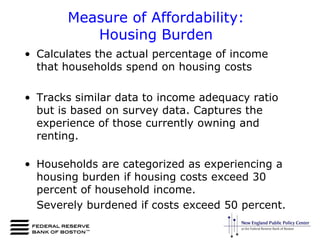
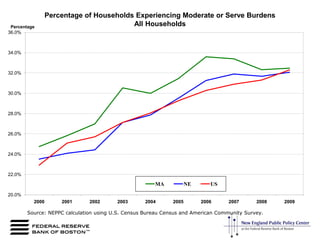
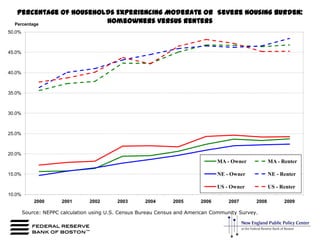
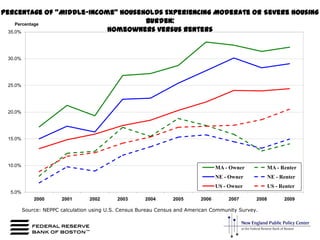
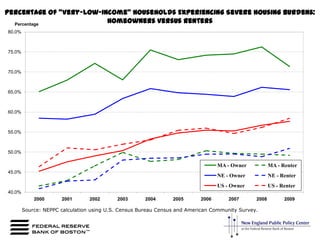
Measure of Affordability:Housing BurdenCalculates the actual percentage of income that households spend on housing costsTracks similar data to income adequacy ratio but is based on survey data. Captures the experience of those currently owning and renting.Households are categorized as experiencing a housing burden if housing costs exceed 30 percent of household income. 	Severely burdened if costs exceed 50 percent.
Percentage of Households Experiencing Moderate or Serve BurdensAll Households
Percentage of Households Experiencing Moderate or  Severe Housing Burden:Homeowners versus Renters
Percentage of "Middle-Income" Households Experiencing Moderate or Severe Housing Burden:Homeowners versus Renters
Percentage of "Very-Low-Income" Households Experiencing Severe Housing Burdens:Homeowners versus Renters
Where we are:The housing downturn has resulted in increased affordability for those able to buy.However, very few households are in a position to buy as they are facing high cost burdens from housing. Particularly low- and moderate-income households.The problem is particularly acute in the Massachusetts housing market.

Robert Clifford BWH Boston 2011

  • 1.
    The Housing Bustand Housing Affordability: Where do we stand?Robert Clifford, Policy AnalystNew England Public Policy CenterFederal Reserve Bank of BostonBringing Workers Home 2011 Regional Forum on Workforce Housing in BostonNational Association REALTORS and National Housing ConferenceJuly 28, 2011*The views expressed in this presentation are mine and not necessarily those of the Federal Reserve Bank of Boston or Federal Reserve System
  • 2.
    Real Housing Pricesversus Real Household Incomes, 1995-2010
  • 3.
    Perceived Positive ofthe Housing Crisis Falling housing prices have resulted in record affordability:“Houses in the United States are now more affordable than at any time in the last 40 years, when compared with personal income.” ~ New York Times, March 6, 2009. In reality the improvement in affordability are closer to early 2000 levels.
  • 4.
    However, mosthouseholds in New England and the United States entered the housing downturn facing cost burdens from housing and few are able to take advantage of declining house prices.Measure of Affordability:Income Adequacy RatioCompares household income to income needed to afford housing. If measure is great than or equal to 1.0 the area is affordable.Looks beyond housing price or monthly rent:For buyers: Interest rates, real estate taxes, insurance premiums, and personal mortgage insurance (for first-time homebuyers)For renters: contract rent plus utilitiesCaptures the state of housing affordability for those looking to buy or rent.
  • 5.
    Ratio of RealAnnual Median Households Income to Real Annual Income Needed to Purchase the Median-Priced House: All Households
  • 6.
    Ratio of RealAnnual Median Household Income to Real Annual Income Needed to Afford the Gross Rent: All Households
  • 7.
    Boston versus CompetitorMSAsRatio of Real Annual Median Households Income to Real Annual Income Needed to Purchase the Median-Priced House:All Households
  • 8.
    Measure of Affordability:HousingBurdenCalculates the actual percentage of income that households spend on housing costsTracks similar data to income adequacy ratio but is based on survey data. Captures the experience of those currently owning and renting.Households are categorized as experiencing a housing burden if housing costs exceed 30 percent of household income. Severely burdened if costs exceed 50 percent.
  • 9.
    Percentage of HouseholdsExperiencing Moderate or Serve BurdensAll Households
  • 10.
    Percentage of HouseholdsExperiencing Moderate or Severe Housing Burden:Homeowners versus Renters
  • 11.
    Percentage of "Middle-Income"Households Experiencing Moderate or Severe Housing Burden:Homeowners versus Renters
  • 12.
    Percentage of "Very-Low-Income"Households Experiencing Severe Housing Burdens:Homeowners versus Renters
  • 13.
    Where we are:Thehousing downturn has resulted in increased affordability for those able to buy.However, very few households are in a position to buy as they are facing high cost burdens from housing. Particularly low- and moderate-income households.The problem is particularly acute in the Massachusetts housing market.