To introduce primary market research
           and associated techniques


                        Facilitator: g THIERRY Mbenoun
Objective 1-4
 describe what is meant by primary research, including the
  difference between primary and secondary research

 examine different methods of collecting primary research,
  including surveys and questionnaires, focus groups,
  experiments and observation

 understand the concept of population and sample

 make judgments about the benefits and limitations of
  focus groups as a primary research method.
Market Research
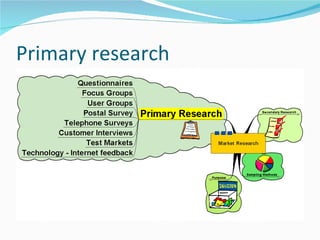
Primary research
Primary Research
  First hand information

  Expensive to collect, analyse and evaluate

  Can be highly focussed and relevant

  Care needs to be taken with the approach and

  methodology to ensure accuracy
  Types of question – closed – limited information

  gained; open – useful information but difficult to
  analyse
Quantitative and Qualitative Information:


 Quantitative – based on numbers – 56% of 18 year
 olds drink alcohol at least four times a week - doesn’t
 tell you why, when, how


 Qualitative – more detail – tells you why, when and
 how!
Advantages and Disadvantages
Advantages
r Addresses Specific Research Issues
i Greater Control
i Efficient Spending for Information
n Proprietary Information

Disadvantages
g) Higher Cost
h) Time Consuming
i) Not Always Feasible
keyword for Primary
Sources
You should type your research subject first then one of these words.
If you can search these are several examples of words that would identify a source as primary.
 charters
 correspondence
 diaries
 early works
 interviews
 manuscripts
 oratory
 pamphlets
 personal narratives
 sources
 speeches
 letters
 documents
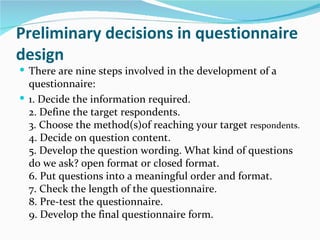
Preliminary decisions in questionnaire
design
 There are nine steps involved in the development of a
  questionnaire:
 1. Decide the information required.
  2. Define the target respondents.
  3. Choose the method(s)of reaching your target respondents.
  4. Decide on question content.
  5. Develop the question wording. What kind of questions
  do we ask? open format or closed format.
  6. Put questions into a meaningful order and format.
  7. Check the length of the questionnaire.
  8. Pre-test the questionnaire.
  9. Develop the final questionnaire form.
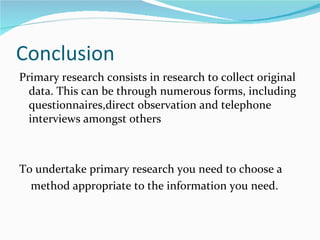
Conclusion
Primary research consists in research to collect original
  data. This can be through numerous forms, including
  questionnaires,direct observation and telephone
  interviews amongst others


To undertake primary research you need to choose a
  method appropriate to the information you need.

Primary market research

  • 1.
    To introduce primarymarket research and associated techniques Facilitator: g THIERRY Mbenoun
  • 2.
    Objective 1-4  describewhat is meant by primary research, including the difference between primary and secondary research  examine different methods of collecting primary research, including surveys and questionnaires, focus groups, experiments and observation  understand the concept of population and sample  make judgments about the benefits and limitations of focus groups as a primary research method.
  • 3.
  • 4.
  • 5.
    Primary Research First hand information  Expensive to collect, analyse and evaluate  Can be highly focussed and relevant  Care needs to be taken with the approach and methodology to ensure accuracy  Types of question – closed – limited information gained; open – useful information but difficult to analyse
  • 6.
    Quantitative and QualitativeInformation:  Quantitative – based on numbers – 56% of 18 year olds drink alcohol at least four times a week - doesn’t tell you why, when, how  Qualitative – more detail – tells you why, when and how!
  • 7.
    Advantages and Disadvantages Advantages rAddresses Specific Research Issues i Greater Control i Efficient Spending for Information n Proprietary Information Disadvantages g) Higher Cost h) Time Consuming i) Not Always Feasible
  • 8.
    keyword for Primary Sources Youshould type your research subject first then one of these words. If you can search these are several examples of words that would identify a source as primary.  charters  correspondence  diaries  early works  interviews  manuscripts  oratory  pamphlets  personal narratives  sources  speeches  letters  documents
  • 9.
    Preliminary decisions inquestionnaire design  There are nine steps involved in the development of a questionnaire:  1. Decide the information required. 2. Define the target respondents. 3. Choose the method(s)of reaching your target respondents. 4. Decide on question content. 5. Develop the question wording. What kind of questions do we ask? open format or closed format. 6. Put questions into a meaningful order and format. 7. Check the length of the questionnaire. 8. Pre-test the questionnaire. 9. Develop the final questionnaire form.
  • 10.
    Conclusion Primary research consistsin research to collect original data. This can be through numerous forms, including questionnaires,direct observation and telephone interviews amongst others To undertake primary research you need to choose a method appropriate to the information you need.