L.I.SYNIAK
TEACHER OF ENGLISH
NIZHYN GYMNASIUM №16
Authentic materials are resources created
for native speakers of the target language.
Authentic materials can include:
Listening:
TV shows, radio,
commercials, news
broadcasts,
documentaries, movies,
phone messages, etc.
Visual:
photographs, art works,
signs with symbols,
postcards, picture books,
etc.
Printed:
Restaurant menus,
newspaper articles,
bulletin board
advertisements,
company websites,
coupons, sales
catalogues, travel
brochures, maps,
telephone books, signs,
blogs, movie posters,
food labels, etc.
 Don’t attempt to use an audio clip that’s
longer than 1 minute.
 Plan great comprehension questions.
 Stay organized.
 Comics and cartoons
 Books and films
 use subtitles in the native language for the first
half of the film, allowing students to get used
to the actors’ voices and the words in the film,
before switching and putting the subtitles in
the target language for the rest of the film
Reinforce a grammar point
Listen for gist
Practice vocabulary
Discuss and debate
Role play
Comprehension Activities
How
Observant
Are You?
Vocabulary
Meaning
Match
Order
the
Events
Buzz
Game
Choose a
Word
Weather Report:
There Is a Blizzard on the Way!
 summarizes key points in the
weather report
 teaches 2-3 vocabulary related to the weather
condition
Menus: Order Your Favorite Dish
 Give students a worksheet where
they can write down what they order
at each station. Include a section for
price.
 Divide students into teams so they will need to move
together from one station to another.
 At each station, a team member should be the
waiter/waitress and use the back of his/her
worksheet to take orders.
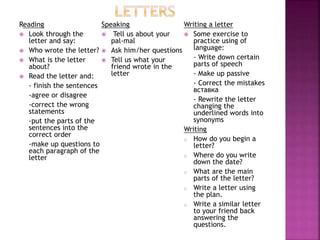
Reading
 Look through the
letter and say:
 Who wrote the letter?
 What is the letter
about?
 Read the letter and:
- finish the sentences
-agree or disagree
-correct the wrong
statements
-put the parts of the
sentences into the
correct order
-make up questions to
each paragraph of the
letter
Speaking
 Tell us about your
pal-mal
 Ask him/her questions
 Tell us what your
friend wrote in the
letter
Writing a letter
 Some exercise to
practice using of
language:
- Write down certain
parts of speech
- Make up passive
- Correct the mistakes
вставка
- Rewrite the letter
changing the
underlined words into
synonyms
Writing
o How do you begin a
letter?
o Where do you write
down the date?
o What are the main
parts of the letter?
o Write a letter using
the plan.
o Write a similar letter
to your friend back
answering the
questions.
Good reader employs a variety of skills:
 Predicting
 Skimming
 Making interferences
 Understanding text references
 Vocabulary development skills
www.strangeplacetostay.com

з досвіду роботи синяк л. і.

  • 1.
  • 4.
    Authentic materials areresources created for native speakers of the target language. Authentic materials can include: Listening: TV shows, radio, commercials, news broadcasts, documentaries, movies, phone messages, etc. Visual: photographs, art works, signs with symbols, postcards, picture books, etc. Printed: Restaurant menus, newspaper articles, bulletin board advertisements, company websites, coupons, sales catalogues, travel brochures, maps, telephone books, signs, blogs, movie posters, food labels, etc.
  • 5.
     Don’t attemptto use an audio clip that’s longer than 1 minute.  Plan great comprehension questions.  Stay organized.
  • 6.
     Comics andcartoons  Books and films  use subtitles in the native language for the first half of the film, allowing students to get used to the actors’ voices and the words in the film, before switching and putting the subtitles in the target language for the rest of the film
  • 7.
    Reinforce a grammarpoint Listen for gist Practice vocabulary Discuss and debate Role play
  • 8.
  • 9.
    Weather Report: There Isa Blizzard on the Way!  summarizes key points in the weather report  teaches 2-3 vocabulary related to the weather condition Menus: Order Your Favorite Dish  Give students a worksheet where they can write down what they order at each station. Include a section for price.  Divide students into teams so they will need to move together from one station to another.  At each station, a team member should be the waiter/waitress and use the back of his/her worksheet to take orders.
  • 10.
    Reading  Look throughthe letter and say:  Who wrote the letter?  What is the letter about?  Read the letter and: - finish the sentences -agree or disagree -correct the wrong statements -put the parts of the sentences into the correct order -make up questions to each paragraph of the letter Speaking  Tell us about your pal-mal  Ask him/her questions  Tell us what your friend wrote in the letter Writing a letter  Some exercise to practice using of language: - Write down certain parts of speech - Make up passive - Correct the mistakes вставка - Rewrite the letter changing the underlined words into synonyms Writing o How do you begin a letter? o Where do you write down the date? o What are the main parts of the letter? o Write a letter using the plan. o Write a similar letter to your friend back answering the questions.
  • 12.
    Good reader employsa variety of skills:  Predicting  Skimming  Making interferences  Understanding text references  Vocabulary development skills
  • 13.