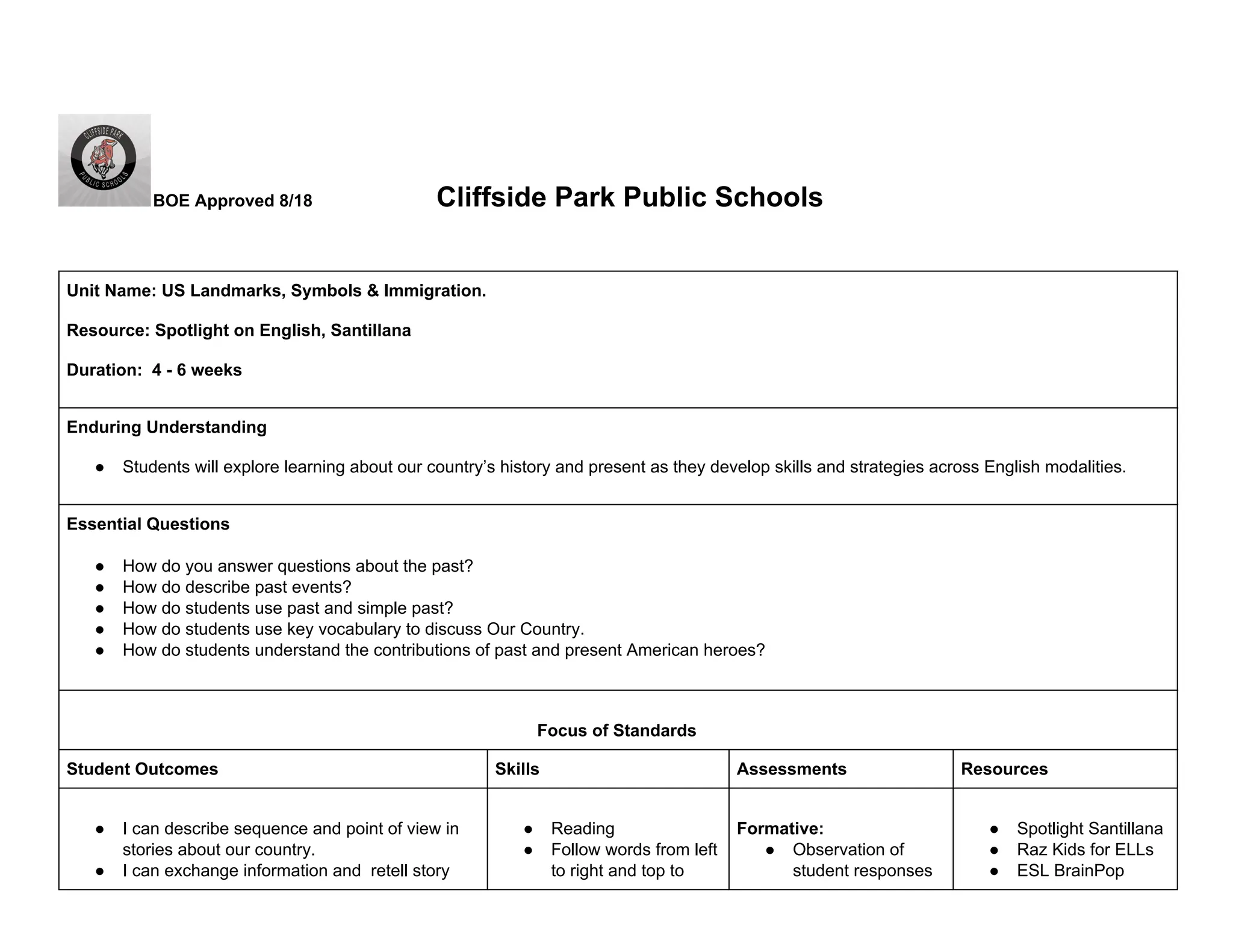
BOE Approved 8/18 ​​Cliffside Park Public Schools
Unit Name: US Landmarks, Symbols & Immigration.
Resource: Spotlight on English, Santillana
Duration: 4 - 6 weeks
Enduring Understanding
● Students will explore learning about our country’s history and present as they develop skills and strategies across English modalities.
Essential Questions
● How do you answer questions about the past?
● How do describe past events?
● How do students use past and simple past?
● How do students use key vocabulary to discuss Our Country.
● How do students understand the contributions of past and present American heroes?
Focus of Standards
Student Outcomes Skills Assessments Resources
● I can describe sequence and point of view in
stories about our country.
● I can exchange information and retell story
● Reading
● Follow words from left
to right and top to
Formative:
● Observation of
student responses
● Spotlight Santillana
● Raz Kids for ELLs
● ESL BrainPop
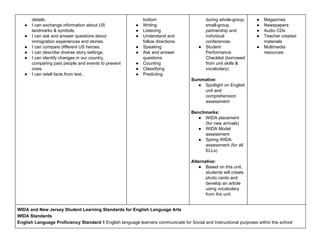
details.
● I can exchange information about US
landmarks & symbols.
● I can ask and answer questions about
immigration experiences and stories.
● I can compare different US heroes.
● I can describe diverse story settings.
● I can identify changes in our country,
comparing past people and events to present
ones.
● I can retell facts from text..
bottom
● Writing
● Listening
● Understand and
follow directions.
● Speaking
● Ask and answer
questions
● Counting
● Classifying
● Predicting
during whole-group,
small-group,
partnership and
individual
conferences.
● Student
Performance
Checklist (borrowed
from unit skills &
vocabulary)
Summative:
● Spotlight on English
unit and
comprehension
assessment
Benchmarks:
● WIDA placement
(for new arrivals)
● WIDA Model
assessment
● Spring WIDA
assessment (for all
ELLs)
Alternative:
● Based on this unit,
students will create
photo cards and
develop an article
using vocabulary
from the unit
● Magazines
● Newspapers
● Audio CDs
● Teacher created
materials
● Multimedia
resources
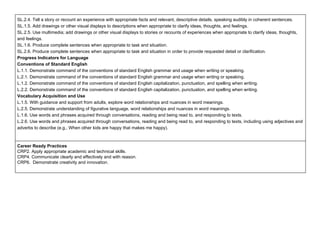
WIDA and New Jersey Student Learning Standards for English Language Arts
WIDA Standards
English Language Proficiency Standard 1​​ English language learners communicate for Social and Instructional purposes within the school
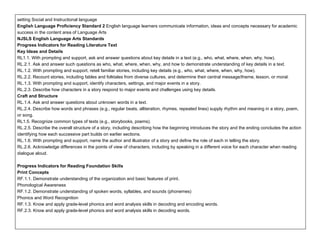
setting Social and Instructional language
English Language Proficiency Standard 2 ​​English language learners communicate information, ideas and concepts necessary for academic
success in the content area of Language Arts
NJSLS English Language Arts Standards
Progress Indicators for Reading Literature Text
Key Ideas and Details
RL1.1. With prompting and support, ask and answer questions about key details in a text (e.g., who, what, where, when, why, how).
RL.2.1. Ask and answer such questions as who, what, where, when, why, and how to demonstrate understanding of key details in a text.
RL.1.2. With prompting and support, retell familiar stories, including key details (e.g., who, what, where, when, why, how).
RL.2.2. Recount stories, including fables and folktales from diverse cultures, and determine their central message/theme, lesson, or moral.
RL.1.3. With prompting and support, identify characters, settings, and major events in a story.
RL.2.3. Describe how characters in a story respond to major events and challenges using key details.
Craft and Structure
RL.1.4. Ask and answer questions about unknown words in a text.
RL.2.4. Describe how words and phrases (e.g., regular beats, alliteration, rhymes, repeated lines) supply rhythm and meaning in a story, poem,
or song.
RL1.5. Recognize common types of texts (e.g., storybooks, poems).
RL.2.5. Describe the overall structure of a story, including describing how the beginning introduces the story and the ending concludes the action
identifying how each successive part builds on earlier sections.
RL.1.6. With prompting and support, name the author and illustrator of a story and define the role of each in telling the story.
RL.2.6. Acknowledge differences in the points of view of characters, including by speaking in a different voice for each character when reading
dialogue aloud.
Progress Indicators for Reading Foundation Skills
Print Concepts
RF.1.1. Demonstrate understanding of the organization and basic features of print.
Phonological Awareness
RF.1.2. Demonstrate understanding of spoken words, syllables, and sounds (phonemes)
Phonics and Word Recognition
RF.1.3. Know and apply grade-level phonics and word analysis skills in decoding and encoding words.
RF.2.3. Know and apply grade-level phonics and word analysis skills in decoding words.
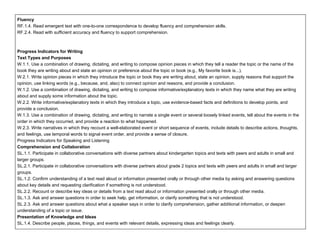
Fluency
RF.1.4. Read emergent text with one-to-one correspondence to develop fluency and comprehension skills.
RF.2.4. Read with sufficient accuracy and fluency to support comprehension.
Progress Indicators for Writing
Text Types and Purposes
W.1.1. Use a combination of drawing, dictating, and writing to compose opinion pieces in which they tell a reader the topic or the name of the
book they are writing about and state an opinion or preference about the topic or book (e.g., My favorite book is...).
W.2.1. Write opinion pieces in which they introduce the topic or book they are writing about, state an opinion, supply reasons that support the
opinion, use linking words (e.g., because, and, also) to connect opinion and reasons, and provide a conclusion.
W.1.2. Use a combination of drawing, dictating, and writing to compose informative/explanatory texts in which they name what they are writing
about and supply some information about the topic.
W.2.2. Write informative/explanatory texts in which they introduce a topic, use evidence-based facts and definitions to develop points, and
provide a conclusion.
W.1.3. Use a combination of drawing, dictating, and writing to narrate a single event or several loosely linked events, tell about the events in the
order in which they occurred, and provide a reaction to what happened.
W.2.3. Write narratives in which they recount a well-elaborated event or short sequence of events, include details to describe actions, thoughts,
and feelings, use temporal words to signal event order, and provide a sense of closure.
Progress Indicators for Speaking and Listening
Comprehension and Collaboration
SL.1.1. Participate in collaborative conversations with diverse partners about kindergarten topics and texts with peers and adults in small and
larger groups.
SL.2.1. Participate in collaborative conversations with diverse partners about grade 2 topics and texts with peers and adults in small and larger
groups.
SL.1.2. Confirm understanding of a text read aloud or information presented orally or through other media by asking and answering questions
about key details and requesting clarification if something is not understood.
SL.2.2. Recount or describe key ideas or details from a text read aloud or information presented orally or through other media.
SL.1.3. Ask and answer questions in order to seek help, get information, or clarify something that is not understood.
SL.2.3. Ask and answer questions about what a speaker says in order to clarify comprehension, gather additional information, or deepen
understanding of a topic or issue.
Presentation of Knowledge and Ideas
SL.1.4. Describe people, places, things, and events with relevant details, expressing ideas and feelings clearly.
SL.2.4. Tell a story or recount an experience with appropriate facts and relevant, descriptive details, speaking audibly in coherent sentences.
SL.1.5. Add drawings or other visual displays to descriptions when appropriate to clarify ideas, thoughts, and feelings.
SL.2.5. Use multimedia; add drawings or other visual displays to stories or recounts of experiences when appropriate to clarify ideas, thoughts,
and feelings.
SL.1.6. Produce complete sentences when appropriate to task and situation.
SL.2.6. Produce complete sentences when appropriate to task and situation in order to provide requested detail or clarification.
Progress Indicators for Language
Conventions of Standard English
L.1.1. Demonstrate command of the conventions of standard English grammar and usage when writing or speaking.
L.2.1. Demonstrate command of the conventions of standard English grammar and usage when writing or speaking.
L.1.2. Demonstrate command of the conventions of standard English capitalization, punctuation, and spelling when writing.
L.2.2. Demonstrate command of the conventions of standard English capitalization, punctuation, and spelling when writing.
Vocabulary Acquisition and Use
L.1.5. With guidance and support from adults, explore word relationships and nuances in word meanings.
L.2.5. Demonstrate understanding of figurative language, word relationships and nuances in word meanings.
L.1.6. Use words and phrases acquired through conversations, reading and being read to, and responding to texts.
L.2.6. Use words and phrases acquired through conversations, reading and being read to, and responding to texts, including using adjectives and
adverbs to describe (e.g., When other kids are happy that makes me happy).
Career Ready Practices
CRP2. Apply appropriate academic and technical skills.
CRP4. Communicate clearly and effectively and with reason.
CRP6. Demonstrate creativity and innovation.
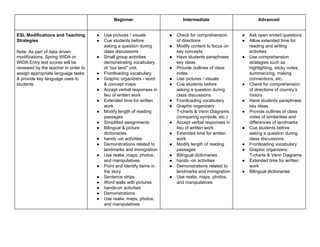
Beginner Intermediate Advanced
ESL Modifications and Teaching
Strategies
Note: As part of data driven
modifications, Spring WIDA or
WIDA Entry test scores will be
reviewed by the teacher in order to
assign appropriate language tasks
& provide key language uses to
students.
● Use pictures / visuals
● Cue students before
asking a question during
class discussions
● Small group activities
demonstrating vocabulary
of “our land” unit.
● Frontloading vocabulary
● Graphic organizers - word
& concept maps
● Accept verbal responses in
lieu of written work
● Extended time for written
work
● Modify length of reading
passages
● Simplified assignments
● Bilingual & picture
dictionaries
● hands -on activities
● Demonstrations related to
landmarks and immigration
● Use realia, maps, photos,
and manipulatives
● Point and identify items in
the story
● Sentence strips
● Word walls with pictures
● hands-on activities
● Demonstrations
● Use realia, maps, photos,
and manipulatives
● Check for comprehension
of directions
● Modify content to focus on
key concepts
● Have students paraphrase
key ideas
● Provide outlines of class
notes
● Use pictures / visuals
● Cue students before
asking a question during
class discussions
● Frontloading vocabulary
● Graphic organizers:
T-charts & Venn Diagrams
(comparing symbols, etc.)
● Accept verbal responses in
lieu of written work
● Extended time for written
work
● Modify length of reading
passages
● Bilingual dictionaries
● hands -on activities
● Demonstrations related to
landmarks and immigration
● Use realia, maps, photos,
and manipulatives
● Ask open ended questions
● Allow extended time for
reading and writing
activities
● Use comprehension
strategies such as
highlighting, sticky notes,
summarizing, making
connections, etc.
● Check for comprehension
of directions of country’s
history
● Have students paraphrase
key ideas
● Provide outlines of class
notes of similarities and
differences of landmarks
● Cue students before
asking a question during
class discussions
● Frontloading vocabulary
● Graphic organizers:
T-charts & Venn Diagrams
● Extended time for written
work
● Bilingual dictionaries
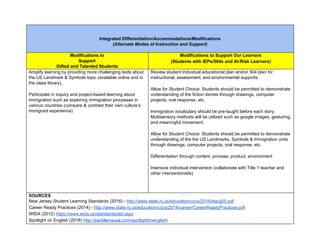
Integrated Differentiation/Accommodations/Modifications
(Alternate Modes of Instruction and Support)
Modifications to
Support
Gifted and Talented Students
Modifications to Support Our Learners
(Students with IEPs/504s and​​ ​At-Risk Learners)
Amplify learning by providing more challenging texts about
the US Landmark & Symbols topic (available online and in
the class library).
Participate in inquiry and project-based learning about
immigration such as exploring immigration processes in
various countries (compare & contrast their own culture’s
immigrant experience)
Review student individual educational plan and/or 504 plan for
instructional, assessment, and environmental supports.
Allow for Student Choice: Students should be permitted to demonstrate
understanding of the fiction stories through drawings, computer
projects, oral response, etc.
Immigration vocabulary should be pre-taught before each story.
Multisensory methods will be utilized such as google images, gesturing,
and meaningful movement.
Allow for Student Choice: Students should be permitted to demonstrate
understanding of the the US Landmarks, Symbols & Immigration units
through drawings, computer projects, oral response, etc.
Differentiation through content, process, product, environment
Intensive individual intervention (collaborate with Title 1 teacher and
other interventionists)
SOURCES
New Jersey Student Learning Standards (2016) -​ ​http://www.state.nj.us/education/cccs/2016/ela/g05.pdf
Career Ready Practices (2014) -​ ​http://www.state.nj.us/education/cccs/2014/career/CareerReadyPractices.pdf
WIDA (2012)​ ​https://www.wida.us/standards/eld.aspx
Spotlight on English (2016) ​http://santillanausa.com/spotlightonenglish/

DocuGrade-1-and-2-ESL-Unit-5planning.pdf

  • 1.
    BOE Approved 8/18​​Cliffside Park Public Schools Unit Name: US Landmarks, Symbols & Immigration. Resource: Spotlight on English, Santillana Duration: 4 - 6 weeks Enduring Understanding ● Students will explore learning about our country’s history and present as they develop skills and strategies across English modalities. Essential Questions ● How do you answer questions about the past? ● How do describe past events? ● How do students use past and simple past? ● How do students use key vocabulary to discuss Our Country. ● How do students understand the contributions of past and present American heroes? Focus of Standards Student Outcomes Skills Assessments Resources ● I can describe sequence and point of view in stories about our country. ● I can exchange information and retell story ● Reading ● Follow words from left to right and top to Formative: ● Observation of student responses ● Spotlight Santillana ● Raz Kids for ELLs ● ESL BrainPop
  • 2.
    details. ● I canexchange information about US landmarks & symbols. ● I can ask and answer questions about immigration experiences and stories. ● I can compare different US heroes. ● I can describe diverse story settings. ● I can identify changes in our country, comparing past people and events to present ones. ● I can retell facts from text.. bottom ● Writing ● Listening ● Understand and follow directions. ● Speaking ● Ask and answer questions ● Counting ● Classifying ● Predicting during whole-group, small-group, partnership and individual conferences. ● Student Performance Checklist (borrowed from unit skills & vocabulary) Summative: ● Spotlight on English unit and comprehension assessment Benchmarks: ● WIDA placement (for new arrivals) ● WIDA Model assessment ● Spring WIDA assessment (for all ELLs) Alternative: ● Based on this unit, students will create photo cards and develop an article using vocabulary from the unit ● Magazines ● Newspapers ● Audio CDs ● Teacher created materials ● Multimedia resources WIDA and New Jersey Student Learning Standards for English Language Arts WIDA Standards English Language Proficiency Standard 1​​ English language learners communicate for Social and Instructional purposes within the school
  • 3.
    setting Social andInstructional language English Language Proficiency Standard 2 ​​English language learners communicate information, ideas and concepts necessary for academic success in the content area of Language Arts NJSLS English Language Arts Standards Progress Indicators for Reading Literature Text Key Ideas and Details RL1.1. With prompting and support, ask and answer questions about key details in a text (e.g., who, what, where, when, why, how). RL.2.1. Ask and answer such questions as who, what, where, when, why, and how to demonstrate understanding of key details in a text. RL.1.2. With prompting and support, retell familiar stories, including key details (e.g., who, what, where, when, why, how). RL.2.2. Recount stories, including fables and folktales from diverse cultures, and determine their central message/theme, lesson, or moral. RL.1.3. With prompting and support, identify characters, settings, and major events in a story. RL.2.3. Describe how characters in a story respond to major events and challenges using key details. Craft and Structure RL.1.4. Ask and answer questions about unknown words in a text. RL.2.4. Describe how words and phrases (e.g., regular beats, alliteration, rhymes, repeated lines) supply rhythm and meaning in a story, poem, or song. RL1.5. Recognize common types of texts (e.g., storybooks, poems). RL.2.5. Describe the overall structure of a story, including describing how the beginning introduces the story and the ending concludes the action identifying how each successive part builds on earlier sections. RL.1.6. With prompting and support, name the author and illustrator of a story and define the role of each in telling the story. RL.2.6. Acknowledge differences in the points of view of characters, including by speaking in a different voice for each character when reading dialogue aloud. Progress Indicators for Reading Foundation Skills Print Concepts RF.1.1. Demonstrate understanding of the organization and basic features of print. Phonological Awareness RF.1.2. Demonstrate understanding of spoken words, syllables, and sounds (phonemes) Phonics and Word Recognition RF.1.3. Know and apply grade-level phonics and word analysis skills in decoding and encoding words. RF.2.3. Know and apply grade-level phonics and word analysis skills in decoding words.
  • 4.
    Fluency RF.1.4. Read emergenttext with one-to-one correspondence to develop fluency and comprehension skills. RF.2.4. Read with sufficient accuracy and fluency to support comprehension. Progress Indicators for Writing Text Types and Purposes W.1.1. Use a combination of drawing, dictating, and writing to compose opinion pieces in which they tell a reader the topic or the name of the book they are writing about and state an opinion or preference about the topic or book (e.g., My favorite book is...). W.2.1. Write opinion pieces in which they introduce the topic or book they are writing about, state an opinion, supply reasons that support the opinion, use linking words (e.g., because, and, also) to connect opinion and reasons, and provide a conclusion. W.1.2. Use a combination of drawing, dictating, and writing to compose informative/explanatory texts in which they name what they are writing about and supply some information about the topic. W.2.2. Write informative/explanatory texts in which they introduce a topic, use evidence-based facts and definitions to develop points, and provide a conclusion. W.1.3. Use a combination of drawing, dictating, and writing to narrate a single event or several loosely linked events, tell about the events in the order in which they occurred, and provide a reaction to what happened. W.2.3. Write narratives in which they recount a well-elaborated event or short sequence of events, include details to describe actions, thoughts, and feelings, use temporal words to signal event order, and provide a sense of closure. Progress Indicators for Speaking and Listening Comprehension and Collaboration SL.1.1. Participate in collaborative conversations with diverse partners about kindergarten topics and texts with peers and adults in small and larger groups. SL.2.1. Participate in collaborative conversations with diverse partners about grade 2 topics and texts with peers and adults in small and larger groups. SL.1.2. Confirm understanding of a text read aloud or information presented orally or through other media by asking and answering questions about key details and requesting clarification if something is not understood. SL.2.2. Recount or describe key ideas or details from a text read aloud or information presented orally or through other media. SL.1.3. Ask and answer questions in order to seek help, get information, or clarify something that is not understood. SL.2.3. Ask and answer questions about what a speaker says in order to clarify comprehension, gather additional information, or deepen understanding of a topic or issue. Presentation of Knowledge and Ideas SL.1.4. Describe people, places, things, and events with relevant details, expressing ideas and feelings clearly.
  • 5.
    SL.2.4. Tell astory or recount an experience with appropriate facts and relevant, descriptive details, speaking audibly in coherent sentences. SL.1.5. Add drawings or other visual displays to descriptions when appropriate to clarify ideas, thoughts, and feelings. SL.2.5. Use multimedia; add drawings or other visual displays to stories or recounts of experiences when appropriate to clarify ideas, thoughts, and feelings. SL.1.6. Produce complete sentences when appropriate to task and situation. SL.2.6. Produce complete sentences when appropriate to task and situation in order to provide requested detail or clarification. Progress Indicators for Language Conventions of Standard English L.1.1. Demonstrate command of the conventions of standard English grammar and usage when writing or speaking. L.2.1. Demonstrate command of the conventions of standard English grammar and usage when writing or speaking. L.1.2. Demonstrate command of the conventions of standard English capitalization, punctuation, and spelling when writing. L.2.2. Demonstrate command of the conventions of standard English capitalization, punctuation, and spelling when writing. Vocabulary Acquisition and Use L.1.5. With guidance and support from adults, explore word relationships and nuances in word meanings. L.2.5. Demonstrate understanding of figurative language, word relationships and nuances in word meanings. L.1.6. Use words and phrases acquired through conversations, reading and being read to, and responding to texts. L.2.6. Use words and phrases acquired through conversations, reading and being read to, and responding to texts, including using adjectives and adverbs to describe (e.g., When other kids are happy that makes me happy). Career Ready Practices CRP2. Apply appropriate academic and technical skills. CRP4. Communicate clearly and effectively and with reason. CRP6. Demonstrate creativity and innovation.
  • 6.
    Beginner Intermediate Advanced ESLModifications and Teaching Strategies Note: As part of data driven modifications, Spring WIDA or WIDA Entry test scores will be reviewed by the teacher in order to assign appropriate language tasks & provide key language uses to students. ● Use pictures / visuals ● Cue students before asking a question during class discussions ● Small group activities demonstrating vocabulary of “our land” unit. ● Frontloading vocabulary ● Graphic organizers - word & concept maps ● Accept verbal responses in lieu of written work ● Extended time for written work ● Modify length of reading passages ● Simplified assignments ● Bilingual & picture dictionaries ● hands -on activities ● Demonstrations related to landmarks and immigration ● Use realia, maps, photos, and manipulatives ● Point and identify items in the story ● Sentence strips ● Word walls with pictures ● hands-on activities ● Demonstrations ● Use realia, maps, photos, and manipulatives ● Check for comprehension of directions ● Modify content to focus on key concepts ● Have students paraphrase key ideas ● Provide outlines of class notes ● Use pictures / visuals ● Cue students before asking a question during class discussions ● Frontloading vocabulary ● Graphic organizers: T-charts & Venn Diagrams (comparing symbols, etc.) ● Accept verbal responses in lieu of written work ● Extended time for written work ● Modify length of reading passages ● Bilingual dictionaries ● hands -on activities ● Demonstrations related to landmarks and immigration ● Use realia, maps, photos, and manipulatives ● Ask open ended questions ● Allow extended time for reading and writing activities ● Use comprehension strategies such as highlighting, sticky notes, summarizing, making connections, etc. ● Check for comprehension of directions of country’s history ● Have students paraphrase key ideas ● Provide outlines of class notes of similarities and differences of landmarks ● Cue students before asking a question during class discussions ● Frontloading vocabulary ● Graphic organizers: T-charts & Venn Diagrams ● Extended time for written work ● Bilingual dictionaries
  • 7.
    Integrated Differentiation/Accommodations/Modifications (Alternate Modesof Instruction and Support) Modifications to Support Gifted and Talented Students Modifications to Support Our Learners (Students with IEPs/504s and​​ ​At-Risk Learners) Amplify learning by providing more challenging texts about the US Landmark & Symbols topic (available online and in the class library). Participate in inquiry and project-based learning about immigration such as exploring immigration processes in various countries (compare & contrast their own culture’s immigrant experience) Review student individual educational plan and/or 504 plan for instructional, assessment, and environmental supports. Allow for Student Choice: Students should be permitted to demonstrate understanding of the fiction stories through drawings, computer projects, oral response, etc. Immigration vocabulary should be pre-taught before each story. Multisensory methods will be utilized such as google images, gesturing, and meaningful movement. Allow for Student Choice: Students should be permitted to demonstrate understanding of the the US Landmarks, Symbols & Immigration units through drawings, computer projects, oral response, etc. Differentiation through content, process, product, environment Intensive individual intervention (collaborate with Title 1 teacher and other interventionists) SOURCES New Jersey Student Learning Standards (2016) -​ ​http://www.state.nj.us/education/cccs/2016/ela/g05.pdf Career Ready Practices (2014) -​ ​http://www.state.nj.us/education/cccs/2014/career/CareerReadyPractices.pdf WIDA (2012)​ ​https://www.wida.us/standards/eld.aspx Spotlight on English (2016) ​http://santillanausa.com/spotlightonenglish/