xiv 一切漏經注:巴漢校譯與導論
Foreword
One ofthe most significant developments in modern Buddhism has been the
encounter of different Buddhist traditions after centuries of mutual isolation. From
the time Buddhism disappeared in India in the 12th century high mountains or
forbidding deserts separated each major tradition from the others. Thus each of the
three major traditions was confined to a different region. Theravada Buddhism,
heir to the early stage of Indian Buddhism, flourished in southern Asia. East Asian
Buddhism, representing early and middle period Indian Mahayana Buddhism,
flourished in China, Korea, and Japan. Vajrayana Buddhism, representing late
Indian Mahayana, flourished in Tibet and other Himalayan lands.
Through all the centuries these Buddhist traditions hardly knew of each other’s
existence. Today, however, rapid means of travel and communications have
removed these barriers, making it possible for followers of the different Buddhist
traditions to study the other traditions in depth. I believe this meeting between
different Buddhist traditions will help to revitalize Buddhism. In the future it is
bound to result in cross-fertilization between Buddhist systems and contribute to
greater understanding among fellow Buddhists.
Since Theravada Buddhism is a living tradition based on texts from the earliest
phase of Indian Buddhism, its literature has received special attention from
scholars and practitioners. To learn Theravada Buddhism in depth, however, it is
not enough only to study the Pāli Tipiṭaka. The Theravada tradition has evolved
through several stages, all of which have given it a distinctive character. The
earliest stage of the tradition is represented by the four major Nikāyas and the
oldest books of the Khuddaka Nikāya, such as the Suttanipāta, the Dhammapada,
and the Theragāthā and Therīgāthā. Because the Pāli Nikāyas correspond closely
to the Chinese Āgamas, modern scholars have been comparing parallel versions of
the same texts in Pāli and Chinese, as well as other versions preserved in Sanskrit
and Tibetan.
0-3_前言_菩提比丘_1031211打樣1修.indd 2 2015/2/14 下午 09:29:55
xvi 一切漏經注:巴漢校譯與導論
Following theage of the Nikāyas the next major stage in the evolution of
Theravada doctrine is found in the Abhidhamma Piṭaka and in later books of the
Khuddaka Nikāya such as the Paṭisambhidāmagga and the two Niddesas, word
commentaries on parts of the Suttanipāta. In these works the distinctly Theravada
method of analysis is beginning to take shape. The Theravada interpretation of
the Buddha-dharma, however, reached full maturity in the Pāli commentaries by
Ācariya Buddhaghosa, an Indian monk who came to Sri Lanka in the fifth century.
Buddhaghosa is best known as the author of the Visuddhimagga, a large
treatise on Theravada doctrine and practice, but he also composed commentaries
on the four Nikāyas, the Vinaya Piṭaka, and possibly the Abhidhamma Piṭaka.
Buddhaghosa, however, was not the author of the commentaries as we understand
the idea of “authorship” today. According to his own statement, his achievement
was to edit older commentaries that had been preserved at the Mahāvihāra (the
Great Monastery) in Anuradhapura, the ancient capital of Sri Lanka. These older
commentaries were recorded in an early form of the Sinhala language. The earliest
layers of the ancient commentaries must go back to India, perhaps as far back
as the first few generations after the Buddha’s time. The later parts would have
been added after Buddhism came to Sri Lanka in the third century BCE. But
from internal evidence it seems these ancient commentaries were closed by about
the beginning of the 2nd century CE. Buddhaghosa studied these commentaries,
eliminated what he found redundant, and translated the material into a lucid and
elegant style of Pāli.
In the Pāli language the commentaries are collectively called Aṭṭhakathā, which
means “discussions (kathā) of the meaning (aṭṭha).” The commentaries explain
the original texts from two points of view. One is the word explanation, which
clarifies the meaning of important terms in the root text by means of more familiar
terms. The other type of explanation explains the doctrinal meaning. This kind of
explanation usually interprets a term or passage in the root text by relating it to the
body of Theravada doctrine.
The most important of the commentaries are those to the four Nikāyas, each of
which has its own commentary. For those who want to understand the Pāli suttas
as they are interpreted in the living Theravada tradition, it is necessary to become
0-3_前言_菩提比丘_1031211打樣1修.indd 4 2015/2/14 下午 09:29:55
xviii 一切漏經注:巴漢校譯與導論
familiar withthe Pāli commentaries. At this point in time, however, very little
material from these commentaries has been translated into English or other modern
languages. The present work is a pioneering attempt to make an important Pāli
commentary, with its root text, available for readers of Chinese. It is the translation
of the commentary to the second sutta of the Majjhima Nikāya, the Sabbāsava
Sutta. It is taken from the commentary to the Majjhima Nikāya, which is called
the Majjhima Nikāya Aṭṭhakathā and is also known by its proper name, Papañca-
sūdanī.
In 2009 three of my Pāli students asked me to help them study the commentaries
in Pāli. Two were nuns from Taiwan, Ven. Jiandao and Ven. Jianxun, both from
Xiang Guang Si in Jia Yi. The other was a lay student, Po-Hui Chang, PhD, who
has long lived in the U.S. All three had studied sutta-style Pāli under me for several
years. The two nuns were enrolled in a PhD program at the University of Hong
Kong and had come back to the U.S for a three-month stay to learn commentarial-
style Pāli with me at Chuang Yen Monastery in New York State, where I live.
During their stay, the three of them read with me the commentary to the first sutta
of the Majjhima Nikāya, the Mūlapariyāya Sutta. After our session, the two nuns
returned to Hong Kong. They came back the following year to continue their study
of commentarial Pāli. This time I taught these three students the commentary to the
Sabbāsava Sutta.
As I explained the commentary, Po-Hui took detailed notes. She also recorded
our classes so she could review them later. When our three-month session was
over, she decided to translate the entire Sabbāsava Commentary from Pāli directly
into Chinese. She has been diligently working on this project for the past two years.
In this time we have often met to discuss questions she had about the commentary,
so I am confident she has provided an accurate translation.
Not only has Po-Hui translated the entire commentary, but she has included
an illuminating introduction and many valuable notes. Some notes are based on
my oral explanations, but many notes are drawn from theṬīkā or subcommentary
to the Sabbāsava Sutta. This was written by the South Indian monk Ācariya
Dhammapāla, who lived perhaps two centuries after Buddhaghosa. The Ṭīkās
have the purpose of clarifying unclear terms in the commentaries and also
0-3_前言_菩提比丘_1031211打樣1修.indd 6 2015/2/14 下午 09:29:55
xx 一切漏經注:巴漢校譯與導論
providing furtherelucidation of the suttas. The style of theṬīkās is complex. Their
language is very technical and their ideas are often more philosophical than the
commentaries.
For several decades Chinese translations of the Pāli suttas have been available.
Although these are still imperfect, new projects are underway to provide more
accurate translations of the Nikāyas. However, there is also a need for translations
of commentaries. In this respect, Po-Hui has made a truly groundbreaking
contribution. I am delighted that I could help her fulfill this need and congratulate
her on completing this work. I give my blessings to its publication.
I hope this translation will inspire a more sustained effort to translate Pāli
commentaries into Chinese. I also hope that the respectful study of our different
Buddhist traditions will promote harmony among Buddhist followers and give
fresh vitality to Buddhism in the modern world.
Ven. Bhikkhu Bodhi
Chuang Yen Monastery
Carmel, New York, U.S.A.
0-3_前言_菩提比丘_1031211打樣1修.indd 8 2015/2/14 下午 09:29:55
40 一切漏經注:巴漢校譯與導論
四、念(sati)
sati ([正]念):雖然巴利原文無「正」字,但因巴利上座部
論把「念」歸為美心所,因此所有的念(sati),都屬「正念」
(sammāsati),對於經中「邪念」(micchāsati) 一詞,詮釋為「無
正念」,此與說一切有部論所說不同。說一切有部論中,「念」
通一切心所 (aññasamānacetasika),因此,為善時念茲在茲的念屬
「正念」,為惡時念茲在茲的念屬「邪念」。經說的目的在於實
修,提及「念」時總在修行的範疇之內,因此經中的「念」皆
等同於「正念」,如三十七道品中,四念處、念根、念力、念覺
支,雖然沒有如八正道中的正念冠上正 (sammā) 字,但實際上都
是「正念」。
五、列舉而憶念、無漂流 (apilāpana)
apilāpana:經中原始涵義為「列舉」,但注釋文獻解說「念覺
支」的特相 apilāpana 為「無漂流」,Norman, K. R. 認為無漂流
應是「列舉而(令人)憶起」一字之誤
82
。菩提長老根據 Norman
的考證,進一步說明其由來:apilāpana 的動詞是 lapati (談話),
由字根 lap 而來,加上字首 abhi- 成為 abhilāpati(描述),而
abhilāpati = apilāpati,使役動詞是 apilāpeti (告知某人使令憶起),
名詞 apilāpana 是「列舉使憶起」之義。注釋文獻以為 apilāpana
82 “Apilāpeti means “to cause to be recited, to enumerate” and then “to remind
someone of something by enumerating it to them.” (使令誦讀、列舉,
之後,因列舉而使其想起) (Norman, K. R. (1992), Pali Lexicographical
Studies V. Collected Papers, Vol. III. Oxford: The Pali Text Society,頁256-
259)。
02_導論_1040214_修.indd 40 2015/2/14 下午 09:43:55
108 一切漏經注:巴漢校譯與導論
Tattha ahosiṃnu kho na nu kho ti sassatâkārañ ca adhiccasamuppatti-
ākārañ ca nissāya atīte attano vijjamānatañ ca avijjamānatañ ca kaṅkhati.
Kiṃ kāraṇan ti na vattabbaṃ. Ummattako viya bālaputhujjano yathā vā
tathā vā pavattati. Api ca ayoniso manasikāro yev’ ettha kāraṇaṃ. Evaṃ
ayoniso manasikārassa pana kiṃ kāraṇan ti? Sv’ eva puthujjanabhāvo;
ariyānaṃ adassanâdīni vā. Nanu ca puthujjano yoniso pi manasikaroti?
Ko vā evam āha: Na manasi karotī ti? Na pana tattha puthujjanabhāvo
kāraṇaṃ. Saddhammasavana-kalyāṇamittatâdīni tattha kāraṇāni. Na hi
macchamaṃsâdīni attano pakatiyā sugandhāni; abhisaṅkhārapaccayā pana
sugandhāni pi honti.
Kin nu kho ahosin ti jātiliṅgūpapattiyo38
nissāya khattiyo nu kho ahosiṃ,
brāhmaṇa-vessa-sudda-gahaṭṭha-pabbajita-deva-manussānaṃ aññataro ti
kaṅkhati. Kathaṃ nu kho ti saṇṭhānâkāraṃ nissāya, dīgho nu kho ahosiṃ,
rassa-odāta-kaṇha-ppamāṇika-appamāṇikâdīnaṃ39
aññataro ti kaṅkhati. Keci
pana, Issaranimmānâdiṃ nissāya kena nu kho kāraṇena ahosin ti hetuto
kaṅkhatī ti vadanti.Kiṃ hutvā kiṃ ahosin ti jāti-ādīni nissāya, khattiyo hutvā
nu kho brāhmaṇo ahosiṃ—pe—devo hutvā manusso ti attano paramparaṃ
38 Ee作 jātiliṅguppattiyo,今依Be和Ce改。
39 Ee作 appamanikâdīnaṃ,今依Be和Ce改。
27.
26.
04_一切漏經注_注釋_16開_1040214修.indd 42 2015/2/14 下午 09:41:58
112 一切漏經注:巴漢校譯與導論
No nukho ’smī ti attano natthibhāvaṃ kaṅkhati. Tatrâpi idaṃ vatthu: Eko
kira macche gaṇhanto udake ciraṭṭhānena sītibhūtaṃ attano ūruṃ maccho ti
cintetvā pahari. Aparo susānapasse khettaṃ rakkhanto bhīto saṅkuṭito sayi.
So paṭibujjhitvā attano jaṇṇukāni dve yakkhā ti cintetvā pahari. Evaṃ no nu
kho ’smī ti kaṅkhati.
Kiṃ nu kho ti khattiyo va45
samāno attano khattiyabhāvaṃ kaṅkhati.
Esa nayo sesesu pi. Devo pana samāno devabhāvaṃ ajānanto nāma
natthi. So pi pana ahaṃ rūpī nu kho arūpī nu kho ti ādinā nayena kaṅkhati.
Khattiyâdayo kasmā na jānantī ti ce? Apaccakkhā tesaṃ tattha tattha kule
uppatti. Gahaṭṭhā pi ca Potalikâdayo pabbajitasaññino; pabbajitā pi, kuppaṃ
nu kho me kamman ti ādinā nayena gahaṭṭhasaññino; manussā pi ca rājāno
viya attani devasaññino honti.
45 Ee作 vā,今依Be和Ce改。
30.
29.
04_一切漏經注_注釋_16開_1040214修.indd 46 2015/2/14 下午 09:41:58
116 一切漏經注:巴漢校譯與導論
bhasmantā hutiyoti gahitadiṭṭhikānaṃ viya, ucchedadiṭṭhi. Atīte eva
natthī ti gaṇhantī adhiccasamuppannikass’ eva sassatadiṭṭhi.
Attanā va attānaṃ sañjānāmī ti saññākkhandhasīsena khandhe attā ti gahetvā
saññāya avasesakkhandhe sañjānato, iminā attanā imaṃ attānaṃ sañjānāmī
ti hoti. Attanā va anattānan ti saññākkhandhaṃ yeva attā ti gahetvā, itare
cattāro pi anattā ti gahetvā saññāya te sañjānato evaṃ hoti. Anattanā va
attānan ti saññākkhandhaṃ anattā ti itare ca cattāro attā ti gahetvā saññāya
te sañjānato evaṃ hoti. Sabbā pi sassatucchedadiṭṭhiyo va.
34.
04_一切漏經注_注釋_16開_1040214修.indd 50 2015/2/14 下午 09:41:59
128 一切漏經注:巴漢校譯與導論
ti vā—pe—maggaṃbhāvemī ti vā ti. Api ca khv’ assa ārammaṇaṃ
katvā paṭivedhavasena nirodhaṃ sacchikaroto yeva57
taṃ ñāṇaṃ
dukkhapariññākiccam pi samudayapahānakiccam pi maggabhāvanākiccam
pi karoti yeva.
57 Be 作 evaṃ。
04_一切漏經注_注釋_16開_1040214修.indd 62 2015/2/14 下午 09:41:59
152 一切漏經注:巴漢校譯與導論
kāmâsavo uppajjati.Īdisaṃ74
aññasmim pi sugatibhave labhissāmī ti
bhavapatthanāya assādayato bhavâsavo uppajjati. Satto ti vā sattassā ti vā
gaṇhantassa diṭṭhâsavo uppajjati. Sabbeh’ eva sahajātaṃ aññāṇaṃ avijjâsavo
ti cattāro āsavā uppajjanti. Tehi sampayuttā apare kilesā vighātapariḷāhā,
āyatiṃ vā tesaṃ vipākā, te pi hi asaṃvutass’ eva viharato uppajjeyyun
ti vuccanti. Evaṃsa te ti evaṃ assa te. Evaṃ etena upāyena na honti, no
aññathā ti vuttaṃ hoti. Esa nayopaṭisaṅkhā yoniso sotindriyasaṃvara-saṃvuto
ti ādīsu.
74 Ee作 Idisaṃ,今依Be和Ce改。
04_一切漏經注_注釋_16開_1040214修.indd 86 2015/2/14 下午 09:42:00
186 一切漏經注:巴漢校譯與導論
ti kilesasantāna-niddāyauṭṭhahati, cattāri vā ariyasaccāni paṭivijjhati,
nibbānam eva vā sacchikarotī ti vuttaṃ hoti; yath’ āha: ‘‘Satta bojjhaṅge
bhāvetvā anuttaraṃ sammāsambodhiṃ abhisambuddho’’ ti (DN. ii.
83); tassā dhammasāmaggisaṅkhātāya bodhiyā aṅgo ti pi bojjhaṅgo,
jhānaṅgamaggaṅgâdayo viya. Yo p’ esa yathāvuttappakārāya etāya
dhammasāmaggiyā bujjhatī ti katvā ariyasāvako bodhī ti vuccati, tassa
bodhissa aṅgo ti pi bojjhaṅgo, senaṅga-rathaṅgādayo109
viya. Ten’ āhu
aṭṭhakathācariyā110
: ‘‘Bujjhanakassa puggalassa aṅgā ti vā bojjhaṅgā’’
ti. Api ca, ‘‘Bojjhaṅgā ti ken’ aṭṭhena bojjhaṅgā? Bodhāya saṃvattantī ti
bojjhaṅgā, bujjhantī ti bojjhaṅgā, anubujjhantī ti bojjhaṅgā, paṭibujjhantī
ti bojjhaṅgā, sambujjhantī ti bojjhaṅgā’’ (Paṭis. ii. 115) icc’ ādinā
Paṭisambhidānayenâpi bojjhaṅgattho veditabbo. Pasattho sundaro ca
bojjhaṅgo sambojjhaṅgo. Evaṃ sati eva sambojjhaṅgo satisambojjhaṅgo.
Taṃsatisambojjhaṅgan ti. Evaṃ tāva ekassa ādipadassa atthato lakkhaṇâdīhi
ca vinicchayo viññātabbo.
109 Ee作 rathaṅgadayo,今依Be和Ce校訂。
110 Ee作 Porāṇā,依Be和Ce改。
04_一切漏經注_注釋_16開_1040214修.indd 120 2015/2/14 下午 09:42:01
200 一切漏經注:巴漢校譯與導論
Tathā hiayaṃ bojjhaṅgabhāvanânuyutto yogī vipassanākkhaṇe
kiccato tadaṅgavivekanissitaṃ, ajjhāsayato nissaraṇavivekanissitaṃ,
m a g g a k ā l e p a n a k i c c a t o s a m u c c h e d a v i v e k a n i s s i t a ṃ ,
ārammaṇato nissaraṇavivekanissitaṃ satisambojjhaṅgaṃ
bhāveti. Pañcavidhavivekanissitam pī ti eke. Te hi na kevalaṃ
balavavipassanā-magga-phalakkhaṇesu eva bojjhaṅge uddharanti;
vipassanāpādakakasiṇajjhāna-ānāpānâsubha-brahmavihārajjhānesu pi
uddharanti. Na ca paṭisiddhā aṭṭhakathâcariyehi. Tasmā tesaṃ matena
etesaṃ jhānānaṃ pavattikkhaṇe kiccato eva vikkhambhanavivekanissitaṃ,
yathā ca vipassanākkhaṇe ajjhāsayato nissaraṇavivekanissitan ti vuttaṃ,
evaṃ paṭipassaddhivivekanissitam pi bhāvetī ti vattuṃ vaṭṭati. Esa nayo
virāganissitâdīsu. Vivekatthā eva hi virāgâdayo.
72.
04_一切漏經注_注釋_16開_1040214修.indd 134 2015/2/14 下午 09:42:01
參考書目 221
參考書目
【工具書】
巴利三藏電子辭典及巴利三藏、義注、復注助讀,1.94 (PCED)。
http://www.buddhism-dict.net/ddb/
佛門網佛學辭典。http://dictionary.buddhistdoor.com/en/
雲井昭善
1997/2008 パーリ語佛教辞典。 東京:山喜房佛書林。
CBETA電子佛典集成。
2014 http://www.cbeta.org/
Malalasekera, G. P.
Dictionary of Pāli Proper Names.
http://www.palikanon.com/english/pali_names/dic_idx.html
Online Sutta Correspondence Project.
http://www.suttacentral.net/
Rhys Davids T. W. and William Stede
1997 Pali-English Dictionary. Delhi: Motilal Banarsidass
Publishers.
【中日文】
中村元
1988 印度思想與佛教。印度的佛教(許洋主譯)。台北:法
爾出版社。
片山一良
1997 中部根本五十経篇I。東京:大蔵出版株式会社。
平川彰
2002/2009 印度佛教史(莊崑木譯)。台北:商周出版。
莊國彬
2006 覺音論師注釋書略述—以《中部•注釋書》為例—。
圓光佛學學報,13,1-22。
07_參考書目_1031207.indd 1 2014/12/8 下午 01:38:38
258.
222 一切漏經注:巴漢校譯與導論
郭哲彰譯
1993 法集論(漢譯南傳大藏經)。高雄:元亨寺妙林出版社。
————譯
1993 發趣論(漢譯南傳大藏經)。高雄:元亨寺妙林出版社。
尋法比丘(中)譯
2010 阿毗達摩概要精解。台北:慈善精舍。
溫宗堃
2004 新譯《清淨道論.說見清淨品》——並舉示、評析「葉均
譯」及「元亨寺譯」兩譯本的問題。財團法人台灣省台
中市正覺堂2004年佛學論文獎學金得獎論文集,37-68 。
台中:正覺堂。
所有溫宗堃的論文和譯作均可見於其個人網頁
https://sites.google.com/site/tkwenhomepage/tk-article
————
2004 管窺巴利註釋文獻的特色:文法解析—以《清淨道論大疏
鈔》第十八、十九品為例—。大專學生佛學論文集,15,
440-496。
————
2006 巴利註釋書的古層—雜阿含經與相應部註語句交會的幾個
例子。福嚴佛學研究,1,1-31。
————
2007 當代緬甸毗舍那修行傳統之間的一個諍論──觀察過去、
未來的名色。福嚴佛學研究,2,57-90。
————
2007 巴利《念處經》的「外觀」:當代緬甸毗婆舍那修行傳統
之間的一個諍論。新世紀宗教研究,6(2),43-79。
葉均譯
1991 清淨道論(上)(中)(下)。台南:中華佛教百科文獻基金會。
【西文】
Adikaram, E. W. (l946/1994)
1953 Early History of Buddhism in Ceylon. Colombo: M. D.
Gunasena & Co, Ltd.
Anālayo, Bhikkhu
2012 “Purification in Early Buddhist Discourse and Buddhist
07_參考書目_1031207.indd 2 2014/12/8 下午 01:38:38
259.
參考書目 223
Ethics.”Buddhist Studies (Bukkyō Kenkyū) XL, 67-97.
Bodhi, Bhikkhu (trans.)
1989/2008 The Discourse on the Fruits of Recluseship:
The Sāmaññaphala Sutta and Its Commentaries. Kandy,
Sri Lanka: Buddhist Publication Society.
——— (ed.)
1993/2010 Abhidhammattha Saṅgaha: A Comprehensive Manual of
Abhidhamma. Sri Lanka: Buddhist Publication Society.
———
2000 The Connected Discourses of the Buddha: A Translation
of the Saṃyutta Nikāya. Boston: Wisdom Publications.
——— (trans.)
1980/2006 The Discourse on the Root of Existence: The Mūlapariyāya
Sutta and Its Commentaries(2nd ed.). Kandy, Sri Lanka:
Buddhist Publication Society.
——— (trans.)
2012 The Numerical Discourses of the Buddha: A Translation of the
Aṅguttara Nikāya. Boston: Wisdom Publications.
Bronkhorst, Johannes
2009 Buddhist Teaching in India. Boston: Wisdom Publications.
Horner, I. B. (trans.)
1982 The Book of Discipline (Vinaya-Piṭaka), I. London: Pali Text
Society.
Jayawickrama, N. A.
May 2003 “Papañcasūdanī The Commentary to the Majjhimanikāya.”
Sri Lanka: Journal of the Centre for Buddhist Studies, I, 73-107.
———
Jan. 2004 “Papañcasūdanī The Commentary to the Majjhimanikāya
(Mūlapariyāya-sutta--continued).” Sri Lanka: Journal of the
Centre for Buddhist Studies, II, 1-57.
———
2009 “TheExegesisoftheSabbāsavasutta.” BuddhistandPaliStudiesin
HonouroftheVenerableProfessorKakkapalliyeAnuruddha.Eds.K.L.
Dhammajotietal.UniversityofHongKong,HongKong:Centreof
BuddhistStudies,1-41.
07_參考書目_1031207.indd 3 2014/12/8 下午 01:38:38
260.
224 一切漏經注:巴漢校譯與導論
Ñāṇamoli, Bhikkhu
1975/1991The Path of Purification. Kandy: Buddhist Publication Society.
Ñāṇamoli, Bhikkhu and Bodhi, Bhikkhu (trans.)
1995/2005 The Middle Length Discourses of the Buddha: A New
Translation of the Majjhima Nikāya. Boston: Wisdom
Publications.
Nārada Thera
1941/1953 An Elementary Pāli Course. Colombo, Sri Lanka: Lake House.
Norman, K. R.
1992 “Pāli Lexicographical Studies V.”Collected Papers, Vol. III.
Oxford: The Pali Text Society.
Rahula, Walpola
1956/1993 History of Buddhism in Ceylon: The Anuradhapura Period. Sri
Lanka: Dehimala.
Warder, A. K.
1970/ 2000 Indian Buddhism. Delhi: Motilal Banarsidass Publishers.
07_參考書目_1031207.indd 4 2014/12/8 下午 01:38:38




![xxx 一切漏經注:巴漢校譯與導論
凡例
一、 本書「一切漏經」巴利語,以巴利聖典協會版(Ee)1
為底本,填入
「中略(-pe-)」部份,又對照緬甸第六結集巴利藏網路版(Be),
加以校勘、分段。段落間的小標乃依緬本(Be)加入,以方括弧
[ ]示之。
本書「一切漏經注」巴利語,以巴利聖典協會版(Ee)為底本,先
對照緬甸第六結集巴利藏網路版(Be)加以校勘,次請錫蘭的善覺
(Subodha)長老對照錫蘭本(Ce);菩提長老再根據各版本間的異文
作取捨;譯者於更改處加上註腳說明於每頁之下。
二、 本書註腳所引用之巴利三藏及注釋文獻,為便利讀者易於取得,
其冊數及頁碼指緬甸第六結集巴利藏網路版(Be)的VRI版的冊數
及頁碼。2
1 Be、Ce、Ee之說明,請見「縮語表」。
2 緬甸第六結集 (Chaṭṭha Saṅgāyanā) 的巴利藏從1956年開始陸續出版,這是
緬文體的緬版,其冊數及頁碼,在現在廣為使用的 CSCD 或 CST4.0 中以
Myanmar 標示。
1980年代,葛印卡 (S. N. Goenka) 的印度內觀研究所 (Vipassana Research
Institute) 計畫以天城體出版巴利三藏和注、疏,因此派學生去緬甸學習緬
文,之後再將緬文體的第六結集全部轉成天城體而印行成書冊,其冊數及
頁碼在 CSCD 或 CST4.0 中以 VRI 標示。
到了個人電腦和光碟片普遍為人使用的時候,內觀研究所把他們原
本用來印成實體書的天城體緬版電子檔轉製成光碟片,就是 CSCD
(Chaṭṭha Saṅgāyanā CD 第六結集光碟版),使用者可以任意轉換成各
種字體。此外,今日使用者可以不必使用光碟片,而直接從內觀研
究所的網頁下載第六結集三藏 CST4.0 (Chaṭṭha Saṅgāyanā Tipiṭaka 4.0
版)。廣為華人使用的網路巴利三藏電子辭典及巴利三藏、義注、復
注助讀 (PCED),其中的巴利三藏,就是完全複製內觀研究所的 CST
4.0 的。
由於 VRI 版取自緬版,因此就內容而言,VRI 版就是緬版;但如就實體書
的冊數和頁碼而言,VRI 版和緬版則有所不同。
0-5_凡例_1031207.indd 1 2014/12/8 下午 01:36:33](https://image.slidesharecdn.com/random-151124013205-lva1-app6891/85/slide-32-320.jpg)
![凡例 xxxi
例:
SN. 55:5, VRI 3. 414 表示:《相應部55相應5經》,VRI第3冊,頁414。
三、 本書「一切漏經注」中,巴利引文的出處,依巴利聖典協會版
(Ee) 的冊數、頁碼。
例:
DN. iii. 129 表示:Ee版《長部》第3冊,頁129。
MN. i. 10 表示:Ee版《中部》第1冊,頁10。
SN. v. 115 表示:Ee版《相應部》第5冊,頁115。
AN. ii. 39 表示:Ee版《增支部》第2冊,頁39。
四、 本書引用《大正新脩大藏經》經文,係採CBETA光碟2014年版,
出處依冊數、經號、頁欄排列。
例:
T1, no26, 431c-432c 表示:《大正新脩大藏經》第1冊,大正經號26,
頁431下欄至頁432下欄。
五、 本書引用《漢譯南傳大藏經》經文係採元亨寺版,出處依冊數、
頁數排列。
例:
元亨寺版I,頁337 表示:元亨寺版《漢譯南傳大藏經》第1冊,頁337。
六、 「一切漏經注」漢譯譯文:
(一) 方括弧 [ ] 內的語詞,乃譯者為使譯文文意完整及補足行文
語氣而加入。
例:
「如是我聞,……[一時,世尊住]舍衛」
表示:「一時,世尊住」為譯者所加。
(二) 圓括弧 ( ) 內的文字,為譯者的補充說明。
例:
「為此見結所繫的凡夫,不由彼生等 (老、死、愁、悲、苦、憂、惱)
解脫。」
0-5_凡例_1031207.indd 2 2014/12/8 下午 01:36:33](https://image.slidesharecdn.com/random-151124013205-lva1-app6891/85/slide-33-320.jpg)




![導論 7
例如《一切漏經》以「漏」(āsava)
16
字為題,「漏盡」又是解
脫道的最高目標,那麼,漏之涵義究竟為何?巴利三藏中,漏字
最常見的涵義指令眾生流轉於生死的特定煩惱,此狹義之漏,經
中說為欲漏、有漏、無明漏「三漏」,論及注釋文獻中加上見
漏,說為「四漏」,是「染污、後有、怖惱、苦報、引生未來生
老死」
17
的,其集起,「由無明集而漏集」,其滅盡,「由無明
滅而漏滅」,而「八支聖道乃趨向漏滅之行道」
18
。行者修習八
聖道,如實知、見「漏、漏集、漏滅、漏滅之道」之時,心由欲
漏、有漏、無明漏解脫
19
。
16 安世高譯為「流」,僧伽提婆譯為「漏」,玄奘 (602-664) 譯經所
在的慈恩寺,隋朝 (581-618) 時稱為無漏寺,可見「漏」字的使用
是古老且久遠的。
17 「凡於彼,阿義那薩那!彼等染污、後有、怖惱、苦報、引生
未來生老死之諸漏未斷者,我言彼『癡昧』。阿義那薩那!因
以諸漏之未斷,[彼]為癡昧。凡於彼,阿義那薩那!彼等染
污、後有、怖惱、苦報、引生未來生老死之諸漏已斷者,我言彼
『非癡昧』。」(《中部36薩迦遮大經》,改譯自元亨寺版I,頁337)
“Yassa kassaci, aggivessana, ye āsavā saṃkilesikā ponobbhavikā sadarā
dukkhavipākā āyatiṃ jātijarāmaraṇiyā appahīnā, tamahaṃ ‘sammūḷho’ ti
vadāmi. Āsavānañhi, aggivessana, appahānā sammūḷho hoti. Yassa kassaci,
aggivessana, ye āsavā saṃkilesikā ponobbhavikā sadarā dukkhavipākā
āyatiṃ jātijarāmaraṇiyā pahīnā, tamahaṃ ‘asammūḷho’ ti vadāmi.” (MN. 36
Mahāsaccaka Sutta, VRI 1.318)
18 《中部9正見經》。 “Avijjāsamudayā āsavasamudayo, avijjānirodhā
āsavanirodho, ayameva ariyo aṭṭhaṅgiko maggo āsavanirodhagāminī
paṭipadā.” (MN. 9 Sammādiṭṭhi Sutta, VRI 1.70)
19 「如實知『此等是諸漏』,如實知『此是漏集』,如實知『此是
漏滅』,如實知『此是漏滅之道』,彼如是知、如是見時,心由
欲漏解脫,心亦由有漏解脫,心亦由無明漏解脫。」(《中部39馬
邑大經》) “‘Ime āsavā’ ti yathābhūtaṃ pajānāti, ‘ayaṃ āsavasamudayo’ ti
yathābhūtaṃ pajānāti, ‘ayaṃ āsavanirodho’ ti yathābhūtaṃ pajānāti, ‘ayaṃ
02_導論_1040214_修.indd 7 2015/2/14 下午 09:43:54](https://image.slidesharecdn.com/random-151124013205-lva1-app6891/85/slide-43-320.jpg)

![導論 9
二、義理闡發
經注以南傳上座部論藏法義為理論架構而闡發經義。欲了解
《一切漏經注》如何闡發《一切漏經》,首先須了解《一切漏
經》的法義。《一切漏經》中,「如理作意」(yonisomanasikāra)
可謂最重要的法義。經文一開始,即點出「如理作意」的重要
性,佛說對「如理作意」和「非理作意」有知、有見者,才有諸
漏的滅盡:
諸比丘!於知者、於見者,我言[有]諸漏之滅盡,非不
知者,非不見者。諸比丘!而知何者、見何者,有諸漏
之滅盡?如理作意與非理作意。諸比丘!非理作意之
時,未生諸漏生起,及已生諸漏增長;諸比丘!而如理
作意之時,未生諸漏不生,及已生諸漏斷除。(見本書頁
49)
然而如何才能知、見「如理作意」和「非理作意」?無聞凡
夫,不見聖者、善士,不知聖法、善士法,無調伏於聖法、善士
法,不知應作意之法和不應作意之法,生起種種疑和我見,因而
無由從生死中解脫。反之,多聞聖弟子從聖人、善士聞法,故能
如理作意,能證聖果,解脫生死。這也就是四預流支中所說:
「親近善士,聽聞正法,如理作意,法隨法行」
20
。
20 相同的理念如《相應部》提到舍利弗回答世尊何為預流果的道
支時:「尊師!親近善士是預流支,聽聞正法是預流支,如理
作意是預流支,法隨法行是預流支。」(《相應部55預流相應5舍
利弗經》,改譯自元亨寺版VI,頁208) “‘Sappurisasaṃsevo hi, bhante,
sotāpattiyaṅgaṃ, saddhammassavanaṃ sotāpattiyaṅgaṃ, yonisomanasikāro
02_導論_1040214_修.indd 9 2015/2/14 下午 09:43:54](https://image.slidesharecdn.com/random-151124013205-lva1-app6891/85/slide-45-320.jpg)

![導論 11
「如理作意」五取蘊:「當如理作意五取蘊無常、苦、病、癰、
刺、痛、疾、他、壞、空、非我」
22
;「如理作意」內外六處,
如「諸比丘!當如理作意眼,並如實見眼無常。諸比丘!比丘如
理作意眼、並如實見眼無常之時,於眼生厭。由喜盡而貪盡,由
貪盡而喜盡,由喜、貪盡而言為心善解脫」
23
等,以至耳、鼻、
舌、身、意、色、聲、香、味、觸、法;更有經說「如理作意」
七覺支,令未生七覺支生起、已生七覺支圓滿:「諸比丘!有諸
法是念覺支之基礎,其處多修習如理作意,此或為未生念覺支生
起[之食],或為已生念覺支修習圓滿之食」等
24
。如此,「如理
作意」的內容也就涵蓋了五蓋、五取蘊、內外六處、七覺支,而
這也正是《念處經》中「法念處」的內容:「法念處」以隨觀五
vā vicikicchāya uppādāya, uppannāya vā vicikicchāya bhiyyobhāvāya
vepullāya.” (SN. 46:51, VRI 3.126-127)
22 「友拘絺羅!具戒之比丘,當如理作意五取蘊無常、苦、病、
癰、刺、痛、疾、他、壞、空、非我。」(《相應部22蘊相應122戒
經》,改譯自元亨寺版III,頁239) 其後經文又說,預流之比丘、一
來之比丘、不還之比丘以及阿羅漢,都應如是如理作意。(頁239-
240) “Sīlavatāvuso, koṭṭhika, bhikkhunā pañcupādānakkhandhā aniccato
dukkhato rogato gaṇḍato sallato aghato ābādhato parato palokato suññato
anattato yoniso manasi kātabbā.” (SN. 22:122, VRI 2.152)
23 “Cakkhuṃ, bhikkhave, yoniso manasi karotha; cakkhāniccatañca
yathābhūtaṃ samanupassatha. Cakkhuṃ, bhikkhave, bhikkhu yoniso
manasikaronto, cakkhāniccatañca yathābhūtaṃ samanupassanto
cakkhusmimpi nibbindati. Nandikkhayā rāgakkhayo; rāgakkhayā
nandikkhayo. Nandirāgakkhayā cittaṃ suvimuttanti vuccati.” (SN. 35:158,
VRI 2.146)
24 (《相應部46覺支相應51食經》,改譯自元亨寺版V,頁269)其餘
六覺支,經文也以相同的定型語句說明。“Atthi, bhikkhave,
satisambojjhaṅgaṭṭhānīyā dhammā. Tattha yonisomanasikārabahulīkāro –
ayamāhāro anuppannassa vā satisambojjhaṅgassa uppādāya, uppannassa vā
satisambojjhaṅgassa bhāvanāya pāripūriyā.” (SN. 46:51, VRI 3.125)
02_導論_1040214_修.indd 11 2015/2/14 下午 09:43:54](https://image.slidesharecdn.com/random-151124013205-lva1-app6891/85/slide-47-320.jpg)

![導論 13
因此,《一切漏經》教導比丘自始至終如理作意:如理作
意,見法證果,永斷三結之後,復更依如理作意,以其餘六種
斷漏的方式修行。其餘六種斷漏的方式,都以「如理思擇已」
(paṭisaṅkhā yoniso) 一詞開端,「如理思擇」和「如理作意」同
義。如理思擇,以正念守護六根,以「防護」斷除漏;如理思
擇,「受用」四事供養,以除無受用所引生之漏;如理思擇,
「安忍」冷熱饑渴、虻蚊風炎蛇類之觸、惡言誹謗及各種已生的
身苦;如理思擇,「迴避」狂象、馬、牛、犬、毒蛇及不當的處
所;如理思擇,「除遣」已生的欲、恚、害等不善念頭;最後如
理思擇,「修習」七覺支,窮盡苦邊。這是《一切漏經》綱要式
的記載佛陀所說的修行方法和過程。
而《一切漏經注》採取上座部特有的法義,詮釋此一修行方法
和進程,詳說「如理作意」之人、「如理作意」之法和整個修行
過程。首先,「如理作意」之人,經中為「聖弟子」。經中「聖
弟子」一詞,未必指已證四諦的四雙八輩,常見指稱「聖者(佛
陀及其證悟弟子)的弟子」。《一切漏經注》隨順此義,但更進
一步說明此經修觀的「聖弟子」指「從達頂點觀開始,至種姓
[位]為止」的行者(段落38「聖弟子的定義」)。所謂「達頂點觀」,
覺音論師認為指十六觀智中的第十一智「行捨智」,非如某些論
脫。諸比丘!汝等亦當由如理作意、如理正勤,達無上解脫,
證無上解脫。」(《相應部4惡魔相應4魔陷阱經》,改譯自元亨
寺版I,頁182) “‘Mayhaṃ kho, bhikkhave, yoniso manasikārā yoniso
sammappadhānā anuttarā vimutti anuppattā, anuttarā vimutti sacchikatā.
Tumhepi, bhikkhave, yoniso manasikārā yoniso sammappadhānā anuttaraṃ
vimuttiṃ anupāpuṇātha, anuttaraṃ vimuttiṃ sacchikarothā’ ti.” (SN. 4:4, VRI
1.125)
02_導論_1040214_修.indd 13 2015/2/14 下午 09:43:54](https://image.slidesharecdn.com/random-151124013205-lva1-app6891/85/slide-49-320.jpg)
![14 一切漏經注:巴漢校譯與導論
師所主張的第五智「壞滅智」
28
,因此,由此一觀點看來,只有
「行捨智」以上的行者,才稱得上《一切漏經》中,能知、見如
理作意和非理作意的聖弟子。因為只有達到「行捨智」的「善凡
夫」(kalyāṇaputhujjana) 所具備的「聖弟子性」(ariyasāvakabhāva) 才
能真正善修善學。此「聖弟子性」的內容包括了菩提分諸法或三
學,以及導向須陀洹道心的「出起觀」(vuṭṭhānagāminīvipassanā)
的觀智
29
。
此具足「聖弟子性」的聖弟子如理作意,「[依]方法作意、
[依正]道作意,即依無常等[是]「無常」等方式,或以隨順[四]
諦[的方式],心的轉動、運行、思惟、注意、作意」(段落13「何
謂『如理作意』與『非理作意』」);而經中的「如理作意」,注中定
義為觀:「直至須陀洹道為止,凡以作意為論題的,說的都是
觀」(段落39「聖弟子觀修四諦」)。行者如何作觀?注文說依觀修之
法作觀。何為觀修之法?覺音論師指出:
此處的這方法,名為「觀修」,流轉中有,還滅中無。
因而此[行者],依「於此身中,有此地界、水界」等方
式,把握自相續中四大種以及伴隨彼(四大種)的所造色
後,確定「此為色蘊」。確定彼(色蘊)之時,[以]彼
(色蘊)為所緣所生的心、心所法,確定「此等為四無色
蘊」;其後,確定「此等五蘊是苦」。而彼等(五蘊),
簡言之,即「名與色」兩部分。而此名色俱因、俱緣而
28 (見本書頁123,註112) 法護論師在《一切漏經疏》中也持相同的看
法 (VRI 1.143)。
29 《一切漏經疏》(VRI 1.144)。
02_導論_1040214_修.indd 14 2015/2/14 下午 09:43:54](https://image.slidesharecdn.com/random-151124013205-lva1-app6891/85/slide-50-320.jpg)
![導論 15
生,於彼(名色)之「此因、此緣」,[行者]確定為無
明、有愛、業、食等因緣。其後,確定彼等(無明、有
愛、業、食等)諸緣及緣生諸法的確實自味(作用)[與]
特相後,[把]「此等諸法無已而有」歸於無常相,「以
生起與滅沒之逼迫性故,苦」歸於苦相,「以不由支配
而轉故,非我」歸於非我相,如是歸於三相後,次第轉
觀而達須陀洹道。(段落40「聖弟子證道前的觀修內容」)
在此,「觀修」的巴利字是 abhinivesa,較常見的涵義是「執
持、執取、執著,固執」,但此處特指行者取某特定的內容而
修觀,亦即「觀修,觀行」之義 (abhiniveso ti vipassanābhiniveso
vipassanāpaṭipatti)
30
。因此,此段注文,根據上座部阿毗達摩教
義,把經文中所說聖弟子如理思惟直至由體見斷三結的過程完全
納入了上座部的修行教理中(段落39「聖弟子觀修四諦」)。因此接下
來說行者如理作意四諦,以一觀智證得須陀洹道(段落40「須陀洹
道以一通達現觀智證道」),永斷應由體見斷除的諸漏。之後,在四
道的前分,以防護、受用、安忍、迴避、除遣五種方法鎮伏諸漏
(段落45「防護等五種方法於道之前分鎮伏諸漏」),但在道剎那,以正
斷斷除諸漏。其中,在「應由防護斷除之諸漏注」一節中,注文
更採用阿毗達摩十七剎那心路過程的法義(段落48-49「以眼門心路過
程說明眼根防護」)來詮釋經文,以眼門心路過程為例,說明眼根防
護。最後,行者修習依離、依離貪、依滅、迴向至捨之七覺支(段
30 《一切漏經疏》。
02_導論_1040214_修.indd 15 2015/2/14 下午 09:43:54](https://image.slidesharecdn.com/random-151124013205-lva1-app6891/85/slide-51-320.jpg)


![18 一切漏經注:巴漢校譯與導論
著、邪道、邪路、邪性、外道處、顛倒執,此言為見
漏,一切邪見亦為見漏。32
依此「一切邪見亦為見漏」的定義,《一切漏經注》將《一
切漏經》中所說無聞凡夫的六見、初果聖者所斷的有身見和戒
禁取,都歸入了見漏的範圍。因此,注文在「應由體見斷除之
諸漏注」一節中說「六種見漏」(段落32「因疑而有的六種我見」);
又說:「依方法『如理作意之時,三結斷』……其中,有身見
和戒禁取,由於在四漏中以見漏涵攝」(段落41「通達現觀法時斷三
結」);在「應由安忍斷除之諸漏注」一節中說:「執取『我的
冷熱』者,見漏[生起]」(段落58「安忍各種身受」);在「應由迴避
斷除之諸漏注」一節中說:「象踐踏我、馬[踐踏]我之執[是]見
漏」(段落61);在「應由除遣斷除之諸漏注」一節中說:「見漏
[與]其(欲尋思)相應。」(段落64)
《一切漏經注》既以「四漏」注解《一切漏經》,但經文本身
並無「見漏」一詞,對此,覺音論師是如何解說的呢?首先,他
認為「見漏」歸於三漏的「有漏」之中,界定經說的三漏如下:
32 (《法集論》「漏聚」,改譯自元亨寺版48,頁267,郭哲彰譯) “Tattha
katamo diṭṭhāsavo? Sassato lokoti vā, asassato lokoti vā, antavā lokoti vā,
anantavā lokoti vā, taṃ jīvaṃ taṃ sarīranti vā, aññaṃ jīvaṃ aññaṃ sarīranti
vā, hoti tathāgato paraṃ maraṇāti vā, na hoti tathāgato paraṃ maraṇāti vā,
hoti ca na ca hoti tathāgato paraṃ maraṇāti vā, neva hoti na na hoti tathāgato
paraṃ maraṇāti vā; yā evarūpā diṭṭhi diṭṭhigataṃ diṭṭhigahanaṃ diṭṭhikantāro
diṭṭhivisūkāyikaṃ diṭṭhivipphanditaṃ diṭṭhisaṃyojanaṃ gāho paṭiggāho
abhiniveso parāmāso kummaggo micchāpatho micchattaṃ titthāyatanaṃ
vipariyāsaggāho – ayaṃ vuccati diṭṭhāsavo. Sabbāpi micchādiṭṭhi diṭṭhāsavo.”
(Dhammasaṅgaṇī 1105 Āsavagocchakaṃ, VRI 246)
02_導論_1040214_修.indd 18 2015/2/14 下午 09:43:54](https://image.slidesharecdn.com/random-151124013205-lva1-app6891/85/slide-54-320.jpg)
![導論 19
「『欲漏』[指]五種欲貪。『有漏』[指]於色、無色有的欲[與]
貪以及[與]常、斷見俱行的禪定欣求。如是,見漏也就歸於有漏
之中。『無明漏』[指]於四聖諦無證智。」(段落22「三漏的定義」)
為何「[與]常、斷見俱行的禪定欣求」足以說明經中的「有
漏」實際上包涵了「見漏」呢?法護論師疏鈔的解釋是:「『禪
定欣求』意即禪味。以『此處妙美、常、恆』等而味著之時,
所生起的[與]常、斷見俱行的貪,[即是]關於『存有』之漏,
即是『有漏』。」
33
疏鈔接著又說:「如是,以常、斷見涵攝
的一切見的『見漏』,以『有漏』涵攝,以彼(一切見)俱貪性
之故(taṃsahagatarāgatāya)」
34
。此處的「一切見」,指一切的
邪見,因為阿毗達摩中,凡提及「見」(diṭṭhi) 之處,皆指「邪
見」(micchādiṭṭhi),唯除在「見」之前,冠以正 (sammā-) 的
「正見」外
35
。一切的邪見,不外「常見」與「斷見」兩類。
而一切的邪見,根據阿毗達摩,皆與貪根心相應,都有俱貪性
(sahagatarāgatā)。因此,疏鈔在此的論點是:對於多數執持常見
的禪定者,執禪定妙美、常、恆之見而味著欣求之時,所生起的
與常見俱行之貪,是「有漏」;對於少數的禪者,執持死後一切
皆無的斷見,味著禪定為現法涅槃之時,所生起的與斷見俱行之
33 《一切漏經疏》。“Jhānanikantīti jhānassādo. ‘Sundaramidaṃ
ṭhānaṃ niccaṃ dhuva’ ntiādinā assādentassa uppajjamāno
sassatucchedadiṭṭhisahagato rāgo bhave āsavoti bhavāsavo.”
(Sabbāsavasuttavaṇṇanā, VRI 1.138)
34 《一切漏經疏》。“Evanti sabbadiṭṭhīnaṃ sassatucchedadiṭṭhisaṅgahato
bhavāsaveneva diṭṭhāsavo gahito taṃsahagatarāgatāyāti adhippāyo.”
(Sabbāsavasuttavaṇṇanā, VRI 1.138)
35 見 Bodhi, A Comprehensive Manual of Abhidhamma,頁 34。
02_導論_1040214_修.indd 19 2015/2/14 下午 09:43:54](https://image.slidesharecdn.com/random-151124013205-lva1-app6891/85/slide-55-320.jpg)
![20 一切漏經注:巴漢校譯與導論
貪,也是「有漏」
36
。此所謂俱常、斷見貪的「有漏」,在後來
的四漏體系下,劃歸「見漏」的範疇;但在早期「三漏」的體
系中,由於「見」本質上俱貪性的緣故,就歸入了「有漏」的
範圍。不過,疏鈔又說,有時,「見漏」也歸於「無明漏」之
中。
37
其次,覺音論師認為經中只說「三漏」
38
,是為了與「三解
脫」相對應:「為何在此僅說三漏?[與][三]解脫相違之故。因
欲漏與無願解脫相違,其他(有漏、無明漏)與無相、空相違。因
此,令此三漏生者是三解脫的無份者,不令生者是有份者,[因
此,]僅三[漏]為示此涵義[的佛]所說,應如是理解。或者,在
此也說了見漏,此已說明[於前]。」(段落23「三漏與三解脫」)。嚴
格說來,此論點或失之牽強,然而我們可以說:阿毗達摩和注釋
文獻,以「見漏」名一切見,將之與原始的「三漏」相提並論,
強調了正見的重要性,是與經意相契合的
39
。
36 不過菩提長老認為和死後一切皆無的斷見相應的渴愛似乎應是無
有愛 (vibhava-taṇhā),但他未見無有愛涵攝於有漏的說法。
37 同本書頁19,註34。“Apare pana ‘diṭṭhāsavo avijjāsavena ca saṅgahito’ ti
vadanti.”「然他處有說為:『見漏』由『無明漏』所涵攝。」
38 漢傳佛教中,慧遠 (523-592)《大乘義章》卷5中,也提及未說見漏
之因,又略說攝在前二漏(即欲漏、有漏)中,但未有詳細的闡發:
「何故漏中不說見漏?《雜心》釋言:連注之義,是其漏義。見
心捷疾,於連注義,不相順故,不說見漏。雖不別說,當知:攝
在前二漏中。」(T44, no1851, 566b)
39 根據此「四漏」之說,初果聖者全斷「見漏」,並斷與見相應的
欲漏、有漏、無明漏,然尚存與見不相應的欲漏、有漏、無明
漏;三果聖者全斷「欲漏」,至阿羅漢全斷「有漏」和「無明
漏」。《殊勝義注》(《法集論》之注) 進一步闡說:「以道之次
序言,『見漏』以須陀洹道斷除,『欲漏』以阿那含道斷除,
02_導論_1040214_修.indd 20 2015/2/14 下午 09:43:54](https://image.slidesharecdn.com/random-151124013205-lva1-app6891/85/slide-56-320.jpg)


![24 一切漏經注:巴漢校譯與導論
因此,對於《一切漏經》中,行者證四諦的一段文:「彼如理
作意:『此是苦』;如理作意:『此是集』;如理作意:『此是
苦滅』;如理作意:『此是趣向苦滅之道』。彼如是如理作意之
時,三結斷──有身見、疑、戒禁取」,《一切漏經注》作了如
下的解釋:
於彼[須陀洹道心]剎那,即以一通達[智]通達四諦,以
一現觀[智]現觀[四諦]。以遍知通達[智]通達苦,以斷
通達[智][通達]集,以現證通達[智][通達]滅,以修習
通達[智][通達]道。又,以遍知現觀[智]現觀苦──中
略(以斷現觀[智]現觀集,以現證現觀[智]現觀滅)──
以修習現觀[智]現觀道。不過[證須陀洹道時]不是依別
別之智,而是就依一智,他(須陀洹道者)以所緣[通達並
現觀]滅,以作用通達並現觀其餘(苦、集、道)。因為
那時,他不如是想:或「我遍知苦」、中略(或「我斷
集」、或「我證滅」)、或「我修道」。而是就在他以
[滅]做所緣,以通達證滅之時,那[證滅之]智也就執行
了遍知苦、斷集、修道的作用。(段落40「須陀洹道以一通達
現觀智證道」)
其義是:在須陀洹道剎那,行者以一通達智,或稱現觀智,以
涅槃為所緣,親證涅槃的那一剎那,同時也執行了知苦、斷集、
修道的作用;也就是說,智僅有一智,時僅有一剎那。因此,疏
鈔也解說:「以一通達」(ekapaṭivedhen’eva) 即「以一智通達」
(ekañāṇen’eva paṭivijjhanena),此一通達智同時執行四種通達的
02_導論_1040214_修.indd 24 2015/2/14 下午 09:43:54](https://image.slidesharecdn.com/random-151124013205-lva1-app6891/85/slide-60-320.jpg)


![導論 27
者,但他仍然等心供養:「僧伽受請之時,諸天詣而告[我]曰:
『某比丘俱分解脫者、某慧解脫者、某身證者、某見至者、某信
解者、某隨法行者、某隨信行者、某具戒者、某善法者、某破戒
者、某惡法者。』大德!然我奉食之際,不知[有]如是心生:
『或與彼少,或與彼多。』大德!爾時,我等心而予。」
50
飯食
既不是剎那間的事,因此,從隨信行者、隨法行者至證得須陀洹
的時間,也就不可能如阿毗達摩主張的是一「須陀洹道剎那」的
長短。
51
不然,以阿毗達摩的觀點而論,飯食之間,向須陀洹應
已成須陀洹果;但就經文本身看,向須陀洹的狀態,可以持續一
段時間
52
。
(二)證者的差異
約證四諦者而言,《一切漏經注》說「須陀洹道」證四聖諦,
也與經說不同。經說「向須陀洹」者──隨信行者和隨法行者
──未見四聖諦、未得法眼,須陀洹方得法眼。須陀洹現觀法
(dhammābhisamaya)、得法眼 (dhammacakkhupaṭilābha) 的經證,見
50 (《增支部8集22經》,改譯自元亨寺版V,頁76) “saṅghe nimantite devatā
upasaṅkamitvā ārocenti – ‘asuko, gahapati, bhikkhu ubhatobhāgavimutto
asuko paññāvimutto asuko kāyasakkhī asuko diṭṭhippatto asuko
saddhāvimutto asuko dhammānusārī asuko saddhānusārī asuko sīlavā
kalyāṇadhammo asuko dussīlo pāpadhammo’ ti. Saṅghaṃ kho panāhaṃ,
bhante, parivisanto nābhijānāmi evaṃ cittaṃ uppādento – ‘imassa vā thokaṃ
demi imassa vā bahukan’ti. Atha khvāhaṃ, bhante, samacitto'va demi.” (AN.
8:22, VRI 3.52)
51 Bodhi (2012),The Numerical Discourses of the Buddha,頁70。
52 菩提長老提及上座部阿毗達摩和經典在時間上的出入,除了須陀洹
道剎那之外,還有其根據《發趣論》認為死後即刻投生的主張。
詳見上註。
02_導論_1040214_修.indd 27 2015/2/14 下午 09:43:54](https://image.slidesharecdn.com/random-151124013205-lva1-app6891/85/slide-63-320.jpg)


![30 一切漏經注:巴漢校譯與導論
三、《一切漏經注》中的種姓剎那
上座部阿毗達摩在須陀洹道之前,尚安立一「種姓剎那」。
《發趣論》中說:「以等無間緣,善法是善法之緣……隨順
是種姓[之緣],隨順是淨化[之緣]……種姓是[須沱洹]道[之
緣]」
61
,可知種姓的下一剎那是須陀洹道剎那。換言之,阿毗達
摩認為行者在「種姓剎那」以涅槃為所緣,由「凡夫種姓轉變為
聖者種姓」
62
。然而,種姓者雖見涅槃,卻不能稱為聖者,因為
其觀智尚不足以斷「十結」中的任何一結;上座部阿毗達摩主張
成為聖者所斷的最初「三結」,是由須陀洹道斷除的。因此《一
切漏經注》中說:
所謂「體見」[指]須陀洹道,「應由彼(須陀洹道)斷」
之義。何以須陀洹道[是]體見?由於初見涅槃之故。難
道不是種姓最先見?並非未見,而是見了之後,未執行
應執行的任務,以未斷結縛的緣故,因此不應說「他看
見」。(段落43「為何不說種姓體見涅槃」)
此處說種姓以涅槃為所緣,但不可說見涅槃,疏鈔的解釋是:
「因彼智(種姓智)是道的轉向位,其以通說而言,以涅槃為所
緣性,非以通達涅槃而言,因此,不名為達到數數產生修習之
見的法眼。法眼以執行遍知等作用,見四諦法及現觀彼(四諦
61 “Kusalo dhammo kusalassa dhammassa anantarapaccayena
paccayo…Anulomaṃ gotrabhussa…anulomaṃ vodānassa…gotrabhu
maggassa….” (Paṭṭhānapāli 1 417, VRI 1.159)
62 見本書附表二「『種姓、四道、四果』和涅槃、四聖諦、結縛的
關係」。
02_導論_1040214_修.indd 30 2015/2/14 下午 09:43:54](https://image.slidesharecdn.com/random-151124013205-lva1-app6891/85/slide-66-320.jpg)
![導論 31
法)」
63
。換言之,種姓雖以涅槃為所緣,不可稱為法眼,因為法
眼是能「數數產生修習」的見法經驗。由於種姓沒有斷煩惱,因
此《一切漏經注》一開始就說諸漏流至種姓:
「約法而言,流至種姓[位],約空間言,直至有頂[天],[故
稱]「āsavā 諸漏」,[以]這些法與這空間,作為內部而轉起之
義」(段落6「漏的四種涵義」),此和《法集論》中界定的九種無漏
不包括種姓在內相合:「云何為無漏法?非所攝之道、道果、無
為界,此等為無漏法。」
64
相較於論及注釋文獻,巴利經典中並未有「種姓剎那」的概
念,僅說「種姓者」一詞而已;且出現次數甚少,五部「尼柯
耶」萬餘經中,僅三經提及。其中,《中部142供養分別經》提
及「種姓者」,其涵義與「種姓剎那」迥異,指僧格低落的僧
者。經中記載佛陀的姨母
65
,替佛親手織紡了一套新衣,欲供養
佛陀。佛陀囑咐其供養僧眾,並為其說法,說明對個人的十四類
供養及對僧團的七類供養,前者所得的果報遠不及後者。經中,
佛提及「種姓」一詞:「復次,阿難!於未來世有『諸種姓者』
63 “Āvajjanaṭṭhāniyañhi taṃ ñāṇaṃ maggassa, nibbānārammaṇattasāmaññena
cetaṃ vuttaṃ, na nibbānapaṭivijjhanena, tasmā dhammacakkhu punappunaṃ
nibbattanena bhāvanaṃ appattaṃ dassanaṃ nāma, dhammacakkhuñca
pariññādikiccakaraṇavasena catusaccadhammadassanaṃ tadabhisamayoti.”
(Sabbāsavasuttavaṇṇanā, VRI 1.137)
64 “Katame dhammā anāsavā? Apariyāpannā maggā ca maggaphalāni ca,
asaṅkhatā ca dhātu – ime dhammā anāsavā.” (Dhammasaṅgaṇī 1109, VRI
246)「非所攝」即非世間所攝,即「出世間」;「道」即四出世間
道;「道果」指四道之果,即四出世間果;「無為界」指涅槃。
65 摩訶波闍波提瞿曇彌,即漢傳佛教中說的大愛道。
02_導論_1040214_修.indd 31 2015/2/14 下午 09:43:54](https://image.slidesharecdn.com/random-151124013205-lva1-app6891/85/slide-67-320.jpg)
![32 一切漏經注:巴漢校譯與導論
(gotrabhuno),袈裟[圍]脖、劣戒惡質,於彼等諸劣戒者中,為僧
伽而供養布施,如是之時,阿難!我亦言僧類之施無數無量,阿
難!我不言以任何方式於個人之施,較僧類之施有大果。」
66
其
義為:即使供養劣戒惡質、僅名義上是僧團一員的僧種姓者,若
供養之時,意樂上安立佛法僧三寶,認為針對整體僧團而施,則
其供養果報,仍不可計、不可稱量。足見「種姓」一詞,原指某
類團體的成員。換言之,若說「僧種姓」,則指僧眾之一員;說
「聖者種姓」,則指聖者之一員。《供養分別經注》注此「諸種
姓者」,僅說「名義沙門」
67
而已。可見「種姓」之原始涵義,
尚未有後來論及注釋文獻中所謂的即將躋身聖者行列者之義。
另外,集成的時間晚於《中部》的《增支部》中,也有兩部
經提及「種姓」一詞,但其涵義已和《供養分別經》中不同。
《增支部9集10應請經》說到九種補特伽羅是世間無上福田,眾
生應請、極應請、應供、應合掌。九種補特伽羅中,包括「種姓
者」:「諸比丘!此等九補特伽羅是應請、極應請、應供、應
合掌,世間之無上福田。何等為九?阿羅漢、向阿羅漢、阿那
含、向阿那含、斯陀含、向斯陀含、須陀洹、向須陀洹、種姓
者。」
68
另一經《增支部10集16應請經》中,內容大致相同,說
66 (《中部142供養分別經》,改譯自元亨寺版IV,頁268)
“Bhavissanti kho panānanda, anāgatamaddhānaṃ gotrabhuno kāsāvakaṇṭhā
dussīlā pāpadhammā. Tesu dussīlesu saṅghaṃ uddissa dānaṃ dassanti.
Tadāpāhaṃ, ānanda, saṅghagataṃ dakkhiṇaṃ asaṅkheyyaṃ appameyyaṃ
vadāmi. Na tvevāhaṃ, ānanda, kenaci pariyāyena saṅghagatāya dakkhiṇāya
pāṭipuggalikaṃ dānaṃ mahapphalataraṃ vadāmi.” (MN. 142, VRI 3.307)
67 “Gotrabhunoti…nāmamattasamaṇāti attho.” (VRI 4.136)
68 (《增支部9集10應請經》,改譯自元亨寺版VI,頁25) “Navayime,
02_導論_1040214_修.indd 32 2015/2/14 下午 09:43:54](https://image.slidesharecdn.com/random-151124013205-lva1-app6891/85/slide-68-320.jpg)


![導論 35
語詞探討與試譯
《一切漏經》及《一切漏經注》中的若干語詞,譯者擇其要,
簡略探討說明於下。
一、漏(āsava)
漏 (āsava) 的方向應理解為「由外而入」或「由內而出」呢?
注文中使用的動詞 āsavati 應譯為「流入」或「流出」呢?
根據經中佛說,有說為「漏入」者,也有說為「漏出」者。
如:「以未防護眼根而住之時,貪、憂、惡、不善法流漏入
(anvāssaveyyuṃ) 彼」
71
;「若於眼根不攝斂住,則世間貪愛、
惡不善法,則漏其心」
72
;以及「由六觸入,不攝戒行,名為
惡漏」
73
,是「流入」。但如:「有一類人,忿而多惱,纔受少
言,牽怒動氣,瞋害固執,顯現忿恨、瞋恚及不滿。諸比丘!猶
如惡瘡,以薪片或碎礫挑之,給出多量[膿]漏」
74
及「若有不攝
71 (《增支部4集14經》) “Yatvādhikaraṇamenaṃ cakkhundriyaṃ asaṃvutaṃ
viharantaṃ abhijjhādomanassā pāpakā akusalā dhammā anvāssaveyyuṁ.”
(AN. 4:14, VRI 1.19)
72 《雜阿含1165經》(T2, no99, 311b)。
73 《別譯雜阿含20經》(T2, no100, 380b)。
74 (《增支部3集25經》,改譯自元亨寺版I ,頁180) “Idha, bhikkhave,
ekacco puggalo kodhano hoti upāyāsabahulo appampi vutto samāno
abhisajjati kuppati byāpajjati patitthīyati kopañca dosañca appaccayañca
pātukaroti. Seyyathāpi, bhikkhave, duṭṭhāruko kaṭṭhena vā kaṭhalāya vā
ghaṭṭito bhiyyosomattāya āsavaṃ deti.” (AN. 3:25, VRI 1.147)
02_導論_1040214_修.indd 35 2015/2/14 下午 09:43:55](https://image.slidesharecdn.com/random-151124013205-lva1-app6891/85/slide-71-320.jpg)
![36 一切漏經注:巴漢校譯與導論
諸根者,增長欲愛種苦子,作諸鄙穢常流出」
75
,則涵義為「流
出」。
若根據佛弟子說,摩訶迦旃延說「漏出」:「眼流者,眼識起
貪,依眼界貪欲流出,故名為流。耳、鼻、舌、身、意流者,
謂意識起貪,依意界貪識流出,故名為流」
76
;大目犍連說「漏
泄」:「比丘以眼見色已,於可愛諸色傾心,於不可愛諸色瞋
憎,身念無現前,[以]囿狹之心而住。又不如實知彼心解脫、慧
解脫,於其處,彼等已生惡、不善法無餘滅盡。……此言為比丘
於眼所識色處『漏泄』(avassuto)
77
……若魔亦由眼近彼,如是而
住之比丘,魔則得機,魔得所緣。」
78
75 《別譯雜阿含20經》(T2, no100, 380b)。
76 《雜阿含551經》(T2, no99, 144b)。
77 avassuto 是 ava- (下) + suto [savati (流、漏)的過去分詞],「漏下」
之意,但根據菩提長老英譯《相應部》解說:“Avassuto” means
literally “flown into” or “leaking” [avassuto 字義為流入或漏],「漏入」
涵義是較強的(見 The Connected Discourses of the Buddha,頁1426,註
194)。無著法師 (2002)也認為論及防護根門時,「漏入」的意思
是顯見的(見 Purification in Early Buddhist Discourse and Buddhist Ethics.
Buddhist Studies (Bukkyō Kenkyū) XL,頁81)。
78 「世尊患背疾,大目犍連為比丘眾說法說:諸友!何為『漏
泄』?於此,比丘以眼見色已,於可愛諸色傾心,於不可愛諸色
瞋憎,身念無現前,[以]囿狹之心而住。又不如實知彼心解脫、
慧解脫,於其處,彼等已生惡、不善法無餘滅盡。……以意識法
已,於可愛諸法傾心,於不可愛諸法瞋憎,身念無現前,[以]囿狹
之心而住。不如實知彼心解脫、慧解脫,於其處,彼等已生惡、
不善法無餘滅盡。諸友!此言為比丘於眼所識色處『漏泄』……
於舌所識味處『漏泄』……於意所識法處『漏泄』。諸友!若
魔亦由眼近彼,如是而住之比丘,魔則得機,魔得所緣……若
魔亦由舌近彼,魔則得機,魔得所緣……若魔亦由意近彼,魔
則得機,魔得所緣。」(《相應部35六處相應202漏泄教說經》,
02_導論_1040214_修.indd 36 2015/2/14 下午 09:43:55](https://image.slidesharecdn.com/random-151124013205-lva1-app6891/85/slide-72-320.jpg)


![40 一切漏經注:巴漢校譯與導論
四、念(sati)
sati ([正]念):雖然巴利原文無「正」字,但因巴利上座部
論把「念」歸為美心所,因此所有的念 (sati),都屬「正念」
(sammāsati),對於經中「邪念」(micchāsati) 一詞,詮釋為「無
正念」,此與說一切有部論所說不同。說一切有部論中,「念」
通一切心所 (aññasamānacetasika),因此,為善時念茲在茲的念屬
「正念」,為惡時念茲在茲的念屬「邪念」。經說的目的在於實
修,提及「念」時總在修行的範疇之內,因此經中的「念」皆
等同於「正念」,如三十七道品中,四念處、念根、念力、念覺
支,雖然沒有如八正道中的正念冠上正 (sammā) 字,但實際上都
是「正念」。
五、列舉而憶念、無漂流 (apilāpana)
apilāpana:經中原始涵義為「列舉」,但注釋文獻解說「念覺
支」的特相 apilāpana 為「無漂流」,Norman, K. R. 認為無漂流
應是「列舉而(令人)憶起」一字之誤
82
。菩提長老根據 Norman
的考證,進一步說明其由來:apilāpana 的動詞是 lapati (談話),
由字根 lap 而來,加上字首 abhi- 成為 abhilāpati(描述),而
abhilāpati = apilāpati,使役動詞是 apilāpeti (告知某人使令憶起),
名詞 apilāpana 是「列舉使憶起」之義。注釋文獻以為 apilāpana
82 “Apilāpeti means “to cause to be recited, to enumerate” and then “to remind
someone of something by enumerating it to them.” (使令誦讀、列舉,
之後,因列舉而使其想起) (Norman, K. R. (1992), Pali Lexicographical
Studies V. Collected Papers, Vol. III. Oxford: The Pali Text Society,頁256-
259)。
02_導論_1040214_修.indd 40 2015/2/14 下午 09:43:55](https://image.slidesharecdn.com/random-151124013205-lva1-app6891/85/slide-76-320.jpg)


![48 一切漏經注:巴漢校譯與導論
Sabbâsavasuttaṃ
Evam me sutaṃ. Ekaṃ samayaṃ Bhagavā Sāvatthiyaṃ viharati Jetavane
Anāthapiṇḍikassa ārāme. Tatra kho Bhagavā bhikkhū āmantesi: Bhikkhavo
ti. Bhadante ti te bhikkhū Bhagavato paccassosuṃ. Bhagavā etad-avoca:
Sabbâsavasaṃvarapariyāyaṃ vo bhikkhave desessāmi, taṃ suṇātha
sādhukaṃ manasikarotha, bhasissāmī ti. Evam-bhante ti kho te bhikkhū
Bhagavato paccassosuṃ. Bhagavā etad-avoca:
Jānato ahaṃ bhikkhave passato āsavānaṃ khayaṃ vadāmi, no ajānato
no apassato. Kiñ-ca bhikkhave jānato kiṃ passato āsavānaṃ khayo hoti1
:
yoniso ca manasikāraṃ ayoniso ca manasikāraṃ. Ayoniso bhikkhave
manasikaroto anuppannā c’ eva āsavā uppajjanti uppannā ca āsavā
pavaḍḍhanti, yoniso ca bhikkhave manasikaroto anuppannā c’ eva āsavā
na uppajjanti uppannā ca āsavā pahīyanti. Atthi bhikkhave āsavā dassanā
pahātabbā, atthi āsavā saṃvarā pahātabbā, atthi āsavā paṭisevanā pahātabbā,
atthi āsavā adhivāsanā pahātabbā, atthi āsavā parivajjanā pahātabbā, atthi
āsavā vinodanā pahātabbā, atthi āsavā bhāvanā pahātabbā.
[Dassanā pahātabba-āsavā]
Katame ca bhikkhave āsavā dassanā pahātabbā: Idha bhikkhave
1 Ee和BJT都作 khayo hoti, Be作 khayaṃ vadāmi。但Be在《相應部56諦相
應25漏盡經》有一段相同的經文 (VRI 3. 497),也作 khayo hoti,故採此
一讀法。
03_一切漏經_16開_1031206.indd 2 2014/12/8 下午 02:05:06](https://image.slidesharecdn.com/random-151124013205-lva1-app6891/85/slide-84-320.jpg)
![一切漏經 49
一切漏經
如是我聞:一時,世尊住舍衛祇陀林給孤獨園。爾
處,世尊告諸比丘:「諸比丘!」彼等比丘答世尊曰:「尊
師!」世尊言此:「諸比丘!我將示汝等一切漏防護法門,諦
聽之!善作意!我將說。」彼等比丘答世尊曰:「如是!尊
師!」世尊言此:
諸比丘!於知者、於見者,我言[有]諸漏之滅盡,非不
知者,非不見者。諸比丘!而知何者、見何者,有諸漏之滅
盡?如理作意與非理作意。諸比丘!非理作意之時,未生諸漏
生起,及已生諸漏增長;諸比丘!而如理作意之時,未生諸漏
不生,及已生諸漏斷除。諸比丘!有諸漏應由體見斷,有諸漏
應由防護斷,有諸漏應由受用斷,有諸漏應由安忍斷,有諸漏
應由迴避斷,有諸漏應由除遣斷,有諸漏應由修習斷。
[應由體見斷除之諸漏]
諸比丘!而何為應由體見斷除之諸漏?於此,諸比丘!
無聞凡夫不見諸聖者,不熟知聖法,無調伏於聖法;不見諸
善士,不熟知善士法,無調伏於善士法──不了知應作意之
法,不了知不應作意之法。彼不了知應作意諸法、不了知不應
03_一切漏經_16開_1031206.indd 3 2014/12/8 下午 02:05:06](https://image.slidesharecdn.com/random-151124013205-lva1-app6891/85/slide-85-320.jpg)


![56 一切漏經注:巴漢校譯與導論
So: idaṃ dukkhan-ti yoniso manasikaroti, ayaṃ dukkhasamudayo ti
yoniso manasikaroti, ayaṃ dukkhanirodho ti yoniso manasikaroti, ayaṃ
dukkhanirodhagāminī paṭipadā ti yoniso manasikaroti. Tassa evaṃ yoniso4
manasikaroto tīṇi saṃyojanāni pahīyanti: sakkāyadiṭṭhi, vicikicchā,
sīlabbataparāmāso. Ime vuccanti bhikkhave āsavā dassanā pahātabbā.
[Saṃvarā pahātabba-āsavā]
Katame ca bhikkhave āsavā saṃvarā pahātabbā: Idha bhikkhave bhikkhu
paṭisaṅkhā yoniso cakkhundriyasaṃvarasaṃvuto viharati. Yaṃ hi ’ssa
bhikkhave cakkhundriyasaṃvaraṃ asaṃvutassa viharato uppajjeyyuṃ
āsavā vighātapariḷāhā, cakkhundriyasaṃvaraṃ saṃvutassa viharato evaṃsa5
te āsavā vighātapariḷāhā na honti.
Paṭisaṅkhā yoniso sotindriyasaṃvarasaṃvuto viharati. Yaṃ hi ’ssa
bhikkhave sotindriyasaṃvaraṃ asaṃvutassa viharato uppajjeyyuṃ āsavā
vighātapariḷāhā, sotindriyasaṃvaraṃ saṃvutassa viharato evaṃsa te āsavā
vighātapariḷāhā na honti.
Paṭisaṅkhā yoniso ghānindriyasaṃvarasaṃvuto viharati. Yaṃ hi ’ssa
bhikkhave ghānindriyasaṃvaraṃ asaṃvutassa viharato uppajjeyyuṃ āsavā
vighātapariḷāhā, ghānindriyasaṃvaraṃ saṃvutassa viharato evaṃsa te āsavā
vighātapariḷāhā na honti.
4 Ee無此字,依Be和BJT加入。
5 Ee原作 evaṃ-sa,現依Be和BJT改;本經文中餘處亦同。
03_一切漏經_16開_1031206.indd 10 2014/12/8 下午 02:05:06](https://image.slidesharecdn.com/random-151124013205-lva1-app6891/85/slide-92-320.jpg)
![一切漏經 57
彼如理作意:「此是苦」;如理作意:「此是集」;
如理作意:「此是苦滅」;如理作意:「此是趣向苦滅之
道」。彼如是如理作意之時,三結斷──有身見、疑、戒禁
取。諸比丘!此等言為應由體見斷除之諸漏。
[應由防護斷除之諸漏]
諸比丘!而何為應由防護斷除之諸漏?於此,諸比丘!
比丘如理思擇已,守護眼根防護而住。諸比丘!因彼無守護眼
根防護而住之時,彼等諸漏憂慼熱惱可生起;守護眼根防護而
住之時,如是,彼無有彼等諸漏憂慼熱惱。
如理思擇已,守護耳根防護而住。諸比丘!因彼無守護
耳根防護而住之時,彼等諸漏憂慼熱惱可生起;守護耳根防護
而住之時,如是,彼無有彼等諸漏憂慼熱惱。
如理思擇已,守護鼻根防護而住。諸比丘!因彼無守護
鼻根防護而住之時,彼等諸漏憂慼熱惱可生起;守護鼻根防護
而住之時,如是,彼無有彼等諸漏憂慼熱惱。
03_一切漏經_16開_1031206.indd 11 2014/12/8 下午 02:05:06](https://image.slidesharecdn.com/random-151124013205-lva1-app6891/85/slide-93-320.jpg)
![58 一切漏經注:巴漢校譯與導論
Paṭisaṅkhā yoniso jivhindriyasaṃvarasaṃvuto viharati. Yaṃ hi ’ssa
bhikkhave jivhindriyasaṃvaraṃ asaṃvutassa viharato uppajjeyyuṃ āsavā
vighātapariḷāhā, jivhindriyasaṃvaraṃ saṃvutassa viharato evaṃsa te āsavā
vighātapariḷāhā na honti.
Paṭisaṅkhā yoniso kāyindriyasaṃvarasaṃvuto viharati. Yaṃ hi ’ssa
bhikkhave kāyindriyasaṃvaraṃ asaṃvutassa viharato uppajjeyyuṃ āsavā
vighātapariḷāhā, kāyindriyasaṃvaraṃ saṃvutassa viharato evaṃsa te āsavā
vighātapariḷāhā na honti.
Paṭisaṅkhā yoniso manindriyasaṃvarasaṃvuto viharati. Yaṃ hi ’ssa
bhikkhave manindriyasaṃvaraṃ asaṃvutassa viharato uppajjeyyuṃ āsavā
vighātapariḷāhā, manindriyasaṃvaraṃ saṃvutassa viharato evaṃsa te āsavā
vighātapariḷāhā na honti.
Yaṃ hi’ssa bhikkhave saṃvaraṃ asaṃvutassa viharato uppajjeyyuṃ
āsavā vighātapariḷāhā, saṃvaraṃ saṃvutassa viharato evaṃsa te āsavā
vighātapariḷāhā na honti. Ime vuccanti bhikkhave āsavā saṃvarā pahātabbā.
[Paṭisevanā pahātabba-āsavā]
Katame ca bhikkhave āsavā paṭisevanā pahātabbā: Idha bhikkhave
bhikkhu paṭisaṅkhā yoniso cīvaraṃ paṭisevati. yāvad-eva sītassa paṭighātāya
uṇhassa paṭighātāya ḍaṃsa-makasa-vātātapa-siriṃsapasamphassānaṃ
paṭighātāya, yāvad-eva hirikopīnapaṭicchādanatthaṃ; paṭisaṅkhā yoniso
piṇḍapātaṃ paṭisevati, n’ eva davāya na madāya na maṇḍanāya na
vibhūsanāya, yāvad-eva imassa kāyassa ṭhitiyā yāpanāya, vihiṃsūparatiyā
brahmacariyânuggahāya: iti purāṇañ-ca vedanaṃ paṭihaṅkhāmi navañ-ca
03_一切漏經_16開_1031206.indd 12 2014/12/8 下午 02:05:06](https://image.slidesharecdn.com/random-151124013205-lva1-app6891/85/slide-94-320.jpg)
![一切漏經 59
如理思擇已,守護舌根防護而住。諸比丘!因彼無守護
舌根防護而住之時,彼等諸漏憂慼熱惱可生起;守護舌根防護
而住之時,如是,彼無有彼等諸漏憂慼熱惱。
如理思擇已,守護身根防護而住。諸比丘!因彼無守護
身根防護而住之時,彼等諸漏憂慼熱惱可生起;守護身根防護
而住之時,如是,彼無有彼等諸漏憂慼熱惱。
如理思擇已,守護意根防護而住。諸比丘!因彼無守護
意根防護而住之時,彼等諸漏憂慼熱惱可生起;守護意根防護
而住之時,如是,彼無有彼等諸漏憂慼熱惱。
諸比丘!因彼無守護防護而住之時,彼等諸漏憂慼熱惱
可生起;守護防護而住之時,如是,彼無有彼等諸漏憂慼熱
惱。諸比丘!此等言為應由防護斷除之諸漏。
[應由受用斷除之諸漏]
諸比丘!而何為應由受用斷除之諸漏?於此,諸比丘!
比丘如理思擇已,受用僧衣,僅為禦寒、防熱、防禦虻蚊風炎
蛇類之觸,僅為遮蔽私處。如理思擇已,受用缽食,非為嬉
戲,非為矜驕,非為裝飾,非為莊嚴,僅為此身之住續、維
持,為止息傷害,為資益梵行。如此,令滅舊受而不令生新
受,於我將續存、無咎與安樂住。如理思擇已,受用牀座,
03_一切漏經_16開_1031206.indd 13 2014/12/8 下午 02:05:06](https://image.slidesharecdn.com/random-151124013205-lva1-app6891/85/slide-95-320.jpg)
![60 一切漏經注:巴漢校譯與導論
vedanaṃ na uppādessāmi, yātrā ca me bhavissati anavajjatā ca phāsuvihāro
câti; paṭisaṅkhā yoniso senāsanaṃ paṭisevati, yāvad-eva sītassa paṭighātāya
uṇhassa paṭighātāya ḍaṃsa-makasa-vātâtapa-siriṃsapasamphassānaṃ
paṭighātāya, yāvad-eva utuparissayavinodanaṃ paṭisallāṇârāmatthaṃ;
paṭisaṅkhā yoniso gilānapaccayabhesajjaparikkhāraṃ paṭisevati,
yāvad-eva uppannānaṃ veyyābādhikānaṃ vedanānaṃ paṭighātāya,
abyābajjhaparamatāya. Yaṃ hi ’ssa bhikkhave apaṭisevato uppajjeyyuṃ
āsavā vighātapariḷāhā, paṭisevato evaṃsa te āsavā vighātapariḷāhā na honti.
Ime vuccanti bhikkhave āsavā paṭisevanā pahātabbā.
[Adhivāsanā pahātabba-āsavā]
Katame ca bhikkhave āsavā adhivāsanā pahātabbā: Idha bhikkhave
bhikkhu paṭisaṅkhā yoniso khamo hoti sītassa uṇhassa jighacchāya pipāsāya
ḍaṃsa-makasa-vātâtapa-siriṃsapasamphassānaṃ, duruttānaṃ durāgatānaṃ
vacanapathānaṃ uppannānaṃ sārīrikānaṃ vedanānaṃ dukkhānaṃ
tippānaṃ kharānaṃ kaṭukānaṃ asātānaṃ amanāpānaṃ pāṇaharānaṃ
adhivāsakajātiko hoti. Yaṃ hi’ssa bhikkhave anadhivāsayato uppajjeyyuṃ
āsavā vighātapariḷāhā, adhivāsayato evaṃsa te āsavā vighātapariḷāhā na
honti. Ime vuccanti bhikkhave āsavā adhivāsanā pahātabbā.
[Parivajjanā pahātabba-āsavā]
Katame ca bhikkhave āsavā parivajjanā pahātabbā: Idha bhikkhave
bhikkhu paṭisaṅkhā yoniso caṇḍaṃ hatthiṃ parivajjeti, caṇḍaṃ assaṃ
parivajjeti, caṇḍaṃ goṇaṃ parivajjeti, caṇḍaṃ kukkuraṃ parivajjeti,
ahiṃ khāṇuṃ kaṇṭakadhānaṃ sobbhaṃ papātaṃ candanikaṃ oḷigallaṃ;
yathārūpe anāsane nisinnaṃ yathārūpe agocare carantaṃ yathārūpe pāpake
03_一切漏經_16開_1031206.indd 14 2014/12/8 下午 02:05:06](https://image.slidesharecdn.com/random-151124013205-lva1-app6891/85/slide-96-320.jpg)
![一切漏經 61
僅為禦寒、防熱、防禦虻蚊風炎蛇類之觸,僅為除遣季候之
危,好獨坐禪修之樂。如理思擇已,受用病緣醫藥資具,僅為
防已生諸病惱之受,為最上之無病惱。諸比丘!因彼無受用之
時,彼等諸漏憂慼熱惱可生起;受用之時,如是,彼無有彼等
諸漏憂慼熱惱。諸比丘!此等言為應由受用斷除之諸漏。
[應由安忍斷除之諸漏]
諸比丘!而何為應由安忍斷除之諸漏?於此,諸比丘!
比丘如理思擇已,耐忍冷熱饑渴、虻蚊風炎蛇類之觸、惡言誹
謗之言語,於已生苦、烈、猛、刺、非適悅、不可意、奪命之
諸身受,安忍為性。諸比丘!因彼無安忍之時,彼等諸漏憂慼
熱惱可生起;安忍之時,如是,彼無有彼等諸漏憂慼熱惱。諸
比丘!此等言為應由安忍斷除之諸漏。
[應由迴避斷除之諸漏]
諸比丘!而何為應由迴避斷除之諸漏?於此,諸比丘!
比丘如理思擇已,迴避狂象,迴避狂馬,迴避狂牛,迴避狂
犬、毒蛇、殘株、荊棘叢、坑塹、斷崖、穢坑、污池。[彼]坐
於如是之非座、行於如是非行處、結交如是諸惡友之時,有智
03_一切漏經_16開_1031206.indd 15 2014/12/8 下午 02:05:06](https://image.slidesharecdn.com/random-151124013205-lva1-app6891/85/slide-97-320.jpg)
![62 一切漏經注:巴漢校譯與導論
mitte bhajantaṃ viññū sabrahmacārī pāpakesu ṭhānesu okappeyyuṃ, so
tañ-ca anāsanaṃ tañ-ca agocaraṃ te ca pāpake mitte paṭisaṅkhā yoniso
parivajjeti. Yaṃ hi ’ssa bhikkhave aparivajjayato uppajjeyyuṃ āsavā
vighātapariḷāhā, parivajjayato evaṃsa te āsavā vighātapariḷāhā na honti. Ime
vuccanti bhikkhave āsavā parivajjanā pahātabbā.
[Vinodanā pahātabba-āsavā]
Katame ca bhikkhave āsavā vinodanā pahātabbā: Idha bhikkhave
bhikkhu paṭisaṅkhā yoniso uppannaṃ kāmavitakkaṃ nâdhivāseti pajahati
vinodeti byantikaroti anabhāvaṃ gameti, uppannaṃ byāpādavitakkaṃ
nâdhivāseti pajahati vinodeti byantikaroti anabhāvaṃ gameti, uppannaṃ
vihiṃsāvitakkaṃ nâdhivāseti pajahati vinodeti byantikaroti anabhāvaṃ
gameti, uppannuppanne pāpake akusale dhamme nâdhivāseti pajahati
vinodeti byantikaroti anabhāvaṃ gameti. Yaṃ hi ’ssa bhikkhave
avinodayato uppajjeyyuṃ āsavā vighātapariḷāhā, vinodayato evaṃsa te
āsavā vighātapariḷāhā na honti. Ime vuccanti bhikkhave āsavā vinodanā
pahātabbā.
[Bhāvanā pahātabba-āsavā]
Katame ca bhikkhave āsavā bhāvanā pahātabbā: Idha bhikkhave
bhikkhu paṭisaṅkhā yoniso satisambojjhaṅgaṃ bhāveti vivekanissitaṃ
virāganissitaṃ nirodhanissitaṃ vossaggapariṇāmiṃ, paṭisaṅkhā yoniso
dhammavicayasambojjhaṅgaṃ bhāveti vivekanissitaṃ virāganissitaṃ
nirodhanissitaṃ vossaggapariṇāmiṃ, viriyasambojjhaṅgaṃ bhāveti
vivekanissitaṃ virāganissitaṃ nirodhanissitaṃ vossaggapariṇāmiṃ,
pītisambojjhaṅgaṃ bhāveti vivekanissitaṃ virāganissitaṃ
03_一切漏經_16開_1031206.indd 16 2014/12/8 下午 02:05:06](https://image.slidesharecdn.com/random-151124013205-lva1-app6891/85/slide-98-320.jpg)
![一切漏經 63
之諸同梵行者或信[其]於諸惡之處。彼如理思擇已,迴避彼非
座、彼非行處與彼等諸惡友。諸比丘!因彼無迴避之時,彼等
諸漏憂慼熱惱可生起;迴避之時,如是,彼無有彼等諸漏憂慼
熱惱。諸比丘!此等言為應由迴避斷除之諸漏。
[應由除遣斷除之諸漏]
諸比丘!而何為應由除遣斷除之諸漏?於此,諸比丘!
比丘如理思擇已,已生之欲尋思不予容忍,斷除、除遣、終
結、遣至無存。已生之恚尋思不予容忍,斷除、除遣、終
結、遣至無存。已生之害尋思不予容忍,斷除、除遣、終
結、遣至無存。方生之惡不善法不予容忍,斷除、除遣、終
結、遣至無存。諸比丘!因彼無除遣之時,彼等諸漏憂慼熱惱
可生起;除遣之時,如是,彼無有彼等諸漏憂慼熱惱。諸比
丘!此等言為應由除遣斷除之諸漏。
[應由修習斷除之諸漏]
諸比丘!而何為應由修習斷除之諸漏?於此,諸比丘!
比丘如理思擇已,修習依離、依離貪、依滅、迴向至捨之念覺
支;如理思擇已,修習依離、依離貪、依滅、迴向至捨之擇法
覺支;如理思擇已,修習依離、依離貪、依滅、迴向至捨之精
進覺支;如理思擇已,修習依離、依離貪、依滅、迴向至捨之
喜覺支;如理思擇已,修習依離、依離貪、依滅、迴向至捨之
03_一切漏經_16開_1031206.indd 17 2014/12/8 下午 02:05:06](https://image.slidesharecdn.com/random-151124013205-lva1-app6891/85/slide-99-320.jpg)


![一切漏經注 69
一切漏經注
◎ 釋舍衛城名
「如是我聞:……[一時,世尊住]舍衛」:即「一切漏經」。在
此,此[注][乃]先前未[釋]語詞之注釋。「舍衛」:舍衛仙人所
居之城,如 Kākandī、Mākandī [等城名]
1
。如是,首先是語源學家
[的解釋]。然而[古]注釋師
2
說:「舉凡人之享樂受用物,在此
悉有」,[故稱]舍衛。又,旅商聚集,被問及「有何貨品」時,
[回答]「一切悉有」,依[此]敘述,[說為]「舍衛」
3
。
一切資具,舍衛[城]中恆時集置,
以此悉有,故稱舍衛。
憍薩羅人迷人之城,悅目悅意,
不離十種音聲
4
,食糧飲水齊備。
已臻繁榮廣大,繁華、富饒、悅意,
猶如天
5
城阿拉加曼陀,舍衛城最上。
1 疏鈔:如同在迦乾陀 (Kākanda) 仙人居住之處所建之城,名為
Kākandī,在 Mākanda 仙人居住之處所建之城,名為 Mākandī 一般。
2 aṭṭhakathācariya ([古]注釋師):指在覺音論師之前的古注釋師。關於覺
音論師及其論、注,詳見本書〈導論〉。
3 Sāvatthī:音譯為「舍衛」。此字讀音類似 sabbamatthi (梵arvamasti),
「一切悉有」之義。
4 dasa saddā (十種音聲):依疏鈔,乃指象聲、馬聲、車聲、鼓聲、小
鼓聲、琴聲、歌聲、螺貝聲、鈸聲、鐃聲。
5 疏鈔:指四大天王天中毗沙門天 (多聞天) 的諸天。
1.
04_一切漏經注_注釋_16開_1040214修.indd 3 2015/2/14 下午 09:41:57](https://image.slidesharecdn.com/random-151124013205-lva1-app6891/85/slide-105-320.jpg)

![一切漏經注 71
----[以上釋][世尊住於]彼「舍衛」。
◎ 釋祇陀林
「祇陀林」:在此,「戰勝己之仇敵」:[即]祇陀(戰勝者)。或
「生時,王
6
已戰勝己之仇敵」:[即]祇陀(已戰勝的)。或「欲
求吉祥之故,於彼取如是名」:[即]祇陀(戰勝)。祇陀的樹林,
[故稱]祇陀林;因其為祇陀王子所種、所育、所守護,他是其
主,故稱「祇陀林」。[以上釋]於彼「祇陀林」。
◎ 釋給孤獨園
[於]「給孤獨園」:在此,那居士依父母所取之名,名須達多
(善施);然以一切欲求皆成辦、無慳吝與具足悲等功德之故,
經常給食予孤獨無怙之人,以此,稱為「給孤獨」。或,眾生
──尤其[是]出家之人──在此歡喜,[是為]「園」
7
。以其成
就花果等潔淨與不過遠、不過近等五種[適宜修定]住所
8
[的]因
素,[眾生]自各處來,歡喜、歡樂、滿足而居之義。或,由於
[園中上]述的各項成就,[眾生]至[園中]各處之際,自己內在即
帶來喜悅、歡喜,[故稱為]園。以其乃給孤獨居士由祇陀太子之
6 即波斯匿 (Pasenadi) 王。祇陀是波斯匿王之子,後因拒絕參與同父異
母的琉璃王 (Vidūḍabha) 滅釋迦族之戰而為其所殺。
7 ārāma (園、園苑;歡喜):在此覺音論師兼用園苑、歡喜二義,以
「歡喜」之義解釋「園」。
8 pañcavidhasenāsanā (五種住所):《清淨道論》中所說五種適宜修定之
住所:一、不過遠不過近、適宜乞食往返。二、日間不吵雜,夜間
無聲音。三、無蚊虻風炎及蛇類之觸。四、易得四事供養。五、有
多聞、通達法與律之長老共住,可得而親近問疑。(詳見《清淨道論》
〈4說地遍品〉,上冊,頁195)
2.
3.
04_一切漏經注_注釋_16開_1040214修.indd 5 2015/2/14 下午 09:41:57](https://image.slidesharecdn.com/random-151124013205-lva1-app6891/85/slide-107-320.jpg)

![一切漏經注 73
手,以一億八千萬金鋪[地]購得,以一億八千萬金建造住所,以
一億八千萬金完成大精舍,如是以五億四千萬金的施捨,贈與佛
陀為首的僧團,故稱「給孤獨園」。[以上釋]於彼「給孤獨園」。
又,於此,「祇陀林」是讚歎前[園]主之詞,「給孤獨園」[是]
讚歎後[園]主[之詞]。這些讚歎之中,目的為何?為[激勵]欲求
福德者效行所見。因為其處有關門屋殿堂的建造,和售地所得的
一億八千萬金,和價值數千萬的樹,[是]祇陀的施捨;五億四千
萬是給孤獨的[施捨]。如此,阿難尊者以對他們的讚歎,指出欲
求福德者如是培福,激勵其他欲求福德者,也效行其所見。
◎ 此經說漏盡的原由
「諸比丘![我將示]汝等一切漏防護法門9
」:為何說此經?為示
那些比丘
10
始於淨化隨煩惱
11
的漏盡之行。其中的「一切漏防護法
門」,[說明]一切漏的防護原由,為防護的原由。依其原由,那
些[諸漏]成已防護、已遮閉後,達到謂為「滅而不生」的滅盡、
斷除、無轉起的「那個原由」的意思。
9 pariyāya (教說;法門):根據《中部1根本法門經》的注釋,有下
列三種涵義:一、教說 (desanā) ;二、原由 (kāraṇa) ;三、回
(vāra)。在此是第一義。
10 疏鈔:指那時受法的諸比丘。
11 upakkilesa 有時譯為「(心之)穢」,有時譯為「隨煩惱」,《中部7
布喻經》列有十六種,不過疏鈔認為在此指世尊先令心淨化修止
觀時的穢染,再說最勝教法 (sāmukkaṃsikaṃ desanaṃ deseti),如種
地先除田中的荊蕀一般。
5.
4.
04_一切漏經注_注釋_16開_1040214修.indd 7 2015/2/14 下午 09:41:57](https://image.slidesharecdn.com/random-151124013205-lva1-app6891/85/slide-109-320.jpg)

![一切漏經注 75
◎ 漏的四種涵義
其中,「流入」
12
,[故稱]「āsavā (諸漏)」,意即「從眼……
亦從意流入、轉起」。或,約法而言,流至種姓
13
[位],約空間
言,直至有頂
14
[天],[故稱]「āsavā (諸漏)」,[以]這些法與
這空間,作為內部而轉起之義,因為此 ā 字有「以[其]為內」
之義。以長久釀酵之義而言,有如 Madirā 等酒 (āsavā) 一般,
[故稱]「āsavā (諸漏)」,因世間久釀的 Madirā 等[酒]稱為 āsavā
之故;若約長久釀酵之義而言是 āsavā,則這些(諸漏)正堪是
[āsavā]──由於此為[經]所說:「諸比丘!於此之前無無明的
無明最前邊際不可知。」(《增支部》v.113)等。或,流出、產生長
遠的輪迴之苦,[故稱]「諸漏」。其中前[三個]
15
語源,凡[經
論中]「漏」所傳為「煩惱」的地方都適用;後[一個語源]
16
也
有「業」的涵義。非但業、煩惱就是漏,各式各樣的困阨也[是
漏]
17
。因為經中[說]:「純陀!我非僅為現世諸漏之防護而說
12 āsava (漏):關於「漏」字的解說及「入漏」、「出漏」的主張,
詳見〈導論〉。譯者採用「入漏」的說法,所以此處譯為「流
入」。
13 種姓 (gotrabhū):巴利阿毗達摩及注釋文獻中,須陀洹道的前一剎
那稱為「種性剎那」,種姓者在「種姓剎那」時,由凡夫種姓轉
變為聖者種姓。此說和經說不同,詳見〈導論〉。
14 此處「有」(bhava) 指有情在欲界、色界、無色界三界之中的一期生
命,從結生開始,到死亡為止的存在。有頂 (bhavagga) 指無色界的
第四天(即非想非非想處天),此天居三界之有的最頂端,所以稱為
「有頂」,是諸漏於空間流漫的最上限。關於「有」的解釋,詳見
〈導論〉「語詞探討與試譯」。
15 指流入、作為內部和長久釀酵。
16 指流出、產生長遠的輪迴之苦。
17 以下三例引證經論:第一例說明「漏」指現世諸諍根煩惱;第二例
6.
04_一切漏經注_注釋_16開_1040214修.indd 9 2015/2/14 下午 09:41:57](https://image.slidesharecdn.com/random-151124013205-lva1-app6891/85/slide-111-320.jpg)

![一切漏經注 77
法」(《長部》iii.129),此處所傳的「漏」指諍根煩惱
18
;
「因之生為天,或空行樂神19
,因之成夜叉,及人之狀
態,彼等漏於我,滅盡碎破壞。」(《增支部》ii.39)
在此,[漏指]三有業與餘不善法;「為現世諸漏之防護,為來世
諸漏之遮止」(《毗奈耶》iii.21),在此,[漏指]遭他譴責、懊悔、
受戮、被縛等,以及形成惡趣苦的各式各樣的困阨。
◎ 漏的種類
再者,那些漏應根據所傳來之處如其理解。因為那些(漏)首先律
中所傳為兩種:「為現世諸漏之防護,為來世諸漏之遮止」(《毗
奈耶》iii.21)。《六處[相應]》中所傳為三種:「友![有]此等三
漏:欲漏、有漏、無明漏」(《相應部》iv.256)。其他諸經中
20
與阿
毗達摩中所傳為四種,即此[三漏]與見漏。《抉擇教法[經]》中
所傳為五種:「諸比丘!有通往地獄之漏,有通往畜生道之漏,
說明「漏」之義為業;第三例以今生困阨為「現世漏」,他生惡趣
苦為「後世漏」。
18 vivādamūla (諍根)有六種:忿恨、貶損(他人)、嫉慳、欺詐偽善、惡
希求邪見、取著自見起堅固執。比丘因有此六種煩惱,不尊重崇信
佛法僧,修學不圓滿,於僧伽中生鬥諍,導致人天無益無利。(見
《中部104舍彌村經》及《增支部6集36經》)
19 音譯「乾闥婆」,居四天王天,以香氣為滋養,帝釋的樂神。
20 三漏或四漏:嚴格說來,經中只有三漏,論中才說四漏。雖然
《導論》(Netti-pakaraṇa) 和《藏釋》(Peṭakopadesa) 提及四漏,但二
者在斯里蘭卡上座部系統中並未列入經藏,只列屬於經、注間的
過渡作品。緬甸系統遲至公元1871年第五結集時,才將二者收入
經藏中的《小部》。漢譯「四阿含」也未有「見漏」之說。
7.
04_一切漏經注_注釋_16開_1040214修.indd 11 2015/2/14 下午 09:41:57](https://image.slidesharecdn.com/random-151124013205-lva1-app6891/85/slide-113-320.jpg)

![一切漏經注 79
有通往鬼道之漏,有通往人間之漏,有通往天界之漏」(《增支
部》iii.414)。〈六集〉中,依「諸比丘!有諸漏應由防護斷」(《增
支部》iii.387)等,所傳為六種。而此[一切漏]經中所傳為七種,就
是這[六種]和應由體見
21
斷除[的諸漏]。這首先是關於 āsava 一字
的語義和類別。
◎ 防護的涵義和種類
其次,關於防護一字,「防護」是「抑制」──「遮閉、遮止、
不予發生」之義,正如於「諸比丘!我聽許日中獨處22
者閉戶以獨
處」(《毗奈耶》iii.39)與「我說諸流23
之防護,以慧彼等被閉塞」
(《經集》1035)等[句]中,[佛]依「遮閉」之涵義而說防護。這
[意謂遮閉的]防護有五種:戒防護,念、智、忍、精進防護。其
中,「已具備此波羅提木叉防護」(《分別論》
24
246)是戒防護,因
為波羅提木叉戒在此意即防護。於「眼根作防護」等(《分別論》
248)[是]念防護,因為念在此意即防護。「我說[渴愛]諸流之防
護,以慧彼等被閉塞」(《經集》1035),這是智防護,因為智依此
[偈]中的「被閉塞」[一詞]為「遮閉」之義而說為防護。而依
「耐忍冷」(《中部》i.10)[及]「已生之欲尋思不予容忍」(《中部》
21 dassana (體見):為了避免混淆,譯者將 diṭṭhi 譯為「見」;dassana
譯為「體見」,意指有所體會的如實知見;anupassati 和 dassati 譯
為「觀見」或「看見」。
22 指日中歇息。
23 疏鈔:指渴愛等諸流。
24 Vibhaṅga (《分別論》):南傳論藏七部論中第二部,是相當早期的
作品,阿育王時代即有。依十八個主題,對經典不明確處或重要
之處加以解說,類似北傳說一切有部的《法蘊足論》。
8.
04_一切漏經注_注釋_16開_1040214修.indd 13 2015/2/14 下午 09:41:57](https://image.slidesharecdn.com/random-151124013205-lva1-app6891/85/slide-115-320.jpg)
![一切漏經注 81
i.11)等[經句],忍、精進說為防護
25
。由於[這五種防護]為[一切
漏經]總說「[我將示汝等]一切漏防護法門」所涵攝,應知它們
的防護性。在此防護也說為五種:其中,忍和精進防護已[如]前
說
26
;「彼[迴避]彼非座與彼非行處」
27
,這是戒防護;「如理
思擇已,守護眼根防護」,這是念防護;所有處[的]「思擇已」
[是]智防護;而總提沒提到的,體見、受用與修習是智防護。
「法門」意為「以此(種種防護為因),諸法
28
轉變」,即[善法]
趨生或[不善法]趨滅。至此,凡是「一切漏防護法門」[句]中應
說的[都]已說。
◎ 知者、見者的涵義
今,「於知者、[於見者],我[言諸漏之滅盡]」等[經句]中,
「於知者」即「對於知道的人」
29
。「於見者」即「對於看見的
25 耐忍冷屬「忍防護」;已生的欲尋思不予容忍屬「精進防護」。
26 指「耐忍冷」及「已生之欲尋思不予容忍」兩句。
27 不宜之座和不宜出入的處所。見本書頁169-171,註207 (不定事) 及
註208 (非行處)。
28 此句動詞,Be 作 pariyāyanti,此處採Ee和Ce版的 pariyanti,是
pariyati 的第三人稱複數動詞。覺音論師在此對 pariyāya 的解釋,
有別於傳統的說法 (pariyāya的一般涵義見本書頁73,註9)。他認為
pariyati 由 pari (周遍) + āyati (走) 二義而來,因此 pariyāya 有「迴
轉、流轉、轉變」之義,說以此戒防護等,諸法由滅而生、由生而
滅轉變 (pariyāyanti)。諸法:疏鈔釋為「善、不善法」,由於以戒
防護等方法為原由,未生善法生,未滅不善法滅。
29 jānato (於知者)、jānantassa (對於知道的人):二詞同義,經中使
用由弱語基變化而來的 jānato,注文使用由強語基變化而來的
jānantassa。
9.
04_一切漏經注_注釋_16開_1040214修.indd 15 2015/2/14 下午 09:41:57](https://image.slidesharecdn.com/random-151124013205-lva1-app6891/85/slide-117-320.jpg)

![一切漏經注 83
人」
30
。二詞(於知者、於見者)義一而文異。雖然如此,「於知
者」依智之特相說明一個人,因為智以知為特相;「於見者」依
智之力[說明一個人],因為智以見為力。具智之人,以智見無覆
蔽之法,猶如有眼之人,以眼見色一般。又[指]對[知]令如理作
意生起的知者,及對[見]非理作意如何不生的見者──這是其中
要義
31
。一些論師談說甚多戲論
32
,那些(戲論)就此涵義而言,並
不正確。
◎ 何謂漏盡
「諸漏之滅盡」:即「諸漏的斷除,諸漏生起的究竟滅盡、已盡
的相貌、無有的狀態」,這正是本經(一切漏經)與「由諸漏之滅
盡,無漏心解脫」(《中部》i.284)等[經]中漏盡的涵義。不過在別
處,道、果、涅槃也稱為「漏盡」,即如
「有學修學者,隨直道而行,[諸漏]滅盡智先[生],其
後究竟智無間[生]」(《如是語》53)
等[句]中,「漏盡」即指[阿羅漢]道
33
。
30 jānato passato (知見):依疏鈔,以慧眼 (paññācakkhunā) 體見
(dassana),不以肉眼 (maṃsacakkhunā) 或天眼 (dibbacakkhunā) 見。
31 疏鈔:因為「知」以「如理作意」為對境 (visaya),「見」以「非
理作意」為對境。
32 疏鈔:指無畏山寺論師,認為「知者」透過定,「見者」透過
觀,如此,「知」[指]奢摩他,「見」[指]毗婆舍那。覺音論師
認為此論點和經典中普遍以「如理作意」和「非理作意」來闡釋
「知」與「見」的說法不合。
33 疏鈔:「阿羅漢果剎那」生起時有「究竟智」,之前阿羅漢道智
已先生起,以正斷 (samucchedavasena) 盡諸漏,故稱「阿羅漢道」
為「漏盡」。
10.
04_一切漏經注_注釋_16開_1040214修.indd 17 2015/2/14 下午 09:41:57](https://image.slidesharecdn.com/random-151124013205-lva1-app6891/85/slide-119-320.jpg)

![一切漏經注 85
「由於諸漏盡,彼即為沙門」
34
(《中部》i.284)
等[句]中,[漏盡即指阿羅漢]果。
「觀他人過者、常不滿想者,其諸漏增長,彼離漏盡
遠」(《法句經》253)
等[經文]中,「漏盡」指涅槃。
◎ 不知不見者無漏盡
「非不知者,非不見者」:然而那些不知不見者,對他[們],
我不說[有諸漏之滅盡],以此駁斥那些對不知不見者說僅憑防
護等就清淨的人。或[另一解釋是],以前一對語詞(於知者、於
見者)說方法
35
;以此[後一對語詞](非不知者、非不見者)[說]
非方法的遮止。簡而言之,在此所闡示的是「智是防護諸漏的原
由」
36
。
◎ 知、見何者有漏盡
現在,欲示知彼者(如理作意與非理作意)而有諸漏的滅盡,佛
始問:「諸比丘!而知何者?」此處,知有多種,因為某某有秉
賦的比丘知道如何製傘,某某[知道如何製]其他[如]僧衣等。
34 一切煩惱皆止息 (samitattā) 故,是為最上沙門義。(《中部40馬邑小
經注》VRI 2.230)
35 upāya (方法):在此尚未有大乘佛法的「方便權宜」之義,僅指
「方法」而已。巴利 upāyakosalla 一字,形容佛陀善巧各種方法,
並非方法本身是方便權宜之法。
36 pariyāya 一字的解釋,見本書頁73,註9。在此依上下文是「原由」
之義。
12.
11.
04_一切漏經注_注釋_16開_1040214修.indd 19 2015/2/14 下午 09:41:58](https://image.slidesharecdn.com/random-151124013205-lva1-app6891/85/slide-121-320.jpg)

![一切漏經注 87
他居於此類要職而作業之時,不應說彼知不是道果的基礎
37
。然
而,於[佛陀]教法中已出家、卻了知行醫業等之人,他如是知之
時,諸漏卻增長
38
。因此,[佛]說「如理作意與非理作意」,以
示知、見彼者(如理作意與非理作意)時,有諸漏的滅盡。
◎ 何謂「如理作意」與「非理作意」
其中所謂「如理作意」[是][依]方法作意、[依正]道作意,即依
無常等[是]「無常」等方式
39
,或以隨順[四]諦[的方式]
40
,心
的轉動、運行、思惟、注意、作意,此謂之「如理作意」。「非
理作意」即非方法作意、非[正]道作意。「無常以為常、苦以為
樂、非我以為我、不淨以為淨」的非理作意、非[正]道作意。或
以違逆[四]諦的方式,心的轉動、運行、思惟、注意、作意,此
謂之「非理作意」。如是,對於[了知]令如理作意生起的知者,
及對於[見]非理作意如何不生的見者,有諸漏的滅盡。
37 服務同梵行者屬清淨正命。《中部48憍賞彌經》提及具足六和敬中
見和的比丘,於大小事務熱心協助同梵行者之時,對增上戒學、
增上心學、增上慧學有強烈的希求。因此此處說為同梵行者製
傘、僧衣等,不能說不能成為道果的近因或基礎。
38 《長部2沙門果經》大分戒中提及:比丘應戒除從事種種醫療的邪
命之行。
39 意即:於「無常、苦、不淨、非我」諸法,以為「無常、苦、不
淨、非我」的無顛倒狀態。
40 即隨順現觀四諦的方式。
13.
04_一切漏經注_注釋_16開_1040214修.indd 21 2015/2/14 下午 09:41:58](https://image.slidesharecdn.com/random-151124013205-lva1-app6891/85/slide-123-320.jpg)

![一切漏經注 89
◎ 「非理作意」和「如理作意」之果
現在,為示即此一道理的理據
41
,[佛]說:「諸比丘!非理[作意
之時,未生諸漏生起,及已生諸漏增長;諸比丘!而如理作意之
時,未生諸漏不生,及已生諸漏]斷除」。依此,所說為何?由
於非理作意之時,諸漏增長,如理作意之時,諸漏消滅,因此應
知:對於[知]令如理作意生起的知者,及對於[見]非理作意如何
不生的見者,有諸漏的滅盡──這先是其中的略釋。
◎ 詳說「非理作意」和「如理作意」之果
○ 非理作意的流轉
其次,這是詳釋──該處先以此「如理、非理」二詞連繫以下全
經,因全經是依流轉和還滅而說的。流轉根源於非理作意,還滅
根源於如理作意。何以故?因非理作意增長之時,完成二法:
無明和有愛
42
。有無明時,「無明[為]緣[而有]行……是苦蘊之
集。有渴愛時,渴愛[為]緣[而有]取……是集。」如此,此多所
非理作意的補特伽羅
43
,如受勁風襲擊迷航的船隻,如落恆河漩
渦的牛群,又如軛於推磨機的公牛,屢屢流轉迴旋於[三]有、
41 疏鈔:理據者,證明結論之理由、原因之義 (Yuttinti
upapattisādhanayuttiṃ, hetunti attho)。
42 「有愛」指對三有 (tayo bhavā)──欲有、色有、無色有的渴愛。
43 puggala (人、個人):舊譯士夫。音譯補特伽羅時,強調其能數數往
取諸趣之義。
15.
14.
04_一切漏經注_注釋_16開_1040214修.indd 23 2015/2/14 下午 09:41:58](https://image.slidesharecdn.com/random-151124013205-lva1-app6891/85/slide-125-320.jpg)

![一切漏經注 91
[四]生
44
、[五]趣
45
、[七]識住
46
、[九]有情居
47
中。如是首先是根
源於非理作意的流轉。
○ 如理作意的還滅
其次,如理作意增長之時,依此「諸比丘!此可預期於如理作意
具足之比丘:他將修習、多所修習八支聖道」的敘述
48
(《相應部》
V.31),他圓滿正見為首的八支[聖]道。正見者即明,他「由明生
而無明滅,由無明滅而行滅……如是,為此全大苦蘊之滅」。如
是應知根源於如理作意的還滅。
◎ 何謂未生諸漏生起,已生諸漏增長
如是,以此[如理作意、非理作意]二詞連繫後面整部經。如是連
繫之時,其中因為[若]先已示諸漏的斷除,後述及生起之時,
[就]不恰當,因為已斷除者不復生起,但[說]已生的斷除[則]恰
44 catasso yoniyo (四生):卵生、濕生、胎生、化生。
45 pañcagatī (五趣):大乘經中雖多說六道或六趣,但是「尼柯耶」中
只提及地獄、鬼、畜生、人、天五趣。不過《經集6寶經》讚歎僧
寶時,說「他已解脫四惡趣 (catūhâpāyehi ca vippamutto)」,應該是
將阿修羅歸於四惡趣之一,加上人、天,也是六趣,只是沒有明
白指出而已。
46 satta viññāṇaṭṭhitiyo (七識住):七類識住之處,指欲界人天及一類墮
地獄者、初禪梵眾天、二禪光音天、三禪遍淨天、第一無色界空
無邊處天、第二無色界識無邊處天、第三無色界無所有處天。(見
《長部15大因緣經》)
47 nava-sattāvāsā (九有情居):七識住加上四禪最高天 (無想處) 和無色
界第四天 (非想非非想處),合為九種有情居住的處所。
48 猶如黎明是日出的前相 (pubbanimitta),「如理作意」是八支聖道生
起的前相。(見《相應部45道相應55如理經》)
16.
04_一切漏經注_注釋_16開_1040214修.indd 25 2015/2/14 下午 09:41:58](https://image.slidesharecdn.com/random-151124013205-lva1-app6891/85/slide-127-320.jpg)

![一切漏經注 93
當。因此,依與略說相反的[次序]
49
說:「諸比丘!非理作意之
時」等。其中「非理作意之時」:[指]生起所述各項的非理作
意
50
之時。「未生諸漏生起」:在此,或[指][獲得]往昔未得的
資具[如]僧衣等,或獲得侍者
51
、共住者
52
、門人
53
的某適意事物
之後,非理作意「此是淨、是樂」之時;或[指][他經驗]某一往
昔不曾經驗的所緣
54
,這般那般非理作意之時,諸漏生起,應知
是「彼等未生者生起」。否則,在無始輪迴之中,所謂未生的諸
漏是沒有的。又,即使是往昔曾經驗的事物和所緣,或者由於他
的本性清淨
55
,或者由於誦經、問疑、學習教法、[從事]新業
56
、
如理作意其中之一的緣故,[諸漏]先前未生,後依相同的緣驟然
生起,這些[漏]也應理解為「未生[諸漏]生起」。而就在那些事
物和所緣上,已生起[諸漏]再再地生起之時,稱為「已生[諸漏]
49 略說中先提「如理作意」,次說「非理作意」;此處先解釋「非
理作意」,故說和略說的順序相反。
50 指以上提及的「無常以為常」等。
51 upaṭṭhāka (侍者),通常指奉侍年長比丘的年輕比丘,如阿難是佛陀
最後二十五年的侍者;在泰國佛教傳統也指僧眾的在家護持者。
52 saddhivihārika (共住者;受戒弟子) 指得戒和尚 (upajjhāya) (即戒師)
的受戒弟子,因和戒師共 (saddhi-) 住 (vihārika) 而得名。
53 antevāsika (內住者;門人;學徒),受戒後長時間依止某一師長
(ācariya) 修學,在師長教導之內 (ante-) 學習而住 (vāsika) 者,也指
僧團之外各行各業中的「學徒」。
54 指六根的所緣。
55 pakatisuddhi (本性清淨):依疏鈔,因往昔所行而成就了遠離煩惱的
清淨本性的緣故。
56 navakamma (新作業):一般指修建、營造之事,但此處疏鈔注解為
指縫製僧衣等。
04_一切漏經注_注釋_16開_1040214修.indd 27 2015/2/14 下午 09:41:58](https://image.slidesharecdn.com/random-151124013205-lva1-app6891/85/slide-129-320.jpg)

![一切漏經注 95
增長」。因為除此之外,對於首次生起的[漏],沒有所謂的增
長。
◎ 何謂未生諸漏不生
其次,「諸比丘!而如理[作意之時,未生諸漏不生,及已生諸
漏斷除]」,在此,對於那本性清淨的人,如大迦葉和[其妻]迦
毘羅妙賢
57
,或以誦經、問疑等[上述的]原因,諸漏沒有生起;
然而他(大迦葉)知道:「對我而言,諸漏並未以[出世間]道斷
絕,讓我為了它們的斷絕而修行吧!」之後,他以修道令一切
[漏]斷絕,那些漏對他而言,稱為「未生的不生」。
◎ 何謂已生諸漏斷除
再者,對於任何的行者,因失念而諸漏驟然生起,而後生起[修
行的]急迫感,如理精勤正斷
58
那些漏時,對他稱為「已生者斷
除」,如住在曼陀羅寺的摩訶帝撒布它長老一般。據說,他就
是在那寺院領受經教。那時候他行於村落乞食之時,於異性
59
所
緣,煩惱生起。他以觀鎮伏它後回寺,但那個所緣在他夢中現
起
60
。他發起了「此煩惱增長後,導向惡趣」的急迫感,向師長
57 大迦葉和妙賢為夫妻時,同修梵行,晚間睡時以花串相隔。同時
為修行而離家,於路口分叉處大迦葉取道右行,妙賢左行。大迦
葉隨後遇佛出家,妙賢則獨居五年,等到佛陀剃度其姨母,成立
比丘尼僧團後才隨佛出家。佛陀稱妙賢是比丘尼中能憶宿命第
一;二人後來都證得阿羅漢果。(見 Dictionary of Pāli Proper Names)
58 正斷:指以四出世間道智永遠根除煩惱。
59 《清淨道論》〈6說不淨業處品〉:男子以女體為異性,女子以男
體為異性。(上冊,頁281)
60 Be作「睡夢中無現起」,因下文說長老發起修行的急迫感,應知
17.
18.
04_一切漏經注_注釋_16開_1040214修.indd 29 2015/2/14 下午 09:41:58](https://image.slidesharecdn.com/random-151124013205-lva1-app6891/85/slide-131-320.jpg)

![一切漏經注 97
告假離寺,於摩訶僧護長老前領受了對治貪欲的不淨業處。[然
後]入叢林深處,展開糞掃衣而坐,以不還道切斷五種欲貪
61
。他
從座而起,[遙]禮師長
62
,於翌日抵達經教之道[的師長處]
63
。不
過,對於已生現行的那些[漏],沒有所謂的以行道斷除
64
。
◎ 諸漏斷除的其他原由
現在,由於他是善巧闡析教法的法王,提完此句「及已生諸漏斷
除」後,[佛]說「諸比丘!有諸漏應由體見斷」等,以廣說教
法,闡明所斷諸漏藉由各種方式的其他斷除原由。在此,「應由
體見斷」即應以體見斷。此[代換]方式[類推於]所有處(防護、
受用、安忍、迴避、除遣、修習)
65
。
Ee和Ce的「睡夢中現起」較為合理。
61 pañca kāmaguṇā (五種欲),巴利文獻中,guṇa 涵義有三:「種類」、
「摺」、「功德」。在 pañca kāmaguṇā 一詞中,作「種類」解,不
作「功德」解。詳見〈導論〉「語詞探討與試譯」。
62 疏鈔:指摩訶僧護長老。
63 疏鈔:摩訶帝撒布它長老證悟之後,返回先前的經教之道。因為
具慧,他並沒有落入「我已是三果聖人,經教於我何用」的狹囿
見解,而是在證果的第二天,回到經教之道的師長處,為習教的
比丘負起教授之責。
64 根據上座部阿毗達摩「剎那心」的理論,行者無法以修行斷除已
生現行的煩惱,因為念現起的那一剎那,先一剎那的煩惱已然滅
去,因此,行者修行在防止煩惱的生起,以及根除未來煩惱生起
的可能性。
65 即其餘六種斷除的方式,如應「由」體見斷,意即應「以」體見
斷;應「由」防護斷,意即應「以」防護斷。換言之,七種斷除
的方式,其從格的使用都可以代換成具格。
19.
04_一切漏經注_注釋_16開_1040214修.indd 31 2015/2/14 下午 09:41:58](https://image.slidesharecdn.com/random-151124013205-lva1-app6891/85/slide-133-320.jpg)

![一切漏經注 99
應由體見斷除之諸漏注
◎ 無聞凡夫的作意
現在,欲以次第解說這些[經]句,[佛]提出「諸比丘!而何為
應由體見66
斷除之諸漏」之問後,即依已述於《根本法門經注》
中的方式,開始以人為依處的教法
67
:「於此,諸比丘!無聞凡
66 注釋文獻中說以體見斷指以須陀洹道斷。體見中的見,不以肉眼
看見,不以天眼看見,而以慧眼體見涅槃。種姓雖也通稱見涅
槃,但卻不稱具「法眼」。經中「法眼」指體見四諦法、現觀四
諦法,須陀洹以知苦、斷集、證滅、修道而體見四諦法、現觀四
諦法,是初具法眼。相較於經中的使用,注釋文獻中認為須陀洹
道時法眼即生起。(參見本書〈導論〉及「附表」)
67 以人為依處而說法即「依人說法」,為佛說法的四種方式之一。
根據《中部1根本法門經注》,佛說法的四種方式是:
一、依法說法 (dhammâdhiṭṭhānā dhammadesanā),如:「諸比丘!
[有]此三受,哪三[受]?苦受、樂受、不苦不樂受。」(《相應
部36受相應2樂經有偈品第二》)
二、依法說人 (dhammâdhiṭṭhānā puggaladesanā),如:「此人有六
界、六觸處、十八意行、四住處。」(《中部140界分別經》)
三、依人說人 (puggalâdhiṭṭhānā puggaladesanā),如:「此三種人存
於世間,云何為三?盲眼人、獨眼人、雙眼人。」(《增支部3
集29經》)
四、依人說法 (puggalâdhiṭṭhānā dhammadesanā),如:「諸比丘!何
為惡趣怖畏?今一類人,如是思惟,由身惡行,於未來有惡
果報。」(《增支部4集121經》)《一切漏經》屬於第四類依人
說法。
佛為何有時依人說法,有時依法說法?《中部42鞞蘭若村婆羅門
經疏》採取阿毗達摩的解說,認為:對於需調伏、未入教法者,
佛依人說法;對於已入教法者,佛依法說法。依人說法以世俗諦
為其領域,依法說法以勝義諦為其領域。前者隨順悲,後者隨順
慧;或說,對於隨信行種姓者,以及以他人、世間為衡量的基準
者,佛依人說法;對於隨法行種姓者,以及以法為衡量基準者,
佛依法說法。依人說法不了義,依法說法了義。(VRI 2.236)
20.
04_一切漏經注_注釋_16開_1040214修.indd 33 2015/2/14 下午 09:41:58](https://image.slidesharecdn.com/random-151124013205-lva1-app6891/85/slide-135-320.jpg)

![一切漏經注 101
夫,[不見諸聖者,不熟知聖法,無調伏於聖法;不見諸善士,
不熟知善士法,無調伏於善士法──不了知應作意之法,不了知
不應作意之法]」。其中,「不了知應作意之法」:他不知[心]應
轉向、注意之法;「[不了知]不應作意[之法]」:[與]此相反
68
。
此方式[類推]於其餘[經]句。
◎ 應作意、不應作意的原則
然而,因為這些「應作意之法、不應作意之法」,約法而言,無
有決定,約[作意]方式而言,則有[決定]:[若彼等諸法]以某
方式被作意之際,成為不善生起的近因
69
,[則]不應以那方式作
意;[若]以那[方式被作意之際],成為善生起的近因,[則]應以
那方式作意。因此,[佛]說:「諸比丘!彼等諸法,彼作意之
時,或未生欲漏生起」,[已生欲漏增長;或未生有漏生起,已
生有漏增長;或未生無明漏生起,已生無明漏增長。此等不應作
意諸法,彼作意之。諸比丘!而何為應作意之法,彼不作意之?
諸比丘!彼等諸法,彼作意之時,或未生欲漏不生,已生欲漏斷
除;或未生有漏不生,已生有漏斷除;或未生無明漏不生,已生
無明漏斷除。此等應作意諸法,彼不作意之]等。其中,「彼等
[諸法]彼[作意之時]」:[指]彼等[諸法]於彼無聞凡夫[作意之
時]。「作意之時」:[指][心]轉向、注意之時。「或未生欲漏
[生起,已生欲漏增長]」,在此,「或」字是總攝之義,不是各
別之義。因此,如「諸比丘!窮盡諸眾生,或無足,或二足……
如來稱為彼等之最勝」(《增支部》ii.34)中所說,意指無足與二
68 即:他不知[心]不應轉向、不應注意之法。
69 padaṭṭhāna (近因):阿毗達摩中,常見譯為「足處」,有「基礎」
之義。
21.
04_一切漏經注_注釋_16開_1040214修.indd 35 2015/2/14 下午 09:41:58](https://image.slidesharecdn.com/random-151124013205-lva1-app6891/85/slide-137-320.jpg)

![一切漏經注 103
足;又如「或為已生成有情之住,或為覓求出生[有情]之資」
(《中部》i.261)
70
中所說,意指已出生者與覓求出生者;又如「由
水或由火,或由聯盟壞」
71
(《長部》ii.88)中所說,意指由於水、
由於火,以及由於聯盟瓦解[之故];如是,在此,亦應如是理解
[「或」字]意指「未生欲漏生起,及已生欲漏增長」,餘處如
是
72
。
◎ 三漏的定義
又,在此,「欲漏」
73
[指]五種欲貪。「有漏」[指]於色、無
色有的欲[與]貪
74
以及[與]常、斷見俱行
75
的禪定欣求。如是,
70 「諸比丘!有此四食,或為已生成有情之住,或為求覓出生[有情]
之資:或粗或細之摶食,觸第二,意思第三,識第四。」(《中部
38愛盡大經》)
71 佛對阿難說,摩揭陀國首都巴連弗 (Pāṭaliputta,或譯華子城) 未來
有三難:水、火及聯盟之瓦解。(《感興語76》)
72 即以下接著說的「或未生有漏生起,已生有漏增長」,意指「未
生有漏生起,及已生有漏增長」;「或未生無明漏生起,已生無
明漏增長」,意指「未生無明漏生起,及已生無明漏增長」。
73 疏鈔說「欲漏」(kamâsava) 並不等同於「欲貪」(kāmarāga),以最
廣義的定義界定「欲漏」,除了「有漏」之外,一切的貪 (lobha)都
歸屬於欲漏的範圍,因此三果聖者雖已斷欲貪,但未斷除欲漏,
例如對他人的稱許還有少許的執取,只有阿羅漢方才徹底去除欲
漏。
74 《長部15大因緣經注》說「欲貪」(chandarāga) 一詞中,「貪」
(rāga) 指強貪,「欲」(chanda) 指弱貪。經中「貪」字的使用一定是
負面的,「欲」則不盡然,可用以指稱善法欲。
75 一般言禪定者易持「常見」,認為禪定境界為美妙、常恆;但
也有少分的禪者持禪定境界為現法涅槃、死後一切皆無的「斷
見」。
22.
04_一切漏經注_注釋_16開_1040214修.indd 37 2015/2/14 下午 09:41:58](https://image.slidesharecdn.com/random-151124013205-lva1-app6891/85/slide-139-320.jpg)

![一切漏經注 105
見漏也就歸於有漏之中
76
。「無明漏」[指]於四聖諦無證智。其
中,於味著、作意[五種]欲者,未生的欲漏生起,已生的增長。
於味著、作意[禪定中]廣大法者
77
,未生的有漏生起,已生的增
長。於以四顛倒
78
為近因,作意三界中諸法者,未生的無明漏生
起,已生的增長,應如是理解。[經文中說]白善的一面,應以與
已述方式相反的[方式]廣說。
◎ 三漏與三解脫
然而,為何在此
79
僅說三漏?[與][三]解脫
80
相違之故。因欲漏與
無願解脫相違,其他(有漏、無明漏)與無相、空相違。因此,令
76 根據疏鈔,「見漏」以「有漏」涵攝,因為常見和斷見包括了一
切見,而所有「見」都有俱貪性 (taṃsahagatarāgatā),此乃由於阿毗
達摩中,「見」包括在貪相應心中。不過,他處也有說「見漏」
由「無明漏」所涵攝的。(見本書〈導論〉,頁20)
77 mahaggatadhamma (廣大法):指禪修者在禪定中的體會。
78 catubbipallāsā (四顛倒):無常謂常,是想顛倒、心顛倒、見顛倒;
苦謂樂,是想顛倒、心顛倒、見顛倒;非我謂我,是想顛倒、心
顛倒、見顛倒;不淨謂淨,是想顛倒、心顛倒、見顛倒,是名
「四顛倒」。(《增支部4集49經》)
79 指在應由體見斷除諸漏的經文中。
80 tayo vimokkhā (三解脫):無願解脫 (appaṇihita-vimokkha)、無相解脫
(animitta-vimokkha) 及空解脫 (suññatā-vimokkha)。《清淨道論》〈22
說智見清淨品〉中提到,無願隨觀即隨觀苦,以此而斷願樂求樂。
無相隨觀即隨觀無常,以此而斷常相。空隨觀即隨觀非我,以此
而斷有我的住著。(下冊,頁423) 因此,此經疏鈔注解「欲漏」以
其渴愛和願求 (paṇidhi) 的本質而言,和「無欲解脫」相違。「無
相」指無有常相,由於對諸有 (bhavā) 執常 (niccaggāhā ,成就有
貪 (bhavarāga) 之故,「有漏」與「無相解脫」相違。由於非我
想 (anattasaññā) 成就智力 (ñāṇânubhāvasiddhita),是故「空解脫」和
「無明漏」相違。
23.
04_一切漏經注_注釋_16開_1040214修.indd 39 2015/2/14 下午 09:41:58](https://image.slidesharecdn.com/random-151124013205-lva1-app6891/85/slide-141-320.jpg)

![一切漏經注 107
此三漏生者是三解脫的無份者,不令生者是有份者,[因此,]僅
三[漏]為示此涵義[的佛]所說,應如是理解。或者,在此也說了
見漏,此已說明[於前]
81
。
「由彼之作意不應作意諸法」:作意為因,意即「因為作意彼等
諸法,是故」。此[詮釋]方式亦[類推]於第二句(由彼之不作意
應作意之法)。「未生諸漏生起,及已生諸漏增長」:此為上述
諸漏整體而言的總結。
至此,為了說明應由體見斷除的諸漏,[佛]依人而說法,說此無
聞凡夫,由於「非理作意之時,諸比丘!未生諸漏生起」。如是
通說他是上述非理作意為緣[所生]欲漏等的依處,因而依彼人
(無聞凡夫)而示諸漏。
◎ 十六分疑
現在,[佛]開始此教說,說:「彼如是非理作意:我[過去世]存
在耶?」等[句],以示應由體見斷除的諸漏,其中也依疑為題而
闡示見漏。其意為:對於那些漏以[前]述方式生起[的]凡夫、
此以「無聞」等方式述及的凡夫,[他]如此以非法、非道非理
作意。如何[作意]?[他作意:]「我過去世存在耶?[我過去世
不存在耶?我過去世是何耶?我過去世是如何耶?我過去世成何
後,是何耶?我未來世存在耶?我未來世不存在耶?我未來世將
是何耶?我未來世將如何耶?我未來世成何後,將是何耶?或今
現在世是內自疑惑者:我存在耶?我不存在耶?我是何耶?我是
81 指上段已說明「見漏」歸於「有漏」之中。
25.
24.
04_一切漏經注_注釋_16開_1040214修.indd 41 2015/2/14 下午 09:41:58](https://image.slidesharecdn.com/random-151124013205-lva1-app6891/85/slide-143-320.jpg)

![一切漏經注 109
如何耶?而此有情從何而來,]彼將去至何處?」意即何者?[意
即]他如是非理作意,因而所說的十六分疑,以「我過去世存在
耶」等方式生起。
◎ 對過去世的五種疑惑
其處(十六分疑中),「[我過去世]存在耶?[我過去世]不存在
耶?」他依執
82
常恆的相貌和無因生的相貌,疑惑過去自己的存
在和不存在。不應[問]說「什麼原因」[他疑惑],[因為]愚癡凡
夫如瘋子一般,[總是]這般那般地翻來覆去。更何況在此非理作
意就是原因。而如此非理作意的原因為何?就是那凡夫的狀態,
或不見聖人等。然而,凡夫不也如理作意嗎?或,誰這樣說:
「他無[如理]作意」?不過,凡夫的狀態不是該處(如理作意)的
原因;聽聞正法、[親近]善士等[才是]該處諸因。魚、肉等實不
因自己本來有好氣味,而是因[烹調]準備的緣故才有好氣味。
「我[過去世]是何耶?」他依出生[階級]、特徵、[各道]再生而
懷疑「我過去是剎帝利、婆羅門、吠舍、首陀羅、在家、出家、
天、人
83
之中的某個嗎?」「我[過去世]如何耶?」他依身形相
貌而懷疑:「我過去是高、矮、白皙、黝黑、可量
84
、不可量之
82 疏鈔:依者,執也 (nissāyāti upādāya)。
83 疏鈔:「出生」指婆羅門、剎帝利、吠舍、首陀羅四種姓階級;
「特徵」指在家出家;「再生」指人、天等。
84 人身形中等,故說可量;在古時,人身形高大,故說不可量。
27.
26.
04_一切漏經注_注釋_16開_1040214修.indd 43 2015/2/14 下午 09:41:58](https://image.slidesharecdn.com/random-151124013205-lva1-app6891/85/slide-145-320.jpg)

![一切漏經注 111
中的某個嗎?」不過有些[論師]
85
依自在天化作等
86
,說他是就
因而疑「我過去以何原由而存在」。「我[過去世]成何後,是何
耶?」:他依出生[階級]等,疑惑自己前前後後的存在
87
:「剎帝
利後,我是婆羅門嗎?……天之後,我是人嗎?」而[此段]所有
地方的「addhāna(世)」[一詞],[都]是時間 ( kāla) 的同義語。
◎ 對未來世的五種疑惑
「[我未來世]存在耶?[我未來世]不存在耶?」他依常與斷的相
貌,疑惑自己於未來的存在與不存在。在此其餘[有關未來世之
疑],即以[關於過去世中]已述的方式[類推]。
◎ 對現在世的六種疑惑
「或今現在世」:[指]當下,或[以]結生作始,死亡為終,都取
為所有現行生起的時間。「是內自疑惑者」:關於自己的諸蘊,
他是疑惑者。「我存在耶?」:他懷疑自己的存在性。不過,這
[疑]合理嗎?在此什麼想法「合理不合理?」
88
更何況在這裡[人
們]還引用這個故事。據說,周利母的兒子光頭,摩訶母的兒子
85 疏鈔:指無畏山寺的論師。
86 指疑惑自己的生出之因,或為自在天,或為梵天,或為往昔所作,
或為無因。
87 依疏鈔解釋而譯。
88 疏鈔:愚癡凡夫就如瘋子一般,因此,在此毋須探討他疑惑自己
現在五蘊的存在或不存在是否合理。
28.
04_一切漏經注_注釋_16開_1040214修.indd 45 2015/2/14 下午 09:41:58](https://image.slidesharecdn.com/random-151124013205-lva1-app6891/85/slide-147-320.jpg)

![一切漏經注 113
非光頭,那[摩訶母之]子[睡眠之中]
89
被剃了光頭,[睡]起後,
他想:「我是周利母的兒子嗎?」如是,是「是我嗎」之疑。
「我不存在耶?」他疑惑自己的不存在。這也有則故事:據說一
人在捕魚的時候,以為自己因久立水中而變冷的大腿是魚而擊
之;另一人在塚邊守地,驚懼瑟縮睡去,醒後以為自己的膝蓋骨
是兩個夜叉而擊之;如是他疑惑「不是我嗎?」
「[我]是何耶?」[他]就是剎帝利,[卻]懷疑自己剎帝利的狀
態,這方式也[類推於]餘處
90
。然而,沒有所謂是天而不知天的
狀態的,不過他也會以「我有色嗎?無色嗎?」等方式起疑。若
[問]:為何剎帝利等不知道?[因為]沒有[親]眼見的[是]他們
在各各族姓的出生。[有]居士哺多利等,[於己]作出家者想
91
;
也[有]出家者,以「我的羯磨
92
動搖否」等方式,[於己]作居士
想;也有[身為]人者,如諸國王,於己作天想。
89 依疏鈔加入。
90 餘處指婆羅門、吠舍、首陀羅、在家、出家、天、人。
91 《中部54哺多利經》,哺多利 (Potaliya) 外觀特徵皆為居士,但
因將錢財穀物金銀悉數給了諸子,不加過問,以最少量的衣食而
住,便自認已捨棄家業,斷除一切俗事,不再是居士。佛陀教導
他如何才是在聖者律中斷絕俗事的八法。
92 kamma (羯磨):凡僧團內部的作業都可稱羯磨,包括受具足戒、安
居期間的誦戒布薩羯磨等。此處指受具足戒,由於懷疑自己受具
足戒時或不盡如法,因而懷疑自己出家的身份。
30.
29.
04_一切漏經注_注釋_16開_1040214修.indd 47 2015/2/14 下午 09:41:58](https://image.slidesharecdn.com/random-151124013205-lva1-app6891/85/slide-149-320.jpg)

![一切漏經注 115
「我是如何耶?」即[依前]述
93
方式[理解]。不過,在此[指]他
於內執取有所謂的靈魂後,依其形貌而疑惑「[靈魂之]我是長、
短、四邊、六邊、八邊、十六邊等其中哪一種類」──「我是如
何耶」的疑惑應如是理解,而沒有所謂的不知當下[自己]身體的
形狀的。「[而此有情]從何而來,彼將去至何處?」他疑惑個
我
94
的來處和去處。
◎ 因疑而有的六種我見
如是闡示十六分疑後,現在,此教說開始在疑之下闡示見漏;闡
示此[見漏]之時,[佛]說:「彼如是非理作意之時,六見之[某
一見生]」等,意即「那人像這樣此疑生,如是非理作意之時,
由於他俱疑非理作意的頑固,六見[中]的某一見生起」。
◎ 六見:1.常見 2.斷見
其[關於六種我見]處,所有[經]句中的「或」字是各別之義,意
即「或如是、或如是,見生起」。「於我有我」,在此,常見
執取於一切時我
95
的存在性,「以為諦實、堅固」,以為真實、
93 即上述依形貌疑惑過去世如何的方式。
94 attabhāva (個我):此處經義為凡夫錯認「個我」擁有不變之我,
因而疑惑其從何而來,去至何處。巴利語中「個我」(attabhāva)
和「自我」(attā) 意思不同,「個我」僅用於指稱死此生彼的世
俗我;「自我」有時雖也用以指稱世俗我──如廣為人知的《慈
經》經句 Sabbe sattā bhavantu sukhitattā,其中 sukhitattā 是 sukhita 加上
attan 的複數主格 attā,而整句句義直譯為「願一切有情有快樂的自
我」,因而此 attā 指稱世俗我──但 attā 多數時候指佛陀所拒斥的
本體不變之我,如靈魂等。
95 指常恆住、不變之我於過去、現在、未來一切時存在,這是「常
33.
32.
31.
04_一切漏經注_注釋_16開_1040214修.indd 49 2015/2/14 下午 09:41:59](https://image.slidesharecdn.com/random-151124013205-lva1-app6891/85/slide-151-320.jpg)

![一切漏經注 117
牢固,意即「極為堅固地」[認為]「此是真理」。而「於我無
我」,此為斷見,由於執取一個現在存在的有情[身壞命終後]不
存在於此處彼處[的存有]在
96
。或者[第二種解釋是],前者(於
我有我)中,以執取「[過、現、未]三時有[我]者為常見,僅執
現在有[我]者為斷見。後者(於我無我)中,以執取過去、未來無
[我]者為斷見,如對於執取「灰燼乃祭祀之終」之見者;僅執過
去無[我]者,即為無因生的常見。
◎ 六見:3.-5.三種以想為首的我見
「[於彼,或]即以我認知97
我[見生起,以為諦實、堅固]」:取
以想蘊為首的諸蘊
98
為「我」,以想認知其餘諸蘊者,是「以
此我認知此我」
99
。「[於彼,或]即以我[認知]非我[見生起,
以為諦實、堅固]」:就取想蘊為「我」,但取其他四者為「非
我」,以想認知彼等[四蘊]者如是。「[於彼,或]即以非我[認
知]我[見生起,以為諦實、堅固]」:取想蘊為「非我」,其他
四者為「我」,以想認知彼等[四蘊]者如是。[這些]也全都是
常、斷見
100
。
見」。
96 此處的「無我」,指死後斷滅,並非由修行所體證,而是由「斷
見」的邪見而來。
97 譯者將 pajānāti 譯為「了知」,vijānāti 譯為「識知」,sañjānāti 譯為
「認知」。
98 疏鈔:以想蘊為上首、首要。諸蘊指包括想蘊在內的五蘊。
99 疏鈔:如燈照物時,亦能自照。
100 疏鈔:執離蘊我者,為常見;執蘊為我者,為斷見。
34.
04_一切漏經注_注釋_16開_1040214修.indd 51 2015/2/14 下午 09:41:59](https://image.slidesharecdn.com/random-151124013205-lva1-app6891/85/slide-153-320.jpg)

![一切漏經注 119
◎ 六見:6.常見的執著相貌
其次,「言者、受者」等,就是常見的執著相貌
101
。此處,「言
者」即「他言說」,意即「語業的作者」;「受者」即「他領
受」,意即「知與領納」。知受何者?感受於此於彼的善惡業
報
102
。「於此於彼」:於此等、彼等生、趣、住、居處、類或所
緣處。「常」:無生滅。「固」:牢固、成為堅實。「恆」:一
切時。「非變易法」:自我的本然之性不受棄捨,不似變色蜥蜴
般,落入種種的相貌。「等如永恆」:日、月、海洋、大地、山
嶽,約世俗言說,稱為永恆之物,因同於「永恆」,[故]「等如
永恆」。於執取「盡諸永恆之物住立、[我之本性]即如[彼等]存
續」者,有如是見。
「諸比丘!此稱之為見、[見之稠林、見之荒野、見之穿刺、
見之游移、見之結縛]」等[句]中,「此」指即將說的眼前之
例,連接[此句中的] diṭṭhigataṃ (見)而說此,非連接[前段的]
diṭṭhi (見)。因此處的「diṭṭhigataṃ (見)」,即diṭṭhi (見),如
「gūthagataṃ(糞)」[一字的使用]
103
。或,此見由於也攝於六十二
見
104
內之故,歸於諸見中,[故說]歸於 ( gataṃ )見
105
。或,經由
101 疏鈔:即顛倒的相貌 (vipariyesâkārā)。
102 vipāka (果報;異熟):巴利三藏僅為平常用語,用於形容農作物
的收成,和 phala 同義。經中多譯為「果報」,論中多譯為「異
熟」。
103 換言之,加了字尾 -gata的 diṭṭhigata 和 diṭṭhi一字同義,都是「見」
之義,如同另一字 gūthagata 的使用,也即 gūtha (糞)之義。
104 dvāsaṭṭhidiṭṭhiyo (六十二見):外道的邪見。(詳見《長部1梵網經》)
105 此解說把 -gata 視為動詞的過去分詞使用。
36.
35.
04_一切漏經注_注釋_16開_1040214修.indd 53 2015/2/14 下午 09:41:59](https://image.slidesharecdn.com/random-151124013205-lva1-app6891/85/slide-155-320.jpg)

![一切漏經注 121
見而去至之故,[故說]由見而至,因為此「於我有我」等[六種
我見],僅是由見[而有常我的]執持
106
而已,並非此中有自我或
誰人為常,此是所說。此見,約難脫離之義而言,是「稠林」;
約難度越及有怖畏之義而言,是「荒野」,如饑饉的荒野、猛獸
的荒野等;約正見的刺穿和違逆之義而言,是「穿刺」;由於時
而執常、時而執斷故,異形變動,是「游移」;約繫縛之義而
言,是「結縛」。因此,[佛]說:「見之稠林、[見之荒野、見
之穿刺、見之游移]、見之結縛」。
◎ 凡夫見結所繫,不由輪迴解脫
現在,闡示它(見)那繫縛之義,[佛]說:「見結所繫」等。這是
其略義:為此見結所繫的凡夫,不由彼生[老死愁悲苦憂惱]等
解脫。或者,何[須]以多[言贅述]?即不由整個輪迴苦解脫。
◎ 戒禁取
如是闡示見漏六種區別後,由於戒禁取是約欲漏[、有漏、無明
漏]等
107
詞而說明的──由於[未斷五欲貪]
108
,為了欲樂、為了有
樂和清淨的存在,受無明宰制的外道沙門婆羅門執取戒禁
109
──
106 依疏鈔,解 gamana (行;旅行) 為執持 (gahaṇa) 義。
107 以欲漏、有漏、無明漏「三漏」說明外道的執取戒禁取:為了欲
樂是「欲漏」;為了有樂和清淨的存在是「有漏」;受無明宰制
是「無明漏」。
108 依疏鈔解釋加入。
109 佛世時,外道普遍認為依戒、禁誓、苦行或梵行,來世可生為天,
享受天樂。
38.
37.
04_一切漏經注_注釋_16開_1040214修.indd 55 2015/2/14 下午 09:41:59](https://image.slidesharecdn.com/random-151124013205-lva1-app6891/85/slide-157-320.jpg)

![一切漏經注 123
因此[在此]沒說明。或者,由於它(戒禁取)以見執所涵攝故,因
此也就沒[再]說明。
◎ 多聞聖弟子和無聞凡夫相反
現在,佛說「諸比丘!而多聞[聖弟子,見諸聖者,熟知聖法,
善調伏於聖法]」等,以示斷除應由體見斷除諸漏之人;示彼
(人)後,[為了再]示所斷之漏[而說此段]。或者,先已示於非
理作意的凡夫彼等[漏]之生,現為示與其(非理作意凡夫)相反
者
110
[之漏]斷[而說此段]。其意是[從多聞聖弟子一句]至「彼
[如理作意]:此是苦」為止,應以和前述相反的方式理解,以相
反的方式,以所有方面和「聖法之不熟知、無調伏」相反方式,
理解此「多聞聖弟子,見諸聖者,熟知聖法,善調伏於聖法」。
◎ 聖弟子的定義
此外,應符合此涵義而理解此聖弟子
111
[的內涵]:從達頂點觀
112
開始,至種姓[位]為止。
110 疏鈔:和無聞凡夫相反,善凡夫 (kalyāṇaputhujjana) 如理作意。
111 ariyasāvaka (聖弟子):顧名思義應指體證四聖諦的四雙八輩,但實
際在經文的使用上,常用以指稱「聖者(佛陀及其證悟弟子)的弟
子」。(詳見本書〈導論〉)
112 sikhāpattavipassanā (達頂點觀):覺音論師認為「達頂點觀」指「行
捨智」(saṅkhār'upekkhāñāṇa),而非「壞滅智」(bhaṅgañāṇa)。(見
《清淨道論》〈21說行道智見清淨品〉,下冊,頁370)
04_一切漏經注_注釋_16開_1040214修.indd 57 2015/2/14 下午 09:41:59](https://image.slidesharecdn.com/random-151124013205-lva1-app6891/85/slide-159-320.jpg)

![一切漏經注 125
◎ 聖弟子觀修四諦
而「彼如理作意:『此是苦』」等[句]中,闡明此義:彼聖弟子
四諦[為]業處──渴愛除外的[欲、色、無色]三界[中的五]蘊
[是]「苦」
113
,渴愛[是]「苦集」,兩者的無轉起[是]「滅」,
令[行者]得滅者[是]「道」──如此,先前於師長跟前習得的
四諦業處,其後由於已登上觀道
114
,彼等三界諸蘊,他「如理作
意:『此是苦』」。他依方法、依[正]道,注意並作觀
115
。因為
在此[經中],直至須陀洹道為止,凡以作意為論題的,說的都是
觀。而凡令此(三界)苦等起、發生的渴愛,他「如理作意:『此
是集』」。由於此苦與集,達到這境界後止息無轉起,即所謂的
涅槃,他「如理作意:『此是苦滅』」。令得滅的八支正道,他
「如理作意:『此是趨向苦滅之道』」,[如是他]依方法、依
[正]道注意並作觀。
113 注文認為渴愛屬集諦,因此說如理作意渴愛除外的三界中的五蘊
是苦。
114 已登上觀道,即已確立於觀道,也就是十六觀智中已去除十種觀
染之後的「生滅隨觀智」,能確實觀三相。(見《清淨道論》〈21說
行道智見清淨品〉)
115 vipassanā (觀) 一詞,傳統音譯「毗婆舍那」,現代常見譯為「內
觀」,不過,觀也包括觀內、外五蘊。vipassanā 在巴利經典中的
使用,字頭 vi-有 visesato (特殊)之意,也有強化作用,如 suddhi意
為清淨,而加上字頭 vi- 的 visuddhi 則有完全、圓滿清淨之意,因
而 vipassanā 特指特殊、深刻、清晰的觀見,非一般尋常的觀見。
注疏界定 vipassanā為「因觀種種 (vividhā) 法,故稱毗婆舍那」。
另一解說是:「因觀相對二法 (dvidhā),如淨不淨、黑白、應奉行
不應奉行、業果報、束縛解脫、積集非積集、流轉還滅、染淨,
故稱為觀。」
39.
04_一切漏經注_注釋_16開_1040214修.indd 59 2015/2/14 下午 09:41:59](https://image.slidesharecdn.com/random-151124013205-lva1-app6891/85/slide-161-320.jpg)

![一切漏經注 127
◎ 聖弟子證道前的觀修內容
此處的這方法,名為「觀修」
116
,流轉中有,還滅中無
117
。因而
此[行者],依「於此身中,有此地界、水界」(《中部》i.57)等方
式,把握自相續中四大種以及伴隨彼(四大種)的所造色後,確定
「此為色蘊」。確定彼(色蘊)之時,[以]彼(色蘊)為所緣所生的
心、心所法,確定「此等為四無色蘊」;其後,確定「此等五蘊
是苦」。而彼等(五蘊),簡言之,即「名與色」兩部分
118
。而此
名色俱因、俱緣而生,於彼(名色)之「此因、此緣」,[行者]確
定為無明、有愛、業、食
119
等因緣
120
。其後,確定彼等(無明、
有愛、業、食等)諸緣及緣生諸法的確實自味(作用)[與]特相
後,[把]「此等諸法無已而有」
121
歸於無常相,「以生起與滅沒
116 abhinivesa (觀修):此字在經中的涵義為「執持、執取、執著」,
但在注釋文獻中並沒有負面的意思,而指取某特定的內容如五
蘊、十二處等而觀修的方法,疏鈔解釋其義為「觀修,觀行」
(abhiniveso ti vipassanâbhiniveso vipassanāpaṭipatti)。
117 菩提長老:行者從分別四大,把握五蘊及其因緣,思惟五蘊苦、
無常、非我,直至須陀洹道為止,涉及對輪迴本質的了解,故說
和生死輪轉相關;但進入須陀洹道,行者所體證的涅槃是離生死
輪轉的。
118 此為「名色分別智」(nāmarūpa-pariccheda-ñāṇa) 的階段。
119 指「摶食」,而非四食。
120 此為「緣攝受智」(paccaya-pariggaha-ñāṇa) 的階段。
121 一般言:無已而有,有已而無,故《清淨道論》〈21說行道智見
清淨品〉說:「此中,無常者五蘊,何以故?或生滅變易故,或
有已而無故。」(改譯自:葉均《清淨道論》,下冊,頁342)
40.
04_一切漏經注_注釋_16開_1040214修.indd 61 2015/2/14 下午 09:41:59](https://image.slidesharecdn.com/random-151124013205-lva1-app6891/85/slide-163-320.jpg)

![一切漏經注 129
之逼迫性故,苦」歸於苦相,「以不由支配而轉故,非我」歸於
非我相
122
,如是歸於三相後,次第轉觀而達須陀洹道
123
。
◎ 須陀洹道以一通達現觀智證道
於彼[須陀洹道心]
124
剎那,即以一通達[智]通達四諦
125
,以一現
觀[智]現觀[四諦]。以遍知通達[智]通達苦
126
,以斷
127
通達[智]
[通達]集,以現證通達[智][通達]滅,以修習通達[智][通達]
道。又,以遍知現觀[智]現觀苦──中略(以斷現觀[智]現觀
集,以現證現觀[智]現觀滅)
128
──以修習現觀[智]現觀道。不
過[證須陀洹道時]不是依別別之智,而是就依一智,他(須陀洹
道者)以所緣[通達並現觀]滅,以作用通達並現觀其餘(苦、集、
道)。因為那時,他不如是想:或「我遍知苦」、中略(或「我斷
122 anattā (非我):作為行者觀察蘊、界、處,依之修行的一個步驟
時,譯者譯為「非我」,不譯為「無我」;但若為觀察所得的結
論時,則「非我」、「無我」兩者通用。詳見〈導論〉「語詞探
討與試譯」。
123 「須陀洹道」係阿毗達摩、注釋及疏鈔用語,非經典用語。詳見
本書〈導論〉有關「四道四果」的修證次第部份。
124 依疏鈔加入。
125 ekapaṭivedhen ’eva (以一通達):疏鈔說即「就以一智通達」
(ekañāṇen ’eva paṭivijjhanena),此一通達智同時執行了四種作用。巴
利上座部是頓觀四諦學派,因此主張以同一智通達四諦,和說一
切有部漸觀四諦之說不同。
126 因為了知「這是苦,苦就這麼多,除此沒有更多」 (Idaṃ dukkhaṃ,
ettakaṃ dukkhaṃ, na ito bhiyyo),所以說行者以「遍知通達智」通達
苦。
127 疏鈔:已斷者不復被斷,因為為聖道所斷者,全然斷除,因而不
再有斷除一事。
128 「須陀洹道」以涅槃為所緣,見涅槃,是現觀滅。
04_一切漏經注_注釋_16開_1040214修.indd 63 2015/2/14 下午 09:41:59](https://image.slidesharecdn.com/random-151124013205-lva1-app6891/85/slide-165-320.jpg)

![一切漏經注 131
集」、或「我證滅」)、或「我修道」
129
。而是就在他以[滅]做
所緣,以通達證滅之時,那[證滅之]智也就執行了遍知苦、斷
集、修道的作用。
◎ 通達現觀法時斷三結
「彼如是」依方法「如理作意之時130
,三結斷:二十種有身
見131
、八種疑132
」、執取戒禁「以戒清淨,以禁誓清淨」的「戒
禁取」。其中,有身見和戒禁取,由於在四漏中以見漏涵攝,
129 換言之,在「須陀洹道」的那一剎那,他並未轉起「我遍知苦」
等的想法,因為那時他的「通達現觀智」以涅槃為所緣。由於
此「通達現觀智」體證涅槃的緣故,其後,於苦不再有迷妄
(sammoha)。
130 根據阿毗達摩和注釋文獻,道心只持續一剎那,因此下一剎那行
者已證初果、斷三結。
131 sakkāyadiṭṭhi (有身見):「身」 (kāya) 非指身體,而指集合體;
「有身」(sakkāya) 音譯薩迦耶,為字頭 sat- (存在的) 加上 kāya 而
成,指存在的五取蘊之聚合體,此定義見於《中部44有明小經》
(Cūḷavedalla Sutta),《相應部•蘊相應》中亦有提及,所以 sakkāya
是存在的,是有的。「有身見」 (sakkāyadiṭṭhi) 指關於這存在的
五取蘊集合體,凡夫錯以為有一個恆常、自在、主宰的「我」
(attā),依其和五取蘊不同的關係而有「二十有身見」:1、色是
我,2、我有色,3、色在我中,4、我在色中,以此類推其餘四蘊
而成二十。《相應部•蘊相應》多論及此「二十有身見」。
132 aṭṭhavatthukā vicikicchā (八疑):1、疑惑師 (即:佛)。2、疑惑法。
3、疑惑僧。4、疑惑學 (戒、定、慧)。5、疑惑前際 (過去世):信
有來世但不信有過去世。6、疑惑後際 (未來世):信有過去世但不
信有來世。7、疑惑前際及後際:對過去世、未來世兩者皆疑而不
信。8、疑惑此緣性和緣生諸法。(見《法聚論1008》)
41.
04_一切漏經注_注釋_16開_1040214修.indd 65 2015/2/14 下午 09:41:59](https://image.slidesharecdn.com/random-151124013205-lva1-app6891/85/slide-167-320.jpg)

![一切漏經注 133
[兩者]是漏,又是結。疑只是結,不是漏,在此因包含於「應由
體見斷除之諸漏」,而[說為]「漏」
133
。
◎ 由體見斷之漏的「漏」指三結或僅指有身見
[佛]說「此等言為應[由體見]斷除之[諸漏]」,說明此有身見
(、戒禁取、疑)等
134
,是所謂的「應由體見斷除之諸漏」。或
[說],「六見[中]之某一見生」是僅就有身見本身
135
解說的,針
對它(有身見),[佛]說:「諸比丘!此等言為[應由體見斷除之
諸漏]」
136
,因為它(有身見)與[和它]俱生、共斷一處
137
的[漏]同
133 「疑」在此《一切漏經》中也說為「漏」,可見此經中「漏」字
的使用是廣義的,並不局限於一般經典所說的「三漏」,或論中
所說的「四漏」。
134 從初果至阿羅漢果共斷「十結」:
初果聖者斷有身見 (sakkāyadiṭṭhi)、戒禁取 (sīlabbata-parāmāsa)、疑
(vicikicchā) 三結;二果聖者未斷任何結,但是薄欲貪 (kāmarāga)、
瞋恚 (byāpāda) 二結;三果聖者方斷欲貪、瞋恚二結,合前面
初果聖者所斷的三結,稱為「五下分結」(pañc' orambhāgiyāni
saṃyojanāni),但還未斷「五上分結」(uddhambhāgiyāni saṁyojanāni)
:色貪 (rūparāga)、無色貪 (arūparāga)、慢 (māna)、掉舉
(uddhacca)、無明 (avijjā),此五上分結至阿羅漢果方斷。
135 sarūpena (就其自性而言;就其本身而言):注釋書中特有的用字,
rūpa 非指色,而指性質,sa 是 sva (自)之義。
136 由於經文本身並未說明「戒禁取」,而「疑」嚴格說不是漏,三
結中真正可稱為漏的只有「有身見」,因此古注釋師認為「應由
體見斷除之諸漏」一句僅指「有身見」而已。
137 根據疏鈔,「一處」即「立於一處」(ṭhitaṃ ekaṭṭhaṃ),指「俱生
一處」(sahajātekaṭṭhaṃ) 或「共斷一處」(pahānekaṭṭhaṃ)。「俱生
一處」指同時生起於同一生心中 (cittuppāde),即同一剎那心中;
「共斷一處」指同時斷於同一心相續中 (santāne),非共斷於同一
剎那心中。
前者例如:阿毗達摩論認為見 (diṭṭhi) 總以某些貪 (lobha) 為根,
42.
04_一切漏經注_注釋_16開_1040214修.indd 67 2015/2/14 下午 09:41:59](https://image.slidesharecdn.com/random-151124013205-lva1-app6891/85/slide-169-320.jpg)

![一切漏經注 135
斷。由於見漏被斷之時,與它俱生於四個見相應心的欲漏、無明
漏也被斷
138
;而[共]斷一處的[是]:於四個見不相應心中,以希
冀[他世]龍、金翅鳥[的]成就等方式生起的有漏,和[與]那(有
漏)相應的無明漏也[被斷],於二憂[俱瞋恚]心中
139
產生殺生等
140
的無明漏亦[被斷];相同地,與疑心相應的無明漏亦[被斷]。如
是,所有處[與見漏俱生共斷]的其餘三漏(欲漏、有漏、無明漏)
和貪俱生,所以見被斷之際,四個與見相應、與見同時生於一剎
那心的貪也被斷。
後者雖不與見俱生於同一剎那心中,但以見為緣而生於同一心相
續中,例如疑 (vicikicchā)。疑雖不與見俱生於同一剎那心,但在
須陀洹道心剎那見被斷之際,心相續中的疑也同時被斷,未來再
無生起的可能性。反觀凡夫,縱然當下處於善心剎那,無有疑的
轉起,但疑仍存在於其心相續中。
138 貪瞋癡,經中多使用 rāga、dosa、moha,而論中多使用 lobha、
dosa、moha。Lobha 與 rāga 是同義字。
根據阿毗達摩「剎那心」的理論,不善心生起時,必有貪、瞋、
癡為其根。不善心共有十二個:八個貪根心 (lobhamūlacitta)、兩
個瞋根心 (dosamūlacitta)、兩個癡根心 (mohamūlacitta)。貪根心與
瞋根心不能共存於同一心剎那,癡根普遍存於十二個不善心中。
在貪根心與瞋根心中,癡根是潛在之根,但也有不與貪瞋俱行的
癡,即兩個癡根心:與疑相應的癡根心和與掉舉相應的癡根心
(參閱《阿毗達摩概要精解》〈第一章心之概要〉)。八個貪根心中,
四個與見相應,四個不與見相應。二瞋根心和二癡根心不與見相
應。與見相應的貪根心中,有時有欲漏存在,但恆時有無明漏存
在,這些與見相應的欲漏和無明漏在行者於須陀洹剎那斷有身見
時,一同被斷,永不復生。
139 即兩種瞋根心:憂俱瞋恚相應有行 (domanassasahagata
paṭighasampayutta saṅkhārika)、憂俱瞋恚相應無行 (domanassasahagata
paṭighasampayutta asaṅkhārika)。
140 指由瞋恚心引起的殺生、損毀他人財物及害人為目的的妄語、兩
舌、惡口。
04_一切漏經注_注釋_16開_1040214修.indd 69 2015/2/14 下午 09:41:59](https://image.slidesharecdn.com/random-151124013205-lva1-app6891/85/slide-171-320.jpg)

![一切漏經注 137
亦被斷
141
。因此,使用複數說明[由體見斷諸漏],應如是理解其
中的涵義。此為古注釋師
142
的旨趣。
◎ 為何不說種姓體見涅槃
「應由體見斷」:所謂「體見」[指]須陀洹道,「應由彼(須陀
洹道)斷」之義。何以須陀洹道[是]體見?由於初見涅槃之故。
難道不是種姓最先見?並非未見,而是見了之後,未執行應執行
的任務,以未斷結縛的緣故,因此不應說「他看見」
143
。此處的
例子[是]:一村居之人,雖然某場所也看見國王,[但]以未見而
完成獻禮任務的緣故,[他]說:「我今天也沒見著國王。」
應由體見斷除之諸漏注終
141 換言之,初果聖者全斷見漏,以及斷和見相應的欲漏、有漏、無
明漏,但尚未斷與見不相應的欲漏、有漏、無明漏。三果聖者才
全斷欲漏,阿羅漢才全斷有漏和無明漏。
142 「古注釋師」見本書頁69,註2。
143 參見本書「附表」關於巴利經典中,種姓、向果和涅槃、四聖諦
的關係;以及阿毗達摩和注釋文獻中,種姓、道果和涅槃、四聖
諦的關係。
43.
04_一切漏經注_注釋_16開_1040214修.indd 71 2015/2/14 下午 09:41:59](https://image.slidesharecdn.com/random-151124013205-lva1-app6891/85/slide-173-320.jpg)

![一切漏經注 139
如是闡示應以體見斷除的諸漏後,現在為示[之前]緊接其後略提
的應由防護斷除[的諸漏],[佛]說:「諸比丘!而何為應由防護
斷除之諸漏?」如是當知所有處(各斷除方法之間)的銜接。以下
我們就僅注解[經]義
144
。
◎ 防護等五種方法於道之前分鎮伏諸漏
[或問:]然而,不是無有所謂不應依此「體見與修習」二者斷除
的漏?何以更別別闡示應依防護[、受用、安忍、迴避、除遣]等
斷除者?[答:][因為]在[四道的]前分
145
以防護等鎮伏的諸漏,
以四道根絕。因此[佛]如是說,闡示它們(諸漏)於[四]道的前分
依此五種方式
146
的鎮伏斷
147
。因此,已述的即此第一見道
148
,現
在將說的是以修為名的三道。對它們(四個出世間道)整體來說,
此[以防護等鎮伏斷的部份],也應理解為「行道的前分」
149
。
144 意即:以下經文每處漏與漏之間的轉折銜接,皆同樣地以一疑問
句開始,因此覺音論師以下就不再贅釋此結構上的重複,而僅就
涵義上,對諸漏不同的斷除方法作注。
145 此處「前分」指四出世間道 (magga) 的前分。「行道」和「四出
世間道」的區別。(見本頁,註149)
146 即防護、受用、安忍、迴避、除遣。
147 vikkhambhanapahāna (鎮伏斷):證初果後,證阿羅漢果前,煩惱
還是會生起,此時行者以「鎮伏斷」、「彼分斷」、「正斷斷」
三種方式斷煩惱。其後尚有「止息斷」,是煩惱止息的果,以及
「出離斷」,是一切煩惱的出離,即涅槃。(關於五種斷,詳見本書
頁205,註286)
148 四出世間道中,初道稱為見道,其餘三道稱為修道。
149 此處必須區別「magga (道)」和「paṭipadā (行道)」,才能了解此
段文義。 「magga (道)」 指道果中的道,因此「於 [四] 道的前
分」(maggānaṃ pubbabhāge) 指證須陀洹道之前的部份、證斯陀含
道之前的部份、證阿那含道之前的部份,以及證阿羅漢道之前的
44.
45.
04_一切漏經注_注釋_16開_1040214修.indd 73 2015/2/14 下午 09:41:59](https://image.slidesharecdn.com/random-151124013205-lva1-app6891/85/slide-175-320.jpg)

![一切漏經注 141
應由防護斷除之諸漏注
◎ 如理思擇指思惟過患
此處,「於此」:於此教法中
150
。「思擇已(paṭisaṅkhā)」:思擇
後。其中,此 saṅkhā 一字,可見「智、部份、名稱、算數」之
義,[如]於「思擇已,彼受用一[法]」(《增支部》iv.354)等[句]
中,可見智之涵義;於「戲論想分生起」
151
(《中部》i.109)等[句]
中,可見部份之義;於「彼彼諸法之名稱、泛稱」(《法集論》
226)等[句]中,可見名稱之義;於「不易算數」(《相應部》ii.181)
等[句]中,可見算數之義。然,在此(一切漏經中),應視為智之
義。「如理思擇已」:「依方法、依[正]道思擇後,「知後、省
思後」之義。又,在此(「應由防護斷除之諸漏」一節中),應知
「如理思擇已」指於無防護[的]過患思擇,應依《燃燒教說》
[中經句]
152
「諸比丘!寧以灼熱、燃燒、熱燄、成火紅之鐵棒觸
部份。行者於四個道剎那斷煩惱,但於道剎那之前的前分,以鎮
伏斷 (vikkhambhana) 的方式鎮伏煩惱。「paṭipadā (行道)」則指從
初階行者開始,以至達阿羅漢果的整個修行之道。根據佛陀所教
導的次第修學 (anupubbasikkhā) 之道,行者在修行之初,就應習
戒、防護根門、正念和正知 (次第修學的完整過程,見《中部27象跡
喻小經》及《中部51乾達羅迦經》)。因此,防護等在行者「行道前
分」,即有鎮伏斷的作用。
150 疏鈔:指在此佛陀的教法之中,依智如理思擇而作根防護,有別
於其他外道教法。
151 《中部18蜜丸經》。
152 《相應部35六處相應194燃燒教說經》。
46.
04_一切漏經注_注釋_16開_1040214修.indd 75 2015/2/14 下午 09:41:59](https://image.slidesharecdn.com/random-151124013205-lva1-app6891/85/slide-177-320.jpg)

![一切漏經注 143
壞眼根,而不於眼所識諸色,以細相執相153
」等而理解(《相應
部》iv.168)。
◎ 守護眼根防護
「守護眼根防護而住」:在此,根即是眼,[是]「眼根」。以為
屏障,[是]「防護」,意即「以為遮閉、以為關閉」。此(眼根
防護)是念
154
的同義語,於眼根防護[是]「眼根防護」,如「渡
頭烏、湖龜、林牛」等[詞的使用]
155
。
153 關於守護根門,較常見的定型句是「不執取相,不執細相」(na
nimittaggāhī hoti nânubyañjanaggāhī),指不取著能造成煩惱的事相,
如男女相,也不執取能使成為煩惱依處的細部之相,如手足等。
(詳見《清淨道論》〈1說戒品〉,上冊,頁31)此處使用較為罕用的
奪格 anubyañjanaso,指不藉由具體細部之相而執取其相。
154 根據上座部阿毗達摩,「念」(sati)屬美心所,指正念 (sammāsati)。
詳見〈導論〉「語詞探討與試譯」。
155 如「渡頭烏」一詞指渡口處的烏鴉;「湖龜」一詞指在湖中的烏
龜;「林牛」一詞指林中的水牛。
47.
04_一切漏經注_注釋_16開_1040214修.indd 77 2015/2/14 下午 09:41:59](https://image.slidesharecdn.com/random-151124013205-lva1-app6891/85/slide-179-320.jpg)

![一切漏經注 145
◎ 以眼門心路過程說明眼根防護
不過其[守護眼根防護]中,沒有於眼根[的]防護或無防護
156
,因
為並非依眼淨[色]
157
而[正]念或失念
158
生起。而是當[可見]色所
緣
159
進入眼的[視線]範圍,有分
160
[心]生起兩次
161
,滅去時,唯
156 換言之,根防護並非指根本身能有防護的作用,因為根僅是色法
而已,不能做防護的工作,根防護是正念的作用。
157 pasādarūpa (淨色):一詞源自阿毗達摩,指五根內一種微細的色
法,經中未見「淨色根」一詞。雖然如此,值得注意的是:經中
做為前五識所依的眼、耳、鼻、舌、身五根,和指稱外在器官的
眼、耳、鼻、舌、身,除舌的用字相同外,餘巴利詞各不相同。
前者是 cakkhu, sota, ghāṇa, jivhā, kāya,凡夫肉眼不可見,不屬於
可見色的範疇;後者是 akkha, kaṇṇa, nāsā, jivhā, sarīra,凡夫肉眼可
見。此可與後來唯識學所說淨色根和扶塵根做一對比。
158 muṭṭhasaccaṃ (失念):此字中的 -sacca 和 sacca (諦)無關,由 sati 衍
生而來,因此 muṭṭhasaccaṃ 是「失念」之義。
159 rūpa (色;可見色):有二個涵義,廣義指名色 (nāmarūpa) 中的
色,即物質;狹義僅指眼根所對的色所緣 (rūpârammaṇa)──即外
六處中的色處 (rūpâyatana),即眼可見色。聲、香、味、觸是廣義
的色,但不包括在狹義的色中。做為識所依的眼、耳、鼻、舌、
身五根屬廣義的色,但不屬於狹義可見色的範疇;做為器官的
眼、耳、鼻、舌、身才屬可見色。(見本頁,註157)
160 bhavaṅga (有分):「有分」之說,不見於經典,但見於阿毗達摩
中,是存在 (bhava) 的成份、要素 (aṅga),生起於結生心之後,和
結生心同屬果報心的一種。其作用在保持從結生至死亡的個體的
延續,無心路過程發生的時刻,有分心即於每一剎那中生滅。(參
閱《阿毗達摩概要精解》〈第三章 雜項之概要〉,頁108)或有認為有
分之說和後來唯識所說的阿賴耶識相同,其實不然。因為一旦有
活躍的心路過程生起,有分即中斷。換言之,有分有時間斷不相
續,並不是恆常相續存在的。
161 如以眼門心路過程為例,共有十七個剎那:第一剎那是「過去
有分」(atītabhavaṅga),可見色所緣進入眼的範圍後,有第二剎
那的「有分波動」(bhavaṅga-calana) 和第三剎那的「有分斷」
48.
04_一切漏經注_注釋_16開_1040214修.indd 79 2015/2/14 下午 09:42:00](https://image.slidesharecdn.com/random-151124013205-lva1-app6891/85/slide-181-320.jpg)

![一切漏經注 147
作意界
162
[心]執行轉向任務,生起後滅去。其後,眼識
163
[執行]
看的任務;其後,異熟意界
164
[心][執行]領受的任務;之後,異
熟無因意識界
165
[心][執行]推度的任務;唯作無因意識界
166
[心]
執行確定的任務,生起後滅去;緊隨其後,速行
167
[心]快速生
(bhavaṅg’upaccheda)。(詳閱《阿毗達摩概要精解》〈第四章 心路過程
之概要〉)
162 第四剎那的唯作意界 (kiriyamanodhātu) 心,即五門轉向
(pañcadvārâvajjana) 心,在任何感官所緣呈現於五根門的範圍時,
有分心振動兩次後,有分流 (bhavaṅgasota) 中斷,五門轉向心隨
即生起一剎那,如果感官所緣是色,五門轉向心則轉向於眼,如
所緣為聲,則轉向於耳等。五門轉向心是一種「唯作意界心」。
「唯作」心非善心,非不善心,非由過去而來的果報心,亦不造
未來業。「意界心」有三個:一個五門轉向心和兩個領受心。
163 第五剎那生起眼識,眼識並無辨識的功能,僅類似於照相機械性
的攝相而已。
164 這是第六剎那生起異熟意界 (vipākamanodhātu) 心,接受、領受了
前一剎那眼識所攝入的相。異熟即果報,異熟意界心是一種由過
去善業或惡業產生的果報心,但本身並不造未來業。
165 第七剎那生起異熟無因意識界 (vipākâhetuka-manoviññāṇadhātu)
心,此心無因 (ahetu),無貪瞋癡的根,也無無貪、無瞋、無癡的
根,純粹對前一剎那所領受的感官所緣,執行加以推度、判別它
是什麼的作用而已。
166 這是第八剎那生起的唯作無因意識界 (kiriyāhetukamanoviññāṇadhātu)
[心],確定了前一剎那心推度的所緣是什麼。從第一剎那心到第
八剎那心都不會產生未來果報。
167 從第九剎那至第十五剎那是七個連續生滅的速行心,除了阿羅漢
之外,所有人的速行心都是或善 (kusala)、或不善 (akusala) 的意
識界心,阿羅漢的速行心是非善、非不善的唯作 (akiriya) 心。
04_一切漏經注_注釋_16開_1040214修.indd 81 2015/2/14 下午 09:42:00](https://image.slidesharecdn.com/random-151124013205-lva1-app6891/85/slide-183-320.jpg)

![一切漏經注 149
起
168
。其間,既非於有分[心]時,也非在[五門]轉向等
169
的某一
時,有著防護或無防護。而是,若於速行剎那,或破戒,或失
念,或無智,或無忍,或懈怠生起,是無防護。如是之時,稱
之「彼於眼根無防護」。何以故?由於彼(無防護)存在之時,
[根]門也無衛護,有分[心]也[無],轉向等諸[心]路[過程]心也
[無]。猶如何者?猶如城中四門無守護之際,縱然[城]內戶門、
儲藏室、庫窖等已善守護,城內一切財物亦如無保護、無守衛一
般。因為由城門而入,盜賊便可為所欲為。相同地,於破戒等已
生起於速行、彼(速行)無防護之時,[根]門、有分、轉向等諸路
心亦無衛護
170
。
然而,於彼戒等已生之時,[根]門亦已衛護,有分、轉向等諸路
心亦然。猶如何者?猶如諸城門已善守護之時,縱然[城]內戶宅
等無守護,亦即如城內一切財物已善護、善守;城門已閉時,無
有盜賊的入處。如是,於戒等已生於速行之時,[根]門、有分、
轉向等諸路心亦已衛護。因此,雖然[防護]生於速行剎那,[卻]
言「眼根防護」。又,在此,此(眼根防護)應理解為意指[正]念
防護。
168 此段注文未提及完整的心路過程在七個速行心之後,兩剎那的彼
所緣 (tadārammaṇa)。
169 指五門轉向、眼識、領受、推度、確定五個心剎那。
170 整個心路過程分成兩個主要階段:從有分斷到速行心生起之前,
都是來自過去所造業;但從速行心生起之後,則屬於造新業的部
份。行者善或不善的身口意行為,將影響未來的果報。
49.
04_一切漏經注_注釋_16開_1040214修.indd 83 2015/2/14 下午 09:42:00](https://image.slidesharecdn.com/random-151124013205-lva1-app6891/85/slide-185-320.jpg)

![一切漏經注 151
◎ 已守護的二重涵義
「守護眼根防護」:已以眼根防護守護,意即「已具備」。因為
如「已守護波羅提木叉防護
171
」(《分別論》244)[一句],在《分
別論》中的[解說]是「已具備……已具足此波羅提木叉防護」
(《分別論》246),一以蔽之,應如是[以已具備]理解「已以眼根
防護守護」的涵義。或者,「已守護」是「他防護了」,意即
「他關閉了、遮閉了[外物]」。於眼根防護守護,是「守護眼根
防護」。稱之眼根防護,意即:眼門上的[正]念之窗,猶如宅門
上的小窗,他防護了、關閉了、遮閉了。在此,此[關、遮]義較
[已具備之義]佳,因為[例]如在「未守護眼根防護而住之時、守
護眼根防護而住之時」等句中,正可見到此一[關、遮的]涵義。
「住」,無論[身]依何種威儀住,都如是住於眼根防護守護。
「Yaṃ hi ’ssa」(因彼[無守護防護而住之時],彼等[諸漏憂慼熱
惱可生起]」)等,應理解是如是之義:因為 (yaṃ) 於彼 (assa)
無關閉、無遮閉、無守護眼根防護而住之比丘。或[另一解釋],
「yan」(即 yaṃ)
172
是 ye(彼等)字的代換,「hi」字是虛詞,[Yaṃ
hi ’ssā]是「ye assa (彼等[諸漏憂慼熱惱]可)」之義。
173
「可生
171 saṃvara 一詞雖可譯為「防護」或「律儀」, 但因為《一切漏
經》中所說守護根門,並未特指某些特定的戒條,因此譯者把
cakkhundriyasaṃvara 譯為「眼根防護」,波羅提木叉雖有特定的
戒條,但為了在此譯詞的一致性,還是將 pātimokkhasaṃvara 譯為
「波羅提木叉防護」。
172 yan 即指 Yaṃ hi ’ssa 中的 yaṃ 字,巴利語中 yaṃ + ti = yan ti。
173 Yaṃ hi ’ssa bhikkhave cakkhundriyasaṃvaraṃ asaṃvutassa viharato
uppajjeyyuṃ āsavā vighātapariḷāhā 一句中,yaṃ hi ’ssa 一詞不易理
51.
50.
04_一切漏經注_注釋_16開_1040214修.indd 85 2015/2/14 下午 09:42:00](https://image.slidesharecdn.com/random-151124013205-lva1-app6891/85/slide-187-320.jpg)

![一切漏經注 153
起」:會產生。「諸漏憂慼熱惱」:[指]四漏、其他造成苦惱
的煩惱熱惱或果報熱惱。因為對於以味著欲樂的方式,愛樂、味
著進入眼門範圍的可意所緣之人,欲漏生起;對於以希冀存有的
方式,味著存有之人:「[願]我亦將於其他善趣的存有得到此類
的[可意所緣]」,有漏生起;對於執取「有情」或「有情的」之
人,見漏生起;而「無明漏」是與此一切俱生的無智──如此,
四漏生起。與彼等(四漏)相應的其他煩惱,是憂慼和熱惱,或是
彼等(四漏)未來的果報。因為對於無守護而住者,彼等(憂慼、
熱惱、果報)亦說為「可生起」。「Evaṃsa te (如是,彼[無有]
彼等[諸漏憂慼熱惱])」:[即]「evaṃ assa te (如是,彼[無有]彼
解,注文提供兩種解釋:
一、yaṃ 是 yasmā (由於)或 yato (因為)之義。因此,yaṃ 是「因
為」,hi 是「虛詞」,ssa 即 assa (於他),做為絕對屬格 (assa
asaṃvutassa viharato) 的主詞,因此整句句義是:「因 (yaṃ)
彼 (assa) 無守護眼根防護而住之時,諸漏憂慼熱惱可生起
(uppajjeyyuṃ)」。
二、文法上,yaṃ 可代換成 ye。疏鈔同意此一解說,並進一步說
明:在此文法上以單數中性 yaṃ 取代陽性複數的 ye,或說為
以不變化詞 yaṃ 代替複數主格。換言之,句中 yaṃ 義為「彼
等」,hi 義為「因為」,ssa 即 assa (於他),做為絕對屬格 (assa
asaṃvutassa viharato) 的主詞。不過,注文認為 assa (會;可)是
句末 vighātapariḷāhā 的動詞,因此整句句義為:「因為 (hi) 對
於無守護眼根防護而住之人而言 (asaṃvutassa viharato),彼等
(yaṃ = ye) 諸漏憂慼熱惱會 (assa) 生起 (uppajjeyyuṃ)」。菩提
長老認為動詞 uppajjeyyuṃ 本身已表達了「可、會生起」,毋
須多加 assa,因此 assa 應做「於他」解。
綜合以上各說,譯者將此句譯為Ya ( = ye彼等) hi (因為) ssa
(於他 = 他) bhikkhave cakkhundriyasaṃvaraṃ asaṃvutassa viharato
uppajjeyyuṃ āsavā vighātapariḷāhā (因他無守護眼根防護而住之時,
彼等諸漏憂慼熱惱可生起)。凡此注文中引用經文原句時,譯者仍
採用經文原意,譯其下的注釋解說時,則依注釋師的理解,因而
所引經文及其注釋略有出入。
04_一切漏經注_注釋_16開_1040214修.indd 87 2015/2/14 下午 09:42:00](https://image.slidesharecdn.com/random-151124013205-lva1-app6891/85/slide-189-320.jpg)

![一切漏經注 155
等)」,如此,以此[防護]方法,無有[彼等諸漏憂慼熱惱],意
即:絕非[防護之外的]他法。此[解釋]方式[亦適用]於「如理思
擇已,守護耳根防護」等處。
「此等言為應由防護斷除之諸漏」:此等(四漏),四(者)各對應
於六[根]門,說為應以防護斷除的二十四漏。又,在此,應理解
所有處174
的防護即是念防護。
應由防護斷除之諸漏注終
174 疏鈔:指五根門及意門。
52.
04_一切漏經注_注釋_16開_1040214修.indd 89 2015/2/14 下午 09:42:00](https://image.slidesharecdn.com/random-151124013205-lva1-app6891/85/slide-191-320.jpg)

![一切漏經注 157
應由受用斷除之諸漏注
關於「[比丘]如理思擇已,[受用]僧衣」等:凡應說者,皆已
說於《清淨道論•戒論》
175
中。「因彼[無受用之時],彼等[諸
漏憂慼熱惱可生起]」:缽食等[四資具之]中[的]僧衣或其他的
會[引生諸漏]
176
。「無受用之時」:對於無如此如理受用之人而
言。其餘即[以根門防護中]所述的方式[理解]。然則,在此,欲
漏之生應理解為對於希冀未得之僧衣等之人,或對於味著已得
[物]之人[而言];有漏之[生][應理解為]對於「[願]我亦將於其
他富樂的存有、善趣的存有中得到此類的[受用物]」──味著希
冀存有之人[而言];見漏之生應理解為對於「我得、我不得」或
「此為我所」──無棄捨我想之人[而言];又,與此所有俱生的
[是]「無明漏」,如此[是]四漏之生。而果報熱惱也應就產生的
新受
177
來理解。「諸比丘!此等言為應由受用斷除之諸漏」:此
等(四漏),四(者)各對應於一一資具,說為十六漏,應以此謂為
智防護的省思受用斷除。
應由受用斷除之諸漏注終
175 參見《清淨道論》〈1說戒品〉「資具依止戒」(上冊,頁43-49)。
176 Yaṃ hi ’ssā bhikkhave appaṭisevato uppajjeyyuṃ āsavā vighātapariḷāhā
一句,經文原義是「因 ( hi) 彼 (assa) 無受用之時,彼等 (yaṃ =
ye) 諸漏憂慼熱惱可生起 (uppajjeyyuṃ)」。注文合併一整段無受
用的法義而解釋此單句文義為「因為 (hi) 對於無受用而住之人
(anadhivāsayato viharato),彼等 (yaṃ = ye) 四事資具等中凡任何一
法,會 (assa) 令諸漏憂慼熱惱生起 (uppajjeyyuṃ)」。(詳見本書頁
151,註173)
177 疏鈔:「新受」不僅指未來的果報熱惱,尚指現生的新受,如過
食之後引生的昏沉、睡眠等。
53.
04_一切漏經注_注釋_16開_1040214修.indd 91 2015/2/14 下午 09:42:00](https://image.slidesharecdn.com/random-151124013205-lva1-app6891/85/slide-193-320.jpg)

![一切漏經注 159
應由安忍斷除之諸漏注
◎ 安忍冷熱
「[比丘]如理思擇已,耐忍冷[熱饑渴]」:以方法、[正]道省思
之後,他耐忍寒冷,忍耐、忍受寒冷,不似無勇者,只因為少許
的寒冷就動搖、顫抖、放棄業處;而是如毛龍長老一般,雖為嚴
寒所觸,無動搖、不顫慄,但作意業處而已。據傳述,長老住在
支提山愛支窟精勤堂
178
的時候,於間八降雪期
179
,省思介於世界
間的地獄
180
,在露地度過,並沒有放棄業處。至於熱等涵義的詮
釋,也應如是理解,只不過應理解那也耐受酷熱
181
的比丘為此人
「耐忍熱」,正如那[也安忍極熱的毛龍]長老
182
一般。據傳述,
長老在夏暑時,飯食後坐於外面的經行道。作意業處的同時,他
的汗珠甚至從兩腋流出。那時,弟子對他說:「尊師!請這邊
坐!涼爽之處!」長老[說]:「朋友!我就是因為怕熱
183
才坐在
178 精勤堂指禪堂。
179 「間八」指摩伽月 ( Māgha,約一、二月) 的末四日和孟春月
(Phagguṇa,約二、三月) 的初四日,這兩月間 (antara) 的八
(aṭṭhaka) 日,是印度冬季最冷的時候,常見下雪,故稱為「間八
降雪期」。
180 經中雖有天、人、地獄、惡鬼、畜生五道之說,但沒有明確指出
地獄在何處。《增支部4集127經》提到世界與世界之間有無覆無
涯無光的黑暗地帶,注釋書詮釋其為某類地獄的所在。
181 疏鈔:非指毛龍長老如外道裸行沙門忍受酷熱,而指他在酷熱中
沒有捨棄業處。
182 毛龍長老以安忍嚴寒與酷熱著稱,參見 Dictionary of Pāli Proper
Names。
183 疏鈔:指對地獄之火的畏懼。
54.
04_一切漏經注_注釋_16開_1040214修.indd 93 2015/2/14 下午 09:42:00](https://image.slidesharecdn.com/random-151124013205-lva1-app6891/85/slide-195-320.jpg)

![一切漏經注 161
這裡。」他省思阿鼻大地獄[的炙熱之苦]
184
而坐。這裡,「熱」
應理解為火的炙熱
185
,雖然這個故事藉著太陽的炎熱而說。
◎ 安忍饑渴虻蚊風炎蛇類之觸
又,若有人即使兩三回沒有得到食物或飲水,省思自己無始輪迴
中的鬼道之生,就是不動搖,沒有放棄業處;或,即使為極度的
虻蚊風炎之觸所觸,省思畜生道之生,就是不動搖,沒有放棄業
處;或,即使為蛇類之觸所觸,省思於無始輪迴中多次翻騰於獅
虎等口中的過去情況,就是不動搖,沒有放棄業處,正如精勤
長老一般,應知此人「耐忍……饑[渴虻蚊風炎]蛇類之觸」。
據述,長老在破蓬寺翅子樹精勤堂聽聞《聖種經》時
186
,遭毒蛇
咬。長老雖然知道,[仍]淨心端坐聞法。毒性頑強,長老省思自
具足戒壇場以來的戒行,[知道]「我戒行清淨」而生喜。隨著喜
184 「阿鼻地獄」意譯即「無間地獄」,八大地獄之一。疏鈔:長老
省思自己多次經歷無間大地獄的熱苦,相較之下,太陽之熱輕微
多了。
185 疏鈔:此處應知僅指火之熱 (aggisantāpo va),太陽之熱稍後述說。
186 《增支部4集28聖種經》讚歎四類比丘為四聖種,安立於古來最高
的四種聖者的傳承:喜足衣服者、喜足飲食者、喜足牀座者、愛
樂禪修但不詆毀不樂禪修者。
55.
04_一切漏經注_注釋_16開_1040214修.indd 95 2015/2/14 下午 09:42:00](https://image.slidesharecdn.com/random-151124013205-lva1-app6891/85/slide-197-320.jpg)

![一切漏經注 163
之生,毒液逆轉入於土中
187
。長老就在那裡得心一境性
188
,修
189
觀而達阿羅漢果。
◎ 安忍惡言誹謗的言語
再者,若有人聽了以罵詈方式[表達]的惡言、惡語的誹謗,甚且
伴隨[誣控]終極[驅擯]事
190
的言語,省思忍辱的功德而無動搖,
如長部誦者無畏長老一般,應知此人「耐忍……惡言誹謗之言
語」。據傳述,長老以喜足資具、愛樂禪修[為題],開示大聖
種行道
191
,整個「摩訶村」都來了,對長老生大恭敬。某位大長
老
192
於此不能忍受,以「他喧囂了一整晚」等詆毀長部誦者(無
畏長老)[的]「我開示聖種[經]」。二人前往各自的精舍時,同
行了一段伽浮它
193
[長的]道路,他(大長老)也就整段路地詆毀他
(無畏長老)。長部誦者[無畏]長老在通往二精舍的道路分叉處停
187 疏鈔:此處的喜是「遍滿喜」(pharaṇapīti),長老依「有意喜者身
輕安,身輕安者受樂,有樂者得心定」的方式得等持,由於「遍
滿喜」遍滿全身,所以令蛇毒逆轉。(關於五種喜,見《清淨道論》
〈4說地遍品〉,上冊)
188 關於「心一境性」,經說只有定中才有:「彼心之一境性為定」
(Yā……cittassa ekaggatā ayaṃ samādhi)。(《中部44有明小經》) 論則
主張每一心識都有一境性,但禪定中更為明顯。
189 vaḍḍheti 意為增大,「四十業處」雖然談到增大或不增大所緣的問
題,但此處未說明長老的業處,所以廣譯為「修」。
190 antimavatthu (終極事;極罪),指驅擯出僧團的四重罪:行淫、殺
人、偷竊五錢以上 (佛時摩竭國國法制定,偷竊五錢以上或等值物
品,犯死罪)、大妄語。
191 《增支部4集28聖種經》。(見本書頁161,註186)
192 疏鈔:大長老指較其年長的長老。
193 gāvuta:長度單位,四分之一由旬 (yojana),約現在的兩英哩。
56.
04_一切漏經注_注釋_16開_1040214修.indd 97 2015/2/14 下午 09:42:00](https://image.slidesharecdn.com/random-151124013205-lva1-app6891/85/slide-199-320.jpg)

![一切漏經注 165
下,向他頂禮後[說]:「尊者,這是您的道路。」他像沒聽見似
地走了。長老也去到了精舍,洗足而坐。弟子對他說:「尊師,
為什麼您對謾罵整段伽浮它的人沒說什麼?」長老說:「朋友!
忍辱正是我的荷擔,不是無忍,甚至於一舉足間,我未見離於業
處。」而此處的「言語道」
194
,應知就是言語。
◎ 安忍各種身受
又,任何人安忍已生的身體諸受──以難忍之義為「苦」;以密
集之義為「烈」;以粗猛之義為「猛」;以穿刺之義為「刺」;
因無樂味,[是]「非適悅」;以無令意寬舒,[是]「不可意」;
以堪奪生命,是「奪命」──[他]不動搖,有如是[安忍的]
195
本性,如羯但羅山的精勤長老一般,應知此人為「於已生[苦、
烈、猛、刺、非適悅、不可意、奪命之諸身受],安忍為性」
等。據說,長老以精勤過夜後
196
,站立時胃風生起,他無法忍受
而翻轉打滾。站在經行道側的乞食長老對他說:「朋友!所謂出
家者,是安忍為習的。」他[答道:]「是的,尊者。」安忍而躺
臥不動。氣風從肚臍至心臟爆裂,長老鎮伏[苦]受後作觀之時,
須臾
197
成不還果,[之後證阿羅漢果而]般涅槃
198
。
194 經文中無「道」字。
195 依疏鈔解釋加入。
196 指整夜禪修。
197 經中 muhutta (須臾、片刻)和 khaṇa (剎那)二字同義,可以互換,
皆指極短的時間。但在阿毗達摩「剎那心」的體系下,「剎那」
特指單一的心剎那,而 muhutta 則遠長於一心剎那的時間,可以長
至幾小時。關於道果剎那心的法義,見本書〈導論〉。
198 指精勤長老先證不還果,再於短時間內證阿羅漢果後般涅槃。
57.
04_一切漏經注_注釋_16開_1040214修.indd 99 2015/2/14 下午 09:42:00](https://image.slidesharecdn.com/random-151124013205-lva1-app6891/85/slide-201-320.jpg)

![一切漏經注 167
「因彼[無安忍之時],彼等[諸漏憂慼熱惱可生起]」:彼等冷
[熱饑渴、虻蚊風炎蛇類之觸、惡言誹謗之言語]等中任一法會
[引生諸漏]
199
。「無安忍之時」:對於無安忍、無忍耐者而言;
餘者即[以]已述方式[理解]。然而,在此,應如是理解[諸]漏
之生:對於為冷所觸、希冀溫熱者,欲漏生起;如是[類推]各
處
200
;對於[認為]「於富樂的存有、善趣的存有,絕無冷或熱」
而希冀[此等]存有者,有漏[生起];執取「我的冷熱」者
201
,見
漏[生起];而與所有[漏]相應者,是「無明漏」。「此等言為應
由安忍斷除[之諸漏]」:意即此等(四漏),以一一的方式,四
(者)各對應於冷等處
202
,說為諸多漏,應以此謂為忍防護的安忍
斷除。在此,應知由於此忍[,而]安忍冷等諸法,置[冷等諸法]
於自我之上,並令住[於自我之上],非不耐忍而棄置,因此,稱
之為「安忍」
203
。
應由安忍斷除之諸漏注終
199 關於Yaṃ hi ’ssa bhikkhave anadhivāsayato uppajjeyyuṃ āsavā
vighātapariḷāhā 一句,經文原義是「因 (hi) 彼 (assa) 無安忍之時,
彼等 (yaṃ = ye) 諸漏憂慼熱惱可生起 (uppajjeyyuṃ)」。注文合併
一整段無安忍的法義而解釋此單句文義為「因為 (hi) 對於一個無
安忍而住的人而言 (anadhivāsayato viharato),那些 (yaṃ = ye) 冷熱
饑渴、虻蚊風炎蛇類之觸、惡言誹謗之語、已生苦烈猛刺、非悅
適、不可意、奪命之身體諸受等中凡任何一法,會 (assa) 令諸漏
憂慼熱惱生起 (uppajjeyyuṃ)」。(見本書頁151,註173)
200 為熱所觸而希冀冷等。
201 疏鈔:因為執取我和我所,所以說「我的冷熱」。
202 即冷、熱、饑、渴、虻、蚊、風、炎、蛇類之觸、惡言誹謗之語
處,都各有四漏。
203 「置於自我之上並令住」是將巴利語 adhivāseti (安忍)拆成 adhi (之
上)和 vāseti (令住)二字而注釋。此種拆字解釋的方式,注釋書中
常見。
58.
04_一切漏經注_注釋_16開_1040214修.indd 101 2015/2/14 下午 09:42:00](https://image.slidesharecdn.com/random-151124013205-lva1-app6891/85/slide-203-320.jpg)

![一切漏經注 169
應由迴避斷除之諸漏注
「[比丘]如理思擇已,迴避狂象」:不應[認為]「我是沙
門」
204
[而]立於狂象的近處。因為以此因緣,可能有死或死般程
度之苦,他如此依方法、依[正]道省思而迴避、遠離狂象。此
方式[亦適用於]所有處
205
。又,「狂」意即發怒、兇暴。「殘
株」:兒茶樹的殘株等。「荊棘叢」:荊棘叢處,意即荊棘存在
的那空間。「坑塹」:全[四]面削陷[之坑]。「斷崖」:一面削
陷[之崖]。「穢坑」:餿食、餿水、胎盤、穢物等丟棄之處。
「污池」:即那些(餿食等)夾泥等流入之所。那裏滿是不淨,甚
至到及膝的程度;又此二處甚且為非人所污
206
,因此應當迴避。
其次,在此,「非座」:不宜之座是非座,約涵義應知其[指]
「[二]不定事的私密遮蔽之座」
207
。其中「非行處」:不宜之
204 疏鈔:我是沙門,我的或生或死何干?
205 即迴避狂馬、狂牛、狂犬、毒蛇。
206 疏鈔:因非人出沒而有危險之義。
207 aniyatavatthuka (不定事):指比丘具足戒中的二不定 (aniyata) 事:
一、單獨與一女坐於私密 (raho) 遮蔽 (paṭicchanna) 可行不淨行之
處。若有可信賴的女居士看見並提出,雖知此比丘犯戒,但
不能因此判定所犯之戒是屬於「波羅夷」(pārājika) ── 驅擯
出僧團的根本罪,還是由全部僧團成員自始至終共同處理的
「僧殘」(saṅghādisesa),或者只要對另一位比丘懺悔的「波
逸提」(pācittiya) 懺悔罪三類戒中的那一種,必須經由特定程
序決定,因此稱為「不定」。
二、單獨與一女坐於雖非遮蔽、不適合行不淨行,但私密 (raho)、
適合說淫穢語的處所。若有可信賴的女居士看見並提出,不
能因此判定比丘所犯之戒是「僧殘」或「波逸提」兩類戒中
59.
60.
04_一切漏經注_注釋_16開_1040214修.indd 103 2015/2/14 下午 09:42:00](https://image.slidesharecdn.com/random-151124013205-lva1-app6891/85/slide-205-320.jpg)

![一切漏經注 171
行處是非行處,分為妓女等五種
208
。「諸惡友」:低劣破戒的偽
友、非友。「結交」:親近之時。「有智之諸同梵行者」:賢
智、具慧的諸同梵行者,此為諸比丘的同義語。因他們「[同]一
羯磨
209
、[同]一說戒、同一學性」
210
的同行此梵[行],故稱「諸
同梵行者」。「於諸惡之處」:於諸低劣處。「或信」:會相
信、確信「的確!此尊者或已做或將做[非法之行]
211
」。
「因彼[無迴避之時],彼等[諸漏憂慼熱惱可生起]」:於象等
之中任何一種會[引生諸漏]
212
。餘者即[依]已述方式[理解]。然
而,在此,應如是理解諸漏之生:對於為象等因緣之苦所觸而希
冀樂者,欲漏生起;對於[認為]「於富樂的存有、善趣的存有,
絕無斯苦」,希冀[此等]存有者,有漏[生起];「象踐踏我、馬
[踐踏]我」之執[是]見漏;「無明漏」與一切[漏]相應。
的那一種,必須經由特定程序而定,所以也是「不定」。(詳
見巴利律藏《經分別•二不定章》)
208 agocara (非行處):指五種人所在之處,比丘不宜出入:妓女、寡
婦、老處女、閹人、比丘尼。(見《清淨道論》〈1說戒品〉,上冊,
頁27)比丘若出入此五種人的場所,即使是已具無漏不動品質的阿
羅漢,仍可能見疑於他人。(見《增支部5集102經》)
209 kamma (羯磨):見本書頁113,註92。
210 疏鈔:同一羯磨、同一說戒、同一學性,即所謂「共住」。
211 依疏鈔補充。
212 關於 Yaṃ hi ’ssa bhikkhave aparivajjayato uppajjeyyuṃ āsavā
vighātapariḷāhā 一句,經文原義是「因 (hi) 彼 (assa) 無迴避之時,
彼等 (yaṃ = ye) 諸漏憂慼熱惱可生起 (uppajjeyyuṃ)」。注文合併
一整段無迴避的法義,解釋此單句文義為「因為 (hi) 對一個無迴
避而住的人 (anadhivāsayato viharato),那些 (yaṃ = ye) 狂暴的象、
馬、牛、犬、毒蛇等中任何一法,會 (assa) 令諸漏憂慼熱惱生起
(uppajjeyyuṃ)」。(詳見本書頁151,註173)
61.
04_一切漏經注_注釋_16開_1040214修.indd 105 2015/2/14 下午 09:42:00](https://image.slidesharecdn.com/random-151124013205-lva1-app6891/85/slide-207-320.jpg)

![一切漏經注 173
「此等言為應由迴避斷除[之諸漏]」:應知此等(四漏),以一一
的方式,四(者)各對應於象等處,說為諸多漏,應以此謂為戒防
護的迴避斷除。
應由迴避斷除之諸漏注終
62.
04_一切漏經注_注釋_16開_1040214修.indd 107 2015/2/14 下午 09:42:00](https://image.slidesharecdn.com/random-151124013205-lva1-app6891/85/slide-209-320.jpg)

![一切漏經注 175
應由除遣斷除之諸漏注
「[比丘]如理思擇已,已生之欲尋思213
不予容忍214
」:如此[理
由]
215
,此尋思不善,如此[理由],有過咎,如此[理由],也有
苦的果報;[比丘]以「其導致損己」(《中部》 i.115)等的方式,如
理省思欲尋思
216
的過患,不容忍在彼彼所緣處已生、已發生、已
再生的欲尋思,上心後不令住。或者,也[有]「不令住於內」
之義。「不予容忍之時,[他]做什麼?」他斷除
217
、排除[已生
的欲尋思]。「如以竹簍[清除]垃圾嗎?
218
」絕不是,而是「除
遣」、戳破、刺穿、除去它。「如以刺棒[驅策]公牛嗎?」絕不
是,而是「終結」它、作了結,它的結束,乃至瓦解的程度,也
213 vitakka (尋、尋思;念頭、念想):在經典中有二義,一、專指心
的安置 (cetaso abhiniropanā) 於所緣,如初禪的有尋有伺;二、
「念頭、念想」之義,傳統譯為「尋思」,為了和下文提及的
「九大尋思」一致,仍保留此一傳統譯詞。
214 adhivāseti (安忍;容忍):前譯為「安忍」,但此處對欲尋思、恚
尋思、害尋思除遣而斷則譯為不能「容忍」。
215 itipi (如此):根據疏鈔,指因為這樣那樣的理由──由於非理作意
等起的緣故,由於貪等俱行的緣故,由於與善相違等的緣故,因
此此念頭不善、有過咎,有苦報。不善、有過咎是「欲尋思」的
現法過患,而苦報指來世的苦報。
216 疏鈔:就相應、所緣而言,「欲尋思」指與欲俱行的念頭。
217 疏鈔:此處的斷除、排除,非指「正斷」,而指「鎮伏斷」。
218 巴利 kiṃ 為疑問詞,用以帶出疑問句。以竹簍除去垃圾或以刺棒
除去公牛,還可見垃圾和牛,但以「除遣」鎮伏欲尋思後,不見
欲尋思。
63.
04_一切漏經注_注釋_16開_1040214修.indd 109 2015/2/14 下午 09:42:01](https://image.slidesharecdn.com/random-151124013205-lva1-app6891/85/slide-211-320.jpg)
![一切漏經注 177
無殘留
219
,即那般地處理它。「然而,如何是那般地處理它?」
「遣至無存」,再再地除遣至無有。意即:如何以鎮伏斷而[欲
尋思]是已善鎮伏,他如是做。此方式[也適用]於恚尋思和害尋
思等。而此處「欲尋思」,《分別論》中說為「凡[與]欲相應的
尋、尋思……邪思惟」(《分別論362》),此方式[亦適用]於他處
(恚、害尋思)。
「方生[之惡不善法不予容忍]」:當生、才生,意即「才正生
起的程度」
220
。或,一次他除遣了已生的[惡不善法],於第二
回,他不是個漠然視之者,他甚至百回地除遣生而又生的[惡不
善法]。「惡不善」:以低劣之義為惡;以其非善性之義為不
善。「法」:即那些欲尋思(恚尋思、害尋思)等,或者,也[指]
所有的九大尋思
221
。其(一切漏經)處,僅提及三種
222
,其餘六種
219 指欲尋思等不再生起。然而,以「除遣」方式斷漏,只斷漏之生,
未斷漏之隨眠,因此接下來說以「鎮伏斷」而有善鎮伏,非指以
四沙門道智根除不同煩惱的「正斷」。
220 uppannuppanna (方生;生[而又]生):根據疏鈔,「方生」可指一念
中生、住、滅三個階段中的第一個「生」的階段,或者三個階段
全部包括在內。此處意指第一個涵義,即惡不善法「才剛生起之
際」,行者即將其除遣。「生生」則指一再生起的。
221 《瑜伽師地論》卷89提及八大尋思,與此相較,少了「哀憫他人
相應尋思」。(T30,no1579,803)
222 即此處所說的欲尋思、恚尋思、害尋思。
64.
04_一切漏經注_注釋_16開_1040214修.indd 111 2015/2/14 下午 09:42:01](https://image.slidesharecdn.com/random-151124013205-lva1-app6891/85/slide-213-320.jpg)

![一切漏經注 179
為「親屬尋思
223
、國土尋思
224
、不死[諸天]尋思
225
、哀憫他人相
應尋思
226
、利養恭敬名聞相應尋思、無受輕賤相應尋思」(《分別
223 ñātivitakka (親屬尋思):根據疏鈔,指已生的依於俗愛
(gehasitapema) 而生起與親屬有關的念想,例如:我的親屬生活安
樂否,成功否等等。
224 janapadavitakka (國土尋思):根據疏鈔,指已生的依於俗愛而生起
與國土有關的念想,例如:我的國家國土豐饒、穀物豐收,令人
可樂否等等。
225 amaravitakka (不死[諸天]尋思):未見於經說,此處注釋依《小
部•大義釋》的闡釋而添增。根據疏鈔,amara 一字涵義有二:
一、「不死」。菩提長老指出此處的不死非指涅槃,和涅槃同義
的不死的巴利語是 amata,而非 amara。長老認為,amara 在
佛世時,意指印度外道觀念中不死的諸天 (devas),可說是天
的同義字。疏鈔的解釋是,耆那教徒認為諸苦可以經由種種
苦行,如長時的蹲踞等,精勤消磨滅盡。諸苦滅盡之時,則
永恆不朽之「我」,於來世得安樂 (attā sukhī hoti)。「不死
尋思」因而指外道為了得天的不死而行苦行,與此相關的尋
思。
二、「詭辨」,如《長部1梵網經》中,六十二種外道見中的持詭
辨 (amarāvikkhepa) 見者。
226 anuddayā (哀憫):巴利經典中,此詞多用於正面之義,其例不勝
枚舉。此處注釋將「哀憫他人相應尋思」歸於須以除遣斷除的煩
惱,對此,疏鈔解釋為指依於俗愛 (gehasitapema) 和貪 (rāga) 而哀
憫他人。
《如是語80》中提及三不善尋思,「哀憫他人相應尋思」為其
一:「諸比丘!此三不善尋思。何者為三?無受輕賤相應尋思、
利養恭敬名聞相應尋思、哀憫他人相應尋思。諸比丘!此三不善
尋思……離結縛之滅盡遠。」
疏鈔注為「於他人眾中,與俗愛相應的相似哀憫」(paresu
anuddayatāpatirūpakena gehasitapemena paṭisaṃyutto),與王、王之大
臣、婆羅門、居士、外道、外道弟子交際而住,共喜共憂,於安
樂眾中樂,於苦惱眾中苦,於已生應作事務中,自致其力。」也
就是《相應部35六處相應200第一圓木喻經》中所說的「為人所取
(manussaggāho)」,如漂流河上的圓木,中途為人所取,終不得流
04_一切漏經注_注釋_16開_1040214修.indd 113 2015/2/14 下午 09:42:01](https://image.slidesharecdn.com/random-151124013205-lva1-app6891/85/slide-215-320.jpg)

![一切漏經注 181
論》356)。「因彼[無除遣之時],彼等[諸漏憂慼熱惱可生起]」:
這些尋思中的任何一種會[引生諸漏]
227
。其餘即[依]已述的方式
[理解]。又,在此,欲尋思即欲漏;其(欲尋思)特殊型態為有
漏;見漏[與]其(欲尋思)相應;一切尋思中[的]無明,[是]「無
明漏」,應如是理解諸漏之生。
「此等言為應由除遣斷除之[諸漏]」:應知此等諸漏,以欲尋思
等方式述及,說為「應於彼彼尋思處,以此伴隨省思過患、謂為
精進防護的除遣斷除」。
應由除遣斷除之諸漏注終
至涅槃大海。「諸比丘!何者是為人所取?在此,比丘與在家者交
際而住,共喜共憂,於安樂眾中樂,於苦惱眾中苦,於已生應作
事務中,自致其力,諸比丘!此稱之為人所取。」
《分別論888》中,「哀憫他人」說為依貪染而哀憫他人,對此而
有哀憫之行 (rāgavasena anuddayakaraṇaṃ etassāti parānuddayo)。
227 關於 Yaṃ hi ’ssa bhikkhave avinodayato uppajjeyyuṃ āsavā
vighātapariḷāhā 一句,經文原義是「因 (hi) 彼 (assa) 無除遣之時,
彼等 (yaṃ = ye) 諸漏憂慼熱惱可生起 (uppajjeyyuṃ)」。注文引用
此單句文字,但合併了整段無除遣的法義而加注:「因為 (hi) 對
於一個無除遣而住的人而言 (anadhivāsayato viharato),那些 (yaṃ
= ye) 欲尋思等中凡任何一法,會 (assa) 令諸漏憂慼熱惱生起
(uppajjeyyuṃ)」。注文和原經文的出入,見本書頁151,註173。
此處另一不同之處:注文將經中指稱「諸漏憂慼熱惱」的 yaṃ (那
些),解釋為指稱「九種尋思」。譯者翻譯此注文中引用原經文句
時,仍採用經文原意,因此和其注文的解說略有出入。
65.
04_一切漏經注_注釋_16開_1040214修.indd 115 2015/2/14 下午 09:42:01](https://image.slidesharecdn.com/random-151124013205-lva1-app6891/85/slide-217-320.jpg)

![一切漏經注 183
應由修習斷除之諸漏注
◎ 總說七覺支
「[比丘]如理思擇已,修習……念覺支」:[指]依方法、依[正]
道省思無修習的過患和修習的利益而修習念覺支,此方式[也適
用於]所有[覺支]。雖然在此[經中],此(七覺支)僅意指生於上
三[聖]道的出世間覺支
228
,然而,為了初學者不困惑於諸覺支
[的涵義],我將以混合世、出世間
229
[兩種涵義]的方式注釋其
義。不過在此[應由修習斷除之諸漏的段落],應捨世間而取出世
間的方式[而解說]。該處,首先,以「念覺支」等所說的七個
[句]首語詞
230
的決定[是]:
228 意即:雖然在《一切漏經》中,七覺支指生於三上聖道的出世間
七覺支,但實際上,初果也有出世間覺支,凡夫修行有世間七覺
支。只是《一切漏經》中提及修習覺支的部份,是在行者已由體
見斷除三結、證初果之後,所以說僅屬於三上聖道。覺音論師為
了避免初學者誤以為覺支只有出世間,而無世間,因此說以下的
解釋,混合了覺支的世、出世間雙重涵義。
229 此處根據阿毗達摩及注釋書,區別世間和出世間覺支:證初果前,
行者精勤修習七覺支時,因以有為法為所緣,是世間覺支。在須
陀洹道剎那,以涅槃為所緣,同時有七覺支的現起,是出世間覺
支,果剎那時也是出世間覺支。之後,初果聖者修習觀智時,其
覺支屬世間覺支,因為所觀的是有為法的三相,但到了斯陀洹道
剎那,其七覺支是出世間。
根據《分別論》,聖者還可以修習出世間定,在果定中其七覺支
也是出世間覺支。《一切漏經》此處,指出世間覺支。
230 以下巴利經文七個句子,每一句的第一個字是七覺支中的一個覺
支,所以「七個句首語詞」指的就是念、擇法、精進、喜、輕
安、定、捨。
66.
04_一切漏經注_注釋_16開_1040214修.indd 117 2015/2/14 下午 09:42:01](https://image.slidesharecdn.com/random-151124013205-lva1-app6891/85/slide-219-320.jpg)

![一切漏經注 185
以義、特相等
231
,以次序而言,
以不多不少,應為智者知。
◎ 念的特相、作用、現起
其處,關於念覺支,首先「念」
232
是憶念之義。又,其特相是現
起或無漂流
233
。又由於此為[經]所說:「大王!猶如王之司庫,
列舉234
王之財富──大王!如此多金幣,如此多黃金,如此多財
富──如是,大王![正]念生時,令[行者]列舉(憶念)善、不
善、有咎、無咎、卑劣、妙勝、黑惡、白淨[等]對比之法,此四
念住[等]」廣說
235
(《彌蘭王問經》37),以[龍軍]長老
236
依作用提
231 疏鈔:即特相、作用 (或譯為味)、現起。通常還包括近因 (或譯為
足處 ),但此處未提及。
232 念 (sati):指正念 (sammāsati)。(見本書頁143,註154)
233 apilāpeti 一般解釋為「列舉」,根據 Norman, K. R. 的考證,還有
「使憶起」之義,此解說確實與此處《彌蘭王問經》的經義相
合。然而,注釋文獻一向解說念覺支的特相 apilāpana 是「無漂
流」。本譯文中,若出於經文,譯者採「列舉、細數使令憶念」
之義,若出於注釋,則採「無漂流」之義。(詳見〈導論〉「語詞探
討與試譯」)
234 此處是經文,所以採 apilāpeti (列舉使令憶起)之義。
235 vitthāro (廣說、詳說),此處用於一段引文後,表示其後還有一大
段引文。原經文是:龍軍長老:「大王!念生起之時,令[行者]
憶起善、不善、有咎、無咎、卑劣、妙勝、黑惡、白淨[等]對比
之法,此四念住,此四正勤,此四神足、此五根、此五力、此七
覺支、此八支聖道、此奢摩他、此毗婆舍那,此明、此解脫。」
此處引經文,所以依「列舉令憶起」之義解釋 apilāpeti。
236 龍軍長老音譯那先長老。
67.
04_一切漏經注_注釋_16開_1040214修.indd 119 2015/2/14 下午 09:42:01](https://image.slidesharecdn.com/random-151124013205-lva1-app6891/85/slide-221-320.jpg)

![一切漏經注 187
及[念]的此一特相
237
,[因而]無漂流[也是]作用
238
。或[說]無忘
失為作用,面對行境的狀態
239
為現起。念就是覺支,[即]「念覺
支」。
◎ 覺和覺支
其中,「覺支」
240
指[七覺支的]
241
覺或[聖弟子的]覺的支分。
◎ 七覺支之覺
意謂什麼?聖弟子依此念、擇法、精進、喜、輕安、定、捨[七]
法之和合
242
生起於世出世間道剎那時,正對治退縮
243
、掉舉
244
、
沉滯、亢進、從事欲樂、自我勞損、執持斷常等種種困阨而覺
237 此段先說念以無漂流為「特相」,接下來提及《彌蘭王問經》中,
龍軍長老說念以無漂流是為「作用」,因此注文說,「無漂流」
可說為念的「特相」或「作用」。
238 此句引注釋文句,所以譯為「無漂流」。
239 疏鈔:念覺支面對的行境,即身受心法四念住。
240 七覺支法和合的支分,可以是世間或出世間覺支;聖弟子之覺的
支分,則為出世間覺支。
241 依疏鈔解釋加入。
242 依疏鈔加入,其中,「法之和合」中的「法」指七個覺支法,而
「和合」是名詞,非動詞。
243 līna (退縮):此字葉均在《清淨道論》中譯為「惛沉」,但元亨
寺在《相應部46覺支相應53火經》中譯為「退縮」。līna 和 thīna
(昏沉)不同,līna 指精進過於鬆緩,心退縮無法進入禪修心路的狀
態,換言之,行者可能並不昏沉但精進過於鬆緩,所以譯者採元
亨寺版譯詞。另外,用「沉沒」譯細昏沉的 osīdana。
244 uddhacca (掉舉):在此指精進過強,心過於緊繃的狀態。
04_一切漏經注_注釋_16開_1040214修.indd 121 2015/2/14 下午 09:42:01](https://image.slidesharecdn.com/random-151124013205-lva1-app6891/85/slide-223-320.jpg)
![一切漏經注 189
悟
245
,因此,此[七]法之和合稱為「覺」。「覺悟」[指]由煩
惱相續之眠睡中起來
246
,意即通達四聖諦或體證涅槃
247
,如[佛]
說:「修習七覺支而現正覺
248
無上正等正覺
249
。」(《長部》ii.83)。
那個由「[七]法之和合」所構成之覺的支分是「覺支」,如禪
支、道支等。
◎ 聖弟子之覺
又,凡[有]人以如[上所]述的方式,依那「法和合」而覺悟,那
聖弟子稱為「覺者」,他(聖弟子)的覺的支分也是覺支,如軍隊
的支分、車的支分等,因此[古]注釋諸師說:「覺支者,覺者之
支分也。」
◎ 覺的其他涵義
再者,也應依《無礙解道》的方式理解覺支涵義
250
:「因何義,
覺支[說為]「覺支」?「趨向覺」[是為]覺支;「覺悟」[是為]
覺支;「隨順覺悟」[是為]覺支;「面向覺悟」[是為]覺支;
「正覺」[是為]覺支」如是等(《無礙解道》ii.115)。又,受讚歎、
美好的覺支是正覺支
251
,如此,念就是正覺支,[所以是]念正覺
245 注釋巴利中,此類句型中的 katvā,有「所以」之義。
246 此為論和注釋文獻的譬喻,經中沒有。
247 兩者同時發生,行者於道剎那體證涅槃之時,通達四聖諦。
248 abhisambuddha (現正覺):詳見〈導論〉「語詞探討與試譯」。
249 sambodhi (覺;正覺):詳見〈導論〉「語詞探討與試譯」。
250 《無礙解道》的說法是契合原始經義的:「導向覺,故說為覺支。」
(《相應部46覺支相應5比丘經》)
251 為何受讚歎又美好即稱正覺支,疏鈔並無解釋。
04_一切漏經注_注釋_16開_1040214修.indd 123 2015/2/14 下午 09:42:01](https://image.slidesharecdn.com/random-151124013205-lva1-app6891/85/slide-225-320.jpg)
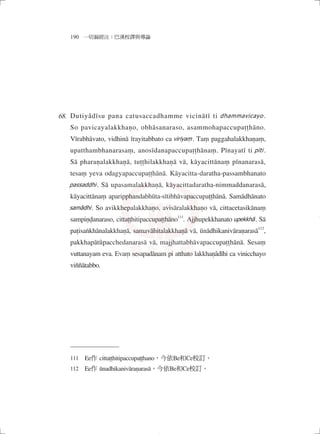
![一切漏經注 191
支,[所以稱]其[為]「念覺支」
252
。首先應如是依涵義、特相
等,了知一[句]首字的決定。
◎ 餘六覺支的特相、作用、現起
又,關於第二[覺支]等:「擇法」[謂]「抉擇四諦法」
253
,它簡
擇為特相,光照
254
為作用,無癡為現起。「精進」[謂]應令以雄
健狀態及適當方式運轉
255
,它策勵為特相,撐持為作用,不沉
沒為現起。「足滿」
256
[謂]「喜」,它遍滿為特相,或滿足為特
相,身心的悅滿為作用,其(身心)歡喜踴躍為現起。由於平息
身心的不安,[謂]「輕安」,它止息為特相,破除身心不安為
作用,身心無微細擾動之清涼狀態為現起。以等持
257
故,[謂]
「定」,它不散亂為特相,或不漫散為特相,心、心所的統合
258
252 sambojjhaṅga其實就是 bojjhaṅga,並無特別的差異,只是 sam-有強
化的作用,兩者都是「覺支」之義。此處非區分二者不可,只好
將 sambojjhaṅgo 譯為「正覺支」,而 bojjhaṅgo 譯為「覺支」,但
satisambojjhaṅgo 還是保留傳統譯詞「念覺支」。(詳見〈導論〉「語
詞探討與試譯」)
253 擇法覺支「抉擇四諦法」,即思惟「此是苦,此是苦之集、此是
苦之滅、此是苦滅之道」。不過,擇法覺支的對象可以包涵更
廣。(詳見本書頁195,註265)
254 obhāsanaṃ (光照):擇法覺支破壞覆蓋諸法如實自性的愚癡,猶如
光之於暗一般。
255 vīriyaṃ(精進):覺音論師將 vīriyaṃ 拆成 vidhinā (以適當的方法)的
vi- 和 īrayitabba (應被移動)的 īray- 而解釋其涵義。疏鈔:īrayitabba
是應令運轉之義 (īrayitabbatoti pavattetabbato)。
256 pīṇayati (足滿):根據疏鈔,「使滿足、令增長」之義。
257 samādhāna (等持):疏鈔注解 samā = sammā,認為samādhāna (等持)
即sammā + ādhāna,指心的正確地放置。
258 疏鈔:指相應無散亂的狀態,如同古時印度揉合浴粉與水共成一
68.
04_一切漏經注_注釋_16開_1040214修.indd 125 2015/2/14 下午 09:42:01](https://image.slidesharecdn.com/random-151124013205-lva1-app6891/85/slide-227-320.jpg)

![一切漏經注 193
為作用,心住
259
為現起。以旁觀
260
故,[謂]「捨」
261
,它觀視
262
團一般。
259 疏鈔:「心住」指心的連續而住 (pabandhaṭhiti)。
260 ajjhupekkhana (旁觀):中立性 (udāsīnabhāva)。
261 upekkhā (捨):「捨」分屬五十二心所中的兩種心所:一、「捨
偏、持平、平衡」的中立性、處中性 (tatramajjhattatā) 心所。二、
「不苦不樂」的受 (vedanā) 心所。《清淨道論》〈4說地遍品〉中
「捨」詳說為十種,除第六「受捨」屬受心所外,均屬於「處中
性」心所:
一、六支捨 (chaḷaṅg’upekkhā):指漏盡者在六根門處可愛、不可愛
所緣現起的時候,無排斥、無愛染,沒有失去他無煩惱、遍
淨本性的狀態。
二、梵住捨 (brahmavihār’upekkhā):指四無量心中的捨無量心,不
偏、等視一切有情。
三、覺支捨 (bojjhaṅg’upekkhā):修習七覺支時,諸覺支達到平衡
的狀態。
四、精進捨 (vīriy’upekkhā):指精進不過急、不過緩的平衡狀態。
五、行捨 (saṅkhār’upekkhā):指依四禪四無色定止 (samatha) 的八
種行捨,和依四道、四果、空住、無相住的十行捨,達到對
諸行中捨的平衡狀態。
六、受捨 (vedan’upekkhā):指苦受、樂受、不苦不樂受三種感受
中的「不苦不樂」的感受。
七、觀捨 (vipassan’upekkhā):對那現有的,已生成的五蘊,行者
以觀智見無常、苦、非我三相而得的中立性捨。
八、處中捨 (tatramajjhatt’upekkhā):特指五十二心所中的中捨性心
所。
九、禪捨 (jhān’upekkhā):指第三禪「捨、念、樂住」中的捨,對
此禪樂不偏染的禪捨。
十、遍淨捨 (pārisuddh’upekkhā):指第四禪「捨念遍淨」(或譯「捨
念清淨」) 中的平衡「捨」,雖和不苦不樂的捨受結合,但
是是斷了相對的苦、樂、喜、憂而有的中性捨。(詳見《清淨
道論》〈4說地遍品〉,上冊,頁241-243)
262 paṭisaṅkhāna 一字,一般譯為「思擇」,但此處指捨覺支「觀視」
相應諸法(即其他的覺支),依各自的作用平衡地轉起。
04_一切漏經注_注釋_16開_1040214修.indd 127 2015/2/14 下午 09:42:01](https://image.slidesharecdn.com/random-151124013205-lva1-app6891/85/slide-229-320.jpg)

![一切漏經注 195
為特相;或,平衡運轉為特相,遮止不足或過度為作用;或,
破除偏墮是作用,中性狀態是現起。其餘即[以][上]述方式[闡
釋],如是,其餘字詞(六覺支)
263
的決定,亦應依涵義、特相等
了解。
◎ 七覺支的次序
「依次序」:在此,念覺支由於「諸比丘!我說念是一切[處]
希欲」的
264
敘述(《相應部》v.115)及對所有其餘覺支有所助成的緣
故,首先被說起。之後,「他(行者)如是念住之時,以慧簡擇彼
法
265
」等,以此方式,其餘覺支前後次序的目的,已於經中
266
述
說(《相應部》v.68)。在此應如是了解[七覺支]依次序的決定。
◎ 不多不少七個覺支
「依不多不少」:再者,何以僅七覺支為世尊所說,不多不少?
由於對治退縮、掉舉,及一切[處]希欲之故。因為在此,三覺支
[為]退縮之對治──如[經中]說:「凡心退縮時,是修習擇法
263 其餘:指對「覺支」一詞的解釋,根據以上念覺支的解釋類推。
264 sabbatthika (一切[處]希欲):指行者不論於緩滯時或掉舉時,都需
要「念覺支」(詳見《清淨道論》〈4說地遍品〉,上冊,頁205);也有
譯為一切處適合的、有用的。
265 在此上下文中,「擇法覺支」以慧抉擇「念覺支」作意之法,即
入出息。然於諸多經中,如《相應部147覺支相應》中,皆提及
「擇法覺支」抉擇善、不善、有過、無過、卑劣、妙勝、黑惡、
白淨等相對之法。
266 非特指在此《一切漏經》中,而是泛指在經典中,如《中部118入
出息念經》,即說明了七覺支彼此間的次序關係。
69.
70.
04_一切漏經注_注釋_16開_1040214修.indd 129 2015/2/14 下午 09:42:01](https://image.slidesharecdn.com/random-151124013205-lva1-app6891/85/slide-231-320.jpg)

![一切漏經注 197
覺支之時,修習精進覺支之時,修習喜覺支之時」
267
(《相應部》
v.113);三[覺支為]掉舉之對治,如[經中]說:「凡心掉舉時,
是修習輕安覺支之時,修習定覺支之時,修習捨覺支之時268
。」
(《相應部》v.114)又,在此,一[覺支]是一切[處]希欲的,如[經
中]說:「又,諸比丘!我說念一切[處]希欲」(《相應部》v.115);
「一切[處]利益」是另一解讀,兩者皆有「一切處應欲」之義。
如此,由於對治退縮、掉舉,及一切[處]希欲之故,僅七覺支被
說及,不多不少。應如是了解在此[七覺支]以不多不少的決定。
◎ 修習依離的念覺支
如是先瞭解了以「念覺支」等所陳述的七個句首語詞的解釋,
現在應這樣理解「修習依離、[依離貪、依滅、迴向至捨之念覺
支]」等:「修習」即令增長,再再地令發、令生於自己的心相
續中的意思。
267 疏鈔:精進過於鬆緩時,不應修習輕安、定、捨覺支,如此猶如
以溼草起火,連小火也難起;而應修習擇法、精進、喜覺支,猶
如以乾草起火,火易生起。
268 疏鈔:精進過度時,不應修習擇法、精進、喜覺支,因為如此則
猶如以乾草滅火;而應修習輕安、定、捨覺支,如此則猶如以溼
草放置火上。
71.
04_一切漏經注_注釋_16開_1040214修.indd 131 2015/2/14 下午 09:42:01](https://image.slidesharecdn.com/random-151124013205-lva1-app6891/85/slide-233-320.jpg)

![一切漏經注 199
◎ 依離意指依止五種離
依止於離即「依離」;「離」即離的狀態,這[離]有五種:「彼
分離
269
、鎮伏
270
、正斷
271
、止息
272
、出離離
273
」。它[們]的不
同,應以「無調伏於聖法」
274
中所說的來理解,因為這(離)
275
就
269 tadaṅgaviveka (彼分離):在觀智剎那,以「彼」智「分」的作用令
心暫「離」和其正相對的那「分」錯誤的認知,如以無常隨觀令
心離常想,以苦隨觀離樂想等。
270 vikkhambhanaviveka (鎮伏離):以禪定鎮伏煩惱。
271 samucchedaviveka (正斷離):以四沙門道正斷離煩惱。
272 paṭippassaddhiviveka (止息離):四沙門果心剎那中的止息,來自煩
惱的根除。
273 nissaraṇaviveka (出離離):出離指涅槃,因貪瞋癡的止息而離煩
惱。
274 雖然《一切漏經》中也有「無調伏於聖法」一句,但此處指的乃
是第一次的出處:《中部1根本法門經》。vinaya (調伏、去除),
直譯為「引離」,有「引導離開」之義。《根本法門經注》注釋
vinaya 有兩種。
一、防護調伏 (saṃvaravinaya):包括戒、念、智、忍、精進防護
五種。
二、斷除調伏 (pahānavinaya):包括彼分斷、鎮伏斷、正斷斷、止
息斷、出離斷五種。(見本書頁205,註286)就「斷除調伏」的
調伏其實就是去除、斷除的意思,例如經說 「於諸欲去除
欲貪、斷除欲貪者,此為諸欲之出離。」 (Yo kho bhikkhave
kāmesu chandarāgavinayo chandarāgappahānaṃ – idaṃ kāmānaṃ
nissaraṇaṃ)(《中部13苦蘊大經》);又如《相應部45道相應84
善友經》說比丘修習八正道,「為究盡貪欲之去除、為究
盡瞋恚之去除、為究盡愚癡之去除 (rāgavinayapariyosānaṃ
dosavinayapariyosānaṃ mohavinayapariyosānaṃ)」。
275 疏鈔:「此」指「離」(viveka),因為離和斷除 (pahāna)、去除
(vinaya)、離貪 (virago)、滅 (nirodha) 同義。(關於 vinaya (調伏、引
離、去除),見本書註274)
04_一切漏經注_注釋_16開_1040214修.indd 133 2015/2/14 下午 09:42:01](https://image.slidesharecdn.com/random-151124013205-lva1-app6891/85/slide-235-320.jpg)

![一切漏經注 201
是那裡所說的「調伏」
276
,如是,應以「依離」意謂此五種離而
理解「修習依彼分離、正斷離和出離離的念覺支」的涵義。
◎ 如何是修習依止五種離的念覺支
同樣地,此致力修習覺支的行者,於觀剎那,約作用言,[修
習]依彼分離[的念覺支],約意向
277
言,[修習]依出離離
278
[的念
覺支];而於道之時,約作用言,[修習]依正斷離[的念覺支],
約所緣言,修習依出離離
279
的念覺支。有些[認為]也「依五種
離」。因為他們不僅在強觀
280
、道、果的剎那上提出覺支;也在
276 屬兩種調伏中的斷除調伏,即「去除」。(見本書頁199,註274)
277 疏鈔:因為行者修習念覺支時以「我將證涅槃」為大志向。
278 nissaraṇaviveka (出離離):出離指涅槃。在觀剎那,行者以有為[法]
為所緣,於諸有為處善見其過患,志向、意樂與彼有為諸法相對
的涅槃,依於出離離,猶如被燒之人,心向於清涼一般。
279 因道以無為法的涅槃為所緣。
280 觀智有「稚觀」(taruṇavipassanā) 和「強觀」(balavavipassanā) 之
分。《相應部》注釋書《顯揚心義》(Sāratthappakāsinī ) 注釋《12
因緣相應23緣由經》(Upanisasutta) 時,說「稚觀」包括:
一、行識別智 (saṅkhāraparicchedañāṇa),[菩提長老:即名色攝受智
(nāmarūpa-pariggahañāṇa)]。
二、度疑智 (kaṅkhāvitaraṇañāṇa),即緣攝受智 (paccaya-
pariggahañāṇa)。
三、思惟智 (sammasanañāṇa)。
四、道非道智 (maggâmaggañāṇa)。
而「強觀」指怖畏現起智 (bhayatūpaṭṭhānañāṇa)、過患隨觀智
(ādīnavânupassanañāṇa)、欲解脫智 (muñcitukamyatāñāṇa) 和行捨智
(saṅkhār’upekkhāñāṇa) 四智。《清淨道論大疏鈔》(Visuddhimagga-
mahāṭīkā) 則認為從厭離隨觀智 (nibbidânupassanā) 開始才是「強
觀」,之前皆屬「稚觀」。
72.
04_一切漏經注_注釋_16開_1040214修.indd 135 2015/2/14 下午 09:42:01](https://image.slidesharecdn.com/random-151124013205-lva1-app6891/85/slide-237-320.jpg)

![一切漏經注 203
觀的基礎[如][十]遍禪
281
、入出息[禪]、不淨[禪]、梵住禪等處
提出,而並未被[古]注釋諸師
282
駁斥。因此,根據他們的論點,
在這些禪定
283
發生的剎那,約作用言,[覺支]依於鎮伏離
284
。又
如前述的「於觀剎那,約意向言,依出離離」,如此,說「[約
意向言,]他也修習依止息離的[覺支]」是成立的。這個[詮釋]
方式[也適用]於「依離貪、[依滅、迴向至捨]」等,因為離貪
[、滅盡、捨]等就是離的意思。
◎ 迴向至捨的「捨」有兩種
只不過這裡(迴向至捨)的「捨」
285
有兩種:「遍捨捨和躍入
捨」。其中,「遍捨捨」[指]於觀剎那的依彼分[斷]和於道剎那
281 依據《清淨道論》〈3說取業處品〉,修習十遍和入出息,可得一
至四禪;修習十不淨,能得初禪;修習四梵住中的慈悲喜,可得
前三禪,修習捨得第四禪。(詳見上冊,頁173-174)
282 見本書頁69,註2。
283 即上句所說的十遍禪、入出息禪、不淨禪、梵住禪。
284 因為禪定鎮伏了五蓋,所以說禪定時,覺支依於「鎮伏離」。
285 vossagga (放捨):《無礙解道10:41》說,正定 (sammāsamādhissa)
者,有五種放捨:
一、對初禪者,有五蓋的鎮伏放捨 (vikkhambhanavossagga)。
二、對修習抉擇分 (nibbedhabhāgiya [譯按:指七覺支]) 定者,有見
的彼分放捨 (tadaṅgavossagga)。
三、對修出世間向滅盡道者,有正斷放捨 (samucchedavossagga)。
四、在果剎那有止息放捨 (paṭippassaddhivossagga)。
五、出離放捨 (nissaraṇavossagga) 是滅,是涅槃。
這是正定者的五種放捨。和 upekkhā (捨偏、處中、平衡、不苦不
樂之捨)的差別,參見〈導論〉「語詞探討與試譯」部份。upekkhā
的涵義,見本書頁193,註261。
73.
04_一切漏經注_注釋_16開_1040214修.indd 137 2015/2/14 下午 09:42:01](https://image.slidesharecdn.com/random-151124013205-lva1-app6891/85/slide-239-320.jpg)

![一切漏經注 205
的依正斷[斷]的煩惱捨斷
286
。「躍入捨」[指]於觀剎那的依向彼
性
287
和於道剎那的依作所緣
288
的涅槃躍入。二者(遍捨捨、躍入
捨)依此混合世、出世間
289
的釋義方式也都正確。像這樣,此念
覺支依所說的[這個]方式
290
遍捨煩惱和躍入涅槃。
286 pahāna (斷、斷除):《清淨道論》〈22說智見清淨品〉(下冊,頁
421) 中說煩惱的斷除有三種:
一、鎮伏斷 (vikkhambhana-pahāna):以初禪暫時伏斷。其實定前的
專注也有鎮伏的作用,不過巴利注釋文獻說明鎮伏斷時,都
指禪定。
二、彼分斷 (tadaṅga-pahāna):指以觀暫斷,即以「彼」彼應斷之
法的正對治 (paṭipakkhena) 的智「分」(ñāṇaṅga),或十二觀,
或十八大觀,暫時「斷除」彼彼應斷之法。
三、正斷斷 (samuccheda-pahāna):四沙門道智生起的時候,正斷根
除不同的煩惱。
此外,《無礙解道》尚提及另外二種斷除,合以上三種為五種斷:
四、止息斷 (paṭipassaddhi-pahāna):四沙門果是煩惱的止息。
五、出離斷 (nissaraṇa-pahāna):出離指涅槃,涅槃是一切煩惱的出
離。
相同地,離 (viveka)、離貪 (virāga)、滅 (nirodha)、放捨 (vossagga)
也都各有五種。
287 「彼」指涅槃。
288 即以涅槃為所緣。
289 在此依世間的方式指觀剎那,依出世間的方式指道剎那。
290 疏鈔:即以上所說以彼分、正斷、傾向於涅槃、以涅槃作所緣的
方式。
04_一切漏經注_注釋_16開_1040214修.indd 139 2015/2/14 下午 09:42:01](https://image.slidesharecdn.com/random-151124013205-lva1-app6891/85/slide-241-320.jpg)

![一切漏經注 207
◎ 迴向至捨
「迴向至捨」:又,以此整個語詞
291
[說明]正迴向
292
和已迴向
至
293
捨的目的,意即「正遍熟
294
及已圓熟」。因為此致力於修習
覺支的比丘,念覺支怎樣正遍熟及已圓熟於遍捨煩惱捨與躍入涅
槃捨的目的,他便這樣修習它。此[解釋]方式
295
[也適用]於其餘
覺支。
◎ 涅槃稱為離、離貪、滅
不過,在此[一切漏經中]
296
,僅涅槃[說為]「離」,由於離一切
的有為[法]之故;[說為]「離貪」
297
,由於離一切貪的狀態故;
說為「滅」,由於滅的狀態故;[修]道
298
僅是趣於捨而已。因
291 疏鈔:上段單釋「捨」,此段則解釋整個「迴向至捨」。
292 疏鈔:pariṇamanta (正在迴向),指於觀剎那時。
293 疏鈔:pariṇata (已迴向至),指於道剎那時。
294 疏鈔:「迴向 (pariṇāma)」即「遍熟 (paripāka)」,因此說「正遍熟
及已圓熟」。七覺支成熟,其捷疾明淨之性 (tikkhavisadasabhāva)
得以遍棄捨因串習而得 (āsevanalābhena) 的煩惱,並得以躍入涅
槃。
295 疏鈔:指「修習依彼分離、正斷離和出離離的念覺支」一句開始
至此為止。
296 依疏鈔加入。即:以上廣義的從世間和出世間兩方面來解說七覺
支,但是在此《一切漏經》中有關修習七覺支的這一段經文,並
不包括修習世間七覺支成聖道之前的部份,僅指狹義修習出世間
七覺支的部份。
297 virāga (離貪;消逝、滅去)一字在巴利經典中的使用有二義:一、
「離貪」之義;二、「消逝、滅去」之義,和 khaya (滅盡)和 vaya
(衰滅)同義。詳見〈導論〉「語詞探討與試譯」。
298 疏鈔認為「道」指「修道」(bhāvanāmagga),即三上聖道。
75.
74.
04_一切漏經注_注釋_16開_1040214修.indd 141 2015/2/14 下午 09:42:02](https://image.slidesharecdn.com/random-151124013205-lva1-app6891/85/slide-243-320.jpg)

![一切漏經注 209
此,[行者]修習念覺支,由於[念覺支][以]離作所緣後轉起而依
止離;同樣[類推於]依止貪和依止滅。又,於聖道剎那轉起時,
由於依以正斷遍捨煩惱性以及以躍入涅槃性,彼[念覺支是]
299
已
迴向、已圓熟[於捨],應如是理解此義。此[解釋]方式[也適用]
於其餘的覺支。
「因彼[無修習之時],彼等[諸漏憂慼熱惱可生起]」:於此等覺
支之中任何一種會[引生諸漏],餘者即[以]已述方式[理解]。
又,在此,有關諸漏之生[是]:由於無修習與[上]三道相應的覺
支而可能生起的「欲漏、有漏、無明漏」三漏
300
,修習之時,他
(行者)如是無有彼等諸漏,應[如是]理解此[斷漏的]方式。
「此等言為應由修習斷除[之諸漏]」:這些說為應「以在於[與
上三]道相應的覺支修習而斷除」的三漏。
今,讚歎以此七種方式已斷諸漏的比丘,顯其斷漏之利益
301
,及
令眾生發起以此等方式斷漏的熱切,[佛]說:「諸比丘!凡[比
丘──應由體見斷除之諸漏已由體見斷、應由防護斷除之諸漏已
由防護斷、應由受用斷除之諸漏已由受用斷、應由安忍斷除之諸
漏已由安忍斷、應由迴避斷除之諸漏已由迴避斷、應由除遣斷除
之諸漏已由除遣斷、應由修習斷除之諸漏已由修習斷──之時,
諸比丘!是謂此比丘已守護一切漏防護而住,切斷渴愛,解除結
縛,由正現觀慢,]盡苦邊際。」其中,「yato kho」中的 to 字是
299 依疏鈔解釋而加入。
300 疏鈔:因為先前見漏已為須陀洹道所斷。
301 ānisaṃsa (利益):根據疏鈔,指切斷渴愛、苦滅盡的結果產生。
77.
78.
76.
04_一切漏經注_注釋_16開_1040214修.indd 143 2015/2/14 下午 09:42:02](https://image.slidesharecdn.com/random-151124013205-lva1-app6891/85/slide-245-320.jpg)

![一切漏經注 211
屬格之義,意即「對於任何[比丘]」
302
;然古注釋師注釋為「當
其時」。「凡應由體見[斷除]之諸漏」:凡應以體見斷除之諸
漏,即已以體見斷除,非於未斷之時,作已斷想者。如是一切處
廣說。
◎ 慢的現觀見和現觀斷
「[比丘]已守護一切漏防護[而住]」:已以一切漏之屏障遮閉。
或,對於一切漏,已以屏障遮閉。「切斷渴愛」:甚至已切斷、
斬斷、正斷一切渴愛。「解除結縛」:不令十種結縛轉起
303
,使
成無根。「正」:藉因依由。「由現觀慢」:以慢的現觀見
304
和
現觀斷。因為阿羅漢道以作用看見慢,這對他來說是現觀見;然
而,它(慢)一為其(阿羅漢道)所見,即立刻被捨斷,猶如為毒所
毒的諸有情的生命[立刻命斷]一般
305
,這對他來說是現觀斷。
◎ 四種邊義及「盡苦邊際」的邊義
「盡苦邊際」:這樣,因阿羅漢道[而]慢完全被見和被斷,在此
四種邊當中──「身帶306
邊緣老舊」(《律藏》ii.136)[和]「或至綠
302 換言之,注文認為文法上,Yato kho bhikkhave bhikkhuno ye āsavā
dassanā pahātabbā te dassanā pahīnā honti 一句中,Yato 一字和 yassa 同
義,修飾 bhikkhuno,意即「對於凡任何一位比丘而言」,但菩提
長老認為以下古注釋師的解釋為「當……之時」才是正解。
303 Vattati 為「轉起」義,vāvattayi 是 vivatteti 的過去使役形,「不令
轉起」,不令十種結縛轉起發生之義。(十種結縛,見本書頁133,
註134「十結」)
304 初果現觀法,阿羅漢現觀慢。
305 diṭṭha 有「已被見,已中毒」二義,因此覺音論師有此一譬喻。
306 指僧人繫於腰間的衣帶。
79.
04_一切漏經注_注釋_16開_1040214修.indd 145 2015/2/14 下午 09:42:02](https://image.slidesharecdn.com/random-151124013205-lva1-app6891/85/slide-247-320.jpg)

![一切漏經注 213
草邊」
307
(《中部》i.188))中說的最邊緣、「諸比丘!此乃諸活命之
最下邊」
308
(《如是語》89)中說的最低下邊、「有身是一邊」(《義
釋》ii.112)
309
中說的一部份(邊)、「因一切緣之滅盡,此即苦之盡
邊」( )
310
中說的盡頭終邊──他成辦了那被稱為第四種邊的一
切輪迴苦的盡邊,作了邊限周界,令剩餘的苦僅是最後身
311
程度
的意思。
「彼等悅意比丘」:適意、滿意,或,意與喜悅相應之後。「歡
喜世尊之所說」:他們以頂戴[來]領受、隨喜這個世尊所說的盡
苦邊為終極目標的善說、善述,[說道]:「是如此!世尊!是如
此!善逝!」其餘那些在此處沒說的,由於先前已說,以及易於
瞭解而沒說。因此,一切應依所[闡]說的逐字逐句思惟審察。
《一切漏經注》終
307 「有時外火界有怒,……燃燒……或至綠草邊。」(《中部28象跡
喻大經》)
308 「諸比丘!此乃諸活命之最下邊,即乞食。」(《相應部22蘊相應
80乞食經》)
309 「有身是一邊,有身之集是第二邊,有身滅居中,渴愛是縫接。」
(《增支部6集61經》)
310 無此經文出處。
311 疏鈔:samussaya 指身 (kāya) 或個我 (attabhāva)。「個我」的解
釋,參見本書頁115,註94。
80.
04_一切漏經注_注釋_16開_1040214修.indd 147 2015/2/14 下午 09:42:02](https://image.slidesharecdn.com/random-151124013205-lva1-app6891/85/slide-249-320.jpg)


![226 一切漏經注:巴漢校譯與導論
ettāvatā 至此
H
hetu 因
hi 由於,因為
I
ito paraṃ 之後,其後
K
kāraṇa 原由,因由
kevalaṃ hi 只不過,但是,然而
kiccato 依作用言,約作用而言
kira 傳說,據說,據述
N
ñātabba 應知為
-nayena 以......(詮釋)方式
P
pakārena 以......方式
pana 然而,但,又,再者,其次
S
sāmaññato 通說,通稱
saṅkhaṃ gacchati 稱為
saṅkhepato 簡言之
saṅkhepattha 略義
saṅkhepavaṇṇanā 略釋
sarūpena 就其本身而言
sesaṃ vuttanayam eva 餘者即如已述方式[理解]
-sīsena 以......為題,在......的論題、主題之下
X-saṅkhāta 被稱為,被視為,被認為,名為,由X所構成,在於
08_常用注釋語彙表_1031205黑字版.indd 2 2014/12/8 下午 01:38:53](https://image.slidesharecdn.com/random-151124013205-lva1-app6891/85/slide-262-320.jpg)

![香光書鄉──超越時空的文化傳播者
香光書鄉出版社 (Luminary Publishing Association) 成立於1992年,附
設於財團法人嘉義市安慧學苑教育事務基金會,以掌握佛法核心
義理、法門行持、回應時代需求為使命,出版、譯介南北傳佛教
教理、教史、教制、修行法門之優質著作,如佛使比丘、性空法
師、菩提長老、向智尊者、中村元、悟因法師等著作,為社會大
眾開啟佛教正見與正信之門。並出版佛教參考資源工具書、佛教
圖書館叢書、僧伽教育叢書等,服務教界與社會。
[出版品推廣:香光尼僧團各寺院、機構]
.香光尼僧團 Luminary International Buddhist Society(LIBS)
願景與使命:以尊重生命為起點、關懷時代為志願,秉持悲願、
力行、和合的理念,播撒佛法的種籽,共創祥和清淨的世界。
[佛教教育.弘化道場]
香光山寺 gaya.gaya.org.tw
33559 桃園縣大溪鎮福安里11鄰頭寮16號
(03) 3873141
印儀學苑 yinyi.gaya.org.tw
10056 台北市中正區濟南路二段36號
(02) 23946800
定慧學苑 dinghui.gaya.org.tw
36044 苗栗市福星街74巷3號
(037) 272477
養慧學苑 yanghui.gaya.org.tw
40356 台中市西區大墩十街50號
(04) 23192007
安慧學苑 anhui.gaya.org.tw
60082 嘉義市文化路820號
(05) 2325165
香光寺 xianguan.gaya.org.tw
60444 嘉義縣竹崎鄉內埔村溪州49-1號
(05) 2541267
紫竹林精舍 zizhulin.gaya.org.tw
83081 高雄市鳳山區漢慶街60號
(07) 7133891~3
[僧伽教育]
香光尼眾佛學院 hkbi.gaya.org.tw
60444 嘉義縣竹崎鄉內埔村溪州49-1號
(05) 2540359
[社會教育.禪修課程]
香光慧青學佛中心
gaya.org.tw/blog/youthgaya/
香光禪修中心 gaya.org.tw/blog/insight/
香光研究學院 research.gaya.org.tw/
香光佛教學院 gaya.org.tw/gayalbc/
[文化研發推廣.數位弘法]
香光尼眾佛學院圖書館
gaya.org.tw/library/
香光莊嚴雜誌 gayamagazine.org/
佛教圖書館館刊
gaya.org.tw/journal/
香光影音.葉葉拂心
gaya.org.tw/blog/video/
香光書鄉出版社 gaya.org.tw/publisher/
11_香光書鄉叢書發行及版權頁_1031205黑字版.indd 1 2014/12/8 下午 02:23:35](https://image.slidesharecdn.com/random-151124013205-lva1-app6891/85/slide-264-320.jpg)
![法行叢書──法的傳行與會遇
佛法傳行、流行於古往今來不同時空,而有各系對義理的詮解與
行持的方法。法,不斷的前行、流變。「法行叢書」為讀者們譯
介各傳承、各語系的三藏聖典及其注釋書,開啟各系佛教傳統
「法」的會遇與傳譯。
[法行叢書發行.歡迎贊助]
.財團法人伽耶山基金會 Gaya Foundation
伽耶山基金會關懷人本,以大乘菩薩的精神為宗旨,結合社會力
量共創悲願、力行、和合的普世價值。「伽耶山」取典於佛教教
主釋迦牟尼佛證悟菩提之地──印度古摩揭陀國的伽耶城,旨
在說明人人皆有成佛的可能,不分男女、種族、膚色、貧富貴
賤……,都可以開啟慈悲和智慧,建立世間、出世間的正見與正
行。
捐款項目及方式: https://donate.gaya.org.tw
◎感謝美國佛教會於美加地區流通《一切漏經注:巴漢校譯與導論》
.美國佛教會 The Buddhist Association of the United States (BAUS)
地址:2020 Route 301, Carmel NY 10512 USA
電話:845-228-4287
網址:baus.org/tc/
E-mail:baus.book@gmail.com
11_香光書鄉叢書發行及版權頁_1031205黑字版.indd 2 2014/12/8 下午 02:23:35](https://image.slidesharecdn.com/random-151124013205-lva1-app6891/85/slide-265-320.jpg)


