PSY499 PSYCHOLOGY
CAPSTONE PROJECT
Project title:The Effect ofWordVariability on the Lexical
DecisionTask: A Review
SCOPE
 Introduction
 Literature review
 Research objective & hypothesis
 Method
 Results
 Discussion & conclusion
 Q&A
LET’S DO A SIMPLE QUIZ!
Is this a word?
ZARF
How about this?
SLEEVE
ZARF = SLEEVE
Zarf /zarf/ [n]: a small, metal holder, used in
the Levant to hold a cup of hot coffee. (Collins
American English Dictionary)
A very valuable word in Scrabble ;)
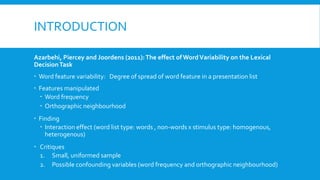
INTRODUCTION
Azarbehi, Piercey and Joordens (2011):The effect of WordVariability on the Lexical
DecisionTask
 Word feature variability: Degree of spread of word feature in a presentation list
 Features manipulated
 Word frequency
 Orthographic neighbourhood
 Finding
 Interaction effect (word list type: words , non-words x stimulus type: homogenous,
heterogenous)
 Critiques
1. Small, uniformed sample
2. Possible confounding variables (word frequency and orthographic neighbourhood)
LITERATURE REVIEW
 Critique 1 : Small, uniformed sample
 Depth of writing script could influence performance on language tasks - > language
background of participant needs to be accounted for. (Liow & Poon, 1998)
 Interference effects might account for variance in Lexical Decision (Ehrich & Meuter,
2009)
 Critique 2: Possible confounding variables (word frequency and orthographic
neighbourhood)
 Some studies attempted to hold other word features constant (Connine, Mullennix,
Shernoff, &Yelen, 1990; Niendenthal, Halberstadt & Setterlund, 1997)
RESEARCH OBJECTIVE AND HYPOTHESIS
Research Objective
 To extend Azarbehi, Piercey and Joordens’ (2011) study by examining effects of language
understanding and word feature variability on LDT performance
Hypothesis
H1: Limited participant sample -> difference in ReactionTime (RT) in LDT performance
based on language understanding (Phonographic, Logographic).
H2: If word feature variability (in terms of word frequency) affect LDT performance ->
difference between RT taken to respond to HighVariability and LowVariability words.
H3: Participant’s language understanding affects the word feature variability on RT in the
LDT -> Interaction effect (language understanding x word feature variability).
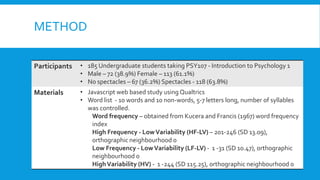
METHOD
Participants • 185 Undergraduate students taking PSY107 - Introduction to Psychology 1
• Male – 72 (38.9%) Female – 113 (61.1%)
• No spectacles – 67 (36.2%) Spectacles - 118 (63.8%)
Materials • Javascript web based study using Qualtrics
• Word list - 10 words and 10 non-words, 5-7 letters long, number of syllables
was controlled.
Word frequency – obtained from Kucera and Francis (1967) word frequency
index
High Frequency - LowVariability (HF-LV) – 201-246 (SD 13.09),
orthographic neighbourhood 0
Low Frequency - LowVariability (LF-LV) - 1 -31 (SD 10.47), orthographic
neighbourhood 0
HighVariability (HV) - 1 -244 (SD 115.25), orthographic neighbourhood 0
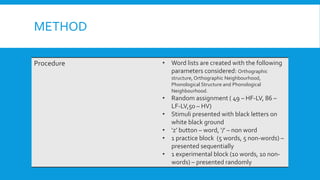
METHOD
Procedure • Word lists are created with the following
parameters considered: Orthographic
structure, Orthographic Neighbourhood,
Phonological Structure and Phonological
Neighbourhood.
• Random assignment ( 49 – HF-LV, 86 –
LF-LV,50 – HV)
• Stimuli presented with black letters on
white black ground
• ‘z’ button – word, ‘/’ – non word
• 1 practice block (5 words, 5 non-words) –
presented sequentially
• 1 experimental block (10 words, 10 non-
words) – presented randomly
RESULTS
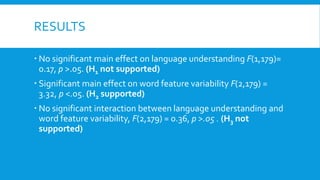
 No significant main effect on language understanding F(1,179)=
0.17, p >.05. (H1 not supported)
 Significant main effect on word feature variability F(2,179) =
3.32, p <.05. (H2 supported)
 No significant interaction between language understanding and
word feature variability, F(2,179) = 0.36, p >.05 . (H3 not
supported)
RESULTS
0
0.2
0.4
0.6
0.8
1
High Frequency - Low
Variability
Low Frequency - Low
Variability
High Variability
MeanRT(mSec)
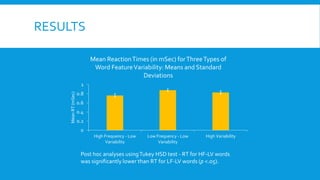
Mean ReactionTimes (in mSec) forThreeTypes of
Word FeatureVariability: Means and Standard
Deviations
Post hoc analyses usingTukey HSD test - RT for HF-LV words
was significantly lower than RT for LF-LV words (p <.05).
DISCUSSION & CONCLUSION
Key Findings
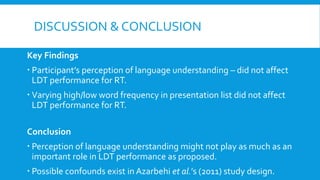
 Participant’s perception of language understanding – did not affect
LDT performance for RT.
 Varying high/low word frequency in presentation list did not affect
LDT performance for RT.
Conclusion
 Perception of language understanding might not play as much as an
important role in LDT performance as proposed.
 Possible confounds exist in Azarbehi et al.’s (2011) study design.
REFERENCES
Azarbehi, R., Piercey, C. D., & Joordens, S. (2011).The effects of word variability on the
Lexical DecisionTask. North American Journal of Psychology, 13(3), 427–434.
Connine, C. M., Mullennix, J., Shernoff, E., &Yelen, J. (1990).Word familiarity and
frequency in visual and auditory word recognition. Journal of Experimental
Psychology. Learning, Memory, and Cognition, 16(6), 1084–1096.
Ehrich, J. F., & Meuter, R. F. I. (2009). Acquiring an Artificial Logographic. Journal of Cross-
Cultural Psychology, 711–745. http://doi.org/10.1177/0022022109338624
Liow, S. J. R., & Poon, K. K. L. (1998). Phonological awareness in multilingual Chinese
children, 19, 339–362.
Niendenthal, P. M., Halberstadt, J. B., & Setterlund, M. B. (1997). Being happy and seeing
“happy”: Emotional state mediates visual word recognition. Cognition & Emotion,
11, 403–432.
Q&A

PSY499 Psychology Capstone Project

  • 1.
    PSY499 PSYCHOLOGY CAPSTONE PROJECT Projecttitle:The Effect ofWordVariability on the Lexical DecisionTask: A Review
  • 2.
    SCOPE  Introduction  Literaturereview  Research objective & hypothesis  Method  Results  Discussion & conclusion  Q&A
  • 3.
    LET’S DO ASIMPLE QUIZ! Is this a word? ZARF
  • 4.
  • 5.
    ZARF = SLEEVE Zarf/zarf/ [n]: a small, metal holder, used in the Levant to hold a cup of hot coffee. (Collins American English Dictionary) A very valuable word in Scrabble ;)
  • 6.
    INTRODUCTION Azarbehi, Piercey andJoordens (2011):The effect of WordVariability on the Lexical DecisionTask  Word feature variability: Degree of spread of word feature in a presentation list  Features manipulated  Word frequency  Orthographic neighbourhood  Finding  Interaction effect (word list type: words , non-words x stimulus type: homogenous, heterogenous)  Critiques 1. Small, uniformed sample 2. Possible confounding variables (word frequency and orthographic neighbourhood)
  • 7.
    LITERATURE REVIEW  Critique1 : Small, uniformed sample  Depth of writing script could influence performance on language tasks - > language background of participant needs to be accounted for. (Liow & Poon, 1998)  Interference effects might account for variance in Lexical Decision (Ehrich & Meuter, 2009)  Critique 2: Possible confounding variables (word frequency and orthographic neighbourhood)  Some studies attempted to hold other word features constant (Connine, Mullennix, Shernoff, &Yelen, 1990; Niendenthal, Halberstadt & Setterlund, 1997)
  • 8.
    RESEARCH OBJECTIVE ANDHYPOTHESIS Research Objective  To extend Azarbehi, Piercey and Joordens’ (2011) study by examining effects of language understanding and word feature variability on LDT performance Hypothesis H1: Limited participant sample -> difference in ReactionTime (RT) in LDT performance based on language understanding (Phonographic, Logographic). H2: If word feature variability (in terms of word frequency) affect LDT performance -> difference between RT taken to respond to HighVariability and LowVariability words. H3: Participant’s language understanding affects the word feature variability on RT in the LDT -> Interaction effect (language understanding x word feature variability).
  • 9.
    METHOD Participants • 185Undergraduate students taking PSY107 - Introduction to Psychology 1 • Male – 72 (38.9%) Female – 113 (61.1%) • No spectacles – 67 (36.2%) Spectacles - 118 (63.8%) Materials • Javascript web based study using Qualtrics • Word list - 10 words and 10 non-words, 5-7 letters long, number of syllables was controlled. Word frequency – obtained from Kucera and Francis (1967) word frequency index High Frequency - LowVariability (HF-LV) – 201-246 (SD 13.09), orthographic neighbourhood 0 Low Frequency - LowVariability (LF-LV) - 1 -31 (SD 10.47), orthographic neighbourhood 0 HighVariability (HV) - 1 -244 (SD 115.25), orthographic neighbourhood 0
  • 10.
    METHOD Procedure • Wordlists are created with the following parameters considered: Orthographic structure, Orthographic Neighbourhood, Phonological Structure and Phonological Neighbourhood. • Random assignment ( 49 – HF-LV, 86 – LF-LV,50 – HV) • Stimuli presented with black letters on white black ground • ‘z’ button – word, ‘/’ – non word • 1 practice block (5 words, 5 non-words) – presented sequentially • 1 experimental block (10 words, 10 non- words) – presented randomly
  • 11.
    RESULTS  No significantmain effect on language understanding F(1,179)= 0.17, p >.05. (H1 not supported)  Significant main effect on word feature variability F(2,179) = 3.32, p <.05. (H2 supported)  No significant interaction between language understanding and word feature variability, F(2,179) = 0.36, p >.05 . (H3 not supported)
  • 12.
    RESULTS 0 0.2 0.4 0.6 0.8 1 High Frequency -Low Variability Low Frequency - Low Variability High Variability MeanRT(mSec) Mean ReactionTimes (in mSec) forThreeTypes of Word FeatureVariability: Means and Standard Deviations Post hoc analyses usingTukey HSD test - RT for HF-LV words was significantly lower than RT for LF-LV words (p <.05).
  • 13.
    DISCUSSION & CONCLUSION KeyFindings  Participant’s perception of language understanding – did not affect LDT performance for RT.  Varying high/low word frequency in presentation list did not affect LDT performance for RT. Conclusion  Perception of language understanding might not play as much as an important role in LDT performance as proposed.  Possible confounds exist in Azarbehi et al.’s (2011) study design.
  • 14.
    REFERENCES Azarbehi, R., Piercey,C. D., & Joordens, S. (2011).The effects of word variability on the Lexical DecisionTask. North American Journal of Psychology, 13(3), 427–434. Connine, C. M., Mullennix, J., Shernoff, E., &Yelen, J. (1990).Word familiarity and frequency in visual and auditory word recognition. Journal of Experimental Psychology. Learning, Memory, and Cognition, 16(6), 1084–1096. Ehrich, J. F., & Meuter, R. F. I. (2009). Acquiring an Artificial Logographic. Journal of Cross- Cultural Psychology, 711–745. http://doi.org/10.1177/0022022109338624 Liow, S. J. R., & Poon, K. K. L. (1998). Phonological awareness in multilingual Chinese children, 19, 339–362. Niendenthal, P. M., Halberstadt, J. B., & Setterlund, M. B. (1997). Being happy and seeing “happy”: Emotional state mediates visual word recognition. Cognition & Emotion, 11, 403–432.
  • 15.