An Introduction to Captive
Insurance


F. Hale Stewart, JD, LLM, CTEP, CWM,
CAM
Author of the book U.S. Captive
Insurance Law
Captiveinsuranceinfo.com
832-330-4101
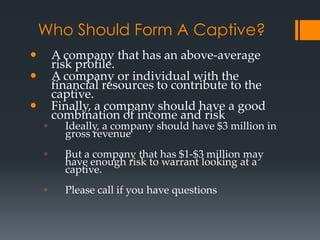
Who Should Form A Captive?
ď‚—       A company that has an above-average
        risk profile.
ď‚—       A company or individual with the
        financial resources to contribute to the
        captive.
ď‚—       Finally, a company should have a good
        combination of income and risk
    â—¦     Ideally, a company should have $3 million in
          gross revenue
    â—¦     But a company that has $1-$3 million may
          have enough risk to warrant looking at a
          captive.
    â—¦     Please call if you have questions
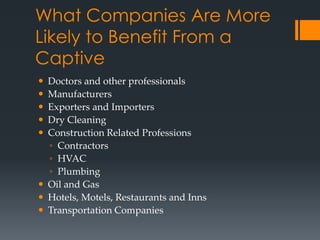
What Companies Are More
Likely to Benefit From a
Captive
ď‚— Doctors and other professionals
ď‚— Manufacturers
ď‚— Exporters and Importers
ď‚— Dry Cleaning
ď‚— Construction Related Professions
  â—¦ Contractors
  â—¦ HVAC
  â—¦ Plumbing
ď‚— Oil and Gas
ď‚— Hotels, Motels, Restaurants and Inns
ď‚— Transportation Companies
What Are the Benefits of
Forming A Captive?
ď‚§ Custom Insurance Policies
  ď‚§ The Beech Case
  ď‚§ Using Individual loss experience in determining insurance
    rates
ď‚§ Gives the insured negotiating leverage with third
  party insurers
  ď‚§ Third party insurer insures standard risk
  ď‚§ The captive underwrites specialty risk
ď‚§ Captives can be used as wealth transfer vehicles
ď‚§ Small Insurance Companies are Taxed Advantaged
  ď‚§ 831(b)
What Are the Benefits to
Forming a Captive, con’t?
ď‚§ Underneath the insurance and risk management purposes of
  a captive insurance company is a great tax arbitrage
  opportunity.
   ď‚§ In the current year, the insured lowers his taxable income
     through the payment of insurance premiums. In forming
     the captive, the insured is most likely insuring a large
     amount of risk which was previously “self-insured,”
     meaning the insured paid for losses out of current
     earnings and savings.
    The premiums are placed into a tax-advantaged vehicle –
     remember that small insurance companies are taxed on
     their current portfolio income rather than their current
     earnings.
   ď‚§ When the insured sells his captive shares, the transaction
     is taxed as a capital gains transaction rather than as an
     ordinary income transaciton.
What Are the Steps to Forming
a Captive?
ď‚§After a company decides to form a captive,
 the next step is to perform a feasibility
 study, which has three objectives.
 ď‚§ It provides a blueprint for the entire captive
   program.
 ď‚§ Second, it aids in compliance.
 ď‚§ Third, the study can aid in selling important
   decision-makers within the organization on the
   plan.
What Are the Steps to Forming
a Captive?
ď‚— The jurisdiction where the captive is being
  formed must determine if forming the
  captive is in the jurisdiction’s best interest.
  To do that, they will consider
  â—¦ (i) The character, reputation, financial standing
    and purposes of the incorporators;
  â—¦ (ii) The character, reputation, financial
    responsibility, insurance experience and
    business qualifications of the officers and
    directors; and
  â—¦ (iii) Such other aspects as the commissioner
    shall deem advisable.
What Are the Steps in Forming a
Captive, con’t
ď‚§ Next, the applicant must make a formal
  application to open an insurance company. The
  application must typically contain the following
  information
  ď‚§ (A) The amount and description of its assets relative to the
    risks to be assumed;
  ď‚§ (B) The adequacy of the expertise, experience, and
    character of the person or persons who will manage it;
  ď‚§ (C) The overall soundness of its plan of operation;
  ď‚§ (D) The adequacy of the loss-prevention programs of its
    parent, member organizations, or industrial insureds, as
    applicable; and
  ď‚§ (E) Other factors considered relevant by the commissioner
    in ascertaining whether the proposed captive insurance
    company will be able to meet its policy obligations
ď‚§ Finally, there is the issue of original capital and
  surplus.
Running the Captive


ď‚§Domicile manager
ď‚§Legal counsel
ď‚§Audit
ď‚§Actuarial Services
ď‚§Investment manager
Shutting Down the Captive
ď‚— In most states, one of the following seven reasons
  will allow a state regulator to shut down a
  captive:
  â—¦ 1. Insolvency or impairment of capital and surplus.
  ◦ 2. Refusal or failure to submit an annual report … or any
    other report or statement required by law or by lawful
    order of the director.
  â—¦ 3. Failure to comply with the provisions of its own
    articles of incorporation, bylaws or other organizational
    document.
  â—¦ 4. Failure to submit to an examination or any legal
    obligation related to the examination.
  â—¦ 5. Refusal or failure to pay the cost of an examination.
  â—¦ 6. Use of methods that, although not otherwise
    specifically prohibited by law, render its operation
    hazardous or its condition unsound with respect to the
    public or to its policyholders.
  â—¦ 7. Failure otherwise to comply with the captive statute.
The IRS Fought Captive
Insurance For Nearly 30
Years
 ď‚§They used three arguments
  ď‚§The Economic Family
  ď‚§Nexus of Contracts
  ď‚§Assignment of Income
 ď‚§No Court Accepted Any of the
  IRS’ arguments
Safe Harbor Guidance, Part I

ď‚§Under Harper, a captive must comply with
 a three prong test:
  ď‚§(1) whether the arrangement involves the
   existence of “insurance risk”;
  ď‚§(2) whether there was both risk shifting
   and risk distribution; and
  ď‚§(3) whether the arrangement was for
   “insurance” in its commonly accepted
   sense.
   The duck test – does the company “walk
    and talk” like an insurance company?
Safe Harbor Guidance, Part II

ď‚— The IRS has issued several Revenue Rulings that
  provide further safe harbor guidance
ď‚— A captive must derive at least 50% of its
  insurance revenue from a non-parent.
    â—¦ Harper lowers this amount to 30%
    â—¦ This is accomplished through reinsurance
ď‚—   Or, a captive must have at least 12 subsidiaries
    in order to have sufficient risk distribution.
Private Letter Rulings, or, the
Ultimate Safe Harbor
ď‚§A Private Letter Ruling (or PLR) is "issued
 for a fee upon a taxpayer's request and
 describes how the IRS will treat a proposed
 transaction for tax purposes."
Private Letter Rulings create certainty – we
 know how the IRS will view a specific
 transaction
The Law Offices of Hale Stewart
ď‚§ Approved Utah Captive Manager
ď‚§ Start-up costs are usually between $25,000 - $50,000
ď‚§ Ongoing fees are usually between $15,000 and $20,000
  ď‚§ These fees do not include reinsurance, risk distribution or
    accounting fees

Captive Insurance Presentation

  • 1.
    An Introduction toCaptive Insurance F. Hale Stewart, JD, LLM, CTEP, CWM, CAM Author of the book U.S. Captive Insurance Law Captiveinsuranceinfo.com 832-330-4101
  • 2.
    Who Should FormA Captive? ď‚— A company that has an above-average risk profile. ď‚— A company or individual with the financial resources to contribute to the captive. ď‚— Finally, a company should have a good combination of income and risk â—¦ Ideally, a company should have $3 million in gross revenue â—¦ But a company that has $1-$3 million may have enough risk to warrant looking at a captive. â—¦ Please call if you have questions
  • 3.
    What Companies AreMore Likely to Benefit From a Captive ď‚— Doctors and other professionals ď‚— Manufacturers ď‚— Exporters and Importers ď‚— Dry Cleaning ď‚— Construction Related Professions â—¦ Contractors â—¦ HVAC â—¦ Plumbing ď‚— Oil and Gas ď‚— Hotels, Motels, Restaurants and Inns ď‚— Transportation Companies
  • 4.
    What Are theBenefits of Forming A Captive? ď‚§ Custom Insurance Policies ď‚§ The Beech Case ď‚§ Using Individual loss experience in determining insurance rates ď‚§ Gives the insured negotiating leverage with third party insurers ď‚§ Third party insurer insures standard risk ď‚§ The captive underwrites specialty risk ď‚§ Captives can be used as wealth transfer vehicles ď‚§ Small Insurance Companies are Taxed Advantaged ď‚§ 831(b)
  • 5.
    What Are theBenefits to Forming a Captive, con’t?  Underneath the insurance and risk management purposes of a captive insurance company is a great tax arbitrage opportunity.  In the current year, the insured lowers his taxable income through the payment of insurance premiums. In forming the captive, the insured is most likely insuring a large amount of risk which was previously “self-insured,” meaning the insured paid for losses out of current earnings and savings.  The premiums are placed into a tax-advantaged vehicle – remember that small insurance companies are taxed on their current portfolio income rather than their current earnings.  When the insured sells his captive shares, the transaction is taxed as a capital gains transaction rather than as an ordinary income transaciton.
  • 6.
    What Are theSteps to Forming a Captive? ď‚§After a company decides to form a captive, the next step is to perform a feasibility study, which has three objectives. ď‚§ It provides a blueprint for the entire captive program. ď‚§ Second, it aids in compliance. ď‚§ Third, the study can aid in selling important decision-makers within the organization on the plan.
  • 7.
    What Are theSteps to Forming a Captive?  The jurisdiction where the captive is being formed must determine if forming the captive is in the jurisdiction’s best interest. To do that, they will consider ◦ (i) The character, reputation, financial standing and purposes of the incorporators; ◦ (ii) The character, reputation, financial responsibility, insurance experience and business qualifications of the officers and directors; and ◦ (iii) Such other aspects as the commissioner shall deem advisable.
  • 8.
    What Are theSteps in Forming a Captive, con’t  Next, the applicant must make a formal application to open an insurance company. The application must typically contain the following information  (A) The amount and description of its assets relative to the risks to be assumed;  (B) The adequacy of the expertise, experience, and character of the person or persons who will manage it;  (C) The overall soundness of its plan of operation;  (D) The adequacy of the loss-prevention programs of its parent, member organizations, or industrial insureds, as applicable; and  (E) Other factors considered relevant by the commissioner in ascertaining whether the proposed captive insurance company will be able to meet its policy obligations  Finally, there is the issue of original capital and surplus.
  • 9.
    Running the Captive ď‚§Domicilemanager ď‚§Legal counsel ď‚§Audit ď‚§Actuarial Services ď‚§Investment manager
  • 10.
    Shutting Down theCaptive  In most states, one of the following seven reasons will allow a state regulator to shut down a captive: ◦ 1. Insolvency or impairment of capital and surplus. ◦ 2. Refusal or failure to submit an annual report … or any other report or statement required by law or by lawful order of the director. ◦ 3. Failure to comply with the provisions of its own articles of incorporation, bylaws or other organizational document. ◦ 4. Failure to submit to an examination or any legal obligation related to the examination. ◦ 5. Refusal or failure to pay the cost of an examination. ◦ 6. Use of methods that, although not otherwise specifically prohibited by law, render its operation hazardous or its condition unsound with respect to the public or to its policyholders. ◦ 7. Failure otherwise to comply with the captive statute.
  • 11.
    The IRS FoughtCaptive Insurance For Nearly 30 Years They used three arguments The Economic Family Nexus of Contracts Assignment of Income No Court Accepted Any of the IRS’ arguments
  • 12.
    Safe Harbor Guidance,Part I Under Harper, a captive must comply with a three prong test: (1) whether the arrangement involves the existence of “insurance risk”; (2) whether there was both risk shifting and risk distribution; and (3) whether the arrangement was for “insurance” in its commonly accepted sense. The duck test – does the company “walk and talk” like an insurance company?
  • 13.
    Safe Harbor Guidance,Part II ď‚— The IRS has issued several Revenue Rulings that provide further safe harbor guidance ď‚— A captive must derive at least 50% of its insurance revenue from a non-parent. â—¦ Harper lowers this amount to 30% â—¦ This is accomplished through reinsurance ď‚— Or, a captive must have at least 12 subsidiaries in order to have sufficient risk distribution.
  • 14.
    Private Letter Rulings,or, the Ultimate Safe Harbor A Private Letter Ruling (or PLR) is "issued for a fee upon a taxpayer's request and describes how the IRS will treat a proposed transaction for tax purposes." Private Letter Rulings create certainty – we know how the IRS will view a specific transaction
  • 15.
    The Law Officesof Hale Stewart ď‚§ Approved Utah Captive Manager ď‚§ Start-up costs are usually between $25,000 - $50,000 ď‚§ Ongoing fees are usually between $15,000 and $20,000 ď‚§ These fees do not include reinsurance, risk distribution or accounting fees